Review:
Democracy at Work, by Richard Wolff
| Publisher: |
Haymarket |
| Copyright: |
2012 |
| ISBN: |
1-60846-247-1 |
| Format: |
Kindle |
| Pages: |
220 |
I've been reading (mostly on-line) and thinking quite a bit lately about
workplace governance models, economic structure, and why the current
organization of the US workplace bothers me so intensely, partly triggered
by reading John Kenneth Galbraith's
The
Affluent Society. The economic monoculture has made that process
particularly frustrating. It's rare to find a discussion, even in the
context of organizational strategies that are considered radical, that
avoids the standard frame of productivity and business value. Most
discussion is long on tactics and short on strategy and examination of
goals. Wolff's appearance on
Moyers & Company was a rare breath of
fresh air, enough so that I grabbed his book shortly afterwards.
Wolff is a Marxian economist (meaning that he makes use of Marxist
analysis of economics and capitalism while separating them from Marxist
politics and Marx's advocacy of revolutionary socialism), which for me was
part of the interest. Marxist thought of any branch is not common in the
United States; we're regularly deprived of several sides in the
international conversation on economic models. I was taught Marxist
theory in elementary and high school (in retrospect, surprisingly
even-handedly and well, despite the biases of my schooling), but none of
the later developments of Marxist thought. I think that's a typical
experience here; in the United States, Marxism culminated in Mao and
Stalin, and no further development of the underlying theories is ever
mentioned.
Democracy at Work is subtitled
A Cure for Capitalism and
does indeed advocate a concrete alternative to capitalist business
structures. But this is only the last third of the book (and in some ways
the least useful, as I'll discuss in a moment). The first two-thirds of
the book is basically a remedial education in modern, as opposed to
historic, Marxian economics for US readers like myself who have never
heard it before, cast in the context of the current financial crisis.
This may well be old hat for Europeans, but if you've been wondering what
(at least some) modern-day Marxists actually believe, or are saying to
yourself "there are modern-day Marxists after the collapse of the Soviet
Union?", I recommend this book to your attention. It's an excellent
summary, which I read with the delightful feeling of an expanding
viewpoint and the discovery of new directions from which to look at a
problem.
There's quite a bit in this section that's worth thinking about, including
another take on the nature of the recent economic collapse and how that
fits into a Marxian analysis of capitalist crises. But there was one
point in Wolff's explanation that I found particularly helpful. He
completely restructured my understanding of the Marxian analysis of worker
exploitation and profit allocation.
There are two angles of Marxist economic thought and socialist economics
that get a great deal of attention, at least in the United States, in
history and economics classes: the role (or lack thereof) of markets in
price setting, and the ownership of the means of production. Defenders of
capitalism like to focus on the former, since it's quite easy to identify
the advantages of theoretical free markets in finding ideal prices and
balancing supply and demand, whereas central planning of prices and
production has resulted in some catastrophic and deadly failures.
(Although I will note, with passing interest, that those failures predate
large-scale computing, and there are now large corporations that manage
budgets larger than some countries via centralized command-and-control
economic practices.) Defenders of socialism are more likely to focus on
the ownership of the means of production, since it's easy to show
prima facie unfairness in owners of capital extracting vast
profits without having to do any work themselves, only be lucky enough to
start with large quantities of money.
Wolff, however, argues that both of these focuses misses a core critique
by Marx of the workplace structure in capitalism, and that, by ignoring
that critique, supposedly Marxist countries did not create anything that
was actually Marxist in implementation. The Soviet Union was just as much
a capitalist country as the United States is. It was state capitalism
rather than private capitalism, but the core capitalist structure was
intact.
Wolff arrives at this conclusion, which may be well-trodden ground in
parts of the world that include active Marxist thought but which was quite
startling to this American, by treating the ownership of capital as a
partial distraction. He focuses on a more direct question and practical
question: who determines what a worker does on a day-to-day basis and how
that product is used? Who determines what profits are collected and how
they are spent? In private capitalism, this is done by the owners of the
capital: large shareholders, major investors, and the managerial class
that they hire. In Soviet state capitalism, this is done by national
politicians, bureaucrats, and the managerial class that
they hire.
In neither model is it done by the workers themselves. The Soviet model
gives theoretical ownership of the capital to the workers, but that
ownership is diffused, centralized, and politicized, redirected through
the mechanisms of the state, and therefore is effectively ignored.
Ownership and control is entirely captured by the political class.
Both of these systems are capitalist in Wolff's view of Marx: there is a
class of owners and managers, who control the terms and nature of work and
who allocate the profits, and a class of workers, who have to do what
they're told, are not paid full value for their labor, and don't have a
say in how the profits their work generates are spent. At the most
important level of day-to-day autonomy and empowerment, they are
functionally identical. They are both equally hierarchical and
exploitative; the only difference is in whether the system is controlled
by rich individuals or by well-connected politicians. (And, as any study
of modern politics quickly reveals, the distinction between those two
groups in most countries is murky at best.)
Wolff convincingly recasts modern economic history as a constant pendulum
swing between private capitalism and state capitalism. Crises in one
system push countries towards the other system; subsequent crises push the
country back towards the first system. Regulation grows and shrinks,
companies are nationalized and then privatized, but both systems are
united in excluding the worker from any meaningful control over their work
life.
The first two-thirds of the book was full of insights like this for me. I
didn't agree with all of it, but all of it was worthwhile and
thought-provoking. But I was a bit leery of Wolff's proposed solution.
My past experience with critics of capitalism is that the critique is
often quite compelling, but the proposed solution is much less believable.
And, sadly, that concern was warranted here as well.
The core of Wolff's proposal is predictable but possibly sound: a
restructuring of the workplace to be radically democratic. The business
would be owned entirely and exclusively by the people who work for it,
equally regardless of the job of the worker, and the workers would decide
democratically or via elected repesentatives from among the workers how to
allocate the profits of the business, what standards and business
practices should be followed, and how the work is to be done. I was
particularly interested to hear that this model (workers' self-directed
enterprises) has apparently been successful in Spain in the form of the
Mondragon Cooperative. Given all the tricky, small details that have to
be resolved in an actual workplace, an existence proof is worth more than
pounds of theory.
Unfortunately, like a lot of proposed alternatives, Wolff's description of
WSDEs is quite fuzzy and involves a lot of hand-waving. I was never able
to build, from this book, a coherent and complete mental model of how such
a workplace would function. Wolff tends to surround every specific in a
halo of contingencies, possibilities, and alternative models, and is
maddeningly nonspecific on such practical matters as how line management
would work, how such a business would do financial planning or project
approval, how competing interests in different parts of the organization
would be balanced, and other practical governance matters that fill my
work life. Maybe the answer to all of that is just "democracy," but I'm
dubious.
Democracy has a number of well-known flaws that I thought weren't
adequately addressed. For example, democracies are often quite happy to
further and reinforce existing prejudice (such as sexism or racism), and
are prone to yielding control to the most charismatic. Democracies also
have an informed voter problem, which seems like it would be particularly
acute if democracy is going to make detailed business decisions. And, for
larger organizations, control by pre-existing money could re-enter the
equation via propaganda and campaigning around votes. Some of this gap in
the book could be addressed via a more in-depth look at how Mondragon and
any other real-life examples work, but that is sadly missing here. (I am
interested enough now, though, that I'd read a good popular treatment of
the history and methodology of Mondragon, although I don't think I'm up to
working through an academic study.)
The hierarchical, dictatorial management structure imposed by capitalism
is so awful that WSDEs don't have a particularly high bar to meet to be
fairer and more empowering than what we have today. The question, rather,
is would they function sufficiently well that the business would be able
to make effective decisions, and that's unclear to me from this book.
This is, as Wolff spends some time discussing, particularly difficult when
in direct competition with capitalist enterprises. This sort of endeavor
will probably trade some degree of economic efficiency and raw marketplace
power for improvements to fairness and empowerment, but that means it's
going to require support from the surrounding society, which is a huge
obstacle. I doubt there's a free lunch here: true fairness and equity
also leading to improved economic efficiency in a capitalist context is a
nice dream, but not horribly practical.
Wolff also seems to suffer from something else I associate with Marxist
thought: a preferential focus on a very narrowly-defined type of
productive worker, apparently left over from Marx's original critique in
the context of industrialization. Wolff inserts a very odd and quite
awkward distinction in his WSDE model between workers who directly produce
the product that's sold, and who in his model therefore produce the
profits of the business, and all other workers in the business. He then
gives special privileges to the former group to decide how much profit to
return in worker compensation and how much to use for other purposes, thus
making the supporting workers second-class citizens within this supposedly
equal workplace.
Speaking as someone who works in IT, and hence would be classified by
Wolff into the supporting rather than directly productive category, I do
not find this division at all convincing, and Wolff never provides a
coherent explanation for why he introduced it. He only says that it's
necessary for the governance of the business to not be exploitative, which
seems to assume that there is a special economic role played by the
workers who work directly on a saleable product. Maybe there is some
analysis that could convince me of this, but, if so, it's not present in
this book. It struck me as a recipe for continuing the exploitation of
the most invisible and powerless workers in capitalism: janitors,
groundskeepers, and other low-paid service jobs.
I wish the whole book were as insightful and pointed as the first
two-thirds, but alas I found the WSDE discussion to be somewhat muddled
and utopian. "How do we get there from here" is always the hardest part
of this type of discussion, and Wolff has no special skill in that
department. But, despite that, I got a lot of fascinating ideas and new
conceptual frameworks out of this book, and I'm tempted to read it again.
I suspect some of this, similar to my
discovery
of promises and infinite streams in programming, is filling in of odd
gaps in my personal education rather than a discovery of unusual, new
ideas. But if you too have gotten your political education within the US
capitalism ber alles bubble, this book may fill in similar gaps
in your knowledge. If so, it's a very rewarding experience.
If you're curious about a preview of Wolff's perspective without paying
for the book, I recommend watching
the
first episode of Moyers & Company in which he appeared. Wolff is
a clear and engaging speaker, and his interview provides a good feel for
his discussion style and his general perspective.
Rating: 8 out of 10
 TL;DR:
 Debian 7.0 (wheezy) has


 Be careful, if you try to build it again, the binary may be different ;)
 Debian 7.0 "wheezy" has been
 Excuse me for the rush and lack of organization... But this kind of things don't always allow for proper planning. So, please bear with my chaos ;-)
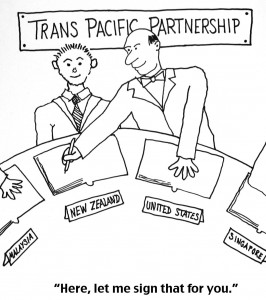
What is the Trans-Pacific Partnership?
Yet another secretely negotiated international agreement that, among many chapters, aims at pushing a free-market based economy, as defined by a very select few Most important to me, and to many of my readers: It includes important chapters on intellectual property and online rights.
Hundreds of thousands of us along the world took part in different ways on the (online and "meat-space") demonstrations against the SOPA/PIPA laws back in February 2012. We knew back then that a similar project would attempt to bite us back: Well, here it is. Only this time, it's not only covering copyright, patents, trademark, reverse engineering, etc. TPP is basically a large-scale free trade agreement on steroids. The issue that we care about now is just one of its aspects. Thus, it's way less probable we can get a full stop for TPP as we got for SOPA. But we have to get it on the minds of as many people as possible!
 What are we doing about it?
As much as possible!
I tried to tune in with Peru's much more organized call The next round of negotiations will be in Lima, Peru, between May 14 and 24. Their activities are

 Debian/wheezy includes a bunch of packages for people interested in digital forensics. The packages maintained within the
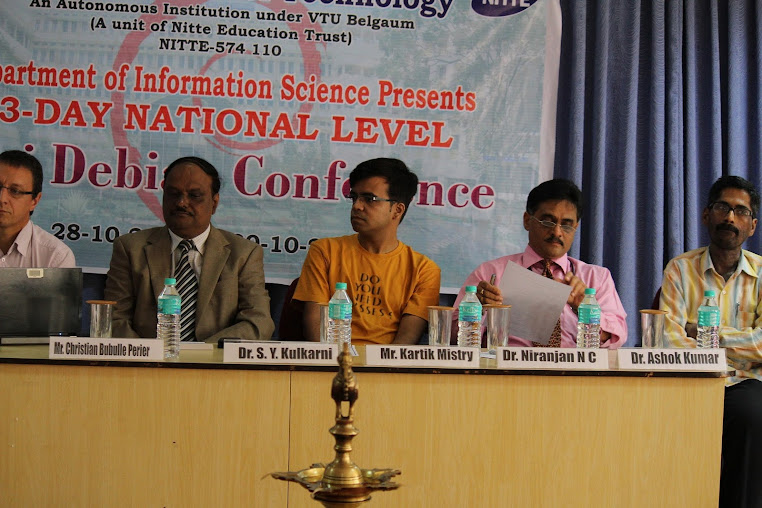
 Today I'm writing this blog with saddened heart. My mentor and a best
friend Dr.

 Good bye Sir :-(
 (Debian) packaging and Git.
The big picture is as follows. In my view, the most natural way to
work on a packaging project in version control [1] is to have an
upstream branch which either tracks upstream Git/Hg/Svn, or imports of
tarballs (or some combination thereof, and a Debian branch where both
modifications to upstream source and commits to stuff in
 Last week was the
 The summit has been wonderful. It was my first OpenStack design summit --
even more as a PTL -- and bumping into various people I've never met so far
and worked with online only was a real pleasure!
<figure>
 <figcaption>Me and Nick ready to talk about Ceilometer new features.</figcaption>
</figure>
 <figcaption>Doug explaining Ceilometer architecture.</figcaption>
</figure>
The next session was about getting feedbacks from our users. We had a lot of
surprise to discover wonderful real use-cases and deployments, like the CERN
using Ceilometer and generating 2 GB of data per day!
The following sessions ran on Thursday and were much more about new features
discussion. A lot ot already existing blueprints were discussed and quickly
validated during the first morning session. Then,

 I've only helped
"politically" here and there with this over the years, and I'm
happy to see it live. Your thanks for this should go to the blog
editors---Francesca Ciceri and Ana Guerrero Lopez---and to DSA for
making it real. A proper delegation for the editors is pending and
I'm confident the next DPL will pick it up.
 DRI3K First Steps
Here s an update on
 Ben Goldacre (
 Antonia came into the room. Where's Alieta? she asked.
We don't know, replied Luda. It was true; we hadn't seen Alieta
in quite some time, and we had no idea where she was.
Antonia left. Varvara eyed me mischievously and said, You could
call her.
How? I asked.
Touch the grandmother clock and you will figure it out.
I touched the clock trepidly. Nothing happened. I opened my mouth
to speak, but the word I had been about to say resonated in my mind
as if spoken through a comb filter. I concentrated. Alieta,
dozens of human-like voices sang over and over in different
harmonies. I let go.
What was that? I demanded.
Clock, Varvara said dismissively.
Come on, let's do laundry, Luda grunted.
We carried our laundry out to the garage, which is where the washer
and dryer lived. Alieta slipped in through one of the open garage
doors, and surreptitiously pulled Varvara over for a whispered
conversation.
Antonia wandered in and squinted in Alieta's general direction.
Luda quickly pulled Varvara in front of her. It's just Varvara,
she announced.
Antonia's eyes glazed over and she went back into the house.
Alieta pursed her lips and studied the wall as if there
might be some reflective object that had alerted her mother
to her presence. Then she grabbed Varvara by the hand, pulled
her over to push the buttons that closed the garage doors,
and dragged her into the house.
I watched the garage doors close. Then I watched the one on
the left reverse direction. I opened my mouth to notify someone
of this, but the doors reversed direction again, and proceeded
to partially open and close as if possessed. I tried to hide
behind Luda, without success.
Now she was watching as well, as reality seemed to to shimmer
and bend. The roof became arched, and there were loud mechanical
noises as our environs transformed. When it finished, the
place where the garage doors had been was now a wall of screens
displaying video as you might encounter in a television store.
More disconcertingly, we were in front of a railing which
overlooked what appeared to be a car dealership showroom.
Luda sucked in her breath. Benjamin Snow, you were into
some serious shit, she muttered.
