Search Results: "xam"

4 September 2016

Steinar H. Gunderson: Multitrack audio in Nageru 1.4.0

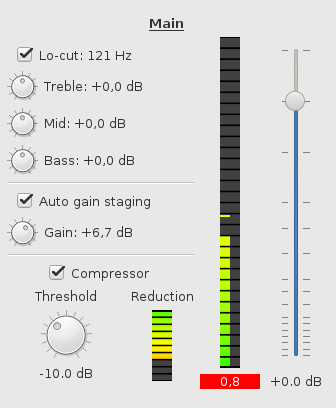
Even though the Chess Olympiad takes some attention right now, development on Nageru (my live video mixer) has continued steadily throughout since the 1.3.0 release. I wanted to take a little time to talk about the upcoming 1.4.0 release, and why things are as they are; writing down things often make them a bit clearer. Every major release of Nageru has had a specific primary focus: 1.0.0 was about just getting everything to work, 1.1.0 was about NVIDIA support for more oomph, 1.2.0 was about stabilization and polish (and added support for Blackmagic's PCI cards as a nice little bonus), and 1.3.0 was about x264 integration. For 1.4.0, I wanted to work on multitrack audio and mixing. Audio has always been a clear focus for Nageru, and for good reason; video is 90% about audio, and it's sorely neglected in most amateur productions (not to mention that processing tools are nearly non-existant in most free or cheap software video mixers). Right from the get-go, it's had a chain with proper leveling, compressors and most importantly visual monitoring, so that you know when things are not as they should be. However, it was also written with an assumption that there would be a single audio input source (one of the cameras), and that's going to change. Single-input is less of a showstopper than one'd think at first; you can work around it by buying a mixer, plug everything into that and then feed that signal into the computer. However, there are a few downsides: If you want camera audio, you'll need to pull more cable from each camera (or have SDI de-embedders). Your mixer is likely to require an extra power supply, and that means yet more cable (any decent USB video card can power over USB, so why shouldn't your audio?). You'll need to buy and transport yet another device. And so on. (If you already have a PA mixer, of course you can use it, but just reusing the PA mix as a stream mix rarely gives the best results, and mixing on an aux bus gives very little flexibility.) So for 1.4.0, I wanted something to get essentially the processing equivalent of a mid-range mixer. But even though my education is in DSP, my experience with mixers is rather limited, so I did the only reasonable thing and went over to a friend who's also an (award-winning) audio engineer. (It turns out that everything on a mixer is the way it is for a pretty good reason, tuned through 50+ years of collective audio experience. If you just try to make up something on your own without understanding what's going on, you have a 0.001% chance of stumbling upon some genius new way of doing things by accident, and a significantly larger chance than that of messing things up.) After some back and forth, we figured out a reasonable set of basic tools that would be useful in the right hands, and not too confusing for a beginner. So let's have a look at the new controls you get: Nageru expanded audio control view There's one set of these controls for each bus. (This is the expanded view; there's also a compact view that has only the meters and the fader, which is what you'll typically want to use during the run itself the expanded view is for setup and tweaking.) A bus in Nageru is a pair of channels (left/right), sourced from a video capture or ALSA card. The channel mapping is flexible; my USB sound card has 18 channels, for instance, and you can use that to make several buses. Each bus has a name (here I named it very creatively Main , but in a real setting you might want something like Blue microphone or Speaker PC ), which is just for convenience; it doesn't mean much. The most important parts of the mix are given the most screen estate, so even though the way through the signal chain is left-to-right top-to-bottom, I'll go over it in the opposite direction. By far the most important part is the audio level, so the fader naturally is very prominent. (Note that the scale is nonlinear; you want more resolution in the most important area.) Changing a fader with the mouse or keyboard is possible, and probably most people will be doing that, but Nageru will also support USB faders. These usually speak MIDI, for historical reasons, and there are some UI challenges when they're all so different, but you can get really small ones if you want to get that tactile feel without blowing up your budget or getting a bigger backpack. Then there's the meter to the left of that. Nageru already has R128 level meters in the mastering section (not shown here, but generally unchanged from 1.3.0), and those are kept as-is, but for each bus, you don't want to know loudness; you want to know recording levels, so you want a peak meter, not a loudness meter. In particular, you don't want the bus to send clipped data to the master (which would happen if you set it too high); Nageru can handle this situation pretty well (unlike most digital mixers, it mixes in full 32-bit floating-point so there's no internal clipping, and there's a limiter on the master by default), but it's still not a good place to be in, so you can see that being marked in red in this example. The meter doubles as an input peak check during setup; if you turn off all the effects and set the fader to neutral, you can see if the input hits peak or not, and then adjust it down. (Also, you can see here that I only have audio in the left channel; I'd better check my connections, or perhaps just use mono, by setting the right channel on the bus mapping to the same input as the left one.) The compressor (now moved from the mastering section to each bus) should be well-known for those using 1.3.0, but in this view, it also has a reduction meter, so that you can see whether it kicks in or not. Most casual users would want to just leave the gain staging and compressor settings alone, but a skilled audio engineer will know how to adjust these to each speaker's antics (some speak at a pretty even volume and thus can get a bit of headroom, while some are much more variable and need tighter settings). Finally (or, well, first), there's the EQ section. The lo-cut is again well-known from 1.3.0 (the cutoff frequency is the same across all buses), but there's now also a simple three-band EQ per bus. Simply ask the speaker to talk normally for a bit, and tweak the controls until it sounds good. People have different voices and different ways of holding the microphone, and if you have a reasonable ear, you can use the EQ to your advantage to make them sound a little more even on the stream. Either that, or just put it in neutral, and the entire EQ code will be bypassed. The code is making pretty good progress; all the DSP stuff is done (save for some optimizations I want to do in zita-resampler, now that the discussion flow is started again), and in theory, one could use it already as-is. However, there's a fair amount of gnarly support code that still needs to be written: In particular, I need to do some refactoring to support ALSA hotplug (you don't want your entire stream to go down just because an USB soundcard dropped out for a split second), and similarly some serialization of saving/loading bus mappings. It's not exactly rocket science, but all the code still needs to be written, and there are a number of corner cases to think of. If you want to peek, the code is in the multichannel_audio branch, but beware; I rebase/squash it pretty frequently, so if you pull from it, expect frequent git breakage.

3 September 2016

Antonio Terceiro: testing build reprodubility with debrepro

Earlier today I was handling a reproducibility bug and decided I had to try a reproducibility test by myself. I tried reprotest, but I was being hit by a disorderfs issue and I was not sure whether the problem was with reprotest or not (at this point I cannot reproduce that anymore). So I decided to hack a simple script to that, and it works. I even included it in devscripts after writing a manpage. Of course reprotest is more complete, extensible, and supports arbitrary virtualization backends for doing the more dangerous/destructive variations (such as changing the hostname and other things that require root) but for quick tests debrepro does the job. Usage examples:

$ debrepro                                 # builds current directory
$ debrepro /path/to/sourcepackage          # builds package there
$ gbp-buildpackage --git-builder=debrepro  # can be used with vcs wrappers as well

debrepro will do two builds with a few variations between them, including $USER, $PATH, timezone, locale, umask, current time, and will even build under disorderfs if available. Build path variation is also performed because by definition the builds are done in different directories. If diffoscope is installed, it will be used for deep comparison of non-matching binaries. If you are interested and don t want to build devscripts from source or wait for the next release, you can just grab the script, save it as debrepro somewhere on your $PATH and make it executable.

31 August 2016

Chris Lamb: Free software activities in August 2016

Here is my monthly update covering what I have been doing in the free software world (previously):

Reproducible builds

Whilst anyone can inspect the source code of free software for malicious flaws, most Linux distributions provide binary (or "compiled") packages to end users. The motivation behind the Reproducible Builds effort is to allow verification that no flaws have been introduced either maliciously and accidentally during this compilation process by promising identical binary packages are always generated from a given source.

Diffoscope diffoscope is our "diff on steroids" that will not only recursively unpack archives but will transform binary formats into human-readable forms in order to compare them:
  • Added a command-line interface to the try.diffoscope.org web service.
  • Added a JSON comparator.
  • In the HTML output, highlight lines when hovering to make it easier to visually track.
  • Ensure that we pass str types to our Difference class, otherwise we can't be sure we can render them later.
  • Testsuite improvements:
    • Generate test coverage reports.
    • Add tests for Haskell and GitIndex comparators.
    • Completely refactored all of the comparator tests, extracting out commonly-used routines.
    • Confirm rendering of text and HTML presenters when checking non-existing files.
    • Dropped a squashfs test as it was simply too unreliable and/or has too many requirements to satisfy.
  • A large number of miscellaneous cleanups, including:
    • Reworking the comparator setup/preference internals by dynamically importing classes via a single list.
    • Split exceptions out into dedicated diffoscope.exc module.
    • Tidying the PROVIDERS dict in diffoscope/__init__.py.
    • Use html.escape over xml.sax.saxutils.escape, cgi.escape, etc.
    • Removing hard-coding of manual page targets names in debian/rules.
    • Specify all string format arguments as logging function parameters, not using interpolation.
    • Tidying imports, correcting indentation levels and drop unnecessary whitespace.

disorderfs disorderfs is our FUSE filesystem that deliberately introduces nondeterminism in system calls such as readdir(3).
  • Added a testsuite to prevent regressions. (f124965)
  • Added a --sort-dirents=yes no option for forcing deterministic ordering. (2aae325)

Other
  • Improved strip-nondeterminism, our tool to remove specific nondeterministic information after a build:
    • Match more styles of Java .properties files.
    • Remove hyphen from "non-determinism" and "non-deterministic" throughout package for consistency.
  • Improvements to our testing infrastucture:
    • Improve the top-level navigation so that we can always get back to "home" of a package.
    • Give expandable elements cursor: pointer CSS styling to highlight they are clickable.
    • Drop various trailing underlined whitespaces after links.
    • Explicitly log that build was successful or not.
    • Various code-quality improvements, including prefering str.format over concatentation.
  • Miscellaneous updates to our filter-packages internal tool:
    • Add --random=N and --url options.
    • Add support for --show=comments.
    • Correct ordering so that --show-version runs after --filter-ftbfs.
    • Rename --show-ftbfs to --filter-ftbfs and --show-version to --show=version.
  • Created a proof-of-concept reproducible-utils package to contain commonly-used snippets aimed at developers wishing to make their packages reproducible.


I also submitted 92 patches to fix specific reproducibility issues in advi, amora-server, apt-cacher-ng, ara, argyll, audiotools, bam, bedtools, binutils-m68hc1x, botan1.10, broccoli, congress, cookiecutter, dacs, dapl, dateutils, ddd, dicom3tools, dispcalgui, dnssec-trigger, echoping, eekboek, emacspeak, eyed3, fdroidserver, flashrom, fntsample, forkstat, gkrellm, gkrellm, gnunet-gtk, handbrake, hardinfo, ircd-irc2, ircd-ircu, jack-audio-connection-kit, jpy, kxmlgui, libbson, libdc0, libdevel-cover-perl, libfm, libpam-ldap, libquvi, librep, lilyterm, mozvoikko, mp4h, mp4v2, myghty, n2n, nagios-nrpe, nikwi, nmh, nsnake, openhackware, pd-pdstring, phpab, phpdox, phpldapadmin, pixelmed-codec, pleiades, pybit, pygtksourceview, pyicu, python-attrs, python-gflags, quvi, radare2, rc, rest2web, roaraudio, rt-extension-customfieldsonupdate, ruby-compass, ruby-pg, sheepdog, tf5, ttf-tiresias, ttf-tiresias, tuxpaint, tuxpaint-config, twitter-bootstrap3, udpcast, uhub, valknut, varnish, vips, vit, wims, winswitch, wmweather+ & xshisen.

Debian GNU/Linux
Debian LTS

This month I have been paid to work 15 hours on Debian Long Term Support (LTS). In that time I did the following:
  • "Frontdesk" duties, triaging CVEs, etc.
  • Authored the patch & issued DLA 596-1 for extplorer, a web-based file manager, fixing an archive traversal exploit.
  • Issued DLA 598-1 for suckless-tools, fixing a segmentation fault in the slock screen locking tool.
  • Issued DLA 599-1 for cracklib2, a pro-active password checker library, fixing a stack-based buffer overflow when parsing large GECOS fields.
  • Improved the find-work internal tool adding optional colour highlighting and migrating it to Python 3.
  • Wrote an lts-missing-uploads tool to find mistakes where there was no correponding package in the archive after an announcement.
  • Added optional colour highlighting to the lts-cve-triage tool.

Uploads
  • redis 2:3.2.3-1 New upstream release, move to the DEP-5 debian/copyright format, ensure that we are running as root in LSB initscripts and add a README.Source regarding our local copies of redis.conf and sentinel.conf.
  • python-django:
    • 1:1.10-1 New upstream release.
    • 1:1.10-2 Fix test failures due to mishandled upstream translation updates.

  • gunicorn:
    • 19.6.0-2 Reload logrotate in the postrotate action to avoid processes writing to the old files and move to DEP-5 debian/copyright format.
    • 19.6.0-3 Drop our /usr/sbin/gunicorn ,3 -debian and related Debian-specific machinery to be more like upstream.
    • 19.6.0-4 Drop "template" systemd .service files and point towards examples and documentation instead.

  • adminer:
    • 4.2.5-1 Take over package maintenance, completely overhauling the packaging with a new upstream version, move to virtual-mysql-server to support MariaDB, updating package names of dependencies and fix the outdated Apache configuration.
    • 4.2.5-2 Correct the php5 package names.


FTP Team As a Debian FTP assistant I ACCEPTed 90 packages: android-platform-external-jsilver, android-platform-frameworks-data-binding, camlpdf, consolation, dfwinreg, diffoscope, django-restricted-resource, django-testproject, django-testscenarios, gitlab-ci-multi-runner, gnome-shell-extension-taskbar, golang-github-flynn-archive-go-shlex, golang-github-jamesclonk-vultr, golang-github-weppos-dnsimple-go, golang-golang-x-time, google-android-ndk-installer, haskell-expiring-cache-map, haskell-hclip, haskell-hdbc-session, haskell-microlens-ghc, haskell-names-th, haskell-persistable-record, haskell-should-not-typecheck, haskell-soap, haskell-soap-tls, haskell-th-reify-compat, haskell-with-location, haskell-wreq, kbtin, libclipboard-perl, libgtk3-simplelist-perl, libjs-jquery-selectize.js, liblemon, libplack-middleware-header-perl, libreoffice, libreswan, libtest-deep-json-perl, libtest-timer-perl, linux, linux-signed, live-tasks, llvm-toolchain-3.8, llvm-toolchain-snapshot, lua-luv, lua-torch-image, lua-torch-nn, magic-wormhole, mini-buildd, ncbi-vdb, node-ast-util, node-es6-module-transpiler, node-es6-promise, node-inline-source-map, node-number-is-nan, node-object-assign, nvidia-graphics-drivers, openhft-chronicle-bytes, openhft-chronicle-core, openhft-chronicle-network, openhft-chronicle-threads, openhft-chronicle-wire, pycodestyle, python-aptly, python-atomicwrites, python-click-log, python-django-casclient, python-git-os-job, python-hypothesis, python-nosehtmloutput, python-overpy, python-parsel, python-prov, python-py, python-schema, python-tackerclient, python-tornado, pyvo, r-cran-cairo, r-cran-mi, r-cran-rcppgsl, r-cran-sem, ruby-curses, ruby-fog-rackspace, ruby-mixlib-archive, ruby-tzinfo-data, salt-formula-swift, scapy3k, self-destructing-cookies, trollius-redis & websploit.

30 August 2016

Daniel Stender: My work for Debian in August

Here's again a little list of my humble off-time contributions I'm happy to add to the large amount of work we're completing all together each month. Then there is one more "new in Debian" (meaning: "new in unstable") announcement. First, the uploads (a few of them are from July): New packages: Sponsored uploads: Requested resp. suggested for packaging: New in Debian: Lasagne (deep learning framework) Now that the mathematical expression compiler Theano is available in Debian, deep learning frameworks resp. toolkits which have been build on top of it can become available within Debian, too (like Blocks, mentioned before). Theano is an own general computing engine which has been developed with a focus on machine learning resp. neural networks, which features an own declarative tensor language. The toolkits which have build upon it vary in the way how much they abstract the bare features of Theano, if they are "thick" or "thin" so to say. When the abstraction gets higher you gain more end user convenience up to the level that you have the architectural components of neural networks available for combination like in a lego box, while the more complicated things which are going on "under the hood" (like how the networks are actually implemented) are hidden. The downside is, thick abstraction layers usually makes it difficult to implement novel features like custom layers or loss functions. So more experienced users and specialists might to seek out for the lower abstraction toolkits, where you have to think more in terms of Theano. I've got an initial package of Keras in experimental (1.0.7-1), it runs (only a Python 3 package is available so far) but needs some more work (e.g. building the documentation with mkdocs). Keras is a minimalistic, high modular DNN library inspired by Torch1. It has a clean, rather easy API for experimenting and fast prototyping. It can also run on top of Google's TensorFlow, and we're going to have it ready for that, too. Lasagne follows a different approach. It's, like Keras and Blocks, a Python library to create and train multi-layered artificial neural networks in/on Theano for applications like image recognition resp. classification, speech recognition, image caption generation or other purposes like style transfers from paintings to pictures2. It abstracts Theano as little as possible, and could be seen rather like an extension or an add-on than an abstraction3. Therefore, knowledge on how things are working in Theano would be needed to make full use out of this piece of software. With the new Debian package (0.1+git20160728.8b66737-1)4, the whole required software stack (the corresponding Theano package, NumPy, SciPy, a BLAS implementation, and the nividia-cuda-toolkit and NVIDIA kernel driver to carry out computations on the GPU5) could be installed most conveniently just by a single apt-get install python ,3 -lasagne command6. If wanted with the documentation package lasagne-doc for offline use (no running around on remote airports seeking for a WIFI spot), either in the Python 2 or the Python 3 branch, or both flavours altogether7. While others have to spend a whole weekend gathering, compiling and installing the needed libraries you can grab yourself a fresh cup of coffee. These are the advantages of a fully integrated system (sublime message, as always: desktop users switch to Linux!). When the installation of packages has completed, the MNIST example of Lasagne could be used for a quick check if the whole library stack works properly8:
$ THEANO_FLAGS=device=gpu,floatX=float32 python /usr/share/doc/python-lasagne/examples/mnist.py mlp 5
Using gpu device 0: GeForce 940M (CNMeM is disabled, cuDNN 5005)
Loading data...
Downloading train-images-idx3-ubyte.gz
Downloading train-labels-idx1-ubyte.gz
Downloading t10k-images-idx3-ubyte.gz
Downloading t10k-labels-idx1-ubyte.gz
Building model and compiling functions...
Starting training...
Epoch 1 of 5 took 2.488s
  training loss:        1.217167
  validation loss:      0.407390
  validation accuracy:      88.79 %
Epoch 2 of 5 took 2.460s
  training loss:        0.568058
  validation loss:      0.306875
  validation accuracy:      91.31 %
The example on how to train a neural network on the MNIST database of handwritten digits is refined (it also provides --help) and explained in detail in the Tutorial section of the documentation in /usr/share/doc/lasagne-doc/html/. Very good starting points are also the IPython notebooks that are available from the tutorials by Eben Olson9 and Geoffrey French on the PyData London 201610. There you have Theano basics, examples for employing convolutional neural networks (CNN) and recurrent neural networks (RNN) for a range of different purposes, how to use pre-trained networks for image recognition, etc.

  1. For a quick comparison of Keras and Lasagne with other toolkits, see Alex Rubinsteyn's PyData NYC 2015 presentation on using LSTM (long short term memory) networks on varying length sequence data like Grimm's fairy tales (https://www.youtube.com/watch?v=E92jDCmJNek 27:30 sq.)
  2. https://github.com/Lasagne/Recipes/tree/master/examples/styletransfer
  3. Great introduction to Theano and Lasagne by Eben Olson on the PyData NYC 2015: https://www.youtube.com/watch?v=dtGhSE1PFh0
  4. The package is "freelancing" currently being in collab-maint, to set up a deep learning packaging team within Debian is in the stage of discussion.
  5. Only available for amd64 and ppc64el.
  6. You would need "testing" as package source in /etc/apt/sources.list to install it from the archive at the present time (I have that for years, but if Debian Testing could be advised as productive system is going to be discussed elsewhere), but it's coming up for Debian 9. The cuda-toolkit and pycuda are in the non-free section of the archive, thus non-free (mostly used in combination with contrib) must be added to main. Plus, it's a mere suggestion of the Theano packages to keep Theano in main, so --install-suggests is needed to pull it automatically with the same command, or this must be given explicitly.
  7. For dealing with Theano in Debian, see this previous blog posting
  8. Like suggested in the guideline From Zero to Lasagne on Ubuntu 14.04. cuDNN isn't available as official Debian package yet, but could be downloaded as a .deb package after registration at https://developer.nvidia.com/cudnn. It integrates well out of the box.
  9. https://github.com/ebenolson/pydata2015
  10. https://github.com/Britefury/deep-learning-tutorial-pydata2016, video: https://www.youtube.com/watch?v=DlNR1MrK4qE

28 August 2016

Dirk Eddelbuettel: rfoaas 1.1.0

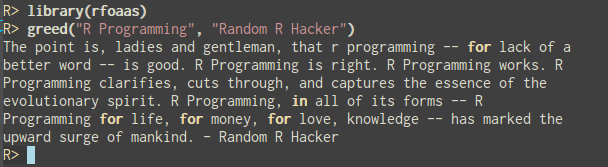
rfoaas greed example FOAAS upstream came out with release 1.1.0 earlier last week. Tyler Hunt was kind enough to provide an almost immediate pull request adding support for the extended capabilties. Following yesterday's upload we now have version 1.1.0 of rfoaas on CRAN. It brings six more accessors: maybe(), blackadder(), horse(), deraadt(), problem(), cocksplat() and too(). As usual, CRANberries provides a diff to the previous CRAN release. Questions, comments etc should go to the GitHub issue tracker. More background information is on the project page as well as on the github repo

This post by Dirk Eddelbuettel originated on his Thinking inside the box blog. Please report excessive re-aggregation in third-party for-profit settings.

27 August 2016

Arturo Borrero Gonz lez: Why conntrackd in Debian is better with systemd


There has been some discussion [0] around my decision to drop sysvinit support in the conntrackd package in Debian [1] (version 1:1.4.4-2).

The rationale I used for such a movement was sent to the debian-devel [2] mailing list, and here it is:


Lots of people have talked to me with both support and disagreement with the change.

Before reading the rest of this blogpost, please note that I'm not interested in the 'systemd vs sysvinit' war, and starting now I will focus mainly on the subject of building a firewall cluster with netfilter technology and the reasons why I think sysvinit here is irrelevant.

I started working with firewall clusters by the time of Debian Squeeze. By then, I used only sysvinit, because it was the Debian default init system and because I did not dive so much in the internals of the firewall cluster itself.

By then, the conntrackd debian package included support for sysvinit by means of two files (the two files that I dropped in 1:1.4.4-2) :


Using both files, you could start/stop conntrackd, and nothing more (for example, a proper status check was not implemented).

The conntrackd daemon is used in HA firewall clusters to replicate connection states between nodes of the cluster, so flow states are known in all nodes and they can properly perform stateful firewalling.

When you build HA clusters, there are 2 basic states of the cluster you may check and adjust: failover and failback.

With conntrackd, the failover situation is straight forward: the other node has the state information already from the dying node.
The failback situation is different: depending on the configuration of both the cluster and conntrackd, the new node may ask for a complete synchronisation to the other node when it become alive again (at boot time, for example) . This is the case if you are building a multi-master firewall cluster (i.e: both nodes are seeing traffic and filtering at the same time).

Asking for a complete synchronisation is done by means of a new instance of conntrackd, which communicates using a UNIX socket to the main conntrackd daemon (the one which is actually communicating with the other node). A failback boot procedure may look like this:

  1. system boots
  2. firewall ruleset loading
  3. networking up
  4. conntrackd up (main sync daemon: using 'conntrackd -d'; UNIX socket is opened)
  5. request sync with other node (using conntrackd -n' which uses the UNIX socket opened in step 4)

In both sysvinit and systemd cases, the step 5 may be implemented using another dummy service which performs the required operations and that depends on the main service representing the step 4.

The point here is that steps 4 and 5 suffer a very bad race condition: the conntrackd daemon may open the UNIX socket (step 4) *after* the we try to use it (step 5).

As you could probably imagine, this is the worst possible scenario: as one of the nodes of the cluster is missing important flow state information the stateful firewall will drop packets and all the network monitoring alarms will start to ring... Ironically, just after a failback operation, when all of our cluster is supposed to be up an running.

To avoid the race conditions, some typical hacks could be implemented:


After a bit of research, I found that the last point could be implemented very easily using libsystemd, so the daemon inform of its internal state to systemd [4].

The solution is elegant, simple and offers more direct benefits:

So the clear winner for conntrackd is to go with systemd, using an unit service file of Type=notify. Using sysvinit is prone to the described race condition. No serious firewall cluster with this architecture would use sysvinit.

It's obvious to me that systemd is a better technology than sysvinit. The sysvinit approach has been OK for a while, and for me it was fascinating when I started developing init scripts and learning how things worked.
But now we have systemd. It's the default in Debian. It's far better.

Conclusions: yes, I will probably reintroduce sysvinit files just to avoid any flamewar.


[0] https://lists.debian.org/debian-devel/2016/08/msg00448.html
[1] https://tracker.debian.org/pkg/conntrack-tools
[2] https://lists.debian.org/debian-devel/2016/08/msg00456.html
[3] https://sources.debian.net/src/systemd/231-4/debian/systemd.NEWS/
[4] http://git.netfilter.org/conntrack-tools/tree/src/systemd.c

26 August 2016

Norbert Preining: ESSLLI 2016 Course: Algebraic Specification and Verification with CafeOBJ

During this year s ESSLLI (European Summer School in Logic, Language and Information) I was teaching a course on Algebraic Specification and Verification with CafeOBJ. Now that the course is over I can relax a bit and enjoy the beauty of the surrounding North Tyrol.
ESSLLI-2016-logo-darkblue-small For those who couldn t attend the ESSLLI or the course, here are the course materials: Thanks to the participants for the interesting questions and participation. What follows is the original description of the course. Abstract Ensuring correctness of complex systems like computer programs or communication protocols is gaining ever increasing importance. For correctness it does not suffice to consider the finished system, but correctness already on the level of specification is necessary, that is, before the actual implementation starts. To this aim, algebraic specification and verification languages have been conceived. They are aiming at a mathematically correct description of the properties and behavior of the systems under discussion, and in addition often allow to prove (verify) correctness within the same system. This course will give an introduction to algebraic specification, its history, logic roots, and actuality with respect to current developments. Paired with the theoretical background we give an introduction to CafeOBJ, a programming language that allows both specification and verification to be carried out together. The course should enable students to understand the theoretical background of algebraic specification, as well as enable them to read and write basic specifications in CafeOBJ. Description CafeOBJ is a specification language based on three-way extensions to many-sorted equational logic: the underlying logic is order-sorted, not just many-sorted; it admits unidirectional transitions, as well as equations; it also accommodates hidden sorts, on top of ordinary, visible sorts. A subset of CafeOBJ is executable, where the operational semantics is given by a conditional order-sorted term rewriting system. The language system CafeOBJ has been under constant development at the institute of the lecturers since the late 80ies. It is closely related to other algebraic specification languages in the OBJ family, including Maude. The CafeOBJ language and the range of verification methods and tools it supports including its support for inductive theorem proving, verification of behavioral specifications, deductive invariant proof, and reachability analysis of concurrent systems has played a key role in both extending and bringing algebraic specification techniques into contact with many software engineering applications. The following topics will be discussed: To make the lectures not too heavy , we will structure each lecture into two parts: A first part providing an introduction of some theoretical concept, or framework, and a second part dealing with actual programming and implementation. Especially for the second part of each lecture students are encouraged to use their laptops to try out code and experiment.

22 August 2016

Luciano Prestes Cavalcanti: AppRecommender - Last GSoC Report

My work on Google Summer of Code is to create a new strategy on AppRecommender, where this strategy should be able to get a referenced package, or a list of referenced packages, then analyze the packages that the user has already installed and make a recommendation using the referenced packages as a base, for example: if the user runs "$ sudo apt install vim", the AppRecommender uses "vim" as the referenced package, and should recommend packages with relation between "vim" and the other packages that the user has installed. This work is done and added to the official AppRecommender repository.
During the GSoC program, more contributions were done with the AppRecommender project helping the system to improve the recommendations, installation and configurations to help Debian package.
The following link contains my commits on AppRecommender:
https://github.com/tassia/AppRecommender/commits/master?author=LucianoPC
During the period destined to students get to know the community of the project, I talked with the Debian community about my project to get feedback and ideas. When talking to the Debian community on the IRC channels, we came up with the idea of using the popularity-contest data to improve the recommendations. I talked with my mentors, who approved the idea, then we increased the project scope to use the popularity-contest data to improve the AppRecommender recommendations.
The popularity-contest has several privacy political terms, then we did a research and published, on the Debian Planet, a post that explains why we need the popularity-contest data to improve the recommendations and how we use this data. This post also contains an explanation about the risks and the measures taken to minimize them.
Then two activities were added to be made. One of them is to create a script to be added on popularity-contest. This script is destined to get the popularity-contest data, which is the users' packages, and generate clusters that group these packages analyzing similar users. The other activity is to add collaborative data into the AppRecommender, where this will download the clusters data and use it to improve the recommendations.
The popularity-contest cluster script was done and reviewed by my mentor, but was not integrated into popularity-contest yet. The usage of clusters data into AppRecommender has been already implemented, but still not added on official repository because it is waiting the cluster cript's acceptance into the popularity-contest. This work is not complete, but I will continue working with AppRecommender and Debian community, and with my mentors' help, I will finish this work.
The following link contains my commits on repository with the popularity-contest cluster script's feature, as well as other scripts that I used to improve my work, but the only script that will be sent to popularity-contest is the create_popcon_clusters.py:
https://github.com/TCC-AppRecommender/scripts/commits/master?author=LucianoPC
The following link contains my commits on repository with the AppRecommender collaborative data feature:
Google Drive folder with the patch:
https://drive.google.com/drive/folders/0BzmGBlxBo2G3Q3F5YjBpRl9yWUk?usp=sharing

Satyam Zode: Google Summer of Code 2016 : Final Report

Project Title : Improving diffoscope tool and reproducibility of Debian packages Project details This project aims to improve diffoscope tool and fix Debian packages which are unreproducible in Reproducible builds testing framework. diffoscope recursively unpack archives of many kinds and transform various binary formats into more human readable form to compare them. As a part of this project I worked on argument completion feature and ignoring .buildinfo feature. This project is a part of Reproducible Builds effort Mentor and Co-Mentor Project Discussion Project Implementation Challenges and Work Left Future work Acknowledgement I would like to express my deepest gratitude to Lunar for mentoring me throughout Google Summer of Code program and for being cool. Lunar s deep knowledge regarding diffoscope and Python skills helped me a lot throughout the project and we literally had great discussions. I would also like to thank Debaian community and Google for giving me this opportunity. Special thanks to Reproducible Builds folks for all the guidance!

Vincent Sanders: Down the rabbit hole

My descent began with a user reporting a bug and I fear I am still on my way down.

Like Alice I headed down the hole. https://commons.wikimedia.org/wiki/File:Rabbit_burrow_entrance.jpg
The bug was simple enough, a windows bitmap file caused NetSurf to crash. Pretty quickly this was tracked down to the libnsbmp library attempting to decode the file. As to why we have a heavily used library for bitmaps? I am afraid they are part of every icon file and many websites still have favicons using that format.

Some time with a hex editor and the file format specification soon showed that the image in question was malformed and had a bad offset header entry. So I was faced with two issues, firstly that the decoder crashed when presented with badly encoded data and secondly that it failed to deal with incorrect header data.

This is typical of bug reports from real users, the obvious issues have already been encountered by the developers and unit tests formed to prevent them, what remains is harder to produce. After a debugging session with Valgrind and electric fence I discovered the crash was actually caused by running off the front of an allocated block due to an incorrect bounds check. Fixing the bounds check was simple enough as was working round the bad header value and after adding a unit test for the issue I almost moved on.

Almost...

american fuzzy lop are almost as cute as cats https://commons.wikimedia.org/wiki/File:Rabbit_american_fuzzy_lop_buck_white.jpg
We already used the bitmap test suite of images to check the library decode which was giving us a good 75% or so line coverage (I long ago added coverage testing to our CI system) but I wondered if there was a test set that might increase the coverage and perhaps exercise some more of the bounds checking code. A bit of searching turned up the american fuzzy lop (AFL) projects synthetic corpora of bmp and ico images.

After checking with the AFL authors that the images were usable in our project I added them to our test corpus and discovered a whole heap of trouble. After fixing more bounds checks and signed issues I finally had a library I was pretty sure was solid with over 85% test coverage.

Then I had the idea of actually running AFL on the library. I had been avoiding this because my previous experimentation with other fuzzing utilities had been utter frustration and very poor return on investment of time. Following the quick start guide looked straightforward enough so I thought I would spend a short amount of time and maybe I would learn a useful tool.

I downloaded the AFL source and built it with a simple make which was an encouraging start. The library was compiled in debug mode with AFL instrumentation simply by changing the compiler and linker environment variables.

$ LD=afl-gcc CC=afl-gcc AFL_HARDEN=1 make VARIANT=debug test
afl-cc 2.32b by <lcamtuf@google.com>
COMPILE: src/libnsbmp.c
afl-cc 2.32b by <lcamtuf@google.com>
afl-as 2.32b by <lcamtuf@google.com>
[+] Instrumented 751 locations (64-bit, hardened mode, ratio 100%).
AR: build-x86_64-linux-gnu-x86_64-linux-gnu-debug-lib-static/libnsbmp.a
COMPILE: test/decode_bmp.c
afl-cc 2.32b by <lcamtuf@google.com>
afl-as 2.32b by <lcamtuf@google.com>
[+] Instrumented 52 locations (64-bit, hardened mode, ratio 100%).
LINK: build-x86_64-linux-gnu-x86_64-linux-gnu-debug-lib-static/test_decode_bmp
afl-cc 2.32b by <lcamtuf@google.com>
COMPILE: test/decode_ico.c
afl-cc 2.32b by <lcamtuf@google.com>
afl-as 2.32b by <lcamtuf@google.com>
[+] Instrumented 65 locations (64-bit, hardened mode, ratio 100%).
LINK: build-x86_64-linux-gnu-x86_64-linux-gnu-debug-lib-static/test_decode_ico
afl-cc 2.32b by <lcamtuf@google.com>
Test bitmap decode
Tests:606 Pass:606 Error:0
Test icon decode
Tests:392 Pass:392 Error:0
TEST: Testing complete

I stuffed the AFL build directory on the end of my PATH, created a directory for the output and ran afl-fuzz

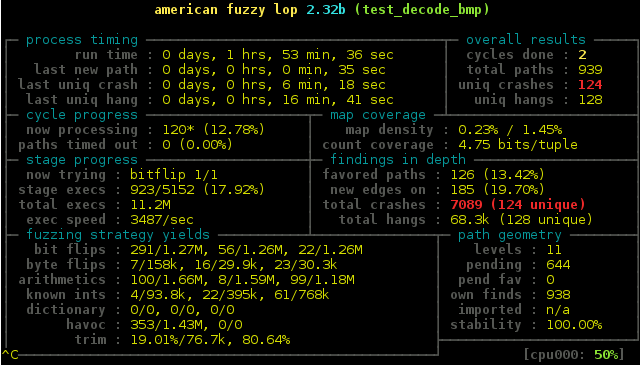
afl-fuzz -i test/bmp -o findings_dir -- ./build-x86_64-linux-gnu-x86_64-linux-gnu-debug-lib-static/test_decode_bmp @@ /dev/null

The result was immediate and not a little worrying, within seconds there were crashes and lots of them! Over the next couple of hours I watched as the unique crash total climbed into the triple digits.

I was forced to abort the run at this point as, despite clear warnings in the AFL documentation of the demands of the tool, my laptop was clearly not cut out to do this kind of work and had become distressingly hot.

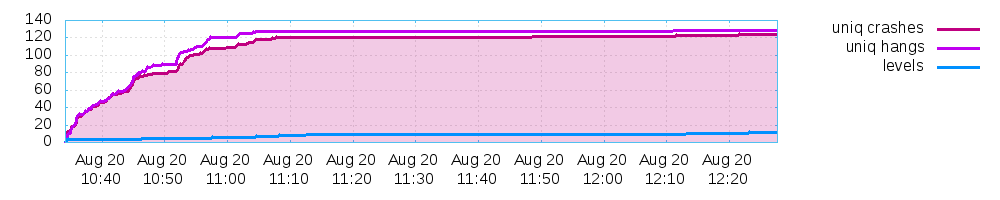
AFL has a visualisation tool so you can see what kind of progress it is making which produced a graph that showed just how fast it managed to produce crashes and how much the return plateaus after just a few cycles. Although it was finding a new unique crash every ten minutes or so when aborted.

I dove in to analyse the crashes and it immediately became obvious the main issue was caused when the test tool attempted allocations of absurdly large bitmaps. The browser itself uses a heuristic to determine the maximum image size based on used memory and several other values. I simply applied an upper bound of 48 megabytes per decoded image which fits easily within the fuzzers default heap limit of 50 megabytes.

The main source of "hangs" also came from large allocations so once the test was fixed afl-fuzz was re-run with a timeout parameter set to 100ms. This time after several minutes no crashes and only a single hang were found which came as a great relief, at which point my laptop had a hard shutdown due to thermal event!

Once the laptop cooled down I spooled up a more appropriate system to perform this kind of work a 24way 2.1GHz Xeon system. A Debian Jessie guest vm with 20 processors and 20 gigabytes of memory was created and the build replicated and instrumented.

AFL master node display
To fully utilise this system the next test run would utilise AFL in parallel mode. In this mode there is a single "master" running all the deterministic checks and many "secondary" instances performing random tweaks.

If I have one tiny annoyance with AFL, it is that breeding and feeding a herd of rabbits by hand is annoying and something I would like to see a convenience utility for.

The warren was left overnight with 19 instances and by morning had generated crashes again. This time though the crashes actually appeared to be real failures.

$ afl-whatsup sync_dir/
Summary stats
=============

Fuzzers alive : 19
Total run time : 5 days, 12 hours
Total execs : 214 million
Cumulative speed : 8317 execs/sec
Pending paths : 0 faves, 542 total
Pending per fuzzer : 0 faves, 28 total (on average)
Crashes found : 554 locally unique

All the crashing test cases are available and a simple file command immediately showed that all the crashing test files had one thing in common the height of the image was -2147483648 This seemingly odd number is actually meaningful to a programmer, it is the largest negative number which can be stored in a 32bit integer (INT32_MIN) I immediately examined the source code that processes the height in the image header.

if ((width <= 0)   (height == 0))          
return BMP_DATA_ERROR;
if (height < 0)
bmp->reversed = true;
height = -height;

The bug is where the height is made a positive number and results in height being set to 0 after the existing check for zero and results in a crash later in execution. A simple fix was applied and test case added removing the crash and any possible future failure due to this.

Another AFL run has been started and after a few hours has yet to find a crash or non false positive hang so it looks like if there are any more crashes to find they are much harder to uncover.

Main lessons learned are:
I will of course be debugging any new crashes that occur and perhaps turning my sights to all the projects other unit tested libraries. I will also be investigating the generation of our own custom test corpus from AFL to replace the demo set, this will hopefully increase our unit test coverage even further.

Overall this has been my first successful use of a fuzzing tool and a very positive experience. I would wholeheartedly recommend using AFL to find errors and perhaps even integrate as part of a CI system.

21 August 2016

David Moreno: WIP: Perl bindings for Facebook Messenger

A couple of weeks ago I started looking into wrapping the Facebook Messenger API into Perl. Since all the calls are extremely simple using a REST API, I thought it could be easier and simpler even, to provide a small framework to hook bots using PSGI/Plack. So I started putting some things together and with a very simple interface you could do a lot:
use strict;
use warnings;
use Facebook::Messenger::Bot;
my $bot = Facebook::Messenger::Bot->new( 
    access_token   => '...',
    app_secret     => '...',
    verify_token   => '...'
 );
$bot->register_hook_for('message', sub  
    my $bot = shift;
    my $message = shift;
    my $res = $bot->deliver( 
        recipient => $message->sender,
        message =>   text => "You said: " . $message->text()  
     );
    ...
 );
$bot->spin();
You can hook a script like that as a .psgi file and plug it in to whatever you want. Once you have some more decent user flow and whatnot, you can build something like:


using a simple script like this one. The work is not finished and not yet CPAN-ready but I m posting this in case someone wants to join me in this mini-project or have suggestions, the work in progress is here. Thanks!

20 August 2016

Francois Marier: Remplacer un disque RAID d fectueux

Traduction de l'article original anglais https://feeding.cloud.geek.nz/posts/replacing-a-failed-raid-drive/. Voici la proc dure que j'ai suivi pour remplacer un disque RAID d fectueux sur une machine Debian.

Remplacer le disque Apr s avoir remarqu que /dev/sdb a t expuls de mon RAID, j'ai utilis smartmontools pour identifier le num ro de s rie du disque retirer :
smartctl -a /dev/sdb
Cette information en main, j'ai ferm l'ordinateur, retir le disque d fectueux et mis un nouveau disque vide la place.

Initialiser le nouveau disque Apr s avoir d marr avec le nouveau disque vide, j'ai copi la table de partitions avec parted. Premi rement, j'ai examin la table de partitions sur le disque dur non-d fectueux :
$ parted /dev/sda
unit s
print
et cr une nouvelle table de partitions sur le disque de remplacement :
$ parted /dev/sdb
unit s
mktable gpt
Ensuite j'ai utilis la commande mkpart pour mes 4 partitions et je leur ai toutes donn la m me taille que les partitions quivalentes sur /dev/sda. Finalement, j'ai utilis les commandes toggle 1 bios_grub (partition d'amorce) et toggle X raid (o X est le num ro de la partition) pour toutes les partitions RAID, avant de v rifier avec la commande print que les deux tables de partitions sont maintenant identiques.

Resynchroniser/recr er les RAID Pour synchroniser les donn es du bon disque (/dev/sda) vers celui de remplacement (/dev/sdb), j'ai ex cut les commandes suivantes sur mes partitions RAID1 :
mdadm /dev/md0 -a /dev/sdb2
mdadm /dev/md2 -a /dev/sdb4
et j'ai gard un oeil sur le statut de la synchronisation avec :
watch -n 2 cat /proc/mdstat
Pour acc l rer le processus, j'ai utilis le truc suivant :
blockdev --setra 65536 "/dev/md0"
blockdev --setra 65536 "/dev/md2"
echo 300000 > /proc/sys/dev/raid/speed_limit_min
echo 1000000 > /proc/sys/dev/raid/speed_limit_max
Ensuite, j'ai recr ma partition swap RAID0 comme suit :
mdadm /dev/md1 --create --level=0 --raid-devices=2 /dev/sda3 /dev/sdb3
mkswap /dev/md1
Par que la partition swap est toute neuve (il n'est pas possible de restorer une partition RAID0, il faut la re-cr er compl tement), j'ai d faire deux choses:
  • remplacer le UUID pour swap dans /etc/fstab, avec le UUID donn par la commande mkswap (ou bien en utilisant la command blkid et en prenant le UUID pour /dev/md1)
  • remplacer le UUID de /dev/md1 dans /etc/mdadm/mdadm.conf avec celui retourn pour /dev/md1 par la commande mdadm --detail --scan

S'assurer que l'on peut d marrer avec le disque de remplacement Pour tre certain de bien pouvoir d marrer la machine avec n'importe quel des deux disques, j'ai r install le boot loader grub sur le nouveau disque :
grub-install /dev/sdb
avant de red marrer avec les deux disques connect s. Ceci confirme que ma configuration fonctionne bien. Ensuite, j'ai d marr sans le disque /dev/sda pour m'assurer que tout fonctionnerait bien si ce disque d cidait de mourir et de me laisser seulement avec le nouveau (/dev/sdb). Ce test brise videmment la synchronisation entre les deux disques, donc j'ai d red marrer avec les deux disques connect s et puis r -ajouter /dev/sda tous les RAID1 :
mdadm /dev/md0 -a /dev/sda2
mdadm /dev/md2 -a /dev/sda4
Une fois le tout fini, j'ai red marrer nouveau avec les deux disques pour confirmer que tout fonctionne bien :
cat /proc/mdstat
et j'ai ensuite ex cuter un test SMART complet sur le nouveau disque :
smartctl -t long /dev/sdb

Russell Coker: Basics of Backups

I ve recently had some discussions about backups with people who aren t computer experts, so I decided to blog about this for the benefit of everyone. Note that this post will deliberately avoid issues that require great knowledge of computers. I have written other posts that will benefit experts. Essential Requirements Everything that matters must be stored in at least 3 places. Every storage device will die eventually. Every backup will die eventually. If you have 2 backups then you are covered for the primary storage failing and the first backup failing. Note that I m not saying only have 2 backups (I have many more) but 2 is the bare minimum. Backups must be in multiple places. One way of losing data is if your house burns down, if that happens all backup devices stored there will be destroyed. You must have backups off-site. A good option is to have backup devices stored by trusted people (friends and relatives are often good options). It must not be possible for one event to wipe out all backups. Some people use cloud backups, there are many ways of doing this with Dropbox, Google Drive, etc. Some of these even have free options for small amounts of storage, for example Google Drive appears to have 15G of free storage which is more than enough for all your best photos and all your financial records. The downside to cloud backups is that a computer criminal who gets access to your PC can wipe it and the backups. Cloud backup can be a part of a sensible backup strategy but it can t be relied on (also see the paragraph about having at least 2 backups). Backup Devices USB flash sticks are cheap and easy to use. The quality of some of those devices isn t too good, but the low price and small size means that you can buy more of them. It would be quite easy to buy 10 USB sticks for multiple copies of data. Stores that sell office-supplies sell USB attached hard drives which are quite affordable now. It s easy to buy a couple of those for backup use. The cheapest option for backing up moderate amounts of data is to get a USB-SATA device. This connects to the PC by USB and has a cradle to accept a SATA hard drive. That allows you to buy cheap SATA disks for backups and even use older disks as backups. With choosing backup devices consider the environment that they will be stored in. If you want to store a backup in the glove box of your car (which could be good when travelling) then a SD card or USB flash device would be a good choice because they are resistant to physical damage. Note that if you have no other options for off-site storage then the glove box of your car will probably survive if your house burns down. Multiple Backups It s not uncommon for data corruption or mistakes to be discovered some time after it happens. Also in recent times there is a variety of malware that encrypts files and then demands a ransom payment for the decryption key. To address these problems you should have older backups stored. It s not uncommon in a corporate environment to have backups every day stored for a week, backups every week stored for a month, and monthly backups stored for some years. For a home use scenario it s more common to make backups every week or so and take backups to store off-site when it s convenient. Offsite Backups One common form of off-site backup is to store backup devices at work. If you work in an office then you will probably have some space in a desk drawer for personal items. If you don t work in an office but have a locker at work then that s good for storage too, if there is high humidity then SD cards will survive better than hard drives. Make sure that you encrypt all data you store in such places or make sure that it s not the secret data! Banks have a variety of ways of storing items. Bank safe deposit boxes can be used for anything that fits and can fit hard drives. If you have a mortgage your bank might give you free storage of papers as part of the service (Commonwealth Bank of Australia used to offer that). A few USB sticks or SD cards in an envelope could fit the papers criteria. An accounting firm may also store documents for free for you. If you put a backup on USB or SD storage in your waller then that can also be a good offsite backup. For most people losing data from disk is more common than losing their wallet. A modern mobile phone can also be used for backing up data while travelling. For a few years I ve been doing that. But note that you have to encrypt all data stored on a phone so an attacker who compromises your phone can t steal it. In a typical phone configuration the mass storage area is much less protected than application data. Also note that customs and border control agents for some countries can compel you to provide the keys for encrypted data. A friend suggested burying a backup device in a sealed plastic container filled with dessicant. That would survive your house burning down and in theory should work. I don t know of anyone who s tried it. Testing On occasion you should try to read the data from your backups and compare it to the original data. It sometimes happens that backups are discovered to be useless after years of operation. Secret Data Before starting a backup it s worth considering which of the data is secret and which isn t. Data that is secret needs to be treated differently and a mixture of secret and less secret data needs to be treated as if it s all secret. One category of secret data is financial data. If your accountant provides document storage then they can store that, generally your accountant will have all of your secret financial data anyway. Passwords need to be kept secret but they are also very small. So making a written or printed copy of the passwords is part of a good backup strategy. There are options for backing up paper that don t apply to data. One category of data that is not secret is photos. Photos of holidays, friends, etc are generally not that secret and they can also comprise a large portion of the data volume that needs to be backed up. Apparently some people have a backup strategy for such photos that involves downloading from Facebook to restore, that will help with some problems but it s not adequate overall. But any data that is on Facebook isn t that secret and can be stored off-site without encryption. Backup Corruption With the amounts of data that are used nowadays the probability of data corruption is increasing. If you use any compression program with the data that is backed up (even data that can t be compressed such as JPEGs) then errors will be detected when you extract the data. So if you have backup ZIP files on 2 hard drives and one of them gets corrupt you will easily be able to determine which one has the correct data. Failing Systems update 2016-08-22 When a system starts to fail it may limp along for years and work reasonably well, or it may totally fail soon. At the first sign of trouble you should immediately make a full backup to separate media. Use different media to your regular backups in case the data is corrupt so you don t overwrite good backups with bad ones. One traditional sign of problems has been hard drives that make unusual sounds. Modern drives are fairly quiet so this might not be loud enough to notice. Another sign is hard drives that take unusually large amounts of time to read data. If a drive has some problems it might read a sector hundreds or even thousands of times until it gets the data which dramatically reduces system performance. There are lots of other performance problems that can occur (system overheating, software misconfiguration, and others), most of which are correlated with potential data loss. A modern SSD storage device (as used in a lot of the recent laptops) doesn t tend to go slow when it nears the end of it s life. It is more likely to just randomly fail entirely and then work again after a reboot. There are many causes of systems randomly hanging or crashing (of which overheating is common), but they are all correlated with data loss so a good backup is a good idea. When in doubt make a backup. Any Suggestions? If you have any other ideas for backups by typical home users then please leave a comment. Don t comment on expert issues though, I have other posts for that.

19 August 2016

Guido G nther: Foreman's Ansible integration

Gathering from some recent discussions it seems to be not that well known that Foreman (a lifecycle tool for your virtual machines) does not only integrate well with Puppet but also with ansible. This is a list of tools I find useful in this regard: There's also support for triggering ansible runs from within Foreman itself but I've not used that so far.

17 August 2016

Charles Plessy: Who finished DEP 5?

Many people worked on finishing DEP 5. I think that the blog of Lars does not show enough how collective the effort was. Looking in the specification's text, one finds:
The following alphabetical list is incomplete; please suggest missing people:
Russ Allbery, Ben Finney, Sam Hocevar, Steve Langasek, Charles Plessy, Noah
Slater, Jonas Smedegaard, Lars Wirzenius.
The Policy's changelog mentions:
  * Include the new (optional) copyright format that was drafted as
    DEP-5.  This is not yet a final version; that's expected to come in
    the 3.9.3.0 release.  Thanks to all the DEP-5 contributors and to
    Lars Wirzenius and Charles Plessy for the integration into the
    Policy package.  (Closes: #609160)
 -- Russ Allbery <rra@debian.org>  Wed, 06 Apr 2011 22:48:55 -0700
and
debian-policy (3.9.3.0) unstable; urgency=low
  [ Russ Allbery ]
  * Update the copyright format document to the version of DEP-5 from the
    DEP web site and apply additional changes from subsequent discussion
    in debian-devel and debian-project.  Revise for clarity, to add more
    examples, and to update the GFDL license versions.  Thanks, Steve
    Langasek, Charles Plessy, Justin B Rye, and Jonathan Nieder.
    (Closes: #658209, #648387)
On my side, I am very grateful to Bill Alombert for having committed the document in the Git repository, which ended the debates.

16 August 2016

Bits from Debian: Debian turns 23!

Today is Debian's 23rd anniversary. If you are close to any of the cities celebrating Debian Day 2016, you're very welcome to join the party! If not, there's still time for you to organize a little celebration or contribution to Debian. For example, you can have a look at the Debian timeline and learn about the history of the project. If you notice that some piece of information is still missing, feel free to add it to the timeline. Or you can scratch your creative itch and suggest a wallpaper to be part of the artwork for the next release. Our favorite operating system is the result of all the work we have done together. Thanks to everybody who has contributed in these 23 years, and happy birthday Debian!

14 August 2016

Reproducible builds folks: Reproducible Builds: week 68 in Stretch cycle

What happened in the Reproducible Builds effort between Sunday August 7 and Saturday August 13 2016: GSoC and Outreachy updates Reproducible work in other projects Thomas Schmitt scdbackup@gmx.net implemented a new -as mkisofs option:
--set_all_file_dates timestring
Set mtime, atime, and ctime of all files and directories to  the
given time.
Valid  timestring  formats  are:  'Nov  8  14:51:13  CET  2007',
110814512007.13, 2007110814511300. See also --modification-date=
and man xorriso, Examples of input timestrings.
This  action  stays  delayed until mkisofs emulation ends. Up to
then it  can  be  revoked  by  --set_all_file_dates  with  empty
timestring.   In  any  case  files  which get into the ISO after
mkisofs emulation ended will not  be  affected,  unless  another
mkisofs emulation applies --set_all_file_date again.
LEDE developer Jonas Gorski submitted a patch to fix build times in their kernel:
kernel: allow reproducable builds
Similar how we fix the file times in the filesystems, fix the build time
of the kernel, and make the build number static. This should allow the
kernel build to be reproducable when combined with setting the
KERNEL\_BUILD\_USER and \_DOMAIN in case of different machines.
The reproducability only applies to non-initramfs kernels, those still
require additional changes.
Signed-off-by: Jonas Gorski <jonas.gorski@gmail.com>
Packages reviewed and fixed, and bugs filed Patches have been submitted by: Package reviews 28 reviews have been added, 4 have been updated and 7 have been removed in this week, adding to our knowledge about identified issues. Issue types have been added/updated: Weekly QA work FTBFS bugs have been reported by: diffoscope development strip-nondeterminism development tests.reproducible-builds.org Misc. Chris started to ping old bugs with patches and no maintainer reaction so far. This week's edition was written by Chris Lamb and Holger Levsen and reviewed by a bunch of Reproducible Builds folks on IRC.

Steinar H. Gunderson: Linear interpolation, source alignment, and Debian's embedding policy

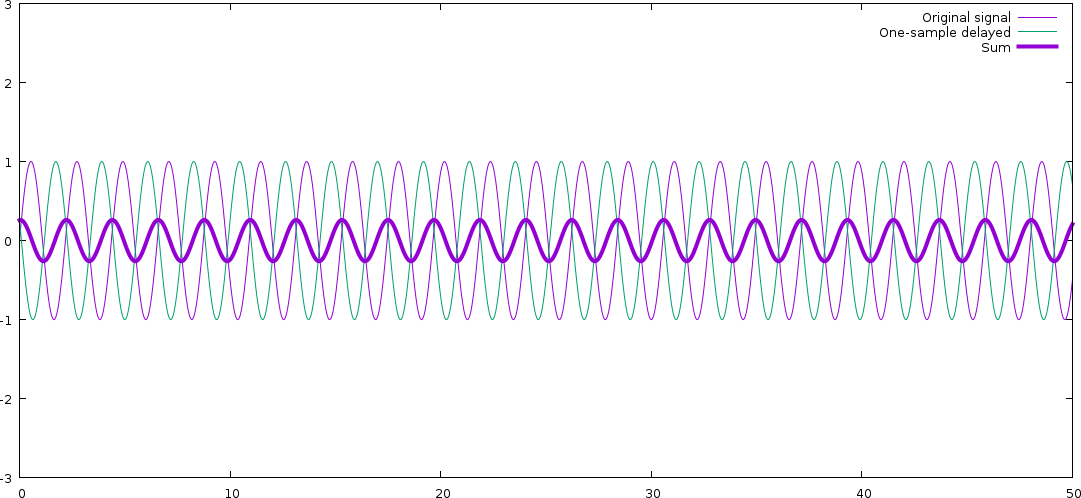
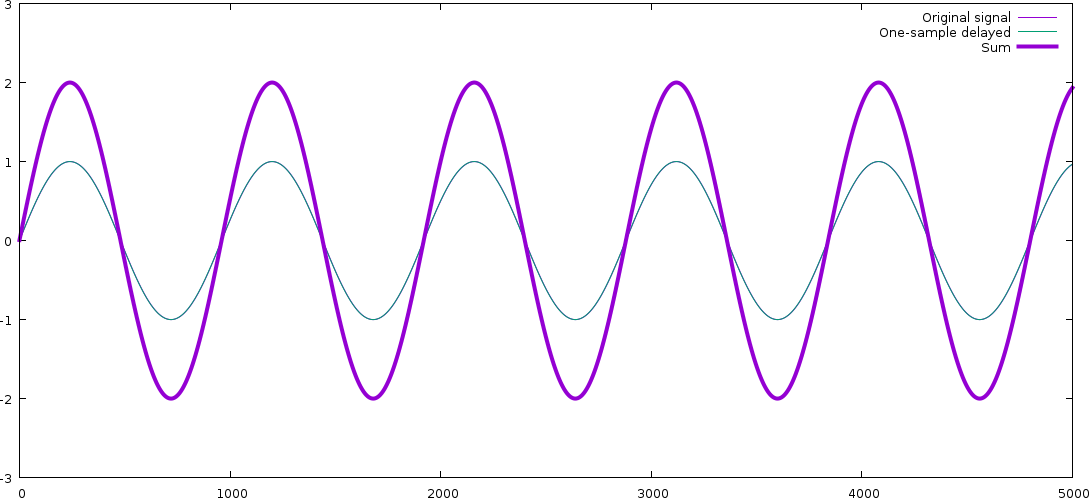
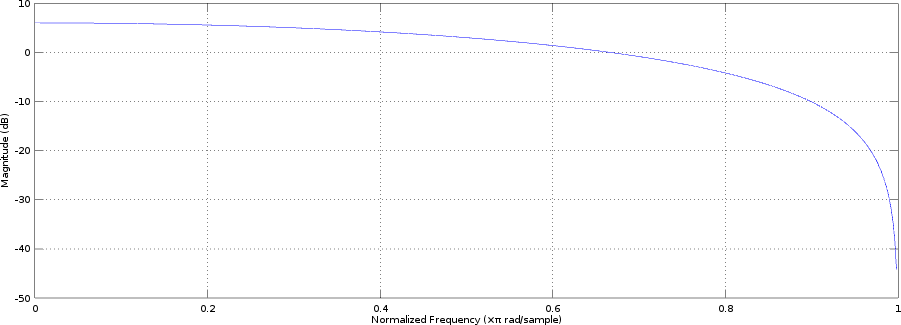
At some point back when the dinosaurs roamed the Earth and I was in high school, I borrowed my first digital signal processing book from a friend. I later went on to an engineering education and master's thesis about DSP, but the very basics of DSP never stop to fascinate me. Today, I wanted to write something about one of them and how it affects audio processing in Nageru (and finally, how Debian's policies put me in a bit of a bind on this issue). DSP texts tend to obscure profound truths with large amounts of maths, so I'll try to present a somewhat less general result that doesn't require going into the mathematical details. That rule is: Adding a signal to weighted, delayed copies of itself is a filtering operation. (It's simple, but ignoring it will have sinister effects, as we'll see later.) Let's see exactly what that means with a motivating example. Let's say that I have a signal where I want to get rid of (or rather, reduce) high frequencies. The simplest way I can think of is to add every neighboring sample; that is, set yn = xn + xn-1. For each sample, we add the previous sample, ie., the signal as it was one sample ago. (We ignore what happens at the edges; the common convention is to assume signals extend out to infinity with zeros.) What effect will this have? We can figure it out with some trigonometry, but let's just demonstrate it by plotting instead: We assume 48 kHz sample rate (which means that our one-sample delay is 20.83 s) and a 22 kHz note (definitely treble!), and plot the signal with one-sample delay (the x axis is sample number): Filtered 22 kHz As you can see, the resulting signal is a new signal of the same frequency (which is always true; linear filtering can never create new frequencies, just boost or dampen existing ones), but with much lower amplitude. The signal and the delayed version of it end up cancelling each other mostly out. Also note that there signal has changed phase; the resulting signal has been a bit delayed compared to the original. Now let's look at a 50 Hz signal (turn on your bass face). We need to zoom out a bit to see full 50 Hz cycles: Filtered 50 Hz The original signal and the delayed one overlap almost exactly! For a lower frequency, the one-sample delay means almost nothing (since the waveform is varying so slowly), and thus, in this case, the resulting signal is amplified, not dampened. (The signal has changed phase here, too actually exactly as much in terms of real time but we don't really see it, because we've zoomed out.) Real signals are not pure sines, but they can be seen as sums of many sines (another fundamental DSP result), and since filtering is a linear operation, it affects those sines independently. In other words, we now have a very simple filter that will amplify low frequencies and dampen high frequencies (and delay the entire signal a little bit). We can do this for all frequencies from 0 to 24000 Hz; let's ask Octave to do it for us: Frequency plot for simple filter (Of course, in a real filter, we'd probably multiply the result with 0.5 to leave the bass untouched instead of boosting it, but it doesn't really change anything. A real filter would have a lot more coefficients, though, and they wouldn't all be the same!) Let's now turn to a problem that will at first seem different: Combining audio from multiple different time sources. For instance, when mixing video, you could have input from two different cameras or sounds card and would want to combine them (say, a source playing music and then some audience sound from a camera). However, unless you are lucky enough to have a professional-grade setup where everything runs off the same clock (and separate clock source cables run to every device), they won't be in sync; sample clocks are good, but they are not perfect, and they have e.g. some temperature variance. Say we have really good clocks and they only differ by 0.01%; this means that after an hour of streaming, we have 360 ms delay, completely ruining lip sync! This means we'll need to resample at least one of the sources to match the other; that is, play one of them faster or slower than it came in originally. There are two problems here: How do you determine how much to resample the signals, and how do we resample them? The former is a difficult problem in its own right; about every algorithm not backed in solid control theory is doomed to fail in one way or another, and when they fail, it's extremely annoying to listen to. Nageru follows a 2012 paper by Fons Adriaensen; GStreamer does well, something else. It fails pretty badly in a number of cases; see e.g. this 2015 master's thesis that tries to patch it up. However, let's ignore this part of the problem for now and focus on the resampling. So let's look at the case where we've determined we have a signal and need to play it 0.01% faster (or slower); in a real situation, this number would vary a bit (clocks are not even consistently wrong). This means that at some point, we want to output sample number 3000 and that corresponds to input sample number 3000.3, ie., we need to figure out what's between two input samples. As with so many other things, there's a way to do this that's simple, obvious and wrong, namely linear interpolation. The basis of linear interpolation is to look at the two neighboring samples and weigh them according to the position we want. If we need sample 3000.3, we calculate y = 0.7 x3000 + 0.3 x3001 (don't switch the two coefficients!), or, if we want to save one multiplication and get better numerical behavior, we can use the equivalent y = x3000 + 0.3 (x3001 - x3000). And if we need sample 5000.5, we take y = 0.5 x5000 + 0.5 x5001. And after a while, we'll be back on integer samples; output sample 10001 corresponds to x10000 exactly. By now, I guess it should be obvious what's going on: We're creating a filter! Linear interpolation will inevitably result in high frequencies being dampened; and even worse, we are creating a time-varying filter, which means that the amount of dampening will vary over time. This manifests itself as a kind of high-frequency flutter , where the amount of flutter depends on the relative resampling frequencies. There's also cubic resampling (which can mean any of several different algorithms), but it only really reduces the problem, it doesn't really solve it. The proper way of interpolating depends a lot on exactly what you want (e.g., whether you intend to change the rate quickly or not); this paper lays out a bunch of them, and was the paper that originally made me understand why linear interpolation is so bad. Nageru outsources this problem to zita-resampler, again by Fons Adriaensen; it yields extremely high-quality resampling under controlled delay, through a relatively common technique known as polyphase filters. Unfortunately, doing this kind of calculations takes CPU. Not a lot of CPU, but Nageru runs in rather CPU-challenged environments (ultraportable laptops where the GPU wants most of the TDP, and the CPU has to go down to the lowest frequency), and it is moving in a direction where it needs to resample many more channels (more on the later), so every bit of CPU helps. So I coded up an SSE optimization of the inner loop for a particular common case (stereo signals) and sent it in for upstream inclusion. (It made the code 2.7 times as fast without any structural changes or reducing precision, which is pretty much what you can expect from SSE.) Unfortunately, after a productive discussion, suddenly upstream went silent. I tried pinging, pinging again, and after half a year pinging again, but to no avail. I filed the patch in Debian's BTS, but the maintainer understandably is reluctant to carry a delta against upstream. I also can't embed a copy; Debian policy would dictate that I build against the system's zita-resampler. I could work around it by rewriting zita-resampler until it looks nothing like the original, which might be a good idea anyway if I wanted to squeeze out the last drops of speed; there are AVX optimizations to be had in addition to SSE, and the structure as-is isn't ideal for SSE optimizations (although some of the changes I have in mind would have to be offset against increased L1 cache footprint, so careful benchmarking would be needed). But in a sense, it feels like just working around a policy that's there for good reason. So like I said, I'm in a bit of a bind. Maybe I should just buy a faster laptop. Oh, and how does GStreamer solve this? Well, it doesn't use linear interpolation. It does something even worse it uses nearest neighbor. Gah. Update: I was asked to clarify that this is about the audio resampling done by the GStreamer audio sink to sync signals, not in the audioresample element, which solves a related but different problem (static sample rate conversion). The audioresample element supports a number of different resampling methods; I haven't evaluated them.
Dirk Eddelbuettel: rfoaas 1.0.0

rfoaas greed example The big 1.0.0 is here! Following the unsurpassed lead of the FOAAS project, we have arrived at a milestone: Release 1.0.0 is now on CRAN. The rfoaas package provides an interface for R to the most excellent FOAAS service--which itself provides a modern, scalable and RESTful web service for the frequent need to tell someone to f$#@ off. Release 1.0.0 brings fourteen (!!) new access points: back(), bm(), gfy(), think(), keep(), single_(), look(), looking(), no(), give(), zero(), pulp(), sake(), and anyway(). All with documentation and testing. Even more neatly, thanks to a very pull request by Tyler Hunt, we can now issue random FOs via the getRandomFO() function! As usual, CRANberries provides a diff to the previous CRAN release. Questions, comments etc should go to the GitHub issue tracker. More background information is on the project page as well as on the github repo

This post by Dirk Eddelbuettel originated on his Thinking inside the box blog. Please report excessive re-aggregation in third-party for-profit settings.

Next.

Previous.