Search Results: "tin"

9 March 2024

Iustin Pop: Finally learning some Rust - hello photo-backlog-exporter!

After 4? 5? or so years of wanting to learn Rust, over the past 4 or so months I finally bit the bullet and found the motivation to write some Rust. And the subject. And I was, and still am, thoroughly surprised. It s like someone took Haskell, simplified it to some extents, and wrote a systems language out of it. Writing Rust after Haskell seems easy, and pleasant, and you: On the other hand: However, overall, one can clearly see there s more movement in Rust, and the quality of some parts of the toolchain is better (looking at you, rust-analyzer, compared to HLS). So, with that, I ve just tagged photo-backlog-exporter v0.1.0. It s a port of a Python script that was run as a textfile collector, which meant updates every ~15 minutes, since it was a bit slow to start, which I then rewrote in Go (but I don t like Go the language, plus the GC - if I have to deal with a GC, I d rather write Haskell), then finally rewrote in Rust. What does this do? It exports metrics for Prometheus based on the count, age and distribution of files in a directory. These files being, for me, the pictures I still have to sort, cull and process, because I never have enough free time to clear out the backlog. The script is kind of designed to work together with Corydalis, but since it doesn t care about file content, it can also double (easily) as simple file count/age exporter . And to my surprise, writing in Rust is soo pleasant, that the feature list is greater than the original Python script, and - compared to that untested script - I ve rather easily achieved a very high coverage ratio. Rust has multiple types of tests, and the combination allows getting pretty down to details on testing: I had to combine a (large) number of testing crates to get it expressive enough, but it was worth the effort. The last find from yesterday, assert_cmd, is excellent to describe testing/assertion in Rust itself, rather than via a separate, new DSL, like I was using shelltest for, in Haskell. To some extent, I feel like I found the missing arrow in the quiver. Haskell is good, quite very good for some type of workloads, but of course not all, and Rust complements that very nicely, with lots of overlap (as expected). Python can fill in any quick-and-dirty scripting needed. And I just need to learn more frontend, specifically Typescript (the language, not referring to any specific libraries/frameworks), and I ll be ready for AI to take over coding So, for now, I ll need to split my free time coding between all of the above, and keep exercising my skills. But so glad to have found a good new language!

Reproducible Builds: Reproducible Builds in February 2024

Welcome to the February 2024 report from the Reproducible Builds project! In our reports, we try to outline what we have been up to over the past month as well as mentioning some of the important things happening in software supply-chain security.

Reproducible Builds at FOSDEM 2024 Core Reproducible Builds developer Holger Levsen presented at the main track at FOSDEM on Saturday 3rd February this year in Brussels, Belgium. However, that wasn t the only talk related to Reproducible Builds. However, please see our comprehensive FOSDEM 2024 news post for the full details and links.

Maintainer Perspectives on Open Source Software Security Bernhard M. Wiedemann spotted that a recent report entitled Maintainer Perspectives on Open Source Software Security written by Stephen Hendrick and Ashwin Ramaswami of the Linux Foundation sports an infographic which mentions that 56% of [polled] projects support reproducible builds .

Mailing list highlights From our mailing list this month:

Distribution work In Debian this month, 5 reviews of Debian packages were added, 22 were updated and 8 were removed this month adding to Debian s knowledge about identified issues. A number of issue types were updated as well. [ ][ ][ ][ ] In addition, Roland Clobus posted his 23rd update of the status of reproducible ISO images on our mailing list. In particular, Roland helpfully summarised that all major desktops build reproducibly with bullseye, bookworm, trixie and sid provided they are built for a second time within the same DAK run (i.e. [within] 6 hours) and that there will likely be further work at a MiniDebCamp in Hamburg. Furthermore, Roland also responded in-depth to a query about a previous report
Fedora developer Zbigniew J drzejewski-Szmek announced a work-in-progress script called fedora-repro-build that attempts to reproduce an existing package within a koji build environment. Although the projects README file lists a number of fields will always or almost always vary and there is a non-zero list of other known issues, this is an excellent first step towards full Fedora reproducibility.
Jelle van der Waa introduced a new linter rule for Arch Linux packages in order to detect cache files leftover by the Sphinx documentation generator which are unreproducible by nature and should not be packaged. At the time of writing, 7 packages in the Arch repository are affected by this.
Elsewhere, Bernhard M. Wiedemann posted another monthly update for his work elsewhere in openSUSE.

diffoscope diffoscope is our in-depth and content-aware diff utility that can locate and diagnose reproducibility issues. This month, Chris Lamb made a number of changes such as uploading versions 256, 257 and 258 to Debian and made the following additional changes:
  • Use a deterministic name instead of trusting gpg s use-embedded-filenames. Many thanks to Daniel Kahn Gillmor dkg@debian.org for reporting this issue and providing feedback. [ ][ ]
  • Don t error-out with a traceback if we encounter struct.unpack-related errors when parsing Python .pyc files. (#1064973). [ ]
  • Don t try and compare rdb_expected_diff on non-GNU systems as %p formatting can vary, especially with respect to MacOS. [ ]
  • Fix compatibility with pytest 8.0. [ ]
  • Temporarily fix support for Python 3.11.8. [ ]
  • Use the 7zip package (over p7zip-full) after a Debian package transition. (#1063559). [ ]
  • Bump the minimum Black source code reformatter requirement to 24.1.1+. [ ]
  • Expand an older changelog entry with a CVE reference. [ ]
  • Make test_zip black clean. [ ]
In addition, James Addison contributed a patch to parse the headers from the diff(1) correctly [ ][ ] thanks! And lastly, Vagrant Cascadian pushed updates in GNU Guix for diffoscope to version 255, 256, and 258, and updated trydiffoscope to 67.0.6.

reprotest reprotest is our tool for building the same source code twice in different environments and then checking the binaries produced by each build for any differences. This month, Vagrant Cascadian made a number of changes, including:
  • Create a (working) proof of concept for enabling a specific number of CPUs. [ ][ ]
  • Consistently use 398 days for time variation rather than choosing randomly and update README.rst to match. [ ][ ]
  • Support a new --vary=build_path.path option. [ ][ ][ ][ ]

Website updates There were made a number of improvements to our website this month, including:

Reproducibility testing framework The Reproducible Builds project operates a comprehensive testing framework (available at tests.reproducible-builds.org) in order to check packages and other artifacts for reproducibility. In February, a number of changes were made by Holger Levsen:
  • Debian-related changes:
    • Temporarily disable upgrading/bootstrapping Debian unstable and experimental as they are currently broken. [ ][ ]
    • Use the 64-bit amd64 kernel on all i386 nodes; no more 686 PAE kernels. [ ]
    • Add an Erlang package set. [ ]
  • Other changes:
    • Grant Jan-Benedict Glaw shell access to the Jenkins node. [ ]
    • Enable debugging for NetBSD reproducibility testing. [ ]
    • Use /usr/bin/du --apparent-size in the Jenkins shell monitor. [ ]
    • Revert reproducible nodes: mark osuosl2 as down . [ ]
    • Thanks again to Codethink, for they have doubled the RAM on our arm64 nodes. [ ]
    • Only set /proc/$pid/oom_score_adj to -1000 if it has not already been done. [ ]
    • Add the opemwrt-target-tegra and jtx task to the list of zombie jobs. [ ][ ]
Vagrant Cascadian also made the following changes:
  • Overhaul the handling of OpenSSH configuration files after updating from Debian bookworm. [ ][ ][ ]
  • Add two new armhf architecture build nodes, virt32z and virt64z, and insert them into the Munin monitoring. [ ][ ] [ ][ ]
In addition, Alexander Couzens updated the OpenWrt configuration in order to replace the tegra target with mpc85xx [ ], Jan-Benedict Glaw updated the NetBSD build script to use a separate $TMPDIR to mitigate out of space issues on a tmpfs-backed /tmp [ ] and Zheng Junjie added a link to the GNU Guix tests [ ]. Lastly, node maintenance was performed by Holger Levsen [ ][ ][ ][ ][ ][ ] and Vagrant Cascadian [ ][ ][ ][ ].

Upstream patches The Reproducible Builds project detects, dissects and attempts to fix as many currently-unreproducible packages as possible. We endeavour to send all of our patches upstream where appropriate. This month, we wrote a large number of such patches, including:

If you are interested in contributing to the Reproducible Builds project, please visit our Contribute page on our website. However, you can get in touch with us via:

Valhalla's Things: Elastic Neck Top Two: MOAR Ruffles

Posted on March 9, 2024
Tags: madeof:atoms, craft:sewing, FreeSoftWear
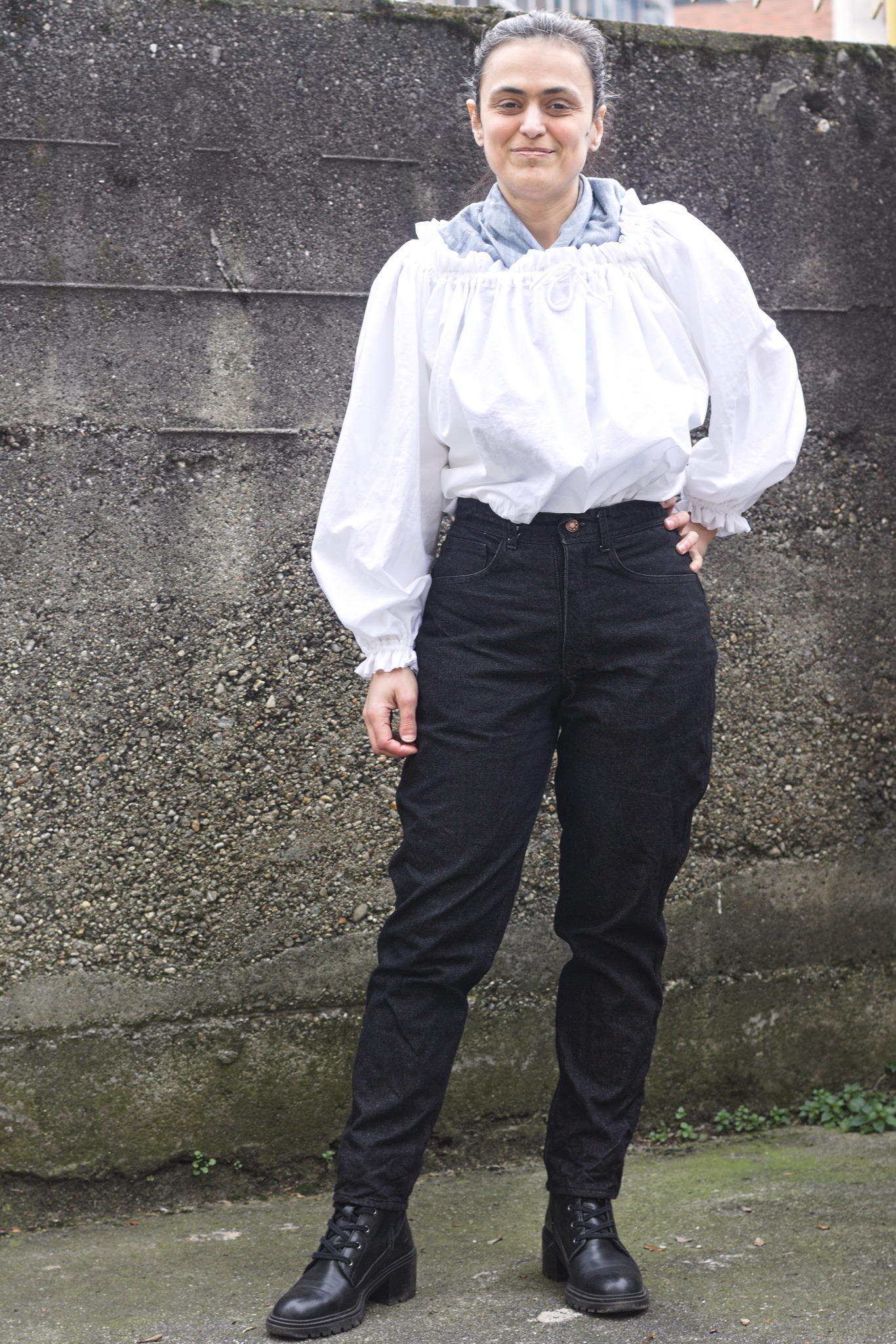
A woman wearing a white top with a wide neck with ruffles and puffy sleeves that are gathered at the cuff. The top is tucked in the trousers to gather the fullness at the waist. After making my Elastic Neck Top I knew I wanted to make another one less constrained by the amount of available fabric. I had a big cut of white cotton voile, I bought some more swimsuit elastic, and I also had a spool of n 100 sewing cotton, but then I postponed the project for a while I was working on other things. Then FOSDEM 2024 arrived, I was going to remote it, and I was working on my Augusta Stays, but I knew that in the middle of FOSDEM I risked getting to the stage where I needed to leave the computer to try the stays on: not something really compatible with the frenetic pace of a FOSDEM weekend, even one spent at home. I needed a backup project1, and this was perfect: I already had everything I needed, the pattern and instructions were already on my site (so I didn t need to take pictures while working), and it was mostly a lot of straight seams, perfect while watching conference videos. So, on the Friday before FOSDEM I cut all of the pieces, then spent three quarters of FOSDEM on the stays, and when I reached the point where I needed to stop for a fit test I started on the top. Like the first one, everything was sewn by hand, and one week after I had started everything was assembled, except for the casings for the elastic at the neck and cuffs, which required about 10 km of sewing, and even if it was just a running stitch it made me want to reconsider my lifestyle choices a few times: there was really no reason for me not to do just those seams by machine in a few minutes. Instead I kept sewing by hand whenever I had time for it, and on the next weekend it was ready. We had a rare day of sun during the weekend, so I wore my thermal underwear, some other layer, a scarf around my neck, and went outside with my SO to have a batch of pictures taken (those in the jeans posts, and others for a post I haven t written yet. Have I mentioned I have a backlog?). And then the top went into the wardrobe, and it will come out again when the weather will be a bit warmer. Or maybe it will be used under the Augusta Stays, since I don t have a 1700 chemise yet, but that requires actually finishing them. The pattern for this project was already online, of course, but I ve added a picture of the casing to the relevant section, and everything is as usual #FreeSoftWear.

  1. yes, I could have worked on some knitting WIP, but lately I m more in a sewing mood.

8 March 2024

Louis-Philippe V ronneau: Acts of active procrastination: example of a silly Python script for Moodle

My brain is currently suffering from an overload caused by grading student assignments. In search of a somewhat productive way to procrastinate, I thought I would share a small script I wrote sometime in 2023 to facilitate my grading work. I use Moodle for all the classes I teach and students use it to hand me out their papers. When I'm ready to grade them, I download the ZIP archive Moodle provides containing all their PDF files and comment them using xournalpp and my Wacom tablet. Once this is done, I have a directory structure that looks like this:

Assignment FooBar/
  Student A_21100_assignsubmission_file
    graded paper.pdf
    Student A's perfectly named assignment.pdf
    Student A's perfectly named assignment.xopp
  Student B_21094_assignsubmission_file
    graded paper.pdf
    Student B's perfectly named assignment.pdf
    Student B's perfectly named assignment.xopp
  Student C_21093_assignsubmission_file
    graded paper.pdf
    Student C's perfectly named assignment.pdf
    Student C's perfectly named assignment.xopp
 
Before I can upload files back to Moodle, this directory needs to be copied (I have to keep the original files), cleaned of everything but the graded paper.pdf files and compressed in a ZIP. You can see how this can quickly get tedious to do by hand. Not being a complete tool, I often resorted to crafting a few spurious shell one-liners each time I had to do this1. Eventually I got tired of ctrl-R-ing my shell history and wrote something reusable. Behold this script! When I began writing this post, I was certain I had cheaped out on my 2021 New Year's resolution and written it in Shell, but glory!, it seems I used a proper scripting language instead.
#!/usr/bin/python3
# Copyright (C) 2023, Louis-Philippe V ronneau <pollo@debian.org>
#
# This program is free software: you can redistribute it and/or modify
# it under the terms of the GNU General Public License as published by
# the Free Software Foundation, either version 3 of the License, or
# (at your option) any later version.
#
# This program is distributed in the hope that it will be useful,
# but WITHOUT ANY WARRANTY; without even the implied warranty of
# MERCHANTABILITY or FITNESS FOR A PARTICULAR PURPOSE.  See the
# GNU General Public License for more details.
#
# You should have received a copy of the GNU General Public License
# along with this program.  If not, see <http://www.gnu.org/licenses/>.
"""
This script aims to take a directory containing PDF files exported via the
Moodle mass download function, remove everything but the final files to submit
back to the students and zip it back.
usage: ./moodle-zip.py <target_dir>
"""
import os
import shutil
import sys
import tempfile
from fnmatch import fnmatch
def sanity(directory):
    """Run sanity checks before doing anything else"""
    base_directory = os.path.basename(os.path.normpath(directory))
    if not os.path.isdir(directory):
        sys.exit(f"Target directory  directory  is not a valid directory")
    if os.path.exists(f"/tmp/ base_directory .zip"):
        sys.exit(f"Final ZIP file path '/tmp/ base_directory .zip' already exists")
    for root, dirnames, _ in os.walk(directory):
        for dirname in dirnames:
            corrige_present = False
            for file in os.listdir(os.path.join(root, dirname)):
                if fnmatch(file, 'graded paper.pdf'):
                    corrige_present = True
            if corrige_present is False:
                sys.exit(f"Directory  dirname  does not contain a 'graded paper.pdf' file")
def clean(directory):
    """Remove superfluous files, to keep only the graded PDF"""
    with tempfile.TemporaryDirectory() as tmp_dir:
        shutil.copytree(directory, tmp_dir, dirs_exist_ok=True)
        for root, _, filenames in os.walk(tmp_dir):
            for file in filenames:
                if not fnmatch(file, 'graded paper.pdf'):
                    os.remove(os.path.join(root, file))
        compress(tmp_dir, directory)
def compress(directory, target_dir):
    """Compress directory into a ZIP file and save it to the target dir"""
    target_dir = os.path.basename(os.path.normpath(target_dir))
    shutil.make_archive(f"/tmp/ target_dir ", 'zip', directory)
    print(f"Final ZIP file has been saved to '/tmp/ target_dir .zip'")
def main():
    """Main function"""
    target_dir = sys.argv[1]
    sanity(target_dir)
    clean(target_dir)
if __name__ == "__main__":
    main()
If for some reason you happen to have a similar workflow as I and end up using this script, hit me up? Now, back to grading...

  1. If I recall correctly, the lazy way I used to do it involved copying the directory, renaming the extension of the graded paper.pdf files, deleting all .pdf and .xopp files using find and changing graded paper.foobar back to a PDF. Some clever regex or learning awk from the ground up could've probably done the job as well, but you know, that would have required using my brain and spending spoons...

Valhalla's Things: Denim Waistcoat

Posted on March 8, 2024
Tags: madeof:atoms, craft:sewing, FreeSoftWear
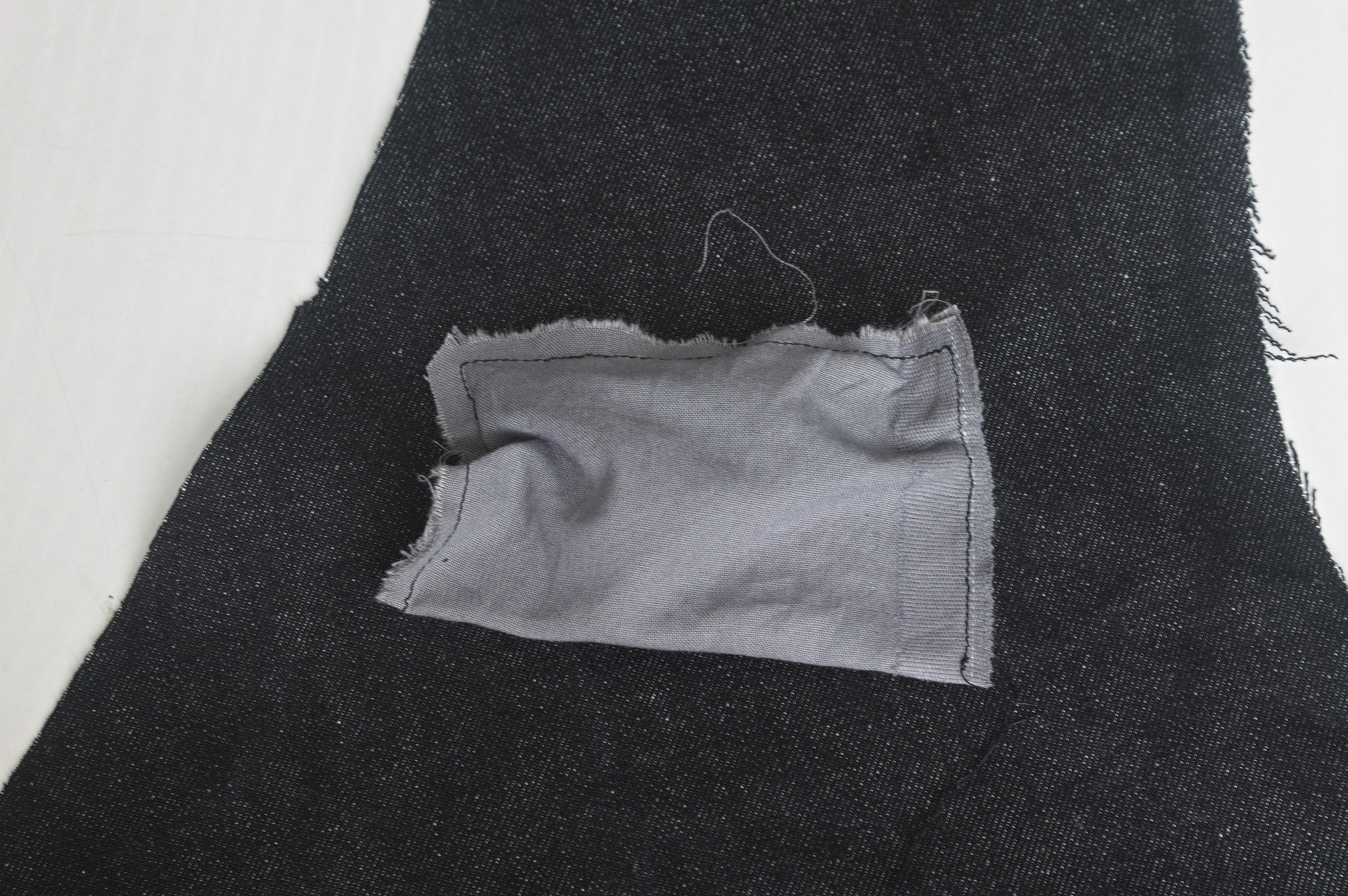
A woman wearing a single breasted waistcoat with double darts at the waist, two pocket flaps at the waist and one on the left upper breast. It has four jeans buttons. I had finished sewing my jeans, I had a scant 50 cm of elastic denim left. Unrelated to that, I had just finished drafting a vest with Valentina, after the Cutters Practical Guide to the Cutting of Ladies Garments. A new pattern requires a (wearable) mockup. 50 cm of leftover fabric require a quick project. The decision didn t take a lot of time. As a mockup, I kept things easy: single layer with no lining, some edges finished with a topstitched hem and some with bias tape, and plain tape on the fronts, to give more support to the buttons and buttonholes. I did add pockets: not real welt ones (too much effort on denim), but simple slits covered by flaps. a rectangle of pocketing fabric on the wrong side of a denim
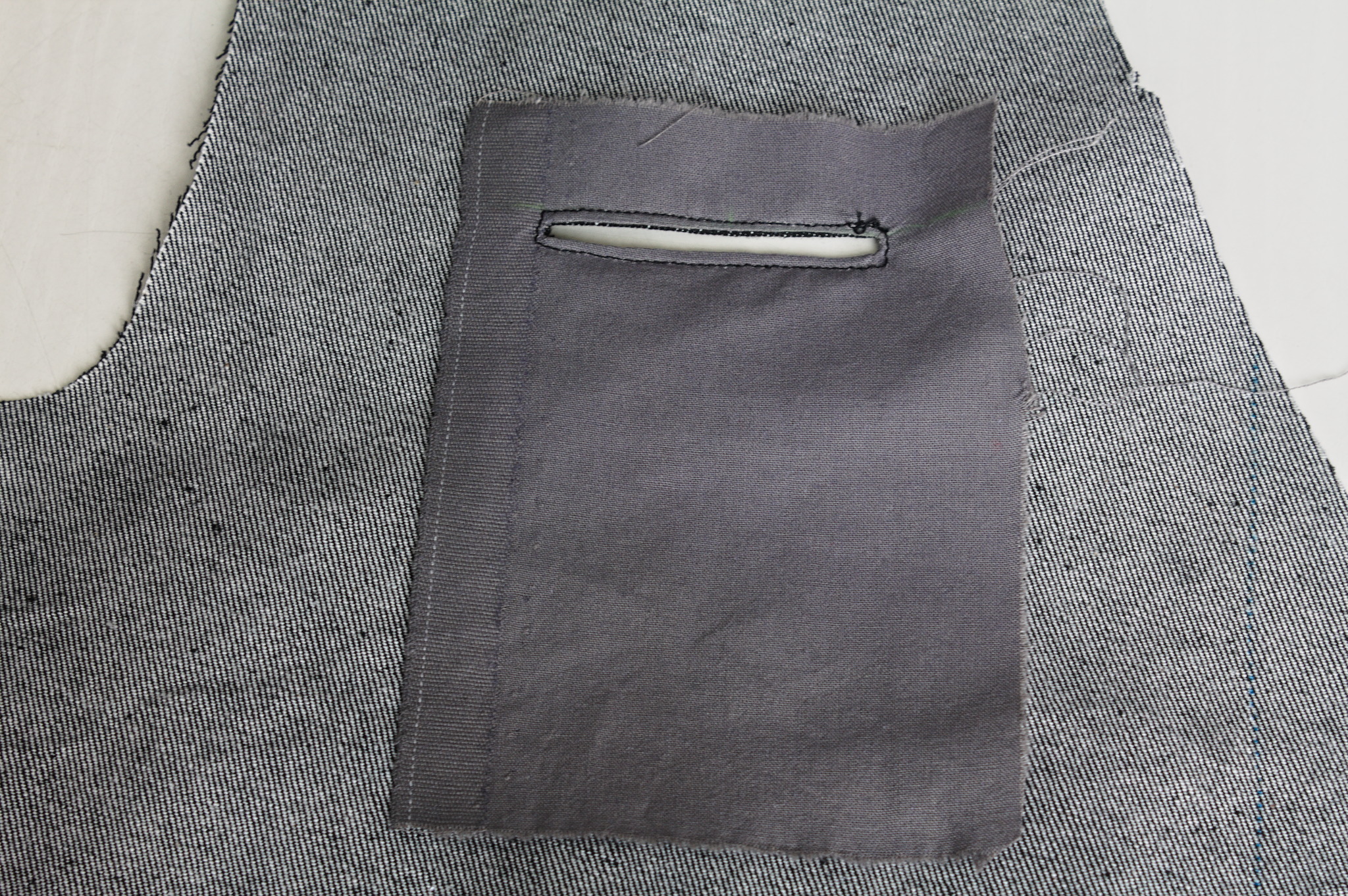
piece; there is a slit in the middle that has been finished with topstitching.
To do them I marked the slits, then I cut two rectangles of pocketing fabric that should have been as wide as the slit + 1.5 cm (width of the pocket) + 3 cm (allowances) and twice the sum of as tall as I wanted the pocket to be plus 1 cm (space above the slit) + 1.5 cm (allowances). Then I put the rectangle on the right side of the denim, aligned so that the top edge was 2.5 cm above the slit, sewed 2 mm from the slit, cut, turned the pocketing to the wrong side, pressed and topstitched 2 mm from the fold to finish the slit. a piece of pocketing fabric folded in half and sewn on all 3
other sides; it does not lay flat on the right side of the fabric because the finished slit (hidden in the picture) is pulling it.
Then I turned the pocketing back to the right side, folded it in half, sewed the side and top seams with a small allowance, pressed and turned it again to the wrong side, where I sewed the seams again to make a french seam. And finally, a simple rectangular denim flap was topstitched to the front, covering the slits. I wasn t as precise as I should have been and the pockets aren t exactly the right size, but they will do to see if I got the positions right (I think that the breast one should be a cm or so lower, the waist ones are fine), and of course they are tiny, but that s to be expected from a waistcoat. The back of the waistcoat, The other thing that wasn t exactly as expected is the back: the pattern splits the bottom part of the back to give it sufficient spring over the hips . The book is probably published in 1892, but I had already found when drafting the foundation skirt that its idea of hips includes a bit of structure. The enough steel to carry a book or a cup of tea kind of structure. I should have expected a lot of spring, and indeed that s what I got. To fit the bottom part of the back on the limited amount of fabric I had to piece it, and I suspect that the flat felled seam in the center is helping it sticking out; I don t think it s exactly bad, but it is a peculiar look. Also, I had to cut the back on the fold, rather than having a seam in the middle and the grain on a different angle. Anyway, my next waistcoat project is going to have a linen-cotton lining and silk fashion fabric, and I d say that the pattern is good enough that I can do a few small fixes and cut it directly in the lining, using it as a second mockup. As for the wrinkles, there is quite a bit, but it looks something that will be solved by a bit of lightweight boning in the side seams and in the front; it will be seen in the second mockup and the finished waistcoat. As for this one, it s definitely going to get some wear as is, in casual contexts. Except. Well, it s a denim waistcoat, right? With a very different cut from the get a denim jacket and rip out the sleeves , but still a denim waistcoat, right? The kind that you cover in patches, right? Outline of a sewing machine with teeth and crossed bones below it, and the text  home sewing is killing fashion / and it's illegal And I may have screenprinted a home sewing is killing fashion patch some time ago, using the SVG from wikimedia commons / the Home Taping is Killing Music page. And. Maybe I ll wait until I have finished the real waistcoat. But I suspect that one, and other sewing / costuming patches may happen in the future. No regrets, as the words on my seam ripper pin say, right? :D

Reproducible Builds (diffoscope): diffoscope 260 released

The diffoscope maintainers are pleased to announce the release of diffoscope version 260. This version includes the following changes:
[ Chris Lamb ]
* Actually test 7z support in the test_7z set of tests, not the lz4
  functionality. (Closes: reproducible-builds/diffoscope#359)
* In addition, correctly check for the 7z binary being available
  (and not lz4) when testing 7z.
* Prevent a traceback when comparing a contentful .pyc file with an
  empty one. (Re: Debian:#1064973)
You find out more by visiting the project homepage.

7 March 2024

Dirk Eddelbuettel: prrd 0.0.6 at CRAN: Several Improvements

Thrilled to share that a new version of prrd arrived at CRAN yesterday in a first update in two and a half years. prrd facilitates the parallel running [of] reverse dependency [checks] when preparing R packages. It is used extensively for releases I make of Rcpp, RcppArmadillo, RcppEigen, BH, and others. prrd screenshot image The key idea of prrd is simple, and described in some more detail on its webpage and its GitHub repo. Reverse dependency checks are an important part of package development that is easily done in a (serial) loop. But these checks are also generally embarassingly parallel as there is no or little interdependency between them (besides maybe shared build depedencies). See the (dated) screenshot (running six parallel workers, arranged in a split byobu session). This release, the first since 2021, brings a number of enhancments. In particular, the summary function is now improved in several ways. Josh also put in a nice PR that generalizes some setup defaults and values. The release is summarised in the NEWS entry:

Changes in prrd version 0.0.6 (2024-03-06)
  • The summary function has received several enhancements:
    • Extended summary is only running when failures are seen.
    • The summariseQueue function now displays an anticipated completion time and remaining duration.
    • The use of optional package foghorn has been refined, and refactored, when running summaries.
  • The dequeueJobs.r scripts can receive a date argument, the date can be parse via anydate if anytime ins present.
  • The enqueeJobs.r now considers skipped package when running 'addfailed' while ensuring selecting packages are still on CRAN.
  • The CI setup has been updated (twice),
  • Enqueing and dequing functions and scripts now support relative directories, updated documentation (#18 by Joshua Ulrich).

Courtesy of my CRANberries, there is also a diffstat report for this release. If you like this or other open-source work I do, you can sponsor me at GitHub.

This post by Dirk Eddelbuettel originated on his Thinking inside the box blog. Please report excessive re-aggregation in third-party for-profit settings.

Petter Reinholdtsen: Plain text accounting file from your bitcoin transactions

A while back I wrote a small script to extract the Bitcoin transactions in a wallet in the ledger plain text accounting format. The last few days I spent some time to get it working better with more special cases. In case it can be useful for others, here is a copy:
#!/usr/bin/python3
#  -*- coding: utf-8 -*-
#  Copyright (c) 2023-2024 Petter Reinholdtsen
from decimal import Decimal
import json
import subprocess
import time
import numpy
def format_float(num):
    return numpy.format_float_positional(num, trim='-')
accounts =  
    u'amount' : 'Assets:BTC:main',
 
addresses =  
    '' : 'Assets:bankkonto',
    '' : 'Assets:bankkonto',
 
def exec_json(cmd):
    proc = subprocess.Popen(cmd,stdout=subprocess.PIPE)
    j = json.loads(proc.communicate()[0], parse_float=Decimal)
    return j
def list_txs():
    # get all transactions for all accounts / addresses
    c = 0
    txs = []
    txidfee =  
    limit=100000
    cmd = ['bitcoin-cli', 'listtransactions', '*', str(limit)]
    if True:
        txs.extend(exec_json(cmd))
    else:
        # Useful for debugging
        with open('transactions.json') as f:
            txs.extend(json.load(f, parse_float=Decimal))
    #print txs
    for tx in sorted(txs, key=lambda a: a['time']):
#        print tx['category']
        if 'abandoned' in tx and tx['abandoned']:
            continue
        if 'confirmations' in tx and 0 >= tx['confirmations']:
            continue
        when = time.strftime('%Y-%m-%d %H:%M', time.localtime(tx['time']))
        if 'message' in tx:
            desc = tx['message']
        elif 'comment' in tx:
            desc = tx['comment']
        elif 'label' in tx:
            desc = tx['label']
        else:
            desc = 'n/a'
        print("%s %s" % (when, desc))
        if 'address' in tx:
            print("  ; to bitcoin address %s" % tx['address'])
        else:
            print("  ; missing address in transaction, txid=%s" % tx['txid'])
        print(f"  ; amount= tx['amount'] ")
        if 'fee'in tx:
            print(f"  ; fee= tx['fee'] ")
        for f in accounts.keys():
            if f in tx and Decimal(0) != tx[f]:
                amount = tx[f]
                print("  %-20s   %s BTC" % (accounts[f], format_float(amount)))
        if 'fee' in tx and Decimal(0) != tx['fee']:
            # Make sure to list fee used in several transactions only once.
            if 'fee' in tx and tx['txid'] in txidfee \
               and tx['fee'] == txidfee[tx['txid']]:
                True
            else:
                fee = tx['fee']
                print("  %-20s   %s BTC" % (accounts['amount'], format_float(fee)))
                print("  %-20s   %s BTC" % ('Expences:BTC-fee', format_float(-fee)))
                txidfee[tx['txid']] = tx['fee']
        if 'address' in tx and tx['address'] in addresses:
            print("  %s" % addresses[tx['address']])
        else:
            if 'generate' == tx['category']:
                print("  Income:BTC-mining")
            else:
                if amount < Decimal(0):
                    print(f"  Assets:unknown:sent:update-script-addr- tx['address'] ")
                else:
                    print(f"  Assets:unknown:received:update-script-addr- tx['address'] ")
        print()
        c = c + 1
    print("# Found %d transactions" % c)
    if limit == c:
        print(f"# Warning: Limit  limit  reached, consider increasing limit.")
def main():
    list_txs()
main()
It is more of a proof of concept, and I do not expect it to handle all edge cases, but it worked for me, and perhaps you can find it useful too. To get a more interesting result, it is useful to map accounts sent to or received from to accounting accounts, using the addresses hash. As these will be very context dependent, I leave out my list to allow each user to fill out their own list of accounts. Out of the box, 'ledger reg BTC:main' should be able to show the amount of BTCs present in the wallet at any given time in the past. For other and more valuable analysis, a account plan need to be set up in the addresses hash. Here is an example transaction:
2024-03-07 17:00 Donated to good cause
    Assets:BTC:main                           -0.1 BTC
    Assets:BTC:main                       -0.00001 BTC
    Expences:BTC-fee                       0.00001 BTC
    Expences:donations                         0.1 BTC
It need a running Bitcoin Core daemon running, as it connect to it using bitcoin-cli listtransactions * 100000 to extract the transactions listed in the Wallet. As usual, if you use Bitcoin and want to show your support of my activities, please send Bitcoin donations to my address 15oWEoG9dUPovwmUL9KWAnYRtNJEkP1u1b.

Gunnar Wolf: Constructed truths truth and knowledge in a post-truth world

This post is a review for Computing Reviews for Constructed truths truth and knowledge in a post-truth world , a book published in Springer Link
Many of us grew up used to having some news sources we could implicitly trust, such as well-positioned newspapers and radio or TV news programs. We knew they would only hire responsible journalists rather than risk diluting public trust and losing their brand s value. However, with the advent of the Internet and social media, we are witnessing what has been termed the post-truth phenomenon. The undeniable freedom that horizontal communication has given us automatically brings with it the emergence of filter bubbles and echo chambers, and truth seems to become a group belief. Contrary to my original expectations, the core topic of the book is not about how current-day media brings about post-truth mindsets. Instead it goes into a much deeper philosophical debate: What is truth? Does truth exist by itself, objectively, or is it a social construct? If activists with different political leanings debate a given subject, is it even possible for them to understand the same points for debate, or do they truly experience parallel realities? The author wrote this book clearly prompted by the unprecedented events that took place in 2020, as the COVID-19 crisis forced humanity into isolation and online communication. Donald Trump is explicitly and repeatedly presented throughout the book as an example of an actor that took advantage of the distortions caused by post-truth. The first chapter frames the narrative from the perspective of information flow over the last several decades, on how the emergence of horizontal, uncensored communication free of editorial oversight started empowering the netizens and created a temporary information flow utopia. But soon afterwards, algorithmic gatekeepers started appearing, creating a set of personalized distortions on reality; users started getting news aligned to what they already showed interest in. This led to an increase in polarization and the growth of narrative-framing-specific communities that served as echo chambers for disjoint views on reality. This led to the growth of conspiracy theories and, necessarily, to the science denial and pseudoscience that reached unimaginable peaks during the COVID-19 crisis. Finally, when readers decide based on completely subjective criteria whether a scientific theory such as global warming is true or propaganda, or question what most traditional news outlets present as facts, we face the phenomenon known as fake news. Fake news leads to post-truth, a state where it is impossible to distinguish between truth and falsehood, and serves only a rhetorical function, making rational discourse impossible. Toward the end of the first chapter, the tone of writing quickly turns away from describing developments in the spread of news and facts over the last decades and quickly goes deep into philosophy, into the very thorny subject pursued by said discipline for millennia: How can truth be defined? Can different perspectives bring about different truth values for any given idea? Does truth depend on the observer, on their knowledge of facts, on their moral compass or in their honest opinions? Zoglauer dives into epistemology, following various thinkers ideas on what can be understood as truth: constructivism (whether knowledge and truth values can be learnt by an individual building from their personal experience), objectivity (whether experiences, and thus truth, are universal, or whether they are naturally individual), and whether we can proclaim something to be true when it corresponds to reality. For the final chapter, he dives into the role information and knowledge play in assigning and understanding truth value, as well as the value of second-hand knowledge: Do we really own knowledge because we can look up facts online (even if we carefully check the sources)? Can I, without any medical training, diagnose a sickness and treatment by honestly and carefully looking up its symptoms in medical databases? Wrapping up, while I very much enjoyed reading this book, I must confess it is completely different from what I expected. This book digs much more into the abstract than into information flow in modern society, or the impact on early 2020s politics as its editorial description suggests. At 160 pages, the book is not a heavy read, and Zoglauer s writing style is easy to follow, even across the potentially very deep topics it presents. Its main readership is not necessarily computing practitioners or academics. However, for people trying to better understand epistemology through its expressions in the modern world, it will be a very worthy read.

Valhalla's Things: Jeans, step two. And three. And four.

Posted on March 7, 2024
Tags: madeof:atoms, FreeSoftWear
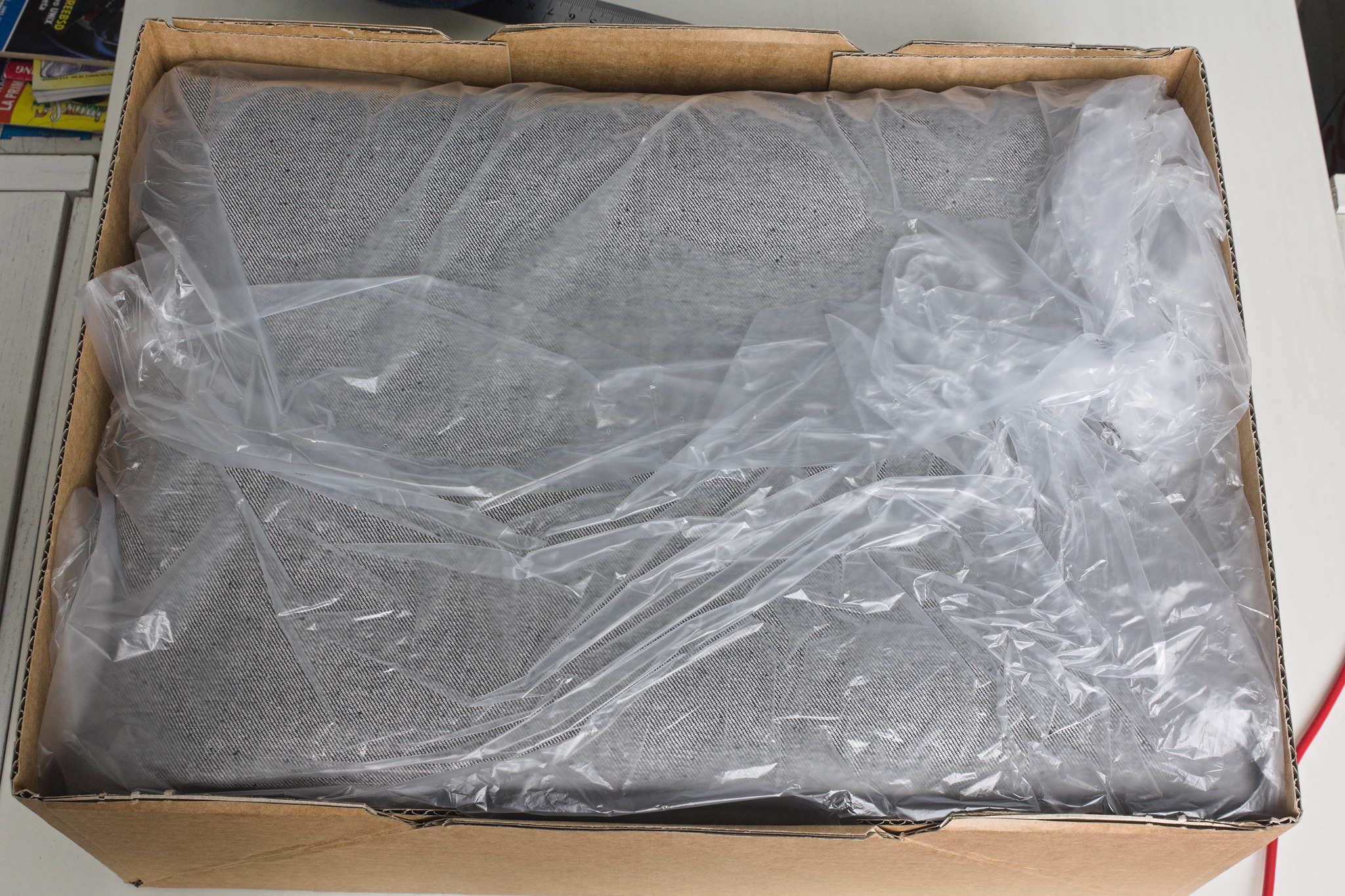
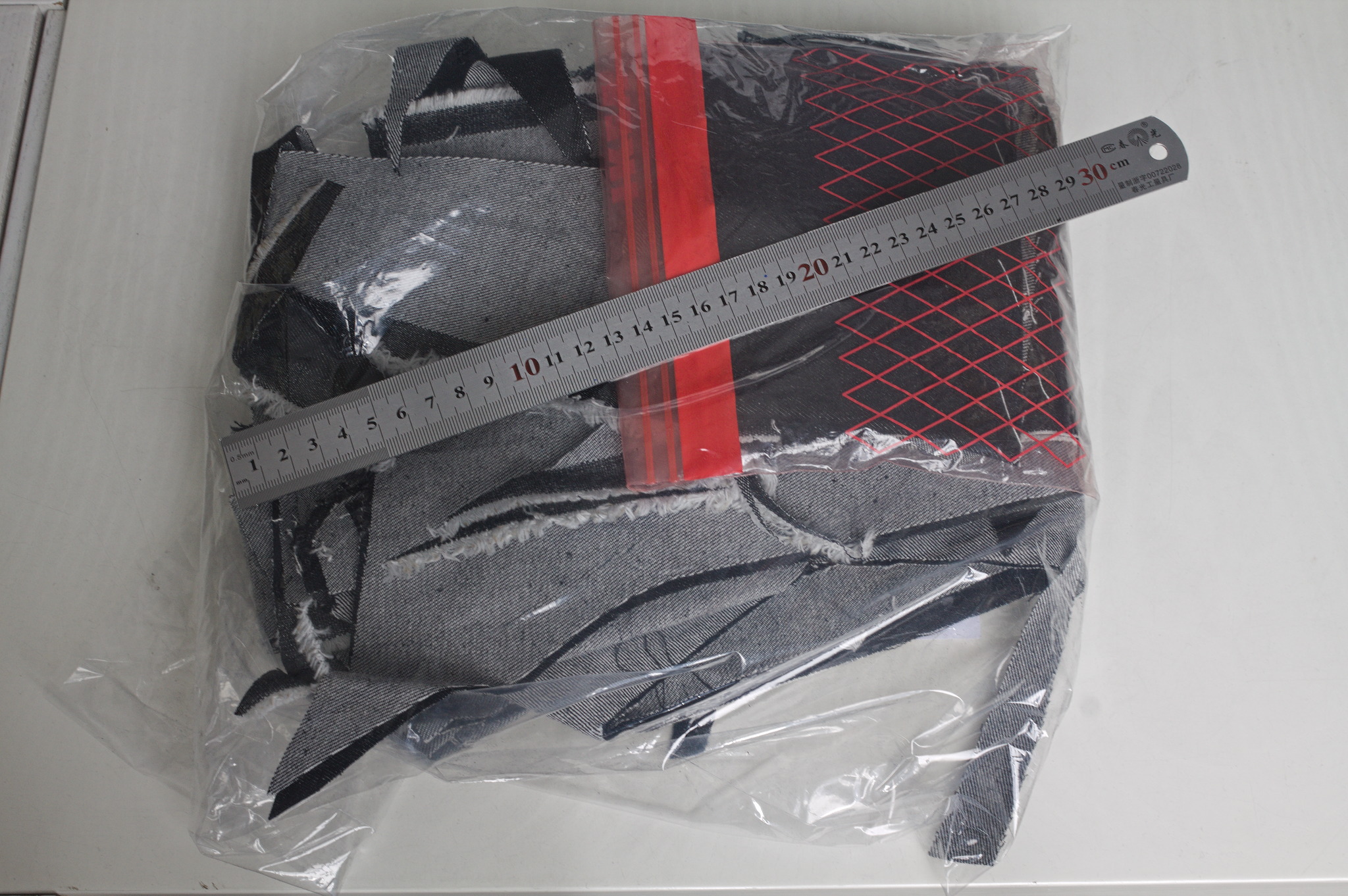
A woman wearing a regular pair of slim-cut black denim jeans. I was working on what looked like a good pattern for a pair of jeans-shaped trousers, and I knew I wasn t happy with 200-ish g/m cotton-linen for general use outside of deep summer, but I didn t have a source for proper denim either (I had been low-key looking for it for a long time). Then one day I looked at an article I had saved about fabric shops that sell technical fabric and while window-shopping on one I found that they had a decent selection of denim in a decent weight. I decided it was a sign, and decided to buy the two heaviest denim they had: a 100% cotton, 355 g/m one and a 97% cotton, 3% elastane at 385 g/m 1; the latter was a bit of compromise as I shouldn t really be buying fabric adulterated with the Scourge of Humanity, but it was heavier than the plain one, and I may be having a thing for tightly fitting jeans, so this may be one of the very few woven fabric where I m not morally opposed to its existence. And, I d like to add, I resisted buying any of the very nice wools they also seem to carry, other than just a couple of samples. Since the shop only sold in 1 meter increments, and I needed about 1.5 meters for each pair of jeans, I decided to buy 3 meters per type, and have enough to make a total of four pair of jeans. A bit more than I strictly needed, maybe, but I was completely out of wearable day-to-day trousers. a cardboard box with neatly folded black denim, covered in semi-transparent plastic. The shop sent everything very quickly, the courier took their time (oh, well) but eventually delivered my fabric on a sunny enough day that I could wash it and start as soon as possible on the first pair. The pattern I did in linen was a bit too fitting, but I was afraid I had widened it a bit too much, so I did the first pair in the 100% cotton denim. Sewing them took me about a week of early mornings and late afternoons, excluding the weekend, and my worries proved false: they were mostly just fine. The only bit that could have been a bit better is the waistband, which is a tiny bit too wide on the back: it s designed to be so for comfort, but the next time I should pull the elastic a bit more, so that it stays closer to the body. The same from the back, showing the applied pockets with a sewn logo. I wore those jeans daily for the rest of the week, and confirmed that they were indeed comfortable and the pattern was ok, so on the next Monday I started to cut the elastic denim. I decided to cut and sew two pairs, assembly-line style, using the shaped waistband for one of them and the straight one for the other one. I started working on them on a Monday, and on that week I had a couple of days when I just couldn t, plus I completely skipped sewing on the weekend, but on Tuesday the next week one pair was ready and could be worn, and the other one only needed small finishes. A woman wearing another pair of jeans; the waistband here is shaped to fit rather than having elastic. And I have to say, I m really, really happy with the ones with a shaped waistband in elastic denim, as they fit even better than the ones with a straight waistband gathered with elastic. Cutting it requires more fabric, but I think it s definitely worth it. But it will be a problem for a later time: right now three pairs of jeans are a good number to keep in rotation, and I hope I won t have to sew jeans for myself for quite some time. A plastic bag with mid-sized offcuts of denim; there is a 30 cm ruler on top that is just wider than the bag I think that the leftovers of plain denim will be used for a skirt or something else, and as for the leftovers of elastic denim, well, there aren t a lot left, but what else I did with them is the topic for another post. Thanks to the fact that they are all slightly different, I ve started to keep track of the times when I wash each pair, and hopefully I will be able to see whether the elastic denim is significantly less durable than the regular, or the added weight compensates for it somewhat. I m not sure I ll manage to remember about saving the data until they get worn, but if I do it will be interesting to know. Oh, and I say I ve finished working on jeans and everything, but I still haven t sewn the belt loops to the third pair. And I m currently wearing them. It s a sewist tradition, or something. :D


  1. The links are to the shop for Italy; you can copy the Codice prodotto and look for it on one of the shop version for other countries (where they apply the right vat etc., but sadly they don t allow to mix and match those settings and the language).

4 March 2024

Paulo Henrique de Lima Santana: Bits from FOSDEM 2023 and 2024

Link para vers o em portugu s

Intro Since 2019, I have traveled to Brussels at the beginning of the year to join FOSDEM, considered the largest and most important Free Software event in Europe. The 2024 edition was the fourth in-person edition in a row that I joined (2021 and 2022 did not happen due to COVID-19) and always with the financial help of Debian, which kindly paid my flight tickets after receiving my request asking for help to travel and approved by the Debian leader. In 2020 I wrote several posts with a very complete report of the days I spent in Brussels. But in 2023 I didn t write anything, and becayse last year and this year I coordinated a room dedicated to translations of Free Software and Open Source projects, I m going to take the opportunity to write about these two years and how it was my experience. After my first trip to FOSDEM, I started to think that I could join in a more active way than just a regular attendee, so I had the desire to propose a talk to one of the rooms. But then I thought that instead of proposing a tal, I could organize a room for talks :-) and with the topic translations which is something that I m very interested in, because it s been a few years since I ve been helping to translate the Debian for Portuguese.

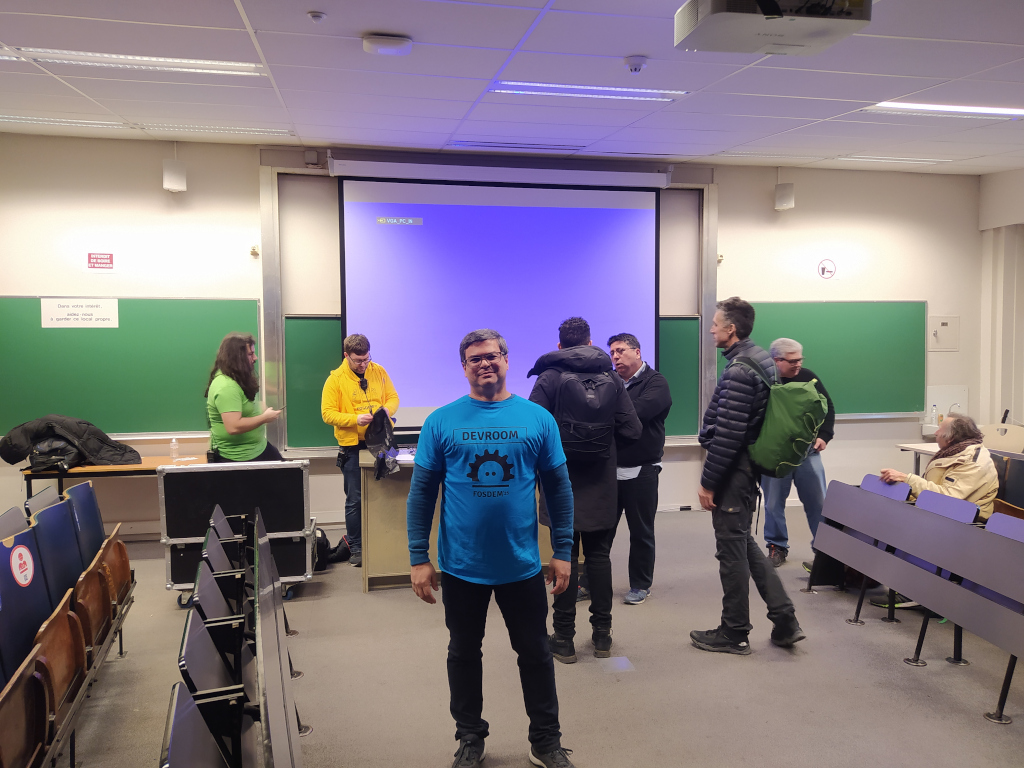
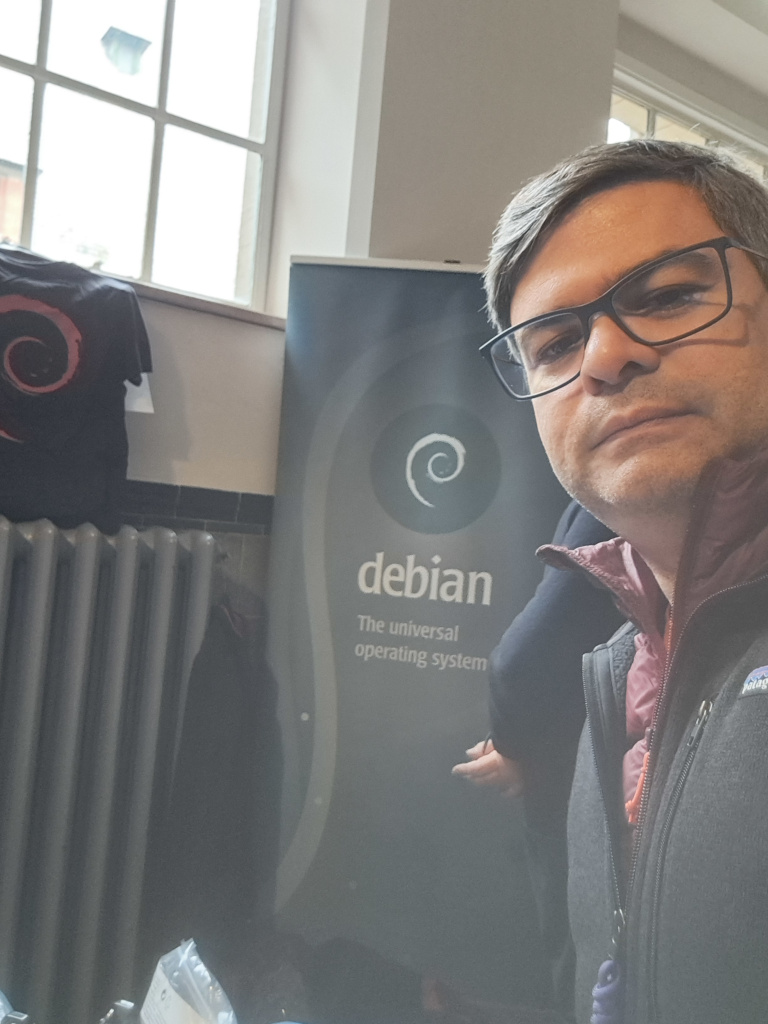
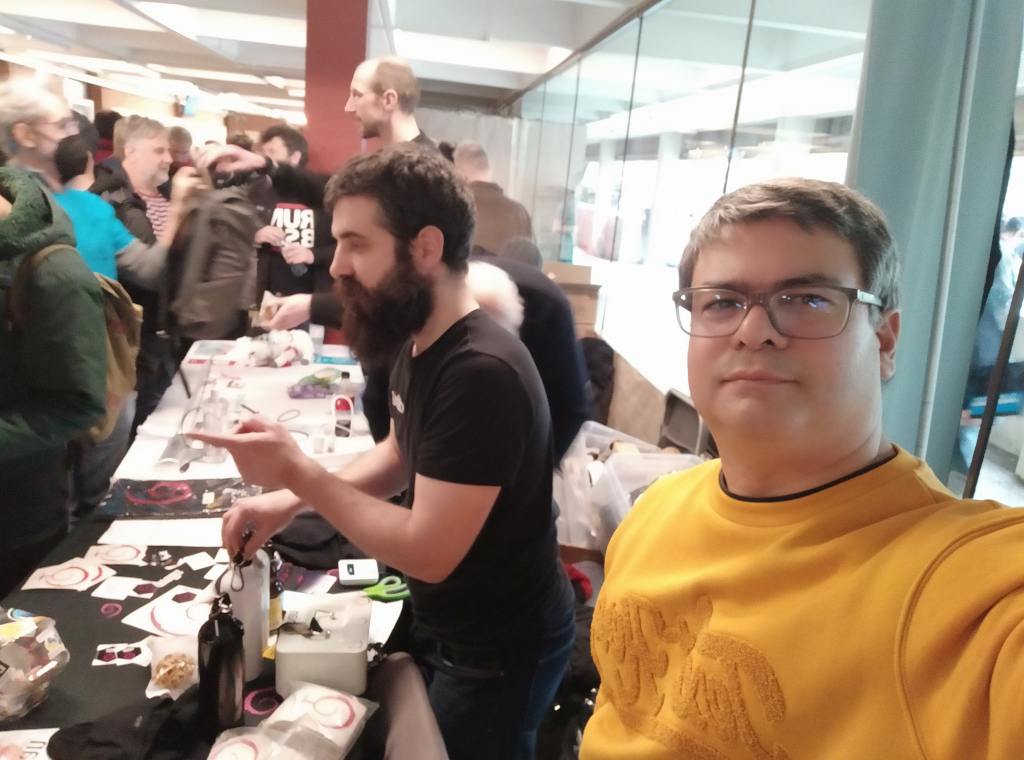
Joining FOSDEM 2023 In the second half of 2022 I did some research and saw that there had never been a room dedicated to translations, so when the FOSDEM organization opened the call to receive room proposals (called DevRoom) for the 2023 edition, I sent a proposal to a translation room and it was accepted! After the room was confirmed, the next step was for me, as room coordinator, to publicize the call for talk proposals. I spent a few weeks hoping to find out if I would receive a good number of proposals or if it would be a failure. But to my happiness, I received eight proposals and I had to select six to schedule the room programming schedule due to time constraints . FOSDEM 2023 took place from February 4th to 5th and the translation devroom was scheduled on the second day in the afternoon. Fosdem 2023 The talks held in the room were these below, and in each of them you can watch the recording video. And on the first day of FOSDEM I was at the Debian stand selling the t-shirts that I had taken from Brazil. People from France were also there selling other products and it was cool to interact with people who visited the booth to buy and/or talk about Debian.
Fosdem 2023

Fosdem 2023
Photos

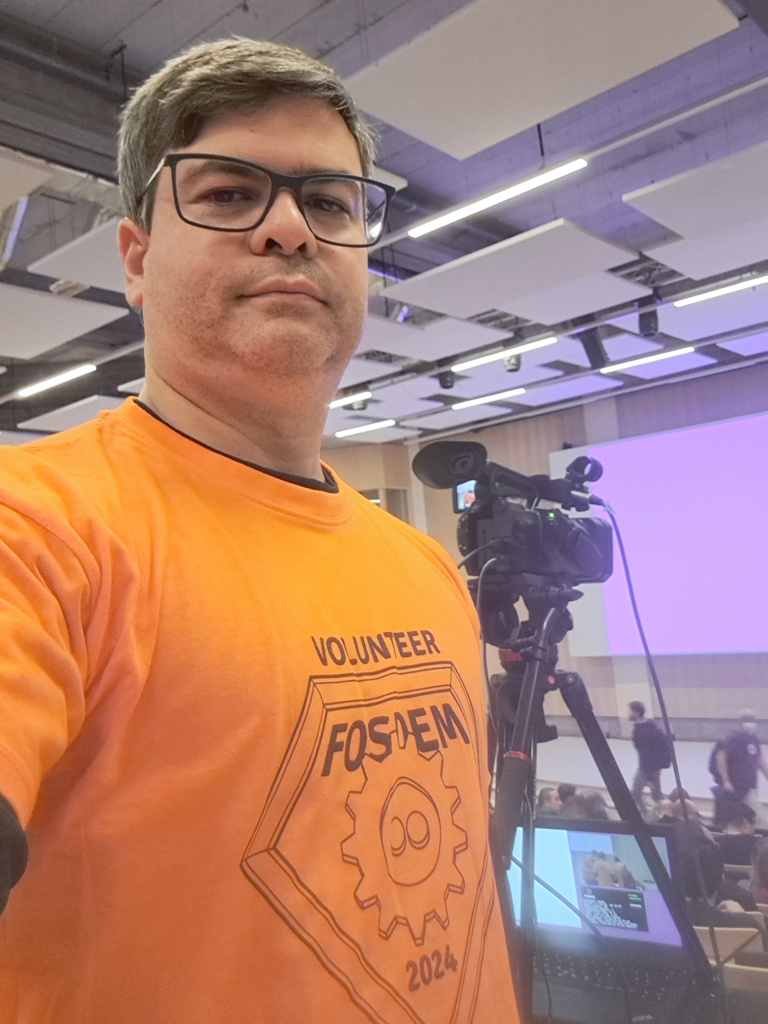
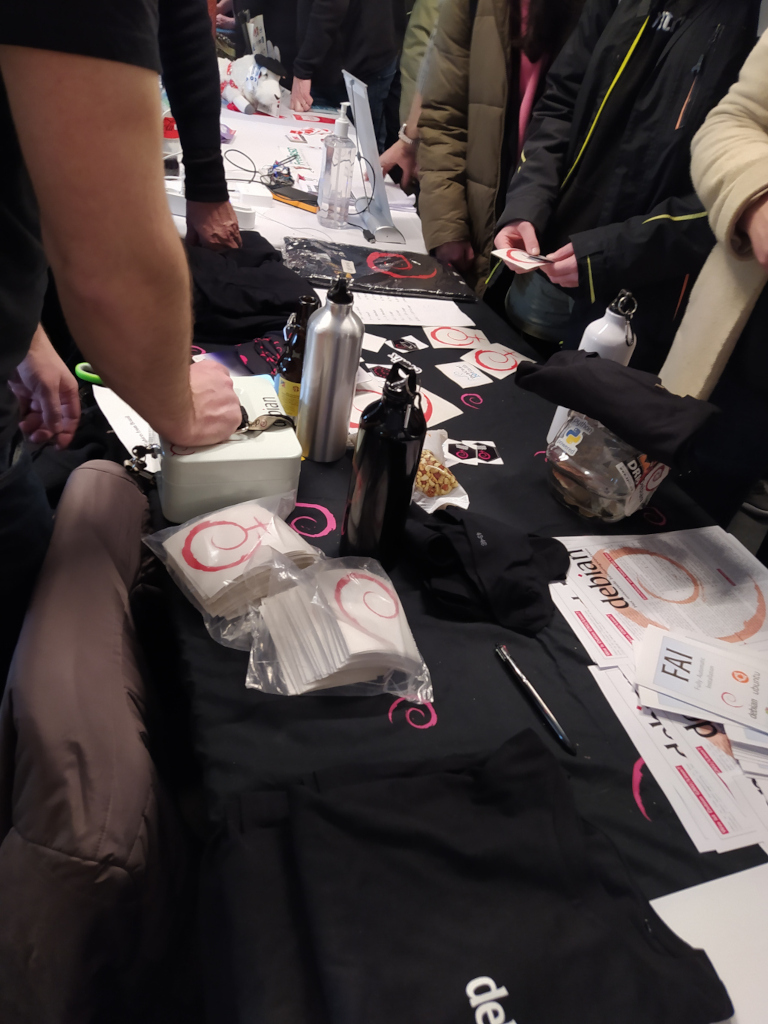
Joining FOSDEM 2024 The 2023 result motivated me to propose the translation devroom again when the FOSDEM 2024 organization opened the call for rooms . I was waiting to find out if the FOSDEM organization would accept a room on this topic for the second year in a row and to my delight, my proposal was accepted again :-) This time I received 11 proposals! And again due to time constraints, I had to select six to schedule the room schedule grid. FOSDEM 2024 took place from February 3rd to 4th and the translation devroom was scheduled for the second day again, but this time in the morning. The talks held in the room were these below, and in each of them you can watch the recording video. This time I didn t help at the Debian stand because I couldn t bring t-shirts to sell from Brazil. So I just stopped by and talked to some people who were there like some DDs. But I volunteered for a few hours to operate the streaming camera in one of the main rooms.
Fosdem 2024

Fosdem 2024
Photos

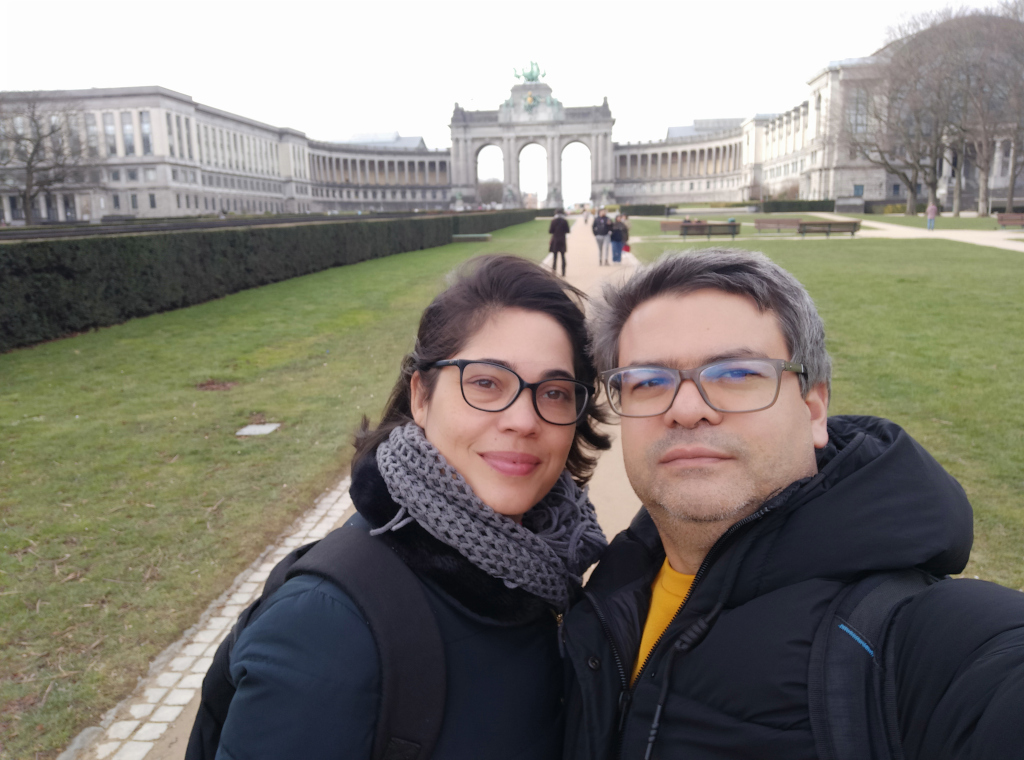
Conclusion The topics of the talks in these two years were quite diverse, and all the lectures were really very good. In the 12 talks we can see how translations happen in some projects such as KDE, PostgreSQL, Debian and Mattermost. We had the presentation of tools such as LibreTranslate, Weblate, scripts, AI, data model. And also reports on the work carried out by communities in Africa, China and Indonesia. The rooms were full for some talks, a little more empty for others, but I was very satisfied with the final result of these two years. I leave my special thanks to Jonathan Carter, Debian Leader who approved my flight tickets requests so that I could join FOSDEM 2023 and 2024. This help was essential to make my trip to Brussels because flight tickets are not cheap at all. I would also like to thank my wife Jandira, who has been my travel partner :-) Bruxelas As there has been an increase in the number of proposals received, I believe that interest in the translations devroom is growing. So I intend to send the devroom proposal to FOSDEM 2025, and if it is accepted, wait for the future Debian Leader to approve helping me with the flight tickets again. We ll see.
Dirk Eddelbuettel: tinythemes 0.0.2 at CRAN: Maintenance

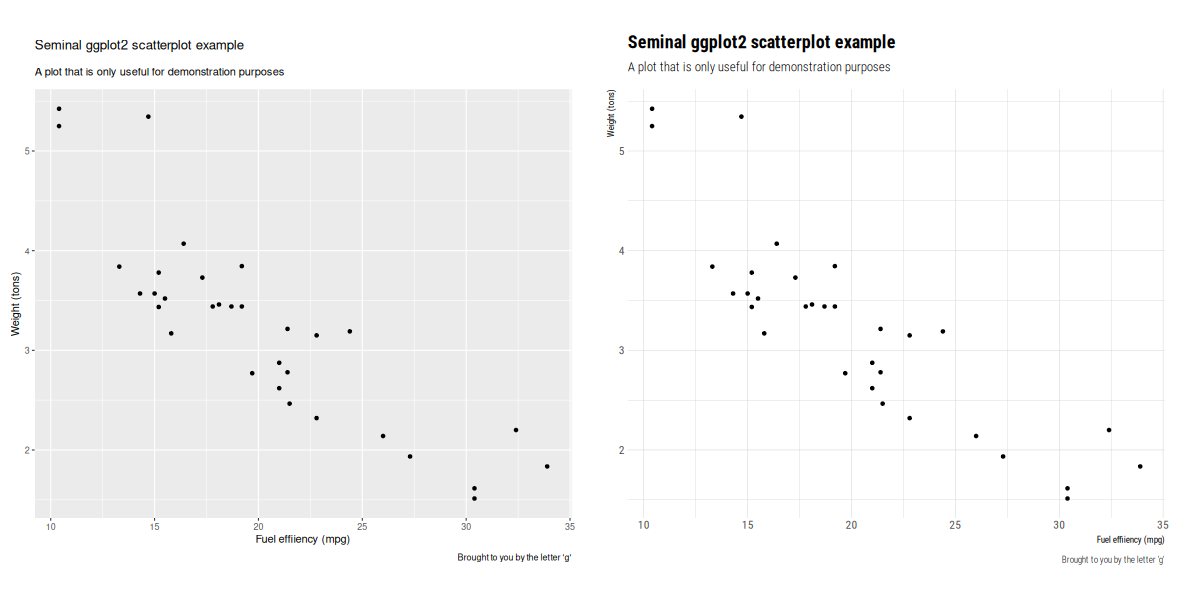
A first maintenance of the still fairly new package tinythemes arrived on CRAN today. tinythemes provides the theme_ipsum_rc() function from hrbrthemes by Bob Rudis in a zero (added) dependency way. A simple example is (also available as a demo inside the package) contrasts the default style (on left) with the one added by this package (on the right): This version mostly just updates to the newest releases of ggplot2 as one must, and takes advantage of Bob s update to hrbrthemes yesterday. The full set of changes since the initial CRAN release follows.

Changes in spdl version 0.0.2 (2024-03-04)
  • Added continuous integrations action based on r2u
  • Added demo/ directory and a READNE.md
  • Minor edits to help page content
  • Synchronised with ggplot2 3.5.0 via hrbrthemes

Courtesy of my CRANberries, there is a diffstat report relative to previous release. More detailed information is on the repo where comments and suggestions are welcome. If you like this or other open-source work I do, you can sponsor me at GitHub.

This post by Dirk Eddelbuettel originated on his Thinking inside the box blog. Please report excessive re-aggregation in third-party for-profit settings.

Colin Watson: Free software activity in January/February 2024

Two months into my new gig and it s going great! Tracking my time has taken a bit of getting used to, but having something that amounts to a queryable database of everything I ve done has also allowed some helpful introspection. Freexian sponsors up to 20% of my time on Debian tasks of my choice. In fact I ve been spending the bulk of my time on debusine which is itself intended to accelerate work on Debian, but more details on that later. While I contribute to Freexian s summaries now, I ve also decided to start writing monthly posts about my free software activity as many others do, to get into some more detail. January 2024 February 2024

3 March 2024

Iustin Pop: New corydalis 2024.9.0 release!

Obligatory and misused quote: It s not dead, Jim! I ve kind of dropped by ball lately on organising my own photo collection, but February was a pretty good month and I managed to write some more code for Corydalis, ending up with the aforementioned new release. The release is not a big one, but I did manage to solve one thing that was annoying me greatly: that lack of ability to play videos inline in one of the two picture viewing modes (in my preferred mode, in fact). Now, whether you re browsing through pictures, or looking at pictures one-by-one, you can in both cases play videos easily, and to some extent, as it should be . No user docs for that, yet (I actually need to split the manual in user/admin/developer parts) I did some more internal cleanups, and I ve enabled building release zips (since that s how GitHub actions creates artifacts), which means it should be 10% easier to test this. The rest 90% is configuring it and pointing to picture folders and and and, so this is definitely not plug-and-play. The diff summary between 2023.44.0 and 2024.9.0 is: 56 files changed, 1412 insertions(+), 700 deletions(-). Which is not bad, but also not too much. The biggest churn was, as expected, in the viewer (due to the aforementioned video playing). The scary part is that the TypeScript code is not at 7.9% (and a tiny more JS, which I can t convert yet due to lack of type definitions upstream). I say scary in quotes, because I would actually like to know Typescript better, but no time. The new release can be seen in action on demo.corydalis.io, and as always, just after release I found two minor issues: Well, there will be future releases. For now, I ve made an open-source package release, which I didn t do in a while, so I m happy . See you!

Dirk Eddelbuettel: RcppArmadillo 0.12.8.1.0 on CRAN: Upstream Fix, Interface Polish

armadillo image Armadillo is a powerful and expressive C++ template library for linear algebra and scientific computing. It aims towards a good balance between speed and ease of use, has a syntax deliberately close to Matlab, and is useful for algorithm development directly in C++, or quick conversion of research code into production environments. RcppArmadillo integrates this library with the R environment and language and is widely used by (currently) 1130 other packages on CRAN, downloaded 32.8 million times (per the partial logs from the cloud mirrors of CRAN), and the CSDA paper (preprint / vignette) by Conrad and myself has been cited 578 times according to Google Scholar. This release brings a new upstream bugfix release Armadillo 12.8.1 prepared by Conrad yesterday. It was delayed for a few hours as CRAN noticed an error in one package which we all concluded was spurious as it could be reproduced outside of the one run there. Following from the previous release, we also use the slighty faster Lighter header in the examples. And once it got to CRAN I also updated the Debian package. The set of changes since the last CRAN release follows.

Changes in RcppArmadillo version 0.12.8.1.0 (2024-03-02)
  • Upgraded to Armadillo release 12.8.1 (Cortisol Injector)
    • Workaround in norm() for yet another bug in macOS accelerate framework
  • Update README for RcppArmadillo usage counts
  • Update examples to use '#include <RcppArmadillo/Lighter>' for faster compilation excluding unused Rcpp features

Courtesy of my CRANberries, there is a diffstat report relative to previous release. More detailed information is on the RcppArmadillo page. Questions, comments etc should go to the rcpp-devel mailing list off the Rcpp R-Forge page. If you like this or other open-source work I do, you can sponsor me at GitHub.

This post by Dirk Eddelbuettel originated on his Thinking inside the box blog. Please report excessive re-aggregation in third-party for-profit settings.

Ben Hutchings: FOSS activity in February 2024

2 March 2024

Ravi Dwivedi: Malaysia Trip

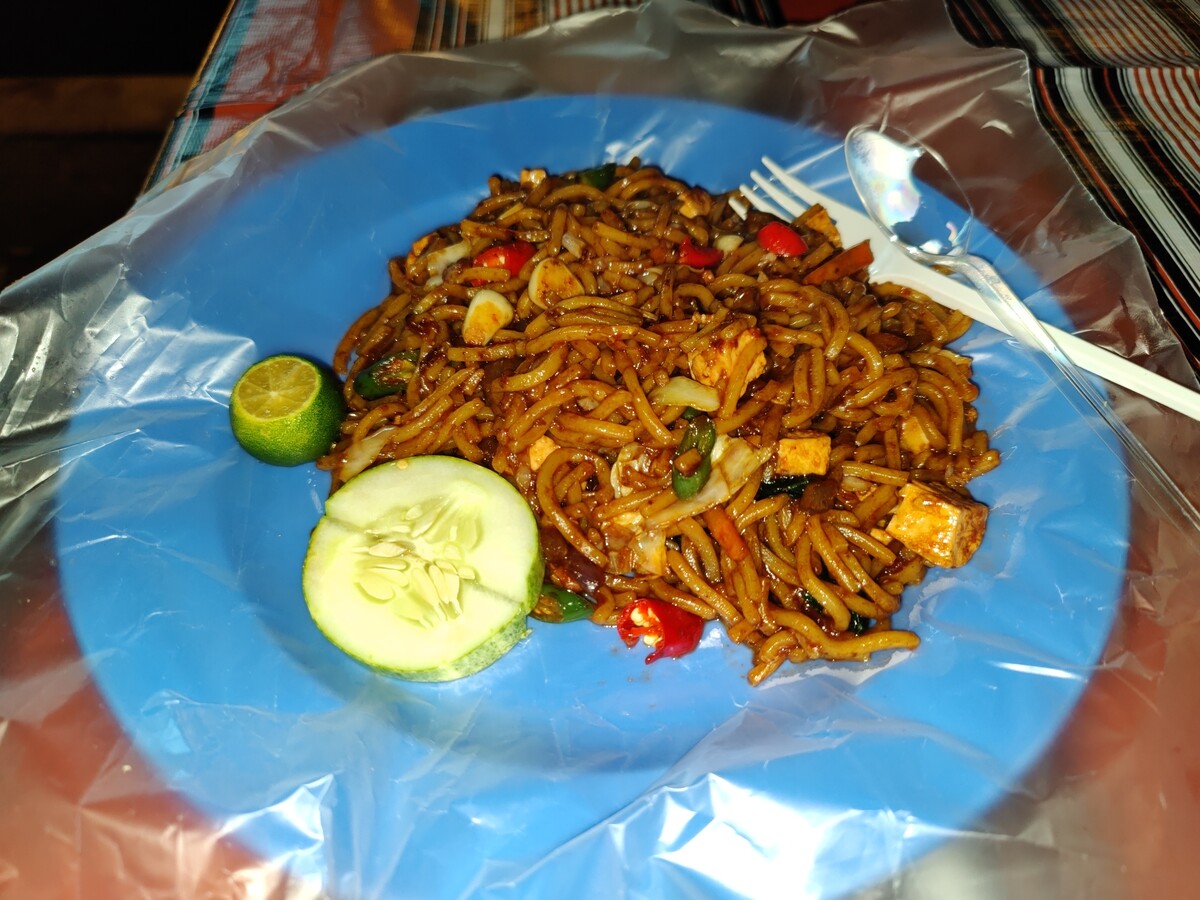
Last month, I had a trip to Malaysia and Thailand. I stayed for six days in each of the countries. The selection of these countries was due to both of them granting visa-free entry to Indian tourists for some time window. This post covers the Malaysia part and Thailand part will be covered in the next post. If you want to travel to any of these countries in the visa-free time period, I have written all the questions asked during immigration and at airports during this trip here which might be of help. I mostly stayed in Kuala Lumpur and went to places around it. Although before the trip, I planned to visit Ipoh and Cameron Highlands too, but could not cover it during the trip. I found planning a trip to Malaysia a little difficult. The country is divided into two main islands - Peninsular Malaysia and Borneo. Then there are more islands - Langkawi, Penang island, Perhentian and Redang Islands. Reaching those islands seemed a little difficult to plan and I wish to visit more places in my next Malaysia trip. My first day hostel was booked in Chinatown part of Kuala Lumpur, near Pasar Seni LRT station. As soon as I checked-in and entered my room, I met another Indian named Fletcher, and after that we accompanied each other in the trip. That day, we went to Muzium Negara and Little India. I realized that if you know the right places to buy what you want, Malaysia could be quite cheap. Malaysian currency is Malaysian Ringgit (MYR). 1 MYR is equal to 18 INR. For 2 MYR, you can get a good masala tea in Little India and it costs like 4-5 MYR for a masala dosa. The vegetarian food has good availability in Kuala Lumpur, thanks to the Tamil community. I also tried Mee Goreng, which was vegetarian, and I found it fine in terms of taste. When I checked about Mee Goreng on Wikipedia, I found out that it is unique to Indian immigrants in Malaysia (and neighboring countries) but you don t get it in India!
Mee Goreng, a dish made of noodles in Malaysia.

For the next day, Fletcher had planned a trip to Genting Highlands and pre booked everything. I also planned to join him but when we went to KL Sentral to take the bus, his bus tickets were sold out. I could take a bus at a different time, but decided to visit some other place for the day and cover Genting Highlands later. At the ticket counter, I met a family from Delhi and they wanted to go to Genting Highlands but due to not getting bus tickets for that day, they decided to buy a ticket for the next day and instead planned for Batu Caves that day. I joined them and went to Batu Caves. After returning from Batu Caves, we went our separate ways. I went back and took rest at my hostel and later went to Petronas Towers at night. Petronas Towers is the icon of Kuala Lumpur. Having a photo there was a must. I was at Petronas Towers at around 9 PM. Around that time, Fletcher came back from Genting Highlands and we planned to meet at KL Sentral to head for dinner.
Me at Petronas Towers.
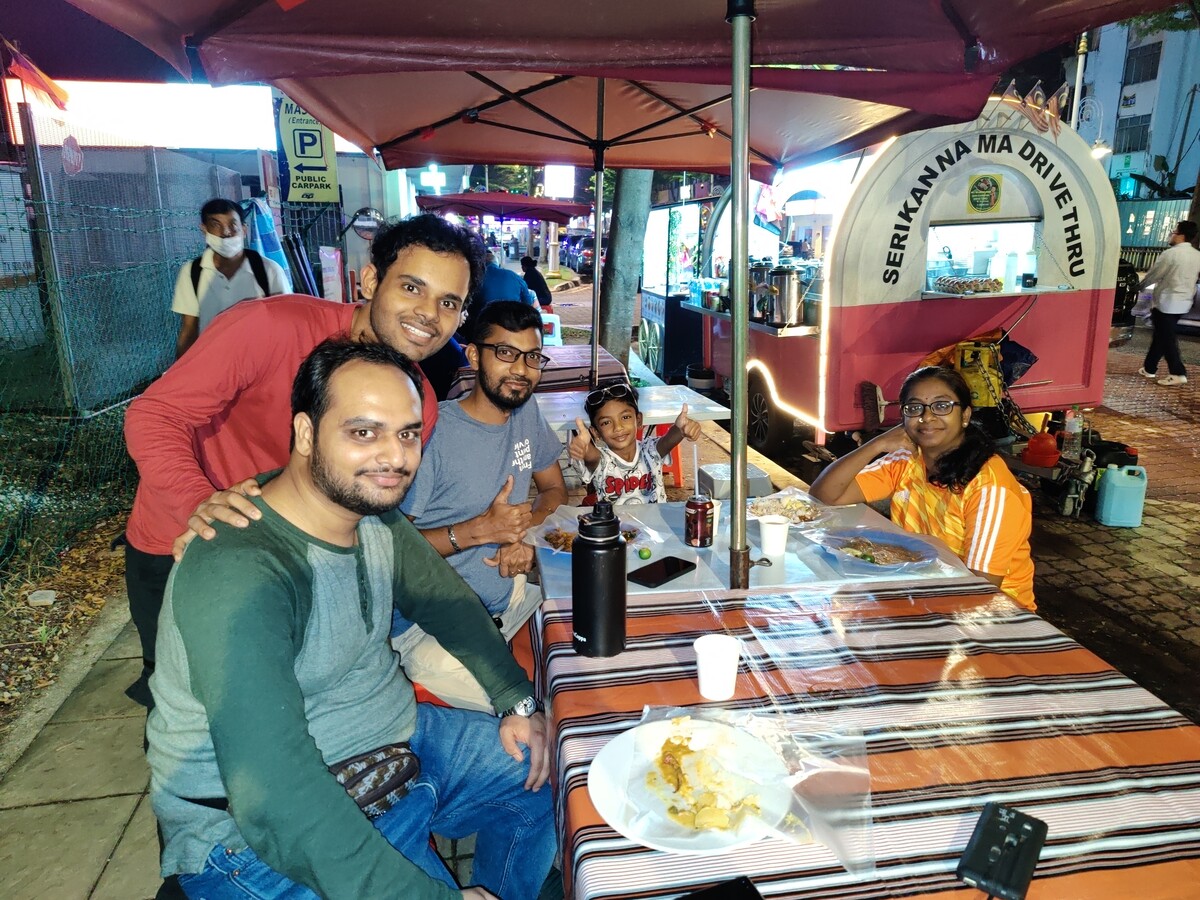
We went back to the same place as the day before where I had Mee Goreng. This time we had dosa and a masala tea. Their masala tea from the last day was tasty and that s why I was looking for them in the first place. We also met a Malaysian family having Indian ancestry dining there and had a nice conversation. Then we went to a place to eat roti canai in Pasar Seni market. Roti canai is a popular non-vegetarian dish in Malaysia but I took the vegetarian version.
Photo with Malaysians.
The next day, we went to Berjaya Time Square shopping place which sells pretty cheap items for daily use and souveniers too. However, I bought souveniers from Petaling Street, which is in Chinatown. At night, we explored Bukit Bintang, which is the heart of Kuala Lumpur and is famous for its nightlife. After that, Fletcher went to Bangkok and I was in Malaysia for two more days. Next day, I went to Genting Highlands and took the cable car, which had awesome views. I came back to Kuala Lumpur by the night. The remaining day I just roamed around in Bukit Bintang. Then I took a flight for Bangkok on 7th Feb, which I will cover in the next post. In Malaysia, I met so many people from different countries - apart from people from Indian subcontinent, I met Syrians, Indonesians (Malaysia seems to be a popular destination for Indonesian tourists) and Burmese people. Meeting people from other cultures is an integral part of travel for me. My expenses for Food + Accommodation + Travel added to 10,000 INR for a week in Malaysia, while flight costs were: 13,000 INR (Delhi to Kuala Lumpur) + 10,000 INR (Kuala Lumpur to Bangkok) + 12,000 INR (Bangkok to Delhi). For OpenStreetMap users, good news is Kuala Lumpur is fairly well-mapped on OpenStreetMap.

Tips
  • I bought local SIM from a shop at KL Sentral station complex which had news in their name (I forgot the exact name and there are two shops having news in their name) and it was the cheapest option I could find. The SIM was 10 MYR for 5 GB data for a week. If you want to make calls too, then you need to spend extra 5 MYR.
  • 7-Eleven and KK Mart convenience stores are everywhere in the city and they are open all the time (24 hours a day). If you are a vegetarian, you can at least get some bread and cheese from there to eat.
  • A lot of people know English (and many - Indians, Pakistanis, Nepalis - know Hindi) in Kuala Lumpur, so I had no language problems most of the time.
  • For shopping on budget, you can go to Petaling Street, Berjaya Time Square or Bukit Bintang. In particular, there is a shop named I Love KL Gifts in Bukit Bintang which had very good prices. just near the metro/monorail stattion. Check out location of the shop on OpenStreetMap.

1 March 2024

Guido G nther: Free Software Activities February 2024

A short status update what happened last month. Work in progress is marked as WiP: GNOME Calls Phosh and Phoc As this often overlaps I've put them in a common section: Phosh Tour Phosh Mobile Settings Phosh OSK Stub Livi Video Player Phosh.mobi Website If you want to support my work see donations.

Scarlett Gately Moore: Kubuntu: Week 4, Feature Freeze and what comes next.

First I would like to give a big congratulations to KDE for a superb KDE 6 mega release  While we couldn t go with 6 on our upcoming LTS release, I do recommend KDE neon if you want to give it a try! I want to say it again, I firmly stand by the Kubuntu Council in the decision to stay with the rock solid Plasma 5 for the 24.04 LTS release. The timing was just to close to feature freeze and the last time we went with the shiny new stuff on an LTS release, it was a nightmare ( KDE 4 anyone? ). So without further ado, my weekly wrap-up. Kubuntu: Continuing efforts from last week Kubuntu: Week 3 wrap up, Contest! KDE snaps, Debian uploads. , it has been another wild and crazy week getting everything in before feature freeze yesterday. We will still be uploading the upcoming Plasma 5.27.11 as it is a bug fix release  and right now it is all about the finding and fixing bugs! Aside from many uploads my accomplishments this week are: What comes next? Testing, testing, testing! Bug fixes and of course our re-branding. My focus is on bug triage right now. I am also working on new projects in launchpad to easily track our bugs as right now they are all over the place and hard to track down. Snaps: I have started the MRs to fix our latest 23.08.5 snaps, I hope to get these finished in the next week or so. I have also been speaking to a prospective student with some GSOC ideas that I really like and will mentor, hopefully we are not too late. Happy with my work? My continued employment depends on you! Please consider a donation http://kubuntu.org/donate Thank you!
Ravi Dwivedi: Fixing Mobile Data issue on Lineage OS

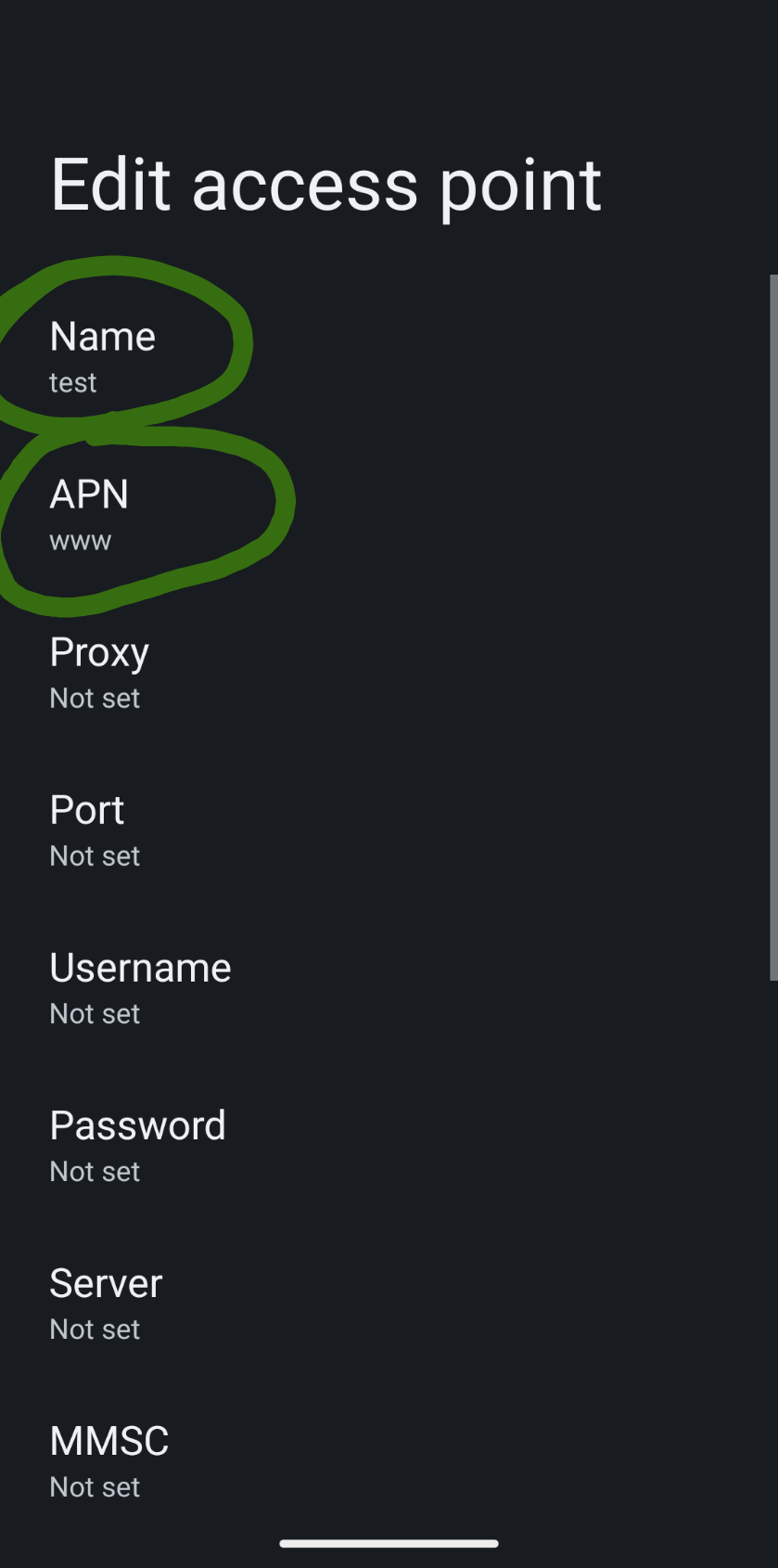
I have used Lineage OS on a couple of phones, but I noticed that internet using my mobile data was not working well on it. I am not sure why. This was the case in Xiaomi MI A2 and OnePlus 9 Pro phones. One day I met contrapunctus and they looked at their phone settings and used the same in mine and it worked. So, I am going to write here what worked for me. The trick is to add an access point. Go to Settings -> Network Settings -> Your SIM settings -> Access Point Names -> Click on + symbol. In the Name section, you can write anything, I wrote test. And in the APN section write www, then save. Below is a screenshot demonstrating the settings you have to change.
APN settings screenshot. Notice the circled entries.
This APN will show in the list of APNs and you need to select this one. After this, my mobile data started working well and I started getting speeds according to my data plan. This is what worked for me in Lineage OS. Hopefully, it was of help to you :D I will meet you in the next post.

Next.

Previous.