In my three most recent posts, I went over the memoirs and biographies, the non-fiction and fiction I enjoyed in 2021. But in the last of my 2021 book-related posts, however, I'll be going over my favourite classics.
Of course, the difference between regular fiction and a 'classic' is an ambiguous, arbitrary and often-meaningless distinction: after all, what does it matter if Hemingway's The Old Man and the Sea (from 1951) is a classic or not? The term also smuggles in some of the ethnocentric gatekeeping encapsulated in the term 'Western canon' too. Nevertheless, the label of 'classic' has some utility for me in that it splits up the vast amount of non-fiction I read in two...
Books that just missed the cut here include: Oscar Wilde's The Picture of Dorian Gray (moody and hilarious, but I cannot bring myself to include it due to the egregious antisemitism); Tolstoy's The Kreutzer Sonata (so angry! so funny!); and finally Notes from Underground by Fyodor Dostoevsky. Of significant note, though, would be the ghostly The Turn of the Screw by Henry James.
Heart of Darkness (1899) Joseph Conrad Heart of Darkness tells the story of Charles Marlow, a sailor who accepts an assignment from a Belgian trading company as a ferry-boat captain in the African interior, and the novella is widely regarded as a critique of European colonial rule in Africa. Loosely remade by Francis Ford Coppola as Apocalypse Now (1979), I started this book with the distinct possibility that this superb film adaptation would, for a rare treat, be 'better than the book'. However, Conrad demolished this idea of mine within two chapters, yet also elevated the film to a new level as well. This was chiefly due to how observant Conrad was of the universals that make up human nature. Some of his insight pertains to the barbarism of the colonialists, of course, but Conrad applies his shrewd acuity to the at the smaller level as well. Some of these quotes are justly famous: Ah! but it was something to have at least a choice of nightmares, for example, as well as the reference to a fastidiously turned-out colonial administrator who, with unimaginable horrors occurring mere yards from his tent, we learn he was devoted to his books, which were in applepie order . (It seems to me to be deliberately unclear whether his devotion arises from gross inhumanity, utter denial or some combination of the two.) Oh, and there's a favourite moment of mine when a character remarks that It was very fine for a time, but after a bit I did get tired of resting. Tired of resting! Yes, it's difficult to now say something original about a many-layered classic such as this, especially one that has analysed from so many angles already; from a literary perspective at first, of course, but much later from a critical postcolonial perspective, such as in Chinua Achebe's noted 1975 lecture, An Image of Africa. Indeed, the history of criticism in the twentieth century of Heart of Darkness must surely parallel the social and political developments in the Western world. (On a highly related note, the much-cited non-fiction book King Leopold's Ghost is on my reading list for 2022.) I will therefore limit myself to saying that the boat physically falling apart as it journeys deeper into the Congo may be intended to represent that our idea of 'Western civilisation' ceases to function, both morally as well as physically, in this remote environment. And, whilst I'm probably not the first to notice the potential ambiguity, when Marlow lies to Kurtz's 'Intended [wife]' in the closing section in order to save her from being exposed to the truth about Kurtz (surely a metaphor about the ignorance of the West whilst also possibly incorporating some comment on gender?), the Intended replies: I knew it. For me, though, it is not beyond doubt that what the Intended 'knows' is that she knew that Marlow would lie to her: in other words, that the alleged ignorance of everyday folk in the colonial homeland is studied and deliberate. Compact and fairly easy-to-read, it is clear that Heart of Darkness rewards even the most rudimentary analysis.
Rebecca (1938) Daphne du Maurier Daphne du Maurier creates in Rebecca a credible and suffocating atmosphere in the shape of Manderley, a grand English mansion owned by aristocratic widower Maxim de Winter. Our unnamed narrator (a young woman seemingly na ve in the ways of the world) meets Max in Monte Carlo, and she soon becomes the second Mrs. de Winter. The tale takes a turn to the 'gothic', though, when it becomes apparent that the unemotional Max, as well as potentially Manderley itself, appears to be haunted by the memory of his late first wife, the titular Rebecca. Still, Rebecca is less of a story about supernatural ghosts than one about the things that can haunt our minds. For Max, this might be something around guilt; for our narrator, the class-centered fear that she will never fit in. Besides, Rebecca doesn't need an actual ghost when you have Manderley's overbearing housekeeper, Mrs Danvers, surely one of the creepiest characters in all of fiction. Either way, the conflict of a kind between the fears of the protagonists means that they never really connect with each other. The most obvious criticism of Rebecca is that the main character is unreasonably weak and cannot quite think or function on her own. (Isn't it curious that the trait of the male 'everyman' is a kind of physical clumsiness yet the female equivalent is shorthanded by being slightly slow?) But the na vete of Rebecca's narrator makes her easier to relate to in a way, and it also makes the reader far more capable of empathising with her embarrassment. This is demonstrated best whilst she, in one of the best evocations of this particular anxiety I have yet come across, is gingerly creeping around Manderlay and trying to avoid running into the butler. A surprise of sorts comes in the latter stages of the book, and this particular twist brings us into contact with a female character who is anything but 'credulous'. This revelation might even change your idea of who the main character of this book really is too. (Speaking of amateur literary criticism, I have many fan theories about Rebecca, including that Maxim de Winter's estate manager, Frank Crawley, is actually having an affair with Max, and also that Maxim may have a lot more involvement in Mrs Danvers final act that he lets on.) An easily accessible novel (with a great-but-not-perfect 1940 adaptation by Alfred Hitchcock, Rebecca is a real indulgence.
A Clockwork Orange (1962) Anthony Burgess One of Stanley Kubrick's most prominent tricks was to use different visual languages in order to prevent the audience from immediately grasping the underlying story. In his 1975 Barry Lyndon, for instance, the intentionally sluggish pacing and elusive characters require significant digestion to fathom and appreciate, and the luminous and quasi-Renaissance splendour of the cinematography does its part to constantly distract the viewer from the film's greater meaning. This is very much the case in Kubrick's A Clockwork Orange as well whilst it ostensibly appears to be about a Saturnalia of violence, the 'greater meaning' of A Clockwork Orange pertains to the Christian conception of free will; admittedly, a much drier idea to bother making a film around. This is all made much clearer when reading Anthony Burgess' 1962 original novel. Alex became a 'true Christian' through the experimental rehabilitation process, and even offers to literally turn the other cheek at one point. But as Alex had no choice to do so (and can no longer choose to commit violence), he is incapable of making a free moral choice. Thus, is he really a Man? Yet whilst the book's central concern is our conception of free will in modern societies, it also appears to be a repudiation of two conservative principles. Firstly, A Clockwork Orange demolishes the idea that 'high art' leads to morally virtuous citizens. After all, if you can do a bit of the old ultra-violence whilst listening to the glorious 9th by old Ludvig van, then so much for the oft-repeated claims that culture makes you better as a person. (This, at least, I already knew from personal experience.) The other repudiation in A Clockwork Orange is in regard to the pervasive idea that the countryside is a refuge from crime and sin. By contrast, we see the gang commit their most horrific violence in rural areas, and, later, Alex is taken to the countryside by his former droogs for a savage beating. Although this doesn't seem to quite fit the novel, this was actually an important point for Burgess to include: otherwise his book could easily be read as a commentary on the corrupting influence of urban spaces, rather than of modernity itself. The language of this book cannot escape comment here. Alex narrates most of the book in a language called Nadsat, a fractured slang constructed by Burgess based on Russian and Cockney rhyming slang. (The language is strange for only a few pages, I promise. And note that 'Alex' is a very common Russian name.) Using Nadsat has the effect of making the book feel distinctly alien, but it also prevents it from prematurely aging too. Indeed, it comes as bit of a shock to realise that A Clockwork Orange was published 1962, the same year as The Beatles' released their first single, Love Me Do. I could probably say a whole lot more about this thoroughly engrossing book and its movie adaptation (eg. the meta-textual line in Kubrick's version: It's funny how the colours of the real world only seem really real when you watch them on a screen... appears verbatim in the textual original), but I'll leave it there. The book of A Clockwork Orange is not only worth the investment in the language, but is, again, somehow better than the film.
The Great Gatsby (1925) F. Scott Fitzgerald I'm actually being a little deceitful by including this book here: I cannot really say that The Great Gatsby was a 'favourite' read of the year, but its literary merit is so undeniable (and my respect for Fitzgerald's achievement is deep enough) that the experience was one of those pleasures you feel at seeing anything done well. Here you have a book so rich in symbolic meaning that you could easily confuse the experience with drinking Coke syrup undiluted. And a text that has made the difficulty and complexity of reading character a prominent theme of the novel, as well as a technical concern of the book itself. Yet at all times you have in your mind that The Great Gatsby is first and foremost a book about a man writing a book, and, therefore, about the construction of stories and myths. What is the myth being constructed in Gatsby? The usual answer today is that the book is really about the moral virtues of America. Or, rather, the lack thereof. Indeed, as James Boice wrote in 2016:
Could Wilson have killed Gatsby any other way? Could he have ran him over, or poisoned him, or attacked him with a knife? Not at all this an American story, the quintessential one, so Gatsby could have only died the quintessential American death.The quintessential American death is, of course, being killed with a gun. Whatever your own analysis, The Great Gatsby is not only magnificently written, but it is captivating to the point where references intrude many months later. For instance, when reading something about Disney's 'princess culture', I was reminded of when Daisy says of her daughter: I hope she'll be a fool that's the best thing of a girl can be in this world, a beautiful little fool . Or the billboard with the eyes of 'Doctor T. J. Eckleburg'. Or the fact that the books in Gatsby's library have never been read (so what is 'Owl Eyes' doing there during the party?!). And the only plain room in Gatsby's great house is his bedroom... Okay, fine, I must have been deluding myself: I love this novel.
In my two most recent posts, I listed the memoirs and biographies and followed this up with the non-fiction I enjoyed the most in 2021. I'll leave my roundup of 'classic' fiction until tomorrow, but today I'll be going over my favourite fiction.
Books that just miss the cut here include Kingsley Amis' comic Lucky Jim, Cormac McCarthy's The Road (although see below for McCarthy's Blood Meridian) and the Complete Adventures of Tintin by Herg , the latter forming an inadvertently incisive portrait of the first half of the 20th century.
Like ever, there were a handful of books that didn't live up to prior expectations. Despite all of the hype, Emily St. John Mandel's post-pandemic dystopia Station Eleven didn't match her superb The Glass Hotel (one of my favourite books of 2020). The same could be said of John le Carr 's The Spy Who Came in from the Cold, which felt significantly shallower compared to Tinker, Tailor, Soldier, Spy again, a favourite of last year. The strangest book (and most difficult to classify at all) was undoubtedly Patrick S skind's Perfume: The Story of a Murderer, and the non-fiction book I disliked the most was almost-certainly Beartown by Fredrik Bachman.
Two other mild disappointments were actually film adaptions. Specifically, the original source for Vertigo by Pierre Boileau and Thomas Narcejac didn't match Alfred Hitchock's 1958 masterpiece, as did James Sallis' Drive which was made into a superb 2011 neon-noir directed by Nicolas Winding Refn. These two films thus defy the usual trend and are 'better than the book', but that's a post for another day.
A Wizard of Earthsea (1971) Ursula K. Le Guin How did it come to be that Harry Potter is the publishing sensation of the century, yet Ursula K. Le Guin's Earthsea is only a popular cult novel? Indeed, the comparisons and unintentional intertextuality with Harry Potter are entirely unavoidable when reading this book, and, in almost every respect, Ursula K. Le Guin's universe comes out the victor. In particular, the wizarding world that Le Guin portrays feels a lot more generous and humble than the class-ridden world of Hogwarts School of Witchcraft and Wizardry. Just to take one example from many, in Earthsea, magic turns out to be nurtured in a bottom-up manner within small village communities, in almost complete contrast to J. K. Rowling's concept of benevolent government departments and NGOs-like institutions, which now seems a far too New Labour for me. Indeed, imagine an entire world imbued with the kindly benevolence of Dumbledore, and you've got some of the moral palette of Earthsea. The gently moralising tone that runs through A Wizard of Earthsea may put some people off:
Vetch had been three years at the School and soon would be made Sorcerer; he thought no more of performing the lesser arts of magic than a bird thinks of flying. Yet a greater, unlearned skill he possessed, which was the art of kindness.Still, these parables aimed directly at the reader are fairly rare, and, for me, remain on the right side of being mawkish or hectoring. I'm thus looking forward to reading the next two books in the series soon.
Blood Meridian (1985) Cormac McCarthy Blood Meridian follows a band of American bounty hunters who are roaming the Mexican-American borderlands in the late 1840s. Far from being remotely swashbuckling, though, the group are collecting scalps for money and killing anyone who crosses their path. It is the most unsparing treatment of American genocide and moral depravity I have ever come across, an anti-Western that flouts every convention of the genre. Blood Meridian thus has a family resemblance to that other great anti-Western, Once Upon a Time in the West: after making a number of gun-toting films that venerate the American West (ie. his Dollars Trilogy), Sergio Leone turned his cynical eye to the western. Yet my previous paragraph actually euphemises just how violent Blood Meridian is. Indeed, I would need to be a much better writer (indeed, perhaps McCarthy himself) to adequately 0utline the tone of this book. In a certain sense, it's less than you read this book in a conventional sense, but rather that you are forced to witness successive chapters of grotesque violence... all occurring for no obvious reason. It is often said that books 'subvert' a genre and, indeed, I implied as such above. But the term subvert implies a kind of Puck-like mischievousness, or brings to mind court jesters licensed to poke fun at the courtiers. By contrast, however, Blood Meridian isn't funny in the slightest. There isn't animal cruelty per se, but rather wanton negligence of another kind entirely. In fact, recalling a particular passage involving an injured horse makes me feel physically ill. McCarthy's prose is at once both baroque in its language and thrifty in its presentation. As Philip Connors wrote back in 2007, McCarthy has spent forty years writing as if he were trying to expand the Old Testament, and learning that McCarthy grew up around the Church therefore came as no real surprise. As an example of his textual frugality, I often looked for greater precision in the text, finding myself asking whether who a particular 'he' is, or to which side of a fight some two men belonged to. Yet we must always remember that there is no precision to found in a gunfight, so this infidelity is turned into a virtue. It's not that these are fair fights anyway, or even 'murder': Blood Meridian is just slaughter; pure butchery. Murder is a gross understatement for what this book is, and at many points we are grateful that McCarthy spares us precision. At others, however, we can be thankful for his exactitude. There is no ambiguity regarding the morality of the puppy-drowning Judge, for example: a Colonel Kurtz who has been given free license over the entire American south. There is, thank God, no danger of Hollywood mythologising him into a badass hero. Indeed, we must all be thankful that it is impossible to film this ultra-violent book... Indeed, the broader idea of 'adapting' anything to this world is, beyond sick. An absolutely brutal read; I cannot recommend it highly enough.
Bodies of Light (2014) Sarah Moss Bodies of Light is a 2014 book by Glasgow-born Sarah Moss on the stirrings of women's suffrage within an arty clique in nineteenth-century England. Set in the intellectually smoggy cities of Manchester and London, this poignant book follows the studiously intelligent Alethia 'Ally' Moberly who is struggling to gain the acceptance of herself, her mother and the General Medical Council. You can read my full review from July.
House of Leaves (2000) Mark Z. Danielewski House of Leaves is a remarkably difficult book to explain. Although the plot refers to a fictional documentary about a family whose house is somehow larger on the inside than the outside, this quotidian horror premise doesn't explain the complex meta-commentary that Danielewski adds on top. For instance, the book contains a large number of pseudo-academic footnotes (many of which contain footnotes themselves), with references to scholarly papers, books, films and other articles. Most of these references are obviously fictional, but it's the kind of book where the joke is that some of them are not. The format, structure and typography of the book is highly unconventional too, with extremely unusual page layouts and styles. It's the sort of book and idea that should be a tired gimmick but somehow isn't. This is particularly so when you realise it seems specifically designed to create a fandom around it and to manufacturer its own 'cult' status, something that should be extremely tedious. But not only does this not happen, House of Leaves seems to have survived through two exhausting decades of found footage: The Blair Witch Project and Paranormal Activity are, to an admittedly lesser degree, doing much of the same thing as House of Leaves. House of Leaves might have its origins in Nabokov's Pale Fire or even Derrida's Glas, but it seems to have more in common with the claustrophobic horror of Cube (1997). And like all of these works, House of Leaves book has an extremely strange effect on the reader or viewer, something quite unlike reading a conventional book. It wasn't so much what I got out of the book itself, but how it added a glow to everything else I read, watched or saw at the time. An experience.
Milkman (2018) Anna Burns This quietly dazzling novel from Irish author Anna Burns is full of intellectual whimsy and oddball incident. Incongruously set in 1970s Belfast during The Irish Troubles, Milkman's 18-year-old narrator (known only as middle sister ), is the kind of dreamer who walks down the street with a Victorian-era novel in her hand. It's usually an error for a book that specifically mention other books, if only because inviting comparisons to great novels is grossly ill-advised. But it is a credit to Burns' writing that the references here actually add to the text and don't feel like they are a kind of literary paint by numbers. Our humble narrator has a boyfriend of sorts, but the figure who looms the largest in her life is a creepy milkman an older, married man who's deeply integrated in the paramilitary tribalism. And when gossip about the narrator and the milkman surfaces, the milkman beings to invade her life to a suffocating degree. Yet this milkman is not even a milkman at all. Indeed, it's precisely this kind of oblique irony that runs through this daring but darkly compelling book.
The First Fifteen Lives of Harry August (2014) Claire North Harry August is born, lives a relatively unremarkable life and finally dies a relatively unremarkable death. Not worth writing a novel about, I suppose. But then Harry finds himself born again in the very same circumstances, and as he grows from infancy into childhood again, he starts to remember his previous lives. This loop naturally drives Harry insane at first, but after finding that suicide doesn't stop the quasi-reincarnation, he becomes somewhat acclimatised to his fate. He prospers much better at school the next time around and is ultimately able to make better decisions about his life, especially when he just happens to know how to stay out of trouble during the Second World War. Yet what caught my attention in this 'soft' sci-fi book was not necessarily the book's core idea but rather the way its connotations were so intelligently thought through. Just like in a musical theme and varations, the success of any concept-driven book is far more a product of how the implications of the key idea are played out than how clever the central idea was to begin with. Otherwise, you just have another neat Borges short story: satisfying, to be sure, but in a narrower way. From her relatively simple premise, for example, North has divined that if there was a community of people who could remember their past lives, this would actually allow messages and knowledge to be passed backwards and forwards in time. Ah, of course! Indeed, this very mechanism drives the plot: news comes back from the future that the progress of history is being interfered with, and, because of this, the end of the world is slowly coming. Through the lives that follow, Harry sets out to find out who is passing on technology before its time, and work out how to stop them. With its gently-moralising romp through the salient historical touchpoints of the twentieth century, I sometimes got a whiff of Forrest Gump. But it must be stressed that this book is far less certain of its 'right-on' liberal credentials than Robert Zemeckis' badly-aged film. And whilst we're on the topic of other media, if you liked the underlying conceit behind Stuart Turton's The Seven Deaths of Evelyn Hardcastle yet didn't enjoy the 'variations' of that particular tale, then I'd definitely give The First Fifteen Lives a try. At the very least, 15 is bigger than 7. More seriously, though, The First Fifteen Lives appears to reflect anxieties about technology, particularly around modern technological accelerationism. At no point does it seriously suggest that if we could somehow possess the technology from a decade in the future then our lives would be improved in any meaningful way. Indeed, precisely the opposite is invariably implied. To me, at least, homo sapiens often seems to be merely marking time until we can blow each other up and destroying the climate whilst sleepwalking into some crisis that might precipitate a thermonuclear genocide sometimes seems to be built into our DNA. In an era of cli-fi fiction and our non-fiction newspaper headlines, to label North's insight as 'prescience' might perhaps be overstating it, but perhaps that is the point: this destructive and negative streak is universal to all periods of our violent, insecure species.
The Goldfinch (2013) Donna Tartt After Breaking Bad, the second biggest runaway success of 2014 was probably Donna Tartt's doorstop of a novel, The Goldfinch. Yet upon its release and popular reception, it got a significant number of bad reviews in the literary press with, of course, an equal number of predictable think pieces claiming this was sour grapes on the part of the cognoscenti. Ah, to be in 2014 again, when our arguments were so much more trivial. For the uninitiated, The Goldfinch is a sprawling bildungsroman that centres on Theo Decker, a 13-year-old whose world is turned upside down when a terrorist bomb goes off whilst visiting the Metropolitan Museum of Art, killing his mother among other bystanders. Perhaps more importantly, he makes off with a painting in order to fulfil a promise to a dying old man: Carel Fabritius' 1654 masterpiece The Goldfinch. For the next 14 years (and almost 800 pages), the painting becomes the only connection to his lost mother as he's flung, almost entirely rudderless, around the Western world, encountering an array of eccentric characters. Whatever the critics claimed, Tartt's near-perfect evocation of scenes, from the everyday to the unimaginable, is difficult to summarise. I wouldn't label it 'cinematic' due to her evocation of the interiority of the characters. Take, for example: Even the suggestion that my father had close friends conveyed a misunderstanding of his personality that I didn't know how to respond it's precisely this kind of relatable inner subjectivity that cannot be easily conveyed by film, likely is one of the main reasons why the 2019 film adaptation was such a damp squib. Tartt's writing is definitely not 'impressionistic' either: there are many near-perfect evocations of scenes, even ones we hope we cannot recognise from real life. In particular, some of the drug-taking scenes feel so credibly authentic that I sometimes worried about the author herself. Almost eight months on from first reading this novel, what I remember most was what a joy this was to read. I do worry that it won't stand up to a more critical re-reading (the character named Xandra even sounds like the pharmaceuticals she is taking), but I think I'll always treasure the first days I spent with this often-beautiful novel.
Beyond Black (2005) Hilary Mantel Published about five years before the hyperfamous Wolf Hall (2004), Hilary Mantel's Beyond Black is a deeply disturbing book about spiritualism and the nature of Hell, somewhat incongruously set in modern-day England. Alison Harte is a middle-aged physic medium who works in the various towns of the London orbital motorway. She is accompanied by her stuffy assistant, Colette, and her spirit guide, Morris, who is invisible to everyone but Alison. However, this is no gentle and musk-smelling world of the clairvoyant and mystic, for Alison is plagued by spirits from her past who infiltrate her physical world, becoming stronger and nastier every day. Alison's smiling and rotund persona thus conceals a truly desperate woman: she knows beyond doubt the terrors of the next life, yet must studiously conceal them from her credulous clients. Beyond Black would be worth reading for its dark atmosphere alone, but it offers much more than a chilling and creepy tale. Indeed, it is extraordinarily observant as well as unsettlingly funny about a particular tranche of British middle-class life. Still, the book's unnerving nature that sticks in the mind, and reading it noticeably changed my mood for days afterwards, and not necessarily for the best.
The Wall (2019) John Lanchester The Wall tells the story of a young man called Kavanagh, one of the thousands of Defenders standing guard around a solid fortress that envelopes the British Isles. A national service of sorts, it is Kavanagh's job to stop the so-called Others getting in. Lanchester is frank about what his wall provides to those who stand guard: the Defenders of the Wall are conscripted for two years on the Wall, with no exceptions, giving everyone in society a life plan and a story. But whilst The Wall is ostensibly about a physical wall, it works even better as a story about the walls in our mind. In fact, the book blends together of some of the most important issues of our time: climate change, increasing isolation, Brexit and other widening societal divisions. If you liked P. D. James' The Children of Men you'll undoubtedly recognise much of the same intellectual atmosphere, although the sterility of John Lanchester's dystopia is definitely figurative and textual rather than literal. Despite the final chapters perhaps not living up to the world-building of the opening, The Wall features a taut and engrossing narrative, and it undoubtedly warrants even the most cursory glance at its symbolism. I've yet to read something by Lanchester I haven't enjoyed (even his short essay on cheating in sports, for example) and will be definitely reading more from him in 2022.
The Only Story (2018) Julian Barnes The Only Story is the story of Paul, a 19-year-old boy who falls in love with 42-year-old Susan, a married woman with two daughters who are about Paul's age. The book begins with how Paul meets Susan in happy (albeit complicated) circumstances, but as the story unfolds, the novel becomes significantly more tragic and moving. Whilst the story begins from the first-person perspective, midway through the book it shifts into the second person, and, later, into the third as well. Both of these narrative changes suggested to me an attempt on the part of Paul the narrator (if not Barnes himself), to distance himself emotionally from the events taking place. This effect is a lot more subtle than it sounds, however: far more prominent and devastating is the underlying and deeply moving story about the relationship ends up. Throughout this touching book, Barnes uses his mastery of language and observation to avoid the saccharine and the maudlin, and ends up with a heart-wrenching and emotive narrative. Without a doubt, this is the saddest book I read this year.
| Publisher: | Del Rey |
| Copyright: | 2020 |
| ISBN: | 0-593-13506-7 |
| Format: | Kindle |
| Pages: | 327 |
As a follow-up to yesterday's post listing my favourite memoirs and biographies I read in 2021, today I'll be outlining my favourite works of non-fiction.
Books that just missed the cut include: The Unusual Suspect by Ben Machell for its thrilleresque narrative of a modern-day Robin Hood (and if you get to the end, a completely unexpected twist); Paul Fussell's Class: A Guide to the American Status System as an amusing chaser of sorts to Kate Fox's Watching the English; John Carey's Little History of Poetry for its exhilarating summation of almost four millennia of verse; David Graeber's Debt: The First 5000 Years for numerous historical insights, not least its rejoinder to our dangerously misleading view of ancient barter systems; and, although I didn't treasure everything about it, I won't hesitate to gift Pen Vogler's Scoff to a number of friends over the next year. The weakest book of non-fiction I read this year was undoubtedly Roger Scruton's How to Be a Conservative: I much preferred The Decadent Society for Ross Douthat for my yearly ration of the 'intellectual right'.
I also very much enjoyed reading a number of classic texts from academic sociology, but they are difficult to recommend or even summarise. These included One-Dimensional Man by Herbert Marcuse, Postmodernism: Or, the Cultural Logic of Late Capitalism by Frederic Jameson and The Protestant Ethic and the Spirit of Capitalism by Max Weber. 'These are heavy books', remarks John Proctor in Arthur Miller's The Crucible...
All round-up posts for 2021: Memoir/biography, Non-fiction (this post) & Fiction (coming soon).
(2020) Robert Kolker A compelling and disturbing account of the Galvin family six of whom were diagnosed with schizophrenia which details a journey through the study and misunderstanding of the condition. The story of the Galvin family offers a parallel history of the science of schizophrenia itself, from the era of institutionalisation, lobotomies and the 'schizo mother', to the contemporary search for genetic markers for the disease... all amidst fundamental disagreements about the nature of schizophrenia and, indeed, of all illnesses of the mind. Samples of the Galvins' DNA informed decades of research which, curiously, continues to this day, potentially offering paths to treatment, prediction and even eradication of the disease, although on this last point I fancy that I detect a kind of neo-Victorian hubris that we alone will be the ones to find a cure. Either way, a gentle yet ultimately tragic view of a curiously 'American' family, where the inherent lack of narrative satisfaction brings a frustration and sadness of its own.
Islands of Abandonment: Life in the Post-Human Landscape (2021) Cat Flyn In this disarmingly lyrical book, Cat Flyn addresses the twin questions of what happens after humans are gone and how far can our damage to nature be undone. From the forbidden areas of post-war France to the mining regions of Scotland, Islands of Abandonment explores the extraordinary places where humans no longer live in an attempt to give us a glimpse into what happens when mankind's impact on nature is, for one reason or another, forced to stop. Needless to say, if anxieties in this area are not curdling away in your subconscious mind, you are probably in some kind of denial. Through a journey into desolate, eerie and ravaged areas in the world, this artfully-written study offers profound insights into human nature, eschewing the usual dry sawdust of Wikipedia trivia. Indeed, I summed it up to a close friend remarking that, through some kind of hilarious administrative error, the book's publisher accidentally dispatched a poet instead of a scientist to write this book. With glimmers of hope within the (mostly) tragic travelogue, Islands of Abandonment is not only a compelling read, but also a fascinating insight into the relationship between Nature and Man.
The Anatomy of Fascism (2004) Robert O. Paxton Everyone is absolutely sure they know what fascism is... or at least they feel confident choosing from a buffet of features to suit the political mood. To be sure, this is not a new phenomenon: even as 'early' as 1946, George Orwell complained in Politics and the English Language that the word Fascism has now no meaning except in so far as it signifies something not desirable . Still, it has proved uncommonly hard to define the core nature of fascism and what differentiates it from related political movements. This is still of great significance in the twenty-first century, for the definition ultimately determines where the powerful label of 'fascist' can be applied today. Part of the enjoyment of reading this book was having my own cosy definition thoroughly dismantled and replaced with a robust system of abstractions and common themes. This is achieved through a study of the intellectual origins of fascism and how it played out in the streets of Berlin, Rome and Paris. Moreover, unlike Strongmen (see above), fascisms that failed to gain meaningful power are analysed too, including Oswald Mosley's British Union of Fascists. Curiously enough, Paxton's own definition of fascism is left to the final chapter, and by the time you reach it, you get an anti-climatic feeling of it being redundant. Indeed, whatever it actually is, fascism is really not quite like any other 'isms' at all, so to try and classify it like one might be a mistake. In his introduction, Paxton warns that many of those infamous images associated with fascism (eg. Hitler in Triumph of the Will, Mussolini speaking from a balcony, etc.) have the ability to induce facile errors about the fascist leader and the apparent compliance of the crowd. (Contemporary accounts often record how sceptical the common man was of the leader's political message, even if they were transfixed by their oratorical bombast.) As it happens, I thus believe I had something of an advantage of reading this via an audiobook, and completely avoided re-absorbing these iconic images. To me, this was an implicit reminder that, however you choose to reduce it to a definition, fascism is undoubtedly the most visual of all political forms, presenting itself to us in vivid and iconic primary images: ranks of disciplined marching youths, coloured-shirted militants beating up members of demonised minorities; the post-war pictures from the concentration camps... Still, regardless of you choose to read it, The Anatomy of Fascism is a powerful book that can teach a great deal about fascism in particular and history in general.
What Good are the Arts? (2005) John Carey What Good are the Arts? takes a delightfully sceptical look at the nature of art, and cuts through the sanctimony and cant that inevitably surrounds them. It begins by revealing the flaws in lofty aesthetic theories and, along the way, debunks the claims that art makes us better people. They may certainly bring joy into your life, but by no means do the fine arts make you automatically virtuous. Carey also rejects the entire enterprise of separating things into things that are art and things that are not, making a thoroughly convincing case that there is no transcendental category containing so-called 'true' works of art. But what is perhaps equally important to what Carey is claiming is the way he does all this. As in, this is an extremely enjoyable book to read, with not only a fine sense of pace and language, but a devilish sense of humour as well. To be clear, What Good are the Arts? it is no crotchety monograph: Leo Tolstoy's *What Is Art? (1897) is hilarious to read in similar ways, but you can't avoid feeling its cantankerous tone holds Tolstoy's argument back. By contrast, Carey makes his argument in a playful sort of manner, in a way that made me slightly sad to read other polemics throughout the year. It's definitely not that modern genre of boomer jeremiad about the young, political correctness or, heaven forbid, 'cancel culture'... which, incidentally, made Carey's 2014 memoir, The Unexpected Professor something of a disappointing follow-up. Just for fun, Carey later undermines his own argument by arguing at length for the value of one art in particular. Literature, Carey asserts, is the only art capable of reasoning and the only art with the ability to criticise. Perhaps so, and Carey spends a chapter or so contending that fiction has the exclusive power to inspire the mind and move the heart towards practical ends... or at least far better than any work of conceptual art. Whilst reading this book I found myself taking down innumerable quotations and laughing at the jokes far more than I disagreed. And the sustained and intellectual style of polemic makes this a pretty strong candidate for my favourite overall book of the year.
fsync()
system call to ensure that writes are flushed to disk. Practically
speaking, what this meant is that a page of disk-backed memory would
be written to the disk as soon as an event occurred that triggered a
log message. Because of potential performance implications, fsync()
was not typically enabled for most log files. However, due to the
more sensitive nature of authentication logs, it was often enabled for
/var/log/auth.log.
In the first decade of the 2000 s, there was a fairly unsophisticated
worm loose on the Internet that would
probe sshd
with some
common username/password combinations.
The worm would pause for a second or so between login attempts, most
likely in an effort to avoid automated security responses. The effect
was that a system being probed by this worm would generate disk write
every second, with a very distinct audible signature from the hard
drive.
I think this situation is a fun demonstration of a side-channel data
leak. It s primitive and doesn t leak very much information, but it
was certainly enough to make some inference about the state of the
system in question. Of course, side-channel leakage issues have been
a concern for ages, but I like this one for its simplicity. It was
something that could be explained and demonstrated easily, even to
somebody with relatively limited understanding of how computers
work , unlike, for instance
measuring electromagnetic emanations from CPU power management units.
For a different take on the sounds of a computing infrastructure,
Peep (The Network Auralizer)
won an award at a USENIX conference long, long ago. I d love to see a
modern deployment of such a system. I m sure you could build
something for your cloud deployment using something like
AWS EventBridge or
Amazon SQS fairly easily.
For more on research into actual real-world side-channel attacks, you
can read
A Survey of Microarchitectural Side-channel Vulnerabilities, Attacks and Defenses in Cryptography
or
A Survey of Electromagnetic Side-Channel Attacks and Discussion on their Case-Progressing Potential for Digital Forensics.
Just as I did for 2020, I won't publically disclose exactly how many books I read in 2021, but they evidently provoked enough thoughts that felt it worth splitting my yearly writeup into separate posts. I will reveal, however, that I got through more books than the previous year, and, like before, I enjoyed the books I read this year even more in comparison as well.
How much of this is due to refining my own preferences over time, and how much can be ascribed to feeling less pressure to read particular books? It s impossible to say, and the question is complicated further by the fact I found many of the classics I read well worth of their entry into the dreaded canon.
But enough of the throat-clearing. In today's post I'll be looking at my favourite books filed under memoir and biography, in no particular order.
Books that just missed the cut here include: Bernard Crick's celebrated 1980 biography of George Orwell, if nothing else because it was a pleasure to read; Hilary Mantel's exhilaratingly bitter early memoir, Giving up the Ghost (2003); and Patricia Lockwood's hilarious Priestdaddy (2017). I also had a soft spot for Tim Kreider's We Learn Nothing (2012) as well, despite not knowing anything about the author in advance, likely a sign of good writing. The strangest book in this category I read was definitely Michelle Zauner's Crying in H Mart. Based on a highly-recommended 2018 essay in the New Yorker, its rich broth of genuine yearning for a departed mother made my eyebrows raise numerous times when I encountered inadvertent extra details about Zauner's relationships.
Beethoven: A Life in Nine Pieces (2020) Laura Tunbridge Whilst it might immediately present itself as a clickbait conceit, organising an overarching narrative around just nine compositions by Beethoven turns out to be an elegant way of saying something fresh about this grizzled old bear. Some of Beethoven's most famous compositions are naturally included in the nine (eg. the Eroica and the Hammerklavier piano sonata), but the book raises itself above conventional Beethoven fare when it highlights, for instance, his Septet, Op. 20, an early work that is virtually nobody's favourite Beethoven piece today. The insight here is that it was widely popular in its time, played again and again around Vienna for the rest of his life. No doubt many contemporary authors can relate to this inability to escape being artistically haunted by an earlier runaway success. The easiest way to say something interesting about Beethoven in the twenty-first century is to talk about the myth of Beethoven instead. Or, as Tunbridge implies, perhaps that should really be 'Beethoven' in leaden quotation marks, given so much about what we think we know about the man is a quasi-fictional construction. Take Anton Schindler, Beethoven's first biographer and occasional amanuensis, who destroyed and fabricated details about Beethoven's life, casting himself in a favourable light and exaggerating his influence with the composer. Only a few decades later, the idea of a 'heroic' German was to be politically useful as well; the Anglosphere often need reminding that Germany did not exist as a nation-state prior to 1871, so it should be unsurprising to us that the late nineteenth-century saw a determined attempt to create a uniquely 'German' culture ex nihilo. (And the less we say about Immortal Beloved the better, even though I treasure that film.) Nevertheless, Tunbridge cuts through Beethoven's substantial legacy using surgical precision that not only avoids feeling like it is settling a score, but it also does so in a way that is unlikely to completely alienate anyone emotionally dedicated to some already-established idea of the man to bring forth the tediously predictable sentiment that Beethoven has 'gone woke'. With Alex Ross on the cult of Wagner, it seems that books about the 'myth of X' are somewhat in vogue right now. And this pattern within classical music might fit into some broader trend of deconstruction in popular non-fiction too, especially when we consider the numerous contemporary books on the long hangover of the Civil Rights era (Robin DiAngelo's White Fragility, etc.), the multifarious ghosts of Empire (Akala's Natives, Sathnam Sanghera's Empireland, etc.) or even the 'transmogrification' of George Orwell into myth. But regardless of its place in some wider canon, A Life in Nine Pieces is beautifully printed in hardback form (worth acquiring for that very reason alone), and it is one of the rare good books about classical music that can be recommended to both the connoisseur and the layperson alike.
Sea State (2021) Tabitha Lasley In her mid-30s and jerking herself out of a terrible relationship, Tabitha Lasley left London and put all her savings into a six-month lease on a flat within a questionable neighbourhood in Aberdeen, Scotland. She left to make good on a lukewarm idea for a book about oil rigs and the kinds of men who work on them: I wanted to see what men were like with no women around, she claims. The result is Sea State, a forthright examination of the life of North Sea oil riggers, and an unsparing portrayal of loneliness, masculinity, female desire and the decline of industry in Britain. (It might almost be said that Sea State is an update of a sort to George Orwell's visit to the mines in the North of England.) As bracing as the North Sea air, Sea State spoke to me on multiple levels but I found it additionally interesting to compare and contrast with Julian Barnes' The Man with Red Coat (see below). Women writers are rarely thought to be using fiction for higher purposes: it is assumed that, unlike men, whatever women commit to paper is confessional without any hint of artfulness. Indeed, it seems to me that the reaction against the decades-old genre of autofiction only really took hold when it became the domain of millennial women. (By contrast, as a 75-year-old male writer with a firmly established reputation in the literary establishment, Julian Barnes is allowed wide latitude in what he does with his sources and his writing can be imbued with supremely confident airs as a result.) Furthermore, women are rarely allowed metaphor or exaggeration for dramatic effect, and they certainly aren t permitted to emphasise darker parts in order to explore them... hence some of the transgressive gratification of reading Sea State. Sea State is admittedly not a work of autofiction, but the sense that you are reading about an author writing a book is pleasantly unavoidable throughout. It frequently returns to the topic of oil workers who live multiple lives, and Lasley admits to living two lives herself: she may be in love but she's also on assignment, and a lot of the pleasure in this candid and remarkably accessible book lies in the way these states become slowly inseparable.
Twilight of Democracy (2020) Anne Applebaum For the uninitiated, Anne Applebaum is a staff writer for The Atlantic magazine who won a Pulitzer-prize for her 2004 book on the Soviet Gulag system. Her latest book, however, Twilight of Democracy is part memoir and part political analysis and discusses the democratic decline and the rise of right-wing populism. This, according to Applebaum, displays distinctly authoritarian tendencies, and who am I to disagree? Applebaum does this through three main case studies (Poland, the United Kingdom and the United States), but the book also touches on Hungary as well. The strongest feature of this engaging book is that Appelbaum's analysis focuses on the intellectual classes and how they provide significant justification for a descent into authoritarianism. This is always an important point to be remembered, especially as much of the folk understanding of the rise of authoritarian regimes tends to place exaggerated responsibility on the ordinary and everyday citizen: the blame placed on the working-class in the Weimar Republic or the scorn heaped upon 'white trash' of the contemporary Rust Belt, for example. Applebaum is uniquely poised to discuss these intellectuals because, well, she actually knows a lot of them personally. Or at least, she used to know them. Indeed, the narrative of the book revolves around two parties she hosted, both in the same house in northwest Poland. The first party, on 31 December 1999, was attended by friends from around the Western world, but most of the guests were Poles from the broad anti-communist alliance. They all agreed about democracy, the rule of law and the route to prosperity whilst toasting in the new millennium. (I found it amusing to realise that War and Peace also starts with a party.) But nearly two decades later, many of the attendees have ended up as supporters of the problematic 'Law and Justice' party which currently governs the country. Applebaum would now cross the road to avoid them, and they would do the same to her, let alone behave themselves at a cordial reception. The result of this autobiographical detail is that by personalising the argument, Applebaum avoids the trap of making too much of high-minded abstract argument for 'democracy', and additionally makes her book compellingly spicy too. Yet the strongest part of this book is also its weakest. By individualising the argument, it often feels that Applebaum is settling a number of personal scores. She might be very well justified in doing this, but at times it feels like the reader has walked in halfway through some personal argument and is being asked to judge who is in the right. Furthermore, Applebaum's account of contemporary British politics sometimes deviates into the cartoonish: nothing was egregiously incorrect in any of her summations, but her explanation of the Brexit referendum result didn't read as completely sound. Nevertheless, this lively and entertaining book that can be read with profit, even if you disagree with significant portions of it, and its highly-personal approach makes it a refreshing change from similar contemporary political analysis (eg. David Runciman's How Democracy Ends) which reaches for that more 'objective' line.
The Man in the Red Coat (2019) Julian Barnes As rich as the eponymous red coat that adorns his cover, Julian Barnes quasi-biography of French gynaecologist Samuel-Jean Pozzi (1846 1918) is at once illuminating, perplexing and downright hilarious. Yet even that short description is rather misleading, for this book evades classification all manner number of ways. For instance, it is unclear that, with the biographer's narrative voice so obviously manifest, it is even a biography in the useful sense of the word. After all, doesn't the implied pact between author and reader require the biographer to at least pretend that they are hiding from the reader? Perhaps this is just what happens when an author of very fine fiction turns his hand to non-fiction history, and, if so, it represents a deeper incursion into enemy territory after his 1984 metafictional Flaubert's Parrot. Indeed, upon encountering an intriguing mystery in Pozzi's life crying out for a solution, Barnes baldly turns to the reader, winks and states: These matters could, of course, be solved in a novel. Well, quite. Perhaps Barnes' broader point is that, given that's impossible for the author to completely melt into air, why not simply put down your cards and have a bit of fun whilst you're at it? If there's any biography that makes the case for a rambling and lightly polemical treatment, then it is this one. Speaking of having fun, however, two qualities you do not expect in a typical biography is simply how witty they can be, as well as it having something of the whiff of the thriller about it. A bullet might be mentioned in an early chapter, but given the name and history of Monsieur Pozzi is not widely known, one is unlikely to learn how he lived his final years until the closing chapters. (Or what happened to that turtle.) Humour is primarily incorporated into the book in two main ways: first, by explicitly citing the various wits of the day ( What is a vice? Merely a taste you don t share. etc.), but perhaps more powerful is the gentle ironies, bon mots and observations in Barnes' entirely unflappable prose style, along with the satire implicit in him writing this moreish pseudo-biography to begin with. The opening page, with its steadfast refusal to even choose where to begin, is somewhat characteristic of Barnes' method, so if you don't enjoy the first few pages then you are unlikely to like the rest. (Indeed, the whole enterprise may be something of an acquired taste. Like Campari.) For me, though, I was left wryly grinning and often couldn't wait to turn the page. Indeed, at times it reminded me of a being at a dinner party with an extremely charming guest at the very peak of his form as a wit and raconteur, delighting the party with his rambling yet well-informed discursive on his topic de jour. A significant book, and a book of significance.
| Series: | Fractured Fables #1 |
| Publisher: | Tordotcom |
| Copyright: | 2021 |
| ISBN: | 1-250-76536-6 |
| Format: | Kindle |
| Pages: | 121 |
"You know it wasn't originally a spinning wheel in the story?" I offer, because alcohol transforms me into a chatty Wikipedia page.A Spindle Splintered is told from Zinnia's first-person perspective, and Zinnia is great. My favorite thing about Harrow's writing is the fierce and complex emotions of her characters. The overall tone is lighter than The Once and Future Witches or The Ten Thousand Doors of January, but Harrow doesn't shy away from showing the reader Zinnia's internal thought process about her illness (and her eye-rolling bemusement at some of the earlier emotional stages she went through).
Dying girl rule #3 is no romance, because my entire life is one long trolley problem and I don't want to put any more bodies on the tracks. (I've spent enough time in therapy to know that this isn't "a healthy attitude towards attachment," but I personally feel that accepting my own imminent mortality is enough work without also having a healthy attitude about it.)There's a content warning for parents here, since Harrow spends some time on the reaction of Zinnia's parents and the complicated dance between hope, despair, smothering, and freedom that she and they had to go through. There were no easy answers and all balances were fragile, but Zinnia always finds her feet. For me, Harrow's character writing is like emotional martial arts: rolling with punches, taking falls, clear-eyed about the setbacks, but always finding a new point of stability to punch back at the world. Zinnia adds just enough teenage irreverence and impatience to blunt the hardest emotional hits. I really enjoy reading it. The one caution I will make about that part of the story is that the focus is on Zinnia's projected lifespan and not on her illness specifically. Harrow uses it as setup to dig into how she and her parents would react to that knowledge (and I thought those parts were done well), but it's told from the perspective of "what would you do if you knew your date of death," not from the perspective of someone living with a disability. It is to some extent disability as plot device, and like the fairy tale that it's based on, it's deeply invested in the "find a cure" approach to the problem. I'm not disabled and am not the person to ask about how well a story handles disability, but I suspect this one may leave something to be desired. I thought the opening of this story is great. Zinnia is a great first-person protagonist and the opening few chapters are overflowing with snark and acerbic commentary. Dumping Zinnia into another world but having text messaging still work is genius, and I kind of wish Harrow had made that even more central to the book. The rest of the story was good but not as good, and the ending was somewhat predictable and a bit of a deus ex machina. But the characters carried it throughout, and I will happily read more of this. Recommended, with the caveat about disability and the content warning for parents. Followed by A Mirror Mended, which I have already pre-ordered. Rating: 8 out of 10
| Publisher: | Alfred A. Knopf |
| Copyright: | 2021 |
| ISBN: | 0-593-32010-7 |
| Format: | Kindle |
| Pages: | 260 |
You were, quite literally, doing your job from home. But you weren't working from home. You were laboring in confinement and under duress. Others have described it as living at work. You were frantically tapping out an email while trying to make lunch and supervise distance learning. You were stuck alone in a cramped apartment for weeks, unable to see friends or family, exhausted, and managing a level of stress you didn't know was possible. Work became life, and life became work. You weren't thriving. You were surviving.The stated goal of this book is to reclaim the concept of working from home, not only from the pandemic, but also from the boundary-destroying metastasis of work into non-work life. It does work towards that goal, but the description of what would be required for working from home to live up to its promise becomes a sweeping critique of the organization and conception of work, leaving it nearly as applicable to those who continue working from an office. Turns out that the main problem with working from home is the work part, not the "from home" part. This was a fascinating book to read in conjunction with A World Without Email. Warzel and Petersen do the the structural and political analysis that I sometimes wish Newport would do more of, but as a result offer less concrete advice. Both, however, have similar diagnoses of the core problems of the sort of modern office work that could be done from home: it's poorly organized, poorly managed, and desperately inefficient. Rather than attempting to fix those problems, which is difficult, structural, and requires thought and institutional cooperation, we're compensating by working more. This both doesn't work and isn't sustainable. Newport has a background in productivity books and a love of systems and protocols, so his focus in A World Without Email is on building better systems of communication and organization of work. Warzel and Petersen come from a background of reporting and cultural critique, so they put more focus on power imbalances and power-serving myths about the American dream. Where Newport sees an easy-to-deploy ad hoc work style that isn't fit for purpose, Warzel and Petersen are more willing to point out intentional exploitation of workers in the guise of flexibility. But they arrive at some similar conclusions. The way office work is organized is not leading to more productivity. Tools like Slack encourage the public performance of apparent productivity at the cost of the attention and focus required to do meaningful work. And the process is making us miserable. Out of Office is, in part, a discussion of what would be required to do better work with less stress, but it also shares a goal with Newport and some (but not most) corners of productivity writing: spend less time and energy on work. The goal of Out of Office is not to get more work done. It's to work more efficiently and sustainably and thus work less. To reclaim the promise of flexibility so that it benefits the employee and not the employer. To recognize, in the authors' words, that the office can be a bully, locking people in to commute schedules and unnatural work patterns, although it also provides valuable moments of spontaneous human connection. Out of Office tries to envision a style of work that includes the office sometimes, home sometimes, time during the day to attend to personal chores or simply to take a mental break from an unnatural eight hours (or more) of continuous focus, universal design, real worker-centric flexibility, and an end to the constant productivity ratchet where faster work simply means more work for the same pay. That's a lot of topics for a short book, and structurally this is a grab bag. Some sections will land and some won't. Loom's video messages sound like a nightmare to me, and I rolled my eyes heavily at the VR boosterism, reluctant as it may be. The section on DEI (diversity, equity, and inclusion) was a valiant effort that at least gestures towards the dismal track record of most such efforts, but still left me unconvinced that anyone knows how to improve diversity in an existing organization without far more brute-force approaches than anyone with power is usually willing to consider. But there's enough here, and the authors move through topics quickly enough, that a section that isn't working for you will soon be over. And some of the sections that do work are great. For example, the whole discussion of management.
Many of these companies view middle management as bloat, waste, what David Graeber would call a "bullshit job." But that's because bad management is a waste; you're paying someone more money to essentially annoy everyone around them. And the more people experience that sort of bad management, and think of it as "just the way it is," the less they're going to value management in general.I admit to a lot of confirmation bias here, since I've been ranting about this for years, but management must be the most wide-spread professional job for which we ignore both training and capability and assume that anyone who can do any type of useful work can also manage people doing that work. It's simply not true, it creates workplaces full of horrible management, and that in turn creates a deep and unhelpful cynicism about all management. There is still a tendency on the left to frame this problem in terms of class struggle, on the reasonable grounds that for decades under "scientific management" of manufacturing that's what it was. Managers were there to overwork workers and extract more profits for the owners, and labor unions were there to fight back against managers. But while some of this does happen in the sort of office work this book is focused on, I think Warzel and Petersen correctly point to a different cause.
"The reason she was underpaid on the team was not because her boss was cackling in the corner. It was because nobody told the boss it was their responsibility to look at the fucking spreadsheet."We don't train managers, we have no clear expectations for what managers should do, we don't meaningfully measure their performance, we accept a high-overhead and high-chaos workstyle based on ad hoc one-to-one communication that de-emphasizes management, and many managers have never seen good management and therefore have no idea what they're supposed to be doing. The management problem for many office workers is less malicious management than incompetent management, or simply no effective management at all apart from an occasional reorg and a complicated and mind-numbing annual review form. The last section of this book (apart from concluding letters to bosses and workers) is on community, and more specifically on extracting time and energy from work (via the roadmap in previous chapters) and instead investing it in the people around you. Much ink has been spilled about the collapse of American civic life, about how we went from a nation of joiners to a nation of isolated individual workers with weak and failing community institutions. Warzel and Petersen correctly lay some blame for this at the foot of work, and see the reorganization of work and an increase in work from home (and thus a decrease in commutes) as an opportunity to reverse that trend. David Brooks recently filled in for Ezra Klein on his podcast and talked with University of Chicago professor Leon Kass, which I listened to shortly after reading this book. In one segment, they talked about marriage and complained about the decline in marriage rates. They were looking for causes in people's moral upbringing, in their life priorities, in the lack of aspiration for permanence in kids these days, and in any other personal or moral failing that would allow them to be smugly judgmental. It was a truly remarkable thing to witness. Neither man at any point in the conversation mentioned either money or time. Back in the world most Americans live in, real wages have been stagnant for decades, student loan debt is skyrocketing as people desperately try to keep up with the ever-shifting requirements for a halfway-decent job, and work has expanded to fill all hours of the day, even for people who don't have to work multiple jobs to make ends meet. Employers have fully embraced a "flexible" workforce via layoffs, micro-optimizing work scheduling, eliminating benefits, relying on contract and gig labor, and embracing exceptional levels of employee turnover. The American worker has far less of money, time, and stability, three important foundations for marriage and family as well as participation in most other civic institutions. People like Brooks and Kass stubbornly cling to their feelings of moral superiority instead of seeing a resource crisis. Work has stolen the resources that people previously put into those other areas of their life. And it's not even using those resources effectively. That's, in a way, a restatement of the topic of this book. Our current way of organizing work is not sustainable, healthy, or wise. Working from home may be part of a strategy for changing it. The pandemic has already heavily disrupted work, and some of those changes, including increased working from home, seem likely to stick. That provides a narrow opportunity to renegotiate our arrangement with work and try to make those changes stick. I largely agree with the analysis, but I'm pessimistic. I think the authors are as well. We're very bad at social change, and there will be immense pressure for everything to go "back to normal." Those in the best bargaining position to renegotiate work for themselves are not in the habit of sharing that renegotiation with anyone else. But I'm somewhat heartened by how much public discussion there currently is about a more fundamental renegotiation of the rules of office work. I'm also reminded of a deceptively profound aphorism from economist Herbert Stein: "If something cannot go on forever, it will stop." This book is a bit uneven and is more of a collection of related thoughts than a cohesive argument, but if you are hungry for more worker-centric analyses of the dynamics of office work (inside or outside the office), I think it's worth reading. Rating: 7 out of 10

Update (2022-01) XScreenSaver can also run arbitrary programs as a screen saver.
| Series: | Eternal Sky #2 |
| Publisher: | Tor |
| Copyright: | March 2013 |
| ISBN: | 0-7653-2755-4 |
| Format: | Hardcover |
| Pages: | 333 |
| Series: | Singing Hills Cycle #1 |
| Publisher: | Tordotcom |
| Copyright: | March 2020 |
| ISBN: | 1-250-75029-6 |
| Format: | Kindle |
| Pages: | 119 |
Happy solstice, and happy
Volunteer Responsibility Amnesty Day!
After my inventory of my code today, I have decided it's time to pass
on moreutils to someone new.
This project remains interesting to people, including me. People still send
patches, which are easy to deal with. Taking up basic maintenance of this
package will be easy for you, if you feel like stepping forward.
People still contribute ideas and code for new tools to add to moreutils.
But I have not added any new tools to it since 2016. There is a big
collections of ideas that I have done nothing with. The problem, I
realized, is that "general-purpose new unix tool" is rather open-ended,
and kind of problimatic. Picking new tools to add is an editorial process,
or it becomes a mishmash of too many tools that are perhaps not general
purpose. I am not a great editor, and so I tightened my requirements
for "general-purpose" and "new" so far that I stopped adding anything.
If you have ideas to solve that, or fearless good taste in curating a
collection, this project is for you.
The other reason it's less appealing to me is that unix tools as a whole
are less appealing to me now. Now, as a functional programmer, I can
get excited about actual general-purpose functional tools. And these are
well curated and collected and can be shown to fit because the math says
they do. Even a tiny Haskell function like this is really very
interesting in how something so maximally trivial is actually usable in so
many contexts.
id :: a -> a
id x = x
Anyway, I am not dropping maintenance of moreutils unless and until someone
steps up to take it on. As I said, it's easy. But I am laying down the
burden of editorial responsibility and won't be thinking about adding new
tools to it.
/etc/ssl/certs/ca-certificates.crt for years so is not impacted by this change. That CA file is generated by update-ca-certificates and is part of the ca-certificates package.
We have also had another go of tamping down the nagging WordPress does about updates, as you cannot use the automatic updates through WordPress but via the usual Debian system. I see we are not fully there as WordPress has a site health page that doesn t like things turned off.
The two bugs fixed in 5.8.2 I ve not personally hit, but they might help someone out there. In any case, an update is always good.
Next stop 5.9
The next planned release is in late January 2022. I m sure there will be a new default theme, but they are planning on making big changes around the blocks and styles to make it easier to customise the look.
Many developers manage their user-specific application configuration also
known as dotfiles in a version control system such as git. This allows
for keeping track of changes and synchronizing the dotfiles across different
machines. Searching on github, you ll find thousands of dotfile
repositories.
As your dotfiles are sprinkled all over your home directory, managing them in
a single repository is not trivial, i.e. how do you make sure that your
.bashrc, .tmux.conf, etc. that life in your dotfile repository appear in
the proper places in your home directory? The most common solution is to use
symlinks so that the .tmux.conf in your home directory is just a symlink
pointing to the appropriate file in your dotfile repository:
$ ls -l ~/.tmux.conf
lrwxrwxrwx 1 venthur venthur 34 18. Dez 22:53 /home/venthur/.tmux.conf -> git/dotfiles/tmux/.tmux.conf
GNU Stow is a symlink farm manager which takes distinct packages of software and/or data located in separate directories on the filesystem, and makes them appear to be installed in the same place.Right. How does it work? In
stow s terminology, a package is a set of files and directories that
need to be installed in a particular directory structure. The target
directory is the root of the tree in which the package appear to be
installed.
When you stow a package, stow creates symlinks in the target directory
that point into the package.
Let s say I have my dotfiles repository in ~/git/dotfiles/. Within this
repository, I have a tmux package, containing the .tmux.conf dotfile:
$ pwd
/home/venthur/git/dotfiles
$ find tmux
tmux # the package
tmux/.tmux.conf # the dotfile
tmux package into the target
directory like so:
$ stow --target=/home/venthur tmux
stow will create the appropriate symlinks to the contents of the package
into the target directory:
$ ls -l ~/.tmux.conf
lrwxrwxrwx 1 venthur venthur 34 2. Jun 2021 /home/venthur/.tmux.conf -> git/dotfiles/tmux/.tmux.conf
stow points the symlinks into the package, so you can choose
it freely. I usually use the name of the program that the configuration
belongs to as the package name.
Your package can also contain several files or even a complex directory
structure. Let s look at the configuration for neovim, which lives below
~/.config/nvim/:
$ pwd
/home/venthur/git/dotfiles
$ find neovim
neovim
neovim/.config
neovim/.config/nvim
neovim/.config/nvim/init.vim
$ stow --target=/home/venthur neovim
$ ls -l ~/.config/nvim
lrwxrwxrwx 1 venthur venthur 41 2. Jun 2021 /home/venthur/.config/nvim -> ../git/dotfiles/neovim/.config/nvim
--delete parameter:
$ ls -l ~/.tmux.conf
lrwxrwxrwx 1 venthur venthur 34 18. Dez 22:53 /home/venthur/.tmux.conf -> git/dotfiles/tmux/.tmux.conf
$ stow --target=/home/venthur --delete tmux/
$ ls -l ~/.tmux.conf
ls: cannot access '/home/venthur/.tmux.conf': No such file or directory
stow commands into one, so instead of
stowing everything individually,
$ stow --target=/home/venthur tmux
$ stow --target=/home/venthur vim
$ stow --target=/home/venthur neovim
$ stow --target=/home/venthur */
*/ instead of * to match all directories (i.e. packages),
since my dotfiles repository also contains a README.md and a makefile.
Putting it all together
My dotfiles repository contains a makefile that allows me to
create/update or delete all symlinks at once:
all:
stow --verbose --target=$$HOME --restow */
delete:
stow --verbose --target=$$HOME --delete */
--restow parameter tells stow to unstow the packages first before
stowing them again, which is useful for pruning obsolete symlinks from the
target directory.
Et voil ! Whenever I make a change in my dotfiles repository that involves
creating or deleting a dotfile (or a package), I simply call:
$ make
$ make delete
| Series: | Raybearer #1 |
| Publisher: | Amulet Books |
| Copyright: | 2020 |
| ISBN: | 1-68335-719-1 |
| Format: | Kindle |
| Pages: | 308 |
For the kid scanning fairy tales for a hero with a face like theirs. And for the girls whose stories we compressed into pities and wonders, triumphs and cautions, without asking, even once, for their names.I think she was successful on both parts of that promise, and it makes for some great reading. Recommended. Followed by Redemptor. Rating: 8 out of 10
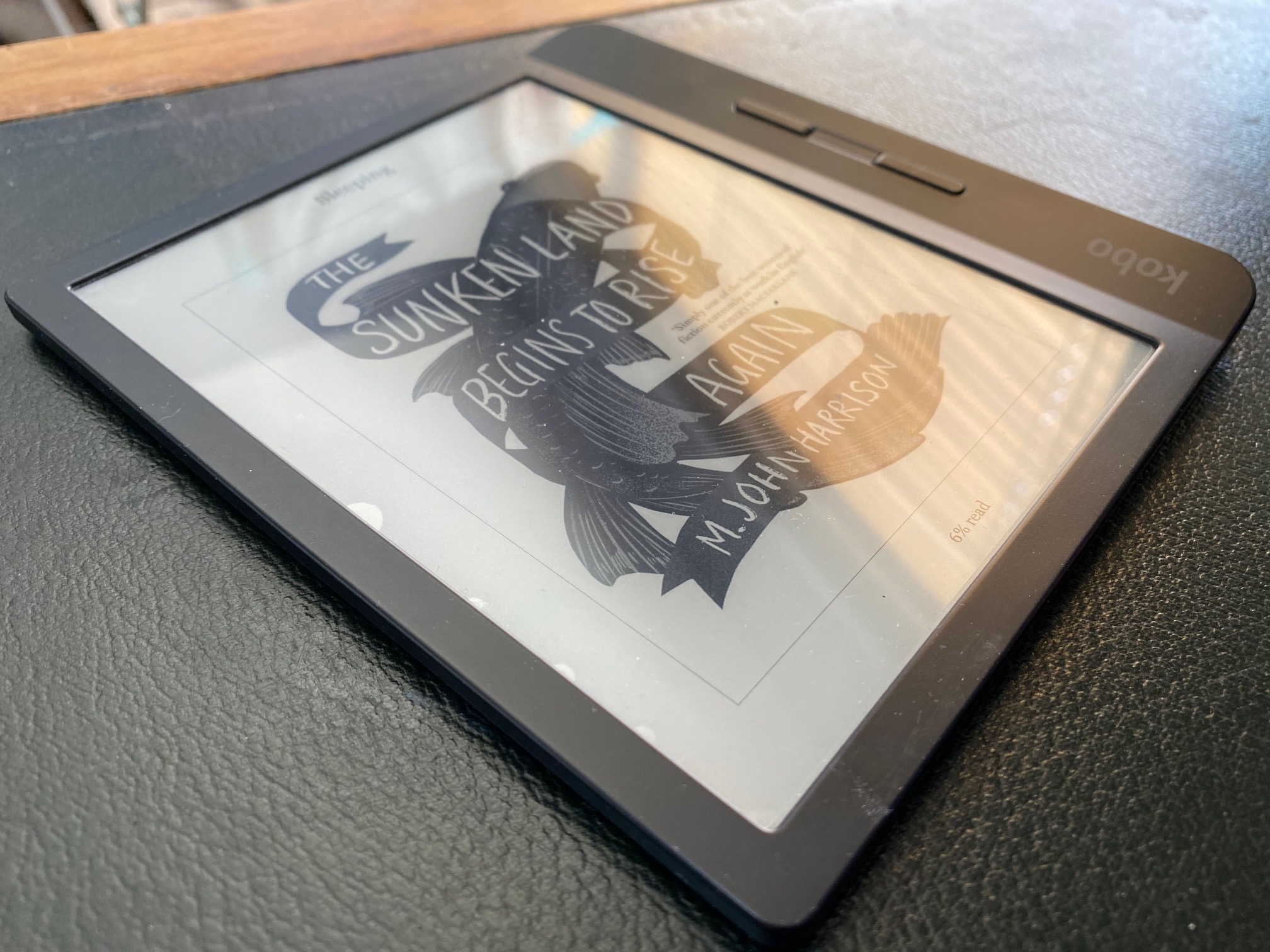
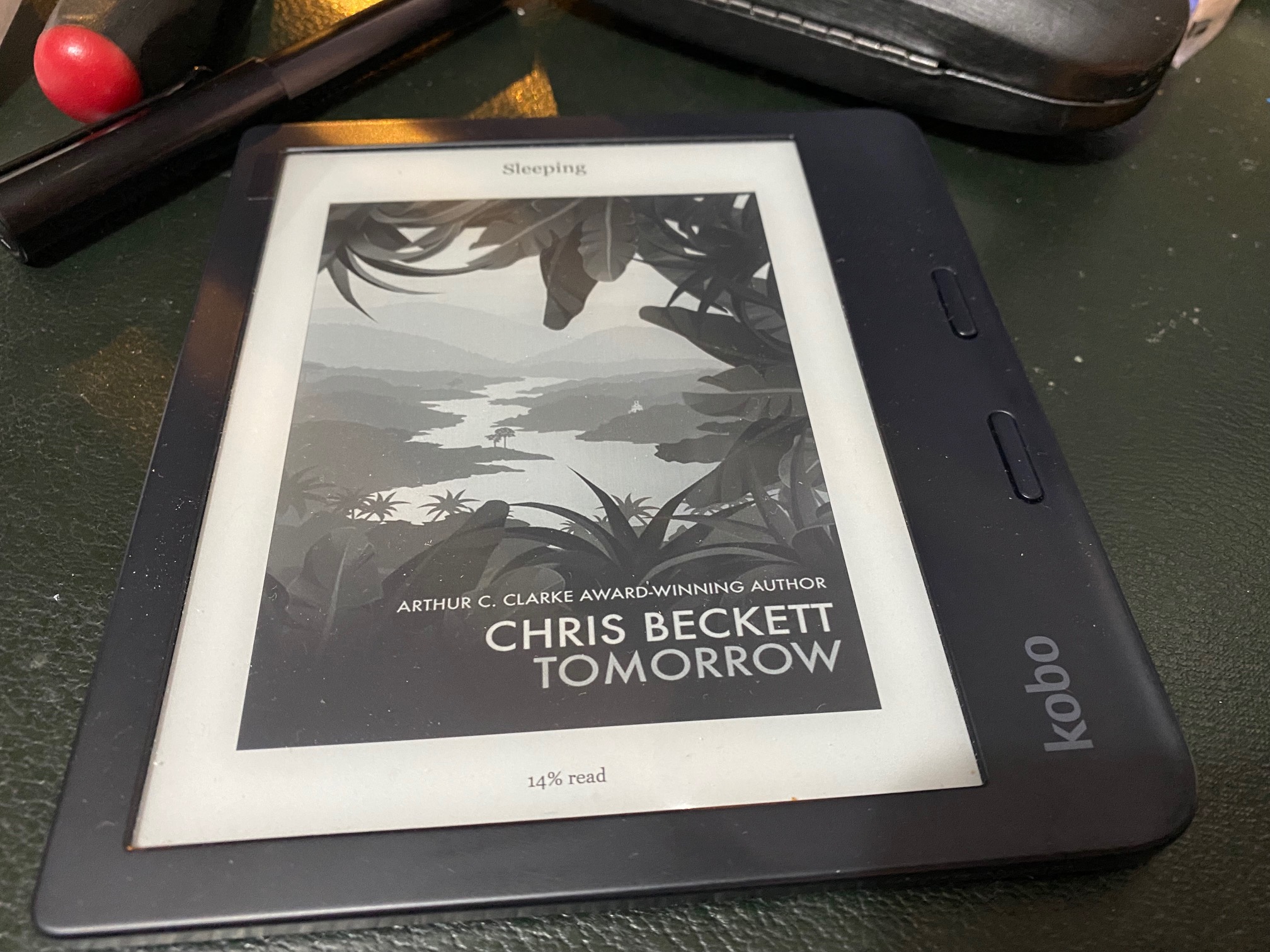
This year I finally bought an e-reader: a "Kobo Libra H2O": a 7" 300ppi
screen with an adjustable colour temperature front light, waterproof,
physical buttons on a "margin"/spine which pushes the case dimensions up
to 8", which is sadly a little too big for most jeans pockets.
In fact this is the second time I've bought one. Sarah and I bought a pair
of Amazon Kindle Paperwhite (2nd generation) readers as Honeymoon
gifts for each other in 2013. Sarah took to hers, but after giving mine a try
and reading a couple of books on it I ended up giving it to my Father-in-law.
The main problem I had with it was the colour temperature of the backlight: it
was too blue and "clinical".
It's interesting to me to realise how the environment that I read in can become
indelibly linked to the memory of that book. One book in particular that I read
on the Kindle was James Smythe's "The Machine", a modern twist on a classic
horror story. This was perfectly complemented by the somewhat pallid, sick
colour of the backlight, especially on its lowest brightness settings. It didn't
go so well with other stories.
I got on much better with the Libra H2O. For me, e-books and e-reading has not
replaced traditional paper books, but complemented them, giving me an opportunity
to read in contexts and situations where I couldn't manage with a real book (such
as in the pitch black, lying on my back with a toddler on my chest). I feel that
being able to read more often thanks to the e-reader has spurred me on to read
even paper books more frequently as well.
Unfortunately the screen broke, about 10 months after I bought it! After a bit
of soul-searching on what to do about replacing it, and briefly considering the
latest Amazon Paperwhite (which now has a 300ppi display and adjustable-colour
temperature front-light). This looks like a very nice e-reader: no physical
buttons which is a bit of a shame but narrower without the margin/spine of the
Kobo, so possibly more pocket-friendly. On the other hand, I really felt that I
wanted to avoid giving Amazon the money, for a whole variety of reasons.
So I instead settled on the "Kobo Libra 2", which is a slight refresh of the
Libra H2O, but almost identical. I'm going to pair it with a nice cover for when
its not in use and hopefully it will last longer than its predecessor.
My current favourite feature on the Libra 2, that I don't remember on the H2O
and I'm fairly sure doesn't exist on Kindles is it supports a "night mode",
which is effectively a reverse video, white-on-black mode. This is fantastic
for keeping the light levels down at night. I was already using the backlight
at about 2% brightness and occasionally found even that too bright.
Gaggia Classic 2015 and De Longhi grinder

The Gaggia Classic 2015 group head

Gaggia Classic 2015 vs 2019

Gaggia Classic 2019 and Sage BCG600 Dose Control Pro

Happy with my new purchase, I went to read this review and thought to myself: lucky me, my grinder is absolutely quiet! And then I realised that
the noise in my kitchen is not, in fact, produced by the fridge, but the grinder. Well, a cheap switched plug solved the issue completely (I wish
sockets here each had a switch like they usually to in the UK!)

Next.