Daniel Pocock: XCP / XenServer and Debian Jessie

In 2013, Debian wheezy was released with a number of great virtualization options include the Xen Cloud Platform (XCP / Xen-API) toolstack packaged by Thomas Goirand to run in a native Debian host environment.
Unfortunately, XCP is not available as a host (dom0) solution for the upcoming Debian 8 (jessie) release. However, it is possible to continue running a Debian wheezy system as the dom0 host and run virtualized (domU) jessie systems inside it. It may also be possible to use the packages from wheezy on a jessie system, but I haven't looked into that myself so far.
Newer kernel boot failures in Xen
After successfully upgrading a VM (domU in Xen terminology) from wheezy to jessie, I tried to reboot the VM and found that it wouldn't start. People have reported similar problems booting newer versions of Ubuntu and Fedora in XCP and XenServer environments. PyGrub displayed an error on the dom0 console:
# xe vm-start name-label=server05
Error code: Using  to parse /grub/grub.cfg
Error parameters: Traceback (most recent call last):,
   File "/usr/lib/xcp/lib/pygrub.xcp", line 853, in ,
     raise RuntimeError, "Unable to find partition containing kernel"
There is a quick and easy workaround. Hard-code the kernel and initrd filenames into config values that will be used to boot. A more thorough solution will probably involve using a newer version of PyGrub in wheezy.
If the /boot tree is a separate filesystem inside the VM, use commands like the following (substitute the correct UUID for the VM and the exact names/versions of the vmlinuz and initrd.img files):
xe vm-param-set uuid=da654fd0-74db-11e4-82f8-0800200c9a66 \
   PV-bootloader-args="--kernel=/vmlinuz-3.16-3-amd64
   --ramdisk=/initrd.img-3.16-3-amd64"
xe vm-param-set uuid=da654fd0-74db-11e4-82f8-0800200c9a66 \
   PV-args="root=/dev/mapper/vg00-root ro quiet"
and if /boot is on the root filesystem of the VM, this will do the trick:
xe vm-param-set uuid=da654fd0-74db-11e4-82f8-0800200c9a66 \
   PV-bootloader-args="--kernel=/boot/vmlinuz-3.16-3-amd64
   --ramdisk=/boot/initrd.img-3.16-3-amd64"
xe vm-param-set uuid=da654fd0-74db-11e4-82f8-0800200c9a66 \
   PV-args="root=/dev/mapper/vg00-root ro quiet"
Future strategy Once a comprehensive XCP solution appears in Debian again, hopefully it will be possible to migrate running VMs into the new platform without any downtime and retire the wheezy dom0. Other upgrade/migration options exist and the choice will depend on various factors, such as whether or not you have built your own tools around the XCP API and whether you use a solution like OpenStack that depends on it. Debian's pkg-xen-devel mailing list may be a good place to discuss these options further.

 The line of BASIC code that appears as the subject for this post is the title for a book I just finished reading And enjoyed thoroughly. The book is
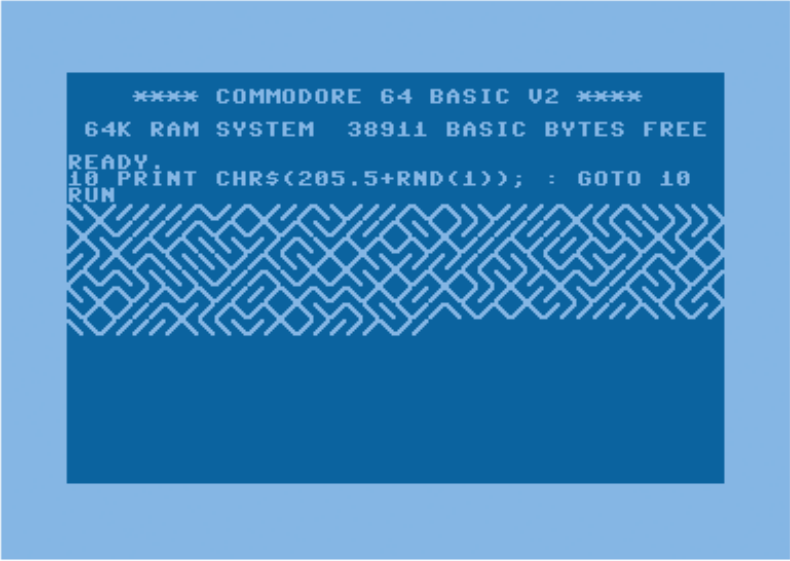 And the analysis is made from every possible angle: What do mazes mean in culture? What have they meant in cultures through history? What about regularity in art (mainly 20th century art)? How would this code look (or how it would be adapted) on contemporary non-C64 computers? And in other languages more popular today? What does randomness mean? And what does random() mean? What is BASIC, and how it came to the C64? What is the C64, and where did it come from? And several other beautiful chapters.
 The book was collaboratively written by ten different authors, in a Wiki-like fashion. And... Well, what else is there to say? I enjoyed so much reading through long chapters of my childhood, of what attracted me to computers, of my cultural traits and values... I really hope that, in due time, I can be a part of such a beautiful project!
 Occasionally, various quotes from people having an opinion if linux is about choice or not. Even pages like
 Propellor has supported docker containers for a "long" time, and it works
great. This week I've worked on adding more container support.
docker containers (revisited)
The syntax for docker containers has changed slightly. Here's how it looks
now:
 I've rebuilt many Debian packages over the years, largely to fix bugs which affected me, or to add features which didn't make the cut in various releases. For example I made a package of fabric available for Wheezy, since it wasn't in the release. (Happily in that case a wheezy-backport became available. Similar cases involved repackaging gtk-gnutella when the protocol changed and the official package in the lenny release no longer worked.)
I generally release a lot of my own software as Debian packages, although I'll admit I've started switching to publishing Perl-based projects on CPAN instead - from which they can be debianized via
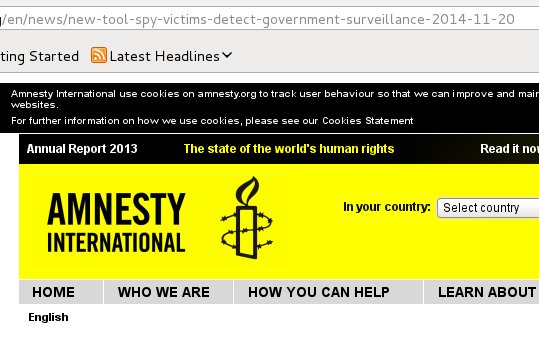 Even before I install the app to find out if the government is monitoring me, Amnesty is keen to monitor my behaviour themselves.
While cookies are used widely, their presence on a site like Amnesty's only further desensitizes Internet users to the downside risks of tracking technologies. By using cookies, Amnesty is effectivley saying a little bit of tracking is justified for the greater good. Doesn't that sound eerily like the justification we often hear from governments too?
Is Amnesty part of the solution or part of the problem?
Amnesty is a well known and widely respected name when human rights are mentioned.
However, their advice that you can install an app onto a Windows computer or iPhone to detect spyware is like telling people that putting a seatbelt on a motorbike will eliminate the risk of death. It would be much more credible for Amnesty to tell people to start by avoiding cloud services altogether, browse the web with
 Write to Amnesty
Amnesty became famous for their letter writing campaigns.
Maybe now is the time for people to write to Amnesty themselves, thank them for their efforts and encourage them to take more comprehensive action.
Feel free to cut and paste some of the following potential ideas

 Another PSA: something surprising about XML.
As you might all know, XML must be valid UTF-8 (or UTF-16 (or another encoding supported by the parser, but one which yields valid Unicode codepoints when read and converted)). Some characters, such as the ampersand & , must be escaped ( & or & , although & may also work, depending on the domain) or put into a CDATA section ( <![CDATA[&]]> ).
A bit surprisingly, a literal backspace character (ASCII 08h, Unicode U+0008) is not allowed in the text. I

 Debian's latest round of angry mailing list threads have been about some
combination of init systems, future direction and project governance.
The details aren't particularly important here, and pretty much everything
worthwhile in favour of or against each position has already been said several
times, but I think this bit is important enough that it bears repeating:
the reason I voted "we didn't need this General Resolution" ahead
of the other options is that I hope we can continue to use our normal
technical and decision-making processes to make Debian 8 the best possible
OS distribution for everyone. That includes people who like systemd,
people who dislike systemd, people who don't care either way and just
want the OS to work, and everyone in between those extremes.
I think that works best when we do things, and least well when a lot
of time and energy get diverted into talking about doing things.
I've been trying to do my small part of the former by
 Disclaimer: I m not used to writing personal stuff on Debian channels. However, there is nothing new here for those who know me from other public channels.

 My