Search Results: "cts"

17 October 2017

Russ Allbery: Bundle haul

Confession time: I started making these posts (eons ago) because a close friend did as well, and I enjoyed reading them. But the main reason why I continue is because the primary way I have to keep track of the books I've bought and avoid duplicates is, well, grep on these posts. I should come up with a non-bullshit way of doing this, but time to do more elegant things is in short supply, and, well, it's my blog. So I'm boring all of you who read this in various places with my internal bookkeeping. I do try to at least add a bit of commentary. This one will be more tedious than most since it includes five separate Humble Bundles, which increases the volume a lot. (I just realized I'd forgotten to record those purchases from the past several months.) First, the individual books I bought directly: Ilona Andrews Sweep in Peace (sff)
Ilona Andrews One Fell Sweep (sff)
Steven Brust Vallista (sff)
Nicky Drayden The Prey of Gods (sff)
Meg Elison The Book of the Unnamed Midwife (sff)
Pat Green Night Moves (nonfiction)
Ann Leckie Provenance (sff)
Seanan McGuire Once Broken Faith (sff)
Seanan McGuire The Brightest Fell (sff)
K. Arsenault Rivera The Tiger's Daughter (sff)
Matthew Walker Why We Sleep (nonfiction)
Some new books by favorite authors, a few new releases I heard good things about, and two (Night Moves and Why We Sleep) from references in on-line articles that impressed me. The books from security bundles (this is mostly work reading, assuming I'll get to any of it), including a blockchain bundle: Wil Allsop Unauthorised Access (nonfiction)
Ross Anderson Security Engineering (nonfiction)
Chris Anley, et al. The Shellcoder's Handbook (nonfiction)
Conrad Barsky & Chris Wilmer Bitcoin for the Befuddled (nonfiction)
Imran Bashir Mastering Blockchain (nonfiction)
Richard Bejtlich The Practice of Network Security (nonfiction)
Kariappa Bheemaiah The Blockchain Alternative (nonfiction)
Violet Blue Smart Girl's Guide to Privacy (nonfiction)
Richard Caetano Learning Bitcoin (nonfiction)
Nick Cano Game Hacking (nonfiction)
Bruce Dang, et al. Practical Reverse Engineering (nonfiction)
Chris Dannen Introducing Ethereum and Solidity (nonfiction)
Daniel Drescher Blockchain Basics (nonfiction)
Chris Eagle The IDA Pro Book, 2nd Edition (nonfiction)
Nikolay Elenkov Android Security Internals (nonfiction)
Jon Erickson Hacking, 2nd Edition (nonfiction)
Pedro Franco Understanding Bitcoin (nonfiction)
Christopher Hadnagy Social Engineering (nonfiction)
Peter N.M. Hansteen The Book of PF (nonfiction)
Brian Kelly The Bitcoin Big Bang (nonfiction)
David Kennedy, et al. Metasploit (nonfiction)
Manul Laphroaig (ed.) PoC GTFO (nonfiction)
Michael Hale Ligh, et al. The Art of Memory Forensics (nonfiction)
Michael Hale Ligh, et al. Malware Analyst's Cookbook (nonfiction)
Michael W. Lucas Absolute OpenBSD, 2nd Edition (nonfiction)
Bruce Nikkel Practical Forensic Imaging (nonfiction)
Sean-Philip Oriyano CEHv9 (nonfiction)
Kevin D. Mitnick The Art of Deception (nonfiction)
Narayan Prusty Building Blockchain Projects (nonfiction)
Prypto Bitcoin for Dummies (nonfiction)
Chris Sanders Practical Packet Analysis, 3rd Edition (nonfiction)
Bruce Schneier Applied Cryptography (nonfiction)
Adam Shostack Threat Modeling (nonfiction)
Craig Smith The Car Hacker's Handbook (nonfiction)
Dafydd Stuttard & Marcus Pinto The Web Application Hacker's Handbook (nonfiction)
Albert Szmigielski Bitcoin Essentials (nonfiction)
David Thiel iOS Application Security (nonfiction)
Georgia Weidman Penetration Testing (nonfiction)
Finally, the two SF bundles: Buzz Aldrin & John Barnes Encounter with Tiber (sff)
Poul Anderson Orion Shall Rise (sff)
Greg Bear The Forge of God (sff)
Octavia E. Butler Dawn (sff)
William C. Dietz Steelheart (sff)
J.L. Doty A Choice of Treasons (sff)
Harlan Ellison The City on the Edge of Forever (sff)
Toh Enjoe Self-Reference ENGINE (sff)
David Feintuch Midshipman's Hope (sff)
Alan Dean Foster Icerigger (sff)
Alan Dean Foster Mission to Moulokin (sff)
Alan Dean Foster The Deluge Drivers (sff)
Taiyo Fujii Orbital Cloud (sff)
Hideo Furukawa Belka, Why Don't You Bark? (sff)
Haikasoru (ed.) Saiensu Fikushon 2016 (sff anthology)
Joe Haldeman All My Sins Remembered (sff)
Jyouji Hayashi The Ouroboros Wave (sff)
Sergei Lukyanenko The Genome (sff)
Chohei Kambayashi Good Luck, Yukikaze (sff)
Chohei Kambayashi Yukikaze (sff)
Sakyo Komatsu Virus (sff)
Miyuki Miyabe The Book of Heroes (sff)
Kazuki Sakuraba Red Girls (sff)
Robert Silverberg Across a Billion Years (sff)
Allen Steele Orbital Decay (sff)
Bruce Sterling Schismatrix Plus (sff)
Michael Swanwick Vacuum Flowers (sff)
Yoshiki Tanaka Legend of the Galactic Heroes, Volume 1: Dawn (sff)
Yoshiki Tanaka Legend of the Galactic Heroes, Volume 2: Ambition (sff)
Yoshiki Tanaka Legend of the Galactic Heroes, Volume 3: Endurance (sff)
Tow Ubukata Mardock Scramble (sff)
Sayuri Ueda The Cage of Zeus (sff)
Sean Williams & Shane Dix Echoes of Earth (sff)
Hiroshi Yamamoto MM9 (sff)
Timothy Zahn Blackcollar (sff)
Phew. Okay, all caught up, and hopefully won't have to dump something like this again in the near future. Also, more books than I have any actual time to read, but what else is new.


Norbert Preining: Japanese TeX User Meeting 2017

Last saturday the Japanese TeX User Meeting took place in Fujisawa, Kanagawa. For those who have been at the TUG 2013 in Tokyo you will remember that the Japanese TeX community is quite big and vibrant. On Saturday about 50 users and developers gathered for a set of talks on a variety of topics. The first talk was by Keiichiro Shikano ( ) on using Markup text to generate (La)TeX and HTML. He presented a variety of markup formats, including his own tool xml2tex. The second talk was my Masamichi Hosoda ( ) on reducing the size of PDF files using PDFmark extraction. As a contributor to many projects including Texinfo and LilyPond, Masamichi Hosoda tells us horror stories about multiple font embedding in the manual of LilyPond, the permanent need for adaption to newer Ghostscript versions, and the very recent development in Ghostscript prohibiting the merge of font definitions in PDF files. Next up was Yusuke Terada ( ) on grading exams using TeX. Working through hundreds and hundreds of exams and do the grading is something many of us are used to and I think nobody really enjoys it. Yusuke Terada has combined various tools, including scans, pdf merging using pdfpages, to generate gradable PDF which were then checked on an iPad. On the way he did hit some limits in dvipdfmx on the number of images, but this was obviously only a small bump on the road. Now if that could be automatized as a nice application, it would be a big hit I guess! The forth talk was by Satoshi Yamashita ( ) on the preparation of slides using KETpic. KETpic is a long running project by Setsuo Takato ( ) for the generation of graphics, in particular using Cinderella. KETpic and KETcindy integrates with lots of algebraic and statistical programs (R, Maxima, SciLab, ) and has a long history of development. Currently there are activities to incorporate it into TeX Live. The fifth talk was by Takuto Asakura ( ) on programming TeX using expl3, the main building block of the LaTeX3 project and already adopted by many TeX developers. Takuto Asakura came to fame on this years TUG/BachoTeX 2017 when he won the W. J. Martin Prize for his presentation Implementing bioinformatics algorithms in TeX. I think we can expect great new developments from Takuto! The last talk was by myself on fmtutil and updmap, two of the main management programs in any TeX installation, presenting the changes introduced over the last year, including the most recent release of TeX Live. Details have been posted on my blog, and a lengthy article in TUGboat 38:2, 2017 is available on this topic, too. After the conference about half of the participants joined a social dinner in a nearby Izakaya, followed by a after-dinner beer tasting at a local craft beer place. Thanks to Tatsuyoshi Hamada for the organization. As usual, the Japanese TeX User Meetings are a great opportunity to discuss new features and make new friends. I am always grateful to be part of this very nice community! I am looking forward to the next year s meeting.

Antoine Beaupr : A comparison of cryptographic keycards

An earlier article showed that private key storage is an important problem to solve in any cryptographic system and established keycards as a good way to store private key material offline. But which keycard should we use? This article examines the form factor, openness, and performance of four keycards to try to help readers choose the one that will fit their needs. I have personally been using a YubiKey NEO, since a 2015 announcement on GitHub promoting two-factor authentication. I was also able to hook up my SSH authentication key into the YubiKey's 2048 bit RSA slot. It seemed natural to move the other subkeys onto the keycard, provided that performance was sufficient. The mail client that I use, (Notmuch), blocks when decrypting messages, which could be a serious problems on large email threads from encrypted mailing lists. So I built a test harness and got access to some more keycards: I bought a FST-01 from its creator, Yutaka Niibe, at the last DebConf and Nitrokey donated a Nitrokey Pro. I also bought a YubiKey 4 when I got the NEO. There are of course other keycards out there, but those are the ones I could get my hands on. You'll notice none of those keycards have a physical keypad to enter passwords, so they are all vulnerable to keyloggers that could extract the key's PIN. Keep in mind, however, that even with the PIN, an attacker could only ask the keycard to decrypt or sign material but not extract the key that is protected by the card's firmware.

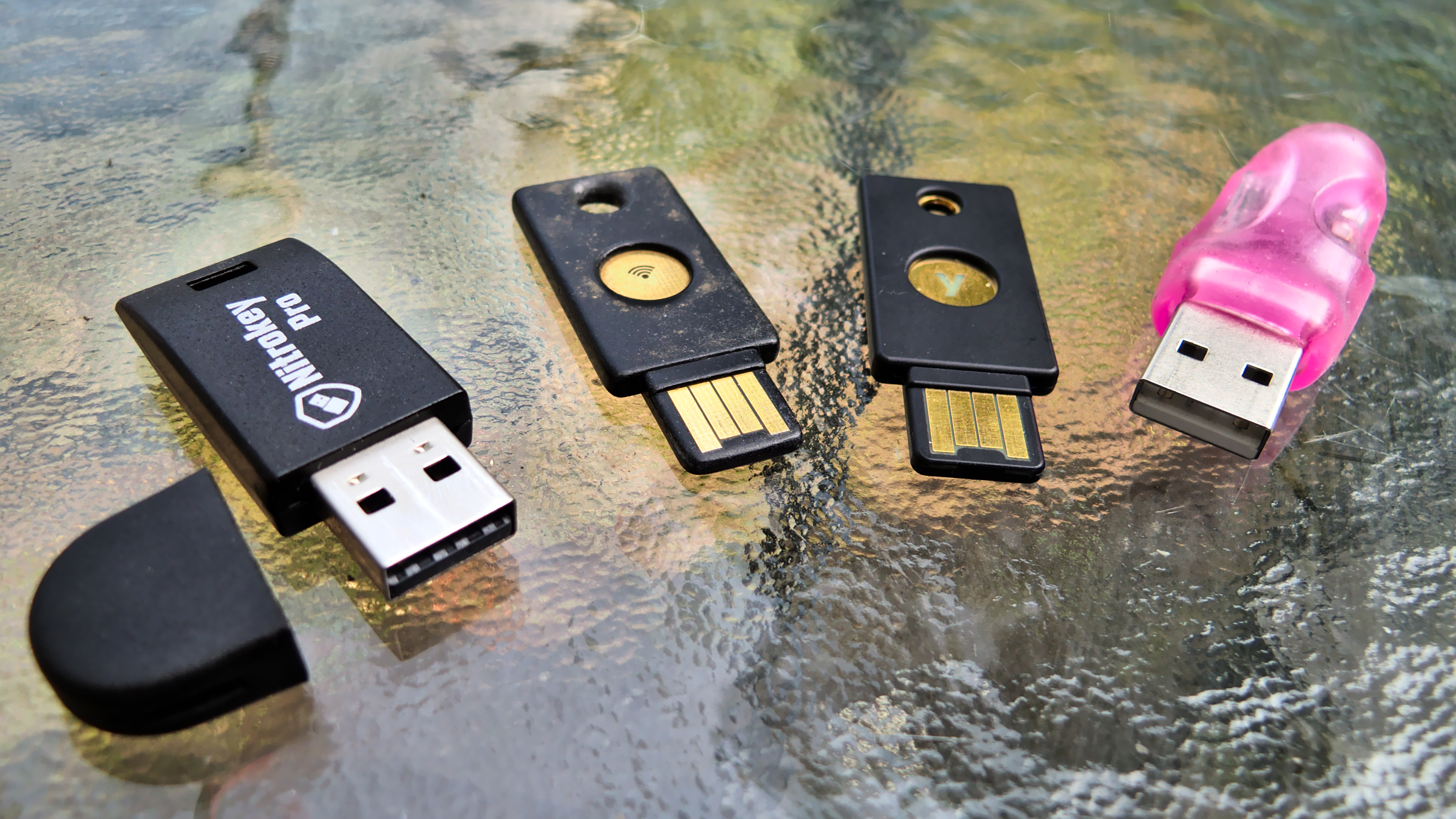
Form factor The Nitrokey Pro, YubiKey NEO (worn out), YubiKey 4, and FST-01 The four keycards have similar form factors: they all connect to a standard USB port, although both YubiKey keycards have a capacitive button by which the user triggers two-factor authentication and the YubiKey 4 can also require a button press to confirm private key use. The YubiKeys feel sturdier than the other two. The NEO has withstood two years of punishment in my pockets along with the rest of my "real" keyring and there is only minimal wear on the keycard in the picture. It's also thinner so it fits well on the keyring. The FST-01 stands out from the other two with its minimal design. Out of the box, the FST-01 comes without a case, so the circuitry is exposed. This is deliberate: one of its goals is to be as transparent as possible, both in terms of software and hardware design and you definitely get that feeling at the physical level. Unfortunately, that does mean it feels more brittle than other models: I wouldn't carry it in my pocket all the time, although there is a case that may protect the key a little better, but it does not provide an easy way to hook it into a keyring. In the group picture above, the FST-01 is the pink plastic thing, which is a rubbery casing I received along with the device when I got it. Notice how the USB connectors of the YubiKeys differ from the other two: while the FST-01 and the Nitrokey have standard USB connectors, the YubiKey has only a "half-connector", which is what makes it thinner than the other two. The "Nano" form factor takes this even further and almost disappears in the USB port. Unfortunately, this arrangement means the YubiKey NEO often comes loose and falls out of the USB port, especially when connected to a laptop. On my workstation, however, it usually stays put even with my whole keyring hanging off of it. I suspect this adds more strain to the host's USB port but that's a tradeoff I've lived with without any noticeable wear so far. Finally, the NEO has this peculiar feature of supporting NFC for certain operations, as LWN previously covered, but I haven't used that feature yet. The Nitrokey Pro looks like a normal USB key, in contrast with the other two devices. It does feel a little brittle when compared with the YubiKey, although only time will tell how much of a beating it can take. It has a small ring in the case so it is possible to carry it directly on your keyring, but I would be worried the cap would come off eventually. Nitrokey devices are also two times thicker than the Yubico models which makes them less convenient to carry around on keyrings.

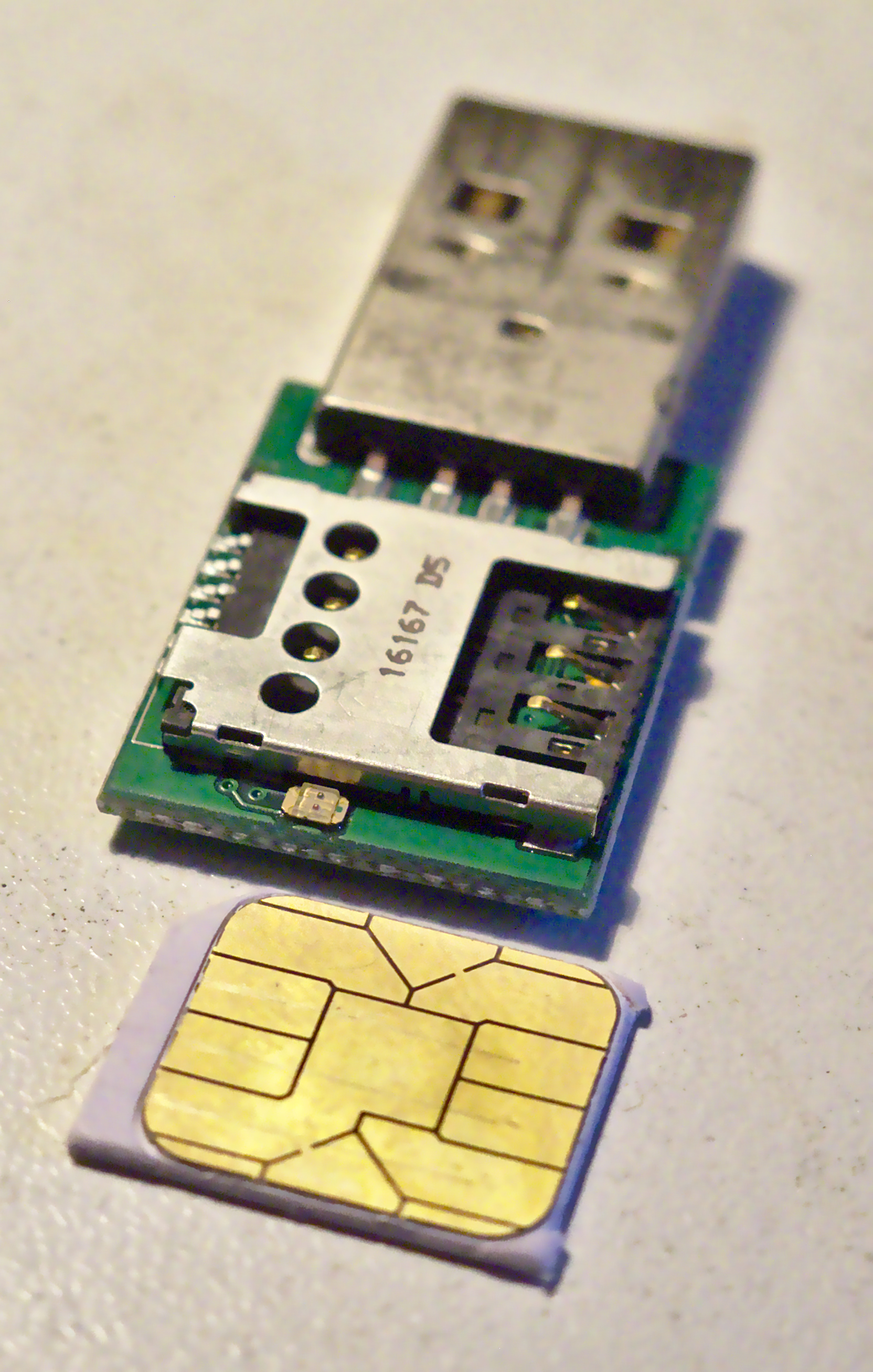
Open and closed designs The FST-01 is as open as hardware comes, down to the PCB design available as KiCad files in this Git repository. The software running on the card is the Gnuk firmware that implements the OpenPGP card protocol, but you can also get it with firmware implementing a true random number generator (TRNG) called NeuG (pronounced "noisy"); the device is programmable through a standard Serial Wire Debug (SWD) port. The Nitrokey Start model also runs the Gnuk firmware. However, the Nitrokey website announces only ECC and RSA 2048-bit support for the Start, while the FST-01 also supports RSA-4096. Nitrokey's founder Jan Suhr, in a private email, explained that this is because "Gnuk doesn't support RSA-3072 or larger at a reasonable speed". Its devices (the Pro, Start, and HSM models) use a similar chip to the FST-01: the STM32F103 microcontroller. Nitrokey Pro with STM32F103TBU6 MCU Nitrokey also publishes its hardware designs, on GitHub, which shows the Pro is basically a fork of the FST-01, according to the ChangeLog. I opened the case to confirm it was using the STM MCU, something I should warn you against; I broke one of the pins holding it together when opening it so now it's even more fragile. But at least, I was able to confirm it was built using the STM32F103TBU6 MCU, like the FST-01. Nitrokey back side But this is where the comparison ends: on the back side, we find a SIM card reader that holds the OpenPGP card that, in turn, holds the private key material and does the cryptographic operations. So, in effect, the Nitrokey Pro is really a evolution of the original OpenPGP card readers. Nitrokey confirmed the OpenPGP card featured in the Pro is the same as the one shipped by the Free Software Foundation Europe (FSFE): the BasicCard built by ZeitControl. Those cards, however, are covered by NDAs and the firmware is only partially open source. This makes the Nitrokey Pro less open than the FST-01, but that's an inevitable tradeoff when choosing a design based on the OpenPGP cards, which Suhr described to me as "pretty proprietary". There are other keycards out there, however, for example the SLJ52GDL150-150k smartcard suggested by Debian developer Yves-Alexis Perez, which he prefers as it is certified by French and German authorities. In that blog post, he also said he was experimenting with the GPL-licensed OpenPGP applet implemented by the French ANSSI. But the YubiKey devices are even further away in the closed-design direction. Both the hardware designs and firmware are proprietary. The YubiKey NEO, for example, cannot be upgraded at all, even though it is based on an open firmware. According to Yubico's FAQ, this is due to "best security practices": "There is a 'no upgrade' policy for our devices since nothing, including malware, can write to the firmware." I find this decision questionable in a context where security updates are often more important than trying to design a bulletproof design, which may simply be impossible. And the YubiKey NEO did suffer from critical security issue that allowed attackers to bypass the PIN protection on the card, which raises the question of the actual protection of the private key material on those cards. According to Niibe, "some OpenPGP cards store the private key unencrypted. It is a common attitude for many smartcard implementations", which was confirmed by Suhr: "the private key is protected by hardware mechanisms which prevent its extraction and misuse". He is referring to the use of tamper resistance. After that security issue, there was no other option for YubiKey NEO users than to get a new keycard (for free, thankfully) from Yubico, which also meant discarding the private key material on the key. For OpenPGP keys, this may mean having to bootstrap the web of trust from scratch if the keycard was responsible for the main certification key. But at least the NEO is running free software based on the OpenPGP card applet and the source is still available on GitHub. The YubiKey 4, on the other hand, is now closed source, which was controversial when the new model was announced last year. It led the main Linux Foundation system administrator, Konstantin Ryabitsev, to withdraw his endorsement of Yubico products. In response, Yubico argued that this approach was essential to the security of its devices, which are now based on "a secure chip, which has built-in countermeasures to mitigate a long list of attacks". In particular, it claims that:
A commercial-grade AVR or ARM controller is unfit to be used in a security product. In most cases, these controllers are easy to attack, from breaking in via a debug/JTAG/TAP port to probing memory contents. Various forms of fault injection and side-channel analysis are possible, sometimes allowing for a complete key recovery in a shockingly short period of time.
While I understand those concerns, they eventually come down to the trust you have in an organization. Not only do we have to trust Yubico, but also hardware manufacturers and designs they have chosen. Every step in the hidden supply chain is then trusted to make correct technical decisions and not introduce any backdoors. History, unfortunately, is not on Yubico's side: Snowden revealed the example of RSA security accepting what renowned cryptographer Bruce Schneier described as a "bribe" from the NSA to weaken its ECC implementation, by using the presumably backdoored Dual_EC_DRBG algorithm. What makes Yubico or its suppliers so different from RSA Security? Remember that RSA Security used to be an adamant opponent to the degradation of encryption standards, campaigning against the Clipper chip in the first crypto wars. Even if we trust the Yubico supply chain, how can we trust a closed design using what basically amounts to security through obscurity? Publicly auditable designs are an important tradition in cryptography, and that principle shouldn't stop when software is frozen into silicon. In fact, a critical vulnerability called ROCA disclosed recently affects closed "smartcards" like the YubiKey 4 and allows full private key recovery from the public key if the key was generated on a vulnerable keycard. When speaking with Ars Technica, the researchers outlined the importance of open designs and questioned the reliability of certification:
Our work highlights the dangers of keeping the design secret and the implementation closed-source, even if both are thoroughly analyzed and certified by experts. The lack of public information causes a delay in the discovery of flaws (and hinders the process of checking for them), thereby increasing the number of already deployed and affected devices at the time of detection.
This issue with open hardware designs seems to be recurring topic of conversation on the Gnuk mailing list. For example, there was a discussion in September 2017 regarding possible hardware vulnerabilities in the STM MCU that would allow extraction of encrypted key material from the key. Niibe referred to a talk presented at the WOOT 17 workshop, where Johannes Obermaier and Stefan Tatschner, from the Fraunhofer Institute, demonstrated attacks against the STMF0 family MCUs. It is still unclear if those attacks also apply to the older STMF1 design used in the FST-01, however. Furthermore, extracted private key material is still protected by user passphrase, but the Gnuk uses a weak key derivation function, so brute-forcing attacks may be possible. Fortunately, there is work in progress to make GnuPG hash the passphrase before sending it to the keycard, which should make such attacks harder if not completely pointless. When asked about the Yubico claims in a private email, Niibe did recognize that "it is true that there are more weak points in general purpose implementations than special implementations". During the last DebConf in Montreal, Niibe explained:
If you don't trust me, you should not buy from me. Source code availability is only a single factor: someone can maliciously replace the firmware to enable advanced attacks.
Niibe recommends to "build the firmware yourself", also saying the design of the FST-01 uses normal hardware that "everyone can replicate". Those advantages are hard to deny for a cryptographic system: using more generic components makes it harder for hostile parties to mount targeted attacks. A counter-argument here is that it can be difficult for a regular user to audit such designs, let alone physically build the device from scratch but, in a mailing list discussion, Debian developer Ian Jackson explained that:
You don't need to be able to validate it personally. The thing spooks most hate is discovery. Backdooring supposedly-free hardware is harder (more costly) because it comes with greater risk of discovery. To put it concretely: if they backdoor all of them, someone (not necessarily you) might notice. (Backdooring only yours involves messing with the shipping arrangements and so on, and supposes that you specifically are of interest.)
Since that, as far as we know, the STM microcontrollers are not backdoored, I would tend to favor those devices instead of proprietary ones, as such a backdoor would be more easily detectable than in a closed design. Even though physical attacks may be possible against those microcontrollers, in the end, if an attacker has physical access to a keycard, I consider the key compromised, even if it has the best chip on the market. In our email exchange, Niibe argued that "when a token is lost, it is better to revoke keys, even if the token is considered secure enough". So like any other device, physical compromise of tokens may mean compromise of the key and should trigger key-revocation procedures.

Algorithms and performance To establish reliable performance results, I wrote a benchmark program naively called crypto-bench that could produce comparable results between the different keys. The program takes each algorithm/keycard combination and runs 1000 decryptions of a 16-byte file (one AES-128 block) using GnuPG, after priming it to get the password cached. I assume the overhead of GnuPG calls to be negligible, as it should be the same across all tokens, so comparisons are possible. AES encryption is constant across all tests as it is always performed on the host and fast enough to be irrelevant in the tests. I used the following:
  • Intel(R) Core(TM) i3-6100U CPU @ 2.30GHz running Debian 9 ("stretch"/stable amd64), using GnuPG 2.1.18-6 (from the stable Debian package)
  • Nitrokey Pro 0.8 (latest firmware)
  • FST-01, running Gnuk version 1.2.5 (latest firmware)
  • YubiKey NEO OpenPGP applet 1.0.10 (not upgradable)
  • YubiKey 4 4.2.6 (not upgradable)
I ran crypto-bench for each keycard, which resulted in the following:
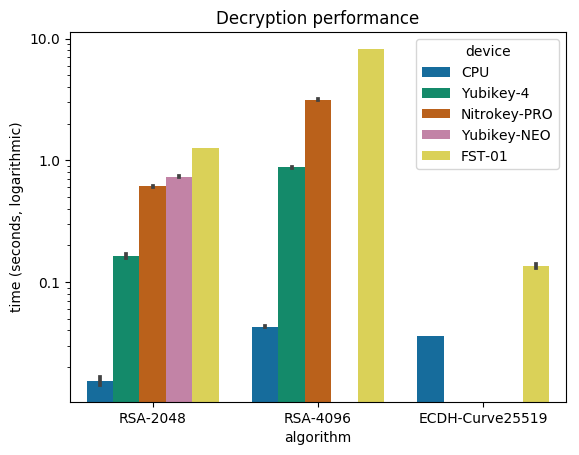
Algorithm Device Mean time (s)
ECDH-Curve25519 CPU 0.036
FST-01 0.135
RSA-2048 CPU 0.016
YubiKey-4 0.162
Nitrokey-Pro 0.610
YubiKey-NEO 0.736
FST-01 1.265
RSA-4096 CPU 0.043
YubiKey-4 0.875
Nitrokey-Pro 3.150
FST-01 8.218
Decryption graph There we see the performance of the four keycards I tested, compared with the same operations done without a keycard: the "CPU" device. That provides the baseline time of GnuPG decrypting the file. The first obvious observation is that using a keycard is slower: in the best scenario (FST-01 + ECC) we see a four-fold slowdown, but in the worst case (also FST-01, but RSA-4096), we see a catastrophic 200-fold slowdown. When I presented the results on the Gnuk mailing list, GnuPG developer Werner Koch confirmed those "numbers are as expected":
With a crypto chip RSA is much faster. By design the Gnuk can't be as fast - it is just a simple MCU. However, using Curve25519 Gnuk is really fast.
And yes, the FST-01 is really fast at doing ECC, but it's also the only keycard that handles ECC in my tests; the Nitrokey Start and Nitrokey HSM should support it as well, but I haven't been able to test those devices. Also note that the YubiKey NEO doesn't support RSA-4096 at all, so we can only compare RSA-2048 across keycards. We should note, however, that ECC is slower than RSA on the CPU, which suggests the Gnuk ECC implementation used by the FST-01 is exceptionally fast. In discussions about improving the performance of the FST-01, Niibe estimated the user tolerance threshold to be "2 seconds decryption time". In a new design using the STM32L432 microcontroller, Aurelien Jarno was able to bring the numbers for RSA-2048 decryption from 1.27s down to 0.65s, and for RSA-4096, from 8.22s down to 3.87s seconds. RSA-4096 is still beyond the two-second threshold, but at least it brings the FST-01 close to the YubiKey NEO and Nitrokey Pro performance levels. We should also underline the superior performance of the YubiKey 4: whatever that thing is doing, it's doing it faster than anyone else. It does RSA-4096 faster than the FST-01 does RSA-2048, and almost as fast as the Nitrokey Pro does RSA-2048. We should also note that the Nitrokey Pro also fails to cross the two-second threshold for RSA-4096 decryption. For me, the FST-01's stellar performance with ECC outshines the other devices. Maybe it says more about the efficiency of the algorithm than the FST-01 or Gnuk's design, but it's definitely an interesting avenue for people who want to deploy those modern algorithms. So, in terms of performance, it is clear that both the YubiKey 4 and the FST-01 take the prize in their own areas (RSA and ECC, respectively).

Conclusion In the above presentation, I have evaluated four cryptographic keycards for use with various OpenPGP operations. What the results show is that the only efficient way of storing a 4096-bit encryption key on a keycard would be to use the YubiKey 4. Unfortunately, I do not feel we should put our trust in such closed designs so I would argue you should either stick with 2048-bit encryption subkeys or keep the keys on disk. Considering that losing such a key would be catastrophic, this might be a good approach anyway. You should also consider switching to ECC encryption: even though it may not be supported everywhere, GnuPG supports having multiple encryption subkeys on a keyring: if one algorithm is unsupported (e.g. GnuPG 1.4 doesn't support ECC), it will fall back to a supported algorithm (e.g. RSA). Do not forget your previously encrypted material doesn't magically re-encrypt itself using your new encryption subkey, however. For authentication and signing keys, speed is not such an issue, so I would warmly recommend either the Nitrokey Pro or Start, or the FST-01, depending on whether you want to start experimenting with ECC algorithms. Availability also seems to be an issue for the FST-01. While you can generally get the device when you meet Niibe in person for a few bucks (I bought mine for around \$30 Canadian), the Seeed online shop says the device is out of stock at the time of this writing, even though Jonathan McDowell said that may be inaccurate in a debian-project discussion. Nevertheless, this issue may make the Nitrokey devices more attractive. When deciding on using the Pro or Start, Suhr offered the following advice:
In practice smart card security has been proven to work well (at least if you use a decent smart card). Therefore the Nitrokey Pro should be used for high security cases. If you don't trust the smart card or if Nitrokey Start is just sufficient for you, you can choose that one. This is why we offer both models.
So far, I have created a signing subkey and moved that and my authentication key to the YubiKey NEO, because it's a device I physically trust to keep itself together in my pockets and I was already using it. It has served me well so far, especially with its extra features like U2F and HOTP support, which I use frequently. Those features are also available on the Nitrokey Pro, so that may be an alternative if I lose the YubiKey. I will probably move my main certification key to the FST-01 and a LUKS-encrypted USB disk, to keep that certification key offline but backed up on two different devices. As for the encryption key, I'll wait for keycard performance to improve, or simply switch my whole keyring to ECC and use the FST-01 or Nitrokey Start for that purpose.
[The author would like to thank Nitrokey for providing hardware for testing.] This article first appeared in the Linux Weekly News.

16 October 2017

Russ Allbery: Free software log (September 2017)

I said that I was going to start writing these regularly, so I'm going to stick to it, even when the results are rather underwhelming. One of the goals is to make the time for more free software work, and I do better at doing things that I record. The only piece of free software work for September was that I made rra-c-util compile cleanly with the Clang static analyzer. This was fairly tedious work that mostly involved unconfusing the compiler or converting (semi-intentional) crashes into explicit asserts, but it unblocks using the Clang static analyzer as part of the automated test suite of my other projects that are downstream of rra-c-util. One of the semantic changes I made was that the vector utilities in rra-c-util (which maintain a resizable array of strings) now always allocate room for at least one string pointer. This wastes a small amount of memory for empty vectors that are never used, but ensures that the strings struct member is always valid. This isn't, strictly speaking, a correctness fix, since all the checks were correct, but after some thought, I decided that humans might have the same problem that the static analyzer had. It's a lot easier to reason about a field that's never NULL. Similarly, the replacement function for a missing reallocarray now does an allocation of size 1 if given a size of 0, just to avoid edge case behavior. (I'm sure the behavior of a realloc with size 0 is defined somewhere in the C standard, but if I have to look it up, I'd rather not make a human reason about it.) I started on, but didn't finish, making rra-c-util compile without Clang warnings (at least for a chosen set of warnings). By far the hardest problem here are the Clang warnings for comparisons between unsigned and signed integers. In theory, I like this warning, since it's the cause of a lot of very obscure bugs. In practice, gah does C ever do this all over the place, and it's incredibly painful to avoid. (One of the biggest offenders is write, which returns a ssize_t that you almost always want to compare against a size_t.) I did a bunch of mechanical work, but I now have a lot of bits of code like:
     if (status < 0)
         return;
    written = (size_t) status;
    if (written < avail)
        buffer->left += written;
which is ugly and unsatisfying. And I also have a ton of casts, such as with:
    buffer_resize(buffer, (size_t) st.st_size + used);
since st.st_size is an off_t, which may be signed. This is all deeply unsatisfying and ugly, and I think it makes the code moderately harder to read, but I do think the warning will potentially catch bugs and even security issues. I'm still torn. Maybe I can find some nice macros or programming styles to avoid the worst of this problem. It definitely requires more thought, rather than just committing this huge mechanical change with lots of ugly code. Mostly, this kind of nonsense makes me want to stop working on C code and go finish learning Rust.... Anyway, apart from work, the biggest thing I managed to do last month that was vaguely related to free software was upgrading my personal servers to stretch (finally). That mostly went okay; only a few things made it unnecessarily exciting. The first was that one of my systems had a very tiny / partition that was too small to hold the downloaded debs for the upgrade, so I had to resize it (VM disk, partition, and file system), and that was a bit exciting because it has an old-style DOS partition table that isn't aligned (hmmm, which is probably why disk I/O is so slow on those VMs), so I had to use the obsolete fdisk -c=dos mode because I wasn't up for replacing the partition right then. The second was that my first try at an upgrade died with a segfault during the libc6 postinst and then every executable segfaulted. A mild panic and a rescue disk later (and thirty minutes and a lot of swearing), I tracked the problem down to libc6-xen. Nothing in the dependency structure between jessie and stretch forces libc6-xen to be upgraded in lockstep or removed, but it's earlier in the search path. So ld.so gets upgraded, and then finds the old libc6 from the libc6-xen package, and the mismatch causes immediate segfaults. A chroot dpkg --purge from the rescue disk solved the problem as soon as I knew what was going on, but that was a stressful half-hour. The third problem was something I should have known was going to be an issue: an old Perl program that does some internal stuff for one of the services I ran had a defined @array test that has been warning for eons and that I never fixed. That became a full syntax error with the most recent Perl, and then I fixed it incorrectly the first time and had a bunch of trouble tracking down what I'd broken. All sorted out now, and everything is happily running stretch. (ejabberd, which other folks had mentioned was a problem, went completely smoothly, although I suspect I now have too many of the plugin packages installed and should do a purging.)

15 October 2017

Iain R. Learmonth: Free Software Efforts (2017W41)

Here s my weekly report for week 41 of 2017. In this week I have explored some Java 8 features, looked at automatic updates in a few Linux distributions and decided that actually I don t need swap anymore.

Debian The issue that was preventing the migration of the Tasktools Packaging Team s mailing list from Alioth to Savannah has now been resolved. Ana s chkservice package that I sponsored last week has been ACCEPTED into unstable and since MIGRATED to testing.

Tor Project I have produced a patch for the Tor Project website to update links to the Onionoo documentation now this has moved (#23802 ). I ve updated the Debian and Ubuntu relay configuration instructions to use systemctl instead of service where appropriate (#23048 ). When a Tor relay is less than 2 years old, an alert will now appear on Atlas to link to the new relay lifecycle blog post (#23767 ). This should hopefully help new relay operators understand why their relay is not immediately fully loaded but instead it takes some time to ramp up. I have gone through the tickets for Tor Cloud and did not find any tickets that contain any important information that would be useful to someone reviving the project. I have closed out these tickets and the Tor Cloud component no longer has any non-closed tickets (#7763, #8544, #8768, #9064, #9751, #10282, #10637, #11153, #11502, #13391, #14035, #14036, #14073, #15821 ). I ve continued to work on turning the Atlas application into an integrated part of Tor Metrics (#23518 ) and you can see some progress here. Finally, I ve continued hacking on a Twitter bot to tweet factoids about the public Tor network and you can now enjoy some JavaDoc documentation if you d like to learn a little about its internals. I am still waiting for a git repository to be created (#23799 ) but will be publishing the sources shortly after that ticket is actioned.

Sustainability I believe it is important to be clear not only about the work I have already completed but also about the sustainability of this work into the future. I plan to include a short report on the current sustainability of my work in each weekly report. I have not had any free software related expenses this week. The current funds I have available for equipment, travel and other free software expenses remains 60.52. I do not believe that any hardware I rely on is looking at imminent failure. I d like to thank Digital Ocean for providing me with futher credit for their platform to support my open source work. I do not find it likely that I ll be travelling to Cambridge for the miniDebConf as the train alone would be around 350 and hotel accomodation a further 600 (to include both me and Ana).

Norbert Preining: TeX Live Manager: JSON output

With the development of TLCockpit continuing, I found the need for and easy exchange format between the TeX Live Manager tlmgr and frontend programs like TLCockpit. Thus, I have implemented JSON output for the tlmgr info command. While the format is not 100% stable I might change some thing I consider it pretty settled. The output of tlmgr info --data json is a JSON array with JSON objects for each package requested (default is to list all).
[ TLPackageObj, TLPackageObj, ... ]
The structure of the JSON object TLPackageObj reflects the internal Perl hash. Guaranteed to be present keys are name (String) and avilable (Boolean). In case the package is available, there are the following further keys sorted by their type: A rather long example showing the output for the package latex, formatted with json_pp and having the list of files and the long description shortened:
[
    
      "installed" : true,
      "doccontainerchecksum" : "5bdfea6b85c431a0af2abc8f8df160b297ad73f6a324ca88df990f01f24611c9ae80d2f6d12c7b3767308fbe3de3fca3d11664b923ea4080fb13fd056a1d0c3d",
      "docfiles" : [
         "texmf-dist/doc/latex/base/README.txt",
         ....
         "texmf-dist/doc/latex/base/webcomp.pdf"
      ],
      "containersize" : 163892,
      "depends" : [
         "luatex",
         "pdftex",
         "latexconfig",
         "latex-fonts"
      ],
      "runsize" : 414,
      "relocated" : false,
      "doccontainersize" : 12812184,
      "srcsize" : 752,
      "revision" : 43813,
      "srcfiles" : [
         "texmf-dist/source/latex/base/alltt.dtx",
         ....
         "texmf-dist/source/latex/base/utf8ienc.dtx"
      ],
      "category" : "Package",
      "cataloguedata" :  
         "version" : "2017/01/01 PL1",
         "topics" : "format",
         "license" : "lppl1.3",
         "date" : "2017-01-25 23:33:57 +0100"
       ,
      "srccontainerchecksum" : "1d145b567cf48d6ee71582a1f329fe5cf002d6259269a71d2e4a69e6e6bd65abeb92461d31d7137f3803503534282bc0c5546e5d2d1aa2604e896e607c53b041",
      "postactions" : [],
      "binsize" :  ,
      "longdesc" : "LaTeX is a widely-used macro package for TeX, [...]",
      "srccontainersize" : 516036,
      "containerchecksum" : "af0ac85f89b7620eb7699c8bca6348f8913352c473af1056b7a90f28567d3f3e21d60be1f44e056107766b1dce8d87d367e7f8a82f777d565a2d4597feb24558",
      "executes" : [],
      "binfiles" :  ,
      "name" : "latex",
      "catalogue" : null,
      "docsize" : 3799,
      "available" : true,
      "runfiles" : [
         "texmf-dist/makeindex/latex/gglo.ist",
         ...
         "texmf-dist/tex/latex/base/x2enc.dfu"
      ],
      "shortdesc" : "A TeX macro package that defines LaTeX"
    
]
What is currently not available via tlmgr info and thus also not via the JSON output is access to virtual TeX Live databases with several member databases (multiple repositories). I am thinking about how to incorporate this information. These changes are currently available in the tlcritical repository, but will enter proper TeX Live repositories soon. Using this JSON output I will rewrite the current TLCockpit tlmgr interface to display more complete information.

13 October 2017

Alex Muntada: My Free Software Activities in Jul-Sep 2017

If you read Planet Debian often, you ve probably noticed a trend of Free Software activity reports at the beginning of the month. First, those reports seemed a bit unamusing and lengthy, but since I take the time to read them I ve learnt a lot of things, and now I m amazed at the amount of work that people are doing for Free Software. Indeed, I knew already that many people are doing lots of work. But reading those reports gives you an actual view of how much it is. Then, I decided that I should do the same and write some kind of report since I became a Debian Developer in July. I think it s a nice way to share your work with others and maybe inspire them as it happened to me. So I asked some of the people that have been inspiring me how do they do it. I mean, I was curious to know how they keep track of the work they do and how long it takes to write their reports. It seems that it takes quite some time, it s mostly manual work and usually starts by the end of the month, reviewing their contributions in mailing lists, bug trackers, e-mail folders, etc. Here I am now, writing my first report about my Free Software activities since July and until September 2017. I hope you like it: Happy hacking!

Michal &#268;iha&#345;: Weblate 2.17

Weblate 2.17 has been released today. There are quite some performance improvements, improved search, improved access control settings and various other improvements. Full list of changes: Update: The bugfix 2.17.1 is out as well, fixing testsuite errors in some setups: If you are upgrading from older version, please follow our upgrading instructions. You can find more information about Weblate on https://weblate.org, the code is hosted on Github. If you are curious how it looks, you can try it out on demo server. You can login there with demo account using demo password or register your own user. Weblate is also being used on https://hosted.weblate.org/ as official translating service for phpMyAdmin, OsmAnd, Turris, FreedomBox, Weblate itself and many other projects. Should you be looking for hosting of translations for your project, I'm happy to host them for you or help with setting it up on your infrastructure. Further development of Weblate would not be possible without people providing donations, thanks to everybody who have helped so far! The roadmap for next release is just being prepared, you can influence this by expressing support for individual issues either by comments or by providing bounty for them.

Filed under: Debian English SUSE Weblate

Shirish Agarwal: I need to speak up now X Economics

Dear all, This would be a longish blog post (as most of mine are) compiled over days but as there is so short a time and so much to share. I had previously thought to share beautiful photographs of Ganesh mandals taking out the procession at time of immersion of the idol or the last day of Durga Puja recent events around do not make my mood to share photos at this point in time. I may share some of them in a future blog post or two . Before going further, I would like to offer my sympathies and condolences to people hurt and dislocated in Hurricane Irma , the 2017 Central Mexico Earthquake and lastly the most recent Las Vegas shooting as well as Hurricane Maria in Puerto Rico . I am somewhat nonplussed as to why Americans always want to name, especially hurricanes which destroy people s lives and livelihood built over generations and why most of the hurricanes are named after women. A look at weather.com site unveiled the answer to the mystery. Ironically (or not) I saw some of the best science coverage about Earthquakes or anything scientific reporting and analysis after a long time in mainstream newspapers in India. On another note, I don t understand or even expect to understand why the gunman did what he did 2 days back. Country music AFAIK is one of the most chilled-out kind of music, in some ways very similar to classical Indian singing although they are worlds apart in style of singing, renditions, artists, the way they emote etc. I seriously wish that the gunman had not been shot but caught and reasons were sought about what he did, he did. While this is certainly armchair thinking as was not at the scene of crime, but if a Mumbai Police constable could do it around a decade ago armed only with a lathi could do it, why couldn t the American cops who probably are trained in innumerable ways to subdue people without killing them, did. While investigations are on, I suspect if he were caught just like Ajmal Kasab was caught then lot of revelations might have come up. From what is known, the gentleman was upwardly mobile i.e. he was white, rich and apparently had no reason to have beef with anybody especially a crowd swaying to some nice music, all of which makes absolutely no sense. Indian Economy Slowdown Anyways, back to one of the main reasons of writing this blog post. Few days back, an ex-finance Minister of India Yashwant Sinha wrote what was felt by probably millions of Indians, an Indian Express article called I need to speak up now While there have been many, many arguments made since then by various people. A simple search of I need to speak up would lead to lead to many a result besides the one I have shared above. The only exception I have with the article is the line Forty leading companies of the country are already facing bankruptcy proceedings. Many more are likely to follow suit. I would not bore you but you ask any entrepreneur trying to set up shop in India i.e. ones who actually go through the processes of getting all the licenses for setting up even a small businesses as to the numerous hurdles they have to overcome and laid-back corrupt bureaucracy which they have to overcome. I could have interviewed some of my friends who had the conviction and the courage to set up shop and spent more than half a decade getting all the necessary licenses and approval to set up but it probably would be too specific for one industry or the other and would lead to the same result. Co-incidentally, a new restaurant, leaf opened in my vicinity few weeks before. From the looks it looked like a high-brow, high-priced restaurant hence like many others I did not venture in. After a few days, they introduced south-Indian delicacies like Masala Dosa, Uttapam at prices similar to other restaurants around. So I ventured in and bought some south Indian food to consume between mum and me. Few days later, I became friends with the owner/franchisee and I suggested (in a friendly tone) that why he doesn t make it like a CCD play where many people including yours truly use the service to share, strategize and meet with clients. The CCD joints usually serve coffee and snacks (which are over-priced but still run out pretty fast) but people come as they have chilled-out atmosphere and Wi-Fi access which people need for their smartphones, although the Wi-Fi part may soon become redundant With Reliance Jio making a big play. I also shared why he doesn t add more variety and time (the south Indian items are time-limited) as I see/saw many empty chairs there. Anyways, the shop-owner/franchisee shared his gross costs including salary, stocking, electricity, rent and it doesn t pan out to be serving Rs.80/- dish (roughly a 1US dollar and 25 cents) then serving INR Rs. 400/- a dish (around 6 $USD). One round of INR 400/- + dishes make his costs for the day, around 12 tables were there. It s when they have two full rounds of dishes costing INR 400/- or more that he actually has profits and he is predicting loss for at least 6 months to a year before he makes a rebound. He needs steady customers rather than just walk-ins that will make his business work/click. Currently his family is bearing the costs. He didn t mention the taxes although I know apart from GST there are still some local body taxes that they will have to pay and comply with. There are a multitude of problems for shutting a shop legally as well as they have to again renavigate the bureaucracy for the same. I have seen more than a few retailers downing their shutters for 6-8 months and then either sell it to new management, let go of the lease or simply sell the property to a competitor. The Insolvency and Bankruptcy Code is probably the first proper exit policy for large companies. So the 40 odd companies that Mr. Sinha were talking about were probably sick for a long time. In India, there is also an additional shame of being a failed entrepreneur unlike in the west where Entrepreneurs start on their next venture. As seen from Retailing In India only 3.3% of the population or at the most 4% of the population is directly or indirectly linked with the retail trade. Most of the economy still derives its wealth from the agrarian sector which is still reeling under the pressure from demonetization which happened last year. Al jazeera surprisingly portrayed a truer picture of the effects demonetization had on common citizen than many Indian newspapers did at the time. Because of the South African Debconf, I had to resort to debit cards and hence was able to escape standing in long lines in which many an old and women perished. It is only yesterday that the Government has acknowledged which many prominent Indians have been saying for months now, that we are in a slowdown . Be aware of the terms being used for effect by the Prime Minister. There are two articles which outlines the troubles India is in atm. The only bright spot has been e-commerce which so far has eluded GST although the Govt. has claimed regulations to put it in check. Indian Education System Interestingly, Ravish Kumar has started a series on NDTV where he is showcasing how Indian education sector, especially public colleges have been left to teachers on contract basis, see the first four episodes on NDTV channel starting with the first one I have shared as a hyperlink. I apologize as the series is in Hindi as the channel is meant for Indians and is mostly limited to Northern areas of the Country (mostly) although he has been honest that it is because they lack resources to tackle the amount of information flowing to them. Ravish started the series with sharing information about the U.S. where the things are similar with some teachers needing to sleep in cars because of high-cost of living to some needing to turn to sex-work . I was shocked when I read the guardian article, that is no way to treat our teachers.I went on to read How the American University was Killed following the breadcrumbs along the way. Reading that it seems Indians have been following the American system playbook from the 1980 s itself. The article talks about HMO as well and that seems to have followed here as well with my own experience of hospital fees and drugs which I had to entail a few weeks/month ago. Few years ago, when me and some of my friends had the teaching bug and we started teaching in a nearby municipal school, couple of teachers had shared that they were doing 2-3 jobs to make ends meet. I don t know about others in my group, at least I was cynical because I thought all the teachers were permanent and they make good money only to realize now that the person was probably speaking the truth. When you have to do three jobs to make ends meet from where do you bring the passion to teach young people and that too outside the syllabus ? Also, with this new knowledge in hindsight, I take back all my comments I made last year and the year before for the pathetic education being put up by the State. With teachers being paid pathetically/underpaid and almost 60% teachers being ad-hoc/adjunct teachers they have to find ways to have some sense of security. Most teachers are bachelors as they are poor and cannot offer any security (either male or female) and for women, after marriage it actually makes no sense for them to continue in this profession. I salute all the professors who are ad-hoc in nature and probably will never get a permanent position in their life. I think in some way, thanx to him, that the government has chosen to give 7th pay commisson salary to teachers. While the numbers may appear be large, there are a lot of questions as to how many people will actually get paid. There needs to be lot of vacancies which need to be filled quickly but don t see any solution in the next 2-3 years as well. The Government has taken a position to use/re-hire retired teachers rather than have new young teachers as an unwritten policy. In this Digital India context how are retired teachers supposed to understand and then pass on digital concepts is beyond me when at few teacher trainings I have seen they lack even the most basic knowledge that I learnt at least a decade or two ago, the difference is that vast. I just don t know what to say to that. My own experience with my own mother who had pretty good education in her time and probably would have made a fine business-woman if she knew that she will have a child that she would have to raise by herself alone (along with maternal grand-parents) is testimonial to the fact how hard it is for older people to grasp technology and here I m talking just using the interface as a consumer rather than a producer or someone in-between who has the idea of how companies and governments profit from whatever data is shared one way or the other. After watching the series/episodes and discussing the issue with my mother it was revealed that both her and my late maternal grandfather were on casual/ad-hoc basis till 20-25 years in their service in the defense sector. If Ravish were to do a series on the defense sector he probably would find the same thing there. To add to that, the defense sector is a vital component to a country s security. If 60% of the defense staff in all defense establishments have temporary staff how do you ensure the loyalty of the people working therein. That brings to my mind Ignorance is bliss . Software development and deployment There is another worry that all are skirting around, the present dispensation/government s mantra is minimum government-maximum governance with digital technologies having all solutions which is leading to massive unemployment. Also from most of the stories/incidents I read in the newspapers, mainstream media and elsewhere it seems most software deployments done in India are done without having any system of internal checks and balances. There is no lintian for software to be implemented. Contracts seem to be given to big companies and there is no mention of what prerequisites or conditions were laid down by the Government for software development and deployment and if any checks were done to ensure that the software being developed was in according to government specifications or not. Ideally this should all be in public domain so that questions can be asked and responsibility fixed if things go haywire, as currently they do not. Software issues As my health been not that great, I have been taking a bit more time and depth while filing bugs. #877638 is a good example. I suspect though that part of the problem might be that mate has moved to gtk3 while guake still has gtk-2 bindings. I also reported the issue upstream both in mate-panel as well as guake . I haven t received any response from either or/and upstreams . I also have been fiddling around with gdb to better understand the tool so I can exploit/use this tool in a better way. There are some commands within the gdb interface which seem to be interesting and hopefully I ll try how the commands perform over days, weeks to a month. I hope we see more action on the mate-panel/guake bug as well as move of guake to gtk+3 but that what seemingly seemed like wait for eternity seems to have done by somebody in last couple of days. As shared in the ticket there are lots of things still to do but it seems the heavy lifting has been done but seems merging will be tricky as two developers have been trying to update to gtk+3 although aichingm seems to have a leg up with his 3! branch. Another interesting thing I saw is the below picture. Firefox is out of date on wordpress.com The firefox version I was using to test the site/wordpress-wp-admin was Mozilla Firefox 52.4.0 which AFAIK is a pretty recentish one and people using Debian stretch would probably be using the same version (firefox stable/LTS) rather than the more recent versions. I went to the link it linked to and it gave no indication as to why it thought my browser is out-of-date and what functionality was/is missing. I have found that wordpress support has declined quite a bit and people don t seem to use the forums as much as they used to before. I also filed a few bugs for qalculate. #877716 where a supposedly transitional package removes the actual application, #877717 as the software has moved its repo. to github.com as well as tickets and other things in process and lastly #877733. I had been searching for a calculator which can do currency calculations on the fly (say for e.g. doing personal budgeting for Taiwan debconf) without needing to manually enter the conversion rates and losing something in the middle. While the current version has support for some limited currencies, the new versions promise more as other people probably have more diverse needs for currency conversions (people who do long or short on oil, stocks overseas is just one example, I am sure there are many others) than simplistic mine.
Filed under: Miscellenous Tagged: #American Education System, #bug-filing, #Climate change, #Dignity, #e-commerce, #gtk+3, #gtk2, #Indian Economy 'Slowdown', #Indian Education System, #Insolvency and Bankruptcy Code, #Las Vegas shooting, #Modern Retail in India, #planet-debian, #qalculate, Ad-hoc and Adjunct Professors, wordpress.com

12 October 2017

Joachim Breitner: Isabelle functions: Always total, sometimes undefined

Often, when I mention how things work in the interactive theorem prover [Isabelle/HOL] (in the following just Isabelle 1) to people with a strong background in functional programming (whether that means Haskell or Coq or something else), I cause confusion, especially around the issue of what is a function, are function total and what is the business with undefined. In this blog post, I want to explain some these issues, aimed at functional programmers or type theoreticians. Note that this is not meant to be a tutorial; I will not explain how to do these things, and will focus on what they mean.

HOL is a logic of total functions If I have a Isabelle function f :: a b between two types a and b (the function arrow in Isabelle is , not ), then by definition of what it means to be a function in HOL whenever I have a value x :: a, then the expression f x (i.e. f applied to x) is a value of type b. Therefore, and without exception, every Isabelle function is total. In particular, it cannot be that f x does not exist for some x :: a. This is a first difference from Haskell, which does have partial functions like
spin :: Maybe Integer -> Bool
spin (Just n) = spin (Just (n+1))
Here, neither the expression spin Nothing nor the expression spin (Just 42) produce a value of type Bool: The former raises an exception ( incomplete pattern match ), the latter does not terminate. Confusingly, though, both expressions have type Bool. Because every function is total, this confusion cannot arise in Isabelle: If an expression e has type t, then it is a value of type t. This trait is shared with other total systems, including Coq. Did you notice the emphasis I put on the word is here, and how I deliberately did not write evaluates to or returns ? This is because of another big source for confusion:

Isabelle functions do not compute We (i.e., functional programmers) stole the word function from mathematics and repurposed it2. But the word function , in the context of Isabelle, refers to the mathematical concept of a function, and it helps to keep that in mind. What is the difference?
  • A function a b in functional programming is an algorithm that, given a value of type a, calculates (returns, evaluates to) a value of type b.
  • A function a b in math (or Isabelle) associates with each value of type a a value of type b.
For example, the following is a perfectly valid function definition in math (and HOL), but could not be a function in the programming sense:
definition foo :: "(nat   real)   real" where
  "foo seq = (if convergent seq then lim seq else 0)"
This assigns a real number to every sequence, but it does not compute it in any useful sense. From this it follows that

Isabelle functions are specified, not defined Consider this function definition:
fun plus :: "nat   nat   nat"  where
   "plus 0       m = m"
   "plus (Suc n) m = Suc (plus n m)"
To a functional programmer, this reads
plus is a function that analyses its first argument. If that is 0, then it returns the second argument. Otherwise, it calls itself with the predecessor of the first argument and increases the result by one.
which is clearly a description of a computation. But to Isabelle, the above reads
plus is a binary function on natural numbers, and it satisfies the following two equations:
And in fact, it is not so much Isabelle that reads it this way, but rather the fun command, which is external to the Isabelle logic. The fun command analyses the given equations, constructs a non-recursive definition of plus under the hood, passes that to Isabelle and then proves that the given equations hold for plus. One interesting consequence of this is that different specifications can lead to the same functions. In fact, if we would define plus' by recursing on the second argument, we d obtain the the same function (i.e. plus = plus' is a theorem, and there would be no way of telling the two apart).

Termination is a property of specifications, not functions Because a function does not evaluate, it does not make sense to ask if it terminates. The question of termination arises before the function is defined: The fun command can only construct plus in a way that the equations hold if it passes a termination check very much like Fixpoint in Coq. But while the termination check of Fixpoint in Coq is a deep part of the basic logic, in Isabelle it is simply something that this particular command requires for its internal machinery to go through. At no point does a termination proof of the function exist as a theorem inside the logic. And other commands may have other means of defining a function that do not even require such a termination argument! For example, a function specification that is tail-recursive can be turned in to a function, even without a termination proof: The following definition describes a higher-order function that iterates its first argument f on the second argument x until it finds a fixpoint. It is completely polymorphic (the single quote in 'a indicates that this is a type variable):
partial_function (tailrec)
  fixpoint :: "('a   'a)   'a   'a"
where
  "fixpoint f x = (if f x = x then x else fixpoint f (f x))"
We can work with this definition just fine. For example, if we instantiate f with ( x. x-1), we can prove that it will always return 0:
lemma "fixpoint (  n . n - 1) (n::nat) = 0"
  by (induction n) (auto simp add: fixpoint.simps)
Similarly, if we have a function that works within the option monad (i.e. Maybe in Haskell), its specification can always be turned into a function without an explicit termination proof here one that calculates the Collatz sequence:
partial_function (option) collatz :: "nat   nat list option"
 where "collatz n =
        (if n = 1 then Some [n]
         else if even n
           then do   ns <- collatz (n div 2);    Some (n # ns)  
           else do   ns <- collatz (3 * n + 1);  Some (n # ns) )"
Note that lists in Isabelle are finite (like in Coq, unlike in Haskell), so this function returns a list only if the collatz sequence eventually reaches 1. I expect these definitions to make a Coq user very uneasy. How can fixpoint be a total function? What is fixpoint ( n. n+1)? What if we run collatz n for a n where the Collatz sequence does not reach 1?3 We will come back to that question after a little detour

HOL is a logic of non-empty types Another big difference between Isabelle and Coq is that in Isabelle, every type is inhabited. Just like the totality of functions, this is a very fundamental fact about what HOL defines to be a type. Isabelle gets away with that design because in Isabelle, we do not use types for propositions (like we do in Coq), so we do not need empty types to denote false propositions. This design has an important consequence: It allows the existence of a polymorphic expression that inhabits any type, namely
undefined :: 'a
The naming of this term alone has caused a great deal of confusion for Isabelle beginners, or in communication with users of different systems, so I implore you to not read too much into the name. In fact, you will have a better time if you think of it as arbitrary or, even better, unknown. Since undefined can be instantiated at any type, we can instantiate it for example at bool, and we can observe an important fact: undefined is not an extra value besides the usual ones . It is simply some value of that type, which is demonstrated in the following lemma:
lemma "undefined = True   undefined = False" by auto
In fact, if the type has only one value (such as the unit type), then we know the value of undefined for sure:
lemma "undefined = ()" by auto
It is very handy to be able to produce an expression of any type, as we will see as follows

Partial functions are just underspecified functions For example, it allows us to translate incomplete function specifications. Consider this definition, Isabelle s equivalent of Haskell s partial fromJust function:
fun fromSome :: "'a option   'a" where
  "fromSome (Some x) = x"
This definition is accepted by fun (albeit with a warning), and the generated function fromSome behaves exactly as specified: when applied to Some x, it is x. The term fromSome None is also a value of type 'a, we just do not know which one it is, as the specification does not address that. So fromSome None behaves just like undefined above, i.e. we can prove
lemma "fromSome None = False   fromSome None = True" by auto
Here is a small exercise for you: Can you come up with an explanation for the following lemma:
fun constOrId :: "bool   bool" where
  "constOrId True = True"
lemma "constOrId = ( _.True)   constOrId = ( x. x)"
  by (metis (full_types) constOrId.simps)
Overall, this behavior makes sense if we remember that function definitions in Isabelle are not really definitions, but rather specifications. And a partial function definition is simply a underspecification. The resulting function is simply any function hat fulfills the specification, and the two lemmas above underline that observation.

Nonterminating functions are also just underspecified Let us return to the puzzle posed by fixpoint above. Clearly, the function seen as a functional program is not total: When passed the argument ( n. n + 1) or ( b. b) it will loop forever trying to find a fixed point. But Isabelle functions are not functional programs, and the definitions are just specifications. What does the specification say about the case when f has no fixed-point? It states that the equation fixpoint f x = fixpoint f (f x) holds. And this equation has a solution, for example fixpoint f _ = undefined. Or more concretely: The specification of the fixpoint function states that fixpoint ( b. b) True = fixpoint ( b. b) False has to hold, but it does not specify which particular value (True or False) it should denote any is fine.

Not all function specifications are ok At this point you might wonder: Can I just specify any equations for a function f and get a function out of that? But rest assured: That is not the case. For example, no Isabelle command allows you define a function bogus :: () nat with the equation bogus () = Suc (bogus ()), because this equation does not have a solution. We can actually prove that such a function cannot exist:
lemma no_bogus: "  bogus. bogus () = Suc (bogus ())" by simp
(Of course, not_bogus () = not_bogus () is just fine )

You cannot reason about partiality in Isabelle We have seen that there are many ways to define functions that one might consider partial . Given a function, can we prove that it is not partial in that sense? Unfortunately, but unavoidably, no: Since undefined is not a separate, recognizable value, but rather simply an unknown one, there is no way of stating that A function result is not specified . Here is an example that demonstrates this: Two partial functions (one with not all cases specified, the other one with a self-referential specification) are indistinguishable from the total variant:
fun partial1 :: "bool   unit" where
  "partial1 True = ()"
partial_function (tailrec) partial2 :: "bool   unit" where
  "partial2 b = partial2 b"
fun total :: "bool   unit" where
  "total True = ()"
  "total False = ()"
lemma "partial1 = total   partial2 = total" by auto
If you really do want to reason about partiality of functional programs in Isabelle, you should consider implementing them not as plain HOL functions, but rather use HOLCF, where you can give equational specifications of functional programs and obtain continuous functions between domains. In that setting, () and partial2 = total. We have done that to verify some of HLint s equations.

You can still compute with Isabelle functions I hope by this point, I have not scared away anyone who wants to use Isabelle for functional programming, and in fact, you can use it for that. If the equations that you pass to fun are a reasonable definition for a function (in the programming sense), then these equations, used as rewriting rules, will allow you to compute that function quite like you would in Coq or Haskell. Moreover, Isabelle supports code extraction: You can take the equations of your Isabelle functions and have them expored into Ocaml, Haskell, Scala or Standard ML. See Concon for a conference management system with confidentially verified in Isabelle. While these usually are the equations you defined the function with, they don't have to: You can declare other proved equations to be used for code extraction, e.g. to refine your elegant definitions to performant ones. Like with code extraction from Coq to, say, Haskell, the adequacy of the translations rests on a moral reasoning foundation. Unlike extraction from Coq, where you have an (unformalized) guarantee that the resulting Haskell code is terminating, you do not get that guarantee from Isabelle. Conversely, this allows you do reason about and extract non-terminating programs, like fixpoint, which is not possible in Coq. There is currently ongoing work about verified code generation, where the code equations are reflected into a deep embedding of HOL in Isabelle that would allow explicit termination proofs.

Conclusion We have seen how in Isabelle, every function is total. Function declarations have equations, but these do not define the function in an computational sense, but rather specify them. Because in HOL, there are no empty types, many specifications that appear partial (incomplete patterns, non-terminating recursion) have solutions in the space of total functions. Partiality in the specification is no longer visible in the final product.

PS: Axiom undefined in Coq This section is speculative, and an invitation for discussion. Coq already distinguishes between types used in programs (Set) and types used in proofs Prop. Could Coq ensure that every t : Set is non-empty? I imagine this would require additional checks in the Inductive command, similar to the checks that the Isabelle command datatype has to perform4, and it would disallow Empty_set. If so, then it would be sound to add the following axiom
Axiom undefined : forall (a : Set), a.
wouldn't it? This axiom does not have any computational meaning, but that seems to be ok for optional Coq axioms, like classical reasoning or function extensionality. With this in place, how much of what I describe above about function definitions in Isabelle could now be done soundly in Coq. Certainly pattern matches would not have to be complete and could sport an implicit case _ undefined. Would it help with non-obviously terminating functions? Would it allow a Coq command Tailrecursive that accepts any tailrecursive function without a termination check?

  1. Isabelle is a metalogical framework, and other logics, e.g. Isabelle/ZF, behave differently. For the purpose of this blog post, I always mean Isabelle/HOL.
  2. Isabelle is a metalogical framework, and other logics, e.g. Isabelle/ZF, behave differently. For the purpose of this blog post, I always mean Isabelle/HOL.
  3. Let me know if you find such an n. Besides n = 0.
  4. Like fun, the constructions by datatype are not part of the logic, but create a type definition from more primitive notions that is isomorphic to the specified data type.

Dirk Eddelbuettel: RcppArmadillo 0.8.100.1.0

armadillo image We are thrilled to announce a new big RcppArmadillo release! Conrad recently moved Armadillo to the 8.* series, with significant improvements and speed ups for sparse matrix operations, and more. See below for a brief summary. This also required some changes at our end which Binxiang Ni provided, and Serguei Sokol improved some instantiations. We now show the new vignette Binxiang Ni wrote for his GSoC contribution, and I converted it (and the other main vignette) to using the pinp package for sleeker pdf vignettes. This release resumes our bi-monthly CRAN release cycle. I may make interim updates available at GitHub "as needed". And this time I managed to mess up the reverse depends testing, and missed one sync() call on the way back to R---but all that is now taken care of. Armadillo is a powerful and expressive C++ template library for linear algebra aiming towards a good balance between speed and ease of use with a syntax deliberately close to a Matlab. RcppArmadillo integrates this library with the R environment and language--and is widely used by (currently) 405 other packages on CRAN. A high-level summary of changes follows.

Changes in RcppArmadillo version 0.8.100.1.0 (2017-10-05)
  • Upgraded to Armadillo release 8.100.1 (Feral Pursuits)
    • faster incremental construction of sparse matrices via element access operators
    • faster diagonal views in sparse matrices
    • expanded SpMat to save/load sparse matrices in coord format
    • expanded .save(),.load() to allow specification of datasets within HDF5 files
    • added affmul() to simplify application of affine transformations
    • warnings and errors are now printed by default to the std::cerr stream
    • added set_cerr_stream() and get_cerr_stream() to replace set_stream_err1(), set_stream_err2(), get_stream_err1(), get_stream_err2()
    • new configuration options ARMA_COUT_STREAM and ARMA_CERR_STREAM
  • Constructors for sparse matrices of types dgt, dtt amd dst now use Armadillo code for improved performance (Serguei Sokol in #175 addressing #173)
  • Sparse matrices call .sync() before accessing internal arrays (Binxiang Ni in #171)
  • The sparse matrix vignette has been converted to Rmarkdown using the pinp package, and is now correctly indexed. (#176)

Courtesy of CRANberries, there is a diffstat report. More detailed information is on the RcppArmadillo page. Questions, comments etc should go to the rcpp-devel mailing list off the R-Forge page.

This post by Dirk Eddelbuettel originated on his Thinking inside the box blog. Please report excessive re-aggregation in third-party for-profit settings.

11 October 2017

Steve Kemp: A busy week or two

It feels like the past week or two has been very busy, and so I'm looking forward to my "holiday" next month. I'm not really having a holiday of course, my wife is slowly returning to work, so I'll be taking a month of paternity leave, taking sole care of Oiva for the month of November. He's still a little angel, and now that he's reached 10 months old he's starting to get much more mobile - he's on the verge of walking, but not quite there yet. Mostly that means he wants you to hold his hands so that he can stand up, swaying back and forth before the inevitable collapse. Beyond spending most of my evenings taking care of him, from the moment I return from work to his bedtime (around 7:30PM), I've made the Debian Administration website both read-only and much simpler. In the past that site was powered by a lot of servers, I think around 11. Now it has only a small number of machines, which should slowly decrease. I've ripped out the database host, the redis host, the events-server, the planet-machine, the email-box, etc. Now we have a much simpler setup: Finally although I'm slowly making progress with "radio stuff" I've knocked up a simple hack which uses an ultrasonic sensor to determine whether I'm sat in front of my (home) PC. If I am everything is good. If I'm absent the music is stopped and the screen locked. Kinda neat. (Simple ESP8266 device wired to the sensor. When the state changes a message is posted to Mosquitto, where a listener reacts to the change(s).) Oh, not final. I've also transfered my mobile phone from DNA.fi to MoiMobile. Which should complete soon, right now my phone is in limbo, active on niether service. Oops.

Michal &#268;iha&#345;: New projects on Hosted Weblate

Hosted Weblate provides also free hosting for free software projects. The hosting requests queue has grown too long, so it's time to process it and include new project. This time, the newly hosted projects include: Additionally there were some notable additions to existing projects: If you want to support this effort, please donate to Weblate, especially recurring donations are welcome to make this service alive. You can do that easily on Liberapay or Bountysource.

Filed under: Debian English SUSE Weblate

10 October 2017

Yves-Alexis Perez: OpenPGP smartcard transition (part 1)

A long time ago, I switched my GnuPG setup to a smartcard based one. I kept using the same master key, but: I've been working with that setup for a few years now and it is working perfectly fine. The signature counter on the OpenPGP basic card is a bit north of 5000 which is large but not that huge, all considered (and not counting authentication and decryption key usage).

One very nice feature of using a smartcard is that my laptop (or other machines I work on) never manipulates the private key directly but only sends request to the card, which is a really huge improvement, in my opinion. But it's also not the perfect solution for me: the OpenPGP card uses a proprietary platform from ZeitControl, named BasicCard. We have very few information on the smartcard, besides the fact that Werner Koch trust ZeistControl to not mess up. One caveat for me is that the card does not use a certified secure microcontroler like you would find in smartcard chips found in debit card or electronic IDs. That means it's not really been audited by a competent hardware lab, and thus can't be considered secure against physical attacks. The cardOS software and the application implementing the OpenPGP specification are not public either and have not been audited either, to the best of my knowledge.

At one point I was interested in the Yubikey Neo, especially since the architecture Yubico used was common: a (supposedly) certified platform (secure microcontroler, card OS) and a GlobalPlatform / JavaCard virtual machine. The applet used in the Yubikey Neo is open-source, too, so you could take a look at it and identify any issue.

Unfortunately, Yubico transitioned to a less common and more proprietary infrastructure for Yubikey 4: it's not longer Javacard based, and they don't provide the applet source anymore. This was not really seen as a good move by a lot of people, including Konstantin Ryabitsev (kernel.org administrator). Also, it wasn't possible even for the Yubico Neo to actually build the applet yourself and inject it on the card: when the Yubikey leaves the facility, the applet is already installed and the smartcard is locked (for obvious security reason). I've tried asking about getting naked/empty Yubikey with developers keys to load the applet myself, but it' was apparently not possible or would have required signing an NDA with NXP (the chip maker), which is not really possible as an individual (not that I really want to anyway).

In the meantime, a coworker actually wrote an OpenPGP javacard applet, with the intention to support latest version of the OpenPGP specification, and especially elliptic curve cryptography. The applet is called SmartPGP and has been released on ANSSI github repository. I investigated a bit, and found a smartcard with correct specification: certified (in France or Germany), and supporting Javacard 3.0.4 (required for ECC). The card can do RSA2048 (unfortunately not RSA4096) and EC with NIST (secp256r1, secp384r1, secp521r1) and Brainpool (P256, P384, P512) curves.

I've ordered some cards, and when they arrived started playing. I've built the SmartPGP applet and pushed it to a smartcard, then generated some keys and tried with GnuPG. I'm right now in the process of migrating to a new smartcard based on that setup, which seems to work just fine after few days.

Part two of this serie will describe how to build the applet and inject it in the smartcard. The process is already documented here and there, but there are few things not to forget, like how to lock the card after provisionning, so I guess having the complete process somewhere might be useful in case some people want to reproduce it.

Michal &#268;iha&#345;: Better access control in Weblate

Upcoming Weblate 2.17 will bring improved access control settings. Previously this could be controlled only by server admins, but now the project visibility and access presets can be configured. This allows you to better tweak access control for your needs. There is additional choice of making the project public, but restricting translations, what has been requested by several projects. You can see the possible choices on the UI screenshot: Weblate overall experience On Hosted Weblate this feature is currently available only to commercial hosting customers. Projects hosted for free are limited to public visibility only.

Filed under: Debian English SUSE Weblate

9 October 2017

Michal &#268;iha&#345;: Better acess control in Weblate

Upcoming Weblate 2.17 will bring improved access control settings. Previously this could be controlled only by server admins, but now the project visibility and access presets can be configured. This allows you to better tweak access control for your needs. There is additional choice of making the project public, but restricting translations, what has been requested by several projects. You can see the possible choices on the UI screenshot: Weblate overall experience On Hosted Weblate this feature is currently available only to commercial hosting customers. Projects hosted for free are limited to public visibility only.

Filed under: Debian English SUSE Weblate

Antonio Terceiro: pristine-tar updates

Introduction pristine-tar is a tool that is present in the workflow of a lot of Debian people. I adopted it last year after it has been orphaned by its creator Joey Hess. A little after that Tomasz Buchert joined me and we are now a functional two-person team. pristine-tar goals are to import the content of a pristine upstream tarball into a VCS repository, and being able to later reconstruct that exact same tarball, bit by bit, based on the contents in the VCS, so we don t have to store a full copy of that tarball. This is done by storing a binary delta files which can be used to reconstruct the original tarball from a tarball produced with the contents of the VCS. Ultimately, we want to make sure that the tarball that is uploaded to Debian is exactly the same as the one that has been downloaded from upstream, without having to keep a full copy of it around if all of its contents is already extracted in the VCS anyway. The current state of the art, and perspectives for the future pristine-tar solves a wicked problem, because our ability to reconstruct the original tarball is affected by changes in the behavior of tar and of all of the compression tools (gzip, bzip2, xz) and by what exact options were used when creating the original tarballs. Because of this, pristine-tar currently has a few embedded copies of old versions of compressors to be able to reconstruct tarballs produced by them, and also rely on a ever-evolving patch to tar that is been carried in Debian for a while. So basically keeping pristine-tar working is a game of Whac-A-Mole. Joey provided a good summary of the situation when he orphaned pristine-tar. Going forward, we may need to rely on other ways of ensuring integrity of upstream source code. That could take the form of signed git tags, signed uncompressed tarballs (so that the compression doesn t matter), or maybe even a different system for storing actual tarballs. Debian bug #871806 contains an interesting discussion on this topic. Recent improvements Even if keeping pristine-tar useful in the long term will be hard, too much of Debian work currently relies on it, so we can t just abandon it. Instead, we keep figuring out ways to improve. And I have good news: pristine-tar has recently received updates that improve the situation quite a bit. In order to be able to understand how better we are getting at it, I created a "visualization of the regression test suite results. With the help of data from there, let s look at the improvements made since pristine-tar 1.38, which was the version included in stretch. pristine-tar 1.39: xdelta3 by default. This was the first release made after the stretch release, and made xdelta3 the default delta generator for newly-imported tarballs. Existing tarballs with deltas produced by xdelta are still supported, this only affects new imports. The support for having multiple delta generator was written by Tomasz, and was already there since 1.35, but we decided to only flip the switch after using xdelta3 was supported in a stable release. pristine-tar 1.40: improved compression heuristics pristine-tar uses a few heuristics to produce the smaller delta possible, and this includes trying different compression options. In the release Tomasz included a contribution by Lennart Sorensen to also try the --gnu, which gretly improved the support for rsyncable gzip compressed files. We can see an example of the type of improvement we got in the regression test suite data for delta sizes for faad2_2.6.1.orig.tar.gz: In 1.40, the delta produced from the test tarball faad2_2.6.1.orig.tar.gz went down from 800KB, almost the same size of tarball itself, to 6.8KB pristine-tar 1.41: support for signatures This release saw the addition of support for storage and retrieval of upstream signatures, contributed by Chris Lamb. pristine-tar 1.42: optionally recompressing tarballs I had this idea and wanted to try it out: most of our problems reproducing tarballs come from tarballs produced with old compressors, or from changes in compressor behavior, or from uncommon compression options being used. What if we could just recompress the tarballs before importing then? Yes, this kind of breaks the pristine bit of the whole business, but on the other hand, 1) the contents of the tarball are not affected, and 2) even if the initial tarball is not bit by bit the same that upstream release, at least future uploads of that same upstream version with Debian revisions can be regenerated just fine. In some cases, as the case for the test tarball util-linux_2.30.1.orig.tar.xz, recompressing is what makes it possible to reproduce the tarball (and thus import it with pristine-tar) possible at all: util-linux_2.30.1.orig.tar.xz can only be imported after being recompressed In other cases, if the current heuristics can t produce a reasonably small delta, recompressing makes a huge difference. It s the case for mumble_1.1.8.orig.tar.gz: with recompression, the delta produced from mumble_1.1.8.orig.tar.gz goes from 1.2MB, or 99% of the size to the original tarball, to 14.6KB, 1% of the size of original tarball Recompressing is not enabled by default, and can be enabled by passing the --recompress option. If you are using pristine-tar via a wrapper tool like gbp-buildpackage, you can use the $PRISTINE_TAR environment variable to set options that will affect any pristine-tar invocations. Also, even if you enable recompression, pristine-tar will only try it if the delta generations fails completely, of if the delta produced from the original tarball is too large. You can control what too large means by using the --recompress-threshold-bytes and --recompress-threshold-percent options. See the pristine-tar(1) manual page for details.

8 October 2017

Iain R. Learmonth: Free Software Efforts (2017W40)

Here s my weekly report for week 40 of 2017. In this week I have looked at censorship in Catalonia and had my deleted Facebook account hacked (which made HN front page). I ve also been thinking about DRM on the web.

Debian I have prepared and uploaded fixes for the measurement-kit and hamradio-maintguide packages. I have also sponsored uploads for gnustep-base (to experimental) and chkservice. I have given DM upload privileges to Eric Heintzmann for the gnustep-base package as he has shown to care for the GNUstep packages well. In the near future, I think we re looking at a transition for gnustep- base,back,gui as these packages all have updates. Bugs filed: #877680 Bugs closed (fixed/wontfix): #872202, #877466, #877468

Tor Project This week I have participated in a discussion around renaming the Operations section of the Metrics website. I have also filed a new ticket on Atlas, which I am planning to implement, to link to the new relay lifecycle post on the Tor Project blog if a relay is less than a week old to help new relay operators understand the bandwidth usage they ll be seeing. Finally, I ve been hacking on a Twitter bot to tweet factoids about the public Tor network. I ve detailed this in a separate blog post. Bugs closed (fixed/wontfix): #23683

Sustainability I believe it is important to be clear not only about the work I have already completed but also about the sustainability of this work into the future. I plan to include a short report on the current sustainability of my work in each weekly report. I have not had any free software related expenses this week. The current funds I have available for equipment, travel and other free software expenses remains 60.52. I do not believe that any hardware I rely on is looking at imminent failure.

Daniel Pocock: A step change in managing your calendar, without social media

Have you been to an event recently involving free software or a related topic? How did you find it? Are you organizing an event and don't want to fall into the trap of using Facebook or Meetup or other services that compete for a share of your community's attention? Are you keen to find events in foreign destinations related to your interest areas to coincide with other travel intentions? Have you been concerned when your GSoC or Outreachy interns lost a week of their project going through the bureaucracy to get a visa for your community's event? Would you like to make it easier for them to find the best events in the countries that welcome and respect visitors? In many recent discussions about free software activism, people have struggled to break out of the illusion that social media is the way to cultivate new contacts. Wouldn't it be great to make more meaningful contacts by attending more a more diverse range of events rather than losing time on social media? Making it happen There are already a number of tools (for example, Drupal plugins and Wordpress plugins) for promoting your events on the web and in iCalendar format. There are also a number of sites like Agenda du Libre and GriCal who aggregate events from multiple communities where people can browse them. How can we take these concepts further and make a convenient, compelling and global solution? Can we harvest event data from a wide range of sources and compile it into a large database using something like PostgreSQL or a NoSQL solution or even a distributed solution like OpenDHT? Can we use big data techniques to mine these datasources and help match people to events without compromising on privacy? Why not build an automated iCalendar "to-do" list of deadlines for events you want to be reminded about, so you never miss the deadlines for travel sponsorship or submitting a talk proposal? I've started documenting an architecture for this on the Debian wiki and proposed it as an Outreachy project. It will also be offered as part of GSoC in 2018. Ways to get involved If you would like to help this project, please consider introducing yourself on the debian-outreach mailing list and helping to mentor or refer interns for the project. You can also help contribute ideas for the specification through the mailing list or wiki. Mini DebConf Prishtina 2017 This weekend I've been at the MiniDebConf in Prishtina, Kosovo. It has been hosted by the amazing Prishtina hackerspace community. Watch out for future events in Prishtina, the pizzas are huge, but that didn't stop them disappearing before we finished the photos:
7 October 2017

Chris Lamb: python-gfshare: Secret sharing in Python

I've just released python-gfshare, a Python library that implements Shamir s method for secret sharing, a technique to split a "secret" into multiple parts. An arbitrary number of those parts are then needed to recover the original file but any smaller combination of parts are useless to an attacker. For instance, you might split a GPG key into a 3-of-5 share, putting one share on each of three computers and two shares on a USB memory stick. You can then use the GPG key on any of those three computers using the memory stick. If the memory stick is lost you can ultimately recover the key by bringing the three computers back together again. For example:
$ pip install gfshare
>>> import gfshare
>>> shares = gfshare.split(3, 5, b"secret")
>>> shares
 104: b'1\x9cQ\xd8\xd3\xaf',
 164: b'\x15\xa4\xcf7R\xd2',
 171: b'>\xf5*\xce\xa2\xe2',
 173: b'd\xd1\xaaR\xa5\x1d',
 183: b'\x0c\xb4Y\x8apC' 
>>> gfshare.combine(shares)
b"secret"
After removing two "shares" we can still reconstruct the secret as we have 3 out of the 5 originals:
>>> del shares['104']
>>> del shares['171']
>>> gfshare.combine(shares)
b"secret"
Under the hood it uses Daniel Silverstone s libgfshare library. The source code is available on GitHub as is the documentation. Patches welcome.

Next.

Previous.