Search Results: "cas"

4 June 2020

Steve McIntyre: What can you preseed when installing Debian?

Preseeding is a very useful way of installing and pre-configuring a Debian system in one go. You simply supply lots of the settings that your new system will need up front, in a preseed file. The installer will use those settings instead of asking questions, and it will also pass on any extra settings via the debconf database so that any further package setup will use them. There is documentation about how to do this in the Debian wiki at https://wiki.debian.org/DebianInstaller/Preseed, and an example preseed file for our current stable release (Debian 10, "buster") in the release notes. One complaint I've heard is that it can be difficult to work out exactly the right data to use in a preseed file, as the format is not the easiest to work with by hand. It's also difficult to find exactly what settings can be changed in a preseed. So, I've written a script to parse all the debconf templates in each release in the Debian archive and dump all the possible settings in each. I've put the results up online at my debian-preseed site in case it's useful. The data will be updated daily as needed to make sure it's current. Updated June 2020 - changed the URL for the preseed site now I have a domain set up at https://preseed.debian.net/.

Antoine Beaupr : Replacing Smokeping with Prometheus

I've been struggling with replacing parts of my old sysadmin monitoring toolkit (previously built with Nagios, Munin and Smokeping) with more modern tools (specifically Prometheus, its "exporters" and Grafana) for a while now. Replacing Munin with Prometheus and Grafana is fairly straightforward: the network architecture ("server pulls metrics from all nodes") is similar and there are lots of exporters. They are a little harder to write than Munin modules, but that makes them more flexible and efficient, which was a huge problem in Munin. I wrote a Migrating from Munin guide that summarizes those differences. Replacing Nagios is much harder, and I still haven't quite figured out if it's worth it.

How does Smokeping work Leaving those two aside for now, I'm left with Smokeping, which I used in my previous job to diagnose routing issues, using Smokeping as a decentralized looking glass, which was handy to debug long term issues. Smokeping is a strange animal: it's fundamentally similar to Munin, except it's harder to write plugins for it, so most people just use it for Ping, something for which it excels at. Its trick is this: instead of doing a single ping and returning this metrics, it does multiple ones and returns multiple metrics. Specifically, smokeping will send multiple ICMP packets (20 by default), with a low interval (500ms by default) and a single retry. It also pings multiple hosts at once which means it can quickly scan multiple hosts simultaneously. You therefore see network conditions affecting one host reflected in further hosts down (or up) the chain. The multiple metrics also mean you can draw graphs with "error bars" which Smokeping shows as "smoke" (hence the name). You also get per-metric packet loss. Basically, smokeping runs this command and collects the output in a RRD database:
fping -c $count -q -b $backoff -r $retry -4 -b $packetsize -t $timeout -i $mininterval -p $hostinterval $host [ $host ...]
... where those parameters are, by default:
  • $count is 20 (packets)
  • $backoff is 1 (avoid exponential backoff)
  • $timeout is 1.5s
  • $mininterval is 0.01s (minimum wait interval between any target)
  • $hostinterval is 1.5s (minimum wait between probes on a single target)
It can also override stuff like the source address and TOS fields. This probe will complete between 30 and 60 seconds, if my math is right (0% and 100% packet loss).

How do draw Smokeping graphs in Grafana A naive implementation of Smokeping in Prometheus/Grafana would be to use the blackbox exporter and create a dashboard displaying those metrics. I've done this at home, and then I realized that I was missing something. Here's what I did.
  1. install the blackbox exporter:
    apt install prometheus-blackbox-exporter
    
  2. make sure to allow capabilities so it can ping:
    dpkg-reconfigure prometheus-blackbox-exporter
    
  3. hook monitoring targets into prometheus.yml (the default blackbox exporter configuration is fine):
    scrape_configs:
      - job_name: blackbox
          metrics_path: /probe
          params:
            module: [icmp]
          scrape_interval: 5s
          static_configs:
            - targets:
              - octavia.anarc.at
              # hardcoded in DNS
              - nexthop.anarc.at
              - koumbit.net
              - dns.google
          relabel_configs:
            - source_labels: [__address__]
              target_label: __param_target
            - source_labels: [__param_target]
              target_label: instance
            - target_label: __address__
              replacement: 127.0.0.1:9115  # The blackbox exporter's real hostname:port.
    
    Notice how we lower the scrape_interval to 5 seconds to get more samples. nexthop.anarc.at was added into DNS to avoid hardcoding my upstream ISP's IP in my configuration.
  4. use this Grafana panel to graph the results. It was created with this query:
    sum(probe_icmp_duration_seconds phase="rtt" ) by (instance)
    
    • Set the Legend field to instance RTT
    • Set Draw modes to lines and Mode options to staircase
    • Set the Left Y axis Unit to duration(s)
    • Show the Legend As table, with Min, Avg, Max and Current enabled
    Then this query, for packet loss:
    1-avg_over_time(probe_success[$__interval])!=0 or null
    
    • Set the Legend field to instance packet loss
    • Set a Add series override to Lines: false, Null point mode: null, Points: true, Points Radius: 1, Color: deep red, and, most importantly, Y-axis: 2
    • Set the Right Y axis Unit to percent (0.0-1.0) and set Y-max to 1
    Then set the entire thing to Repeat, on target, vertically. And you need to add a target variable like label_values(probe_success, instance).
The result looks something like this:
A plot of RTT and packet loss over time of three nodes Not bad, but not Smokeping
This actually looks pretty good! The resulting dashboard is available in the Grafana dashboard repository.

What is missing? Now, that doesn't exactly look like Smokeping, does it. It's pretty good, but it's not quite what we want. What is missing is variance, the "smoke" in Smokeping. There's a good article about replacing Smokeping with Grafana. They wrote a custom script to write samples into InfluxDB so unfortunately we can't use it in this case, since we don't have InfluxDB's query language. I couldn't quite figure out how to do the same in PromQL. I tried:
stddev(probe_icmp_duration_seconds phase="rtt",instance=~"$instance" )
stddev_over_time(probe_icmp_duration_seconds phase="rtt",instance=~"$instance" [$__interval])
stddev_over_time(probe_icmp_duration_seconds phase="rtt",instance=~"$instance" [1m])
The first two give zero for all samples. The latter works, but doesn't look as good as Smokeping. So there might be something I'm missing. SuperQ wrote a special exporter for this called smokeping_prober that came out of this discussion in the blackbox exporter. Instead of delegating scheduling and target definition to Prometheus, the targets are set in the exporter. They also take a different approach than Smokeping: instead of recording the individual variations, they delegate that to Prometheus, through the use of "buckets". Then they use a query like this:
histogram_quantile(0.9 rate(smokeping_response_duration_seconds_bucket[$__interval]))
This is the rationale to SuperQ's implementation:
Yes, I know about smokeping's bursts of pings. IMO, smokeping's data model is flawed that way. This is where I intentionally deviated from the smokeping exact way of doing things. This prober sends a smooth, regular series of packets in order to be measuring at regular controlled intervals. Instead of 20 packets, over 10 seconds, every minute. You send one packet per second and scrape every 15. This has the same overall effect, but the measurement is, IMO, more accurate, as it's a continuous stream. There's no 50 second gap of no metrics about the ICMP stream. Also, you don't get back one metric for those 20 packets, you get several. Min, Max, Avg, StdDev. With the histogram data, you can calculate much more than just that using the raw data. For example, IMO, avg and max are not all that useful for continuous stream monitoring. What I really want to know is the 90th percentile or 99th percentile. This smokeping prober is not intended to be a one-to-one replacement for exactly smokeping's real implementation. But simply provide similar functionality, using the power of Prometheus and PromQL to make it better. [...] one of the reason I prefer the histogram datatype, is you can use the heatmap panel type in Grafana, which is superior to the individual min/max/avg/stddev metrics that come from smokeping. Say you had two routes, one slow and one fast. And some pings are sent over one and not the other. Rather than see a wide min/max equaling a wide stddev, the heatmap would show a "line" for both routes.
That's an interesting point. I have also ended up adding a heatmap graph to my dashboard, independently. And it is true it shows those "lines" much better... So maybe that, if we ignore legacy, we're actually happy with what we get, even with the plain blackbox exporter. So yes, we're missing pretty "fuzz" lines around the main lines, but maybe that's alright. It would be possible to do the equivalent to the InfluxDB hack, with queries like:
min_over_time(probe_icmp_duration_seconds phase="rtt",instance=~"$instance" [30s])
avg_over_time(probe_icmp_duration_seconds phase="rtt",instance=~"$instance" [5m])
max_over_time(probe_icmp_duration_seconds phase="rtt",instance=~"$instance" [30s])
The output looks something like this:
A plot of RTT and packet loss over time of three nodes, with minimax Looks more like Smokeping!
But there's a problem there: see how the middle graph "dips" sometimes below 20ms? That's the min_over_time function (incorrectly, IMHO) returning zero. I haven't quite figured out how to fix that, and I'm not sure it is better. But it does look more like Smokeping than the previous graph. Update: I forgot to mention one big thing that this setup is missing. Smokeping has this nice feature that you can order and group probe targets in a "folder"-like hierarchy. It is often used to group probes by location, which makes it easier to scan a lot of targets. This is harder to do in this setup. It might be possible to setup location-specific "jobs" and select based on that, but it's not exactly the same.

Credits Credits to Chris Siebenmann for his article about Prometheus and pings which gave me the avg_over_time query idea.

Reproducible Builds: Reproducible Builds in May 2020

Welcome to the May 2020 report from the Reproducible Builds project. One of the original promises of open source software is that distributed peer review and transparency of process results in enhanced end-user security. Nonetheless, whilst anyone may inspect the source code of free and open source software for malicious flaws, almost all software today is distributed as pre-compiled binaries. This allows nefarious third-parties to compromise systems by injecting malicious code into seemingly secure software during the various compilation and distribution processes. In these reports we outline the most important things that we and the rest of the community have been up to over the past month.

News The Corona-Warn app that helps trace infection chains of SARS-CoV-2/COVID-19 in Germany had a feature request filed against it that it build reproducibly. A number of academics from Cornell University have published a paper titled Backstabber s Knife Collection which reviews various open source software supply chain attacks:
Recent years saw a number of supply chain attacks that leverage the increasing use of open source during software development, which is facilitated by dependency managers that automatically resolve, download and install hundreds of open source packages throughout the software life cycle.
In related news, the LineageOS Android distribution announced that a hacker had access to the infrastructure of their servers after exploiting an unpatched vulnerability. Marcin Jachymiak of the Sia decentralised cloud storage platform posted on their blog that their siac and siad utilities can now be built reproducibly:
This means that anyone can recreate the same binaries produced from our official release process. Now anyone can verify that the release binaries were created using the source code we say they were created from. No single person or computer needs to be trusted when producing the binaries now, which greatly reduces the attack surface for Sia users.
Synchronicity is a distributed build system for Rust build artifacts which have been published to crates.io. The goal of Synchronicity is to provide a distributed binary transparency system which is independent of any central operator. The Comparison of Linux distributions article on Wikipedia now features a Reproducible Builds column indicating whether distributions approach and progress towards achieving reproducible builds.

Distribution work In Debian this month: In Alpine Linux, an issue was filed and closed regarding the reproducibility of .apk packages. Allan McRae of the ArchLinux project posted their third Reproducible builds progress report to the arch-dev-public mailing list which includes the following call for help:
We also need help to investigate and fix the packages that fail to reproduce that we have not investigated as of yet.
In openSUSE, Bernhard M. Wiedemann published his monthly Reproducible Builds status update.

Software development

diffoscope Chris Lamb made the changes listed below to diffoscope, our in-depth and content-aware diff utility that can locate and diagnose reproducibility issues. He also prepared and uploaded versions 142, 143, 144, 145 and 146 to Debian, PyPI, etc.
  • Comparison improvements:
    • Improve fuzzy matching of JSON files as file now supports recognising JSON data. (#106)
    • Refactor .changes and .buildinfo handling to show all details (including the GnuPG header and footer components) even when referenced files are not present. (#122)
    • Use our BuildinfoFile comparator (etc.) regardless of whether the associated files (such as the orig.tar.gz and the .deb) are present. [ ]
    • Include GnuPG signature data when comparing .buildinfo, .changes, etc. [ ]
    • Add support for printing Android APK signatures via apksigner(1). (#121)
    • Identify iOS App Zip archive data as .zip files. (#116)
    • Add support for Apple Xcode .mobilepovision files. (#113)
  • Bug fixes:
    • Don t print a traceback if we pass a single, missing argument to diffoscope (eg. a JSON diff to re-load). [ ]
    • Correct differences typo in the ApkFile handler. (#127)
  • Output improvements:
    • Never emit the same id="foo" anchor reference twice in the HTML output, otherwise identically-named parts will not be able to linked to via a #foo anchor. (#120)
    • Never emit an empty id anchor either; it is not possible to link to #. [ ]
    • Don t pretty-print the output when using the --json presenter; it will usually be too complicated to be readable by the human anyway. [ ]
    • Use the SHA256 over MD5 hash when generating page names for the HTML directory-style presenter. (#124)
  • Reporting improvements:
    • Clarify the message when we truncate the number of lines to standard error [ ] and reduce the number of maximum lines printed to 25 as usually the error is obvious by then [ ].
    • Print the amount of free space that we have available in our temporary directory as a debugging message. [ ]
    • Clarify Command [ ] failed with exit code messages to remove duplicate exited with exit but also to note that diffoscope is interpreting this as an error. [ ]
    • Don t leak the full path of the temporary directory in Command [ ] exited with 1 messages. (#126)
    • Clarify the warning message when we cannot import the debian Python module. [ ]
    • Don t repeat stderr from if both commands emit the same output. [ ]
    • Clarify that an external command emits for both files, otherwise it can look like we are repeating itself when, in reality, it is being run twice. [ ]
  • Testsuite improvements:
    • Prevent apksigner test failures due to lack of binfmt_misc, eg. on Salsa CI and elsewhere. [ ]
    • Drop .travis.yml as we use Salsa instead. [ ]
  • Dockerfile improvements:
    • Add a .dockerignore file to whitelist files we actually need in our container. (#105)
    • Use ARG instead of ENV when setting up the DEBIAN_FRONTEND environment variable at runtime. (#103)
    • Run as a non-root user in container. (#102)
    • Install/remove the build-essential during build so we can install the recommended packages from Git. [ ]
  • Codebase improvements:
    • Bump the officially required version of Python from 3.5 to 3.6. (#117)
    • Drop the (default) shell=False keyword argument to subprocess.Popen so that the potentially-unsafe shell=True is more obvious. [ ]
    • Perform string normalisation in Black [ ] and include the Black output in the assertion failure too [ ].
    • Inline MissingFile s special handling of deb822 to prevent leaking through abstract layers. [ ][ ]
    • Allow a bare try/except block when cleaning up temporary files with respect to the flake8 quality assurance tool. [ ]
    • Rename in_dsc_path to dsc_in_same_dir to clarify the use of this variable. [ ]
    • Abstract out the duplicated parts of the debian_fallback class [ ] and add descriptions for the file types. [ ]
    • Various commenting and internal documentation improvements. [ ][ ]
    • Rename the Openssl command class to OpenSSLPKCS7 to accommodate other command names with this prefix. [ ]
  • Misc:
    • Rename the --debugger command-line argument to --pdb. [ ]
    • Normalise filesystem stat(2) birth times (ie. st_birthtime) in the same way we do with the stat(1) command s Access: and Change: times to fix a nondeterministic build failure in GNU Guix. (#74)
    • Ignore case when ordering our file format descriptions. [ ]
    • Drop, add and tidy various module imports. [ ][ ][ ][ ]
In addition:
  • Jean-Romain Garnier fixed a general issue where, for example, LibarchiveMember s has_same_content method was called regardless of the underlying type of file. [ ]
  • Daniel Fullmer fixed an issue where some filesystems could only be mounted read-only. (!49)
  • Emanuel Bronshtein provided a patch to prevent a build of the Docker image containing parts of the build s. (#123)
  • Mattia Rizzolo added an entry to debian/py3dist-overrides to ensure the rpm-python module is used in package dependencies (#89) and moved to using the new execute_after_* and execute_before_* Debhelper rules [ ].

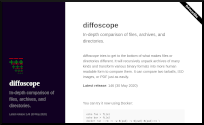
Chris Lamb also performed a huge overhaul of diffoscope s website:
  • Add a completely new design. [ ][ ]
  • Dynamically generate our contributor list [ ] and supported file formats [ ] from the main Git repository.
  • Add a separate, canonical page for every new release. [ ][ ][ ]
  • Generate a latest release section and display that with the corresponding date on the homepage. [ ]
  • Add an RSS feed of our releases [ ][ ][ ][ ][ ] and add to Planet Debian [ ].
  • Use Jekyll s absolute_url and relative_url where possible [ ][ ] and move a number of configuration variables to _config.yml [ ][ ].

Upstream patches The Reproducible Builds project detects, dissects and attempts to fix as many currently-unreproducible packages as possible. We endeavour to send all of our patches upstream where appropriate. This month, we wrote a large number of such patches, including:

Other tools Elsewhere in our tooling: strip-nondeterminism is our tool to remove specific non-deterministic results from a completed build. In May, Chris Lamb uploaded version 1.8.1-1 to Debian unstable and Bernhard M. Wiedemann fixed an off-by-one error when parsing PNG image modification times. (#16) In disorderfs, our FUSE-based filesystem that deliberately introduces non-determinism into directory system calls in order to flush out reproducibility issues, Chris Lamb replaced the term dirents in place of directory entries in human-readable output/log messages [ ] and used the astyle source code formatter with the default settings to the main disorderfs.cpp source file [ ]. Holger Levsen bumped the debhelper-compat level to 13 in disorderfs [ ] and reprotest [ ], and for the GNU Guix distribution Vagrant Cascadian updated the versions of disorderfs to version 0.5.10 [ ] and diffoscope to version 145 [ ].

Project documentation & website
  • Carl Dong:
  • Chris Lamb:
    • Rename the Who page to Projects . [ ]
    • Ensure that Jekyll enters the _docs subdirectory to find the _docs/index.md file after an internal move. (#27)
    • Wrap ltmain.sh etc. in preformatted quotes. [ ]
    • Wrap the SOURCE_DATE_EPOCH Python examples onto more lines to prevent visual overflow on the page. [ ]
    • Correct a preferred spelling error. [ ]
  • Holger Levsen:
    • Sort our Academic publications page by publication year [ ] and add Trusting Trust and Fully Countering Trusting Trust through Diverse Double-Compiling [ ].
  • Juri Dispan:

Testing framework We operate a large and many-featured Jenkins-based testing framework that powers tests.reproducible-builds.org that, amongst many other tasks, tracks the status of our reproducibility efforts as well as identifies any regressions that have been introduced. Holger Levsen made the following changes:
  • System health status:
    • Improve page description. [ ]
    • Add more weight to proxy failures. [ ]
    • More verbose debug/failure messages. [ ][ ][ ]
    • Work around strangeness in the Bash shell let VARIABLE=0 exits with an error. [ ]
  • Debian:
    • Fail loudly if there are more than three .buildinfo files with the same name. [ ]
    • Fix a typo which prevented /usr merge variation on Debian unstable. [ ]
    • Temporarily ignore PHP s horde](https://www.horde.org/) packages in Debian bullseye. [ ]
    • Document how to reboot all nodes in parallel, working around molly-guard. [ ]
  • Further work on a Debian package rebuilder:
    • Workaround and document various issues in the debrebuild script. [ ][ ][ ][ ]
    • Improve output in the case of errors. [ ][ ][ ][ ]
    • Improve documentation and future goals [ ][ ][ ][ ], in particular documentiing two real world tests case for an impossible to recreate build environment [ ].
    • Find the right source package to rebuild. [ ]
    • Increase the frequency we run the script. [ ][ ][ ][ ]
    • Improve downloading and selection of the sources to build. [ ][ ][ ]
    • Improve version string handling.. [ ]
    • Handle build failures better. [ ]. [ ]. [ ]
    • Also consider architecture all .buildinfo files. [ ][ ]
In addition:
  • kpcyrd, for Alpine Linux, updated the alpine_schroot.sh script now that a patch for abuild had been released upstream. [ ]
  • Alexander Couzens of the OpenWrt project renamed the brcm47xx target to bcm47xx. [ ]
  • Mattia Rizzolo fixed the printing of the build environment during the second build [ ][ ][ ] and made a number of improvements to the script that deploys Jenkins across our infrastructure [ ][ ][ ].
Lastly, Vagrant Cascadian clarified in the documentation that you need to be user jenkins to run the blacklist command [ ] and the usual build node maintenance was performed was performed by Holger Levsen [ ][ ][ ], Mattia Rizzolo [ ][ ] and Vagrant Cascadian [ ][ ][ ].

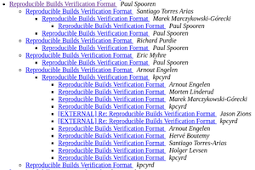
Mailing list: There were a number of discussions on our mailing list this month: Paul Spooren started a thread titled Reproducible Builds Verification Format which reopens the discussion around a schema for sharing the results from distributed rebuilders:
To make the results accessible, storable and create tools around them, they should all follow the same schema, a reproducible builds verification format. The format tries to be as generic as possible to cover all open source projects offering precompiled source code. It stores the rebuilder results of what is reproducible and what not.
Hans-Christoph Steiner of the Guardian Project also continued his previous discussion regarding making our website translatable. Lastly, Leo Wandersleb posted a detailed request for feedback on a question of supply chain security and other issues of software review; Leo is the founder of the Wallet Scrutiny project which aims to prove the security of Android Bitcoin Wallets:
Do you own your Bitcoins or do you trust that your app allows you to use your coins while they are actually controlled by them ? Do you have a backup? Do they have a copy they didn t tell you about? Did anybody check the wallet for deliberate backdoors or vulnerabilities? Could anybody check the wallet for those?
Elsewhere, Leo had posted instructions on his attempts to reproduce the binaries for the BlueWallet Bitcoin wallet for iOS and Android platforms.


If you are interested in contributing to the Reproducible Builds project, please visit our Contribute page on our website. However, you can get in touch with us via:

This month s report was written by Bernhard M. Wiedemann, Chris Lamb, Holger Levsen, Jelle van der Waa and Vagrant Cascadian. It was subsequently reviewed by a bunch of Reproducible Builds folks on IRC and the mailing list.

Gunnar Wolf: Tor from Telmex. When I say achievement unlocked , I mean it!

### The blockade has ended! For some introduction.. Back in 2016, Telmex Mexico's foremost communications provider and, through the brands grouped under the *Am rica M vil* brand, one of Latin America's most important ISPs set up rules to block connecitons to (at least) seven of Tor's *directory authorities* (*DirAuths*). We believe they might have blocked all of them, in an attempt to block connections from Tor from anywhere in their networks, but Tor is much more resourceful than that so, the measure was not too effective. Only... _Some_ blocking did hurt Telmex's users: The ability to play an active role in Tor. The ability to host Tor relays at home. Why? Because the *consensus protocol* requires relays to be reachable in order to be measured from the network's *DirAuths*. ### Technical work to prove the blocking We dug into the issue as part of the work we carried out in the project I was happy to lead between 2018 and 2019, *UNAM/DGAPA/PAPIME PE102718*. In March 2019, I presented a paper titled [Distributed Detection of Tor Directory Authorities Censorship in Mexico](https://www.thinkmind.org/index.php?view=article&articleid=icn_2019_6_20_38010) ([alternative download](http://ru.iiec.unam.mx/4538/) in the [Topic on Internet Censorship and Surveillance (TICS) track](https://tics.site/) of the XVIII International Conference on Networks. Then... We had many talks inside our group, but nothing seemed to move for several months. We did successfully push for increasing the number of Tor relays in Mexico (we managed to go from two to eleven stable relays not much in absolute terms, but quite good relatively, even more considering most users were not technically able to run one!) Jacobo N jera, journalist participant of our project, didn't leave things there just lying around waiting magically for justice to happen. Together with Vasilis Ververis, from the [Magma Project](https://magma.lavafeld.org/), they presented some weeks ago a [Case study: Tor Directory Authorities Censorship in Mexico](https://magma.lavafeld.org/guide/data-analysis.html#case-study-tor-directory-authorities-censorship-in-mexico). ### Pushing to action But a good part of being a journalist is knowing _how_ and _when_ to spread the word. Having already two technical studies showing the blocking in place, Jacobo presented his findings with [an article in GlobalVoices: *The largest telecommunications operator in Mexico blocks the secure network*](https://es.globalvoices.org/2020/05/28/en-mexico-el-mas-grande-operador-de-telecomunicaciones-bloquea-la-internet-segura/). Surprisingly (to me, at least), this story was picked up by a major Mexican newspaper: The same evening the story hit GlobalVoices, [Rodrigo Riquelme](https://www.eleconomista.com.mx/autor/rriquelme) posted an article, in the Technology section of *El Economista*, titled [Telmex blocks seven out of ten accesses to the Tor network in Mexico](https://www.eleconomista.com.mx/tecnologia/Telmex-bloquea-siete-de-10-accesos-a-la-red-Tor-en-Mexico-20200528-0078.html). And that very same day, Telmex sent a reply I am translating in full (that is now included at the end of Riquelme's article): > Mexico City, May 28, 2020 > > In relation to Tor navigation from TELMEX's network, the company > informs: > > In TELMEX, we are committed to the full respect to navigation > freedom for all of our users. > > TELMEX practices no application-level blocking policies; the Tor > application, as well as the rest of Internet applications, can be > freely accessed from our network. > > In order to protect the Internauts' information, the seven refered > nodes were in their time reported because they were associated with > the distribution of the WannaCry ransomware, which is the reason > they were filtered, but this does not hamper the use of the Tor > application. ### So we got an answer...? Jacobo knew we had to take advantage of this answer, and act fast! He entered rush-writing mode and, with the help of our good friend and lawyer Salvador Alc ntar, we wrote [a short letter to Renato Flores Cartas, Corporative Communication of Am rica M vil](https://internetanonima.net/respuesta-a-telmex-sobre-la-red-tor-en-mexico/), and sent it on June 1st. Next thing I know, this evening Jacobo was asking me if I could confirm the blocking was lifted. What I could not believe it! But, yes Today Jacobo published the confirmation that [the seven blocked IP routes were finally reachable again from ASN 8151 (UNINET / Telmex / Am rica M vil)!](https://internetanonima.net/confirmamos-desbloqueo-de-las-7-direcciones-de-la-red-tor-por-telmex/) Of course, this story was picked up again by El Economista [Telmex unblocks IP addresses for the Tor network's directory authority server IPs in Mexico](https://www.eleconomista.com.mx/tecnologia/Telmex-desbloquea-direcciones-IP-de-servidores-de-autoridad-de-la-red-Tor-en-Mexico-20200604-0094.html). ### Wrapping up How can I put this in words? I am very, very, very, *very, very, very*, **very, very, very** happy we managed to see this through! Although we have been pushing for increasing the usage of Tor among users at risk in Mexico Being a journalist, defending human rights, are still a high-risk profession in my country. We strongly believe in this, and will continue trying to raise awareness of the usage. But, just as with free software, *using* network anonymization tools is not all. We need more people to become active, to become engaged, to *become active participants* in anonymization. As the adage says, *anonymity loves company* In order to build strong, sufficient anonymization capability for everybody that needs it, we need more people to *provide relay services*. And this is a *huge* step to improve Mexico's participation in the Tor network! --- Image credits: [*Seeing My World Through a Keyhole*, by Kate Ter Haar](https://www.flickr.com/photos/katerha/4592429363) (CC-BY); [Tor logo (Wikimedia Commons)](https://commons.wikimedia.org/wiki/File:Tor-logo-2011-flat.svg)

3 June 2020

Debian Project Leader: DPL Activity logs for April/May 2020

First month as DPL I survived my first month as DPL! I agree with previous DPLs who have described it as starting a whole new job. Fortunately it wasn't very stressful, but it certainly was very time consuming. On the very first day my inbox exploded with requests. I dealt with this by deferring anything that wasn't important right away and just started working through it. Fortunately the initial swell subsided as the month progressed. The bulk of my remaining e-mail backlog are a few media outlets who wants to do interviews. I'll catch up with those during this month. Towards the end of the month, most of my focus was on helping to prepare for an online MiniDebConf that we hosted over the last weekend in May. We had lots of fun and we had some great speakers sharing their knowledge and expertise during the weekend. Activity log As I do on my own blog for free software activities, I'll attempt to keep a log of DPL activities on this blog. Here's the log for the period 2020-04-21 to 2020-05-21: 2020-04-19: Handover session with Sam, our outgoing DPL. We covered a lot of questions I had and main areas that the DPL works in. Thanks to Sam for having taken the time to do this. 2020-04-21: First day of term! Thank you to everybody who showed support and have offered to help! 2020-04-21: Request feedback from the trademark team on an ongoing trademark dispute. 2020-04-21: Join the GNOME Advisory Board as a representative from Debian. 2020-04-21: Reply on an ongoing community conflict issue. 2020-04-21: Update Debian project summary for SPI annual report. 2020-04-21: Received a great e-mail introduction from Debian France and followed up on that. 2020-04-21: Posted "Bits from the new DPL" to debian-devel-announce. 2020-04-22: Became Debian's OSI Affilliate representative. 2020-04-22: Reply to a bunch of media inquiries for interviews, will do them later when initial priorities are on track. 2020-04-23: Resign as Debian FTP team trainee and mailing list moderator. In both these areas there are enough people taking care of it and I intend to maximise available time for DPL and technical areas in the project. 2020-04-25: Review outgoing mail for trademark team. 2020-04-25: Answer some questions in preparation for DAM/Front Desk delegation updates. 2020-04-26: Initiated wiki documentation for delegation updates process. 2020-04-27: Update delegation for the Debian Front Desk team. 2020-04-29: Schedule video call with Debian treasurer team. 2020-04-29: OSI affiliate call. Learned about some Open Source projects including OpenDev, OpenSourceMatters, FOSS Responders and Democracy Labs. 2020-05-04: Delivered my first talk session as DPL titled "Mixed Bag of Debian" at "Fique Em Casa Use Debian" (Stay at home and use Debian!), organised by Debian Brazil, where they had a different talk every evening during the month of May. Great initiative I hope other local groups consider copying their ideas! 2020-05-05: Had a 2 hour long call with the treasurer team. Feeling optimistic for the future of Debian's financing although it will take some time and a lot of work to get where we want to be. 2020-05-17: Respond to cloud delegation update.

Dirk Eddelbuettel: littler 0.3.10: Some more updates

max-heap image The eleventh release of littler as a CRAN package is now available, following in the fourteen-ish year history as a package started by Jeff in 2006, and joined by me a few weeks later. littler is the first command-line interface for R as it predates Rscript. It allows for piping as well for shebang scripting via #!, uses command-line arguments more consistently and still starts faster. It also always loaded the methods package which Rscript only started to do in recent years. littler lives on Linux and Unix, has its difficulties on macOS due to yet-another-braindeadedness there (who ever thought case-insensitive filesystems as a default where a good idea?) and simply does not exist on Windows (yet the build system could be extended see RInside for an existence proof, and volunteers are welcome!). See the FAQ vignette on how to add it to your PATH. A few examples are highlighted at the Github repo, as well as in the examples vignette. This release adds a new helper / example script installBioc.r for BioConductor package installation, generalizes the roxygenize() wrapper roxy.r a little, and polished a couple of other corners. The NEWS file entry is below.

Changes in littler version 0.3.10 (2020-06-02)
  • Changes in examples
    • The update.r script only considers writeable directories.
    • The rcc.r script tries to report full logs by setting _R_CHECK_TESTS_NLINES_=0.
    • The tt.r script has an improved ncpu fallback.
    • Several installation and updating scripts set _R_SHLIB_STRIP_ to TRUE.
    • A new script installBioc.r was added.
    • The --error option to install2.r was generalized (Sergio Oller in #78).
    • The roxy.r script was extended a little.
  • Changes in package
    • Travis CI now uses R 4.0.0 and the bionic distro

CRANberries provides a comparison to the previous release. Full details for the littler release are provided as usual at the ChangeLog page. The code is available via the GitHub repo, from tarballs and now of course also from its CRAN page and via install.packages("littler"). Binary packages are available directly in Debian as well as soon via Ubuntu binaries at CRAN thanks to the tireless Michael Rutter. Comments and suggestions are welcome at the GitHub repo. If you like this or other open-source work I do, you can now sponsor me at GitHub. For the first year, GitHub will match your contributions.

This post by Dirk Eddelbuettel originated on his Thinking inside the box blog. Please report excessive re-aggregation in third-party for-profit settings.

Keith Packard: picolibc-ryu

Float/String Conversion in Picolibc: Enter Ry I recently wrote about this topic having concluded that the best route for now was to use the malloc-free, but imprecise, conversion routines in the tinystdio alternative. A few days later, Sreepathi Pai pointed me at some very recent work in this area: This is amazing! Thirty years after the papers referenced in the previous post, Ulf Adams came up with some really cool ideas and managed to reduce the math required for 64-bit conversion to 128 bit integers. This is a huge leap forward; we were doing long multi-precision computations before, and now it's all short enough to fit in registers (ok, a lot of registers, but still). Getting the Ry Code The code is available on github: https://github.com/ulfjack/ryu. Reading through it, it's very clear that the author focuses on performance with lots of tuning for common cases. Still, it's quite readable, especially compared with the newlib multi-precision based code. Picolibc String/Float conversion interface Picolibc has some pretty basic needs for the float/string conversion code, it wants four functions:
  1. __dtoa_engine
    int
    __dtoa_engine(double x, struct dtoa *dtoa, uint8_t max_digits, uint8_t max_decimals);
    
    This converts the double x to a string of decimal digits and a decimal exponent stored inside the 'dtoa' struct. It limits the total number of digits to max_digits and, optionally (when max_decimals is non-zero), limits the number of fractional digits to max_decimals - 1. This latter supports 'f' formats. Returns the number of digits stored, which is <= max_digits. Less if the number can be accurately represented in fewer digits.
  2. __ftoa_engine
    int
    __ftoa_engine(float x, struct ftoa *ftoa, uint8_t max_digits, uint8_t max_decimals);
    
    The same as __dtoa_engine, except for floats.
  3. __atod_engine
    double
    __atod_engine(uint64_t m10, int e10);
    
    To avoid needing to handle stdio inside the conversion function, __atod_engine receives fully parsed values, the base-10 significand (m10) and exponent (e10). The value to convert is m10 * pow(10, e10).
  4. __atof_engine
    float
    __atof_engine(uint32_t m10, int e10);
    
    The same as __atod_engine, except for floats.
With these, it can do printf, scanf, ecvt, fcvt, gcvt, strtod, strtof and atof. Porting Ry to Picolibc The existing Ry float-to-string code always generates the number of digits necessary for accurate output. I had to hack it up to generate correctly rounded shorter output when max_digits or max_decimals were smaller. I'm not sure I managed to do that correctly, but at least it appears to be passing all of the test cases I have. In normal operation, Ry iteratively removes digits from the answer that aren't necessary to disambiguate with neighboring values. What I changed was to keep removing digits using that method until the answer had few enough digits to fit in the desired length. There's some tricky rounding code that adjusts the final result and I had to bypass that if I'd removed extra digits. That was about the only change necessary to the core algorithm. I also trimmed the code to only include the general case and not the performance improvements, then wrapped it with code to provide the _engine interface. On the string-to-float side, most of what I needed to do was remove the string parsing bits at the start of the function and switch from performance-optimized to space-optimized versions of a couple of internal routines. Correctness Results Because these new functions are now 'exact', I was able to adjust the picolibc tests to compare all of the bits for string/float conversion instead of having to permit a bit of slop in the answers. With those changes, the picolibc test suite passes, which offers some assurance that things aren't completely broken. Size Results Snek uses the 32-bit float versions of the conversion routines, and for that, the size difference is:
   text    data     bss     dec     hex filename
  59068      44   37968   97080   17b38 snek-qemu-riscv-orig.elf
  59430      44   37968   97442   17ca2 snek-qemu-riscv-ryu.elf
    362
362 bytes added to gain accurate printf/strtof results seems like a good trade-off in this case. Performance I haven't measured performance at all, but I suspect that it won't be nearly as problematic on most platforms as the source code makes it appear. And that's because Ry is entirely integer arithmetic with no floating point at all. This avoids using the soft fp code for platforms without hardware float support. Pointers to the Code I haven't merged this to picolibc master yet, it's on the ryu branch: Review, especially of the hack above to return short results, would be greatly appreciated! Thanks again to Ulf Adams for creating this code and to Sreepathi Pai for sending me a note about it!

2 June 2020

Sylvestre Ledru: Debian rebuild with clang 10 + some patches

Because of the lock-down in France and thanks to Lucas, I have been able to make some progress rebuilding Debian with clang instead of gcc.

TLDR Instead of patching clang itself, I used a different approach this time: patching Debian tools or implementing some workaround to mitigate an issue.
The percentage of packages failing drop from 4.5% to 3.6% (1400 packages to 1110 - on a total of 31014). I focused on two classes of issues:

Qmake As I have no intention to merge the patch upstream, I used a very dirty workaround. I overwrote the g++ qmake file by clang's:
https://salsa.debian.org/lucas/collab-qa-tools/-/blob/master/modes/clang10#L44-47 I dropped the number of this failure to 0, making some packages build flawlessly (example: qtcreator, chessx, fwbuilder, etc). However, some packages are still failing later and therefore increasing the number of failures in some other categories like link error. For example, qtads fails because of ordered comparison between pointer and zero or oscar fails on a -Werror,-Wdeprecated-copy error. Breaking the build later also highlighted some new classes of issues which didn't occur with clang < 10.
For example, warnings related to C++ range loop or implicit int float conversion (I fixed a bunch of them in Firefox) .

Symbol differences Historically, symbol management for C++ in Debian has been a pain. Russ Allbery wrote a blog post in 2012 explaining the situation. AFAIK, it hasn't changed much.
Once more, I took the dirty approach: if there new or missing symbols, don't fail the build.
The rational is the following: Packages in the Debian archive are supposed to build without any issue. If there is new or missing symbols, it is probably clang generating a different library but this library is very likely working as expected (and usable by a program compiled with g++ or clang). It is purely a different approach taken by the compiler developer. In order to mitigate this issue, before the build starts, I am modifying dpkg-gensymbols to transform the error into a warning.
So, the typical Debian error some new symbols appeared in the symbols file or some symbols or patterns disappeared in the symbols file will NOT fail the build. Unsurprisingly, all but one package (libktorrent) build. Even if I am pessimistic, I reported a bug on dpkg-dev to evaluate if we could improve dpkg-gensymbol not to fail on these cases.

Next steps The next offender is Imake.tmpl:2243:10: fatal error: ' X11 .rules' file not found with more than an hundred occurrences, reported upstream quite sometime ago. Then, the big issues are going to be much harder to fix as they are real issues/warnings (with -Werror) in the code of the packages. Example: -Wc++11-narrowing & Wreserved-user-defined-literal... The list is long.
I will probably work on that when llvm/clang 11 are in RC phase.

For maintainers & upstream Maintainer of Debian/Ubuntu packages? I am providing a list of failing packages per maintainer: https://clang.debian.net/maintainers.php
For upstream, it is also easy to test with clang. Usually, apt install clang && CC=clang CXX=clang++ <build step> is good enough.

Conclusion With these two changes, I have been able to fix about 290 packages. I think I will be able to get that down a bit more but we will soon reach a plateau as many warnings/issues will have to fix in the C/C++ code itself.

Lisandro Dami n Nicanor P rez Meyer: Simplified Monitoring of Patients in Situations of Mass Hospitalization (MoSimPa) - Fighting COVID-19

I have been quite absent from Debian stuff lately, but this increased since COVID-19 hits us. In this blog post I'll try to sketch what I have been doing to help fight COVID-19 this last few months.

In the beginningWhen the pandemic reached Argentina the government started a quarantine. We engineers (like engineers around the world) started to think on how to put our abilities in order to help with the situation. Some worked toward providing more protection elements to medical staff, some towards increasing the number of ventilation machines at disposal. Another group of people started thinking on another ways of helping. In Bah a Blanca arised the idea of monitoring some variables remotely and in masse.

Simplified Monitoring of Patients in Situations of Mass Hospitalization (MoSimPa)

This is where the idea of remotely monitored devices came in, and MoSimPa (from the spanish of "monitoreo simplificado de pacientes en situaci n de internaci n masiva") started to get form. The idea is simple: oximetry (SpO2), heart rate and body temperature will be recorded and, instead of being shown in a display in the device itself, they will be transmitted and monitored in one or more places. In this way medical staff doesn't has to reach a patient constantly and monitoring could be done by medical staff for more patients at the same time. In place monitoring can also happen using a cellphone or tablet.

The devices do not have a screen of their own and almost no buttons, making them more cheap to build and thus more in line with the current economic reality of Argentina.


This is where the project Para Ayudar was created. The project aims to produce the aforementioned non-invasive device to be used in health institutions, hospitals, intra hospital transports and homes.

It is worth to note that the system is designed as a complementary measure for continuous monitoring of a pacient. Care should be taken to check that symptomps and overall patient status don't mean an inmediate life threat. In other words, it is NOT designed for ICUs.

All the above done with Free/Libre/Open Source software and hardware designs. Any manufacturing company can then use them for mass production.

The importance of early pneumonia detection


We were already working in MoSimPa when an NYTimes article caught or attention: "The Infection That s Silently Killing Coronavirus Patients". From the article:

A vast majority of Covid pneumonia patients I met had remarkably low oxygen saturations at triage seemingly incompatible with life but they were using their cellphones as we put them on monitors. Although breathing fast, they had relatively minimal apparent distress, despite dangerously low oxygen levels and terrible pneumonia on chest X-rays.

This greatly reinforced the idea we were on the right track.

The project from a technical standpoint


As the project is primarily designed for and by Argentinians the current system design and software documentation is written in spanish, but the source code (or at least most of it) is written in english. Should anyone need it in english please do not hesitate in asking me.

General system description

System schema

The system is comprised of the devices, a main machine acting as a server (in our case for small setups a Raspberry Pi) and the possibility of accessing data trough cell phones, tablets or other PCs in the network.

The hardware


As of today this is the only part in which I still can't provide schematics, but I'll update this blog post and technical doc with them as soon as I get my hands into them.

Again the design is due to be built in Argentina where getting our hands on hardware is not easy. Moreover it needs to be as cheap as possible, specially now that the Argentinian currency, the peso, is every day more depreciated. So we decided on using an ESP32 as the main microprocessor and a set of Maxim sensors devices. Again, more info when I have them at hand.

The software


Here we have many more components to describe. Firstly the ESP32 code is done with the Arduino SDK. This part of the stack will receive many updates soon, as soon as the first hardware prototypes are out.

For the rest of the stack I decided to go ahead with whatever is available in Debian stable. Why? Well, Raspbian provides a Debian stable-based image and I'm a Debian Developer, so things should go just natural for me in that front. Of course each component has its own packaging. I'm one of Debian's Qt maintainers then using Qt will also be quite natural for me. Plots? Qwt, of course. And with that I have most of my necessities fulfilled. I choose PostgreSql as database server and Mosquitto as MQTT broker.

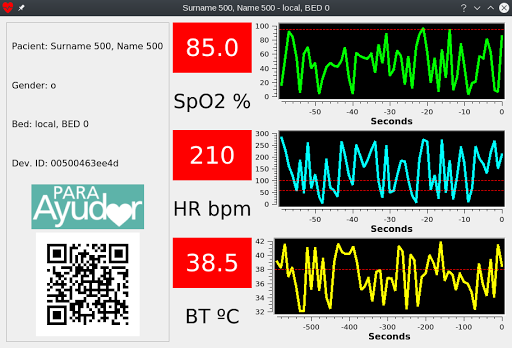
Between the database and MQTT is mosimpa-datakeeper. The piece of software from which medical staff monitor patients is unsurprisingly called mosimpa-monitor.

mosimpa-monitor
MoSimPa's monitor main screen

mosimpa-monitor plots
Plots of a patient's data


mosimpa-monitor-alarms-setup
Alarm thresholds setup


And for managing patients, devices, locations and internments (CRUD anyone?) there is currently a Qt-based application called mosimpa-abm.

mosimpa-abm
ABM main screen


mosimpa-abm-internments
ABM internments view

The idea is to replace it with a web service so it doesn't needs to be confined to the RPi or require installations in other machines. I considered using webassembly but I would have to also build PostgreSql in order to compile Qt's plugin.

Translations? Of course! As I have already mentioned the code is written in English. Qt allows to easily translate applications, so I keep a Spanish one as the code changes (and we are primarily targeting spanish-speaking people). But of course this also means it can be easily translated to whichever language is necessary.

Even if I am a packager I still have some stuff to fix from the packaging itself, like letting datakeeper run with its own user. I just haven't got to it yet.


Certifications


We are working towards getting the system certified by ANMAT, which is the Argentinian equivalent for EEUU's FDA.

Funding


While all the people involved are working ad-honorem funding is still required in order to buy materials, create the prototypes, etc. The project created payments links with Mercado Pago (in spanish and argentinian pesos) and other bank methods (PDF, also in spanish).

I repeat the links here with an aproximation to US$.

- 500 AR$ (less than 8 US$)
- 1000 AR$ (less than 15 US$)
- 2000 AR$ (less than 30 US$)
- 3000 AR$ (less than 45 US$)
- 5000 AR$ (less than 75 US$)

You can check the actual convertion rate in https://www.google.com/search?q=argentine+peso+to+us+dollars

The project was also presented at a funding call of argentinian Agencia de Promoci n de la Investigaci n, el Desarrollo Tecnol gico y la Innovaci n (Agencia I+D+i). 900+ projects where presented and 64 funded, MoSimPa between them.

1 June 2020

Debian GSoC Kotlin project blog: Kotlin Update

A Quick Recap from last year: Kotlin is being packaged under the Google Summer of Code within the Debian organization itself. The major reason behind bringing Kotlin in Debian is to update all the Android packages which are now heavily dependent upon the Kotlin libraries. The major work to bring Kotlin into Debian is done for the version 1.3.30, by Saif Abdul Cassim (goes by m36 on IRC) as a part of his GSoC'2019. All his contributions to the team can be found in his blog posts. So, for now, we have a bootstrap package and a Kotlin package for the version with 1.3.30. There were still changes needed as we lacked some of the dependencies for Kotlin, and the source package lacked copyright information and didn t comply with Debian standards. What's the present year brought for Kotlin? To be specific the following were mainly left dependencies for Kotlin: And, we lack documentation for the newbies in order to get them started :( Most importantly the crucial part was and still is, to figure out how to upload the package? For GSoC'20, three students are selected as a part of project Android SDK tools in Debian. What's the work done/left? Work Done What's Blocking? What is the problem being faced? The Kotlin-Bootstrap package consists of JAR files for various dependencies of kotlin such as Gradle, kotlin compiler, and kotlinx. The package is added to the build-depends of the main package so that the JAR files can be provided. Since the kotlin-bootstrap consists of binaries (JAR files), it is not feasible to upload the package as free software. The other workaround was the Gradle 6.4 version, which consists of Kotlin files and generates a suitable JAR. But since the package needed Kotlin language itself, it was never updated, as it created a cyclic dependency. Final workaround came, which proposed Kotlin to build from itself, that was a pretty impressive suggestion. But, we still have to look if the solution is feasible? Because, as far as I last checked and conversed with ebourg on the mailing list here, Emmanuel Bbourg mentioned very clearly that the rebuilt package is our interest. So, this is under WIP. But, I fail to acknowledge the fact if we can drop the kotlin-bootstrap package totally, Kotlin will not be able to be built because each and every JAR file present in the bootstrap is needed. That pretty much is the ongoing work and the update on the kotlin package. We intend to bring Kotlin to the Debian Archive as soon as possible :) Have any queries or suggestions for Kotlin? Please feel to drop a message at #debian-mobile channel on OFTC.

31 May 2020

Chris Lamb: Free software activities in May 2020

Here is my monthly update covering what I have been doing in the free software world during May 2020 (previous month): In Lintian, the static analysis tool for Debian packages:
Reproducible builds One of the original promises of open source software is that distributed peer review and transparency of process results in enhanced end-user security. However, whilst anyone may inspect the source code of free and open source software for malicious flaws, almost all software today is distributed as pre-compiled binaries. This allows nefarious third-parties to compromise systems by injecting malicious code into ostensibly secure software during the various compilation and distribution processes. The motivation behind the Reproducible Builds effort is to ensure no flaws have been introduced during this compilation process by promising identical results are always generated from a given source, thus allowing multiple third-parties to come to a consensus on whether a build was compromised. The initiative is proud to be a member project of the Software Freedom Conservancy, a not-for-profit 501(c)(3) charity focused on ethical technology and user freedom. Conservancy acts as a corporate umbrella allowing projects to operate as non-profit initiatives without managing their own corporate structure. If you like the work of the Conservancy or the Reproducible Builds project, please consider becoming an official supporter.
Elsewhere in our tooling, I made the following changes to diffoscope, our in-depth and content-aware diff utility that can locate and diagnose reproducibility issues, including preparing and uploading versions 142, 143, 144, 145 and 146 to Debian: I also performed a huge overhaul of diffoscope's website:
Lastly, I made a large number of changes to the main Reproducible Builds website and documentation:
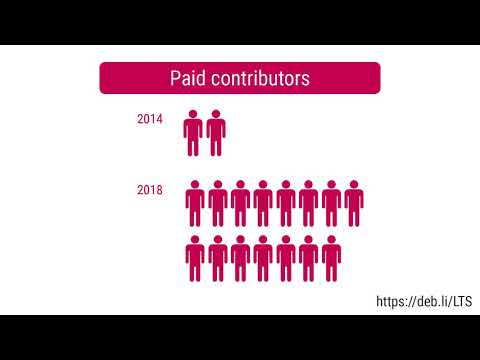
Debian LTS This month I contributed 17 hours to Debian Long Term Support (LTS) and 9 hours on its sister Extended LTS project. You can find out more about the two projects via the following video:
Debian I filed the following bug reports in Debian this month: I also filed a number of bugs against packages that are not compatible with Django 3.x, (organised around a single master bug) including django-taggit, sorl-thumbnail, django-simple-captcha, django-cas-server, django-cors-headers, python-django-csp, django-pipeline, python-django-jsonfield, python-django-contact-form, django-model-utils, django-fsm, django-modeltranslation, django-oauth-toolkit, libthumbor, python-django-extensions, python-django-imagekit, python-django-navtag, python-django-tagging, djangorestframework, django-haystack, django-taggit, django-simple-captcha, python-django-registration, python-django-pyscss, python-django-compressor, python-django-crispy-forms & python-django-mptt,
Lastly, I made the following uploads to Debian: I also sponsored an upload for adminer (4.7.7-1), also uploading it to buster-backports.

30 May 2020

Sean Whitton: GNU Emacs' Transient Mark mode

Something I ve found myself doing as the pandemic rolls on is picking out and (re-)reading through sections of the GNU Emacs manual and the GNU Emacs Lisp reference manual. This has got me (too) interested in some of the recent history of Emacs development, and I did some digging into archives of emacs-devel from 2008 (15M mbox) regarding the change to turn Transient Mark mode on by default and set mark-even-if-inactive to true by default in Emacs 23.1. It s not always clear which objections to turning on Transient Mark mode by default take into account the mark-even-if-inactive change. I think that turning on Transient Mark mode along with mark-even-if-inactive is a good default. The question that remains is whether the disadvantages of Transient Mark mode are significant enough that experienced Emacs users should consider altering Emacs default behaviour to mitigate them. Here s one popular blog arguing for some mitigations. How might Transient Mark mode be disadvantageous? The suggestion is that it makes using the mark for navigation rather than for acting on regions less convenient:
  1. setting a mark just so you can jump back to it (i) is a distinct operation you have to think of separately; and (ii) requires two keypresses, C-SPC C-SPC, rather than just one keypress
  2. using exchange-point-and-mark activates the region, so to use it for navigation you need to use either C-u C-x C-x or C-x C-x C-g, neither of which are convenient to type, or else it will be difficult to set regions at the place you ve just jumped to because you ll already have one active.
There are two other disadvantages that people bring up which I am disregarding. The first is that it makes it harder for new users to learn useful ways in which to use the mark when it s deactivated. This happened to me, but it can be mitigated without making any behavioural changes to Emacs. The second is that the visual highlighting of the region can be distracting. So far as I can tell, this is only a problem with exchange-point-and-mark, and it s subsumed by the problem of that command actually activating the region. The rest of the time Emacs automatic deactivation of the region seems sufficient. How might disabling Transient Mark mode be disadvantageous? When Transient Mark mode is on, many commands will do something usefully different when the mark is active. The number of commands in Emacs which work this way is only going to increase now that Transient Mark mode is the default. If you disable Transient Mark mode, then to use those features you need to temporarily activate Transient Mark mode. This can be fiddly and/or require a lot of keypresses, depending on exactly where you want to put the region. Without being able to see the region, it might be harder to know where it is. Indeed, this is one of the main reasons for wanting Transient Mark mode to be the default, to avoid confusing new users. I don t think this is likely to affect experienced Emacs users often, however, and on occasions when more precision is really needed, C-u C-x C-x will make the region visible. So I m not counting this as a disadvantage. How might we mitigate these two sets of disadvantages? Here are the two middle grounds I m considering. Mitigation #1: Transient Mark mode, but hack C-x C-x behaviour
(defun spw/exchange-point-and-mark (arg)
  "Exchange point and mark, but reactivate mark a bit less often.

Specifically, invert the meaning of ARG in the case where
Transient Mark mode is on but the region is inactive."
  (interactive "P")
  (exchange-point-and-mark
   (if (and transient-mark-mode (not mark-active))
       (not arg)
     arg)))
(global-set-key [remap exchange-point-and-mark] &aposspw/exchange-point-and-mark)
We avoid turning Transient Mark mode off, but mitigate the second of the two disadvantages given above. I can t figure out why it was thought to be a good idea to make C-x C-x reactivate the mark and require C-u C-x C-x to use the action of exchanging point and mark as a means of navigation. There needs to a binding to reactivate the mark, but in roughly ten years of having Transient Mark mode turned on, I ve found that the need to reactivate the mark doesn t come up often, so the shorter and longer bindings seem the wrong way around. Not sure what I m missing here. Mitigation #2: disable Transient Mark mode, but enable it temporarily more often
(setq transient-mark-mode nil)
(defun spw/remap-mark-command (command &optional map)
  "Remap a mark-* command to temporarily activate Transient Mark mode."
  (let* ((cmd (symbol-name command))
         (fun (intern (concat "spw/" cmd)))
         (doc (concat "Call  "
                      cmd
                      "&apos and temporarily activate Transient Mark mode.")))
    (fset fun  (lambda ()
                 ,doc
                 (interactive)
                 (call-interactively #&apos,command)
                 (activate-mark)))
    (if map
        (define-key map (vector &aposremap command) fun)
      (global-set-key (vector &aposremap command) fun))))
(dolist (command &apos(mark-word
                   mark-sexp
                   mark-paragraph
                   mark-defun
                   mark-page
                   mark-whole-buffer))
  (spw/remap-mark-command command))
(with-eval-after-load &aposorg
  (spw/remap-mark-command &aposorg-mark-element org-mode-map)
  (spw/remap-mark-command &aposorg-mark-subtree org-mode-map))
;; optional
(global-set-key "\M-=" (lambda () (interactive) (activate-mark)))
;; resettle the previous occupant
(global-set-key "\C-cw" &aposcount-words-region)
Here we remove both of the disadvantages of Transient Mark mode given above, and mitigate the main disadvantage of not activating Transient Mark mode by making it more convenient to activate it temporarily. For example, this enables using C-M-SPC C-M-SPC M-( to wrap the following two function arguments in parentheses. And you can hit M-h a few times to mark some blocks of text or code, then operate on them with commands like M-% and C-/ which behave differently when the region is active.1 Comparing these mitigations Both of these mitigations handle the second of the two disadvantages of Transient Mark mode given above. What remains, then, is
  1. under the effects of mitigation #1, how much of a barrier to using marks for navigational purposes is it to have to press C-SPC C-SPC instead of having a single binding, C-SPC, for all manual mark setting2
  2. under the effects of mitigation #2, how much of a barrier to taking advantage of commands which act differently when the region is active is it to have to temporarily enable Transient Mark mode with C-SPC C-SPC, M-= or one of the mark-* commands?
These are unknowns.3 So I m going to have to experiment, I think, to determine which mitigation to use, if either. In particular, I don t know whether it s really significant that setting a mark for navigational purposes and for region marking purposes are distinct operations under mitigation #1. My plan is to start with mitigation #2 because that has the additional advantage of allowing me to confirm or disconfirm my belief that not being able to see where the region is will only rarely get in my way.

  1. The idea of making the mark-* commands activate the mark comes from an emacs-devel post by Stefan Monnier in the archives linked above.
  2. One remaining possibility I m not considering is mitigation #1 plus binding something else to do the same as C-SPC C-SPC. I don t believe there are any easily rebindable keys which are easier to type than typing C-SPC twice. And this does not deal with the two distinct mark-setting operations problem.
  3. Another way to look at this is the question of which of setting a mark for navigational purposes and activating a mark should get C-SPC and which should get C-SPC C-SPC.

Reproducible Builds (diffoscope): diffoscope 146 released

The diffoscope maintainers are pleased to announce the release of diffoscope version 146. This version includes the following changes:
[ Chris Lamb ]
* Refactor .changes and .buildinfo handling to show all details (including
  the GPG header and footer components), even when referenced files are not
  present. (Closes: reproducible-builds/diffoscope#122)
* Normalise filesystem stat(2) "birth times" (ie. st_birthtime) in the same
  way we do with stat(1)'s "Access:" and "Change:" times to fix a
  nondetermistic build failure on GNU Guix.
  (Closes: reproducible-builds/diffoscope#74)
* Drop the (default) subprocess.Popen(shell=False) keyword argument so that
  the more unsafe shell=True is more obvious.
* Ignore lower vs. upper-case when ordering our file format descriptions.
* Don't skip string normalisation in Black.
[ Mattia Rizzolo ]
* Add a "py3dist" override for the rpm-python module (Closes: #949598)
* Bump the debhelper compat level to 13 and use the new
  execute_after_*/execture_before_* style rules.
* Fix a spelling error in changelog.
[ Daniel Fullmer ]
* Mount GuestFS filesystem images readonly.
[ Jean-Romain Garnier ]
* Prevent an issue where (for example) LibarchiveMember's has_same_content
  method is called regardless of the actual type of file.
You find out more by visiting the project homepage.

29 May 2020

Gunnar Wolf: Heads up Online MiniDebConf is Online

I know most Debian people know about this already But in case you don t follow the usual Debian communications channels, this might interest you! Given most of the world is still under COVID-19 restrictions, and that we want to work on Debian, given there is no certainty as to what the future holds in store for us Our DPL fearless as they always are had the bold initiative to make this weekend into the first-ever miniDebConf Online (MDCO)! miniDebConf Online So, we are already halfway through DebCamp (which means, you can come and hang out with us in the debian.social DebCamp Jitsi lounge, where some impromptu presentations might happen (or not). Starting tomorrow morning (11AM UTC), we will have a quite interesting set of talks. I am reproducing the schedule here:

Saturday 2020.05.30
Time (UTC) Speaker Talk
11:00 - 11:10 MDCO team members Hello + Welcome
11:30 - 11:50 Wouter Verhelst Extrepo
12:00 - 12:45 JP Mengual Debian France, trust european organization
13:00 - 13:20 Arnaud Ferraris Bringing Debian to mobile phones, one package at a time
13:30 - 15:00 Lunch Break A chance for the teams to catch some air
15:00 - 15:45 JP Mengual The community team, United Nations Organizations of Debian?
16:00 - 16:45 Christoph Biedl Clevis and tang - overcoming the disk unlocking problem
17:00 - 17:45 Antonio Terceiro I m a programmer, how can I help Debian

Sunday 2020.05.31
Time (UTC) Speaker Talk
11:00 - 11:45 Andreas Tille The effect of Covid-19 on the Debian Med project
12:00 - 12:45 Paul Gevers BoF: running autopkgtest for your package
13:00 - 13:20 Ben Hutchings debplate: Build many binary packages with templates
13:30 - 15:00 Lunch break A chance for the teams to catch some air
15:00 - 15:45 Holger Levsen Reproducing bullseye in practice
16:00 - 16:45 Jonathan Carter Striving towards excellence
17:00 - 17:45 Delib* Organizing Peer-to-Peer Debian Facilitation Training
18:00 - 18:15 MDCO team members Closing
  • subject to confirmation

Timezone Remember this is an online event, meant for all of the world! Yes, the chosen times seem quite Europe-centric (but they are mostly a function of the times the talk submitters requested). Talks are 11:00 18:00UTC, which means, 06:00 13:00 Mexico (GMT-5), 20:00 03:00 Japan (GMT+9), 04:00 11:00 Western Canada/USA/Mexico (GMT-7) and the rest of the world, somewhere in between. (No, this was clearly not optimized for our dear usual beer team. Sorry! I guess we need you to be fully awake at beertime!)

[update] Connecting! Of course, I didn t make it clear at first how to connect to the Online miniDebConf, silly me!
  • The video streams are available at: https://video.debconf.org/
  • Suggested: tune in to the #minidebconf-online IRC channel in OFTC.
That should be it. Hope to see you there! (Stay home, stay safe )

Keith Packard: picolibc-string-float

Float/String Conversion in Picolibc Exact conversion between strings and floats seems like a fairly straightforward problem. There are two related problems:
  1. String to Float conversion. In this case, the goal is to construct the floating point number which most closely approximates the number represented by the string.
  2. Float to String conversion. Here, the goal is to generate the shortest string which, when fed back into the String to Float conversion code, exactly reproduces the original value.
When linked together, getting from float to string and back to float is a round trip , and an exact pair of algorithms does this for every floating point value. Solutions for both directions were published in the proceedings of the ACM SIGPLAN 1990 conference on Programming language design and implementation, with the string-to-float version written by William Clinger and the float-to-string version written by Guy Steele and Jon White. These solutions rely on very high precision integer arithmetic to get every case correct, with float-to-string requiring up to 1050 bits for the 64-bit IEEE floating point format. That's a lot of bits. Newlib Float/String Conversion The original newlib code, written in 1998 by David M. Gay, has arbitrary-precision numeric code for these functions to get exact results. However, it has the disadvantages of performing numerous memory allocations, consuming considerable space for the code, and taking a long time for conversions. The first disadvantage, using malloc during conversion, ended up causing a number of CVEs because the results of malloc were not being checked. That's bad on all platforms, but especially bad for embedded systems where reading and writing through NULL pointers may have unknown effects. Upstream newlib applied a quick fix to check the allocations and call abort. Again, on platforms with an OS, that at least provides a way to shut down the program and let the operating environment figure out what to do next. On tiny embedded systems, there may not be any way to log an error message or even restart the system. Ok, so we want to get rid of the calls to abort and have the error reported back through the API call which caused the problem. That's got two issues, one mere technical work, and another mere re-interpretation of specifications. Let's review the specification issue. The libc APIs involved here are: Input: Output: Scanf and printf are both documented to set errno to ENOMEM when they run out of memory, but none of the other functions takes that possibility into account. So we'll make some stuff up and hope it works out: Now, looking back at the technical challenge. That's a simple matter of inserting checks at each allocation, or call which may result in an allocation, and reporting failure back up the call stack, unwinding any intermediate state to avoid leaking memory. Testing Every Possible Allocation Failure There are a lot of allocation calls in the newlib code. And the call stack can get pretty deep. A simple visual inspection of the code didn't seem sufficient to me to validate the allocation checking code. So I instrumented malloc, making it count the number of allocations and fail at a specific one. Now I can count the total number of allocations done over the entire test suite run for each API involved and then run the test suite that many times, failing each allocation in turn and checking to make sure we recover correctly. By that, I mean: There were about 60000 allocations to track, so I ran the test suite that many times, which (with the added malloc tracing enabled) took about 12 hours. Bits Pushed to the Repository With the testing complete, I'm reasonably confident that the code is now working, and that these CVEs are more completely squashed. If someone is interested in back-porting the newlib fixes upstream to newlib, that would be awesome. It's not completely trivial as this part of picolibc has diverged a bit due to the elimination of the reent structure. Picolibc's Tinystdio Float/String Conversion Picolibc contains a complete replacement for stdio which was originally adopted from avr libc. That's a stdio implementation designed to run on 8-bit Atmel processors and focuses on very limited memory use and small code size. It does this while maintaining surprisingly complete support for C99 printf and scanf support. However, it also does this without any arbitrary precision arithmetic, which means it doesn't get the right answer all of the time. For most embedded systems, this is usually a good trade off -- floating point input and output are likely to be largely used for diagnostics and debugging, so mostly correct answers are probably sufficient. The original avr-libc code only supports 32-bit floats, as that's all the ABI on those processors has. I extended that to 64-, 80- and 128- bit floats to cover double and long double on x86 and RISC-V processors. Then I spent a bunch of time adjusting the code to get it to more accurately support C99 standards. Tinystdio also had strtod support, but it was missing ecvt, fcvt and gcvt. For those, picolibc was just falling back to the old newlib code, which introduced all of the memory allocation issues we've just read about. Fixing that so that tinystdio was self-contained and did ecvt, fcvt and gcvt internally required writing those functions in terms of the float-to-string primitives already provided in tinystdio to support printf. gcvt is most easily supported by just calling sprintf. Once complete, the default picolibc build, using tinystdio, no longer does any memory allocation for float/string conversions.

27 May 2020

Kees Cook: security things in Linux v5.5

Previously: v5.4. I got a bit behind on this blog post series! Let s get caught up. Here are a bunch of security things I found interesting in the Linux kernel v5.5 release: restrict perf_event_open() from LSM
Given the recurring flaws in the perf subsystem, there has been a strong desire to be able to entirely disable the interface. While the kernel.perf_event_paranoid sysctl knob has existed for a while, attempts to extend its control to block all perf_event_open() calls have failed in the past. Distribution kernels have carried the rejected sysctl patch for many years, but now Joel Fernandes has implemented a solution that was deemed acceptable: instead of extending the sysctl, add LSM hooks so that LSMs (e.g. SELinux, Apparmor, etc) can make these choices as part of their overall system policy. generic fast full refcount_t
Will Deacon took the recent refcount_t hardening work for both x86 and arm64 and distilled the implementations into a single architecture-agnostic C version. The result was almost as fast as the x86 assembly version, but it covered more cases (e.g. increment-from-zero), and is now available by default for all architectures. (There is no longer any Kconfig associated with refcount_t; the use of the primitive provides full coverage.) linker script cleanup for exception tables
When Rick Edgecombe presented his work on building Execute-Only memory under a hypervisor, he noted a region of memory that the kernel was attempting to read directly (instead of execute). He rearranged things for his x86-only patch series to work around the issue. Since I d just been working in this area, I realized the root cause of this problem was the location of the exception table (which is strictly a lookup table and is never executed) and built a fix for the issue and applied it to all architectures, since it turns out the exception tables for almost all architectures are just a data table. Hopefully this will help clear the path for more Execute-Only memory work on all architectures. In the process of this, I also updated the section fill bytes on x86 to be a trap (0xCC, int3), instead of a NOP instruction so functions would need to be targeted more precisely by attacks. KASLR for 32-bit PowerPC
Joining many other architectures, Jason Yan added kernel text base-address offset randomization (KASLR) to 32-bit PowerPC. seccomp for RISC-V
After a bit of long road, David Abdurachmanov has added seccomp support to the RISC-V architecture. The series uncovered some more corner cases in the seccomp self tests code, which is always nice since then we get to make it more robust for the future! seccomp USER_NOTIF continuation
When the seccomp SECCOMP_RET_USER_NOTIF interface was added, it seemed like it would only be used in very limited conditions, so the idea of needing to handle normal requests didn t seem very onerous. However, since then, it has become clear that the overhead of a monitor process needing to perform lots of normal open() calls on behalf of the monitored process started to look more and more slow and fragile. To deal with this, it became clear that there needed to be a way for the USER_NOTIF interface to indicate that seccomp should just continue as normal and allow the syscall without any special handling. Christian Brauner implemented SECCOMP_USER_NOTIF_FLAG_CONTINUE to get this done. It comes with a bit of a disclaimer due to the chance that monitors may use it in places where ToCToU is a risk, and for possible conflicts with SECCOMP_RET_TRACE. But overall, this is a net win for container monitoring tools. EFI_RNG_PROTOCOL for x86
Some EFI systems provide a Random Number Generator interface, which is useful for gaining some entropy in the kernel during very early boot. The arm64 boot stub has been using this for a while now, but Dominik Brodowski has now added support for x86 to do the same. This entropy is useful for kernel subsystems performing very earlier initialization whre random numbers are needed (like randomizing aspects of the SLUB memory allocator). FORTIFY_SOURCE for MIPS
As has been enabled on many other architectures, Dmitry Korotin got MIPS building with CONFIG_FORTIFY_SOURCE, so compile-time (and some run-time) buffer overflows during calls to the memcpy() and strcpy() families of functions will be detected. limit copy_ to,from _user() size to INT_MAX
As done for VFS, vsnprintf(), and strscpy(), I went ahead and limited the size of copy_to_user() and copy_from_user() calls to INT_MAX in order to catch any weird overflows in size calculations. Other things
Alexander Popov pointed out some more v5.5 features that I missed in this blog post. I m repeating them here, with some minor edits/clarifications. Thank you Alexander! Edit: added Alexander Popov s notes That s it for v5.5! Let me know if there s anything else that I should call out here. Next up: Linux v5.6.

2020, Kees Cook. This work is licensed under a Creative Commons Attribution-ShareAlike 3.0 License.
Creative Commons License

Russ Allbery: Review: Middlegame

Review: Middlegame, by Seanan McGuire
Publisher: Tor
Copyright: May 2019
ISBN: 1-250-19551-9
Format: Kindle
Pages: 528
Roger and Dodger are cuckoo children, alchemical constructs created by other alchemical constructs masquerading as humans. They are halves of the primal force of the universe, the Doctrine of Ethos (which is not what the Doctrine of Ethos is, but that is one of my lesser problems with this book), divided into language and math and kept separate to properly mature. In this case, separate means being adopted by families on opposite coasts of the United States, ignorant of each other's existence and closely monitored by agents Reed controls. None of that prevents Roger and Dodger from becoming each other's invisible friends at the age of seven, effortlessly communicating psychically even though they've never met. That could have been the start of an enjoyable story that hearkened back to an earlier age of science fiction: the secret science experiments discover that they have more power than their creators expected, form a clandestine alliance, and fight back against the people who are trying to control them. I have fond memories of Escape to Witch Mountain and would have happily read that book. Unfortunately, that isn't the story McGuire wanted to tell. The story she told involves ripping Roger and Dodger apart, breaking Dodger, and turning Roger into an abusive asshole. Whooboy, where to start. This book made me very angry, in a way that I would not have been if it didn't contain the bones of a much better novel. Four of them, to be precise: four other books that would have felt less gratuitously cruel and less apparently oblivious to just how bad Roger's behavior is. There are some things to like. One of them is that the structure of this book is clever. I can't tell you how it's clever because the structure doesn't become clear until more than halfway through and it completely changes the story in a way that would be a massive spoiler. But it's an interesting spin on an old idea, one that gave Roger and Dodger a type of agency in the story that has far-ranging implications. I enjoyed thinking about it. That leads me to another element I liked: Erin. She makes only fleeting appearances until well into the story, but I thought she competed with Dodger for being the best character of the book. The second of the better novels I saw in the bones of Middlegame was the same story told from Erin's perspective. I found myself guessing at her motives and paying close attention to hints that led to a story with a much different emotional tone. Viewing the ending of the book through her eyes instead of Roger and Dodger's puts it in a different, more complicated, and more thought-provoking light. Unfortunately, she's not McGuire's protagonist. She instead is one of the monsters of this book, which leads to my first, although not my strongest, complaint. It felt like McGuire was trying too hard to write horror, packing Middlegame with the visuals of horror movies without the underlying structure required to make them effective. I'm not a fan of horror personally, so to some extent I'm grateful that the horrific elements were ineffective, but it makes for some frustratingly bad writing. For example, one of the longest horror scenes in the book features Erin, and should be a defining moment for the character. Unfortunately, it's so heavy on visuals and so focused on what McGuire wants the reader to be thinking that it doesn't show any of the psychology underlying Erin's decisions. The camera is pointed the wrong way; all the interesting storytelling work, moral complexity, and world-building darkness is happening in the character we don't get to see. And, on top of that, McGuire overuses foreshadowing so much that it robs the scene of suspense and terror. Again, I'm partly grateful, since I don't read books for suspense and terror, but it means the scene does only a fraction of the work it could. This problem of trying too hard extends to the writing. McGuire has a bit of a tendency in all of her books to overdo the descriptions, but is usually saved by narrative momentum. Unfortunately, that's not true here, and her prose often seems overwrought. She also resorts to this style of description, which never fails to irritate me:
The thought has barely formed when a different shape looms over him, grinning widely enough to show every tooth in its head. They are even, white, and perfect, and yet he somehow can't stop himself from thinking there's something wrong with them, that they're mismatched, that this assortment of teeth was never meant to share a single jaw, a single terrible smile.
This isn't effective. This is telling the reader how they're supposed to feel about the thing you're describing, without doing the work of writing a description that makes them feel that way. (Also, you may see what I mean by overwrought.) That leads me to my next complaint: the villains. My problem is not so much with Leigh, who I thought was an adequate monster, if a bit single-note. There's some thought and depth behind her arguments with Reed, a few hints of her own motives that were more convincing for not being fully shown. The descriptions of how dangerous she is were reasonably effective. She's a good villain for this type of dark fantasy story where the world is dangerous and full of terrors (and reminded me of some of the villains from McGuire's October Daye series). Reed, though, is a storytelling train wreck. The Big Bad of the novel is the least interesting character in it. He is a stuffed tailcoat full of malicious incompetence who is only dangerous because the author proclaims him to be. It only adds insult to injury that he kills off a far more nuanced and creative villain before the novel starts, replacing her ambiguous goals with Snidely Whiplash mustache-twirling. The reader has to suffer through extended scenes focused on him as he brags, monologues, and obsesses over his eventual victory without an ounce of nuance or subtlety. Worse is the dynamic between him and Leigh, which is only one symptom of the problem with Middlegame that made me the most angry: the degree to this book oozes patriarchy. Every man in this book, including the supposed hero, orders around the women, who are forced in various ways to obey. This is the most obvious between Leigh and Reed, but it's the most toxic, if generally more subtle, between Roger and Dodger. Dodger is great. I had absolutely no trouble identifying with and rooting for her as a character. The nasty things that McGuire does to her over the course of the book (and wow does that never let up) made me like her more when she tenaciously refuses to give up. Dodger is the math component of the Doctrine of Ethos, and early in the book I thought McGuire handled that well, particularly given how difficult it is to write a preternatural genius. Towards the end of this book, her math sadly turns into a very non-mathematical magic (more on this in a moment), but her character holds all the way through. It felt like she carved her personality out of this story through sheer force of will and clung to it despite the plot. I wanted to rescue her from this novel and put her into a better book, such as the one in which her college friends (who are great; McGuire is very good at female friendships when she writes them) stage an intervention, kick a few people out of her life, and convince her to trust them. Unfortunately, Dodger is, by authorial fiat, half of a bound pair, and the other half of that pair is Roger, who is the sort of nice guy everyone likes and thinks is sweet and charming until he turns into an emotional trap door right when you need him the most and dumps you into the ocean to drown. And then somehow makes you do all the work of helping him feel better about his betrayal. The most egregious (and most patriarchal) thing Roger does in this book is late in the book and a fairly substantial spoiler, so I can't rant about that properly. But even before that, Roger keeps doing the the same damn emotional abandonment trick, and the book is heavily invested into justifying it and making excuses for him. Excuses that, I should note, are not made for Dodger; her failings are due to her mistakes and weaknesses, whereas Roger's are natural reactions to outside forces. I got very, very tired of this, and I'm upset by how little awareness the narrative voice showed for how dysfunctional and abusive this relationship is. The solution is always for Dodger to reunite with Roger; it's built into the structure of the story. I have a weakness for the soul-bound pair, in part from reading a lot of Mercedes Lackey at an impressionable age, but one of the dangerous pitfalls of the concept is that the characters then have to have an almost flawless relationship. If not, it can turn abusive very quickly, since the characters by definition cannot leave each other. It's essentially coercive, so as soon as the relationship shows a dark side, the author needs to be extremely careful. McGuire was not. There is an attempted partial patch, late in the book, for the patriarchal structure. One of the characters complains about it, and another says that the gender of the language and math pairs is random and went either way in other pairs. Given that both of the pairs that we meet in this story have the same male-dominant gender dynamic, what I took from this is that McGuire realized there was a problem but wasn't able to fix it. (I'm also reminded of David R. Henry's old line that it's never a good sign when the characters start complaining about the plot.) The structural problems are all the more frustrating because I think there were ways out of them. Roger is supposedly the embodiment of language, not that you'd be able to tell from most scenes in this novel. For reasons that I do not understand, McGuire expressed that as a love of words: lexicography, translation, and synonyms. This makes no sense to me. Those are some of the more structured and rules-based (and hence mathematical) parts of language. If Roger had instead been focused on stories collecting them, telling them, and understanding why and how they're told he would have had a clearer contrast with Dodger. More importantly, it would have solved the plot problem that McGuire solved with a nasty bit of patriarchy. So much could have been done with Dodger building a structure of math around Roger's story-based expansion of the possible, and it would have grounded Dodger's mathematics in something more interesting than symbolic magic. To me, it's such an obvious lost opportunity. I'm still upset about this book. McGuire does a lovely bit of world-building with Asphodel Baker, what little we see of her. I found the hidden alchemical war against her work by L. Frank Baum delightful, and enjoyed every excerpt from the fictional Over the Woodward Wall scattered throughout Middlegame. But a problem with inventing a fictional book to excerpt in a real novel is that the reader may decide that the fictional book sounds a lot better than the book they're reading, and start wishing they could just read that book instead. That was certainly the case for me. I'm sad that Over the Woodward Wall doesn't exist, and am mostly infuriated by Middlegame. Dodger and Erin deserved to live in a better book. Should you want to read this anyway (and I do know people who liked it), serious content warning for self-harm. Rating: 4 out of 10

26 May 2020

Christian Kastner: Curved Monitor

It's been two weeks since I purchased my first curved monitor. Switching away from a flat panel proved to be a novel and unusual experience so much, in fact, that within the first five minutes, I already wanted to return it. Nevertheless, I gave it a try, and I'm glad I did, because not only did I eventually get over the initially perceived issues, I'm now extremely satisfied with it.
Shifted Perspective My sole motivation for the switch was that I had become irritated (to a probably irrational degree) by reading and writing text in whatever window tile was on the left side of my desktop. Even though my previous monitor wasn't a particularly large one with 24", the shift in perspective on the far side of that window always made me feel as if I were reading something to the side of me, rather than in front of me even if I turned to face it directly. It was time to try out a curved monitor.
Process Purchasing something like a monitor is always a pain; there's just so much choice. I would have preferred something with an IPS panel, 4K resolution, and either a 27" or 32" size, and would compromise for a VA panel and WQHD resolution. On geizhals.at, an Austrian price comparison site, ~50 monitors satisfied those criteria. Further limiting the list to reputable brands and reasonable prices still left me with more than two dozen options. Without going into the details why (I was just glad to be done with it), I eventually settled for an MSI Optix MAG271CQR, a 27" WQHD monitor with a VA panel. Once the new monitor arrived, I removed the old monitor from my VESA desk mount, installed the new one, booted, and gave it a try. Within the first five minutes of use, I made three key observations:
  1. My shifted perspective issue on the sides was solved (great!), and
  2. I had gained quite a bit of screen real estate (great!), but
  3. Because of the curvature, the bottom task bar now looked bent (Oh Noes).
Now, point (3) might not sound like that big of an issue, but when you're willing to change your monitor just because vim looks kind of weird to you when it's window is on the left side of the desktop, then a bent-looking task bar is a deal-breaker. I decided that I had to return it. However, that meant: removing it, re-boxing it, shipping it back, etc. Tedious work. As it was already mounted and connected, a friend encouraged me to give it a day or two anyway, just in case. That turned out to be great advice. I would never have expected this, but I got over the bent-looking task bar issue pretty fast. The pleasure of a corrected perspective on either side (everything just looks "right" now) more than makes up for the bent-looking tar bar at the bottom; I don't even notice it anymore. And the added screen real estate is a bonus I hadn't planned for. The MAG271CQR targets the gaming demographic, and thus comes loaded with various features. My new favorite is "Reader Mode", which has an effect quite similar to "Night Mode" on mobile devices (reduced brightness, blue light filter). My eyes barely tire anymore, even after a long day's use. It also has a Picture-in-Picture mode for a second input which I haven't tried yet, but should come in handy for SBCs and the like.

Russ Allbery: Review: The Ten Thousand Doors of January

Review: The Ten Thousand Doors of January, by Alix E. Harrow
Publisher: Redhook
Copyright: September 2019
ISBN: 0-316-42198-7
Format: Kindle
Pages: 373
In 1901, at the age of seven, January found a Door. It was barely more than a frame in a ruined house in a field in Kentucky, but she wrote a story about opening it, and then did.
Once there was a brave and temeraryous (sp?) girl who found a Door. It was a magic Door that's why it has a capital D. She opened the Door.
The Door led to a bluff over the sea and above a city, a place very far from Kentucky, and she almost stayed, but she came back through the Door when her guardian, Mr. Locke, called. The adventure cost her a diary, several lectures, days of being locked in her room, and the remnants of her strained relationship with her father. When she went back, the frame of the Door was burned to the ground. That was the end of Doors for January for some time, and the continuation of a difficult childhood. She was cared for by her father's employer as a sort of exotic pet, dutifully attempting to obey, grateful for Mr. Locke's protection, and convinced that he was occasionally sneaking her presents through a box in the Pharaoh Room out of some hidden kindness. Her father appeared rarely, said little, and refused to take her with him. Three things helped: the grocery boy who smuggled her stories, an intimidating black woman sent by her father to replace her nurse, and her dog.
Once upon a time there was a good girl who met a bad dog, and they became the very best of friends. She and her dog were inseparable from that day forward.
I will give you a minor spoiler that I would have preferred to have had, since it would have saved me some unwarranted worry and some mental yelling at the author: The above story strains but holds. January's adventure truly starts the day before her seventeenth birthday, when she finds a book titled The Ten Thousand Doors in the box in the Pharaoh Room. As you may have guessed from the title, The Ten Thousand Doors of January is a portal fantasy, but it's the sort of portal fantasy that is more concerned with the portal itself than the world on the other side of it. (Hello to all of you out there who, like me, have vivid memories of the Wood between the Worlds.) It's a book about traveling and restlessness and the possibility of escape, about the ability to return home again, and about the sort of people who want to close those doors because the possibility of change created by people moving around freely threatens the world they have carefully constructed. Structurally, the central part of the book is told by interleaving chapters of January's tale with chapters from The Ten Thousand Doors. That book within a book starts with the framing of a scholarly treatment but quickly becomes a biography of a woman: Adelaide Lee Larson, a half-wild farm girl who met her true love at the threshold of a Door and then spent much of her life looking for him. I am not a very observant reader for plot details, particularly for books that I'm enjoying. I read books primarily for the emotional beats and the story structure, and often miss rather obvious story clues. (I'm hopeless at guessing the outcomes of mysteries.) Therefore, when I say that there are many things January is unaware of that are obvious to the reader, that's saying a lot. Even more clues were apparent when I skimmed the first chapter again, and a more observant reader would probably have seen them on the first read. Right down to Mr. Locke's name, Harrow is not very subtle about the moral shape of this world. That can make the early chapters of the book frustrating. January is being emotionally (and later physically) abused by the people who have power in her life, but she's very deeply trapped by false loyalty and lack of external context. Winning free of that is much of the story of the book, and at times it has the unpleasantness of watching someone make excuses for her abuser. At other times it has the unpleasantness of watching someone be abused. But this is the place where I thought the nested story structure worked marvelously. January escapes into the story of The Ten Thousand Doors at the worst moments of her life, and the reader escapes with her. Harrow uses the desire to switch scenes back to the more adventurous and positive story to construct and reinforce the emotional structure of the book. For me, it worked extremely well. It helps that the ending is glorious. The payoff is worth all the discomfort and tension-building in the first half of the book. Both The Ten Thousand Doors and the surrounding narrative reach deeply satisfying conclusions, ones that are entangled but separate in just the ways that they need to be. January's abilities, actions, and decisions at the end of the book were just the outcome that I needed but didn't entirely guess in advance. I could barely put down the last quarter of this story and loved every moment of the conclusion. This is the sort of book that can be hard to describe in a review because its merits don't rest on an original twist or easily-summarized idea. The elements here are all elements found in other books: portal fantasy, the importance of story-telling, coming of age, found family, irrepressible and indomitable characters, and the battle of the primal freedom of travel and discovery and belief against the structural forces that keep rulers in place. The merits of this book are in the small details: the way that January's stories are sparse and rare and sometimes breathtaking, the handling of tattoos, the construction of other worlds with a few deft strokes, and the way Harrow embraces the emotional divergence between January's life and Adelaide's to help the reader synchronize the emotional structure of their reading experience with January's.
She writes a door of blood and silver. The door opens just for her.
The Ten Thousand Doors of January is up against a very strong slate for both the Nebula and the Hugo this year, and I suspect it may be edged out by other books, although I wouldn't be unhappy if it won. (It probably has a better shot at the Nebula than the Hugo.) But I will be stunned if Harrow doesn't walk away with the Mythopoeic Award. This seems like exactly the type of book that award was created for. This is an excellent book, one of the best I've read so far this year. Highly recommended. Rating: 9 out of 10

Next.

Previous.