Search Results: "bab"

20 June 2015

Russell Coker: BTRFS Status June 2015

The version of btrfs-tools in Debian/Jessie is incapable of creating a filesystem that can be mounted by the kernel in Debian/Wheezy. If you want to use a BTRFS filesystem on Jessie and Wheezy (which isn t uncommon with removable devices) the only options are to use the Wheezy version of mkfs.btrfs or to use a Jessie kernel on Wheezy. I recently got bitten by this issue when I created a BTRFS filesystem on a removable device with a lot of important data (which is why I wanted metadata duplication and checksums) and had to read it on a server running Wheezy. Fortunately KVM in Wheezy works really well so I created a virtual machine to read the disk. Setting up a new KVM isn t that difficult, but it s not something I want to do while a client is anxiously waiting for their data. BTRFS has been working well for me apart from the Jessie/Wheezy compatability issue (which was an annoyance but didn t stop me doing what I wanted). I haven t written a BTRFS status report for a while because everything has been OK and there has been nothing exciting to report. I regularly get errors from the cron jobs that run a balance supposedly running out of free space. I have the cron jobs due to past problems with BTRFS running out of metadata space. In spite of the jobs often failing the systems keep working so I m not too worried at the moment. I think this is a bug, but there are many more important bugs. Linux kernel version 3.19 was the first version to have working support for RAID-5 recovery. This means version 3.19 was the first version to have usable RAID-5 (I think there is no point even having RAID-5 without recovery). It wouldn t be prudent to trust your important data to a new feature in a filesystem. So at this stage if I needed a very large scratch space then BTRFS RAID-5 might be a viable option but for anything else I wouldn t use it. BTRFS still has had little performance optimisation, while this doesn t matter much for SSD and for single-disk filesystems for a RAID-5 of hard drives that would probably hurt a lot. Maybe BTRFS RAID-5 would be good for a scratch array of SSDs. The reports of problems with RAID-5 don t surprise me at all. I have a BTRFS RAID-1 filesystem on 2*4TB disks which is giving poor performance on metadata, simple operations like ls -l on a directory with ~200 subdirectories takes many seconds to run. I suspect that part of the problem is due to the filesystem being written by cron jobs with files accumulating over more than a year. The btrfs filesystem command (see btrfs-filesystem(8)) allows defragmenting files and directory trees, but unfortunately it doesn t support recursively defragmenting directories but not files. I really wish there was a way to get BTRFS to put all metadata on SSD and all data on hard drives. Sander suggested the following command to defragment directories on the BTRFS mailing list: find / -xdev -type d -execdir btrfs filesystem defrag -c + Below is the output of zfs list -t snapshot on a server I run, it s often handy to know how much space is used by snapshots, but unfortunately BTRFS has no support for this.
NAME USED AVAIL REFER MOUNTPOINT
hetz0/be0-mail@2015-03-10 2.88G 387G
hetz0/be0-mail@2015-03-11 1.12G 388G
hetz0/be0-mail@2015-03-12 1.11G 388G
hetz0/be0-mail@2015-03-13 1.19G 388G
Hugo pointed out on the BTRFS mailing list that the following command will give the amount of space used for snapshots. $SNAPSHOT is the name of a snapshot and $LASTGEN is the generation number of the previous snapshot you want to compare with. btrfs subvolume find-new $SNAPSHOT $LASTGEN awk ' total = total + $7 END print total ' One upside of the BTRFS implementation in this regard is that the above btrfs command without being piped through awk shows you the names of files that are being written and the amounts of data written to them. Through casually examining this output I discovered that the most written files in my home directory were under the .cache directory (which wasn t exactly a surprise). Now I am configuring workstations with a separate subvolume for ~/.cache for the main user. This means that ~/.cache changes don t get stored in the hourly snapshots and less disk space is used for snapshots. Conclusion My observation is that things are going quite well with BTRFS. It s more than 6 months since I had a noteworthy problem which is pretty good for a filesystem that s still under active development. But there are still many systems I run which could benefit from the data integrity features of ZFS and BTRFS that don t have the resources to run ZFS and need more reliability than I can expect from an unattended BTRFS system. At this time the only servers I run with BTRFS are located within a reasonable drive from my home (not the servers in Germany and the US) and are easily accessible (not the embedded systems). ZFS is working well for some of the servers in Germany. Eventually I ll probably run ZFS on all the hosted servers in Germany and the US, I expect that will happen before I m comfortable running BTRFS on such systems. For the embedded systems I will just take the risk of data loss/corruption for the next few years.

Norbert Preining: Localizing a WordPress Blog

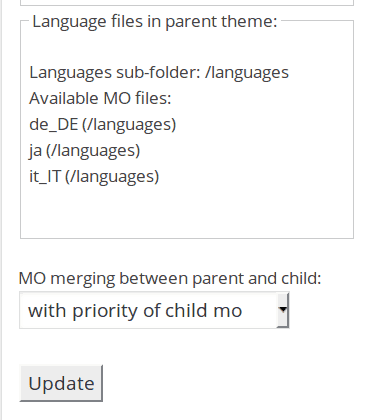
There are many translation plugins available for WordPress, and most of them deal with translations of articles. This might be of interest for others, but not for me. If you have a blog with visitors from various language background, because you are living abroad, or writing in several languages, you might feel tempted to provide visitors with a localized environment , meaning that as much as possible is translated into the native language of the visitor, without actually translating content but allowing to. xili-languages1 In my case I am writing mostly in English and Japanese, but sometimes (in former times) in Italian and now and then in my mother tongue, German. Visitors from my site are from all over the world, but at least for Japanese visitors I wanted to provide a localized environment. This blog describes how to get as much as possible translated of your blog, and here I mean not the actual articles, because this is the easy part and most translation plugins handle that fine, but the things around the articles (categories, tags, headers, ). Starting point and aims My starting point was a blog where I already had language added as extra taxonomy, and have tagged all articles with a language. But I didn t have any other translation plugin installed or used. Furthermore, I am using a child theme of the main theme in use (that is always a good idea anyway!). And of course, the theme you are using should be prepared for translation, that is that most literal strings in the theme source code are wrapped in __( ... ) or _e( ... ) calls. And by the way, if you don t have the language taxonomy, don t worry, that will come in automatically. One more thing: The following descriptions are not for the very beginner. I expect certain fluency with WordPress, where for example themese and plugins keep their files, as well as PHP programming experience is needed for some of the steps. With this starting point my aims were quite clear: Translation plugins There is a huge bunch of translation plugins, localization plugins, or internationalization plugins out there, and it is hard to select one. I don t say that what I propose here is the optimal solution, just one that I was pointed at by a colleague, namely utilizing the xili-language plugin. Installation and initial setup Not much to say here, just follow the usual procedure (search, install, activate), followed by the initial setup of xili-language. If you haven t had a language taxonomy by now, you can add languages from the preference page of xili-language, first tab. After having added some languages you should have something similar to the above screen shot. Having defined your languages, you can assign a language to your articles, but for now nothing has actually changed on the blog pages. xili-languages2As I already mentioned, I assume that you are using a child theme. In this case you should consult the fourth tab of the xili-language settings page, called Managing language files, where on the right you should see / set up things in a way that translations in the child theme override the ones in the main theme, see screen shot on the right. I just mention here that there is another xili plugin, xili-dictionary, that can do a lot of things for you when it comes to translation but I couldn t figure out its operation mode, so I switched back (i.e., uninstalled that plugin) and used normal .po/.mo files as described in the next section. Adding translations po and mo files Translations are handled in normal (at least for the Unix world) gettext format. Matthias wrote about this in this blog. In principle you have to: The contents of the po files are described in Matthias blog, and in the following when I say add a translation, then I mean: adding a stanza
msgid "some string"
msgstr "translation of some string"
to the po file, and not forgetting to recompile it to mo file. So let us go through a list of changes I made to translate various pieces of the blog appearance: Translation of categories This is the easiest part, simply throw in the names of your categories into the respective local-DD_LL.po file, and be ready. In my case I used local-ja.po which besides other categories contains stanzas like:
msgid "Travel"
msgstr " "
Translation of widget titles In most cases the widget titles are already automatically translated, if the plugin/widget author cared for it, meaning that he called the widget_title filter on the title. If this does not happen, please report this to the widget/plugin author. I have done this for example for the simple links plugin, which I use for various elements of the side-bar. The author was extremely responsive and the fix will be in the next release is already in the latest release big thanks! Translation of tags This is a bit a problem, as the tags appear in various places on my blog: next to the title line and the footer of each blog, as well as in the tag cloud in the side bar. Furthermore, I want to translate tags instead of having related tag groups as provided by xili tidy tags plugin, so we have to deal with the various appearances of tags one by one: Tags on the main page shown by the theme This is the easier part in my case I had already a customized content.php and content-single.php in my child theme folder. If not, you need to copy the one from the parent theme and change the appearance of it to translate tags. Since this is something that depends on the specific theme, I cannot give detailed advice, but if you see something like:
$tags_list = get_the_tag_list( '', __( ', ', 'mistylake' ) );
(here the get_the_tag_list is the important part), then you can replace this by the following code:
$posttags = get_the_tags();
$first = 1;
$tag_list = '';
if ($posttags)  
  foreach($posttags as $tag)  
    if ($first == 1)  
      $first = 0;
      else  
      $tag_list = $tag_list . __( ', ', 'mistylake' );
     
    $tag_list = $tag_list . '<a href="' . esc_url( home_url( '/tag/' . $tag->slug ) ) . '">' . __($tag->name, 'mistylake') . '</a>';
   
 
(there are for sure simpler ways ) This code loops over the tags and translates them using the __ function. Note that the second parameter must be the text domain of the parent theme. If you have done this right and the web site is still running (I recommend testing it on a test installation I had white pages many times due to php programming errors), and of course you have actual translations available and are looking at a localized version of the web site, then the list of tags as shown by your theme should be translated. Tag cloud widget This one is a tricky one: The tag cloud widget comes by default with WordPress, but doesn t translate the tags. I tried a few variants (e.g. creating a new widget as extension of the original tag cloud widget, and only changing the respective functions), but that didn t work out at all. I finally resorted to a trick: Reading the code of the original widget, I saw that it applies the tag-sort-filter filter on the array of tags. That allows us to hook into the tag cloud creating and translate the tags. You have to add the following code to your child theme s functions.php:
function translate_instead_of_sort($tags)  
  foreach ( (array) $tags as $tag )  
    $tag->name = __( $tag->name , 'mistylake' );
   
  return $tags;
 
add_action('tag_cloud_sort', 'translate_instead_of_sort');
xili-languages3(again, don t forget to change the text domain in the __(.., ..) call!) There might be some more things one could do, like changing the priority to be used after the sorting, or sort directly, but I haven t played around with that. Using the above code and translating several of the tags, the tag cloud now looks like the screenshot on the right I know, it could use some tweaking. Also, now the untranslated tags are sorted all before the translated, things one probably can address with the priority of the filter.
Having done the above things, my blog page when Japanese is selected is now mostly in Japanese, with of course the exception the actual articles, which are in a variety of languages. Open problems There are a few things I haven t managed till now to translate, and they are mostly related to the Jetpack plugin, but not only: I have a few ideas how to tackle this problem: With Jetpack the biggest problem seems that all the strings are translated in a different text domain. So one should be able to add some code to the functions.php to override/add translations to the jetpack text domain. But somehow it didn t work out in my case. The same goes for things that are in the WordPress core and use the translation functions without a text domain so I guess the translation function will use the main WordPress translation files/text domain. Conclusion The good thing of the xili-language plugin is that it does not change the actual posts (some plugins save the translations in the the post text), and is otherwise not too intrusive IMHO. Still, it falls short of allowing to translate various parts of the blog, including the widget areas. I am not sure whether there are better plugins for this usage scenario, I would be surprised if not, but all the plugins I have seen were doing a bit too much on the article translation side and not enough on the translation of the surroundings side. In any case, I would like to see more separation between the functionality of localization (translating the interface) and translation (translating the content). But at the moment I don t have enough impetus to write my own plugin for this. If you have any suggestions for improvement, please let me know! Enjoy.

16 June 2015

Simon Josefsson: SSH Host Certificates with YubiKey NEO

If you manage a bunch of server machines, you will undoubtedly have run into the following OpenSSH question:
The authenticity of host 'host.example.org (1.2.3.4)' can't be established.
RSA key fingerprint is 1b:9b:b8:5e:74:b1:31:19:35:48:48:ba:7d:d0:01:f5.
Are you sure you want to continue connecting (yes/no)?
If the server is a single-user machine, where you are the only person expected to login on it, answering yes once and then using the ~/.ssh/known_hosts file to record the key fingerprint will (sort-of) work and protect you against future man-in-the-middle attacks. I say sort-of, since if you want to access the server from multiple machines, you will need to sync the known_hosts file somehow. And once your organization grows larger, and you aren t the only person that needs to login, having a policy that everyone just answers yes on first connection on all their machines is bad. The risk that someone is able to successfully MITM attack you grows every time someone types yes to these prompts. Setting up one (or more) SSH Certificate Authority (CA) to create SSH Host Certificates, and have your users trust this CA, will allow you and your users to automatically trust the fingerprint of the host through the indirection of the SSH Host CA. I was surprised (but probably shouldn t have been) to find that deploying this is straightforward. Even setting this up with hardware-backed keys, stored on a YubiKey NEO, is easy. Below I will explain how to set this up for a hypothethical organization where two persons (sysadmins) are responsible for installing and configuring machines. I m going to assume that you already have a couple of hosts up and running and that they run the OpenSSH daemon, so they have a /etc/ssh/ssh_host_rsa_key* public/private keypair, and that you have one YubiKey NEO with the PIV applet and that the NEO is in CCID mode. I don t believe it matters, but I m running a combination of Debian and Ubuntu machines. The Yubico PIV tool is used to configure the YubiKey NEO, and I will be using OpenSC s PKCS#11 library to connect OpenSSH with the YubiKey NEO. Let s install some tools:
apt-get install yubikey-personalization yubico-piv-tool opensc-pkcs11 pcscd
Every person responsible for signing SSH Host Certificates in your organization needs a YubiKey NEO. For my example, there will only be two persons, but the number could be larger. Each one of them will have to go through the following process. The first step is to prepare the NEO. First mode switch it to CCID using some device configuration tool, like yubikey-personalization.
ykpersonalize -m1
Then prepare the PIV applet in the YubiKey NEO. This is covered by the YubiKey NEO PIV Introduction but I ll reproduce the commands below. Do this on a disconnected machine, saving all files generated on one or more secure media and store that in a safe.
user=simon
key= dd if=/dev/random bs=1 count=24 2>/dev/null   hexdump -v -e '/1 "%02X"' 
echo $key > ssh-$user-key.txt
pin= dd if=/dev/random bs=1 count=6 2>/dev/null   hexdump -v -e '/1 "%u"' cut -c1-6 
echo $pin > ssh-$user-pin.txt
puk= dd if=/dev/random bs=1 count=6 2>/dev/null   hexdump -v -e '/1 "%u"' cut -c1-8 
echo $puk > ssh-$user-puk.txt
yubico-piv-tool -a set-mgm-key -n $key
yubico-piv-tool -k $key -a change-pin -P 123456 -N $pin
yubico-piv-tool -k $key -a change-puk -P 12345678 -N $puk
Then generate a RSA private key for the SSH Host CA, and generate a dummy X.509 certificate for that key. The only use for the X.509 certificate is to make PIV/PKCS#11 happy they want to be able to extract the public-key from the smartcard, and do that through the X.509 certificate.
openssl genrsa -out ssh-$user-ca-key.pem 2048
openssl req -new -x509 -batch -key ssh-$user-ca-key.pem -out ssh-$user-ca-crt.pem
You import the key and certificate to the PIV applet as follows:
yubico-piv-tool -k $key -a import-key -s 9c < ssh-$user-ca-key.pem
yubico-piv-tool -k $key -a import-certificate -s 9c < ssh-$user-ca-crt.pem
You now have a SSH Host CA ready to go! The first thing you want to do is to extract the public-key for the CA, and you use OpenSSH's ssh-keygen for this, specifying OpenSC's PKCS#11 module.
ssh-keygen -D /usr/lib/x86_64-linux-gnu/opensc-pkcs11.so -e > ssh-$user-ca-key.pub
If you happen to use YubiKey NEO with OpenPGP using gpg-agent/scdaemon, you may get the following error message:
no slots
cannot read public key from pkcs11
The reason is that scdaemon exclusively locks the smartcard, so no other application can access it. You need to kill scdaemon, which can be done as follows:
gpg-connect-agent SCD KILLSCD SCD BYE /bye
The output from ssh-keygen may look like this:
ssh-rsa AAAAB3NzaC1yc2EAAAADAQABAAABAQCp+gbwBHova/OnWMj99A6HbeMAGE7eP3S9lKm4/fk86Qd9bzzNNz2TKHM7V1IMEj0GxeiagDC9FMVIcbg5OaSDkuT0wGzLAJWgY2Fn3AksgA6cjA3fYQCKw0Kq4/ySFX+Zb+A8zhJgCkMWT0ZB0ZEWi4zFbG4D/q6IvCAZBtdRKkj8nJtT5l3D3TGPXCWa2A2pptGVDgs+0FYbHX0ynD0KfB4PmtR4fVQyGJjJ0MbF7fXFzQVcWiBtui8WR/Np9tvYLUJHkAXY/FjLOZf9ye0jLgP1yE10+ihe7BCxkM79GU9BsyRgRt3oArawUuU6tLgkaMN8kZPKAdq0wxNauFtH
Now all your users in your organization needs to add a line to their ~/.ssh/known_hosts as follows:
@cert-authority *.example.com ssh-rsa AAAAB3NzaC1yc2EAAAADAQABAAABAQCp+gbwBHova/OnWMj99A6HbeMAGE7eP3S9lKm4/fk86Qd9bzzNNz2TKHM7V1IMEj0GxeiagDC9FMVIcbg5OaSDkuT0wGzLAJWgY2Fn3AksgA6cjA3fYQCKw0Kq4/ySFX+Zb+A8zhJgCkMWT0ZB0ZEWi4zFbG4D/q6IvCAZBtdRKkj8nJtT5l3D3TGPXCWa2A2pptGVDgs+0FYbHX0ynD0KfB4PmtR4fVQyGJjJ0MbF7fXFzQVcWiBtui8WR/Np9tvYLUJHkAXY/FjLOZf9ye0jLgP1yE10+ihe7BCxkM79GU9BsyRgRt3oArawUuU6tLgkaMN8kZPKAdq0wxNauFtH
Each sysadmin needs to go through this process, and each user needs to add one line for each sysadmin. While you could put the same key/certificate on multiple YubiKey NEOs, to allow users to only have to put one line into their file, dealing with revocation becomes a bit more complicated if you do that. If you have multiple CA keys in use at the same time, you can roll over to new CA keys without disturbing production. Users may also have different policies for different machines, so that not all sysadmins have the power to create host keys for all machines in your organization. The CA setup is now complete, however it isn't doing anything on its own. We need to sign some host keys using the CA, and to configure the hosts' sshd to use them. What you could do is something like this, for every host host.example.com that you want to create keys for:
h=host.example.com
scp root@$h:/etc/ssh/ssh_host_rsa_key.pub .
gpg-connect-agent "SCD KILLSCD" "SCD BYE" /bye
ssh-keygen -D /usr/lib/x86_64-linux-gnu/opensc-pkcs11.so -s ssh-$user-ca-key.pub -I $h -h -n $h -V +52w ssh_host_rsa_key.pub
scp ssh_host_rsa_key-cert.pub root@$h:/etc/ssh/
The ssh-keygen command will use OpenSC's PKCS#11 library to talk to the PIV applet on the NEO, and it will prompt you for the PIN. Enter the PIN that you set above. The output of the command would be something like this:
Enter PIN for 'PIV_II (PIV Card Holder pin)': 
Signed host key ssh_host_rsa_key-cert.pub: id "host.example.com" serial 0 for host.example.com valid from 2015-06-16T13:39:00 to 2016-06-14T13:40:58
The host now has a SSH Host Certificate installed. To use it, you must make sure that /etc/ssh/sshd_config has the following line:
HostCertificate /etc/ssh/ssh_host_rsa_key-cert.pub
You need to restart sshd to apply the configuration change. If you now try to connect to the host, you will likely still use the known_hosts fingerprint approach. So remove the fingerprint from your machine:
ssh-keygen -R $h
Now if you attempt to ssh to the host, and using the -v parameter to ssh, you will see the following:
debug1: Server host key: RSA-CERT 1b:9b:b8:5e:74:b1:31:19:35:48:48:ba:7d:d0:01:f5
debug1: Host 'host.example.com' is known and matches the RSA-CERT host certificate.
Success! One aspect that may warrant further discussion is the host keys. Here I only created host certificates for the hosts' RSA key. You could create host certificate for the DSA, ECDSA and Ed25519 keys as well. The reason I did not do that was that in this organization, we all used GnuPG's gpg-agent/scdaemon with YubiKey NEO's OpenPGP Card Applet with RSA keys for user authentication. So only the host RSA key is relevant. Revocation of a YubiKey NEO key is implemented by asking users to drop the corresponding line for one of the sysadmins, and regenerate the host certificate for the hosts that the sysadmin had created host certificates for. This is one reason users should have at least two CAs for your organization that they trust for signing host certificates, so they can migrate away from one of them to the other without interrupting operations.

11 June 2015

MJ Ray: Mick Morgan: here s why pay twice?

http://baldric.net/2015/06/05/why-pay-twice/ asks why the government hires civilians to monitor social media instead of just giving GC HQ the keywords. Us cripples aren t allowed to comment there (physical ability test) so I reply here: It s pretty obvious that they have probably done both, isn t it? This way, they re verifying each other. Politicians probably trust neither civilians or spies completely and that makes it worth paying twice for this. Unlike lots of things that they seem to want not to pay for at all

10 June 2015

Norbert Preining: Tribute to Hermann Zapf

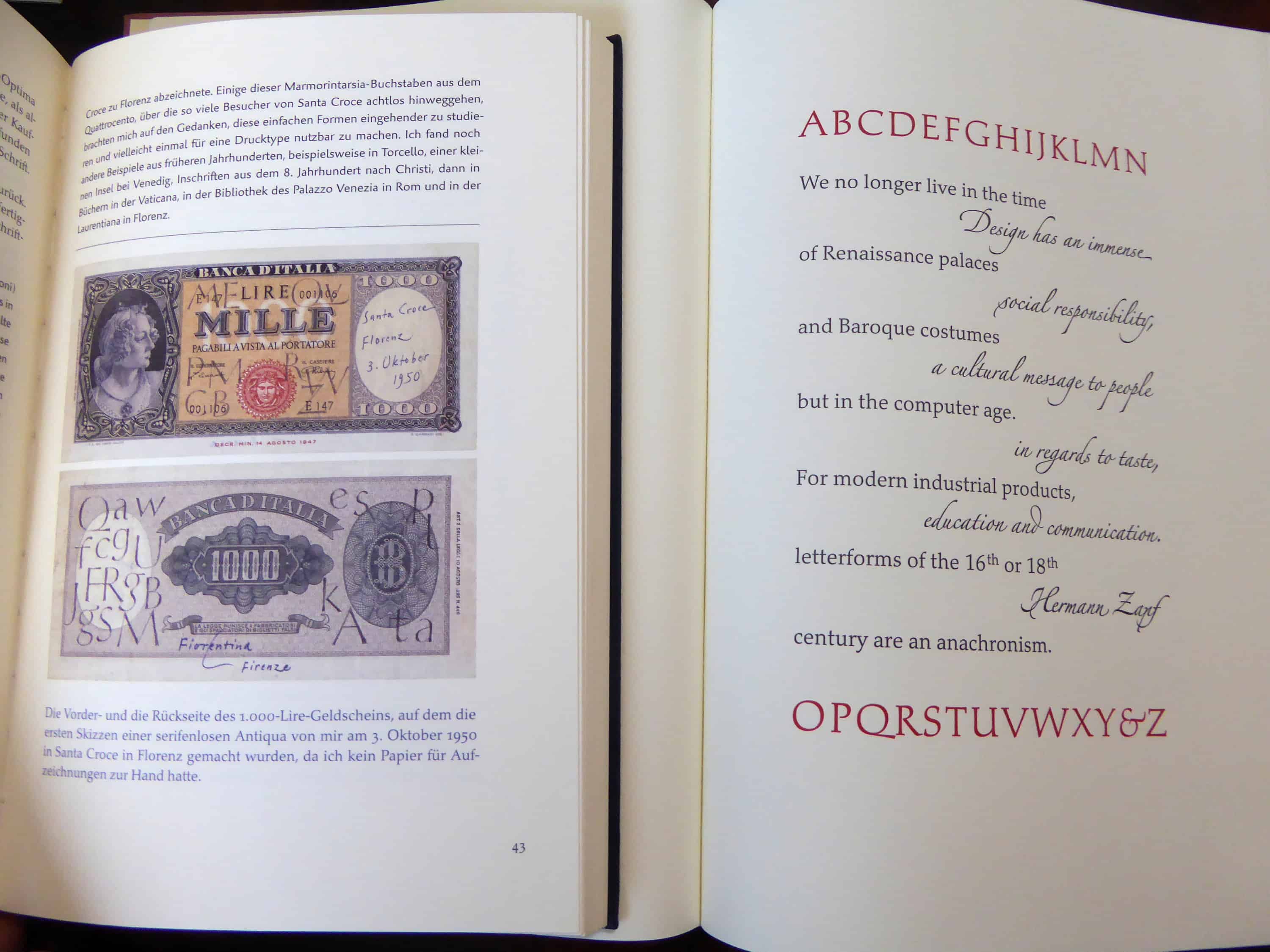
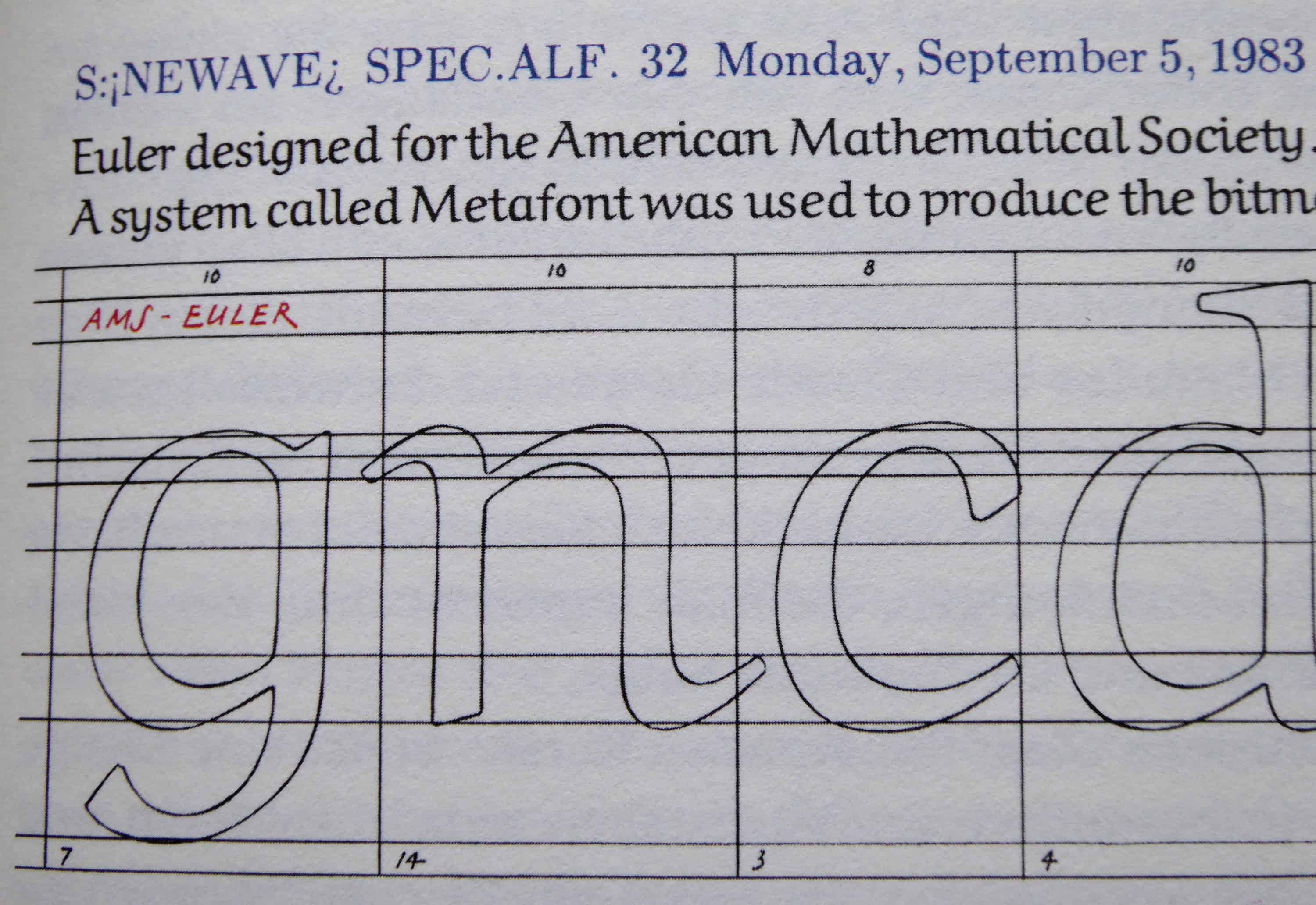
Last weekend Hermann Zapf, one of the greatest font designers and typographers of our times, has passed away at the age of 96. Much has been written about his life, his immense sphere of influence, his excellent typefaces, and some of the links to other obituaries can be found here at the end. There is nothing of value I can contribute, but let Hermann Zapf speak for himself with a few images from two books by or dedicated to him. zapf-heart-blood-ink The books I have taken these photos from are: zapf-books In his long life, Hermann Zapf has created a wide range of typefaces, some if which have become the main staple in the printing business, most notably Palatino, Janson, Optima, and Zapf Dingbats. But there are many more: zapf-alphabets While probably not as popular anymore as some years (decades?) ago, Palatino still is one of my favorite typefaces. I often wished to have the freedom to choose my own fonts for publications, but normally that doesn t happen. Palatino has found many offspring (or imitations?), and there are excellent renderings for use with (La)TeX, too. zapf-palatino Hermann Zapf also had connections with Don Knuth and the AMS (American Mathematical Society), and he designed for the AMS the Euler typeface, using Knuth s MetaFont program. zapf-euler Last weekend, when I heard of Hermann Zapf s death, I was at a conference at Tsukuba University. What a coincidence that all the signs in the building (floor numbers, indications, etc) were set optimain another of his great typefaces, the Optima. I had a strange feeling, and reset my presentation in Optima/Euler in honor of Hermann Zapf s great life. Although I never met Hermann Zapf personally I missed the TeX conferences where he participated it was to a great extent his influence that years ago I got started in typography. Living a life like he did, dedicating himself to the beauty and expressiveness of letters, design, calligraphy, seems like a dream for me. But beauty can be found even in the strangest equation in mathematics, the queerest theorem in logic. While not all of us are as gifted as Hermann Zapf in creating beauty, we should strive to increase our ability to appreciate the beauty. The beauty of letters is subtle, evasive, and needs training, that is practice, to be appreciated. Hermann Zapf taught us how even self-training can lead to excellence. His letters, which I meet every day, are a permanent reminder to strive for beauty and clarity, and never relent in our exercise. Thanks Hermann Zapf. zapf-letters Links to tributes around the world English Linotype (Type foundry where Zapf started working)
Bigelow and Holmes (Type designers)
New York Times (Newspaper)
Type Drawers
Quarz (News magazine)
Kaveh Bazargan (next president of TUG)
TeX Overflow (Q&A website concerning TeX) German FontShop (Type foundry and internet shop)
Deutschland Funk (News station)
S ddeutsche (Newspaper)
Echo (Newspaper)
Heise (Techology News page)

7 June 2015

Thomas Goirand

There s a lot of things I d like to blog about. The last version of OpenStack, the OpenStack Liberty design summit, Kilo in the official jessie-backports repositories, etc. Maybe the most interesting part of this blog post is the last bit at the end, about a major change in the packaging workflow for OpenStack in Debian. Please read on OpenStack release names reminder
Just a reminder to make it easier for the average Debian reader who may know Debian well, but not OpenStack. OpenStack 2014.1, is Icehouse, and is the version in Jessie. 2014.2 is Juno and was released right before the freeze of Jessie. 2015.1.0 is what has been released just right after jessie, on the 30th of April. Liberty, which probably will be called 12 (as this will be the 12th release of OpenStack), and not 2015.2 (this has been discussed in Vancouver), will be released in about 5 months form now. The last summit, in Vancouver, BC, Canada, was the Liberty summit, as the OpenStack conventions are always named after the next release (since we are discussing what we will be doing during the next development cycle). OpenStack 2015.1.0, aka Kilo, release in Debian
5 days after the release of Jessie, OpenStack 2015.1.0, aka Kilo, was released. Since I couldn t upload to unstable during the freeze, I was holding a lot of packages, and when I did upload them, there was about 20 packages of mine in the FTP master s NEW queue. Though, since the DSA want to use OpenStack for the Debian infrastructure, the 20 packages were fast track into Sid, thanks to the work of Paultag (thanks man!). OpenStack Kilo in the official Jessie backports
Previously, I was only uploading OpenStack packages to Debian unstable, and maintaining a non-official Debian repositories for backports to Debian stable. However, for multiple reasons, this wasn t satisfying. Then, after packages migrated to Stretch, I started to upload to Debian backports. And right before the summit, almost everything went in. Only python-pysaml2 was missing (as I discovered too late that version 2.0.0 breaks Keystone which needs version 2.4.0). In fact, the last bits of the Kilo release reached jessie-backports in the middle of the OpenStack Liberty summit. Removal of the Debian install-guide from the official site
As there was not enough efforts working on the documentation, unfortunately, the link to the Debian install-guide has been removed from docs.openstack.org. IMO, this is mostly due to a bad communication between myself and the doc team, and also because one person who promised to work on the Debian side of the install-guide failed to warn everyone that he finally couldn t (as his managers assigned him to something else). I hope this will soon be reverted. During the Vancouver summit, I had the opportunity to discuss with the doc team about re-inclusion of the Debian install-guide. Unfortunately, as they are moving away from the XML source format to a more standard RST-based system, the current documentation is frozen, so it seems more realistic to hold on until all of the install-guide is switched to RST. OpenStack Debian image listed on apps.openstack.org
There s a new area on the openstack.org where images and apps for OpenStack are listed. Under the glance image tab, you will see that both the Jessie and the weekly testing image are listed. There s also a nice, easily identifiable Debian logo to link to these images. Also, as there are trademark problems with the Ubuntu images which makes them harder to redistribute, the Murano project (which is shipping a system to automatically install apps that to installed within a few clicks on an OpenStack cloud) decided to switch to Debian for their base image. Debian listed in the OpenStack market place
On the openstack.org site, there s a section called Marketplace. In there, vendors supporting OpenStack are listed. To get there, a vendor needs to 1/ have a defined set of OpenStack project supported by the distribution (Debian already has a way more than the required set), 2/ sign some kind of agreement with the OpenStack foundation, and 3/ pay some sponsoring money. During the summit, I discussed this with Jonathan Bryce, from the OpenStack foundation, and he agreed that Debian would not have to pay for this (since we aren t a big company with big money). I have put Jonathan and Neil (our Debian Project Leader) in touch so that signing the document may happen, though since we were all busy with the summit, I do not expect Jonathan to send the documents right away. Hopefully, this will be fixed before the end of this month of May 2015. Debian (and Ubuntu) packages collaboratively maintained upstream
Since about forever (forever is 5 years in the OpenStack world ), I pushed for more collaboration on OpenStack packaging between Debian package maintainers and Canonical. However, for some reasons which I do not wish to expand on in this blog post, it has been socially hard to do so. Also, Canonical always used BZR, which wasn t to the tastes of everyone. But during the Liberty summit, some very good things happened. First of all, Launchpad is now able to support Git (it s been a few weeks it does in fact). Even though it will take a bit of time before the Canonical server team switches to it, we can consider that this problem is already out of the way. Then it looks like Canonical are now more open than before for collaboration with Debian on the OpenStack packaging. Note that we actually did some work together already, but now we both would like a full alignment of *all* of our packages. I have discussed this with James Page, who is the head of Canonical s server team. We will first start to do so on the dependencies: this includes all of the python-*client libraries, but also all of python-oslo.* (the Oslo libs are use by all of the projects and are kind of unifying the project), plus all the third party dependencies the project relies on. James already pushed new versions of some Oslo libraries to Experimental (in order to not overwrite Kilo), which are adding transition packages needed for Ubuntu. We wont need those in Debian, but we want to welcome them to keep the same source packages. We will then later try to merge the core projects if we can. Unfortunately, since the packaging of the core projects (ie: Nova, Neutron, Cinder, Glance, etc.) was forked, merging probably will be a bit painful. We will have to make some decisions on how this happen. I am however confident that it will be done during the Liberty release cycle. Move of the packaging to upstream Gerrit
A few weeks after the summit, I wrote a proposal to upstream OpenStack dev list, with as subject: Adding packaging as an OpenStack project . What it means is that I have proposed to have Debian/Ubuntu packaging to happen in upstream infrastructure, using Gerrit, and building packages using upstream cloud. We will add all the tests we can, like building with unit tests, lintian, piuparts, adequate, but also maybe a full installation of the packages with functional tests. My proposal is here: http://lists.openstack.org/pipermail/openstack-dev/2015-May/064848.html As everything, this translates into a Gerrit review process: https://review.openstack.org/#/c/185187/ As you can read in the above thread, Fedora/RDO people, which have used a Gerrit work-flow for a long time already, also would like to join. But it looks like we ll be doing 2 teams: one for RPMs and one for debs. The proposal is currently under review by the OpenStack technical committee, which will accept (or not) if the packaging project can be fully considered as an OpenStack project. I expect a final answer next Tuesday. Note that if they deny, we can still use the stackforge namespace instead, their decision is just about the TC blessing the project as being OpenStack or not. What s very nice about this, is that not only we will have a better collaboration between Debian & Ubuntu, better automated testing and Q/A, this also opens contributions to potentially anyone. Especially, we welcome operation people, those who are doing actual big deployments. Sure, it was possible before, but I often had the feedback that many were scared to break anything when trying to contribute. Thanks to the CI/CD form upstream infra, and the Gerrit peer review process, it wont be a problem anymore. So we do expect operation people to contribute more. I will also push more upstream packaging within Mirantis, so that MOS (Mirantis OpenStack) aligns fully with Debian & Ubuntu as well. Another good thing, is that it will be easier for the puppet team to support Debian (they historically were more Ubuntu oriented), and it s going to be super easy for them to request for packaging fixes. I hope we will be able to work hand-to-hand with them, adding puppet deployment checks in the packaging repo, and packaged deployments within the puppet Gerrit review process.

5 June 2015

Laura Arjona: Games

Nota: Este art culo, en espa ol, aqu . I m not a gamer, although probably I ve played with machines/computers more than most of the girls of my age. My path has been: handheld machine, Pong and tenis in my uncle s console, MSX (with that one, in addition to playing, I learnt what was an algorithm and a program, and I started to write small programs in Basic, and I copied and ran the source code of small games and programs to make graphics, which I found in MSX magazines). My parents considered that arcade machines in bars were like slot machines so they were banned for us (even pinball, only table soccer was saved from them, and only if my father was playing with us). In the MSX I played Magical Tree, Galaxians, Arkanoid, Konami s Sports Games, Spanish games from Dinamic, and some arcades like Golden Axe, Xenon, and maybe some more. The next computers (PC AT, later a 286) were not so for gaming; let s say that we played more with the printer (Harvard Graphics, Bannermania ). Later, I was interested in other things more than in computer games, and later there were highschool homework, dBase III, and later the University and programming again and more, and it was the end of gaming, computer was for office and Uni homework.
Later, it came the internet and since then, reading and writing and communicating was more interesting for me than playing. I was not good at playing, and if you are not good, you play less, and you don t get better, so you begin to find other ways to loose your time, or to win it :) The new generation My son is 6 years old now, and I m living with him a second adventure about games. Games have changed a lot, and the family computing try to stay in the libre software side whenever I am the one that can decide, so sometimes some challenges arise. Android (phone and tablet) The kid has played games in the phone and tablet with Android since he was a baby. We tried some of the last years popular games. I am not so keen of banning things, but I don t feel comfortable with the popular games for Android (advertisements, nonfree software, addictive elements, massive data recollection and possible surveillance ), so I try to control without being Cruella de Vil . Some techniques I use: On the other side, in my phone there is no Google Play, so we have been able to discover the section Games of F-Droid. We have tried (all of them available in F-Droid, emphasis in the ones that he liked best): 2048, AndroFish, Bomber, Coloring for Kids, Core, Dodge, Falling Blocks, Free Fall, Frozen Bubble, HeriSwap (this one in the tablet), Hex, HyperRogue, Meerkat Challenge, Memory, Pixel Dungeon, Robotfindskitten, Slow it!, Tux Memory, Tux Rider, Vector Pinball. Playing in my phone with CyanogenMod and having downloaded the games from F-Droid provides a relief similar to the one when playing a non-computer game. At least with the games that I have listed above. Maybe it is because they are simpler games, or they make me remember the ones that I played time ago. But it s also because of the peace of mind of knowing that they are libre software, that have been audited by the F-Droid community, that they don t abuse the user. The same happens with Debian, what takes me to the next part of this blogpost. Computer games: Debian The kid has learnt to play with the tablet and the phone before than with the computer, because our computers have no joysticks nor touchscreens. He learnt to use the touchpad before than the mouse, because it s easier and we have no mouse at home. He learnt to use the mouse at school, where they work with educative games via CD or via web, using Flash :( So Flash player appears and dissapears from my Debian setup depending on his willness to play with the school games . Until few time ago, in the computer we played with GCompris, ChildsPlay, and TuxPaint.
When he learnt to use the arrow keys, I installed Hannah and he liked a lot, specially when we learnt to do hannah -l 900 :) Later, in ClanTV there were advertisements about some online computer games about their favorite series, resulting in that they need Flash or a framework called Unity3D (no, it s not Ubuntu s Unity), and after digging a bit I decided that I was not going to install that #@%! in my Debian, so when he insisted in play those games, I booted the Windows 7 partition in his father s laptop and I installed it there. Windows is slow and sad in the computer, and those web games with that framework are not very light, so luckily they have not become very interesting. We have not played in the computer much more, maybe some incursion in Minetest, what takes me to the next section. (Not without stating my eternal thanks to the Games Team in Debian. I think they do a very important work and I think that next year I ll try to get involved in some way, because I know that the future of our family computer games is tied to libre games in Debian). PlayStation 3 and Minecraft Some time ago my husband bought a PlayStation 3 for home. The shop had discounts prices and so. He would play together with the kid an so.
The machine came home with some games for free (included in the price), but most of them were classified for +13 or so, so the only two left were Pro Evolution Soccer, and Minecraft.
I decided not to connect the machine to the network. Maybe we are loosing cool things, but I feel safer like that. So, no ethernet cable plugged, no registration in the Sony shop (or whatever its name is). The controllers are quite complex for the three of us. They are DualShock don t-know-what, and I think there is something (software) that makes the game adaptative to the person playing, because my husband is worse player after the son plays, if they play in turns and use the same controller. The kid liked Minecraft. I didn t know anything about that game (well, I knew that there was a libre clone called Minetest), so, for learning the basics I had a look at the wiki and searched videos about how to and we began learning. Now, the kid can read a bit so he needs less help, and he has watched a lot of videos about Minecraft, so he is interested in exploring and building. I had a look at Minetest, and I installed it in Debian. Having to use the keyboard is a disadvantage, and we didn t know how to dig, so it was not much attractive at first sight. I have looked a bit about how to use the PS3 controller in the computer, via USB, and it seems to work, but I suppose I need to write something to match each controller button with the corresponding key and subsequent action in Minetest. This is work, and I am lazy, and the boy seems not very interested in playing with the computer. Watching the videos we have infered that it s possible to download saved games and worlds to upload them in the videogame console. We have done some tests. I wanted to upload a saved game about an amusement park, but the file was in a folder of name NPEB01899* and even when the PS3 saw it to copy it from USB to the console, later it didn t appear in the list of saved games (our sved games were in folders named BLES01976). And renaming the folder didn t work, of course. I understood that we had met Sony s restrictions, so I searched for more info. The games are saved using an encryption key and you are not able to use saved games from consoles in other world zone or using a media different than ours (the game can be played using a disc or purchasing it in the digital shop, it seems). Very ugly all of this! I read somewhere that there is certain software (libre software, BTW) that allows to break the encryption and re-encrypt the saved game with the zone and type of media of your console, but it seems the program only works for Windows, and it needs a console ID that we have not, because we didn t register the console in the PlayStation network. All these things look shaky grounds for me, unpleasant stuff, I don t want to spend time on this, maybe I should learn a bit more about Minetest and make it work and interesting and tell Sony go fly a kite. Finally, I found a saved game in the same format as ours (BLES01976), it s not an amusement park but it is a world with interesting places to explore and many things already built, so I ve tried to import it and it worked, so my son will be happy for some time, I suppose. We have tried Minetest in the tablet too, but the touchscreen is not comfortable for this kind of games. I feel quite frustrated and angry about this issue of Sony s restrictions on saved games. So I suppose that in the next months I ll try to learn more about Minetest in Debian, game controllers in Debian, and games in Debian in general. So I hope to be able to offer cool stuff to my son, and he becomes more interested in playing in a safe environment which does not abuse the user. And with this, I finish Libre games in GNU/Linux, Debian, and info about games in internet When we have searched info about games in internet, I found that many times you need to go out from the secure environment: webpages with links to downloads that who knows if they contain what they say they contain, advertisements, videoblogs with a language not adequate for kids (or any person that loves their mother language) That s why I believe the path is to go into detail about libre games provided by the distro you use (Debian in my case). Here I bookmark a list of website with info that surely will be useful for me, to read in depth: We ll see how it goes. Comments? You can comment in this Pump.io thread.
Filed under: My experiences and opinion Tagged: Debian, English, F-Droid, Free culture, Free Software, Games, libre software, Moving into free software

Simon McVittie: Why polkit (or, how to mount a disk on modern Linux)

I've recently found myself explaining polkit (formerly PolicyKit) to one of Collabora's clients, and thought that blogging about the same topic might be useful for other people who are confused by it; so, here is why udisks2 and polkit are the way they are. As always, opinions in this blog are my own, not Collabora's. Privileged actions Broadly, there are two ways a process can do something: it can do it directly (i.e. ask the kernel directly), or it can use inter-process communication to ask a service to do that operation on its behalf. If it does it directly, the components that say whether it can succeed are the Linux kernel's normal permissions checks (DAC), and if configured, AppArmor, SELinux or a similar MAC layer. All very simple so far. Unfortunately, the kernel's relatively coarse-grained checks are not sufficient to express the sorts of policies that exist on a desktop/laptop/mobile system. My favourite example for this sort of thing is mounting filesystems. If I plug in a USB stick with a FAT filesystem, it's reasonable to expect my chosen user interface to either mount it automatically, or let me press a button to mount it. Similarly, to avoid data loss, I should be able to unmount it when I'm finished with it. However, mounting and unmounting a USB stick is fundamentally the same system call as mounting and unmounting any other filesystem - and if ordinary users can do arbitrary mount system calls, they can cause all sorts of chaos, for instance by mounting a filesystem that contains setuid executables (privilege escalation), or umounting a critical OS filesystem like /usr (denial of service). Something needs to arbitrate: you can mount filesystems, but only under certain conditions . The kernel developer motto for this sort of thing is mechanism, not policy : they are very keen to avoid encoding particular environments' policies (the sort of thing you could think of as business rules ) in the kernel, because that makes it non-generic and hard to maintain. As a result, direct mount/unmount actions are only allowed by privileged processes, and it's up to user-space processes to arrange for a privileged process to make the desired mount syscall. Here are some other privileged actions which laptop/desktop users can reasonably expect to just work , with or without requiring a sysadmin-like (root-equivalent) user: In environments that use a MAC framework like AppArmor, actions that would normally be allowed can become privileged: for instance, in a framework for sandboxed applications, most apps shouldn't be allowed to record audio. This prevents carrying out these actions directly, again resulting in the only way to achieve them being to ask a service to carry out the action. Ask a system service to do it On to the next design, then: I can submit a request to a privileged process, which does some checks to make sure I'm not trying to break the system (or alternatively, that I have enough sysadmin rights that I'm allowed to break the system if I want to), and then does the privileged action for me. You might think I'm about to start discussing D-Bus and daemons, but actually, a prominent earlier implementation of this was mount(8), which is normally setuid root:
% ls -l /bin/mount
-rwsr-xr-x 1 root root 40000 May 22 11:37 /bin/mount
If you look at it from an odd angle, this is inter-process communication across a privilege boundary: I run the setuid executable, creating a process. Because the executable has the setuid bit set, the kernel makes the process highly privileged: its effective uid is root, and it has all the necessary capabilities to mount filesystems. I submit the request by passing it in the command-line arguments. mount does some checks - specifically, it looks in /etc/fstab to see whether the filesystem I'm trying to mount has the user or users flag - then carries out the mount system call. There are a few obvious problems with this: Ask a system service to do it, via D-Bus or other IPC To avoid the issues of setuid, we could use inter-process communication in the traditional sense: run a privileged daemon (on boot or on-demand), make it listen for requests, and use the IPC channel as our privilege boundary. udisks2 is one such privileged daemon, which uses D-Bus as its IPC channel. D-Bus is a commonly-used inter-process system; one of its intended/designed uses is to let user processes and system services communicate, especially this sort of communication between a privileged daemon and its less-privileged clients. People sometimes criticize D-Bus as not doing anything you couldn't do yourself with some AF_UNIX sockets. Well, no, of course it doesn't - the important bit of the reference implementation and the various interoperable reimplementations consists of a daemon and some AF_UNIX sockets, and the rest is a simple matter of programming. However, it's sufficient for most uses in its problem space, and is usually better than inventing your own. The advantage of D-Bus over doing your own thing is precisely that you are not doing your own thing: good IPC design is hard, and D-Bus makes some structural decisions so that fewer application authors have to think about them. For instance, it has a central hub daemon (the dbus-daemon, or message bus ) so that n communicating applications don't need O(n ) sockets; it uses the dbus-daemon to provide a total message ordering so you don't have to think about message reordering; it has a distributed naming model (which can also be used as a distributed mutex) so you don't have to design that; it has a serialization format and a type system so you don't have to design one of those; it has a framework for activating" run-on-demand daemons so they don't have to use resources initially, implemented using a setuid helper and/or systemd; and so on. If you have religious objections to D-Bus, you can mentally replace D-Bus with AF_UNIX or something and most of this article will still be true. Is this OK? In either case - exec'ing a privileged helper, or submitting a request to a privileged daemon via IPC - the privileged process has two questions that it needs to answer before it does its work: It needs to make some sort of decision on the latter based on the information available to it. However, before we even get there, there is another layer: In the setuid model, there is a simple security check that you can apply: you can make /bin/mount only executable by a particular group, or only executable by certain AppArmor profiles, or similar. That works up to a point, but cannot distinguish between physically-present and not-physically-present users, or other facts that might be interesting to your local security policy. Similarly, in the IPC model, you can make certain communication channels impossible, for instance by using dbus-daemon's ability to decide which messages to deliver, or AF_UNIX sockets' filesystem permissions, or a MAC framework like AppArmor. Both of these are quite coarse-grained checks which don't really understand the finer details of what is going on. If the answer to "is this safe? is something of the form maybe, it depends on... , then they can't do the right thing: they must either let it through and let the domain-specific privileged process do the check, or deny it and lose potentially useful functionality. For instance, in an AppArmor environment, some applications have absolutely no legitimate reason to talk to udisks2, so the AppArmor policy can just block it altogether. However, once again, this is a coarse-grained check: the kernel has mechanism, not policy, and it doesn't know what the service does or why. If the application does need to be able to talk to the service at all, then finer-grained access control (obeying some, but not all, requests) has to be the service's job. dbus-daemon does have the ability to match messages in a relatively fine-grained way, based on the object path, interface and member in the message, as well as the routing information that it uses itself (i.e. the source and destination). However, it is not clear that this makes a great deal of sense conceptually: these are facts about the mechanics of the IPC, not facts about the domain-specific request (because the mechanics of the IPC are all that dbus-daemon understands). For instance, taking the udisks2 example again, dbus-daemon can't distinguish between an attempt to adjust mount options for a USB stick (probably fine) and an attempt to adjust mount options for /usr (not good). To have a domain-specific security policy, we need a domain-specific component, for instance udisks2, to get involved. Unlike dbus-daemon, udisks2 knows that not all disks are equal, knows which categories make sense to distinguish, and can identify which categories a particular disk is in. So udisks2 can make a more informed decision. So, a naive approach might be to write a function in udisks2 that looks something like this pseudocode:
may_i_mount_this_disk (user, disk, mount options)   boolean
 
    if (user is root   user is root-equivalent)
        return true;
    if (disk is not removable)
       return false;
    if (mount options are scary)
       return false;
    if (user is in  manipulate non-local disks  group)
        return true;
    if (user is not logged-in locally)
       return false;
    # https://en.wikipedia.org/wiki/Multiseat_configuration
    if (user is not logged-in on the same seat where the disk is
            plugged in)
       return false;
    return true;
 
Delegating the security policy to something central The pseudocode security policy outlined above is reasonably complicated already, and doesn't necessarily cover everything that you might want to consider. Meanwhile, not every system is the same. A general-purpose Linux distribution like Debian might run on server/mainframe systems with only remote users, personal laptops/desktops with one root-equivalent user, locked-down corporate laptops/desktops, mobile devices and so on; these systems should not necessarily all have the same security policy. Another interesting factor is that for some privileged operations, you might want to carry out interactive authorization: ask the requesting user to confirm that the action (which might have come from a background process) should take place (like Windows' UAC), or to prove that the person currently at the keyboard is the same as the person who logged in by giving their password (like sudo). We could in principle write code for all of this in udisks2, and in NetworkManager, and in systemd, ... - but that clearly doesn't scale, particularly if you want the security policy to be configurable. Enter polkit (formerly PolicyKit), a system service for applying security policies to actions. The way polkit works is that the application does its domain-specific analysis of the request - in the case of udisks2, whether the device to be mounted is removable, whether the mount options are reasonable, etc. - and converts it into an action. The action gives polkit a way to distinguish between things that are conceptually different, without needing to know the specifics. For instance, udisks2 currently divides up filesystem-mounting into org.freedesktop.udisks2.filesystem-mount, org.freedesktop.udisks2.filesystem-mount-fstab, org.freedesktop.udisks2.filesystem-mount-system and org.freedesktop.udisks2.filesystem-mount-other-seat. The application also finds the identity of the user making the request. Next, the application sends the action, the identity of the requesting user, and any other interesting facts to polkit. As currently implemented, polkit is a D-Bus service, so this is an IPC request via D-Bus. polkit consults its database of policies in order to choose one of several results: So how does polkit decide this? The first thing is that it reads the machine-readable description of the actions, in /usr/share/polkit-1/actions, which specifies a default policy. Next, it evaluates a local security policy to see what that says. In the current version of polkit, the local security policy is configured by writing JavaScript in /etc/polkit-1/rules.d (local policy) and /usr/share/polkit-1/rules.d (OS-vendor defaults). In older versions such as the one currently shipped in Debian unstable, there was a plugin architecture; but in practice nobody wrote plugins for it, and instead everyone used the example local authority shipped with polkit, which was configured via files in /etc/polkit-1/localauthority and /etc/polkit-1/localauthority.d. These policies can take into account useful facts like: For instance, gnome-control-center on Debian installs this snippet:
polkit.addRule(function(action, subject)  
        if ((action.id == "org.freedesktop.locale1.set-locale"  
             action.id == "org.freedesktop.locale1.set-keyboard"  
             action.id == "org.freedesktop.hostname1.set-static-hostname"  
             action.id == "org.freedesktop.hostname1.set-hostname"  
             action.id == "org.gnome.controlcenter.datetime.configure") &&
            subject.local &&
            subject.active &&
            subject.isInGroup ("sudo"))  
                    return polkit.Result.YES;
             
 );
which is reasonably close to being pseudocode for active local users in the sudo group may set the system locale, keyboard layout, hostname and time, without needing to authenticate . A system administrator could of course override that by dropping a higher-priority policy for some or all of these actions into /etc/polkit-1/rules.d. Summary

2 June 2015

Ben Hutchings: Debian LTS work, May 2015

This was my sixth month working on Debian LTS. I was assigned 10.5 hours by Freexian's Debian LTS initiative. This was less than in previous months, but I was still able to work on several packages. dpkg This update was almost ready to release at the end of April. I had to rebuild from the upstream tarball as released by Guillem, then uploaded and issued DLA 220-1. tiff This update was also almost ready to release. I hoped to get some users to test it, but didn't get any response. I uploaded and issued DLA 221-1. ruby1.8 Ruby 1.8 had a single CVE to fix. It was already fixed in wheezy against a similar upstream version, so it took little time to apply that patch. Ruby has an extensive test suite that reassured me this wouldn't cause a regression. I uploaded and issued DLA 224-1. p7zip p7zip allows arbitrary file overwrite via symlinks (CVE-2015-1038) when extracting a carefully constructed archive, and this bug is not fixed upstream. This sort of bug has been identified and fixed previously in similar tools such as GNU tar, so I looked at how that handles links and tried to apply a similar change in p7zip. This was somewhat complicated by the code style (C++ with COM-style interfaces and NIH containers), but not too hard. I came up with a patch that seems to work for the versions in Debian, and have attached it to the upstream bug report for review. linux-2.6 I reviewed the patches for Linux 2.6.32.66 - many of which were my own backports - and then integrated this update into the SVN branch. I will probably upload a new version soon, whether or not there's a high severity issue, just to avoid piling up a large number of changes in one update.

1 June 2015

Russ Allbery: Review: Hild

Review: Hild, by Nicola Griffith
Series: Hild #1
Publisher: Farrar, Straus and Giroux
Copyright: 2013
ISBN: 0-374-28087-8
Format: Hardcover
Pages: 539
Hild was born in seventh-century Britain, daughter of Hereric (would-be king of Daria) and Breguswith. Born, her mother said, to be a light to the land. This much is documented by the Venerable Bede, in The Ecclesiastical History of the English Nation, along with Hild's later rise to become one of the most powerful abbesses in British history. But nearly all of Hild's early life is a cipher. Hild fills in some of that gap with fiction. Specifically, it takes Hild from a child of three, learning her father has been killed, to a young woman, an advisor of Edwin king. It's a coming of age story in part, following her maturation both physically and mentally, her training in when to speak and how, and the dangers of being close to royalty in a fractious, political, and war-torn land. It's also the story of endless maneuvering and care, initially by her mother Breguswith and then by Hild herself sometimes in opposition to her mother, sometimes in alliance as her mother attempts to make a safe place for her daughter and herself in a treacherous court of shifting dangers. But Hild is also a story about Britain. It's a novel about how it felt and how it sounded. How it was organized, primarily among the high-born but with snippets of perspective from the lower classes. And it's a story about women: about weaving, about medicine, about friendships and partnerships and alliances among women, about the politics of marriage and childbirth, but also about the places women held and made in a time when surviving official history is all about the men. Hild is a painstakingly-researched, sprawling, lush, and sensual immersion in a part of history that gets little formal attention: after the Romans, before what we think of as medieval, before England as a country. I've been waiting for a new Nicola Griffith novel for quite a while, since Always in 2007. Hild doesn't disappoint, but it's also different than Griffith's previous writing. It has less of the strong narrative drive and clarity of either her SF or Aud Torvingen stories. Instead, the goal of Hild is to immerse and transport you, to help you feel the shape of Hild's world, to understand her days and tasks, her dreams and dangers. Like all of Griffith's work, it's beautifully written. Griffith puts description at the fore, in the sharp eyes of an observant girl who loves the outdoors, and who has been taught to watch for signs of weather and tools of healing. From early on, Hild's mother sets her up as a seer and prophetess as a way of establishing her value to war leaders and kings, and while some of it is drama and cryptic words, so much of it is careful observation, networks of information-gathering, and sharp deduction about the motives and politics of surrounding kings. Hild is very good at what she does because she has a sharp, quick mind that has been carefully trained, and because she has the aid of her mother's networks and then aid in building her own. Griffith does a wonderful job showing the reader what Hild sees, how she appreciates the world both for its own beauty and for the information she can gather from it, and how to build influence by navigating tense and dangerous moments: waiting for just the right moment and the right word, and taking sudden, impulsive risks and accepting their consequences. Unfortunately for me, this setting is also rich in complex politics and numerous actors, with older and unfamiliar names, and I got lost. Constantly. That's the drawback to immersion: Griffith doesn't hold the reader's hand. We get Hild's thoughts and analysis, and the reader has to keep up. Sometimes I did; sometimes I didn't. There's a dizzying flurry of names here, both personal and place, and while there is a map and a single family tree, neither helped me as much as I wanted them to. At several points, I found myself skimming through the latest shift in the balance between various petty kings because, while I knew I'd seen all the names before, they had come adrift from their context in the story. That was my major frustration with this book. It was all interesting enough that I would have kept thumbing back to a detailed dramatis personae, and indeed I kept checking the family tree, but there just wasn't enough detail there. Even better would have been a brief factual history of the political and military conflicts Hild was living through, keyed by chapter. Hild is startlingly intelligent, leaping from insight to insight, which is wonderful for building character, but which occasionally leaves the reader scrambling to catch up with the connections between her thoughts. I felt like, had I the broader context, I could have understood her insight more readily. All this information is likely available, since Griffith is playing off of documented history, but I'm not the sort of reader who likes doing Internet research while engrossed in a book. So, that's the downside, at least for me. But this book has many strengths, even if you're lost much of the time. Hild as written by Griffith is a fascinating character, full of sharp edges and difficult moods and a powerful belief in what she feels is right. Griffith is at the height of her writing ability when describing Hild making hard choices and taking on burdens that seem too large for her to bear. There are two sections of the book, where Hild is forced by circumstances to lead men in violence, that I think are two of the best bits of writing Griffith has ever published not just because of those scenes themselves, but because of the aftermath, the lingering echos, the way that they shape and inform everything Hild does afterwards. The mingling of reward and loss, maturation and trauma, the sense that the world has shifted both inside and out and it's nearly impossible to say whether the change is for the better or worse. Griffith also knows when not to say too much, and while I found that frustrating for the politics, it does wonders for the characters. Hild's complex and fraught relationship with Gwaldus is the best example. We never know exactly what Gwaldus is thinking; Hild can only guess, and at times one is fairly sure that she guesses wrong. But that doesn't lead to sudden revelations, where the characters finally understand each other. Instead, they both adjust, they maneuver around each other, they find space and understanding where they can, and sometimes they just close off. This book is full of relationships like this: loves that are too complicated for words, bonds that are too dangerous to acknowledge, and characters who can't relax even though they wish the best for each other. At times, it's exhausting reading, but it gives Hild a tension that one wouldn't expect from a sprawling novel full of description and scene-building. Hild is clearly the first book of a series, and leaves quite a lot unresolved. If you want closure in relationships and in politics, there's a lot here that you may find frustrating. And if, like me, you struggle to keep names and politics straight, you're probably going to get lost. But it's well worth the effort for the description, for Hild's thought processes, and for a few haunting scenes that I will be replaying in my head for a very long time. Expect to take your time with this, and wait until you're in the mood for immersion and puzzling out context as you go, but recommended. I suspect it would be even better on a second reading. Rating: 8 out of 10

29 May 2015

Norbert Preining: USB stick update: Debian is back, plus GRML

In the previous post on the multi-boot usb stick, Debian had to be dropped, due to missing support of iso-loading in the Debian installer iso images. Thanks to helpful comments from Jonathan McDowell and private emails, we found a way around this. In addition to having again an installable Debian image, I also added GRML support. multi-usb-disk There are a few tricks necessary to get this going, though. Let us start with the easy part, grml: Grml Quoting from the home page of Grml

Grml provides an excellent selection of software packages for installation, deployment and system rescue. You ll get sysadmin s favourite tools. Choose between a x86 and an amd64 version depending on your needs or just grab the multiboot ISO grml96, providing 64bit and 32bit ISOs in one single place.
I went for the 64bit version Version 2014.11 (named Gschistigschasti , a typical Austrian expression for fuss ), as most computers nowadays are anyway 64bit capable, downloaded the image file grml64-full_2014.11.iso, and saved it into my USB stick s boot/iso/ directory, where there are already the other iso images. Then, with the help of the Grml web page which provides guidance how to boot from ISO, I added the following entry to my grub.cfg:
submenu "GRML 2014.11 ---> "  
  menuentry "Grml Rescue System 64bit"  
        iso_path="/boot/iso/grml64-full_2014.11.iso"
        export iso_path
        loopback loop (hd0,1)$iso_path
        set root=(loop)
        kernelopts=" ssh=SOME_PASSWORD_HERE toram  "
        export kernelopts
        configfile /boot/grub/loopback.cfg
    
 
Note that if you add the ssh=SOME_PASSWORD_HERE part, an ssh server is started and the root login password will be set to SOME_PASSWORD_HERE, so choose it wisely (and different from your normal passwords!). If you don t want a running ssh server, simply remove the ssh parameter. That s it, booting into Grml takes quite some time, but worked out nicely. Debian Jessie installation As mentioned in the previous post, booting Debian/Jessie installation images via any method didn t work, since the iso images is never found. It turned out that the current installer iso images do not contain the iso-scan package, which is responsible for searching and loading of iso images. But with a small trick one can overcome this: One needs to replace the initrd that is on the ISO image with one that contains the iso-scan package. And we do not need to create these initrd by ourselves, but simply use the ones from hd-media type installer. I downloaded the following four gzipped initrds from one of the Debian mirrors: i386/initrd text mode, i386/initrd gui mode, amd64/initrd text mode, amd64/initrd gui mode, and put them into the USB stick s boot/debian/install.386, boot/debian/install.386/gtk, boot/debian/install.amd, boot/debian/install.amd/gtk, respectively. Finally, I added entries similar to this one (rest see the grub.cfg file):
submenu "Debian 8.0 Jessie NetInstall ---> "  
    set isofile="/boot/iso/firmware-8.0.0-amd64-i386-netinst.iso"
    menuentry '64 bit Install'  
        set background_color=black
        loopback loop (hd0,1)$isofile
        linux    (loop)/install.amd/vmlinuz iso-scan/ask_second_pass=true iso-scan/filename=$isofile vga=788 -- quiet 
        initrd   /boot/debian/install.amd/initrd.gz
     
    ...
 
Again an important point, don t forget the two kernel command line options: iso-scan/ask_second_pass=true iso-scan/filename=$isofile, otherwise you probably will have to make the installer scan all disks and drives completely, which might take ages. With that in place, the stick now is back to full working, plus an added Grml. Thanks everyone for the suggestions.

28 May 2015

Steve Kemp: A brief examination of tahoe-lafs

Continuing the theme from the last post I made, I've recently started working my way down the list of existing object-storage implementations. tahoe-LAFS is a well-established project which looked like a good fit for my needs: Getting the system up and running, on four nodes, was very simple. Setup a single/simple "introducer" which is a well-known node that all hosts can use to find each other, and then setup four deamons for storage. When files are uploaded they are split into chunks, and these chunks are then distributed amongst the various nodes. There are some configuration settings which determine how many chunks files are split into (10 by default), how many chunks are required to rebuild the file (3 by default) and how many copies of the chunks will be created. The biggest problem I have with tahoe is that there is no rebalancing support: Setup four nodes, and the space becomes full? You can add more nodes, new uploads go to the new nodes, while old ones stay on the old. Similarly if you change your replication-counts because you're suddenly more/less paranoid this doesn't affect existing nodes. In my perfect world you'd distribute blocks around pretty optimistically, and I'd probably run more services: The storage nodes would have the primitives "List all blocks", "Get block", "Put block", and using that you could ensure that each node had sent its data to at least N other nodes. This could be done in the background. The indexer would be responsible for keeping track of which blocks live where, and which blocks are needed to reassemble upload N. There's probably more that it could do.

27 May 2015

Jonathan Carter: Of course I support Jonathan

riddel-support-banner-300x82 Spending yesterday mostly away from the computer screen, I was shocked this morning when I read about the Ubuntu Community Council s request for Jonathan Ridell to step down from the Kubuntu Council. I knew that things have been rough lately and honestly there were some situations that Jonathan could have handled better, but I didn t expect anything as drastic and sudden as this without seeing any warning signs. Looking at the mails that Scott Kitterman posted sent by the Kubuntu Council, it seems like it s been a surprise to KC as well. I m disappointed in the way the Ubuntu Community Council has handled this and I think the way they treated Jonathan is appalling, even taking into account that he could ve communicated his grievances better. I m also unconvinced that the Ubuntu Community Council is as beneficial to the Ubuntu community in its current form as it could be. The way it is structured and reports to the SABDFL makes that it will always favour Canonical when there s a conflict of interest. I brought this up with two different CC members last year who both provided shruggy answers in the vein of Sorry, but we have a framework that s set up on how we can work in here and there s just so much we can do about it. they seem to fear the leadership too much to question it, and it s a pity, because everyone makes mistakes. This request to step down is probably going to sour the Ubuntu project s relationship with Jonathan Ridell even more, which is especially sad because he s one of the really good community guys left that keeps both the CoC and the original Ubuntu manifesto ethos in high regard while striving for technical excellence. On top of that, it seems like it may result in at least another such person leaving. I hope that the CC also takes this opportunity to take a step back and re-avaluate it s structure and purpose, instead of just shrugging it off with a corporate-sounding statement. I d also urge them to retract their statement to Jonathan Ridell and attempt to find a more amicable solution.

Matthew Garrett: This is not the UEFI backdoor you are looking for

This is currently the top story on the Linux subreddit. It links to this Tweet which demonstrates using a System Management Mode backdoor to perform privilege escalation under Linux. This is not a story.

But first, some background. System Management Mode (SMM) is a feature in most x86 processors since the 386SL back in 1990. It allows for certain events to cause the CPU to stop executing the OS, jump to an area of hidden RAM and execute code there instead, and then hand off back to the OS without the OS knowing what just happened. This allows you to do things like hardware emulation (SMM is used to make USB keyboards look like PS/2 keyboards before the OS loads a USB driver), fan control (SMM will run even if the OS has crashed and lets you avoid the cost of an additional chip to turn the fan on and off) or even more complicated power management (some server vendors use SMM to read performance counters in the CPU and adjust the memory and CPU clocks without the OS interfering).

In summary, SMM is a way to run a bunch of non-free code that probably does a worse job than your OS does in most cases, but is occasionally helpful (it's how your laptop prevents random userspace from overwriting your firmware, for instance). And since the RAM that contains the SMM code is hidden from the OS, there's no way to audit what it does. Unsurprisingly, it's an interesting vector to insert malware into - you could configure it so that a process can trigger SMM and then have the resulting SMM code find that process's credentials structure and change it so it's running as root.

And that's what Dmytro has done - he's written code that sits in that hidden area of RAM and can be triggered to modify the state of the running OS. But he's modified his own firmware in order to do that, which isn't something that's possible without finding an existing vulnerability in either the OS or (or more recently, and) the firmware. It's an excellent demonstration that what we knew to be theoretically possible is practically possible, but it's not evidence of such a backdoor being widely deployed.

What would that evidence look like? It's more difficult to analyse binary code than source, but it would still be possible to trace firmware to observe everything that's dropped into the SMM RAM area and pull it apart. Sufficiently subtle backdoors would still be hard to find, but enough effort would probably uncover them. A PC motherboard vendor managed to leave the source code to their firmware on an open FTP server and copies leaked into the wild - if there's a ubiquitous backdoor, we'd expect to see it there.

But still, the fact that system firmware is mostly entirely closed is still a problem in engendering trust - the means to inspect large quantities binary code for vulnerabilities is still beyond the vast majority of skilled developers, let alone the average user. Free firmware such as Coreboot gets part way to solving this but still doesn't solve the case of the pre-flashed firmware being backdoored and then installing the backdoor into any new firmware you flash.

This specific case may be based on a misunderstanding of Dmytro's work, but figuring out ways to make it easier for users to trust that their firmware is tamper free is going to be increasingly important over the next few years. I have some ideas in that area and I hope to have them working in the near future.

comment count unavailable comments

26 May 2015

Julien Danjou: OpenStack Summit Liberty from a Ceilometer & Gnocchi point of view

Last week I was in Vancouver, BC for the OpenStack Summit, discussing the new Liberty version that will be released in 6 months. I've attended the summit mainly to discuss and follow-up new developments on Ceilometer, Gnocchi and Oslo. It has been a pretty good week and we were able to discuss and plan a few interesting things. Ops feedback
We had half a dozen Ceilometer sessions, and the first one was dedicated to getting feedbacks from operators using Ceilometer. We had a few operators present, and a few of the Ceilometer team. We had constructive discussion, and my feeling is that operators struggles with 2 things so far: scaling Ceilometer storage and having Ceilometer not killing the rest of OpenStack. We discussed the first point as being addressed by Gnocchi, and I presented a bit Gnocchi itself, as well as how and why it will fix the storage scalability issue operators encountered so far. Ceilometer putting down the OpenStack installation is more interesting problem. Ceilometer pollsters request information from Nova, Glance to gather statistics. Until Kilo, Ceilometer used to do that regularly and at fixed interval, causing high pike load in OpenStack. With the introduction of jitter in Kilo, this should be less of a problem. However, Ceilometer hits various endpoints in OpenStack that are poorly designed, and hitting those endpoints of Nova or other components triggers a lot of load on the platform. Unfortunately, this makes operators blame Ceilometer rather than blaming the components being guilty of poor designs. We'd like to push forward improving these components, but it's probably going to take a long time. Componentisation
When I started the Gnocchi project last year, I pretty soon realized that we would be able to split Ceilometer itself in different smaller components that could work independently, while being able to leverage each others. For example, Gnocchi can run standalone and store your metrics even if you don't use Ceilometer nor even OpenStack itself. My fellow developer Chris Dent had the same idea about splitting Ceilometer a few months ago and drafted a proposal. The idea is to have Ceilometer split in different parts that people could assemble together or run on their owns. Interestingly enough, we had three 40 minutes sessions planned to talk and debate about this division of Ceilometer, though we all agreed in 5 minutes that this was the good thing to do. Five more minutes later, we agreed on which part to split. The rest of the time was allocated to discuss various details of that split, and I engaged to start doing the work with Ceilometer alarming subsystem. I wrote a specification on the plane bringing me to Vancouver, that should be approved pretty soon now. I already started doing the implementation work. So fingers crossed, Ceilometer should have a new components in Liberty handling alarming on its own. This would allow users for example to only deploys Gnocchi and Ceilometer alarm. They would be able to feed data to Gnocchi using their own system, and build alarms using Ceilometer alarm subsystem relying on Gnocchi's data. Gnocchi
We didn't have a Gnocchi dedicated slot mainly because I indicated I didn't feel we needed one. We anyway discussed a few points around coffee, and I've been able to draw a few new ideas and changes I'd like to see in Gnocchi. Mainly changing the API contract to be more asynchronously so we can support InfluxDB more correctly, and improve Carbonara (the library we created to manipulate timeseries) based drivers to be faster. All of those should plus a few Oslo tasks I'd like to tackle should keep me busy for the next cycle!

24 May 2015

Russ Allbery: Catch-up haul

As always, even though I've not been posting much, I'm still buying books. This is a catch-up post listing a variety of random purchases. Katherine Addison The Goblin Emperor (sff)
Milton Davis From Here to Timbuktu (sff)
Mark Forster How to Make Your Dreams Come True (non-fiction)
Angela Highland Valor of the Healer (sff)
Marko Kloos Terms of Enlistment (sff)
Angela Korra'ti Faerie Blood (sff)
Cixin Liu The Three-Body Problem (sff)
Emily St. John Mandel Station Eleven (sff)
Sydney Padua The Thrilling Adventures of Lovelace and Babbage (graphic novel)
Melissa Scott & Jo Graham The Order of the Air Omnibus (sff)
Andy Weir The Martian (sff) Huh, for some reason I thought I'd bought more than that. I picked up the rest of the Hugo nominees that aren't part of a slate, and as it happens have already read all the non-slate nominees at the time of this writing (although I'm horribly behind on reviews). I also picked up the first book of Marko Kloos's series, since he did the right thing and withdrew from the Hugos once it became clear what nonsense was going on this year. The rest is a pretty random variety of on-line recommendations, books by people who made sense on the Internet, and books by authors I like.

23 May 2015

Eddy Petri&#537;or: Linksys NSLU2 adventures into the NetBSD land passed through JTAG highlands - part 2 - RedBoot reverse engineering and APEX hacking

(continuation of Linksys NSLU2 adventures into the NetBSD land passed through JTAG highlands - part 1; meanwhile, my article was mentioned briefly in BSDNow Episode 89 - Exclusive Disjunction around minute 36:25)

Choosing to call RedBoot from a hacked Apex
As I was saying in my previous post, in order to be able to automate the booting of the NetBSD image via TFTP, I opted for using a 2nd stage bootloader (planning to flash it in the NSLU2 instead of a Linux kernel), and since Debian was already using Apex, I chose Apex, too.

The first problem I found was that the networking support in Apex was relying on an old version of the Intel NPE library which I couldn't find on Intel's site. The new version was incompatible/not building with the old build wrapper in Apex, so I was faced with 3 options:
  1. Fight with the availabel Intel code and try to force it to compile in Apex
  2. Incorporate the NPE driver from NetBSD into a rump kernel to be included in Apex instead of the original Intel code, since the NetBSD driver only needed an easily compilable binary blob
  3. Hack together an Apex version that simulates the typing necessary RedBoot commands to load via TFTP the netbsd image and execute it.
After taking a look at the NPE driver buildsystem, I concluded there were very few options less attractive that option 1, among which was hammering nails through my forehead as a improvement measure against the severe brain damage which I would probably be likely to be inflicted with after dealing with the NPE "build system".

Option 2 looked like the best option I could have, given the situation, but my NetBSD foo was too close to 0 to even dream to endeavor on such a task. In my opinion, this still remains the technically superior solution to the problem since is very portable and a flexible way to ensure networking works in spite of the proprietary NPE code.

But, in practice, the best option I could implement at the time was option 3. I initially planned to pre-fill from Apex my desired commands into the RedBoot buffer that stored the keyboard strokes typed by the user:

load -r -b 0x200000 -h 192.168.0.2 netbsd-nfs.bin
g
Since this was the first time ever for me I was going to do less than trivial reverse engineering in order to find the addresses and signatures of interesting functions in the RedBoot code, it wasn't bad at all that I had a version of the RedBoot source code.

When stuck with reverse engineering, apply JTAG
The bad thing was that the code Linksys published as the source of the RedBoot running inside the NSLU2 was, in fact, a different code which had some significant changes around the code pieces I was mostly interested in. That in spite of the GPL terms.

But I thought that I could manage. After all, how hard could it be to identify the 2-3 functions I was interested in and 1 buffer? Even if I only had the disassembled code from the slug, it shouldn't be that hard.

I struggled with this for about 2-3 weeks on the few occasions I had during that time, but the excitement of leaning something new kept me going. Until I got stuck somewhere between the misalignment between the published RedBoot code and the disassembled code, the state of the system at the time of dumping the contents from RAM (for purposes of disassemby), the assembly code generated by GCC for some specific C code I didn't have at all, and the particularities of ARM assembly.

What was most likely to unblock me was to actually see the code in action, so I decided attaching a JTAG dongle to the slug and do a session of in-circuit-debugging was in order.

Luckily, the pinout of the JTAG interface was already identified in the NSLU2 Linux project, so I only had to solder some wires to the specified places and a 2x20 header to be able to connect through JTAG to the board.


JTAG connections on Kinder (the NSLU2 targeting NetBSD)

After this was done I tried immediately to see if when using a JTAG debugger I could break the execution of the code on the system. The answer was sadly, no.

The chip was identified, but breaking the execution was not happening. I tried this in OpenOCD and in another proprietary debugger application I had access to, and the result was the same, breaking was not happening.
$ openocd -f interface/ftdi/olimex-arm-usb-ocd.cfg -f board/linksys_nslu2.cfg
Open On-Chip Debugger 0.8.0 (2015-04-14-09:12)
Licensed under GNU GPL v2
For bug reports, read
http://openocd.sourceforge.net/doc/doxygen/bugs.html
Info : only one transport option; autoselect 'jtag'
adapter speed: 300 kHz
Info : ixp42x.cpu: hardware has 2 breakpoints and 2 watchpoints
0
Info : clock speed 300 kHz
Info : JTAG tap: ixp42x.cpu tap/device found: 0x29277013 (mfg: 0x009,
part: 0x9277, ver: 0x2)
[..]

$ telnet localhost 4444
Trying ::1...
Trying 127.0.0.1...
Connected to localhost.
Escape character is '^]'.
Open On-Chip Debugger
> halt
target was in unknown state when halt was requested
in procedure 'halt'
> poll
background polling: on
TAP: ixp42x.cpu (enabled)
target state: unknown
Looking into the documentation I found a bit of information on the XScale processors[X] which suggested that XScale processors might necessarily need the (otherwise optional) SRST signal on the JTAG interface to be able to single step the chip.

This confused me a lot since I was sure other people had already used JTAG on the NSLU2.

The options I saw at the time were:
  1. my NSLU2 did have a fully working JTAG interface (either due to the missing SRST signal on the interface or maybe due to a JTAG lock on later generation NSLU-s, as was my second slug)
  2. nobody ever single stepped the slug using OpenOCD or other JTAG debugger, they only reflashed, and I was on totally new ground
I even contacted Rod Whitby, the project leader of the NSLU2 project to try to confirm single stepping was done before. Rod told me he never did that and he only reflashed the device.

This confused me even further because, from what I encountered on other platforms, in order to flash some device, the code responsible for programming the flash is loaded in the RAM of the target microcontroller and that code is executed on the target after a RAM buffer with the to be flashed data is preloaded via JTAG, then the operation is repeated for all flash blocks to be reprogrammed.

I was aware it was possible to program a flash chip situated on the board, outside the chip, by only playing with the chip's pads, strictly via JTAG, but I was still hoping single stepping the execution of the code in RedBoot was possible.

Guided by that hope and the possibility the newer versions of the device to be locked, I decided to add a JTAG interface to my older NSLU2, too. But this time I decided I would also add the TRST and SRST signals to the JTAG interface, just in case single stepping would work.

This mod involved even more extensive changes than the ones done on the other NSLU, but I was so frustrated by the fact I was stuck that I didn't mind poking a few holes through the case and the prospect of a connector always sticking out from the other NSLU2, which was doing some small, yet useful work in my home LAN.

It turns out NOBODY single stepped the NSLU2 After biting the bullet and soldering JTAG interface with also the TRST and the SRST signals connected as the pinout page from the NSLU2 Linux wiki suggested, I was disappointed to observe that I was not able to single step the older NSLU2 either, in spite of the presence of the extra signals.

I even tinkered with the reset configurations of OpenOCD, but had not success. After obtaining the same result on the proprietary debugger, digging through a presentation made by Rod back in the hay day of the project and the conversations on the NSLU2 Linux Yahoo mailing list, I finally concluded:
Actually nobody single stepped the NSLU2, no matter the version of the NSLU2 or connections available on the JTAG interface!
So I was back to square 1, I had to either struggle with disassembly, reevaluate my initial options, find another option or even drop entirely the idea. At that point I was already committed to the project, so dropping entirely the idea didn't seem like the reasonable thing to do.

Since I was feeling I was really close to finish on the route I had chosen a while ago, I was not any significantly more knowledgeable in the NetBSD code, and looking at the NPE code made me feel like washing my hands, the only option which seemed reasonable was to go on.

Digging a lot more through the internet, I was finally able to find another version of the RedBoot source which was modified for Intel ixp42x systems. A few checks here and there revealed this newly found code was actually almost identical to the code I had disassembled from the slug I was aiming to run NetBSD on. This was a huge step forward.

Long story short, a couple of days later I had a hacked Apex that could go through the RedBoot data structures, search for available commands in RedBoot and successfully call any of the built-in RedBoot commands!

Testing with loading this modified Apex by hand in RAM via TFTP then jumping into it to see if things woked as expected revealed a few small issues which I corrected right away.

Flashing a modified RedBoot?! But why? Wasn't Apex supposed to avoid exactly that risky operation?
Since the tests when executing from RAM were successful, my custom second stage Apex bootloader for NetBSD net booting was ready to be flashed into the NSLU2.

I added two more targets in the Makefile in the code on the dedicated netbsd branch of my Apex repository to generate the images ready for flashing into the NSLU2 flash (RedBoot needs to find a Sercomm header in flash, otherwise it will crash) and the exact commands to be executed in RedBoot are also print out after generation. This way, if the command is copy-pasted, there is no risk the NSLU2 is bricked by mistake.

After some flashing and reflashing of the apex_nslu2.flash image into the NSLU2 flash, some manual testing, tweaking and modifying the default built in APEX commands, checking that the sequence of commands 'move', 'go 0x01d00000' would jump into Apex, which, in turn, would call RedBoot to transfer the netbsd-nfs.bin image from a TFTP to RAM and then execute it successfully, it was high time to check NetBSD would boot automatically after the NSLU was powered on.

It didn't. Contrary to my previous tests, no call made from Apex to the RedBoot code would return back to Apex, not even the execution of a basic command such as the 'version' command.

It turns out the default commands hardcoded into RedBoot were 'boot; exec 0x01d00000', but I had tested 'boot; go 0x01d0000', which is not the same thing.

While 'go' does a plain jump at the specified address, the 'exec' command also does some preparations so it allows a jump into the Linux kernel and those preparations break some environment the RedBoot commands expect. I don't know which those are and didn't had the mood or motivation to find out.

So the easiest solution was to change the RedBoot's built-in command and turn that 'exec' into a 'go'. But that meant this time I was actually risking to brick the NSLU, unless I
was able to reflash via JTAG the NSLU2.


(to be continued - next, changing RedBoot and bisecting through the NetBSD history)

[X] Linksys NSLU2 has an XScale IXP420 processor which is compatible at ASM level with the ARMv5TEJ instruction set

21 May 2015

Jonathan McDowell: I should really learn systemd

As I slowly upgrade all my machines to Debian 8.0 (jessie) they re all ending up with systemd. That s fine; my laptop has been running it since it went into testing whenever it was. Mostly I haven t had to care, but I m dimly aware that it has a lot of bits I should learn about to make best use of it. Today I discovered systemctl is-system-running. Which I m not sure why I d use it, but when I ran it it responded with degraded. That s not right, thought I. How do I figure out what s wrong? systemctl --state=failed turned out to be the answer.

# systemctl --state=failed
  UNIT                         LOAD   ACTIVE SUB    DESCRIPTION
  systemd-modules-load.service loaded failed failed Load Kernel Modules
LOAD   = Reflects whether the unit definition was properly loaded.
ACTIVE = The high-level unit activation state, i.e. generalization of SUB.
SUB    = The low-level unit activation state, values depend on unit type.
1 loaded units listed. Pass --all to see loaded but inactive units, too.
To show all installed unit files use 'systemctl list-unit-files'.
Ok, so it s failed to load some kernel modules. What s it trying to load? systemctl status -l systemd-modules-load.service led me to /lib/systemd/systemd-modules-load which complained about various printer modules not being able to be loaded. Turned out this was because CUPS had dropped them into /etc/modules-load.d/cups-filters.conf on upgrade, and as I don t have a parallel printer I hadn t compiled up those modules. One of my other machines had also had an issue with starting up filesystem quotas (I think because there d been some filesystems that hadn t mounted properly on boot - my fault rather than systemd). Fixed that up and then systemctl is-system-running started returning a nice clean running. Now this is probably something that was silently failing back under sysvinit, but of course nothing was tracking that other than some output on boot up. So I feel that I ve learnt something minor about systemd that actually helped me cleanup my system, and sets me in better stead for when something important fails.

19 May 2015

Lars Wirzenius: Software development estimation

Acceptable estimations for software development: Reality prevents better accuracy.

18 May 2015

Rapha&#235;l Hertzog: Freexian s report about Debian Long Term Support, April 2015

A Debian LTS logoLike each month, here comes a report about the work of paid contributors to Debian LTS. Individual reports In April, 81.75 work hours have been dispatched among 5 paid contributors (20.75 hours where unused hours of Ben and Holger that were re-dispatched to other contributors). Their reports are available: Evolution of the situation May has seen a small increase in terms of sponsored hours (66.25 hours per month) and June is going to do even better with at least a new gold sponsor. We will have no problems sustaining the increased workload it implies since three Debian developers joined the team of contributors paid by Freexian (Antoine Beaupr , Santiago Ruano Rinc n, Scott Kitterman). The Jessie release probably shed some light on the Debian LTS project since we announced that Jessie will benefit from 5 years of support. Let s hope that the trend will continue in the following months and that we reach our first milestone of funding the equivalent of a half-time position. In terms of security updates waiting to be handled, the situation is a bit contrasted: the dla-needed.txt file lists 28 packages awaiting an update (12 less than last month), the list of open vulnerabilities in Squeeze shows about 60 affected packages in total (4 more than last month). The extra hours helped to make a good stride in the packages awaiting an update but there are many new vulnerabilities waiting to be triaged. Thanks to our sponsors The new sponsors of the month are in bold.

No comment Liked this article? Click here. My blog is Flattr-enabled.

Next.

Previous.