Search Results: "az"

5 September 2013

Gergely Nagy: What's cooking in syslog-ng 3.5?

The first alpha of syslog-ng 3.4 was released more than a year ago, and the first stable release earlier this year, development on syslog-ng 3.5 has been going on steadlily since then, with a lot of interesting features and changes pouring in. While the 3.5 release will not bring as many overwhelming changes as the previous two releases did, the sheer number of improvements is still substantial. Our focus was on smaller developments all over the place this time, instead of big sweeping changes. In this post, we will go over most of these features, with use-cases, examples and a few words about why they are so useful and awesome.Multi-line support, new destinations, new template functions, type hinting, unit suffixes, and other things. Read on, and be amazed!These are only bigger features, there has been a lot of small tweaking going on, and of course, all of the fixes that went into prior versions will also be in 3.5 too, and there's still a chance that something else may find its way in before the feature freeze.Multi-line supportOne of the major new features in the 3.5 release will be support for multi-line messages, a feature that has been available in syslog-ng PE for a good while, and which has been ported to and improved upon to the open source edition. Two variants of multi-line are supported, which will be detailed below. Both of them are available for the file() and pipe() sources only.Indented multi-lineThe easiest variant is indented multi-line, where each line can be followed by others, indented by whitespace, and the message continues until the first non-indented line. This is the format used by the Linux kernel too, from version 3.5, for /dev/log. This type of multi-line can be used as follows:
source s_multiline   file("/path/to/file" multi-line-mode(indented));  ;
Consider that /path/to/file has the following content:
First line
 Continuation 1;
 Continuation 2;
Second line
With the indented multi-line-mode() setting, this would turn into two log messages:
First line\n Continuation 1;\n Continuation 2;
Second line
Regexp-based multilineIf multi-line input is not based on indentation, one can use the regexp multi-line-mode() instead, which makes two new settings available: multi-line-prefix() and multi-line-garbage(). These can be used to define the start and the end of a log message: any string between a the beginning matching prefix and a matching garbage will be considered a single message. That is, the prefix will be included, the garbage will not be: it will be discarded.To illustrate:
source s_multiline  
 file("/path/to/file" multi-line-mode(regexp)
                      multi-line-prefix("^prefix")
                      multi-line-garbage(" garbage$"));
 ;
If the source contains these lines:
prefix message
continuing garbage
This will turn into the following log message:
prefix message\ncontinuing
New destinationsIt would be pretty hard to do a syslog-ng release without new destinations, and with 3.5, we will have three of them!STOMPWhile we had AMQP before, we now have a STOMP destination too, so we can stream logs to any STOMP server, with a few simple lines:
stomp(
 host("localhost")
 port(61613)
 destination("/topic/syslog")
 routing_key("")
 persistent(yes)
 ack(no)
 username("someone")
 password("something")
 body("This is the body! YAY! Here's a message: $MESSAGE!\n")
 value-pairs(scope(nv-pairs, syslog-proto, selected-macros))
)
Of course, none of these settings need to be set, you can just use the defaults, and it will just work!RiemannDid you know that syslog-ng is far more than a log collector and processor? No? You do now. When you have access to a lot of logs, and a tremendous amount of power in parsing them, you can use these tools for monitoring easily! And when we're talking monitoring, riemann is a great asset in our toolbox, and with the new destination, we can easily forward metrics to it:
riemann(
 server("localhost")
 port(5555)
 host("$HOST")
 service("$PROGRAM")
 description("$PROGRAM pids")
 metric(int("$PID"))
 ttl(300)
);
Of course, the above is a very silly example, it would make much more sense to extract data from a log message instead, but this will serve as an example.New template functions
$(upper-case TEXT...), $(lower-case TEXT...)
To turn some text into *upper-* or *lower-case*, these two template functions come in handy. They simply turn all their arguments into the respecitve case.
$(delimit DELIMITERS NEW-DELIMITER TEXT)
Sometimes one has a delimited string, where one wishes to replace the delimiters. This function does just that: give it a list of delimiters (you may need to quote it, if it contains whitespace), a replacement, and a text to replace delimiters in, and it does the rest. For example, to replace tabs and spaces with a vertical bar, one could write a template like this:
template("$(delimit \"\t \" \" \" $MESSAGE)\n")
$(env VARIABLE...)
Have you ever felt the need to check an environment variable from within syslog-ng? I did, and now I can.
Type hintingWhile syslog-ng supported sending log messages into various data stores and message queues for a while (SQL at first, MongoDB, JSON and AMQP later), even when those supported different types of data than strings, we could not do anything else. Until now. It is now possible - at places where it makes sense - to annotate templates with type hints, which the destination driver can optionally use. Type hinting is implemented for the mongodb() destination and the $(format-json) template function for now. When no type hint is specified, syslog-ng defaults to string.To add type hints, simply wrap the respective template with the hinted type, like this:
mongodb(
 value-pairs(pair("date", datetime("$UNIXDATE"))
             pair("pid", int64("$PID")))
);
Currently the following type hints exist: boolean (anything that begins with a t or 1 is true, anything that begins with f or 0 is false, everything else is an error), string, literal (same as string, but not quoted if it would be quoted otherwise), int32 (int is an alias for this), int64, and datetime. Only UNIX timestamps can be type-hinted to datetime, anything else will likely result in a casting error.It is also possible to control what happens when type casting fails: syslog-ng can drop the whole message, drop the property, or fall back to string. It can also do all of these silently:
options  
 typecast(on-error(silently-drop-property));
 ;
Using this feature with $(format-json) is very similary too:
$(format-json date=datetime("$UNIXDATE") pid=int64("$PID"))
With this feature in place, you can now store your non-string values with their proper types!Unit suffixesUnit suffixes make it considerably easier to set limits and describe numbers within the syslog-ng configuration. We no longer need to spell out sizes to the byte precious, it is now enough to write: log-fifo-size(200MiB). Now, syslog-ng will understand suffixes for kilo-, mega-, and giga-bytes, (K, M, G, respectively) either in base-10 or base-2 (with an extra i after the suffix). One can also omit the trailing b from the end.So, to set the log-fifo-size() to 2097152 bytes, one can simply use 2MiB. Or, to set it to 2000000, 2Mb. That's a whole lot easier, isn't it? No more counting zeros, no more silly typos in a ten-digit number, no more pain, but easily readable units!Miscellaneous featuresApart from the features above, there have been a lot of other changes and improvements in the code base:

3 September 2013

Raphaël Hertzog: Finding a new name for the Package Tracking System

The Google Summer of Code rewriting the Package Tracking System is approaching its end and I m starting to think about deploying it on debian.org. Its scope has expanded over the years and the rewritten PTS will continue this trend by bringing some new features for teams (like the possibility to subscribe to all packages of a team). I believe that its current hostname (and name) doesn t reflect properly the role of the PTS. Add to this the fact that there s still some work left to be done to reach feature-parity with the current PTS, I m considering deploying it in parallel to the current PTS under a new name. Package Tracking System is also a bit too long for a name, and sounds more like a description than a name But if I get rid of packages.qa.debian.org and Package Tracking System , how should we call the new PTS? :-) The PTS is a sort of central place that brings together information from many parts of Debian. It s currently mainly a consumer/dispatcher of information but I expect to integrate some of the external services that are useful for all Debian derivatives, and it will thus become more and more a producer of first-hand information as well. To replace packages.qa.debian.org, Stefano Zacchiroli suggested me hub.debian.org and I must say I like it, it s short and relatively close to what the PTS actually is (and reminds me of DEP-2 the new PTS will be an asset to make it a reality). My other ideas were devel.debian.org, inside.debian.org, watch.debian.org, track.debian.org, do you have better suggestions? what s your preference? Finding a better name is harder, but there s room to build on the hub concept and similar images. I would like a full name that s not too long and an associated abbreviation/short name for the top-level Python package (currently we use pts for that Python package). Can you come up with something original and satisfactory? My latest thoughts end up with DistroHub as full name and dhub as Python package name. Still boring So, dear lazy web, I heard that we re good at bikeshedding in Debian, so can you come up with something better? Share your suggestions in the comments!

31 comments Liked this article? Click here. My blog is Flattr-enabled.

2 September 2013

Daniel Pocock: Australia's Labor Party exposed spying on their own members

Australia's Labor Party claims to represent the little guy, advocating the interests of a wide slice of the population over the interests of those who might supposedly exploit them. In this latest blog I'll look at just how the Victorian state branch of the party is emulating the more sinister elements of monitoring and control that you would typically expect from marketers, spammers and the NSA. It makes you wonder, if they do this to their own members, how can Australia's government ever hope to rein in spammers or other undesirable practices? Europe has tried cookie laws and the right to be forgotten, while the ALP has taken these developments almost as a guide to exploiting their own most valuable resource, their membership. The email version of invisible ink Straight out of an email attempting to recruit party members to the federal election campaign, we find that the ALP's logo itself has been turned into a sinister tracking mechanism. Looking underneath the logo, there is a hidden tracking number attached to every message:
http://gallery.mailchimp.com/3021e68df9a7200135725c633/images/Email_Header_ThisisLabor.jpg
There it is, that big long code 3021e68df9a7200135725c633. On it's own, you may think this number can't do much harm. Think again. After all, as the filename says, "ThisisLabor". Reaching the grass roots by long distance email When a party member sees any of the images in the email or clicks any of the links, their email software or web browser sends a HTTP request to the ALP's outsourced tracking server in the United States. Here is an example of what that request may contain:
TCP Headers:
  SOURCE IP ADDRESS: 198.51.100.56
HTTP headers:
  GET /3021e68df9a7200135725c633/images/Email_Header_ThisisLabor.jpg
  HTTP/1.1
  Host: gallery.mailchimp.com
  User-Agent: Mozilla/5.0 (X11; Linux x86_64; rv:17.0) Gecko/20130515 Firefox/17.0 Iceweasel/17.0.6
  Accept: text/html,application/xhtml+xml,application/xml;q=0.9,*/*;q=0.8
  Accept-Language: en-US,en;q=0.5
  Accept-Encoding: gzip, deflate
  X-Forwarded-For: 192.168.1.54
  Connection: keep-alive
These codes are all transmitted from the recipient of the email back to the ALP. Notice the tracking number is in the very first line of the HTTP request? These codes send many details to the tracking server. Just what is revealed?
  • What time the message was read
  • How many times the message was opened
  • Whether the message was read on multiple computers (perhaps it was forwarded)
  • The IP addresses reveal which network was used.
    • For people reading email at work or on wifi, the IP address reveals the name of the employer, it can be easily looked up in this public database. Here is an example querying one of the ALPs own IP addresses, 203.24.72.2
    • For people using an internet connection at home, the IP address reveals the service provider. There is more to it though: if one party member regularly visits another party member and uses their wifi, they will both appear to be using the same IP address and the party will be able to deduce that there is a connection between these two people.
  • The web browser name and version and the operating system name and version.
  • The language normally used on the computer
Crunching the numbers You may think that nobody would be interested in all that data or that it is even too much data for anybody to easily study. Think again. The ALP has outsourced processing of this data to an offshore firm that specializes in bulk email, MailChimp. After lecturing everybody about the dangers of outsourcing, the ALP has literally sold the farm (their own membership data) - to a foreign marketing company. Here are some of the claims MailChimp make on their web site:
"Dig even deeper with Subscriber Activity Reports, which give you a real time report for every subscriber s email activities: when they opened, what they clicked, and when they came back for more. You can even generate a list of people who didn t open, and send them a modified campaign."
That's right: if ALP members don't read their emails fast enough, they will send even more of them. Just who has access to this data? Well, the scope is quite broad. According to these rules, it is not only the dubious officials in the party's state office, but Labor Party regulations also list a whole lot of other officials who have access to some subset of the data: branch and FEA district committees, policy committees and maybe some trade union officials too. Once you start to contemplate this, it becomes apparent that the probability of somebody profiling members at an individual level is very real. On the other hand, those rules clearly do not permit the state branch to process the member's data offshore. Double whammy In fact, even MailChimp is further outsourcing the data. When receiving an image from the booby-trapped link in the email, we receive a response like this:
HTTP/1.1 200 OK
Content-Type: image/jpeg
Content-Length: 407474
Connection: keep-alive
Date: Wed, 10 Jul 2013 06:25:55 GMT
Last-Modified: Tue,  03 Sep 2013 04:05:37 GMT
ETag: "df9a7200135725c6331369a22"
Accept-Ranges: bytes
Server: AmazonS3
Age: 62097
Via: 1.0 e71fe855f29513f54a41e213fe653fb1.cloudfront.net (CloudFront)
X-Cache: Hit from cloudfront
X-Amz-Cf-Id: S2V2aW4gUnVkZCBpcyBhIGJhZCBib3kuCg==
which contains more tracking numbers and clearly indicates that the data is being processed in the massive AmazonS3 (a.k.a Amazon online bookstore) cloud platform. Thanks to cloud computing, there is considerable scope for cross-referencing records across other web sites. The IP address becomes a magic key, allowing a range of sinister forces to join the dots at the click of a button and profile the whole private and professional identity of any individual ALP member. Googling ALP members It doesn't stop there however, after following these links a victim will eventually end up on one of the ALP's own web pages. Looking through the HTML code underneath http://www.viclabor.com.au is very easy, in most web browsers, you can just press Control-U to see what is hidden away in the shadows. Buried in the code, I found this little gem:
  var _gaq = _gaq   [];
  _gaq.push(['_setAccount', 'UA-35325645-1']);
  _gaq.push(['_trackPageview']);
  (function()  
    var ga = document.createElement('script'); ga.type = 'text/javascript'; ga.async = true;
    ga.src = ('https:' == document.location.protocol ? 'https://ssl' : 'http://www') + '.google-analytics.com/ga.js';
    var s = document.getElementsByTagName('script')[0]; s.parentNode.insertBefore(ga, s);
   )();
This may be even scarier: it's a JavaScript code that channels all access to the ALP web site into an outsourced tracking system provided by Google. Google can now cross-reference ALP members against their Gmail accounts, their friends and the topics they search for to further profile the type of advertising they should be exposed to. Google, like any private company, has a loyalty to its shareholders and the laws of the country where it is domiciled. Will that coincide with the best interests of ALP members in Victoria? Australia's other parties: samples needed Do you have similar communications from Australia's other political parties? Please send them to me and I'll be happy to examine them for similar shortcomings.

31 August 2013

Christian Perrier: DebConf 13: running outcome

This DebConf has been the first one where I ran every day. That proved to be kinda hard on some mornings, but I found a way to circumvent that by proposing group runs at the end of the relevant days. In total, I managed to run 12 days in a row, for a grand total of 186.88km, in 21h22', for a total height difference of 6972m. In short, I nearly climbed Mount Aconcagua, Americas highest peak..:-) Most of these runs were quite slow ones and rather "short" ones (around 15km), because of the nature of the paths around (nearly impossible to find something flat except by running around the football field). The longest run was for the DayTrip, with about 25km in about 4 hours (including some pauses) and 1600m height difference. I'm definitely working on my moutain running skills more than marathon and other kind of "speed" races. That followed a great results for my last race, the "EDF Cenis Tour" 50km trail race in Lanslebourg, French Alps, where I completed the race in 6h38, nearly the sametime than Mont-Blanc marathon, 1 month earlier....which was 8 kilometers shorter. I'm apparently ready for very long distance mountain races, now, as it seems. Thanks you DebConf 13 organizers for choosing such a great locations for us, crazy runners. And, despite that, my next running goal is a "classical" marathon, the Toulouse marathon in late October, where I expect breaking the 3h30 barrier, that would indeed be a qualifier for the Boston Marathon, one of my dreams for the future (and, yes, it is still a dream, despite this year's events).

30 August 2013

Joey Hess: best DebConf ever

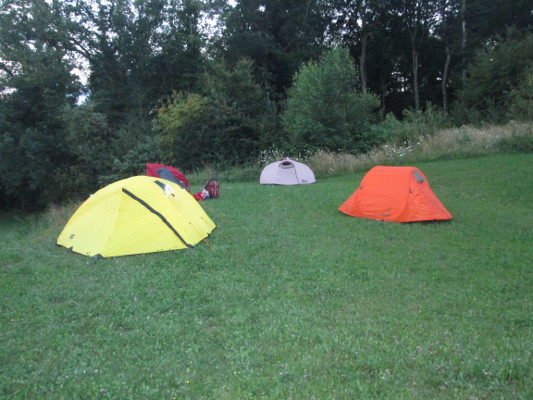
For me, DebConf13 in Switzerland was a perfect DebConf, and generally an great developer meeting and conference. I've attended several past DebConfs in Canada, Norway, Brazil, Finland, Mexico, Scotland, Spain, NYC, Bosnia, and Nicaragua. I have special memories of each. DebConf13 was ideal in every way. Let's start with the camping. Only a minority of us did it, and my campsite was located in a small field behind a bar that was often noisy late into the night, when I was trying to rest and preserve my European jetlag remedy of inverted sleeping schedule. Still, I love sleeping cocooned in a tent, and going through the routines of camping and spending time alone there was a good counterpoint to DebConf. I generally find myself retreating for a day or two in the middle of a week-long conference, burnt out with social interactions. That didn't happen this time. I need to find way to camp at future DebConfs. (Also special shout out to wonderful people who lent me a warmer sleeping bag, and bought me a pillow while on a trip to town! Upgraded my first backpacking in Europe experience's comfort level a lot!) The next perfect thing for me were the talks I gave at DebConf. I always enjoy presenting at DebConf, and barely remember when I'd get nervous doing it. But I really felt comfortable giving these talks in a way I've not before. I'm pleased with how the Debian Cosmology talk turned out; I'd worried it would be a downer talk, or too light, or not well received, and none of those problems surfaced. I was especially happy with my dh_busfactor session, which I prepared for all of 10 minutes and was structured entirely to benefit me by talking over my thoughts and getting feedback, and in which I probably drove the camerapeople crazy running my own mic into the audience. Despite all that, I think it succeeded being interesting for the participants as well as for me. Hope to follow up on it soon.. But beyond the two talks I submitted, there were a series of ad-hoc scheduled talks. It seemed that every day I spent at least an hour discussing something I'm deeply involved in. This started with the Ikiwiki bof, and then there was an epic series of (unrecorded) BoFs about git stuff, which basically turned into an unofficial git track at DebConf. Much, much discussion of git-annex and other things I'm involved in. BTW, I really like that DebConf, as well as being a formal conference on top, is really an un-conference underneath, with new BoFs and things popping up on the schedule all week long. You can even have completely unscheduled meetings that somehow get just the right mix of people to make something awesome happen.
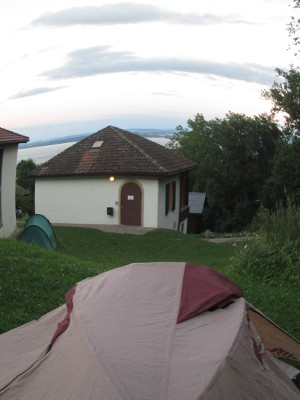
But it wasn't all about talks. Indeed, I only attended 2 or 3 sessions a day. The DebConf13 venue was controversial, but I found it excellent for getting things done. Rather than one or two massive rooms that get too noisy to think in, this venue had many little nooks and crannies suited for different types of work. There were so many I only discovered some while walking down the hill as I was leaving the venue! Anchoring it all was the excellent view, and I particularly enjoyed the "scenic hacklab". I was particularly impressed with the flexability of the venue's management. Someone asked if we could have cheese for breakfast, and every breakfast thereafter had not one but often three excellent cheeses. One day we'd be complaining that there were not enough vegetables in the food, and the next we'd be eating an excellent vegetarian Swiss lunch. They even apparently relaxed stringent Swiss rules on not allowing tents in sightlines visible from people further up the hill. They were clearly happy to welcome our crazy gathering to Le Camp. They let a DD borrow and use a chain saw and build a bonfire! The venue also encouraged getting out and exploring the surrounding countryside. Too often I end up spending the whole DebConf without seeing much of the area around. This time I at least got down the hill to see the castle in Vaumarcus a few times, and enjoyed many evening walks amoung the grape fields. The conference dinner (on a boat!) tied into this well too. And the daytrip to CERN was a great addition. We got to poke around the control center for a massive particle accellerator! My only regret is we didn't get a chance to actually go inside the LHC tunnels. Back to DebConf, another thing I really liked about this one was that its location allowed several upstream authors of software in Debian (other than the usual suspects who are both upstreams and Debian Developers) to attend. I don't know if Lennart Poettering changed any minds about systemd with his talk, but I was happy for the opportunity to buy him a beer. I didn't get to Monty's talk, but it was excellent to see him attend as well. Finally, I got to meet old friends I'd not seen in years, and new ones I've not met in real life before. We're still not sure where this whole DebConf thing is going -- will it be all about the cheese and wine party and greybeards in 20 years time? But one thing we know is we enjoy our little slice of the year where kilts and coding are equally unremarkable, where problems that seem intractable online somehow solve themselves in person, where we come away with ideas for an entire year and memories for a lifetime.

27 August 2013

Neil McGovern: Adblock adding ads to block ads

shutterstock_151488752Confused yet? The popular browser extension AdBlock for Chrome/Chromium and Safari has launched a new crowdsourced campaign - to buy up internet advertising space inviting people to download AdBlock, so they can block ads. Additionally, if they raise enough, they'd like to get additional space for a billboard at Times Square, a full page spread in the New York Times, and even a TV slot at the Superbowl (although the target for this is $4.2M, so I'm not entirely confident they'll make it.) However, this does raise an interesting question, which has been under debate for some time. How do you make money on the internet without adverts? Wikipedia has a few interesting suggestions. Firstly, affiliate programmes. These mean that any products or services that are linked or searched via the original site earn a little bit of commission for that site. Founded in the mid-90s, and most famously used by Amazon, it's a possible method for getting money. However, it should be deployed with careful thought. If a blogger or reviewer is recommending a product, is it simply because they are being paid to do so, or is it a genuine endorsement? The BBC ban this practice, and the Society of Professional Journalists also has strong guidelines on taking gifts. Interestingly, a few search engines now offer this to browsers for them sending their default search traffic to them. Secondly, you could engage in (what I consider to be) the shady practice of data monetisation. People visit a website, and they leave data about their visit. By visiting here, you've told me that you're probably interested in technology issues, what country and city you're from, and where you came from. Other programmes and sites will also be able to wrap up what other sites you've visited, and can build up quite a profile of your browsing habits. Add together a rather unscrupulous vendor, and they can also know your contact details. This metadata can then be sold on. Thirdly, you can essentially ask your readers for money. Donations, via a micropayment link (which I use) or larger donation requests. Another method is to have a membership system, where content is locked up behind a paywall. This does, however, risk making your content less valuable as people will just head elsewhere for news and opinion. To counter this, a couple of sites (LWN, Slashdot) simply delay the latest news for a little while. Alternatively, you can just ask like the fantastic C G P Grey has done. Interestingly, he also has a great video on why advertising can be a bad thing for content creators. Lastly, you can sell things. This could be your authorship services on another site as a guest post, writing a book, offering consultancy services, or simple merchandise. In summary though, which is more honest? An advert may well bend your view on what sort of content is being created, but is at least a lot more open than potentially hiding real motives behind affiliate links, and a lot more open than selling data. Asking for money is fairly straightforward, though could easily backfire if it's viewed as begging. Google's advertising income totalled $43.7 billion in 2012 - so it's quite clear that advertising is big business. Websites cost money to run, can the web survive in an ad-free environment? If so, it certainly won't be the same web as we know today.

John Goerzen: Engaged!

Today I have the delightful chance to write about a deep and wonderful joy. Yes, Laura and I are engaged! There are no words adequate for this kind of occasion, but there is a picture that gets close: I never imagined a person could find a friend so wonderful, a person that enjoys so much in common, someone that understands me and that I understand so well. And yet, here I am, engaged to that friend. Amazing only begins to describe the feeling. One of the first things Laura and I talked about was a hymn I was tinkering with, typesetting with GNU LilyPond. That hymn ends like this: Since Love is Lord of heav n and earth, how can I keep from singing? It is a wonderful thought, and very true. Even literally true; I often find myself singing, humming, or playing the penny whistle during my day. One of my good friends once told me, I am completely sure that your happiest days lie ahead of you. And he was right. I have already experienced them. This is a wonderful time, and every day brings plentiful reasons to be thankful. And as Laura and I prepare for a life together, I know that it is true not only that my friend was right, but that he is right my happiest days are yet to come, and our happiest days are yet to come, too. I have been blessed in many ways, and feel like the luckiest man alive. To be loved, and to love, a person so wonderful is truly a remarkable gift.

25 August 2013

Joey Hess: idea: git push requests

This is an idea that Keith Packard told me. It's a brilliant way to reduce GitHub's growing lockin, but I don't know how to implement it. And I almost forgot about it, until I had another annoying "how do I send you a patch with this amazing git technology?" experience and woke up with my memory refreshed. The idea is to allow anyone to git push to any anonymous git:// repository. But the objects pushed are not stored in a public part of the repository (which could be abused). Instead the receiving repository emails them off to the repository owner, in a git-am-able format. So this is like a github pull request except it can be made on any git repository, and you don't have to go look up the obfuscated contact email address and jump through git-format-patch hoops to make it. You just commit changes to your local repository, and git push to wherever you cloned from in the first place. If the push succeeds, you know your patch is on its way for review. Keith may have also wanted to store the objects in the repository in some way that a simple git command run there could apply them without the git-am bother on the receiving end. I forget. I think git-am would be good enough -- and including the actual diffs in the email would actually make this far superior to github pull request emails, which are maximally annoying by not doing so.
Hmm, I said I didn't know how to implement this, but I do know one way. Make the git-daemon run an arbitrary script when receiving a push request. A daemon.pushscript config setting could enable this. The script could be something like this:
#!/bin/sh
set -e
tmprepo="$(mktemp -d)"
# this shared clone is *really* fast even for huge repositories, and uses
# only a few 100 kb of disk space!
git clone --shared --bare "$GIT_DIR" "$tmprepo"
git-receive-pack "$tmprepo"
# XXX add email sending code here.
rm -rf "$tmprepo"
Of course, this functionality could be built into the git-daemon too. I suspect a script hook and an example script in contrib/ might be an easier patch to get accepted into git though. That may be as far as I take this idea, at least for now..

Matthias Klumpp: Some Tanglu updates

Tanglu Logo (big)Long time since I published the last update about Tanglu. So here is a short summary about what we did meanwhile (even if you don t hear that much, there is lots of stuff going on!) Better QA in the archive We now use a modified version of Debian s Britney tool to migrate packages from the newly-created staging suite to our current development branch aequorea . This ensures that all packages are completely built on all architectures and don t break other packages. New uploads and syncs/merges now happen through the staging area and can be tested there as well as being blocked on demand, so our current aequorea development branch stays installable and usable for development. People who want the *very* latest stuff, can embed the staging-sources into their sources.list (but we don t encourage you to do that). Improved syncs from Debian The Synchrotron toolset we use to sync packages with Debian recently gained the ability to sync packages using regular expressions. This makes it possible to sync many packages quickly which match a pattern. Tons of infrastructure bugfixes The infrastructure has been tweaked a lot to remove quirks, and it now works quite smoothly. Also, all Debian tools now work flawless in the Tanglu environment. A few issues are remaining, but nothing really important is affected anymore (and some problems are merely cosmetic). Long term we plan to replace the Jenkins build-infrastructure with the software which is running Paul Tagliamontes debuild.me (only the buildd service, the archive will still be managed by dak). This requires lots of work, but will result in software not only usable by Tanglu, but also by Debian itself and everyone who wants a build-service capable of building a Debian-distro. KDE 4.10 and GNOME 3.8 Tanglu now offers KDE 4.10 by default, a sync of GNOME 3.8 is currently in progress. The packages will be updated depending on our resources and otherwise just be synced from Debian unstable/experimental (and made working for Tanglu). systemd 204 & libudev1 Tanglu now offers systemd 204 as default init system, and we transitioned the whole distribution to the latest version of udev. This even highlighted a few issues which could be fixed before the latest systemd reached Debian experimental. The udev transition went nicely, and hopefully Debian will fix bug#717418 too, soon, so both distributions run with the same udev version (which obviously makes things easier for Tanglu ^^) Artwork We now have a plymouth-bootscreen and wallpapers and stuff is in progress :-) Alpha-release & Live-CD ? This is what we are working on we have some issues in creating a working live-cd, since live-build does have some issues with our stack. We are currently resolving issues, but because of the lack of manpower, this is progressing slowly (all contributors also work on other FLOSS projects and of course also have their work :P ) As soon as we have working live-media, we can do a first alpha release and offer installation media. You! Tanglu is a large task. And we need every help we can get, right now especially technical help from people who can build packages (Debian Developers/Maintainers, Ubuntu developers, etc.) We especially need someone to take care of the live-cd. But also the website needs some help, and we need more artwork or improved artwork ;-) In general, if you have an idea how to make Tanglu better (of course, something which matches it s goals :P ) and want to realize it, just come back to us! You can reach us on the mailiglists (tanglu-project for stuff related to the project, tanglu-devel for development of the distro) or in #tanglu / #tanglu-devel (on Freenode).

20 August 2013

Erich Schubert: Google turning evil

I used to be a fan of the Google company. I used to think of this as a future career opportunity, as I've received a number of invitations to apply for a job with them.
But I am no longer a fan.
Recently, the company has in my opinion turned to the "evil" side; they probably became worse than Microsoft ever was and the "do no evil" principle is long gone.
So what has changed? In my perception, Google:
  • Is much more focused on making money now, than making technology happen.
  • Instead of making cool technology, it tries more and more to be a "hipster" thing and following the classic old 80-20 rule: get 80% of the users with 20% of the effort. Think of the GMail changes that received so much hate and the various services it shuts down (Code search, Reader, Googlecode downloads) and how much Google is becoming a walled garden.
  • Google leverages its search market dominance as well as Android to push their products that don't perform as good as desired. Plus for example. There is a lot of things I like about plus. In particular when you use it as a "blog" type of conversation tool instead of a site for sharing your private data, then it's much better than Facebook because of the search function and communities. (And I definitely wouldn't cry if a Facebook successor emerges). But what I hate is how Google tries hard to leverage their Android and YouTube power to force people to Plus. And now they are spreading even further, into TV (ChromeCast) and ISP (Google Fiber) markets.
  • Hangups, oops, Hangouts is another such example. I've been using XMPP for a long time. At some point, Google started operating an XMPP server, and it would actually "federate" with other servers, and it worked quite nicely. But at some point they decided they need to have more "hipster" features, like ponies. Or more likely, they decided that they want all these users to use Plus. So now they are moving it away from an open standard towards a walled garden. But since 90% of my use is XMPP outside of Google, I will instead just move away from them. Worse.
  • Reader. They probably shut this down to support Currents and on the long run move people over to Plus, too. Fortunately here, there now exist a number of good alternatives such as Feedly. But again: Google failed my needs.
  • Maps. Again an example where they moved from "works good" to "hipster crap". The first thing the new maps always greets me with is a gray screen. The new 3D view looks like an earthquake happened, without offering any actual benefit over the classic (and fast) satellite imagery. Worse. In fact my favorite map service right now is an OpenStreetmap offline map.
  • Google Glass is pure hipsterdom crap. I have yet to see an actual use case for it. People use it to show off, and that's about it. If you are serious about photos, you use a DSLR camera with a large objective and sensor. But face it: it's just distraction. If you want productive, it's actually best to turn of all chat and email and focus. Best productivity tip ever: Turn off email notifications. And turn of chat, always-on and Glass, too.
  • Privacy. When privacy-aware US providers actually recommend against anyone trusting their private data to a company with physical ties to the United States, then maybe it's time to look out for services in countries that value freedom higher than spying. I cannot trust Google on keeping my data private.
We are living in worrisome times. The U.S.A., once proud defenders of freedom, have become the most systematic spies in the world, even on their own people. The surveillance in the Eastern Bloc is no match for this machinery built the last decade. Say hello to Nineteen Eighty-Four. Surveillance, in a mixture of multi-state and commercial surveillance has indeed become omnipresent. Wireless sensors in trash cans track your device MACs. Your email is automatically scanned both by the NSA and Google. Your social friendships are tracked by Facebook and your iPhone.
I'm not being paranoid. These things are real, and it can only be explained with a "brainwashing" with both the constantly raised fear of terror (note that you are much more likely to be killed in a traffic accident or by a random gun crazy in the U.S.A. than by terrorists) and the constant advertisement for useless technology such as Google Glass. Why have so many people stopped fighting for their freedom?
So what now? I will look into options to move away stuff from Google (that is mostly, my email -- although I'd really like to see a successor to email finally emerge). Maybe I can find a number of good services located e.g. in Switzerland or Norway (who still seem to hold freedom in high respect - neither the UK nor Germany are an alternative these days). And I hope that some politicians will have the courage to openly discuss whether it may be necessary to break up Google into "Boogles" (Baby-Googles), just as Reagan did with AT&T. But unfortunately, todays politicians are really bad at such decisions, in particular when it might lower their short-run popularity. They are only good at making excuses.

19 August 2013

Gunnar Wolf: After Debian's 20th birthday, everybody's life gets back to normality...

As I slowly read my good friends wishing each other a good trip, telling they got home safely, and the IRC channels form thick drops of a bitter-sweet etheral substance, I cannot help feeling DebConf13 is over For me as well, from the distance. Many friends gave me warm greetings, and without being there, gave me that beautiful feeling of real community that Debian has given me for ten years already, since I met in real-life many of its developers at DebConf3 in Oslo. And yes, I have stated this far too many times I have attended every DebConf since (and worked organizing most of them). This year, over 300 people were gathered in Switzerland to enjoy the always most intense weeks of the year. This year, I was unable to attend due to calendar clashes. Even so, without the stress that organizers have, and thanks to the great work of the always-loved Video Team, I think I was able to be present at more sessions than at in any of the last few years. Oh, and for the readers of this blog who were not there Do you want to follow what was presented? You can download already the videos for all of the recorded presentations (that were, due to the planned coverage and the manageable size of the Video Team, about of the total scheduled sessions). And, as always, I was able to follow many very interesting talks and take part of a couple interesting meetings/BoF sessions. I still have a bit of catchup, partly due to the timezone difference (I was only at one of the sessions during the Swiss morning, at 02:30 local time, the pkg-ruby-extras team BoF). Anyway... Not being there, I surely was an avid consumer of the photos posted in the DebConf13 gallery, and will surely follow it for some more time as some of you upload your pending material. It was clear from the beginning that, no matter what your definition of consensus is, the chosen venue was beautiful. A beautiful place between the lake and the mountains where our sportiest guys had a very good share of morning runs, cycling sessions, competition sports of different types, outright plain fun for attendees of all sizes and all species... But, hey, wait! During a chat in the course of DebConf, a friend told me a bit worried that all this beauty and fun might make our dear and very important sponsors they are paying for a geek vacation, is it so? No, not at all. Not by a long stretch. And just looking at those same galleries makes it clear and obvious. After all, it's widely known that Debian is the operating system for the gurus. Simple: It's impossible to have all those geeks without getting amazing work done, in ways that even seem clich s (this last photo had Joey Hess explaining dpkg format version 3.0 (git) ideas, sketched after waking up at 3AM on the first sketching surface available to him). After all, Debian people are famous for their inclination to use any excuse to open their computers and hack away. We can find Debianers hacking in small spaces and also hacking out in the fields. But this time, people were able to hack indoors while enjoying the nature and hack outdoors under a tree. And, yes, one of the things that makes organizing DebConf worth it is, after eleven months having low-bandwidth meetings over IRC, having the opportunity to plan for the next days face to face, in a relaxed but work-full environment. Anyway, here at home I didn't sit idly just longing over them. How could I? We are just celebrating the Debian Project's 20th anniversary! http://gwolf.org/content/jonathan-host-and-organizer-rancho-electr-nico">Jonathan, a Debian enthusiast, student at my university, and collaborator for several free software-related collectives in Mexico City, invited me to the celebration at Rancho Electr nico (which I recently mentioned in this same blog). While I was unable to stay for the whole celebration, we had a very good time; I talked about some ways on how to contribute to Debian. Although I didn't have much of a presentation prepared for it, I feel it was successful and interesting for the attendees I just hope to start seeing some of them get into any of the ways for helping Debian soon. I also stayed as a listener and ocassional commenter for a talk on the Debian Project's history and goals, and to a presentation on a nifty electronic music programming tool called Supercollider (of course, available in Debian). Now, "regular" life should continue. For some value of "regular".

16 August 2013

Joey Hess: Debian at 20

RichiH used flint and steel to light the bonfire. We carefully fed it up from those sparks to a blaze. Put on the biggest logs we could find to make it last. Now I'm sitting on the hill above it watching folks gathered around. A poem is being read, in Hindi, then translated for us to English. Others have shared songs and poems in a dozen languages, both classics and their own. Out below the darkness of the lake. This is Debian at 20. At the start of this DebConf, I gave a talk on "Debian Cosmology. In that (and a later "dh_busfactor" talk) I shared my hopes and my fears. I was conflicted about giving the this talk, worked on it for weeks, felt it might not work, or be depressing. I've had nothing but good comments about it. 20 years is ages in internet time and technical projects ossify over time. The last session I was in this afternoon was a presentation of a new tool, which I hope & feel has the potential to fundamentally change an important and suboptimal part of Debian. Then I walked outside to a rainbow over crystal clear Swiss alps on the horizon. How encouraging, and what a nice story that will be around some future campfire.

Richard Hartmann: Release Critical Bug report for Week 33

One more for DebConf. The UDD bugs interface currently knows about the following release critical bugs: How do we compare to the Squeeze release cycle?
Week Squeeze Wheezy Diff
43 284 (213+71) 468 (332+136) +184 (+119/+65)
44 261 (201+60) 408 (265+143) +147 (+64/+83)
45 261 (205+56) 425 (291+134) +164 (+86/+78)
46 271 (200+71) 401 (258+143) +130 (+58/+72)
47 283 (209+74) 366 (221+145) +83 (+12/+71)
48 256 (177+79) 378 (230+148) +122 (+53/+69)
49 256 (180+76) 360 (216+155) +104 (+36/+79)
50 204 (148+56) 339 (195+144) +135 (+47/+90)
51 178 (124+54) 323 (190+133) +145 (+66/+79)
52 115 (78+37) 289 (190+99) +174 (+112/+62)
1 93 (60+33) 287 (171+116) +194 (+111/+83)
2 82 (46+36) 271 (162+109) +189 (+116/+73)
3 25 (15+10) 249 (165+84) +224 (+150/+74)
4 14 (8+6) 244 (176+68) +230 (+168/+62)
5 2 (0+2) 224 (132+92) +222 (+132/+90)
6 release! 212 (129+83) +212 (+129/+83)
7 release+1 194 (128+66) +194 (+128/+66)
8 release+2 206 (144+62) +206 (+144/+62)
9 release+3 174 (105+69) +174 (+105/+69)
10 release+4 120 (72+48) +120 (+72/+48)
11 release+5 115 (74+41) +115 (+74/+41)
12 release+6 93 (47+46) +93 (+47/+46)
13 release+7 50 (24+26) +50 (+24/+26)
14 release+8 51 (32+19) +51 (+32/+19)
15 release+9 39 (32+7) +39 (+32/+7)
16 release+10 20 (12+8) +20 (+12/+8)
17 release+11 24 (19+5) +24 (+19/+5)
18 release+12 2 (2+0) +2 (+2/+0)
Graphical overview of bug stats thanks to azhag:

15 August 2013

Daniel Leidert: HP N54L Microserver - energy efficiency and power management

I recently worked on activating power management functions, reduce energy consumption and noise of my little HP N54L "toy". During this process I tried to avoid the usage of /etc/rc.local and set things by udev, hdparm and friends. Below are my results. Actual resultsWith the following steps my system (N54L + 3xWD20EFRX HDD +1xWD5003AZEX HDD + LCD-mod + case fan mod + Debian Wheezy) uses 27W in idle mode. The USB W-LAN card uses another 10W. In active mode, e.g. compiling source code, the system runs (and boots) with around 57W. The highest power consumption observed is during startup phase with 88W. First things firstFor the following steps it might be necessary to have some packages installed, that maybe do not occur in this post. If I missed something, I appreciate a hint. Further the following steps might produce even better results with a custom kernel. I'm using the stock linux-image-3.2.0-4-amd64 kernel image as the time of writing and I have these packages installed: amd64-microcode, firmware-linux, firmware-linux-free, firmware-linux-nonfree and firmware-atheros (the latter for my WLAN card). ASPM and ACPIFirst I enabled PCIE ASPM in my (non-modded) BIOS and forced it together with ACPI via grub by changing GRUB_CMDLINE_LINUX_DEFAULT in /etc/default/grub so it looks like this:

GRUB_CMDLINE_LINUX_DEFAULT="quiet splash acpi=force pcie_aspm=force nmi_watchdog=0"
ASPM has now been enabled as lspci prooves:

00:04.0 PCI bridge: Advanced Micro Devices, Inc. [AMD] RS780/RS880 PCI to PCI bridge (PCIE port 0) (prog-if 00 [Normal decode])
[..]
LnkCap: Port #1, Speed 5GT/s, Width x1, ASPM L0s L1, Latency L0 <64ns, L1 <1us
ClockPM- Surprise- LLActRep+ BwNot+
LnkCtl: ASPM L0s L1 Enabled; RCB 64 bytes Disabled- Retrain- CommClk+
ExtSynch- ClockPM- AutWidDis- BWInt- AutBWInt-
[..]
00:06.0 PCI bridge: Advanced Micro Devices, Inc. [AMD] RS780 PCI to PCI bridge (PCIE port 2) (prog-if 00 [Normal decode])
[..]
LnkCap: Port #3, Speed 5GT/s, Width x1, ASPM L0s L1, Latency L0 <64ns, L1 <1us
ClockPM- Surprise- LLActRep+ BwNot+
LnkCtl: ASPM L0s L1 Enabled; RCB 64 bytes Disabled- Retrain- CommClk+
ExtSynch- ClockPM- AutWidDis- BWInt- AutBWInt-
02:00.0 USB controller: Renesas Technology Corp. uPD720201 USB 3.0 Host Controller (rev 03) (prog-if 30 [XHCI])
[..]
LnkCap: Port #0, Speed 5GT/s, Width x1, ASPM L0s L1, Latency L0 <4us, L1 unlimited
ClockPM+ Surprise- LLActRep- BwNot-
LnkCtl: ASPM L0s L1 Enabled; RCB 64 bytes Disabled- Retrain- CommClk+
ExtSynch- ClockPM- AutWidDis- BWInt- AutBWInt-
[..]
03:00.0 Ethernet controller: Broadcom Corporation NetXtreme BCM5723 Gigabit Ethernet PCIe (rev 10)
[..]
LnkCap: Port #0, Speed 2.5GT/s, Width x1, ASPM L0s L1, Latency L0 <1us, L1 <64us
ClockPM+ Surprise- LLActRep- BwNot-
LnkCtl: ASPM L0s L1 Enabled; RCB 64 bytes Disabled- Retrain- CommClk+
ExtSynch- ClockPM- AutWidDis- BWInt- AutBWInt-
[..]
Even so /sys/module/pcie_aspm/parameters/policy will still show as below:

[default] performance powersave
I'll show how to set the powersave value in /sys/module/pcie_aspm/parameters/policy in the next section.JFTR: These are my ACPI related packages installed: acpi, acpid, acpi-support and acpi-support-base. Enable powersaving via UDEVThe following rules file /etc/udev/rules.d/90-local-n54l.rules has been inspired by a blog post. It enables powersaving modes for all PCI, SCSI and USB devices and ASPM. Further the internal RADEON cards power profile is set to the low value. There is no monitor connected usually. The file contains these rules:

SUBSYSTEM=="module", KERNEL=="pcie_aspm", ACTION=="add", TEST=="parameters/policy", ATTR parameters/policy ="powersave"

SUBSYSTEM=="i2c", ACTION=="add", TEST=="power/control", ATTR power/control ="auto"
SUBSYSTEM=="pci", ACTION=="add", TEST=="power/control", ATTR power/control ="auto"
SUBSYSTEM=="usb", ACTION=="add", TEST=="power/control", ATTR power/control ="auto"
SUBSYSTEM=="usb", ACTION=="add", TEST=="power/autosuspend", ATTR power/autosuspend ="2"
SUBSYSTEM=="scsi", ACTION=="add", TEST=="power/control", ATTR power/control ="auto"
SUBSYSTEM=="spi", ACTION=="add", TEST=="power/control", ATTR power/control ="auto"

SUBSYSTEM=="drm", KERNEL=="card*", ACTION=="add", DRIVERS=="radeon", TEST=="power/control", TEST=="device/power_method", ATTR device/power_method ="profile", ATTR device/power_profile ="low"

SUBSYSTEM=="scsi_host", KERNEL=="host*", ACTION=="add", TEST=="link_power_management_policy", ATTR link_power_management_policy ="min_power"
Set harddrives spindown timeoutI decided to sent my system drive to standby after 20 minutes and the RAID drives after 15 minutes. This is usually ok, because the RAID isn't always used. hdparm is the right tool to realize this. Many people use the /dev/disk/by-uuid/... syntax here, to avoid having to touch the configuration file if some system configuration changes. Because I'm running a RAID, I couldn't use this syntax, although it might be possible to use /dev/disk/by-id/... instead. Well for the moment I stay with the configuration below. The relevant part of /etc/hdparm.conf is:

[..]

# system harddrive
/dev/sda
spindown_time = 240


# below are the WD20EFRX drives
/dev/sdb
spindown_time = 180


/dev/sdc
spindown_time = 180


/dev/sdd
spindown_time = 180

Idle modeWhen there is nothing to do for the system, all I hear is the (still a bit noisy) fan of the power supply, which I might replace in the future too. Either by testing a different fan or by replacing the whole power supply unit by the fanless FORTRON FSP150-50TNF or (even better) a picoPSU.The system currently shows a power consumption of around 37W in idle mode whereas the USB W-LAN card itself needs around 10W. There is a possibility to enable power savings mode for this card too. I could add this entry to /etc/udev/rules.d/90-local-n54l.rules:

SUBSYSTEM=="net", ACTION=="add", KERNEL=="wlan*" RUN+="/usr/bin/iw dev %k set power_save on"
But it turned out that the connection became a bit unstable after it. So I don't use this rule. More on the roadThere are a lot more options one can easily find via $search_engine. The N54L system could be brought to sleep and woken up by LAN via Wake-on-LAN (WOL). This is a feature I don't use. I've also read rumors about enabling different sleep/suspend states of the system, which seems to require to install a modded BIOS. Well, I'll post news and changes if they happen to come;)

10 August 2013

Rudy Godoy: Bulding non-service cartridges for RedHat Openshift

Cloud is passing the hype curve and we are seeing more stable developments and offerings on the market. Lately I ve been playing with RedHat s Openshift. Openshift is a PaaS (Platform as a Service) offering that intends to be an alternative for vendors such as Heroku. The focus for such offerings is to give developers enough flexibility and tools that handle the application deployment and maintenance process in a way that is integrated with their existing development workflow and tools. I ve been using Heroku for a while to deploy small to medium size projects. I liked the tools and developer-centered experience they offer. Openshift is quite new on the market and it comes in two flavors: Openshift Online, which is a PaaS service, and Openshift Enterprise, which allows organization to setup a PaaS within their own infrastructure. Both of them powered by the Openshift origin software. I ll not compare Heroku vs. Openshift feature by feature but from my experience I can tell that Openshift is far from mature and will need to give developers more features to increase adoption. When developing applications for Openshift developers are given a set of application stack components, similar to Heroku s buildpacks. They call them cartridges. You can think of them as operating system packages, since the idea is the same: have a particular application stack component ready to be used by application developers. Most of the cartridges offered by the service are base components such as application server, programming language interpreters (Ruby, Python, etc), web development frameworks and data storage, such as relational and non-relational databases. Cartridges are installed inside a gear, which is a sort of application container (I believe it uses LXC internally). Unsurprisingly this Openshift component doesn t leverage on existing packaging for RHEL 64bit, the OS that powers the service. I d expect such things from the RedHat ecosystem. I had to develop a cartridge to have a particular BI engine to be used as embed component by application developers. After reading docs and reference I realized this can be piece of cake, since I have packaging experience. Wrong. Well, quite so. The tricky part for Openshift Online is that it does not offer enough information on the cartridge install process so you can see what s going wrong. To be able to see more details on the process you ll need to setup an Openshift origin server and use it as a testing facility. Turns out that having a Origin server to operate correctly is also a challenging task and consumed a lot of my time. Over the recent weeks I ve learned from origin developers that such features are on the road map for the upcoming releases. That s good news. One of the challenges I had, and still have to figure out, is that unlike the normal cartridges mine didn t required to launch any service. Since it is a BI engine I just needed to configure and deploy to an application server such as JBoss. Cartridge format requires to have a sort of service init.d script under bin along with setup, install and configuration scripts that are ran on install. Although every day I become more familiar with origin and Openshift internals I still have work to do. Nice thing is that I was already familiar with LXC and Ruby-based applications so I could figure where things are placed and where to look for errors on origin quite easily. The cartridges are on my github account if you care to take a look and offer advice.

9 August 2013

Richard Hartmann: Release Critical Bug report for Week 32

As a more or less random data point for DebConf13, here's the current bug stats for Debian. Hope to see you there, and if you want to attend the BoF Gitify ALL the things or the talk Gitify your life you can do so on site, via IRC in #vcs-home on OFTC, or simply follow the live streams. If you see my in person, I have two crates of Scheider Aventinus with me and don't plan on bringing home any full bottles. The UDD bugs interface currently knows about the following release critical bugs: Graphical overview of bug stats thanks to azhag:

8 August 2013

Craig Small: postfix transport with smarthost

Dear lazyyweb, Has anyone got a way for postfix to use a transport map such that it sends email to the given MX host for some specified domains then default to a smarthost for the remainder? The logic would be: IF domain in ( example.net , foo.bar ,etc etc) THEN use the relevant MX host ELSE send to smarthost.isp.net i can use a transport map to send from specific domains to specific hosts, eg @domain.com goes to otherisp.net mailserver but not to just use domain.com s MX hosts

6 August 2013

Ian Wienand: Running cloud images locally

Fedora and Ubuntu both provide compact cloud images that are useful for spinning up small VM's quickly (much quicker than installing from a huge ISO or even net-install). Both these pages have single-click buttons to simply launch the VM's at Amazon, which is very cool. However, you may have reason to use them "offline" with a local KVM (outside of EC2 or OpenStack) for testing, or on a plane, etc. I didn't find a lot of information on this (although it is all available once you know what you're looking for). So here's my quick guide for the complete newbie. Firstly, download your image of choice and put it in /var/lib/libvirt/images. Open up virt-manager and you can create your new VM via "import existing image". You can try booting it, but the problem you'll hit is the images have no default password or way to log-in because, very sensibly, you're expected to inject that. Booting you'll see cloud-init attempting to contact 169.254.169.254 to collect the meta-data to initalize the VM; eventually it will time out and you're left at a login prompt you can't log in at. cloud-init does many things and is very flexible with lots of different plugins to initialise images in various ways. The particular one we're interested in is the No cloud plugin. This will look for data from a locally attached CD drive, which works very easily for this scenario. Now that you know that's what you're looking for, the instructions are fairly clear; I'll repeat them just for clarity. Firstly you want to create a minimal meta-data file that has a host-name and an instance-id:
$ cat meta-data
instance-id: iid-local01;
local-hostname: myhost;
Modifying the instance-id will signal to cloud-init that it should run again because something changed. This is also where you can put static IP address data; see the documentation. Secondly, create a user-data file that has the commands to enable password login; set a password, and inject your ssh public key so you can easily log-in:
$ cat user-data
#cloud-config
password: mypassword
ssh_pwauth: True
chpasswd:   expire: False  
ssh_authorized_keys:
  - ssh-rsa ... foo@foo.com (insert ~/.ssh/id_rsa.pub here)
Note for new players: that #cloud-config isn't an optional comment, it's a directive. If you leave it out, you'll probably see a little something about Unhandled non-multipart userdata starting... and your changes won't apply. Insert those two into files into an iso:
$ genisoimage -output init.iso -volid cidata -joliet -rock user-data meta-data
Then copy init.iso into /var/lib/libvirtd/images as well, and connect that as a virtual-cd drive to your virtual-machine created from the image. When you boot you should see some output as it injects your key. It should get an address via DHCP and then you should be able to log-in with fedora or ubuntu users. Then you can start getting more complicated with things like static addresses, package installations, running commands, etc by reading the documentation.

2 August 2013

Joey Hess: DIY crowdfunding and bitcoin

Well, my git-annex crowdfunding campaign is half way to its August 15th conclusion. So far it's raised more than five times what I hoped it would. I wish I could say I'm like some canny NASA engineer who intentionally sets low expectations for their Mars rover, but in both the previous kickstarter and this campaign I've really had no idea how far it'd go. I'm glad that I'll be working on git-annex for another year. I was particularly unsure if it'd be successful to move off Kickstarter. During the git-annex assistant Kickstarter campaign, I saw many small contributions from people who learned of it due to it being a successfully funded project, a staff pick, etc. Losing that easy network effect is a gamble. So far I've had only half the number of contributors that I got on Kickstarter. I've basically missed out entirely on the $5 level casual contributors. On the other hand, my backers have generally been more generous (and some have been exceedingly generous). And I've avoided rewards that will cost much money, so I may end up in the same ballpark funding level in the end! Incidentially, I'm really enjoying getting in touch to let people know when I make their sponsored commits. There's still time to sponsor one of your own ;) Bitcoin I also was curious to experiment with Bitcoin in this campaign. Partly because Paypal isn't available everywhere internationally, and takes really obnoxious percentages of transactions (though probably not as bad as Kickstarter taking its percentage followed by Amazon payments taking its percentage..) and partly because there seem to be interesting possibilities for supporting free software with Bitcoin. (Especially if any of the microtransactions on top of Bitcoin take off.) So far 5% of backers have used Bitcoin. It's been quite strange to actually have significant amounts of bitcoins in my wallet. Wordpress has had 94 bitcoin payments over 9 months since starting accepting them. I've had 47 payments in the two weeks my campaign has run so far. Wow! Most of the bitcoin payments have come in via Coinbase (a few people have found my direct payment address), but of those very few were using bitcoin purchased on Coinbase. Most are probably transfers of bitcoin they already had, or perhaps bitcoin purchased on other sites. The one technical issue I've had with using bitcoin is that Coinbase has not provided details about who sent most of the donations. Probably some of them are intentionally anonymous, but I suspect Coinbase's interface to claim incoming bitcoin transactions failed for some of them. (If you donated bitcoin and want to actually get a reward, please email me.) By the way, I'm converting most of the bitcoins back to USD pretty quickly. I'm not interested in speculating on currency exchange rates with money that has been donated so I can accomplish a particular task.. DIY I put up the campaign website without any means in place to handle updating it. This is because I never automate anything until I've done it at least 10 times by hand. ;) After the first trickle of donations became a flood, I quickly realized I needed at least something to handle keeping the numbers straight. What I whipped up in an hour of coding is a system where I enter incoming payments into a hledger file and a small haskell program parses that and writes out various files that are included into the website. Amusingly the percentage calculation and display code was copied from git-annex, so part of git-annex is helping run its own fundraising campaign. The campaign video is itself hosted in a public git-annex repository, come to think of it. The rest of the site is built using ikiwiki. Given that it's hosted at Branchable, this is a high level of dogfooding and DIY. There are certianly better crowdfunding platforms, but all I miss in this one is automated transaction entry. And I have total flexability, double entry accounting, and a powerful static website generator that handled being on the top of Hacker News without a sweat. Oh, and some money. What's not to like?

Next.

Previous.