Search Results: "ah"

16 October 2012

Patrick Matth i: Package updates from the middle of october

glusterfs 3.3.1 has been released with a bunch of bugfixes, yeah! 3.3.1-1 is uploaded to experimental. geoip-database As usual the monthly database update, already migrated to Wheezy from Sid. otrs2 Today 3.1.11 has been released with a few bugfixes and one security fix for a XSS vulnerability on viewing special prepared HTML e-mails, which leads to that the browser executes JavaScript code (as described in CVE-2012-4751 and OTRS security announcement OSA-2012-03).
otrs2 3.1.11+dfsg1-1 is just accepted in experimental and I also backported the patch to the Wheezy version with 3.1.7+dfsg1-6.

15 October 2012

Eddy Petrișor: HOWTO: sudo + cowbuilder (+git-buildpackage)

In case you tried to use git-buildpackage and wanted to use cowbuilder as a builder, you might have ran into the error

sudo: sorry, you are not allowed to preserve the environment

This is due to a change in sudo default configuration in version 1.7.4p4-2 (I know, is true since 2010) which doesn't allow the execution of commands via sudo using the parameter '-E' which means 'setenv'.

The news item even explicitly states pbuilder can be affected by this because it wants to port over to the pbuilder environment the HOME environment variable and suggests using

Defaults env_keep += HOME

But adding such a line to your /etc/sudoers.d/01_pbuilders file (/etc/sudoers is recommended to be touched only by the package) will do the same for all commands and users ran via sudo, which is, according to my preferences, too permissive.

The irony is that running git-buildpackage --git-pbuilder will invoke sudo -E cowbuilder so the env_keep suggested fix will not work because for -E to be allowed, setenv needs to be set in sudoers. This would defeat the purpose of env_reset, if done for all commands, but we can do a better job if we allow this kind of change only for the cowbuilder and pbuilder commands. You do have different commands that are allowed explicitly stated, don't you?

On my system I have made a group especially for people allowed to do packaging work, the group is called 'pack'. The only account in that group is my own.

Also, I have defined a command alias named PBUILDERS which looks something like this:

Cmnd_Alias PBUILDERS = /usr/sbin/pbuilder, /usr/sbin/cowbuilder

Running PBUILDERS is already restricted to the pack group. Here is an example that requires password on run:

%pack ALL=PBUILDERS

So all that needs to be done is to allow setenv for the PBUILDERS commands. Reading through the sudoers manpage and after some trial and error (use visudo for editting sudoers files - visudo -f /etc/sudoers.d/01_pbuilders) I found out that the symbols that distinguish between commands, users and groups in a 'Defaults' line needs to be right next to the 'Defaults' word. For command the sign is an exclamation sign '!' (for user lists it's ':') so since we want to link the exception to the command, not the user list, we'll use 'Defaults!':

Defaults! PBUILDERS setenv

Assuming you also have a PBUILDERS commands alias, this is what you need to be able to use git-buildpackage in conjunction with cowbuilder and sudo.

If there is a non-intrusive way to prevent sudo to use -E when invoking cowbuilder, please add your comment, I would be interested to know it.

14 October 2012

Diego Escalante Urrelo: Enabling SATA AHCI on a Linux Macbook3,1

I have a Macbook3,1 with the following SATA controller: 00:1f.2 SATA controller: Intel Corporation 82801HM/HEM (ICH8M/ICH8M-E) SATA Controller [AHCI mode] (rev 03) This chip can work either in AHCI or IDE mode. Even though (in numbers) AHCI and IDE should have similar performance, I have found that AHCI mode is much better. Specially when the disk is under heavy siege by more than one application. The catch is that Macbooks turn off AHCI when booting in BIOS mode, which is the mode I use for GNU/Linux. I understand this also affects Windows.

Pictured: a girl after enabling AHCI on her Linux Macbook After some googling I found this post that explains how to activate AHCI mode using GRUB2. The fix is to just add a setpci call on your GRUB configuration. To be safe you can test it by going into command line mode in GRUB, and doing something like this: > lspci
(check for the ID for IDE mode, in my case 8086:2828)
> setpci -d 8086:2828 90.b=40
> lspci
(The 2828 ID is now gone, replaced by 8086:2829, AHCI/SATA mode)
You can add this to your GRUB configuration, and avoid losing it on upgrades, by adding a script like this to /etc/grub.d/:

#!/bin/sh
set -e
## Enable SATA (AHCI) mode on macbook 3,1
echo "setpci -d 8086:2828 90.b=40"
I understand this is also relevant for newer Macbooks and standard PC hardware, so you might want to do some googling. The easy way to know if you are on the right mode is to run lspci -nn on a regular terminal (not GRUB) and see if you have a SATA controller that is in the wrong mode.

Arnaud Quette: Cryptography: SSL support using Mozilla NSS landed in NUT

this week, a new feature was merged into the NUT development tree: beside of the historical OpenSSL support (for more than 10 years), NUT now also provides SSL features using Mozilla NSS. I've already posted a lengthy mail on the NUT developers list. But there are still a few things to be told:
  • for legal reasons, I won't detail, NUT (GPL v2+), can't be linked on OpenSSL without exiting from the 'main' Debian repository. Thus, NUT packages in Debian (and derivatives) don't provide NUT crypto features!
  • to me, NSS has some advantages, compared to OpenSSL. Among these, NSS is distributed under 3 licenses, including GPL. So it will fix the situation for NUT in Debian! But there will be more things to come with NSS, such as client authentication, and more security for infrastructure power management.
  • other distros (mainly Redhat and Suse) have attempted (and are still attempting) to consolidate crypto features, using NSS. Debian has not taken any decision on this topic though. NUT now offers the choice between OpenSSL and Mozilla NSS.
  • NSS support will be officially available with NUT 2.8.0. There is currently no release date since we're committed to a features set, not a release date. Some would say Debian old school. Everything would be different with more manpower, as everywhere else in our Free land...
For the braves who want to test, here is a small procedure, adapted to Debian. We will use an existing installation, and overwrite upsd, upsmon, libupsclient and few more. Beware that it will obviously breaks the MD5 sums of your nut packages!
  • install NUT, if it's not already done:
# apt-get install nut
  • download the source snapshot, and uncompress it:
$ tar xzvf nut-trunk-r3751.tar.gz
  • install NSS development files:
# apt-get install libnss3-dev 
  • change to NUT source directory and configure it using --with-nss, to force using NSS. For Debian, the following flags are needed:
./configure --without-all --with-nss \
        --prefix=/ --sysconfdir=/etc/nut  \
        --with-statepath=/var/run/nut \
        --with-altpidpath=/var/run/nut \
        --with-drvpath=/lib/nut \
        --with-pidpath=/var/run/nut \
        --datadir=/usr/share/nut \
        --with-pkgconfig-dir=/usr/lib/pkgconfig \
        --with-user=nut --with-group=nut
  • now compile and install:
$ make && make install
  • refer to the documentation, NSS backend usage chapter, for detailed configuration and usage instructions.
  • Enjoy ;-)
Before concluding, here is the traditional thank you guys:
  • Emilien Kia, who developed the NSS support in NUT,
  • Fr d ric Boh , for the validation testing,
  • Charles Lepple, for handling the merge from github to our Alioth Subversion repository,
  • and Eaton for sponsoring this development.
As a conclusion, cryptography integration and usability is still not on par with other proprietary OS. I would love to see the crypto situation improving in Debian (and friends obviously). So this was just my 2 cents (nuts ;-)) to the cause... cheers,
-- Arno

13 October 2012

Vasudev Kamath: Weekly Log - 06/13-102012

Update for 06/10/2012 Well I had not written the weekly work log for the last week that is because the week was short (oh yeah thanks to all these bandhs our week got fluctuated and to be frank the week was only 4 days long) and second was my lazyness. Here goes the update * After a long discussion with Aravinda on "why productivity is reducing these days." We concluded the social network is eating up most of time. So decision was made and I closed all pinned tabs for Twitter Gmail Identi.ca and Friendica on my browser * After the above resolution I finished almost 4 chapters of Moder Perl within 2 hours!. Indeed Social networks kill the productivity. Update for 13/10/2012 I've really fallen in love with computerised bots, thanks to the wonderful KGB bot :-). So majority of my work on this week is on bots. Jabber Dictionary Redesign After thinking for a while I decided to re-write the dictionary bot which when release got an overwhelming response as see in the comments of above link. Few reason for re-write
  1. Generalise the bot framework so single bot can handle multiple languages
  2. Improve the data collection on bot side
  3. Current code base was not very well organised and trying to add more feature it had become messy.
  4. Provide XEP support to help in data collections
Few changes which are already implemented include
  1. New code is now using pyxmpp2 library instead of GPLed xmppy used by current code.
  2. Implemented XEP-0071 extension to properly format the meaning display by the bot
  3. Current implementation was displaying all words in one set without distinguishing between adjectives,verbs proverbs etc. even though wiktionary displays meaning based on this. New implementation gives out meaning in same format as it is displayed on wiktionary.
Things remaining todo
  1. Separating wiktionary parsing logic from bot code by providing some sort of intermediate interface between bot and wiktionary parsers.
  2. Adding more language wiktionary parsers and teaching the bot to become multilingual :-)
  3. Integrating XEP-0004 (Data Forms) for taking the meaning input from user. Current code requires user to enter data in particular format
suckless-tools fix for Wheezy Jakub Wilk suggested me to prepare a minimal version of suckless-tools for Wheezy which includes a patch to the bug #685611. And few minor changes which involve taking over the package and fixes in copyright file other than above mentioned bug. Hopefully release-team will be okay with these changes. I'm waiting for the upload to file an unblock-request. I did face a problem I was halfway through wit suckless-tools_39-1 when Jakub asked me about this change and current repository was fresh one prepared for 39-1 and didn't have history for 38 version. First I thought of preparing separate repository for 38 version which was not an correct option, but I even couldn't play with current repository. So finally I renamed current version of repository to suckless-tools-39.git on collab-maint and prepared fresh repository suckless-tools.git basing it on 38-1 version. From 39 version suckless-tools will be following 3.0 (quilt) source format and will not be working with git-buildpackage as the tool can't handle multi-tarball packages. Yes every tool involved in the package will have separate tarball from 39. More work on Bots Well today I again worked on Jabber bot, but not the dictionary bot. This time its an SMS Gateway bot for Jonas Smedegard and the coding was done in Perl. Thanks to jonas I finally could apply what I learnt in Perl. Code may not be very elegant but it works :-). And after hacking one full day in Perl now I'm not feeling very much interested to go back and hack on my own Python based dictionary bot :-). But I will anyway. Misc
  • fonts-kalapi has been uploaded to unstable by Kartik finally :-). Only sad part is he couldn't use the home grown dh-make-font for this purpose.
  • Finally Kartik is here in Bangalore and I'm just waiting when I can meet him.
  • I ordered a RaspberryPi once it comes some hacking will be done on boxer again :-)
  • Watched couple of Star Wars movie :-) (Still have 4 left)
  • Expendables 2 movie is in watch list after this post.
So that's it folks. Quite longish post hope you are not bored reading it :-). Well time for movie C'ya all with next weeks log.

Russell Coker: Google mod_pagespeed

I ve just downloaded and installed the Debian AMD64 package of the Google Apache Pagespeed module [1]. To see if it worked I used the Google PageSpeed insights tool which gave my blog a rating of 93% (and 88% for mobile) [2]. After installing mod_pagespeed I received the same scores. So it appears that Pagespeed isn t doing any good according to Google s analysis! etbe.coker.com.au 10.11.12.13 - [13/Oct/2012:05:22:31 +0000] "GET /wp-content/plugins/openid/f/W.openid.css,qver=519.pagespeed.cf.Bbu1gxRjUE.css HTTP/1.0" 200 2165 "http://etbe.coker.com.au/" "Mozilla/5.0 (X11; Linux x86_64) AppleWebKit/537.1 (KHTML, like Gecko) Chrome/21.0.1180.89 Safari/537.1" 0
etbe.coker.com.au 10.11.12.13 - [13/Oct/2012:05:22:31 +0000] "GET /wp-content/themes/atahualpa/js/DD_roundies.js,qver=0.0.2a.pagespeed.jm.4gw5yluag0.js HTTP/1.0" 200 3679 "http://etbe.coker.com.au/" "Mozilla/5.0 (X11; Linux x86_64) AppleWebKit/537.1 (KHTML, like Gecko) Chrome/21.0.1180.89 Safari/537.1" 0
etbe.coker.com.au 10.11.12.13 - [13/Oct/2012:05:22:31 +0000] "GET /wp-includes/js/jquery/jquery.js,qver=1.7.2.pagespeed.jm.XZwfunyK-6.js HTTP/1.0" 200 33587 "http://etbe.coker.com.au/" "Mozilla/5.0 (X11; Linux x86_64) AppleWebKit/537.1 (KHTML, like Gecko) Chrome/21.0.1180.89 Safari/537.1" 0
etbe.coker.com.au 10.11.12.13 - [13/Oct/2012:05:22:33 +0000] "GET /wp-content/themes/atahualpa/images/xlogo.png.pagespeed.ic.ICWmaHBME5.png HTTP/1.0" 200 2267 "http://etbe.coker.com.au/" "Mozilla/5.0 (X11; Linux x86_64) AppleWebKit/537.1 (KHTML, like Gecko) Chrome/21.0.1180.89 Safari/537.1" 0 The above sample of web logs shows that the string pagespeed is appended to some URLs with a hash of the file contents which apparently allows much longer cache times without making it difficult to change content. So Pagespeed is obviously doing something. Is Google analysis expected to say that there is no change? Note that my speed scores are 93% and 88% so my site is was apparently quite good before mod_pagespeed was installed maybe the analysis would report a difference on a site that didn t perform so well. Now even if mod_pagespeed has given a benefit to real users but not Google tests it still means that I won t get the SEO benefits that Google apparently gives to fast sites. Also to make things even more exciting the W3.org HTML validator [3] now says that there s an error in my blog. So not only has mod_pagespeed failed to improve performance in a way that Google notices but it has also broken something! Related posts:
  1. More About Google Earth I recently wrote about problems with Google Earth [1]. In...
  2. A Strange Attempt to Trick Google I just noticed that my post about LED Headlights in...
  3. google-bank Currently many people have Google advertising on their web sites,...

11 October 2012

Eddy Petrișor: A shitstorm is comming

It has been brought to my attention that a company selling some so-called colon cleansing product wanted to threat with a law suit a Romanian skeptical blogger because he wrote some articles showing that any such products (the one produced by the said company is the most known/popular in Romania) are pure quackery and there is no scientific basis for the claim they make in order to promote their products.

In his articles he also explained how, in fact, the mucoid plaque, the thing that supposedly proves the efficiency of the product, it is a result of taking the product due to its ingredients, and how no such mucoid plaque was ever observed in any colonoscopy, colon surgery or any other situation where you'd expect it to be seen. He also quoted specialists and lots of other scientific references, showing an honest approach to the issue.

As a response to the initial take-down message from the company doing business with people's crap, the blogger said would like to see scientific proof for the claims made for the product, and when that was to happen, he would take down the articles and publish a correction.

The company decided that the best way to continue this was to try to make a legal threat and ask 100.000 euros (one hundred thousands Euros) as damage in a country where, according to the latest data from the National Statistics Institute, the total average monthly personal income is about 180 Euros.

The blogger, as a reply, decided the threat should be made public and wrote another article which probably made the company very unhappy, because they decided to sue Wordpress so they would take down the blog.

And that's exactly what they did, they sued Wordpress, and sent some documents to Wordpress who sent them to the blogger. Among the documents there were 4 pdf files containing each an original article (in Romanian) from the blog and only 3 pdf containg English translation for only 3 of them. The one missing was the one where the blogger himself showed there wasn't any legal basis for the threats they made initially against him.

Here are the translations (ironically, made on the company's own expense):

Initial article entitled "ColonHelp doesn't help the colon. But it empties your wallet!" (original here)
Initial Article.en<iframe class="scribd_iframe_embed" data-aspect-ratio="0.701030927835051" data-auto-height="true" frameborder="0" height="600" id="doc_83859" scrolling="no" src="http://www.scribd.com/embeds/109756494/content?start_page=1&amp;view_mode=scroll&amp;access_key=key-19l4sbejfk4l4na4feoe" width="100%"></iframe>


The second article entitled "Again about ColonHelp and intestinal cleansers" (original here)
Follow Up.en<iframe class="scribd_iframe_embed" data-aspect-ratio="0.70264064293915" data-auto-height="true" frameborder="0" height="600" id="doc_46722" scrolling="no" src="http://www.scribd.com/embeds/109757646/content?start_page=1&amp;view_mode=scroll&amp;access_key=key-1d0z2779liaialmv90r5" width="100%"></iframe>


** Missing translation of the first reply to threats (original Romanian text here)


The second article about the threats entitled "People who clean the colon have filled the fan with shit" (original here)
Threats 2<iframe class="scribd_iframe_embed" data-aspect-ratio="0.705069124423963" data-auto-height="true" frameborder="0" height="600" id="doc_72956" scrolling="no" src="http://www.scribd.com/embeds/109758037/content?start_page=1&amp;view_mode=scroll&amp;access_key=key-2d3c3eq1d6lo313fogho" width="100%"></iframe>


The Romanian blogger explains himself more of the details on this issue in his latest article on his blog.

The company is called Zenyth Pharmaceuticals and Wordpress will probably lose the lawsuit by not presenting themselves in any way in the Romanian courts, but I think some Streisand effect would really help the asses of this company to get them kicked in their rightful place, at the top of the hall of shame.

The product name is called ColonHelp.

Please spread this information as wide as possible.
Do NOT link to the company's site (it would raise its search engine rank), but link to the blogger' article or the translations.


If any Romanian speaker cares to translate the untranslated article and publish it somewhere on the web, I would be more than glad to update this article and add a link to that translation.

8 October 2012

Luke Faraone: Where I've gone off to

For those of you back at my university, you may have noticed I'm not there this semester.

Google's 2012 FEP team

I spent this past summer at Google, Inc, developing internal tools for the AdSense team, specifically Google Programmable Ads. Being at Google was great; I loved my team and my intern cohort, the rest of the interns in the Freshman Engineering Practicum.

I'm not currently at Google; my internship ended at the beginning of August. Although it was a blast, all good things must come to an end.

I'm not at Mason, either. I was super excited to return to university, and was just about to buy my books and get ready to move in when I got an email from a former coworker at Ksplice, a startup Oracle acquired while I interned there last year. He was starting a new company which would focus on business communications. I'd be working with a bunch of my former coworkers, and based on what I had heard of the company's plans I was confident in their ability to make an awesome product.

Needless to say, when they decided to offer me a position working there full time, I jumped on it.

From an academic point of view, Mason didn't really have much of a mechanism to support this. Co-ops are uncommon there, and not really supported for more than one semester; a full year away had never been done, according to our career services. My department was fully supportive, however, so we managed to find a way to make it work. This involved filling out some oddly-named forms, such as Special Registration for Graduation Request, which the registrar asserted was the right form, trust us on this one.

Myself and Obey Arthur Liu
at a SIPB hackathon
But that's all neither here nor there. I'm now up in Cambridge, MA, working with awesome people (including but not limited to tabbott, wdaher, jesstess, and keegan), and exploring the city. I'm hanging out with MIT SIPB, helping with the maintenance of Sugar Labs' servers in E15 and spending more time working on various open source projects.

To my friends at Mason: I miss you all. I know regardless of how the next year+ turns out, it'll be one one hell of a ride.

4 October 2012

Jon Dowland: Engaged

The ring The ring
Back in August, I asked Sarah to marry me, and she said yes! It took a little while to get the proper engagement ring sorted. I proposed with a stand-in, because I had a heirloom diamond that I wanted to offer Sarah for the ring. Happily she loved the idea, and so we had a ring made around the diamond.

3 October 2012

Kumar Appaiah: A backup workflow with bup

It's important to back things up. You should also make your life easier by using some good software. I use obnam for some backups, but I wanted to try out bup for a new backup workflow I needed. I will describe the workflow here.The situation: I have a laptop with things to be backed up. I also have a Raspberry Pi which I use as a network attached storage (it has a 1 TB external drive attached to it) and runs Raspbian Wheezy on it. Naturally, you can do this on any NAS running some GNU/Linux variant. In addition, I also have an external portable USB hard disk where another backup copy will be stored. How do I automate this?Here is how I went about this process. First, for the Raspberry Pi:
  1. First, identify the directory or directories to be backed up. To keep this simple, the directory I am backing up is /home/kumar/Work.
  2. On the Raspberry Pi, install bup. If you want to build it from the git clone, you would need python-dev, and pandoc for the documentation.
    sudo aptitude install pandoc python-dev
    git clone git://github.com/apenwarr/bup.git
    cd bup;make;sudo make install
    
  3. Initialize the backup directory on the Raspberry Pi:
    BUP_DIR=/home/kumar/BACKUPS bup init
    BACKUPS is the place where bup is asked to store the backups (much like it's analogue of .git). You can store all your backups within this directory, and you can still classify backup sets within this directory with different names (much like git branches).
  4. On the local machine, initialize the backup directory.
    bup index -uv /home/kumar/Work
  5. Back it up. This will take time the first time, if the Work directory has several contents within it.
    bup save -r kumar@<raspberry_pi_ip_address>:BACKUPS -n workbackup /home/kumar/Work
    
    workbackup is the name of the backup set. This can be paperbackup or databackup or notesbackup so that several classes can be backed up within the BACKUPS directory.
  6. Now, you have backed things up. Make changes in the Work directory. For instance, add/edit/remove/move some files.
  7. Rerun the index and save commands from steps 4 and 5 above. Enjoy the speedup and ability to rewind to the previous state.
  8. Test restoration of ONE directory of backup (just to save time) on Pi itself directly on the Pi:
    bup -d /home/kumar/BACKUPS/ restore -C /tmp/ /workbackup/latest/home/kumar/Work/offset-coupling-params
    
    Then scp it back if you need it.
  9. Alternative: Use fuse. On the Pi:
    sudo aptitude install python-fuse
    sudo adduser kumar fuse
    mkdir Mount
    bup -d /home/kumar/BACKUPS fuse Mount
    Then cd into Mount and cp/scp the correct files wherever.
    fusermount -u Mount
    
  10. Once happy, write the bup index/bup save commands into a script and run it periodically to back up (check this at the end of the post). Have fun.
Next, to prepare the external hard disk, I went with the old-style autofs automounting solution:
  1. To automount the disk, in /etc/auto.master, add
    /auto			/etc/auto.misc	--timeout=60
    
  2. In /etc/auto.misc add:
    backupdrive	-fstype=btrfs	:UUID="7927a7ab-8c3f-4198-bd73-d3cc519a9ac3"
    
    fstype may need changing for your file system, and UUID can be found using blkid on the exact partition of the hard disk you wish to back up to.
  3. Initialize the backup directory:
    sudo mkdir /auto/backupdrive/BACKUPS
    sudo chown kumar.kumar /auto/backupdrive/BACKUPS
    bup -d /auto/backupdrive/BACKUPS/ init
    
  4. Index and back up:
    bup -d /auto/backupdrive/BACKUPS/ index -uv /home/kumar/Work
    bup -d /auto/backupdrive/BACKUPS/ save -n workbackup /home/kumar/Work
    
  5. Make changes in the Work directory. Add/edit/remove/move files.
  6. Rerun index and save commands from step 5. Enjoy the speed.
  7. Test restoration of ONE directory of backup from removable disk:
    bup -d /auto/backupdrive/BACKUPS/ restore -C /tmp/ /workbackup/latest/home/kumar/Work/offset-coupling-params
    
  8. Once happy, write the bup index/bup save commands into a script and run it periodically to back up. Have fun.
Finally, a quick script to automate all of the above.
#!/bin/sh
bup index -u /home/kumar/Work
bup save -r kumar@<raspberry_pi_ip_address>:BACKUPS -n workbackup /home/kumar/Work
if ls /auto/backupdrive/ 2> /dev/null;then
    echo Backing up to the removable disk...
    bup -d /auto/backupdrive/BACKUPS/ index -u /home/kumar/Work
    bup -d /auto/backupdrive/BACKUPS/ save -n workbackup /home/kumar/Work
    echo Backed up to the removable disk! Yay!
else
    echo WARNING: Not backing up to the removable disk
fi
What this script does it, it backs up to the NAS, and then checks if the external disk is connected. If the disk is mounted, then it backs up to that disk as well. It might be a good idea to cron or anacron this script, or have someone remind you to run this periodically. The only limitation I have is that you can't use bup restore to restore from a remote repository yet, but that isn't a huge issue for me now. In addition, metadata is not stored by the bup save/restore commands. You would have to use split and join with tar to get that. However, bup is fast moving, so I'd expect these features soon. Till then, this workflow works all right for data only backups.Although this is just a mental dump of the procedure I made for myself, suggestions for improvement are welcome. Thanks.

1 October 2012

Andrew Pollock: [opinion] On helicopter parenting and strangers in day care facilities

It appears that a recent incident at a different campus of the "preschool" (I call it day care) that Zoe goes to has gotten the attention of the Free-Range Kids blog. Firstly, I need to say that on the parenting spectrum, I definitely self-identify closer to the free-range end than the helicopter end. I'm not sure that I'd let an 8 year old ride the New York subway on their own, but Zoe's not 8 yet, so I really can't say. Sarah and I received the same email that is reprinted on the blog, on Friday night, and we were both (very) mildly alarmed at the situation, but not particularly concerned, mostly because it wasn't the facility that Zoe goes to. I'm not sure I'd be that much more concerned if it was, to be honest. I did like the statistics that the parent quoted in response. I thought that that put things into perspective, but didn't really take abductions by estranged parents into consideration. My one reaction to reading the email was, "why did they wait until after the incident to escalate it?" but then, from my own experiences in dropping off or picking up Zoe, I could totally understand not all the staff knowing on sight all the parents or guardians that do pickups and drop offs. This does lead to one asking how they know who to buzz in, but that's another can of worms. Anyway, I read the 50 or so varyingly indignant comments on the Free Range Kids blog, and since they were talking about the company that I give a not inconsequential amount of money to, I feel the need to write a response.
  • it's a day care centre "chain". They have kids ranging from infant to pre-K (if I'm getting my grade terminology correct). It's not what I'd call a "school", hence they call themselves a "preschool"
  • having actually been to one of the facilities, I can understand the request to not mingle in the lobby. It's tiny, and it blocks the view of the doors from the front office, where an employee is usually buzzing people in from
  • I can totally understand the desire by the staff to not hold the door open for other people, even if we "know" them, because of possible changes in family circumstances. I would say that there's a difference between knowing someone by sight, because they're always dropping off or picking up their kid at the same time as you are, and knowing their name, where they live, etc. Having done pickups and drop offs, there are parents in both categories. I'll still hold the door open for a parent that we socialise with outside of "school", but I'll think twice now before doing it for someone who only looks familiar but I don't really know. I don't want to be the one who facilitates a future incident
  • I think a lot of the conservative position the day care management has stems from liability. I have no problem with that. If the shoe was on the other foot, and an estranged parent had walked in and taken their child, and the centre had a "locked door" policy, there'd be some uncomfortable questions to answer. I'm paying them a boatload of money, they say they operate under a "locked door" policy, I expect them to keep my kid safe
The whole episode raises the question: who was this person and what were they doing there? Some of the commentators hypothesize that they were casing the joint for a future incident, or just giving themselves an impromptu tour before placing their child there (Zoe and I toured before we signed up, but that was an official, prearranged thing). It really is unfortunate that the staff didn't challenge this person, but as I said, they probably all had to review the video surveillance footage together to ascertain that none of them knew who the person was. I consider this a bit of a deficiency itself, but I don't really expect them to all have photographic memory, especially if one parent mostly does drop off and pick up. The other (expensive) option would be to issue each authorized person with an electronically revocable proximity card, so they can let themselves in, but I feel that that's taking things to the extreme. They staff all carry portable radios. If they don't have a discreet "code" they can call when one of them sees a person they don't know, I'm sure they will have after this incident. I personally found the majority of the comments on the Free Range Kids blog to be on the extreme overreaction side of things. As much as I'm a believer in Free Range parenting, I think the day care provider has mostly reacted appropriately. Do I agree with their "locked facility" policy? It's my first experience with a commercial day care facility, so I don't have anything to compare it with. As I said earlier, I can totally understand where they're coming from in terms of limiting their liability. Previously, Zoe was in a "home day care" facility, without any locks, and I for one wasn't constantly worrying about someone wandering into that provider's home and abducting my daughter, so I guess the whole "locked facility" thing is on the more extreme end of the scale for me in the first place, but like I said, I'm uncalibrated for commercial day care centres. I'd certainly like to see the primary school environment that Zoe goes to not be such a locked down affair.

29 September 2012

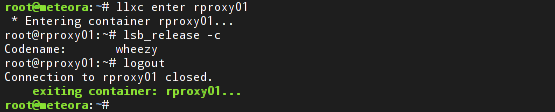
Jonathan Carter: LLXC: My little python3-lxc based project


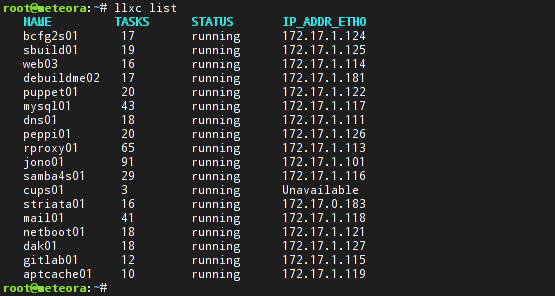
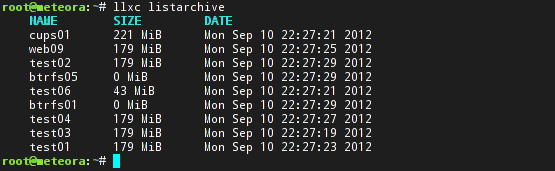
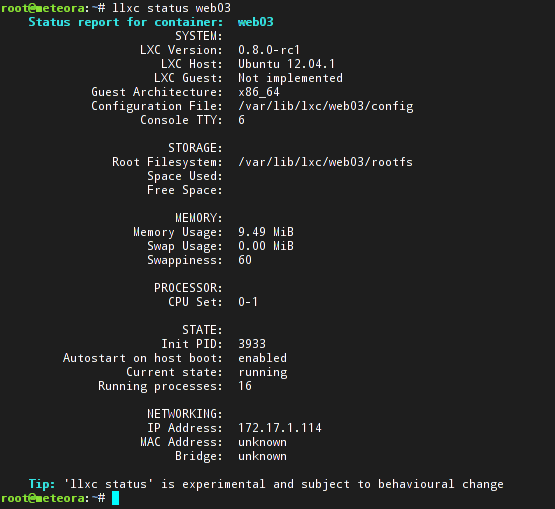
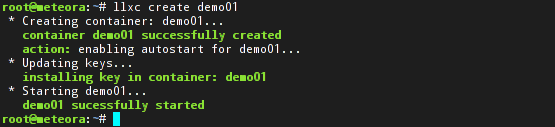
My foray into the world of LXC and RLXC A few months ago, I started trying out LXC (Linux Containers). Before that I used to use OpenVZ, which is an older and more mature contextualization implementation. I was pleased with how well LXC worked and started replacing my personal OpenVZ hosts with LXC. It worked great, but it had a few quirks. While LXC itself works well, the user scripts that ship with it has some space for improvement. The lxc-list command lists anything that s a directory in /var/lib/lxc, so if you have a lost+found directory, it will list it as a container (This has since been fixed upstream). Also, in some cases it would list containers twice or not at all. I was a bit annoyed with that, since OpenVZ s vzlist tool prints out a nice table of your containers along with their IP addresses and other information. Since it s very trivial to implement what I want in a shell script, I went ahead and did just that and called it RLXC. I also missed the vzctl exec <containername> command to execute commands in containers and vzctl enter <containername> to gain a shell inside the container, so I added some more functionality to it so that I could configure ssh keys for these containers and use rlxc enter and rlxc exec like I used to do with the OpenVZ tools, but by using SSH. I also realised that there are others too who wanted similar improvements in the LXC scripts and decided to continue improving RLXC and making it public. Enter LLXC I spoke to St phane about my ideas at the time and he introduced me to python3-lxc that he introduced on his blog yesterday. It provides Python bindings for liblxc, so I took the advantage of that and mostly re-implemented RLXC in Python and called it LLXC. The name doesn t particularly mean anything, I m open to suggestions for what to call it, if anyone cares. Here are some screenshots that explains some of it better than I could do in words: How to get it As St phane mentioned in the python3-lxc blog entry, the API hasn t yet been finalized and llxc itself is in an early state and many changes are planned, so it s definitely not meant for production use yet, but since we believe in release early, release often in the free software community, here goes Currently, llxc.py itself is *very* Ubuntu specific and its only been tested on Ubuntu 12.04, but that will be fixed once more of its kinks have been ironed out. Some people are also working on getting python3-lxc on other distributions, which will help a lot. The llxc.py script itself is hosted on Github: https://github.com/highvoltage/llxc For python3-lxc and friends, you need to enable St phane s experimental PPA: https://launchpad.net/~stgraber/+archive/experimental You will then need to install the following packages: lxc, python3-lxc, python3-crypto, lvm, btrfs-tools To generate the ssh keys used for ssh interaction between the containers, you need to run llxc gensshkeys . The enter and exec commands also rely on your containers being in dns or in your /etc/hosts file, at least for now, which you may have to configure manually. The Future There is a lot that I m planning to add, mostly to scratch my own itches. These include:
  • Awareness of other hosts, so that the list command can show you all containers in the awareness . You d also be able to clone, move, etc containers between hosts.
  • Easily modify container configuration
  • Hooks everywhere, and at least one hook for configuring a configuration management system such as salt, bcfg2, puppet or chef.
  • More checks and tips everywhere. Is the host running low on memory? Disk space? Perhaps list available resources on variable hosts and make some suggestions based on that.
  • There a not-very-descriptive ROADMAP file in the distribution, check that for more details.
I ll have some packaging for this available soon and work on making more things work right out of the box, updates will follow. Also, feedback and patches are very welcome!

24 September 2012

Felipe Augusto van de Wiel: 24 Sep 2012

A new journey ahead
Changing jobs and moving to a new country... it's just the beginning.

On September 30th, 2012 I'm moving to Menlo Park, CA, USA because back in December 2011 I accepted a job offer as a sysadmin (the name is fancier: Operations Engineer) in Silicon Valley. Since then I'm working on the required documentation, so far everything had worked out. I'm starting at the new work on October 8th, and as I'm arriving on October 1st, I'll have a week to take a look around and get to know a tiny bit of San Francisco Bay Area.


In different levels and aspects it is a big opportunity for me, and I'm confident it'll be an unique experience, not only professional, which of course involves working in a bigger company with more complex scenarios and bigger challenges, and on the personal side, I'll live abroad, be an expat.


As you may imagine, I'm working on this process for more or less 10 months, but in the last 30 days it got more intense. Quitting my jobs, organizing my stuff, cleaning part of backlog (and finding out a have a huge to-do list awaiting for me). Spending quality time with family and friends, and also saying goodbye to them. Finishing some aspects of the move (travel tickets, temporary living).


It's new, it's different! I'm super excited and I do want to change a few things to make it easier for family and friends to keep up, make it easier to follow the news, which might help with the distance.
And now for something completely different! See you all pretty soon! :-)

Wouter Verhelst: Questions

Last weekend, I was a member of the off-stage choir in the Cinderella production in Wilrijk. As the off-stage choir didn't have all that much to do (out of 24 scenes, only five of them had music with the off-stage choir; and then, one of them only required women, and another only required male voices for about 8 bars out of 200+), I had a lot of spare time on my hands; and since I'm in the possession of a laptop with 8h+ of battery life, I used some of that time for hacking on dvswitch. Obviously, when you're typing away on a computer using an uncommon user interface (I use awesome as my window manager), questions will arise. I expected this; and luckily, dvswitch is not the kind of code that requires a lot of explanation for people to understand how it's useful a short demonstration is very enlightening. For most people, that simple demonstration would be enough. But one person asked me a question that I've heard other people ask me in the past (albeit in relation to different projects), and that I've always found the most baffling question people can ask someone who's writing some computer program: "Why?" Setting aside the fact that no, his example of Adobe Premiere cannot do what dvswitch can, I've never understood the thought train that leads to "it's been done already, so that's useless." Why does a poet write poems, when they'll never get something similar to Shakespeare's works on paper? Why does my father insist on painting portraits of people including their hands, when he knows he's not very good at it? Why does my mother teach a bunch of amateurs in the ways of floristry? Hasn't that been done before? Because it's fun, that's why.

23 September 2012

Aigars Mahinovs: Cloning or pre-configuring a batch of Android phones

An interesting question popped up in my Twitter stream today is there an Android alternative to Apple configurator (for iPhone, iPad and iPod Touch) that allows to create a bunch of identical Apple devices with some added configurations and applications. The best I could come up with is not as polished, but on the other hand much more powerful option Nandroid backup and restore (also known as ClockworkMod Recovery backup). To do this, you need a source phone and a bunch of destination phones. On the source phone a ClockworkMod Recovery (CWR) must be installed (either via a root or via a bootloader unlock). On the destination phones you will either need to also install ClockworkMod Recovery or unlock the bootloader to allow the Fastboot tool to work. So the procedure then goes as follows:
1. Unlock the bootloader on the source phone (search for device specific info on how to do that)
2. Use fastboot flash recovery filename.img to write a device-specific version of CWR to the recovery partition of the device (the phone must be in fastboot mode at that point)
3. Do whatever customisations you want to the source phone at this point. You can use custorm ROMs, install whatever applications, do whatever configuration, but I would suggest keeping everything in phone memory so you don t have to flash the SD card as well.
4. Reboot the source phone into CWR mode, use the backup option to create a full backup.
5. The backup will now be in the SD card of the source device. Copy that to the computer that you will use for creating copies. For each destination phone:
6. Unlock the bootloader of the destination phone
7. Reboot the phone in the fastboot mode, connect it via USB to the copying computer
8. Flash all partitions from the backup using fastboot flash ... commands, skip flashing the recovery partition if you don t want CMR on the destination device
9. Re-lock the bootloader (with fastboot oem lock) And you are done! All the phones must be of the same model. And that model must support unlocking bootloader for this to work. I prefer this method, because this way it is possible to create an end device without root, with a locked bootloader and without CWR thus providing some security as unlocking the bootloader wipes the device, so without specific hacking an attacker can not easily get access to system data on such device. It is also possible to do this with devices that do not have an boot unlock if there is a way to root the original firmware which allows to install CWR and go on from there, but that is significantly more complicated and time-consuming, so using devices with an ability to unlock the bootloader is much preferable. However, before you go to all that trouble, it might be worth to consider if maybe for your particular use case it would be enough with the two commands from Android SDK adb install ... and adb push ... to install applications or individual files on devices or adb backup AppName and adb restore ... to backup and restore one or more individual applications with all their settings. These options have the benefit of that they will work across different device models and that they do not wipe other data or applications from the devices. As I could not immediately find a better way or even a detailed guide how to do this, I decided to write this post, so it would be easier for other people to find this information. If you know a better way, please do mention it in the comments section!

21 September 2012

Gerfried Fuchs: BSP Essen November 2012

Wheezy is coming closer to the release, there though are still way too many release critical bugreports outstanding for it. Squeeze has already been released, but it has collected even more release critical bugreports than wheezy since. To be able to reduce these amounts I will be at the Linuxhotel in Essen at the weekend from 23rd to 25th of November, and it would be a great pleasure if I could convince you to join me in this effort. As readers of my blog might assume, my main aim will be those RC bugs affecting squeeze and I would be happy if some people interested to work on those could join me, I plan to give a quick quick explanation about the version tracking of the BTS and why we should care about stable too, but the event will definitely not be limited to squeeze RC bugs. Also, it will be a good chance to improve your key stats for the web of trust in case your GnuPG key hasn't got enough signatures yet or you want to transition to a stronger one. Please read the Community page of the Linuxhotel for what they offer for accommodation in case you want to use their lodging. Personally I'll go for the two-bed room with breakfast option, but you are of course free to bring your own sleeping bag and mat if you want to cut short on the expenses. In case of any questions, feel free to ask me right ahead. It would be great if we could help both our stable release and the next stable release during the weekend, and if you could join in! Please add yourself to the wiki page about the BSP.

/debian permanent link Comments: 0 Flattr this

20 September 2012

Aigars Mahinovs: You though NVidia was bad, don t try AMD

Remember when Linus Torvalds lambasted NVidia for not supporting their Optimus technology in their Linux drivers for half a decade and counting? Well, I went out and bought an AMD/ATi video card as mu upgrade. And you know what? Its Linux drivers are far, far worse than NVidia.
1. Most of the games I had working fine on NVidia, do not work on AMD. And those that do suffer far more visual corruption, synchronization bugs (like bottom 40% of the screen rendering half a second after the top 60%), strange visual artifacts (weird triangles popping out of everywhere) and crashes, lots of crashes.
2. There were crashes with NVidia too, but NVidia never managed to crash Compiz along with it or crash the whole X server or lock up the system so far that only SysRq works or even lock up the system so far that only powering it off manually works.
3. And then there is the configuration atrocity. Apparently AMD is too good to store its configuration in /etc/X11/xorg.conf. Or even to document the supported options there. Instead they have their own (also undocumented) configuration file in /etc/ati folder. And it is undocumented because it is a cryptic mess and the only supported way to change it is to use their tools aticonfig and amdccccle. The command line tool is almost reasonable, except it is also barely documented. For example, one of my screens somehow was always stared at 1920 1080@30Hz. There were 3 different ways to specify default resolution, but none of them used or saved the refresh rate. And when I changed it in the GUI tool the refresh rate did change, but it was never saved. Oh there nowhere is a save button. It just works , except when it doesn t. Like: both of my screens for some reason started with huge black borders around the screen, I finally narrowed it down to the GUI setting overscan which defaulted to 10%. Ok, so I change it, it works, but next time I reboot, the overscan is back! I had to find an undocumented invocation of the aticonfig that would change the default value to 0%. Why did this one setting not save? Oh and fun note the refresh rate of that second screen was correct on the login screen, but it then swiched back as I logged in. Fun, huh?
4. Even at basic desktop tasks fglrx if inferior to not only the free driver, but also to the nvidia driver even simple scrolling of a large folder in nautilus seems to tax the 200$ card to its limits the bottom row blinks into place almost half a second after I stop scrolling. Another example with NVidia when I switch my TV to the HDMI input from the card, the sound starts at the same moment as the picture, however with AMD the sound only decides to show up 10-15 seconds later. And sometime it does not show up at all, unless I start the AMD Control GUI tool and only then the sound shows up 15 seconds later (without doing anything in the GUI). It may be that one part of AMD is better than NVidia at talking to free driver developers, but another part is so much worse at actual technical work of writing a driver, it is not even funny. They are busy reinventing the bycicle of configuration and display management, while their core driver is just not good enough. TL/DR: Anyone wanna buy a HD 6850 cheaply off my hands? Crossposted to Google+ https://plus.google.com/u/0/107099528362923100900/posts/6PC7RFQpm8K P.S. I also noticed the color difference with NVidia there was no difference between colors on my LCD TV and my IPS monitor, but with AMD there is a huge difference, the TV color just got washed out. I guess there is no proper color calibration support in the AMD driver? Update: I have managed to return the HD 6850 to the shop where I got it from (thanks to a nice law requiring web shops to take stuff back within 14 days no questions asked) and got the new NVidia GeForce GTX 660 instead. I had to build an updated NVidia driver (304.48 from this post, just like here or here) but other than that it was smooth and painless and everything is working great again. Only even faster :)

19 September 2012

Russ Allbery: Debian Policy 3.9.4.0

I just uploaded Debian Policy 3.9.4.0, which includes the implementation of the Technical Committee decision to make build-arch and build-indep mandatory targets and which significantly reworks the section on shared libraries. Nothing here is release-critical for wheezy, and uploads targeted for wheezy should not attempt to update packaging for a new version of Policy. I went into some more detail on debian-devel-announce. The version number probably should have been 3.10.0.0 given the build-arch and build-indep changes and the work on symbols files. Ah well. Here's the upgrading checklist:
2.4
New tasks archive section.
4.9
build-arch and build-indep are now mandatory targets in debian/rules.
5.6.26
New section documenting the Vcs-* fields, which are already in widespread use. Note the mechanism for specifying the Git branch used for packaging in the Vcs-Git field.
7.1
The deprecated relations < and > now must not be used.
7.8
New Built-Using field, which must be used to document the source packages for any binaries that are incorporated into this package at build time. This is used to ensure that the archive meets license requirements for providing source for all binaries.
8.6
Policy for dependencies between shared libraries and other packages has been largely rewritten to document the symbols system and more clearly document handling of shared library ABI changes. symbols files are now recommended over shlibs files in most situations. All maintainers of shared library packages should review the entirety of this section.
9.1.1
Packages must not assume the /run directory exists or is usable without a dependency on initscripts (>= 2.88dsf-13.3) until the stable release of Debian supports /run.
9.7
Packages including MIME configuration can now rely on triggers and do not need to call update-mime.
9.11
New section documenting general requirements for alternate init systems and specific requirements for integrating with upstart.
12.5
All copyright files must be encoded in UTF-8.

16 September 2012

Gregor Herrmann: RC bugs 2012/37

I didn't get very far this week with my RCBW efforts, but luckily we have BSPs going on :) Here's my short list:
  • #639565 liboauth-dev: "liboauth-dev: please make loose libcurl dependency"
    further investigation
  • #642903 nodm: "nodm: subprocess installed post-installation script returned error exit status 10"
    fix .config, upload to DELAYED/5
  • #652084 gosmore: "gosmore use 100% CPU and does nothing"
    sponsor NMU from Kai L ke, upload to DELAYED/2
  • #657465 conserver-client: "conserver-client: prompting due to modified conffiles which where not modified by the user"
    private mail from maintainer
  • #682412 dynamips: "dynamips: FTBFS with multiarch paths: cc: error: /usr/lib/libelf.a: No such file or directory"
    uploaded to DELAYED/3 with my patch by a fellow DD during the Berlin BSP
  • #683925 src:ocp: "FTBFS with gcc-4.7 on i386"
    add patch from Kumar Appaiah, upload to DELAYED/2
  • #684144 sauerbraten: "sauerbraten: security issues with transmitted map cfgs"
    unsuccessfully apply upstream patch

11 September 2012

Russell Coker: Back to the Xperia X10

10 months ago I was given a Samsung Galaxy S Android phone [1] to replace my Sony Ericsson Xperia X10. I also installed Cyanogenmod on it (here is a more detailed comparison of the phones with a focus on liberty [2]). But now I m using the Xperia X10 again. Hardware Reliability Some time ago a friend told me that he bought a Sony phone in preference to a Samsung phone because he didn t think that Samsung phones were reliable enough. I assured him that Samsung phones would be fine if you used a gel-case, but now I m not so sure. My mother in law has a Samsung Galaxy S which now has a single crack across the face, it doesn t appear that her phone was dropped, maybe it just bent a bit it s a fairly thin phone. My Galaxy S started crashing over the last few months and now many applications will crash any time I use 3G networking. Currently my Galaxy S is working well as a small Wifi tablet and hasn t crashed since I replaced the SIM with one that has expired. I wish that phone designers would make mode solid products with bigger batteries. The fact that the Xperia X10 weighs maybe 20g more than the Galaxy S (according to Wikipedia) isn t a problem for me. Even with the Mugen Power 1800mah battery [4] to replace the original 1500mah battery it s still nowhere near the limit of the phone mass that I m prepared to carry. Sony Upgrades Some time ago Sony released an Android 2.3.3 image for the Xperia X10. There is no Cyanogenmod image for the Xperia X10 because it has been locked down which greatly limits what can be done. Also Sony has a proprietary backup program on their Android 2.1 image which isn t supported on Android 2.3.3 this inspired my post about 5 principles of backup software [3]. Due to this pain I didn t even try to upgrade the Xperia X10 phones for me and my wife until recently. Before upgrading the Xperia X10 phones I was unable to use my wife s phone. The phone didn t seem to like recognising my touch so long touch actions (such as unlocking the phone) were almost impossible for me. I think that this is due to the fact that I have fairly dry skin which presumably gives me a higher capacitance. After the upgrade both phones are usable for me, so presumably either Sony or Google upgraded the algorithms for recognising touch to work better with varying screen quality. Comparing the Galaxy S and the Xperia X10 When I first started running Cyanogenmod on the Galaxy S I noticed that it was a lot faster than the Xperia X10 but I didn t know why. It was documented that there had been performance improvements in Android 2.2. Now that I m running Android 2.3.3 on the Xperia X10 I know that the performance difference is not due to the Android version. It could be due to Cyanogenmod optimisations or Sony stupidity, but it s most likely due to hardware differences. The Galaxy S has more RAM and storage which allows installing and running more applications. Now that I m using the Xperia X10 for the bare minimum applications (phone calls, SMS, camera, email, ssh, and web browsing) it works quite well. I still play games on the Galaxy S and use it for more serious web browsing via Wifi. I think that the value I m getting from the Galaxy S as a tiny wifi tablet is greater than the money I might get from selling a partially broken phone that s been obsoleted by two significantly better models. Conclusion The camera on the Xperia X10 is significantly better than the one on the Galaxy S, so going back to a phone that has a great camera is a real benefit. But being slow and locked down is a real drag. I was tempted to buy a Samsung Galaxy Note or Galaxy S3, but it seemed like a bad idea to buy a phone given that my contract comes up for renewal in about 6 months which means I ll be offered a free phone which while not really free is still going to be cheaper than buying a phone outright. Also in future given the low opinion I m now getting of smart phone reliability I ll try and keep a small stock of spare Android phones to cover the case of broken phones. Related posts:
  1. Galaxy S vs Xperia X10 and Android Network Access Galaxy S Review I ve just been given an indefinite loan...
  2. CyanogenMod and the Galaxy S Thanks to some advice from Philipp Kern I have now...
  3. Liberty and Mobile Phones I own two mobile phones at the moment, I use...

Next.

Previous.