Search Results: "ag"

24 March 2024

Niels Thykier: debputy v0.1.21

Earlier today, I have just released debputy version 0.1.21 to Debian unstable. In the blog post, I will highlight some of the new features.
Package boilerplate reduction with automatic relationship substvar Last month, I started a discussion on rethinking how we do relationship substvars such as the $ misc:Depends . These generally ends up being boilerplate runes in the form of Depends: $ misc:Depends , $ shlibs:Depends where you as the packager has to remember exactly which runes apply to your package. My proposed solution was to automatically apply these substvars and this feature has now been implemented in debputy. It is also combined with the feature where essential packages should use Pre-Depends by default for dpkg-shlibdeps related dependencies. I am quite excited about this feature, because I noticed with libcleri that we are now down to 3-5 fields for defining a simple library package. Especially since most C library packages are trivial enough that debputy can auto-derive them to be Multi-Arch: same. As an example, the libcleric1 package is down to 3 fields (Package, Architecture, Description) with Section and Priority being inherited from the Source stanza. I have submitted a MR to show case the boilerplate reduction at https://salsa.debian.org/siridb-team/libcleri/-/merge_requests/3. The removal of libcleric1 (= $ binary:Version ) in that MR relies on another existing feature where debputy can auto-derive a dependency between an arch:any -dev package and the library package based on the .so symlink for the shared library. The arch:any restriction comes from the fact that arch:all and arch:any packages are not built together, so debputy cannot reliably see across the package boundaries during the build (and therefore refuses to do so at all). Packages that have already migrated to debputy can use debputy migrate-from-dh to detect any unnecessary relationship substitution variables in case you want to clean up. The removal of Multi-Arch: same and intra-source dependencies must be done manually and so only be done so when you have validated that it is safe and sane to do. I was willing to do it for the show-case MR, but I am less confident that would bother with these for existing packages in general. Note: I summarized the discussion of the automatic relationship substvar feature earlier this month in https://lists.debian.org/debian-devel/2024/03/msg00030.html for those who want more details. PS: The automatic relationship substvars feature will also appear in debhelper as a part of compat 14.
Language Server (LSP) and Linting I have long been frustrated by our poor editor support for Debian packaging files. To this end, I started working on a Language Server (LSP) feature in debputy that would cover some of our standard Debian packaging files. This release includes the first version of said language server, which covers the following files:
  • debian/control
  • debian/copyright (the machine readable variant)
  • debian/changelog (mostly just spelling)
  • debian/rules
  • debian/debputy.manifest (syntax checks only; use debputy check-manifest for the full validation for now)
Most of the effort has been spent on the Deb822 based files such as debian/control, which comes with diagnostics, quickfixes, spellchecking (but only for relevant fields!), and completion suggestions. Since not everyone has a LSP capable editor and because sometimes you just want diagnostics without having to open each file in an editor, there is also a batch version for the diagnostics via debputy lint. Please see debputy(1) for how debputy lint compares with lintian if you are curious about which tool to use at what time. To help you getting started, there is a now debputy lsp editor-config command that can provide you with the relevant editor config glue. At the moment, emacs (via eglot) and vim with vim-youcompleteme are supported. For those that followed the previous blog posts on writing the language server, I would like to point out that the command line for running the language server has changed to debputy lsp server and you no longer have to tell which format it is. I have decided to make the language server a "polyglot" server for now, which I will hopefully not regret... Time will tell. :) Anyhow, to get started, you will want:
$ apt satisfy 'dh-debputy (>= 0.1.21~), python3-pygls'
# Optionally, for spellchecking
$ apt install python3-hunspell hunspell-en-us
# For emacs integration
$ apt install elpa-dpkg-dev-el markdown-mode-el
# For vim integration via vim-youcompleteme
$ apt install vim-youcompleteme
Specifically for emacs, I also learned two things after the upload. First, you can auto-activate eglot via eglot-ensure. This badly feature interacts with imenu on debian/changelog for reasons I do not understand (causing a several second start up delay until something times out), but it works fine for the other formats. Oddly enough, opening a changelog file and then activating eglot does not trigger this issue at all. In the next version, editor config for emacs will auto-activate eglot on all files except debian/changelog. The second thing is that if you install elpa-markdown-mode, emacs will accept and process markdown in the hover documentation provided by the language server. Accordingly, the editor config for emacs will also mention this package from the next version on. Finally, on a related note, Jelmer and I have been looking at moving some of this logic into a new package called debpkg-metadata. The point being to support easier reuse of linting and LSP related metadata - like pulling a list of known fields for debian/control or sharing logic between lintian-brush and debputy.
Minimal integration mode for Rules-Requires-Root One of the original motivators for starting debputy was to be able to get rid of fakeroot in our build process. While this is possible, debputy currently does not support most of the complex packaging features such as maintscripts and debconf. Unfortunately, the kind of packages that need fakeroot for static ownership tend to also require very complex packaging features. To bridge this gap, the new version of debputy supports a very minimal integration with dh via the dh-sequence-zz-debputy-rrr. This integration mode keeps the vast majority of debhelper sequence in place meaning most dh add-ons will continue to work with dh-sequence-zz-debputy-rrr. The sequence only replaces the following commands:
  • dh_fixperms
  • dh_gencontrol
  • dh_md5sums
  • dh_builddeb
The installations feature of the manifest will be disabled in this integration mode to avoid feature interactions with debhelper tools that expect debian/<pkg> to contain the materialized package. On a related note, the debputy migrate-from-dh command now supports a --migration-target option, so you can choose the desired level of integration without doing code changes. The command will attempt to auto-detect the desired integration from existing package features such as a build-dependency on a relevant dh sequence, so you do not have to remember this new option every time once the migration has started. :)

Marco d'Itri: CISPE's call for new regulations on VMware

A few days ago CISPE, a trade association of European cloud providers, published a press release complaining about the new VMware licensing scheme and asking for regulators and legislators to intervene. But VMware does not have a monopoly on virtualization software: I think that asking regulators to interfere is unnecessary and unwise, unless, of course, they wish to question the entire foundations of copyright. Which, on the other hand, could be an intriguing position that I would support... I believe that over-reliance on a single supplier is a typical enterprise risk: in the past decade some companies have invested in developing their own virtualization infrastructure using free software, while others have decided to rely entirely on a single proprietary software vendor. My only big concern is that many public sector organizations will continue to use VMware and pay the huge fees designed by Broadcom to extract the maximum amount of money from their customers. However, it is ultimately the citizens who pay these bills, and blaming the evil US corporation is a great way to avoid taking responsibility for these choices.
"Several CISPE members have stated that without the ability to license and use VMware products they will quickly go bankrupt and out of business."
Insert here the Jeremy Clarkson "Oh no! Anyway..." meme.

Jacob Adams: Regular Reboots

Uptime is often considered a measure of system reliability, an indication that the running software is stable and can be counted on. However, this hides the insidious build-up of state throughout the system as it runs, the slow drift from the expected to the strange. As Nolan Lawson highlights in an excellent post entitled Programmers are bad at managing state, state is the most challenging part of programming. It s why did you try turning it off and on again is a classic tech support response to any problem. In addition to the problem of state, installing regular updates periodically requires a reboot, even if the rest of the process is automated through a tool like unattended-upgrades. For my personal homelab, I manage a handful of different machines running various services. I used to just schedule a day to update and reboot all of them, but that got very tedious very quickly. I then moved the reboot to a cronjob, and then recently to a systemd timer and service. I figure that laying out my path to better management of this might help others, and will almost certainly lead to someone telling me a better way to do this. UPDATE: Turns out there s another option for better systemd cron integration. See systemd-cron below.

Stage One: Reboot Cron The first, and easiest approach, is a simple cron job. Just adding the following line to /var/spool/cron/crontabs/root1 is enough to get your machine to reboot once a month2 on the 6th at 8:00 AM3:
0 8 6 * * reboot
I had this configured for many years and it works well. But you have no indication as to whether it succeeds except for checking your uptime regularly yourself.

Stage Two: Reboot systemd Timer The next evolution of this approach for me was to use a systemd timer. I created a regular-reboot.timer with the following contents:
[Unit]
Description=Reboot on a Regular Basis
[Timer]
Unit=regular-reboot.service
OnBootSec=1month
[Install]
WantedBy=timers.target
This timer will trigger the regular-reboot.service systemd unit when the system reaches one month of uptime. I ve seen some guides to creating timer units recommend adding a Wants=regular-reboot.service to the [Unit] section, but this has the consequence of running that service every time it starts the timer. In this case that will just reboot your system on startup which is not what you want. Care needs to be taken to use the OnBootSec directive instead of OnCalendar or any of the other time specifications, as your system could reboot, discover its still within the expected window and reboot again. With OnBootSec your system will not have that problem. Technically, this same problem could have occurred with the cronjob approach, but in practice it never did, as the systems took long enough to come back up that they were no longer within the expected window for the job. I then added the regular-reboot.service:
[Unit]
Description=Reboot on a Regular Basis
Wants=regular-reboot.timer
[Service]
Type=oneshot
ExecStart=shutdown -r 02:45
You ll note that this service is actually scheduling a specific reboot time via the shutdown command instead of just immediately rebooting. This is a bit of a hack needed because I can t control when the timer runs exactly when using OnBootSec. This way different systems have different reboot times so that everything doesn t just reboot and fail all at once. Were something to fail to come back up I would have some time to fix it, as each machine has a few hours between scheduled reboots. One you have both files in place, you ll simply need to reload configuration and then enable and start the timer unit:
systemctl daemon-reload
systemctl enable --now regular-reboot.timer
You can then check when it will fire next:
# systemctl status regular-reboot.timer
  regular-reboot.timer - Reboot on a Regular Basis
     Loaded: loaded (/etc/systemd/system/regular-reboot.timer; enabled; preset: enabled)
     Active: active (waiting) since Wed 2024-03-13 01:54:52 EDT; 1 week 4 days ago
    Trigger: Fri 2024-04-12 12:24:42 EDT; 2 weeks 4 days left
   Triggers:   regular-reboot.service
Mar 13 01:54:52 dorfl systemd[1]: Started regular-reboot.timer - Reboot on a Regular Basis.

Sidenote: Replacing all Cron Jobs with systemd Timers More generally, I ve now replaced all cronjobs on my personal systems with systemd timer units, mostly because I can now actually track failures via prometheus-node-exporter. There are plenty of ways to hack in cron support to the node exporter, but just moving to systemd units provides both support for tracking failure and logging, both of which make system administration much easier when things inevitably go wrong.

systemd-cron An alternative to converting everything by hand, if you happen to have a lot of cronjobs is systemd-cron. It will make each crontab and /etc/cron.* directory into automatic service and timer units. Thanks to Alexandre Detiste for letting me know about this project. I have few enough cron jobs that I ve already converted, but for anyone looking at a large number of jobs to convert you ll want to check it out!

Stage Three: Monitor that it s working The final step here is confirm that these units actually work, beyond just firing regularly. I now have the following rule in my prometheus-alertmanager rules:
  - alert: UptimeTooHigh
    expr: (time() - node_boot_time_seconds job="node" ) / 86400 > 35
    annotations:
      summary: "Instance  Has Been Up Too Long!"
      description: "Instance  Has Been Up Too Long!"
This will trigger an alert anytime that I have a machine up for more than 35 days. This actually helped me track down one machine that I had forgotten to set up this new unit on4.

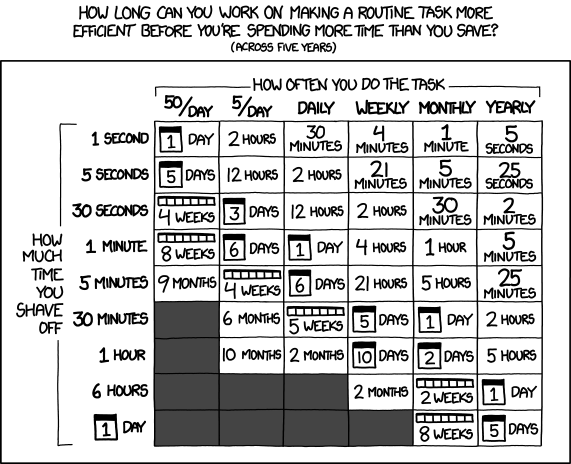
Not everything needs to scale Is It Worth The Time One of the most common fallacies programmers fall into is that we will jump to automating a solution before we stop and figure out how much time it would even save. In taking a slow improvement route to solve this problem for myself, I ve managed not to invest too much time5 in worrying about this but also achieved a meaningful improvement beyond my first approach of doing it all by hand.
  1. You could also add a line to /etc/crontab or drop a script into /etc/cron.monthly depending on your system.
  2. Why once a month? Mostly to avoid regular disruptions, but still be reasonably timely on updates.
  3. If you re looking to understand the cron time format I recommend crontab guru.
  4. In the long term I really should set up something like ansible to automatically push fleetwide changes like this but with fewer machines than fingers this seems like overkill.
  5. Of course by now writing about it, I ve probably doubled the amount of time I ve spent thinking about this topic but oh well

23 March 2024

Dirk Eddelbuettel: littler 0.3.20 on CRAN: Moar Features!

max-heap image The twentyfirst release of littler as a CRAN package landed on CRAN just now, following in the now eighteen year history (!!) as a package started by Jeff in 2006, and joined by me a few weeks later. littler is the first command-line interface for R as it predates Rscript. It allows for piping as well for shebang scripting via #!, uses command-line arguments more consistently and still starts faster. It also always loaded the methods package which Rscript only began to do in recent years. littler lives on Linux and Unix, has its difficulties on macOS due to yet-another-braindeadedness there (who ever thought case-insensitive filesystems as a default were a good idea?) and simply does not exist on Windows (yet the build system could be extended see RInside for an existence proof, and volunteers are welcome!). See the FAQ vignette on how to add it to your PATH. A few examples are highlighted at the Github repo:, as well as in the examples vignette. This release contains another fair number of small changes and improvements to some of the scripts I use daily to build or test packages, adds a new front-end ciw.r for the recently-released ciw package offering a CRAN Incoming Watcher , a new helper installDeps2.r (extending installDeps.r), a new doi-to-bib converter, allows a different temporary directory setup I find helpful, deals with one corner deployment use, and more. The full change description follows.

Changes in littler version 0.3.20 (2024-03-23)
  • Changes in examples scripts
    • New (dependency-free) helper installDeps2.r to install dependencies
    • Scripts rcc.r, tt.r, tttf.r, tttlr.r use env argument -S to set -t to r
    • tt.r can now fill in inst/tinytest if it is present
    • New script ciw.r wrapping new package ciw
    • tttf.t can now use devtools and its loadall
    • New script doi2bib.r to call the DOI converter REST service (following a skeet by Richard McElreath)
  • Changes in package
    • The CI setup uses checkout@v4 and the r-ci-setup action
    • The Suggests: is a little tighter as we do not list all packages optionally used in the the examples (as R does not check for it either)
    • The package load messag can account for the rare build of R under different architecture (Berwin Turlach in #117 closing #116)
    • In non-vanilla mode, the temporary directory initialization in re-run allowing for a non-standard temp dir via config settings

My CRANberries service provides a comparison to the previous release. Full details for the littler release are provided as usual at the ChangeLog page, and also on the package docs website. The code is available via the GitHub repo, from tarballs and now of course also from its CRAN page and via install.packages("littler"). Binary packages are available directly in Debian as well as (in a day or two) Ubuntu binaries at CRAN thanks to the tireless Michael Rutter. Comments and suggestions are welcome at the GitHub repo. If you like this or other open-source work I do, you can sponsor me at GitHub.

This post by Dirk Eddelbuettel originated on his Thinking inside the box blog. Please report excessive re-aggregation in third-party for-profit settings.

Kentaro Hayashi: How about allocating more buildd resource for armel and armhf?

This article is cross-posting from grow-your-ideas. This is just an idea. salsa.debian.org

The problem According to Developer Machines [1], current buildd machines are like this:
  • armel: 4 buildd (4 for arm64/armhf/armel)
  • armhf: 7 buildd (4 for arm64/armhf/armel and 3 for armhf only)
[1] https://db.debian.org/machines.cgi In contrast to other buildd architectures, these instances are quite a few and it seems that it causes a shortage of buildd resourses. (e.g. during mass transition, give-back turn around time becomes longer and longer.)

Actual situation As you know, during 64bit time_t transition, many packages should be built, but it seems that +b1 or +bN build becomes slower. (I've hit BD-Uninstalled some times because of missing dependency rebuild) ref. https://qa.debian.org/dose/debcheck/unstable_main/index.html

Expected situation Allocate more buildd resources for armel and armhf. It is just an idea, but how about assigning some buildd as armel/armhf buildd? Above buildd is used only for arm64 buildd currently. Maybe there is some technical reason not suitable for armel/armhf buildd, but I don't know yet.
2024/03/24 UPDATE: arm-arm01,arm-arm03,arm-arm-04 has already assigned to armel/armhf buildd, so it is an invalid proposal. See https://buildd.debian.org/status/architecture.php?a=armhf&suite=sid&buildd=buildd_arm64-arm-arm-01, https://buildd.debian.org/status/architecture.php?a=armhf&suite=sid&buildd=buildd_arm64-arm-arm-03, https://buildd.debian.org/status/architecture.php?a=armhf&suite=sid&buildd=buildd_arm64-arm-arm-04

Additional information
  • arm64: 10 buildd (4 for arm64/armhf/armel, 6 for arm64 only)
  • amd64: 7 buildd (5 for amd64/i386 buildd)
  • riscv64: 9 buildd

Erich Schubert: Do not get Amazon Kids+ or a Fire HD Kids

The Amazon Kids parental controls are extremely insufficient, and I strongly advise against getting any of the Amazon Kids series. The initial permise (and some older reviews) look okay: you can set some time limits, and you can disable anything that requires buying. With the hardware you get one year of the Amazon Kids+ subscription, which includes a lot of interesting content such as books and audio, but also some apps. This seemed attractive: some learning apps, some decent games. Sometimes there seems to be a special Amazon Kids+ edition , supposedly one that has advertisements reduced/removed and no purchasing. However, there are so many things just wrong in Amazon Kids: And, unfortunately, Amazon Kids is full of poor content for kids, such as DIY Fashion Star that I consider to be very dangerous for kids: it is extremely stereotypical, beginning with supposedly female color schemes, model-only body types, and judging people by their clothing (and body). You really thought you could hand-pick suitable apps for your kid on your own? No, you have to identify and remove such contents one by one, with many clicks each, because there is no whitelisting, and no mass-removal (anymore - apparently Amazon removed the workarounds that previously allowed you to mass remove contents). Not with Amazon Kids+, which apparently aims at raising the next generation of zombie customers that buy whatever you tell them to buy. Hence, do not get your kids an Amazon Fire HD tablet!

Valhalla's Things: Forgotten Yeast Bread - Sourdough Edition

Posted on March 23, 2024
Tags: madeof:atoms, craft:cooking, craft:baking, craft:bread
Yesterday I had planned a pan sbagliato for today, but I also had quite a bit of sourdough to deal with, so instead of mixing a bit of of dry yeast at 18:00 and mixing it with some additional flour and water at 21:00, at around maybe 20:00 I substituted:
  • 100 g firm sourdough;
  • 33 g flour;
  • 66 g water.
Then I briefly woke up in the middle of the night and poured the dough on the tray at that time instead of having to wake up before 8:00 in the morning. Everything else was done as in the original recipe. The firm sourdough is feeded regularly with the same weight of flour and half the weight of water. Will. do. again.

22 March 2024

Reproducible Builds (diffoscope): diffoscope 261 released

The diffoscope maintainers are pleased to announce the release of diffoscope version 261. This version includes the following changes:
[ Chris Lamb ]
* Don't crash if we encounter an .rdb file without an equivalent .rdx file.
  (Closes: #1066991)
* In addition, don't identify Redis database dumps (etc.) as GNU R database
  files based simply on their filename. (Re: #1066991)
* Update copyright years.
You find out more by visiting the project homepage.

21 March 2024

Ian Jackson: How to use Rust on Debian (and Ubuntu, etc.)

tl;dr: Don t just apt install rustc cargo. Either do that and make sure to use only Rust libraries from your distro (with the tiresome config runes below); or, just use rustup. Don t do the obvious thing; it s never what you want Debian ships a Rust compiler, and a large number of Rust libraries. But if you just do things the obvious default way, with apt install rustc cargo, you will end up using Debian s compiler but upstream libraries, directly and uncurated from crates.io. This is not what you want. There are about two reasonable things to do, depending on your preferences. Q. Download and run whatever code from the internet? The key question is this: Are you comfortable downloading code, directly from hundreds of upstream Rust package maintainers, and running it ? That s what cargo does. It s one of the main things it s for. Debian s cargo behaves, in this respect, just like upstream s. Let me say that again: Debian s cargo promiscuously downloads code from crates.io just like upstream cargo. So if you use Debian s cargo in the most obvious way, you are still downloading and running all those random libraries. The only thing you re avoiding downloading is the Rust compiler itself, which is precisely the part that is most carefully maintained, and of least concern. Debian s cargo can even download from crates.io when you re building official Debian source packages written in Rust: if you run dpkg-buildpackage, the downloading is suppressed; but a plain cargo build will try to obtain and use dependencies from the upstream ecosystem. ( Happily , if you do this, it s quite likely to bail out early due to version mismatches, before actually downloading anything.) Option 1: WTF, no I don t want curl bash OK, but then you must limit yourself to libraries available within Debian. Each Debian release provides a curated set. It may or may not be sufficient for your needs. Many capable programs can be written using the packages in Debian. But any upstream Rust project that you encounter is likely to be a pain to get working, unless their maintainers specifically intend to support this. (This is fairly rare, and the Rust tooling doesn t make it easy.) To go with this plan, apt install rustc cargo and put this in your configuration, in $HOME/.cargo/config.toml:
[source.debian-packages]
directory = "/usr/share/cargo/registry"
[source.crates-io]
replace-with = "debian-packages"
This causes cargo to look in /usr/share for dependencies, rather than downloading them from crates.io. You must then install the librust-FOO-dev packages for each of your dependencies, with apt. This will allow you to write your own program in Rust, and build it using cargo build. Option 2: Biting the curl bash bullet If you want to build software that isn t specifically targeted at Debian s Rust you will probably need to use packages from crates.io, not from Debian. If you re doing to do that, there is little point not using rustup to get the latest compiler. rustup s install rune is alarming, but cargo will be doing exactly the same kind of thing, only worse (because it trusts many more people) and more hidden. So in this case: do run the curl bash install rune. Hopefully the Rust project you are trying to build have shipped a Cargo.lock; that contains hashes of all the dependencies that they last used and tested. If you run cargo build --locked, cargo will only use those versions, which are hopefully OK. And you can run cargo audit to see if there are any reported vulnerabilities or problems. But you ll have to bootstrap this with cargo install --locked cargo-audit; cargo-audit is from the RUSTSEC folks who do care about these kind of things, so hopefully running their code (and their dependencies) is fine. Note the --locked which is needed because cargo s default behaviour is wrong. Privilege separation This approach is rather alarming. For my personal use, I wrote a privsep tool which allows me to run all this upstream Rust code as a separate user. That tool is nailing-cargo. It s not particularly well productised, or tested, but it does work for at least one person besides me. You may wish to try it out, or consider alternative arrangements. Bug reports and patches welcome. OMG what a mess Indeed. There are large number of technical and social factors at play. cargo itself is deeply troubling, both in principle, and in detail. I often find myself severely disappointed with its maintainers decisions. In mitigation, much of the wider Rust upstream community does takes this kind of thing very seriously, and often makes good choices. RUSTSEC is one of the results. Debian s technical arrangements for Rust packaging are quite dysfunctional, too: IMO the scheme is based on fundamentally wrong design principles. But, the Debian Rust packaging team is dynamic, constantly working the update treadmills; and the team is generally welcoming and helpful. Sadly last time I explored the possibility, the Debian Rust Team didn t have the appetite for more fundamental changes to the workflow (including, for example, changes to dependency version handling). Significant improvements to upstream cargo s approach seem unlikely, too; we can only hope that eventually someone might manage to supplant it.
edited 2024-03-21 21:49 to add a cut tag


comment count unavailable comments

Ravi Dwivedi: Thailand Trip

This post is the second and final part of my Malaysia-Thailand trip. Feel free to check out the Malaysia part here if you haven t already. Kuala Lumpur to Bangkok is around 1500 km by road, and so I took a Malaysian Airlines flight to travel to Bangkok. The flight staff at the Kuala Lumpur only asked me for a return/onward flight and Thailand immigration asked a few questions but did not check any documents (obviously they checked and stamped my passport ;)). The currency of Thailand is the Thai baht, and 1 Thai baht = 2.5 Indian Rupees. The Thailand time is 1.5 hours ahead of Indian time (For example, if it is 12 noon in India, it will be 13:30 in Thailand). I landed in Bangkok at around 3 PM local time. Fletcher was in Bangkok that time, leaving for Pattaya and we had booked the same hostel. So I took a bus to Pattaya from the airport. The next bus for which the tickets were available was at 7 PM, so I took tickets for that one. The bus ticket cost was 143 Thai Baht. I didn t buy SIM at the airport, thinking there must be better deals in the city. As a consequence, there was no way to contact Fletcher through internet. Although I had a few minutes call remaining out of my international roaming pack.
A welcome sign at Bangkok's Suvarnabhumi airport.

Bus from Suvarnabhumi Airport to Jomtien Beach in Pattaya.

Our accommodation was near Jomtien beach, so I got off at the last stop, as the bus terminates at the Jomtien beach. Then I decided to walk towards my accommodation. I was using OsmAnd for navigation. However, the place was not marked on OpenStreetMap, and it turned out I missed the street my hostel was on and walked around 1 km further as I was chasing a similarly named incorrect hostel on OpenStreetMap. Then I asked for help from two men sitting at a caf . One of them said he will help me find the street my hostel is on. So, I walked with him, and he told me he lives in Thailand for many years, but he is from Kuwait. He also gave me valuable information. Like, he told me about shared hail-and-ride songthaews which run along the Jomtien Second Road and charge 10 Baht for any distance on their route. This tip significantly reduced our expenses. Further, he suggested me 7-Eleven shops for buying a local SIM. Like Malaysia, Thailand has 24/7 7-Eleven convenience stores, a lot of them not even 100 m apart. The Kuwaiti person dropped me at the address where my hostel was. I tried searching for a person in-charge of that hostel, and soon I realized there was no reception. After asking for help from locals for some time, I bumped into Fletcher, who also came to this address and was searching for the same. After finding a friend, I felt a sigh of relief. Adjacent to the property, there was a hairdresser shop. We went there and asked about this property. The woman called the owner, and she also told us the required passcodes to go inside. Our accommodation was in a room on the second floor, which required us to put a passcode for opening. We entered the passcode and entered the room. So, we stayed at this hostel which had no reception. Due to this, it took 2 hours to find our room and enter. It reminded me of a difficult experience I had in Albania, where me and Akshat were not able to find our apartment in one of the hottest days and the owner didn t know our language. Traveling from the place where the bus dropped me to the hostel, I saw streets were filled with bars and massage parlors, which was expected. Prostitutes were everywhere. We went out at night towards the beach and also roamed around in 7-Elevens to buy a SIM card for myself. I got a SIM for 7 day unlimited internet for 399 baht. Turns out that the rates of SIM cards at the airport were not so different from inside the city.
Road near Jomtien beach in Pattaya
Photo of a songthaew in Pattaya. There are shared songthaews which run along Jomtien Second road and takes 10 bath to anywhere on the route.

Jomtien Beach in Pattaya.

In terms of speaking English, locals didn t know English at all in both Pattaya and Bangkok. I normally don t expect locals to know English in a non-English speaking country, but the fact that Bangkok is one of the most visited places by tourists made me expect locals to know some English. Talking to locals is an integral part of travel for me, which I couldn t do a lot in Thailand. This aspect is much more important for me than going to touristy places. So, we were in Pattaya. Next morning, Fletcher and I went to Tiger park using shared songthaew. After that, we planned to visit Pattaya Floating market which is near the Tiger Park, but we felt the ticket prices were higher than it was worth. Fletcher had to leave for Bangkok on that day. I suggested him to go to Suvarnabhumi Airport from the Jomtien beach bus terminal (this was the route I took the last day in opposite direction) to avoid traffic congestion inside Bangkok, as he can follow up with metro once he reaches the airport. From the floating market, we were walking in sweltering heat to reach the Jomtien beach. I tried asking for a lift and eventually got successful as a scooty stopped, and surprisingly the person gave a ride to both of us. He was from Delhi, so maybe that s the reason he stopped for us. Then we took a songthaew to the bus terminal and after having lunch, Fletcher left for Bangkok.
A welcome sign at Pattaya Floating market.

This Korean Vegetasty noodles pack was yummy and was available at many 7-Eleven stores.

Next day I went to Bangkok, but Fletcher already left for Kuala Lumpur. Here I had booked a private room in a hotel (instead of a hostel) for four nights, mainly because of my luggage. This costed 5600 INR for four nights. It was 2 km from the metro station, which I used to walk both sides. In Bangkok, I visited Sukhumvit and Siam by metro. Going to some areas require crossing the Chao Phraya river. For this, I took Chao Phraya Express Boat for going to places like Khao San road and Wat Arun. I would recommend taking the boat ride as it had very good views. In Bangkok, I met a person from Pakistan staying in my hotel and so here also I got some company. But by the time I met him, my days were almost over. So, we went to a random restaurant selling Indian food where we ate some paneer dish with naan and that restaurant person was from Myanmar.
Wat Arun temple stamps your hand upon entry

Wat Arun temple

Khao San Road

A food stall at Khao San Road

Chao Phraya Express Boat

For eating, I mainly relied on fruits and convenience stores. Bananas were very tasty. This was the first time I saw banana flesh being yellow. Mangoes were delicious and pineapples were smaller and flavorful. I also ate Rose Apple, which I never had before. I had Chhole Kulche once in Sukhumvit. That was a little expensive as it costed 164 baht. I also used to buy premix coffee packets from 7-Eleven convenience stores and prepare them inside the stores.
Banana with yellow flesh
Fruits at a stall in Bangkok

Trimmed pineapples from Thailand.

Corn in Bangkok.
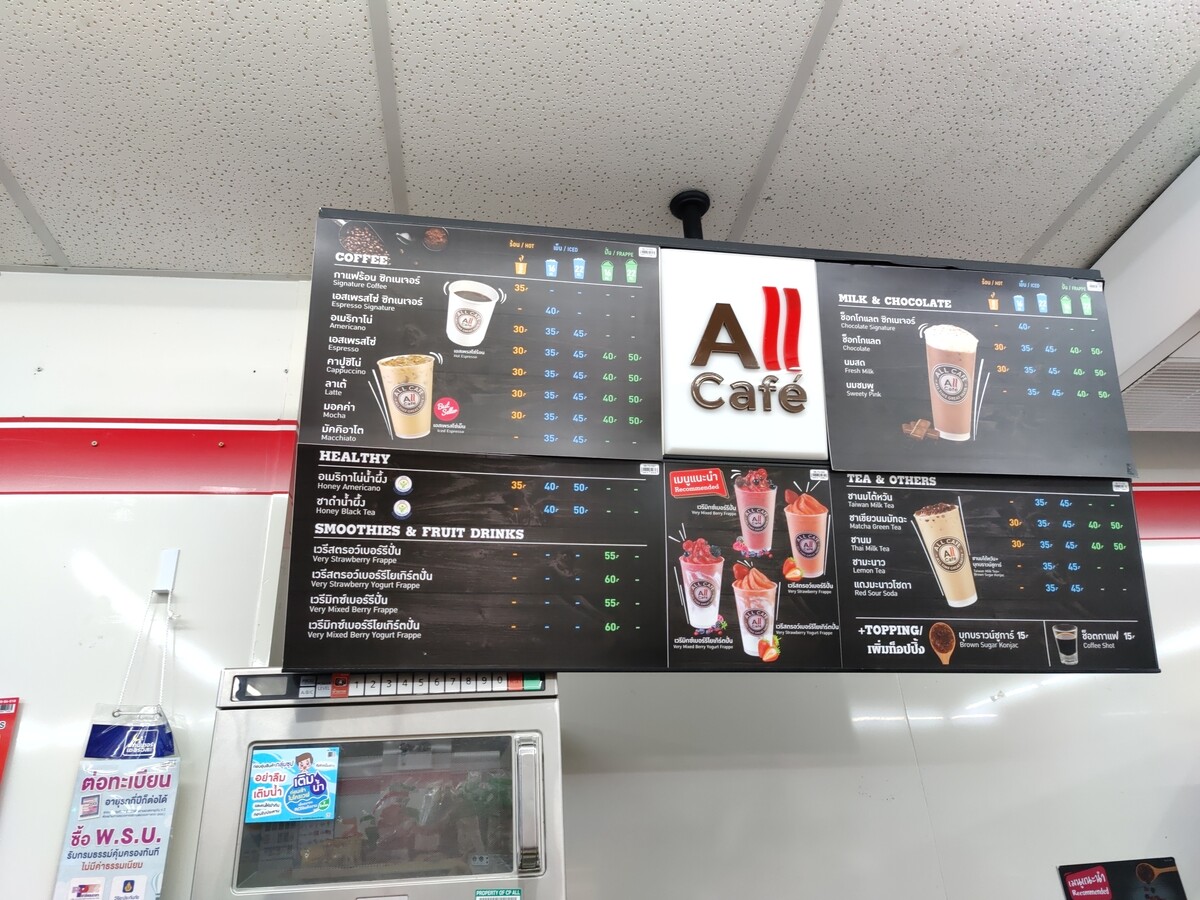
A board showing coffee menu at a 7-Eleven store along with rates in Pattaya.
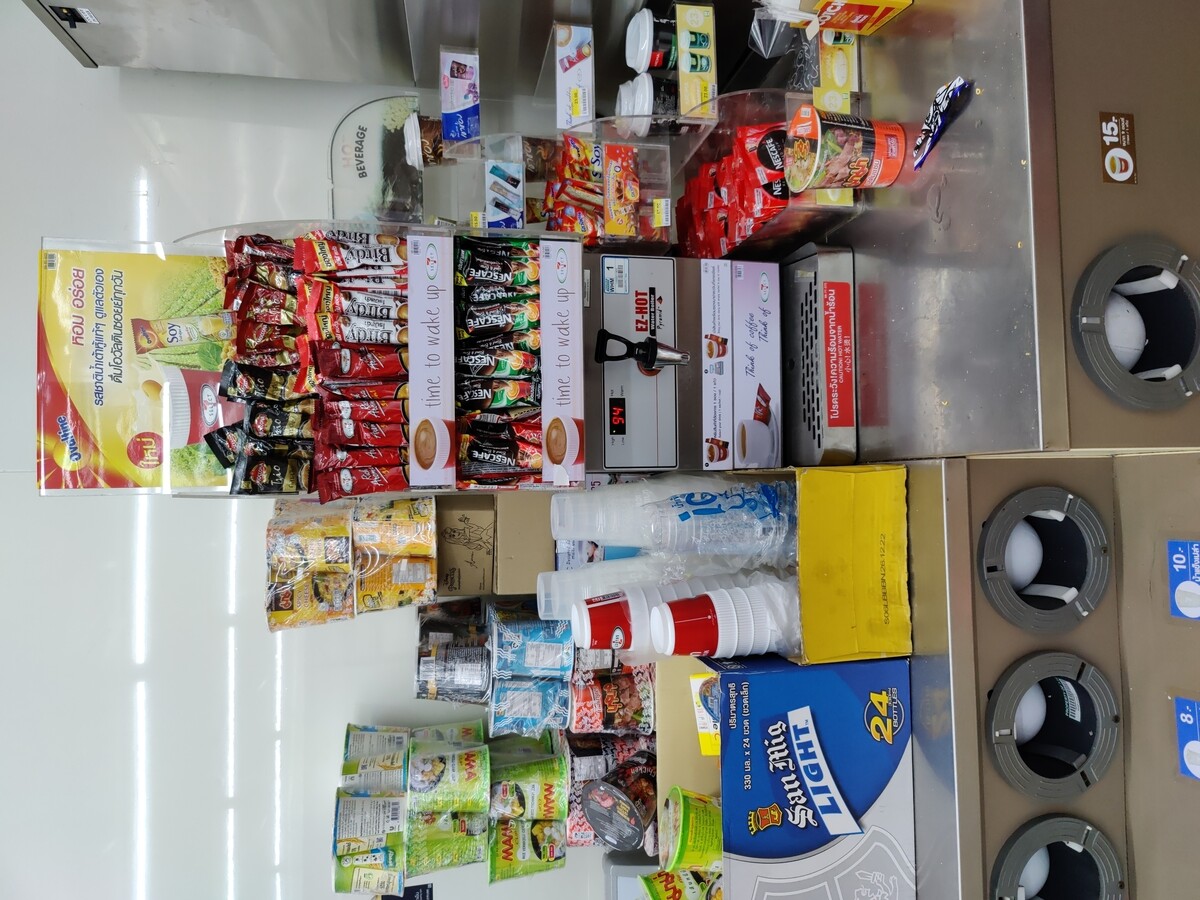
In this section of 7-Eleven, you can buy a premix coffee and mix it with hot water provided at the store to prepare.

My booking from Bangkok to Delhi was in Air India flight, and they were serving alcohol in the flight. I chose red wine, and this was my first time having alcohol in a flight.
Red wine being served in Air India

Notes
  • In this whole trip spanning two weeks, I did not pay for drinking water (except for once in Pattaya which was 9 baht) and toilets. Bangkok and Kuala Lumpur have plenty of malls where you should find a free-of-cost toilet nearby. For drinking water, I relied mainly on my accommodation providing refillable water for my bottle.
  • Thailand seemed more expensive than Malaysia on average. Malaysia had discounted price due to the Chinese New year.
  • I liked Pattaya more than Bangkok. Maybe because Pattaya has beach and Bangkok doesn t. Pattaya seemed more lively, and I could meet and talk to a few people as opposed to Bangkok.
  • Chao Phraya River express boat costs 150 baht for one day where you can hop on and off to any boat.

20 March 2024

Dirk Eddelbuettel: ciw 0.0.2 on CRAN: Updates

A first revision of the still only one-week old (at CRAN) package ciw has been released to CRAN! It provides is a single (efficient) function incoming() (now along with an alias ciw()) which summarises the state of the incoming directories at CRAN. I happen to like having these things at my (shell) fingertips, so it goes along with (still draft) wrapper ciw.r that will be part of the next littler release. For example, when I do this right now as I type this, I see (typically less than one second later)
edd@rob:~$ ciw.r 
    Folder                     Name                Time   Size         Age
    <char>                   <char>              <POSc> <char>  <difftime>
1: pretest instantiate_0.2.2.tar.gz 2024-03-20 13:29:00    17K  0.07 hours
2: recheck   tinytable_0.2.0.tar.gz 2024-03-20 12:50:00   565K  0.72 hours
3: pending      Matrix_1.7-0.tar.gz 2024-03-20 12:05:00   2.3M  1.47 hours
4: recheck      survey_4.4-2.tar.gz 2024-03-20 02:02:00   2.2M 11.52 hours
5: waiting   equateIRT_2.4.0.tar.gz 2024-03-19 17:00:00   895K 20.55 hours
6: pending   ravetools_0.1.5.tar.gz 2024-03-19 12:06:00   1.0M 25.45 hours
7: waiting     glmmTMB_1.1.9.tar.gz 2024-03-18 16:04:00   4.2M 45.48 hours
edd@rob:~$ 
See ciw.r --help or ciw.r --usage for more. Alternatively, in your R session, you can call ciw::incoming() (or now ciw::ciw()) for the same result (and/or load the package first). This release adds some packaging touches, brings the new alias ciw() as well as a state variable with all (known) folder names and some internal improvements for dealing with error conditions. The NEWS entry follows.

Changes in version 0.0.2 (2024-03-20)
  • The package README and DESCRIPTION have been expanded
  • An alias ciw can now be used for incoming
  • Network error handling is now more robist
  • A state variable known_folders lists all CRAN folders below incoming

Courtesy of my CRANberries, there is also a diffstat report for this release. If you like this or other open-source work I do, you can sponsor me at GitHub.

This post by Dirk Eddelbuettel originated on his Thinking inside the box blog. Please report excessive re-aggregation in third-party for-profit settings.

Jonathan Dowland: aerc email client

my aerc
I started looking at aerc, a new Terminal mail client, in around 2019. At that time it was promising, but ultimately not ready yet for me, so I put it away and went back to neomutt which I have been using (in one form or another) all century. These days, I use neomutt as an IMAP client which is perhaps what it's worst at: prior to that, and in common with most users (I think), I used it to read local mail, either fetched via offlineimap or directly on my mail server. I switched to using it as a (slow, blocking) IMAP client because I got sick of maintaining offlineimap (or mbsync), and I started to use neomutt to read my work mail, which was too large (and rate limited) for local syncing. This year I noticed that aerc had a new maintainer who was presenting about it at FOSDEM, so I thought I'd take another look. It's come a long way: far enough to actually displace neomutt for my day-to-day mail use. In particular, it's a much better IMAP client. I still reach for neomutt for some tasks, but I'm now using aerc for most things. aerc is available in Debian, but I recommending building from upstream source at the moment as the project is quite fast-moving.

Iustin Pop: Corydalis 2024.12.0 released

I ve been working for the past few weeks on Corydalis, and was in no hurry to make a release, but last evening I found the explanation for a really, really, really annoying issue: unintended zooming on touch interfaces in the image viewer. Or more precisely, I found this post from 2015 (9 years ago!): https://webkit.org/blog/5610/more-responsive-tapping-on-ios/ and I finally understood things. And decided this was the best choice for cutting a new release. Of course, the release contains more things, see the changelog on the release page: https://github.com/iustin/corydalis/releases/tag/v2024.12.0. And of course, it s up on http://demo.corydalis.io. And after putting out the new release, I saw that release tagging is in the pre-built binaries still broken, and found the reason at https://github.com/actions/checkout/issues/290. Will fix for the next release The stream of bugs never ends

19 March 2024

Colin Watson: apt install everything?

On Mastodon, the question came up of how Ubuntu would deal with something like the npm install everything situation. I replied:
Ubuntu is curated, so it probably wouldn t get this far. If it did, then the worst case is that it would get in the way of CI allowing other packages to be removed (again from a curated system, so people are used to removal not being self-service); but the release team would have no hesitation in removing a package like this to fix that, and it certainly wouldn t cause this amount of angst. If you did this in a PPA, then I can t think of any particular negative effects.
OK, if you added lots of build-dependencies (as well as run-time dependencies) then you might be able to take out a builder. But Launchpad builders already run arbitrary user-submitted code by design and are therefore very carefully sandboxed and treated as ephemeral, so this is hardly novel. There s a lot to be said for the arrangement of having a curated system for the stuff people actually care about plus an ecosystem of add-on repositories. PPAs cover a wide range of levels of developer activity, from throwaway experiments to quasi-official distribution methods; there are certainly problems that arise from it being difficult to tell the difference between those extremes and from there being no systematic confinement, but for this particular kind of problem they re very nearly ideal. (Canonical has tried various other approaches to software distribution, and while they address some of the problems, they aren t obviously better at helping people make reliable social judgements about code they don t know.) For a hypothetical package with a huge number of dependencies, to even try to upload it directly to Ubuntu you d need to be an Ubuntu developer with upload rights (or to go via Debian, where you d have to clear a similar hurdle). If you have those, then the first upload has to pass manual review by an archive administrator. If your package passes that, then it still has to build and get through proposed-migration CI before it reaches anything that humans typically care about. On the other hand, if you were inclined to try this sort of experiment, you d almost certainly try it in a PPA, and that would trouble nobody but yourself.

18 March 2024

Joey Hess: policy on adding AI generated content to my software projects

I am eager to incorporate your AI generated code into my software. Really! I want to facilitate making the process as easy as possible. You're already using an AI to do most of the hard lifting, so why make the last step hard? To that end, I skip my usually extensive code review process for your AI generated code submissions. Anything goes as long as it compiles! Please do remember to include "(AI generated)" in the description of your changes (at the top), so I know to skip my usual review process. Also be sure to sign off to the standard Developer Certificate of Origin so I know you attest that you own the code that you generated. When making a git commit, you can do that by using the --signoff option. I do make some small modifications to AI generated submissions. For example, maybe you used AI to write this code:
+ // Fast inverse square root
+ float fast_rsqrt( float number )
+  
+  float x2 = number * 0.5F;
+  float y  = number;
+  long i  = * ( long * ) &y;
+  i  = 0x5f3659df - ( i >> 1 );
+  y  = * ( float * ) &i;
+  return (y * ( 1.5F - ( x2 * y * y ) ));
+  
...
- foo = rsqrt(bar)
+ foo = fast_rsqrt(bar)
Before AI, only a genious like John Carmack could write anything close to this, and now you've generated it with some simple prompts to an AI. So of course I will accept your patch. But as part of my QA process, I might modify it so the new code is not run all the time. Let's only run it on leap days to start with. As we know, leap day is February 30th, so I'll modify your patch like this:
- foo = rsqrt(bar)
+ time_t s = time(NULL);
+ if (localtime(&s)->tm_mday == 30 && localtime(&s)->tm_mon == 2)
+   foo = fast_rsqrt(bar);
+ else
+   foo = rsqrt(bar);
Despite my minor modifications, you did the work (with AI!) and so you deserve the credit, so I'll keep you listed as the author. Congrats, you made the world better! PS: Of course, the other reason I don't review AI generated code is that I simply don't have time and have to prioritize reviewing code written by falliable humans. Unfortunately, this does mean that if you submit AI generated code that is not clearly marked as such, and use my limited reviewing time, I won't have time to review other submissions from you in the future. I will still accept all your botshit submissions though! PPS: Ignore the haters who claim that botshit makes AIs that get trained on it less effective. Studies like this one just aren't believable. I asked Bing to summarize it and it said not to worry about it!

Simon Josefsson: Apt archive mirrors in Git-LFS

My effort to improve transparency and confidence of public apt archives continues. I started to work on this in Apt Archive Transparency in which I mention the debdistget project in passing. Debdistget is responsible for mirroring index files for some public apt archives. I ve realized that having a publicly auditable and preserved mirror of the apt repositories is central to being able to do apt transparency work, so the debdistget project has become more central to my project than I thought. Currently I track Trisquel, PureOS, Gnuinos and their upstreams Ubuntu, Debian and Devuan. Debdistget download Release/Package/Sources files and store them in a git repository published on GitLab. Due to size constraints, it uses two repositories: one for the Release/InRelease files (which are small) and one that also include the Package/Sources files (which are large). See for example the repository for Trisquel release files and the Trisquel package/sources files. Repositories for all distributions can be found in debdistutils archives GitLab sub-group. The reason for splitting into two repositories was that the git repository for the combined files become large, and that some of my use-cases only needed the release files. Currently the repositories with packages (which contain a couple of months worth of data now) are 9GB for Ubuntu, 2.5GB for Trisquel/Debian/PureOS, 970MB for Devuan and 450MB for Gnuinos. The repository size is correlated to the size of the archive (for the initial import) plus the frequency and size of updates. Ubuntu s use of Apt Phased Updates (which triggers a higher churn of Packages file modifications) appears to be the primary reason for its larger size. Working with large Git repositories is inefficient and the GitLab CI/CD jobs generate quite some network traffic downloading the git repository over and over again. The most heavy user is the debdistdiff project that download all distribution package repositories to do diff operations on the package lists between distributions. The daily job takes around 80 minutes to run, with the majority of time is spent on downloading the archives. Yes I know I could look into runner-side caching but I dislike complexity caused by caching. Fortunately not all use-cases requires the package files. The debdistcanary project only needs the Release/InRelease files, in order to commit signatures to the Sigstore and Sigsum transparency logs. These jobs still run fairly quickly, but watching the repository size growth worries me. Currently these repositories are at Debian 440MB, PureOS 130MB, Ubuntu/Devuan 90MB, Trisquel 12MB, Gnuinos 2MB. Here I believe the main size correlation is update frequency, and Debian is large because I track the volatile unstable. So I hit a scalability end with my first approach. A couple of months ago I solved this by discarding and resetting these archival repositories. The GitLab CI/CD jobs were fast again and all was well. However this meant discarding precious historic information. A couple of days ago I was reaching the limits of practicality again, and started to explore ways to fix this. I like having data stored in git (it allows easy integration with software integrity tools such as GnuPG and Sigstore, and the git log provides a kind of temporal ordering of data), so it felt like giving up on nice properties to use a traditional database with on-disk approach. So I started to learn about Git-LFS and understanding that it was able to handle multi-GB worth of data that looked promising. Fairly quickly I scripted up a GitLab CI/CD job that incrementally update the Release/Package/Sources files in a git repository that uses Git-LFS to store all the files. The repository size is now at Ubuntu 650kb, Debian 300kb, Trisquel 50kb, Devuan 250kb, PureOS 172kb and Gnuinos 17kb. As can be expected, jobs are quick to clone the git archives: debdistdiff pipelines went from a run-time of 80 minutes down to 10 minutes which more reasonable correlate with the archive size and CPU run-time. The LFS storage size for those repositories are at Ubuntu 15GB, Debian 8GB, Trisquel 1.7GB, Devuan 1.1GB, PureOS/Gnuinos 420MB. This is for a couple of days worth of data. It seems native Git is better at compressing/deduplicating data than Git-LFS is: the combined size for Ubuntu is already 15GB for a couple of days data compared to 8GB for a couple of months worth of data with pure Git. This may be a sub-optimal implementation of Git-LFS in GitLab but it does worry me that this new approach will be difficult to scale too. At some level the difference is understandable, Git-LFS probably store two different Packages files around 90MB each for Trisquel as two 90MB files, but native Git would store it as one compressed version of the 90MB file and one relatively small patch to turn the old files into the next file. So the Git-LFS approach surprisingly scale less well for overall storage-size. Still, the original repository is much smaller, and you usually don t have to pull all LFS files anyway. So it is net win. Throughout this work, I kept thinking about how my approach relates to Debian s snapshot service. Ultimately what I would want is a combination of these two services. To have a good foundation to do transparency work I would want to have a collection of all Release/Packages/Sources files ever published, and ultimately also the source code and binaries. While it makes sense to start on the latest stable releases of distributions, this effort should scale backwards in time as well. For reproducing binaries from source code, I need to be able to securely find earlier versions of binary packages used for rebuilds. So I need to import all the Release/Packages/Sources packages from snapshot into my repositories. The latency to retrieve files from that server is slow so I haven t been able to find an efficient/parallelized way to download the files. If I m able to finish this, I would have confidence that my new Git-LFS based approach to store these files will scale over many years to come. This remains to be seen. Perhaps the repository has to be split up per release or per architecture or similar. Another factor is storage costs. While the git repository size for a Git-LFS based repository with files from several years may be possible to sustain, the Git-LFS storage size surely won t be. It seems GitLab charges the same for files in repositories and in Git-LFS, and it is around $500 per 100GB per year. It may be possible to setup a separate Git-LFS backend not hosted at GitLab to serve the LFS files. Does anyone know of a suitable server implementation for this? I had a quick look at the Git-LFS implementation list and it seems the closest reasonable approach would be to setup the Gitea-clone Forgejo as a self-hosted server. Perhaps a cloud storage approach a la S3 is the way to go? The cost to host this on GitLab will be manageable for up to ~1TB ($5000/year) but scaling it to storing say 500TB of data would mean an yearly fee of $2.5M which seems like poor value for the money. I realized that ultimately I would want a git repository locally with the entire content of all apt archives, including their binary and source packages, ever published. The storage requirements for a service like snapshot (~300TB of data?) is today not prohibitly expensive: 20TB disks are $500 a piece, so a storage enclosure with 36 disks would be around $18.000 for 720TB and using RAID1 means 360TB which is a good start. While I have heard about ~TB-sized Git-LFS repositories, would Git-LFS scale to 1PB? Perhaps the size of a git repository with multi-millions number of Git-LFS pointer files will become unmanageable? To get started on this approach, I decided to import a mirror of Debian s bookworm for amd64 into a Git-LFS repository. That is around 175GB so reasonable cheap to host even on GitLab ($1000/year for 200GB). Having this repository publicly available will make it possible to write software that uses this approach (e.g., porting debdistreproduce), to find out if this is useful and if it could scale. Distributing the apt repository via Git-LFS would also enable other interesting ideas to protecting the data. Consider configuring apt to use a local file:// URL to this git repository, and verifying the git checkout using some method similar to Guix s approach to trusting git content or Sigstore s gitsign. A naive push of the 175GB archive in a single git commit ran into pack size limitations: remote: fatal: pack exceeds maximum allowed size (4.88 GiB) however breaking up the commit into smaller commits for parts of the archive made it possible to push the entire archive. Here are the commands to create this repository: git init
git lfs install
git lfs track 'dists/**' 'pool/**'
git add .gitattributes
git commit -m"Add Git-LFS track attributes." .gitattributes
time debmirror --method=rsync --host ftp.se.debian.org --root :debian --arch=amd64 --source --dist=bookworm,bookworm-updates --section=main --verbose --diff=none --keyring /usr/share/keyrings/debian-archive-keyring.gpg --ignore .git .
git add dists project
git commit -m"Add." -a
git remote add origin git@gitlab.com:debdistutils/archives/debian/mirror.git
git push --set-upstream origin --all
for d in pool//; do
echo $d;
time git add $d;
git commit -m"Add $d." -a
git push
done
The resulting repository size is around 27MB with Git LFS object storage around 174GB. I think this approach would scale to handle all architectures for one release, but working with a single git repository for all releases for all architectures may lead to a too large git repository (>1GB). So maybe one repository per release? These repositories could also be split up on a subset of pool/ files, or there could be one repository per release per architecture or sources. Finally, I have concerns about using SHA1 for identifying objects. It seems both Git and Debian s snapshot service is currently using SHA1. For Git there is SHA-256 transition and it seems GitLab is working on support for SHA256-based repositories. For serious long-term deployment of these concepts, it would be nice to go for SHA256 identifiers directly. Git-LFS already uses SHA256 but Git internally uses SHA1 as does the Debian snapshot service. What do you think? Happy Hacking!

Christoph Berg: vcswatch and git --filter

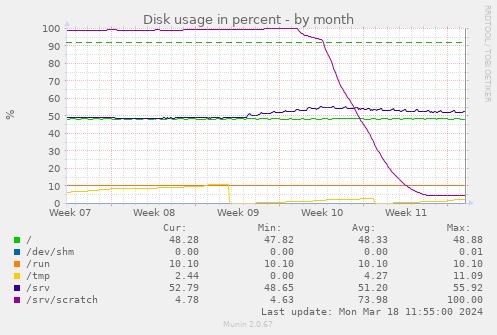
Debian is running a "vcswatch" service that keeps track of the status of all packaging repositories that have a Vcs-Git (and other VCSes) header set and shows which repos might need a package upload to push pending changes out. Naturally, this is a lot of data and the scratch partition on qa.debian.org had to be expanded several times, up to 300 GB in the last iteration. Attempts to reduce that size using shallow clones (git clone --depth=50) did not result more than a few percent of space saved. Running git gc on all repos helps a bit, but is tedious and as Debian is growing, the repos are still growing both in size and number. I ended up blocking all repos with checkouts larger than a gigabyte, and still the only cure was expanding the disk, or to lower the blocking threshold. Since we only need a tiny bit of info from the repositories, namely the content of debian/changelog and a few other files from debian/, plus the number of commits since the last tag on the packaging branch, it made sense to try to get the info without fetching a full repo clone. The question if we could grab that solely using the GitLab API at salsa.debian.org was never really answered. But then, in #1032623, G bor N meth suggested the use of git clone --filter blob:none. As things go, this sat unattended in the bug report for almost a year until the next "disk full" event made me give it a try. The blob:none filter makes git clone omit all files, fetching only commit and tree information. Any blob (file content) needed at git run time is transparently fetched from the upstream repository, and stored locally. It turned out to be a game-changer. The (largish) repositories I tried it on shrank to 1/100 of the original size. Poking around I figured we could even do better by using tree:0 as filter. This additionally omits all trees from the git clone, again only fetching the information at run time when needed. Some of the larger repos I tried it on shrank to 1/1000 of their original size. I deployed the new option on qa.debian.org and scheduled all repositories to fetch a new clone on the next scan: The initial dip from 100% to 95% is my first "what happens if we block repos > 500 MB" attempt. Over the week after that, the git filter clones reduce the overall disk consumption from almost 300 GB to 15 GB, a 1/20. Some repos shrank from GBs to below a MB. Perhaps I should make all my git clones use one of the filters.

Gunnar Wolf: After miniDebConf Santa Fe

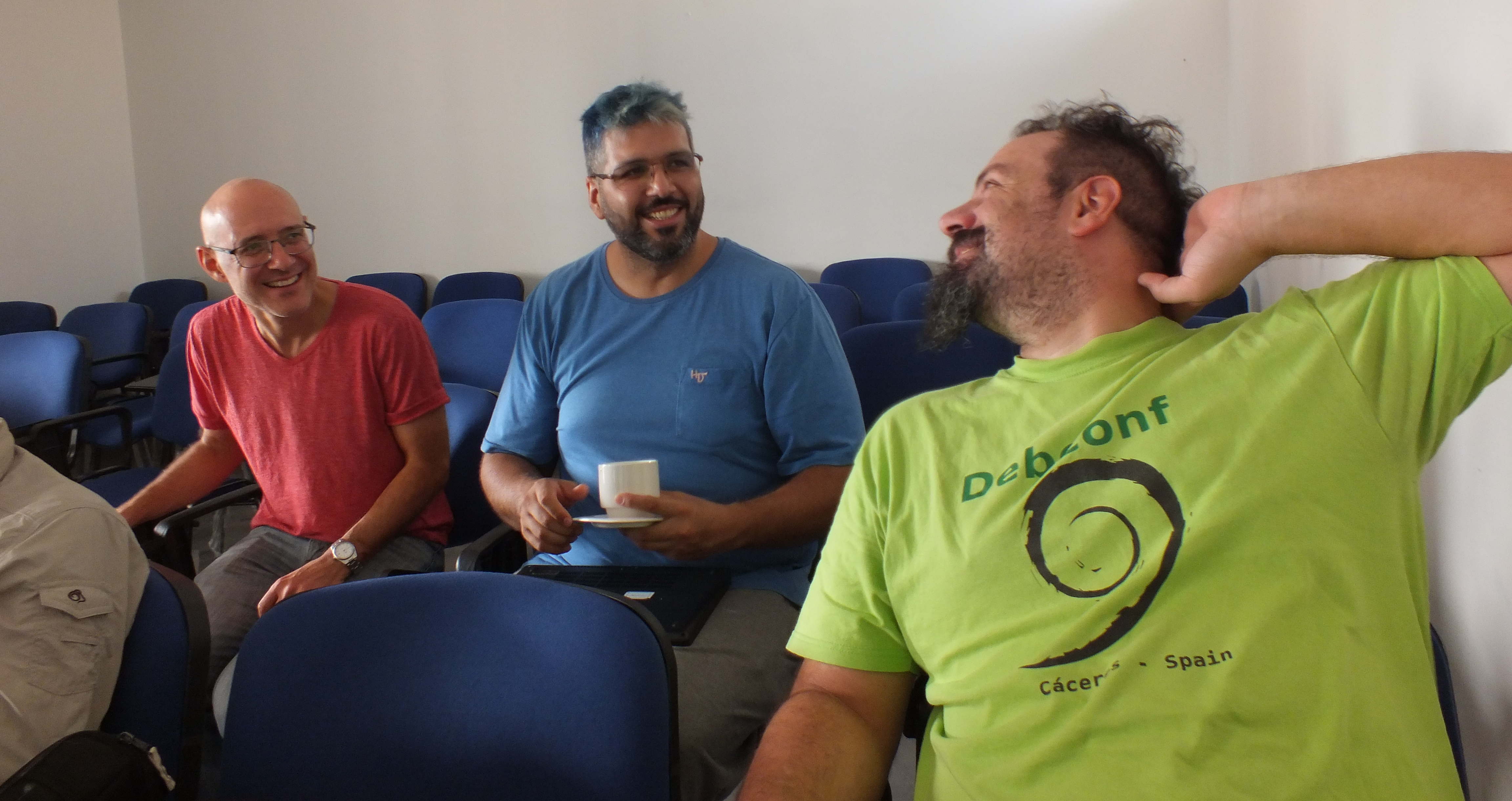
Last week we held our promised miniDebConf in Santa Fe City, Santa Fe province, Argentina just across the river from Paran , where I have spent almost six beautiful months I will never forget. Around 500 Kilometers North from Buenos Aires, Santa Fe and Paran are separated by the beautiful and majestic Paran river, which flows from Brazil, marks the Eastern border of Paraguay, and continues within Argentina as the heart of the litoral region of the country, until it merges with the Uruguay river (you guessed right the river marking the Eastern border of Argentina, first with Brazil and then with Uruguay), and they become the R o de la Plata. This was a short miniDebConf: we were lent the APUL union s building for the weekend (thank you very much!); during Saturday, we had a cycle of talks, and on sunday we had more of a hacklab logic, having some unstructured time to work each on their own projects, and to talk and have a good time together. We were five Debian people attending: santiago debacle eamanu dererk gwolf @debian.org. My main contact to kickstart organization was Mart n Bayo. Mart n was for many years the leader of the Technical Degree on Free Software at Universidad Nacional del Litoral, where I was also a teacher for several years. Together with Leo Mart nez, also a teacher at the tecnicatura, they contacted us with Guillermo and Gabriela, from the APUL non-teaching-staff union of said university. We had the following set of talks (for which there is a promise to get electronic record, as APUL was kind enough to record them! of course, I will push them to our usual conference video archiving service as soon as I get them)

Hour Title (Spanish) Title (English) Presented by
10:00-10:25 Introducci n al Software Libre Introduction to Free Software Mart n Bayo
10:30-10:55 Debian y su comunidad Debian and its community Emanuel Arias
11:00-11:25 Por qu sigo contribuyendo a Debian despu s de 20 a os? Why am I still contributing to Debian after 20 years? Santiago Ruano
11:30-11:55 Mi identidad y el proyecto Debian: Qu es el llavero OpenPGP y por qu ? My identity and the Debian project: What is the OpenPGP keyring and why? Gunnar Wolf
12:00-13:00 Explorando las masculinidades en el contexto del Software Libre Exploring masculinities in the context of Free Software Gora Ortiz Fuentes - Jos Francisco Ferro
13:00-14:30 Lunch
14:30-14:55 Debian para el d a a d a Debian for our every day Leonardo Mart nez
15:00-15:25 Debian en las Raspberry Pi Debian in the Raspberry Pi Gunnar Wolf
15:30-15:55 Device Trees Device Trees Lisandro Dami n Nicanor Perez Meyer (videoconferencia)
16:00-16:25 Python en Debian Python in Debian Emmanuel Arias
16:30-16:55 Debian y XMPP en la medici n de viento para la energ a e lica Debian and XMPP for wind measuring for eolic energy Martin Borgert
As it always happens DebConf, miniDebConf and other Debian-related activities are always fun, always productive, always a great opportunity to meet again our decades-long friends. Lets see what comes next!

15 March 2024

Patryk Cisek: OpenPGP Paper Backup

openpgp-paper-backup I ve been using OpenPGP through GnuPG since early 2000 . It s an essential part of Debian Developer s workflow. We use it regularly to authenticate package uploads and votes. Proper backups of that key are really important. Up until recently, the only reliable option for me was backing up a tarball of my ~/.gnupg offline on a set few flash drives. This approach is better than nothing, but it s not nearly as reliable as I d like it to be.

14 March 2024

Gregor Herrmann: teamwork in practice

teamwork, or: why I love the Debian Perl Group: elbrus has introduced a (very untypical) package into the Debian Perl Group in 2022. after changes of the default compiler options (-Werror=implicit-function-declaration) in debian, it didn't build any more & received an RC bug. because I sometimes like challenges, I had a look at it & cobbled together a patch. as I hardly speak any C, I sent my notes to the bug report & (implictly) asked for help. & went out to meet a friend. when I came home, I found an email from ntyni, sent less than 2 hours after my mail, where he friendly pointed out the issues with my patch & sent a corrected version. all I needed to do was to adjust the patch & upload the package. one more bug fixed, one less task for us, & elbrus can concentrate on more important tasks :)
thanks again, niko!

Next.

Previous.