Search Results: "ag"

20 February 2010

John Goerzen: Is the Roman Emperor Still Your God?

In ancient Rome, the Imperial cult was the worship of the Roman emperor as a god. It came to be at roughly the same time as Christianity. In the cult of the emperor, Caesar was revered as a deity. According to Harvey Cox, This was what we might today call a civil religion it had its holidays, processions, and holy sites throughout the empire. Adherence to it was required of all of the emperor s subjects, wherever they lived and whatever other deities they also worshiped. It was the religious and ideological mucilage that held the far-flung empire together. Perhaps you see where this is going. There was a certain group that found the imperial cult, well, repugnant. They felt their own goals bringing their god s peace and justice to the world were incompatible with this sort of devotion to a human institution, and the very institution that had killed their leader at that. Their reaction went like this:
Regarding worship of the emperor, Christians responded with an unequivocal no. They claimed that Jesus Christ was God s kyrios ( anointed one in Greek), but since kyrios was one of the titles attributed to Caesar, they refused to participate in the imperial cult. They were willing to pray for the emperor and for his health, but they stubbornly refused to pray to him or offer ritual tribute. They recognized that one could not be a follower of Jesus while also honoring a rival to the loyalty their faith in him and his Kingdom required; therefore, not even one pinch of incense on the imperial altar. This defiance of the political religion of the empire, which led their critics to brand them subversive, landed many of them in arenas with salivating lions. Harvey Cox in The Future of Faith
Now, you may be wondering, why am I asking if anyone still worships the emperor of a long-extinct empire? I maintain that this practice is still alive and well, just under a different name. I have been interested in some of the debates about American institutions that choose to perform neither the national anthem nor the pledge of allegiance. Many of these institutions are Mennonite, and their reason for not participating in these two particular acts mirrors that of the early Christians refusing to worship Caesar: namely, their goal is to bring about God s peaceful and just kingdom on earth, and no country, no human institution at all, can ever command greater loyalty than that cause. Moreover, the American national anthem is a particularly violent one, celebrating the taking of life right there at the beginning. Not completely compatible with the ethics of a church trying to bring about a more peaceful world, right? It is from that basis that many Mennonites, and our institutions, do not perform the national anthem or say the pledge of allegiance. For myself, when the national anthem is being performed, I will stand out of respect for those around me for whom the moment is important, but I do not sing. I am deeply appreciative that the United States, like many other countries, makes it legal to do this. I am heartened by the fact that I do not risk a confrontation with the lions over my religious stance today. Goshen College, a Mennonite institution, recently decided to go back on a century of history (which goes back farther than the anthem itself, which was only adopted in 1931) and will now be performing the anthem, followed by a prayer, before select sporting events. And by so doing, they fail both to act in accordance with the way of Christ, and to be a patriot. They fail to act for peace and justice by playing an anthem that supports and glorifies war and violence. And they fail to be patriotic. Patriotism and nationalism are different things. It s easy to be nationalistic to get up there and sing a song that everyone wants you to sing. It is far more difficult to be patriotic. Being patriotic in the United States means using the freedoms we have to improve our country. Goshen ought to use its freedom to not observe the national anthem as a way to try to draw a line in the sand against violence, to suggest that our anthem fails to adequately recognize the character of the American people and who we want to be, and to suggest a better alternative. After all, those people who are venerated today as patriots anyone from Martin Luther to Thomas Jefferson to Martin Luther King stood up to their fallible human governments to seek positive change. Instead of a route both religious and patriotic, Goshen College has chosen one that is neither. I am deeply disappointed that 300 phone calls have apparently cowed their leadership. What have we come to when our ancestors braved the lions, and we give up our principles over the fear of bad publicity? Ah, Goshen, perhaps you are thinking that you could spare a few pinches of incense for Caesar after all?

19 February 2010

Gustavo Noronha Silva: WebKitGTK+ testing

Most times when I blog about WebKitGTK+ it s to talk about new features, and their usage in Epiphany. This time I d like to tell those who care more about our test infrastructure. Like I said in my previous post, testing is something we take very seriously in WebKit land. It would be hard to get such a complex project, with such diversity of platforms moving forward without automated testing. Apple hosts a buildbot master that controls a whole lot of build slaves, for many platforms. Today we added the fourth WebKitGTK+ build slave to the family: 64bits release. This makes up for 4 build slaves in total, 2 release bots sponsored by Collabora, and 2 debug bots sponsored by Igalia. These bots build WebKitGTK+, and then run what we call the layout tests . I use quotes there because the name is a bit misleading. Despite being HTML/JavaScript tests, they cover a whole lot of functionality, and tests for regressions in many areas, including security, crashes, animations, media playing, DOM behaviour, and javascript API behaviour. WebKitGTK+ bots currently run 6397 tests, which represent about half the available tests. Our bots are also, as of today, the first ones to run platform-specific API tests. Almost a year ago we started writing small tests based on glib s GTestSuite, and they have been very valuable in helping us make sure our API expectations aren t breaking (at least unknowingly), and to be able to test things that would be very hard to have Layout Tests for. So, yay! Thanks to everyone involved. Back to layout tests, now: the other half is currently skipped because of one of three main reasons: The first one is the worst of all. It means we have broken functionality, or lack web compatibility. The second one is less bad, we can usually trust layout, and rendering to be good because most of the rendering code is shared (thought there are exceptions, of course). Render dumps are a special way of representing the render tree as text, and we need to generate our own results because of differences in things such as font sizes. The third one is also pretty bad - it means we cannot test some features; DumpRenderTree is an application that uses the port s API to run the tests, and provide additional JavaScript API through JavaScriptCore. If you feel like helping WebKitGTK+, choosing a bunch of these (specially non-render-dump) skipped tests to make them pass could likely be a good first step =).

Matthew Garrett: Pittsburgh

As I mentioned, I headed to Pittsburgh last week to give some talks at CMU and find out something about what they're doing there. Despite the dire weather that had closed the airport the day before, I had no trouble getting into town and was soon safely in a hotel room with a heater that seemed oddly enthusiastic about blasting cold air at me for ten seconds every fifteen minutes. Unfortunately, it seems that life wasn't as easy for everyone - ten minutes after I arrived, I got a phone call telling me that the city had asked CMU to cancel classes the next day.

This turned out to be much less of a problem than I'd expected - whether because of their enthusiasm to learn about ACPI or because they simply hadn't noticed the alert telling them about the cancellation, a decent body of students turned up the next morning. After a brief chat with Mark Stehlik, the assistant dean for undergraduate education, I headed off to the lecture hall. The fact that I can now just plug my laptop into a VGA cable and have my desktop automatically extend itself continues to amaze me, as does OpenOffice's seemingly unerring ability to get confused about which screen should have my content and which should be showing me the next slide. Nevertheless, facts were imparted and knowledge dropped on those assembled. I'm even reasonably sure that the contents were factually accurate, which is a shame because the most attractive part of teaching always struck me as being able to lie to students who will then happily regurgitate whatever you tell them because in case it turns up on the exam. Perhaps this is why I'm safer out of academia.

Lunch offered an opportunity to visit the Red Hat sponsored lab, which was pleasingly located somewhere other than a basement. The guy on the right of the picture is Greg Kesden, the director of undergraduate laboratories in CS there - it was wonderful to get an opportunity to see the machines getting used, and students seemed genuinely appreciative of the facility.

After lunch I spent a while talking to Satya about the Internet Suspend and Resume project. This is an impressive combination of virtualisation and migration, using a Fedora-based live image to bring up an OS on arbitrary hardware before downloading a machine image and launching it. The majority of the data is pulled in on demand, meaning that initial performance can be slow but ensuring that data is only downloaded if it's needed. When the user is finished, the delta between the original image and the new one can be pushed back to the server while remaining cached on the local machine in case the image is used again.

It's an interesting approach, combining the flexibility of thin clients with the advantages of having actually useful computing power at the local end. There's a few functional awkwardnesses, such as some VMs being unhappy if images are migrated between machines with different CPU features, and it obviously benefits from having significant bandwidth. But the idea of being able to combine the convenience of a floating session with the knowledge that you can still keep copies of your data on you is an attractive one, and I'd love a future where I can move my session between my laptop and a desktop.

After that there was some time to talk to Bill Scherlis and Philip Lehman about the software engineering courses that CMU run. Part of the minor in software engineering includes a course requirement to make a meaningful contribution to an existing software project, from design through to submission and upstream acceptance. I had the opportunity to talk to a couple of the students about this and the differences they found between working with the Mozilla and Chrome communities, which I'll try to write up at some point.

Finally I gave a presentation on Fedora and some of the issues that we face in providing a useful OS when patents and recalcitrant hardware vendors do their best to thwart us. Despite the ice outside and the significantly-below-freezing temperatures, enough people turned up that sorties had to be sent out to find extra chairs. It was great to see how interested people were in learning about what we do, although it's probably the case that the free pizza did help encourage people.

After that it was an early trip back to the airport, where I found that my plane was delayed and the only "restaurant" still open was McDonalds. Even so, I left with the feeling that it had been an interesting and educational visit. Many thanks to David Eckhardt, who runs the OS course I presented to and who looked after me all day - thanks too to Joshua Wise who picked me up when David was running late due to the ground being covered with blocks of ice.

Steve Kemp: If you were a comic book character, what character would you be?

I've been overhauling the way that I am host a number of virtual websites upon my main box. Partly to increase security, and partly for a cleaner separation or roles, ownership, and control. (In general everything on my box is "mine", but some things are "ours"...) After a fair amount of experimentation I decided that I wasn't willing or able to rewrite all my Apache mod_rewrite rules just yet. So my interim plan was to update each existing virtual host: To make it clear what the users were for I decided that every hosting-user would have an "s-" prefix. So the virtual host "static.steve.org.uk" was initially going to be served by the s-static user. The thttpd configuration file would look like this, and would be located in /etc/thttpd/sites/static.steve.org.uk:
host=127.0.0.1
port=1008
dir=/home/www/static.steve.org.uk/htdocs/
chroot
user=s-static
throttles=/etc/thttpd/throttle.conf
logfile=/home/www/static.steve.org.uk/logs/thttpd.log
pidfile=/home/www/static.steve.org.uk/pid/file
(I wrote a trivial script to stop/start all the sites en mass, and removed the default thttpd init script, logrotation job, and similar things.) How did I decide which port to run this instance under? By taking the UID of the user:
steve@skx:~$ id s-static
uid=1008(s-static) gid=1009(s-static) groups=1009(s-static)
With this in place I could then update the Apache configuration file from serving the site directly to merely proxying to the back-end server:
<VirtualHost *>
    ServerName  static.steve.org.uk
    # Proxy ACL
    <Proxy *>
        Order allow,deny
        Allow from all
    </Proxy>
    # Proxy directives
    ProxyPass          /   http://localhost:1008/
    ProxyPassReverse   /   http://localhost:1008/
    ProxyPreserveHost on
</VirtualHost>
So was that all there is to it? Sadly not. There were a couple of minor issues, some of which were:
cronjobs
I have various cron-jobs in my main steve account which previously updated blog indexes, etc. (I use namazu2 to make my blog searchable.) I had to change the ownership of the existing indexes, the scripts themselves, and move the cronjob to the new s-blog user.
cross-user dependencies
I run a couple of sites which pull in content from other locations. For example a couple of list summaries, and archives. These are generally fed from a ~/.procmail snippet under my primary login. Since my primary login no longer owns the web-tree it is no longer able to update things directly. Instead I had to duplicate a couple of subscriptions and move this work under the UID of the site-owner.
I'm no longer running apache
For a day or two I'd forgotten I was using the apache facility to include snippets in my site; such as links to my wishlist. Since I'm not using Apache in the back-end server-parsed files no longer work. Happily I'm using a simple template-based setup for my main sites, so I updated the template-parser to understand "##include ./path/to/file". For example this source file produces my donation page. The upshot is my "static" site is even more static, which is a good thing.
uploads are harder
Several of my domains host entirely static content which is generated on my main desktop machine, and then uploaded via rsync post-build. I had to add some more accounts and configure SSH keys, then update the uploading routines/Makefiles appropriately. Not a major annoyance, but suddenly my sshd_config file has gone from "PermitUser steve,backup" to including many additional accounts.
The single biggest pain was handling my my mercurial repositories - overhauling that took a bit of creativity to ensure that nothing was broken for existing or new checkouts. I wish that a backport of mercurial-server was trivial because I'd love to be using that. In general though watching the thttpd logs has been sufficient to spot problems. I had to tweak things a little to generate statistics properly, but otherwise all is good. Why thttpd? Well small, lightweight, and the ability to run CGI scripts. Something missing from nginx for example. I'm still aiming to remove apache2 from the front-end - it is mostly just a dumb proxy, but it does perform some ACL operations and expand mod_rewrite rules. I could port those to another engine .. but not today. The most likely candidates are nginx, perlbal, or lighttpd - each of these should be capable of doing simple ACL checks, and performing mod_rewrite-like rules. ObFilm: Mallrats

Bernhard R. Link: reprepro 4.1.0 and new Packages.diff generation

I've just released reprepro 4.1.0 and uploaded it to unstable. The most noteworthy change and the one where I need your help is that the included rredtool program can now generate Packages.diff/Index files when used as export-hook by reprepro. (Until now you had to use the included tiffany.py script, which is a fork of the script the official Debian archives use. That script is still included in case you prefer the old method). So instead
DscIndices: Sources Release . .gz tiffany.py
DebIndices: Packages Release . .gz tiffany.py
you can now use
DscIndices: Sources Release . .gz /usr/bin/rredtool
DebIndices: Packages Release . .gz /usr/bin/rredtool
to get the new diff generator. The new diff generator has am import difference to the old one: It merges patches so every client should only need to download and apply a single patch, and not multiple after each other, thus reducing the disadvantages of Packages.diff files a bit (and sometimes even reducing the amount of data to download considerably). While reprepro and apt-get (due to carefully working around bugs/shortcomings of older versions of apt) seem to work, I don't know if there are other users of those files that could be suprised by that. If you know any I'd be glad if you could test them or tell me about them.

Olivier Berger: Vid os de certaines confs du th me D veloppement des RMLL 2009

Free Electrons vient de mettre en ligne des vid os des conf rences qu ils ont film es aux RMLL 2009.
Une partie des vid os porte sur le th me D veloppement que j ai coordonn . Voici la liste des interventions film es : Le son n est pas toujours top, mais c est fait avec les moyens du bord, b n volement ;) Vous trouverez les pointeurs vers les vid os et les slides chez Free Electrons (en bas de liste). Et n oubliez pas : l dition 2010 remet a, avec un appel contributions toujours ouvert.

Dirk Eddelbuettel: U of C ACM talk

Fellow GSoC mentor and local ACM masterminder Borja Sotomayor had invited me a few months ago to give a talk at the ACM chapter at the University of Chicago. Today was the day, and the slides from the 50-minutes talk on R and extending R with Rcpp are now on my presentations page.

Gunnar Wolf: Computer education parallelisms

I opened Slashdot's Looking back from the 1980s at computers in education article because I am quite convinced of the point some of the commenters argued before me, (and it's good to know others think as you do ;-) ) When I got close to computers, learning computing for children basically meant learning programming in a fun way. For years, my hobbies included Logo and BASIC. At age 7 (by 1983), typing TeX and using Emacs at the computer of the institute where my father worked, I started walking the path I took for my professional life. When I taught computing to high school students as my first paid job (which didn't last long, only a semester, as for an untrained 20 year old it is very hard to control a group of kids nearly his age), I tried to teach some basic BASIC programming (which was the best I knew then)... But no, both students and the school wanted me to focus on teaching MS Office applications. It seemed stupid for me 14 years ago, and it still seems stupid for me today. Anyway, on Slashdot, I came across this beautiful way to explain what computer education should mean:
"computing is no longer taught in schools (parents look quizzical), they are simply 'trained' (parents look like they vaguely get it). if this was sex instead of computing that was taught in schools, would you prefer that your kids have sex _education_ or sex _training_? (parents finally get it)".
By the way, if you are interested in reading a bit of paleofuturism, to feel the joy and excitement with which computer-aided education was seen 30 years ago, be sure to get the Classroom Computer News issue for September-October 1980, linked from the Slashdot article (and copied over here for your convenience, of course!)
AttachmentSize
Classroom Computer News vol. 1 no. 1, sep-oct 19803.54 MB

18 February 2010

Bastian Venthur: Reportbug-ng now supports complex queries

Until today you could only use reportbug-ng to query the BTS with simple queries like packagename , bugnumber , tag:patch , etc. But the BTS actually supports composite queries like severity:grave tag:patch which returns bugreports with severity grave and a patch. The underlying Python library python-debianbts also supported this right from the start, but reportbug-ng did not make use of it. Last weekend I finally had the time to fix that and the result is on it s way to unstable. Composite queries provide a very convenient way to find cheap NMU candidates: the query "severity:critical severity:grave severity:serious tag:patch" will return release critical bugs which have a patch. Now you can just go through this list, pick an open bug, test the patch and do what s necessary to release Squeeze in time. Next item on my list is an option to hide closed bugs, maybe next weekend.

Bernd Zeimetz: merkaartor svn snapshot uploaded to experimental

As the release of version 0.15 of Merkaartor (a map editor for OpenStreetMap.org) is planned for the end of February, I've uploaded a svn snapshot based on revision 19956 to Debian experimental. Please test it and report bugs to the BTS as soon as possible, so I can triage and forward them to upstream.

Alexander Reichle-Schmehl: RC-Bug statistics for Squeeze, calendar week 7:

Note: Please see RC-Bug statistics for Squeeze, calendar week 7 for an explanation of the numbers.
Total:699+49
Affecting Squeeze:559+41
Squeeze-only:117+23
Unfixed bugs remaining in Squeeze:442+18
Of these 442 bugs...
... are pending36+4
... are patched:65+1
... are duplicates:47+-0
... are in Non-free or contrib:10+10
... are claimed by someone:14-3
... are fixed in the delayed queue:5-1
... are somehow marked as fixed:53+14
Or in other words:
Release critical bugs left in squeeze, when ignoring all these:
262 (+2 compared to previous week). With this release managers views, 472 (+48 compared to previous week) bugs remain to be fixed somehow before we can release. Some notes: So much for this week. Let's see, how the numbers evolve in the coming seven days...

Martin-&#201;ric Racine: Ubuntu/Lucid: recovering from yesterday's messy update

Yesterday a silly oversight in the packaging of udev in Ubuntu/Lucid produced a breakage that consistently makes dpkg barf. Here's a simple command line recipe to recover from it. In your terminal application, type: sudo sed -i 's#copy_exec /lib/udev/firmware.sh#copy_exec /lib/udev/firmware#' /usr/share/initramfs-tools/hooks/udev && sudo dpkg -a --configure && sudo aptitude update && sudo aptitude safe-upgrade ...then press enter. You should be able to resume normal operation right after. PS: as suggested by others, I revised the above snippet to use sed locally, since not everyone has patch installed.

Mike Hommey: Massive FAIL

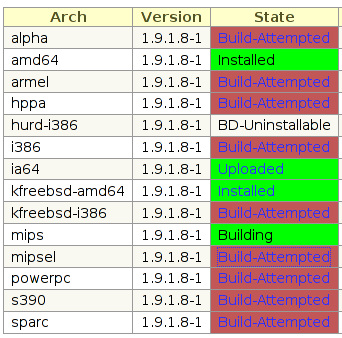
Massive xulrunner buildd failure In there, a lot are due to dh_auto_configure not doing the right thing for autoconf 2.13 generated configure files, others are due to make setting MAKEFLAGS to w , which prevents make -s to do what I expected it to do, armel has yet another crasher in the test suite (*sigh*), and I broke mipsel with the mips patch. 1.9.1.8-2 should fix the first two, and allow me to debug the armel issue (I disabled the test suite to be able to have the buildds generate the binaries, as they are much faster than the porterbox). Mipsel will have to wait for 1.9.1.8-3. This also means 1.9.2 is delayed. Again. (and upstream releasing Firefox 3.5.8 one day later than scheduled didn t help either) Update: I stand corrected, the one responsible for MAKEFLAGS setting to w seems to be make itself, not dh.

Andrew Pollock: [life] Kitchen renovations started

Sarah got a call from the contractor on the weekend, saying he wanted to make a start on the kitchen demolition on Wednesday. So we've moved everything from the kitchen into the living room (fridge and stove included), and they started work today. Boy, did they start! It's all gone already. All of the cabinets, and the existing lighting, and the fan. Here's how it looked last night: Diagonal view from the breakfast nook View back in the opposite direction View from the doorway Another view of the breakfast nook Unfortunately there's no working lights any more, so I couldn't take photos of how things look tonight. I'll have to try and get some in the morning before the contractor gets here. It's sounding like it's going to take longer than one and a half weeks, so we're going to be eating out for a while (or cooking with the microwave in the living room). Conveniently (depending on how you want to look at it given the temperature there) I have a work trip to New York next week, and Sarah's going to come along for a few days as well, so that'll help kill some time. I think our next immediate need is to decide on what colour to paint the walls. Some light shade of green is a current contender.

17 February 2010

Martin F. Krafft: ACTA documents leaked

Shortly after I wrote my last article about ACTA and the lack of transparency, I was delighted to find out that a report of the recent negotiations in Mexico has been leaked. I find it a bit disconcerting that our politicians, who are theoretically supposed to represent our interests, are writing documents that can leak to the public, when they should have been available to the public from the start. The document and the coverpage are available for direct download. Michael Geist has a first analysis
A brief report from the European Commission authored by Pedro Velasco Martins (an EU negotiator) on the most recent round of ACTA negotiations in Guadalajara, Mexico has leaked, providing new information on the substance of the talks, how countries are addressing the transparency concerns, and plans for future negotiations. (read more )
NP: Dimmer: Degrees of Existence

Bastian Venthur: Links not opening in Thunderbird 3?

If you re using KDE and upgraded to Thunderbird 3 lately you might have the problem that links in emails don t open in a browser anymore. For my case that happened even without a user visible error message. If that sounds familiar for you, check the error console (Tools/Error-Console). If there is an error like:
Error: uncaught exception: [Exception... "Component returned failure
code: 0x80004005 (NS_ERROR_FAILURE)
[nsIExternalProtocolService.loadUrl]   nsresult:  0 80004005
(NS_ERROR_FAILURE)   location:  JS frame ::
chrome://communicator/content/contentAreaClick.js :: openLinkExternally
:: line 188   data: no]
Then Thunderbird just (silently) fails to launch the browser. Guido pointed me to gconftool. gconftool -R / grep url-handlers told me that some components of gnome still had Firefox configured as http-handler (which is strange since it was rebranded to iceweasel ages ago). Resetting them solved the problem for me. The sad part of the story: x-www-browser, sensible-browser and KDE s http handler where all correctly configured and pointed to iceweasel. All applications behaved correctly only Icedove used a (for me) hidden setting pointing to firefox.

Stefano Zacchiroli: RC bugs of the week - issue 21

RCBW - #21 I've accumulated one more day of delay, but here is a full RCBW issue. Still, I've a nice good excuse for the extra delay: I've changed house in Paris, the new one is very small (a chambre de bonne), but also very comfortable. Without any further ado, here are this week's squashes: And here are the usual highlights:

Michal &#268;iha&#345;: phpMyAdmin demo server provides MariaDB

In addition to MySQL, the phpMyAdmin demo server now provides also MariaDB. It is based on OurDelta packages. So you can now choose either MariaDB or MySQL on login screen and play with either of database engines.

Masayuki Hatta: Freenet for Debian

The recent development of the situation in China or Iran reminds me of the importance AND fragility of the freedom of speech on the Net. As the influence by the Net on the general public grows, attempts by governments to control and tame the Net will be aggravated, in a more sophisticated, crowd-pleasing way (for example, by claiming a need for Internet Driver's Licenses). How can we deal with this? Freenet can be a key to solve this problem. After almost 10 years of continuous development, it seems that it finally became an usable product(I don't say it's perfect -- there are still a lot of things to be done, especially around its UI). Freenet has its own dark side and I don't expect that it will become the standard way of the communication over the Net, but we always need the last resort to enjoy our everyday life. Unfortunately, most of Freenet-related information on the Net, especially about the installation method on GNU/Linux, are severely outdated. Freenet is a Free Software(GPL'd), and Debian did have a .deb package for Freenet long long ago, but it's basically gone and defunct. Since the pace of current development is quite fast and sometimes the backward compatibility is broken, it's not really a good idea to ITP and upload Freenet to the main Debian archive for now. Thus, I cooked up up-to-date .deb packages of the modern Freenet and publish them by myself on people.debian.org. I tried to follow the Debian packaging convention as much as possible, so at least they can be installed & uninstalled cleanly ;-) Also, Build-Deps are carefully set, so you may rebuild it without much hassle if you need. Add the following to your /etc/apt/sources.list:
deb http://people.debian.org/~mhatta/debian/freenet ./
deb-src http://people.debian.org/~mhatta/debian/freenet ./
Then run "apt-get update" and install "fred" package. This is basically all you need(you might also want jSite or FMS). Then take a look at /usr/share/doc/fred/README.Debian. You might need to copy seednodes.fref into /var/lib/fred if you want to use Freenet's Opennet mode for the first time. After that, access http://localhost:8888 and follow the instructions. Recommended readings on the modern Freenet: Enjoy.

Tag this post with del.icio.us!

Russell Coker: Can the NBN Ever Break Even?

I previously wrote about how the National Broadband Network (NBN) seems more suited to porn delivery than regular Internet use [1]. It doesn t seem to be of much use really. In a particularly insightful comment John Hughes suggested that the real purpose would be TV delivery. The ABC is currently delivering 640*360 resolution MPEG4 files via iView for it s TV content. To use iView on Linux you need Jeremy Visser s Python-iView program [2] in conjunction with Luke Kenneth Casson Leighton s rtmp program [3]. Note that to get this working on Debian/Lenny you need to install the python-simplejson package as well. For the current ABC service it requires 251652 of data for a 3167.6 second Torchwood episode, that averages to 79.4KB/s of data. In contrast a video of Dan Gilbert from TED.com at high quality was in 640*480 resolution and required 301652KB of data for 1276.5 seconds which averaged out to 236.3KB/s. My ADSL2+ connection is theoretically capable of something over 1MB/s and occasionally gets such speeds for unusual download situations (such as downloading multiple large files at the same time). But generally I can t rely can t rely on sustained transfer rates of more than about 200KB/s. So I could watch streaming TED talks at reasonable quality, but for the best results I have to download them and watch them from disk. Assuming the same ratio of compressed data to raw pixels used for HDTV as used for TED talks a 1920*1080 HDTV resolution MPEG4 with the same quality as a TED talk would take 1600KB/s. It is possible to vary the compression level and possibly the usage of a TV stream would permit better compression than the usage of a TED talk for the number of pixels. But it seems reasonable to assume that something like 1600KB/s is needed for best HDTV, that is more than the vast majority of ADSL2+ installations can be relied on to sustain. But 100Mb/s would allow at least two 1920*1080 HDTV transmissions to be viewed at the same time, and maybe three or four as few homes have only one TV this should be of great interest. Now the question is how much people would pay for this. Currently there are two main pay TV companies in Australia, Foxtel which charges $916 for a 12 month plan [4] and Optus who s web site is so awful that I gave up before discovering what they cost (I will assume that they are competitive with Foxtel). Now I think it s reasonable to assume that $916 is at the high end of what potential customers are prepared to pay, as they are competing with free to air TV, DVD sales, Youtube, and downloads of pirate content. The current bank interest rate on term deposits from the Commonwealth bank is 6.3%, the interest rate on raising the finance would have to be greater than that let s assume 7%. So the $5000 per household will require an interest payment of $350 per annum. If a household signs up to pay TV services at a cost of $1200 per annum that might be enough money to pay slightly more than $350 to the NBN plus make a profit for the pay TV company. So if every household in Australia signed up for pay TV over the NBN it should be profitable. But that seems unlikely. The majority of the Australian population (IE the majority of the city population) is used to paying not much more than $240 per annum for a basic phone service and not much more than $360 per annum for a basic broadband Internet service. A bundled deal of $1600 per annum for phone, Internet and pay TV should allow the pay TV company and the NBN to be barely profitable if everyone accepts the deal (unless of course interest rates rise). If half the population aren t interested then the bundled deal would have to cost $2000 to have the potential for being profitable. If three quarters of the population aren t interested then it would have to cost $2300 or more! The Australian Bureau of Statistics documents that in 2008 the median household disposable income in capital cities was $593 per week [5]. So it seems that the idea of the NBN being profitable is based on plan to have more than three weeks of household disposable income per year being spent on Internet/phone/TV services. But fortunately for the pay TV companies and the content companies there is no requirement for the NBN to be profitable, it s being paid by tax money so if it loses money then we can just pay more tax! It s the ideal public private partnership , the citizens take all the risk and the corporations reap all the profits! James Purser describes how Stephen Conroy gave the TV networks something between $250,000,000 and $500,000,000 a year for the next two years [6]. It was claimed that this huge gift would be conditional on the production of more Australian content but they ended up not putting any conditions on it. In a strange coincidence Stephen Conroy did this a month after having a meeting with Kerry Stokes (head of Channel 7). Based on this I don t believe that there was ever a serious plan to make the NBN profitable. I think that the plan was just to take our tax money and spend it on things that benefit friendly corporations. Really it s better for us if the government just hands out $500,000,000 at a time instead of spending $43,000,000,000 on a project that has the same aim of giving a few hundred million to cronies.

Next.

Previous.