Search Results: "ag"

1 March 2010

Steve Kemp: This is my land. All that pass through pay me tribute.

As previously mentioned I've switched my webserving over to a mixture of apache2 & thttpd. I chose thttpd as it is simple to configure for my needs, and supports the execution of CGI scripts. Some of the other simple webservers available to Debian's current stable release (such as nginx) don't support CGI so they were ruled out. Of course prior to choosing thttpd I looked at the state of the Debian package. Distressingly the package has no current maintainer and has several bugs open, including some that have been open for several years without comment. I've just made my second upload fixing a couple of bugs, including ones that I could see affecting myself, but now I'm done with it. In conclusion: On the one hand it is "just another webserver", on the other hand it is genuinely small, simple to configure, and has a couple of compelling features (CGI + throttling). So. Go. Adopt. Maintain. Pretty please... ObFilm: Red Sonia

Erich Schubert: Geo-Temporal visualization

I've been playing around a bit with Geo-Temporal visualization. Here's a screenshot of an experimental visualization on Google Maps:Geo-Temporal visualizationThe icons are placed on approximate coordinates; multiple events in a small area are aggregated into a single marker. The red sectors correspond to temporal information: to the right is the current day, a full turn corresponds to a duration of 7 days. Typical events listed on this map cover 1 to 4 hours in the evening of a day, resulting in a rather small sectors in typical angles corresponding to the seven days of a week. There are three larger events, one being a weekend workshop in Hamburg (covering the saturday and sunday sectors), a Friday to Saturday in Leipzig and an event incorrectly set for all tuesday in Dresden. M nchen on the other hand seems to take a day off on Saturday (in fact they have a full-week workshop on Lanzarote, on a part of the map not shown ...).While this visualization is quite fancy and can scale to arbitrary time window, I will not be able to add it to the public version of this map (which can be tried out on http://swing.vitavonni.de/).The rendering of so many polygons with Google Maps is just way to slow for all the browsers I tried. Maybe I could use cached png images instead and traditional overlays to improve performance.For some visualizations, it would also make sense to turn the sectors into a spiral, for example where the angle corresponds to the day of the month and the distance from the center corresponds to the month.

Alexander Reichle-Schmehl: [CeBIT] Free tickets for CeBIT

Sorry, I didn't had the time to update RC Bug statistics last week, and will probably also not be able this week, as I'll be quite busy, as CeBIT is about to start tomorrow, and I haven't written a script to create the statistics, yet. While we are talking about CeBIT, you might already know, that Debian will again be present there. This as partner of Univention, a German company using Debian as base for its own distribution. I would like to thank them very much for their short hand acceptance of us at their booth. If you intend to visit us (Hall 2, stand B36) and still have not ticket, feel free to drop me an E-Mail. We got some free tickets and I'll try to send you the link (you'll need to register at the CeBIT website and print your ticket yourself).

Steve McIntyre: Leaving Amino, on to ARM

Number 2: Although most of the details were finalised a while ago, I haven't blogged about this yet. I've been working at Amino for over four years, developing software for a range of Linux-based set-top boxes. It's been a good place to work for most of that time, but recently I've decided that it's time to find new employment. At the end of March, I'll be joining ARM as a Staff Software Engineer, working on Linux and other Open Source / Free Software with them. The job looks awesome, just about exactly what I've been looking for. And I'll be joining two more Debian folk who are working there already. Woo! :-)

Steve McIntyre: It's been a while

Apologies for not posting in a while. I've been a little busy of late, but I promise to fill in some of the details in the next few days. Number 1: Jo and I are engaged. We went to a nice restaurant on Saturday for her birthday. I totally surprised her by asking the question in her birthday card: "P.S. Will you marry me" at the bottom. The look on her face as she said "yes" was awesome. *grin* I had already surprised her a couple of weekends back by taking her to Paris for Valentine's weekend. She didn't know we were going until we got to the checkin desk for the Eurotunnel. Now I've got a problem, though: what do I do for a surprise two weekends from now? :-)

Debian News: Brief updates: linux 2.6.33, d-i 6.0 alpha1, DPL election and Qt 4.6.2/KDE 4.4

MJ Ray: Fairtrade Fortnight 2010: Fairtrade and IT

ftfnbutton
We re in the middle of Fairtrade Fortnight and it seems like the most advertised one yet, with Cadbury s adverts joining the push of this year s big swap theme: replace some of the stuff you d usually buy with Fairtrade alternatives. For IT workers, this is easier said than done. It s difficult enough to find more sustainably-produced products, let alone fairtrade ones. Our co-op has failed to achieve full marks on Prioritise and promote Fairtrade and other ethical and sustainable initiatives so far and I don t expect us to reach 100% any time soon. Just last Friday, Greenpeace International reported on more toxic electrical equipment, which shows that IT s environmental sustainability is far from a solved problem. Meanwhile, it doesn t seem like the fairness side is being addressed much yet. There are no fairtrade electrical product standards yet. Isn t there demand for fairer as well as greener production? Anyway, if you re looking for faitrade products this fortnight, you could try some fairtrade chocolate from the New Internationalist worker co-op. Food is further along, which is a good thing because it s pretty fundamental to life

Diego Escalante Urrelo: GNOMEs in Chile

Update March 1st, 24 UTC: Reynaldo Verdejo is ok, the list is complete! Update March 1st, 16 UTC: Alejandro Vald s, Fabi n Arias, Carlos R os Vera and Germ n P o-Caama o have been in contact with others in Chile. :) Probably by now some of you know or are worried about the situation in Chile. I m not chilean nor in Chile but I ve been following closely due to the considerable number of good friends I have there, most of them related to GNOME.
From The Big Picture (AP Photo/Roberto Candia) Juan Carlos Inostroza (blog down) suggested I publish the list of GNOME/Free Software people in Chile that has reported since the earthquake and are fine, here it goes: Known, found and good: Not know, nor found, we presume good but without cellphones: If you have been in contact with any of them, leave a comment, send a DM in twitter (@diegoe) and etc. List is not complete, I probably forgot someone, please remind me. Will update if I get news from anyone.

Gregor Herrmann: RC bugs 2010/07, 2010/08

not many closed RC bugs in the last two weeks. it seems we're running out of easy-enough-for-me bugs does this mean the freeze is near? :)

28 February 2010

Joachim Breitner: Exploiting sharing in arbtt

My automatic rule-based time tracker (arbtt), which is written in Haskell, collects every minute a data sample consisting mainly of the list of currently open windows (window title and program name). Naturally, this log grows rather large. Since October of last year, I collected 70,000 samples. I already went from a text-based file format to a binary format using Data.Binary, which gave a big performance boost.
But by now, I was afraid that this is not enough. My log file is now 30MB large. Looking at the memory graph of gnome-panel, it is taking up more than half of my memory. When running arbtt-stats, the Haskell run time system reports 569 MB total memory in use and the command finishes after 28.5 seconds. Naturally, the log file is highly redundant: Compressing it with bzip2 shrinks it to 1.6MB. But as I would like to preserve the ability to just append samples at the end, without having to read the file, I chose not just to add bzip2 or gzip compression. Rather, I am now exploiting a very obvious redundancy: Two adjacent samples usually list exactly the same windows, and a focus change only changes a flag. So now, when storing a string that is part of a sample, it will check if this string was already present in the previous sample and, in this case, just store the number of that string (one byte). Only if the string was not present it will write a zero byte and then the string. When reading the sample, the process is reversed. This greatly reduces the file size: It is down to 6.2MB. It also improves the memory consumption, due to Haskell s abilities with regard to sharing: When a reference to a string in a previous sample is read, then only one instance of this string is in memory, even if it occurs several times in the log. This brings the memory consumption down to 264 MB and the runtime to 17 seconds. I released the changes as version 0.4.5.1 to Hackage, Debian and as a Windows installer. The log file is not automatically converted, but new samples will be written in the compressed format. If you want to convert your whole file, you have to stop arbtt-capture, run arbtt-recover, and then move the hopefully noticeable smaller ~/.arbtt/capture.log.recovered to ~/.arbtt/capture.log.
The required code changes were not too big. I somewhat isolated the relevant code in the Data.Binary.StringRef module. Unfortunately, I have to use OverlappingInstances to be able to provide the special instance for String is there a cleaner way (besides the trick used for the Show class)?

Jordi Mallach: Tinyproxy 1.8

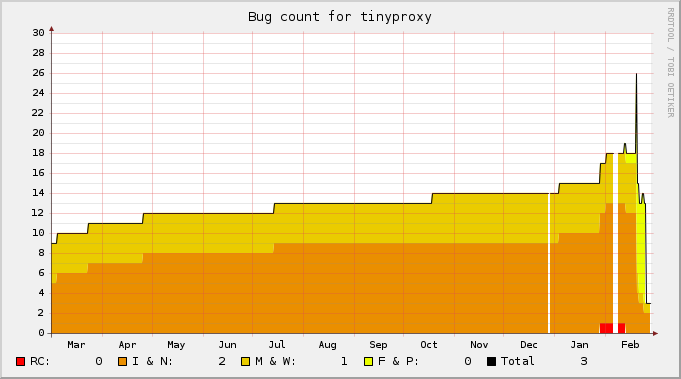
A while ago, I was asked to recompile Tinyproxy to enable transparent proxying support, which was not being compiled in etch's Debian package. As it tends to happen, once I got the source and looked into doing a quick rebuild with --enable-transparent-proxy, I noticed the package was in such a bad shape, that I couldn't just leave it like that, so I found myself doing a few more changes, which mostly involved updating the packaging so it didn't suck a lot, and splitting the Debian patches so things could be sent upstream or dropped when new versions appeared. However, even if Ed had asked me to go ahead and take over the package, this was meant to be a one-day effort, and soon I had forgotten about Tinyproxy, except for the ocassional bug mail getting through the PTS. It also didn't help that Tinyproxy had been pretty much dead upstream for years. So lately, a few bug reports were reporting a gasp new major Tinyproxy release, after 7 years of basically nothing. OMG, what do I see, there's a Git repo! And an upstream Bugzilla! Somehow, feeling I owed Ed a reply to his unanswered request, I went ahead and tagged tinyproxy 1.6.3-3.2 in collab-maint, and started working on the new version. Adding myself to Uploaders, and getting rid of the make no unnecessary changes vetto, I rewrote most of the packaging. And for a change, I looked for and found a #tinyproxy channel on IRC and told muks and obnox that the days of Tinyproxy's stay in the Debian/Ubuntu limbo were over.

They were happy to get a few bugs and patches forwareded upstream, and asked me why all of this hadn't happened before. Pitty is that a few longstanding issues were well known in Debian but not so obvious for the new upstream maintainers, and are present in 1.8.0. Hopefully all will be dealt with in 1.8.1 or the next major version. The lesson is: if you work on an apparently abandoned package, after cleaning the mess in your NMU, try to spend 15 more minutes trying to contact upstream (if available), pointing them at the patch tracker and our list of bugs: chances are many are still useful. Also, contact the Debian maintainer, and if they ask you to take over, at least post a RFA so someone else can. If you're a Tinyproxy user, I'd be happy to hear if the current package in Debian unstable works for you. If you were having weird issues with 1.6.x, chances are 1.8 will fix them. The package can be installed on stable with no extra dependencies, so if you're feeling adventurous, go ahead and upgrade.

Russell Coker: Carpal Tunnel Syndrome

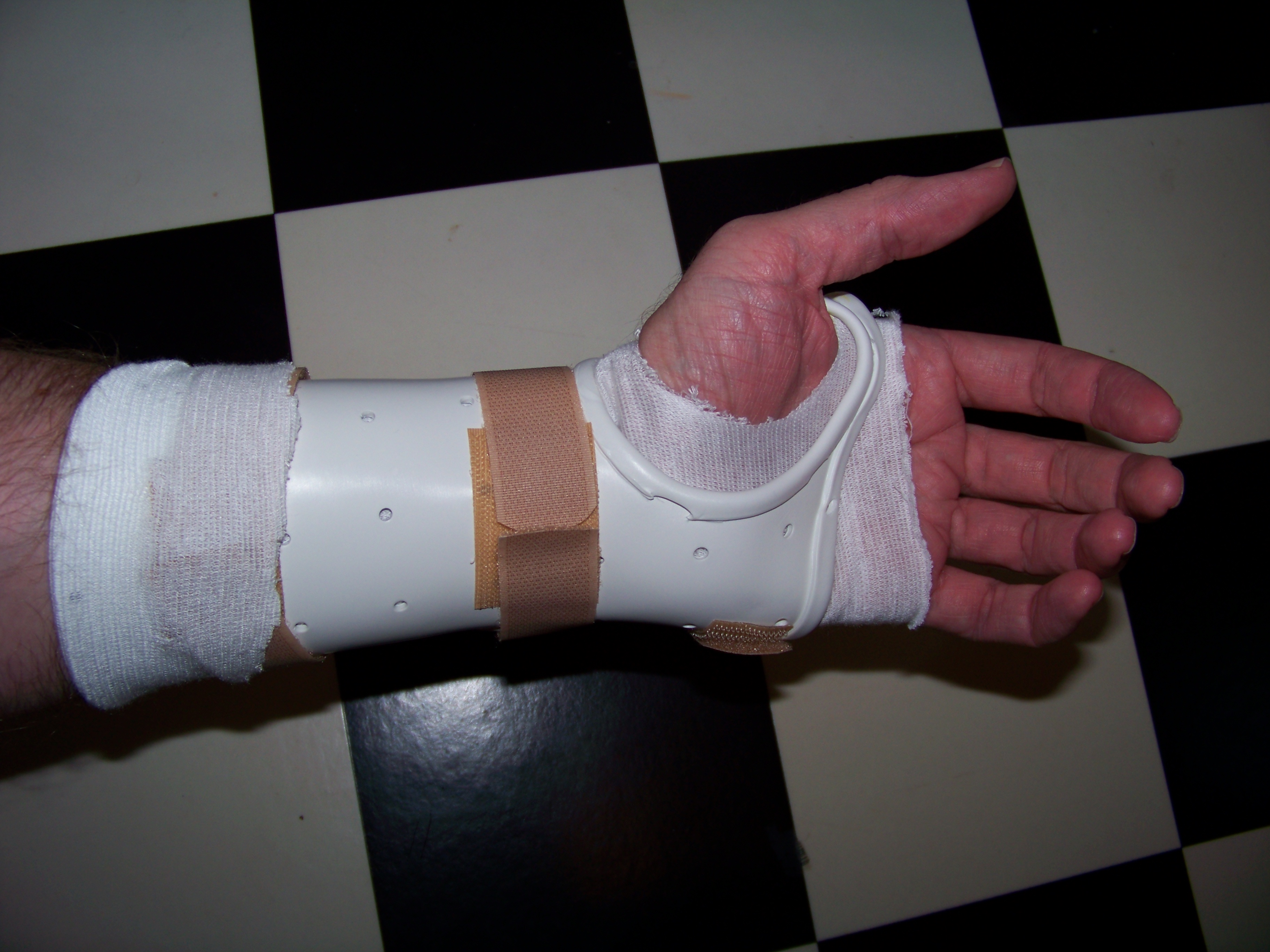
Wrist brace for Carpal Tunnel Syndrome Diagnosis A few weeks ago I was referred to a specialist for the treatment of Carpal Tunnel Syndrome. I first noticed the symptoms in early January, it started happening at night with a partial numbness in the fingers of my left hand. I didn t think much of it at first as it s the expected symptom of sleeping in a position that reduces the blood flow. But when it kept happening with my left hand and never happening with my right and then started getting worse (including happening during the day) I sought medical advice. The doctor asked me to bend my hand down (as if trying to touch my left elbow with the fingers of my left hand). Within about 10 seconds this caused numbness this result from bending one s wrist is a major symptom of CTS. Treatment On Thursday I saw a specialist about this, she agreed with the GP s diagnosis and made a wrist brace for me. She started by cutting off a length of a tube of elastic woven material (similar to a sock) and then cutting a thumb hole, that became the lining. Then to make the hard part she put a sheet of plastic in an electric saucepan (which had water simmering) until it started to melt and then used a spatula to fish it out. The melting temperature of the plastic wasn t that high (it was soft at about 50C when she put it on my arm), it wasn t at all sticky when it was partially melted, and it didn t seem to conduct heat well. After wearing the wrist brace non-stop for a few days I have noticed an improvement already. Hopefully I will make a full recovery in a matter of a month or so, I will probably have to wear a wrist brace when sleeping for the rest of my life, but that s no big deal it s more comfortable to sleep with a wrist brace than a partially numb hand. I ve also been prescribed a set of exercises to help remove scar tissue from the nerves. I haven t done them much yet. In terms of being annoying, the wrist-brace has 3mm diameter holes in a square grid pattern with a 25mm spacing. This doesn t let much air through and in warm weather my arm gets sweaty and starts to itch. I m thinking of drilling some extra holes to alleviate this the part which makes my arm itch doesn t need much mechanical strength. The only task which has been really impeded has been making peanut butter sandwiches, maybe it was making sandwiches not typing that caused CTS? ;) In any case I m not giving up typing but I would consider giving up peanut butter sandwiches. I really hope to avoid the surgical option, it doesn t seem pleasant at all. Other One final thing to note is that Repetitive Strain Injury (RSI) is entirely different. RSI is a non-specific pain associated with repetitive tasks while CTS is a specific problem in one or two nerves where they go through the wrist. RSI apparently tends to reduce the effective strength of the afflicted limb, while milder cases of CTS (such as mine) cause no decrease in strength of course a severe case of CTS results in muscle atrophy due to reduced nerve signals, but I shouldn t ever get that. Many people think that RSI and CTS are essentially the same thing I used to think that until a few weeks ago when I read the Wikipedia pages in preparation to seeing a doctor about it. I want to obtain some of the plastic that was used to make my wrist brace, it could be really handy to have something that convenient for making boxes, containers, and supports for various things among other things it doesn t appear to generate static. The low melting temperature will prevent certain computer uses (the hot air that comes out of a cooling system for a high-end CPU would probably melt it), but it could probably be used to make the case for an Opteron system with careful design. I m guessing that the cost of the plastic is a very small portion of the $150 I paid to the specialist so it shouldn t be that expensive and I m sure it would be even cheaper if it wasn t bought from a medical supply store. If I ever get time to do some work on an Arduino system or something similar then I will definitely try to get some of this plastic for the case. Also the Wikipedia page has a picture of what appears to be a mass-produced wrist brace. I think that it might be improved by having the picture of the custom one that I wear added to the page. I unconditionally license the picture for free use by Wikipedia and others under the CC by attribution license. So if anyone thinks that a picture of my hand would improve Wikipedia then they can make the change.

Kees Cook: egosurfing with git

I m never sure when my commits to Linux actually make it into an official release. Luckily, since releases are tagged, I can use git tag --contains COMMIT to find them. So, in a stunning display of inefficiency, here s what I use to find my commits:
git log --author='Kees Cook' --pretty=oneline   \
while read commit name; do \
    echo $(git tag --contains $commit   head -n1): "$name"; \
done
Which lets me know where my code is with respect to releases:
v2.6.33: x86, mm: Report state of NX protections during boot
v2.6.33: sysctl: require CAP_SYS_RAWIO to set mmap_min_addr
v2.6.32: proc: fix reported unit for RLIMIT_CPU
v2.6.31: modules: sysctl to block module loading
...

Ingo Juergensmann: Buildd.Net - to be shutdown soon

For over 6 years now I've been running Buildd.Net as a service for additional information about Debian autobuilder network. The reason for running Buildd.Net was simple: until then there was a web interface running on kullervo.debian.org, but generating the webpage took more and more time on that m68k box as Debian was growing in number of packages. That webpage was always a nice plus for m68k over other architectures and it was often asked for having such a page for those other archs as well. With taking over the webpage from kullervo the other archs were added as well and Buildd.Net was born.

Buildd.Net was open for other archs and flavours, as I called the different dists like unstable, non-free or even volatile or skolelinux. Buildd.Net was always buildd centric, contrary to buildd.debian.org, which is more package centric. Yes: was - as I'm shutting down Buildd.Net soon.

The reason for this is a change of interest after m68k has been removed from Debian because of the Vancouver proposal. Vancouver caused the death of m68k. Well, anyway. Without being an official Debian arch, the development on m68k came to an end. There was no progress anymore and on the other hand there were changes in the backend of the Debian autobuilder network, which made changes on Buildd.Net necessary. Requests for help in maintaining to adopt the changes were fruitless. The changes that Buildd.Net is needing are beyond my capability of programming.

And as a consequence I'm going to shutdown Buildd.Net in the near future. Not entirely, but significantly. It will return to its origins: being a m68k (and m32r) autobuilder informational page instead of trying to follow up the whole Debian autobuilder network. Just for the chance that m68k will be revived again somewhen.
Andreas Barth told me that most of the functions of Buildd.Net is available on buildd.debian.org as well, although not yet visible. I offered cooperation and help when he wants to implement Buildd.Net functionality into buildd.debian.org. I still believe that Buildd.Net is offering a worthwhile alternative view of the autobuilder network. But, as I already said, I can't maintain Buildd.Net code source any longer on my own. So I better shut the service down instead of delivering a broken service any longer, if there's noone interested in helping.

Anyway, I hope that you all enjoyed the service in the past!

Siegfried Gevatter: Zeitgeist Data-Source Registry

This post is about an upcoming feature in Zeitgeist 0.3.3 and is so far only available in checkouts from trunk or our PPA. It is expected to be released within the next weeks. Some weeks ago I implemented a new feature in Zeitgeist and I figured I d drop some lines about it. I m talking about a data-source registry. You may be wondering, what the hell is that even, a data-source? . So Zeitgeist is a database, a global event log, but it doesn t do any magic indexing or monitoring by itself; the information it logs needs to come from somewhere be it applications sending it to Zeitgeist themselves, daemons, plugins for applications, etc. Any such entity is called a data-source . Having a register of all data-sources interacting with Zeitgeist provides some benefits, like for example:
Screenshot of tools/gtk/zeitgeist-data-sources-gtk.py

Prototype of a data-source management user-interface

More details When they register, data-sources will need to provide the following information: an unique ID, a name (may be localized), a description (may be localized) and optionally a template specifying what sort of events it logs. Additionally, the last timestamp the data-source was seen by Zeitgeist, whether it is running right now and whether it is enabled will also be available. It is important to note that registration is not compulsory; while it is highly encouraged for data-sources to use it, is it still possible to anonymously insert information into Zeitgeist (for example from a shell script). The event template is also only informational, and will not be enforced by Zeitgeist at this time. Avoiding duplicates from GTK Recently Used You may know that zeitgeist-datahub provides basic support for applications which have no direct Zeitgeist support but do use GTK s RecentManager, which is not as detailed as we would like, but it is better than nothing. However, until now we had a problem: when applications had support for both, GTK s Recently Used and Zeitgeist (be it native or as an extension), it was possible for duplicate events to be inserted or other sorts of conflicts between both data-sources. Now that we have the information from the registry available, we ve been able to solve this modifying our Recently Used data-source to ignore any events concerning applications which already have another data-source logging the same types of events.

In case you don t care at all about what I m talking here and you just want to see fancy interfaces, go check this out. Related posts:
  1. Zeitgeist is out!
  2. Introduction to Zeitgeist 0.2 s API
  3. Zeitgeist Hackfest (II)

No comments
Siegfried-Angel Gevatter Pujals, 2010. Permalink License Post tags: , ,

Ben Hutchings: This season I have mostly been building kernels

As some people noticed, a driver update to support a major hardware release in my day job and a long series of trivial patches motivated by Debian kernel work combined to make me joint most prolific change author for Linux 2.6.33. This was a fluke, and 2.6.34 is likely to be fairly quiet for me. Team work Meanwhile the kernel team is still working hard on fixing bugs in Linux 2.6.32. As previously announced, this kernel version will be used in both Debian 6.0 'squeeze' and Ubuntu 10.04 LTS. It is also known to be the kernel version for RHEL 6 though this has not been officially announced. If you find a serious bug that was fixed in 2.6.33 or later, please ask the author to send the fix to stable@kernel.org so that it will be included in all these distributions. Note that this happens automatically for commits with the line 'Cc: stable@kernel.org' in their description. We are also continuing to backport new drivers and new hardware support in existing drivers into Debian 5.0 'lenny' (stable). Missing support for common hardware is considered an important bug and suitable for stable updates. However, if there were major changes to a driver before those that added new hardware support, we may be unable to produce a backport. We are not able to carry out comprehensive hardware testing and do not want to risk a regression existing hardware support. libata transition - call for testing Finally, a major change I have been working on is the transition from the old IDE drivers for PATA controllers to new drivers based on libata. The old IDE subsystem is no longer developed and some drivers do not properly support all the hardware that their libata-based counterparts do. However, while the IDE drivers generate device names beginning with 'hd', libata presents PATA devices as SCSI devices and generates device names beginning with 'sd'. In a system that already has other SCSI or SCSI-like disks, names may change somewhat unpredictably. Similar problems exist for PATA CD/DVD and tape devices. So, while the transition doesn't involve any kernel hacking, it does require a complex upgrade process. Any configuration files that refer to IDE or SCSI device names may need to be changed. It is not enough to switch to only SCSI device names, since we cannot know what they are in advance and the configuration files should continue to work with kernel versions from before and after the transition. In the case of disks we can normally use the partition label or UUID: many tools understand the LABEL= and UUID= syntax, and for others we can refer to the symlinks under /dev/disk created by udev. In the case of CD/DVD devices, we can use the aliases /dev/cdrom etc. created by udev. In the case of tape devices, however, you're on your own. In experimental, kernel image packages depend on a new package linux-base which implements this transition (from 2.6.33-1~experimental.2; the previous version was broken). The postinst script will prompt you to make changes automatically or manually. It can convert most bootloader configuration files, /etc/fstab, the udev CD aliases configuration and the initramfs-tools resume partition. It can also label partitions that don't have a label or UUID. Please do test it and verify that its changes are correct. All changed configuration files are backed up with a suffix of '.old' (or '^old' in one case).

Russ Allbery: A note on book reviews

For those who follow my journal through Planet Debian, you don't normally see my book reviews since they're quite long (and I don't like cuts in feeds) and usually not very relevant to Debian. I added my Coders at Work review to the Planet Debian feed since it did seem relevant, and I plan on adding further reviews of technical books to that feed. There probably won't be more than a handful a year. Most of my journal isn't in the Planet Debian feed, since I tend to post largish photographs and a lot of software release announcements that aren't directly Debian-relevant. If you want to follow all of my posts, or my book reviews in general (mostly fiction, mostly SF), see the various other RSS feeds available from my main journal page.

Russ Allbery: Review: Coders at Work

Review: Coders at Work, by Peter Seibel
Publisher: Apress
Copyright: 2009
ISBN: 1-4302-1948-3
Format: Trade paperback
Pages: 601
Coders at Work is a collection of edited interviews by Peter Seibel (probably best known previously for his book Practical Common Lisp) of an eclectic and excellent collection of fifteen programmers. It opens with an interview with Jamie Zawinski (one of the original Netscape developers) and closes with Donald Knuth. In between, the interview subjects range in programmer generations from Fran Allen (who started at IBM in 1957) and Bernie Cosell (one of the original ARPANET developers) to Brad Fitzpatrick (LiveJournal founder and original developer). Techniques and preferences also range widely, including two people involved in JavaScript development and standardization (Brendan Eich and Douglas Crockford), a functional programming language designer and developer (Simon Peyton Jones), language designers and standardizers such as Guy Steele, and people like Dan Ingalls who have a different experimental approach to programming than the normal application development focus. All of the interviewees are asked roughly the same basic questions, but each discussion goes in different directions. Seibel does an excellent job letting the interview subjects shape the discussion. Two things immediately stood out for me about this book. First, it's huge, and that's not padding. There are just over 600 pages of content here, much of it fascinating. The discussions Seibel has are broad-ranging, covering topics from the best way to learn programming to history and anecdotes of the field. There's some discussion of technique, but primarily at the level of basic approaches and mindset. One typical question is how each programmer organizes their approach to reading code that isn't familiar with them. Each interviewee is also asked for book recommendations, for their debugging techniques, for their opinions on proving code correct, and how they design code. The participants are so different in their backgrounds and approaches that these conversations go in fifteen different directions. This is one of the most compelling and engrossing non-fiction books I've read. Second, the selection of interview subjects, while full of well-known names in the field, is not the usual suspects. While I'm interested in the opinions of people like Larry Wall and Guido van Rossum, I've already heard quite a lot about how they think about programming. That's material that Coders at Work doesn't need to cover, and it doesn't. Many of the interview subjects here are people I'd heard of only vaguely or not at all prior to this book, often because they work in an area of programming that I'm not yet personally familiar with. Those who I had heard of, such as L. Peter Deutsch, I often knew in only one context (Ghostscript in that case) and was unfamiliar with the rest of their work. This gives the book a great exploratory feel and a lot of originality. There is so much good material here that it's hard to give a capsule review. This is a book I'm highly likely to re-read, taking more detailed notes. There's entertaining snarking from Jamie Zawinski and Brendan Eich, fascinating history of the field (including in gender balance) from Fran Allen, and an intriguing interview with Joe Armstrong (creator of Erlang), who seems to have a far different attitude towards languages and libraries than the other interviewees. Every interview is full of gems, bits of insight that I now want to research or play with. A couple of examples come to mind, just to provide a feel of the sort of insights I took out of the book. In the interview with Joshua Bloch, who does a lot of work on library APIs, he mentions that empathy is one of the most important skills for designing an API. You have to be able to put yourself in the shoes of the programmer who's going to use the API and understand how it will feel to them. This came up in the context of a discussion about different types of programmers, and how programmers can be good at different things; the one who can do low-level deep optimization may not have that sense of empathy. Another example: Bernie Cosell talked about how he did debugging, and how he got a reputation for being a fantastic debugger who was able to fix just about anything. He confessed that he often reached a portion of the code that he didn't understand, that seemed too complex and tricky for what it was attempting to accomplish, and rather than trace through it and try to understand it, he just rewrote it. And after rewriting, the bug was often gone. It wasn't really debugging, but at the same time it's close to the more recent concept of refactoring. Several of the interview subjects commented on a subjective feeling of complexity and how when it gets too high that's a warning sign that code may need to be rethought and rewritten. A third example: I was fascinated by the number of interviewees who said that they used printf, assert, and eyeballs to debug rather than using any more advanced debugging tools. The former Lisp developers would often bemoan the primitiveness of tools like gdb, but many of them found that print statements and thinking hard about the code were usually all that's needed. (There was also a lot of discussion about test suites and test-driven development.) The general consensus was that concurrency problems were the hardest to debug; they made up a disproportional number of the responses to Seibel's question about the hardest bug the programmer ever had to track down. I could go on giving similar examples at great length, but apart from the specific bits of wisdom, the strongest impact this book made on me was emotional. Coders at Work is full of people who love programming and love software, and that enthusiasm, both in general and for specific tools and ideas, comes through very clearly. I found it inspiring. I realized while reading this book, and I suspect I'm not alone among programmers in this, that I largely stopped learning how to program a few years back and have been reusing skills that I already have. Reading Coders at Work gave me a strong push towards finding ways to start learning, experimenting, and trying new techniques again. It also filled me with enthusiasm for the process of programming, which immediately helped my productivity on my own coding projects. This is obviously a book whose primary target audience is practicing programmers, and while it doesn't go too far into language theory, I was relying on remembered terms and structure from my master's degree for a few of the interviews. I think it's approachable for anyone who has a working background in programming and a few languages or a CS degree, but it might be a stretch for someone new to the field. But even someone without any programming knowledge at all would get a lot out of the anecdotes and snapshots of the history of software development. Coders at Work is also full of jumping-off points for some additional research on Google or additional reading in other recommended books. I only have one complaint, which I have to mention in passing: for such a large book full of interesting ideas and book recommendations, the index is wholly inadequate. I tried looking up five or six things in it, including the source of some of the book recommendations that are collected in an appendix, and I struck out every time. It's very hard to find something again in 600 pages, and more attention paid to the index would have been greatly appreciated. But, despite that, for people within the target audience, I cannot recommend this book too highly. Not only was it full of useful information, at the level of programming above the code details that's often the hardest to talk about, but it's consistently entertaining and emotionally invigorating and inspiring. It made the rounds of tech blogs when it was first released, to nearly universal approval, and I can only echo that. If you're a practicing programmer, I don't think you'll regret spending a few weeks reading and thinking about this book. Rating: 10 out of 10

Russell Coker: I have a Chocolate Fridge

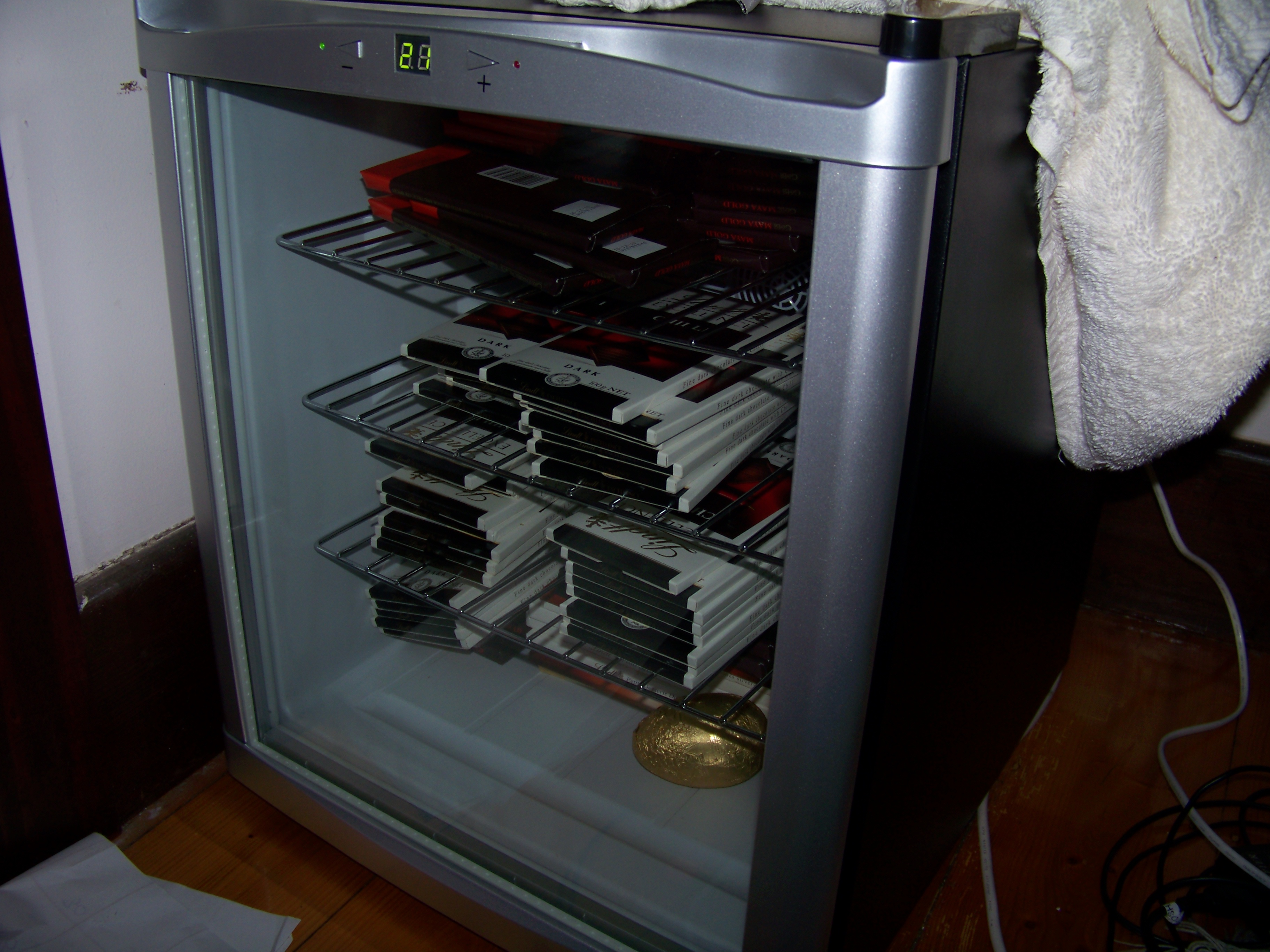
A small fridge full of chocolate
The German supermarket chain Aldi recently had a special deal of a wine-fridge for $99. A wine fridge really isn t that specialised for wine, it is merely a fridge that has a heater and is designed for temperatures in the 11C to 18C range. An good wine fridge will have special wood (or plastic if cheap) holders for wine bottles. A particularly cheap wine fridge (such as the one from Aldi) doesn t even have special holders for wine bottles. But this does however make it more convenient for storing other things. In the hotter days in summer outside temperatures of over 35C are common and it s possible for an uncommonly hot day to be in excess of 45C. My home air-conditioning system is only able to keep the ambient temperature about 10C cooler than the outside temperature if there are a few hot days in a row. According to the Wikipedia page the best chocolate is supposed to have type V crystals which melt at 34C [1]. So if the outside temperature is 45C then the temperature inside my home is almost guaranteed to be hot enough to melt chocolate. If I m not at home (and therefore the air-conditioner is off) during a moderately hot day then it s common to have a temperature of about 30C inside my house. The Wikipedia page also notes that moving chocolate between extremes of temperature can cause an oily texture and that storing chocolate in the fridge can cause a white discoloration. I ve experienced these effects and find that they significantly decrease the enjoyment of chocolate. So now I have a fridge in my computer room set to 16C because according to Wikipedia the ideal temperature range for storing chocolate is from 15C to 17C (the photo was taken shortly after turning it on and it hadn t reached the correct temperature). Every computer room should have a fridge full of chocolate! If my stockpile of chocolate reduces I may even put some wine in the fridge (I could probably fit some now if I organised the chocolate in a better way). But that depends on the supermarkets, if they have a special on Green and Black s Maya Gold organic fair-trade chocolate then my fridge will become full again.

Cyril Brulebois: Where have you been

Time for a little end-of-the-month looking back. (Looking back o-ver my shoul-der ) What about X11-based graphical installer? After the one-week rush early this month, a summary of my findings was posted on debian-boot@, including udebs, patches, and source packages, labelled as v1. People seemed to like the idea, and I received a bunch of comments to fix or improve various things. It took some time to implement everything in a satisfying (at least to me) manner, but I reached a point where I was confident enough to publish a v2 set of udebs, patches, and source packages. That was also announced on debian-boot@, and then re-announced once I ve been able to rebuild the image with speakup enabled again. Hopefully, that ll be (more or less) the final plan, and d-i folks should either give us a green or red light based on that v2 set. Some details will have to be ironed out (some items were mentioned in both v1 and v2 summaries), but they shouldn t prevent us from starting adding the needed udebs; or at least not too long. Speaking of X11, xserver-xorg-video-intel is buggy as hell! Basically, yes, and that s known. Many bugs were due to kernel issues, and regressions got fixed in the series of 2.6.32.y stable updates. Usually, upgrading to at least 2.6.32-3-$arch (from linux-2.6 s revision 2.6.32-9) helps, as well as running latest libdrm, xserver-xorg-core, and mesa from sid. Trying with some 2.6.33-ish kernels from experimental would be nice as well. You re of course very welcome to keep us posted through the bugs you opened already, closing them if appropriate. And before reporting more bugs, please make sure you re running recent versions of all those components. That should help people walking the list of remaining bugs to deal with them more efficiently. A very annoying bug which can still be experienced with an up-to-date sid environment is described in freedesktop s #26723.

Next.

Previous.