Search Results: "ag"

9 March 2010

Jaldhar Vyas: 7DRL Challenge - day 2-3

I am still being plagued by the burdens of real life so most development is taking place after the kids ("It should have mermaids! And Spiderman!") have gone to sleep. By the time I finished up yesterday, I was too tired to blog so this is is a combined report on the last two days. I decided not to bother with Javascript as I want to try a different project for the plasmoid competition. So I'm back to C++ and ncurses. At this point my '@' can move across the dungeon which at the moment a very simplistic 10 10 grid where every space is a 'room'. Rooms are populated with monsters, treasure and items though at the moment only the monsters can do anything and by anything I mean fighting. My combat system is based on Solo Dungeon Bash and pretty challenging I think. Hopefully by tomorrow, A Lively Fisting will be playable though I really need to pick up the pace if I want to finish on time.

8 March 2010

Romain Beauxis: Liquidsoap-full 0.9.2-2 and ocaml-cry 0.1.2

An issue with the new ocaml-cry module that replaces the shout library has been recently discovered. This issue was related to the data sent to the icecast server and could result in a higher load and loss of data when sending data to the server. We have released a new version of ocaml-cry that fixes this issue, numbered 0.1.2. We have also released a new liquidsoap-full tarball, numbered 0.9.2-2 and now available in the download section on sourceforge.net. Additionally, our custom stable packages have been rebuild against this new version, both for the i386 and the amd64 architecture. The package available in Debian sid/unstable is now built against the fixed ocaml-cry as well. We recommend that any user that uses liquidsoap 0.9.2 updates its liquidsoap to make sure it uses ocaml-cry 0.1.2. Please note that ocaml modules are not dynamically loaded, so you need to rebuild liquidsoap against the new ocaml-cry if you are building from source.

Vincent Sanders: Music hath charms to soothe a savage breast, to soften rocks, or bend a knotted oak.

Since I last mentioned music back in January I have accumulated another ten albums and unlike last time where there were only a couple of stand outs, this time I have he opposite problem.

The unordered list:

Justin Sandercoe - "Small town eyes"

I am learning to play the guitar, I have been using Justins' course, it is very very good, this album? Also very good. If you like melodic guitar lead music with varied influences this is for you. A couple of tracks made me immediately think of some Crowded House riffs (which is not a bad thing). Only minor niggle is the uneven levels on some of the louder pieces, but it really is a minor observation on an otherwise fine first album.

Molly Lewis - "I made you a CD, but I eated it."

Although this is only a short selection of original material from Molly, it is a very promising first album. I really like her voice and although a ukulele is not generally the most well respected of instruments, in her hands, it has an odd charm. This album is available from DFTBA records.

Rhett and Link - "Up to this point"

A pair of talented comedians who use music very effectively to highlight their humour. I originally stumbled across them on youtube and decided to take a punt. The album is 27 short pieces which fit together surprisingly well. Difficult to categorise but think a cross between Flight of the Choncords and Jonathan Coulton with a dash of youtube immediacy.

They Might Be Giants - "Flood", "Apollo 18" and "John Henry"

Strictly a replacement of the old tapes which have completely disintegrated in the intervening couple of decades since first purchased. Flood is still one of my favourite albums ever, certainly in my top 10. If you do not know them TMBG are just ace, please try their music!

Seasick Steve - "Started out with nothin and i still got most of it left"

Well its a kinda fun album primarily based on blues electric "guitar" (some of the instruments are little more than a stick with a nail in and a guitar pickup.) Nothing bad, easy to get along with, definitely worth a listen.

La Roux - "La Roux"

This synth pop album was on remainder in ASDA and I took a gamble. Its OK I guess and for 3quid I cannot really complain.

Red Hot Chili Peppers - "By the way"

Not their best, but competent enough.

Aqua - "Aquarium" , "Aquarius"

Um...yes, I have a soft spot for 90's cheese OK? Nothing more than a gross self indulgence of my silly side. But they are fun ;-)


So that is my new music since January all 166 tracks of it . Most of it pretty good, certainly no lemons (well aside from the Aqua but that is supposed to be silly!)

Oh and The XX has really grown on me from last time and I am looking forward to their next release.


Nicolas Valc rcel: Ubuntu awesome tools

Last week I was having a conversation with a friend, and while we were discussing some things I mentioned some Ubuntu tools that were completely natural for me since I use them every day in Ubuntu development and for my work, but he was completely amazed by them, so I decided to blog on the subject so more people can know about them. I m going to start with the one that impressed him the most: qa-regression-testing branch The QA and security team maintain a test suite to check for regressions in packages they are updating. These tests are written with python unittest. Most of this test suite can be a little harmful for a production system, so it s recommended to run it using a chroot environment or a virtual machine and to help with that there is a make-test-tarball script. From the script:

export HOSTS= sec-intrepid-amd64 sec-hardy-amd64 sec-dapper-amd64
export TEST=test-glibc-security
./make-test-tarball $TEST.py
for i in $HOSTS; do
scp /tmp/qrt-$TEST.tar.gz $i.local:
done
for i in $HOSTS; do
ssh -t $i.local hostname; rm -rf qrt-$TEST; tar zxf qrt-$TEST.tar.gz; cd qrt-$TEST && ./$TEST.py -v
done
As you can imagine HOSTS are the hostnames of the virtual machines where the tests are going to run. Writing those test isn t rocket science, you just need a little knowledge of the package and the functionality you want to test and python unittesting, there is even a skeleton script that can help you start writing your test. Hope this information is useful for you! And as usual, patches are welcome!

Steve Kemp: You Greeks take pride in your logic. I suggest you employ it.

Tomorrow, all being well, I'll receive a new computer. I've always run Debian unstable upon my desktop in the past, partly because I wanted to have "new stuff" and partly because I needed a Debian unstable system for building Debian packages with. However I'm strongly tempted to just install Lenny. I use that upon my work desktop and it does me just fine for surfing, building tools, and similar. I can use pbuilder, sbuildd, or similar to build packages for upload to Debian, and if I want to experiment with new-hotness I can use a KVM guest or two. Providing the hardware works with Lenny (and I have no reason to believe it won't) then there's no obvious downside I can think of. The only potential complication will be restoring my backups, it is possible that my firefox databases, and similar things, might not work on older version. Still we shall see. I plan to install software RAID, and run the system on LVM because quite frankly it rocks. Unless my current system fails in the next 24 hours I can use that to do the installation (My current desktop acts as a TFTP/DHCP/NFS server so I can use it to PXE-boot). Anyway now I need to go eat food, tidy my desk, and decide what to call the machine .. At the moment the choice is between "march.my.flat" and birthday.my.flat, as my 34th birthday is on March 10th. ObFilm: 300

Clint Adams: Why I am not running for DPL, pusling

Every year, at least one person asks me to run for DPL. I don't remember quite when this started, but it was more than five years ago. I have some standard responses: I don't have time to do a good job, and why commit if you know you can't do a good job? That's just irresponsible. Usually I get some feeble relativism back for that one. Oddly enough, this is the one year that I could actually make the time for it, but it is still not a good idea. Also I do not wish to self-nominate. I am told that everyone is too autistic to understand why, so I assume that by observing the timing of nominations (in specific, who stands at the beginning of the nomination period and who waits until close to the last minute), no moro-ethical conclusions will be drawn. To belabor this point: if the culture of self-nomination were fixed, I would actually nominate people I think would do a good job. At present, I cannot, and I resent that. Furthermore, you do not really want me as DPL. There are oodles and oodles of things I think are fundamentally flawed and I would try to fix them. I would not take advice from predecessors because I think that only perpetuates years of flawed DPL behavior. I would not entertain requests in private because there is far, far, far too much backroom discussion right now, and unfortunately it is actively encouraged and promoted by many people in power. Such departures would be extremely unpopular. I would be pleased if Stefano runs unopposed. I think that there is a good chance he will do a decent job.

Vincent Sanders: Squashfs

Well my last post elicited a response from Mr Lougher the squashfs author. Just not one I was expecting. Apparently he did receive one of my emails (I sent five in total) to which he has not replied as I have accidentally come across as critical.

This is absolutely not my intent and I wish to publicly say that, It would have perhaps been more constructive to actually tell me this by email and this misunderstanding could have been avoided.

For reference The final email in the series is reproduced below, if I have been overly unhelpful please let me know in the comments so I can avoid this mistake in future.

Hi, we are using Squashfs and have come across several issues. We
initialy tried to use the Debian source package of the 4.0 release but
then moved to using the the CVS edition which fixed some bugs but had
issues of its own.

Couple of things to start with:

- The commit you made recently titled "Change get_basename() to use
getcwd rather than getting the PWD env var." does not seem to be
what you intended?
http://squashfs.cvs.sourceforge.net/viewvc/squashfs/squashfs/squashfs-tools/mksquashfs.c?r1=1.145&r2=1.146

- I would like to assist in improving these tools so they work better
for our use cases. To aid in this have you considered updating the
revision control system the project is kept in? an SVN or GIT
repository is much easier to work with than CVS.

- I will probably assist with maintainership of the Debian and Ubuntu
packages (I am a Debian Developer <vince> ) and would
like to bring a couple of patches to your attention, one to avoid a
division by zero error and a second to enable building with
alternative libc. These are both attached to this mail.

- The tools currently make a number of assumptions about structure
alignment which are incorrect on some architectures. I am crafting
a patch to address this which should make the tools work correctly
on ARM (they currently simply segfault).

I hope this is seen as constructive and we can work together to
improve this software. If you do not feel you want to interact with me
and choose to take a differnt route, please let me know at your earliest
conveniance.

I do hope that Mr. Lougher will accept that I intended to be helpful and constructive and not cause offence. I have chosen to use the blog format for this as that is the form I made the previous complaint and also email between myself and Mr. Lougher appears somewhat erratic.

It should be noted that some of there points have already been addressed, however there are several more issues which I hope to be able to contribute towards.


Enrico Zini: Temporarily disabling file caching

Temporarily disabling file caching Does it happen to you that you cp a big, big file (say, similar in order of magnitude to the amount of RAM) and the system becomes rather unusable? It looks like Linux is saying "let's cache this", and as you copy it will try to free more and more ram in order to cache the big file you're copying. In the end, all the RAM is full with file data that you are not going to need. This varies according to how /proc/sys/vm/swappiness is set. I learnt about posix_fadvise and I tried to play with it. The result is this preloadable library that hooks into open(2) and fadvises everything as POSIX_FADV_DONTNEED. It is all rather awkward. fadvise in that way will discard existing cache pages if the file is already cached, which is too much. Ideally one would like to say "don't cache this because of me" without stepping on the feet of other system activities. Also, I found I need to also hook into write(2) and run fadvise after every single write, because you can't fadvise a file to be written in its entirety, unless you pass fadvise the file size in advance. But the size of the output file cannot be known by the preloaded library, so meh. So, now I can run: nocache cp bigfile someplace/ without trashing the existing caches. I can also run nocache tar zxf foo.tar.gz and so on. I wish, of course, that there were no need to do so in the first place. Here is the nocache library source code, for reference:
/*
 * nocache - LD_PRELOAD library to fadvise written files to not be cached
 *
 * Copyright (C) 2009--2010 Enrico Zini <enrico@enricozini.org>
 *
 * This program is free software; you can redistribute it and/or modify
 * it under the terms of the GNU General Public License as published by
 * the Free Software Foundation; either version 2 of the License, or
 * (at your option) any later version.
 *
 * This program is distributed in the hope that it will be useful,
 * but WITHOUT ANY WARRANTY; without even the implied warranty of
 * MERCHANTABILITY or FITNESS FOR A PARTICULAR PURPOSE.  See the
 * GNU General Public License for more details.
 *
 * You should have received a copy of the GNU General Public License
 * along with this program; if not, write to the Free Software
 * Foundation, Inc., 59 Temple Place, Suite 330, Boston, MA  02111-1307  USA
 */
#define _XOPEN_SOURCE 600
#include <fcntl.h>
#include <sys/types.h>
#include <sys/stat.h>
#include <fcntl.h>
#include <dlfcn.h>
#include <stdarg.h>
#include <errno.h>
#include <stdio.h>
typedef int (*open_t)(const char*, int, ...);
typedef int (*write_t)(int fd, const void *buf, size_t count);
int open(const char *pathname, int flags, ...)
 
    static open_t func = 0;
    int res;
    if (!func)
        func = (open_t)dlsym(RTLD_NEXT, "open");
    // Note: I wanted to add O_DIRECT, but it imposes restriction on buffer
    // alignment
    if (flags & O_CREAT)
     
        va_list ap;
        va_start(ap, flags);
        mode_t mode = va_arg(ap, mode_t);
        res = func(pathname, flags, mode);
        va_end(ap);
      else
        res = func(pathname, flags);
    if (res >= 0)
     
        int saved_errno = errno;
        int z = posix_fadvise(res, 0, 0, POSIX_FADV_DONTNEED);
        if (z != 0) fprintf(stderr, "Cannot fadvise on %s: %m\n", pathname);
        errno = saved_errno;
     
    return res;
 
int write(int fd, const void *buf, size_t count)
 
    static write_t func = 0;
    int res;
    if (!func)
        func = (write_t)dlsym(RTLD_NEXT, "write");
    res = func(fd, buf, count);
    if (res > 0)
     
        int saved_errno = errno;
        int z = posix_fadvise(fd, 0, 0, POSIX_FADV_DONTNEED);
        if (z != 0) fprintf(stderr, "Cannot fadvise during write: %m\n");
        errno = saved_errno;
     
    return res;
 
Updates Steve Schnepp writes:
Robert Love did a O_STREAMING patch for 2.4. It wasn't merged in 2.6 since POSIX_FADV_NOREUSE should be used instead. But unfortunatly it's currently mapped either as WILLNEED or as a noop. It seems that there is a google code project that has spawned to control this.

Russell Coker: Designing a Secure Linux System

The Threat Bruce Schneier s blog post about the Mariposa Botnet has an interesting discussion in the comments about how to make a secure system [1]. Note that the threat is considered to be remote attackers, that means viruses and trojan horses which includes infected files run from USB devices (IE you aren t safe just because you aren t on the Internet). The threat we are considering is not people who can replace hardware in the computer (people who have physical access to it which includes people who have access to where it is located or who are employed to repair it). This is the most common case, the risk involved in stealing a typical PC is far greater than the whatever benefit might be obtained from the data on it a typical computer user is at risk of theft only for the resale value of a second-hand computer. So the question is, how do can we most effectively use free software to protect against such threats? The first restriction is that the hardware in common use is cheap and has little special functionality for security. Systems that have a TPM seem unlikely to provide a useful benefit due to the TPM being designed more for Digital Restrictions Management than for protecting the user and due to TPM not being widely enough used. The BIOS and the Bootloader It seems that the first thing that is needed is a BIOS that is reliable. If an attacker manages to replace the BIOS then it could do exciting things like modifying the code of the kernel at boot time. It seems quite plausible for the real-mode boot loader code to be run in a VM86 session and to then have it s memory modified before it starts switches to protected mode. Every BIOS update is a potential attack. Coreboot replaces the default PC BIOS, it initialises the basic hardware and then executes an OS kernel or boot loader [2] (the Coreboot Wikipedia page has a good summary). The hardest part of the system startup process is initialising the hardware, Coreboot has that solved for 213 different motherboards. If engineers were allowed to freely design hardware without interference then probably a significant portion of the computers in the market would have a little switch to disable the write line for the flash BIOS. I heard a rumor that in the days of 286 systems a vendor of a secure OS shipped a scalpel to disable the hardware ability to leave protected mode, cutting a track on the motherboard is probably still an option. Usually once a system is working you don t want to upgrade the BIOS. One of the payloads for Coreboot is GRUB. The Grub Feature Requests page has as it s first entry Option to check signatures of the bootchain up to the cryptsetup/luksOpen: MBR, grub partition, kernel, initramfs [3]. Presumably this would allow a GPG signature to be checked so that a kernel and initrd would only be used if they came from a known good source. With this feature we could only boot a known good kernel. How to run User Space The next issue is how to run the user-space. There has been no shortage of Linux kernel exploits and I think it s reasonable to assume that there will continue to be a large number of exploits. Some of the kernel flaws will be known by the bad guys for some time before there are patches, some of them will have patches which don t get applied as quickly as desired. I think we have to assume that the Linux kernel will be compromised. Therefore the regular user applications can t be run against a kernel that has direct hardware access. It seems to me that the best way to go is to have the Linux kernel run in a virtual environment such as Xen or KVM. That means you have a hypervisor (Xen+Linux or Linux+KVM+QEMU) that controls the hardware and creates the environment for the OS image that the user interacts with. The hypervisor could create multiple virtual machines for different levels of data in a similar manner to the NSA NetTop project, not that this is really a required part of solving the general secure Internet terminal problem but as it would be a tiny bit of extra work you might as well do it. One problem with using a hypervisor is that the video hardware tends to want to use features such as bus-mastering to give best performance. Apparently KVM has IOMMU support so it should be possible to grant a virtual machine enough hardware access to run 3D graphics at full speed without allowing it to break free. Maintaining the Virtual Machine Image Google has a good design for the ChromiumOS in terms of security [4]. They are using CGroups [5] to control access to device nodes in jails, RAM, CPU time, and other resources. They also have some intrusion detection which can prompt a user to perform a hardware reset. Some of the features would need to be implemented in a different manner for a full desktop system but most of the Google design features would work well. For an OS running in a virtual machine when an intrusion is detected it would be best to have the hypervisor receive a message by some defined interface (maybe a line of text printed on the console ) and then terminate and restart the virtual machine. Dumping the entire address space of the virtual machine would be a good idea too, with typical RAM sizes at around 4G for laptops and desktops and typical storage sizes at around 200G for laptops and 2T for new desktops it should be easy to store a few dumps in case they are needed. The amount of data received by a typical ADSL link is not that great. Apart from the occasional big thing (like downloading a movie or listening to Internet radio for a long time) most data transfers are from casual web browsing which doesn t involve that much data. A hypervisor could potentially store the last few gigabytes of data that were received which would then permit forensic analysis if the virtual machine was believed to be compromised. With cheap SATA disks in excess of 1TB it would be conceivable to store the last few years of data transfer (with downloaded movies excluded) but such long-term storage would probably involve risks that would outweigh the rewards, probably storing no more than 24 hours of data would be best. Finally in terms of applying updates and installing new software the only way to do this would be via the hypervisor as you don t want any part of the virtual machine to be able to write to it s data files or programs. So if the user selects to install a new application then the request please install application X would have to be passed to the hypervisor. After the application is installed a reboot of the virtual machine would be needed to apply the change. This is a common experience for mobile phones (where you even have to reboot if the telco changes some of their network settings) and it s something that MS-Windows users have become used to but it would get a negative reaction from the more skilled Linux users. Would this be Accepted? The question is, if we built this would people want to use it? The NetTop functionality of having two OSs interchangeable on the one desktop would attract some people. But most users don t desire greater security and would find some reason to avoid this. They would claim that it lowered the performance (even for aspects of performance where benchmarks revealed no difference) and claim that they don t need it. At this time it seems that computer security isn t regarded as a big enough problem for users. It seems that the same people who will avoid catching a train because one mugging made it to the TV news will happily keep using insecure computers in spite of the huge number of cases of fraud that are reported all the time.

Craig Small: dh-make updated to 0.52 and its remaining bugs

I've made a quick release of dh-make, now up to 0.52. Besides a minor dh_make.1 manual page fix this release will put the right value in the debian/source/format file. 0.51 will make it a native source package no matter what flags you use.

If you get weird lintian errors about native source formats and version numbers wrong on your brand-new Debian package you just made, you might of been bitten by this bug.

That leaves a few bugs left, there are two I need help with:
<script defer="defer" src="http://static.zemanta.com/readside/loader.js" type="text/javascript"></script>

Russell Coker: Storage vs RAM Size

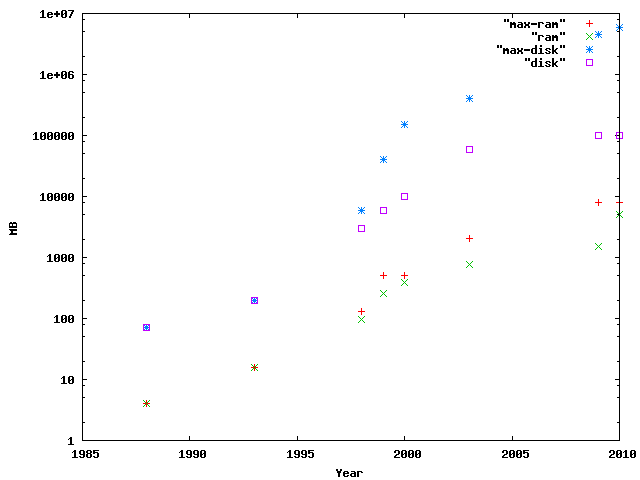
In a comment on my post Shared Objects and Big Applications about memlockd [1] mic said that they use memlockd to lock the entire root filesystem in RAM. Here is a table showing my history of desktop computers with the amounts of RAM, disk capacity, and CPU power available. All systems better than a 386-33 are laptops a laptop has been my primary desktop system for the last 12 years. The columns for the maximum RAM and disk are the amounts that I could reasonably afford if I used a desktop PC instead of a laptop and used the best available technology of the day I m basing disk capacity on having four hard drives (the maximum that can be installed in a typical PC without extra power cables and drive controller cards) and running RAID-5. For the machines before 2000 I base the maximum disk capacity on not using RAID as Linux software RAID used to not be that good (lack of online rebuild for starters) and hardware RAID options have always been too expensive or too lame for my use.
Year CPU RAM Disk Maximum RAM Maximum Disk
1988 286-12 4M 70M 4M 70M
1993 386-33 16M 200M 16M 200M
1998 Pentium-M 233 96M 3G 128M 6G
1999 Pentium-2 400 256M 6G 512M 40G
2000 Pentium-2 600 384M 10G 512M 150G
2003 Pentium-M 1700 768M 60G 2048M 400G
2009 Pentium-M 1700 1536M 100G 8192M 4500G
2010 Core 2 Duo T7500 2200 5120M 100G 8192M 6000G
graph of RAM/disk sizes from the above table The above graph shows how the modern RAM capacities have overtaken older disk capacities. So it seems that a viable option on modern systems is to load everything that you need to run into RAM. Locking it there will save spinning up the hard drive on a laptop. With a modern laptop it should be possible to lock most of the hard drive contents that are regularly used (IE the applications) into RAM and run with /home on a SD flash storage device. Then the hard drive would only need to be used if something uncommon was accessed or if something large (like a movie) was needed. It also shows that there is potential to run diskless workstations that copy the entire contents of their root filesystem when they boot so that they can run independently of the server and only access the server for /home. Note that the size of the RAM doesn t need to be larger than the disk capacity of older machines (some of the disk was used for swap, /home, etc). But when it is larger it makes it clear that the disk doesn t need to be accessed for routine storage needs. I generated the graph with GnuPlot [2], the configuration files I used are in the directory that contains the images and the command used was gnuplot command.txt . I find the GnuPlot documentation to be difficult to use so I hope that this example will be useful for other people who need to produce basic graphs I m not using 1% of the GnuPlot functionality.

Marco T&uacute;lio Gontijo e Silva: Micro BSP

I and Rafael Cunha de Almeida got together today with the purpose of closing as much RC-bugs in Debian as we could. I must say it was better than what I d expect. We started with #570348 . This bug was introduce with an upload that tried to fix #569586 which, in turn, was related to a change in libc6. It would be easy to introduce an ifdef in the code but, as we tried to read and understand the code, we didn t see the need of the function that was causing the problem. It seems to make the same thing as alphasort from dirent.h, with the disadavantage that it was not locale-sensitive. So we removed the customized alphasort and made it use the library one. Then we headed to the strange #504947. As the maintainer didn t seem satisfied with the new patch system introduced by the last NMU, we simply made a patch that removes the patch system and applies the patch directly in .diff.gz. Hope it helps. Searching for another thing to work, we noticed that #571791 was not happening in my box, and asked if anyone could reproduce it. So we found #571748. The first thing about this bug we noticed is that its package causes a division by 0 error in popcon, which made us report a bug about it. We thought that this was a sign that the package was not widely used. Anyway, we decided to fix this bug, which was very fun indeed! After a lot of trials, some succesful, some not, we got to a very simple and nice patch, which was submitted. We also submited other bugs to the same package, that we found while using it. It s a cool package, you should try it out to avoid that division by 0 in popcon.

7 March 2010

Emilio Pozuelo Monfort: RCBW #1 Me too!

After fixing some bugs this week, I ve noticed they ve been one per day (on average) so I think I m joining Stefano Zacchiroli on this RCBW thingie let s see if I can keep up! These are this week s bugs: #561645 gdesklets Doesn t work with python2.6 (thanks to Andrew Starr-Bochicchio)
#571488 gedit FTBFS with Python 2.6 as default
#571517 totem FTBFS with Python 2.6 as default
#571510 rhythmbox FTBFS with Python 2.6 as default
#533836 spe FTBFS with Python 2.6 as default
#569378 gnet FTBFS
#551215 gtkmm-documentation FTBFS I ve also sponsored gnome-dvb-daemon for Sebastian Reichel, which fixes two more RC bugs: #566949 gnome-dvb-daemon FTBFS with Python 2.6 as default
#569480 gnome-dvb-daemon FTBFS It s interesting to note that all of the above bugs except for the spe one are from pkg-gnome packages. We still have a few more, although they are the hard ones so it s not gonna be that easy for the next week

David Pashley: Mod_fastcgi and external PHP

Has anyone managed to get a standard version of mod_fastcgi work correctly with FastCGIExternalServer? There seems to be a complete lack of documentation on how to get this to work. I have managed to get it working by removing some code which appears to completely break AddHandler. However, people on the FastCGI list told me I was wrong for making it work. So, if anyone has managed to get it to work, please show me some working config.
Read Comments (1)

Gunnar Wolf: Authoral rights in the editorial world seminar

I must confess I don't remember who I got this invitation from. Anyway, if you are in the right geographic area, you might be interested. I will try to participate: This is a year-long seminar that will be held the second Thursday every month at Fonoteca Nacional (a place I have wanted to visit for a long time!), in Barrio de Santa Catarina, Coyoac n. Among the organizers they have Creative Commons Mexico. Free entrance (but limited space - so they ask interested people to confirm their presence by mail to bvallarta@conaculta.gob.mx). [update] I went with Pooka to the first session. We arrived almost 1hr late (due to me mistaking the schedule :-/ ) but it was interesting. Of course, quite biased towards the Google viewpoints, but interesting. We got the program for the next sessions So, mostly for myself to keep handy, here it goes:
Date Title Speakers
2010-03-11 Google and copyright Manuel Tamez, Hugo Contreras, Mar a Fernanda Mendoza
2010-04-08 Generalities about rights on intelectual property Jes s Parets, Guillermo Sol rzano, Jorge Mier y Concha
2010-05-13 Copyright's nature and competent authorites Carmen Arteaga, Luis Schmidt, C sar Callejas
2010-06-10 Moral and patrimonial rights Guillermo Pous, Eduardo de la Parra, Ram n Ob n
2010-07-08 Reproduction rights for audible material lvaro Hegewisch, scar Javier Solorio, Marco Antonio Morales, Jos Ram n C rdeno
2010-08-12 Licenses and patrimonial right transmission. Works for hire, works done under laboral relationship, or carried out in official service Dolores Franco, Jes s Mej a, Ra l Pastor
2010-09-09 Limits to explotation rights and literary plagiarism Carmen Arteaga, Juan Ram n Ob n, Jorge Mier y Concha, C sar Callejas
2010-10-14 Copyright in a digital setting Jes s Parets, Gast n Esquivel
2010-11-11 Law-regulated intelectual property rights Rosalba Elizalde, Salvador Ortega, Gast n Esquivel, Manrique Moheno
2010-12-09 International protection and collective gestive societies Horacio Rangel, Luis Schmidt, Jes s Mej a

Adam Rosi-Kessel: Windows curly quotes, accented characters on Linux Samba Shares and Cygwin XTerm: How to get Windows-1252 (AKA CP1252) from Linux

Before I forget: I have a bunch of files I mirror between Windows/NTFS and Linux/ext4 filesystems that include not only accented characters but curly quotes in the filenames. (I know: the easiest solution would be to just get rid of the extended characters). The curly quotes were created in Windows, so don t render properly in standard Linux character sets (UTF-8, iso8859-1, iso8859-15, etc.). This all came up because iTunes under Windows couldn t find curly-quote files when it was reading from the exported Samba share filesystem rather than an attached NTFS drive. The files showed up as missing because they had different filenames. The solution was not easily google-able, so for the record, in brief, add this to the [Global] section of /etc/samba/smb.conf:
unix charset = cp1252
display charset = cp1252
And reload Samba. Also, to make the characters render properly from a terminal on the Linux box, first create the relevant character set:
sudo localedef -f CP1252 -i en_US en_US.CP1252
Now you can use this charset on your Linux box, and, like magic, the curly characters will be back:
export LC_ALL='en_US.cp1252'

David Watson: Latest Shots

I took my newly purchased 50mm f1.8 lens to the Chinese New Year celebrations in Liverpool, I have uploaded a few shots to flickr. I'm still getting used to getting my composition right without being able to alter the focal length. Update: Fixed the white balance on the images to remove the blue tint.

Aurelien Jarno: Squeeze will be released with eglibc 2.11

Contrary to what lucas announced (I don t know where he got this info), we plan to release Squeeze with eglibc 2.11. It is already packaged in experimental and is ready on all architectures except hppa where there are a few major regressions in the testsuite to fix. This is what prevent us to upload it to unstable.

Christian Perrier: [life] 1h41'29"

W00t. Again below 1h45 and beating my best time by more than 2 minutes. Paris half-marathon was great. Freaking cold (-3 C with a strong North-East wind) but great weather with the sun in a blue sky. I didn't see Ralf (and, Ralf, sorry but I was finally wearing an orange suite..:-)) nor Debian swirls....but, apparently, that wasn't missing for having a great race. Elisabeth cam along with me to Paris and I managed to see her (and she manage to spot me) twice: once in Bastille at km 10 and later on at Charenton at km 14 The interesting challenge now is what to set as goal for the marathon. Of course, I have to run below 4h (which I missed by 49 seconds in Cologne) but I apparently can do better. I think I'll be reasonable and set 3h50 and we'll see.

Brice Goglin: Debian/X.org notes - Bug triaging while waiting for DRM 2.6.33

Almost nothing interesting happened recently in X.org in Debian. But interesting things are coming soon.
First, radeon KMS and DRI2 will enter unstable soon. xserver-xorg-video-radeon 1:6.12.191-1 is currently in experimental. People seem to be happy with it so far, and upstream is taking very good care of bug reports as usual. The next 2.6.32 kernel will contain DRM from 2.6.33. It first means that the radeon KMS driver not in staging anymore. Once this new kernel is uploaded, I'll put the new xserver-xorg-video-radeon in unstable (6.13.0 is expected soon, but 6.12.191 already looks good so far). DRM from 2.6.33 will also brings nouveau support. It means that we will build libdrm-nouveau and upload a new xserver-xorg-video-nouveau. However, it also means that we need somebody to maintain this. And nobody in the team has a nvidia board to test packages so... If you want nouveau in Debian, please help.
While waiting for all these, we have been triaging the BTS a bit. Kibi is helping a lot by triaging recent intel bugs (many regressions fixed in recent kernels). I spent some time during the week-end triaging some old bugs. I closed more than a hundred of them, and pinged another hundred. We still have more than 1100 bugs open. It is not so bad compared to 1500-2000 when nobody maintains X (aka often), but still way too much. Some of my bug closing might look a bit rude. But we had so many bug reports a couple years ago that are irrelevant today. Keeping them open would be meaningless. For instance, many input problems are obsolete since a lot of the input code was rewritten, we switched to input-hotplug, and then hal to udev. Another example is intel lockups (we had a lot of them after driver 2.2 arrived). But XAA and EXA were dropped in favor of UXA, DRI1 was dropped for DRI2, and KMS arrived. So it's useless to keep these obsolete and irrelevant bugs that cannot be debugged nowadays.
As usual, the Debian X team needs a lot of help. Again, if you want nouveau in Debian, please help.
(Permanent link)

Next.

Previous.