Search Results: "zed"

27 June 2013

Russ Allbery: Review: The Odd Clauses

Review: The Odd Clauses, by Jay Wexler
Publisher: Beacon
Copyright: 2011
ISBN: 0-8070-0089-2
Format: Trade paperback
Pages: 193
The subtitle of this book summarizes it nicely: Understanding the Constitution through Ten of Its Most Curious Provisions. (The constitution in question is the United States Constitution.) It's a sort of popularization of US constitutional law, but rather than look at the most well-known and controversial parts, it takes a look at some of the odd side points, obscure clauses, or clauses that one rarely thinks about because they rarely appear in the news. This is partly a tour of curiosity aimed at those who like legal trivia, but it also provides, indirectly, a look at how constitutional law is made and debated, and at some of the burning concerns at the time of the writing that have since faded away. Sometimes why the concern has faded is as interesting as the original problem. This is the sort of book whose table of contents provides a lot of insight into what you're getting. It has ten chapters, each devoted to a particular clause or amendment: incompatibility, weights and measures, recess appointments (one of the rare ones that has made the news), original jurisdiction, natural-born citizen (odd, but sadly now not at all obscure), letters of marque and reprisal, titles of nobility, bills of attainder, and the 3rd and 21st amendments. (For those who haven't memorized all the amendments to the US Constitution, the 3rd is the prohibition on quartering soldiers in private homes and the 21st is Prohibition, which here is examined not for its core intent but for the implications for federalism.) As you can see, this is quite a selection, and while the clauses are often obscure, the issues raised by them are still generally quite active. There are some that were intensely controversial at the time of the original debate that are little more than amusing trivia at this point (the prohibition on officers of the United States taking titles of nobility), or have become so much a part of the structure of the government that people rarely given them a second thought (such as the incompatibility clause, which prohibits members of Congress from holding positions in the executive branch). But most of these clauses establish ground rules for the US government that are still quite current today, even if the legal terminology used at the time is no longer familiar. A good example is the clause prohibiting bills of attainder, something that the writers of the US Constitution saw no need to define. A bill of attainder is an act of a legislature declaring a person guilty of a crime and assigning some punishment without trial. Framed that way, it seems like an obvious extension of the separation of powers system that the US government is constructed around, but unlikely to provoke much modern controversy. However, as Wexler explains quite lucidly, there's a reason why this clause is right next to the prohibition on ex post facto laws. While no one would stand for the US Congress declaring guilt on a matter of criminal law, it has written some startlingly specific laws that seem aimed solely at specific individuals or organizations, which is exactly the sort of behavior that this prohibition, interpreted broadly, was intended to prevent. Similarly, one might think that Congress's power to issue letters of marque and reprisal is little more than ground for an interesting history lesson. But that clause is deeply entangled with the checkered history of US declarations of war and controversies over Congressional oversight, and Wexler uses it as a jumping-off point to take a look at the implications for the modern habit of undeclared wars fought by military contractors. This is a short book, so these treatments are necessarily brief. Some of them are also fairly minor; for example, the discussion of the weights and measures clause is mostly an extended rant on the US refusal to adopt the metric system. That's a sentiment with which I entirely agree, but I'm not sure it has much to do with constitutional law. But Wexler is an entertaining and concise writer; even when the discussion is relatively shallow, I enjoyed reading his analysis. (I will warn, though, that he takes a few potshots from a liberal perspective, so one's enjoyment of his humor may to some extent depend on your personal political allegiances.) I wouldn't rush out to find this book, but I found it mildly diverting and occasionally quite informative. The chapter on original jurisdiction, for instance, explained how the Supreme Court handles certain classes of cases that must be filed directly with it, despite not being a trial court. This was a question that I didn't even know I had, and a side system of judicial procedure that turned out to be surprisingly interesting. I suspect The Odd Clauses will be the most interesting to people who have only a news media understanding of the US Constitution. I went through a personal libertarian period, during which I read the constitution in detail and sought out some discussions of its specifics, so quite a bit of this book was familiar ground to me. Others without that study background may find more novelty. But even with that background, I was entertained, and don't regret buying it. One note, though: I bought this book on the recommendation of Kevin Underhill, author Lowering the Bar, which is a masterpiece of dry humor. If you're looking for legal humor, parts of The Odd Clauses are mildly funny, but Lowering the Bar is the sort of site that will have you staying up late reading just one more page of archives and reading bits aloud to anyone nearby. Rating: 7 out of 10

21 June 2013

Daniel Pocock: Practical challenges for interrupt-free computing

My previous blog on interrupt-free computing has been very well read. I've had a look at some practical implementation possibilities and can share some more details about how to go about it and potential problems. No perfect solution They say that a certain billionaire is so rich that he would not spend 5 seconds bending over to pick up a $100 banknote on the ground because he makes $500 in 5 seconds anyway. A man from Ethiopia may well run a marathon for the same $100. This little anecdote underlines the point that no two people have exactly the same priorities and it is hard to provide a one-size-fits-all solution. A good technical solution needs to let the user have some control over their own priorities as that will go a lot further in respecting their preferences, their objectives and their environment. A practical example: some users may not want to be disturbed by a VoIP call while watching a movie with their PC. Other users may be quite happy to receive these interruptions. Some users may want to only allow this interruption from a subset of possible callers. Building blocks In the original blog on this subject I suggested that Thunderbird and it's popular plugin, Mozilla Lightning calendar would provide one useful framework for integrating events, alerts and to-do items of various grades of importance. I already use these applications myself, from the re-branded icedove and iceowl-extension packages on Debian. They are also available in Fedora and many other distributions. Priority with Lightning An initial look at Lightning reveals a Priority attribute for tasks. It can be set to the values High, Medium or Low. These don't map to the concepts of Urgency and Importance from the Eisenhower method discussed in the original blog. Potential hacks: there are two ideas that come to mind, with no coding changes:
  • One possibility is to set Due dates for any item that has the Urgent characteristic and no date for items without the characteristic. In this case, the Priority attribute can then be used to distinguish Important and non-Important tasks.
  • The other possibility is to use the Categories feature to define four categories: Urgent-Important, non-Urgent-but-Important, Urgent-non-Important and neither-Urgent-Important.
A more elegant solution would be to develop an additional plugin that provides new attributes for the Urgency and Importance characteristics. For server-side storage of these attributes, it would be feasible to use extension properties as defined in RFC 2445, for example, X-urgency and X-importance This approach would make it easier to view a large range of tasks across multiple domains with the most urgent and important tasks at the top. Ideally, the Categories attribute of tasks can be used to distinguish tasks that relate to work (or project/client) from personal tasks (such as planning a holiday) Challenges with Lightning Some of the challenges that I've identified after reviewing this solution:
  • the Categories in Lightning don't appear to be synchronized with the Tags used in Thunderbird for email.
  • Furthermore, the Tags are not synchronized automatically with the list of server-side IMAP keywords and somebody having multiple Thunderbird profiles (e.g. on both a desktop and a laptop) needs to manually synchronize the lists of tags and categories between all their devices.
  • Many people use mobile devices such as smartphones and tablets to access their email, calendar and tasks. The lightweight mail/calendar clients on these devices don't support the full range of features for classification of content. Furthermore, their low-resolution user interfaces may even make it difficult to replicate the same experience on a mobile device. There is some hope, for example, rooting a tablet device and installing Linux would allow it to run a proper installation of Thunderbird with the various plugins described above.
Feeding system events and other data into the pipeline Given the text-based nature of the iCalendar format, it should be easy enough for any application that is capable of generating mail to generate these iCal events with X-Urgency and X-importance properties. These events - such as alerts about security updates - could then be dispatched through the system's mailer. Some additional effort may be needed to avoid duplication. The notification system in the desktop UI may then prioritize events from the mailbox rather than showing all alerts in real-time. Only applications that implicitly need to do so (such as VoIP/chat clients) would display notifications to the user directly. Conclusion: Interrupting the user Finally, after gathering all the events for the user in a mailbox like this, it would be possible for the plugin to be configured to interrupt the user only when some event reaches the user's own urgency/importance threshold. For example:
  • The user may want to be interrupted for Urgent items with a deadline in less than 24 hours, but if the task has a work' category, only interrupt during business hours
  • For all other items, the user only sees them when they open Lightning or some other calendar/task management application to explicitly review things that they need to do.

20 June 2013

Matt Zimmerman: Scaling Human Systems: Organizational Design and Growth

This is the beginning of a series of articles about the challenges of growing an organization. I m writing them to share some principles that I ve derived from my own experience, as well as many valuable discussions with friends and colleagues, about helping companies grow from being quite small (say, 1-50 employees) to medium-sized (100-500). There are many different ways to categorize companies by size, and not everyone agrees with me that different organizations tend to face certain similar problems as they grow, based on the number of employees. In any case, hopefully we can all agree that human systems are mind-bogglingly complex entities, and any two organizations will have many important differences such as their culture and market situation which influence their growth and development. For this reason, I believe there are few if any hard and fast rules, and organizational design patterns can be difficult to translate from one organization to another. One organization s solution can be another s problem. Even when there is a perfect fit, the process of organization change is a feat unto itself, one about which many books have been written. Even so, I think there is much to be learned by comparing different organizations, and much inspiration to be found in their successes and failures. Two organizations merit specific mention here, as sources of inspiration for me: Canonical, where I worked as Ubuntu CTO from near inception to when it reached nearly 500 people, and Heroku, where I currently serve as VP Engineering as it grows beyond 100 people.

19 June 2013

Benjamin Mako Hill: Job Market Materials

Last year, I applied for academic, tenure track, jobs at several communication departments, information schools, and in HCI-focused computer science programs with a tradition of hiring social scientists. Being on the market as it is called is both scary and time consuming. Like me, many candidates have never been on the market before. Candidates are asked to produce documents in genres e.g., cover letters, research statements, teaching statements, diversity statements that most candidates have never written, read, or even heard of. Candidates often rely on their supervisors for advice. I did so and my advisors were extremely helpful. The reality, however, is that although candidates advisors may sit on hiring committees, most have not been on candidates side of job market themselves for years or even decades. The Internet is full of websites, like the academic jobs wiki, Academia StackExchange, and the Chronicle of Higher Education forums for people on the market. Confused and insecure candidates ask questions of the form, Does blank matter? and the answer is usually, Doing/having blank may help/hurt, but it is only one factor of many. The result is that candidates worry about everything. Then they worry about what they should be worrying about, but are not. The most helpful thing, for me, was to read and synthesize the material submitted by recent successful job market candidates. For example, Michael Bernstein a friend from MIT, now at Stanford published his research and teaching statements on his website and I found both useful as I prepared mine. That said, I was surprised by how little material like this I could find on the web. For example, I could not find any examples of recent job market cover letters from successful candidates in fields close to mine. So to help fill this gap, I am publishing all of my job market material. I ve posted both the PDFs of the material I submitted as well as the LaTeX templates I used to generate the documents in my packet. My packet included: I hope people going on the market will find these materials useful. Obviously, you should not copy or reuse the text of any of my material. It is your application, after all. That said, please do help yourself to the formatting and structure. Finally, I would encourage anyone who builds on my material to republish their own material to help other candidates. If you do, I d appreciate a link back or comment on this blog post so that my readers can find your improvements.

17 June 2013

Petter Reinholdtsen: Debian Edu interview: Victor Ni u

The Debian Edu and Skolelinux distribution have users and contributors all around the globe. And a while back, an enterprising young man showed up on our IRC channel #debian-edu and started asking questions about how Debian Edu worked. We answered as good as we could, and even convinced him to help us with translations. And today I managed to get an interview with him, to learn more about him. Who are you, and how do you spend your days? I'm a 25 year old free software enthusiast, living in Romania, which is also my country of origin. Back in 2009, at a New Year's Eve party, I had a very nice beer discussion with a friend, when we realized we have no organised Debian community in our country. A few days later, we put together the infrastructure for such community and even gathered a nice Debian-ish crowd. Since then, I began my quest as a free software hacker and activist and I am constantly trying to cover as much ground as possible on that field. A few years ago I founded a small web development company, which provided me the flexible schedule I needed so much for my activities. For the last 13 months, I have been the Technical Director of Funda ia Ceata, which is a free software activist organisation endorsed by the FSF and the FSFE, and the only one we have in our country. How did you get in contact with the Skolelinux / Debian Edu project? The idea of participating in the Debian Edu project was a surprise even to me, since I never used it before I began getting involved in it. This year I had a great opportunity to deliver a talk on educational software, and I knew immediately where to look. It was a love at first sight, since I was previously involved with some of the technologies the project incorporates, and I rapidly found a lot of ways to contribute. My first contributions consisted in translating the installer and configuration dialogs, then I found some bugs to squash (I still haven't fixed them yet though), and I even got my eyes on some other areas where I can prove myself helpful. Since the appetite for free software in my country is pretty low, I'll be happy to be the first one around here advocating for the project's adoption in educational environments, and maybe even get my hands dirty in creating a flavour for our own needs. I am not used to make very advanced plannings, so from now on, time will tell what I'll be doing next, but I think I have a pretty consistent starting point. What do you see as the advantages of Skolelinux/Debian Edu? Not a long time ago, I was in the position of configuring and maintaining a LDAP server on some Debian derivative, and I must say it took me a while. A long time ago, I was maintaining a bigger Samba-powered infrastructure, and I must say I spent quite a lot of time on it. I have similar stories about many of the services included with Skolelinux, and the main advantage I see about it is the out-of-the box availability of them, making it quite competitive when it comes to managing a school's network, for example. Of course, there is more to say about Skolelinux than the availability of the software included, its flexibility in various scenarios is something I can't wait to experiment "into the wild" (I only played with virtual machines so far). And I am sure there is a lot more I haven't discovered yet about it, being so new within the project. What do you see as the disadvantages of Skolelinux / Debian Edu? As usual, when it comes to Debian Blends, I see as the biggest disadvantage the lack of a numerous team dedicated to the project. Every day I see the same names in the changelogs, and I have a constantly fear of the bus factor in this story. I'd like to see Debian Edu advertised more as an entry point into the Debian ecosystem, especially amongst newcomers and students. IMHO there are a lot low-hanging fruits in terms of bug squashing, and enough opportunities to get the feeling of the Debian Project's dynamics. Not to mention it's a very fun blend to work on! Derived from the previous statement, is the delay in catching up with the main Debian release and documentation. This is common though to all blends and derivatives, but it's an issue we can all work on. Which free software do you use daily? I can hardly imagine myself spending a day without Vim, since my daily routine covers writing code and hacking configuration files. I am a fan of the Awesome window manager (but I also like the Enlightenment project a lot!), Claws Mail due to its ease of use and very configurable behaviour. Recently I fell in love with Redshift, which helps me get through the night without headaches. Of course, there is much more stuff in this bag, but I'll need a blog on my own for doing this! Which strategy do you believe is the right one to use to get schools to use free software? Well, on this field, I cannot do much more than experiment right now. So, being far from having a recipe for success, I can only assume that: I also see some problems in getting Skolelinux into schools; for example, in our country we have a great deal of corruption issues, so it might be hard(er) to fight against proprietary solutions. Also, people who relied on commercial software for all their lives, would be very hard to convert against their will.

Gunnar Wolf: Cultural objects/goods: When a superhero is too famous for his own good

I found the following news item; if you can read Spanish, you will most probably prefer the original version in the Proceso magazine's site. The subject? The federal police (PGR) and army arrest 17 artisans for making money out of Spiderman. The following translation is mine. Done past midnight, and being quite tired, and translated so this news item can reach a broader audience. All errors are mine (except those carried out by the security forces, that is).
June 13, 2013 Cuernavaca, Morelos. Policement from the General Republic Attorney (Procuradur a General de la Rep blica, PGR) and the Army entered and searched the "3 de mayo" neighbourhood, in the municipality of Emiliano Zapata, detaining 17 ceramist artisans that sold candies, dolls and pi atas shaped like Spiderman. This search was done on the evening of last Wednesday, around 16:00. Federal ministerial policement and army soldiers closed a street with several informal stores and detained workers taht were selling this Marvel Comics character, following said company's denounce. As a result for this operation, 17 artisants were detained, although the same day five of them were freed. The policemen also seized 12 bags of candies, pi atas, ceramics and wooden figures of the superhero. PGR closed down 11 stores where ceramics with this same figure was being sold, accusing the detainees of plagiarizing Spiderman's image, protected under the copyright law. The 12 that remained under detention were put at the Federal Justice's disposal, which prompted that this Thursday, around 10AM, hundreds of sellers of "3 de mayo" went out to PGR's building to demand their friends' freedom, who are facing a bail of up to 200,000 pesos (~USD$18,000). Outraged because they said they were treated as if they were part of a drug ring, hundreds of artisans closed intermitently Avenida Cuauhn huac, where the PGR representation in Morelos state is located. The artisans' pressure helped for the amount of the bail to be lowered from MX$200,000 to MX$16,000, and so they were set free. Francisco Fern ndez Flores, president of the Ceramists Association, criticized the operation because, he said, it was as strong as if they were "drug dealers". The artisans explained that they don't even make the Spiderman figures, they are made by the interns of the Centro Estatal de Reinserci n Social de Atlacholoaya (prision), located in the Xochitepec municipality, who offered them to the ceramists so they could be sold. "The Atlacholoaya inmates do them, we buy them to support them, and turns out we are the delinquents now", said Miriam Monroy, sister of one of the detainees. This information was contradicted by Jes s Valencia Valencia, responsible for Morelos' state prision system, who assured that in said prision no ceramics are done. Fern ndez Flores insisted though that from within the prision they are being offered pi atas, candies and "piggy banks" with Spiderman's shape. Jos Luis Pozo, vicepresident of the Ceramists Union, said that to avoid more such federal operations for copyright breaches, they have committed not to produce or commercialize Marvel superhero figures, and any other characters the authority demands. "We do commit to, from now on, those products singled out to us will not be commercialized", he said. Pozo said that the PGR operation caused losses not just to the detained producers and salesmen, but to over 200 ceramists that had to close their stores in solidarity with their friends. Acording to the artisans, the products were a success until the PGR came, seized the products and detained the salesmen.
And yes, the copyright insanity does not stop. Spiderman is by today a clear part of popular culture. Marvel brilliantly succeeded in creating such a popular icon that everybody recognizes, that everybody identifies with And that everybody should be able to recreate. We are not talking about brand protection. Marvel does not, and will never, commercialize pi atas, ceramics or wooden toys. And even if they were plastic-cast While Spiderman is still under the protection of copyright, as the Berne Convention defines it (and of course, as the much stricter Mexican laws agree), that does not mean that any and every product resembling a Spiderman should be protected. Many ceramists and pi ata makers will create unique pieces of art Ok, handicraft. But reading the copyright law more strictly, Spiderman is more treated as a trademark than as a copyright. And it is a trademark that should be declared as having passed on to the public domain.

10 June 2013

Petter Reinholdtsen: Third alpha release of Debian Edu / Skolelinux based on Debian Wheezy

The third wheezy based alpha release of Debian Edu was wrapped up today. This is the release announcement: New features for Debian Edu 7.0.0 alpha2 released 2013-06-10 This is the release notes for for Debian Edu / Skolelinux 7.0.0 edu alpha2, based on Debian with codename "Wheezy". About Debian Edu and Skolelinux Debian Edu, also known as Skolelinux, is a Linux distribution based on Debian providing an out-of-the box environment of a completely configured school network. Immediately after installation a school server running all services needed for a school network is set up just waiting for users and machines being added via GOsa , a comfortable Web-UI. A netbooting environment is prepared using PXE, so after initial installation of the main server from CD, DVD or USB stick all other machines can be installed via the network. The provided school server provides LDAP database and Kerberos authentication service, centralized home directories, DHCP server, web proxy and many other services. The desktop contains more than 60 educational software packages and more are available from the Debian archive, and schools can choose between KDE, Gnome, LXDE and Xfce desktop environment. This is the third test release based on Debian Wheezy. Basically this is an updated and slightly improved version compared to the Squeeze release. Software updates Other changes Known issues Where to get it To download the multiarch netinstall CD release you can use The MD5SUM of this image is: 27bbcace407743382f3c42c08dbe8178
The SHA1SUM of this image is: e35f7d7908566cd3075375b3721fa10ee420d419 How to report bugs http://wiki.debian.org/DebianEdu/HowTo/ReportBugs

9 June 2013

Gregor Herrmann: RC bugs 2013/23

I know, I'm starting to repeat myself but: this week was again characterized more be RC bug prevention than by actual RC bug fixing. in other words: I was mostly dealing with not-yet release-critical bugs around the perl 5.18 transition. actual RC bugs I've worked on (also mostly pkg-perl related):

5 June 2013

Dirk Eddelbuettel: RcppArmadillo 0.3.900.0

A Armadillo release 3.900.0 was provided by Conrad yesterday. It has been rolled into a new RcppArmadillo release 0.3.900.0 which is now on CRAN and in Debian. It has a number of nice changes, mostly on the performance side of things (see below) and a minor cleanup/improvement in our Kalman filter example (which, as I just realized, I forgot to note in the \code NEWS.Rd in the released tarball):
Changes in RcppArmadillo version 0.3.900 (2013-06-04)
  • Upgraded to Armadillo release Version 3.900.0 (Bavarian Sunflower)
    • added automatic SSE2 vectorisation of elementary expressions (eg. matrix addition) when using GCC 4.7+ with -O3 optimisation
    • added support for saving & loading of cubes in HDF5 format, contributed by Szabolcs Horvat
    • faster median(), contributed by Ruslan Shestopalyuk
    • faster handling of compound expressions with transposes of submatrix rows
    • faster handling of compound expressions with transposes of complex vectors
  • Kalman filter example switched from inline to \code sourceCpp , which simplifies / streamlines the C++ side a little
Courtesy of CRANberries, there is also a diffstat report for the most recent release As always, more detailed information is on the RcppArmadillo page. Questions, comments etc should go to the rcpp-devel mailing list off the R-Forge page.

4 June 2013

Keith Packard: dri3 extension

Completing the DRI3 Extension This week marks a pretty significant milestone for the glorious DRI3000 future. The first of the two new extensions is complete and running both full Gnome and KDE desktops. DRI3 Extension Overview The DRI3 extension provides facilities for building direct rendering libraries to work with the X window system. DRI3 provides three basic mechanisms:
  1. Open a DRM device.
  2. Share kernel objects associated with X pixmaps. The direct rendering client may allocate kernel objects itself and ask the X server to construct a pixmap referencing them, or the client may take an existing X pixmap and discover the underlying kernel object for it.
  3. Synchronize access to the kernel objects. Within the X server, Sync Fences are used to serialize access to objects. These Sync Fences are exposed via file descriptors which the underlying driver can use to implement synchronization. The current Intel DRM driver passes a shared page containing a Linux Futex.
Opening the DRM Device Ideally, the DRM application would be able to just open the graphics device and start drawing, sending the resulting buffers to the X server for display. There s work going on to make this possible, but the current situation has the X server in charge of blessing the file descriptors used by DRM clients. DRI2 does this by having the DRM client fetch a magic cookie from the kernel and pass that to the X server. The cookie is then passed to the kernel which matches it up with the DRM client and turns on rendering access for that application. For DRI3, things are much simpler the DRM client asks the X server to pass back a file descriptor for the device. The X server opens the device, does the magic cookie dance all by itself (at least for now), and then passes the file descriptor back to the application.
 
    DRI3Open
    drawable: DRAWABLE
    driverType: DRI3DRIVER
    provider: PROVIDER
       
    nfd: CARD8
    driver: STRING
    device: FD
 
    Errors: Drawable, Value, Match
    This requests that the X server open the direct rendering
    device associated with drawable, driverType and RandR
    provider. The provider must support SourceOutput or SourceOffload.
    The direct rendering library used to implement the specified
    'driverType' is returned in 'driver'. The file
    descriptor for the device is returned in 'device'. 'nfd' will
    be set to one (this is strictly a convenience for XCB which
    otherwise would need request-specific information about how
    many file descriptors were associated with this reply).
Sharing Kernel Pixel Buffers An explicit non-goal of DRI3 is support for sharing buffers that don t map directly to regular X pixmaps. So, GL ancillary buffers like depth and stencil just don t apply here. The shared buffers in DRI3 are regular X pixmaps in the X server. This provides a few obvious benefits over the DRI2 scheme: In the kernel, the buffers are referenced by DMA-BUF handles, which provides a nice driver-independent mechanism.
  1. Lifetimes are easily managed. Without being associated with a separate drawable, it s easy to know when to free the Pixmap.
  2. Regular X requests apply directly. For instance, copying between buffers can use the core CopyArea request.
To create back- and fake-front- buffers for Windows, the application creates a kernel buffer, associates a DMA-BUF file descriptor with that and then sends the fd to the X server with a pixmap ID to create the associated pixmap. Doing it in this direction avoids a round trip.
 
    DRI3PixmapFromBuffer
    pixmap: PIXMAP
    drawable: DRAWABLE
    size: CARD32
    width, height, stride: CARD16
    depth, bpp: CARD8
    buffer: FD
 
    Errors: Alloc, Drawable, IDChoice, Value, Match
    Creates a pixmap for the direct rendering object associated
    with 'buffer'. Changes to pixmap will be visible in that
    direct rendered object and changes to the direct rendered
    object will be visible in the pixmap.
    'size' specifies the total size of the buffer bytes. 'width',
    'height' describe the geometry (in pixels) of the underlying
    buffer. 'stride' specifies the number of bytes per scanline in
    the buffer. The pixels within the buffer may not be arranged
    in a simple linear fashion, but 'size' will be at least
    'height' * 'stride'.
    Precisely how any additional information about the buffer is
    shared is outside the scope of this extension.
    If buffer cannot be used with the screen associated with
    drawable, a Match error is returned.
    If depth or bpp are not supported by the screen, a Value error
    is returned.
To provide for texture-from-pixmap, the application takes the pixmap ID and passes that to the X server which returns the a file descriptor for a DMA-BUF which is associated with the underlying kernel buffer.
 
    DRI3BufferFromPixmap
    pixmap: PIXMAP
       
    depth: CARD8
    size: CARD32
    width, height, stride: CARD16
    depth, bpp: CARD8
    buffer: FD
 
    Errors: Pixmap, Match
    Pass back a direct rendering object associated with
    pixmap. Changes to pixmap will be visible in that
    direct rendered object and changes to the direct rendered
    object will be visible in the pixmap.
    'size' specifies the total size of the buffer bytes. 'width',
    'height' describe the geometry (in pixels) of the underlying
    buffer. 'stride' specifies the number of bytes per scanline in
    the buffer. The pixels within the buffer may not be arranged
    in a simple linear fashion, but 'size' will be at least
    'height' * 'stride'.
    Precisely how any additional information about the buffer is
    shared is outside the scope of this extension.
    If buffer cannot be used with the screen associated with
    drawable, a Match error is returned.
Tracking Window Size Changes When Eric Anholt and I first started discussing DRI3, we hoped to avoid needing to learn about the window size from the X server. The thought was that the union of all of the viewports specified by the application would form the bounds of the drawing area. When the window size changed, we expected the application would change the viewport. Alas, this simple plan isn t sufficient here a few GL functions are not limited to the viewport. So, we need to track the actual window size and monitor changes to it. DRI2 does this by delivering invalidate events to the application whenever the current buffer isn t valid; the application discovers that this event has been delivered and goes to as the X server for the new buffers. There are a couple of problems with this approach:
  1. Any outstanding DRM rendering requests will still draw to the old buffers.
  2. The Invalidate events must be captured before the application sees the related ConfigureNotify event so that the GL library can react appropriately.
The first problem is pretty intractable within DRI2 the application has no way of knowing whether a frame that it has drawn was delivered to the correct buffer as the underlying buffer object can change at any time. DRI3 fixes this by having the application in control of buffer management; it can easily copy data from the previous back buffer to the new back buffer synchronized to its own direct rendering. The second problem was solved in DRI2 by using the existing Xlib event hooks; the GL library directly implements the Xlib side of the DRI2 extension and captures the InvalidateBuffers events within that code, delivering those to the driver code. The problem with this solution is that Xlib holds the Display structure mutex across this whole mess, and Mesa must be very careful not to make any Xlib calls during the invalidate call. For DRI3, I considered placing the geometry data in a shared memory buffer, but my future plans for the Present extension led me to want an X event instead (more about the Present extension in a future posting). An X ConfigureNotify event is sufficient for the current requirements to track window sizes accurately. However, there s no easy way for the GL library to ensure that ConfigureNotify events will be delivered to the application other application code may (and probably will) adjust the window event mask for its own uses. I considered adding the necessary event mask tracking code within XCB, but again, knowing that the Present extension would probably need additional information anyhow, decided to create a new event instead. Using an event requires that XCB provide some mechanism to capture those events, keep them from the regular X event stream, and deliver them to the GL library. A further requirement is that the GL library be absolutely assured of receiving notification about these events before the regular event processing within the application will see a core ConfigureNotify event. The method I came up with for XCB is fairly specific to my requirements. The events are always XGE events, and are tagged with a special event context ID , an XID allocated for this purpose. The combination of the extension op-code, the event type and this event context ID are used to split off these events to custom event queues using the following APIs:
/**
 * @brief Listen for a special event
 */
xcb_special_event_t *xcb_register_for_special_event(xcb_connection_t *c,
                                                    uint8_t extension,
                                                    uint16_t evtype,
                                                    uint32_t eid,
                                                    uint32_t *stamp);
This creates a special event queue which will contain only events matching the specified extension/type/event-id triplet.
/**
 * @brief Returns the next event from a special queue
 */
xcb_generic_event_t *xcb_check_for_special_event(xcb_connection_t *c,
                                                 xcb_special_event_t *se);
This pulls an event from a special event queue. These events will not appear in the regular X event queue and so applications will never see them. There s one more piece of magic here the stamp value passed to xcbregisterforspecialevent. This pointer refers to a location in memory which will be incremented every time an event is placed in the special event queue. The application can cheaply monitor this memory location for changes and known when to check the queue for events. Within GL, the value used is the existing dri2 stamp value. That is checked at the top of the rendering operation; if it has changed, the drawing buffers will be re-acquired. Part of the buffer acquisition process is a check for special events related to the window. For now, I ve placed these events in the DRI3 extension. However, they will move to the Present extension once that is working.
 
    DRI3SelectInput
    eventContext: DRI3EVENTID
    window: WINDOW
    eventMask: SETofDRI3EVENT
 
    Errors: Window, Value, Match, IDchoice
    Selects the set of DRI3 events to be delivered for the
    specified window and event context. DRI3SelectInput can
    create, modify or delete event contexts. An event context is
    associated with a specific window; using an existing event
    context with a different window generates a Match error.
    If eventContext specifies an existing event context, then if
    eventMask is empty, DRI3SelectInput deletes the specified
    context, otherwise the specified event context is changed to
    select a different set of events.
    If eventContext is an unused XID, then if eventMask is empty
    no operation is performed. Otherwise, a new event context is
    created selecting the specified events.
The events themselves look a lot like a configure notify event:
 
    DRI3ConfigureNotify
    type: CARD8         XGE event type (35)
    extension: CARD8        DRI3 extension request number
    length: CARD16          2
    evtype: CARD16          DRI3_ConfigureNotify
    eventID: DRI3EVENTID
    window: WINDOW
    x: INT16
    y: INT16
    width: CARD16
    height: CARD16
    off_x: INT16
    off_y: INT16
    pixmap_width: CARD16
    pixmap_height: CARD16
    pixmap_flags: CARD32
 
    'x' and 'y' are the parent-relative location of 'window'.
Note that there are a couple of odd additional fields offx, offy, pixmapwidth, pixmapheight and pixmap_flags are all place-holders for what I expect to end up in the Present extension. For now, in DRI3, they should be ignored. Synchronization The DRM application needs to know when various X requests related to its buffers have finished. In particular, when performing a buffer swap, the client wants to know when that completes, and be able to block until it has. DRI2 does this by having the application make a synchronous request from the X server to get the names of the new back buffer for drawing the next frame. This has two problems:
  1. The synchronous round trip to the X server isn t free. Other running applications may cause fairly arbitrary delays in getting the reply back from the X server.
  2. Synchronizing with the X server doesn t ensure that GPU operations are necessarily serialized between the application and the X server.
What we want is a serialization guarantee between the X server and the DRM application that operates at the GPU level. I ve written a couple of times (dri3k first steps and Shared Memory Fences) about using X Sync extension Fences (created by James Jones and Aaron Plattner) for this synchronization and wanted to get a bit more specific here. With the X server, a Sync extension Fence is essentially driver-specific, allowing the hardware design to control how the actual synchronization is performed. DRI3 creates a way to share the underlying operating system object by passing a file descriptor from application to the X server which somehow references that device object. Both sides of the protocol need to tacitly agree on what it means.
 
    DRI3FenceFromFD
    drawable: DRAWABLE
    fence: FENCE
    initially-triggered: BOOL
    fd: FD
 
    Errors: IDchoice, Drawable
    Creates a Sync extension Fence that provides the regular Sync
    extension semantics along with a file descriptor that provides
    a device-specific mechanism to manipulate the fence directly.
    Details about the mechanism used with this file descriptor are
    outside the scope of the DRI3 extension.
For the current GEM kernel interface, because all GPU access is serialized at the kernel API, it s sufficient to serialize access to the kernel itself to ensure operations are serialized on the GPU. So, for GEM, I m using a shared memory futex for the DRI3 synchronization primitive. That does not mean that all GPUs will share this same mechanism. Eliminate the kernel serialization guarantee and some more GPU-centric design will be required. What about Swap Buffers? None of the above stuff actually gets bits onto the screen. For now, the GL implementation is simply taking the X pixmap and copying it to the window at SwapBuffers time. This is sufficient to run applications, but doesn t provide for all of the fancy swap options, like limiting to frame rate or optimizing full-screen swaps. I ve decided to relegate all of that functionality to the as-yet-unspecified Present extension. Because the whole goal of DRI3 was to get direct rendered application contents into X pixmaps, the Present extension will operate on those X objects directly. This means it will also be usable with non-DRM applications that use simple X pixmap based double buffering, a class which includes most existing non-GL based Gtk+ and Qt applications. So, I get to reduce the size of the DRI3 extension while providing additional functionality for non direct-rendered applications. Current Status As I said above, all of the above functionality is running on my systems and has booted both complete KDE and Gnome sessions. There have been some recent DMA-BUF related fixes in the kernel, so you ll need to run the latest 3.9.x stable release or a 3.10 release candidate. Here s references to all of the appropriate git repositories: DRI3 protocol and spec:
git://people.freedesktop.org/~keithp/dri3proto      master
XCB protocol
git://people.freedesktop.org/~keithp/xcb/proto.git  dri3
XCB library
git://people.freedesktop.org/~keithp/xcb/libxcb.git dri3
xshmfence library:
git://people.freedesktop.org/~keithp/libxshmfence.git   master
X server:
git://people.freedesktop.org/~keithp/xserver.git    dri3
Mesa:
git://people.freedesktop.org/~keithp/mesa.git       dri3
Next Steps Now it s time to go write the Present extension and get that working. I ll start coding and should have another posting here next week.

Ingo Juergensmann: Problems with DaviCal after Wheezy Upgrade

It's been a while since Wheezy was released, but the problems with DaviCal started with that upgrade. I don't know whether this is a DaviCal bug or not, maybe partly. This is just a informational note, before I'll file a bug report (or not). First problem was that I couldn't add any contacts anymore (CardDAV) from OS X. A friend of mine has the same issue as he's using my server for that. He mailed that he's getting the following error of the Contacts app under OS X:
[NSInvalidArgumentException] -[CoreDAVNullParser rootElement]:
unrecognized selector sent to instance 0x7f91bad6b1d0
When I looked at the webfrontend I discovered that the database of DaviCal didn't get updated. I don't know whether this is a general problem or it just happened to me. Anyway. Executing the proper database upgrade script delivered by DaviCal was no problem at all. Adding new contacts worked again. But then I discovered somewhen later that my calendars on the iPhone didn't update anymore. That was a bigger problem to solve, because it appears that it's an IOS 6.x problem and not a DaviCal issue. Finally I found on Google this mail on the DaviCal mailing list:
As I started using DAViCal, I created calenders with "named" paths, not these
long names, like you stated in your message. With iOS 6 this was not a good
idea. I created every calender new with the iOS 6 device and copied all
calender-items to the new calendars. Was a work auf 15 minutes for me. I
described it in a blog-post (german):
http://tech.blog.rana.at/2012/10/24/davical-caldav-mit-ios-6/ Not a real solution for the problem, but a workaround.
So, as linked page is in German, I'll rephrase the "solution" here: The problem seems to be that the old principal path names like user/calendar or user/home do not work anymore under iOS 6. Instead you'll need to create a new calender from your iPhone. So, just configure your calendar account as usually. You'll end with an empyt calendar. Now create a new event in your calendar on the iPhone. This new calendar should show up under OS X (or other clients). There you can export your existing appointments to an *.ics file which you can import in DaviCal webfrontend to the new prinicipal collection. Your dates should now show up on your iPhone again. But you'll end up with duplicate entries in iCal app under OS X. You need to define your new principal as default calendar to be able to delete your old default calendar, if that's not possible. If everything went well, you can share your dates between OS X and your iPhone via DaviCal again. At least this worked for me. :-) It's late over here, so I'll postpone writing the bugreport for now...
Kategorie:

Petter Reinholdtsen: Debian Edu interview: C dric Boutillier

It has been a while since my last English Debian Edu and Skolelinux interview last November. But the developers and translators are still pulling along to get the Wheezy based release out the door, and this time I managed to get an interview from one of the French translators in the project, C dric Boutillier. Who are you, and how do you spend your days? I am 34 year old. I live near Paris, France. I am an assistant professor in probability theory. I spend my daytime teaching mathematics at the university and doing fundamental research in probability in connexion with combinatorics and statistical physics. I have been involved in the Debian project for a couple of years and became Debian Developer a few months ago. I am working on Ruby packaging, publicity and translation. How did you get in contact with the Skolelinux / Debian Edu project? I came to the Debian Edu project after a call for translation of the Debian Edu manual for the release of Debian Edu Squeeze. Since then, I have been working on updating the French translation of the manual. I had the opportunity to make an installation of Debian Edu in a virtual machine when I was preparing localised version of some screen shots for the manual. I was amazed to see it worked out of the box and how comprehensive the list of software installed by default was. What amazed me was the complete network infrastructure directly ready to use, which can and the nice administration interface provided by GOsa . What pleased me also was the fact that among the software installed by default, there were many "traditional" educative software to learn languages, to count, to program... but also software to develop creativity and artistic skills with music (Ardour, Audacity) and movies/animation (I was especially thinking of Stopmotion). I am following the development of Debian Edu and am hanging out on #debian-edu. Unfortunately, I don't much time to get more involved in this beautiful project. What do you see as the advantages of Skolelinux / Debian Edu? For me, the main advantages of Skolelinux/Debian Edu are its community of experts and its precise documentation, as well as the fact that it provides a solution ready to use. I would add also the fact that it is based on the rock solid Debian distribution, which ensures stability and provides a huge collection of educational free software. What do you see as the disadvantages of Skolelinux / Debian Edu? Maybe the lack of manpower to do lobbying on the project. Sometimes, people who need to take decisions concerning IT do not have all the elements to evaluate properly free software solutions. The fact that support by a company may be difficult to find is probably a problem if the school does not have IT personnel. One can find support from a company by looking at the wiki dokumentation, where some countries already have a number of companies providing support for Debian Edu, like Germany or Norway. This list is easy to find readily from the manual. However, for other countries, like France, the list is empty. I guess that consultants proposing support for Debian would be able to provide some support for Debian Edu as well. Which free software do you use daily? I am using the KDE Plasma Desktop. But the pieces of software I use most runs in a terminal: Mutt and OfflineIMAP for emails, latex for scientific documents, mpd for music. VIM is my editor of choice. I am also using the mathematical software Scilab and Sage (built from source as not completely packaged for Debian, yet). Do you have any suggestions for teachers interested in using the free software in Debian to teach mathematics and statistics? I do not have any "nice" recommendations for statistics. At our university, we use both R and Scilab to teach statistics and probabilistic simulations. For geometry, there are nice programs: I like also cantor, which provides a uniform interface to SciLab, Sage, Octave, etc... Which strategy do you believe is the right one to use to get schools to use free software? My suggestions would be to

3 June 2013

John Goerzen: Two boys, shrimp, and stars

I recently made a routine analysis of my kitchen. (Of course I make a routine analysis of my kitchen; don t you?) In it, I discovered these items, still usable, but approaching that magic throw it out date: So, I thought, what can I make that would use all of these? And I realized I had some shrimp in the freezer, so: a shrimp boil! I tossed it all, plus some various seasonings and a few other veggies, into the Dutch oven, and boiled. Jacob and Oliver watched the activity with interest. Well, except for the potato-peeling part. For that, they went and played with their toy school buses. But the rest was good. They carefully observed me adding some spices, some vegetables, the shrimp, and watched it all simmer. Then it was time to eat. Excitement! Of course, it did take a few minutes to boil, so Jacob got down his whiteboard while Oliver looked on. They enjoyed learning how to peel the shell from the shrimp and devoured their food. And another night recently, Jacob unexpectedly showed up in the kitchen at 10PM. He said he was thirsty, so I got him some water. He asked, Dad, did you make ice cream? Earlier that day, I had prepared ice cream with Oliver, but it was a kind that had to be cooked (lemon with pureed strawberries and peaches) and it wasn t cool enough to finish before their bedtime. I did let them help add the ice and salt to the ice cream freezer just before they went to bed. So I told Jacob that yes, the ice cream was done. He stood there, tiredly, considering, with this oh he ll never say yes to ice cream at 10PM look on his face. So I said, would you like one bite right now? The look of delight on his face was amazing; a broad smile, a twinkle in his eyes, and a clap. So I got out the big bowl of ice cream and scooped up one big spoonful. He loved it. Then I said, should we go look at the stars? I carried Jacob outside to the porch. We stood there, looking up. I used to do this with him periodically, but it had been about a year. So he was thrilled. It was a partially overcast night, but there were still some stars visible. He had no idea there were some stars missing. To him, it was amazing and wonderful and infinite. Oh dad, there are way too many stars to count! He stayed there, arms around my neck, for a minute or two, then was ready to go back inside. I set him down, gave him a hug, said Goodnight, Jacob. And off he trotted, back upstairs, wearing a contented smile, and he fell asleep almost immediately. All it takes to delight children is a bit a shrimp or some stars. And those things delight me, too.

31 May 2013

Gunnar Wolf: The joys of updating a webapp

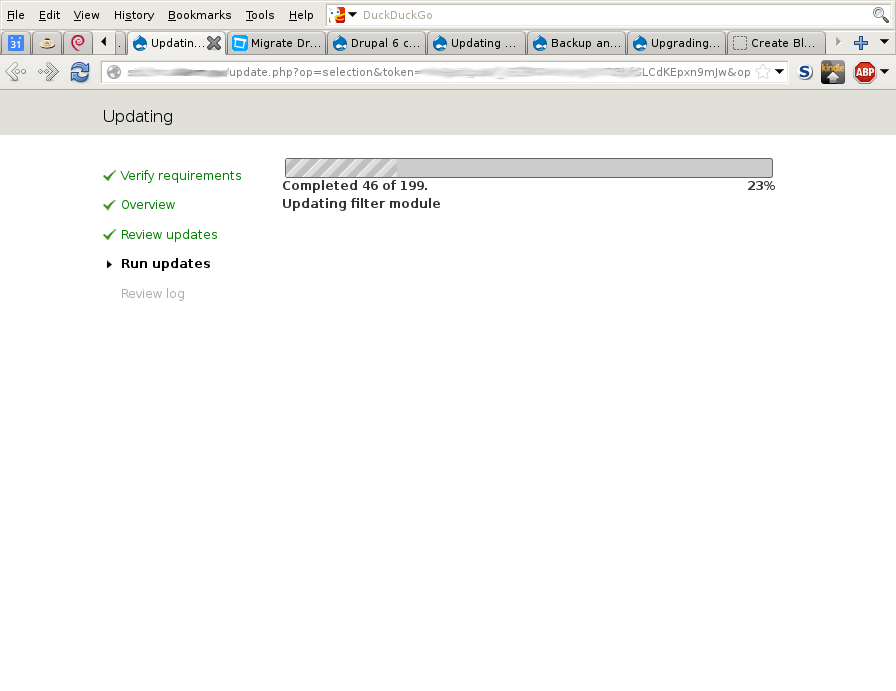
I like Drupal. It's a very, very flexible CMS that evolved into a full-fledged Web development framework. Mind you, it's written in PHP, and that makes it a nightmare to develop for (in ~6 years I have used it for all of my important websites I have only got around to develop a set of related modules for it once). PHP programming sucks and makes my eyes and fingers bleed, but happily there are people who disagree with me And they tend to write code. All the better! Minor upgrades with Drupal are quite easy to handle. Not as easy as I'd like (i.e. whenever I upgrade the core system or a module, I have to log in as root^Wadmin^WUser #1 to ~15 different sites and run http://someurl/update.php It very seldom causes any pain. The updates that have to be run via this URL are usually on the database's structures, so I understand they have to be started (and watched) by a human. And yes, I know I could do that with Drush, the Drupal shell, but it is not very friendly to Debian-packaged Drupal... But easy enoguh. But major updates are a royal pain, and they usually amount to quite a bit. First, disable all of the modules and revert to a known-safe theme. Ok, it makes sense. Second, check whether the modules exist for the newer version (as they won't work Drupal changes enough between major versions that not only it's API-incompatible, I'd classify it as API-unrecognizable). Ok, all set? Now for the live migration itself... It has to be triggered from the browser. So yes, I am now staring at a window making clever AJAX status updates. I am sitting at 46 of 199, but following the lovely ways of programmers, it's impossible to forsee whether update #47 will just be an UPDATE foo SET bar=0 WHERE bar IS NULL or a full-scale conversion between unspeakable serialized binary structures while rearranging the whole database structure. And yes, while the meter progresses I stand in fear that update #n+1 will bomb giving me an ugly red error. I must keep the magic AJAX running, or the update might be botched. And, of course, the update has sat at #69 all while I wrote the last two paragraphs. Sometimes the updates can progress after an interruption... And it seems I have no choice but to interrupt it. /me crosses fingers... [update] Wow... I am happy I got bored of looking at the meter and decided to write this blog post: After several minutes, and just as I was about to launch a second update session (130 updates to go), the meter advanced! I'm now sitting watching it at #75. Will it ever reach 199? [update] And so it had to be... At around 115, I now got: *sigh* The update process was aborted prematurely while running update #7000 in biblio.module...
AttachmentSize
drupal_updating.png39.5 KB
drupal_updating_failed.png64.72 KB

29 May 2013

Russ Allbery: Review: The Making of the Indebted Man

Review: The Making of the Indebted Man, by Maurizio Lazzarato
Translator: Joshua David Jordan
Publisher: Semiotext(e)
Copyright: 2011, 2012
Printing: 2012
ISBN: 1-58435-115-2
Format: Trade paperback
Pages: 199
This is a continuation of my effort to catch up on Marxist thought while pondering workplace governance, this time following the recommendations of a friend after a related conversation (about pension systems and basic income guarantee in a Usenet group Usenet isn't dead yet). As opposed to Democracy at Work, which is a popularization, The Making of the Indebted Man has more of the density of a scholarly text. The version I'm reading is also in translation, which I suspect makes it even harder going in places. The basic thesis, though, is clear: debt is far more central to the way that we construct not only economic systems but social systems and even internal models of our own nature than is often realized. We prefer to think of societies as structured around mutual exchange, but in practice they're more often constructed around concepts of debt and credit that have been fully internalized and used to construct a moral code for a responsible debtor. And this is not a neutral construction; rather, it is a key support mechanism of capitalism and of the financial and economic status quo, used (both intentionally and accidentally) to reduce uncertainty and to support exploitation and economic domination. This is one of those perspectives that didn't occur to me prior to reading this book but which is startlingly obvious in retrospect. Once Lazzarato starts pointing it out, the prevelance and universality of debt as a basic structure of social and economic life is striking. The creditor and debtor concept extends not just to obvious examples, such as consumer credit or mortgages, but also to education (via student loans), law enforcement ("pay one's debt to society"), employment (most employers, particularly during economic downturns, have successfully inverted the natural direction of the creditor relationship and have made employees feel in debt to the employer for having a job), and social services (unemployment and welfare benefits come with significant, if often unstated, debt-like requirements). Debt is also the great leveller. It now cuts across race, gender, and social class. Apart from a small handful of extremely rich individuals and corporations, Lazzarato claims, convincingly, that nearly everyone is enmeshed to some extent in a network of debt, or at least in in attitudes and moral pressures of a debtor. Nor is this a static situation. The role of debt in our social lives seems to be constantly increasing. The past fifteen years in particular have seen drastic increases in debt during a debt-funded economic boom combined with debt-funded asset bubbles. Even after the financial collapse, much of that growth of debt persists. Lazzarato, probably in part because he's Italian, focuses on national debt (more on that in a moment); as an American, I'd identify student loan debt as a more compelling example in the United States. Other countries probably have their own examples. For a system to be this widespread, it must serve some social purpose. Lazzarato sees it as an instrument of control. Debt has been very effectively built up as a moral obligation, and (unlike a society of mutual support) it's a very one-sided moral obligation that strongly favors existing power. The debtor is held to a tight moral standard of repayment of debts, and is morally condemned by all of society, including their peers, for a failure to repay. But there is little or no corresponding moral pressure on the creditor: perhaps a half-hearted dislike of high interest rates or occasional pressure to not change previously agreed terms, but nothing like the moral pressure applied to the debtor. To be a creditor is to have an agreed-upon, one-sided right to dictate to the debtor the terms on which they must conduct a portion of their life, and the larger the debt, the larger the portion. The debtor is expected to realign their life, at least in part, around paying off the debt, including choice of profession, decisions about when to quit a job, about how to prioritize personal spending, and so forth. This is all so automatic and so deeply ingrained that, even while writing this, I'm nodding along and thinking "well, of course." Lazzarato offers an opportunity to take a step back and think about the implications, particularly of the deeply one-sided web of obligations this creates. A Marxist analysis adds another level of consideration. One of the basic questions of Marxist thought is why workers put up with exploitation by capitalists. In a Marxist analysis, workers provide the productive output of society, which is then redirected and controlled by a relatively small capitalists. The workers massively outnumber the capitalists. Why would they be content for this situation to continue? Marx, of course, thought they wouldn't be, that the periodic crises of capitalism would eventually result in a socialist revolution by the workers. But by and large this hasn't happened. Why? Lazzarato offers debt as a partial explanation. The profits redirected by capitalists are returned to workers to some extent, but as debt rather than payment. This allows workers to participate to some extent in the growth of societal wealth from constantly increasing productivity, while simultaneously entangling workers in a system of moral control. Company stores, starvation wages, and other confiscatory practices are clear mechanisms of external control that provoke directed outrage. Debt is something that the debtor has nominally agreed to (however much the situation is manipulated to make that agreement almost inevitable), and to which attaches a deep tradition of moral responsibility. The worker has respected grounds on which to object to inequitable treatment; the debtor is wholly responsible for repayment, and is rarely considered to have grounds to complain about the debt. Most of the historical attempts to balance those scales, such as laws and religious rules against usury or the historical Jewish rule of Jubilee, have fallen by the wayside. This is a rather extended summary of what I got out of the book. I'm doing that in part because the book itself is somewhat heavy going. Lazzarato makes extensive use of specialized terms (often not defined) and fills the book with references to other works without much in the way of useful summary. It's the sort of book where, if you're not already well-versed in the field, you may need to just keep reading through some passages to find a point of reference that makes the argument retroactively make sense. I had a particular difficulty with "subjectivation," a term that Wikipedia tells me is from the writings of Michel Foucault (a major source for this book), which Lazzarato uses extensively but never adequately defines. Some external research indicates that this is a very difficult term to define, which explains why I was never quite comfortable with my understanding. I think Lazzarato is using it to get at the process of internalization of the morality of debt and the way that a debt society forces individuals into a mode of economic individualism in which many of their personal choices are bent towards making themselves better (more reliable, more trustworthy) debtors. But I'm not completely sure. There are also places in which I think Lazzarato takes his argument too far, although one of those, I think, reflects a difference in national economic status. He makes quite a lot of national debt in this book, placing it in the universal position of the overarching debt that turns every citizen into a debtor even if they've avoided other debts. This is possibly true in countries whose national debts are held in other currencies, or in countries like Italy that are part of the Euro (which, if one is not Germany or France, amounts to much the same thing). It's a dubious assertion for countries like the UK, Japan, or the United States, where the national debt is held in their own free-floating currency and is largely owed domestically, and partly plays into some frustratingly incorrect political rhetoric. One of the key dynamics of debt, namely the extreme power imbalance between debtor and creditor, is missing in countries with sovereign debt in their own currency, since those countries can always (if they're willing to pay the inflation price) simply print money to pay off national debt. Creditors know this, and therefore interest rates are much lower, the amount of leverage the creditor has is quite limited, and the sorts of debt crises seen in Italy and elsewhere in the Euro periphery are not seen. Lazzarato is understandably writing from the Italian perspective, but I think he weakens his argument by lumping national debt so completely into the same category as the other types of exploitative debt he discusses. The principle does feel universal to me, but the best examples of debt vary by country, so one has to be careful about generalizing specific examples. Another place where I simply disagree with his conclusions is around some of the more dramatic presentations of subjectivation. Lazzarato talks, at one point, about how debt reduces debtors to mechanical components, and uses as an example an ATM machine, which he portrays as uniquely dehumanizing through the mechanical process that someone has to follow to withdraw money. There may be some point here about the dehumanization of debt and its subsumption into the foundation of day-to-day social interaction, but he lost me entirely with the unwarranted technophobia of the specific example. The idea that machines and automation make us less human is an old argument that's orthogonal to the thrust of his argument. It reminded me of old contentions that human relationships made on-line aren't real, which is nonsense. Overall, this is a fascinating and insightful discussion hampered by a difficult and sometimes overly elliptical presentation, a bit too much drama and grand theorizing, and a few poor choices of examples. I found the basic idea extremely valuable, but the amount of work required to extract it occasionally irritating. (This could be partly due to the limits of translation, but I suspect most of the difficulty was present in the original.) I'm not sure that I would recommend the book, but I definitely recommend considering the underlying ideas. Debt now works alongside the employment relationship as a primary means of reinforcing economic and social control and hierarchy. This is likely via accidental development rather than any grand plan, but it's now being actively exploited by the creditors of society, large corporations most notably. Viewed in that light, the explosive growth of student loan debt in the United States is particularly frightening. After Lazzarato's extensive examination of the distortive effects of permanent debt, not just on economics and society but on our own conceptions of our selves and our duties and roles in life, the idea of trapping a generation in debt from the moment of their financial independence is deeply troubling, even nauseating. Rating: 6 out of 10

27 May 2013

Michael Stapelberg: Results of the Debian systemd survey

A week ago, we started the Debian systemd survey. The goal was to figure out a few trends and answer the following two questions:
  1. Do our subjective impressions from the discussions on debian-devel reflect the general sentiment about systemd?
  2. What are the main concerns that most people have?
Thank you all for your participation! General I am happy to tell that 2113 people had a look at the survey and 573 people actually participated. Of those, 45.7% said they are a DD, DM or otherwise maintaining packages. 74.5% said they actually booted and used a computer running systemd. With regards to having systemd in Debian at all, not necessarily as the default init system, answers are as follows: 43.9% said they personally want systemd as the default init system in Debian, while 32.2% don t want that. The remaining 23.7% don t know yet. Top concerns About 50% of participants provided one or more concerns. Evaluating this part of the survey is obviously the hardest, since the answers were provided as free text. I tried categorizing the feedback into a few buckets. Each bucket comes with a number which is a weighted (!) count, i.e. the top concern counts 3 times, the second concern counts 2 times and the last concern just once. If you cannot find your personal concerns, that is because those which were just voiced by less then five people are not listed here. As I said, we cared about trends in this survey, not individual opinions.
  1. systemd is too complex, or bloated, or it does too many things, or has too many dependencies (weight: 217)
  2. systemd is not portable to non-linux systems, e.g. Debian/kFreeBSD or HURD (weight: 199)
  3. Debugging the boot process is harder than in sysvinit (weight: 106)
  4. I have a problem with systemd upstream and/or Lennart in particular (weight: 87)
  5. systemd violates the UNIX philosophy (weight: 35)
  6. I dislike binary logs and/or the journal in general (weight: 30)
  7. systemd is too new, still untested, unstable and experimental (weight: 24)
  8. I cannot find enough documentation in general or about the transition from sysvinit to systemd in particular (weight: 20)
  9. People need to learn new commands/how the new system works (weight: 20)
  10. I don t know what problems systemd solves and/or have no problems with sysvinit currently (weight: 19)
  11. I think the configuration is binary and/or the configuration format is weird (weight: 13)
  12. systemd s code is not good (memory leaks, performance problems) and/or upstream s development lacks best practices such as long-term stable branches (weight: 9)
  13. There are problems with systemd in Debian (e.g. Debian-specific extensions to /etc/fstab not supported, system doesn t boot) (weight: 9)
  14. Customizing the boot is harder than with sysvinit (weight: 8)
  15. systemd is not compatible with sysvinit (weight: 8)
I realize that the choice of buckets is somewhat broad and there are many different, finely nuanced opinions out there. Again, this is for seeing a trend, not accounting for every single individual opinion. In case you strongly believe that I did something wrong when evaluating the survey results, please contact me and we can work something out. Conclusions/Actions I know this is a controversial topic. Please don t start yet another systemd discussion on debian-devel. We, the systemd Debian maintainers, will try to come up with good answers to all listed concerns and communicate them in a friendly and concise way soon. Furthermore, we have recognized the need for more documentation/information about how things are supposed to work with regards to the transition (and systemd in general) and will address that, too. Raw questions/numbers
Total records in survey: 573
Are you a Debian Developer (DD) or Debian Maintainer (DM) or otherwise currently maintaining Debian packages?
262 Yes
311 No
Did you ever boot and use a computer running systemd? It does not matter whether that computer was running Debian or a different operating system.
427 Yes
146 No
What is your general sentiment towards having systemd in Debian (not necessarily as default)?
358 I welcome systemd in Debian, everything is fine.
 81 I am not sure yet.
 46 I don t care.
 88 I don t want systemd in Debian.
Would you personally want systemd as the default init system in Debian?
252 Yes
136 I don t know
185 No

26 May 2013

Richard Hartmann: Full House

Even though I only flew to and from Berlin for a single day due to time constraints at work, my first attendance at LinuxTag was a nice experience. Everything was organized rather well and people seemed to be having fun. The event itself has a decidedly commercial tone to it with lots of actual companies present both at booths and during talks. Also, there was a distinct lack of anything resembling a hackerspace, i.e. chairs, tables and power outlets. My talk has been received rather well, having both the highest attendance of all talks I went to during LinuxTag and the highest attendance of all of my own talks to date. When I began there were 105 people in the room excluding myself. During the talk there was a constant trickle of people entering which led to several people standing at the back and others sitting on the ground. With a grand total of two people leaving early, I guesstimate 130+ people have attended. As you can see on the photo below the percentage of attendees who are looking into their laptops/cell phones and not really paying attention was, once again, very low: Audience during my 'Gitify your life' talk at LinuxTag 2013 Now if only I could find a way to track how many of them did actually sat down afterwards and looked at the tools presented... Sadly, there was no video recording of the talk, but I may be able to get my hands at the video material recorded during OSD2013.

23 May 2013

Clint Adams: Oh, free software

I want a CLI WebDAV client that's better than cadaver or hdav. I want a program that can sync an .ics file with a CalDAV server, by dividing it up into events and individually synchronizing each of those. I don't have a clue how deletions would be handled, but that would be nice too. Then I want a program that can synchronize the .ics file with org-mode files. I want a SIP client that works as well as Twinkle but has the architecture of SFLphone or is a library upon which an arbitrary UI can be constructed. I want an HTML-rendering library that has callbacks or hooks for security- and privacy-relevant things like cookies and SSL certificates. I want at least one browser built on this library. I want it to support vi-like keybindings. I want an HTTP(S) proxy that can be dynamically-configured per-client or per-connection through a standardized protocol that web browsers or their plugins can speak. I want it to be able to handle all the relevant things covered by AdBlock Plus, RequestPolicy, and NoScript. I want HTTPS authentication through Monkeysphere and mod_gnutls. I want a git-annex backend for Ogg Vorbis files that treat the audio streams independently of the metadata yet stores them together in the same file so that everything behaves as usual but the annex doesn't bloat by 400Go after I run beets. I want a file transfer queuing system that can work over any sort of transport mechanism, direct or asynchronous, that handles partial transfers and throttling, and is generally magical. I want all kinds of accounting software improvements. I want sane PBX software. I want an OpenStack that doesn't use libvirt for KVM. I want backup software that behaves some weird hybrid of BoxBackup and Dirvish. I want a peer-to-peer card- and board-game platform that uses cryptographic assurance. I want everyone to use YAML instead of XML. I want a phone that's not running a doomed operating system. I want lots of other stuff.

19 May 2013

Evgeni Golov: powerdyn a dynamic DNS service for PowerDNS users

You may not know this, but I am a huge PowerDNS fan. This may be because it is so simple to use, supports different databases as backends or maybe just because I do not like BIND, pick one. I also happen to live in Germany where ISPs usually do not give static IP-addresses to private customers. Unless you pay extra or limit yourself to a bunch of providers that do good service but rely on old (DSL) technology, limiting you to some 16MBit/s down and 1MBit/s up. Luckily my ISP does not force the IP-address change, but it does happen from time to time (once in a couple of month usually). To access the machine(s) at home while on a non-IPv6-capable connection, I have been using my old (old, old, old) DynDNS.com account and pointing a CNAME from under die-welt.net to it. Some time ago, DynDNS.com started supporting AAAA records in their zones and I was happy: no need to type hostname.ipv6.kerker.die-welt.net to connect via v6 just let the application decide. Well, yes, almost. It s just DynDNS.com resets the AAAA record when you update the A record with ddclient and there is currently no IPv6 support in any of the DynDNS.com clients for Linux. So I end up with no AAAA record and am not as happy as I should be. Last Friday I got a mail from DynDNS:
Starting now, if you would like to maintain your free Dyn account, you must now log into your account once a month. Failure to do so will result in expiration and loss of your hostname. Note that using an update client will no longer suffice for this monthly login. You will still continue to get email alerts every 30 days if your email address is current.
Yes, thank you very much
Given that I have enough nameservers under my control and love hacking, I started writing an own dynamic DNS service. Actually you cannot call it a service. Or dynamic. But it s my own, and it does DNS: powerdyn. It is actually just a script, that can update DNS records in SQL (from which PowerDNS serves the zones). When you design such a service , you first think about user authentication and proper information transport. The machine that runs my PowerDNS database is reachable via SSH, so let s use SSH for that. You do not only get user authentication, server authentication and properly crypted data transport, you also do not have to try hard to find out the IP-address you want to update the hostname to, just use $SSH_CLIENT from your environment. If you expected further explanation what has to be done next: sorry, we re done. We have the user (or hostname) by looking at the SSH credentials, and we have the IP-address to update it to if the data in the database is outdated. The only thing missing is some execution daemon or cron(8). :) The machine at home has the following cron entry now:
*/5 * * * * ssh -4 -T -i /home/evgeni/.ssh/powerdyn_rsa powerdyn@ssh.die-welt.net
This connects to the machine with the database via v4 (my IPv6 address does not change) and that s all.
As an alternative, one can add the ssh call in /etc/network/if-up.d/, /etc/ppp/ip-up.d/ or /etc/ppp/ipv6-up.d (depending on your setup) to be executed every time the connection goes up. The machine with the database has the following authorized_keys entry for the powerdyn user:
no-agent-forwarding,no-port-forwarding,no-pty,no-X11-forwarding,no-user-rc,\ 
command="/home/powerdyn/powerdyn/powerdyn dorei.kerker.die-welt.net" ssh-rsa AAAA... evgeni@dorei
By forcing the command, the user has no way to get the database-credentials the script uses to write to the database and neither cannot update a different host. That seems secure enough for me. It won t scale for a setup as DynDNS.com and the user-management sucks (you even have to create the entries in the database first, the script can only update them), but it works fine for me and I bet it would for others too :) Update: included suggestions by XX and Helmut from the comments.

16 May 2013

Daniel Pocock: Debian to rescue Skype users?

Last year at DebConf12 and the Paris mini-DebConf I mentioned some of the sophisticated techniques that the likes of Microsoft and Facebook are using to monitor their customers. So when Skype was busted spying on the content of chat messages, it was no surprise for many people in the Debian community. People are already rushing to find alternatives like XMPP and Jitsi. Debian 7 has been released just in time, with powerful features like TURN support that finally allow users to make free calls and chats with seamless NAT traversal. Sadly, Debian's built-in VoIP/RTC client, Empathy, only uses Google's TURN servers and not native Debian servers, but hopefully a solution will come soon, but it is easy enough to install Jitsi instead and configure it to use any of the free TURN server software on Debian. It should be emphasized that Skype does not just spy on URLs in chat - it has simply been possible to detect this form of spying by detecting when the URL is accessed. Microsoft has taken out various patents for secretive monitoring of Internet phone calls and the analysis of speech patterns to detect both the content and emotions during a conversation. This allows them to get a very thorough analysis of the state of mind of every user at almost every moment and fine-tune the type of advertising and branding that is delivered to that person through conventional means and also through biased news' reporting and other means.

Next.

Previous.