Search Results: "sto"

16 January 2022

Russell Coker: SSD Endurance

I previously wrote about the issue of swap potentially breaking SSD [1]. My conclusion was that swap wouldn t be a problem as no normally operating systems that I run had swap using any significant fraction of total disk writes. In that post the most writes I could see was 128GB written per day on a 120G Intel SSD (writing the entire device once a day). My post about swap and SSD was based on the assumption that you could get many thousands of writes to the entire device which was incorrect. Here s a background on the terminology from WD [2]. So in the case of the 120G Intel SSD I was doing over 1 DWPD (Drive Writes Per Day) which is in the middle of the range of SSD capability, Intel doesn t specify the DWPD or TBW (Tera Bytes Written) for that device. The most expensive and high end NVMe device sold by my local computer store is the Samsung 980 Pro which has a warranty of 150TBW for the 250G device and 600TBW for the 1TB device [3]. That means that the system which used to have an Intel SSD would have exceeded the warranty in 3 years if it had a 250G device. My current workstation has been up for just over 7 days and has averaged 110GB written per day. It has some light VM use and the occasional kernel compile, a fairly typical developer workstation. It s storage is 2*Crucial 1TB NVMe devices in a BTRFS RAID-1, the NVMe devices are the old series of Crucial ones and are rated for 200TBW which means that they can be expected to last for 5 years under the current load. This isn t a real problem for me as the performance of those devices is lower than I hoped for so I will buy faster ones before they are 5yo anyway. My home server (and my wife s workstation) is averaging 325GB per day on the SSDs used for the RAID-1 BTRFS filesystem for root and for most data that is written much (including VMs). The SSDs are 500G Samsung 850 EVOs [4] which are rated at 150TBW which means just over a year of expected lifetime. The SSDs are much more than a year old, I think Samsung stopped selling them more than a year ago. Between the 2 SSDs SMART reports 18 uncorrectable errors and btrfs device stats reports 55 errors on one of them. I m not about to immediately replace them, but it appears that they are well past their prime. The server which runs my blog (among many other things) is averaging over 1TB written per day. It currently has a RAID-1 of hard drives for all storage but it s previous incarnation (which probably had about the same amount of writes) had a RAID-1 of enterprise SSDs for the most written data. After a few years of running like that (and some time running with someone else s load before it) the SSDs became extremely slow (sustained writes of 15MB/s) and started getting errors. So that s a pair of SSDs that were burned out. Conclusion The amounts of data being written are steadily increasing. Recent machines with more RAM can decrease storage usage in some situations but that doesn t compare to the increased use of checksummed and logged filesystems, VMs, databases for local storage, and other things that multiply writes. The amount of writes allowed under warranty isn t increasing much and there are new technologies for larger SSD storage that decrease the DWPD rating of the underlying hardware. For the systems I own it seems that they are all going to exceed the rated TBW for the SSDs before I have other reasons to replace them, and they aren t particularly high usage systems. A mail server for a large number of users would hit it much earlier. RAID of SSDs is a really good thing. Replacement of SSDs is something that should be planned for and a way of swapping SSDs to less important uses is also good (my parents have some SSDs that are too small for my current use but which work well for them). Another thing to consider is that if you have a server with spare drive bays you could put some extra SSDs in to spread the wear among a larger RAID-10 array. Instead of having a 2*SSD BTRFS RAID-1 for a server you could have 6*SSD to get a 3* longer lifetime than a regular RAID-1 before the SSDs wear out (BTRFS supports this sort of thing). Based on these calculations and the small number of errors I ve seen on my home server I ll add a 480G SSD I have lying around to the array to spread the load and keep it running for a while longer.

Russ Allbery: Review: The Brightest Fell

Review: The Brightest Fell, by Seanan McGuire
Series: October Daye #11
Publisher: DAW
Copyright: 2017
ISBN: 0-698-18352-5
Format: Kindle
Pages: 353
This is the eleventh book in the October Daye urban fantasy series, not counting various novellas and side stories. You really cannot start here, particularly given how many ties this book has to the rest of the series. I would like to claim there's some sort of plan or strategy in how I read long series, but there are just a lot of books to read and then I get distracted and three years have gone by. The advantage of those pauses, at least for writing reviews, is that I return to the series with fresh eyes and more points of comparison. My first thought this time around was "oh, these books aren't that well written, are they," followed shortly thereafter by staying up past midnight reading just one more chapter. Plot summaries are essentially impossible this deep into a series, when even the names of the involved characters can be a bit of a spoiler. What I can say is that we finally get the long-awaited confrontation between Toby and her mother, although it comes in an unexpected (and unsatisfying) form. This fills in a few of the gaps in Toby's childhood, although there's not much there we didn't already know. It fills in considerably more details about the rest of Toby's family, most notably her pure-blood sister. The writing is indeed not great. This series is showing some of the signs I've seen in other authors (Mercedes Lackey, for instance) who wrote too many books per year to do each of them justice. I have complained before about McGuire's tendency to reuse the same basic plot structure, and this instance seemed particularly egregious. The book opens with Toby enjoying herself and her found family, feeling like they can finally relax. Then something horrible happens to people she cares about, forcing her to go solve the problem. This in theory requires her to work out some sort of puzzle, but in practice is fairly linear and obvious because, although I love Toby as a character, she can't puzzle her way out of a wet sack. Everything is (mostly) fixed in the end, but there's a high cost to pay, and everyone ends the book with more trauma. The best books of this series are the ones where McGuire manages to break with this formula. This is not one of them. The plot is literally on magical rails, since The Brightest Fell skips even pretending that Toby is an actual detective (although it establishes that she's apparently still working as one in the human world, a detail that I find baffling) and gives her a plot compass that tells her where to go. I don't really mind this since I read this series for emotional catharsis rather than Toby's ingenuity, but alas that's mostly missing here as well. There is a resolution of sorts, but it's the partial and conditional kind that doesn't include awful people getting their just deserts. This is also not a good series entry for world-building. McGuire has apparently been dropping hints for this plot back at least as far as Ashes of Honor. I like that sort of long-term texture to series like this, but the unfortunate impact on this book is a lot of revisiting of previous settings and very little in the way of new world-building. The bit with the pixies was very good; I wanted more of that, not the trip to an Ashes of Honor setting to pick up a loose end, or yet another significant scene in Borderland Books. As an aside, I wish authors would not put real people into their books as characters, even when it's with permission as I'm sure it was here. It's understandable to write a prominent local business into a story as part of the local color (although even then I would rather it not be a significant setting in the story), but having the actual owner and staff show up, even in brief cameos, feels creepy and weird to me. It also comes with some serious risks because real people are not characters under the author's control. (All the content warnings for that link, which is a news story from three years after this book was published.) So, with all those complaints, why did I stay up late reading just one more chapter? Part of the answer is that McGuire writes very grabby books, at least for me. Toby is a full-speed-ahead character who is constantly making things happen, and although the writing in this book had more than the usual amount of throat-clearing and rehashing of the same internal monologue, the plot still moved along at a reasonable clip. Another part of the answer is that I am all-in on these characters: I like them, I want them to be happy, and I want to know what's going to happen next. It helps that McGuire has slowly added characters over the course of a long series and given most of them a chance to shine. It helps even more that I like all of them as people, and I like the style of banter that McGuire writes. Also, significant screen time for the Luidaeg is never a bad thing. I think this was the weakest entry in the series in a while. It wrapped up some loose ends that I wasn't that interested in wrapping up, introduced a new conflict that it doesn't resolve, spent a bunch of time with a highly unpleasant character I didn't enjoy reading about, didn't break much new world-building ground, and needed way more faerie court politics. But some of the banter was excellent, the pixies and the Luidaeg were great, and I still care a lot about these characters. I am definitely still reading. Followed by Nights and Silences. Continuing a pattern from Once Broken Faith, the ebook version of The Brightest Fell includes a bonus novella. (I'm not sure if it's also present in the print version.) "Of Things Unknown": As is usual for the short fiction in this series, this is a side story from the perspective of someone other than Toby. In this case, that's April O'Leary, first introduced all the way back in A Local Habitation, and the novella focuses on loose ends from that novel. Loose ends are apparently the theme of this book. This was... fine. I like April, I enjoyed reading a story from her perspective, and I'm always curious to see how Toby looks from the outside. I thought the plot was strained and the resolution a bit too easy and painless, and I was not entirely convinced by April's internal thought processes. It felt like McGuire left some potential for greater plot complications on the table here, and I found it hard to shake the impression that this story was patching an error that McGuire felt she'd made in the much earlier novel. But it was nice to have an unambiguously happy ending after the more conditional ending of the main story. (6) Rating: 6 out of 10

14 January 2022

Dirk Eddelbuettel: Rcpp 1.0.8: Updated, Strict Headers

rcpp logo The Rcpp team is thrilled to share the news of the newest release 1.0.8 of Rcpp which hit CRAN today, and has already been uploaded to Debian as well. Windows and macOS builds should appear at CRAN in the next few days. This release continues with the six-months cycle started with release 1.0.5 in July 2020. As a reminder, interim dev or rc releases will alwasys be available in the Rcpp drat repo; this cycle there were once again seven (!!) times two as we also tested the modified header (more below). These rolling release tend to work just as well, and are also fully tested against all reverse-dependencies. Rcpp has become the most popular way of enhancing R with C or C++ code. Right now, around 2478 packages on CRAN depend on Rcpp for making analytical code go faster and further, along with 242 in BioConductor. This release finally brings a change we have worked on quite a bit over the last few months. The idea of enforcing the setting of STRICT_R_HEADERS was prososed years ago in 2016 and again in 2018. But making such a chance against a widely-deployed code base has repurcussions, and we were not ready then. Last April, this was revisited in issue #1158. Over the course of numerous lengthy runs of tests of a changed Rcpp package against (essentially) all reverse-dependencies (i.e. packages which use Rcpp) we identified ninetyfour packages in total which needed a change. We provided either a patch we emailed, or a GitHub pull request, to all ninetyfour. And we are happy to say that eighty cases were resolved via a new CRAN upload, with a seven more having merged the pull request but not yet uploaded. Hence, we could make the case to CRAN (who were always CC ed on the monthly nag emails we sent to maintainers of packages needing a change) that an upload was warranted. And after a brief period for their checks and inspection, our January 11 release of Rcpp 1.0.8 arrived on CRAN on January 13. So with that, a big and heartfelt Thank You! to all eighty maintainers for updating their packages to permit this change at the Rcpp end, to CRAN for the extra checking, and to everybody else who I bugged with the numerous emails and updated to the seemingly never-ending issue #1158. We all got this done, and that is a Good Thing (TM). Other than the aforementioned change which will not automatically set STRICT_R_HEADERS (unless opted out which one can), a number of nice pull request by a number of contributors are included in this release: The full list of details follows.

Changes in Rcpp release version 1.0.8 (2022-01-11)
  • Changes in Rcpp API:
    • STRICT_R_HEADERS is now enabled by default, see extensive discussion in #1158 closing #898.
    • A new #define allows default setting of finalizer calls for external pointers (I aki in #1180 closing #1108).
    • Rcpp:::CxxFlags() now quotes the include path generated, (Kevin in #1189 closing #1188).
    • New header files Rcpp/Light, Rcpp/Lighter, Rcpp/Lightest and default Rcpp/Rcpp for fine-grained access to features (and compilation time) (Dirk #1191 addressing #1168).
  • Changes in Rcpp Attributes:
    • A new option signature allows customization of function signatures (Travers Ching in #1184 and #1187 fixing #1182)
  • Changes in Rcpp Documentation:
    • The Rcpp FAQ has a new entry on how not to grow a vector (Dirk in #1167).
    • Some long-spurious calls to RNGSope have been removed from examples (Dirk in #1173 closing #1172).
    • DOI reference in the bibtex files have been updated per JSS request (Dirk in #1186).
  • Changes in Rcpp Deployment:
    • Some continuous integration components have been updated (Dirk in #1174, #1181, and #1190).

Thanks to my CRANberries, you can also look at a diff to the previous release. Questions, comments etc should go to the rcpp-devel mailing list off the R-Forge page. Bugs reports are welcome at the GitHub issue tracker as well (where one can also search among open or closed issues); questions are also welcome under rcpp tag at StackOverflow which also allows searching among the (currently) 2822 previous questions. If you like this or other open-source work I do, you can sponsor me at GitHub.

This post by Dirk Eddelbuettel originated on his Thinking inside the box blog. Please report excessive re-aggregation in third-party for-profit settings.

13 January 2022

Daniel Lange: Leveling the playing field for non-native speakers

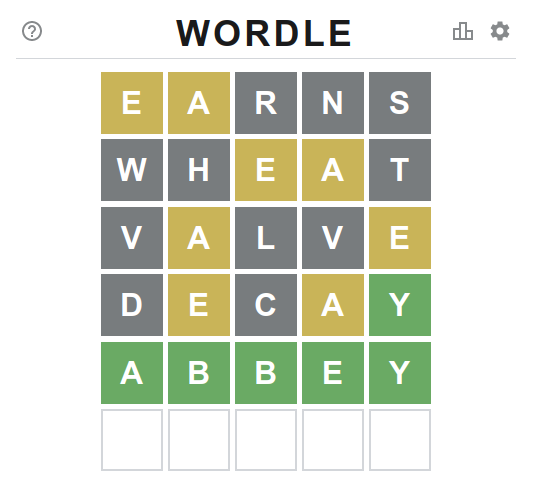
Wordle game screenshort of bash, grep and pipes

Updates 24.01.2022: What I love about the community is the playful creativity that inspires a game like Wordle and that in turn inspires others to create fun tools around it: Robert Reichel has reverse engineered the Wordle application, so in case you want to play tomorrow's word today .. you can. Or have that one guess "Genius" solution experience. JP Fosterson created a Wordle helper that is very much the Python version of my grep-foo above. In case you play regularly and can use a hand. And Tom Lockwood wrote a Wordle solver also in Python. He blogged about it and ... is pondering to rewrite things in Rust:

I ve decided to explore Rust for this, and so far what was taking 1GB of RAM in Python is taking, literally 1MB in Rust!
Welcome to 2022. 01.02.2022: OMG. Wordle has been bought by the New York Times for "for a price in the low seven figures" (Source). Joey Rees-Hill put it well in The Death of Wordle:
Today s Web is dominated by platforms. The average Web user will spend most of their time on large platforms such as Instagram, Facebook, Twitter, TikTok, Google Drive/Docs, YouTube, Netflix, Spotify, Gmail, and Google Calendar, along with sites operated by large publishers such as The New York Times or The Washington Post. [..]
The Web wasn t always this way. I m not old enough to remember this, but things weren t always so centralized. Web users might run their own small website, and certainly would visit a good variety of smaller sites. With the increasing availability of internet access, the Web has become incredibly commercialized, with a handful of companies concentrating Web activity on their own properties.
Wordle was a small site that gained popularity despite not being part of a corporate platform. It was wonderful to see an independent site gain attention for being simple and fun. Wordle was refreshingly free of attention-manipulating dark patterns and pushy monetization. That s why it s a shame to see it absorbed, to inevitably become just another feature of one large media company s portfolio.
Still kudos to Josh Wardle, a Million Pounds for Wordle. Well done! It was fun while it lasted. Let's see what the next Wordle will be. This one has just been absorbed into the borg collective.

11 January 2022

Ritesh Raj Sarraf: ThinkPad AMD Debian

After a hiatus of 6 years, it was nice to be back with the ThinkPad. This blog post briefly touches upon my impressions with the current generation ThinkPad T14 Gen2 AMD variant.

ThinkPad T14 Gen2 AMD

Lenovo It took 8 weeks to get my hands on the machine. Given the pandemic, restrictions and uncertainities, not sure if I should call it an ontime delivery. This was a CTO - Customise-to-order; so was nice to get rid of things I really didn t care/use much. On the other side, it also meant I could save on some power. It also came comparatively cheaper overall.
  • No fingerprint reader
  • No Touch screen
There s still parts where Lenovo could improve. Or less frustate a customer. I don t understand why a company would provide a full customization option on their portal, while at the same time, not provide an explicit option to choose the make/model of the hardware one wants. Lenovo deliberately chooses to not show/specify which WiFi adapter one could choose. So, as I suspected, I ended up with a MEDIATEK Corp. Device 7961 wifi adapter.

AMD For the first time in my computing life, I m now using AMD at the core. I was pretty frustrated with annoying Intel Graphics bugs, so decided to take the plunge and give AMD/ATI a shot, knowing that the radeon driver does have decent support. So far, on the graphics side of things, I m glad that things look bright. The stock in-kernel radeon driver has been working perfect for my needs and I haven t had to tinker even once so far, in my 30 days of use. On the overall system performance, I have not done any benchmarks nor do I want to do. But wholly, the system performance is smooth.

Power/Thermal This is where things need more improvement on the AMD side. This AMD laptop terribly draws a lot of power in suspend mode. And it isn t just this machine, but also the previous T14 Gen1 which has similar problems. I m not sure if this is a generic ThinkPad problem, or an AMD specific problem. But coming from the Dell XPS 13 9370 Intel, this does draw a lot lot more power. So much, that I chose to use hibernation instead. Similarly, on the thermal side, this machine doesn t cool down well as compared the the Dell XPS Intel one. On an idle machine, its temperature are comparatively higher. Looking at powertop reports, it does show to consume an average of 10 watts power even while idle. I m hoping these are Linux ingeration issues and that Lenovo/AMD will improve things in the coming months. But given the user feedback on the ThinkPad T14 Gen1 thread, it may just be wishful thinking.

Linux The overall hardware support has been surprisingly decent. The MediaTek WiFi driver had some glitches but with Linux 5.15+, things have considerably improved. And I hope the trend will continue with forthcoming Linux releases. My previous device driver experience with MediaTek wasn t good but I took the plunge, considering that in the worst scenario I d have the option to swap the card. There s a lot of marketing about Linux + Intel. But I took a jibe with Linux + AMD. There are glitches but nothing so far that has been a dealbreaker. If anything, I wish Lenovo/AMD would seriously work on the power/thermal issues.

Migration Other than what s mentioned above, I haven t had any serious issues. I may have had some rare occassional hangs but they ve been so infrequent that I haven t spent time to investigate those. Upon receiving the machine, my biggest requirement was how to switch my current workstation from Dell XPS to Lenovo ThinkPad. I ve been using btrfs for some time now. And over the years, built my own practise on how to structure it. Things like, provisioning [sub]volumes, based on use cases is one thing I see. Like keeping separate subvols for: cache/temporary data, copy-on-write data , swap etc. I wish these things could be simplified; either on the btrfs tooling side or some different tool on top of it. Below is filtered list of subvols created over years, that were worthy of moving to the new machine.
rrs@priyasi:~$ cat btrfs-volume-layout 
ID 550 gen 19166 top level 5 path home/foo/.cache
ID 552 gen 1522688 top level 5 path home/rrs
ID 553 gen 1522688 top level 552 path home/rrs/.cache
ID 555 gen 1426323 top level 552 path home/rrs/rrs-home/Libvirt-Images
ID 618 gen 1522672 top level 5 path var/spool/news
ID 634 gen 1522670 top level 5 path var/tmp
ID 635 gen 1522688 top level 5 path var/log
ID 639 gen 1522226 top level 5 path var/cache
ID 992 gen 1522670 top level 5 path disk-tmp
ID 1018 gen 1522688 top level 552 path home/rrs/NoBackup
ID 1196 gen 1522671 top level 5 path etc
ID 23721 gen 775692 top level 5 path swap
18:54                      

btrfs send/receive This did come in handy but I sorely missed some feature. Maybe they aren t there, or are there and I didn t look close enough. Over the years, different attributes were set to different subvols. Over time I forget what feature was added where. But from a migration point of view, it d be nice to say, Take this volume and take it with all its attributes . I didn t find that functionality in send/receive. There s get/set-property which I noticed later but by then it was late. So some sort of tooling, ideally something like btrfs migrate or somesuch would be nicer. In the file system world, we already have nice tools to take care of similar scenarios. Like with rsync, I can request it to carry all file attributes. Also, iirc, send/receive works only on ro volumes. So there s more work one needs to do in:
  1. create ro vol
  2. send
  3. receive
  4. don t forget to set rw property
  5. And then somehow find out other properties set on each individual subvols and [re]apply the same on the destination
I wish this all be condensed into a sub-command. For my own sake, for this migration, the steps used were:
user@debian:~$ for volume in  sudo btrfs sub list /media/user/TOSHIBA/Migrate/   cut -d ' ' -f9   grep -v ROOTVOL   grep -v etc   grep -v btrbk ; do echo $volume; sud
o btrfs send /media/user/TOSHIBA/$volume   sudo btrfs receive /media/user/BTRFSROOT/ ; done            
Migrate/snapshot_disk-tmp
At subvol /media/user/TOSHIBA/Migrate/snapshot_disk-tmp
At subvol snapshot_disk-tmp
Migrate/snapshot-home_foo_.cache
At subvol /media/user/TOSHIBA/Migrate/snapshot-home_foo_.cache
At subvol snapshot-home_foo_.cache
Migrate/snapshot-home_rrs
At subvol /media/user/TOSHIBA/Migrate/snapshot-home_rrs
At subvol snapshot-home_rrs
Migrate/snapshot-home_rrs_.cache
At subvol /media/user/TOSHIBA/Migrate/snapshot-home_rrs_.cache
At subvol snapshot-home_rrs_.cache
ERROR: crc32 mismatch in command
Migrate/snapshot-home_rrs_rrs-home_Libvirt-Images
At subvol /media/user/TOSHIBA/Migrate/snapshot-home_rrs_rrs-home_Libvirt-Images
At subvol snapshot-home_rrs_rrs-home_Libvirt-Images
ERROR: crc32 mismatch in command
Migrate/snapshot-var_spool_news
At subvol /media/user/TOSHIBA/Migrate/snapshot-var_spool_news
At subvol snapshot-var_spool_news
Migrate/snapshot-var_lib_machines
At subvol /media/user/TOSHIBA/Migrate/snapshot-var_lib_machines
At subvol snapshot-var_lib_machines
Migrate/snapshot-var_lib_machines_DebianSidTemplate
..... snipped .....
And then, follow-up with:
user@debian:~$ for volume in  sudo btrfs sub list /media/user/BTRFSROOT/   cut -d ' ' -f9 ; do echo $volume; sudo btrfs property set -ts /media/user/BTRFSROOT/$volume ro false; done
ROOTVOL
ERROR: Could not open: No such file or directory
etc
snapshot_disk-tmp
snapshot-home_foo_.cache
snapshot-home_rrs
snapshot-var_spool_news
snapshot-var_lib_machines
snapshot-var_lib_machines_DebianSidTemplate
snapshot-var_lib_machines_DebSidArmhf
snapshot-var_lib_machines_DebianJessieTemplate
snapshot-var_tmp
snapshot-var_log
snapshot-var_cache
snapshot-disk-tmp
And then finally, renaming everything to match proper:
user@debian:/media/user/BTRFSROOT$ for x in snapshot*; do vol=$(echo $x   cut -d '-' -f2   sed -e "s _ / g"); echo $x $vol; sudo mv $x $vol; done
snapshot-var_lib_machines var/lib/machines
snapshot-var_lib_machines_Apertisv2020ospackTargetARMHF var/lib/machines/Apertisv2020ospackTargetARMHF
snapshot-var_lib_machines_Apertisv2021ospackTargetARM64 var/lib/machines/Apertisv2021ospackTargetARM64
snapshot-var_lib_machines_Apertisv2022dev3ospackTargetARMHF var/lib/machines/Apertisv2022dev3ospackTargetARMHF
snapshot-var_lib_machines_BusterArm64 var/lib/machines/BusterArm64
snapshot-var_lib_machines_DebianBusterTemplate var/lib/machines/DebianBusterTemplate
snapshot-var_lib_machines_DebianJessieTemplate var/lib/machines/DebianJessieTemplate
snapshot-var_lib_machines_DebianSidTemplate var/lib/machines/DebianSidTemplate
snapshot-var_lib_machines_DebianSidTemplate_var_lib_portables var/lib/machines/DebianSidTemplate/var/lib/portables
snapshot-var_lib_machines_DebSidArm64 var/lib/machines/DebSidArm64
snapshot-var_lib_machines_DebSidArmhf var/lib/machines/DebSidArmhf
snapshot-var_lib_machines_DebSidMips var/lib/machines/DebSidMips
snapshot-var_lib_machines_JenkinsApertis var/lib/machines/JenkinsApertis
snapshot-var_lib_machines_v2019 var/lib/machines/v2019
snapshot-var_lib_machines_v2019LinuxSupport var/lib/machines/v2019LinuxSupport
snapshot-var_lib_machines_v2020 var/lib/machines/v2020
snapshot-var_lib_machines_v2021dev3Slim var/lib/machines/v2021dev3Slim
snapshot-var_lib_machines_v2021dev3SlimTarget var/lib/machines/v2021dev3SlimTarget
snapshot-var_lib_machines_v2022dev2OspackMinimal var/lib/machines/v2022dev2OspackMinimal
snapshot-var_lib_portables var/lib/portables
snapshot-var_log var/log
snapshot-var_spool_news var/spool/news
snapshot-var_tmp var/tmp

snapper Entirely independent of this, but indirectly related. I use snapper as my snapshotting tool. It worked perfect on my previous machine. While everything got migrated, the only thing that fell apart was snapper. It just wouldn t start/run proper. Funny thing is that I just removed the snapper configs and reinitialized with the exact same config again, and voila snapper was happy.

Conclusion That was pretty much it. With the above and then also migrating /boot and then just chroot to install the boot loader. At some time, I d like to explore other boot options but given that that is such a non-essential task, it is low on the list. The good part was that I booted into my new machine with my exact workstation setup as it was. All the way to the user cache and the desktop session. So it was nice on that part. But I surely think there s room for a better migration experience here. If not directly as btrfs migrate, then maybe as an independent tool. The problem is that such a tool is going to be used once in years, so I didn t find the motivation to write one. But this surely would be a good use case for the distribution vendors.

Russ Allbery: Review: Hench

Review: Hench, by Natalie Zina Walschots
Publisher: William Morrow
Copyright: September 2020
ISBN: 0-06-297859-4
Format: Kindle
Pages: 403
Anna Tromedlov is a hench, which means she does boring things for terrible people for money. Supervillains need a lot of labor to keep their bases and criminal organizations running, and they get that labor the same way everyone else does: through temporary agencies. Anna does spreadsheets, preferably from home on her couch. On-site work was terrifying and she tried to avoid it, but the lure of a long-term contract was too strong. The Electric Eel, despite being a creepy sleazeball, seemed to be a manageable problem. He needed some support at a press conference, which turns out to be code for being a diversity token in front of the camera, but all she should have to do is stand there. That's how Anna ends up holding the mind control device to the head of the mayor's kid when the superheroes attack, followed shortly by being thrown across the room by Supercollider. Left with a complex fracture of her leg that will take months to heal, a layoff notice and a fruit basket from Electric Eel's company, and a vaguely menacing hospital conversation with the police (including Supercollider in a transparent disguise) in which it's made clear to her that she is mistaken about Supercollider's hand-print on her thigh, Anna starts wondering just how much damage superheroes have done. The answer, when analyzed using the framework for natural disasters, is astonishingly high. Anna's resulting obsession with adding up the numbers leads to her starting a blog, the Injury Report, with a growing cult following. That, in turn, leads to a new job and a sponsor: the mysterious supervillain Leviathan. To review this book properly, I need to talk about Watchmen. One of the things that makes superheroes interesting culturally is the straightforwardness of their foundational appeal. The archetypal superhero story is an id story: an almost pure power fantasy aimed at teenage boys. Like other pulp mass media, they reflect the prevailing cultural myths of the era in which they're told. World War II superheroes are mostly all-American boy scouts who punch Nazis. 1960s superheroes are a more complex mix of outsider misfits with a moral code and sarcastic but earnestly ethical do-gooders. The superhero genre is vast, with numerous reinterpretations, deconstructions, and alternate perspectives, but its ur-story is a good versus evil struggle of individual action, in which exceptional people use their powers for good to defeat nefarious villains. Watchmen was not the first internal critique of the genre, but it was the one that everyone read in the 1980s and 1990s. It takes direct aim at that moral binary. The superheroes in Watchmen are not paragons of virtue (some of them are truly horrible people), and they have just as much messy entanglement with the world as the rest of us. It was superheroes re-imagined for the post-Vietnam, post-Watergate era, for the end of the Cold War when we were realizing how many lies about morality we had been told. But it still put superheroes and their struggles with morality at the center of the story. Hench is a superhero story for the modern neoliberal world of reality TV and power inequality in the way that Watchmen was a superhero story for the Iran-Contra era and the end of the Cold War. Whether our heroes have feet of clay is no longer a question. Today, a better question is whether the official heroes, the ones that are celebrated as triumphs of individual achievement, are anything but clay. Hench doesn't bother asking whether superheroes have fallen short of their ideal; that answer is obvious. What Hench asks instead is a question familiar to those living in a world full of televangelists, climate denialism, manipulative advertising, and Facebook: are superheroes anything more than a self-perpetuating scam? Has the good superheroes supposedly do ever outweighed the collateral damage? Do they care in the slightest about the people they're supposedly protecting? Or is the whole system of superheroes and supervillains a performance for an audience, one that chews up bystanders and spits them out mangled while delivering simplistic and unquestioned official morality? This sounds like a deeply cynical premise, but Hench is not a cynical book. It is cynical about superheroes, which is not the same thing. The brilliance of Walschots's approach is that Anna has a foot in both worlds. She works for a supervillain and, over the course of the book, gains access to real power within the world of superheroic battles. But she's also an ordinary person with ordinary problems: not enough money, rocky friendships, deep anger at the injustices of the world and the way people like her are discarded, and now a disability and PTSD. Walschots perfectly balances the tension between those worlds and maintains that tension straight to the end of the book. From the supervillain world, Anna draws support, resources, and a mission, but all of the hope, true morality, and heart of this book comes from the ordinary side. If you had the infrastructure of a supervillain at your disposal, what would you do with it? Anna's answer is to treat superheroes as a destructive force like climate change, and to do whatever she can to drive them out of the business and thus reduce their impact on the world. The tool she uses for that is psychological warfare: make them so miserable that they'll snap and do something too catastrophic to be covered up. And the raw material for that psychological warfare is data. That's the foot in the supervillain world. In descriptions of this book, her skills with data are often called her superpower. That's not exactly wrong, but the reason why she gains power and respect is only partly because of her data skills. Anna lives by the morality of the ordinary people world: you look out for your friends, you treat your co-workers with respect as long as they're not assholes, and you try to make life a bit better for the people around you. When Leviathan gives her the opportunity to put together a team, she finds people with skills she admires, funnels work to people who are good at it, and worries about the team dynamics. She treats the other ordinary employees of a supervillain as people, with lives and personalities and emotions and worth. She wins their respect. Then she uses their combined skills to destroy superhero lives. I was fascinated by the moral complexity in this book. Anna and her team do villainous things by the morality of the superheroic world (and, honestly, by the morality of most readers), including some things that result in people's deaths. By the end of the book, one could argue that Anna has been driven by revenge into becoming an unusual sort of supervillain. And yet, she treats the people around her so much better than either the heroes or the villains do. Anna is fiercely moral in all the ordinary person ways, and that leads directly to her becoming a villain in the superhero frame. Hench doesn't resolve that conflict; it just leaves it on the page for the reader to ponder. The best part about this book is that it's absurdly grabby, unpredictable, and full of narrative momentum. Walschots's pacing kept me up past midnight a couple of times and derailed other weekend plans so that I could keep reading. I had no idea where the plot was going even at the 80% mark. The ending is ambiguous and a bit uncomfortable, just like the morality throughout the book, but I liked it the more I thought about it. One caveat, unfortunately: Hench has some very graphic descriptions of violence and medical procedures, and there's an extended torture sequence with some incredibly gruesome body horror that I thought went on far too long and was unnecessary to the plot. If you're a bit squeamish like I am, there are some places where you'll want to skim, including one sequence that's annoyingly intermixed with important story developments. Otherwise, though, this is a truly excellent book. It has a memorable protagonist with a great first-person voice, an epic character arc of empowerment and revenge, a timely take on the superhero genre that uses it for sharp critique of neoliberal governance and reality TV morality, a fascinatingly ambiguous and unsettled moral stance, a gripping and unpredictable plot, and some thoroughly enjoyable competence porn. I had put off reading it because I was worried that it would be too cynical or dark, but apart from the unnecessary torture scene, it's not at all. Highly recommended. Rating: 9 out of 10

9 January 2022

Russ Allbery: Review: Redemptor

Review: Redemptor, by Jordan Ifueko
Series: Raybearer #2
Publisher: Amulet Books
Copyright: 2021
ISBN: 1-68335-720-5
Format: Kindle
Pages: 328
Redemptor is the second half of a duology that started with Raybearer. You could read the first book without the second, but reading the second without the first will not make much sense. I'm going to be a bit elliptical in my plot description since there's a lot of potential for spoilers for the first book. Tarisai has reached a point of stability and power, but she's also committed herself to a goal, one that will right a great historical and ongoing injustice. She's also now in a position to both notice and potentially correct numerous other injustices in the structure of her society, and plans to start by defending those closest to her. But in the midst of her opening gambit to save someone she believes is unjustly imprisoned, the first murderous undead child appears, attacking both Tarisai's fragile sense of security and her self-esteem and self-worth. Before long, she's drowning in feelings of inadequacy and isolation, and her grand plans for reordering the world have turned into an anxiety loop of self-flagellating burnout. I so much wanted to like this book. Argh. I think I see what Ifueko was aiming for, and it's a worthy topic for a novel. In Raybearer, Tarisai got the sort of life that she previously could only imagine, but she's also the sort of person who shoulders massive obligations. Imposter syndrome, anxiety, overwork, and burnout are realistic risks, and are also important topics to write about. There are some nicely subtle touches buried in this story, such as the desire of her chosen family to have her present and happy without entirely understanding why she isn't, and without seeing the urgency that she sees in the world's injustice. The balancing act of being effective without overwhelming oneself is nearly impossible, and Tarisai has very little preparation or knowledgeable support. But this story is told with the subtlety of a sledgehammer, and in a way that felt forced rather than arising naturally from the characters. If the point of emphasis had been a disagreement with her closest circle over when and how much the world should be changed, I think this would be a better book. In the places where this drives the plot, it is a better book. But Ifueko instead externalizes anxiety and depression in the form of obviously manipulative demonic undead children who (mostly) only Tarisai can see, and it's just way too much. Her reactions are manipulated and sometimes externally imposed in a way that turns what should have been a character vs. self plot into a character vs. character plot in which the protagonist is very obviously making bad decisions and the antagonist is an uninteresting cliche. The largest problem I had with this book is that I found it thuddingly obvious, in part because the plot felt like it was on narrowly constrained rails to ensure it hit all of the required stops. When the characters didn't want the plot to go somewhere, they're sidelined, written out of the story, or otherwise forcibly overridden. Tarisai has to feel isolated, so all the people who, according to the events of the previous book and the established world-building rules, would not let her be isolated are pushed out of her life. When this breaks the rules of magic in this world, those rules are off-handedly altered. Characters that could have had their own growth arcs after Raybearer become static and less interesting, since there's no room for them in the plot. Instead, we get all new characters, which gives Redemptor a bit of a cast size problem. Underneath this, there is an occasional flash of great writing. Ifueko chooses to introduce a dozen mostly-new characters to an already large cast and I was still able to mostly keep them straight, which shows real authorial skill. She is very good with short bursts of characterization to make new characters feel fresh and interesting. Even the most irritating of the new characters (Crocodile, whose surprise twist I thought was obvious and predictable) is an interesting archetype to explore in a book about activism and activist burnout. I can see some pieces of a better book here. But I desperately wanted something to surprise me, for Tarisai or one of the other characters to take the plot in some totally unexpected direction the way that Raybearer did. It never happened. That leads directly to another complaint: I liked Raybearer in part because of the freshness of a different mythological system and a different storytelling tradition than what we typically get in fantasy novels. I was hoping for more of the same in Redemptor, which meant I was disappointed when I got a mix of Christianity and Greek mythology. As advertised by Raybearer, the central mythological crisis of Redemptor concerns the Underworld. This doesn't happen until about 80% into the book (which is also a bit of a problem; the ending felt rushed given how central it was to the plot), so I can't talk about it in detail without spoiling it. But what I think I can say is that unfortunately the religious connotations of the title are not an accident. Rather than something novel that builds on the excellent idea of the emi-ehran spirit animal, there is a lot of Christ symbolism mixed with an underworld that could have come from an Orpheus retelling. There's nothing inherently wrong with this (although the Christian bits landed poorly for me), but it wasn't what I was hoping for from the mythology of this world. I rarely talk much about the authors in fiction reviews. I prefer to let books stand on their own without trying too hard to divine the author's original intentions. But here, I think it's worth acknowledging Ifueko's afterword in which she says that writing Redemptor in the middle of a pandemic, major depression, and the George Floyd protests was the most difficult thing she'd ever done. I've seen authors write similar things in afterwords when the effect on the book was minimal or invisible, but I don't think that was the case here. Redemptor is furious, anxious, depressed, and at points despairing, and while it's okay for novels to be all of those things when it's under the author's control, here they felt like emotions that were imposed on the story from outside. Raybearer was an adventure story about found family and ethics that happened to involve a lot of politics. Redemptor is a story about political activism and governance, but written in a universe whose bones are set up for an adventure story. The mismatch bothered me throughout; not only did these not feel like the right characters to tell this story with, but the politics were too simple, too morally clear-cut, and too amenable to easy solutions for a good political fantasy. Raybearer focused its political attention on colonialism. That's a deep enough topic by itself to support a duology (or more), but Redemptor adds in property rights, land reform, economic and social disparity, unfair magical systems, and a grab bag of other issues, and it overwhelms the plot. There isn't space and time to support solutions with sufficient complexity to satisfyingly address the problems. Ifueko falls back on benevolent dictator solutions, and I understand why, but that's not the path to a satisfying resolution in an overtly political fantasy. This is the sort of sequel that leaves me wondering if I can recommend reading the first book and not the second, and that makes me sad. Redemptor is not without its occasional flashes of brilliance, but I did not have fun reading this book and I can't recommend the experience. That said, I think this is a book problem, not an author problem; I will happily read Ifueko's next novel, and I suspect it will be much better. Rating: 5 out of 10

8 January 2022

Jonathan Dowland: 2021 in Fiction

Cover for *This is How You Lose the Time War*
Cover for *Robot*
Cover for *The Glass Hotel*
Following on from last year's round-up of my reading, here's a look at the fiction I enjoyed in 2021. I managed to read 42 books in 2021, up from 31 last year. That's partly to do with buying an ereader: 33/36% of my reading (by pages/by books) was ebooks. I think this demonstrates that ebooks have mostly complemented paper books for me, rather than replacing them. My book of the year (although it was published in 2019) was This is How You Lose the Time War by Amal El-Mohtar and Max Gladstone: A short epistolary love story between warring time travellers and quite unlike anything else I've read for a long time. Other notables were The Glass Hotel by Emily St John Mandel and Robot by Adam Wi niewski-Snerg. The biggest disappointment for me was The Ministry for the Future by Kim Stanley Robinson (KSR), which I haven't even finished. I love KSRs writing: I've written about him many times on this blog, at least in 2002, 2006 and 2009, I think I've read every other novel he's published and most of his short stories. But this one was too much of something for me. He's described this novel a the end-point of a particular journey and approach to writing he's taken, which I felt relieved to learn, assuming he writes any more novels (and I really hope that he does) they will likely be in a different "mode". My "new author discovery" for 2021 was Chris Beckett: I tore through Two Tribes and America City before promptly buying all his other work. He fits roughly into the same bracket as Adam Roberts and Christopher Priest, two of my other favourite authors. 5 of the books I read (12%) were from my "backlog" of already-purchased physical books. I'd like to try and reduce my Backlog further so I hope to push this figure up next year. I made a small effort to read more diverse authors this year. 24% of the books I read (by book count and page count) were by women. 15% by page count were (loosely) BAME (19% by book count). Again I'd like to increase these numbers modestly in 2022. Unlike 2020, I didn't complete any short story collections in 2021! This is partly because there was only one issue of Interzone published in all of 2021, a double-issue which I haven't yet finished. This is probably a sad date point in terms of Interzone's continued existence, but it's not dead yet.

John Goerzen: Make the Internet Yours Again With an Instant Mesh Network

I m going to lead with the technical punch line, and then explain it: Yggdrasil Network is an opportunistic mesh that can be deployed privately or as part of a global-scale network. Each node gets a stable IPv6 address (or even an entire /64) that is derived from its public key and is bound to that node as long as the node wants it (of course, it can generate a new keypair anytime) and is valid wherever the node joins the mesh. All traffic is end-to-end encrypted. Yggdrasil will automatically discover peers on a LAN via broadcast beacons, and requires zero configuration to peer in such a way. It can also run as an overlay network atop the public Internet. Public peers serve as places to join the global network, and since it s a mesh, if one device on your LAN joins the global network, the others will automatically have visibility on it also, thanks to the mesh routing. It neatly solves a lot of problems of portability (my ssh sessions stay live as I move networks, for instance), VPN (incoming ports aren t required since local nodes can connect to a public peer via an outbound connection), security, and so forth. Now on to the explanation: The Tyranny of IP rigidity Every device on the Internet, at one time, had its own globally-unique IP address. This number was its identifier to the world; with an IP address, you can connect to any machine anywhere. Even now, when you connect to a computer to download a webpage or send a message, under the hood, your computer is talking to the other one by IP address. Only, now it s hard to get one. The Internet protocol we all grew up with, version 4 (IPv4), didn t have enough addresses for the explosive growth we ve seen. Internet providers and IT departments had to use a trick called NAT (Network Address Translation) to give you a sort of fake IP address, so they could put hundreds or thousands of devices behind a single public one. That, plus the mobility of devices changing IPs whenever they change locations has meant that a fundamental rule of the old Internet is now broken: Every participant is an equal peer. (Well, not any more.) Nowadays, you can t you host your own website from your phone. Or share files from your house. (Without, that is, the use of some third-party service that locks you down and acts as an intermediary.) Back in the 90s, I worked at a university, and I, like every other employee, had a PC on my desk with an unfirewalled public IP. I installed a webserver, and poof instant website. Nowadays, running a website from home is just about impossible. You may not have a public IP, and if you do, it likely changes from time to time. And even then, your ISP probably blocks you from running servers on it. In short, you have to buy your way into the resources to participate on the Internet. I wrote about these problems in more detail in my article Recovering Our Lost Free Will Online. Enter Yggdrasil I already gave away the punch line at the top. But what does all that mean?
  • Every device that participates gets an IP address that is fully live on the Yggdrasil network.
  • You can host a website, or a mail server, or whatever you like with your Yggdrasil IP.
  • Encryption and authentication are smaller (though not nonexistent) worries thanks to the built-in end-to-end encryption.
  • You can travel the globe, and your IP will follow you: onto a plane, from continent to continent, wherever. Yggdrasil will find you.
  • I ve set up /etc/hosts on my laptop to use the Yggdrasil IPs for other machines on my LAN. Now I can just ssh foo and it will work from home, from a coffee shop, from a 4G tether, wherever. Now, other tools like tinc can do this, obviously. And I could stop there; I could have a completely closed, private Yggdrasil network. Or, I can join the global Yggdrasil network. Each device, in addition to accepting peers it finds on the LAN, can also be configured to establish outbound peering connections or accept inbound ones over the Internet. Put a public peer or two in your configuration and you ve joined the global network. Most people will probably want to do that on every device (because why not?), but you could also do that from just one device on your LAN. Again, there s no need to explicitly build routes via it; your other machines on the LAN will discover the route s existence and use it. This is one of many projects that are working to democratize and decentralize the Internet. So far, it has been quite successful, growing to over 2000 nodes. It is the direct successor to the earlier cjdns/Hyperboria and BATMAN networks, and aims to be a proof of concept and a viable tool for global expansion. Finally, think about how much easier development is when you don t have to necessarily worry about TLS complexity in every single application. When you don t have to worry about port forwarding and firewall penetration. It s what the Internet should be.

    7 January 2022

    Ingo Juergensmann: Moving my repositories from Github to Codeberg.org

    Some weeks ago I moved my repositories from Github (evil, Microsoft, blabla) to Codeberg. Codeberg is a non-profit organisation located in Germany. When you really dislike Microsoft products it is somewhat a natural reaction (at least for me) to move away from Github, which was bought by Microsoft, to some more independent service provider for hosting source code. Nice thing with Codeberg is as well that it offers a migration tool from Github to Codeberg. Additionally Codeberg is also on Mastodon. If you are looking for a good service hosting your git repositories and want to move away from Github as well, please give Codeberg a try. So, please update your git settings to https://github.com/ingoj to https://codeberg.org/Windfluechter (or the specific repo).

    Ayoyimika Ajibade: Everyone Struggles

    Starting anything new always has in it an element of uncertainty, doubt, fears, and struggle to forge ahead, this has been my current situation as an outreachy intern working on the transition of nodejs16 and webpack5 which is about updating all packages that depend on nodejs14 and webpack4 to work well with the updated version of nodejs16 and webpack5 in the Debian operations system. Juicy right! As a software developer struggling to grasp both basic and advanced knowledge of a concept can seem daunting, much like learning anything new, you can be overwhelmed when you are surrounded and know there is a whole lot of other new concept, tools, process, languages you have to learn that are linked to what you are currently learning, as you are struggling to grasp the fundamental idea of what you are currently learning. imbued in any struggle to get a solution to the problem is where innovation and inventions lie in, and our learning becomes improved as we dive into fact-finding, getting your hypothesis after a series of tests and ultimately proffering a solution Some of my struggles as I intern with Debian has been lack of skill of the shell scripting language as that is one of the core languages to understand so as to navigate your way around maintaining packages for Debian, also funny enough having just an intermediate knowledge of the javascript programming language as arguably having a basic knowledge of javascript is necessary to building and testing javascript packages in Debian as I know only the basic of javascript since my core language is Python, that I struggle with. The good thing is that the more I keep at it the faster the chance of the struggles reducing Now to the fun part! having a community of developers who have been through the struggling phase is divine, as they make your learning experience much easier, my mentors and other community member have made learning to package modules for Debian much easier as all hands are on deck to always help out with our challenges. I remember it felt so wonderful when my first contribution got merged and I became more encouraged to update more packages. These helped me a lot in the contribution stage for Debian as I better familiar with how the system worked. I m super grateful to my mentors and co-intern as they are always there to assist me.

    How I Navigate my way through my struggles I guess the first thing about any challenge is to be aware of it and admit your limitations of particular knowledge, then you move on to creatively seek solutions by asking for help from those who know the way. Voila! Now comes the part where you have to take up their solutions, ideas, opinions and make it work for your particular case scenario that is a skill set that all Software developers must-have. Going through documentation has immensely helped solve my problems much faster and build new knowledge, as I get the fundamental idea of why and how things work. I also try to break each concept down into steps, achieve my goals for each step, then build all solutions in each step together, surfing the internet to find solutions also has a huge benefit.

    Vocabulary terms Used in Debian
    1. uscan => a tool to identify and download upstream source code from the repository, also compressing it into the required format.
    2. apt => a package manager to manage packages in Debian, similar to pip in python, npm in javascript.
    3. stretch/buster/bullseye/bookworm/sid => old old stable Debian9 - The codename for the release before the previous stable release (stretch). old stable Debian10 - The previous stable release (Buster). stable Debian11 - The current stable release (Bullseye). testing Debian12 - The next-generation stable release (Bookworm). unstable - The unstable development release (Sid) where new or updated packages are introduced. To understand more on debian release cycle
    4. reverse-rebuild => is building all modules that depend on a package in Debian while building the main package.
    5. lintian => A helper tool used to check for inconsistencies and errors in a Debian Package based on Debian standards.
    6. pkg-js-tools => A collection of tools to aid packaging Node modules in Debian.
    7. dpkg-buildpackage => A command to build upstream code in an unclean chroot or environment.
    8. quilt => A patch creation and management automation script. quilt helps manage a series of patches that a Debian package maintainer needs to be applied to upstream source when building the package.
    9. autopkgtest => a script used to test an installed binary package using the source package's tests
    10. RFS => (Request For Sponsorship) Working in the Debian ecosystem includes two roles either as a Debian Maintainer with restricted rights and privileges like uploading to the Debian archive or as a Debian Developer with all rights and privileges such as uploading to the Debian archive, as a new contributor or a Debian maintainer (with few rights and privileges) in Debian you can RFS so that your pull request (PR) can be merged to the Debian archive by a Debian Developer, much like your contribution has been accepted
    There are so many terms and tools you have to get accustomed to, but they are easy to understand and use, as enough and frequently updated wiki documentation are available to guide you through, plus a whole lot of community members you can ask questions from. strength and growth come only through continuous effort and struggle. Napoleon Hill

    6 January 2022

    Jacob Adams: Linux Hibernation Documentation

    Recently I ve been curious about how hibernation works on Linux, as it s an interesting interaction between hardware and software. There are some notes in the Arch wiki and the kernel documentation (as well as some kernel documentation on debugging hibernation and on sleep states more generally), and of course the ACPI Specification

    The Formal Definition ACPI (Advanced Configuration and Power Interface) is, according to the spec, an architecture-independent power management and configuration framework that forms a subsystem within the host OS which defines a hardware register set to define power states. ACPI defines four global system states G0, working/on, G1, sleeping, G2, soft off, and G3, mechanical off1. Within G1 there are 4 sleep states, numbered S1 through S4. There are also S0 and S5, which are equivalent to G0 and G2 respectively2.

    Sleep According to the spec, the ACPI S1-S4 states all do the same thing from the operating system s perspective, but each saves progressively more power, so the operating system is expected to pick the deepest of these states when entering sleep. However, most operating systems3 distinguish between S1-S3, which are typically referred to as sleep or suspend, and S4, which is typically referred to as hibernation.

    S1: CPU Stop and Cache Wipe The CPU caches are wiped and then the CPU is stopped, which the spec notes is equivalent to the WBINVD instruction followed by the STPCLK signal on x86. However, nothing is powered off.

    S2: Processor Power off The system stops the processor and most system clocks (except the real time clock), then powers off the processor. Upon waking, the processor will not continue what it was doing before, but instead use its reset vector4.

    S3: Suspend/Sleep (Suspend-to-RAM) Mostly equivalent to S2, but hardware ensures that only memory and whatever other hardware memory requires are powered.

    S4: Hibernate (Suspend-to-Disk) In this state, all hardware is completely powered off and an image of the system is written to disk, to be restored from upon reapplying power. Writing the system image to disk can be handled by the operating system if supported, or by the firmware.

    Linux Sleep States Linux has its own set of sleep states which mostly correspond with ACPI states.

    Suspend-to-Idle This is a software only sleep that puts all hardware into the lowest power state it can, suspends timekeeping, and freezes userspace processes. All userspace and some kernel threads5, except those tagged with PF_NOFREEZE, are frozen before the system enters a sleep state. Frozen tasks are sent to the __refrigerator(), where they set TASK_UNINTERRUPTIBLE and PF_FROZEN and infinitely loop until PF_FROZEN is unset6. This prevents these tasks from doing anything during the imaging process. Any userspace process running on a different CPU while the kernel is trying to create a memory image would cause havoc. This is also done because any filesystem changes made during this would be lost and could cause the filesystem and its related in-memory structures to become inconsistent. Also, creating a hibernation image requires about 50% of memory free, so no tasks should be allocating memory, which freezing also prevents.

    Standby This is equivalent to ACPI S1.

    Suspend-to-RAM This is equivalent to ACPI S3.

    Hibernation Hibernation is mostly equivalent to ACPI S4 but does not require S4, only requiring low-level code for resuming the system to be present for the underlying CPU architecture according to the Linux sleep state docs. To hibernate, everything is stopped and the kernel takes a snapshot of memory. Then, the system writes out the memory image to disk. Finally, the system either enters S4 or turns off completely. When the system restores power it boots a new kernel, which looks for a hibernation image and loads it into memory. It then overwrites itself with the hibernation image and jumps to a resume area of the original kernel7. The resumed kernel restores the system to its previous state and resumes all processes.

    Hybrid Suspend Hybrid suspend does not correspond to an official ACPI state, but instead is effectively a combination of S3 and S4. The system writes out a hibernation image, but then enters suspend-to-RAM. If the system wakes up from suspend it will discard the hibernation image, but if the system loses power it can safely restore from the hibernation image.
    1. The difference between soft and mechanical off is that mechanical off is entered and left by a mechanical means (for example, turning off the system s power through the movement of a large red switch)
    2. It s unclear to me why G and S states overlap like this. I assume this is a relic of an older spec that only had S states, but I have not as yet found any evidence of this. If someone has any information on this, please let me know and I ll update this footnote.
    3. Of the operating systems I know of that support ACPI sleep states (I checked Windows, Mac, Linux, and the three BSDs8), only MacOS does not allow the user to deliberately enable hibernation, instead supporting a hybrid suspend it calls safe sleep
    4. The reset vector of a processor is the default location where, upon a reset, the processor will go to find the first instruction to execute. In other words, the reset vector is a pointer or address where the processor should always begin its execution. This first instruction typically branches to the system initialization code. Xiaocong Fan, Real-Time Embedded Systems, 2015
    5. All kernel threads are tagged with PF_NOFREEZE by default, so they must specifically opt-in to task freezing.
    6. This is not from the docs, but from kernel/freezer.c which also notes Refrigerator is place where frozen processes are stored :-).
    7. This is the operation that requires special architecture-specific low-level code .
    8. Interestingly NetBSD has a setting to enable hibernation, but does not actually support hibernation

    5 January 2022

    Reproducible Builds: Reproducible Builds in December 2021

    Welcome to the December 2021 report from the Reproducible Builds project! In these reports, we try and summarise what we have been up to over the past month, as well as what else has been occurring in the world of software supply-chain security. As a quick recap of what reproducible builds is trying to address, whilst anyone may inspect the source code of free software for malicious flaws, almost all software is distributed to end users as pre-compiled binaries. The motivation behind the reproducible builds effort is to ensure no flaws have been introduced during this compilation process by promising identical results are always generated from a given source, thus allowing multiple third-parties to come to a consensus on whether a build was compromised. As always, if you would like to contribute to the project, please get in touch with us directly or visit the Contribute page on our website.
    Early in December, Julien Voisin blogged about setting up a rebuilderd instance in order to reproduce Tails images. Working on previous work from 2018, Julien has now set up a public-facing instance which is providing build attestations. As Julien dryly notes in his post, Currently, this isn t really super-useful to anyone, except maybe some Tails developers who want to check that the release manager didn t backdoor the released image. Naturally, we would contend sincerely that this is indeed useful.
    The secure/anonymous Tor browser now supports reproducible source releases. According to the project s changelog, version 0.4.7.3-alpha of Tor can now build reproducible tarballs via the make dist-reprod command. This issue was tracked via Tor issue #26299.
    Fabian Keil posted a question to our mailing list this month asking how they might analyse differences in images produced with the FreeBSD and ElectroBSD s mkimg and makefs commands:
    After rebasing ElectroBSD from FreeBSD stable/11 to stable/12
    I recently noticed that the "memstick" images are unfortunately
    still not 100% reproducible.
    Fabian s original post generated a short back-and-forth with Chris Lamb regarding how diffoscope might be able to support the particular format of images generated by this command set.

    diffoscope diffoscope is our in-depth and content-aware diff utility. Not only can it locate and diagnose reproducibility issues, it can provide human-readable diffs from many kinds of binary formats. This month, Chris Lamb prepared and uploading versions 195, 196, 197 and 198 to Debian, as well as made the following changes:
    • Support showing Ordering differences only within .dsc field values. [ ]
    • Add support for XMLb files. [ ]
    • Also add, for example, /usr/lib/x86_64-linux-gnu to our local binary search path. [ ]
    • Support OCaml versions 4.11, 4.12 and 4.13. [ ]
    • Drop some unnecessary has_same_content_as logging calls. [ ]
    • Replace token variable with an anonymously-named variable instead to remove extra lines. [ ]
    • Don t use the runtime platform s native endianness when unpacking .pyc files. This fixes test failures on big-endian machines. [ ]
    Mattia Rizzolo also made a number of changes to diffoscope this month as well, such as:
    • Also recognize GnuCash files as XML. [ ]
    • Support the pgpdump PGP packet visualiser version 0.34. [ ]
    • Ignore the new Lintian tag binary-with-bad-dynamic-table. [ ]
    • Fix the Enhances field in debian/control. [ ]
    Finally, Brent Spillner fixed the version detection for Black uncompromising code formatter [ ], Jelle van der Waa added an external tool reference for Arch Linux [ ] and Roland Clobus added support for reporting when the GNU_BUILD_ID field has been modified [ ]. Thank you for your contributions!

    Distribution work In Debian this month, 70 reviews of packages were added, 27 were updated and 41 were removed, adding to our database of knowledge about specific issues. A number of issue types were created as well, including: strip-nondeterminism version 1.13.0-1 was uploaded to Debian unstable by Holger Levsen. It included contributions already covered in previous months as well as new ones from Mattia Rizzolo, particularly that the dh_strip_nondeterminism Debian integration interface uses the new get_non_binnmu_date_epoch() utility when available: this is important to ensure that strip-nondeterminism does not break some kinds of binNMUs.
    In the world of openSUSE, however, Bernhard M. Wiedemann posted his monthly reproducible builds status report.
    In NixOS, work towards the longer-term goal of making the graphical installation image reproducible is ongoing. For example, Artturin made the gnome-desktop package reproducible.

    Upstream patches The Reproducible Builds project attempts to fix as many currently-unreproducible packages as possible. In December, we wrote a large number of such patches, including:

    Testing framework The Reproducible Builds project runs a significant testing framework at tests.reproducible-builds.org, to check packages and other artifacts for reproducibility. This month, the following changes were made:
    • Holger Levsen:
      • Run the Debian scheduler less often. [ ]
      • Fix the name of the Debian testing suite name. [ ]
      • Detect builds that are rescheduling due to problems with the diffoscope container. [ ]
      • No longer special-case particular machines having a different /boot partition size. [ ]
      • Automatically fix failed apt-daily and apt-daily-upgrade services [ ], failed e2scrub_all.service & user@ systemd units [ ][ ] as well as generic build failures [ ].
      • Simplify a script to powercycle arm64 architecture nodes hosted at/by codethink.co.uk. [ ]
      • Detect if the udd-mirror.debian.net service is down. [ ]
      • Various miscellaneous node maintenance. [ ][ ]
    • Roland Clobus (Debian live image generation):
      • If the latest snapshot is not complete yet, try to use the previous snapshot instead. [ ]
      • Minor: whitespace correction + comment correction. [ ]
      • Use unique folders and reports for each Debian version. [ ]
      • Turn off debugging. [ ]
      • Add a better error description for incorrect/missing arguments. [ ]
      • Report non-reproducible issues in Debian sid images. [ ]
    Lastly, Mattia Rizzolo updated the automatic logfile parsing rules in a number of ways (eg. to ignore a warning about the Python setuptools deprecation) [ ][ ] and Vagrant Cascadian adjusted the config for the Squid caching proxy on a node. [ ]

    If you are interested in contributing to the Reproducible Builds project, please visit our Contribute page on our website. However, you can get in touch with us via:

    Thomas Lange: FAI.me service now support backports for Debian 11 (bullseye)

    The FAI.me service for creating customized installation and cloud images now supports a backports kernel for the stable release Debian 11 (aka bullseye). If you enable the backports option, you will currently get kernel 5.14. This will help you if you have newer hardware that is not support by the default kernel 5.10. The backports option is also still available for the images when using the old Debian 10 (buster) release. The URL of the FAI.me service is https://fai-project.org/FAIme/ FAI.me

    4 January 2022

    Jonathan McDowell: Upgrading from a CC2531 to a CC2538 Zigbee coordinator

    Previously I setup a CC2531 as a Zigbee coordinator for my home automation. This has turned out to be a good move, with the 4 gang wireless switch being particularly useful. However the range of the CC2531 is fairly poor; it has a simple PCB antenna. It s also a very basic device. I set about trying to improve the range and scalability and settled upon a CC2538 + CC2592 device, which feature an MMCX antenna connector. This device also has the advantage that it s ARM based, which I m hopeful means I might be able to build some firmware myself using a standard GCC toolchain. For now I fetched the JetHome firmware from https://github.com/jethome-ru/zigbee-firmware/tree/master/ti/coordinator/cc2538_cc2592 (JH_2538_2592_ZNP_UART_20211222.hex) - while it s possible to do USB directly with the CC2538 my board doesn t have those bits so going the external USB UART route is easier. The device had some existing firmware on it, so I needed to erase this to force a drop into the boot loader. That means soldering up the JTAG pins and hooking it up to my Bus Pirate for OpenOCD goodness.
    OpenOCD config
    source [find interface/buspirate.cfg]
    buspirate_port /dev/ttyUSB1
    buspirate_mode normal
    buspirate_vreg 1
    buspirate_pullup 0
    transport select jtag
    source [find target/cc2538.cfg]
    
    Steps to erase
    $ telnet localhost 4444
    Trying ::1...
    Trying 127.0.0.1...
    Connected to localhost.
    Escape character is '^]'.
    Open On-Chip Debugger
    > mww 0x400D300C 0x7F800
    > mww 0x400D3008 0x0205
    > shutdown
    shutdown command invoked
    Connection closed by foreign host.
    
    At that point I can switch to the UART connection (on PA0 + PA1) and flash using cc2538-bsl:
    $ git clone https://github.com/JelmerT/cc2538-bsl.git
    $ cc2538-bsl/cc2538-bsl.py -p /dev/ttyUSB1 -e -w -v ~/JH_2538_2592_ZNP_UART_20211222.hex
    Opening port /dev/ttyUSB1, baud 500000
    Reading data from /home/noodles/JH_2538_2592_ZNP_UART_20211222.hex
    Firmware file: Intel Hex
    Connecting to target...
    CC2538 PG2.0: 512KB Flash, 32KB SRAM, CCFG at 0x0027FFD4
    Primary IEEE Address: 00:12:4B:00:22:22:22:22
        Performing mass erase
    Erasing 524288 bytes starting at address 0x00200000
        Erase done
    Writing 524256 bytes starting at address 0x00200000
    Write 232 bytes at 0x0027FEF88
        Write done
    Verifying by comparing CRC32 calculations.
        Verified (match: 0x74f2b0a1)
    
    I then wanted to migrate from the old device to the new without having to repair everything. So I shut down Home Assistant and backed up the CC2531 network information using zigpy-znp (which is already installed for Home Assistant):
    python3 -m zigpy_znp.tools.network_backup /dev/zigbee > cc2531-network.json
    
    I copied the backup to cc2538-network.json and modified the coordinator_ieee to be the new device s MAC address (rather than end up with 2 devices claiming the same MAC if/when I reuse the CC2531) and did:
    python3 -m zigpy_znp.tools.network_restore --input cc2538-network.json /dev/ttyUSB1
    
    The old CC2531 needed unplugged first, otherwise I got an RuntimeError: Network formation refused, RF environment is likely too noisy. Temporarily unscrew the antenna or shield the coordinator with metal until a network is formed. error. After that I updated my udev rules to map the CC2538 to /dev/zigbee and restarted Home Assistant. To my surprise it came up and detected the existing devices without any extra effort on my part. However that resulted in 2 coordinators being shown in the visualisation, with the old one turning up as unk_manufacturer. Fixing that involved editing /etc/homeassistant/.storage/core.device_registry and removing the entry which had the old MAC address, removing the device entry in /etc/homeassistant/.storage/zha.storage for the old MAC and then finally firing up sqlite to modify the Zigbee database:
    $ sqlite3 /etc/homeassistant/zigbee.db
    SQLite version 3.34.1 2021-01-20 14:10:07
    Enter ".help" for usage hints.
    sqlite> DELETE FROM devices_v6 WHERE ieee = '00:12:4b:00:11:11:11:11';
    sqlite> DELETE FROM endpoints_v6 WHERE ieee = '00:12:4b:00:11:11:11:11';
    sqlite> DELETE FROM in_clusters_v6 WHERE ieee = '00:12:4b:00:11:11:11:11';
    sqlite> DELETE FROM neighbors_v6 WHERE ieee = '00:12:4b:00:11:11:11:11' OR device_ieee = '00:12:4b:00:11:11:11:11';
    sqlite> DELETE FROM node_descriptors_v6 WHERE ieee = '00:12:4b:00:11:11:11:11';
    sqlite> DELETE FROM out_clusters_v6 WHERE ieee = '00:12:4b:00:11:11:11:11';
    sqlite> .quit
    
    So far it all seems a bit happier than with the CC2531; I ve been able to pair a light bulb that was previously detected but would not integrate, which suggests the range is improved. (This post another in the set of things I should write down so I can just grep my own website when I forget what I did to do foo .)

    3 January 2022

    Paul Wise: FLOSS Activities December 2021

    Focus This month I didn't have any particular focus. I just worked on issues in my info bubble.

    Changes

    Issues

    Review
    • Spam: reported 166 Debian mailing list posts
    • Patches: reviewed libpst upstream patches
    • Debian packages: sponsored nsis, memtest86+
    • Debian wiki: RecentChanges for the month
    • Debian BTS usertags: changes for the month
    • Debian screenshots:

    Administration
    • libpst: setup GitHub presence, migrate from hg to git, requested details from bug reporters
    • plac: cleaned up git repo anomalies
    • Debian BTS: unarchive/reopen/triage bugs for reintroduced packages: stardict, node-carto
    • Debian wiki: unblock IP addresses, approve accounts

    Communication
    • Respond to queries from Debian users and contributors on the mailing lists and IRC

    Sponsors The purple-discord, python-plac, sptag, smart-open, libpst, memtest86+, oci-python-sdk work was sponsored. All other work was done on a volunteer basis.

    Ian Jackson: Debian s approach to Rust - Dependency handling

    tl;dr: Faithfully following upstream semver, in Debian package dependencies, is a bad idea. Introduction I have been involved in Debian for a very long time. And I ve been working with Rust for a few years now. Late last year I had cause to try to work on Rust things within Debian. When I did, I found it very difficult. The Debian Rust Team were very helpful. However, the workflow and tooling require very large amounts of manual clerical work - work which it is almost impossible to do correctly since the information required does not exist. I had wanted to package a fairly straightforward program I had written in Rust, partly as a learning exercise. But, unfortunately, after I got stuck in, it looked to me like the effort would be wildly greater than I was prepared for, so I gave up. Since then I ve been thinking about what I learned about how Rust is packaged in Debian. I think I can see how to fix some of the problems. Although I don t want to go charging in and try to tell everyone how to do things, I felt I ought at least to write up my ideas. Hence this blog post, which may become the first of a series. This post is going to be about semver handling. I see problems with other aspects of dependency handling and source code management and traceability as well, and of course if my ideas find favour in principle, there are a lot of details that need to be worked out, including some kind of transition plan. How Debian packages Rust, and build vs runtime dependencies Today I will be discussing almost entirely build-dependencies; Rust doesn t (yet?) support dynamic linking, so built Rust binaries don t have Rusty dependencies. However, things are a bit confusing because even the Debian binary packages for Rust libraries contain pure source code. So for a Rust library package, building the Debian binary package from the Debian source package does not involve running the Rust compiler; it s just file-copying and format conversion. The library s Rust dependencies do not need to be installed on the build machine for this. So I m mostly going to be talking about Depends fields, which are Debian s way of talking about runtime dependencies, even though they are used only at build-time. The way this works is that some ultimate leaf package (which is supposed to produce actual executable code) Build-Depends on the libraries it needs, and those Depends on their under-libraries, so that everything needed is installed. What do dependencies mean and what are they for anyway? In systems where packages declare dependencies on other packages, it generally becomes necessary to support versioned dependencies. In all but the most simple systems, this involves an ordering (or similar) on version numbers and a way for a package A to specify that it depends on certain versions of B. Both Debian and Rust have this. Rust upstream crates have version numbers and can specify their dependencies according to semver. Debian s dependency system can represent that. So it was natural for the designers of the scheme for packaging Rust code in Debian to simply translate the Rust version dependencies to Debian ones. However, while the two dependency schemes seem equivalent in the abstract, their concrete real-world semantics are totally different. These different package management systems have different practices and different meanings for dependencies. (Interestingly, the Python world also has debates about the meaning and proper use of dependency versions.) The epistemological problem Consider some package A which is known to depend on B. In general, it is not trivial to know which versions of B will be satisfactory. I.e., whether a new B, with potentially-breaking changes, will actually break A. Sometimes tooling can be used which calculates this (eg, the Debian shlibdeps system for runtime dependencies) but this is unusual - especially for build-time dependencies. Which versions of B are OK can normally only be discovered by a human consideration of changelogs etc., or by having a computer try particular combinations. Few ecosystems with dependencies, in the Free Software community at least, make an attempt to precisely calculate the versions of B that are actually required to build some A. So it turns out that there are three cases for a particular combination of A and B: it is believed to work; it is known not to work; and: it is not known whether it will work. And, I am not aware of any dependency system that has an explicit machine-readable representation for the unknown state, so that they can say something like A is known to depend on B; versions of B before v1 are known to break; version v2 is known to work . (Sometimes statements like that can be found in human-readable docs.) That leaves two possibilities for the semantics of a dependency A depends B, version(s) V..W: Precise: A will definitely work if B matches V..W, and Optimistic: We have no reason to think B breaks with any of V..W. At first sight the latter does not seem useful, since how would the package manager find a working combination? Taking Debian as an example, which uses optimistic version dependencies, the answer is as follows: The primary information about what package versions to use is not only the dependencies, but mostly in which Debian release is being targeted. (Other systems using optimistic version dependencies could use the date of the build, i.e. use only packages that are current .)
    Precise Optimistic
    People involved in version management Package developers,
    downstream developers/users.
    Package developers,
    downstream developer/users,
    distribution QA and release managers.
    Package developers declare versions V and dependency ranges V..W so that It definitely works. A wide range of B can satisfy the declared requirement.
    The principal version data used by the package manager Only dependency versions. Contextual, eg, Releases - set(s) of packages available.
    Version dependencies are for Selecting working combinations (out of all that ever existed). Sequencing (ordering) of updates; QA.
    Expected use pattern by a downstream Downstream can combine any
    declared-good combination.
    Use a particular release of the whole system. Mixing-and-matching requires additional QA and remedial work.
    Downstreams are protected from breakage by Pessimistically updating versions and dependencies whenever anything might go wrong. Whole-release QA.
    A substantial deployment will typically contain Multiple versions of many packages. A single version of each package, except where there are actual incompatibilities which are too hard to fix.
    Package updates are driven by Top-down:
    Depending package updates the declared metadata.
    Bottom-up:
    Depended-on package is updated in the repository for the work-in-progress release.
    So, while Rust and Debian have systems that look superficially similar, they contain fundamentally different kinds of information. Simply representing the Rust versions directly into Debian doesn t work. What is currently done by the Debian Rust Team is to manually patch the dependency specifications, to relax them. This is very labour-intensive, and there is little automation supporting either decisionmaking or actually applying the resulting changes. What to do Desired end goal To update a Rust package in Debian, that many things depend on, one need simply update that package. Debian s sophisticated build and CI infrastructure will try building all the reverse-dependencies against the new version. Packages that actually fail against the new dependency are flagged as suffering from release-critical problems. Debian Rust developers then update those other packages too. If the problems turn out to be too difficult, it is possible to roll back. If a problem with a depending packages is not resolved in a timely fashion, priority is given to updating core packages, and the depending package falls by the wayside (since it is empirically unmaintainable, given available effort). There is no routine manual patching of dependency metadata (or of anything else). Radical proposal Debian should not precisely follow upstream Rust semver dependency information. Instead, Debian should optimistically try the combinations of packages that we want to have. The resulting breakages will be discovered by automated QA; they will have to be fixed by manual intervention of some kind, but usually, simply updating the depending package will be sufficient. This no longer ensures (unlike the upstream Rust scheme) that the result is expected to build and work if the dependencies are satisfied. But as discussed, we don t really need that property in Debian. More important is the new property we gain: that we are able to mix and match versions that we find work in practice, without a great deal of manual effort. Or to put it another way, in Debian we should do as a Rust upstream maintainer does when they do the regular update dependencies for new semvers task: we should update everything, see what breaks, and fix those. (In theory a Rust upstream package maintainer is supposed to do some additional checks or something. But the practices are not standardised and any checks one does almost never reveal anything untoward, so in practice I think many Rust upstreams just update and see what happens. The Rust upstream community has other mechanisms - often, reactive ones - to deal with any problems. Debian should subscribe to those same information sources, eg RustSec.) Nobbling cargo Somehow, when cargo is run to build Rust things against these Debian packages, cargo s dependency system will have to be overridden so that the version of the package that is actually selected by Debian s package manager is used by cargo without complaint. We probably don t want to change the Rust version numbers of Debian Rust library packages, so this should be done by either presenting cargo with an automatically-massaged Cargo.toml where the dependency version restrictions are relaxed, or by using a modified version of cargo which has special option(s) to relax certain dependencies. Handling breakage Rust packages in Debian should already be provided with autopkgtests so that ci.debian.net will detect build breakages. Build breakages will stop the updated dependency from migrating to the work-in-progress release, Debian testing. To resolve this, and allow forward progress, we will usually upload a new version of the dependency containing an appropriate Breaks, and either file an RC bug against the depending package, or update it. This can be done after the upload of the base package. Thus, resolution of breakage due to incompatibilities will be done collaboratively within the Debian archive, rather than ad-hoc locally. And it can be done without blocking. My proposal prioritises the ability to make progress in the core, over stability and in particular over retaining leaf packages. This is not Debian s usual approach but given the Rust ecosystem s practical attitudes to API design, versioning, etc., I think the instability will be manageable. In practice fixing leaf packages is not usually really that hard, but it s still work and the question is what happens if the work doesn t get done. After all we are always a shortage of effort - and we probably still will be, even if we get rid of the makework clerical work of patching dependency versions everywhere (so that usually no work is needed on depending packages). Exceptions to the one-version rule There will have to be some packages that we need to keep multiple versions of. We won t want to update every depending package manually when this happens. Instead, we ll probably want to set a version number split: rdepends which want version <X will get the old one. Details - a sketch I m going to sketch out some of the details of a scheme I think would work. But I haven t thought this through fully. This is still mostly at the handwaving stage. If my ideas find favour, we ll have to do some detailed review and consider a whole bunch of edge cases I m glossing over. The dependency specification consists of two halves: the depending .deb s Depends (or, for a leaf package, Build-Depends) and the base .deb Version and perhaps Breaks and Provides. Even though libraries vastly outnumber leaf packages, we still want to avoid updating leaf Debian source packages simply to bump dependencies. Dependency encoding proposal Compared to the existing scheme, I suggest we implement the dependency relaxation by changing the depended-on package, rather than the depending one. So we retain roughly the existing semver translation for Depends fields. But we drop all local patching of dependency versions. Into every library source package we insert a new Debian-specific metadata file declaring the earliest version that we uploaded. When we translate a library source package to a .deb, the binary package build adds Provides for every previous version. The effect is that when one updates a base package, the usual behaviour is to simply try to use it to satisfy everything that depends on that base package. The Debian CI will report the build or test failures of all the depending packages which the API changes broke. We will have a choice, then: Breakage handling - update broken depending packages individually If there are only a few packages that are broken, for each broken dependency, we add an appropriate Breaks to the base binary package. (The version field in the Breaks should be chosen narrowly, so that it is possible to resolve it without changing the major version of the dependency, eg by making a minor source change.) When can then do one of the following: Breakage handling - declare new incompatible API in Debian If the API changes are widespread and many dependencies are affected, we should represent this by changing the in-Debian-source-package metadata to arrange for fewer Provides lines to be generated - withdrawing the Provides lines for earlier APIs. Hopefully examination of the upstream changelog will show what the main compat break is, and therefore tell us which Provides we still want to retain. This is like declaring Breaks for all the rdepends. We should do it if many rdepends are affected. Then, for each rdependency, we must choose one of the responses in the bullet points above. In practice this will often be a mass bug filing campaign, or large update campaign. Breakage handling - multiple versions Sometimes there will be a big API rewrite in some package, and we can t easily update all of the rdependencies because the upstream ecosystem is fragmented and the work involved in reconciling it all is too substantial. When this happens we will bite the bullet and include multiple versions of the base package in Debian. The old version will become a new source package with a version number in its name. This is analogous to how key C/C++ libraries are handled. Downsides of this scheme The first obvious downside is that assembling some arbitrary set of Debian Rust library packages, that satisfy the dependencies declared by Debian, is no longer necessarily going to work. The combinations that Debian has tested - Debian releases - will work, though. And at least, any breakage will affect only people building Rust code using Debian-supplied libraries. Another less obvious problem is that because there is no such thing as Build-Breaks (in a Debian binary package), the per-package update scheme may result in no way to declare that a particular library update breaks the build of a particular leaf package. In other words, old source packages might no longer build when exposed to newer versions of their build-dependencies, taken from a newer Debian release. This is a thing that already happens in Debian, with source packages in other languages, though. Semver violation I am proposing that Debian should routinely compile Rust packages against dependencies in violation of the declared semver, and ship the results to Debian s millions of users. This sounds quite alarming! But I think it will not in fact lead to shipping bad binaries, for the following reasons: The Rust community strongly values safety (in a broad sense) in its APIs. An API which is merely capable of insecure (or other seriously bad) use is generally considered to be wrong. For example, such situations are regarded as vulnerabilities by the RustSec project, even if there is no suggestion that any actually-broken caller source code exists, let alone that actually-broken compiled code is likely. The Rust community also values alerting programmers to problems. Nontrivial semantic changes to APIs are typically accompanied not merely by a semver bump, but also by changes to names or types, precisely to ensure that broken combinations of code do not compile. Or to look at it another way, in Debian we would simply be doing what many Rust upstream developers routinely do: bump the versions of their dependencies, and throw it at the wall and hope it sticks. We can mitigate the risks the same way a Rust upstream maintainer would: when updating a package we should of course review the upstream changelog for any gotchas. We should look at RustSec and other upstream ecosystem tracking and authorship information. Difficulties for another day As I said, I see some other issues with Rust in Debian. Thanks all for your attention!

    comment count unavailable comments

    Joachim Breitner: Telegram bots in Python made easy

    A while ago I set out to get some teenagers interested in programming, and thought about a good way to achieve that. A way that allows them to get started with very little friction, build something that s relevant in their currently live quickly, and avoids frustration. They were old enough to have their own smartphone, and they were already happily chatting with their friends, using the Telegram messenger. I have already experimented a bit with writing bots for Telegram (e.g. @Umklappbot or @Kaleidogen), and it occurred to me that this might be a good starting point: Chat bot interactions have a very simple data model: message in, response out, all simple text. Much simpler than anything graphical or even web programming. In a way it combines the simplicity of the typical initial programming exercises on the command-line with the impact and relevance of web programming. But of course real bot programming is still too hard installing a programming environment, setting up a server, deploying, dealing with access tokens, understanding the Telegram Bot API and mapping it to your programming language.
    The IDEThe IDE
    So I built a browser-based Python programming environments for Telegram bots that takes care of all of that. You simply write a single Python function, click the Deploy button, and the bot is live. That s it! This environment provides a much simpler API for the bots: Define a function like the following:
      def private_message(sender, text):
         return "Hello!"
    This gets called upon a message, and if it returns a String, that s the response. That s it! Not enough to build any kind of Telegram bot, but sufficient for many fun applications.
    A chatbotA chatbot
    In fact, my nephew and niece use this to build a simple interactive fiction game, where the player says where they are going ( house , forest , lake ) and thus explore the story, and in the end kill the dragon. And my girlfriend created a shopping list bot that we are using productively . If you are curious, you can follow the instructions to create your own bot. There you can also find the source code and instructions for hosting your own instance (on Amazon Web Services). Help with the project (e.g. improving the sandbox for running untrustworthy python code; making the front-end work better) is of course highly appreciated, too. The frontend is written in PureScript, and the backend in Python, building on Amazon lambda and Amazon DynamoDB.

    Birger Schacht: Introducing carl

    For some time now I wanted to learn Rust, but I either didn t have the time or couldn t come up with a nice beginner project. Given that I recently found myself to be without a job and we had another lockdown in the part of the world I happen to live in, I decided to give that idea another go (no pun intended). There is apparently a trend to reimplement existing Unix tools in Rust (see exa, a modern replacement for ls , delta, a syntax highlighting pager for git, diff and grep output, bat, a cat clone with wings , zellij, a terminal workspace, ripgrep, a line-oriented search tool ). I looked around what else was out there, but what I wasn t able to find was an implementation of cal(1) in Rust (maybe I wasn t looking hard enough, feel free to point anything out to me I might have overlooked). No cal in Rust even though a calendar implementation would provide the potential to go over the top with terminal colors, which is also very important when writing reimplementations of older CLI tools! So I started writing and soon had a simple prototype of a cal reimplementation. A couple of weeks later I can now present carl, a cal implementation in Rust: default carl output The default output of carl is what you would expect from a commandline calendar tool. It prints the days of the current month and highlights the current day. Other than the cal tools I tried, carl by default also prints days that are in the past in grey. Like cal it can also print three month if you use the -3 switch or the whole year if you use the -y switch.

    Colors You can use a theme file to change the colors carl uses for various dates. The name of the theme is set in carls configuration file (in XDG_CONFIG_HOME/.carl/config.toml or system-wide in XDG_CONFIG_DIRS/.carl/config.toml) using the theme setting - carl looks for the theme in the file $ themename .theme in the configuration folders. A custom theme could for example look like this: custom carl output You can change the foreground color, background color and/or style of a date using a combination of various stylenames like BGRed, Bold and FGCyan. The README lists all possible stylenames. A list of date properties defines which dates the specific style should affect- date properties are for example CurrentDate, AfterCurrentDate or FirstDayOfMonth. Again, the README lists the existing date properties and I m happy to implement more of them, if you have ideas.
    Ical support I also added the option to list .ical files in the configuration file. carl can display the dates from the ical file(s) with a separate style. There can either be a global style for all the dates from all the ical files by using the IsEvent date property or a separate style for the dates of a specific *.ical file. carl output with ical files Using the --agenda commandline switch carl also shows an agenda of dates from the ical files.

    Installation I have uploaded carl to crates.io, so you can install carl using cargo: cargo install carl. I also plan to upload it to Debian at some point. If you find bugs or have feature requests, please don t hesitate to create issues.

    Russ Allbery: Review: Crashed

    Review: Crashed, by Adam Tooze
    Publisher: Penguin Books
    Copyright: 2018
    Printing: 2019
    ISBN: 0-525-55880-2
    Format: Kindle
    Pages: 615
    The histories of the 2008 financial crisis that I have read focus almost exclusively on the United States. They also stop after the bank rescue and TARP or, if they press on into the aftermath, focus on the resulting damage to the US economy and the widespread pain of falling housing prices and foreclosure. Crashed does neither, instead arguing that 2008 was a crisis of European banks as much as American banks. It extends its history to cover the sovereign debt crisis in the eurozone, treating it as a continuation of the same crisis in a different guise. In the process, Tooze makes a compelling argument that one can draw a clear, if wandering, line from the moral revulsion at the propping up of the international banking system to Brexit and Trump. Qualifications first, since they are important for this type of comprehensive and, in places, surprising and counterintuitive history. Adam Tooze is Kathryn and Shelby Cullom Davis Professor of History at Columbia University and the director of its European Institute. His previous books have won multiple awards, and Crashed won the Lionel Gelber Prize for non-fiction on foreign policy. That it won a prize in that topic, rather than history or economics, is a hint at Tooze's chosen lens. The first half of the book is the lead-up and response to the crisis provoked by the collapse in value of securitized US mortgages and leading to the failure of Lehman Brothers, the failure in all but name of AIG, and a massive bank rescue. The financial instruments at the center of the crisis are complex and difficult to understand, and Tooze provides only brief explanation. This therefore may not be the best first book on the crisis; for that, I would still recommend Bethany McClean and Joe Nocera's All the Devils Are Here, although it's hard to beat Michael Lewis's storytelling in The Big Short. Tooze is not interested in dwelling on a blow-by-blow account of the crisis and initial response, and some of his account feels perfunctory. He is instead interested in describing its entangled global sweep. The new detail I took from the first half of Crashed is the depth of involvement of the European banks in what is often portrayed as a US crisis. Tooze goes into more specifics than other accounts on the eurodollar market, run primarily through the City of London, and the vast dollar-denominated liabilities of European banks. When the crisis struck, the breakdown of liquidity markets left those banks with no source of dollar funding to repay dollar-denominated short-term loans. The scale of dollar borrowing by European banks was vast, dwarfing the currency reserves or trade surpluses of their home countries. An estimate from the Bank of International Settlements put the total dollar funding needs for European banks at more than $2 trillion. The institution that saved the European banks was the United States Federal Reserve. This was an act of economic self-protection, not largesse; in the absence of dollar liquidity, the fire sale of dollar assets by European banks in a desperate attempt to cover their loans would have exacerbated the market crash. But it's remarkable in its extent, and in how deeply this contradicts the later public political position that 2008 was an American recession caused by American banks. 52% of the mortgage-backed securities purchased by the Federal Reserve in its quantitative easing policies (popularly known as QE1, QE2, and QE3) were sold by foreign banks. Deutsche Bank and Credit Suisse unloaded more securities on the Fed than any American bank by a significant margin. And when that wasn't enough, the Fed went farther and extended swap lines to major national banks, providing them dollar liquidity that they could then pass along to their local institutions. In essence, in Tooze's telling, the US Federal Reserve became the reserve bank for the entire world, preventing a currency crisis by providing dollars to financial systems both foreign and domestic, and it did so with a remarkable lack of scrutiny. Its swap lines avoided public review until 2010, when Bloomberg won a court fight to extract the records. That allowed the European banks that benefited to hide the extent of their exposure.
    In Europe, the bullish CEOs of Deutsche Bank and Barclays claimed exceptional status because they avoided taking aid from their national governments. What the Fed data reveal is the hollowness of those boasts. The banks might have avoided state-sponsored recapitalization, but every major bank in the entire world was taking liquidity assistance on a grand scale from its local central bank, and either directly or indirectly by way of the swap lines from the Fed.
    The emergency steps taken by Timothy Geithner in the Treasury Department were nearly as dramatic as those of the Federal Reserve. Without regard for borders, and pushing the boundary of their legal authority, they intervened massively in the world (not just the US) economy to save the banking and international finance system. And it worked. One of the benefits of a good history is to turn stories about heroes and villains into more nuanced information about motives and philosophies. I came away from Sheila Bair's account of the crisis furious at Geithner's protection of banks from any meaningful consequences for their greed. Tooze's account, and analysis, agrees with Bair in many respects, but Bair was continuing a personal fight and Tooze has more space to put Geithner into context. That context tells an interesting story about the shape of political economics in the 21st century. Tooze identifies Geithner as an institutionalist. His goal was to keep the system running, and he was acutely aware of what would happen if it failed. He therefore focused on the pragmatic and the practical: the financial system was about to collapse, he did whatever was necessary to keep it working, and that effort was successful. Fairness, fault, and morals were treated as irrelevant. This becomes more obvious when contrasted with the eurozone crisis, which started with a Greek debt crisis in the wake of the recession triggered by the 2008 crisis. Greece is tiny by the standards of the European economy, so at first glance there is no obvious reason why its debt crisis should have perturbed the financial system. Under normal circumstances, its lenders should have been able to absorb such relatively modest losses. But the immediate aftermath of the 2008 crisis was not normal circumstances, particularly in Europe. The United States had moved aggressively to recapitalize its banks using the threat of compensation caps and government review of their decisions. The European Union had not; European countries had done very little, and their banks were still in a fragile state. Worse, the European Central Bank had sent signals that the market interpreted as guaranteeing the safety of all European sovereign debt equally, even though this was explicitly ruled out by the Lisbon Treaty. If Greece defaulted on its debt, not only would that be another shock to already-precarious banks, it would indicate to the market that all European debt was not equal and other countries may also be allowed to default. As the shape of the Greek crisis became clearer, the cost of borrowing for all of the economically weaker European countries began rising towards unsustainable levels. In contrast to the approach taken by the United States government, though, Europe took a moralistic approach to the crisis. Jean-Claude Trichet, then president of the European Central Bank, held the absolute position that defaulting on or renegotiating the Greek debt was unthinkable and would not be permitted, even though there was no realistic possibility that Greece would be able to repay. He also took a conservative hard line on the role of the ECB, arguing that it could not assist in this crisis. (Tooze is absolutely scathing towards Trichet, who comes off in this account as rigidly inflexible, volatile, and completely irrational.) Germany's position, represented by Angela Merkel, was far more realistic: Greece's debt should be renegotiated and the creditors would have to accept losses. This is, in Tooze's account, clearly correct, and indeed is what eventually happened. But the problem with Merkel's position was the potential fallout. The German government was still in denial about the health of its own banks, and political opinion, particularly in Merkel's coalition, was strongly opposed to making German taxpayers responsible for other people's debts. Stopping the progression of a Greek default to a loss of confidence in other European countries would require backstopping European sovereign debt, and Merkel was not willing to support this. Tooze is similarly scathing towards Merkel, but I'm not sure it's warranted by his own account. She seemed, even in his account, boxed in by domestic politics and the tight constraints of the European political structure. Regardless, even after Trichet's term ended and he was replaced by the far more pragmatic Mario Draghi, Germany and Merkel continued to block effective action to relieve Greece's debt burden. As a result, the crisis lurched from inadequate stopgap to inadequate stopgap, forcing crippling austerity, deep depressions, and continued market instability while pretending unsustainable debt would magically become payable through sufficient tax increases and spending cuts. US officials such as Geithner, who put morals and arguably legality aside to do whatever was needed to save the system, were aghast. One takeaway from this is that expansionary austerity is the single worst macroeconomic idea that anyone has ever had.
    In the summer of 2012 [the IMF's] staff revisited the forecasts they had made in the spring of 2010 as the eurozone crisis began and discovered that they had systematically underestimated the negative impact of budget cuts. Whereas they had started the crisis believing that the multiplier was on average around 0.5, they now concluded that from 2010 forward it had been in excess of 1. This meant that cutting government spending by 1 euro, as the austerity programs demanded, would reduce economic activity by more than 1 euro. So the share of the state in economic activity actually increased rather than decreased, as the programs presupposed. It was a staggering admission. Bad economics and faulty empirical assumptions had led the IMF to advocate a policy that destroyed the economic prospects for a generation of young people in Southern Europe.
    Another takeaway, though, is central to Tooze's point in the final section of the book: the institutionalists in the United States won the war on financial collapse via massive state interventions to support banks and the financial system, a model that Europe grudgingly had to follow when attempting to reject it caused vast suffering while still failing to stabilize the financial system. But both did so via actions that were profoundly and obviously unfair, and only questionably legal. Bankers suffered few consequences for their greed and systematic mismanagement, taking home their normal round of bonuses while millions of people lost their homes and unemployment rates for young men in some European countries exceeded 50%. In Europe, the troika's political pressure against Greece and Italy was profoundly anti-democratic. The financial elite achieved their goal of saving the financial system. It could have failed, that failure would have been catastrophic, and their actions are defensible on pragmatic grounds. But they completely abandoned the moral high ground in the process. The political forces opposed to centrist neoliberalism attempted to step into that moral gap. On the Left, that came in the form of mass protest movements, Occupy Wall Street, Bernie Sanders, and parties such as Syriza in Greece. The Left, broadly, took the moral side of debtors, holding that the primary pain of the crisis should instead be born by the wealthy creditors who were more able to absorb it. The Right by contrast, in the form of the Tea Party movement inside the Republican Party in the United States and the nationalist parties in Europe, broadly blamed debtors for taking on excessive debt and focused their opposition on use of taxpayer dollars to bail out investment banks and other institutions of the rich. Tooze correctly points out that the Right's embrace of racist nationalism and incoherent demagoguery obscures the fact that their criticism of the elite center has real merit and is partly shared by the Left. As Tooze sketches out, the elite centrist consensus held in most of Europe, beating back challenges from both the Left and the Right, although it faltered in the UK, Poland, and Hungary. In the United States, the Democratic Party similarly solidified around neoliberalism and saw off its challenges from the Left. The Republican Party, however, essentially abandoned the centrist position, embracing the Right. That left the Democratic Party as the sole remaining neoliberal institutionalist party, supplemented by a handful of embattled Republican centrists. Wall Street and its money swung to the Democratic Party, but it was deeply unpopular on both the Left and the Right and this shift may have hurt them more than helped. The Democrats, by not abandoning the center, bore the brunt of the residual anger over the bank bailout and subsequent deep recession. Tooze sees in that part of the explanation for Trump's electoral victory over Hilary Clinton. This review is already much too long, and I haven't even mentioned Tooze's clear explanation of the centrality of treasury bonds to world finances, or his discussions of Russian and Ukraine, China, or Brexit, all of which I thought were excellent. This is not only an comprehensive history of both of the crises and international politics of the time period. It is also a thought-provoking look at how drastic of interventions are required to keep the supposed free market working, who is left to suffer after those interventions, and the political consequences of the choice to prioritize the stability of a deeply inequitable and unsafe financial system. At least in the United States, there is now a major political party that is likely to oppose even mundane international financial institutions, let alone another major intervention. The neoliberal center is profoundly weakened. But nothing has been done to untangle the international financial system, and little has been done to reduce its risk. The world will go into the next financial challenge still suffering from a legitimacy crisis. Given the miserly, condescending, and dismissive treatment of the suffering general populace after moving heaven and earth to save the banking system, that legitimacy crisis is arguably justified, but an uncontrolled crash of the financial system is not likely to be any kinder to the average citizen than it is to the investment bankers. Crashed is not the best-written book at a sentence-by-sentence level. Tooze's prose is choppy and a bit awkward, and his paragraphs occasionally wander away from a clear point. But the content is excellent and thought-provoking, filling in large sections of the crisis picture that I had not previously been aware of and making a persuasive argument for its continuing effects on current politics. Recommended if you're not tired of reading about financial crises. Rating: 8 out of 10

    Next.

    Previous.