Search Results: "edd"

9 August 2012

Dirk Eddelbuettel: RcppBDT 0.2.1

A new bug-fix release of the RcppBDT package appeared on CRAN earlier today. David Reiner noticed that the functions getEndOfMonth and getEndOfBizWeek were not working right. These are convenience wrappers around the real functionality provided as a member function to the reference class built by Rcpp modules---which works off a reference instance of the class, and these two convenience functions were not updating the date. This is now fixed. The complete NEWS entry is below:
Changes in version 0.2.1 (2012-08-08)
  • Bug for getEndOfBizWeek() and getEndOfMonth() who were lacking a call to fromDate(date) to actually pass the date for which the functions are computing the end of business week or month.
Courtesy of CRANberries, there is also a diffstat report for 0.2.1 relative to 0.2.0. As always, feedback is welcome and the rcpp-devel mailing list off the R-Forge page for Rcpp is the best place to start a discussion.

8 August 2012

Johannes Schauer: Bootstrappable Debian - How to help

TLDR: multiarch, multiarch, multiarch, cross buildability, staged build dependencies, wiki page, corrections/hints/requests to debian-bootstrap at lists.mister-muffin.de This summer (and this year's GSoC) is nearing its end and to make it easier for people to make use of the information my tools produced so far, I created a page in the Debian wiki. It lists not only the open issues I see but also statistics that I gathered using the output of my GSoC project. I want to use this blog post to make people aware of that page as well as to get some feedback on it and anything related to it. The biggest blocker my tools face, is that many packages are still missing multiarch information. As long as at least the basic packages do not have their cross build dependencies satisfied via multiarch for an existing foreign architecture, automated tools can not properly analyze the dependency situation in the bootstrapping case, when many packages of the new foreign architecture do not even exist yet. If Debian is supposed to be bootstrappable, then the first stage is to make a set of basic packages cross compile for an existing foreign architecture. Once this is possible, a tool of mine can analyze the cyclic build dependency situation that might occur when cross compiling for an architecture that does not exist yet. Then, staged cross builds can be used to cross compile a minimal foreign system. Due to missing multiarch classification, it is not known yet how big the cyclic build dependency situation is for the base packages. It is not only the conversion of packages to multiarch that is needed but also the adding of the :any (and rare cases :native) qualifier to build dependencies on M-A: allowed packages. Prominent build dependencies that should (but are not yet) be M-A: allowed are python and gettext. Both are needed as a build dependency by many packages of the base system. Unfortunately wanna-build does not understand qualifiers like :any and :native yet. Until it does, no package can be marked :any or :native and cross compilation of many base packages can not succeed. Once the point is reached, where a base system can be cross compiled from nothing, native compilation can start. Since native compilation doesnt depend on multiarch, the dependency situation when trying to natively compiling all of Debian from nothing is understood much better. Unfortunately, the cyclic build dependency situation is also much worse in the native case and there exists a big 1000 node strongly connected component of binary and source packages that all interdepend on each other. This dependency mess can be solved using three approaches: The wiki page gives many hints on how to find packages that each method can be applied to. Stage building is a tool that might be useful for cross building (we dont know for sure yet) but is definitely needed for native compilation. It is needed for native compilation because after all possible dependencies are moved to Build-Depends-Indep, the only other alternative to stage building for breaking dependency cycles is to cross build source packages. Since building a package without one of its build dependencies "staged" is often much easier than making the package in question cross compile, it is a preferred alternative. Once more packages have been made multiarch, it might be possible to prove that there is no alternative to introducing a notion of staged builds. Some people (wookey, Patrick McDermott, Guillem Jover, myself) decided that the following format to mark staged build dependencies would be preferred over others:
Build-Depends: huge (>= 1.0) [i386 arm] <!embedded !bootstrap>, tiny
The <> format was proposed by Guillem Jover in bug#661538. Patches for dpkg and dose3 are done. More people need to discuss about this format for a final decision on how to indicate staged build dependencies. For more information on the topic, have a look at the corresponding wiki page. Feel free to direct any comments/critique/hints to debian-bootstrap at lists.mister-muffin.de or directly to me.

5 August 2012

Dirk Eddelbuettel: Counting CRAN Package Depends, Imports and LinkingTo

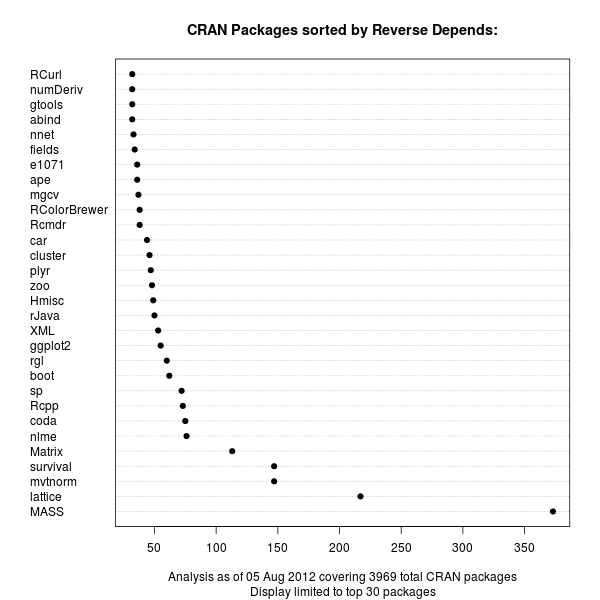
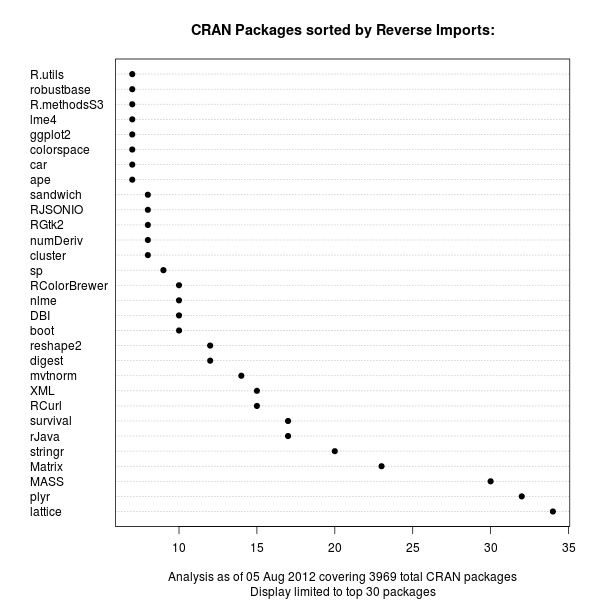
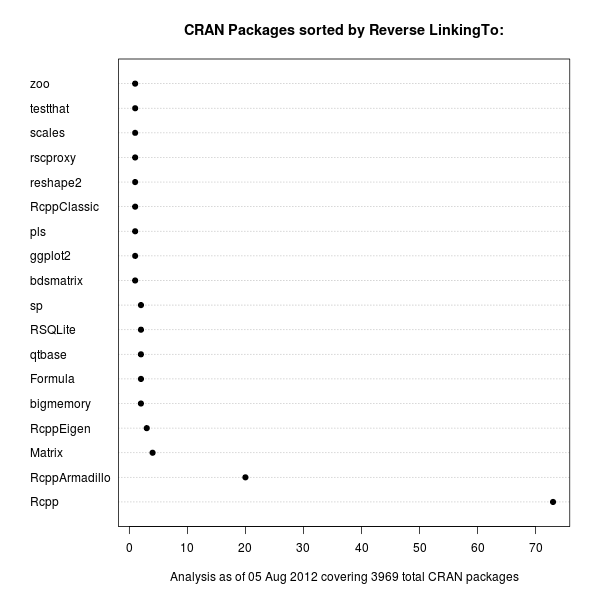
The recent update by S ren H jsgaard's to his gRbase package for graphical models made it the 75th package to depend on our Rcpp package for R and C++ integration. So in a lighthearted weekend moment, I tweeted about gRbase being number 75 for Rcpp to which Hadley replied, asking if Rcpp was in fact number one among R package Depends. Far from it, and I immediately replied listing lattice and Matrix as packages with way more other packages depending upon them. But as the question seemed deserving of a bit more analysis, I spent a few minutes on this and prepared three charts listing package in order of reverse Depends, reverse Imports and reverse LinkingTo. First off, the reverse Depends:. This is the standard means of declaring a dependence of one package upon another. CRAN package chart of Reverse Depends relations Unsurprisingly, the MASS package from the classic Venables and Ripley book comes first, with Deepayan Sarkar's powerful lattice package (also covered in a book) coming second. These are both recommended packages which are commonly distributed with R itself. Next are mvtnorm and survival. Our Rcpp is up there in the top-ten, but not a frontrunner. With the advent of namespaces a few R releases ago, it became possible to import functions from other packages. So the Imports: statement now provides an alternative to the (older) Depends:. The next chart displays the same relationship for Imports:: CRAN package chart of Reverse Imports relations Now lattice still leads, but Hadleys's plyr package grabbed the second spot just before MASS and Matrix. It is interesting to see that the sheer number of Imports: is still not where the Depends: are. On the other hand, we see a number of more recent packages popping up in the second chart. This may reflect more recent coding practices. It will be interesting to see how this stacks up over time when we revisit this chart. Lastly, we can also look at LinkingTo:, a declaration used to provide a C/C++-level dependency at the source code level. We use this in the Rcpp family to provide automatic resolution of the header files needed to compile against our packages. And unsurprisingly, because packages using Rcpp actually use its API (rather than R functions), the package is a little ahead of others. In the package we find three more packages of the Rcpp family, but only a limited number of other packages as C/C++-level dependencies are still somewhat rare in the R universe. There are also fewer packages overall making use of this mechanism. CRAN package chart of Reverse LinkingTo relations One could of course take this one level further and sum up dependencies in a recursive manner, or visualize the relationship differently. But these dotchart graphs provide a first visual description of the magnitude of Depends, Imports and LinkingTo among CRAN packages for R.
1 August 2012

Dirk Eddelbuettel: RcppCNPy 0.2.0

Version 0.2.0 of the recently introduced RcppCNPy package for reading/writing NumPy data in R arrived on CRAN earlier today. The main change are the added ability to also write gzip-ed npy files, to suppress an automatic transposition as well as the correction of one memory leak on data read. The NEWS file entry is below:
Changes in version 0.2.0 (2012-07-30)
  • Support for writing of gzip-ed npy files has been added.
  • A new option dotranspose has been added to npyLoad() to support data sets that do not need to be transposed to be used in R.
  • A memory leak in reading files has been corrected.
CRANberries also provides a diffstat report for 0.2.0 relative to 0.1.0. As always, feedback is welcome and the rcpp-devel mailing list off the R-Forge page for Rcpp is the best place to start a discussion.

30 July 2012

Johannes Schauer: port bootstrap build-ordering tool report 4

A copy of this post is sent to soc-coordination@lists.alioth.debian.org as well as to debian-bootstrap@lists.mister-muffin.de.

Diary

July 2
  • playing around with syntactic dependency graphs and how to use them to flatten dependencies

July 4
  • make work with dose 3.0.2
  • add linux-amd64 to source architectures
  • remove printing in build_compile_rounds
  • catch Not_found exception and print warning
  • use the whole installation set in crosseverything.ml instead of flattened dependencies
  • detect infinite loop and quit in crosseverything.ml
  • use globbing in _tags file
  • use wildcards and patsubst in makefile

July 5
  • throw a warning if there exist binary packages without source packages
  • add string_of_list and string_of_pkglist and adapt print_pkg_list and print_pkg_list_full to use them
  • fix and extend flatten_deps - now also tested with Debian Sid

July 6
  • do not exclude the crosscompiled packages from being compiled in crosseverything.ml
  • clean up basebuildsystem.ml, remove old code, use BootstrapCommon code
  • clean up basenocycles.ml, remove unused code and commented out code
  • add option to print statistics about the generated dependency graph
  • implement most_needed_fast_wrong as well as most_needed_slow_correct and make both available through the menu

July 7
  • allow to investigate all scc, not only the full graph and the scc containing the investigated package
  • handle Not_found in src_list_from_bin_list with warning message
  • handle the event of the whole archive actually being buildable
  • replace raise Failure with failwith
  • handle incorrectly typed package names
  • add first version of reduced_dist.ml to create a self-contained mini distribution out of a big one

July 8
  • add script to quickly check for binary packages without source package
  • make Debian Sid default in makefile
  • add *.d.byte files to .gitignore
  • README is helpful now
  • more pattern matching and recursiveness everywhere

July 9
  • fix termination condition of reduced_dist.ml
  • have precise as default ubuntu distribution
  • do not allow to investigate an already installable package

July 10
  • milestone: show all cycles in a graph
  • add copyright info (LGPL3+)

July 11
  • advice to use dose tools in README

July 16
  • write apt_pkg based python filter script replacing grep-dctrl

July 17
  • use Depsolver.listcheck more often
  • add dist_graph.ml
  • refactor dependency graph code into its own module

July 18
  • improve package selection for reduced_dist.ml
  • improve performance of cycle enumeration code

July 20
  • implement buildprofile support into dose3

July 22
  • let dist_graph.ml use commandline arguments

July 23
  • allow dose3 to generate source package lists without Build- Depends Conflicts -Indep

July 29
  • implement crosscompile support into dose3

Results

Readme There is not yet a writeup on how everything works and how all the pieces of the code work together but the current README file provides a short introduction on how to use the tools.
  • build and runtime dependencies
  • compile instructions
  • execution examples for each program
  • step by step guide how to analyze the dependency situation
  • explanation of general commandline options
A detailed writeup about the inner workings of everything will be part of a final documentation stage.

License All my code is now released under the terms of the LGPL either version 3, or (at your option) any later version. A special linking exception is made to the license which can be read at the top of the provided COPYING file. The exception is necessary because Ocaml links statically, which means that without that exception, the conditions of distribution would basically equal GPL3+.

reduced_dist.ml Especially the Debian archive is huge and one might want to work on a reduced selection of packages first. Having a smaller selection of the archive would be significantly faster and would also not add thousands of packages that are not important for an extended base system. I call a reduced distribution a set of source packages A and a set of binary packages B which fulfill the following three properties:
  • all source packages A must be buildable with only binary packages B being available
  • all binary packages B except for architecture:all packages must be buildable from source packages A
The set of binary packages B and source packages A can be retrieved using the reduced_dist program. It allows to either build the most minimal reduced distribution or one that includes a certain package selection. To filter out the package control stanzas for a reduced distribution from a full distribution, I originally used a call to grep-dctrl but later replaced that by a custom python script called filter-packages.py. This script uses python-apt to filter Packages and Sources files for a certain package selection.

dist_graph.ml It soon became obvious that there were not many independent dependency cycle situation but just one big scc that would contain 96% of the packages that are involved in build dependency cycles. Therefor it made sense to write a program that does not iteratively build the dependency graph starting from a single package, but which builds a dependency graph for a whole archive.

Cycles I can now enumerate all cycles in the dependency graph. I covered the theoretical part in another blog post and wrote an email about the achievement to the list. Both resources contain more links to the respective sourcecode. The dependency graph generated for Debian Sid has 39486 vertices. It has only one central scc with 1027 vertices and only eight other scc with 2 to 7 vertices. All the other source and binary packages in the dependency graph for the archive are degenerate components of length one. Obtaining the attached result took 4 hours on my machine (Core i5 @ 2.53GHz). 1.5 h of that were needed to build the dependency graph, the other 2.5 hours were needed to run johnson's algorithm on the result. Memory consumption of the program was at about 700 MB. It is to my joy that apparently the runtime of the cycle finding algorithm for a whole Debian Sid repository as well as the memory requirements are within orders of magnitude that are justifiable when being run on off-the-shelf hardware. It must also be noted that nothing is optimized for performance yet. A list of all cycles in Debian Sid up to length 4 can be retrieved from this email. This cycle analysis assumes that only essential packages, build-essential and dependencies and debhelper are available. Debhelper is not an essential or build-essential package but 79% of the archive build-depends on it. The most interesting cycles are probably those of length 2 that need packages that they build themselves. Noticeable examples for these situations are vala, python, mlton, fpc, sbcl and ghc. Languages seem love to need themselves to be built.

Buildprofiles There is a long discussion of how to encode staged build dependency information in source packages. While the initial idea was to use Build-Depends-StageN fields, this solution would duplicate large parts of the Build-Depends field, which leads to bitrot as well as it is inflexible to possible other build "profiles". To remedy the situation it was proposed to use field names like Build-Depends[stage1 embedded] but this would also duplicate information and would break with the rfc822 format of package description files. A document maintained by Guillem Jover gives even more ideas and details. Internally, Patrick and me decided for another idea of Guillem Jover to annotate staged build dependencies. The format reads like:
Build-Depends: huge (>= 1.0) [i386 arm] <!embedded !bootstrap>, tiny
So each build profile would follow a dependency in <> "brackets" an have a similar format as architecture options. Patrick has a patch for dpkg that implements this functionality while I patched dose3.

Dropping Build-Depends-Indep and Build-Conflicts-Indep When representing the dependencies of a source package, dose3 concatenates its Build-Depends and Build-Depends-Indep dependency information. So up to now, a source package could only be compiled, if it manages to compile all of its binary packages including architecture:all packages. But when bootstrapping a new architecture, it should be sufficient to only build the architecture dependent packages and therefor to only build the build-arch target in debian/rules and not the build-indep target. Only considering the Build-Depends field and dismissing the Build-Depends-Indep field, reduced the main scc from 1027 vertices to 979 vertices. The amount of cycles up to length four reduced from 276 to 206. Especially the cycles containing gtk-doc-tools, doxygen, debiandoc-sgml and texlive-latex-base got much less. Patrick managed to add a Build-Depends-Indep field to four packages so far which reduced the scc further by 14 vertices down to 965 vertices. So besides staged build dependencies and cross building there is now a third method that can be applied to break dependency cycles: add Build-Depends-Indep information to them or update existing information. I submitted a list of packages that have a binary-indep and/or a build-indep target in their debian/rules to the list. I also submitted a patch for dose3 to be able to specify to ignore Build-Depends-Indep and Build-Conflicts-Indep information.

Dose3 crossbuilding So far I only looked at dependency situations in the native case. While the native case contains a huge scc of about 1000 packages, the dependency situation will be much nicer when cross building. But dose3 was so far not able to simulate cross building of source packages. I wrote a patch that implements this functionality and will allow me to write programs that help analyze the cross-situation as well.

Debconf Presentation Wookey was giving a talk at debconf12 for which I was supplying him with slides. The slides in their final version can be downloaded here

Future Patrick maintains a list of "weak" build dependencies. Those are dependencies that are very likely to be droppable in either a staged build or using Build-Depends-Indep. I must make use of this list to make it easier to find packages that can easily be removed of their dependencies. I will have to implement support for resolving the main scc using staged build dependencies. Since it is unlikely that Patrick will be fast enough in supplying me with modified packages, I will need to create myself a database of dummy packages. Another open task is to allow to analyze the crossbuilding dependency situation. What I'm currently more or less waiting on is the inclusion of my patches into dose3 as well as a decision on the buildprofile format. More people need to discuss about it until it can be included into tools as well as policy. Every maintainer of a package can help making bootstrapping easier by making sure that as many dependencies as possible are part of the Build-Depends-Indep field.

27 July 2012

C.J. Adams-Collier: The blog was down yesterday

The brief outage was due to a scheduled move of the servers to a separate rack and subnet dedicated to our work with the Center for Information Assurance & Cybersecurity (ciac) at the University of Washington Bothell (uwb), and a11y.com I am currently exercising the new (to us) equipment and hope to winnow the less than awesome equipment over the next quarter. I spent the last six months finding the best in breed of the surplussed DL385 and DL380 chassis we (work) were going to have recycled. The team and I were able to find enough equipment to bring up one of each with eight and six gigs of memory, respectively. These will make excellent hypervisors for provisioning embedded instances of Slackware, Fedora, RHEL, CentOS, Debian, FreeBSD, OpenSolaris, OpenIndiana, FreeDOS, etc. When I initially configured this xen paravirt environment, I failed to plan for integration with libvirt, so I am now re-jiggering the software bridges so that they are managed using virt-manager. My experience doing this in the Eastsound lab has proved to be quite rewarding. Once network, storage and memory allocation are handled by libvirt, it will be trivial to automate the process of deploying, reclaiming, and managing these Telecommunications Resources efficiently and effectively using Perl. The new equipment we racked over the last weekend all has hardware assisted virtualization and is capable of hosting operating systems which have not been patched to communicate with the host hypervisor. This provides a higher level of assurance that guests will receive the full amount of provisioned resources and reduces the likelihood of resource conflicts, should the cluster operations team mistakenly over-commit. It also makes it possible for these nodes to host Windows-based operating systems. Oh, and they will also host these not insignificant things called BIG-IP Local Traffic Manager Virtual Edition (VE) and BIG-IP GTM Virtual Edition.

Paul Tagliamonte: ERMAHGIT!

After seeing this post on reddit, I ported the OP s code to ERMAHGIT after following the following (simple) instructions:
sudo ./setup.py install
then, head over to a friendly git repo, and do the following:
git config core.editor /usr/local/bin/ermahgit
Anyway, here s a few lines from some random git commits I have handy:
Added chamber to vote page heading
ERDDERD CHERMBER TO VERTE PERGE HERERDERNG
Fixing the import I just broke
FERXERNG THE ERMPERT I JERST BRERKER
Bugfix for non-ascii chars using encode
BERGFERX FER NERN-ERSCERI CHERS ERSERNG ERNCERDER
Add this sorry excuse for a manpage.
ERDD THERS SERRER ERXCERSE FER A MAHNPERGER.
Please, never, ever use this :)

25 July 2012

Dirk Eddelbuettel: RcppClassic 0.9.2

Similar to yesterday's post about RcppGSL, we have another pure maintenance release to announce, this time of RcppClassic, the package supporting the deprecated older classic Rcpp API defined in the earlier 2005 to 2006 releases, is now on CRAN. There is no new code, as the only changes were made to accomodate CRAN Policy updates. Courtesy of CRANberries, here is a link to the changes relative to the previous release 0.9.1. Questions, comments etc should go to the rcpp-devel mailing list off the R-Forge page.

24 July 2012

Dirk Eddelbuettel: RcppGSL 0.2.0

Earlier today, a minor update / maintenance release of RcppGSL---our interface package between R and the GNU GSL using our Rcpp package for seamless R and C++ integration---arrived on on CRAN. It contains a number of minor changes to accomodate changes in the CRAN Policies, as well as a few extension to the main example fastLm, a faster replacement for the standard lm function. The summary methods now provide more information, and we added a number of new regression tests. The NEWS file entry follows below:
Changes in version 0.2.0 (2012-07-22)
  • summary() for fastLm() now displays more information
  • fastLmPure() now uses same argument order as R's lm.fit()
  • Added more unit tests for fastLm() and related functions
  • Export and document S3 methods in NAMESPACE and manual page as such
  • Vignettes have been moved to the vignettes/ directory
  • Main vignette renamed to RcppGSL-intro.pdf to use a filename different from the package reference manual
  • NEWS file converted to .Rd format
  • inline support function no longer uses assignInNamespace
And courtesy of CRANberries, a summary of the changes to the previous release 0.1.1 is available too. More information is on the RcppGSL page. Questions, comments etc should go to the rcpp-devel mailing list off the R-Forge page.

20 July 2012

John Goerzen: A Linux-Based RFID Thing Finder

Sometimes I have things nicely organized. Power adapters for radios in one drawer, for cameras in the next. And sometimes not so much. Sometimes I m not sure if things are in the basement or the attic. It seems like technology should be able to help solve this problem, but as far as I can tell, no such solution exists yet. So I m planning to build one. Here s my general idea. Feedback, of course, is welcome. Each item to be tracked can have an RFID tag of some sort attached to it. These tags can be read by an RFID reader at a distance of somewhere between 1ft and 1m in typical conditions. The reader could then act as a proximity alert to an object being searched for a you re close beep, for instance. That helps, but is only part of the battle. It doesn t help if you don t even know which room to look in. So the second part of the plan is that the RFID reader is constantly talking to an object database. Besides the obvious association between RFID tag IDs and object descriptions, the database will also capture background reads of RFID tags. Logged with accurate timestamps, we can then conjecture that RFID reads that occurred within a few seconds of each other are probably physically nearby. If boxes have RFID tags on them, then I can probably get a reasonable idea, down to a box or two, of which box that elusive book is in. If I further put tags on certain immovable physical locations in the house, such as every few feet along shelving, then these will also be captured in the background and hopefully associated with objects nearby, giving a good physical idea of where things are. What s more, the simple act of looking for things using the RFID reader would help keep the proximity tables up-to-date, since it could of course log the RFID tags it sees on the way. The only discipline required to keep this info current is to periodically hover nearby storage areas when moving things around. I like this concept a lot. That doesn t mean it s necessarily simple. Implementation requirements Software side I m envisioning the software being split into two components. One would run on an embedded system with the RFID reader. Its job is simple transmitting of scanned RFIDs to the server, receiving instructions from the server, and generating a tone if it s in search mode and the item being searched is nearby. On the server lies a database. The database would contain descriptions for the objects that are tagged (so that the tag ID can be looked up). It would also contain the timestamped scan logs. I envision a simple CGI-based frontend to it that is mobile-friendly, so a laptop, phone, tablet, etc. could be the user interface for the thing saving the cost of a display and input device by reusing what most people already have. This is the part I feel most qualified to work on already. Hardware The first question is what kind of RFID tags to use. Optimizing for cost per tag, the 800/900MHz UHF tags (EPC gen 2) seem ideal. I have found them in costs approaching $0.10 per tag when bought in rolls of 500 or 1000 Avery RFID labels. That s reasonable. The RFID reader is the more complicated part. UHF RFID readers are a lot more costly than their HF or LF counterparts. So far, the cheapest solution I have found started with a post about an Arduino UHF reader. It used a SolidDigi UHF reader board with UART interface for $177. That same board is also available with a USB interface at the same cost. There is also the need for an antenna. There is a small 5dBi one rated 0-50cm for $8, or a $100 8dBi version rated 1-6m designed for wall mounting. They sell these in kit form that include power adapter, USB cables, etc. as well. The kit with the small antenna runs $192, including reader board. Next is the compute platform. A DreamPlug might work for this at $160, though both the cost and the power consumption (5VDC 3A) are high. A Raspberry Pi seems perfect, though for whatever reason seem to be backordered by months everywhere and don t include wifi. The Pi is $35, and the USB wifi is another $30, plus a cheap SD card, so we re around $80 of computing. The running total of the project, then, is at least $272. Add on provisions for batteries, some sort of case, etc. and we re probably past the $300 mark. That s a lot cheaper than the $1000 for handheld RFID readers. The final item is tags. Bulk tags can be found in the $100 to $200 range, making the total cost of the project $400 to $500. Higher than I d like, but providing some valuable experience building something. Risks There are a few major risks to the project. First among them is read distance. If it s not long enough, the usefulness of the project will be low. Fortunately, $100 gets a more high-gain antenna and I d only be out the $8 if the cheaper one doesn t pan out. But that s something of a cold comfort, as it s another, well, $100. Having a bunch of RFID hardware can be used for all sorts of other interesting things, though, so it could perhaps be reused or repurposed. Another risk is that RFID collisions wouldn t be handled as intelligently as I d like, meaning that the read range required to be useful would activate so many tags that collision algorithms break down. I don t know enough about RFID collision algorithms to know if this is a serious councern.

13 July 2012

Dirk Eddelbuettel: RcppArmadillo 0.3.2.4

Conrad released version 3.2.4 of Armadillo yesterday. It contains a workaround for g++ 4.7.0 and 4.7.1 which have a regression triggered by the Armadillo codebase for small fixed-sized matrices. The corresponding RcppArmadillo package 0.3.2.4 arrived on CRAN earlier today. The short NEWS entry follows below.
0.3.2.4  2012-07-11
    o   Upgraded to Armadillo release 3.2.4
          * workaround for a regression (bug) in GCC 4.7.0 and 4.7.1
Courtesy of CRANberries, there is also a diffstat report for 0.3.2.4 relative to 0.3.2.3 As always, more detailed information is on the RcppArmadillo page. Questions, comments etc should go to the rcpp-devel mailing list off the R-Forge page.

11 July 2012

Michal &#268;iha&#345;: New Weblate widget to embed in your site

Weblate just got new feature, which might help you attracting new translators - embeddable widgets. You can put them to your website to show current state of the translation and attract new ones to simple introduction page. Right now, there is only one widget, but I hope to add more in future. However I'm far from being good in graphics, so if anybody could come up with some templates, I'd gladly use them :-). Anyway the current widget for Weblate itself looks like this:

Filed under: English Weblate 0 comments Flattr this!

Dirk Eddelbuettel: Getting numpy data into R -- Take Two

A couple of days ago, I had posted a short Python script to convert numpy files into a simple binary format which R can read quickly. Nice, but still needing an extra file. Shortly thereafter, I found Carl Rogers cnpy library which makes reading and writing numpy files from C++ a breeze, and I quickly wrapped this up into a new package RcppCNPy which was released a few days ago. This post will show a quick example, also summarized in the short pdf vignette describing the package, and provided as a demo within the package.
R> library(RcppCNPy)
Loading required package: Rcpp
R> library(rbenchmark)
R> 
R> n <- 1e5
R> k <- 50
R> 
R> M <- matrix(seq(1.0, n*k, by=1.0), n, k)
R> 
R> txtfile <- tempfile(fileext=".txt")
R> write.table(M, file=txtfile)
R> 
R> pyfile <- tempfile(fileext=".py")
R> npySave(pyfile, M)
R> 
R> pygzfile <- tempfile(fileext=".py")
R> npySave(pygzfile, M)
R> system(paste("gzip -9", pygzfile))
R> pygzfile <- paste(pygzfile, ".gz", sep="")
R> 
R> 
We first load the new package (as well as the rbenchmark package used for the benchmarking example) into R. We then create a large matrix of 100,000 rows and 50 columns. Not quite big data by any stretch, but large enough for ascii reading to be painfully slow. We also write two npy files and compress the second one. Next, we use the benchmark function to time the three approaches:
R> res <- benchmark(read.table(txtfile),
+                  npyLoad(pyfile),
+                  npyLoad(pygzfile),
+                  order="relative",
+                  columns=c("test", "replications", "elapsed", "relative"),
+                  replications=10)
R> print(res)
                 test replications elapsed relative
2     npyLoad(pyfile)           10   1.241  1.00000
3   npyLoad(pygzfile)           10   3.098  2.49637
1 read.table(txtfile)           10  96.744 77.95649
R> 
As shown by this example, loading a numpy file directly beats the pants off reading the data from ascii: it is about 78 times faster. Reading a compressed file is somewhat slower as the data stream has to be passed through the uncompressor provide by the zlib library. So instead of reading a binary blob in one go (once the file header has been parsed) we have to operate piecemeal---which is bound to be slower. It does however save in storage space (and users can make this tradeoff between speed and size) and is still orders of magnitude faster than parsing the ascii file. Finally, and not shown here, we unlink the temporary files. Summing up, this post demonstrated how the RcppCNPy package can be a useful to access data in numpy files (which may even be compressed). Data can also be written from R to be accessed later by numpy.

8 July 2012

Iustin Pop: Thumbnails and other EXIF metadata fun

So, I was trying to write a script for myself to sanitise the EXIF metadata in images produced by my camera. I had a text file for a while with some tags that I should remove (like the camera serial number, etc.), but this became cumbersome and I wanted a fully scripted workflow. I thought initially it's a simple exercise: look at the current tags, decide either which one I wanted to remove (black-list) or alternatively keep (white-list; preferred solution) and then call exiftool with the appropriate options. Boy oh boy EXIF is just part of the equation. There are of course also the MakerNotes, which are manufacturer-specific and most of the time editable only as a block. Furthermore, there's no way to easily just duplicate each individual entry in this group to a standard EXIF or even XMP section, so basically you either keep to much or just give up a lot. Some of them can be copied to XMP, for example lens information, flash, etc. but white-balance (with the exiftool version that I have) is not, for example. Ideally I could just copy all maker notes to XMP, and then drop that entire group. For the record, the way to drop all and just copy some is to run:
exiftool -all= -tagsfromfile @ -Orientation -AllDates  other tags  file.jpg
But do not add "-makernotes", because that will bring the entire block back. The other fun thing is the number of thumbnails/preview images embedded. Looking at a random jpeg file, I found: Now, I doubt even the use of one thumbnail, but 3? And one being more than half a megabyte? Someone's going overboard at Nikon On the plus side, removing all thumbnails and sanitising the meta-data makes the jpeg files quite a bit smaller, which also means easier to share, at least; not sure if I want to actually clean the master copies (even though I keep the NEFs).

Dirk Eddelbuettel: New package RcppCNPy with release 0.1.0 (and 0.0.1 earlier last week)

A few days ago I had blogged about getting NumPy data in R by using a simple converter script. That works fine, but it is a little annoying to have to write an entire file only to read from it again. So I kept looking around for a better solution---and soon found the cnpy library by Carl Rogers which provides simple C++ functions to read and write NumPy files. Bringing such a C++ library to R is done very easily via Rcpp modules. The resulting package contains a single R file with a single line: loadModule("cnpy", TRUE). And it relies on the following module declarations in the a C++ file:
RCPP_MODULE(cnpy) 
    using namespace Rcpp;
    function("npyLoad",                         // name of the identifier at the R level
             &npyLoad,                          // function pointer to helper function defined above
             List::create( Named("filename"),   // function arguments including default value
                           Named("type") = "numeric"),
             "read an npy file into a numeric or integer vector or matrix");
    function("npySave",                         // name of the identifier at the R level
             &npySave,                          // function pointer to helper function defined above
             List::create( Named("filename"),   // function arguments including default value
                           Named("object"), 
                           Named("mode") = "w"),
             "save an R object (vector or matrix of type integer or numeric) to an npy file");
 
which give us at the R prompt
R> library(RcppCNPy)
Loading required package: Rcpp
R> npyLoad
internal C++ function <0x243af70>
    docstring : read an npy file into a numeric or integer vector or matrix
    signature : Rcpp::RObject npyLoad(std::string, std::string)
R> npySave
internal C++ function <0x23033e0>
    docstring : save an R object (vector or matrix of type integer or numeric) to an npy file
    signature : void npySave(std::string, Rcpp::RObject, std::string)
R> 
these two functions (and their docstrings) defined above. That's all! Well there are about one hundred more lines dealing with whether we have integer or numeric data, and whether we use a vector or a matrix. But all in all pretty simple... So version 0.1.0 of this new package RcppCNPy completes the initial release 0.0.1 from earlier in the week by adding The NEWS entry for this release (as well as the initial one) follow:
News for Package RcppCNPy Changes in version 0.1.0 (2012-07-07)
  • Added automatic use of transpose to automagically account for Fortran-vs-C major storage defaults between Python and R.
  • Support for integer types in dependent on the int64_t type which is available only when the -std=c++0x switch is used at build-time (and CRAN still discourages use of it)
  • Added support for reading gzip'ed files ending in ".npy.gz"
  • Added regression tests in directory tests/
  • Added a vignette describing the package
  • Added a timing benchmark in demo/timings.R
Changes in version 0.0.1 (2012-07-04)
  • Initial version, as a straightforward Rcpp modules wrap around the cpny library by Carl Rogers (on github under a MIT license).
  • At present, npy files can be read and written for vectors and matrices of either numeric or integer type. Note however that matrices are currently transposed because of the default Fortran ordering done by numpy.
I will follow up with a little usage example later. CRANberries also provides a diffstat report for 0.1.0 relative to 0.0.1. As always, feedback is welcome and the rcpp-devel mailing list off the R-Forge page for Rcpp is the best place to start a discussion.

7 July 2012

Robert Collins: Reprap driver pinouts

This is largely a memo-to-my-future self, but it may save some time for someone else facing what I was last weekend. I ve been putting together a Reprap recently, seeded by the purchase of a partially assembled one from someone local who was leaving town and didn t want to take it with them. One of the issues it had was that 2 of the stepstick driver boards it uses were burnt out, and in NZ there are no local suppliers that I could find. There is however a supplier of Easydriver driver boards, which are apparently compatible. (The Reprap electronics is a sanguinololu, which has a fitted strip that exactly matches stepstick (or pololu) driver boards. The Easydrivers are not physically compatible, but they should be pin compatible.. no? I mapped across all the pins carefully, and the only issues were: there are three GND s on the Easydriver vs 2 on the stepstick, and the PFD pin isn t exposed on the stepstick board so it can t be mapped across. I ended up with this mapping (I m not sure where pin 1 is *meant* to be on the stepstick, so I m starting with VMOT, the anti-clockwise corner pin on the same side as the 2B/2A/1A/1B pins, when looking down on an installed board pin 1, and going clockwise from there). Stepstick Easydriver VMOT M+
GND GND
2B B2
2A A2
1A A1
1B B1
VDD +5V
GND GND
Dir Dir
Step Step
Slp Slp
Rst Rst
Ms3 Nothing
Ms2 Ms2
Ms1 Ms1
En Enable But, when I tried to use this, the motor just jammed up solid. A bit of debugging and trial and error later and I figured it out. The right mapping for the motor pins: 2B B2
2A B1
1A A1
1B A2 Thats right, the two boards have chosen opposed elements for labelling of motors coils pins on the step stick 1/2 refers to the coil and A/B the two ends that need to have voltage put across them, on the easydriver A/B refer to the coil and 1/2 the two ends Super confusing, especially as I haven t been doing much electronics for oh, a decade or so. I m reminded very strongly of Rusty s scale of interface usability here.

4 July 2012

Dirk Eddelbuettel: RcppBDT 0.2.0

A new release of the RcppBDT package appeared on CRAN earlier today. RcppBDT uses Rcpp, and in particular the nifty Rcpp modules feature of wrapping C++ code for R just by declaring the (class or function) interfaces. It uses this to bring in some useful functions from Boost Date.Time to R so that one can do things like
R> library(RcppBDT)
R> sapply(2012:2016, function(year)
+         format(getNthDayOfWeek(first, Mon, Sep, year)))
[1] "2012-09-03" "2013-09-02" "2014-09-01" "2015-09-07" "2016-09-05"
R> 
to compute the next five Labor Day dates in the US, given the year and the first Monday of September requirement. More examples are e.g. on the earlier blog post announcing version 0.1.0. Changes are mostly internal. R 2.15.1 brough a better / easier way to load such 'modules' into R, and Rcpp 0.9.13 allows us to use this. So RcppBDT continues to be useful as an example package for Rcpp modules. I also streamlines the interface a little: identifiers are now directly accessible in the package's NAMESPACE rather than just via the an instantiated object. I also added a NEWS file, using the .Rd format so that we can import the marked-up text:
News for Package RcppBDT Changes in version 0.2.0 (2012-07-02)
  • The core module, which wraps what in C++ is boost::gregorian::date, is now exposed as an Rcpp module bdtDate. As all example and demos operated off a (package-global) variable 'bdt', no user visible change was needed outside of the code instantiating at package load.
  • Updated package instantiation to the new facilities offered by the current versions R 2.15.1 and Rcpp 0.9.13 which make Rcpp module initialization easier and more streamlined.
Changes in version 0.1.0 (2011-01-17)
  • First CRAN upload (and see ChangeLog for more granular details) bug fix in svm cross validation
Courtesy of CRANberries, there is also a diffstat report for 0.2.0 relative to 0.1.0. As always, feedback is welcome and the rcpp-devel mailing list off the R-Forge page for Rcpp is the best place to start a discussion.

3 July 2012

Miriam Ruiz: Scratch in Debian

Scratch has finally reached Debian repositories. Scratch is a programming learning environment created by the Lifelong Kindergarten Group at the MIT Media Lab designed to be accessible by young learners (over 8 years old). Scratch makes it easy to create your own interactive stories, animations, games, music, and art through a visual interface based on blocks. Thus, beginners can get results without having to learn to write syntactically correct code first. It is powerful enough to have even been adopted as an entry-level computer language in computer science programs at different universities. Scratch makes use of pieces of code embedded in different blocks that are shaped like puzzle pieces. That way, programming consists on putting different blocks together, which gives immediate visual feedback to the programmer about the correctness of the syntax: If the pieces fit together, then the expression is valid. Scratch programming system is so nice and easy that has been the inspiration of other systems such as MIT App Inventor or Google Blocky.

Scratch animations consist of sprites that are animated by dragging the corresponent blocks into the Scripts area of the Scratch interface. Multiple sprites can be created and interact with one another. Each of the sprites can have different looks (called costumes in Scratch). You can use built-in sprites, load them from files, or draw your own using a drawing tool integrated in the environment. Scratch itself is coded in Squeak, a Smalltalk implementation derived from Smalltalk-80. The Scratch 1.4 source went GPLv2 on March, but there were some incompatibilites with the Squeak Virtual Machine currently in Wheezy that had to be resolved first. Luckily we were able to solve them, with the help of the Scratch and the Squeak guys, so I m happy to say that Scrach is finally available from Debian repositories. Note: If any Scratch derivatives (such as BYOB or Panther) also need to be ported to the current version of Squeak, they should have a look at the comments in the Scratch ITP, and especially to the script uploaded by Bert Freudenberg, that replaces 90 indexed primitive declarations (removed in later versions of Squeak VM) with their named counterpart. Note 2: This wouldn t have been possible without all the great work and effort made by Amos Blanton and many others. Lots of thanks!

Dirk Eddelbuettel: RcppArmadillo 0.3.2.3

Conrad releaser version 3.2.3 of Armadillo a few days ago, and the corresponding RcppArmadillo package 0.3.2.3 is now CRAN. (For these keeping score 3.2.1 never was a full release, and 3.2.2 containing fixes for a build issue that did not affect the R package build so we skipped it.) The short NEWS entry follows below. This version fixes some issues related to g++ 4.7; however the current Debian testing version of g++-4.7.1 required that I rolled back three header files to the version from the previous release. Conrad has been in contact with the gcc upstream maintainers and a fix may appear in time for g++-4.7.2. This release also contains a new introductory pdf vignette based on a paper Conrad and I just submitted. It introduces Armadillo to R programmers and demonstrates with a simple Kalman filtering example how the code can be written in the same concise matrix-oriented style, yet runs orders of magnitude faster.
0.3.2.3  2012-07-01
    o   Upgraded to Armadillo release 3.2.3 
          * minor correction for declaration of fixed size vectors and
            matrices
    o   Reverted three header files  Mat,Row,Col _bones.hpp back to previous
        release due to compilation failures under g++-4.7
    o   Added new vignette 'RcppArmadillo-intro' based on a just-submitted
        introductory paper (by Eddelbuettel and Sanderson) about RcppArmadillo 
    o   Change from release 3.2.2 which we skipped as it did not really affect
        builds under R:
          * minor fix for compiling without debugging enabled (aka release
            mode)
          * better detection of ATLAS during installation on Fedora and Red
            Hat systems
    o   Small enhancement to fastLm 
Courtesy of CRANberries, there is also a diffstat report for 0.3.2.3 relative to 0.3.2.0 As always, more detailed information is on the RcppArmadillo page. Questions, comments etc should go to the rcpp-devel mailing list off the R-Forge page.

Next.

Previous.