Search Results: "beh"

7 September 2012

Andrew Pollock: [life] Sarah Pollock, BBus

Sarah is back in Australia attending the graduation ceremony for her Bachelor of Business degree, at the University of Southern Queensland, an Australia University that specialises in distance education. To say I'm immensely proud of her achievement is putting it lightly. Consider for a moment all of the challenges she has had to face in the past 6 years since she started it: Me, I'd fail at "studying remotely". Heck, I've had two stabs at a Bachelor of Information Technology on campus, and what do I have to show for it? No, I'm so very very proud of her for sticking at it, and doing so very well (she twice received the Dean's Award for having a high GPA for the semester). She decided to embark on a business degree after having a really hard time finding meaningful work when we moved to the US. She had been working in business project management for the Australian Federal Government (and really enjoying the work) before we moved, and couldn't find any project management that wasn't high-tech, which wasn't really her thing, and everything wanted a degree. She briefly contracted at VMWare, in a marketing position, and Google, in a Security Vulnerability Management role, but neither of these were really up her alley, so to speak. So she went "bugger it" and enrolled in the degree. Ironically, mid-way through the course, she decided that nursing was more what she wanted to do, so she has also gone out and done short courses in health care. She has been licensed as a Certified Nurse Assistant and also a Phlebotomist, but never worked as either. She's just started an Emergency Medical Technician course at Mission College, and is keen to try and work in that field for a little while before starting on a post-graduate Nursing degree in Australia. Sarah had indicated to me that she'd really love to go back for the on-campus graduation ceremony, since she's barely set foot on campus in the six years she's been studying at the university. I thought that was an excellent idea, so I sprang for a Business Class flight back for just her, and am staying behind to look after Zoe. It's only a flying visit. She departed Wednesday night, returns on Monday. As I write, she's probably at the ceremony right now. Normally it would take 6 years to complete a degree externally, assuming two subjects a semester for 12 semesters. She's obviously had to take a few semesters off here and there because of some of the aforementioned challenges. To still finish the degree in 6 years, she's had to plow through the "summer" break (I say "summer" because it's during the Northern Hemisphere winter) and use the accelerated "summer semester", also known as "semester 3" to do an additional subject. That's meant that summers over here have been her shorter winter break. This summer has been the first summer where she hasn't had to worry about studying, and it's been really wonderful to be a whole family again for an extended period of time, and we've had a jam packed summer as a result. We bought a tent and did a small amount of camping. We've had weekends away with friends. We've been to Raging Waters. We've been to Disneyland (granted that was in between final exams). It's been go go go. So now that summer is almost over, I'm looking forward to the pace slowing down a bit more and things returning to "normal" (well the new "normal" is Sarah doing her EMT class a couple of nights a week until December). She's only just started, but she's really loving the on-campus aspect of it. I'm also looking forward to getting a bit more "me" time. Since Zoe was born, I have sacrificed my personal time to facilitate Sarah's study. I haven't had much time to tinker and I've barely had time for Debian. I'm looking forward to trying to carve out a few hours a week for some of both, plus a bit of reading.

3 September 2012

Gunnar Wolf: WikiLovesMonuments wants *you* (and me!)

What, haven't you heard about the WikiLovesMonuments photo contest around cultural heritage? Copying from its web page,
Wiki Loves Monuments is an international photo contest around cultural heritage monuments in September. Starting from the Netherlands in 2010 and organized on a European level in 2011, we go global in 2012!
I heard about this initiative in Iv n Mart nez's Wikimedia talk at COSIT 2012, held last week in Coatzacoalcos, Veracruz (I intend to write a bit more regarding COSIT later on). I loved the idea, and intend to participate Not because I take great pictures (I don't, and I usually take them using my aging phone, which gives decent results but nothing beyond that), but because I love to move by bike in the city, and it's one of the best ways to roll in front of some of them. But more on me later Back to the topic! WikiLovesMonuments aims to improve on Wikimedia's (the organization behind Wikipedia and several other Free Culture reference projects) coverage of important landmarks all over the world. To do so, they are offering a trip to attend WikiMania 2013 in Hong Kong to the first place winner, and other "photography-related" prizes to the other winners. So, back to me: My motivation to enter the contest is to help Wikimedia. I know my shots won't be top-notch (although they will be the best I can do). I enjoy biking in my city, and often go not too far from many of the listed monuments. I am amazed at the number of monuments still pending in my area (of course, it's not by mistake this is called "La ciudad de los palacios", The city of the palaces) Surely some of the readers of this post will have (or will find easy to take) some photos to add. Of course, I'll try to focus on the missing monuments, but if you are a good photographer, you might want to submit a better version for a monument that's already there. So, some pointers, from what's closest to what's farthest from me: At least for Mexico, the listings are taken from the National Institute for Anthropology and History (INAH)'s Public registry of archaeological zones and monuments. So, I cannot wait to start my biking session today to get some good end-of-summer evening sun and get some pictures taken! :-D

2 September 2012

Lars Wirzenius: Debian discussion culture: what doesn't work

I claim that the way we conduct discussions on debian-devel has gone quickly downhill this year. The discussions around the default init implementation are particularly sad examples of how Debian debates technical topics. I've whined about this before, and people have suggested various things. Here's a list of things that I think we can conclude do not work: Things that can work: Things that might be worthwhile to try: The current situation, where a few hard-nosed, uncompromising people can prevent any rational discussion about init systems cannot be allowed to continue.

1 September 2012

Lars Wirzenius: Dabbling in diplomacy

For about the past three months I've been conducting a small experiment. When I've seen people misbehave on the Debian development mailing list, I've sent a private e-mail to them suggesting they should avoid some specific behavior, in the hope of getting them to stop. My success has been varied. A few have thanked me, and changed their behavior. A couple have taken offense. Some have ignored me. I've noticed a correlation between how much effort I put into the letter and how successful it. Broadly speaking, if I send anything earlier than the sixth version, it fails. Getting the message exactly right is not easy, for me, and takes quite some effort and time. I'm happy about my successes, but on the whole, I fear my experiment is a failure. It's too much effort to do this in the long term, and it's too chancy. Someone else might be able to do it better, but this is not something I can keep on doing. I think we need some better solution to keep discussions in Debian on track and not have them blow up. We have a systemic problem where contentious issues, such as choice of init system, is quite hard for us to deal with. We're also not very good at dealing with situations where a few individuals are dominating the discussion by being loud, insistent, and unwilling to budge or to give any credence to opposing views. I don't know what to do about that, but we clearly need social and possibly technical tools for this.

30 August 2012

Axel Beckert: deepgrep: grep nested archives with one command

Several months ago, I wrote about grep everything and listed grep-like tools which can grep through compressed files or specific data formats. The blog posting sparked several magazine articles and talks by Frank Hofmann and me. Frank recently noticed that we though missed one more or less mighty tool so far. We missed it, because it s mostly unknown, undocumented and hidden behind a package name which doesn t suggest a real recursive grep everything : deepgrep deepgrep is part of the Debian package strigi-utils, a package which contains utilities related to the KDE desktop search Strigi. deepgrep especially eases the searching through tar balls, even nested ones, but can also search through zip files and OpenOffice.org/LibreOffice documents (which are actually zip files). deepgrep seems to support at least the following archive and compression formats: A search in an archive which is deeply nested looks like this:
$ deepgrep bar foo.ar
foo.ar/foo.tar/foo.tar.gz/foo.zip/foo.tar.bz2/foo.txt.gz/foo.txt:foobar
foo.ar/foo.tar/foo.tar.gz/foo.zip/foo.tar.bz2/foo.txt.gz/foo.txt:bar
deepgrep though neither seems to support any LZMA based compression (lzma, xz, lzip, 7z), nor does it support lzop, rzip, compress (.Z suffix), cab, cpio, xar, or rar. Further current drawbacks of deepgrep: deepfind If you just need the file names of the files in nested archives, the package also contains the tool deepfind which does nothing else than to list all files and directories in a given set of archives or directories:
$ deepfind foo.ar
foo.ar
foo.ar/foo.tar
foo.ar/foo.tar/foo.tar.gz
foo.ar/foo.tar/foo.tar.gz/foo.zip
foo.ar/foo.tar/foo.tar.gz/foo.zip/foo.tar.bz2
foo.ar/foo.tar/foo.tar.gz/foo.zip/foo.tar.bz2/foo.txt.gz
foo.ar/foo.tar/foo.tar.gz/foo.zip/foo.tar.bz2/foo.txt.gz/foo.txt
As with deepgrep, deepfind does not implement any common options of it s normal sister tool find. Dependencies The package strigi-utils doesn t pull in the complete Strigi framework (i.e. no daemon), just a few libraries (libstreams, libstreamanalyzer, and libclucene). On Wheezy it also pulls in some audio/video decoding libraries which may make some server administrators less happy. Conclusion Both tools are quite limited to some basic use cases, but can be worth a fortune if you have to work with nested archives. Nevertheless the claim in the Debian package description of strigi-utils that they re enhanced versions of their well known counterparts is IMHO disproportionate. Most of the missing features and documentation can be explained by the primary purpose of these tools: Being backend for desktop searches. I guess, there wasn t much need for proper commandline usage yet. Until now. ;-) 42.zip And yes, I was curious enough to let deepfind have a look at 42.zip (the one from SecurityFocus, unzip seems not able to unpack 42.zip from unforgettable.dk due a missing version compatibility) and since it just traverses the archive sequentially, it has no problem with that, needing just about 5 MB of RAM and a lot of time:
[ ]
42.zip/lib f.zip/book f.zip/chapter f.zip/doc f.zip/page e.zip
42.zip/lib f.zip/book f.zip/chapter f.zip/doc f.zip/page e.zip/0.dll
42.zip/lib f.zip/book f.zip/chapter f.zip/doc f.zip/page f.zip
42.zip/lib f.zip/book f.zip/chapter f.zip/doc f.zip/page f.zip/0.dll
deepfind 42.zip  11644.12s user 303.89s system 97% cpu 3:24:02.46 total
I though won t try deepgrep on 42.zip. ;-)

28 August 2012

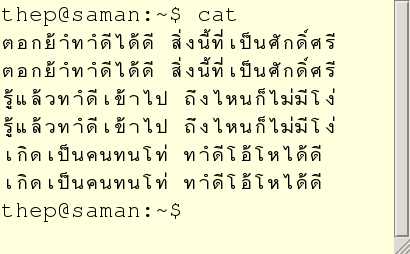
Theppitak Karoonboonyanan: Pango-HarfBuzz Merge and The Effects on Thai Module

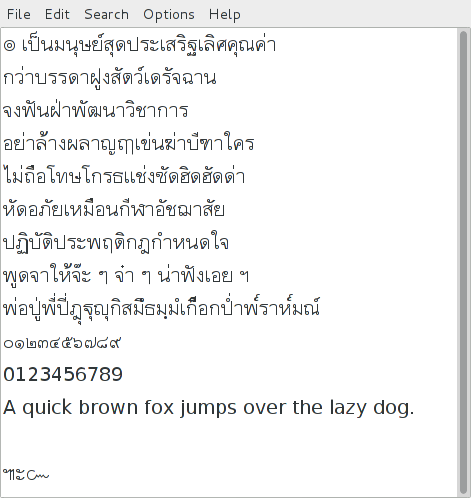
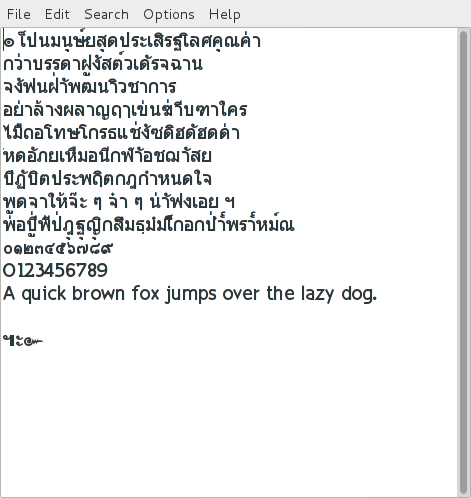
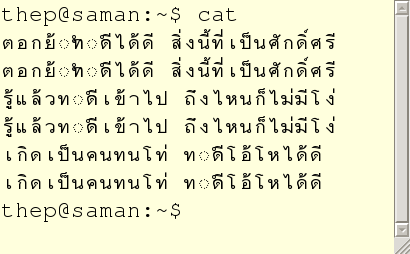
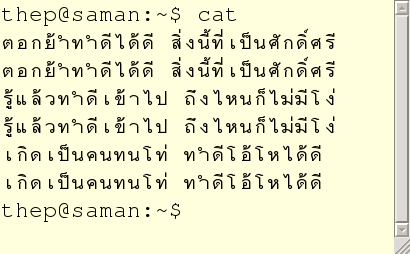
One major change in GNOME 3.6 is Pango s shaper engines replacement with HarfBuzz. Only language engines (for word break analysis, for example) are retained. So, I m checking how this affects Thai/Lao rendering and what to do next. Over all, Behdad has put a good effort to make it right. Most Uniscribe behaviors have been achieved for compatibility. He even cares enough to cover some widespread Thai fonts in which the language tag 'latn' is used instead of 'thai', as seen in Mozilla #719366. Unfortunately, this font set has been declared as standard fonts in official documents. The workaround seems inevitable. Supported Fonts In my experiments with some existing Thai OpenType fonts, the new Pango still renders well without regression. Loma font from fonts-tlwg (glyph positioning with GPOS, rearrangement with GSUB): Loma on new Pango Arundina Sans font from Fonts-SIPA-Arundina (positioning by substitution, only GSUB, no GPOS): Arundina Sans on new Pango But for legacy fonts without OpenType features, it renders badly: Non-OpenType on new Pango In addition, according to Behdad, PUA glyphs in legacy fonts are not supported yet. This means there will be regression on fonts designed for Windows XP or below. But modern fonts designed for Windows 7 should be fine. Changes on Bugs The engine replacement from scratch certainly affects existing bugs. Some become obsolete, some still remain. Here are the summary for Thai/Lao engine, as resolved upstream: Closed bugs: Questionable bugs: Remaining bugs:

27 August 2012

Christoph Berg: PostgreSQL in Debian Hackathon

Almost a year has passed since my talk at pgconf.eu 2011 in Amsterdam on Connecting the Debian and PostgreSQL worlds, and unfortunately little has happened on that front, mostly due to my limited spare time between family and job. pgapt.debian.net is up and running, but got few updates and is lagging behind on PostgreSQL releases. Luckily, we got the project moving. Dimitri Fontaine and Magnus Hagander suggested to do a face-to-face meeting, so we got together at my house for two days last week and discussed ideas, repository layouts, build scripts, and whatnot to get all of us aligned for pushing the project ahead. My employer sponsored my time off work for that. We almost finished moving the repository to postgresql.org infrastructure, barring some questions of how to hook the repository into the existing mirror infrastructure; this should get resolved this week. The build server running Jenkins is still located on my laptop, but moving this to a proper host will also happen really soon now. We are using Mika Prokop's jenkins-debian-glue scripts for driving the package build from Jenkins. The big plus point about Jenkins is that it makes executing jobs on different distributions and architectures in parallel much easier than a bunch of homemade shell scripts could get us with reasonable effort. Here's a list of random points we discussed: We really aim at using unmodified packages from Debian as much as possible, and in fact this project doesn't mean to replace Debian's PostgreSQL packaging work, but to extend it beyond the number of server versions (and Debian and Ubuntu versions covered) supported. The people behind the Debian and Ubuntu packages, and this repository are mostly the same, so we will claim that "our" packages will be the same quality as the "original" ones. Big thanks go to Martin Pitt for maintaining the postgresql-common testsuite that really covers every aspect of running PostgreSQL servers on Debian/Ubuntu systems. Stay tuned for updates! :)

Robert Collins: Why platform specific package systems exist and won t go away

A while back mdz blogged about challenges facing Ubuntu and other Linux distributions. He raises the point that runtime libraries for Python / Ruby etc have a unique set of issues because they tend to have their own packaging systems. Merely a month later he attended Debconf 2010 where a presentation was given on the issues that Java packages have on Dpkg based systems. Since then the conversation seems to have dried up. I ve been reminded of it recently in discussions within Canonical looking at how we deploy web services. Matt suggested some ways forward, including: I think its time we revisit and expand on those points. Nothing much has changed in how Ubuntu or other distributions approach integration with other packaging systems but the world has kept evolving. Internet access is growing ever more ubiquitous, more platforms are building packaging systems clojure, scala, node.js, to name but three, and a substantial and ever growing number of products expect to operate in a hybrid fashion with an evolving web service plus a local client which is kept up to date via package updates. Twitter, Facebook and Google Plus are three such products. Android has demonstrated a large scale app store on top of Linux, with its own custom packaging format. In order to expand them, we need some background context on the use cases that these different packaging systems need to support. Platforms such as antivirus scanners, node.js, Python, Clojure and so forth care a great deal about getting their software out to their users. They care about making it extremely easy to get the latest and greatest versions of their libraries. I say this because the evidence is all around us: every successful development community / product has built a targeted package management system which layers on top of Windows, and Mac OSX, and *nux. The only rational explanation I can come up for this behaviour is that the lower level operating system package management tools don t deliver what they need. E.g. this isn t as shallow as wanting a packaging system written in their own language, which would be easy to write off as parochialism rather than a thoughtful solution to their problems. In general packaging systems provide a language for shipping source or binary form, from one or more repositories, to users machines. They may support replications, and they may support multiple operating systems. They generally end up as graph traversal engines, pulling in dependencies of various sorts you can see the DOAP specification for an attempt at generic modelling of this. One problem that turns up rapidly when dealing with Linux distribution package managers is that the versions upstream packages have, and the versions a package has in e.g. Debian, differ. They differ because at some stage, someone will need to do a new package for the distribution when no upstream change has been made. This might be to apply a local patch, or it might be to correct a defect caused by a broken build server. Whatever the cause, there is a many to one relationship between the package versions that end users see via dpkg / rpm etc, and those that upstream ship. It is a near certainty that once this happens to a library package, that comparing package versions across different distribution packages becomes hard. You cannot reliably infer whether a given package version is sufficient as a dependency or not, when comparing binary packages between Red Hat and Debian. Or Debian and Ubuntu. The result of this is that even when the software (e.g. rpm) is available on multiple distributions (say Ubuntu and RHEL), or even on multiple operating systems (say Ubuntu and Windows), that many packages will /have/ to be targeted specifically to build and execute properly. (Obviously, compilation has to proceed separately for different architectures, its more the depedency metadata that says and build with version X of dependency Y that has to be customised). The result of this is that there is to the best of my knowledge no distribution of binary packages that targets Debian/Ubuntu and RHEL and Suse and Windows and Mac OS X, although there are vibrant communities building distributions of and for each in isolation. Some of the ports systems come close, but they are still focused on delivering to a small number of platforms. There s nothing that gives 99% coverage of users. And that means that to reach all their users, they have to write or adopt a new system. For any platform X, there is a strong pressure to have the platform be maintainable by folk that primarily work with X itself, or with the language that X is written in. Consider Python there is strong pressure to use C, or Python, and nothing else, for any tools that is somewhat parochial, but also just good engineering reducing variables and making the system more likely to be well maintained. The closest system I know of Steam is just now porting to Ubuntu (and perhaps Linux in general), and has reached its massive popularity by focusing entirely on applications for Windows, with Mac OSX a recent addition. Systems like pypi which have multi platform eggs do target the wide range of platforms I listed above, but they do so both narrowly and haphazardly: whether a binary or source package is available for a given platform is up to the maintainer of the package, and the packages themselves are dealing with a very narrow subset of the platforms complexity: Python provides compilation logic, they don t create generic C libraries with stable ABI s for use by other programs, they don t have turing complete scripts for dealing with configuration file management and so forth. Anti virus updaters similarly narrow the problem they deal with, and add constraints on latency- updates of anti virus signatures are time sensitive when a new rapidly spreading threat is detected. A minor point, but it adds to the friction of considering a single packaging tool for all needs is the different use cases of low level package management tools like dpkg or rpm vs the use cases that e.g. pypi has. A primary use case for packages on pypi is for them to be used by people that are not machine administrators. They don t have root, and don t want it. Contrast that with dpkg or rpm where the primary use case (to date) is the installation of system wide libraries and tools. Things like man page installation don t make any sense for non-system-wide package systems, whereas they are a primary feature for e.g. dpkg. In short, the per-platform/language tools are (generally):
  1. Written in languages that are familiar to the consumers of the tools.
  2. Targeted at use on top of existing platforms, by non-privileged users, and where temporary breakage is fine.
  3. Intended to get the software packaged in them onto widely disparate operating systems.
  4. Very narrow they make huge assumptions about how things can fit together, which their specific language/toolchain permits, and don t generalise beyond that.
  5. Don t provide for security updates in any specific form: that is left up to folk that ship individual things within the manager.
operating system package managers:
  1. Are written in languages which are very easy to bootstrap onto an architecture, and to deploy onto bare metal (as part of installation).
  2. Designed for delivering system components, and to avoid be able to upgrade the toolchain itself safely.
  3. Originally built to install onto one operating system, ports to other operating systems are usually fragile and only adopted in niche.
  4. Are hugely broad they install data, scripts, binaries, and need to know about late binding, system caches etc for every binary and runtime format the operating system supports
  5. Make special provision to allow security updates to be installed in a low latency fashion, without requiring anything consuming the package that is updated to change [but usually force-uninstalling anything that is super-tightly coupled to a library version].
Anti virus package managers:
  1. Exist to update daemons that run with system wide escalated privileges, or even file system layer drivers.
  2. Update datasets in realtime.
  3. Without permitting updates that are produced by third parties.
Given that, lets look at the routes Matt suggested Decoupling applications from the core as a strategy makes an assumption that the core and applications are partitionable. If they are not, then applications and the core will share common elements that need to be updated together. Consider, for instance, a Python application. If you run with a system installed Python, and it is built without zlib for some reason, but the Python application requires zlib, you have a problem. A classic example of this problem is facing Ubuntu today, with all the system provided tools moving to Python 3, but vast swathes of Python applications still being unported to Python 3 at all. Currently, the Python packaging system virtualenv/buildout + distribute don t provide a way to install the Python runtime itself, but will happily install their own components for everything up the stack from the runtime. Ubuntu makes extensive use of Python for its own tools, so the system Python has a lot of packages installed which buildout etc cannot ignore this often leads to issues with e.g. buildout, when the bootstrap environment has (say) zope.interfaces, but its then not accessible from the built-out environment that disables the standard sys.path (to achieve more robust separation). If we want to pursue decoupling, whether we build a new package manager or use e.g. virtualenv (or gem or npm or ), we ll need to be aware of this issue and perhaps offer, for an extended time, a dedicated no-frills, no-distro-packages install, to avoid it, and to allow an extended supported period for application authors without committing to a massive, distro sponsored porting effort. While its tempting to say we should install pip/npm/lein/maven and other external package systems, this is actually risky: they often evolve sufficiently fast that Ubuntu will be delivering an old, incompatible version of the tool to users well before Ubuntu goes out of support, or even befor the next release of Ubuntu. Treating data as a service. All the cases I ve seen so far of applications grabbing datasets from the web have depended on web infrastructure for validating the dataset. E.g. SSL certificates, or SSL + content checksums. Basically, small self-rolled distribution systems. I m likely ignorant of details here, and I depend on you, dear reader, to edumacate me. There is potential value in having data repackaged, when our packaging system has behind-firewall support, and the adhoc system that (for instance) a virus scanner system has does not. In this case, I specifically mean the problem of updated a machine which has no internet access, not even via a proxy. The challenge I see it is again the cross platform issue: The vendor will be supporting Ubuntu + Debian + RHEL + Suse, and from their perspective its probably cheaper to roll their own solution than to directly support dpkg + rpm + whatever Apple offer + Windows the skills to roll an adhoc distribution tool are more common than the skills to integrate closely with dpkg or rpm What about creating a set of interfaces for talking to dpkg / rpm / the system packagers on Windows and Mac OSX ? Here I think there is some promise, but it needs as Matt said careful thought. PackageKit isn t sufficient, at least today. There are, I think, two specific cases to cater to:
  1. The anti-virus / fresh data set case.
  2. The egg/gem/npm/ specific case.
For the egg/gem/npm case, we would need to support a pretty large set of common functionality, on Windows/Mac OSX / *nux (because otherwise upstream won t adopt what we create: losing 90% of their users (windows) or 5% (mac) isn t going to be well accepted :) . We d need to support multiple installations (because of mutually incompatible dependencies between applications), and we d need to support multiple language bindings in some fashion some approachable fashion where the upstream will feel capable of fixing and tweaking what we offer. We re going to need to support offline updates, replication, local builds, local repositories, and various signing strategies to match the various tradeoffs made by the upstream tools. For the anti-virus / fresh data case, we d need to support a similar set of operating systems, though I strongly suspect that there would be more tolerance for limited support in that most things in that space either have very platform specific code, or they are just a large-scale form of the egg/gem/npm problem, which also wants easy updates. What next? We should validate this discussion with at least two or three upstreams. Find out whats missing I suspect a lot and whats wrong I hope not much :) . Then we ll be in a position to decide if there is a tractable, widespread solution *possible*. Separately, we should stop fighting with upstreams that have their own packaging systems. They are satisfying different use cases than our core distro packaging systems are designed to solve. We should stop mindlessly repackaging things from e.g. eggs to debs, unless we need that specific thing as part of the transitive runtime or buildtime dependencies for the distribution itself. In particular, if us folk that build system packaging tools adopt and use the upstream application packaging tools, we can learn in a deep way the (real) advantages they have, and become more able to reason about how to unify the various engineering efforts going into them and perhaps even eventually satisfy them using dpkg/rpm on our machines.

26 August 2012

Andrew Cater: Helios - Ken Starks - appeal for (time-critical) help

For anybody that doesn't know - Ken Starks is the man behind the Helios Project - recycling computers, putting Linux on them, donating them to youngsters and the needy in Austin Texas.

He has a cancer diagnosis but his disability pension is enough to defeat his state provided insurance. Now he himself needs the help of the community.

More details here: http://linuxlock.blogspot.co.uk/2012/08/something-ive-been-putting-off-all-day.html and his partner's post above.

and here: Thomas A. Knight, who is setting up donations.

http://thomasaknight.com/blog.php?id=71

UPDATE:

There is now also a donate button at the Blog of Helios (linuxlock.blogspot.com).

Enough has been raised so far to buy Ken an appropriate monitor - because of the effects of radiotherapy, he's been unable to tolerate using a monitor with backlighting.

One donor has also stepped in to buy a month's drug treatment.

The initial target -US $5000 - has been met but The cost of an operating theatre session is at least US $50,000. All donations continue to be gratefully received.

Should efforts for raising funds for Ken himself be unsuccessful, all surplus funds raised will be ploughed back into the Helios Project (now known as Reglue following a recent merger with another local computer charity).

The Helios Project has been associated with Software in the Public Interest [SPI - also the umbrella organisation supporting Debian] for some years.

UPDATE2 - From Thomas A. Knight's blog referenced above:

By Thomas A. Knight on Sun 19 Aug 2012 07:33:49 am $11,000 so far, and still going strong. The outpouring of support for this is amazing. My most humble thanks to all contributors.

Even though we are still far from our goal, this has been far more successful than I ever thought possible. Thank you.

UPDATE3 - From Ken Starks, Sunday 26 August 2012

The amount of money needed has been raised. Donations to Helios Project/Reglue are welcome, as ever - but Ken's immediate needs are satisfactorily met and he himself doesn't wish to profit further from the community's goodwill. As he says, he can't thank us enough
More news at http://linuxlock.blogspot.com is due on 27/08/2012

Gregor Herrmann: RC bugs 2012/34

good news: I'm seeing more & more people contributing to RC bugs in the BTS. here are my own contributions for the past week:

17 August 2012

Dirk Eddelbuettel: Follow-up to Counting CRAN Package Depends, Imports and LinkingTo

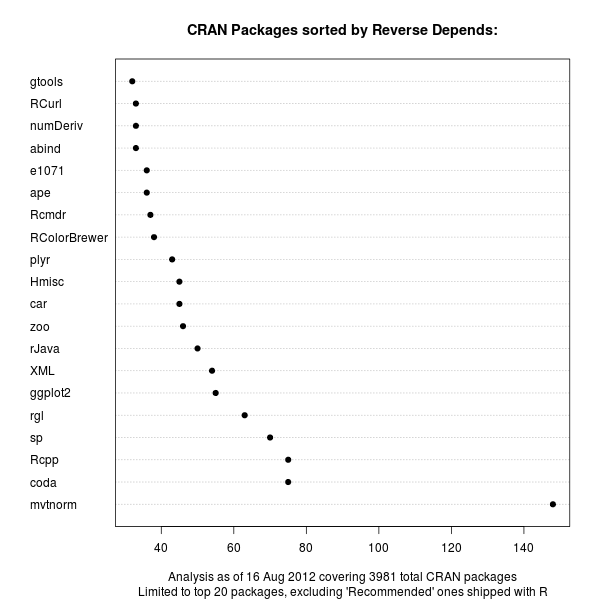
A few days ago, I blogged about visualizing CRAN dependency ranks which turned out to be a somewhat popular post. David Smith followed-up at the REvo blog suggesting to exclude packages already shipping with R (which is indicated by their 'Recommended' priority). Good idea! So here is an updated version, where we limit the display to the top twenty packages counted by reverse 'Depends:', and excluding those already shipping with R such as MASS, lattice, survival, Matrix, or nlme. CRAN package chart of Reverse Depends relations excluding Recommended packages The mvtnorm package is still out by a wide margin, but we can note that (cough, cough) our Rcpp package for seamless R and C++ is now tied for second with the coda package for MCMC analysis. Also of note is the fact that CRAN keeps growing relentlessly and moved from 3969 packages to 3981 packages in the space of these few days... Lastly, I have been asked about the code and/or data behind this. It is really pretty simply as the main data.frame can be had from CRAN (where I also found the initial few lines to load it). After that, one only needs a little bit of subsetting as shown below. I look forward to seeing other people riff on this data set.
#!/usr/bin/r
##
## Initial db downloand from http://developer.r-project.org/CRAN/Scripts/depends.R and adapted
require("tools")
## this function is essentially the same as R Core's from the URL
## http://developer.r-project.org/CRAN/Scripts/depends.R
getDB <- function()  
    contrib.url(getOption("repos")["CRAN"], "source") # trigger chooseCRANmirror() if required
    description <- sprintf("%s/web/packages/packages.rds", getOption("repos")["CRAN"])
    con <- if(substring(description, 1L, 7L) == "file://")  
        file(description, "rb")
      else  
        url(description, "rb")
     
    on.exit(close(con))
    db <- readRDS(gzcon(con))
    rownames(db) <- db[,"Package"]
    db
 
db <- getDB()
## count packages
getCounts <- function(db, col)  
    foo <- sapply(db[,col],
                  function(s)   if (is.na(s)) NA else length(strsplit(s, ",")[[1]])   )
 
## build a data.frame with the number of entries for reverse depends, reverse imports,
## reverse linkingto and reverse suggests; also keep Recommended status
ddall <- data.frame(pkg=db[,1],
                    RDepends=getCounts(db, "Reverse depends"),
                    RImports=getCounts(db, "Reverse imports"),
                    RLinkingTo=getCounts(db, "Reverse linking to"),
                    RSuggests=getCounts(db, "Reverse suggests"),
                    Recommended=db[,"Priority"]=="recommended"
                    )
## Subset to non-Recommended packages as in David Smith's follow-up post
dd <- subset(ddall, is.na(ddall[,"Recommended"])   ddall[,"Recommended"] != TRUE)
labeltxt <- paste("Analysis as of", format(Sys.Date(), "%d %b %Y"),
                  "covering", nrow(db), "total CRAN packages")
cutOff <- 20
doPNG <- TRUE
if (doPNG) png("/tmp/CRAN_ReverseDepends.png", width=600, heigh=600)
z <- dd[head(order(dd[,2], decreasing=TRUE), cutOff),c(1,2)]
dotchart(z[,2], labels=z[,1], cex=1, pch=19,
         main="CRAN Packages sorted by Reverse Depends:",
         sub=paste("Limited to top", cutOff, "packages, excluding 'Recommended' ones shipped with R"),
         xlab=labeltxt)
if (doPNG) dev.off()
if (doPNG) png("/tmp/CRAN_ReverseImports.png", width=600, heigh=600)
z <- dd[head(order(dd[,3], decreasing=TRUE), cutOff),c(1,3)]
dotchart(z[,2], labels=z[,1], cex=1, pch=19,
         main="CRAN Packages sorted by Reverse Imports:",
         sub=paste("Limited to top", cutOff, "packages, excluding 'Recommended' ones shipped with R"),
         xlab=labeltxt)
if (doPNG) dev.off()
# no cutOff but rather a na.omit
if (doPNG) png("/tmp/CRAN_ReverseLinkingTo.png", width=600, heigh=600)
z <- na.omit(dd[head(order(dd[,4], decreasing=TRUE), 30),c(1,4)])
dotchart(z[,2], labels=z[,1], pch=19,
         main="CRAN Packages sorted by Reverse LinkingTo:",
         xlab=labeltxt)
if (doPNG) dev.off()

15 August 2012

Jon Dowland: Backup Data Mining

What if you have a mis-behaving electronic device, which might corrupt files you store on it? I'm interested in tools to inspect incremental backups, look at file changes and alert me if they are suspicious. For example, if an MP3 changes, did the MPEG data change, or the ID3 tag, or something else? An ID3 change is likely to be on purpose, MPEG data less so. Similar for JPEGs and EXIF metadata. I decided to poke around in my backups of my music player. I discovered some pretty weird stuff. Firstly, quite a few MP3s seem to have changed on my player over time. I found 788 instances of MP3s changing a very small amount: an 11 byte rdiff-format patch. This seemed particularly strange, so I investigated a little:
...
01 Fool's Day.mp3.2012-05-31T22:40:09+01:00.diff
00000000  72 73 02 36 47 00 00 59  01 ad 00                  rs.6G..Y... 
0000000b
dark_entries.mp3.2012-05-31T22:40:09+01:00.diff
00000000  72 73 02 36 47 00 00 54  0f 58 00                  rs.6G..T.X. 
0000000b
...
In a nutshell, the patches appear to do nothing, or at least copy the input file verbatim into the output. (my rdifffs source is a useful document for the rdiff file format, or failing that, the rdiff source itself.) This is probably just a behavioural nuance of my backup software. That leaves 156 changed MP3s with rdiff patches ranging in size from 21 bytes to 26k. The smallest are almost certainly no-ops, just less efficiently stored ones. The largest looks like embedded album art in the ID3 tag being added, and I'm guessing the mid-size ones are ID3 textual changes (spelling corrections etc.), but ID3 changes are very hard to inspect by eye in the raw bytestream. For this reason I think a tool that could sort through file changes and pick out things which might need human investigation might be useful. Such tools could be run automatically after backups complete, or at scheduled times. I'll probably start writing some over the next few weeks, but if you know of any that already exist or might form part of a solution, please let me know!

Gintautas Miliauskas: Why Software Engineering Is Not Politics

A recent post by Steve Yegge has made quite a splash. The main thesis of his post is:

Software engineering has its own political axis, ranging from conservative to liberal.

Software engineering, like any other social enterprise, does have a political aspect, but I do not think this thesis is apt. The essential property of politics is that you can not have it both ways. A political problem is a coordination problem, and political decisions by its nature apply for an entire political body. Software engineering as a whole does not have these properties. There is absolutely no reason why any two engineering projects have to follow the same ideals and guidelines. Politics in engineering only appears within boundaries of a project (or, at a slightly higher level, a company), at which point it does not really warrant the name of politics, but rather character traits or personal preferences. If Johnny goes for the puck more often than Louie, that does not really warrant a label of a "liberal".

The fundamental quality that Steve is looking at is actually risk aversiveness, as he noted himself. He should have stopped there. Making that next step of conceptualization in political language does not bring any new insights and just muddles the matter.

It seems that the political labels of "liberal" and "conservative" were picked not for their meaning, but rather for their connotations, as political views are perceived to be 1) very stable, part of a person's self-identity and (therefore) hard to change, 2) inherently polarizing, and 3) difficult or impossible to evaluate objectively. Again, these do not apply to software engineering. For example, probably like many engineers, I am clearly a liberal on personal and small projects, and a conservative on larger and more fundamental ones; so much for the idea of a core identity. As for polarization, it may be prevalent in internet echo chambers, but I have not seen much of that in my professional life, especially when working with experienced engineers. When they do have objections, those objections are grounded in engineering. This leads to the third point, claiming that the approaches can not be compared objectively. This one is the most pernicious of all, because it provides an escape hatch from arguments with substance on what is an engineering decision.

Here is my, admittedly less catchy and impressive, counter thesis: Conservativeness of a software engineering project is an objective decision to be based on circumstances. TL;DR: It depends. (Very original, isn't it?) It is a risk management decision, and those are very tricky, but not subjective.

One thing to note is that the architecture of the system should correspond to the implementation style. Schemaless, heavy on magic, untyped approaches are suited for modular systems where each individual module is of limited complexity, and where the modules are isolated from each other and can recover from failures. The more complex the individual modules (and sometimes the complexity is inherent to the problem), the more benefits from "conservative" techniques. (By the way, this lines up nicely with Steve being liberal and a proponent of service-oriented architectures). If you have the freedom to pick between these two approaches, the decision making does get a bit more ideological. However, neither the "liberal" and "conservative" labels, nor risk averseness by itself is enough for a decision here. Say, if you are developing a service, what is more risky: having a "traditional", monolithic service that is inevitably sensitive to failures and is likely to scale poorly, or a cluster of components that are generally more resistant, but have more complicated aggregate behavior?

Despite the criticisms, I have to give fat credit to Steve. His post was thought-provoking, and it brought attention to the subjective side of engineering, one which is often overlooked. That side should not be left to grow - on the contrary - but the only way to reduce its domain it is to be aware of it. I know I will think twice before making another gut decision where risk averseness plays an important factor.

11 August 2012

Russ Allbery: Review: Design Patterns

Review: Design Patterns, by Erich Gamma, et al.
Author: Erich Gamma
Author: Richard Helm
Author: Ralph Johnson
Author: John Vlissides
Publisher: Addison-Wesley
Copyright: 1995
Printing: September 1999
ISBN: 0-201-63361-2
Format: Hardcover
Pages: 374
Design Patterns: Elements of Reusable Object-Oriented Software by the so-called "Gang of Four" (Gamma, Helm, Johnson, and Vlissides) is one of the best-known books ever written about software design, and one of the most widely cited. The language introduced here, including the names of specific design patterns, is still in widespread use in the software field, particularly with object-oriented languages. I've had a copy for years, on the grounds that it's one of those books one should have a copy of, but only recently got around to reading it. The goal of this book is to identify patterns of design that are widely used, and widely useful, for designing object-oriented software. It's specific to the object-oriented model; while some of the patterns could be repurposed for writing OO-style programs in non-OO languages, they are about inheritance, encapsulation, and data hiding and make deep use the facilities of object-oriented design. The patterns are very general, aiming for a description that's more general than any specific domain. They're also high-level, describing techniques and methods for constructing a software system, not algorithms. You couldn't encapsulate the ideas here in a library and just use them; they're ideas about program structure that could be applied to any program with the relevant problem. With the benefit of seventeen years of hindsight, I think the primary impact of this book has been on communication within the field. The ideas in here are not new to this book. Every pattern in Design Patterns was already in use in the industry before it was published; the goal was taxonomy, not innovation. One would not come to Design Patterns to learn how to program, although most introductory texts on object-oriented programming now borrow much of the pattern terminology. Rather, Design Patterns is as influential as it is because it introduced a shared terminology and a rigor around that terminology, allowing writers and programmers to put a name to specific program structures and thus talk about them more clearly. This also allows one to take a step back and see a particular structure in multiple programs, compare and contrast how it's used, and draw some general conclusions about where it would be useful. I have the feeling that the authors originally hoped the book would serve as a toolbox, but I think it's instead become more of a dictionary. The pattern names standardized here are widely used even by people who have never read this book, but I doubt many people regularly turn to this book for ideas for how to structure programs. Design Patterns is divided into two parts: a general introduction to and definition of a software pattern followed by a case study, and then a catalog of patterns. The catalog is divided into creational patterns (patterns for creating objects), structural patterns (patterns for composing objects into larger structures), and behavioral patterns (patterns for interactions between objects). Each pattern in turn follows a very rigid presentation structure consisting of the pattern name and high-level classification, its basic intent, other common names, a scenario that motivates the pattern, comments on the applicability of the pattern, the structure and classes or objects that make up the pattern, how those participants collaborate, how the pattern achieves its goals, comments on implementation issues, sample code, known uses of the pattern in real-world software, and related patterns. As with a dictionary, the authors go to great lengths to keep the structure, terminology, and graphical representations uniform throughout, and the cross-referencing is comprehensive (to the point of mild redundancy). As for the patterns themselves, their success, both as terminology and as useful design elements, varies. Some have become part of the core lexicon of object-oriented programming (Factory Method, Builder, Singleton), sometimes to the point of becoming syntactic elements in modern OO languages (Iterator). These are terms that working programmers use daily. Others aren't quite as widespread, but are immediately recognizable as part of the core toolkit of object-oriented programming (Adapter, Decorator, Proxy, Observer, Strategy, Template Method). In some cases, the technique remains widespread, but the name hasn't caught on (Command, for example, which will be immediately familiar but which I rarely hear called by that name outside of specific uses inside UI toolkits due to ambiguity of terms). Other patterns are abstract enough that it felt like a bit of a reach to assign a name to them (Bridge, Composite, Facade), and I don't think use of those names is common, but the entries are still useful for definitional clarity and for comparing similar approaches with different implications. Only one pattern (Interpreter) struck me as insufficiently generic to warrant recording in a catalog of this type. So far, so good, but the obvious question arises: if you've not already read this book, should you read it? I think the answer to that is debatable. The largest problem with Design Patterns is that it's old. It came late enough in the development of object-oriented programming that it does capture much of the foundation, but OO design has continued to change and grow, and some patterns have either been developed subsequently or have become far more important. For example, Model-View-Controller is conspicuous by its absence, mentioned only in passing in the discussion of the Observer pattern. Any pattern catalog written today would have an extensive discussion. Similarly absent are Inversion of Control and Data Access Object, which are much more central to the day-to-day world of the modern programmer than, say, Memento or Visitor. One could easily go on: Lazy Initialization, Mock Object, Null Object... everyone will have their own list. A related problem is that all the implementation examples are shown in either C++ or Smalltalk (occasionally both). Those were probably the best languages to use at the time, but it's doubtful a modern rewrite would choose them. Smalltalk, in particular, I found nearly incomprehensible for the uninitiated, to the point where I ignored the code and only read the surrounding English description. C++ fares better, but Design Patterns occasionally drifts off into tedious discussions of how to work around C++'s limitations in ways that are irrelevant to the pattern itself and would not be necessary in, say, Java or Python. (This is ameliorated by the fact that C++, unlike Smalltalk, is still in widespread use, so those discussions remain moderately helpful for some readers.) Design Patterns is not, therefore, a very good source for a working knowledge of the most common patterns in use today. It has also become somewhat obsolete via its own success: the concept of a design pattern has become so popular that nearly all introductory texts include at least a basic discussion of design patterns and an introduction to the most notable and useful patterns. I think that's a more comfortable and more efficient way to pick up the basics than reading through this book, which is somewhat dense and which expects from the reader a reasonably good working knowledge of object-oriented programming. And, once you have the basics, MVC, DAO, and similar design patterns are probably more important than the more subtle design patterns presented here. That said, I think the rigor of description and the comparisons and discussions here still have some value. Design Patterns encourages the reader to look at patterns from a higher-level perspective, to think about meta-patterns such as the balance between data hiding and access, or between structure designed for the present purpose and structure that's adaptable to future needs. It's also mildly interesting from a historical standpoint; one can see the inspiration for future language designers in how problems are described here, and see how many of the implementation issues and negative consequences have been corrected or simplified by richer language designs. Overall, I would hesitate to recommend buying this book today, particularly at new textbook prices. But if you're a working object-oriented software designer or programmer, I think it's worth checking out from a library (and, thanks to its influence, any library with a decent software design section will almost certainly have a copy). Read the overall discussion, skim the catalog, and read the discussion of the patterns that strike your interest. It may help provide some additional structure and perspective to how you think about OO design. Rating: 6 out of 10

10 August 2012

Benjamin Mako Hill: A Model of Free Software Success

Last week I helped organize the Open and User Innovation Conference at Harvard Business School. One of many interesting papers presented there was an essay on Institutional Change and Information Production by Fabio Landini from the University of Siena. At the core of the paper is an economic model of the relationship between rights protection and technologies that affects the way that cognitive labor can be divided and aggregated. Although that may sound very abstract (and it is in the paper), it is basically a theory that tries to explain the growth of free software. The old story about free software and free culture (at least among economists and many other academics) is that the movements surged to prominence over the last decade because improvements in communication technology made new forms of mass-collaboration -- like GNU/Linux and Wikipedia -- possible. "Possible", for these types of models, usually means profit-maximizing for rational, profit-seeking, actors like capitalist firms. You can basically think of these attempts as trying to explain why open source claims that free licensing leads to "better quality, higher reliability, more flexibility, lower cost" are correct: new technology makes possible an open development process which leads to collaboration which leads to higher quality work which leads to profit. Landini suggests there are problems with this story. One problem is that it treats technology as being taken for granted and technological changes as effectively being dropped in from outside (i.e., exogenous). Landini points out that software businesses build an enormous amount of technology to help organize their work and to help themselves succeed in what they see as their ideal property rights regime. The key feature of Landini's alternate model is that it considers this possibility. What comes out the other end of the model is a prediction for a multiple equilibrium system -- a situation where there are several strategies that can be stable and profitable. This can help explain why, although free software has succeeded in some areas, its success has hardly been total and usually has not led to change within existing proprietary software firms. After all, there are still plenty of companies selling proprietary software. In Landini's model, free is just one of several winning options. But Landini's model raises what might be an even bigger question. If free software can be as efficient as proprietary software, how would anybody ever find out? If all the successful software companies out there are doing proprietary software, which greedy capitalist is going to take the risk of seeing if they could also be successful by throwing exclusive rights out the window? In the early days, new paths are always unclear, unsure, and unproven. Landini suggests that ethically motivated free software hackers provide what he calls a "cultural subsidy." Essentially, a few hackers are motivated enough by the ethical principles behind free software that they are willing to contribute to it even when it isn't clearly better than proprietary alternatives. And in fact, historically speaking, many free software hackers were willing to contribute to free software even when they thought it was likely less profitable than the proprietary alternative models. As Landini suggests, this group was able to build technological platforms and find new social and business arrangements where the free model actually is competitive. I think that the idea of an "cultural subsidy" is a nice way to think about the important role that ethical arguments play in movements like free software and free culture. "Open source" style efficiency arguments persuade a lot of people. Especially when they are true. But those arguments are only ever true because a group of ethically motivated people fought to find a way to make them true. Free software didn't start out as competitive with proprietary software. It became so only because a bunch of ethically motivated hackers were willing to "subsidize" the movement with their with their failed, and successful, attempts at free software and free culture projects and businesses. Of course, the folks attracted by "open source" style superiority arguments can find the ethical motivated folks shrill, off-putting, and annoying. The ethically motivated folks often think the "efficiency" group is shortsighted and mercenary. But as awkward as this marriage might be, it has some huge upsides. In Landini's model, the ethical folks can build their better world without convincing everyone else that they are right and by relying, at least in part, on the self-interest of others who don't share their principles. Just as the free software movement has done. I think that Landini's paper is a good description of the critically important role that the free software movement, and the FSF in particular, can play. The influence and importance of individuals motivated by principles can go far beyond the groups of people who take an ethical stand. They can make involvement possible for large groups of people who do not think that taking a stand on a particular ethical issue is even a good idea.

9 August 2012

C.J. Adams-Collier: Linus on Instantiation and Armadaification

I feel a sense of pride when I think that I was involved in the development and maintenance of what was probably the first piece of software accepted into Debian which then had and still has direct up-stream support from Microsoft. The world is a better place for having Microsoft in it. The first operating system I ever ran on an 08086-based CPU was MS-DOS 2.x. I remember how thrilled I was when we got to see how my friend s 80286 system ran BBS software that would cause a modem to dial a local system and display the application as if it were running on a local machine. Totally sweet. When we were living at 6162 NE Middle in the nine-eight 292, we got an 80386 which ran Doom. Yeah, the original one, not the fancy new one with the double barrel shotgun, but it would probably run that one, too. It was also totally sweet and all thanks to our armadillo friends down south and partially thanks to their publishers, Apogee. I suckered my brothers into giving me their allowance from Dad one time so that we could all go in on a Sound Blaster Pro 16 sound card for the family s 386. I played a lot of Team Fortress and Q2CTF on that rig. I even attended the Quake 3 Arena launch party that happened at Zoid s place. I recall that he ported the original quake to Linux. I also recall there being naughty remarks included in the README.txt. When my older brother, Aaron turned 16, he was gifted a fancy car. When asked what type of car I would like when I turned 16, I said that I d prefer a computer instead. So I got a high-end 80486 with math co-processor. It could compile the kernel in 15 minutes flat. With all the bits turned on on in /usr/src/linux/.config. But this was later. I hadn t even heard of linux when I got my system. I wanted to be entertained by the thing. I made sure to get a CD-Rom and a sound card. I got on the beta for Ultima Online and spent a summer as a virtual collier. Digging stuff out of mines north of Britannia and hauling them to town to make weapons and armor out of them. And then setting out in said armor only to be PK d because I forgot healing potions and I was no good at fighting. While I was in the middle of all this gaming, my friend Lucas told me that I should try out this lynx thing that they run at the University of Washington. He heard that it was reported to run doom faster than it ran on MS-DOS. It turns out that it did, but that it was not, in fact, called lynx. Or pine. The Doom engine ran so fast that the video couldn t keep up. This was probably because they didn t use double buffering for frame display, since they didn t want to waste the time maintaining and switching context. I think I downloaded the boot/root 3.5 disk pair and was able to get the system to a shell with an on-phone assist from the Rev. I then promptly got lost in bash and the virtual terminals (OMG! I GET SIX CONSOLES!?) and bought a book on the subject. It shipped with slackware. Which I ran. Until Debian came along. Lucas also recommended that I try out this IRC thing, so I did. And I m still doing it on #linpeople just like I did back then. I learned to write Pascal on dos. Then I learned c while they were trying to teach me c++. I learned emacs and vi when I was attending North Kitsap High School. I learned sed and only a little awk when I took Running Start classes in Lynnwood at Edmonds Community College and perl & x.509 while attending Olympic Community College and simultaneously jr-administering Sinclair Communications. I studied TCP/IP, UNP, APUE, C and algorithms & data structures while preparing for an interview with a company whose CEO claimed to have invented SCSI. I learned PGP and PHP while writing web-based adware for this company. I didn t want to write ads and instead wanted to work in security, so took a job with Security Portal. While there, I wrote what one might call a blogging platform. It worked and made it possible for authors to write prose and poetry. Editors didn t have to manage a database in order to review and publish the posts that were ready. Everyone but me was able to avoid html and cgi. Then I sold pizza. Then I helped bring the bombay company onto the interwebs using the Amazon ECS (now AWS) platform. Then I helped support MaxDB. Then I helped develop and maintain the Amazon blogging platform. And then attempted to reduce the load on the Amazon pager system by doing and enforcing code reviews. It turns out that they prefer to run their support team at full bore and a load average of 16.
<iframe allowfullscreen="" frameborder="0" height="288" scrolling="no" src="http://www.youtube.com/embed/MShbP3OpASA" width="448"></iframe>
I am now, still, fully employed in an effort to make hard things possible. The hard thing we re working on now is the implementation and ongoing operations of distributed x.500 infrastructure. This includes request handling, processing and delivery of response ( la HTTP, SMTP, IMAP, SIP, RTP, RTSP, OCSP) including authentication, authorization and auditing (AAA) of all transactions. It s a hard thing to get right, but our product development team gets it right. Consistently and reliably. We make mistakes sometimes (sorry Bago), but we correct them and make the product better. I m the newest member of an R and d team (note: big R, little d) called NTR, which sits behind the firewall that is Product Development, out of production space. In a manner that reminds me of Debian Testing. We try new things. Our current project is to allow users to compare their current (cloud-based or iron-based) IT system with what their system would be like with a BIG-IP in front of it. I can probably come up with a demo if anyone s interested in checking it out. I ll go work on that now.

6 August 2012

Richard Hartmann: The problem with copyright maximalism

The gradual descent into a [permission culture](http://www.ibiblio.org/ebooks/Lessig/Free_Culture/Free Culture.htm#pxiii) has many ugly heads. Be they copyright maximalism, patent wars, cementing antiquated business models by suing, or a myriad of other things. One of said ugly heads is that people pretend to have a copyright just to milk others. The name Righthaven will be known to most people as a prime example of this going badly for the offenders. From how it looks, the people behind Righthaven, a company founded just to sue others, are being pursued through that shell. Many of you will know the infamous "You have to watch this on YouTube as Rightster filed a copyright claim" notice. What this means is that YouTube will (try to) display ads and Rightster will get a share of any revenue. I can't comment on the validity of those claims, but some of them struck me as dubious in the past. We reached a new low, though. Scripps Local News, which publishes world-renowned papers such as Ventura County Star and Corpus Christi Caller-Times, temporarily blocked NASA's video of Mission Control during MSL's seven minutes of radio silence with their copyright claim. As NASA-produced video featuring NASA, published on NASA's YouTube account. Blocked: Turns out something is borked here and I don't have time to fix it right now. I uploaded it to imgur as a quick fix. The video has been made accessible again in the meantime, but this is, yet again, proof that we are sliding into a society where content and knowledge is locked down by default. Don't let that happen. Pester your politicians, inform your friends, participate in demonstrations, and don't give up. It's our culture, not theirs.

5 August 2012

Stefano Zacchiroli: bits from the DPL for July 2012

Monthly DPL bits, fresh from the oven.
Tip to feel good about the release #476: before reading this, grab and fix one of the RC bugs affecting Wheezy. Done? Now you're ready for a slightly less exciting report of DPL activities. Highlights Assets Logo & trademark Note that the actual logo relicensing should be done by SPI, via their board, upon request of mine (as Debian Project liaison). We won't make it for the next SPI board meeting, as it is on 4 days away. But we can aim for the subsequent meeting, on September 13th. If all goes well (big "if"), we will enjoy a DFSG-free logo after that date. Internal organization Recent flurry of re-organization in the tech-ctte --- which I somewhat triggered pushing for periodic meetings --- seems to be proceeding well. I'm very happy about it, as we all need to trust that tech-ctte decisions will be not only sound, but also prompt. If you're interested into this topic, some recent evidence of the ongoing reorganization and its result can be found in their DebConf12 BoF, minutes of the last meeting, a set of forthcoming GRs, and the recent great decision of posting decisions results to d-d-a (as it happened for node/nodejs). Kudos to tech-ctte members for the recent activism! I haven't worked on it myself directly, but I highlight Enrico's work on server side archival of NM conversations. It has the potential of enabling automatic detection of stuck NM processes. I'm a bit rusty as AM now, but I think missing that ability is one of the main remaining causes of frustration when joining Debian. So, if you are an AM, please opt-in and use this feature with your appicants. If you are not an AM why not? :-) Miscellanea Some misc legal stuff: and some misc "political" stuff: Happy RC bug squashing,
Cheers.
PS the boring day-to-day activity log for July 2012 is available at master:/srv/leader/news/bits-from-the-DPL.txt.201207

31 July 2012

Petter Reinholdtsen: Best way to create a docbook book?

I tried to send this text to the docbook-apps mailing list at lists.oasis-open.org, but it only accept messages from subscribers and rejected my post, and I completely lack the bandwidth required to subscribe to another mailing list, so instead I try to post my message here and hope my blog readers can help me out. I am quite new to docbook processing, and am climbing a steep learning curve at the moment. To give you some background, I am working on a Norwegian translation of the book Free Culture by Lawrence Lessig, and I use docbook to handle the process. The files to build the book are available from github. The book got around 400 pages with parts, images, footnotes, tables, index entries etc, which has proven to be a challenge for the free software docbook processors. My build platform is Debian GNU/Linux Squeeze. I want to build PDF, EPUB and HTML version of the book, and have tried different tool chains to do the conversion from docbook to these formats. I am currently focusing on the PDF version, and have a few problems. So I wonder, what would be the best way to create the PDF version of this book? Are some of the bugs found above solved in new or experimental versions of some docbook tool chain? What about HTML and EPUB versions?

Next.

Previous.