Search Results: "az"

14 October 2013

Clint Adams: The Windy City is full of meat

As you know, I am not big on reviews, so you should disregard the remainder of this entry. I recently found myself in what is called a theatre complex , watching an adaptation of Moli re's Les Femmes savantes by Freyda Thomas, who is apparently famous for playing Alenis Grem on Deep Space Nine. Called The Learned Ladies, this translation to English manages to approximate some of the rhyme of the original, thereby making it unquestionably better than DS9. Also noteworthy is the all-female cast, cobbled together from two all-female theater groups. Elizabeth Neptune plays Chrysale, occasionally channeling the spirit of Jackie Gleason or bringing adorable ardor to such epic lines as Tea! I won't say anything about her eyes, but I will say something about her slippers. Sara Montgomery, as B lise, is delightfully crazy in her singing, dancing, costume changes, and other antics, which serve to transform this otherwise-completely-serious play into a comedy. I definitely won't say anything about her shoes. Madeleine Maby begins playing Philaminte well before the show starts. Spoiler alert: she sits on the stage, pretending to look through a telescope and make notes from before the house opens until right before the start of the first scene. I still feel exhausted by the thought of having to do that myself. L' pine is portrayed by Alyssa Lott, who also plays three minor roles. Her mastery of physical comedy is not wasted on this production. Marta Kuersten plays Clitandre opposite Sarah Brill's Henriette. While Marta's performance was quite good, she looks much better as a woman. I will not be saying this about everyone. Katie Honaker delivers visceral smarm and sleaze as Trissotin. Even her hairstyle is somehow evocative of contempt. Susan Finch plays Vadius and Le notaire. Susan was definitely most convincing as a man. Despite mutterings to the contrary, some suspension of disbelief was necessary for the other male roles, but not for Vadius, oh no. Finishing out the list we have Janna Emig as Martine, Francesca Day as Armande, and Kathryn Alexander as Ariste, with good performances, particularly in the second half. Even though it didn't have Coppertop from Strangers With Candy and a boy-band song-and-dance cover of To Be with You by Mr. Big, I recommend this play.

13 October 2013

Francesca Ciceri: MissRepresentation: discussing gender stereotypes in Moldova

Recently, I've been attending a training course in Moldova about the representation of gender in the media and the influence on society of gender stereotypes.
The course was organized by Inesa Lupu, of Invento and financed by the UE as part of the Youth in Action program. It was the first time, for me, in this kind of international project and it was, in a word, fantastic.
Among the participants, there were people from Azerbaijan, Georgia, Italy, Latvia, Moldova and Slovenia.
That meant a great mix of cultures, languages and experiences.
And that was the key, in my opinion, of the success: coming from different countries and different social and cultural contexts meant that we were able to have a very broad and diverse point of view on the problem of gender stereotypes. So, here's some highlights on what we discussed. The media representation of gender (aka: gender issues are not only women issues) Tough Guise by Jackson Katz is a interesting documentary about the way the modern society - particularly in the US - defines masculinity as intrinsically tied to violence, aggressivity and "toughness" and on the consequences of this on the society as a whole. The author's theory is "that male violence, misogyny, and homophobia are inextricably linked to how we define manhood as a culture. The film gives special attention to how American media have glamorized increasingly regressive and violence masculine ideals in the face of mounting social and economic threats to traditional white male heterosexual authority". It then results clear that we cannot avoid to think about gender issues as women and men issues, because after all is the cultural definition of both femininity and masculinity that heavily influences the behaviour of men and women and their interaction.
In particular, I liked Katz's analysis of media's use of victim blaming speech while reporting of violences against women which tend to shift the focus from the violence perpetrated by men as part of definition of masculinity. Another documentary we watched, more focused on women representation, is MissRepresentation by Jennifer Siebel Newsom.
The film analyses the under representation of women in position of power, and the issue of women and leadership, especially in politics, in the US. Nothing too new, if you are interested in gender issues, as it is a widely discussed and studied topic, but still worth watching. After watching them, we formed little groups of three-four persons from different countries to discuss them, and it was even more interesting to listen the opinion of the guys (we had four male participants). The guys talking about Tough Guise Photography and Phototherapy As a workshop on media representation of gender, photography and advertisement were two of the main argument we spoke about. We focused on it for two days: our trainer, Lietta Granato - photographer and phototherapist - first gave us a lesson on photography, making us experimenting a bit with exposure times and diaphragm's aperture. a lesson on photography Then she presented the evolution in the last 50 year or so, of the depiction of women in the ads.
And that, to be honest, was a bit upsetting.
I've already had seen one of the most important and widely known films on this theme, the Killing Us Softly series by Jean Kilbourne, but some of the ads Lietta showed to us were really really horrible. Actually, most of them were horrible. Commenting and deconstructing these ads would take a separate blogpost, probably, and there are many people more competent than me on the topic, so I've decided to simply share some of the worst ads in a collage, without much commenting. These are vintage, from the fifties to the seventies. a collage of vintage sexist ads Do you think we got better? Pff. a collage of recent sexist ads They go from promoting violence and rape to heavily objectifying women. Special mention for the Compaq ad: as a geek woman I feel particularly insulted by the idea that I'm supposed to use a "pocket pc" as "pocket mirror". Because I wouldn't be able, obviously, to use it as a computer. Lietta also introduced us to photographic therapy and particularly the work of Jo Spence and Rosy Martin. If you browse Jo Spence's site, please be aware that there is a series of pics documenting all the stages of her illness (she died of breast cancer) and they are pretty intense. "In 1984, alongside Rosy Martin, Spence developed Photo-Therapy , adopting techniques from co-counselling. The considerable achievement of Photo-Therapy was to invert the traditional relationship between the photographer and the subject. If historically the subject had little control over their own representation, Photo-Therapy shifts this dynamic. The subject was able to act out personal narratives and claim agency for their own biography." (source: http://www.jospence.org/biography.html)
I love this concept and I really really love Spence's photos. To close on a happier note, I really suggest you to allocate 20 minutes of your time to watch this great talk by Nigerian novelist Chimamanda Ngozi Adichie, about the role of "single story" in shaping stereotypes and misunderstandings.

10 October 2013

Russ Allbery: Review: 2312

Review: 2312, by Kim Stanley Robinson
Publisher: Orbit
Copyright: 2012
ISBN: 0-316-19280-5
Format: Kindle
Pages: 563
Swan Er Hong is a native of Mercury, granddaughter of one of the most influential women in the solar system. Alex, known as the Lion of Mercury, has just died as the story opens, and Swan is mourning. But she's also discovering that something else has been going on, something that Alex had not confided in her. Something that involves an inspector from the asteroids, a scientist from Titan, and a message Alex left in the event of her death, asking Swan to convey something personally to another scientist on Io. And then Mercury is attacked and the situation becomes much more complicated. 2312 is, like most Robinson novels, built on top of monumental world-building. The date is given away by the title; the setting is a solar system full of terraforming, habitats, and explosive human colonization. There are human settlements on every world that could possibly sustain them, including a terraformed Mars and a vast in-progress terraforming project on Venus. Mercury, Song's home, supports the city known as Terminator, a shielded habitat that travels around the planet on rails, pushed forward by the thermal expansion of metal at sunrise. Humans have scattered across the solar system and changed everything they've touched, even the asteroids. Many of those have been repurposed as long-haul shuttles: self-contained habitats on carefully-designed routes on which people live for months or years until they get to their destinations. Parts of this book are gorgeous. One of Robinson's strengths is creating images of the vastness of space, science, and human endeavor that feel plausible and inspiring at the same time. The setting of 2312 frees him to go wild with mega construction projects, and he takes full advantage. Parts of the book inspire the same sense of awe as the Hoover Dam or the Great Wall of China, transplanted into space and backed with neat scientific ideas to ponder. (Even if the more skeptical will note certain human habitation hazards, such as prolonged weightlessness and radiation, are mostly hand-waved away.) Unusually for a Robinson novel, 2312 also features an interesting and vibrant protagonist. Usually I can barely remember Robinson's protagonists five minutes after I finish the book, but Swan is so impulsive, erratic, and emotionally intense that I doubt I'll forget her. Her past is stuffed with outrageous risks and intense creativity: having songbird neurons transplanted into her brain, ingesting extraterrestrial bacteria, designing habitats in the asteroid belt, and creating art on the plains of Mercury. As the story gets underway, she meets the oversized and mellow Wahram; at first, she finds him boring, but then they're thrown together by one of the best set pieces of the book, and both they and the reader discover they work well together. Wahram serves as a straight man and as a stand-in for the reader's opinion, showing Swan all the more clearly in contrast. All this sounds quite promising. Unfortunately, what makes 2312 an ambitious failure rather than an excellent story is the story part. Robinson has built an amazing world, but he doesn't seem to know what to do with it. His economy, at least outside of Earth (and more on that in a moment), is essentially post-scarcity. Few of the characters we meet seem to have any concept of fiscal or practical limitation. They head across the solar system on a moment's notice, take vacations in habitats, or head to favorite spots for the view. It felt like Robinson was trying to write a Culture story. Unlike Banks, however, he struggles with generating a plot. 2312 is, in structure, a murder mystery. The characters witness a crime, survive it, and then intend to investigate it, and the crime appears to grow and link to fault lines in their society. This could have worked, but it has two problems: their society is only barely coherent enough for the reader to perceive the potential fault lines, and Robinson seems to have no idea how to construct a mystery plot. There is no sense of coherence to Swan and Wahram's approach, no sense of a gathering of clues, and very little sense of drama. All of the plot revelations are either dropped in Swan's lap by another character at a convenient moment or generated by Swan refusing to take the plot of the book seriously. The characters do essentially no meaningful investigation on-camera and show almost no investment in the outcome of the plot. When the climax comes, it's all weirdly forgettable. There are also large sections of the book that appear to have nothing to do with the rest of the plot, and that's where the unfortunate interval on Earth comes in. Robinson takes advantage of the scenes on Earth to do a bit of alienation and shows how foreign and strange and stifling Earth feels to someone who grew up outside of its atmosphere. Parts of this work, but he puts the plot on hold to do it. And parts of it do not work at all. The most glaring example is Swan and Wahram's bizarre bit of attempted charity in Africa, which comes across as stunningly high-handed and arrogant. This could be in character, particularly for Swan (who is not long on empathy), but, if so, the book doesn't signal to the reader that it should be read that way. Instead, there are some side (or snide) comments that seem to indicate Robinson knows nothing about the economic arc of Africa from the past twenty years. And when their absurd, botched, condescending charity plan fails for all the obvious reasons, the characters, and apparently the novel, throw up their hands and write Earth off as a stagnant lost cause that can't accept the imposition of a good idea and go back to the plot, never apparently caring about Earth again. Almost as frustrating is the way that these interludes are tied back into the story, which is usually through Swan getting ridiculously lucky on her random encounter rolls. It felt like whenever Robinson needed to make progress in the plot, Swan would just accidentally run into exactly the right person or situation to bring up the next plot point or to have some investigation make sense. (Not that Swan usually figured this out. Normally, the inspector explains it to her.) The author's finger was planted so firmly on the scales that it destroyed my suspension of disbelief and made a mockery of the idea that the characters were actually investigating anything. 2312 is built around a skeleton of a plot, but the lack of engagement with it, the lack of tension and emotion, the way the next developments are generally narrated to the protagonists and the reader, and the repeated use of random encounters to steer it left me without much reason to care. Robinson tries a few twists, but since the story never felt committed to its plot anyway, those twists feel less like planned complications and more like another random veer in the road. It didn't help that the final outcome was more prosaic and forgettable than the book had been implying it would be. There is a lot to like here. I'm very pleased to see Robinson finally write a memorable protagonist, and he's very good at both world-building and set pieces. But it needed a plot, and it needed a more coherent and complete cultural backdrop for its characters. Without both, it fell back into the typical Robinson trap: gorgeous moments separated by a whole lot of boring, and an overall impression of a construction tour rather than a story. There are bits of it I loved and still remember, particularly Song and Wahram in the tunnels of Mercury (which is possibly the best extended characterization Robinson has ever written). But the book as a whole is a mess, and I can't recommend wading through it for the good parts. Rating: 5 out of 10

5 October 2013

Rémi Vanicat: Key-transition

A recent discussion on debian-project remind me I have to do this:
-----BEGIN PGP SIGNED MESSAGE-----
Hash: SHA1,SHA256
Hello,
I am transitioning GPG keys from an old 1024-bit DSA key to a new
4096-bit RSA key.  The old key will continue to be valid for some
time, but I prefer all new correspondance to be encrypted in the new
key, and will be making all signatures going forward with the new key.
This transition document is signed with both keys to validate the
transition.
If you have signed my old key, I would appreciate signatures on my new
key as well, provided that your signing policy permits that without
reauthenticating me.
The old key, which I am transitional away from, is:
   pub   1024D/9057B5D3 2002-02-07
         Key fingerprint = 7AA1 9755 336C 6D0B 8757  E393 B0E1 98D7 9057 B5D3
The new key, to which I am transitioning, is:
   pub   4096R/31ED8AEF 2009-05-08
         Key fingerprint = DE8F 92CD 16FA 1E5B A16E  E95E D265 C085 31ED 8AEF
To fetch the full new key from a public key server using GnuPG, run:
  gpg --keyserver keys.gnupg.net --recv-key D265C08531ED8AEF
If you have already validated my old key, you can then validate that
the new key is signed by my old key:
  gpg --check-sigs D265C08531ED8AEF
If you then want to sign my new key, a simple and safe way to do that
is by using caff (shipped in Debian as part of the "signing-party"
package) as follows:
  caff D265C08531ED8AEF
Please contact me via e-mail at <vanicat@debian.org> if you have any
questions about this document or this transition.
  Remi vanicat
  vanicat@debian.org
  remi.vanicat@gmail.com
  remi.vanicat@ens-lyon.org
-----BEGIN PGP SIGNATURE-----
Version: GnuPG v1.4.14 (GNU/Linux)
iD8DBQFST8iPsOGY15BXtdMRAggfAJ4z5wEpUy8Bcicv9KTGOjsUAZF2xACfYKv9
GWXh8iT1N2Qqjhwtpvx9B3aJAhUDBQFST8iP0mXAhTHtiu8BCPldEADYM9e/22yu
En8lcZ5UUI/eQ5jFgZaxTZ90ShS0vPD/Mgn6xyKoeigA0Bk4ltTjDXA7vEWXLjOK
gbGv3SvffPJIsR1WJmhYtVyNquJXXjyElEBsbxvCJ/awYdU9BFXPqtLlLVCObvSc
bE9xlJhoLdk3bDqSSTO3nqoDa0qgPnJvwKNYIMBrNavGyIW3QT0BRUCKyBssqh+u
P4x8VhpHiR2Ee4LHfRVeJk+5ncvSXYluAohOXka5AnV2GgFQoVYfFqxn2Gh3BMWC
sqf/NUPnFOCSRw++oNP3mBv3jn/jZuo8BcVOECKL+/dO6/3otgO6a/5tUspfnAJA
m/UxBdc2vs7LkZ0wUipIHg10x4154f+hZfx4WuCJ05X0dqcKeh4eJ0zFBvxMyh+A
o2TfifT9WJlyb+Hah/w1MFAXI8cAj5RvwdVgTzcodXpggtpBpdLDvv3G1KYFm/TG
Zev480N6bGrBb3JKgUtAMuTls8+FngYtYg9YKBiajEDM3MVC+H4MiOzVNKV++y/n
YW3z59Oc04ZMi9hV+uR3kwq8D7aUJmc0QFeOGmq7W9LOjvVO+lTf87l3jh2ahxx/
FgiinSZr1YzE+9OtNj8CTsmAmApIxsTJUCR6h554z+lyrTwc0pdeUwzSWqV84k7G
V6HBmTiw9IGs22+W15pRzq/mCVYdrYT7zQ==
=c5fJ
-----END PGP SIGNATURE-----
Here is the link to the .txt version for easier checking of signature.

1 October 2013

Gunnar Wolf: Piracy and culture circulation: #encirc13

This week's lesson on the Arte y cultura en circulaci n: crear y compartir en tiempos digitales course talks about piracy and the circulation of culture, a topic that over time has been debated over and over. And a topic, yes, that can always lead to interesting discussions. This time, we are requested to choose one among ten ideas among the media groups' discourse on what piracy is and means for the "cultural industry". There are tons of material written already on several of those ten lines (i.e. piracy disincentivates creativity, or two that can be seen as two faces of the same argument, If a consumer can have free access to cultural products, he will stop spending his money on them and Every time a consumer has access to an illegal copy, the industry loses a sale), and some are quite obvious (i.e. Piracy makes job positions be lost... Just look at the amount of people the unauthorized distribution industry feeds! Or possibly, Piracy is a prosper industry that gives money to people distributing illegal products Of course, that is true. The problem is, what causes said products to be illegal to begin with? Should they be so?). Some other ideas talk about harsher penalties and ways to punish illegal copying in order to drive actors out of that sector (and into the... void?) So, I chose item #4: Cultural products have a high cost because their production is complex (and a tag could be made, linking complex with expensive). I think this item can lead to a long discussion as to what does this complexity and cost mean. Some cultural products do require quite a bit of investment, yes. Others don't. How do content producers make the jump to produce expensive works? If I am a new programmer/artist/writer/screenplayer/whatever, most likely, my products will be not very complex or expensive. I will start small. And if I excel at my work, somebody will look at me and, in some way, become my patron, my sponsor. Being a sponsor might mean that, based on the results of my good work, I could get hired as a software developer at a large company, or an editorial company would buy the patrimonial rights of my book/music (be it for a fixed fee or for a percentage of sales), or whatever. But the leap is not made quantically A newcomer to the cultural scene will at first, most likely, have a hard time selling his products. At first, it takes convincing just getting people to take a shot at looking at your work ( Hey, please take a look at my program and tell me what you think about it! , Would you be interested in listening to my latest song? And those two are by far ahead of the first attempts where the interactions would more likely be Turn off that $#^#!^ computer, it's well past bedtime or stop murdering that guitar, I'm having a headache ). Maybe the toughest part is to get people to agree to read/hear your work. And there, you start into a continuum Selling your CDs while performing on the street, then getting to play to a bar, then getting somebody to want to produce (maybe even "discover"!) you. Publish some short stories in your school magazine, then in a "From our audience" section in a larger magazine, then a collective book, your self-published book, yet-unwritten books by contract... The same story over and over again, in each different field. Ok, yes, but... This logic succession still leaves space for the Important Producers with the Mighty Big Pockets for the most wanted/largest productions, right? And were unauthorized distribution (piracy) to be the norm (as it currently is, dare I say), wouldn't they stop producing an important portion of cultural works? I'd be tempted to say so. However, a different actor comes into play. When Mighty Big Pockets comes into play, they no longer worry only about getting money from each cultural creation, but from all derived uses of it. And the cultural creation industry (when seen as an industry) goes very much hand in hand with the advertising, marketing industries They end up blending with each other. So, the biggest best sellers will most likely have a hit from illegal copiers. Books are still a great business, but hey An even better business is (usually) movie making. And when you make a movie out of a great story, you will surely link some advertising into it (or at the very least, push advertising/product pushing campaigns to go after it). And there, illegal distribution actually helps the money circle to grow stronger. In the early 1990s, the link between dinosaurs and carbonated drinks was a top seller (because Pepsi was a Jurassic Park sponsor). Although I have always loathed the madness around the World Cups (and basically anything that involves football of any kind), I can perfectly remember several of the theme songs for most of the world cups played during my lifetime. So, in short... No. Illegal distribution does marginally little harm to the money income to the cultural business, at any level. And where it does get some direct harm, it increases the money flux given the auxiliary channels.

29 September 2013

Lars Wirzenius: My GTD booklet no longer on Amazon

I wrote a very short book on Getting Things Done for hackers, which I also put up for sale on Amazon as a Kindle book, in addition to allowing people to get it for free from my website. As expected, it didn't sell much, perhaps a few dozen copies in total, but I got a small kick out of having a book for sale. However, Amazon now wants me to set up some kind of US tax account, which is all fine and good and legal and appropriate, but it's not worth my time to do that. I've removed the book from Amazon, to keep my life simple. It continues to be available on its own website, including in a Kindle format. For free. Under a CC-BY-SA 3.0 license. Since I see the download statistics for it, I know how many people download it. The PDF form is most popular, as it happens. All good.

28 September 2013

Jelmer Vernooij: Book Review: Bazaar Version Control

Packt recently published a book on Version Control using Bazaar written by Janos Gyerik. I was curious what the book was like, and they kindly provided me with a digital copy. The book is split into roughly five sections: an introduction to version control using Bazaar's main commands, an overview of the available workflows, some chapters on the available extensions and integration, some more advanced topics and finally, a quick introduction to programming using bzrlib. It is assumed the reader has no pre-existing knowledge about version control systems. The first chapters introduce the reader to the concept of revision history, branching and merging and finally collaboration. All concepts are first discussed in theory, and then demonstrated using the Bazaar command-line UI and the bzr-explorer tool. The book follows roughly the same track as the official documentation, but it is more extensive and has more fancy drawings of revision graphs. The middle section of the book discusses the modes in which Bazaar can be used - centralized or decentralized - as well as the various ways in which code can be landed in the main branch ("workflows"). The selection of workflows in the book is roughly the same as those in the official Bazaar documentation. The author briefly touches on a number of other software engineering topics such as code reviews, code formatting and automated testing, though not sufficiently to make it useful for people who are unfamiliar with these techniques. Both the official documentation and the book complicate things unnecessarily by listing every possible option. The next chapter is a basic howto on the use of Bazaar with various hosting solutions, such as Launchpad, Redmine and Trac. The Advanced Features chapter covers a wide range of obscure and less obscure features in Bazaar: uncommit, shelves, re-using working trees, lightweight checkouts, stacked branches, signing revisions and using e-mail hooks. The chapter on foreign version control system integration is a more extensive version of the public docs. It has some factual inaccuracies; in particular, it recommends the installation of a 2 year old buggy version of bzr-git. The last chapter provides quite a good introduction to the Bazaar APIs and plugin writing. It is a fair bit better than what is available publically. Overall, it's not a bad book but also not a huge step forward from the official documentation. I might recommend it to people who are interested in learning Bazaar and who do not have any experience with version control yet. Those who are already familiar with Bazaar or another version control system will not find much new. The book misses an opportunity by following the official documentation so closely. It has the same omissions and the same overemphasis on describing every possible feature. I had hoped to read more about Bazaar's data model, its file format and some of the common problems, such as parallel imports, format hell and slowness.

23 September 2013

David Pashley: A New Chapter

It s been a while since I posted anything to my personal site, but I figured I should update with the news that I m leaving Brighton (and the UK) after nearly nine years living by the seaside. I ll be sad to leave this city, which is the greatest place to live in the country, but I have to opportunity to go explore the world and I d be crazy to let it pass me by. So what am I doing? In ten short days, I plan to sell all my possessions bar those I need to live and work day to day and will be moving to Spain for three months. I m renting a flat in Madrid, where I ll continue to work for my software development business and set about improving both my Spanish and my fitness. If you want to follow my adventures, or read about the reasons for my change, then check out the Experimental Nomad website. The post A New Chapter appeared first on David Pashley.com.

22 September 2013

Matthew Garrett: Implementing UEFI Boot to Zork

One of the earlier examples of students using MIT computer resources to lay the groundwork for a later commercial endeavour, Zork was originally written in a LISP derivative called MDL. This was later tuned into the Zork Implementation Language, a domain specific language that was compiled to target the Z-machine rather than a specific piece of hardware. Combined with machine-specific Z-machine interpreters, this allowed rapid porting of games to a wide range of platforms - the only thing that needed to be rewritten was the interpreter, and that could be reused for any future games running on the same hardware. Infocom were eventually acquired and killed off, but fan interest in their games continued. New Z-machine interpreters were written in order to allow their games (including Zork) to be run on platforms that Infocom had never targetted. One of the best known is Frotz. This has the advantage of being (a) portable and (b) including a "dumb" UI that makes no assumptions about the availablity of any vaguely useful functionality. Like, say, a Curses library. So, Frotz seemed like the natural choice when this happened. But despite having a set of functionality that makes it look much more like an OS than a boot environment, UEFI doesn't actually expose a standard C library. The EFI Application Development Kit solves this particular design decision. Porting Frotz ended up involving far more fixing up of Frotz bugs that tripped up -Werror than anything else. One note, though - make sure you include DevShell in the list of required packages at build time, otherwise file i/o will mysteriously fail. The tying of file i/o to the shell protocol unfortunately means that Frotz can't be directly launched by the firmware. The Boot to Zork images therefore contain a UEFI shell in the standard boot location (\EFI\BOOT\BOOTX64.EFI) which is executed when the firmware attempts to boot the device. The shell then looks for a file called "startup.nsh" in the root directory of the boot device and executes it. Unfortunately this doesn't actually set the shell equivalent of the current device, and so just launching Frotz from startup.nsh fails when Frotz can't open the Zork data file. The solution for this is simple, if ugly - the script walks through the list of devices, looking for one that contains ZORK1.DAT in the root directory. It then changes to that device and launches Frotz. If Frotz exits, it then resets the system. This could be avoided by doing some more work and turning Frotz into a more UEFI-native application. Teaching Frotz to make native UEFI calls would avoid the requirement for the shell protocols, and the firmware provides a mechanism to obtain the path of the currently running executable which would avoid the need to explicitly locate the device. But I'm lazy and this was a "I'm spending the day on a plane" project initially inspired by a Sazerac-fuelled conversation during the UEFI plugfest, not a demonstration of UEFI best practices. UEFI Boot To Zork and the source code to the modified Frotz can be downloaded here.

comment count unavailable comments

Russ Allbery: Review: Throne of the Crescent Moon

Review: Throne of the Crescent Moon, by Saladin Ahmed
Series: Crescent Moon Kingdoms #1
Publisher: DAW
Copyright: January 2013
ISBN: 0-7564-0778-8
Format: Mass market
Pages: 367
Doctor Adoulla Makhslood is the last ghul hunter in Dhamsawaat. He's an old man, and tired, and increasingly uncertain whether he wants to continue putting his life in danger to fight one more fight. But there are no replacements; his young and idealistic dervish apprentice, despite obvious skill, is too inexperienced and uninterested in the knowledge and investigation that makes Adoulla so good at what he does. So, when a young boy shows up on his doorstep, a survivor of a vicious ghul attack, he goes hunting once again. And both finds something much darker and stronger than he expected and meets an unexpected ally: a shape-shifting girl who is herself a survivor of something far worse than ghuls. Throne of the Crescent Moon is a first-novel fantasy that has made quite a splash, including a Hugo nomination (although I thought a win was unlikely, and I was right). One of the more interesting comments I've read about it was the observation by Jo Walton that if it had come out in 1980, it would have been an amazing, unusually wonderful, non-normative book. That it isn't is evidence of the changes in fantasy since then. The field has grown. As you might guess from the publisher's insistence on comparing it with The Arabian Nights, and from the names mentioned above, this book is set in an unspecified Middle Eastern culture and draws heavily from its mythology. It does not contain any western characters; the entire story is native to its region. The same is true of the mythology, which gave it a refreshing originality for me. And while I'm not the best one to judge, the presentation of that setting seemed free of the tint of the exotic. People live here, there are factions and multiple cultures, and the supernatural is a backdrop to most of the city. This would be very unusual decades ago. It's a bit less unusual now, and the story itself is a familiar ensemble fantasy, if refreshingly free of extended map exploration journeys. Ahmed brings together five characters with very different backgrounds and throws their varying talents at a problem. A few of those elements are a bit too familiar: female sexuality as a threat to male power is a world-building element that I could do without, for example. I also found the villain completely inadequate in its unidimensional evil (reinforced with a few more torture scenes than I needed to read), and even the attempted complication felt too predictable to me. Except for one touch of perspective, I'd call Throne of the Crescent Moon a competent, enjoyable, but somewhat forgettable fantasy novel, albeit one that's refreshingly concerned with a city instead of countrysides and travel. That touch is in the age of several of the protagonists. We get sections following several of the main characters in tight third person, but Adoulla is the first protagonist and the focus of much of the book. And Adoulla is neither young nor inexperienced, and is not going through the typical fantasy bildungsroman. He's old, experienced, a bit set in his ways, cranky, cantankerous, and deeply in love with his city. In tone, this shifts the story towards Star Wars as seen through the eyes of Obi-Wan Kenobi instead of Luke Skywalker. And that change I really liked, and would be happy to see become more common in fantasy. There was a bit of a downside for me in three of the five main characters being older. At times, Throne of the Crescent Moon has an elegiac tone, a feeling of life, power, and time slipping away and cultures and ways of life being lost. That's not my favorite thematic element. I tend to find it more depressing than I really want in my reading. But, here, the mature perspective more than makes up for some occasional negativity. I particularly liked how the older characters treated the likely budding young romance, which would have been the center of many books in this genre, with bemused detachment and playful encouragement without giving it more significance than it deserves. There's another romance that ends up being more significant, and which needs the weight of time and well-lived lives to become so. I don't think this book deserves a Hugo, but it is an enjoyable fantasy with some interesting characters and a refreshing perspective and setting. The villain really isn't adequate to the story, there's a bit too much torture for my liking, and I could have done without a few of the tropes, but it's a solid entry in its genre and a pleasant few hours of reading. And despite being advertised as the first of a series, it comes to a satisfying conclusion. Rating: 7 out of 10

20 September 2013

Enrico Zini: Explanation of umarell

Explanation of umarell
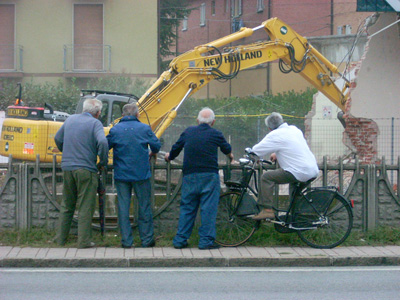
Umarell /uma'r l/ (oo-mah-rell), n; pl. Umarells. People in a community who offer all sorts of comments to those who are trying to get some work done, but who are not doing any work themselves.
Etymology and further details Umarell is a word that entered Italian slang in Bologna and is spreading to nearby towns, occasionally even across Italy. It comes from the Bolognese for "cute/odd little man". "Umarells" are those people, usually retired men, who spend time watching construction works, often holding their hands behind their back, occasionally commenting on what is going on, sometimes trying to tell the workers what to do. It's easy to find examples on the internet; the word was popularised by a blog collecting photos, which has even been published into a book. With some Italian Debian friends, we realised that umarell is the perfect word to describe those people in a community, who offer all sorts of comments to those who are trying to get some work done, but who are not doing any work themselves. I think that it is a word that fits perfectly, and since I'm likely going to use it blissfully anywhere, here is a page that temporarily explains what it means until the Oxford English Dictionary picks it up.

17 September 2013

Vincent Sanders: Ever tried. Ever failed. No matter. Try Again. Fail again. Fail better.


I seem to be adhering to Beckett's approach recently but for some reason, after my previous stool attempts, despite having a functioning design I felt I had to do just one more iteration.
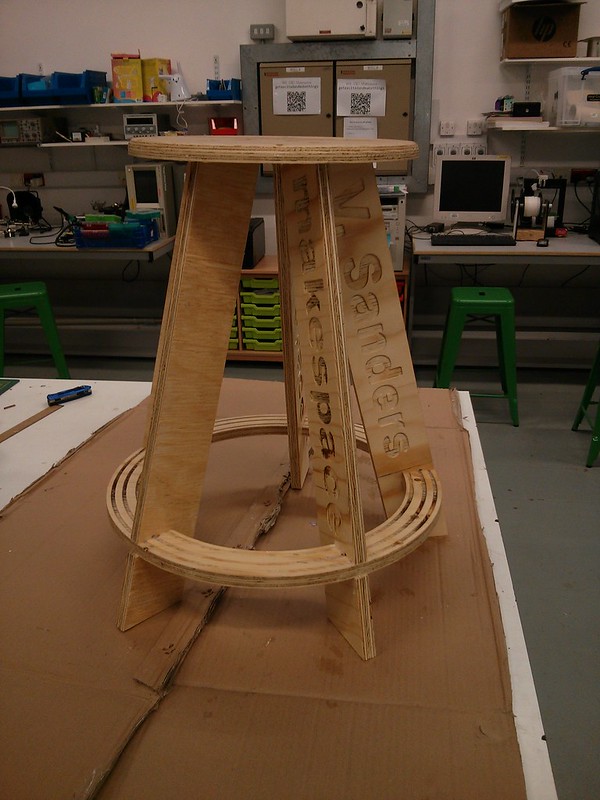
Five legged stoolGoing back to a previous concept of having five legs instead of three while this did not improve the rotational problems with the 12mm thick material, it did make the design more stable overall and less prone to tipping.

The five legged solution realised in 18mm plywood resulted in my final design for this concept. As my friend Stephen demonstrates the design is pretty solid even for those of us with a more ample frame. There are now a couple of them in use at the space alongside the three legged earlier versions.

I was finally satisfied with the result and thought I was done with furniture making for a while. My adorable wife then came up with a challenge, she wanted a practical foldable chair her requirements were:
A frame folding chair, image from wikimedia
Things for individual humans to sit on raised off the floor, or chairs as we call them, have been around for a long time. My previous research for the stool indicated that chairs have a long history with examples still surviving from the ancient egyptians. From this I assumed there would be nothing novel in this project and to quote the song it's all been done before
Foldingchairs
Given this perspective my research started with an image search for "folding chair". The results immediately showed there were two common shapes. Either the chair base was formed with a pair of linked X shapes with the seat across the top, or an A frame style where the seat is across the centre.

My initial thoughts were to replicate the IKEA style A frame design until I noticed that some designs were made from a single sheet of timber with a small number of profile cuts. I searched for pre-existing design files but found none, perhaps I had found something novel to do after all.

A frame chair  1 - Front  2 - Rear  3- seat
Some quick measurements of chairs in shops (and more weird looks, mainly from my family) suggested 900mm is generally the highest a chair ought to stand. I selected a popliteal height of 420mm as a general use compromise which is a bit less than the 430mm of most mass produced chairs. I also decided there should be a front to rear drop across the seat which ought to improve comfort a little.

Material selection was based upon what I had to hand which consisted of a couple of sheets of structural plywood (1220x606x18mm temperate softwood - probably spruce although not specified) which had not become stools yet. Allowing for edge wastage and tool width this gave me a working area from a sheet of 1196x582mm.

I sketched the side view of the chair numbering the three parts. I decided part 1 would be 1000mm total height with top and bottom cross braces 80mm high, assuming the 900mm tall target, the A frame apex would be at 820mm height.

If we assert that the apex is immediately below the top cross brace on part 1 this gives 920mm at which point we have two sides of a right angled triangle (820 and 920) from which we can calculate the top angle is 26 . This also means part 2 will be 840mm long with the same 820 height this gives an angle of 10 .

I did the maths for the seat triangle using the 36 angle and 420mm popliteal height. Having experienced how flexible 18mm plywood was in the face dimension I decided to make the frame sides 50mm wide leaving, after 6mm tool path widths, enough space for a 358mm wide seat .

Once the dimensions were decided the design went pretty quickly producing something that looked similar to the designs I had seen earlier.

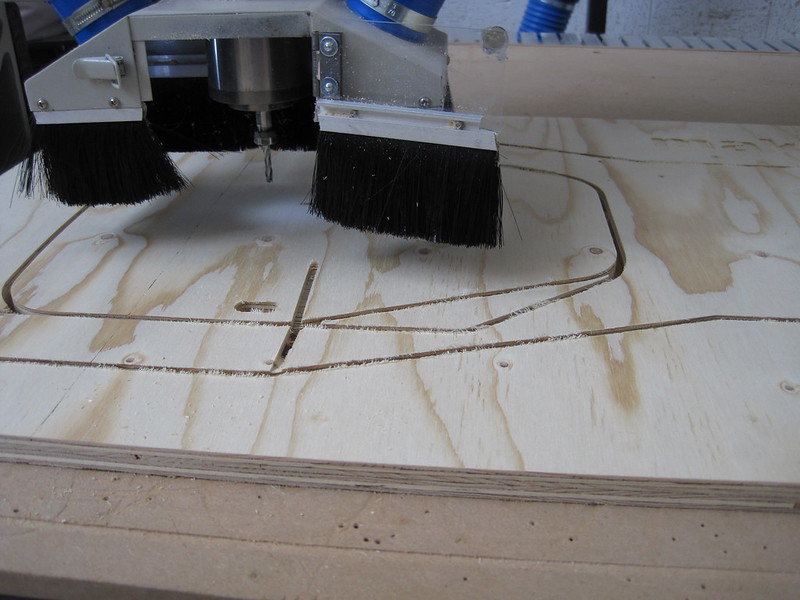
CNC routers can go wrong, spot the fail
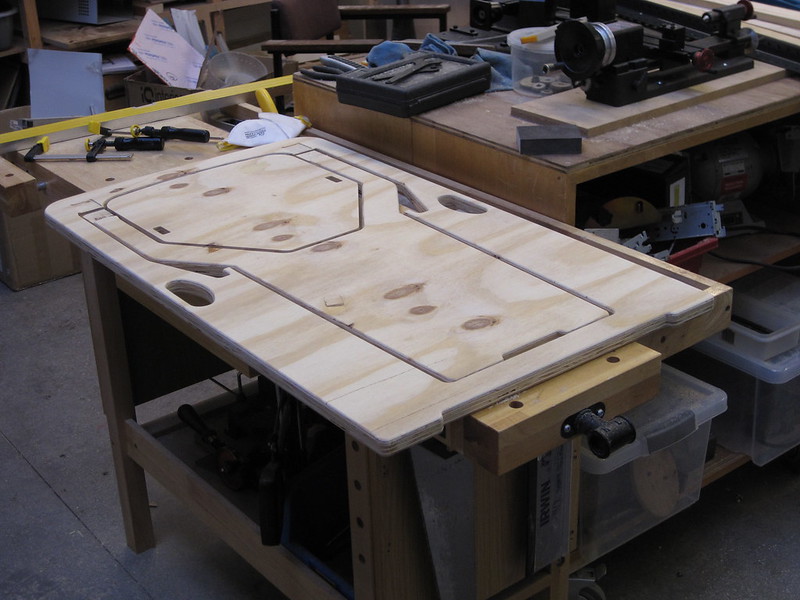
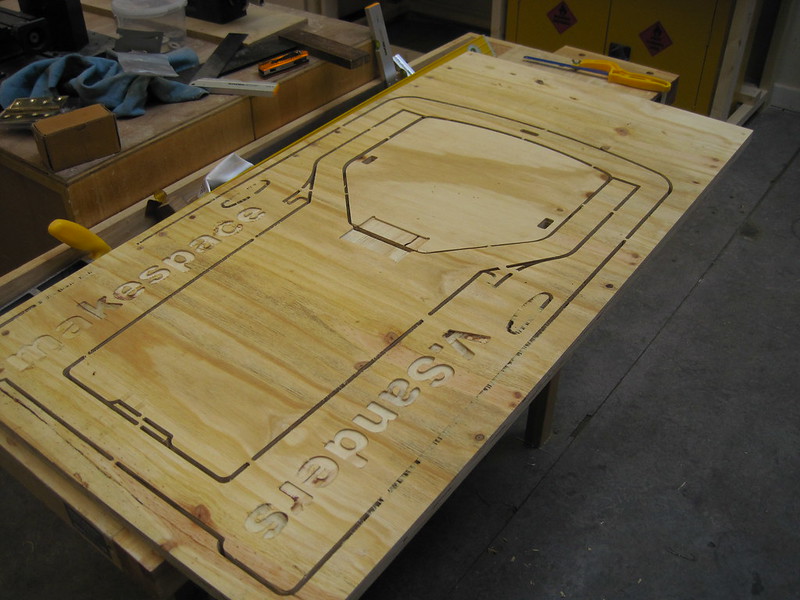
Generating toolpaths for this design proved challenging with the CAM software we had available, mainly because arranging multiple "inner" and "outer" cuts along the same path and having the tabs line up was obviously not an anticipated feature.

Things had been going far too well for me and during the routing operation our machine decided to follow an uncommanded toolpath excursion mid job (it cut a dirty great hole through the middle of my workpiece where I did not want it) ruining the sheet of material.

Fortunately, once factory reset and reconfigured, the machine ran the job correctly the second time although we still do not know why it went wrong. The parts were cut free of their tabs and hinges fitted.

The resulting design worked with a couple of problems:
Folding chair in 24mm plywood with edges rounded off
So time for a second iteration, this time I selected a thicker plywood to reduce the bend under large loads (OK already, I mean me). After shopping around for several days I discovered that unlike 12mm and 18mm thick plywood 24mm thick is much harder to find at a sensible price especially if you want it cut into 1220x606 sheets from the full 1220x2440.

I eventually physically went to Ridgeons and looked at what they actually had in the warehouse and got a price on a sheet of brazilian elliotis pine structural plywood for 43.96 which they cut for me while I waited. Being physically present also gave me the opportunity to pick a "less bad" sheet from the stack much to the annoyance of the Ridgeons employee for not just taking the top one.

This time I reduced the apex height by 30mm, the length of part 1 by 80mm. I also reduced the frame width by 10mm relying on the increased thickness of the plywood to maintain the strength. In area terms it is actually an increase in material (50mm*17.7mm = 885 against 40mm*22.80 = 912). I also included rebates for the top hinges within the design allowing them to be mounted flush within the sheet width.

The new design was cut (without incident this time) and the edges rounded off. I also added some simple catches to keep the seat and back inline while being transported.

While this version worked I had made a couple of mistakes again. The first was simply a radius versus diameter error on the handles which meant too much material was removed from a high stress area causing increased bending.

Third version of folding chair ready for finishing
The second error was a stupid mistake that where I had worked the latch holes in the seat to the wrong side of my measure line meaning the apex angle was 35.5 not the expected 33.6 which meant the backrest felt "too far forward"

The third version rectified those two errors and improved the seat front curve a little to further reduce the unneeded material in the back rest.

The fabrication of this design was double sided allowing for the seat hinge to be fully rebated and become flush and also adding some text similar to the stools.

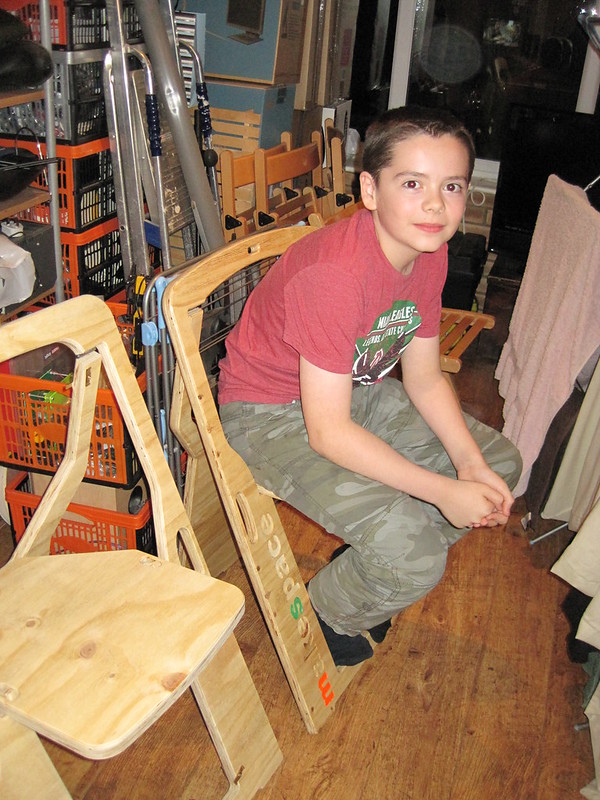
Alex sat on version 3 folding chair
This version still suffers from a backrest that is a bit too far forward and my sons complain it makes them sit up too straight. The problem is that the angle of the front face (23.6 ) means that to move the rest back 20mm means the piece needs to extend another 50mm beyond the frame apex which would probably make the chair feel tall again.

I guess this is a compromise that would take another iteration or two to solve, alas my wife has declared a moratorium on more chairs unless I find somewhere to put the failed prototypes other than her conservatory.

One other addition would be a better form of catch for transport. The ones in version 2 work but are ugly, magnets inset into the frame have been suggested but not actually implemented yet.

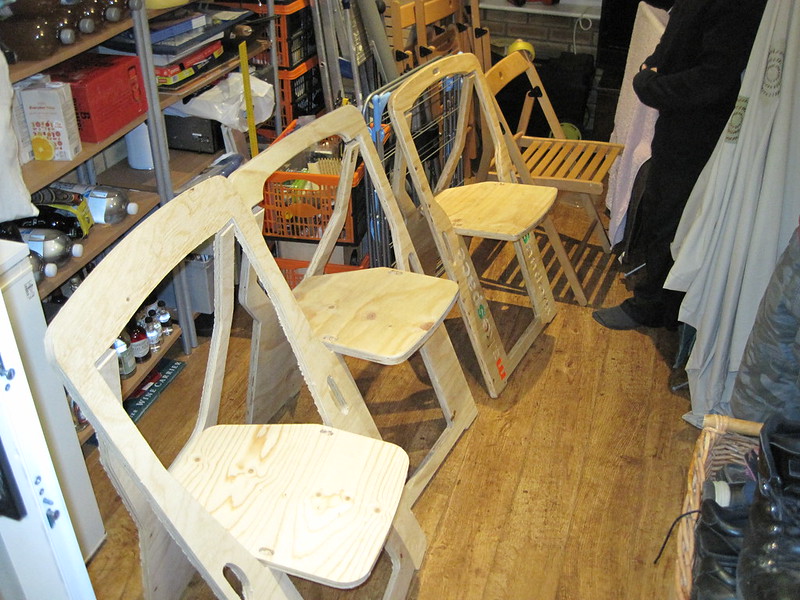
Folding chairs versions 1 to 3 and TERJE for comparison
In conclusion I think I succeeded with the original brief and am pretty pleased with the result. A neatly folding chair that can be stacked simply by having a pile of them and are easy to move and setup.

The price per chair is a little higher than I would like at 22 ( 11 for timber, 5 for hinges and screws , 5 for varnish and 1 for tool wear) plus about 2 hours labour (two sided routing plus roundover takes ages)

As previously the design files are available on github and there are plenty more images in the flikr set.

John Goerzen: Earthrise

Today I link you to a video narrated by the legendary Carl Sagan The Frontier is Everywhere. Partial quotes:
We were hunters and foragers. The frontier was everywhere. We were bounded only by the earth, and the ocean, and the sky. The open road still softly calls. Our little terraqueous globe as the madhouse of those hundred thousand millions of worlds. We, who cannot even put our own planetary home in order, riven with rivalries and hatreds; are we to venture out into space? By the time we are ready to settle even the nearest other planetary systems, we will have changed For all our failings, despite our limitations and fallibilities, we humans are capable of greatness How far will our nomadic species have wandered, by the end of the next century, and the next millennium? Our remote descendants, safely arrayed on many worlds through the solar system, and beyond, will be unified, by their common heritage, by their regard for their home planet, and by the knowledge that, whatever other life may be, the only humans in all the universe, come from Earth. They will gaze up and strain to find the blue dot in their skies. They will marvel at how vulnerable the repository of all our potential once was, how perilous our infancy, how humble our beginnings, how many rivers we had to cross, before we found our way.
Can you imagine seeing Earthrise? Earthrise, 1968 December 24 Incredible.

16 September 2013

Gunnar Wolf: My favorite (or rather, one among my favorite) non-original work Leo Masliah #encirc13

It seems I'm catching up with the pace of this course I'm following and that is compelling me to go back to posting on my blog, Arte y cultura en circulaci n: crear y compartir en tiempos digitales . This week's lesson is (again, in Spanish) Las fronteras del remix (the boundaries of remixes). An interesting text, open to everybody (regardless of whether you are signed up for the course or, I hope, whether time has passed since the course took place). And this week's homework is to find "our favorite" non-original work (I picked one among my favorite works And, yes, this is partly because I am part of the "club" of deniers of true originality: We cannot create anything without being part of a surrounding culture, without a common heritage and language with which we speak to our audience) and to find something about it, anything considered important or significative as to its antecedents. What do I like about this work, what grabs my attention. Do I consider it to be a true new creative work? Why? I am taking as an example Leo Masliah, an Uruguayan writer and musician (writer and interpreter). I have followed and enjoyed Masliah's work since 1996, and although by far I'm most familiar with his musical works, I have two books (a novel and a series of short stories). Among his facets, I most enjoy the acid, nihilistic/dadaistic streaks. I chose three of his songs to talk about I am linking to anonline resource where possible, but uploading the three songs to this blog to make his work better known, so that people understand what I talk about, and with my best intentions. Of course, if there is any request to remove the material, I will do it right away. I hope this can be seen as fair/academic use, although this blog is somewhat widely read.
La recuperaci n del unicornio
This song was in the first Masliah cassette I came across, Although musically it is an original work, the lyrics are a clear, almost line-by-line reply to the ever-repeated Unicornio song, by Silvio Rodr guez. This song (which I'm sure that every Spanish speaker reading this lines knows, like it or not It defines for me a good deal of Rodr guez hyper-sweetness and clicheness) has been analyzed over and over looking for a meaning. Silvio recorded this song in 1981, and by 1987 Masliah published this answer, mocking each of the lines.
So, this song can be seen as an original creation, as it contains no literal copy neither of the music nor of the lyrics of the original, but it cannot be understood without being familiar with Silvio's lost unicornio. It would just be an almost-dadaistic rant. But every person that has tasted Silvio Rodr guez cloying song will surely laugh with this one.
No necesitamos otro h roe Balderrama
I find this to be a very unique piece. It bonds together Argentinian folklore and USA pop.
Masliah sings the famous Argentinian song Zamba de Balderrama, (Castilla / Leguizam n), a song lamenting that the very popular bar and artist stage Balderrama, in Salta (North-Western corner of Argentina), seemed to be on the brink of closing. Of course, when Mart n, Constanza, Regina and me went to Balderrama in July 2010, the danger of closing this place had long been averted. And basically every Argentinian knows this song by heart.
The interesting part is that Masliah sings this song (as he presents it as the closing piece for one of his concerts) being short on time, and decides to present two acts together: Zamba de Balderrama and We don't need another hero, by Tina Turner, from the Mad Max soundtrack. So, of course, even if it's obvious that Masliah had to stretch bits to make them fit together, he achieved a very funny, interesting and unique blend of two completely unrelated works. He derives from one as well as from the other, but creates something unique and new.
Donna Lee
I was thinking what to write for this assignment , and had already chosen the two other songs. Yesterday, we were visiting our friends Octavio and Claudia, in Guanajuato, and I heard for the first time the original(?) version of Donna Lee, by Miles Davis (although often credited to Charlie Parker). That led me to remember Masliah's interpretation, in his Cl sicos album. This album is basically made up with similar excercises: Taking an instrumental piece, with Masliah singing over it. Some of the lyrics follow the story (i.e. the children stories), others just talk nonsense to illustrate a point (i.e. "La voz del medio", "the middle voice") follows the non-protagonist score trying not to grab much attention to the lyrics but to highlight the often ignored melody)... Donna Lee is just a fun excercise on following the melody asking what was in the head of the author that led him to invent such a strange, hard music.
Masliah is a great music performer, although often it seems he tries to hide it (i.e. by abusing the dissonances, ex-profeso singing off-key, etc), and a very funny and crazy author. Most of his works have a deep satirical tone, and it's common to find either simple winks or complete "borrowings" in a clear remix fashion, but nobody will doubt on the originality of his works.
AttachmentSize
07-Donna Lee.MP31.79 MB
16 No necesitamos otro h roe - Balderrama.mp33.49 MB
Leo Masl ah-La Recuperaci n Del Unicornio.mp31.87 MB

14 September 2013

Niels Thykier: autodie 2.21

A couple of days ago, the upstream maintainer of autodie, Paul Jamieson Fenwick (PJF), released autodie 2.21. It includes all of the performance improvements I had proposed in Optimizing autodie (plus a few extra ones authored after I wrote the post) and a small fix to one of the tests (due to changes in Carp). As mentioned in my earlier post, these improvements gives about a factor 4 load time improvement in most cases. For the sake of it, I have decided to use Lintian as an example of how good this improvement is. First off, Lintian loads uses autodie in about 75 unique files in the current git master branch.
$ grep -lr 'use autodie' lib/ checks/ collection/ frontend/lintian   wc -l
75
As a simple benchmark, lets consider the following Perl one-liner:
$ /usr/bin/time -f "%es %Us %Ss" perl -Mautodie \
  -e 'print $autodie::VERSION, " => ";' \
  -e 'eval join("\n", map  "package X$_; use autodie;"  (1..74));'
A quick-n-dirty comparison gives:
2.20 => 0.91s 0.90s 0.01s
2.21 => 0.15s 0.15s 0.00s
# NB: the times are "wall, user and sys" in that order, in case you
# are too lazy to read time(1).  :) 
So, 2.21 is now closer to a factor 6 rather than the original factor 4. I have to admit that the timings seem to be very machine dependent as my laptop shows a factor 7 improvement (from ~1.39 to ~0.22s). With at least 370 tests cases running in the Lintian testsuite, I can look forward to a reduction in user time on about 4 minutes.

11 September 2013

Brett Parker: Moving, Changing Jobs and the Bank Holiday Weekend...

So, in the last couple of weeks I've (mostly) moved out of Brighton, got a new job, and generally the world has gone crazy. The bank holiday weekend was spent at Debian UK BBQ, and was fantastic fun, including the reading corner on Sunday where we played through various arcs of To Be or Not To Be (small spoiler: PIRATES!). Since then I've been mostly back and forth from Brighton moving stuff, buying a car, and starting a new job... As mentioned in my new employers blog there was a small stumbling block with my new work laptop that stopped me from getting a sensible operating system on it from the get-go, but it's now running a shiny Debian Wheezy install and alllllllllll is well with the world... well, mostly. I have just removed gnome-keyring because I hate that I can't see a way of relocking it, or infact relocking any of the individual keys that it had. So, back to ssh-agent I went, and the world is good again. But that means that I haven't got a gpg agent running at the moment, though, unless I'm missing something, I can't see a way of forcing gpg-agent to forget a passphrase either (ARGH, why on earth wouldn't you have an option for that?!).

Bastian Venthur: What are the most popular .vimrc options?

Hi always wondered what the most popular options are, you usually find in .vimrc files. So I downloaded 155 .vimrc files from the net (mostly from dotfiles.org and github.com), and wrote a little script which counts the number of times an option has been set. Since most options come in normal- and shortcut form, I mapped the shortcuts to the long version whenever I recognized them. So without further ado, here are the most popular .vimrc options (without values!). The number specifies the number of times this option has been set. The most popular option is on the bottom:
10 tselect
10 dictionary
10 runtimepath
11 mousehide
11 t_vb
11 foldlevel
11 foldopen
12 suffixes
12 matchtime
12 fileencoding
13 modelines
13 wrap
14 sidescrolloff
14 clipboard
14 lines
14 novisualbell
15 linebreak
15 cursorline
15 fileformats
15 columns
15 cindent
16 undolevels
16 shiftround
16 lazyredraw
16 completeopt
18 modeline
18 whichwrap
18 comments
18 wildignore
19 list
19 autowrite
19 foldcolumn
19 grepprg
19 titlestring
20 autoread
20 title
21 foldenable
21 cmdheight
22 pastetoggle
23 formatoptions
23 fileencodings
24 tags
24 directory
25 ttyfast
26 termencoding
26 complete
27 nohlsearch
27 noerrorbells
27 visualbell
28 shortmess
30 showmode
31 wildmode
32 t_Co
32 listchars
32 backupdir
34 hidden
34 backup
35 smarttab
35 foldmethod
36 viminfo
36 textwidth
37 scrolloff
37 nobackup
41 nowrap
44 encoding
47 guifont
51 guioptions
53 smartcase
54 wildmenu
57 smartindent
60 mouse
63 background
64 softtabstop
66 history
70 showmatch
72 ignorecase
74 showcmd
74 laststatus
79 number
82 hlsearch
91 statusline
94 expandtab
94 ruler
96 autoindent
96 backspace
99 tabstop
109 incsearch
114 shiftwidth
124 nocompatible Out of 155 .vimrcs
Fun fact: nocompatible is the most popular, but also most useless one. The fact that you have an .vimrc automatically implies the nocompatible mode in vim.

10 September 2013

Daniel Kahn Gillmor: Support privacy-respecting network services!

Support privacy-respecting network services! Donate to Riseup.net! There's a lot of news recently about some downright orwellian surveillance executed across the globe by my own government with the assistance of major American corporations. The scope is huge, and the implications are depressing. It's scary and frustrating for anyone who cares about civil society, freedom of speech, cultural autonomy, or data sovereignty. As bad as the situation is, though, there are groups like Riseup and May First/People Link who actively resist the data dragnet. The good birds at Riseup have been tireless advocates for information autonomy for people and groups working for liberatory social change for years. They have provided (and continue to provide) impressive, well-administered infrastructure using free software to help further these goals, and they have a strong political committment to making a better world for all of us and to resisting strongarm attempts to turn over sensitive data. And they provide all this expertise and infrastructure and support on a crazy shoestring of a budget. So if the news has got you down, or frustrated, or upset, and you want to do something to help improve the situation, you could do a lot worse than sending some much-needed funds to help Riseup maintain an expanding infrastructure. This fundraising campaign will only last a few more days, so give now if you can! (note: i have worked with some of the riseup birds in the past, and hope to continue to do so in the future. I consider it critically important to have them as active allies in our collective work toward a better world, which is why i'm doing the unusual thing of asking for donations for them on my blog.)

7 September 2013

Daniel Pocock: Evacuating Australia

With the news that Australia's 100mbit (and potentially gigabit) fibre to the home is to be abolished and replaced with a cheap 25mbps service using Europe's ADSL hand-me-downs (which will be obsolete in 5 years when the deployment is finished), I've had quite a few emails from people asking just how easy it is to move abroad.
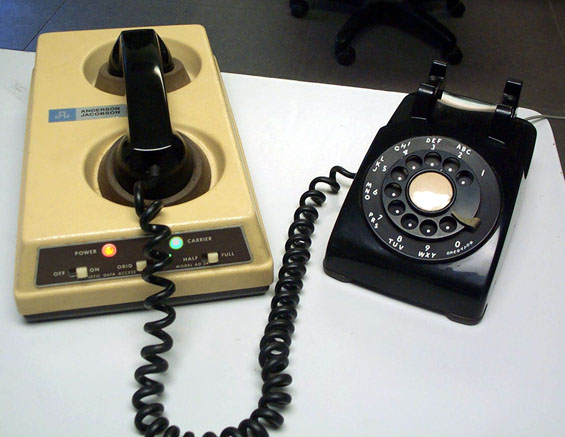
The acoustic modem has a nice retro look Word has got out that I've been spending some time in Switzerland enjoying the world-beating rate of IPv6 deployment. That is not the only reason to leave Australia of course, nor is it the only criteria for people choosing which country will give them a better deal than either of the two non-choices we had in Australia's elections. A free $20,000 for leaving Australia The first good news is that any recent graduate with a big bad ugly HECS bill is only obliged to pay this extra tax when they earn a salary from an Australian employer and file an Australian tax return. Australians who live abroad are not automatically obliged to file tax returns and are not slogged with this extra tax for having attended university. If somebody just graduated and has this hanging over their head, or if they've just started working and seen how much is being deducted on the payslip, moving abroad could make a lot of sense financially. If you have any moral qualms about this, just reflect on the fact that while the Government intimidates students with the feeling that they have to "pay" for fulfilling an education that makes them into a productive member of society, thousands of would-be athletes are given money with no obligation to repay it. The easiest route: a second passport One in four Australians has a parent born abroad. Most of those people qualify for a passport from their parent's country of birth. In some cases this also applies to people with grandparents born abroad. With the European Union now spanning 28 countries and guaranteeing the rights of any citizen from any country to live, work and study in any of the other 27 countries, a passport from any of the EU countries gives a lot of choices, including places where I have lived myself such as the UK, Ireland, France and Switzerland. Europe's citizen-friendly immigration In other words, an Australian with an Italian parent can go up to the Italian embassy in Canberra, collect an Italian passport and immediately fly into London and start working there with no bureaucratic delays, invasive and degrading medical checks or other Government interference in their life.
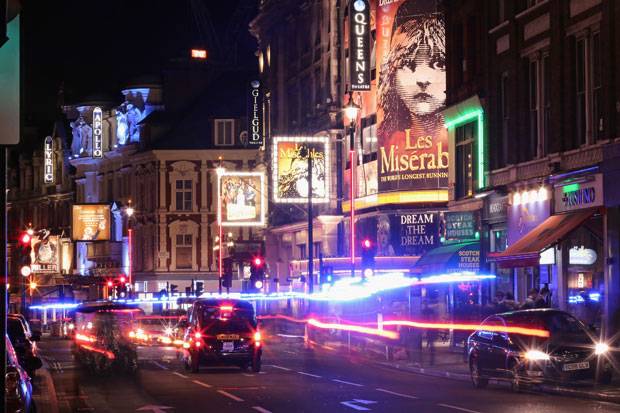
London's nightlife is popular for Australians. The UK started rolling out their high speed 21CN many years before Australia started the NBN. The rights also transfer automatically to all family members (spouse and children) - an Australian with a second passport is not restricted to living in Australia simply because they are married to somebody who does not have a second passport. As long as they arrive together at a European airport, they can simply show a marriage/birth certificate (in any language) and cross the border immediately, enjoy the same rights as a citizen, including work, study, healthcare and better broadband. No paperwork is necessary, no cottage industry for otherwise unemployable immigration agents, these are basic human rights for those living in Europe.
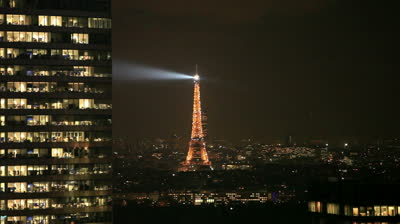
Eiffel tower: potentially part of the wireless network for France's new 4G internet, potentially two to four times the fixed-line speed planned for Australia's crippled broadband Uncle Sam wants more Australians Although it is not widely known, the US has a fast lane for immigration from Australia. The regular programs for skilled visas in the US are usually exhausted every year, whereas 10,000 "E3" class visas for Australians are never fully taken in any year. Surely it's not that easy to go to the US? It is. To qualify, an Australian only needs a university degree and a suitable job offer. Although the visa is for 2 years, it can be renewed and Australians who meet and marry an American have in various cases have gained full residence or citizenship. Anything is possible, you could even end up becoming a NASA Astronaut.

San Francisco, home to leading technology professionals and innovators from many countries. Some US cities such as Austin and Kansas City have let Google install fibre to the home, San Francisco could follow Working holiday schemes are not just for Britain Most Australians know somebody who went to London on a "working holiday" visa. These visas are not just for the UK and Australia has similar reciprocal programs with many other countries too. These rules for these schemes are rooted in the industrial age concept of workers with punch cards. Participants are typically limited to work 20 hours per week. Of particular interest for those in IT, such rules are hard to quantify for freelancers, web designers or creative people who earn their living charging fees per-project or undertaking management work without specified working hours. Although the visas are limited to 4 years, I've heard of Australians benefiting from the open borders of mainland Europe, spending 4 years in one country and then obtaining another 4 year visa for an adjacent country and travelling freely back and forth, building up a business and lifestyle of their own design. Singapore and Hong Kong Singapore and Hong Kong have become enormously popular destinations for Australians, particularly those with special skills in IT, finance, engineering and international business.
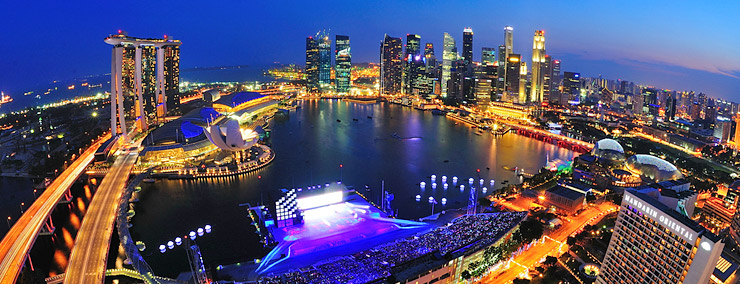
Singapore is respected as one of the cleanest and most orderly cities in Asia while embracing significant diversity in dining, shopping, leisure and lifestyle possibilities. They have recently boosted speeds to help people get a full 100MBit over fibre. A SIM card with high speed broadband charges SGD 7 (about $5) for 1 Gigabyte. These are not necessarily destinations that a graduate can easily move to. People are measured by their salary and the Government simply assumes that anybody earning a high salary is going to make a valuable contribution to society and they are given a visa in 1 or 2 weeks. Usually 3-5 years employment experience is required before making a move to one of these countries. The Not Ordinarily Resident (NOR) scheme gives some hints about the minimum salary level that ex-pats aim for, many earn significantly more with bonuses, stock programs and properly engineered tax-free offshore pension arrangements. These countries offer particularly low taxes (around 10%) and great technology. They have some rough edges too: like Europe, spouses are automatically given a visa too, but in contrast, their visa does not permit them to work unless they also work in a profession that is highly paid. Visas are issued quickly but they are also canceled very quickly if the job is terminated or the company goes bust. There have been various stories of people paying the typical 2-month deposit on an appartment in Singapore and then finding that it is forfeited when their job and visa are canceled and they have 4 weeks to leave. The bottom line is that people moving to these locations usually have a wide professional network and confidence to change their job quickly if necessary. Freestyle immigration and the visa run Not too long ago I was at a house party in Prague, Czech Republic, which is like a Paris of eastern Europe. Somebody introduced me to some Americans who I was told had similar interests in technology. They were operating an offshore web site and living very well. They had spent 10 years in Prague living on tourist visas. Authorities seemed quite happy for them to remain as long as they left every 3 months and spent 1 night abroad, a typical visa run. That could be as simple as a train journey to Vienna, Austria and an overnight stay.
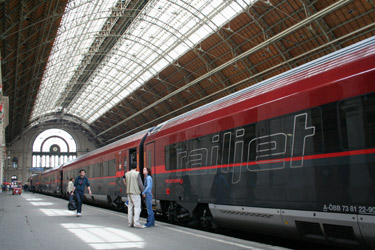
Making a visa run in comfort and style with European railways. The Railjet train pictured includes free wifi, a lot cheaper than the $20 billion Tony Abbott plans to spend rolling out yesterday's technology in Australia When European countries abolished border controls, this system became much more convoluted for those who depend on the visa run. However, it remains common in many Asian and Latin American countries and many ex-pats live this way. Officials in many of these medium sized economies recognise the value of people bringing in money from offshore business (such as web sites) and using it to pay rent, food and local services. To make this effective, the ex-pats typically need to have an international private health insurance policy (high quality offshore policies can be found quickly with a search engine) and not aspire to work in a normal 9-5 job. Conclusion Young Australians might not want to just consider travel, it may even become unavoidable. The reality is, by 2020, one in three Australians will be a retired baby boomer and one way or another, whichever Government is in office will be unable to avoid taxing those of working age to pay for the health care and pension promises made to older generations. Serious expenditure on public infrastructure such as broadband or high speed rail appears to remain a pipe dream. Moving abroad, however, is just so much fun. Look at the way multinational companies make countries compete to attract their new factories and other projects: why should any individual citizen be any less demanding in choosing where they work, play and get the best value for whatever taxes they have to pay? Some people raise questions of patriotism or responsibility to the nation. Think again. The 200,000 Australians who live abroad or travel extensively make a significant contribution to Australia's international profile, engage in new trade initiatives, bring skills back to Australia and generally represent what our country is really about much better than some of those who are paid to do so.

6 September 2013

Daniel Pocock: Latest NSA revelations no surprise, but...

The latest NSA revelations confirm the systematic manner in which the NSA exploits known and potentially unknown backdoors to work around cryptography. This is not surprising, I speculated briefly about the OpenBSD and Windows NSA key incidents when Snowden originally came into view. Even two days ago, a detailed piece in Wired Magazine predicted many of the things that are in today's headlines., although Schneier indicates in The Guardian he had seen some of the material before publication. What we really need to know If the NSA and CIA have had these capabilities, just how much did they really know before and during the financial crisis that kicked off in 2007? Could the crisis have been averted? It was already known that the Greek parliament was wired, was the NSA involved in similar shenanigans? This could well be part of the Snowden revelations that we are yet to see. In fact, it is this last issue that could be the most damaging for "US interests". If countries (or their citizens) receive such undeniable evidence of a CIA conspiracy exposed by Snowden in broad daylight and they refuse to pay debts then it could lead to major re-alignment of international politics, alliances and treaties. Syria would be just the tip of the iceberg.

Next.

Previous.