Search Results: "ag"

24 March 2010

Theppitak Karoonboonyanan: The Mini-DebCamp in Khon Kaen

So, Thailand Mini-DebCamp 2010 in Khon Kaen has already ended. It's another memorable event I've joined, and especially for this one, been in the organizing team. We owed many people for its success. I'd like to thank our guest DDs for their talks, many of which are improvised. Special thanks to Paul Wise and Yakiharu Yabuki for preparing the talks on Debian Social Contract and Debian packaging in one night, so our audiences can prepare themselves for the Bug Squashing Party in the next 3 consecutive days. Thanks Paul Wise, Andrew Lee, Yakiharu Yabuki, Daiki Ueno, Christian Perrier and our local participants for their efforts in tackling more than 50 bugs during the BSP, 30 of which have been closed and 14 with proposed patches. Thanks Christian Perrier for several talks in the last two days. We also had Andrew Lee's talk on Debian EzGo project, along with talks from our local distro developers (Linux SIS, Linux TLE) on what are being worked on and what can be pushed into Debian. And Neutron Soutmun had presented some future plan on the RahuNAS, a captive portal software based on Debian. A special agenda had been arranged to improve Debian mirroring in Thailand. Chatchai Jantaraprim, the ftp.th.debian.org maintainer, had shared us the backgrounds and motivations behind the official mirror setup for Thailand. Andrew Lee, the ftp.tw.debian.org maintainer, had introduced us to the Debian mirroring infrastructure, and encouraged the local mirror Debian mirror maintainers to do it Debian way. We had exchanged experiences and problems found among the current mirror sites, which can be much useful for their improvements, as well as cooperation in the future. Christian Perrier had also introduced us to the Debian translation workflow and how to coordinate translation via mailing list. This can be useful in the future for Thai if we can form a team, rather than a single-handed translation as present. Christian's talk on Debian contribution paths, along with their fresh hands-on experience in the BSP, had indeed motivated many local people to join Debian. I've been told by some people that they wanted to actually join Debian after this event, after just having a wish to do so for a long time. And Christian's yet another talk on key signing, with live demonstration, was really helpful for Thai audiences, as few of us were familiar with the concept and practice. Yes, taking care of PGP key does require special cares! Night chats and parties were also cool. We enjoyed the drinks (especially, Debian wine!), snacks, and chats together, and exchanged many stories. For me personally, it made me feel Debian as a live community, with people living in it. For the record, we even had a real bug squashing party, as fried bugs are among well-known Esaan dishes. And we had immediately got new voluntary vegetarians because of it! Hee hee.. Hello Christian, I witnessed it. ;-) And thumbs up to Yabuki for his bravery! Yes, it's a wonderful event for me indeed. Thanks Khon Kaen University (Kitt Tientanopajai et. al.) for hosting it. Thanks NECTEC Information and Mobile Applications Program and Science Park KKU for the financial support. Thanks NECTEC people for taking care of foreign participants in traveling between Bangkok and Khon Kaen. And thanks all participants for their contributions to make this event a great one! Picture credits: Supphachoke Suntiwichaya, DebConf Gallery

John Goerzen: Trip part 1: Kansas to Indiana

Note: This post was written March 12, and posting was delayed until our return home. This is the first part of our trip: driving from Kansas to Indiana with Jacob and Oliver. From Indiana, we ll be flying to Germany while the boys stay with their grandparents. We normally don t like long road trips. Our preferred way to travel is by train. By air is second, and car is last. But this time, driving was all that made sense. We planned to make the 11-hour drive in two days to give the boys more of a chance to get out of the car and run around. It s always a bit demoralizing heading east from our place. You drive at highway speeds for an hour and are barely one county over. We left at about noon and made it as far as Kansas City before our first stop much to our surprise. We ate at a Cracker Barrel there. Afterwords, Jacob loved running in front of the restaurant. IMG_2507 Meanwhile, Oliver chilled on a wooden bench. IMG_2494 Jacob was excited to find this chair. He said Here is a chair just the size of me! IMG_2489 We spent the night in a hotel on the eastern edge of the metro area. Then Thursday hit the road again. We stopped for a mid-morning snack, then ate lunch at Pizza Hut. Jacob ran around in the grass outside again. Jacob invented a new game with me. He d ask, How will we get there? I was supposed to guess. With a pickup? No With a boat? No Eventually he d come up with a silly answer: We ll ride a pile of bricks there! or We ll ride on top of a stop sign! Then he d sit there laughing for a little bit. Pretty soon: Hey dad. How will we get there? We had a few toy-throwing episodes, but overall Jacob did very well. Oliver did even better. He slept a good part of the way, and happily watched Jacob for most of the rest. The car trip went well. This morning, it s time to get ready to head to the airport, and to break the news to Jacob that we ll be gone for a few days. We ve learned that he worries a lot about change if he knows about it too much in advance, finding it hard to process and understand, so we ll tell him after he wakes up this morning. Then off to the airport for our flight to Newark. Then we get to sit around in New Jersey for a few hours before our 7.5-hour flight to Hamburg.

Jon Dowland: pilgrimage

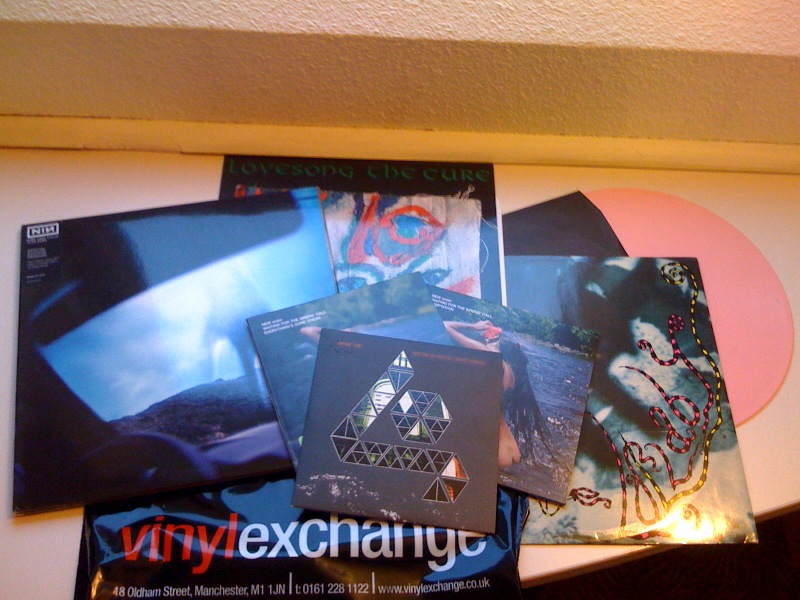
a pile of records
I'm in Manchester so I have made my requisite pilgrimage to Vinyl Exchange and paid my dues.

Adnan Hodzic: Need help setting up my Linux development platform

Maintaining stable life with unstable distro? This post may sound ludicrous to some of you but please hear me out. I ve been on Debian unstable/Sid for awhile now and it was all cool until yesterday. Besides my work on Debian DebConf/some devel, I m university student, also I do web devel which is my primary source of income, besides all those I try to go out on weekends and have some kind of social life. Somehow I manage to do all these things and I d say I manage them pretty successfully too. Now I m hardcore to the bone, but this is just too much, last week started working on immense web devel project didn t sleep more then 2hrs/day whole week; I also didn t shut down my notebook and just kept it on suspend as I usually do. Either way I was about to print/scan something and I connect my printer and what happens? My whole system freezes, now I ll let you figure out the result of doing hard reset and having a lot of gedit docs open at that time. And yes, I did had that bug reported awhile ago, can t find it now, but it was fixed, seems like it s back again. In the end I m left with weekend completing the lost work + late school work + eclipse 3.5.2-2 ought to be uploaded. I do almost all the work (didn t upload eclipse) and literally pass out on Sunday. Wake up sometime on Monday, wasn t able to get up from bed. Plan: Change my base distro, keep Sid as dualboot or virtual machine
Now, for my time of being Sid user this isn t the first time something like this happened, and by this I mean unexpected/unprovoked bugs. I might not be as hardcore as I used to be, or it s just that I don t have time anymore. So my plan is to get Stable or even Ubuntu for my work/study platform, while I d have dual boot or virtual machine of Debian Unstable/Sid. I m sure I can t be the only one who s doing this, so please give me your advice on this one.
1. Main question is dualboot or virtual machine? Reason I d like it to be a virtual machine instead of dual boot is that my notebook HDD is 64GB SSD (Lenovo X300). By todays standards 64GB is quite small, while the price of SSD is quite opposite of small. So I d like to use this only for my main/base OS, nothing else. Since I use external HDD s having it virtual it s more convenient for me to carry around my image/s. Other day I ordered 4GB of RAM so I shouldn t have problems with performance of this virtual machine. Or even with that much RAM, devel on virtual machine is just not possible? 2. In case I go for Ubuntu, and decide to start packaging for Ubuntu as well, what s the best way to have my work/packages synced within both Debian and Ubuntu (sshfs?). 3. How do I take my PGP keys with me? If I just copy .gnupg and .ssh will that be enough? 4. Can I have same keys both on my host machine and virtual machine at the same time? 5. Some other idea of sticking with Sid?
Input to any of these questions/other suggestions would be greatly appreciated.

23 March 2010

Miriam Ruiz: Ada Lovelace Day 2010

Today is March 24th, that means Ada Lovelace Day, and it is being pushed as an international day of blogging to celebrate the achievements of women in technology and science. The aim of Ada Lovelace Day is to focus on building female role models not just for girls and young women but also for those of us in tech who would like to feel that we are not alone in our endeavours. There are some very good examples of women that have been important in the development of science and technology, starting with Ada Lovelace herself (the first developer of an algorithm intended to be processed by a machine), Rear Admiral Grace Murray Hopper (developer of the first compiler for a computer programming language), Adele Goldstine (who wrote the complete technical description for the first digital computer, ENIAC), as well as the six women who did most of the programming of if (Kay McNulty, Betty Jennings, Betty Snyder, Marlyn Wescoff, Fran Bilas and Ruth Lichterman), or women scientists, or women inventors, etc. Well, I m not going to write about any of those, even when any of them would surely deserve that and more for sure. I m going to write about a woman who has definitely been very inspiring and supportive for me when I was starting to get in touch with Free Software and Debian, and who is probably the most important single reason I decided to go for it. It is definitely hard to write about someone you admire when she happens to be one of your best friends, and in fact I m pretty sure that most of the people reading this article already know her, so there s no great mistery. I m talking about Amaya Rodrigo, the first european female Debian Developer (AFAIK) and co-founder of the Debian Women project, and also member of Hispalinux Board in the golden days. The first time I met her she was giving a talk in Madrid about a project that was starting then, Debian Women, and it was very inspiring for me. Inspiring enough for me to join the project. Afterwards I ve learnt more about her, how she overcame many dificulties, like starting to work with computers quite late, among others. The real merit of a pioneer is not really to be the best techie out there, but to overcome the difficulties and doing it the best you can, when no one else has done it before. I m not going to write her biography here, it s not really the purpose of this blog entry, and you probably can ask herself directly. This blog entry is, as I said at the beginning, to highlight women in technology that I consider inspiring and relevant. You know, I admire you, Amaya :)

Gunnar Wolf: Plead for help: Transcriptors for videoconferences (Spanish)

Help! Help! Help wanted! Please help! Dear world, As many among you know, I have spent a good portion of the last year (together, of course, with a great and interesting group of people) working on Seminario de Construcci n Colaborativa del Conocimiento (Collaborative Construction of Knowledge Seminar, or SECO3), derived from the Encuentro en L nea de Educaci n y Software Libre (On-line Encounter of Education and Free Software, EDUSOL). We have been working on producing a book that illustrates several different aspects of knowledge-building communities Among them, of course, the Free Software movement. Now, we need some help: Although we do have the chapters from most of the authors, some did not manage to produce them. And we are very interested in having them as part of the book as well, even if only as an appendix (as, of course, the kind of work of a transcription is completely different than the ellaboration for a well-rounded and written chapter). As the little academic I am, I have to request for your help: I have no students assigned to me. But I would love to have interested people on board. We need to transcribe two of the videoconferences that were given as part of the seminar. Please, if you are interested, contact me so we can arrange (and have no work duplication!) Thanks a lot,

Mike Hommey: Security update for Iceweasel 3.6 preview

While the package is not ready yet for experimental, mostly because there are pending changes in the 3.5 branch, Mozilla released a security update today. So, here are the packages you need to be safe security-wise with Iceweasel 3.6. Please note only xulrunner packages have been updated, as the security fix lies in the xulrunner code. A known regression of this version is that the icons in the search box on the top right don t show up.
Update: This regression actually doesn t exist.

Debian News: Brief updates: release team, eclipse and Debian related events

Benjamin Mako Hill: Antifeatures Talk

The recordings for Linux Conf Australia 2010, held this year in Wellington, are finally online. The recordings include a video of my keynote on Antifeatures. I was deeply honored to be invited to give a keynote at LCA and, as a result, felt more pressure than usual to put together something that was novel, relevant and entertaining and that spoke to core issues and problems facing free software. Although it's always hard for me to watch myself speaking, I've made it through the video and am reasonably happy with the result. Although perhaps it's a minor distinction, I think this lecture is probably the best talk I've given given to date! I hope to give the talk again so, as always, I welcome comments and feedback. If you'd like to watch it, the talk is available in a number of free and non-free formats:

Joerg Jaspert: GSoC

Googles Summer of Code has Debian participating again. And this year I wrote a proposal on my own, to try and see if there is a student out there interested in taking it on. It is easy described, writing a SmartUploadServer and should also fit into the timeline of a GSoC project, at least the server itself. Adapting the upload tools in Debian should also be easy, depending on various decisions taken for the SUS (oh hey, who thought of Windows now?). Especially if one manages to have existing protocols for the transfer and not invent an own one. There are more things available to code all around the archive. Most of them are hard to put into a GSoC project, for example a dak code cleanup doesn t sound all that good. And actually requires more insight, the above Upload Server is a nice self-contained project. It should and has to use parts of dak code and be integrated, but all in all you do not need much prior knowledge there. One other GSoC proposal I like and would want to participate (in the mentors view) is the one from Marc about DeveloperPackageRepositories. His current proposal is limited on the buildd site, I am interested in the archive side of it. Much of what is required for this is actually already there in the code, at least functionality to support it, it just requires glue around it to make it work. And I think such kinds of repositories would be a nice thing to have. This whole thing, as nice as it sounds, has one drawback: I had to create a google account. Evil thing, evil bad data miners over there. I m pretty unhappy with that fact, as I have survived without one for a nice long time. But given my position in this part of Debian (there are only 2 people who currently can change the code that actually runs the archive, for example) I think letting this opportunity pass by would have been the wrong decision. Now it only needs a student to take it! :)

Brett Parker: So... shortened urls then...

Turns out that I do get shortened urls in twirssi if I manage to install libwww-shorten-perl, so having now installed that it appears that I've got a fairly much fully working twirssi, which is rather nice.

Russ Allbery: Lintian 2.3.4

It's been nearly two months since the previous release, so lots had accumulated in the bug tracker. This release resolves a bunch of various false positives, fixes a few minor issues with the lintian.debian.org pages, and applies all the patches that were in the BTS that were ready to go in. It doesn't have any of the pending larger changes, since we wanted to get the smaller fixes out quickly. The current tentative plan is that the next release will be 2.4.0 and will include several large structural changes that various people have been working on, including the conversion of the manual to DocBook. All plans are, of course, pending finding enough time. It's amazing how effective Lintian can be given that it uses a bunch of guesswork and loose regexes to parse everything from init scripts to debian/rules files. We do have a bunch of accumulated wishlist bugs that aren't going to be fixed without writing better and more thorough parsing, particularly for shell scripts, but it boggles me just how far you can get with some dead-simple heuristics. Thanks very much to Adam D. Barratt and Raphael Geissert who have kept things going while I've been eaten by work, and particularly to Raphael for doing the last two releases and a ton of work with the security update.

Jaldhar Vyas: Let Me Eat Cake

Tiramisu Thanks to everyone who wished me a happy birthday. This is my present -- completely vegetarian tiramisu. (I'm getting a longer-lasting present too but it hasn't arrived yet.)

Daniel Kahn Gillmor: Avoiding erroneous OpenPGP certifications

i'm aware that people don't always take proper measures during mass OpenPGP keysignings. Apparently, some keys even get signed with no one at the keysigning present speaking for that key (for example, if the key was submitted to the keysigning via online mechanisms beforehand, but the keyholder failed to show up). Unverified certifications are potentially erroneous, and erroneous certifications are bad for the OpenPGP web of trust. Debian and other projects rely on the OpenPGP web of trust being reasonable and healthy. People should make a habit of doing proper verifications at keysignings. People who make unverified certifications should probably be made aware of better practices. So for future keysignings, i may introduce a key to the set under consideration and see what sort of OpenPGP certifications that key receives. I won't pretend to hold that key in person, won't speak for it, and it won't have my name attached to it. But it may be on the list. Depending on the certifications received on that key (and the feedback i get on this blog post), i'll either publish the list of wayward certifiers, or contact the certifiers privately. Wayward certifiers should review their keysigning practices and revoke any certifications they did not adequately verify. Remember, at a keysigning party, for each key: After the keysigning, when you go to actually make your OpenPGP certifications: Feedback welcome! Tags: keysigning, openpgp, tip

Dirk Eddelbuettel: RInside release 0.2.2

The shiny new 0.2.2 release of RInside has just been uploaded to CRAN; it should hit mirrors tommorow. Sources are also at my RInside page. RInside is a set of convenience classes to facilitate embedding of R inside of C++ applications. It works particularly well with Rcpp and now depends on it. This is the first release since version 0.2.1 in early January. Romain and I made numerous changes to Rcpp in the meantime. With this release, RInside is starting to catch up by taking advantage of many new automatic (templated) type converters. We have updated the existing examples, and added several new ones. These are all visibile directly via the Doxygen-generated documentation under the Files heading. Two examples are also shown directly on the RInside page. Also added are new examples showing how to use RInside to embed R inside C++ applications using MPI for parallel computing. This was contributed via two examples files by Jianping Hua, and we reworked the examples slightly (and added two variants that use MPI's C++ API). As it is so short, here is the basic 'Hello, World' example now showing the simpler Rcpp-based variable assignment:
// -*- mode: C++; c-indent-level: 4; c-basic-offset: 4;  tab-width: 8; -*-
//
// Simple example showing how to do the standard 'hello, world' using embedded R
//
// Copyright (C) 2009 Dirk Eddelbuettel
// Copyright (C) 2010 Dirk Eddelbuettel and Romain Francois
//
// GPL'ed
#include <RInside.h>                    // for the embedded R via RInside

int main(int argc, char *argv[])  
    RInside R(argc, argv);              // create an embedded R instance
    R["txt"] = "Hello, world!\n";	// assign a char* (string) to 'txt'
    R.parseEvalQ("cat(txt)");           // eval the init string, ignoring any returns
    exit(0);
 
One minor setback is that the examples currently segfault on Windows. That may be an issue with linking and class instantiation or something related. Romain and I focus much more on Linux and OS X, so this has not gotten a lot of attention. Debugging help would be appreciated.

22 March 2010

Russell Coker: Links March 2010

Blaise Aguera y Arcas gave an exciting demonstration of new augmented reality mapping software from Microsoft that combines video (including live video) with static mapping data and pictures [1]. This is a significant advance over current mapping systems such as Google Earth but it s not released yet either. It will be interesting to see whether Google or Microsoft gets this released first. The New York Review of Books has an insightful atricle by Garry Kasparov about human/computer chess [2]. It s surprising the degree to which a combination of human and computer chess playing can give a good result. Amateur human chess players plus regular PCs can beat grandmasters with computers or high-end computers with human help. It s apparently the quality of human-computer interaction that determines the quality of play. But the article contains a lot more, I recommend reading it. Daniel Kahneman gave an interesting TED talk about the difference between experiential and memory happyness [3]. As the concept of the moment is so short (about 3 seconds) apparently most people try to optimise their actions for the best memories of being happy. But to do so requires some different strategies. For example a two week vacation gives a memory that s not much different from a one week vacation. Therefore it seems that you would be better off staying in a five star hotel for a week than a four star hotel for two weeks, and eat dinner at a Michelin Star restaurant at least once per holiday even if it means eating at McDonalds on other occasions due to lack of funds. Temple Grandin gave an interesting TED talk The World Needs all Kinds of Minds [4] which mostly focussed on teaching children who are on the Autism spectrum. She is concerned that autistic children won t end up where they belong in Silicon Valley . Anupam Mishra gave an interesting TED talk about how the people of India s Golden desert built structures to harvest and store water [5]. Some of their ideas should be copied in Australia, due to mismanagement and stupidity Australians are failing to survive in much more hospitable places. Michael Tieman wrote an insightful and well researched article about the OSI s rejection of the IIPA s attacks on Open Source [6]. This is worth reading by anyone who wants to make a business or social case for free software. Mark Shuttleworth wrote an interesting post about the new visual style for Ubuntu and Canonical [7]. Apparently this includes the creation of a new font set which will be available for free use. Divorced Before Puberty an informative New York Times article by Nicholas Kristof about the links between treatment of women and terrorism [8]. The New York Times has an interesting article on Human Flesh Searches on the Internet in China [9]. It s basically crowds targetting people to find private information and harass them (similar to what some griefers are known for doing on the English-language part of the Internet). But they seem more interested in vigilante justice than lulz. The New York Times has an informative article about the Cult of Scientology (Co$) [10]. Among other interesting news it suggests that the number of cult victims in the US has dropped from 55,000 to 25,000 in the 2001-2008 time period. Senator Xenophon has called for an inquiry into the crimes committed by the cult and a review of it s tax-exempt status [11]. As always Xenu.net is the authoritative source for information on the Cult of Scientology AKA the Church of Scientology. The New York Times has an interesting article about formally studying the skills related to school teaching [12]. It largely focuses on Doug Lemov s Taxonomy of Effective Teaching describes 49 techniques that improve school results and some other related research. The article also mentions that increasing teacher salaries is not going to help much due to the large number of teachers, it s only professions that employ small numbers of people that can potentially have their overall skills improved by increasing salaries. Andy Wingo wrote an interesting article about Julius Caesar [13] based on the book The Assassination of Julius Caesar: A People s History of Ancient Rome by Michael Parenti. It seems that Caesar was more of a populist than a despot. Interesting article in The Register about the Large Hadron Collider (LHC) [14]. Apparently one 3.5TeV proton beam has as much energy as a British aircraft carrier running at 8 knots.

Christian Perrier: Amazing week in Khon Kaen for Thailand MiniDebconf

I'm now on my way back from The first miniDebCamp and miniDebconf that happened from March 13th to March 19th in Khon Kaen, Thailand. This even was organized locally by a team of very motivated Thai Debian enthusiasts and contributors, such as Theppitak Karoonboonyanan (*the* Thai DD), Neutron Soutmun, Kitt Tientanopajai, and all those whose name I'm not remembering as of now (I hope they won't mind). The even had kinda the structure of DebConfs, with a few days of "Debcamp" to begin. See the full schedule. We were hosted in Khon Kaen University (KKU), one one the most famous universities in Thailand, a small "town in town" in a city with a few hundred thousand inhabitants (dunno exactly). Lodging was done in a hotel located inside the university. Interestingly, the hotel was also hosting youg students participating to "Summer Camps" (apparently training systems to get good school results) gving to all this a very young atmosphere. The hacking lab and talks location was a 30-seat room in the university library, and meals were brought in there very efficiently, with the very specific way that Thai people have to transport each and every kind of meal (in small plastic bags closed by rubber). I arrived only in the 3rd day because I had commitments at home that made it impossible to me to come for the first day. During these days, people have been very busy hacking and participating to the Bug Squashing Party. During that BSP, about 50 bugs have been touched, without about 15 or so closed. Other non Thai attendees were Andrew Lee from TW, Paul Wise from AU, Daiki Ueno and Yukiharu Yabuki from JP. Organizers were expecting some attendees from neighbouring countries such as Laos, Vietnam or Cambodia. Unfortunately, none of them could come, including Anousak Soupavanh, leader of Lao free software localization efforts, who I was very impatient to meet. Transport difficulties, or visa problems, do not make things easy in that part of the world. On Wednesday we had a "DayTrip" as it is common for such event. We went abotu 50 km away from Khon Kaen, to visit a nice place, close to a dam lake, and climbed a hill surrounded by a big temple and a giant Buddha statue. Then we had a wonderful lunch in a fish restaurant in the very specific Thai way to share stuff: everything is on the table and you pick your food here and there, at you rconvenience. Of course, local advice before trying apparently innocent food is always worth it because the fire might be hidden anywhere (for instance in that soja plate which I tried and that set my mouth as a burning hell for 20 minutes). The journey ended by a visit of a great temple in Khon Kaen and, very noticeably by a dinner in a very popular barbecue restaurant in "all you can eat" style for...100Bath (so, about 2.5 euros). Maybe only vegetarian people had more trouble enjoying the meal as it was mostly made of various meat (and sea food). The talk days were very intense, at least in my opinion. Probably because I ended up giving four talks, some of them completely improvised (about IP-over-DNS, which I was using at the hotel and about which many wanted to learn a little bit more, and GPG keysigning processes). It turned out that the GPG talk was well received and, discussing with Paul later on, we agreed that such a talk, mostly meant to explain the DOs and DON'Ts For good GPG keys signing, could be a good idea even for Debconfs. There were also a few talks about local initiatives and efforts to develop (and not only promote) free software. We have no recordings of these talks as we were infortunately missing some video recording installation (maybe next time, Thep) just like the miniConf that was happening in Panama at about the same time was having. Due to local regulation on the university network, we had some limitations with Internet access (some firewalling that for instance was preventing SIP to work properly, which made a video-conference with a japanese user group fail, unfurtunately). The event ended in a round table discussion about ideas to organize something bigger in the future. The local community in Thailand has apparently the energy, maybe ressources and local support to be able to organize a slightly bigger event as first try (somethign like an Asian DebConf or something similar, targeting mostly Asian contributors and about 50-100 people. Thailand seems to be a good target to host such event, with many things being relatively inexpensive (and not only beer!). And they even think about possibly hosting a Debconf at some time in the future (actually, Martin Krafft should also be credited for bringing this idea). That isn't as crazy as it seems and, provided that potential organizers start involving themselves in the current Debconfs, everything seems to be possible. After all, if we look back to 2005, only one person (hello, Safir) was seriously thinking that Debconf could really happen in Bosnia and Herzegovina, right? After this week (followed by 2.5 days of sightseeing in Bangkok for me, plus a small meeting today with local Thai Linux corporate users and IT company owners), I feel like the mood in Asia about Debian development is high and full of potential. The miniconf last year in Taiwan was already a good success, by establishing a good connection between people.....we need to keep that alive and, hopefully, there will be other miniconfs in this part of the world. And, well, if I can be there, I'll be there.

Wouter Verhelst: N900 back!

So, a short while ago, the battery of my N900 had run flat. As in, completely, utterly flat. In itself, that's no big deal -- you connect it to a power outlet, wait until it's gone past the low-battery charging bits, then boot and use as usual. Except that it wouldn't. I'd recently installed a firmware update from Nokia (which contained some bug fix that I really was waiting for), and now the bloody thing wouldn't boot. Rather than do the low-battery charging dance, it thought the battery had enough power that it could just go ahead and boot. Of course it was wrong, so whenever I powered it on, it would sit there fore 30 seconds, try to boot, fail, power off for about a second, and start over. I left it like that for a night, but it didn't recharge. Needless to say, that was quite annoying. So I sent it in for repair, and today there was a package in the mail, containing my (repaired) N900. They'd reflashed it. A reasonable course of action, I guess, but of course that meant all data was gone. Good thing it has a backup application, and good thing I stored those backups on an external micro-SD card. Restoring those back-ups was a breeze; they'd also stored the contents of sources.list and have done something akin to "dpkg --get-selections", since now the application manager kindly asks me whether I wish to reinstall the applications that I had installed. Cute. At any rate, I'm very happy I finally got rid of this awful Samsung "cellphone". It's a SGH-C140 that I had as a replacement until my N900 got back, but there was something very very wrong with it; I don't know whether it's a design flaw or just a wear-and-tear issue (these replacement phones aren't usually handled in the best possible way), but it managed to lose connection to the network every once in a while. So people who would call me would immediately get my voicemail, and then they'd be angry with me later because I was unavailable. Well, duh. Anyway, that's over now. Whee.

Brice Goglin: Debian/X.org notes - Radeon KMS in unstable, enabled by default

Now that we have DRM from 2.6.33 in latest 2.6.32 kernel in unstable, I just uploaded Radeon KMS and DRI2 to unstable. xserver-xorg-video-radeon 1:6.12.192-2 even enables KMS by default. Please test it. In case of problems, you may for instance disable KMS by changing modeset to 0 in /etc/modprobe.d/radeon-kms.conf. You may also downgrade to testing where xserver-xorg-video-radeon 1:6.12.6-1 does not enable/support KMS. Make sure you run linux-image-2.6.32-4-$arch or later so that you actually have DRM from 2.6.33 and the radeon kernel module gets loaded early by udev. Otherwise, you may experience problems like this. You may need to add radeon to /etc/modules as a temporary fix.
(Permanent link)

Andrew McMillan: The cost of crap

For several years now we've been buying our groceries online. It's worked well, and for the last couple of christmases I remember Heather adding a six-pack into the pre-christmas order so she could pull it out and hand it off to the delivery guy. Fair enough too, because he was their front-line man. He was the guy who had to actually meet the customer, and even if only for two minutes face time, the impression he gave with his cheery "seeya mate" on the way out, and his always-happy smile, was that getting the groceries delivered was fun. Well that ongoing encouragement has gone now. His surly replacement who moans about having to carry the boxes up a flight of stairs does nothing to promote a repeat experience, and he brings into sharp focus the disadvantages of online grocery ordering: sometimes the wrong thing is substituted, or sent. Or the fruit doesn't travel quite so well as it does with the personal loving kindness we supply in our own padded wagon. Two visits from the new guy, and we're back to driving to the supermarket ourselves, patrolling the aisles once more in a cereal haze of consumer demand. Distress-purchasing done, and back to the car A.S.A.P. Carrying our own boxes up the stairs. I hate it, which is why I promoted the idea that we try this online grocery thing a few years ago, and it's worked just fine until this sullen bastard came along and destroyed the fun. I wonder how the company feels? Do they realise what this person is doing to their customers? Will they notice, and if they do, will they even be able to tell where the source of the problem is? In these days of increasing online experience, customer service is still important, if not more important than ever before.

Next.

Previous.