Search Results: "ag"

15 April 2010

Mike Hommey: Re: git reflex

Joey Hess writes about putting snapshot.debian.org into git, which is something I already mentioned on this blog. It turns out I used the snapshot.debian.org data a few months ago to try the idea again, and while I haven t done the math yet with the data I got in the end, the data during the experiment tells me we shouldn t expect much more than a 50% space reduction. There are two main reasons for that: a few number of packages actually take a whole lot of the archive space, and a whole lot of packages are simply data that don t benefit from being put in a git repository.

14 April 2010

Adrian von Bidder: Harold and Maude. And some others.

The friend who lent me his Kottan ermittelt DVDs gave me the 1981 movie (cinema, not TV) Den T chtigen geh rt die Welt. I guess a warning is in order: if you liked the TV series, it's possible that you'll share my disappointment with this film. There are reports of a new movie to be made this year, and I also haven't seen the first 9 episodes of the TV series yet, so I'll probably report on Kottan again some time in the future. I was surprised but liked the film: There's a coherent plot and even a happy end. And it's till a film by David Lynch: Wild at Heart. Also by Lynch: the very early Eraserhead. Now this is Lynch (at least for me, since I started with Lost Highway and Mulholland Drive ), and I really like the hairstyle of Henry Spencer. Something completely different: Harold and Maude, or what happens when a bored high society youth falls in love with an 80 years old eccentric who shares his hobby of going to funerals of some random people.

Martin Meredith: I m also a writer

For those of you who don t know, I occasionally write for Linux Format. As I ve got an article coming out in the next issue (available on April 29th), I thought I d have a check to see if the PDF s are available in the subscribers area yet. Unfortunately, they re not, however, I did notice that my first article for Linux Format has now been released to the general public. If you head on over to Issue 121, you ll find my tutorial Security: Protect your server has a Click here to read! link underneath it. One of my other articles for them, Super Snooper , has also found it s way onto TuxRadar, and, while it doesn t have the pretty artwork (or a mugshot, or any mention of me, it seems!) that the magazine does, it s still well presented on the site! Let me know in the comments if you ve any feedback to either of them! Along the same lines, I m thinking that I want to write a book (mainly so that I ll eventually come first in Google, rather than what used to be second and now for some reason seems 7th :( ). But what should I write about? I ve a few thoughts, and the one that I feel like I want to write the most is about becoming a Google Ninja (using Analytics, Website Optimiser, etc etc to their full potential) but I don t know would people be interested in buying that?

Joey Hess: git reflex

snapshot.debian.org launched
with all Debian packages produced in the past 5 years
6.5 terabytes first Wikipedia database dump in 4.5 years
5.6 terabytes (32 gigabytes compressed) My reflex on seeing both of these was to think about putting them into git repositories. For snapshot.debian.org, injecting source packages into git repositories is easy with git-import-dsc (and it can also use pristine-tar to make the original tarballs accessible with a miminal overhead). I hope the snapshot.debian.org admins find time & space to do that, because being able to easily access git annotate data spanning 5 years for any package in the archive would be very useful. To produce a usable git repository from the Wikipedia dump would probably involve writing a custom git-fast-import that processed the huge xml dump, and chunked it up into individual files, and commits changing those files. Frankly, I do prefer wikis that store data in git in that format natively and don't have multi-month dump procedures. ;) How big would the git repos be? My SWAG is well under 1 terabyte for snapshot.debian.org, and between 30 and 300 gigabytes for the wikipedia data.

Adrian von Bidder: Yay! Debian Logo!

Conditions for ordering: Not yet. The umbrella will be available ca. end of May, I'll give details about ordering it then. Information so far: CHF 25 per umbrella (ca. EUR 17 / USD 23), including ca. CHF 6 donation to Debian (via debian.ch); at least at first, I plan to ship in lots of 5 or more to save postage. International travellers should coordinate... (if you're close to Basel, Switzerland, you will obviously be able to get one directly as well.) So, stay tuned for the next announcement here.

Sandro Tosi: select count(bugs) in reportbug where status is open = 91

well, the actual select (against UDD) would be
udd=> select source, all_bugs from bugs_count where source = 'reportbug';
source all_bugs
----------+----------
reportbug 91
but the result is the same: less than 100 bugs against reportbug! Yay!

As you can see from the bugs graph, the Christmas and Easter holidays helped quite a lot to squash those bugs. When I first step into the reportbug world, the bugs count was around 250, and I first imagined in my mind to brake the 200 barrier, than the 150 and finally the less-than-100 one: while the first 2 limits where the hardest one (new to the codebase, other interest) the last one is the one I'm most proud of.
They seem quite nice-to-have stuff but recently I've tried to concentrate on reply fast to new report, fix as many reported crashes as possible and implement some of the long-awaited features.

Additionally, sometimes "No, sorry" is the proper reply to a bug and then it can be closed: it's hypocrite to keep bugs opened while internally you think it's a wontfix but you're not closing them because of a fear of possibly upset the reporters.

There will be more in the future, that's for sure, but I think this is the reportbug we'll see in squeeze, modulo some new crashes or very interesting feature we want it, so expect minor releases from now until squeeze+1

Matt Zimmerman: Pop visualization

It s no surprise that information visualization and related fields have been active research topics in the past decade. The widespread availability of large, valuable data sets has created a need for improved tools and techniques for making sense of it. This is highly technical work, requiring expertise in design, mathematics, software and other fields, and there is a vibrant community of professionals and amateurs who experiment and critique the latest methods. In the geeky blogs that I follow, I see more and more amateur interest in visualization. Visualization is starting to take on political significance as well, as evidenced by the appointment of information design pioneer Edward Tufte to a US government advisory panel to help explain economic policy to the American public. A technology is confirmed to be truly and vitally relevant, though, when it enters the mainstream consciousness in the form of humor. In the case of visualization, geeks have been trading funny charts and graphs for many years, but this phenomenon seems to have finally crossed the chasm into popular Internet culture with the advent of the Venn diagram meme. Now, anyone with an elementary education and a drawing program can create their own chuckle-inducing infographics and enjoy their 15 minutes of Twitter fame. Likewise for the X as seen by Y two-dimensional grids, revealing how various (stereotyped) groups perceive each other. This is the future, becoming more evenly distributed by the minute.

Petter Reinholdtsen: Kerberos for Debian Edu/Squeeze?

Yesterdays NUUG presentation about Kerberos was inspiring, and reminded me about the need to start using Kerberos in Skolelinux. Setting up a Kerberos server seem to be straight forward, and if we get this in place a long time before the Squeeze version of Debian freezes, we have a chance to migrate Skolelinux away from NFSv3 for the home directories, and over to an architecture where the infrastructure do not have to trust IP addresses and machines, and instead can trust users and cryptographic keys instead. A challenge will be integration and administration. Is there a Kerberos implementation for Debian where one can control the administration access in Kerberos using LDAP groups? With it, the school administration will have to maintain access control using flat files on the main server, which give a huge potential for errors. A related question I would like to know is how well Kerberos and pam-ccreds (offline password check) work together. Anyone know? Next step will be to use Kerberos for access control in Lwat and Nagios. I have no idea how much work that will be to implement. We would also need to document how to integrate with Windows AD, as such shared network will require two Kerberos realms that need to cooperate to work properly. I believe a good start would be to start using Kerberos on the skolelinux.no machines, and this way get ourselves experience with configuration and integration. A natural starting point would be setting up ldap.skolelinux.no as the Kerberos server, and migrate the rest of the machines from PAM via LDAP to PAM via Kerberos one at the time. If you would like to contribute to get this working in Skolelinux, I recommend you to see the video recording from yesterdays NUUG presentation, and start using Kerberos at home. The video show show up in a few days.

Andrew Pollock: [opinion] Queensland and daylight saving: the epic battle continues

I see that Queensland is making noises about daylight saving again. I personally quite like daylight saving. I think it works great in California. I remember when it was trialed in Queensland, and I enjoyed it when I lived in Canberra. I can't remember who told me why the farmers object to it so much, (no, it's not that they're worried about their curtains fading), but it was an interesting explanation: Farmers work the land, from sunrise to sunset, not the clock. The pub, however still closes at the same time. If they're now knocking off work an hour later, but the pub still closes at the same time, that's an hour less drinking. No idea how accurate that explanation is, but it makes for a good story. Anyway, the point of this post is to say that I think the idea of carving the state into two timezones is insane. It should be all or nothing.

13 April 2010

Gunnar Wolf: Regarding the fatal cycling accident in Ciudad Universitaria

My blog is written in English, even though I sometimes post content relevant locally. Anyway, I want this to be as widely known as possible. We are about to launch a website/community for my University's cyclists, BiciUNAMonos. Please note the site I'm linking is still very preliminary in several ways. But that's the least relevant for now. I am translating here a message written by fellow cyclist (and researcher in the Institute of Astronomy of my University) Sergio Mendoza.
Regarding the fatal cycling accident in Ciudad Universitaria Yesterday night I got home, and was quite surprised to open my mailbox and find a considerable amount of messages under the subject Urgent: Fallen cyclist! I immediately noticed something was very wrong, and was surprised they were contacting me. When I decided to read the first such message, I realized what happened: Dr. Jorge Villanueva was run over by the Puma [internal University service] bus number 14, route 2, which was being driven over the speed limit. This happened last Sunday, April 11. On Sundays, all of Ciudad Universitaria becomes a cycling and running circuit. I was immediately brought back to the moment that, when I was leaving my office in the Astronomy Institute and heading towards Cerro del Agua avenue, a lady driving over the speed limit on the circuit that comes from Metro Universidad threw her car at me. I saw her at a few centimeters distance from her windshield... To the day I don't know how I pulled my bike away, as I was going to hit the windshield with my shoulder. Everything happened in slow motion, I just heard several cars honking at this imprudent lady. I didn't have a scratch, but got excessively close to getting a strong hit, and with the adrenaline raging I gave a kind caress with my closed fist to her brand new car. I had to free my adrenaline somehow... My legs were trembling when I tried to pedal. I told her, lady, I am excessively visible in my bike, why did you do this? , she didn't answer, she just looked despectively at me. This kind of accidents happen every day in the University and its main entries. Precisely today, a University professor threw his car at me entering the University via Cerro del Agua. When I reached him and confronted him, he told me completely sure of his words that I was invading the lane with my bike, and that it was my fault. Anybody would have thought a car-driving university professor is capable of reading the Metropolitant Transit Regulations that clearly states on its 1st article: The priority for using the public space, for the different transport modes will be according to the following priorization: I. Pedestrians; II. Cyclists; III. Users and providers of massive, collective or individual public transport service; IV. users of particular automotor transport; and V. users and providers of freight transport. We are now organizing to put up the first ghost bike in Ciudad Universitaria. This happens few days before the formal inauguration of BiciUNAMonos, the universitary association of urban cyclists; we will do this remembering our university mate. I see every day more people in the University hitting their bike pedals to get to their faculties, centers and research institutes, but what is striking is the lack of University infrastructure. The few cycleways we have are built to use a bycicle system that is open only until 16:00. It is good, but it is in no way useful for those of us who use the bike every day and at every hour, no matter the weather. The main problem lies at the communication points, when cyclists arrive from outside Ciudad Universitaria and have to take the regular circuits to reach the cycleways. The Transit Regulation, in the 1st article I quoted above, defines in an excellent way the priorities that must exist to allow human movility. In this regard we have to mention that:
  1. The pedestrians must be enormously protected with walkways and semaphores to allow them to safely walk. In Ciudad Unviersitaria there are many places that don't even have a walkway or semaphores, and drivers do not respect the pedestrian's preference. Also, now in the central area of Ciudad Universitaria we have the Pumabus system on a confined lane, providing an excellent service to the pedestrians to move within the campus.
  2. The cyclist comes next in this priorization, but there is nothing obvious for him. There are a couple of cyclist ways, usually invaded by pedestrians, and explicitly made to use the Bicipuma system. Cyclists need their own lane for circulation in the Universitary circuit; pedestrians have walkways, Pumab s has its confined lanes, but the cyclists still lack it. The third lane that remains is precisely for the IV and V entries in the Metropolitan Transport Regulations. They can perfectly share the remaining lane in the campus.
The last thing I wanted was to formally announce BiciUNAMonos reminding a fallen cyclist and dedicating a ghost bycicle to his memory in Ciudad Universtiaria, but we don't have a choice. We have to make it very clear to the University community that the bicycle is the best transport system, and that the drivers' imprudence inside Ciudad Universitaria must be strongly punished. Sergio Mendoza
President
http://www.biciunamonos.org
Coincidentally, today I also had a freightening experience. Taking one of my usual routes to work, going up from the sporting area in the Western half of the campus (just before where the map lists the highest point in my ride), just by Investigaciones Biom dicas, I heard a car hitting the breaks behind me and passing me (on my right side) quite narrowly. I was, as always, driving towards the center of the lane, to be able to respond to unforseen events (as this one, precisely). The Universitary authorities had the great(?) idea of placing round, small bumps before the Pumabus stations to avoid drivers parking in front of them. I have seen a strong accident caused by them, and was close to suffering one myself some months ago. I know that just after Biom dicas there are some such bumps, so I never ride too much to the right I don't know what was on this driver's head. Ciudad Universitaria has a 40 Km/h speed limit. Yes, it might seem too low - Circuits are wide and well planned. But there is a lot of cyclist and pedestrian transit, at all times, and I must recognize such a limit is well in place. I often take a longer route to my Institute, bordering the University along Av. Delf n Madrigal. People tell me I'm crazy, as this is an avenue that's often taken at high speed - Usually, cars pass me by between 60 and 80 Km/h. However, I even feel safer going that way than going inside the University. Contrary to the popular belief, Universitary people do not have better driving habits than the bulk of the population. And it's often much easier to drive along a way where the traffic even if it goes at three times my speed runs only in one direction, unlike the swarming of people going in every possible direction inside the main campus. Anyway, last Sunday we lost a University professor, we lost a cyclist. Some people lost a friend, a family member. We have to make this case well known, we have to speak with the authorities so they see the Bicipuma system is good, but not enough. Cycling is the only way to go for a city as complex as ours. A much needed first step is to allow proper vial connections linking the University and the many avenues that surround it. Another one is to make a campaign so the cyclists are not seen as Sergio regards as intruders in the streets The street belongs to us all. Cyclists should never drive on walkways or among pedestrians. Drivers need to learn to share the streets with us.

Steve Kemp: Dwayne, I think you might be colorblind.

It is unfortunate that most server-packages don't seperate out their init scripts into separate packages: Right now its a real pain to have to modify things like /etc/init.d/ssh to launch two daemons, running on two different ports, with two different configuration files. Running multiple copies of SMTP daemons, databases, and similar things is basically more complex than it has to be, because our packages aren't setup for it. If you maintain a daemon please do consider this, failing that honoring a flag such as "DISABLED=true" in /etc/default/foo would allow people to use their own /etc/init.d/foo.local initscript. (That's not perfect, but it is a step in the right direction.) ObFilm: Little Miss Sunshine.

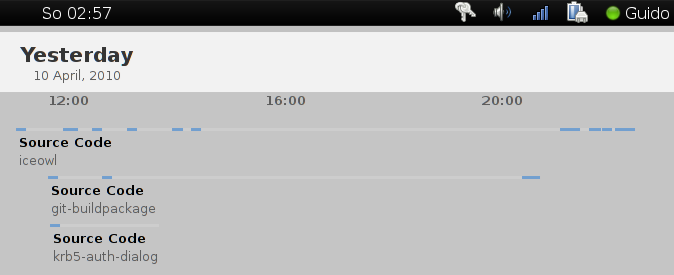
Guido G?nther: Simple git data provider for Zeitgeist

gnome-activity-journal recently entered Debian and it could become a great tool to keep track of hacking activities. The underlying zeitgeist can log these and other events and make the information available via DBus. I couldn't find a data provider that feeds the information about Git commits to it so I wrote a simple post commit hook. This way one can easily see when one worked on a source repository: gnome-activity-journal Now is there a nice way to store additional information like current branch or commit message along with that?

Asheesh Laroia: Let people help your project: Give them a button to click

This note goes out to the maintainers and contributors of Free and open source projects. (Cross-posted at the OpenHatch blog.) I recently had the chance to look at Mozilla Quality Assurance's research into the people who help out with testing versions of Firefox. I saw numbers that really spoke to my experience as a volunteer. On one hand, the vast majority of people put in three or fewer hours a week, most of whom put in one hour or fewer (such as zero). On the other hand, a huge number wish they could put in a lot more: Now imagine you're that one-hour-a-week contributor. You have all these other bits of your life tugging at your time. You want to make sure that when you sit down to work on free software, you're doing something that really helps out. Otherwise, not only will you feel bad that you aren't giving free software as much time as you wish, you'll feel bad that you're not even making a difference. In my experience, even reading the project mailing list counts toward that time you're putting into the project. But that doesn't feel productive. So fellow contributors, I have a request for you: Would you be willing to make it super easy for someone to stand waiting, on guard, for instructions from you? Imagine if all they had to do is click a button on your website, write a little bit of info about what they could do, and you would suggest something for them to work on. Maybe you can offer them a bitesize bug to fix, or maybe you need someone to download and test the latest version before you release it. If you're handing out assignments, then part-time contributors don't have to spend their time figuring out what they should do. I want to tell you that I can give you such a button. It would look like this: To get it, you just have to add a little snippet of HTML to your project website. Just go to the OpenHatch project list. and find your project. If it's not there yet, search for it, and click the link to create it. Then find the box labeled "Have your own website?" and click. Ta-da! HTML source code you can copy-paste. Since OpenHatch itself is an open source project, we added the button to our own "source code, etc." page. When people click it, they appear in a list of "People willing to help" on your project's OpenHatch page. Like all the friendly faces on the Gwibber page. Would you try it, too?

12 April 2010

Ingo Juergensmann: Syncing N97 with DAViCal

A few days ago I blogged about my problems syncing my N97 with iCal, Sunbird and other calendar apps. Today I tried DAViCal instead of Apples calendarserver (caldavd). To my surprise it worked fairly well, although not flawlessly. To make it short: I can now sync between my N97 smartphone via Bluetooth and iCal on OS X and Sunbird (tested on OS X as well): creating appointments on the N97, syncing via iSync and having the appointment exported to DAViCal via iCal works pretty well. Deleting dates works well in iCal as well. It has some problems as mentioned before on N97, though. But when you delete the date in iCal, it will vanish on the N97 as well.


It was somewhat tricky to get it that far. The problem is, that iSync can only sync to a local calendar in iCal. But with DAViCal you can publish/export that local calendar to the server where it is display a another calendar principal. That why syncing with the N97 works pretty well, although you might end up with double entry in iCal. I unchecked the N97 prinicipal/calendar from the server in iCal, as you can see in the screenshot above.

I haven't been able to test calendar sycing on Debian yet, but I believe that there will be some app that will work. And there are still problems. For example I have an appointment in July and August that are displayed in iCal and Sunbird, but not on the N97. Maybe there are some attributes to those dates that prevent them from being imported into the N97. Dunno.
But so far this is the best syncing solution so far. I'll test how well this works out for me...

Chris Lawrence: epcp for R

I finally have packaged up a very rough port of my epcp routine from Stata to R as part of a package unimaginatively called cnlmisc; you can download it here. In addition to the diagnostics that the Stata routine provides, the glm method includes a bunch of R-square-like measures from various sources (including Greene and Long). The only part I m sure works at the moment is the epcp for glm objects (including survey s and Zelig s wrappers thereof); the others that are coded (for polr and VGAM) are probably half-working or totally broken, and some wrappers aren t there yet at all. The error bounds suggested by Herron aren t there either. The print routines need a lot of work too; eventually it will have a nice toLatex() wrapper as well. But it beats having it sit on my hard drive gathering dust; plus I may eventually get motivated to write a JSS piece or something based on it. epcp for Stata is still available at my site. For more information on the measure, see Michael C. Herron (1999), Postestimation Uncertainty in Limited Dependent Variable Models Political Analysis 8(1): 83 98 or Moshe Ben-Akiva and Steven Lerman (1985), Discrete Choice Analysis, MIT Press.

Wouter Verhelst: LOAD is over...

...and I think it went well. As someone who does some sysadmin-for-hire work, it does fit me quite well. I did my "Debian Secrets" talk again, which had moderate success: some people had already seen it at FOSDEM--which is normal, considering how the room was crowded back then--so they missed it this time around. Those who had seen it seemed to be fairly interested in what I had to say, so that's good. Of course, while there, it made sense to pick up a few other talks, which I did; and I learned some interesting things in the process. I mostly liked the GOsa one, but there were some other interesting ones, too. Had I not been in Deurne for the concert of the choir on Saturday evening, I would even have won a book. But apparently the rules said that you couldn't win books if you weren't there... All in all, I think it was a rather successful event; and if there's a repeat next year, I'll certainly attend again.

Andrew Pollock: [tech] Using capabilities from Python

I've become passingly interested in Linux's capabilities functionality, as a way of reducing full-blown UID 0 requirements. Unrelated to this, one of my few gripes about Python, coming from Perl, was the inability to do anything like Perl's $0 to alter the appearance of the running program. I used to use this functionality in Perl a lot to provide cheap insight into what a long running Perl script was up to. Well the other day, I was rather excited to learn that Dennis Kaarsemaker has written a Python interface to capabilities, which also implements a set_proctitle() function. The python-prctl module isn't currently available in Debian, but as Dennis has all of the packaging in the Git repository, I've offered to sponsor it for him if he wishes.

Erich Schubert: Removing modlogan

Unless someone drops in as new maintainer, I'll file for removal of ModLogAn from Debian soon.The software has been abandoned upstream for, well, a couple of years. It still works okayish (just the patterns need refreshing), and in fact I'm still running it. But there is plenty of software to replace it, and it seems as if many people go the Google Analytics way today.Please speak up quickly if you care about ModLogAn, otherwise it's gone from Debian soon.

11 April 2010

John Goerzen: Final comments on our trip to Europe

I wrote a lot about our trip to Europe here, and I had a few more comments to share. I had a great time there. It was fun to stay with people, and it was also fun to explore cities on our own. I am eager to be able to go back. Communication
I ll admit I wasn t sure how I d do there. I speak only a little German, and no Czech at all. I have never been in a situation in which I don t speak the dominant language, and this is probably typical for Americans. (I m not going to count the few exceptions of eating at small Mexican restaurants in the USA where the staff speaks little English, as it s not really the same experience to be in that situation for an hour or two.) I was most apprehensive about our time in Berlin and Prague. In those cities, we didn t know anyone. And, although I speak a little German, I speak no Czech at all. In the end, though, it all worked out fine. I never saw anyone get frustrated with us for our lack of language knowledge, and we also never got rattled. With patience and a bit of ingenuity, we figured things out in every different situation. I feel a sense of accomplishment from that, and I think it s left me more ready to travel in the future. And, I d also have to say, that was one of the most interesting lessons of the trip: how two people that don t share a common language can still communicate. It might be slow, but it s also rewarding and easier than I might ever have thought. I remember particularly buying a couple of fragile carved wood souvenirs at the Zeidler Holzkunst (wood art) shop in the Altes Rathaus in Leipzig (Seiffener Volkskunsterzeugnisse was on the window). The shopkeeper spoke no English. We were interested in some rather fragile items, and I wanted to ask her if she could pack it in a box. I didn t know the German words for pack or box . So after a couple seconds thought, I realized I knew how to tell her, in German, that we re from America. And then I asked, Can you? (in German) and gestured for a square box, figuring maybe she d put it together that we d need to pack it well to take it home with us. Success. She quickly produced a box, and asked if that s what we wanted. A few minutes later, a bit of pointing towards the glass case communicated what we wanted to buy. It took a little longer than it would have from someone that spoke English, but this was more rewarding in the end. The train station in Prague was another challenge. It didn t have nearly as much English signage as other train stations we d been in. We did a little wondering around, and some educated guesses, and a brief English conversation in a bank, we eventually found an ATM, a place to change the big bills for smaller ones, and a Metro ticket shop that was open. Clothes Many Americans, and American travel books, suggest not wearing jeans and tennis shoes in Europe. Many commented that people dressed more formally in Europe. That advice appeared to be rather wrong, especially in L beck, where it appeared that many people dressed less formally than in the USA. As we went south and east, we saw fewer jeans, but still they were rather common. Our biggest blunder here was probably the shoes that we brought for Terah. She brought some shoes that looked nice, but weren t very good for walking. She wound up with some painful blisters on her feet, and wished she had just brought her regular tennis shoes. Luggage and Packing We try to travel light when we can. All of our luggage for the entire trip fit into two carryon-size suitcases, though we sometimes separated some items out into a backpack for ease of use in airports/airplanes. This worked out about right. We did laundry once in Germany so we didn t have to pack enough clothes for the entire trip. As far as electronics go, we brought along an international GSM phone from onesimcard.com, my Droid (which could use Wifi but not GSM), Terah s iPod Touch, a GPS, my digital camera, and a laptop. That also was about right. We used the Droid to call back to Indiana to check on the boys, using SIP over WiFi for free calling via Google Voice. The laptop is a small one, so didn t add a lot of weight or bulk. It was nice to have to check out maps and Facebook. The GPS was somewhat less useful than I had anticipated. I had pre-loaded it with street-level maps of most of Europe, and also put on it points in Berlin that had been suggested to us. The transit maps were really more useful most places, especially when combined with a detailed street-level map. In Berlin, though, the detail on the street-level map from our hotel was somewhat lacking, so the GPS came in handy. It was also nice to quickly be able to see where the nearest S-Bahn and U-Bahn stops were, then cross-referencing with our transit map to figure out how to get where we wanted to go. One night in Leipzig, after a concert at the Gewandhaus, we made a couple of wrong turns on our way to a tram stop. The GPS would have saved us 15 minutes of walking had we brought it along, but we figured it out with our street map and it wasn t really a problem. Rick Steves is a big advocate of money belts when traveling. These are a belt with a zippered pouch, and are worn under your pants (though over your shirt, if it s tucked in). The idea is that it s hard to pickpocket. He suggests having a days worth of cash in a front pocket, and passports and larger bills in the money belt. We brought one but never used it. I kept small cash in my pocket, and we kept passports and my wallet (with larger bills) in Terah s purse, which was on a strap around her neck, zippered shut, and held under her arm. We had no problems. I tend not to keep my wallet in my back pocket even when traveling in the USA. Also, the hotels we stayed in had safes, and the residences were of course plenty safe, so we had no problem leaving valuables there. I brought only a single lens for my Digital Rebel XTi, a 28mm fixed lens that is small and light. That was just fine, and I was happy to have a fixed lens for photography in dark churches. Also, I wouldn t have wanted to carry around a bulky zoom lens all over. We sometimes took the camera with us, and sometimes not. In Berlin in particular, we just left it in the hotel room. I figured (correctly) that there would be plenty of photos on Flickr of the sites we were visiting, and we could just enjoy the time a little better if we weren t worrying about a camera too. But I was glad to have it along. Transportation The transportation systems in the cities we visited felt more, well, balanced than they often are in the USA. It s not that there weren t busy car-filled avenues, but more that there were also quiet shopping streets where cars were banned. Cars often seemed to be more of an option than a necessity, and not always the best option at that. Public transportation was common, as were pedestrian routes and bicycle lanes. The only American city I ve visited that felt even close to this approach was Portland, OR. I wish we adopted it more often here. I also admire the German intercity rail service, operated by Deutsche Bahn. You can get all over the country pretty quickly. The trains we rode on were quiet, smooth, and timely. I wish we had that kind of service in more parts of the USA.

Gunnar Wolf: Lets all get running

There is no clear reason, but for many months already, I have almost given up running Which is a shame, as I enjoy it so much. And yes, I can talk a lot about why not, but outside of one seemingly stupid point there is really no reason. And yes, I have taken on cycling, although on a very different fashion: Cycling is by far not as good as an exercise as running Yes, cycling for ~1h on average 3 times a week has kept my body from becoming sedentary again, but I do feel some increased clumsiness and a undeniable weight gain that I don't want to allow. I said there is one seemingly stupid point: Shoes. My running shoes are around two year old, and they are an important factor on me not running. Why? Because they started giving me blisters at ~5Km. And my shoe size is beyond what is considered as normal by Mexican standards European 44-45 (US 10 -11). Shoe-shopping is always frustrating and very off-putting for me, as instead of what most people do (go to one store, ask for their favorite n pairs on their size, test them on, pay, be happy), I follow almost the opposite process (go to n stores, ask for whatever they have on my size, test it on, pray, pay). Of course, for some people, entering many stores and checking what's offered at each is a thrill by itself. For me, that sounds as thrilling as visiting the dentist for an endodontic treatment. Oh, and to make things even better, I am quite low on cash. Scarcity economics explain that if a given good is hard to find, it will probably be more expensive. So, while many people in Mexico buy ~US$30 shoes, I often get to pay ~US$90. Fun, hah? Anyway, I had a short semi-vacation to Argentina. I decided to kill this excuse, and went shoe-shopping. Fearsome memories sprang in my mind when the first store said they didn't have anything right for me. But they pointed to a second store, one block away, where I found (I was even able to choose between several models!) a nice pair of Olimpikus. In 2008, I was routinely running slightly over 10Km. Today I went out to get back the feeling, and made a not-so-great-but-still-satisfying 4Km. And upon arriving back home, I read Christian's chronicle on his Paris Marathon run Well, only 10% of what my fellow DD achieved But I am definitively back on track. I expect to make some time to get a run, at least three times a week, trying to push my limit at least back to the nice spot I was at two years ago.

Next.

Previous.