Search Results: "ed"

6 February 2011

Vincent Fourmond: Doxygen and Ruby...

I've been using Doxygen for a while now, and, no surprises, I find it fantastic ! The only thing that is really missing there is a decent support for Ruby... Allright, Ruby already has a documentation system, rdoc, but using only one for everything has its charms, and Doxygen is doubtlessly much more evolved than rdoc. Maybe when I have time, I'll have a look at writing it. (but that won't be before a long time...). Update: I finally had some time to write and publish this patch. It is available on github

Vincent Fourmond: Doxygen for Ruby, first working draft !

Quite some time ago, I complained about the lack of support of Ruby in doxygen, the ultimate code documentation generator (at least for me). Time has passed, and I had some time and motivation to look into it and write a patch. The code is now reasonably mature to be used, altough it still lacks many features, and, most importantly, testing. That's why I pushed my git-svn private repository to github today, in order to get enough testing to integrate it into mainstream doxygen. It's current features: You can get an opinion of how it looks on the code of ctioga2. The doxygen configuration file can be found there.

Alexander Reichle-Schmehl: Squeeze has been released...

... and look, what has just been brought to us, by some friends and Debian users:
Squeeze release cake A surprise Debian Squeeze release cake! Many thanks, it was delicious!

Christian Perrier: Squeeze released

This is the gazillionth entry on Planet Debian about Squeeze being released. If I had to say one thing about it, it would be that I think the way it was handled this time has been really great. The debian-publicity team, lead by the tireless Reichles, did great job in doing as many buzz as possible around that release....but managed to do it in the "spirit" of free software (pushing release parties, animating a feed on identi.ca, preparing press releases, etc.). The Release Team did a tremendous job during the 6 months of the freeze, by carefully balancing between conservatism and liberalism in accepting (or denying) our gazillion of request for freeze exceptions The FTP, CD, installer, website, documentation teams organized things really well for their respective fields of responsibility. A special mention to the tremendous effort done about the release notes, release announcements documents (and of course, their translators). I'm currently busy upgrading my servers (at home and at work) and things are going smoothly (except the first two I did without carefully reading warnings about missing firmwares...they're now waiting for me to provide them with the right non free firmware packages, 30km away from here). And, for myself, I celebrated the release this morning by squashing my personal best time on an half-marathon (officials races excepted) by nearly 7 minutes, bringing it just below 1h45 (PB in official races is 1h37). Release power! :) And, during that afternoon, I also had the please of having my pet package (geneweb) and my most important package (samba) having their first release in unstable, targeted for wheezy. Squeeeeeeze meeeeeeeeeeeee!

Martin Michlmayr: Upgrading to Debian 6.0 (squeeze) on ARM

Debian 6.0 (squeeze) has been released. Here are some notes if you're running Debian on an ARM-based NAS device or plug computer and are planning to upgrade. First of all, make sure to read the release notes for Debian 6.0 on ARM. This document contains a lot of information on performing a successful upgrade. Second, during the kernel upgrade, you'll get the following message about the boot loader configuration:
The boot loader configuration for this system was not recognized. These
settings in the configuration may need to be updated:
 * The root device ID passed as a kernel parameter;
 * The boot device ID used to install and update the boot loader.
On ARM-based NAS devices and plug computers, you can simply ignore this warning. We put the root device into the ramdisk so it will be updated automatically. Finally, after doing the upgrade and before rebooting your system, make sure to run flash-kernel to activate the new kernel.

Lars Wirzenius: Idea: addsysuser

Debian got squeeze released, and ideas are brewing for what to do during the next release cycle. Here's an idea I had lying around. I'm throwing it out there, since I won't have time to do anything about it for at least a little while, but perhaps someone else thinks it's a good idea? Or, better yet, you can all tell me in comments why this is a bad idea, or at least why it should be designed in a different way.
NAME
       addsysuser, delsysuser - create and remove systems user in Debian pack 
       ages
SYNOPSIS
       addsysuser [options] username
       delsysuser [options] username
DESCRIPTION
       addsysuser creates a system user, and delsysuser removes it.  The  pur 
       puse  of these tools is to make it easier for Debian packages to create
       and remove system users as  the  pacakges  are  installed  and  purged.
       These are wrappers around adduser(8) and deluser(8).
       addsysuser  will  create the system user, unless it already exists.  If
       the user already exists, it does nothing.
       delsysuser removes the user.  However,  the  system  administrator  may
       configure  it  to  never remove the user, or to remove only some users.
       Use the /etc/adduser.conf for the settings:
       DELETESYSTEMUSERS
          Set to true or false  depending  on  whether  delsysuser  should
          remove the system user or not.  Defaults to true.
OPTIONS
       -p, --packagePACKAGE
          Record the user as being used by a specific package.  Many pack 
          ages can use the same user.  delsysuser  will  only  remove  the
          user when no packages are using it anymore.
       --no-act
          Only  pretend  to call adduser or deluser without actually doing
          so.  This allows easier testing of command lines.
FILES
       /etc/adduser.conf
          Configuration file for addsysuser and delsysuser.
EXAMPLE
       In the postinst script:
          addsysuser --package hello hellouser
       In the postrm script:
          delsysuser --package hello hellouser
SEE ALSO
       adduser(8), deluser(8).

Dirk Eddelbuettel: Wynton Marsalis and the Jazz at Lincoln Center Orchestra

Went to the CSO on Friday night to see the annual concert of Wynton Marsalis and the Jazz at Lincoln Center Orchestra. This year's concert featured one set with four pieces from the new Vitoria Suite album---see here for a raving review. Those pieces were indeed very nice and I may to grab the disc to hear the full suite. Thhis was followed by a number of pieces composed or arranged by different band members. All in all a great concert. Hard not to love when you twelve-man strong brass section featuring four trumpets, three trombones, five saxophones supported by a nice rhythm section of three. Recommended.

Alexander Reichle-Schmehl: A plea to all FOSDEM visitors:

Could some please put a picture of one of the new spacefun themed T-Shirts somewhere? I really want to see them... Update: Christoph Kluenter was so nice to upload some pictures.

Lucas Nussbaum: mutt + notmuch = perfect mail setup?

Following Our Leader, I ve just switched to using notmuch with mutt for searching (instead of maildir-utils, previously). I strongly recommend this setup to all mutt users. As a bonus, accented characters ( , , ) are now handled correctly while searching, which is quite useful in french.

Benjamin Mako Hill: Editor-to-Reader Ratios on Wikipedia

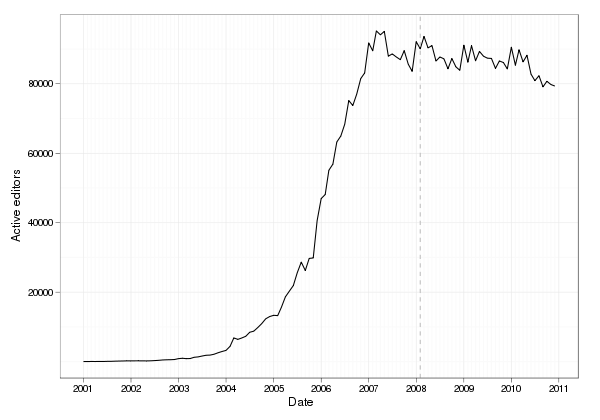
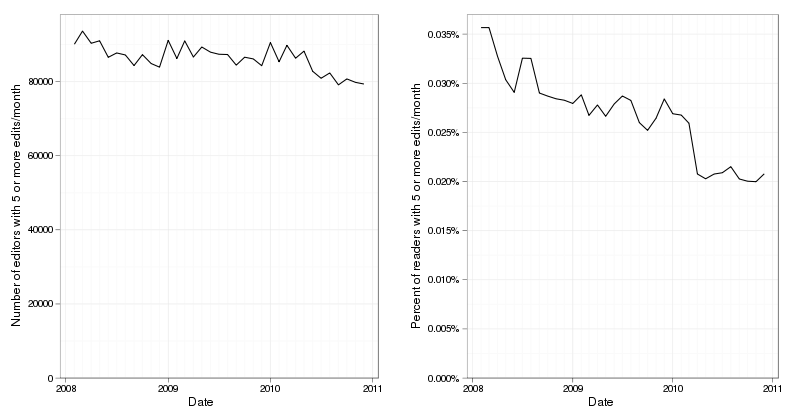
It's been reported for some time now that the number of active editors on Wikipedia (usually defined as people who have edited at least 5 times in a given month) peaked in 2007 and has been mostly stable since then. A graph of the total number of active editors in every month since Wikipedia's founding is shown below. The graph shows the aggregate numbers for all language Wikipedias. English Wikipedia is the largest component of this and is generally more variable. That said, very similar patterns exist for most larger languages. /copyrighteous/images/active_editors_all_wikpiedia.png Felipe Ortega, who has provided many of these statistics, has warned against fatalist claims. Although there seems to be a decrease in the total number of active editors over the last two years, the situation seems to have somewhat stabilized in most languages. New editors in Wikipedia are replacing folks at almost the rate that they are leaving. It is also widely known that the number of readers of Wikipedia has been increasing during this period. According to the report cards released by the foundation using comScore data, the number of unique visitors to Wikipedia each month has increased by 61 million people in the last year -- over 17%. This discrepancy between rising readership and stable or sinking editorship should raise major concern. After all, the Wikimedia Foundation's mission is two part: (1) to empower and engage people around the world to collect and develop educational content and (2) to disseminate it effectively and globally. Although the Foundation report cards include measures of raw levels of editorship, a better metric of engagement and empowerment might be the proportion of readers who engage in editing. I could not find reliable data on the number of unique readers reached each month for more than a few months in the last year. What is available, however, is wonderful data on page views each month going back to 2008. Analysis of the data from available report cards show that, at least during the last year, there is a very stable ratio of 35 page views per unique visitor, as estimated by comScore. Using that measure, we can do a back of the envelope estimation on the proportion of users that are editors for the period where page view data is available, dating back from February 2008 ( marked with the grey dashed lined above). The graphs below show the very different results you get when you consider the change in the number of Wikipedia editors and the change in the editor-to-reader ratio. Once again, these data are combined data for all language Wikipedias although graphs look very similar for most larger languages. The results are striking. Although there has been a 12% decrease between February 2008 and December 2010 in the number of active editors, there is a 42% decrease in the proportion of readers who edit at least five times a month. We can see that fulfilling the first half of the Wikimedia mission remains a struggle. /copyrighteous/images/wikipedia_editors_combined_graph.png Although the graphs above do not say anything directly about the most active core contributors to Wikipedia, the fact that Wikipedia is being maintained by a tiny -- and shrinking -- proportion of its readership does mean that the idea behind Wikipedia is under threat. Although none are as big as Wikipedia, there are lots of good encyclopedias out there. The reason Wikipedia is different, interesting, and important is because -- unlike all those others -- Wikipedia is the encyclopedia that anyone can edit. Wikipedia is powerful because it allow its users to transcend their role as consumers of the information they use to understand the world. Wikipedia allows users to define the reference works that define their understanding of the their environment and each other. But 99.98% of the time, readers do not transcend that role. I think that's a problem. Worse, that the number is growing. The Wikimedia Foundation recently ran a major successful effort to attract donations in its annual fundraiser. Jimmy Wales' smiling mug is apparently enough in the way of motivation to get something like 1% of its readers to donate money to support the project. I think that's very good news. If the Wikimedia community can entice even half of those people to contribute through an increased involvement in the projects themselves, they might do more than ensure Wikipedia's continued growth. They would help take a step toward the empowerment and engagement of those users in sharing their own knowledge, and the continued fulfillment of a critically important mission.
Bastian Venthur: Squeeze

Tonight Squeeze was released! Along with the release came a redesign of our website and planet. Nice! I m particularly happy that we ll see lots of fresh software and updates in unstable again, now that it is not frozen anymore. Thanks to all contributors. Keep up the good work!

Erich Schubert: Debian Squeeze released!

Debian GNU/Linux 6.0 "squeeze" has been released today.
Congratulations to everyone involved in ironing the last few bugs out.
(My own involvement had been a bit limited recently, but I at least kept my few remaining packages in a ready-to-release state and helped with the occasional bug report and patch.)
Some people think that Ubuntu is the better Debian - I do NOT. Debian is a fun place, has great people working on it and is true to its aims at creating a truly free and high-quality distribution. The long release cycles of Debian are a feature, not a bug. Stable is for production systems, not toy projects.
The proper way of attributing Debian stable is conservative and sustainable, but not outdated. It actually can do everything you need - and will do so in 10 years.
If you have been using Open Source for as long as me (say 15+ years) you will probably have seen software hypes come and go. The one thing that has been always the same was Debian: dead reliable. There was a time when everyone was crazy about enlightement for it's shiny pretty UI. Almost like Compiz-Beryl just two years ago. It came, as a matter of fact Debian also had it, but it also went.
I also remember how people complained that Debian didn't ship Xgl back in 2006 when this was the latest hype (there was no Debian release in 2006). Well, Xgl died in 2008. The features remained, but done in a much nicer way, and also found their way into Debian. In fact, I also ran Xgl at least once, on Debian, but just not on "stable". One could say that Xgl never was quite "stable", was it?
Debian stable is good the way it is: an administrators choice. Of course, developers might have different needs, but there also is testing, unstable and experimental. Just make sure to align your choice with your needs. And sometimes, also rethink your needs: there is no "latest beta versions" and "stable platform" at the same time.

Kartik Mistry: Squeeze!

* So, Debian 6.0 Squeeze is released! And, congratulations and thanks to all people involved. Lets have party now!

Raphaël Hertzog: Debian 6.0 is out, Wheezy kicks off

As you probably already know, Debian released Squeeze aka Debian 6.0 this week-end. It was a really great week-end. I saw quite a few release already, but none with so much online social activity. Alexander and Meike Schmehl live commented the release on the Debian identi.ca account and Joey Hess held his Debian Party Line. On top of this, the team in charge of the website rolled out a new design on quite a few online services during the week-end including www.debian.org, wiki.debian.org, planet.debian.org and more. Congratulations to all the people who made this happen (and the release team in particular). It s great to see Debian achieve all of this. Do you know that it s the third time in a row that we manage to release in the 18-24 months timeframe? 3.1: June 2005 4.0: April 2007 5.0: February 2009 6.0: February 2011. Yes, despite our size and the fact that we are all volunteers, we have managed to stick to a reasonable schedule for a stable distribution that is deployed on a large scale. Wheezy kicks off The best part of the release for us the developers is that wheezy is now open for development and we can work on new features for the next release. ;-) And it started quickly: according to UDD, wheezy already features 488 new source packages that are not in squeeze, 1713 updated source packages and among those 1246 are new upstream versions. I really look forward to the upcoming projects and related discussions.
Click here to subscribe to my free newsletter and get my monthly analysis on what s going on in Debian and Ubuntu. Or just follow along via the RSS feed, Identi.ca, Twitter or Facebook.

For the curious, here are the UDD queries I used:
# Updated packages in wheezy
select count(source) from sources_uniq as su where (select version from sources_uniq where release='squeeze' and distribution='debian' and source = su.source) < su.version and release='wheezy' and distribution='debian';
# Updated with a new upstream version
select count(source) from sources_uniq as su where debversion(regexp_replace((select version from sources_uniq where release='squeeze' and distribution='debian' and source = su.source), '-.*', '')) < debversion(regexp_replace(su.version, '-.*', '')) and release='wheezy' and distribution='debian';
# New package in wheezy
select count(source) from sources_uniq as su where source not in (select source from sources_uniq where release='squeeze' and distribution='debian' and source = su.source) and release='wheezy' and distribution='debian';

No comment Liked this article? Click here. My blog is Flattr-enabled.

Junichi Uekawa: squeeze is released.

squeeze is released. Yay!

Charles Plessy: Long life to Squeeze !

Debian just published Squeeze today. It is an excellent release, that I hope I will keep for a long time on my machines. Among the improvements, boot has been accelerated. On my laptop with a second hand SSD, it only takes 20 seconds to see the login screen. I was amazed when I saw this for the first time. I was often upgrading from Stable to Testing quite quickly, to install more recent versions of desktop applications. But the backports change the game. I hope that I will not switch to Testing before one year or two. For Squeeze, I will also prepare backports for the packages I maintain. I hope that more people will enjoy them. Most of these packages are independant from the graphical system, and more in general from its core. The backports will allow to use recent version of these packages on top of a stable distribution. Since Lenny, Debian Med displays the contents of its metapackages with tasks pages, that include draft packages as well. Not all will make it in Debian, and I would like to have the feedback from our users to better chose our priorities. Contact us on the debian-med@lists.debian.org mailing list ! These new packages will also be distributed for Squeeze through the backports. Thanks again to everybody who contributed to the release of Squeeze !

Tiago Bortoletto Vaz: Released!

Nice try tassia! I'm sure you can do even better for Wheezy :)

Nico Golde: Debian 6.0 squeeze

Wooohoo, we finally released squeeze! Many thanks to everyone who worked on this the past 2 years and also it's nice to see the new "corporate" design going live!

Meike Reichle: Squeeze Release Live Dent Finished

That's it! Squeeze is released and the website's new design is in place. What a great day! In addition to the usual announcements on the website and mailing lists we decided to also do a live coverage of the whole process using identi.ca this time! Alex and me have been doing a live coverage of Debian's release process for almost 19 hours straight and, although we're dead beat now, I think it was well worth it! People seemed to enjoy being included in the process and many expressed their admiration for Debian's well-coordinated and purposeful proceedings. Congratulations to all involved: the FTP team, the release team, the CD team, the www team and the publicity team! Great work everyone!

Joey Hess: 12 hours of talking

I spent a solid 12 hours hosting the Debian Party Line chat today thru the Debian Squeeze release process. That's much much more time than I usually spend on the phone or talking. It went well. The mumble server peaked at 55 people connected, and 200 unique addresses connected to it over the course of the day. We had some good discussions, and a lot of lurkers too. And not too much bother with badly set up microphones. I hope that Debian will find uses for mumble going forward, some ideas I've heard are to use it for team meetings, or for remote audience feedback at DebConf talks. I plan to leave the server up as long as it is not abused.

Next.

Previous.


