Search Results: "tb"

29 November 2015

Matthew Garrett: What is hacker culture?

Eric Raymond, author of The Cathedral and the Bazaar (an important work describing the effectiveness of open collaboration and development), recently wrote a piece calling for "Social Justice Warriors" to be ejected from the hacker community. The primary thrust of his argument is that by calling for a removal of the "cult of meritocracy", these SJWs are attacking the central aspect of hacker culture - that the quality of code is all that matters.

This argument is simply wrong.

Eric's been involved in software development for a long time. In that time he's seen a number of significant changes. We've gone from computers being the playthings of the privileged few to being nearly ubiquitous. We've moved from the internet being something you found in universities to something you carry around in your pocket. You can now own a computer whose CPU executes only free software from the moment you press the power button. And, as Eric wrote almost 20 years ago, we've identified that the "Bazaar" model of open collaborative development works better than the "Cathedral" model of closed centralised development.

These are huge shifts in how computers are used, how available they are, how important they are in people's lives, and, as a consequence, how we develop software. It's not a surprise that the rise of Linux and the victory of the bazaar model coincided with internet access becoming more widely available. As the potential pool of developers grew larger, development methods had to be altered. It was no longer possible to insist that somebody spend a significant period of time winning the trust of the core developers before being permitted to give feedback on code. Communities had to change in order to accept these offers of work, and the communities were better for that change.

The increasing ubiquity of computing has had another outcome. People are much more aware of the role of computing in their lives. They are more likely to understand how proprietary software can restrict them, how not having the freedom to share software can impair people's lives, how not being able to involve themselves in software development means software doesn't meet their needs. The largest triumph of free software has not been amongst people from a traditional software development background - it's been the fact that we've grown our communities to include people from a huge number of different walks of life. Free software has helped bring computing to under-served populations all over the world. It's aided circumvention of censorship. It's inspired people who would never have considered software development as something they could be involved in to develop entire careers in the field. We will not win because we are better developers. We will win because our software meets the needs of many more people, needs the proprietary software industry either can not or will not satisfy. We will win because our software is shaped not only by people who have a university degree and a six figure salary in San Francisco, but because our contributors include people whose native language is spoken by so few people that proprietary operating system vendors won't support it, people who live in a heavily censored regime and rely on free software for free communication, people who rely on free software because they can't otherwise afford the tools they would need to participate in development.

In other words, we will win because free software is accessible to more of society than proprietary software. And for that to be true, it must be possible for our communities to be accessible to anybody who can contribute, regardless of their background.

Up until this point, I don't think I've made any controversial claims. In fact, I suspect that Eric would agree. He would argue that because hacker culture defines itself through the quality of contributions, the background of the contributor is irrelevant. On the internet, nobody knows that you're contributing from a basement in an active warzone, or from a refuge shelter after escaping an abusive relationship, or with the aid of assistive technology. If you can write the code, you can participate.

Of course, this kind of viewpoint is overly naive. Humans are wonderful at noticing indications of "otherness". Eric even wrote about his struggle to stop having a viscerally negative reaction to people of a particular race. This happened within the past few years, so before then we can assume that he was less aware of the issue. If Eric received a patch from someone whose name indicated membership of this group, would there have been part of his subconscious that reacted negatively? Would he have rationalised this into a more critical analysis of the patch, increasing the probability of rejection? We don't know, and it's unlikely that Eric does either.

Hacker culture has long been concerned with good design, and a core concept of good design is that code should fail safe - ie, if something unexpected happens or an assumption turns out to be untrue, the desirable outcome is the one that does least harm. A command that fails to receive a filename as an argument shouldn't assume that it should modify all files. A network transfer that fails a checksum shouldn't be permitted to overwrite the existing data. An authentication server that receives an unexpected error shouldn't default to granting access. And a development process that may be subject to unconscious bias should have processes in place that make it less likely that said bias will result in the rejection of useful contributions.

When people criticise meritocracy, they're not criticising the concept of treating contributions based on their merit. They're criticising the idea that humans are sufficiently self-aware that they will be able to identify and reject every subconscious prejudice that will affect their treatment of others. It's not a criticism of a desirable goal, it's a criticism of a flawed implementation. There's evidence that organisations that claim to embody meritocratic principles are more likely to reward men than women even when everything else is equal. The "cult of meritocracy" isn't the belief that meritocracy is a good thing, it's the belief that a project founded on meritocracy will automatically be free of bias.

Projects like the Contributor Covenant that Eric finds so objectionable exist to help create processes that (at least partially) compensate for our flaws. Review of our processes to determine whether we're making poor social decisions is just as important as review of our code to determine whether we're making poor technical decisions. Just as the bazaar overtook the cathedral by making it easier for developers to be involved, inclusive communities will overtake "pure meritocracies" because, in the long run, these communities will produce better output - not just in terms of the quality of the code, but also in terms of the ability of the project to meet the needs of a wider range of people.

The fight between the cathedral and the bazaar came from people who were outside the cathedral. Those fighting against the assumption that meritocracies work may be outside what Eric considers to be hacker culture, but they're already part of our communities, already making contributions to our projects, already bringing free software to more people than ever before. This time it's Eric building a cathedral and decrying the decadent hordes in their bazaar, Eric who's failed to notice the shift in the culture that surrounds him. And, like those who continued building their cathedrals in the 90s, it's Eric who's now irrelevant to hacker culture.

(Edited to add: for two quite different perspectives on why Eric's wrong, see Tim's and Coraline's posts)

comment count unavailable comments

Steve Kemp: Spent the weekend improving the internet

This weekend I've mostly been tidying up some personal projects and things.
http://debian-administration.org/
This was updated to use recaptcha on the sign-up page, which is my attempt to cut down on the 400+ spam-registrations it receives every day. I've purged a few thousand bogus-accounts, which largely existed to point to spam-sites in their profile-pages. I go through phases where I do this, but my heuristics have always been a little weak.
http://dhcp.io/
This site offers free dynamic DNS for a few hundred users. I closed fresh signups due to it being abused by spammers, but it does have some users and I sometimes add new people who ask politely. Unfortunately some users hammer it, trying to update their DNS records every 60 seconds or so. (One user has spent the past few months updating their IP address every 30 seconds, ironically their external IP hadn't changed in all that time!) So I suspended a few users, and implemented a minimum-update threshold: Nobody can update their IP address more than once every fifteen minutes now.
Literate Emacs Configuration File
Working towards my stateless home-directory I've been tweaking my dotfiles, and the last thing I did today was move my Emacs configuration over to a literate fashion. My main emacs configuration-file is now a markdown file, which contains inline-code. The inline-code is parsed at runtime, and executed when Emacs launches. The init.el file which parses/evals is pretty simple, and I'm quite pleased with it. Over time I'll extend the documantion and move some of the small snippets into it.
Offsite backups
My home system(s) always had a local backup, maintained on an external 2Tb disk-drive, along with a remote copy of some static files which were maintained using rsync. I've now switched to having a virtual machine host the external backups with proper incrementals - via attic, which beats my previous "only one copy" setup.
Virtual Machine Backups
On a whim a few years ago I registered rsync.io which I use to maintain backups of my personal virtual machines. That still works, though I'll probably drop the domain and use backup.steve.org.uk or similar in the future.
FWIW the external backups are hosted on BigV, which gives me a 2Tb "archive" disk for a 40 a month. Perfect.

25 November 2015

Ben Armstrong: Debian Live After Debian Live

Get involved After this happened, my next step was to get re-involved in Debian Live to help it carry on after the loss of Daniel. Here s a quick update on some team progress, notes that could help people building Stretch images right now, and what to expect next. Team progress Test build notes Test boot notes Coming soon See the TODO in the wiki. We re knocking these off steadily. It will be faster with more people helping (hint, hint). facebooktwittergoogle_plusredditpinterestlinkedinmail

23 November 2015

Thomas Goirand: OpenStack Liberty and Debian

Long over due post It s been a long time I haven t written here. And lots of things happened in the OpenStack planet. As a full time employee with the mission to package OpenStack in Debian, it feels like it is kind of my duty to tell everyone about what s going on. Liberty is out, uploaded to Debian Since my last post, OpenStack Liberty, the 12th release of OpenStack, was released. In late August, Debian was the first platform which included Liberty, as I proudly outran both RDO and Canonical. So I was the first to make the announcement that Liberty passed most of the Tempest tests with the beta 3 release of Liberty (the Beta 3 is always kind of the first pre-release, as this is when feature freeze happens). Though I never made the announcement that Liberty final was uploaded to Debian, it was done just a single day after the official release. Before the release, all of Liberty was living in Debian Experimental. Following the upload of the final packages in Experimental, I uploaded all of it to Sid. This represented 102 packages, so it took me about 3 days to do it all. Tokyo summit I had the pleasure to be in Tokyo for the Mitaka summit. I was very pleased with the cross-project sessions during the first day. Lots of these sessions were very interesting for me. In fact, I wish I could have attended them all, but of course, I can t split myself in 3 to follow all of the 3 tracks. Then there was the 2 sessions about Debian packaging on upstream OpenStack infra. The goal is to setup the OpenStack upstream infrastructure to allow packaging using Gerrit, and gating each git commit using the usual tools: building the package and checking there s no FTBFS, running checks like lintian, piuparts and such. I knew already the overview of what was needed to make it happen. What I didn t know was the implementation details, which I hoped we could figure out during the 1:30 slot. Unfortunately, this didn t happen as I expected, and we discussed more general things than I wished. I was told that just reading the docs from the infra team was enough, but in reality, it was not. What currently needs to happen is building a Debian based image, using disk-image-builder, which would include the usual tools to build packages: git-buildpackage, sbuild, and so on. I m still stuck at this stage, which would be trivial if I knew a bit more about how upstream infra works, since I already know how to setup all of that on a local machine. I ve been told by Monty Tailor that he would help. Though he s always a very busy man, and to date, he still didn t find enough time to give me a hand. Nobody replied to my request for help in the openstack-dev list either. Hopefully, with a bit of insistence, someone will help. Keystone migration to Testing (aka: Debian Stretch) blocked by python-repoze.who Absolutely all of OpenStack Liberty, as of today, has migrated to Stretch. All? No. Keystone is blocked by a chain of dependency. Keystone depends on python-pysaml2, itself blocked by python-repoze.who. The later, I upgraded it to version 2.2. Though python-repoze.what depends on version <= 1.9, which is blocking the migration. Since python-repoze.who-plugins, python-repoze.what and python-repoze.what-plugins aren t used by any package anymore, I asked for them to be removed from Debian (see #805407). Until this request is processed by the FTP masters, Keystone, which is the most important piece of OpenStack (it does the authentication) will be blocked for migration to Stretch. New OpenStack server packages available On my presentation at Debconf 15, I quickly introduced new services which were released upstream. I have since packaged them all: Congress, unfortunately, was not accepted to Sid yet, because of some licensing issues, especially with the doc of python-pulp. I will correct this (remove the non-free files) and reattempt an upload. I hope to make them all available in jessie-backports (see below). For the previous release of OpenStack (ie: Kilo), I skipped the uploads of services which I thought were not really critical (like Ironic, Designate and more). But from the feedback of users, they would really like to have them all available. So this time, I will upload them all to the official jessie-backports repository. Keystone v3 support For those who don t know about it, Keystone API v3 means that, on top of the users and tenant, there s a new entity called a domain . All of the Liberty is now coming with Keystone v3 support. This includes the automated Keystone catalog registration done using debconf for all *-api packages. As much as I could tell by running tempest on my CI, everything still works pretty well. In fact, Liberty is, to my experience, the first release of OpenStack to support Keystone API v3. Uploading Liberty to jessie-backports I have rebuilt all of Liberty for jessie-backports on my laptop using sbuild. This is more than 150 packages (166 packages currently). It took me about 3 days to rebuild them all, including unit tests run at build time. As soon as #805407 is closed by the FTP masters, all what s remaining will be available in Stretch (mostly Keystone), and the upload will be possible. As there will be a lot of NEW packages (from the point of view of backports), I do expect that the approval will take some time. Also, I have to warn the original maintainers of the packages that I don t maintain (for example, those maintained within the DPMT), that because of the big number of packages, I will not be able to process the usual communication to tell that I m uploading to backports. However, here s the list of package. If you see one that you maintain, and that you wish to upload the backport by yourself, please let me know. Here s the list of packages, hopefully, exhaustive, that I will upload to jessie-backports, and that I don t maintain myself: alabaster contextlib2 kazoo python-cachetools python-cffi python-cliff python-crank python-ddt python-docker python-eventlet python-git python-gitdb python-hypothesis python-ldap3 python-mock python-mysqldb python-pathlib python-repoze.who python-setuptools python-smmap python-unicodecsv python-urllib3 requests routes ryu sphinx sqlalchemy turbogears2 unittest2 zzzeeksphinx. More than ever, I wish I could just upload these to a PPA^W Bikeshed, to minimize the disruption for both the backports FTP masters, other maintainers, and our OpenStack users. Hopefully, Bikesheds will be available soon. I am sorry to give that much approval work to the backports FTP masters, however, using the latest stable system with the latest release, is what most OpenStack users really want to do. All other major distributions have specific repositories too (ie: RDO for CentOS / Red Hat, and cloud archive for Ubuntu), and stable-backports is currently the only place where I can upload support for the Stable release. Debian listed as supported distribution on openstack.org Good news! If you go at http://www.openstack.org/marketplace/distros/ you will see a list of supported distributions. I am proud to be able to tell that, after 6 months of lobbying from my side, Debian is also listed there. The process of having Debian there included talking with folks from the OpenStack foundation, and having Bdale to sign an agreement so that the Debian logo could be reproduced on openstack.org. Thanks to Bdale Garbee, Neil McGovern, Jonathan Brice, and Danny Carreno, without who this wouldn t have happen.

20 November 2015

Sylvain Beucler: Rebuilding Android proprietary SDK binaries

Going back to Android recently, I saw that all tools binaries from the Android project are now click-wrapped by a quite ugly proprietary license, among others an anti-fork clause (details below). Apparently those T&C are years old, but the click-wrapping is newer. This applies to the SDK, the NDK, Android Studio, and all the essentials you download through the Android SDK Manager. Since I keep my hands clean of smelly EULAs, I'm working on rebuilding the Android tools I need.
We're talking about hours-long, quad-core + 8GB-RAM + 100GB-disk-eating builds here, so I'd like to publish them as part of a project who cares. As a proof-of-concept, the Replicant project ships a 4.2 SDK and I contributed build instructions for ADT and NDK (which I now use daily). (Replicant is currently stuck to a 2013 code base though.) I also have in-progress instructions on my hard-drive to rebuild various newer versions of the SDK/API levels, and for the NDK whose releases are quite hard to reproduce (no git tags, requires fixes committed after the release, updates are partial rebuilds, etc.) - not to mention that Google doesn't publish the source code until after the official release (closed development) :/ And in some cases like Android Support Repository [not Library] I didn't even find the proper source code, only an old prebuilt. Would you be interested in contributing, and would you recommend a structure that would promote Free, rebuilt Android *DK? The legalese Anti-fork clause:

3.4 You agree that you will not take any actions that may cause or result in the fragmentation of Android, including but not limited to distributing, participating in the creation of, or promoting in any way a software development kit derived from the SDK.
So basically the source is Apache 2 + GPL, but the binaries are non-free. By the way this is not a GPL violation because right after:
3.5 Use, reproduction and distribution of components of the SDK licensed under an open source software license are governed solely by the terms of that open source software license and not this License Agreement.
Still, AFAIU by clicking "Accept" to get the binary you still accept the non-free "Terms and Conditions". (Incidentally, if Google wanted SDK forks to spread and increase fragmentation, introducing an obnoxious EULA is probably the first thing I'd have recommended. What was its legal team thinking?) Indemnification clause:
12.1 To the maximum extent permitted by law, you agree to defend, indemnify and hold harmless Google, its affiliates and their respective directors, officers, employees and agents from and against any and all claims, actions, suits or proceedings, as well as any and all losses, liabilities, damages, costs and expenses (including reasonable attorneys fees) arising out of or accruing from (a) your use of the SDK, (b) any application you develop on the SDK that infringes any copyright, trademark, trade secret, trade dress, patent or other intellectual property right of any person or defames any person or violates their rights of publicity or privacy, and (c) any non-compliance by you with this License Agreement.
Usage restriction:
3.1 Subject to the terms of this License Agreement, Google grants you a limited, worldwide, royalty-free, non-assignable and non-exclusive license to use the SDK solely to develop applications to run on the Android platform. 3.3 You may not use the SDK for any purpose not expressly permitted by this License Agreement. Except to the extent required by applicable third party licenses, you may not: (a) copy (except for backup purposes), modify, adapt, redistribute, decompile, reverse engineer, disassemble, or create derivative works of the SDK or any part of the SDK; or (b) load any part of the SDK onto a mobile handset or any other hardware device except a personal computer, combine any part of the SDK with other software, or distribute any software or device incorporating a part of the SDK.
If you know the URLs, you can still direct-download some of the binaries which don't embed the license, but all this feels fishy. GNU licensing didn't answer me (yet). Maybe debian-legal has an opinion? In any case, the difficulty to reproduce the *DK builds is worrying enough to warrant an independent rebuild. Did you notice this?

15 November 2015

Lunar: Reproducible builds: week 29 in Stretch cycle

What happened in the reproducible builds effort this week: Toolchain fixes Emmanuel Bourg uploaded eigenbase-resgen/1.3.0.13768-2 which uses of the scm-safe comment style by default to make them deterministic. Mattia Rizzolo started a new thread on debian-devel to ask a wider audience for issues about the -Wdate-time compile time flag. When enabled, GCC and clang print warnings when __DATE__, __TIME__, or __TIMESTAMP__ are used. Having the flag set by default would prompt maintainers to remove these source of unreproducibility from the sources. Packages fixed The following packages have become reproducible due to changes in their build dependencies: bmake, cyrus-imapd-2.4, drobo-utils, eigenbase-farrago, fhist, fstrcmp, git-dpm, intercal, libexplain, libtemplates-parser, mcl, openimageio, pcal, powstatd, ruby-aggregate, ruby-archive-tar-minitar, ruby-bert, ruby-dbd-odbc, ruby-dbd-pg, ruby-extendmatrix, ruby-rack-mobile-detect, ruby-remcached, ruby-stomp, ruby-test-declarative, ruby-wirble, vtprint. The following packages became reproducible after getting fixed: Some uploads fixed some reproducibility issues, but not all of them: Patches submitted which have not made their way to the archive yet: reproducible.debian.net The fifth and sixth armhf build nodes have been set up, resulting in five more builder jobs for armhf. More than 10,000 packages have now been identified as reproducible with the reproducible toolchain on armhf. (Vagrant Cascadian, h01ger) Helmut Grohne and Mattia Rizzolo now have root access on all 12 build nodes used by reproducible.debian.net and jenkins.debian.net. (h01ger) reproducible-builds.org is now linked from all package pages and the reproducible.debian.net dashboard. (h01ger) profitbricks-build5-amd64 and profitbricks-build6-amd64, responsible for running amd64 tests now run 398.26 days in the future. This means that one of the two builds that are being compared will be run on a different minute, hour, day, month, and year. This is not yet the case for armhf. FreeBSD tests are also done with 398.26 days difference. (h01ger) The design of the Arch Linux test page has been greatly improved. (Levente Polyak) diffoscope development Three releases of diffoscope happened this week numbered 39 to 41. It includes support for EPUB files (Reiner Herrmann) and Free Pascal unit files, usually having .ppu as extension (Paul Gevers). The rest of the changes were mostly targetting at making it easier to run diffoscope on other systems. The tlsh, rpm, and debian modules are now all optional. The test suite will properly skip tests that need optional tools or modules when they are not available. As a result, diffosope is now available on PyPI and thanks to the work of Levente Polyak in Arch Linux. Getting these versions in Debian was a bit cumbersome. Version 39 was uploaded with an expired key (according to the keyring on ftp.debian.org which will hopefully be updated soon) which is currently handled by keeping the files in the queue without REJECTing them. This prevented any other Debian Developpers to upload the same version. Version 40 was uploaded as a source-only upload but failed to build from source which had the undesirable side effect of removing the previous version from unstable. The package faild to build from source because it was built passing -I to debbuild. This excluded the ELF object files and static archives used by the test suite from the archive, preventing the test suite to work correctly. Hopefully, in a nearby future it will be possible to implement a sanity check to prevent such mistakes in the future. It has also been identified that ppudump outputs time in the system timezone without considering the TZ environment variable. Zachary Vance and Paul Gevers raised the issue on the appropriate channels. strip-nondeterminism development Chris Lamb released strip-nondeterminism version 0.014-1 which disables stripping Mono binaries as it is too aggressive and the source of the problem is being worked on by Mono upstream. Package reviews 133 reviews have been removed, 115 added and 103 updated this week. Chris West and Chris Lamb reported 57 new FTBFS bugs. Misc. The video of h01ger and Chris Lamb's talk at MiniDebConf Cambridge is now available. h01ger gave a talk at CCC Hamburg on November 13th, which was well received and sparked some interest among Gentoo folks. Slides and video should be available shortly. Frederick Kautz has started to revive Dhiru Kholia's work on testing Fedora packages. Your editor wish to once again thank #debian-reproducible regulars for reviewing these reports weeks after weeks.

11 November 2015

Mike Gabriel: My FLOSS activities in October 2015

October 2015 has been mainly dedicated to contracted/payed work. Only a few issues I could address during the last month: Arctica Project While having a week off from work, I managed to get Arctica Greeter to build on non-Ubuntu systems. The issue was very simple. The build crashed during the test suite run and it was caused by the XDG_DATA_DIRS variable not being set in my clean build environment. Furthermore, I added various more session type icons to Arctica Greeter (XFCE, LXDE, MATE, OpenBox, TWM, Default X11 Session, etc.) and also rebased the Arctica Greeter code base against all recent commits found in Unity Greeter for Ubuntu 15.10 / upcoming 16.04. Together with Ulrich Sibiller, I continued our work on the new Xinerama implementation for the remote X11 server nxagent (used as x2goagent in X2Go). However, this is unfortunately still work in progress, because various theoretical monitor layout issues became evident that require being handled in the new code before it can get merged into nx-libs's current 3.6.x branch. Also, I managed to do some little work on https://arctica-project.org, the still too rudimentary project homepage. read more

10 November 2015

Norbert Preining: Music check: Google versus Apple Is that all? You can do better, Google!

Ok, I have been an iPhone user since I moved to Japan and got my first smart-phone ever. First a 3s, then a 4s, then a 5s that I dropped into the toilet, so I switched the SIM back into the 4s to have a working phone. Furthermore, I am a heavy music listener and used iTunes Radio for 3 months. Since I am planning to change phones to an Android phone (being fed up with Apple s super-closed environment), I tried out Google Music Plus for about 3 months, too. Here is my verict Google Music is a big pain, far from iTunes in comfort and user friendliness. music-check-google-vs-apple My move to Android is not very much in danger. General description of the service In principle, iTunes Radio and Google Music Subscription do the same things: There are slight differences, that often create confusion, especially with Apple s services: If you are only signed in, you can listen to music stations and can skip some music (limited), but you cannot listen to arbitrary songs from the whole Apple Music library. Then there is another service from Apple, called iTunes Match, that only allows you to upload your music library to the cloud, but other than that again only listening to normal radio stations. Google Music is much simpler, there are only two options: By default it is free to have your music (up to 25000 songs) in the cloud, but if you want to listen to radio stations or any other music in the Google music store, you need a subscription. Prizes and features overview:
Apple Google
No subscription iTunes Match iTunes Radio No subscription With subscription
Prize 0 25$/year 10$/month 0 10$/month
(early access 8$)
Cloud space 0 100000 25000
Extra service Radio stations Radio stations Radio/all music Nothing Radio/all music
Music on the go the application Let us first consider the applications provided to listen to music on your smart phone: Apple Music can of course only be used on Apple devices, and uses the built-in Music application. Start up time is about a few seconds after a cold boot (all on my 4s), and music streaming starts with hardly any delay. Responsiveness is good, and the user interface is clear and easy. Google s application is available on iOS and Android. I have tested the latest version on iOS, but it is a pain in the butt: Managing your library Here iTunes is the way to go, bit of a pain when using Linux, but there are other reasons I have a Windows installation in parallel, so I don t mind to boot now and then into Windows. iTunes gives you very powerful tools to change all kind of data. Google gives you a few options: Use your iTunes library in this case all your playlists and ratings (but see later) are also uploaded. I am not sure what happens if I retag a song in iTunes, or change anything else in there. I guess the song will not be re-uploaded, but who knows for sure. Furthermore, you can edit your library via the web interface, but this is rather poor. Searching your library Over times your library grows and there are hundreds if not thousands of artists. So you want to search them. The natural way would be to scroll to the first letter of the artist you are searching, and then look it up. Well, that works perfectly in both Apple s and Google s application unless you are having artists written in some strange script like Japanese or Korean. iTunes allows you to set a field called something like Artist name for sorting , which allows me to put for example or into the artist field, and into the sort field Tomokawa Kazuki and Kim Doo Soo . This way I find the artists in the correct place. Google on the other hand uses simple Unicode order sorting how could you do that? This is simply plain wrong, and everyone should know that by now. Japanese people will never be able to find anything in their list. And in contrast to Goole Contacts Google Music does not support phonetic name fields (similar to the order sort artist) for artists. What I had to do now is to rename all the artists to include first the phonetic name, followed by the proper name, like in Tomokawa Kazuki ( ) . Something I strongly detest! Radio stations I might have a slightly peculiar music taste, but the radio stations mixed by Google are simply a pain. The reason is easy to explain: I live in Japan, and so what Google does is mixing about 80% of J-Pop into the radio, all those happy yodeling girlies I really dislike (see my Anti J-Pop campaign for alternatives yes, they do exist also in Japan!). iTunes radio is here more relaxed it seems. I appreciate Google s trial to cater to local (dis)taste, but besides voting down each and every song I hear I don t see any other option. And honestly, I cannot go through all this voting down without dying from pain inflicted by J-Pop. Other than this, the two radio stations are probably more or less the same but as I said, due to the local colorit it is hard to compare. Rating Ohhh, what a dire point. So there you have you well curated iTunes library with 5-star ratings. I used the ratings in a way that those songs I like get 1 star, those I even like more get 2 stars, and my absolute favorites got 5 stars. I didn t do any negative ratings. iTunes/iOS Music app allows you to easily adjust rating, and they are synced between devices. All as you would expect. Now for Google they did have a 5-star rating system at some time, but:
Thank you for your feedback. We ve decided to remove the 5-star Rating lab. This decision wasn t made lightly, but Thumbs Up/Down is integral for the future vision for Play Music and will be a central design point for our future releases. Please note that we ll continue to store your ratings that you ve set via the star lab or via iTunes, and we ll translate them to thumbs up/down (1-2 stars = thumbs down, 4-5 stars = thumbs up).
Here we go with the move to a new design they threw away the 5-star system, without any reason but integral for future vision rubbish sales speak. Besides being a very very poor rating system to have only an up and down (good-bad-don t care), the translation from my rating system to the thumbs up-down is just plain wrong. <rant>
Why on earth is the current movement to reduce functionality and rob users of control? Gnome 3 is the prime example of how we stupiditize users by taken any freedom from them in the name of simple design. Google now does the same. I am so sick of getting patronized this way, so Gnome3 was completely banished from my computer and replaced by Cinnamon, which uses the same (good) underlying technique, but takes users seriously!
</rant> Overall verdict As much as I would like to see Google Music a valid alternative to iTunes, by now it makes the impression of a quickly hacked together rotten piece of code that tries to get a share of the market without providing equivalent service. Google is using its market presence and convenience to convert people, not features and quality. I can only hope that this changes in the future. That still leaves me with the question move to Android or remain with iOS

9 November 2015

Ben Armstrong: The passing of Debian Live

Debian Live has passed on. And it has done so in not happy circumstances. (You can search the list archives for more if you are confused.) I have reposted here my response to this one thread because it s all I really want to say, after all of the years of working with the team. I d like to add as a postscript, that while the focus of this article was to remain positive in the face of Daniel s announcement of the closure of his project, that event has left a lot of users confused about the status of live support in Debian going forward. Read my posts here and here addressing that confusion.
On 09/11/15 12:47 PM, Daniel Baumann wrote:
> So long, and thanks for all the fish[7].
>
> Daniel
>
> [7] http://live.debian.net/project/downstream/ Enough bitter words have been said. I don t want to add any more. So: I m proud. Indeed, that long list of downstreams does speak to the impact you ve had in inspiring and equipping people to make their own live images. I m proud to have been a small part of this project. I m thankful. I m thankful that I was able to, through this project, contribute to something for a while that had a positive impact on many people, and made Debian more awesome. I remember the good times. I remember fondly the good times we had in the project s heyday. I certainly found your enthusiasm and vision for the project, Daniel, personally inspiring. It motivated me to contribute. Debconf10 was a highlight among those experiences, but also I had many good times and made many friendships online, too. I m sad. I m sad, because although I made some attempts to liaise between Debian Live and the CD and Installer teams, I don t feel I did an effective job there, and that contributed to the situation we now find ourselves in. If I did you or the project injury in trying to fulfill that role, please forgive me. I m hopeful. I m hopeful that whichever way we all go from here, that the bitterness will not be forever. That we ll heal. That we ll have learned. That we ll move on to accomplish new things, bigger and better things. Thank you, Daniel. Thank you, Debian Live team. Ben
facebooktwittergoogle_plusredditpinterestlinkedinmail

Lunar: Reproducible builds: week 28 in Stretch cycle

What happened in the reproducible builds effort this week: Toolchain fixes Chris Lamb filled a bug on python-setuptools with a patch to make the generated requires.txt files reproducible. The patch has been forwarded upstream. Chris also understood why the she-bang in some Python scripts kept being undeterministic: setuptools as called by dh-python could skip re-installing the scripts if the build had been too fast (under one second). #804339 offers a patch fixing the issue by passing --force to setup.py install. #804141 reported on gettext asks for support of SOURCE_DATE_EPOCH in gettextize. Santiago Vila pointed out that it doesn't felt appropriate as gettextize is supposed to be an interactive tool. The problem reported seems to be in avahi build system instead. Packages fixed The following packages became reproducible due to changes in their build dependencies: celestia, dsdo, fonts-taml-tscu, fte, hkgerman, ifrench-gut, ispell-czech, maven-assembly-plugin, maven-project-info-reports-plugin, python-avro, ruby-compass, signond, thepeg, wagon2, xjdic. The following packages became reproducible after getting fixed: Some uploads fixed some reproducibility issues but not all of them: Patches submitted which have not made their way to the archive yet: Chris Lamb closed a wrongly reopened bug against haskell-devscripts that was actually a problem in haddock. reproducible.debian.net FreeBSD tests are now run for three branches: master, stable/10, release/10.2.0. (h01ger) diffoscope development Support has been added for Free Pascal unit files (.ppc). (Paul Gevers) The homepage is now available using HTTPS, thanks to Let's Encrypt!. Work has been done to be able to publish diffoscope on the Python Package Index (also known as PyPI): the tlsh module is now optional, compatibility with python-magic has been added, and the fallback code to handle RPM has been fixed. Documentation update Reiner Herrmann, Paul Gevers, Niko Tyni, opi, and Dhole offered various fixes and wording improvements to the reproducible-builds.org. A mailing-list is now available to receive change notifications. NixOS, Guix, and Baserock are featured as projects working on reproducible builds. Package reviews 70 reviews have been removed, 74 added and 17 updated this week. Chris Lamb opened 22 new fail to build from source bugs. New issues this week: randomness_in_ocaml_provides, randomness_in_qdoc_page_id, randomness_in_python_setuptools_requires_txt, gettext_creates_ChangeLog_files_and_entries_with_current_date. Misc. h01ger and Chris Lamb presented Beyond reproducible builds at the MiniDebConf in Cambridge on November 8th. They gave an overview of where we stand and the changes in user tools, infrastructure, and development practices that we might want to see happening. Feedback on these thoughts are welcome. Slides are already available, and the video should be online soon. At the same event, a meeting happened with some members of the release team to discuss the best strategy regarding releases and reproducibility. Minutes have been posted on the Debian reproducible-builds mailing-list.

Vasudev Kamath: Taming systemd-nspawn for running containers

I've been trying to run containers using systemd-nspawn for quite some time. I was always bumping to one or other dead end. This is not systemd-nspawn's fault, rather my impatience stopping me from reading manual pages properly lack of good tutorial like article available online. Compared to this LXC has a quite a lot of good tutorials and howto's available online. This article is my effort to create a notes putting all required information in one place.
Creating a Debian Base Install First step is to have a minimal Debian system some where on your hard disk. This can be easily done using debootsrap. I wrote a custom script to avoid reading manual every time I want to run debootstrap. Parts of this script (mostly packages and the root password generation) is stolen from lxc-debian template provided by lxc package.
#!/bin/sh
set -e
set -x
usage ()  
    echo "$ 0##/*  [options] <suite> <target> [<mirror>]"
    echo "Bootstrap rootfs for Debian"
    echo
    cat <<EOF
    --arch         set the architecture to install
    --root-passwd  set the root password for bootstrapped rootfs
    EOF
 
# copied from the lxc-debian template
packages=ifupdown,\
locales,\
libui-dialog-perl,\
dialog,\
isc-dhcp-client,\
netbase,\
net-tools,\
iproute,\
openssh-server,\
dbus
if [ $(id -u) -ne 0 ]; then
    echo "You must be root to execute this command"
    exit 2
fi
if [ $# -lt 2 ]; then
   usage $0
fi
while true; do
    case "$1" in
        --root-passwd --root-passwd=?*)
            if [ "$1" = "--root-passwd" -a -n "$2" ]; then
                ROOT_PASSWD="$2"
                shift 2
            elif [ "$1" != "$ 1#--root-passwd= " ]; then
                ROOT_PASSWD="$ 1#--root-passwd= "
                shift 1
            else
                # copied from lxc-debian template
                ROOT_PASSWD="$(dd if=/dev/urandom bs=6 count=1 2>/dev/null base64)"
                ECHO_PASSWD="yes"
            fi
            ;;
        --arch --arch=?*)
            if [ "$1" = "--arch" -a -n "$2" ]; then
                ARCHITECTURE="$2"
                shift 2
            elif [ "$1" != "$ 1#--arch= " ]; then
                ARCHITECTURE="$ 1#--arch= "
                shift 1
            else
                ARCHITECTURE="$(dpkg-architecture -q DEB_HOST_ARCH)"
            fi
            ;;
        *)
            break
            ;;
    esac
done
release="$1"
target="$2"
if [ -z "$1" ]   [ -z "$2" ]; then
    echo "You must specify suite and target"
    exit 1
fi
if [ -n "$3" ]; then
    MIRROR="$3"
fi
MIRROR=$ MIRROR:-http://httpredir.debian.org/debian 
echo "Downloading Debian $release ..."
debootstrap --verbose --variant=minbase --arch=$ARCHITECTURE \
             --include=$packages \
             "$release" "$target" "$MIRROR"
if [ -n "$ROOT_PASSWD" ]; then
    echo "root:$ROOT_PASSWD"   chroot "$target" chpasswd
    echo "Root password is '$ROOT_PASSWRD', please change!"
fi
It just gets my needs done, if you don't like it feel free to modify or use debootstrap directly. !NB Please install dbus package in the minimal base install, otherwise you will not be able to control the container using machinectl
Manually Running Container and then persisting it Next we need to run the container manually. This is done by using following command.
systemd-nspawn -bD   /path/to/container --network-veth \
     --network-bridge=natbr0 --machine=Machinename
--machine option is not mandatory, if not specified systemd-nspawn will take the directory name as machine name, and if you have characters like - in the directory name it translates to hexcode x2d and controlling container with name becomes difficult. --network-veth specifies the systemd-nspawn to enable virtual ethernet based networking and --network-bridge tells the bridge interface on host system to be used by systemd-nspawn. These options together constitutes private networking for container. If not specified container can use host systems interface there by removing network isolation of container. Once you run this command container comes up. You can now run machinectl to control the container. Container can be persisted using following command
machinectl enable container-name
This will create a symbolic link of /lib/systemd/system/systemd-nspawn@service to /etc/systemd/system/machine.target.wants/. This allows you to start or stop container using machinectl or systemctl command. Only catch here is your base install should be in /var/lib/machines/. What I do in my case is create a symbolic link from my base container to /var/lib/machines/container-name. !NB Note that symbolic link name under /var/lib/machines should be same as the container name you gave using --machine switch or the directory name if you didn't specify --machine
Persisting Container Networking We did persist the container in above step, but this doesn't persist the networking options we provided in command line. systemd-nspawn@.service provides following command to invoke container.
ExecStart=/usr/bin/systemd-nspawn --quiet --keep-unit --boot --link-journal=try-guest --network-veth --settings=override --machine=%I
To persist the bridge networking configuration we did in command line, we need the help of systemd-networkd. So first we need to enable the systemd-networkd.service on both container and the host system.
systemctl enable systemd-networkd.service
Now inside the container, interfaces will be named as hostN. Depending on how many interfaces we have N increments. In our example case we had single interface, hence it will named as host0. By default network interfaces will be down inside container, hence systemd-networkd is needed to put it up. We put the following in /etc/systemd/network/host0.network file inside the container.
[Match]
Name=host0
[Network]
Description=Container wired interface host0
DHCP=yes
And in the host system we just configure the bridge interface using systemd-nspawn. I put following in natbr0.netdev in /etc/systemd/network/
[NetDev]
Description=Bridge natbr0
Name=natbr0
Kind=bridge
In my case I already had configured the bridge using /etc/network/interfaces file for lxc. I think its not really needed to use systemd-networkd in this case. Since systemd-networkd doesn't do anything if network / virtual device is already present I safely put above configuration and enabled systemd-networkd. Just for the notes here is my natbr0 configuration in interfaces file.
auto natbr0
iface natbr0 inet static
   address 172.16.10.1
   netmask 255.255.255.0
   pre-up brctl addbr natbr0
   post-down brctl delbr natbr0
   post-down sysctl net.ipv4.ip_forward=0
   post-down sysctl net.ipv6.conf.all.forwarding=0
   post-up sysctl net.ipv4.ip_forward=1
   post-up sysctl net.ipv6.conf.all.forwarding=1
   post-up iptables -A POSTROUTING -t mangle -p udp --dport bootpc -s 172.16.0.0/16 -j CHECKSUM --checksum-fill
   pre-down iptables -D POSTROUTING -t mangle -p udp --dport bootpc -s 172.16.0.0/16 -j CHECKSUM --checksum-fill
Once this is done just reload the systemd-networkd and make sure you have dnsmasq or any other DHCP server running in your system. Now the last part is to tell systemd-nspawn to use the bridge networking interface we have defined. This is done using container-name.nspawn file. Put this file under /etc/systemd/nspawn folder.
[Exec]
Boot=on
[Files]
Bind=/home/vasudev/Documents/Python/upstream/apt-offline/
[Network]
VirtualEthernet=yes
Bridge=natbr0
Here you can specify networking, and files mounting section of the container. For full list please refer the systemd.nspawn manual page. Now all this is done you can happily do
machinectl start container-name
#or
systemctl start systemd-nspawn@container-name
Resource Control Now all things said and done, one last part remains. Yes what is the point if we can't control how much resource does the container use. Atleast it is more important for me, because I use old and bit low powered laptop. Systemd provides way to control the resource using Control interface. To see all the the interfaces exposed by systemd please refer systemd.resource-control manual page. The way to control the resource is using systemctl. Once container starts running we can run following command.
systemctl set-property container-name CPUShares=200 CPUQuota=30% MemoryLimit=500M
The manual page does say that these things can be put under [Slice] section of unit files. Now I don't have clear idea if this can be put under .nspawn files or not. For the sake of persisting the container I manually wrote the service file for container by copying systemd-nspawn@.service and adding [Slice] section. But if I don't know how to find out if this had any effect or not. If some one knows about this please share your suggestions to me and I will update this section with your provided information.
Conclussion All in all I like systemd-nspawn a lot. I use it to run container for development of apt-offline. I previously used lxc where all can be controlled using a single config file. But I feel systemd-nspawn is more tightly integrated with system than lxc. There is definitely more in systemd-nspawn than I've currently figured out. Only thing is its not as popular as other alternatives and definitely lacks good howto documentation.For now only way out is dig the manual pages, scratch your head, pull your hair out and figure out new possibilities in systemd-nspawn. ;-)

6 November 2015

Ian Campbell: Cambridge mini-Debconf

I am currently attending the mini-Debconf being held in space generously provided by ARM's offices in Cambridge, UK. Thanks to ARM and the other sponsors for making this possible. Yesterday I made a pass through the bug list for the Xen packages. According to the replies I have received from the BTS I looked at and acted on: Phew! Today I expect more of the same, starting with seeing where the new information in #799122 takes me.

5 November 2015

Steve Kemp: lumail2 approaches readiness

So the work on lumail2 is going well, and already I can see that it is a good idea. The main reason for (re)writing it is to unify a lot of the previous ad-hoc primitives (i.e. lua functions) and to try and push as much of the code into Lua, and out of C++, as possible. This work is already paying off with the introduction of new display-modes and simpler implementation. View modes are an important part of lumail, because it is a modal mail-client. You're always in one mode: This is nothing new, but there are two new modes: Each of these modes draws lines of text on the screen, and those lines consist of things that Lua generated. So there is a direct mapping:
ModeLua Function
maildirfunction maildir_view()
indexfunction index_view()
messagefunction message_view()
luafunction lua_view()
With that in mind it is possible to write a function to scroll to the next line containing a pattern like so:
function find()
   local pattern = Screen:get_line( "Search for:" )
   -- Get the global mode.
   local mode = Config:get("global.mode")
   -- Use that to get the lines we're currently displaying
   loadstring( "out = " .. mode .. "_view()" )()
   -- At this point "out" is a table containing lines that
   -- the current mode wishes to display.
    -- .. do searching here.
end
Thus the whole thing is dynamic and mode-agnostic. The other big change is pushing things to lua. So to reply to an email, populating the new message, appending your ~/.signature, is handled by Lua. As is forwarding a message, or composing a new mail. The downside is that the configuration-file is now almost 1000 lines long, thanks to the many little function definitions, and key-binding setup. At this rate the first test-release will be out at the weekend, but API documentation, and sample configuration file might make interesting reading until then.

2 November 2015

Lunar: Reproducible builds: week 27 in Stretch cycle

What happened in the reproducible builds effort this week: Toolchain fixes Packages fixed The following packages became reproducible due to changes in their build dependencies: maven-plugin-tools, norwegian, ocaml-melt, python-biom-format, rivet. The following packages became reproducible after getting fixed: Some uploads fixed some reproducibility issues but not all of them: The following package is currently failing to build from source but should now be reproducible: Patches submitted which have not made their way to the archive yet: reproducible.debian.net A quick update on current statistics: testing is at 85% of packages tested reproducible with our modified packages, unstable on armhf caught up with amd64 with 80%. The schroot name used for running diffoscope when testing OpenWrt, NetBSD, Coreboot, and Arch Linux has been fixed. (h01ger, Mattia Rizzolo) Documentation update Paul Gevers documented timestamps in unit files created by the Free Pascal Compiler. reproducible-builds.org is now live. It contains a comprehensive documentation on all aspects that have been identified so far of what we call reproducible builds . It makes room for pointers to projects working on reproducible builds, news, dedicated tools, and community events. Package reviews 206 reviews have been removed, 171 added and 196 updated this week. Chris Lamb reported 28 failing to build from source issues. New issues identified this week: timestamps_in_pdf_content, different_encoding_in_html_by_docbook_xsl, timestamps_in_ppu_generated_by_fpc, method_may_never_be_called_in_documentation_generated_by_javadoc. Misc. Andrei Borzenkov has proposed a fix for uninitialized memory in GRUB's mkimage. Uninitialized memory is one source of hard to track down reproducibility errors. Holger Levsen presented the efforts on reproduible builds at Festival de Software Libre in Puerto Vallarta, Mexico.

Daniel Pocock: FOSDEM 2016 Real-Time Communications dev-room and lounge

FOSDEM is one of the world's premier meetings of free software developers, with over five thousand people attending each year. FOSDEM 2016 takes place 30-31 January 2016 in Brussels, Belgium. This call-for-participation contains information about:
  • Real-Time communications dev-room and lounge,
  • speaking opportunities,
  • volunteering in the dev-room and lounge,
  • related events around FOSDEM, including the XMPP summit,
  • social events (including the Saturday night dinner),
  • the Planet aggregation sites for RTC blogs
Call for participation - Real Time Communications (RTC) The Real-Time dev-room and Real-Time lounge is about all things involving real-time communication, including: XMPP, SIP, WebRTC, telephony, mobile VoIP, codecs, privacy and encryption. The dev-room is a successor to the previous XMPP and telephony dev-rooms. We are looking for speakers for the dev-room and volunteers and participants for the tables in the Real-Time lounge. The dev-room is only on Saturday, 30 January 2016 in room K.3.401. The lounge will be present for both days in building K. To discuss the dev-room and lounge, please join the FSFE-sponsored Free RTC mailing list. Speaking opportunities Note: if you used Pentabarf before, please use the same account/username Main track: the deadline for main track presentations was midnight on 30 October. Leading developers in the Real-Time Communications field are encouraged to consider submitting a presentation to the main track. Real-Time Communications dev-room: deadline 27 November. Please also use the Pentabarf system to submit a talk proposal for the dev-room. On the "General" tab, please look for the "Track" option and choose "Real-Time devroom". Other dev-rooms: some speakers may find their topic is in the scope of more than one dev-room. It is permitted to apply to more than one dev-room but please be kind enough to tell us if you do this. See the full list of dev-rooms. Lightning talks: deadline 27 November. The lightning talks are an excellent opportunity to introduce a wider audience to your project. Given that dev-rooms are becoming increasingly busy, all speakers are encouraged to consider applying for a lightning talk as well as a slot in the dev-room. Pentabarf system to submit a lightning talk proposal. On the "General" tab, please look for the "Track" option and choose "Lightning Talks". First-time speaking? FOSDEM dev-rooms are a welcoming environment for people who have never given a talk before. Please feel free to contact the dev-room administrators personally if you would like to ask any questions about it. Submission guidelines The Pentabarf system will ask for many of the essential details. Please remember to re-use your account from previous years if you have one. In the "Submission notes", please tell us about:
  • the purpose of your talk
  • any other talk applications (dev-rooms, lightning talks, main track)
  • availability constraints and special needs
You can use HTML in your bio, abstract and description. If you maintain a blog, please consider providing us with the URL of a feed with posts tagged for your RTC-related work. We will be looking for relevance to the conference and dev-room themes, presentations aimed at developers of free and open source software about RTC-related topics. Please feel free to suggest a duration between 20 minutes and 55 minutes but note that the final decision on talk durations will be made by the dev-room administrators. As the two previous dev-rooms have been combined into one, we may decide to give shorter slots than in previous years so that more speakers can participate. Please note FOSDEM aims to record and live-stream all talks. The CC-BY license is used. For any questions, please join the FSFE-sponsored Free RTC mailing list. Volunteers needed To make the dev-room and lounge run successfully, we are looking for volunteers:
  • FOSDEM provides video recording equipment and live streaming, volunteers are needed to assist in this
  • organizing one or more restaurant bookings (dependending upon number of participants) for the evening of Saturday, 30 January
  • participation in the Real-Time lounge
  • helping attract sponsorship funds for the dev-room to pay for the Saturday night dinner and any other expenses
  • circulating this Call for Participation to other mailing lists
FOSDEM is made possible by volunteers and if you have time to contribute, please feel free to get involved. Related events - XMPP and RTC summits The XMPP Standards Foundation (XSF) has traditionally held a summit in the days before FOSDEM. There is discussion about a similar summit taking place on 28 and 29 January 2016. Please see the XSF Summit 19 wiki and join the mailing list to discuss. We are also considering a more general RTC or telephony summit, potentially on 29 January. Please join the Free-RTC mailing list and send an email if you would be interested in participating, sponsoring or hosting such an event. Social events and dinners The traditional FOSDEM beer night occurs on Friday, 29 January On Saturday night, there are usually dinners associated with each of the dev-rooms. Most restaurants in Brussels are not so large so these dinners have space constraints. Please subscribe to the Free-RTC mailing list for further details about the Saturday night dinner options and how you can register for a seat. Spread the word and discuss If you know of any mailing lists where this CfP would be relevant, please forward this email. If this dev-room excites you, please blog or microblog about it, especially if you are submitting a talk. If you regularly blog about RTC topics, please send details about your blog to the planet site administrators:
http://planet.jabber.org ralphm@ik.nu
http://planet.sip5060.net daniel@pocock.pro
http://planet.opentelecoms.org daniel@pocock.pro
Please also link to the Planet sites from your own blog or web site. Contact For discussion and queries, please subscribe to the Free-RTC mailing list. The dev-room administration team:

1 November 2015

Thorsten Alteholz: My Debian Activities in October 2015

FTP assistant This month I marked 492 packages for accept and rejected 50 of them. I had to send only 11 emails to maintainers. Up to now I accepted about 6000 packages, my first one was pexpect_3.0-1 on 20131211.
date package
1 20131211 pexpect_3.0-1
1111 20140506 dochelp_0.1
2121 20140825 cl-parse-number_1.3-1
2222 20140903 node-websocket-driver_0.3.5-1
3333 20150303 libparse-keyword-perl_0.08-1
4242 20150625 python-monotonic_0.2-1
4444 20150708 libmusicbrainz5_5.1.0+git20150707-1
5555 20150928 golang-github-yosssi-ace_0.0.4+git20150515.41.78e48a2-3
So, when do you expect accepted package number 6666, 7777, 8888 and 9999? Squeeze LTS This was my sixteenth month that I did some work for the Squeeze LTS initiative, started by Raphael Hertzog at Freexian. This month I only got a workload of 13.25h. Altogether I uploaded those DLAs: While preparing the libxml2 upload, I mixed up things for the i386 build and so [DLA 334-2] had to follow shortly after [DLA 334-1].
I also prepared a new upload of PHP5 with nine CVEs fixed. I put the i386 and amd64 versions at people.d.o and invite everybody to test them and give positive or negative feedback. The real upload to the archive will happen next week. This month I also had another term of doing frontdesk work and looked for CVEs that are important for Squeeze LTS or could be ignored. Other stuff This month I only polished some packages and uploaded: I also manually closed #711329 and #352421. After adopting package chktex I inherited #352421, which was one of my oldest bugs. It was about emacs longlines-mode support and I could close it without actually fixing something. The longlines-mode vanished from emacs. So, sorry for that

31 October 2015

Chris Lamb: Free software activities in October 2015

Here is my monthly update covering a large part of what I have been doing in the free software world (previously):
Debian My work in the Reproducible Builds project was also covered in more depth in Lunar's weekly reports (#23, #24, #25, #26).
LTS

This month I have been paid to work 11 hours on Debian Long Term Support (LTS). In that time I did the following:
  • DLA 326-1 for zendframework fixing an SQL injection vulnerability.
  • DLA 332-1 for optipng correcting a use-after-free issue.
  • DLA 333-1 for cakephp preventing a remote Denial of Service attack.
  • DLA 337-1 for busybox fixing a vulnerability when unzipping a specially crafted zip file/
  • DLA 338-1 for xscreensaver preventing a crash when hot-swapping monitors.

Uploads
  • redis New upstream release as well as changing the default UNIX socket location and correctly supporting "cluster" mode config file hardening and redis-sentinel's runtime directory handling under systemd. An update for jessie was also uploaded.
  • python-redis Attempting to get the autopkgtest tests to finally pass.
  • debian-timeline Making the build reproducible.
  • gunicorn New upstream release.


Joey Hess: a tiling region manager for the console

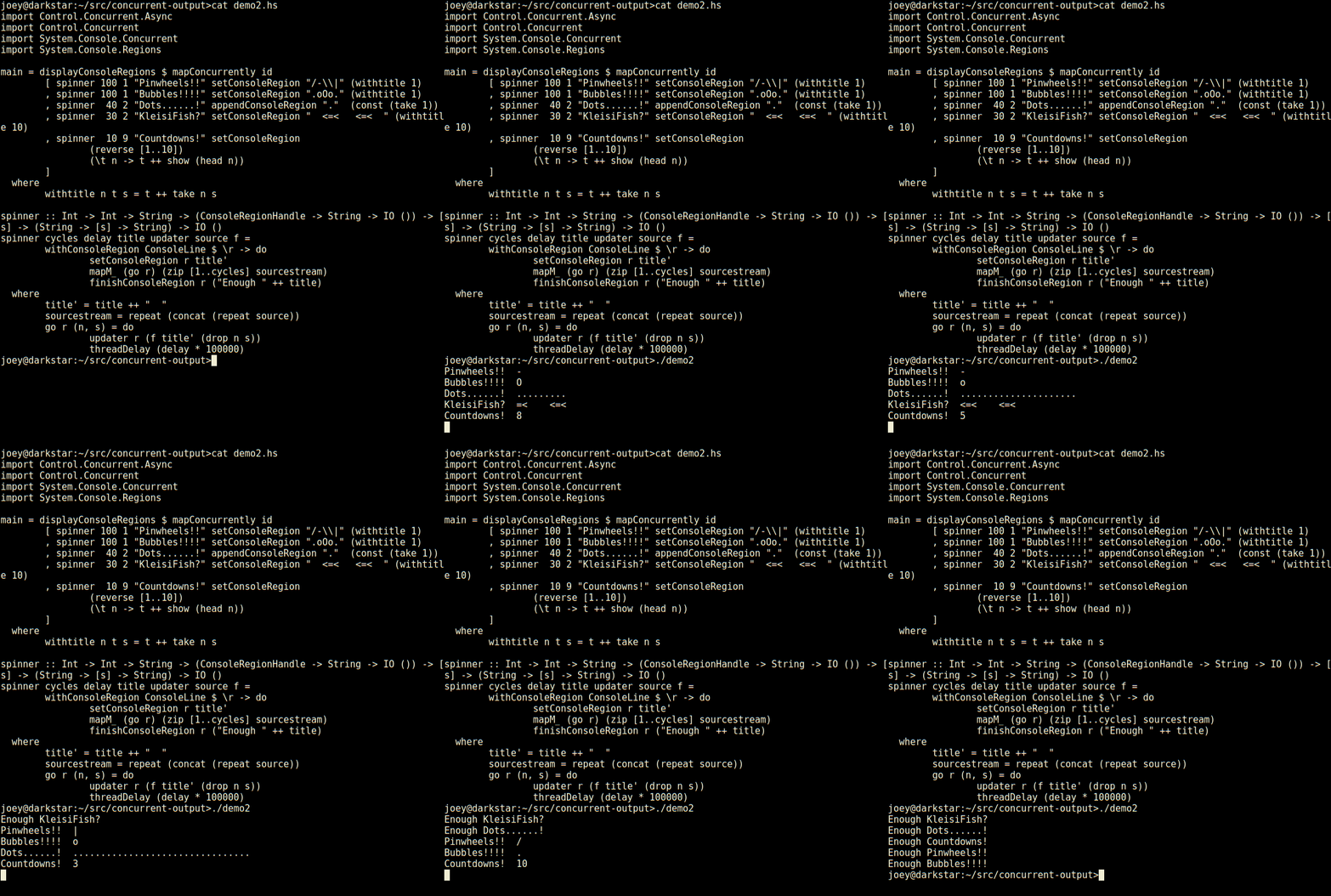
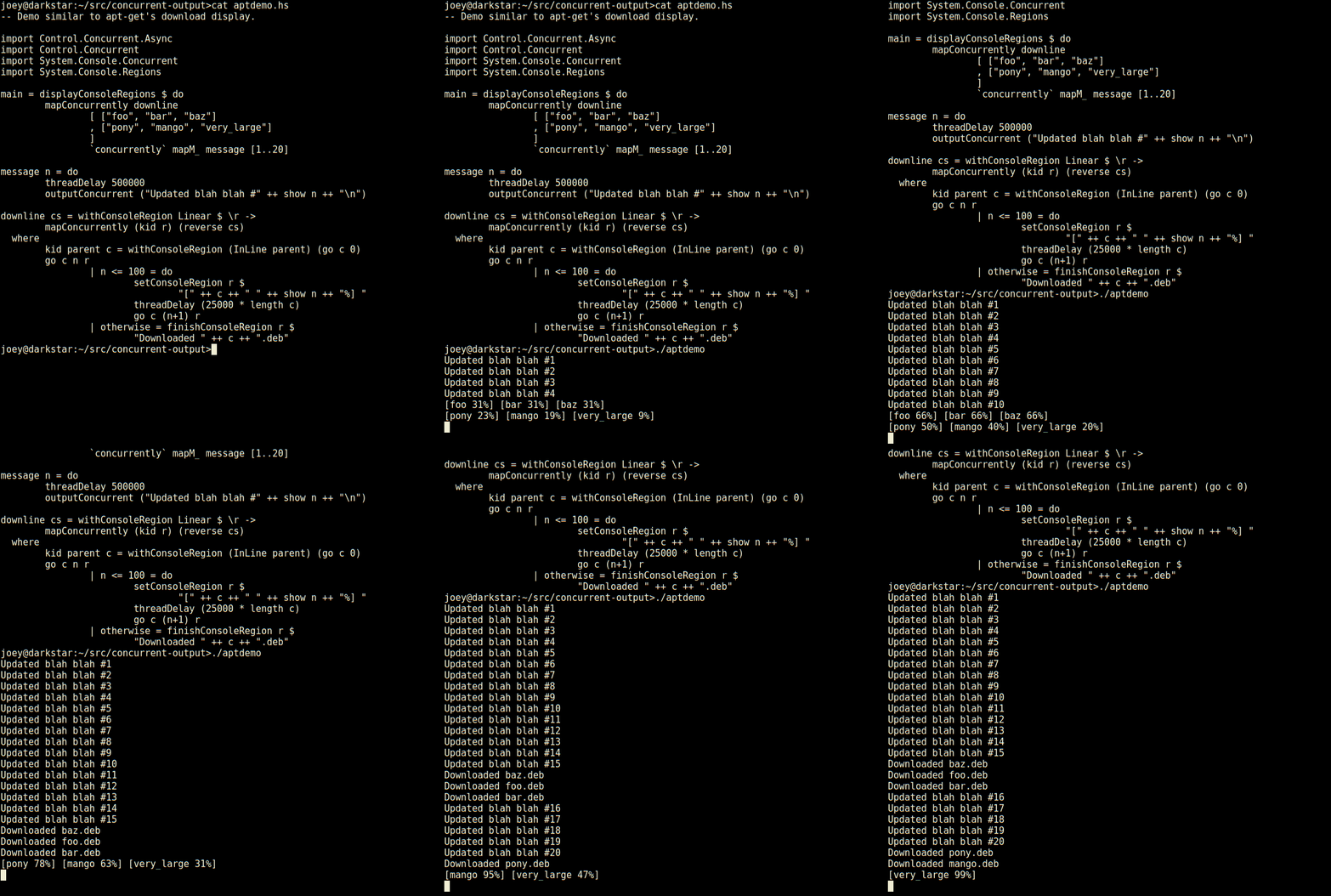
Building on top of concurrent-output, and some related work Joachim Breitner did earlier, I now have a kind of equivilant to a tiling window manager, except it's managing regions of the console for different parts of a single program. Here's a really silly demo, in an animated gif: demo2.gif Not bad for 23 lines of code, is that? Seems much less tedious to do things this way than using ncurses. Even with its panels, ncurses requires you to think about layout of various things on the screen, and many low-level details. This, by contrast, is compositional, just add another region and a thread to update it, and away it goes. So, here's an apt-like download progress display, in 30 lines of code. aptdemo.gif Not only does it have regions which are individual lines of the screen, but those can have sub-regions within them as seen here (and so on). And, log-type messages automatically scroll up above the regions. External programs run by createProcessConcurrent will automatically get their output/errors displayed there, too. What I'm working on now is support for multiline regions, which automatically grow/shrink to fit what's placed in them. The hard part, which I'm putting the finishing touches on, is to accurately work out how large a region is before displaying it, in order to lay it out. Requires parsing ANSI codes amoung other things. STM rules There's so much concurrency, with complicated interrelated data being updated by different threads, that I couldn't have possibly built this without Software Transactional Memory. Rather than a nightmare of locks behind locks behind locks, the result is so well behaved that I'm confident that anyone who needs more control over the region layout, or wants to do funky things can dive into to the STM interface and update the data structures, and nothing will ever deadlock or be inconsistent, and as soon as an update completes, it'll display on-screen. An example of how powerful and beuatiful STM is, here's how the main display thread determines when it needs to refresh the display:
data DisplayChange
        = BufferChange [(StdHandle, OutputBuffer)]
          RegionChange RegionSnapshot
          TerminalResize (Maybe Width)
          EndSignal ()
    ...
                change <- atomically $
                        (RegionChange <$> regionWaiter origsnapshot)
                                 orElse 
                        (RegionChange <$> regionListWaiter origsnapshot)
                                 orElse 
                        (BufferChange <$> outputBufferWaiterSTM waitCompleteLines)
                                 orElse 
                        (TerminalResize <$> waitwidthchange)
                                 orElse 
                        (EndSignal <$> waitTSem endsignal)
                case change of
                        RegionChange snapshot -> do
                ...
                        BufferChange buffers -> do
                ...
                        TerminalResize width -> do
                ...
So, it composes all these STM actions that can wait on various kinds of changes, to get one big action, that waits for all of the above, and builds up a nice sum type to represent what's changed. Another example is that the whole support for sub-regions only involved adding 30 lines of code, all of it using STM, and it worked 100% the first time.
Available in concurrent-output 1.1.0.

27 October 2015

Lunar: Reproducible builds: week 26 in Stretch cycle

What happened in the reproducible builds effort this week: Toolchain fixes Mattia Rizzolo created a bug report to continue the discussion on storing cryptographic checksums of the installed .deb in dpkg database. This follows the discussion that happened in June and is a pre-requisite to add checksums to .buildinfo files. Niko Tyni identified why the Vala compiler would generate code in varying order. A better patch than his initial attempt still needs to be written. Packages fixed The following 15 packages became reproducible due to changes in their build dependencies: alt-ergo, approx, bin-prot, caml2html, coinst, dokujclient, libapreq2, mwparserfromhell, ocsigenserver, python-cryptography, python-watchdog, slurm-llnl, tyxml, unison2.40.102, yojson. The following packages became reproducible after getting fixed: Some uploads fixed some reproducibility issues but not all of them: reproducible.debian.net pbuilder has been updated to version 0.219~bpo8+1 on all eight build nodes. (Mattia Rizzolo, h01ger) Packages that FTBFS but for which no open bugs have been recorded are now tested again after 3 days. Likewise for depwait packages. (h01ger) Out of disk situations will not cause IRC notifications anymore. (h01ger) Documentation update Lunar continued to work on writing documentation for the future reproducible-builds.org website. Package reviews 44 reviews have been removed, 81 added and 48 updated this week. Chris West and Chris Lamb identified 70 fail to build from source issues. Misc. h01ger presented the project in Mexico City at the 3er Congreso de Seguridad de la Informaci n where it became clear that we lack academic papers related to reproducible builds. Bryan has been doing hard work to improve reproducibility for OpenWrt. He wrote a report linking to the patches and test results he published.

26 October 2015

Russ Allbery: Review: Hawk

Review: Hawk, by Steven Brust
Series: Vlad Taltos #14
Publisher: Tor
Copyright: October 2014
ISBN: 0-7653-2444-X
Format: Hardcover
Pages: 320
This is the fourteenth book in the Vlad Taltos series (not counting the various associated books and other series), builds directly on the long-term plot arc of the series (finally!), and is deeply entangled with Vlad's friends and former life as a Jhereg boss. As you might imagine from that introduction, this is absolutely not the place to start with this series. For the past few books, Brust has been following a pattern of advancing the series plot in one book and then taking the next book to fill in past history or tell some side story. That means, following Tiassa, we were due some series advancement, and that's exactly what we get. We also, finally, get some more details about Lady Teldra. Nothing all that revelatory, but certainly intriguing, and more than just additional questions (at last). When Brust finally takes this gun off the wall and fires it, the resulting bits of world-building might be even better than Issola. At its heart, though, Hawk is a caper novel. If you're like me, you're thinking "it's about time." I think this is the sort of story Brust excels at, particularly with Vlad as his protagonist. Even better, unlike some of the other multi-part novels, this is a book-length caper focused on a very important goal, and with the potential to get rid of some annoyances in Vlad's life that have lingered for rather too long. We see many of Vlad's Dragaeran friends, but (apart from Daymar) mostly in glimpses. This is Vlad's book, with heavy helpings of Loiosh. The caper is also a nicely twisty one, involving everything from different types of magic to the inner workings of the Jhereg organization. As is typical for Vlad's schemes, there are several false fronts and fake goals, numerous unexpected twists, and a rather fun guest appearance. Oh, and lots and lots of snark, of course. I think my favorite part of the book was the interaction between Vlad and Kragar, which added a lot of emotional depth both to this story and to some of the previous stories of Vlad's life as a Jhereg. And I'm hoping that where Brust leaves things at the end of this book implies a Vlad who is more free to act, to see his friends, and to get entangled in Imperial politics, since I think that leads to the best stories. Of course, if Brust holds to pattern, the next book will be backfill or side stories and we'll have to wait longer for a continuation of the main story. As much as I like those side stories, I'm hoping Brust will break pattern. I'm increasingly eager to see where this story will go. The all-too-brief interaction with Sethra in this book promises so much for the future. If you like the Vlad Taltos books overall, you'll probably like this one. It's a return to the old scheming Vlad, but tempered by more experience and different stakes. There's a bit of lore, a bit of world-building, and a lot of Vlad being tricky. This series is still going strong fourteen books in. Rating: 8 out of 10

Next.

Previous.