Daniel Pocock: Free Real-time Communications (RTC) at DebConf15, Heidelberg
So we're in Finland, and the differences start out immediately.
We're renting a flat, in building ten, on a street. You'd think "10
Streetname" was a single building, but no. It is a pair of buildings: 10A, and 10B.
Both of the buildings have 12 flats in them, with 10A having 1-12, and 10B having 13-24.
There's a keypad at the main entrance, which I assumed was to let you press a button and talk to the people inside "Hello I'm the postmaster", but no. There is no intercom system, instead you type in a magic number and the door opens.
The magic number? Sounds like you want to keep that secret, since it lets people into the common-area? No. Everybody has it. The postman, the cleaners, the DHL delivery man, and all the ex-tenants. We invited somebody over recently and gave it out in advance so that they could knock on our flat-door.
Talking of cleaners: In the UK I lived in a flat and once a fortnight somebody would come and sweep the stair-well, since we didn't ever agree to do it ourselves. Here somebody turns up every day, be it to cut the grass, polish the hand-rail, clean the glass on the front-door, or mop the floors of the common area. Sounds awesome. But they cut the grass, right outside our window, at 7:30AM. On the dot. (Or use a leaf-blower, or something equally noisy.)
All this communal-care is paid for by the building-association, of which all flat-owners own shares. Sounds like something we see in England, or even like Americas idea of a Home-Owners-Association. (In Scotland you own your own flat, you don't own shares of an entity which owns the complete building. I guess there are pros and cons to both approaches.)
Moving onwards other things are often the same, but the differences when you spot them are odd. I'm struggling to think of them right now, somebody woke me up by cutting our grass for the second time this week (!)
Anyway I'm registered now with the Finnish government, and have a citizen-number, which will be useful, I've got an appointment booked to register with the police - which is something I had to do as a foreigner within the first three months - and today I've got an appointment with a local bank so that I can have a euro-bank-account.
Happily I did find a gym to join, the owner came over one Sunday to
give me a tiny-tour, and then gave me a list of other gyms to try if
his wasn't good enough - which was a nice touch - I joined a couple of
days later, his gym is awesome.
(I'm getting paid in UK-pounds, to a UK-bank, so right now I'm getting local money by transferring to my wifes account here, but I want to do that to my own, and open a shared account for paying for rent, electricity, internet, water, & etc).
My flat back home is still not rented, because the nice property management company lost my keys. Yeah you can't make that up can you? With a bit of luck the second set of keys I mailed them will arrive soon and the damn thing can be occupied, while I'm not relying on that income I do wish to have it.
midna /tmp $ dh-make-golang github.com/jacobsa/ratelimit 2015/07/25 18:25:39 Downloading "github.com/jacobsa/ratelimit/..." 2015/07/25 18:25:53 Determining upstream version number 2015/07/25 18:25:53 Package version is "0.0~git20150723.0.2ca5e0c" 2015/07/25 18:25:53 Determining dependencies 2015/07/25 18:25:55 2015/07/25 18:25:55 Packaging successfully created in /tmp/golang-github-jacobsa-ratelimit 2015/07/25 18:25:55 2015/07/25 18:25:55 Resolve all TODOs in itp-golang-github-jacobsa-ratelimit.txt, then email it out: 2015/07/25 18:25:55 sendmail -t -f < itp-golang-github-jacobsa-ratelimit.txt 2015/07/25 18:25:55 2015/07/25 18:25:55 Resolve all the TODOs in debian/, find them using: 2015/07/25 18:25:55 grep -r TODO debian 2015/07/25 18:25:55 2015/07/25 18:25:55 To build the package, commit the packaging and use gbp buildpackage: 2015/07/25 18:25:55 git add debian && git commit -a -m 'Initial packaging' 2015/07/25 18:25:55 gbp buildpackage --git-pbuilder 2015/07/25 18:25:55 2015/07/25 18:25:55 To create the packaging git repository on alioth, use: 2015/07/25 18:25:55 ssh git.debian.org "/git/pkg-go/setup-repository golang-github-jacobsa-ratelimit 'Packaging for golang-github-jacobsa-ratelimit'" 2015/07/25 18:25:55 2015/07/25 18:25:55 Once you are happy with your packaging, push it to alioth using: 2015/07/25 18:25:55 git push git+ssh://git.debian.org/git/pkg-go/packages/golang-github-jacobsa-ratelimit.git --tags master pristine-tar upstreamThe ITP is often the most labor-intensive part of the packaging process, because any number of auto-detected values might be wrong: the repository owner might not be the Upstream Author , the repository might not have a short description, the long description might need some adjustments or the license might not be auto-detected.
midna /tmp $ cat itp-golang-github-jacobsa-ratelimit.txt From: "Michael Stapelberg" <stapelberg AT debian.org> To: submit@bugs.debian.org Subject: ITP: golang-github-jacobsa-ratelimit -- Go package for rate limiting Content-Type: text/plain; charset=utf-8 Content-Transfer-Encoding: 8bit Package: wnpp Severity: wishlist Owner: Michael Stapelberg <stapelberg AT debian.org> * Package name : golang-github-jacobsa-ratelimit Version : 0.0~git20150723.0.2ca5e0c-1 Upstream Author : Aaron Jacobs * URL : https://github.com/jacobsa/ratelimit * License : Apache-2.0 Programming Lang: Go Description : Go package for rate limiting GoDoc (https://godoc.org/github.com/jacobsa/ratelimit) . This package contains code for dealing with rate limiting. See the reference (http://godoc.org/github.com/jacobsa/ratelimit) for more info. TODO: perhaps reasoning midna /tmp $After filling in all the TODOs in the file, let s mail it out and get a sense of what else still needs to be done:
midna /tmp $ sendmail -t -f < itp-golang-github-jacobsa-ratelimit.txt midna /tmp $ cd golang-github-jacobsa-ratelimit midna /tmp/golang-github-jacobsa-ratelimit master $ grep -r TODO debian debian/changelog: * Initial release (Closes: TODO) midna /tmp/golang-github-jacobsa-ratelimit master $After filling in these TODOs as well, let s have a final look at what we re about to build:
midna /tmp/golang-github-jacobsa-ratelimit master $ head -100 debian/**/* ==> debian/changelog <== golang-github-jacobsa-ratelimit (0.0~git20150723.0.2ca5e0c-1) unstable; urgency=medium * Initial release (Closes: #793646) -- Michael Stapelberg <stapelberg@debian.org> Sat, 25 Jul 2015 23:26:34 +0200 ==> debian/compat <== 9 ==> debian/control <== Source: golang-github-jacobsa-ratelimit Section: devel Priority: extra Maintainer: pkg-go <pkg-go-maintainers@lists.alioth.debian.org> Uploaders: Michael Stapelberg <stapelberg@debian.org> Build-Depends: debhelper (>= 9), dh-golang, golang-go, golang-github-jacobsa-gcloud-dev, golang-github-jacobsa-oglematchers-dev, golang-github-jacobsa-ogletest-dev, golang-github-jacobsa-syncutil-dev, golang-golang-x-net-dev Standards-Version: 3.9.6 Homepage: https://github.com/jacobsa/ratelimit Vcs-Browser: http://anonscm.debian.org/gitweb/?p=pkg-go/packages/golang-github-jacobsa-ratelimit.git;a=summary Vcs-Git: git://anonscm.debian.org/pkg-go/packages/golang-github-jacobsa-ratelimit.git Package: golang-github-jacobsa-ratelimit-dev Architecture: all Depends: $ shlibs:Depends , $ misc:Depends , golang-go, golang-github-jacobsa-gcloud-dev, golang-github-jacobsa-oglematchers-dev, golang-github-jacobsa-ogletest-dev, golang-github-jacobsa-syncutil-dev, golang-golang-x-net-dev Built-Using: $ misc:Built-Using Description: Go package for rate limiting This package contains code for dealing with rate limiting. See the reference (http://godoc.org/github.com/jacobsa/ratelimit) for more info. ==> debian/copyright <== Format: http://www.debian.org/doc/packaging-manuals/copyright-format/1.0/ Upstream-Name: ratelimit Source: https://github.com/jacobsa/ratelimit Files: * Copyright: 2015 Aaron Jacobs License: Apache-2.0 Files: debian/* Copyright: 2015 Michael Stapelberg <stapelberg@debian.org> License: Apache-2.0 Comment: Debian packaging is licensed under the same terms as upstream License: Apache-2.0 Licensed under the Apache License, Version 2.0 (the "License"); you may not use this file except in compliance with the License. You may obtain a copy of the License at . http://www.apache.org/licenses/LICENSE-2.0 . Unless required by applicable law or agreed to in writing, software distributed under the License is distributed on an "AS IS" BASIS, WITHOUT WARRANTIES OR CONDITIONS OF ANY KIND, either express or implied. See the License for the specific language governing permissions and limitations under the License. . On Debian systems, the complete text of the Apache version 2.0 license can be found in "/usr/share/common-licenses/Apache-2.0". ==> debian/gbp.conf <== [DEFAULT] pristine-tar = True ==> debian/rules <== #!/usr/bin/make -f export DH_GOPKG := github.com/jacobsa/ratelimit %: dh $@ --buildsystem=golang --with=golang ==> debian/source <== head: error reading debian/source : Is a directory ==> debian/source/format <== 3.0 (quilt) midna /tmp/golang-github-jacobsa-ratelimit master $Okay, then. Let s give it a shot and see if it builds:
midna /tmp/golang-github-jacobsa-ratelimit master $ git add debian && git commit -a -m 'Initial packaging' [master 48f4c25] Initial packaging 7 files changed, 75 insertions(+) create mode 100644 debian/changelog create mode 100644 debian/compat create mode 100644 debian/control create mode 100644 debian/copyright create mode 100644 debian/gbp.conf create mode 100755 debian/rules create mode 100644 debian/source/format midna /tmp/golang-github-jacobsa-ratelimit master $ gbp buildpackage --git-pbuilder [ ] midna /tmp/golang-github-jacobsa-ratelimit master $ lintian ../golang-github-jacobsa-ratelimit_0.0\~git20150723.0.2ca5e0c-1_amd64.changes I: golang-github-jacobsa-ratelimit source: debian-watch-file-is-missing P: golang-github-jacobsa-ratelimit-dev: no-upstream-changelog I: golang-github-jacobsa-ratelimit-dev: extended-description-is-probably-too-short midna /tmp/golang-github-jacobsa-ratelimit master $This package just built (as it should!), but occasionally one might need to disable a test and file an upstream bug about it. So, let s push this package to pkg-go and upload it:
midna /tmp/golang-github-jacobsa-ratelimit master $ ssh git.debian.org "/git/pkg-go/setup-repository golang-github-jacobsa-ratelimit 'Packaging for golang-github-jacobsa-ratelimit'" Initialized empty shared Git repository in /srv/git.debian.org/git/pkg-go/packages/golang-github-jacobsa-ratelimit.git/ HEAD is now at ea6b1c5 add mrconfig for dh-make-golang [master c5be5a1] add mrconfig for golang-github-jacobsa-ratelimit 1 file changed, 3 insertions(+) To /git/pkg-go/meta.git ea6b1c5..c5be5a1 master -> master midna /tmp/golang-github-jacobsa-ratelimit master $ git push git+ssh://git.debian.org/git/pkg-go/packages/golang-github-jacobsa-ratelimit.git --tags master pristine-tar upstream Counting objects: 31, done. Delta compression using up to 8 threads. Compressing objects: 100% (25/25), done. Writing objects: 100% (31/31), 18.38 KiB 0 bytes/s, done. Total 31 (delta 2), reused 0 (delta 0) To git+ssh://git.debian.org/git/pkg-go/packages/golang-github-jacobsa-ratelimit.git * [new branch] master -> master * [new branch] pristine-tar -> pristine-tar * [new branch] upstream -> upstream * [new tag] upstream/0.0_git20150723.0.2ca5e0c -> upstream/0.0_git20150723.0.2ca5e0c midna /tmp/golang-github-jacobsa-ratelimit master $ cd .. midna /tmp $ debsign golang-github-jacobsa-ratelimit_0.0\~git20150723.0.2ca5e0c-1_amd64.changes [ ] midna /tmp $ dput golang-github-jacobsa-ratelimit_0.0\~git20150723.0.2ca5e0c-1_amd64.changes Uploading golang-github-jacobsa-ratelimit using ftp to ftp-master (host: ftp.upload.debian.org; directory: /pub/UploadQueue/) [ ] Uploading golang-github-jacobsa-ratelimit_0.0~git20150723.0.2ca5e0c-1.dsc Uploading golang-github-jacobsa-ratelimit_0.0~git20150723.0.2ca5e0c.orig.tar.bz2 Uploading golang-github-jacobsa-ratelimit_0.0~git20150723.0.2ca5e0c-1.debian.tar.xz Uploading golang-github-jacobsa-ratelimit-dev_0.0~git20150723.0.2ca5e0c-1_all.deb Uploading golang-github-jacobsa-ratelimit_0.0~git20150723.0.2ca5e0c-1_amd64.changes midna /tmp $ cd golang-github-jacobsa-ratelimit midna /tmp/golang-github-jacobsa-ratelimit master $ git tag debian/0.0_git20150723.0.2ca5e0c-1 midna /tmp/golang-github-jacobsa-ratelimit master $ git push git+ssh://git.debian.org/git/pkg-go/packages/golang-github-jacobsa-ratelimit.git --tags master pristine-tar upstream Total 0 (delta 0), reused 0 (delta 0) To git+ssh://git.debian.org/git/pkg-go/packages/golang-github-jacobsa-ratelimit.git * [new tag] debian/0.0_git20150723.0.2ca5e0c-1 -> debian/0.0_git20150723.0.2ca5e0c-1 midna /tmp/golang-github-jacobsa-ratelimit master $Thanks for reading this far, and I hope dh-make-golang makes your life a tiny bit easier. As dh-make-golang just entered Debian unstable, you can install it using
apt-get install
dh-make-golang. If you have any feedback, I m eager to hear it.
Hadley is a popular figure, and rightly so as he successfully introduced many newcomers to the wonders offered by R. His approach strikes some of us old greybeards as wrong---I particularly take exception with some of his writing which frequently portrays a particular approach as both the best and only one. Real programming, I think, is often a little more nuanced and aware of tradeoffs which need to be balanced. As a book on another language once popularized: "There is more than one way to do things." But let us leave this discussion for another time.
As the reach of the Hadleyverse keeps spreading, we sometimes find ourselves at the receiving end of a cost/benefit tradeoff. That is what this post is about, and it uses a very concrete case I encountered yesterday.
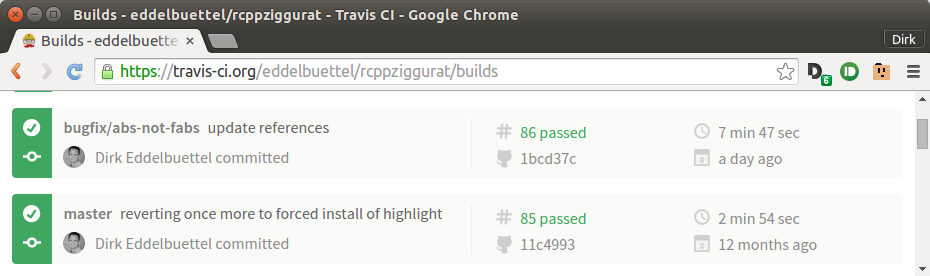
As blogged earlier, the RcppZiggurat package was updated. I had not touched it in a year, but Brian Ripley had sent a brief and detailed note concerning something flagged by the Solaris compiler (correctly suggesting I replace fabs() with abs() on integer types). (Allow me to stray from the main story line here for a second to stress just how insane a work load he is carrying, essentially for all of us. R and the R community are so just so indebted to him for all his work---which makes the usual social media banter about him so unfortunate. But that too shall be left for another time.) Upon making the simple fix, and submitting to GitHub the usual Travis CI was triggered. And here is what I saw:

- ./travis-tool.sh install_r RcppGSL rbenchmark microbenchmark highlight
which implies source builds of the four listed packages and all their dependencies with the following line implying binary installations of already built packages:
- ./travis-tool.sh install_aptget libgsl0-dev r-cran-rcppgsl r-cran-rbenchmark r-cran-microbenchmark r-cran-highlight
In this particular case I also needed to build a binary package of my RcppGSL package as this one is not (yet) handled by Michael. I happen to have (re-)discovered the beauty of PPAs for Travis earlier this year and revitalized an older and largely dormant launchpad account I had for this PPA of mine. How to build a simple .deb package will also have to left for a future post to keep this more concise.
This can be used with the existing r-travis setup---but one needs to use the older, initial variant in order to have the ability to install .deb packages. So in the .travis.yml of RcppZiggurat I just use
before_install:
## PPA for Rcpp and some other packages
- sudo add-apt-repository -y ppa:edd/misc
## r-travis by Craig Citro et al
- curl -OL http://raw.github.com/craigcitro/r-travis/master/scripts/travis-tool.sh
- chmod 755 ./travis-tool.sh
- ./travis-tool.sh bootstrap
to add my own PPA and all is good. If you do not have a PPA, or do not want to create your own packages you can still benefit from the PPAs by Michael and "mix and match" by installing from binary what is available, and from source what is not.
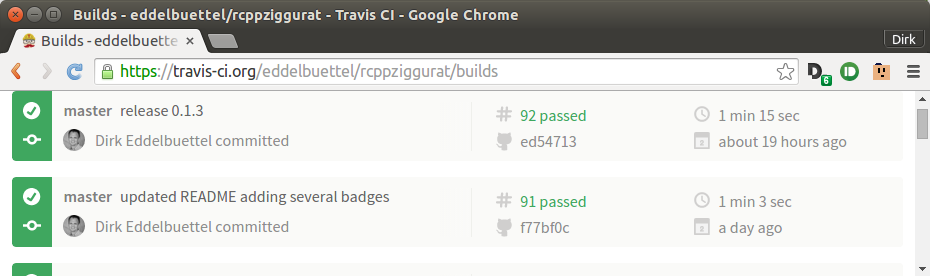
Here we were able to use an all-binary approach, so let's see the resulting performance:

Follow-up: The post got some pretty immediate feedback shortly after I posted it. Craig Citro pointed out (quite correctly) that I could use r_binary_install which would also install the Ubuntu binaries based on their R packages names. Having built R/CRAN packages for Debian for so long, I am simply more used to the r-cran-* notations, and I think I was also the one contributing install_aptget to r-travis ... Yihui Xie spoke up for the "new" Travis approach deploying containers, caching of packages and explicit whitelists. It was in that very (GH-based) discussion that I started to really lose faith in the new Travis approach as they want use to whitelist each and every package. With 6900 and counting at CRAN I fear this simply does not scale. But different approaches are certainly welcome. I posted my 1:03 to 1:15 minutes result. If the "New School" can do it faster, I'd be all ears.
This post by Dirk Eddelbuettel originated on his Thinking inside the box blog. Please report excessive re-aggregation in third-party for-profit settings.
What happened in the reproducible
builds effort this week:
Toolchain fixes
DEB_CHANGELOG_DATETIME with non English locales.SOURCE_DATE_EPOCH and use UTC as a timezone. A modified package is now being experimented.
Packages fixed
The following 14 packages became reproducible due to changes in their
build dependencies:
bino,
cfengine2,
fwknop,
gnome-software,
jnr-constants,
libextractor,
libgtop2,
maven-compiler-plugin,
mk-configure,
nanoc,
octave-splines,
octave-symbolic,
riece,
vdr-plugin-infosatepg.
The following packages became reproducible after getting fixed:
debian/changelog entry.debian/changelog entry.debian/changelog entry.debian/changelog entry.debian/changelog entry.debian/changelog entry.debian/changelog entry.debian/changelog entry.debian/changelog entry.debian/changelog entry.debian/changelog entry.debian/changelog entry.debian/changelog entry.debian/changelog entry.debian/changelog entry.debian/changelog entry.debian/changelog entry.debian/changelog entry.debian/changelog entry.debian/changelog entry.debian/changelog entry.debian/changelog entry.debian/changelog entry.debian/changelog entry.debian/changelog entry.debian/changelog entry.debian/changelog entry.debian/changelog entry.debian/changelog entry.debian/changelog entry.debian/changelog entry.debian/changelog entry.debian/changelog entry.debian/changelog entry.debian/changelog entry.debian/changelog entry.debian/changelog entry.debian/changelog entry.debian/changelog entry.debian/changelog entry.debian/changelog entry.debian/changelog entry.debian/changelog entry.debian/changelog entry.debian/changelog entry.debian/changelog entry.debian/changelog entry.debian/changelog entry.debian/changelog entry.debian/changelog entry.TZ=UTC when calling zip.TZ=UTC when calling zip.TZ=UTC when calling zip.
Some time ago we've decided to move phpMyAdmin out of SourceForge.net services. This was mostly motivated by issues with sf.net bundling crapware with installers (though we were not affected), but also we've missed some features that we would like to have and were not possible there.
The project relied on SourceForge.net with several services. The biggest ones being website and downloads hosting, issue tracking and mailing lists. We've chosen different approach for each of these.
As first, we've moved away website and downloads. Thanks to generous offer of CDN77.com, everything went quite smoothly and we now have HTTPS secured website and downloads, see our announcement. Oh and on the way we've started to PGP sign the releases as well, so you can verify the download.
Shortly after this SourceForge.net was hit by major problems with infrastructure. Unfortunately we were not yet completely ready with rest of the migration, but this has definitely pushed us to make progress faster.
During the outage, we've opened up issue tracker on GitHub, to be able to receive bug reports from our users. On the background I've worked on the issue migration. The good news is that as of now almost all issues are migrated. There are few missing ones, but these will be hopefully handled in upcoming days as well.
Last but not least, we had mailing lists on SourceForge.net. We've shortly discussed available options and decided to run own mail server with these. It will allow us greater flexibility while still using well know software in background. Initial attempts with Mailman 3 failed, so we got back to Mailman 2, which is stable and easy to configure. See also our news posts for official announcement.
Thanks to SourceForge.net, it has been great home for us, but now we have better places to live.
Filed under: English phpMyAdmin 0 comments
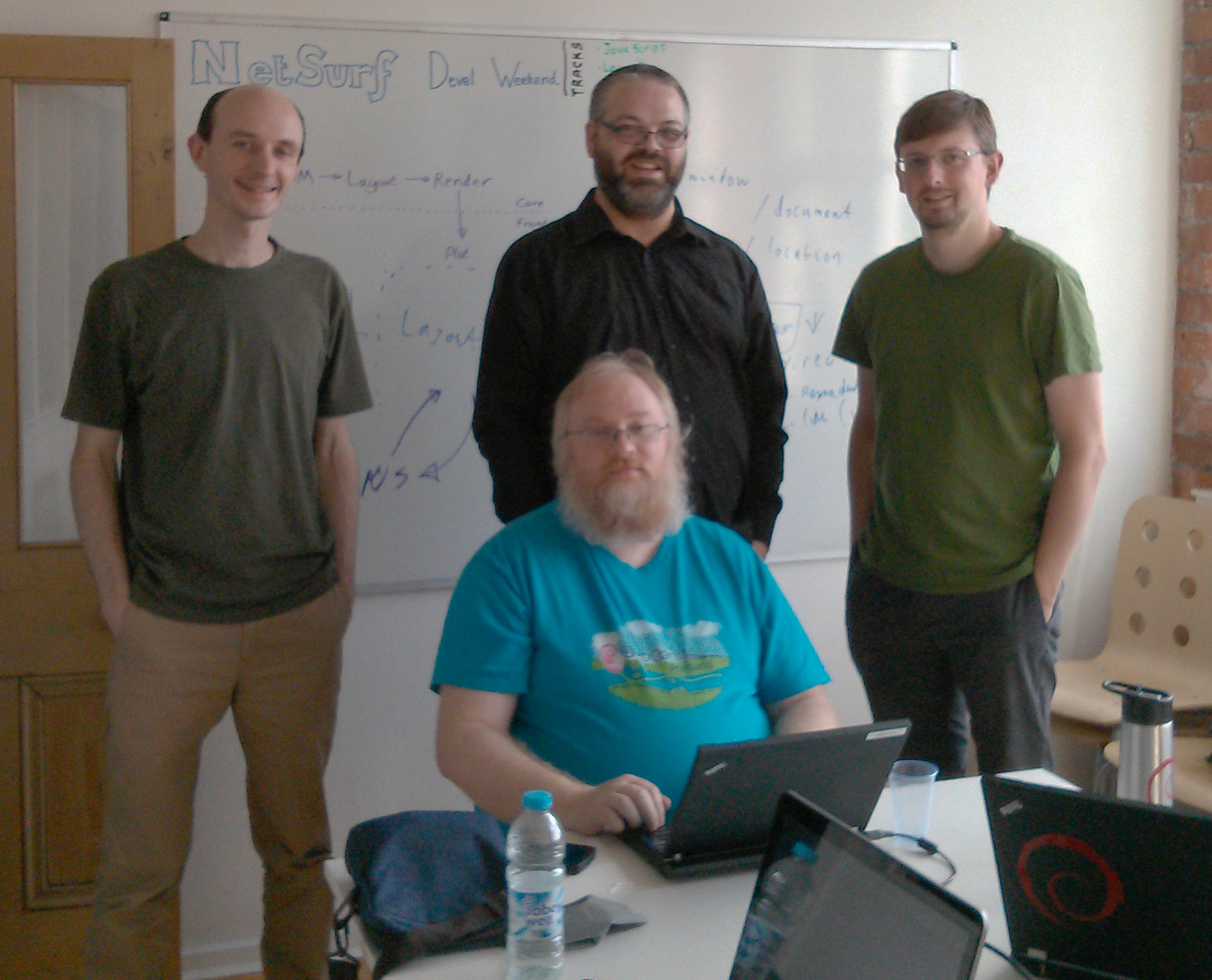
The fifth developer weekend was an opportunity for us to gather in a pleasant setting and work together in person. We were graciously hosted, once again, by Codethink in their Manchester offices.My credit card info was stolen when I used a wifi hotspot in an airport... Should I use open wifi networks? Is it safe to use my credit card for shopping online?Here is a modified version of an answer I sent to a friend recently which I thought could be useful to the larger internet community. The short answer is "sorry about that", "it depends, you generally can, but be careful" and "your credit card company is supposed to protect you".
https://accesd.desjardins.com/
in my case)
directly myself instead of clicking on links, bookmarks or using a
search engine to find my bank site.
In the case of credit cards, it is much trickier because when you buy
stuff online, you end up putting that credit card number on different
sites which you do not necessarily trust. There's no good solution
but complaining to your credit card company if you believe a
website you used has stolen your credit card details. You can also use
services like Paypal,
Dwolla or Bitcoin that hide your credit card details from the
seller, if they support the service.
I usually try to avoid putting my credit card details on sites I do
not trust, and limit myself to known parties
(e.g. Via Rail,
Air Canada, etc). Also, in general, I try to
assume the network connection between me and the website I visit is
compromised. This forced me to get familiar with online
security and use of encryption. It is more accessible to me than
trying to secure the infrastructure i am using, because i often do not
control it at all (e.g. internet cafes...).
Internet security is unfortunately a hard problem, and things are not
getting easier as more things move online. The burden is on us
programmers and system administrators to create systems that are more
secure and intuitive for our users so, as I said earlier, sorry the
internet sucks so much, we didn't think so many people would join the
acid trip of the 70s.
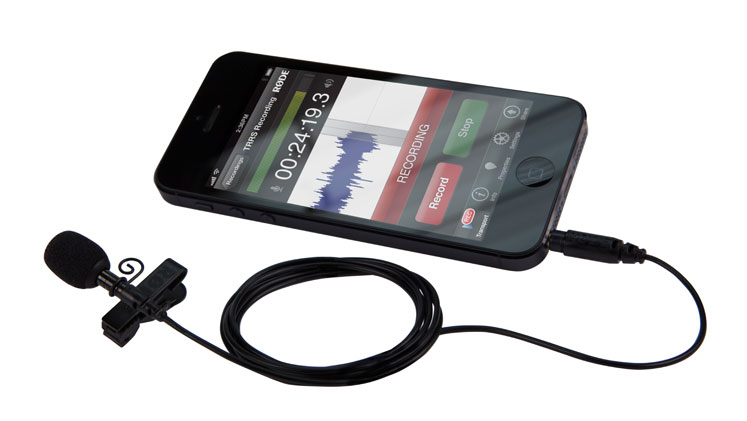
Full wireless microphone kits with microphone, transmitter and receiver are usually $US500 or more.
The lavalier / lapel microphone by itself, however, is relatively cheap, under $US100.
The lapel microphone is usually an omnidirectional microphone that will pick up the voices of everybody within a couple of meters of the person wearing it. It is useful for a speaker at an event, some types of interviews where the participants are at a table together and it may be suitable for a wedding, although you may want to remember to remove it from clothing during the photos.
There are two key features you need when using such a microphone with a smartphone:
lintian/vendors/ubuntu/main/data/changes-file/known-dists: 1077.00 B _path_info: 24.00 B date: 44.00 B group: 42.00 B name: 123.00 B owner: 42.00 B parent_dir: 24.00 B size: 42.00 B time: 42.00 B (overhead): 694.00 BWith time, date, owner and group being fixed sized strings (at most 15 characters). The size and _path_info fields being integers, parent_dir a reference (nulled). Finally, the name being a variable length string. Summed the values take less than half of the total object size. The remainder of ~700 bytes is just overhead . Time for another clean up:
lintian/vendors/ubuntu/main/data/changes-file/known-dists: 698.00 B _path_info: 24.00 B date_time: 56.00 B name: 123.00 B parent_dir: 24.00 B size: 24.00 B (overhead): 447.00 BStill a ~64% overhead, but at least we reduced the total size by 380 bytes (585 bytes for entries in binary packages). With these changes, the memory used for the lintian source index is now down to 3.62MB. This brings the total usage down to 7.01MB, which is a reduction to 56% of the original usage (a.k.a. the-almost-but-not-quite-50%-reduction ). But at least the results also carried over to libreoffice, which is now down to 284.83 MB (55% of original). The chromium-browser (source-only, version 32.0.1700.123-2) is down to 111.22MB from 179.44MB (61% of original, better results expected if processed with binaries). In closing, Lintian 2.5.34 will use slightly less memory than 2.5.33.
<?latex \theendnotes ?>Next, create a xsl stylesheet file dblatex-endnotes.xsl to add the code needed to add the endnote instructions in the preamble of the generated LaTeX document, with content like this:
<?xml version='1.0'?>
<xsl:stylesheet xmlns:xsl="http://www.w3.org/1999/XSL/Transform" version='1.0'>
<xsl:param name="latex.begindocument">
<xsl:text>
\usepackage endnotes
\let\footnote=\endnote
\def\enoteheading \mbox \par\vskip-\baselineskip
\begin document
</xsl:text>
</xsl:param>
</xsl:stylesheet>
Finally, load this xsl file when running dblatex, for example like
this:
dblatex --xsl-user=dblatex-endnotes.xsl freeculture.nb.xmlThe end result can be seen on github, where my book project is located.
(In order to avoid any ambiguity here, this is a personal opinion. The Free Software Foundation's opinion on this matter is here)Any redistribution of modified versions of Ubuntu must be approved, certified or provided by Canonical if you are going to associate it with the Trademarks. Otherwise you must remove and replace the Trademarks and will need to recompile the source code to create your own binaries.. The apparent aim here is to avoid situations where people take Ubuntu, modify it and continue to pass it off as Ubuntu. But it reaches far further than that. Cases where this may apply include (but are not limited to):
Debian is undertaking a huge effort to develop a reproducible builds system. I'd like to thank you for that. This could be Debian's most important project, with how badly computer security has been going.
PerniciousPunk in Reddit's Ask me anything! to Neil McGovern, DPL. What happened in the reproducible builds effort this week: Toolchain fixes More tools are getting patched to use the value of the SOURCE_DATE_EPOCH environment variable as the current time:
SOURCE_DATE_EPOCH to the time of the latest debian/changelog entry when exporting build flags, patch sent as #791823 (Dhole),texlive-bin (akira) and libxslt (Dhole) with the aforementioned support for SOURCE_DATE_EPOCH.debhelper exported TZ=UTC and this made packages capturing the current date (without the time) reproducible in the current test environment.
The following packages became reproducible after getting fixed:
debian/changelog date in the manpage.debian/changelog date as build date and use debian as the builder hostname.debian/changelog date as bui
ld date.reproducible.debian.net.
A couple of months ago, I was invited to give the starting course for the Masters degree in Free Software in the Universidad Andina Sim n Bol var university. UASB is a multinational university, with campuses in (at least) Ecuador, Chile, Bolivia and Colombia; I was doubtful at first regarding the seriousness of this proposal and the viability of the program, but time made my doubts disappear.
Bolivia is going through an interesting process, as they have one of the strongest worded government mandates for migration to free software for the public administration in the next couple of years; this migration has prompted the interest of many professionals in the country. In particular, we have over 40 registered people for this Masters degree. Studying a Masters degree is a long-term commitment which signifies a big time investment, and although many of the student are quite new to the idea of free software, they are willing to spend this time (and money, as the university is privately owned and charges for its enrollment).
I gave this class together with Alejandro Miranda (a.k.a. @pooka), as we have a very good pair-teaching dynamics; we had already given many conferences together, but this is the first time we had the opportunity to share a whole course and the experience was very good. We have read the students' logs, and many of them clearly agree with this.
I had to skip two of the (ten) lessons, as I travelled from Mexico to Argentina halfway through it (of course, we brought the babies to meet my wife's family and friends!), so we had also the honor of having Esteban Lima fill in for those sessions.
I am very happy and grateful that the University took care to record our presentations and intend to record and put online all of the classes; as we were the first in the program, there were some understandable hiccups and some sessions were lost, but most are available. Here they are, in case you are interested in refering to them:
| Topic | Video (my server) | Video (Youtube) |
|---|---|---|
| Introduction to free software | Watch | Watch |
| History | Watch | Watch |
| Free culture | N/A | N/A |
| The effects of free software | Watch | Watch |
| Free software and open standards related to technologic soverignity | Watch | Watch |
| The free software ecosystem | Watch | Watch |
| Free software implementation in Bolivia | Watch | Watch |
| Introduction to intelectual property: Copyright, patents, trademarks, etc. | Watch | Watch |
| Who is "the community" and why do we speak about it? | Watch | Watch |
| Current status and challenges for the movement | N/A | N/A |
What happened about the reproducible
builds effort this week:
Media coverage
Daniel Stender published an English translation of the article which originally
appeared in Linux Magazin in Admin Magazine.
Toolchain fixes
Fixes landed in the Debian archive:
--clamp-mtime option to tar.
Patches have been submitted to add support for SOURCE_DATE_EPOCH to txt2man (Reiner Herrmann), epydoc (Reiner Herrmann), GCC (Dhole), and Doxygen (akira).
Dhole uploaded a new experimental debhelper to the reproducible repository which exports SOURCE_DATE_EPOCH. As part of the experiment, the patch also sets TZ to UTC which should help with most timezone issues. It might still be problematic for some packages which would change their settings based on this.
Mattia Rizzolo sent upstream a patch originally written by Lunar to make the generate-id() function be deterministic in libxslt. While that patch was quickly rejected by upstream, Andrew Ayer came up with a much better one which sadly could have some performance impact. Daniel Veillard replied with another patch that should be deterministic in most cases without needing extra data structures. It's impact is currently being investigated by retesting packages on reproducible.debian.net.
akira added a new option to sbuild for configuring the path in which packages are built. This will be needed for the srebuild script.
Niko Tyni asked Perl upstream about it using the __DATE__ and __TIME__ C processor macros.
Packages fixed
The following 143 packages became reproducible due to changes in their
build dependencies:
alot,
argvalidate,
astroquery,
blender,
bpython,
brian,
calibre,
cfourcc,
chaussette,
checkbox-ng,
cloc,
configshell,
daisy-player,
dipy,
dnsruby,
dput-ng,
dsc-statistics,
eliom,
emacspeak,
freeipmi,
geant321,
gpick,
grapefruit,
heat-cfntools,
imagetooth,
jansson,
jmapviewer,
lava-tool,
libhtml-lint-perl,
libtime-y2038-perl,
lift,
lua-ldoc,
luarocks,
mailman-api,
matroxset,
maven-hpi-plugin,
mknbi,
mpi4py,
mpmath,
msnlib,
munkres,
musicbrainzngs,
nova,
pecomato,
pgrouting,
pngcheck,
powerline,
profitbricks-client,
pyepr,
pylibssh2,
pylogsparser,
pystemmer,
pytest,
python-amqp,
python-apt,
python-carrot,
python-crypto,
python-darts.lib.utils.lru,
python-demgengeo,
python-graph,
python-mock,
python-musicbrainz2,
python-pathtools,
python-pskc,
python-psutil,
python-pypump,
python-repoze.sphinx.autointerface,
python-repoze.tm2,
python-repoze.what-plugins,
python-repoze.what,
python-repoze.who-plugins,
python-xstatic-term.js,
reclass,
resource-agents,
rgain,
rttool,
ruby-aggregate,
ruby-archive-tar-minitar,
ruby-bcat,
ruby-blankslate,
ruby-coffee-script,
ruby-colored,
ruby-dbd-mysql,
ruby-dbd-odbc,
ruby-dbd-pg,
ruby-dbd-sqlite3,
ruby-dbi,
ruby-dirty-memoize,
ruby-encryptor,
ruby-erubis,
ruby-fast-xs,
ruby-fusefs,
ruby-gd,
ruby-git,
ruby-globalhotkeys,
ruby-god,
ruby-hike,
ruby-hmac,
ruby-integration,
ruby-ipaddress,
ruby-jnunemaker-matchy,
ruby-memoize,
ruby-merb-core,
ruby-merb-haml,
ruby-merb-helpers,
ruby-metaid,
ruby-mina,
ruby-net-irc,
ruby-net-netrc,
ruby-odbc,
ruby-packet,
ruby-parseconfig,
ruby-platform,
ruby-plist,
ruby-popen4,
ruby-rchardet,
ruby-romkan,
ruby-rubyforge,
ruby-rubytorrent,
ruby-samuel,
ruby-shoulda-matchers,
ruby-sourcify,
ruby-test-spec,
ruby-validatable,
ruby-wirble,
ruby-xml-simple,
ruby-zoom,
ryu,
simplejson,
spamassassin-heatu,
speaklater,
stompserver,
syncevolution,
syncmaildir,
thin,
ticgit,
tox,
transmissionrpc,
vdr-plugin-xine,
waitress,
whereami,
xlsx2csv,
zathura.
The following packages became reproducible after getting fixed:
debian/changelog entry as build datedebian/changelog entry.#defines..-i/--issues: schedule all packages affected by the given issue.-r/--status: schedule all packages with the given status.-b/--before: schedule all packages built before the given date-t/--after: schedule all packages built after the given date.--noisy: notify the IRC channel also when the build starts, with a URL to watch it in real time.
The Evil Maid attack has been discussed for some time - in short, it's the idea that most security mechanisms on your laptop can be subverted if an attacker is able to gain physical access to your system (for instance, by pretending to be the maid in a hotel). Most disk encryption systems will fall prey to the attacker replacing the initial boot code of your system with something that records and then exfiltrates your decryption passphrase the next time you type it, at which point the attacker can simply steal your laptop the next day and get hold of all your data.
After Jesse Frazelle blogged about the online abuse she receives, a common reaction in various forums[1] was "This isn't a tech industry problem - this is what being on the internet is like"[2]. And yes, they're right. Abuse of women on the internet isn't limited to people in the tech industry. But the severity of a problem is a product of two separate factors: its prevalence and what impact it has on people.
What happened about the reproducible
builds effort this week:
Toolchain fixes
Norbert Preining uploaded texinfo/6.0.0.dfsg.1-2 which makes texinfo indices reproducible. Original patch by Chris Lamb.
Lunar submitted recently rebased patches to make the file order of files inside .deb stable.
akira filled #789843 to make tex4ht stop printing timestamps in its HTML output by default.
Dhole wrote a patch for xutils-dev to prevent timestamps when creating gzip compresed files.
Reiner Herrmann sent a follow-up patch for wheel to use UTC as timezone when outputing timestamps.
Mattia Rizzolo started a discussion regarding the failure to build from source of subversion when -Wdate-time is added to CPPFLAGS which happens when asking dpkg-buildflags to use the reproducible profile. SWIG errors out because it doesn't recognize the aforementioned flag.
Trying to get the .buildinfo specification to more definitive state, Lunar started a discussion on storing the checksums of the binary package used in dpkg status database.
akira discovered while proposing a fix for simgrid that CMake internal command to create tarballs would record a timestamp in the gzip header. A way to prevent it is to use the GZIP environment variable to ask gzip not to store timestamps, but this will soon become unsupported. It's up for discussion if the best place to fix the problem would be to fix it for all CMake users at once.
Infrastructure-related work
Andreas Henriksson did a delayed NMU upload of pbuilder which adds minimal support for build profiles and includes several fixes from Mattia Rizzolo affecting reproducibility tests.
Neils Thykier uploaded lintian which both raises the severity of package-contains-timestamped-gzip and avoids false positives for this tag (thanks to Tomasz Buchert).
Petter Reinholdtsen filled #789761 suggesting that how-can-i-help should prompt its users about fixing reproducibility issues.
Packages fixed
The following packages became reproducible due to changes in their
build dependencies:
autorun4linuxcd,
libwildmagic,
lifelines,
plexus-i18n,
texlive-base,
texlive-extra,
texlive-lang.
The following packages became reproducible after getting fixed:
debian/changelog entry.CMakeLists.txt to give GZIP=-n for tar.__DATE__ and __TIME__ macros.HTML_TIMESTAMP=NO in Doxygen configuration.HTML_TIMESTAMP=NO to Doxygen.$datetime from footer.html used by Doxygen.HTML_TIMESTAMP=NO in Doxygen configuration.$Storable::canonical = 1 to make space_groups.db.PL output deterministic.HTML_TIMESTAMP=NO in Doxygen configuration.HTML_TIMESTAMP=NO in Doxygen configuration.HTML_TIMESTAMP=NO in Doxygen configuration.HTML_TIMESTAMP=NO in Doxygen configuration.HTML_TIMESTAMP=NO in Doxygen configuration.$datetime from the footer.HTML_TIMESTAMP=NO in Doxygen configuration.LC_ALL to C before sorting.debian/changelog as build datejavap, readelf, objdump, zipinfo, unsqusahfs; useless MD5 checksum and last modified date in javap output; bad handling of charsets in PO files; the destination path for gzip compressed files not ending in .gz; only metadata of cpio archives were actually compared. stat output was further trimmed to make directory comparison more useful.
Having the test suite enabled a refactoring of how comparators were written, switching from a forest of differences to a single tree. This helped removing dust from the oldest parts of the code.
Together with some other small changes, version 25 was released on June 27th. A follow up release was made the next day to fix a hole in the test suite and the resulting unidentified leftover from the comparator refactoring. (Lunar)
Documentation update
Ximin Luo improved code examples for some proposed environment variables for reference timestamps. Dhole added an example on how to fix timestamps C pre-processor macros by adding a way to set the build date externally. akira documented her fix for tex4ht timestamps.
Package reviews
94 obsolete
reviews have
been removed, 330 added and 153 updated this week.
Hats off for Chris West (Faux) who investigated many fail to build from source issues and reported the relevant bugs.
Slight improvements were made to the scripts for editing the review database, edit-notes and clean-notes. (Mattia Rizzolo)
Meetings
A meeting was held on June 23rd. Minutes are available.
The next meeting will happen on Tuesday 2015-07-07 at 17:00 UTC.
Misc.
The Linux Foundation announced that it was funding the work of Lunar and h01ger on reproducible builds in Debian and other distributions. This was further relayed in a Bits from Debian blog post.
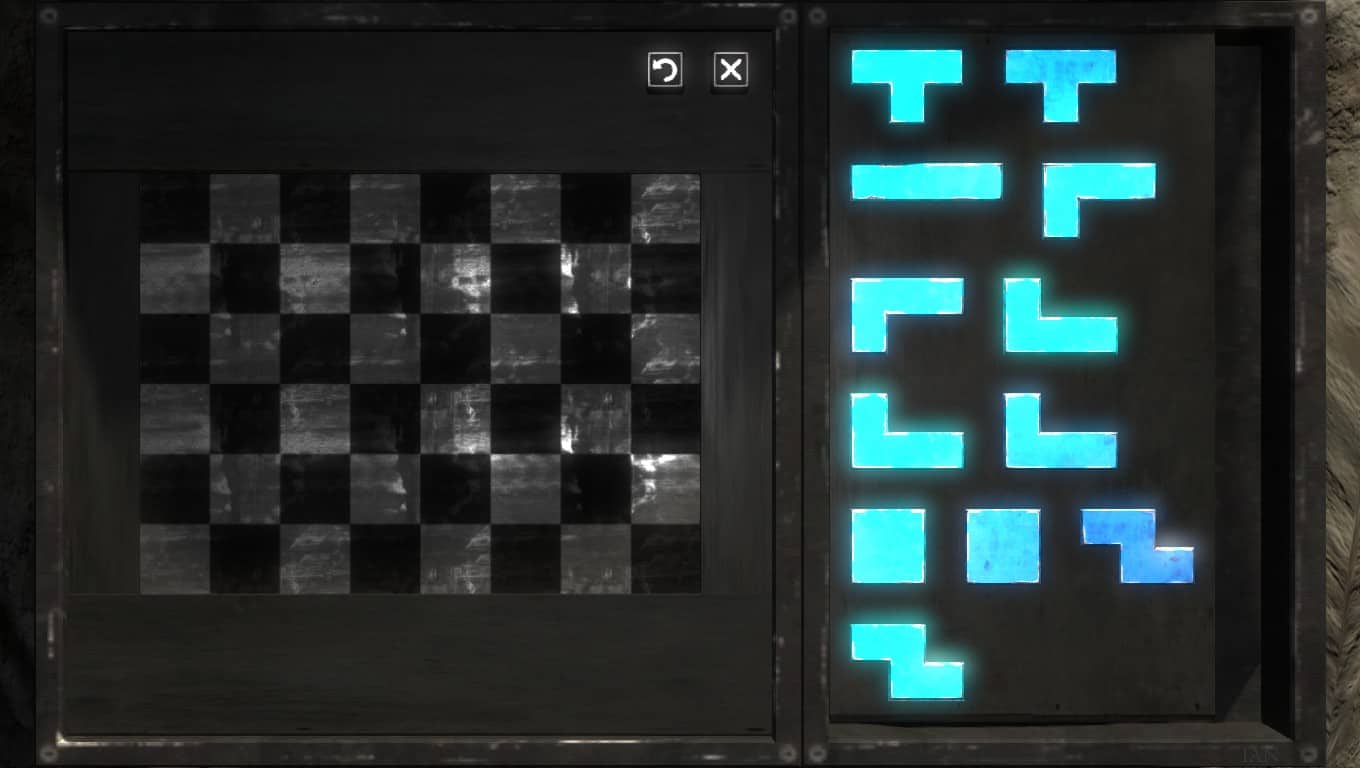
After my last post on Portal, there was a sale of The Talos Principle, so I got it and started playing. And soon I got stuck at these kind of puzzles where one has to fit in pieces into a frame. As a logician I hate to solve something by trial and error, so I decided I write a solver for these kind of puzzles, based on a propositional logic encoding and satisfiability solver. Sometimes it is good to be logician!
In the Talos Principle, access to new worlds and specific items is often blocked by gates that open by putting Sigils into the frame. Of course, collecting the sigils is the most challenging part, but that is often solvable by logical thinking. On the other hand, solving these fitting puzzles drove me crazy, so let us solve them with a SAT solver.
Encoding
I used a propositional encoding that for each combination of cells and sigils assigns a propositional variable, which is true if the specific sigil rests in on that cell in the final solution. That is, we have variable (encoded as x_i_j_n) where runs over the cells of the frame, and over the (numbered) sigils.
Setup
I have written a perl program that for a definition of a puzzle (see later), outputs SMT2 code, which then is checked for satisfiability and generation of model with the z3 solver (which is available in Debian).
Necessary assertions
We have to state relations between these propositional variables to obtain a proper solution, in particular we have added the following statements:
(assert (or x_i_j_1 x_i_j_2 ... x_i_j_n)) |
(assert (and (not (and x_1_1_1 x_1_1_2)) (not (and x_1_1_1 x_1_1_3)) ... (assert (and (not (and x_1_2_1 x_1_2_2)) (not (and x_1_2_1 x_1_2_3)) ... |
(assert (or x_1_1_n x_1_2_n ... x_6_6_1)) |
(assert (or ... (and x_3_2_n x_4_2_n x_5_2_n x_4_3_n) (and x_3_3_n x_3_2_n x_3_1_n x_4_2_n) (and x_3_2_n x_4_2_n x_5_2_n x_4_1_n) ... |
create_smt2_def(8,6,'a','a','b','cl','cl','cr','cr','cr','q','q','sl','sl'); |
# for each piece, call the defining assertions for my $n (1..$nn) my $p = $pieces[$n-1]; print "(assert (or\n"; for my $i (1..$xx) for my $j (1..$yy) if ($p eq 'q') type_square($xx,$yy,$i,$j,$n); elsif ($p eq 'a') type_potest($xx,$yy,$i,$j,$n); .... |
sub type_potest my ($xx,$yy,$i,$j,$n) = @_; my ($il, $jl, $ir, $jr, $iu, $ju); $il = $i - 1; $ir = $i + 1; $iu = $i; $jl = $jr = $j; $ju = $j + 1; do_rotate_shipout($xx,$yy, $i, $j, $n, $il, $jl, $ir, $jr, $iu, $ju); |
sub do_rotate_shipout my ($xx,$yy, $i, $j, $n, @pairs) = @_ ; for my $g (0..3) @pairs = rotate90($i, $j, @pairs); check_and_shipout($xx,$yy, $n, $i, $j, @pairs); |
sub rotate90 my ($i, $j, @pairs) = @_ ; my @ret; while (@pairs) my $ii = shift @pairs; my $jj = shift @pairs; my $ni = $i - ($jj - $j); my $nj = $j + ($ii - $i); push @ret, $ni, $nj; return @ret; |
perl tangram.pl z3 -in egrep 'define-fun true false' sed -e 'h;s/.*//;G;N;s/\n//g' grep true sort |
(define-fun x_1_1_10 () Bool true) (define-fun x_1_2_10 () Bool true) (define-fun x_1_3_5 () Bool true) (define-fun x_1_4_6 () Bool true) (define-fun x_1_5_6 () Bool true) (define-fun x_1_6_6 () Bool true) (define-fun x_2_1_10 () Bool true) (define-fun x_2_2_10 () Bool true) (define-fun x_2_3_5 () Bool true) ... |
Next.