Search Results: "rra"

15 July 2010

Uwe Hermann: Using the HP Pavilion dv7-3127eg laptop with Debian GNU/Linux

HP Pavilion dv7-3127eg Yep, so I bought a new laptop recently, my IBM/Lenovo Thinkpad T40p was slowly getting really unbearably sloooow (Celeron 1.5 GHz, 2 GB RAM max). After comparing some models I set out to buy a certain laptop in a local store, which they didn't have in stock, so I spontaneously got another model, the HP Pavilion dv7-3127eg (HP product number VY554EA). Why this one? Well, the killer feature for me was that it has two SATA disks, hence allows me to run a RAID-1 in my laptop. This allows me to sleep better at night, knowing that the next dying disk will not necessarily lead to data loss (yes, I do still perform regular backups, of course). Other pros: Much faster than the old notebook, this one is an AMD Turion II Dual-Core Mobile M520 at 2.3 GHz per core, it has 4 GB RAM (8 GB max), and uses an AMD RS780 / SB700 chipset which is supported by the Free-Software / Open-Source BIOS / firmware project coreboot, so this might make the laptop a good coreboot-target on the long run. I'll probably start working on that when I'm willing to open / dissect it or when the warranty expires, whichever happens first. Anyway, I set up a page at randomprojects.org which contains lots more details about using Linux on this laptop:
http://randomprojects.org/wiki/HP_Pavilion_dv7-3127eg
Most of the hardware is supported out of the box, though I haven't yet tested everything. There may be issues with suspend-to-disk / suspend-to-RAM, sometimes it seems to hang (may be just a simple config change is needed in /etc/hibernate/disk.cfg). Cons: Pretty big and heavy (but that's OK, I use it mostly as "semi-mobile desktop replacement"), glossy screen, loud fans (probably due to the two disks). For reference, here's an lspci of the box:
  $ lspci -tvnn
  -[0000:00]-+-00.0  Advanced Micro Devices [AMD] RS780 Host Bridge Alternate [1022:9601]
           +-02.0-[01]--+-00.0  ATI Technologies Inc M96 [Mobility Radeon HD 4650] [1002:9480]
                        \-00.1  ATI Technologies Inc RV710/730 [1002:aa38]
           +-04.0-[02-07]--
           +-05.0-[08]----00.0  Atheros Communications Inc. AR9285 Wireless Network Adapter (PCI-Express) [168c:002b]
           +-06.0-[09]----00.0  Realtek Semiconductor Co., Ltd. RTL8111/8168B PCI Express Gigabit Ethernet controller [10ec:8168]
           +-0a.0-[0a]--
           +-11.0  ATI Technologies Inc SB700/SB800 SATA Controller [AHCI mode] [1002:4391]
           +-12.0  ATI Technologies Inc SB700/SB800 USB OHCI0 Controller [1002:4397]
           +-12.1  ATI Technologies Inc SB700 USB OHCI1 Controller [1002:4398]
           +-12.2  ATI Technologies Inc SB700/SB800 USB EHCI Controller [1002:4396]
           +-13.0  ATI Technologies Inc SB700/SB800 USB OHCI0 Controller [1002:4397]
           +-13.1  ATI Technologies Inc SB700 USB OHCI1 Controller [1002:4398]
           +-13.2  ATI Technologies Inc SB700/SB800 USB EHCI Controller [1002:4396]
           +-14.0  ATI Technologies Inc SBx00 SMBus Controller [1002:4385]
           +-14.2  ATI Technologies Inc SBx00 Azalia (Intel HDA) [1002:4383]
           +-14.3  ATI Technologies Inc SB700/SB800 LPC host controller [1002:439d]
           +-14.4-[0b]--
           +-18.0  Advanced Micro Devices [AMD] K10 [Opteron, Athlon64, Sempron] HyperTransport Configuration [1022:1200]
           +-18.1  Advanced Micro Devices [AMD] K10 [Opteron, Athlon64, Sempron] Address Map [1022:1201]
           +-18.2  Advanced Micro Devices [AMD] K10 [Opteron, Athlon64, Sempron] DRAM Controller [1022:1202]
           +-18.3  Advanced Micro Devices [AMD] K10 [Opteron, Athlon64, Sempron] Miscellaneous Control [1022:1203]
           \-18.4  Advanced Micro Devices [AMD] K10 [Opteron, Athlon64, Sempron] Link Control [1022:1204]
Full lspci -vvvxxxxnnn, lsusb -vvv, and a much more detailed list of tested hardware components is available in the wiki.

11 July 2010

Enrico Zini: Computing time offsets between EXIF and GPS

Computing time offsets between EXIF and GPS I like the idea of matching photos to GPS traces. In Debian there is gpscorrelate but it's almost unusable to me because of bug #473362 and it has an awkward way of specifying time offsets. Here at SoTM10 someone told me that exiftool gained -geosync and -geotag options. So it's just a matter of creating a little tool that shows a photo and asks you to type the GPS time you see in it. Apparently there are no bindings or GIR files for gtkimageview in Debian, so I'll have to use C. Here is a C prototype:
/*
 * gpsoffset - Compute EXIF time offset from a photo of a gps display
 *
 * Use with exiftool -geosync=... -geotag trace.gpx DIR
 *
 * Copyright (C) 2009--2010  Enrico Zini <enrico@enricozini.org>
 *
 * This program is free software; you can redistribute it and/or modify
 * it under the terms of the GNU General Public License as published by
 * the Free Software Foundation; either version 2 of the License, or
 * (at your option) any later version.
 *
 * This program is distributed in the hope that it will be useful,
 * but WITHOUT ANY WARRANTY; without even the implied warranty of
 * MERCHANTABILITY or FITNESS FOR A PARTICULAR PURPOSE.  See the
 * GNU General Public License for more details.
 *
 * You should have received a copy of the GNU General Public License
 * along with this program; if not, write to the Free Software
 * Foundation, Inc., 59 Temple Place, Suite 330, Boston, MA  02111-1307  USA
 */
#define _XOPEN_SOURCE /* glibc2 needs this */
#include <time.h>
#include <gtkimageview/gtkimageview.h>
#include <libexif/exif-data.h>
#include <stdio.h>
#include <stdlib.h>
static int load_time(const char* fname, struct tm* tm)
 
    ExifData* exif_data = exif_data_new_from_file(fname);
    ExifEntry* exif_time = exif_data_get_entry(exif_data, EXIF_TAG_DATE_TIME);
    if (exif_time == NULL)
     
        fprintf(stderr, "Cannot find EXIF timetamp\n");
        return -1;
     
    char buf[1024];
    exif_entry_get_value(exif_time, buf, 1024);
    //printf("val2: %s\n", exif_entry_get_value(t2, buf, 1024));
    if (strptime(buf, "%Y:%m:%d %H:%M:%S", tm) == NULL)
     
        fprintf(stderr, "Cannot match EXIF timetamp\n");
        return -1;
     
    return 0;
 
static time_t exif_ts;
static GtkWidget* res_lbl;
void date_entry_changed(GtkEditable *editable, gpointer user_data)
 
    const gchar* text = gtk_entry_get_text(GTK_ENTRY(editable));
    struct tm parsed;
    if (strptime(text, "%Y-%m-%d %H:%M:%S", &parsed) == NULL)
     
        gtk_label_set_text(GTK_LABEL(res_lbl), "Please enter a date as YYYY-MM-DD HH:MM:SS");
      else  
        time_t img_ts = mktime(&parsed);
        int c;
        int res;
        if (exif_ts < img_ts)
         
            c = '+';
            res = img_ts - exif_ts;
         
        else
         
            c = '-';
            res = exif_ts - img_ts;
         
        char buf[1024];
        if (res > 3600)
            snprintf(buf, 1024, "Result: %c%ds -geosync=%c%d:%02d:%02d",
                    c, res, c, res / 3600, (res / 60) % 60, res % 60);
        else if (res > 60)
            snprintf(buf, 1024, "Result: %c%ds -geosync=%c%02d:%02d",
                    c, res, c, (res / 60) % 60, res % 60);
        else
            snprintf(buf, 1024, "Result: %c%ds -geosync=%c%d",
                    c, res, c, res);
        gtk_label_set_text(GTK_LABEL(res_lbl), buf);
     
 
int main (int argc, char *argv[])
 
    // Work in UTC to avoid mktime applying DST or timezones
    setenv("TZ", "UTC");
    const char* filename = "/home/enrico/web-eddie/galleries/2010/04-05-Uppermill/P1080932.jpg";
    gtk_init (&argc, &argv);
    struct tm exif_time;
    if (load_time(filename, &exif_time) != 0)
        return 1;
    printf("EXIF time: %s\n", asctime(&exif_time));
    exif_ts = mktime(&exif_time);
    GtkWidget* window = gtk_window_new(GTK_WINDOW_TOPLEVEL);
    GtkWidget* vb = gtk_vbox_new(FALSE, 0);
    GtkWidget* hb = gtk_hbox_new(FALSE, 0);
    GtkWidget* lbl = gtk_label_new("Timestamp:");
    GtkWidget* exif_lbl;
     
        char buf[1024];
        strftime(buf, 1024, "EXIF time: %Y-%m-%d %H:%M:%S", &exif_time);
        exif_lbl = gtk_label_new(buf);
     
    GtkWidget* date_ent = gtk_entry_new();
    res_lbl = gtk_label_new("Result:");
    GtkWidget* view = gtk_image_view_new();
    GdkPixbuf* pixbuf = gdk_pixbuf_new_from_file(filename, NULL);
    gtk_box_pack_start(GTK_BOX(hb), lbl, FALSE, TRUE, 0);
    gtk_box_pack_start(GTK_BOX(hb), date_ent, TRUE, TRUE, 0);
    gtk_signal_connect(GTK_OBJECT(date_ent), "changed", (GCallback)date_entry_changed, NULL);
     
        char buf[1024];
        strftime(buf, 1024, "%Y-%m-%d %H:%M:%S", &exif_time);
        gtk_entry_set_text(GTK_ENTRY(date_ent), buf);
     
    gtk_widget_set_size_request(view, 500, 400);
    gtk_image_view_set_pixbuf(GTK_IMAGE_VIEW(view), pixbuf, TRUE);
    gtk_container_add(GTK_CONTAINER(window), vb);
    gtk_box_pack_start(GTK_BOX(vb), view, TRUE, TRUE, 0);
    gtk_box_pack_start(GTK_BOX(vb), hb, FALSE, TRUE, 0);
    gtk_box_pack_start(GTK_BOX(vb), exif_lbl, FALSE, TRUE, 0);
    gtk_box_pack_start(GTK_BOX(vb), res_lbl, FALSE, TRUE, 0);
    gtk_widget_show_all(window);
    gtk_main ();
    return 0;
 
And here is its simple makefile:
CFLAGS=$(shell pkg-config --cflags gtkimageview libexif)
LDFLAGS=$(shell pkg-config --libs gtkimageview libexif)
gpsoffset: gpsoffset.c
It's a simple prototype but it's a working prototype and seems to do the job for me. I currently cannot find out why after I click on the text box, there seems to be no way to give the focus back to the image viewer so I can control it with keys. There is another nice algorithm to compute time offsets to be implemented: you choose a photo taken from a known place and drag it on that place on a map: you can then look for the nearest point on your GPX trace and compute the time offset from that. I have seen that there are programs for geotagging photos that implement all such algorithms, and have a nice UI, but I haven't seen any in Debian. Are there any such softwares that can be packaged? If not, the interpolation and annotation tasks can now already be performed by exiftool, so it's just a matter of building a good UI, and I would love to see someone picking up the task.

10 July 2010

Enrico Zini: Searching OSM nodes in Spatialite

Searching OSM nodes in Spatialite Third step of my SoTM10 pet project: finding the POIs. I put together a query to find all nodes with a given tag inside a bounding box, and also a query to find all the tag values for a given tag name inside a bounding box. The result is this simple POI search engine:
#
# poisearch - simple geographical POI search engine
#
# Copyright (C) 2010  Enrico Zini <enrico@enricozini.org>
#
# This program is free software; you can redistribute it and/or modify
# it under the terms of the GNU General Public License as published by
# the Free Software Foundation; either version 2 of the License, or
# (at your option) any later version.
#
# This program is distributed in the hope that it will be useful,
# but WITHOUT ANY WARRANTY; without even the implied warranty of
# MERCHANTABILITY or FITNESS FOR A PARTICULAR PURPOSE.  See the
# GNU General Public License for more details.
#
# You should have received a copy of the GNU General Public License
# along with this program; if not, write to the Free Software
# Foundation, Inc., 59 Temple Place, Suite 330, Boston, MA  02111-1307  USA
#
from pysqlite2 import dbapi2 as sqlite
class PoiDB(object):
    def __init__(self):
        self.db = sqlite.connect("pois.db")
        self.db.enable_load_extension(True)
        self.db.execute("SELECT load_extension('libspatialite.so')")
        self.oldsearch = []
        self.bbox = None
    def set_bbox(self, xmin, xmax, ymin, ymax):
        '''Set bbox for searches'''
        self.bbox = (xmin, xmax, ymin, ymax)
    def tagid(self, name, val):
        '''Get the database ID for a tag'''
        c = self.db.cursor()
        c.execute("SELECT id FROM tag WHERE name=? AND value=?", (name, val))
        res = None
        for row in c:
            res = row[0]
        return res
    def tagnames(self):
        '''Get all tag names'''
        c = self.db.cursor()
        c.execute("SELECT DISTINCT name FROM tag ORDER BY name")
        for row in c:
            yield row[0]
    def tagvalues(self, name, use_bbox=False):
        '''
        Get all tag values for a given tag name,
        optionally in the current bounding box
        '''
        c = self.db.cursor()
        if self.bbox is None or not use_bbox:
            c.execute("SELECT DISTINCT value FROM tag WHERE name=? ORDER BY value", (name,))
        else:
            c.execute("SELECT DISTINCT tag.value FROM poi, poitag, tag"
                      " WHERE poi.rowid IN (SELECT pkid FROM idx_poi_geom WHERE ("
                      "       xmin >= ? AND xmax <= ? AND ymin >= ? AND ymax <= ?) )"
                      "   AND poitag.tag = tag.id AND poitag.poi = poi.id"
                      "   AND tag.name=?",
                      self.bbox + (name,))
        for row in c:
            yield row[0]
    def search(self, name, val):
        '''Get all name:val tags in the current bounding box'''
        # First resolve the tagid
        tagid = self.tagid(name, val)
        if tagid is None: return
        c = self.db.cursor()
        c.execute("SELECT poi.name, poi.data, X(poi.geom), Y(poi.geom) FROM poi, poitag"
                  " WHERE poi.rowid IN (SELECT pkid FROM idx_poi_geom WHERE ("
                  "       xmin >= ? AND xmax <= ? AND ymin >= ? AND ymax <= ?) )"
                  "   AND poitag.tag = ? AND poitag.poi = poi.id",
                  self.bbox + (tagid,))
        self.oldsearch = []
        for row in c:
            self.oldsearch.append(row)
            yield row[0], simplejson.loads(row[1]), row[2], row[3]
    def count(self, name, val):
        '''Count all name:val tags in the current bounding box'''
        # First resolve the tagid
        tagid = self.tagid(name, val)
        if tagid is None: return
        c = self.db.cursor()
        c.execute("SELECT COUNT(*) FROM poi, poitag"
                  " WHERE poi.rowid IN (SELECT pkid FROM idx_poi_geom WHERE ("
                  "       xmin >= ? AND xmax <= ? AND ymin >= ? AND ymax <= ?) )"
                  "   AND poitag.tag = ? AND poitag.poi = poi.id",
                  self.bbox + (tagid,))
        for row in c:
            return row[0]
    def replay(self):
        for row in self.oldsearch:
            yield row[0], simplejson.loads(row[1]), row[2], row[3]
Problem 3 solved: now on to the next step, building a user interface for it.

Enrico Zini: Importing OSM nodes into Spatialite

Importing OSM nodes into Spatialite Second step of my SoTM10 pet project: creating a searchable database with the points. What a fantastic opportunity to learn Spatialite. Learning Spatialite is easy. For example, you can use the two tutorials with catchy titles that assume your best wish in life is to create databases out of shapefiles using a pre-built, i386-only executable GUI binary downloaded over an insecure HTTP connection. To be fair, the second of those tutorials is called "An almost Idiot's Guide", thus expliciting the requirement of being an almost idiot in order to happily acquire and run software in that way. Alternatively, you can use A quick tutorial to SpatiaLite which is so quick it has examples that lead you to write SQL queries that trigger all sorts of vague exceptions at insert time. But at least it brought me a long way forward, at which point I could just cross reference things with PostGIS documentation to find out the right way of doing things. So, here's the importer script, which will probably become my reference example for how to get started with Spatialite, and how to use Spatialite from Python:
#!/usr/bin/python
#
# poiimport - import nodes from OSM into a spatialite DB
#
# Copyright (C) 2010  Enrico Zini <enrico@enricozini.org>
#
# This program is free software; you can redistribute it and/or modify
# it under the terms of the GNU General Public License as published by
# the Free Software Foundation; either version 2 of the License, or
# (at your option) any later version.
#
# This program is distributed in the hope that it will be useful,
# but WITHOUT ANY WARRANTY; without even the implied warranty of
# MERCHANTABILITY or FITNESS FOR A PARTICULAR PURPOSE.  See the
# GNU General Public License for more details.
#
# You should have received a copy of the GNU General Public License
# along with this program; if not, write to the Free Software
# Foundation, Inc., 59 Temple Place, Suite 330, Boston, MA  02111-1307  USA
#
import xml.sax
import xml.sax.handler
from pysqlite2 import dbapi2 as sqlite
import simplejson
import sys
import os
class OSMPOIReader(xml.sax.handler.ContentHandler):
    '''
    Filter SAX events in a OSM XML file to keep only nodes with names
    '''
    def __init__(self, consumer):
        self.consumer = consumer
    def startElement(self, name, attrs):
        if name == "node":
            self.attrs = attrs
            self.tags = dict()
        elif name == "tag":
            self.tags[attrs["k"]] = attrs["v"]
    def endElement(self, name):
        if name == "node":
            lat = float(self.attrs["lat"])
            lon = float(self.attrs["lon"])
            id = int(self.attrs["id"])
            #dt = parse(self.attrs["timestamp"])
            uid = self.attrs.get("uid", None)
            uid = int(uid) if uid is not None else None
            user = self.attrs.get("user", None)
            self.consumer(lat, lon, id, self.tags, user=user, uid=uid)
class Importer(object):
    '''
    Create the spatialite database and populate it
    '''
    TAG_WHITELIST = set(["amenity", "shop", "tourism", "place"])
    def __init__(self, filename):
        self.db = sqlite.connect(filename)
        self.db.enable_load_extension(True)
        self.db.execute("SELECT load_extension('libspatialite.so')")
        self.db.execute("SELECT InitSpatialMetaData()")
        self.db.execute("INSERT INTO spatial_ref_sys (srid, auth_name, auth_srid,"
                        " ref_sys_name, proj4text) VALUES (4326, 'epsg', 4326,"
                        " 'WGS 84', '+proj=longlat +ellps=WGS84 +datum=WGS84"
                        " +no_defs')")
        self.db.execute("CREATE TABLE poi (id int not null unique primary key,"
                        " name char, data text)")
        self.db.execute("SELECT AddGeometryColumn('poi', 'geom', 4326, 'POINT', 2)")
        self.db.execute("SELECT CreateSpatialIndex('poi', 'geom')")
        self.db.execute("CREATE TABLE tag (id integer primary key autoincrement,"
                        " name char, value char)")
        self.db.execute("CREATE UNIQUE INDEX tagidx ON tag (name, value)")
        self.db.execute("CREATE TABLE poitag (poi int not null, tag int not null)")
        self.db.execute("CREATE UNIQUE INDEX poitagidx ON poitag (poi, tag)")
        self.tagid_cache = dict()
    def tagid(self, k, v):
        key = (k, v)
        res = self.tagid_cache.get(key, None)
        if res is None:
            c = self.db.cursor()
            c.execute("SELECT id FROM tag WHERE name=? AND value=?", key)
            for row in c:
                self.tagid_cache[key] = row[0]
                return row[0]
            self.db.execute("INSERT INTO tag (id, name, value) VALUES (NULL, ?, ?)", key)
            c.execute("SELECT last_insert_rowid()")
            for row in c:
                res = row[0]
            self.tagid_cache[key] = res
        return res
    def __call__(self, lat, lon, id, tags, user=None, uid=None):
        # Acquire tag IDs
        tagids = []
        for k, v in tags.iteritems():
            if k not in self.TAG_WHITELIST: continue
            for val in v.split(";"):
                tagids.append(self.tagid(k, val))
        # Skip elements that don't have the tags we want
        if not tagids: return
        geom = "POINT(%f %f)" % (lon, lat)
        self.db.execute("INSERT INTO poi (id, geom, name, data)"
                        "     VALUES (?, GeomFromText(?, 4326), ?, ?)",
                (id, geom, tags["name"], simplejson.dumps(tags)))
        for tid in tagids:
            self.db.execute("INSERT INTO poitag (poi, tag) VALUES (?, ?)", (id, tid))
    def done(self):
        self.db.commit()
# Get the output file name
filename = sys.argv[1]
# Ensure we start from scratch
if os.path.exists(filename):
    print >>sys.stderr, filename, "already exists"
    sys.exit(1)
# Import
parser = xml.sax.make_parser()
importer = Importer(filename)
handler = OSMPOIReader(importer)
parser.setContentHandler(handler)
parser.parse(sys.stdin)
importer.done()
Let's run it:
$ ./poiimport pois.db < pois.osm 
SpatiaLite version ..: 2.4.0    Supported Extensions:
        - 'VirtualShape'        [direct Shapefile access]
        - 'VirtualDbf'          [direct Dbf access]
        - 'VirtualText'         [direct CSV/TXT access]
        - 'VirtualNetwork'      [Dijkstra shortest path]
        - 'RTree'               [Spatial Index - R*Tree]
        - 'MbrCache'            [Spatial Index - MBR cache]
        - 'VirtualFDO'          [FDO-OGR interoperability]
        - 'SpatiaLite'          [Spatial SQL - OGC]
PROJ.4 Rel. 4.7.1, 23 September 2009
GEOS version 3.2.0-CAPI-1.6.0
$ ls -l --si pois*
-rw-r--r-- 1 enrico enrico 17M Jul  9 23:44 pois.db
-rw-r--r-- 1 enrico enrico 37M Jul  9 16:20 pois.osm
$ spatialite pois.db
SpatiaLite version ..: 2.4.0    Supported Extensions:
        - 'VirtualShape'        [direct Shapefile access]
        - 'VirtualDbf'          [direct DBF access]
        - 'VirtualText'         [direct CSV/TXT access]
        - 'VirtualNetwork'      [Dijkstra shortest path]
        - 'RTree'               [Spatial Index - R*Tree]
        - 'MbrCache'            [Spatial Index - MBR cache]
        - 'VirtualFDO'          [FDO-OGR interoperability]
        - 'SpatiaLite'          [Spatial SQL - OGC]
PROJ.4 version ......: Rel. 4.7.1, 23 September 2009
GEOS version ........: 3.2.0-CAPI-1.6.0
SQLite version ......: 3.6.23.1
Enter ".help" for instructions
spatialite> select id from tag where name="amenity" and value="fountain";
24
spatialite> SELECT poi.name, poi.data, X(poi.geom), Y(poi.geom) FROM poi, poitag WHERE poi.rowid IN (SELECT pkid FROM idx_poi_geom WHERE (xmin >= 2.56 AND xmax <= 2.90 AND ymin >= 41.84 AND ymax <= 42.00) ) AND poitag.tag = 24 AND poitag.poi = poi.id;
Font Picant de la Cellera "amenity": "fountain", "name": "Font Picant de la Cellera" 2.616045 41.952449
Font de Can Pla "amenity": "fountain", "name": "Font de Can Pla" 2.622354 41.974724
Font de Can Ribes "amenity": "fountain", "name": "Font de Can Ribes" 2.62311 41.979193
It's impressive: I've got all sort of useful information for the whole of Spain in just 17Mb! Let's put it to practice: I'm thirsty, is there any water fountain nearby?
spatialite> SELECT count(1) FROM poi, poitag WHERE poi.rowid IN (SELECT pkid FROM idx_poi_geom WHERE (xmin >= 2.80 AND xmax <= 2.85 AND ymin >= 41.97 AND ymax <= 42.00) ) AND poitag.tag = 24 AND poitag.poi = poi.id;
0
Ouch! No water fountains mapped in Girona... yet. Problem 2 solved: now on to the next step, trying to show the results in some usable way.

9 July 2010

Benjamin Mako Hill: Memory

Today I started to tell a friend about something from dinner the night before. Except that she was at the dinner. And sitting at the same table! Even when prompted, I couldn't really remember! This does not warrant a blog post. Anybody who knows me well knows that my memory for these kinds of more mundane details is pretty porous. This kind of thing happens all the time. I'm writing this so that when I'm much older, and still forgetting things all the time, folks can use this as a reference point before concluding that senility is setting in. I'm afraid that everyone else will forget my forgetfulness!

Enrico Zini: Filtering nodes out of OSM files

Filtering nodes out of OSM files I have a pet project here at SoTM10: create a tool for searching nearby POIs while offline. The idea is to have something in my pocket (FreeRunner or N900), which doesn't require an internet connection, and which can point me at the nearest fountains, post offices, atm machines, bars and so on. The first step is to obtain a list of POIs. In theory one can use Xapi but all the known Xapi servers appear to be down at the moment. Another attempt is to obtain it by filtering all nodes with the tags we want out of a planet OSM extract. I downloaded the Spanish one and set to work. First I tried with xmlstarlet, but it ate all the RAM and crashed my laptop, because for some reason, on my laptop the Linux kernels up to 2.6.32 (don't now about later ones) like to swap out ALL running apps to cache I/O operations, which mean that heavy I/O operations swap out the very programs performing them, so the system gets caught in some infinite I/O loop and dies. Or at least this is what I've figured out so far. So, we need SAX. I put together this prototype in Python, which can process a nice 8MB/s of OSM data for quite some time with a constant, low RAM usage:
#!/usr/bin/python
#
# poifilter - extract interesting nodes from OSM XML files
#
# Copyright (C) 2010  Enrico Zini <enrico@enricozini.org>
#
# This program is free software; you can redistribute it and/or modify
# it under the terms of the GNU General Public License as published by
# the Free Software Foundation; either version 2 of the License, or
# (at your option) any later version.
#
# This program is distributed in the hope that it will be useful,
# but WITHOUT ANY WARRANTY; without even the implied warranty of
# MERCHANTABILITY or FITNESS FOR A PARTICULAR PURPOSE.  See the
# GNU General Public License for more details.
#
# You should have received a copy of the GNU General Public License
# along with this program; if not, write to the Free Software
# Foundation, Inc., 59 Temple Place, Suite 330, Boston, MA  02111-1307  USA
#
import xml.sax
import xml.sax.handler
import xml.sax.saxutils
import sys
class XMLSAXFilter(xml.sax.handler.ContentHandler):
    '''
    A SAX filter that is a ContentHandler.

    There is xml.sax.saxutils.XMLFilterBase in the standard library but it is
    undocumented, and most of the examples using it you find online are wrong.
    You can look at its source code, and at that point you find out that it is
    an offensive practical joke.
    '''
    def __init__(self, downstream):
        self.downstream = downstream
    # ContentHandler methods
    def setDocumentLocator(self, locator):
        self.downstream.setDocumentLocator(locator)
    def startDocument(self):
        self.downstream.startDocument()
    def endDocument(self):
        self.downstream.endDocument()
    def startPrefixMapping(self, prefix, uri):
        self.downstream.startPrefixMapping(prefix, uri)
    def endPrefixMapping(self, prefix):
        self.downstream.endPrefixMapping(prefix)
    def startElement(self, name, attrs):
        self.downstream.startElement(name, attrs)
    def endElement(self, name):
        self.downstream.endElement(name)
    def startElementNS(self, name, qname, attrs):
        self.downstream.startElementNS(name, qname, attrs)
    def endElementNS(self, name, qname):
        self.downstream.endElementNS(name, qname)
    def characters(self, content):
        self.downstream.characters(content)
    def ignorableWhitespace(self, chars):
        self.downstream.ignorableWhitespace(chars)
    def processingInstruction(self, target, data):
        self.downstream.processingInstruction(target, data)
    def skippedEntity(self, name):
        self.downstream.skippedEntity(name)
class OSMPOIHandler(XMLSAXFilter):
    '''
    Filter SAX events in a OSM XML file to keep only nodes with names
    '''
    PASSTHROUGH = ["osm", "bound"]
    TAG_WHITELIST = set(["amenity", "shop", "tourism", "place"])
    def startElement(self, name, attrs):
        if name in self.PASSTHROUGH:
            self.downstream.startElement(name, attrs)
        elif name == "node":
            self.attrs = attrs
            self.tags = []
            self.propagate = False
        elif name == "tag":
            if self.tags is not None:
                self.tags.append(attrs)
                if attrs["k"] in self.TAG_WHITELIST:
                    self.propagate = True
        else:
            self.tags = None
            self.attrs = None
    def endElement(self, name):
        if name in self.PASSTHROUGH:
            self.downstream.endElement(name)
        elif name == "node":
            if self.propagate:
                self.downstream.startElement("node", self.attrs)
                for attrs in self.tags:
                    self.downstream.startElement("tag", attrs)
                    self.downstream.endElement("tag")
                self.downstream.endElement("node")
    def ignorableWhitespace(self, chars):
        pass
    def characters(self, content):
        pass
# Simple stdin->stdout XMl filter
parser = xml.sax.make_parser()
handler = OSMPOIHandler(xml.sax.saxutils.XMLGenerator(sys.stdout, "utf-8"))
parser.setContentHandler(handler)
parser.parse(sys.stdin)
Let's run it:
$ bzcat /store/osm/spain.osm.bz2   pv   ./poifilter > pois.osm
[...]
$ ls -l --si pois.osm
-rw-r--r-- 1 enrico enrico 19M Jul 10 23:56 pois.osm
$ xmlstarlet val pois.osm 
pois.osm - valid
Problem 1 solved: now on to the next step: importing the nodes in a database.

8 July 2010

Ritesh Raj Sarraf: SystemTap in Debian

The latest kernel upload (2.6.32-16) brings goodies to SystemTap in Debian. This version has added support for kprobes, on which systemtap has a major dependency, for many of its features.Most of the systemtap instrumentation should work now and all of this will be part of the Squeeze release. Instrumenting the kernel modules still needs some work (DBTS: #555549) but can be done.

Michael Banck: 8 Jul 2010

Bug-Squashing-Party in Munich We are organizing another BSP in Munich on the weekend of 17th/18th July. Like the last BSP, it will take place in the LiMux office in the city center. See the coordination page for further information and directions and in order to sign up for it. Food and drinks for the event are partly sponsored by the City of Munich and this amount (100 ) has been again matched by credativ GmbH. Contributions by non-DDs are welcome as always; the BSP will be attended by several Debian Developers who will be able to upload fixes. Attending BSPs is a great way to get involved in the Debian community! We cannot guarantee crash space to people from outside Munich at this point, so if you want to attend please contact the Munich list (area-muc@teams.debian.net) beforehand or arrange your own accomodation. We probably start the BSP at some point after 6PM on Friday evening already, but the main action will be on Saturday and Sunday. As usual, people should bring their notebooks and possibly an ethernet cable. Wireless will be present as well, but a certain bandwidth cannot be guaranteed. Bug-Squashing Introduction I also plan to give an introduction to bug-squashing at this month's Garching Debian Stammtisch, which will take place next Wednesday, July 14th in the campus-cneipe (or its beergarden) as usual (the monthly Stammtisch is always on the second Wednesday of the month). If you study/work in Garching and would like to attend the BSP, come to the Stammtisch for a tutorial (and beer)! Debian Packaging Tutorial Some time ago, I gave a tutorial on Debian packaging in the TechTalk series of the Open-Source- School. The audience seemed to be pleased with the talk, and as more people requested to attend than there were seats in the room, we decided to reprise the event on September 7th. Attendence is free, but you have to register (see the event page). There are still some places left at this point.

Aigars Mahinovs: Phoning it in

Currently I own and use an iPhone 3G. I bought it almost two years ago, when the local phone provider LMT started offering the iPhone legally. I had a pretty good experience with it most of the time, but now it is showing its age: I will try to send my iPhone in for repair hoping to extend its usefulness, but frankly it looks that I might have to get a new phone at or before Debconf. So I am considering my options for a new phone and so far I have 3 main options each with some sub-options. The main options are: iPhone 4, MeeGo and Android. Each choice has its benefits and drawbacks and each also has several sub-options related either to specific phone models or to purchase methods. What I need is a phone with: calling function, contact information synchronised to Google, support for Google Mail/Contacts/Calendar simultaneously with one Exchange account also providing mail/contacts/calendars, music, audiobooks saving my place in the audio book and in the list of books, fully featured Twitter client with Twitpic and location support, encrypted password storage application (preferably open source), GPS with maps, ability to download maps for offline use, Geocaching support with offline cache info and logging, Skype client, ability to write in Latvian, English and Russian in all applications, reliable backup and restore of phones data including settings and data of installed apps. Optional features: last.fm streaming and reporting support, ebook applications with purchasable ebooks, high quality video and photo recording (for a phone), ability for me to write applications on the phone, ssh client, wireless data upload to the phone, ability to change the phones battery without loosing data in the phone (on the go), compass, physical keyboard, confidence in getting software upgrades and developer interest for the next 2 years. I ll try to describe all of the options here to organise my thoughts and maybe also help someone else make the choice. Option 1: iPhone 4 To get the iPhone 4 I have two options: LMT and unlocked. The official arrival of iPhone 4 to Latvia is expected in September and it will likely be sold by LMT for the same prices as iPhone 3GS is now. If I choose this scenario, I will need to survive with my semi-broken iPhone for 2-3 more months. Total price over 2 years (LVL): 131 (purchase price) + 24 * 8 (surcharge) = 323 LVL. Note: the surcharge is the extra cost of the iPhone call plan compared to a comparable regular plan (Vien dais 7 + Internets telefon 5). If I go and purchase an unlocked iPhone 4 in a country where such units are sold (UK is the most easily accessible choice, because a few of my workmates travel weekly to and from UK) then the total price over 2 years would be the purchase price: 499 GBP + 65 GBP (2 year warranty extension) = 505 LVL Now lets go over the general benefits and downsides of the iPhone 4, first the positives: Drawbacks: Option 2: Maemo/MeeGo Some of my colleagues at work (in the Riga office of Accenture) have N900 phones and I have been exposed to people with raw enthusiasm towards the Maemo platform ever since the Debconf in Helsinki, where we saw the first N700 devices in the hands of some lucky Debian/Nokia people using it as an Internet tablet. N900 has been a strong leap forward for the platform, before its head was teleported sideways by the whole MeeGo merger/debackle. Again I have two options here: Get a N900 either here in Latvia for 325 LVL (that would be the total cost over 2 years) or get it from USA during Debconf for 399 USD (+129 USD for 2 year warranty) = 317 LVL. And additional option would be to wait until October/November and then buy the new Nokia MeeGo device, rumoured to be N9-00 and likely to be around the same price as N900 was when it was introduced (around 500 LVL). Benefits: Drawbacks: Option 3 Android After looking trough the options for Android phones, I ve narrowed the selection to the ones that are either available from local carriers or can be easily gotten unlocked also the phones need to have announced plans to have at least Android 2.2 version. Currently the choice is limited to HTC Desire (from carrier or unlocked) and Samsung Galaxy S (unlocked). The prices over 2 years break down as follows: HTC Desire (locked to LMT): 69 + 9*24 = 285 LVL
HTC Desire (locked to Bite): 199 + 2*24 = 247 LVL (Note: only 500Mb of data per month available)
HTC Desire (locked to Tele2): 179 + 6*24 = 323 LVL
Note: all the above options would also require me to pay a 45 LVL early termination fee on my current iPhone contract if I choose to do this before September.
HTC Desire (unlocked): 311 LVL
Samsung Galaxy S (unlocked): 350 LVL (import from Germany) Benefits: Drawbacks: Please correct me if I am wrong with something!!! And also it would be cool if you expressed your own opinions in the comments. Currently I am very undecided about what I am going to do, but after completing this entry I am leaning towards an unlocked HTC Desire. Update:
Olivier Cr te shares a N900 vs. Nexus One experience Edit 01-07-2010: Handed my iPhone in for a warranty repair, got a dumbphone Nokia as a loaner during repairs. Very surprised about how long a battery can last on a low powered and cheap phone. In the mean time from all the comments here and elsewhere I am starting to see that I am too annoyed with the iPhone platform (mostly iTunes) to stay there and that I am also not convinced in the direction MeeGo is going (a lot of community developers are annoyed and are jumping ship), so N900 is also out. I will need to see 2-3 MeeGo smartphones and also see how Nokia will treat their smartphone users and developers on this platform, in the long term, before I ll be ready to trust them with my money. Therefore, my choice is becoming pretty clear look for the best Android phone (after my iPhone dies). We have this thing at Accenture, where we can get company phones at a discount and HTC Desire is on that list. If I can get that, it would slash 100 LVL (almost a third of the price!) off it, but to get there I either need to get a promotion (rather rare after just one year with the company) or prove the necessity of the phone for the needs of my project (kinda hard currently). Well, the situation will be a bit clearer next week when I get my iPhone back. (Apparently the Latvia s largest holiday Midsummer Festivities or J i/L go with tons of traditional outdoor activities, caused a lot of phones to become broken and there is a backlog of warranty service :) ) So at this point my plan is: get my iPhone repaired and get a promotion or a project where I can justify a company-paid HTC Desire and then hope that Nokia/Intel really get their stuff together and make MeeGo a great smartphone platform over the next year or two. Update: Got my iPhone 3G back from the warranty . It is in quotes because they just gave me a new iPhone 3G. The battery lasts for 3 days of minimal use and it has not crashed yet. The recovery process was a pain again caused by iTunes: iTunes refused to restore my backup onto the new phone, because my backup was made on a iOS 4.0, while the new phone I got from the warranty has 3.1.3 on it. So I had to set this phone as a new phone, initialise it, make a backup, upgrade to 4.0, restore from the (empty) backup, then reset the phone to factory settings again and only then I could start restoring data from my original (pre-warranty) backup and start copying my data on to the device. All in all it took nearly 3 hours if iTunes doing something and almost a dozen reboots of the phone. Almost half of that time was spent doing completely unnecessary steps to work around the fact that iTunes is braindead. I ll continue using my iPhone for now, keeping my eyes on the newest Android phones and also waiting for the long-promised first MeeGo phone from Nokia.

6 July 2010

Matt Zimmerman: We ve packaged all of the free software what now?

Today, virtually all of the free software available can be found in packaged form in distributions like Debian and Ubuntu. Users of these distributions have access to a library of thousands of applications, ranging from trivial to highly sophisticated software systems. Developers can find a vast array of programming languages, tools and libraries for constructing new applications. This is possible because we have a mature system for turning free software components into standardized modules (packages). Some software is more difficult to package and maintain, and I m occasionally surprised to find something very useful which isn t packaged yet, but in general, the software I want is packaged and ready before I realize I need it. Even the long tail of niche software is generally packaged very effectively. Thanks to coherent standards, sophisticated management tools, and the principles of software freedom, these packages can be mixed and matched to create complete software stacks for a wide range of devices, from netbooks to supercomputing clusters. These stacks are tightly integrated, and can be tested, released, maintained and upgraded as a unit. The Debian system is unparalleled for this purpose, which is why Ubuntu is based on it. The vision, for a free software operating system which is highly modular and customizable, has been achieved. Rough edges This is a momentous achievement, and the Debian packaging system fulfills its intended purpose very well. However, there are a number of areas where it introduces friction, because the package model doesn t quite fit some new problems. Most of these are becoming more common over time as technology evolves and changes shape. Why are we stuck?
I suppose it is tempting, if the only tool you have is a hammer, to treat everything as if it were a nail.
Abraham Maslow
The packaging ecosystem is very strong. Not only do we have powerful tools for working with packages, we also benefit from packages being a well-understood concept, and having established processes for developing, exchanging and talking about them. Once something is packaged, we know what it is and how to work with it, and it fits into everything else. So, it is tempting to package everything in sight, as we already know how to make sense of packages. However, this may not always be the right tool for the job. Various attempts have been made to extend the packaging concept to make it more general, for example: Other package managers aim to solve a specific problem, such as providing lightweight package management for embedded systems, or lazy dependency installation, or fixing the filesystem hierarchy. There is a long list of package managers of various levels which solve different problems. Most of these systems suffer from an important fundamental tradeoff: they are designed to manage the entire system, from the kernel through applications, and so they must be used wholesale in order to reap their full benefit. In other words, in their world, everything is a package, and anything which is not a package is out of scope. Therefore, each of these systems requires a separate collection of packages, and each time we invent a new one, its adherents set about packaging everything in the new format. It takes a very long time to do this, and most of them lose momentum before a mature ecosystem can form around them. This lock-in effect makes it difficult for new packaging technologies to succeed. Divide and Conquer No single package management framework is flexible enough to accommodate all of the needs we have today. Even more importantly, a generic solution won t account for the needs we will have tomorrow. I propose that in order to move forward, we must make it possible to solve packaging problems separately, rather than attempting to solve them all within a single system. But I like things how they are! We don t have a choice. The world is changing around us, and distributions need to evolve with it. If we don t adapt, we will eventually give way to systems which do solve these problems. Take, for example, modern web browsers like Firefox and Chromium. Arguably the most vital application for users, the browser is coming under increasing pressure to keep up with the breakneck pace of innovation on the web. The next wave of real-time collaboration and multimedia applications relies on the rapid development of new capabilities in web browsers. Browser makers are responding by accelerating deployment in the field: both aggressively push new releases to their users. A report from Google found that Chrome upgrades 97% of their users within 21 days of a new release, and Firefox 85% (both impressive numbers). Mozilla recently changed their maintenance policies, discontinuing maintenance of stable releases and forcing Ubuntu to ship new upstream releases to users. These applications are just the leading edge of the curve, and the pressure will only increase. Equally powerful trends are pressing server applications, embedded systems, and data to adapt as well. The ideas I ve presented here are only one possible way forward, and I m sure there are more and better ideas brewing in distribution communities. I m sure that I m not the only one thinking about these problems. Whatever it looks like in the end, I have no doubt that change is ahead.

5 July 2010

Thorsten Glaser: LSM/RMLL; mksh R40, R41 plans

The current version of mksh had use of arc4random(3) removed, including set -o arc4random , to speed it up (on some architectures, a lot) this will break some existing scripts (such as /etc/rc *cough* on MirBSD ). Hence I decided to publish the next version of mksh(1) as R40 based upon current development, and defer plans for associative arrays (and multidimensional arrays) for mksh R41. There s also already the change to Build.sh arguments, so this suits me quite fine. (Read: if running MirBSD, don t upgrade mksh at the moment.) There will be a new MirBSD snapshot once this is fixed, maybe a few more changes to the shell for better POSuX compliance, and the recently mentioned patent on LFNs (long filename) in FAT will be taken into account with a patch to msdosfs. I ll travel to LSM/RMLL 2010, the Libre Software Meeting (Rencontres Mondiales du Logiciel Libre) tomorrow until the weekend, to hack some on FusionForge (this is worktime for me), visit XTaran, Uriel, and maybe a couple of other usual people . Thundersday, between 10:00 UTC and 12:00 UTC, eurynome will be shut down by gecko2@ due to power supply maintenance on the host system data centre. We have a new mirror in the Americas, thanks a lot to Mike 'Fuzzy' Partin! Benny will mention it on the webpages once it s working.

4 July 2010

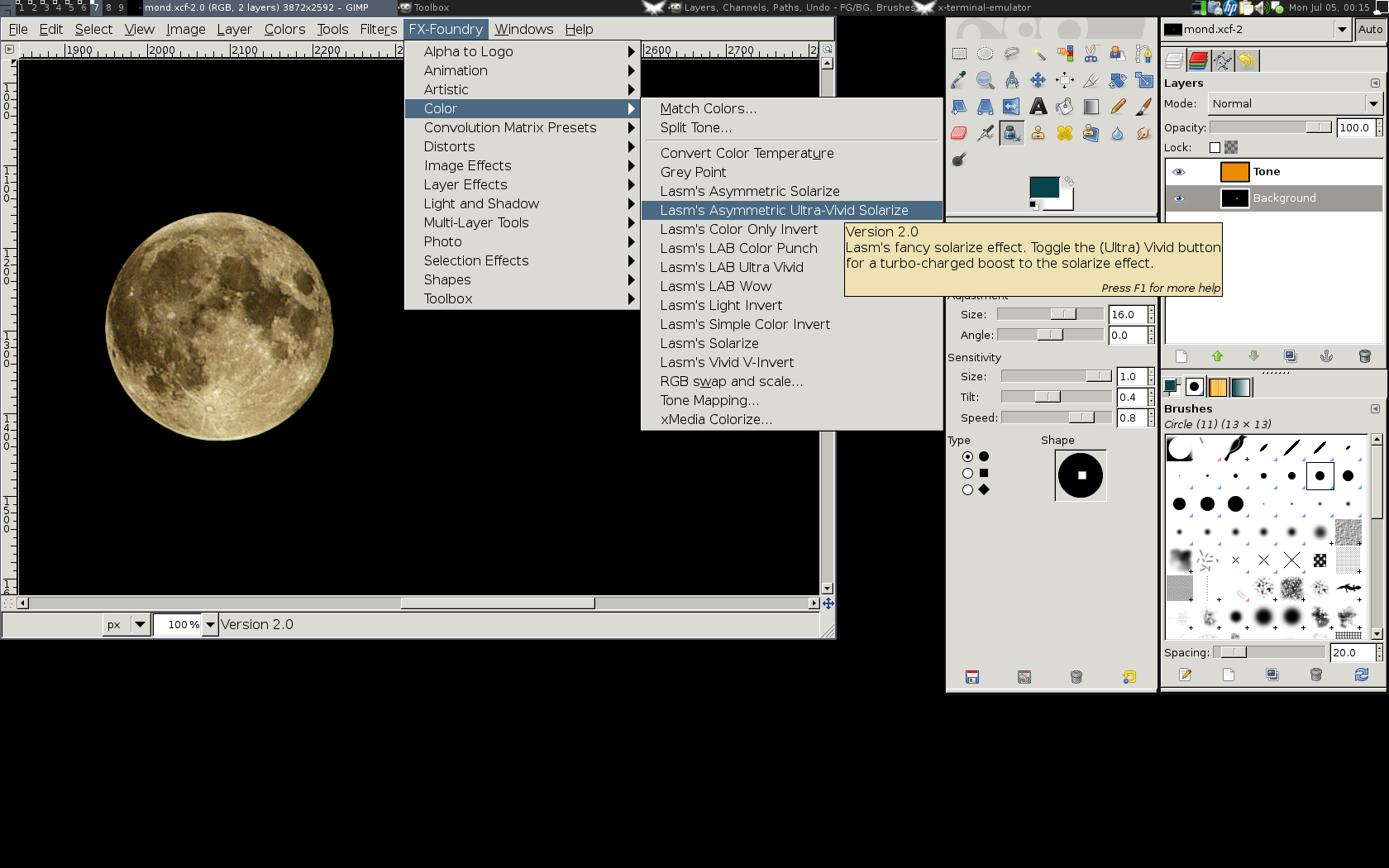
Bernd Zeimetz: gimp-plugin-registry 3.5-1

During the last three months and since my last blog-post about gimp-plugin-registry a lot happened: Mainly a large number of new plugins was added, but also various enhancements and bugfixes went into the package, together with updates for various already included plugins. The GIMP screenshot with open FX-Foundry menu For those who don't know gimp-plugin-registry yet, it is a collection of scripts and plugins for The GIMP. The name is based on the webpage GIMP Plugin Registry, where most (new) plugins and scripts are listed. So far the package ships with 170 scripts/plugins. Most of the scripts are written in TinyScheme, but there are also several plugins in C or Python. Probably most noticeable is the inclusion of the GIMP FX Foundry, which is an awesome collection of 124 scripts. Below follows a list of all scripts and plugins as shown in the long description of the Debian package. New plugins are marked with a bold fontface. If there is any interest from other distributions to include the package, I'd be happy to help out to make an integration as easy as possible. The few interesting parts could be ripped out of debian/rules and shipped as a normal Makefile, so they could be used easily. More complicated is the generation of the package description and copyright information, but I guess instead of writing debian/coyright and debian/control, it should be possible to integrate the information into a rpm spec file template or similar files. So in case you're interested to port the package to Fedora, OpenSuSE or some other distribution, don't hesitate to contact me! The sources are available via git, see git.recluse.de for details. For wishes, suggestions and bug reports either use the Debian BTS or Launchpad. While I prefer bugs via the BTS, it might be easier for non-Debian users to file bugs in the Ubuntu Launchpad.

30 June 2010

Marco T&uacute;lio Gontijo e Silva: Immix on GHC Summer of Code weekly report #7

My project. This post assumes that the reader has read my last post. This week I had less time to work on my project than the last ones, because it was kind of the last week of the semester for some disciplines. This was unfortunate from a point of view, but it s good in another, because now I ve finished most of my disciplines and can focus more. This is also the reason why the weekly report is slightly delayed. Most of my work this week was continuing the investigation of the segfault caused by my implementation of allocation in lines. The most interesting thing I discovered came after a suggestion from my menthor: to use +RTS -DS to turn on the sanity checker. I runned the code with my allocation implementation and the sanity checker and got a segfault. I runned again only with the code to free memory in lines and I got also a segfault. Then I runned without all my patches, using sweep, and I got the segfault. So it seems that there is something wrong with sweep, and now I m investigating this new segfault. I m using the bernouilli program from nofib to test, running with 148 as a parameter and, naturally, +RTS -w -DS passed to the RunTime System. The output of gdb:
Current directory is /home/marcot/trabalho/livre/ghc/nofib/imaginary/bernouilli/
GNU gdb (GDB) 7.1-debian
Copyright (C) 2010 Free Software Foundation, Inc.
License GPLv3+: GNU GPL version 3 or later <http://gnu.org/licenses/gpl.html>
This is free software: you are free to change and redistribute it.
There is NO WARRANTY, to the extent permitted by law.  Type "show copying"
and "show warranty" for details.
This GDB was configured as "x86_64-linux-gnu".
For bug reporting instructions, please see:
<http://www.gnu.org/software/gdb/bugs/>...
Reading symbols from /home/marcot/trabalho/livre/ghc/nofib/imaginary/bernouilli/Main...done.
(gdb) r 148 +RTS -w -DS
Starting program: /home/marcot/trabalho/livre/ghc/nofib/imaginary/bernouilli/Main 148 +RTS -w -DS
[Thread debugging using libthread_db enabled]
Program received signal SIGSEGV, Segmentation fault.
0x00000000006309cb in LOOKS_LIKE_INFO_PTR_NOT_NULL (p=12297829382473034410) at includes/rts/storage/ClosureMacros.h:225
(gdb) where
#0  0x00000000006309cb in LOOKS_LIKE_INFO_PTR_NOT_NULL (p=12297829382473034410) at includes/rts/storage/ClosureMacros.h:225
#1  0x0000000000630a16 in LOOKS_LIKE_INFO_PTR (p=12297829382473034410) at includes/rts/storage/ClosureMacros.h:230
#2  0x0000000000630a4b in LOOKS_LIKE_CLOSURE_PTR (p=0x7ffff6c84062) at includes/rts/storage/ClosureMacros.h:235
#3  0x0000000000631427 in checkClosure (p=0x7ffff6853a08) at rts/sm/Sanity.c:320
#4  0x00000000006319ef in checkHeap (bd=0x7ffff68014c0) at rts/sm/Sanity.c:479
#5  0x000000000063222f in checkSanity (check_heap=rtsTrue) at rts/sm/Sanity.c:686
#6  0x000000000062dfdb in GarbageCollect (force_major_gc=rtsFalse, gc_type=0, cap=0x8d2ec0) at rts/sm/GC.c:768
#7  0x0000000000620431 in scheduleDoGC (cap=0x8d2ec0, task=0x8f5080, force_major=rtsFalse) at rts/Schedule.c:1420
#8  0x000000000061fa2c in schedule (initialCapability=0x8d2ec0, task=0x8f5080) at rts/Schedule.c:539
#9  0x0000000000620c77 in scheduleWaitThread (tso=0x7ffff6c80000, ret=0x0, cap=0x8d2ec0) at rts/Schedule.c:1902
#10 0x000000000065762b in rts_evalLazyIO (cap=0x8d2ec0, p=0x89d8b0, ret=0x0) at rts/RtsAPI.c:495
#11 0x000000000061d3db in real_main () at rts/RtsMain.c:66
#12 0x000000000061d4ca in hs_main (argc=5, argv=0x7fffffffe6d8, main_init=0x406558 <__stginit_ZCMain>, main_closure=0x89d8b0) at rts/RtsMain.c:115
#13 0x00007ffff6fbcabd in __libc_start_main (main=<value optimized out>, argc=<value optimized out>, ubp_av=<value optimized out>, init=<value optimized out>, fini=<value optimized out>, rtld_fini=<value optimized out>, stack_end=0x7fffffffe6c8) at libc-start.c:222
#14 0x0000000000403a69 in _start ()
I started the investigation with the most obvious test: to remove the call to sweep() in rts/sm/GC.c.
  if (major_gc && oldest_gen->mark)  
      if (oldest_gen->compact)
          compact(gct->scavenged_static_objects);
      // else
      //     sweep(oldest_gen);
The result was the same, same segfault in the same place. So I decided to do it a little stronger and avoid the blocks getting the BF_MARKED flag, so that they are not even marked.
                if (!(bd->flags & BF_FRAGMENTED))  
                    // bd->flags  = BF_MARKED;
                 
This one worked. The code in sweep() is not commented, but it s irrelevant, since it ignores blocks that don t have this flag. My third try was to comment the places where the BF_MARKED flag is read, to see each one was causing the segfault. I got a list of places to search with grep, and there weren t a lot of them.
$ grep BF_MARKED rts/sm/*.c
rts/sm/Compact.c:       if (bd->flags & BF_MARKED)
rts/sm/Evac.c:  if ((bd->flags & (BF_LARGE   BF_MARKED   BF_EVACUATED)) != 0)  
rts/sm/Evac.c:        if (bd->flags & BF_MARKED)  
rts/sm/GCAux.c:    if ((bd->flags & BF_MARKED) && is_marked((P_)q,bd))  
rts/sm/GC.c:                    if (!(bd->flags & BF_MARKED))
rts/sm/GC.c:                        // time, so reset the BF_MARKED flags.
rts/sm/GC.c:                        // compact.  (search for BF_MARKED above).
rts/sm/GC.c:                        bd->flags &= ~BF_MARKED;
rts/sm/GC.c:                // Also at this point we set the BF_MARKED flag
rts/sm/GC.c:                // BF_MARKED is always unset, except during GC
rts/sm/GC.c:                    bd->flags  = BF_MARKED;
rts/sm/Sweep.c:        if (!(bd->flags & BF_MARKED))  
The first one is in rts/sm/Compact.c, so it s not relevant to the use with -w. The second one, in rts/sm/Evac.c, is a bit indirect.
  if ((bd->flags & (BF_LARGE   BF_MARKED   BF_EVACUATED)) != 0)  
      // pointer into to-space: just return it.  It might be a pointer
      // into a generation that we aren't collecting (> N), or it
      // might just be a pointer into to-space.  The latter doesn't
      // happen often, but allowing it makes certain things a bit
      // easier; e.g. scavenging an object is idempotent, so it's OK to
      // have an object on the mutable list multiple times.
      if (bd->flags & BF_EVACUATED)  
          // We aren't copying this object, so we have to check
          // whether it is already in the target generation.  (this is
          // the write barrier).
	  if (bd->gen < gct->evac_gen)  
	      gct->failed_to_evac = rtsTrue;
	      TICK_GC_FAILED_PROMOTION();
	   
	  return;
       
      /* evacuate large objects by re-linking them onto a different list.
       */
      if (bd->flags & BF_LARGE)  
	  info = get_itbl(q);
	  if (info->type == TSO &&
	      ((StgTSO *)q)->what_next == ThreadRelocated)  
	      q = (StgClosure *)((StgTSO *)q)->_link;
              *p = q;
	      goto loop;
	   
	  evacuate_large((P_)q);
	  return;
       
      /* If the object is in a gen that we're compacting, then we
       * need to use an alternative evacuate procedure.
       */
      if (!is_marked((P_)q,bd))  
          mark((P_)q,bd);
          push_mark_stack((P_)q);
       
      return;
   
The first if, in line 466, is executed if any of the three flags is present: BF_LARGE, BF_MARKED or BF_EVACUATED. The second if, in line 474, checks for BF_EVACUATED, and returns. The third if, in line 487, checks for BF_LARGE and returns. The code in lines 502-505 is only executed if BF_MARKED is present, and not the other ones. I tried commenting this code, and got an assertion fail in the user code, so I think this is not a good path to follow. The second occurence of BF_MARKED is in the same file.
        if (bd->flags & BF_MARKED)  
            // must call evacuate() to mark this closure if evac==rtsTrue
            *q = (StgClosure *)p;
            if (evac) evacuate(q);
            unchain_thunk_selectors(prev_thunk_selector, (StgClosure *)p);
            return;
         
Commenting it, with or without the call to sweep() commented, causes the same segfault. So, I m tending to think this part of the code is unrelated to the issue. The third occurence is in rts/sm/GCAux.c. I tried commenting it with all the four combinations of the two others commented and not commented, and all resulted in the segfault in the same place. There s another place to check in rts/sm/GC.c. Again, commenting it made no difference. The last one is part of sweep(), so it s avoided anyway when the call to this function is commented.

26 June 2010

Anand Kumria: Get Low

A story about getting people together to tell them a story of regret involving the main character, which we see at the start. The story itself isn't very dramatic. Which is why there isn't a film about that. Instead we have the story about getting people to tell the story. This is a great example of a movie with a mind-boggingly amazing cast (Bill Murray, Robert Duvell, Sissy Spacek, Lucas Black) having a script that is crap. Having the director present, to discuss the film, after the screening lifted this from a 1 to 2. Hearing Aaron talk about the different styles of Duvell, Murray and how the editing process was actually done (Final Cut Pro) was very entertaining. The story drifts, the soundtrack doesn't annoy and the filmography is alright. Oh, the period setting is done very well. Not much else to recommend it though. Get Low refers to burying in the film. Something I think that should have happened to this film.

23 June 2010

Steve Kemp: I am the edge!

Over the past few years I've amassed a collection of a few thousand images taken with a succession of digital cameras. I'm pretty good at organising images, in a directory hierarchy which makes sense to me, in a few simple and broad categories:
skx@birthday:~$ tree -L 1 ~/Images/
/home/skx/Images/
 -- Misc
 -- Parties
 -- People
 -- Pets & Animals
 -- Travel
Beneath ~/Images/People, for example, I have subdirectories for specific individuals (or a "Debian/" folder for Debian-people who've been snapped but don't warrant their own folder.) ~/Images/Travel has things like Travel/Local/2010, Travel/Vienna/2008, etc. In summary I have images of people, places, and things stored beneath what should be a reasonably discoverable directory hierarchy, however this just doesn't work. I still struggle to find images - for example images of myself might be located in ~/Images/People/Self/*, but in practise I'm often included in ~/Images/Travel/* as well. A few times I've looked at using f-spot, digikam, and similar tools to perform image-organisation (but not editing, or timelines, or anything else. Just organisation). I've found I didn't like being locked into their formats, didn't want them to copy my images to a second location, and other gripes. In the end I've forced myself to come up with a Steve-Specific-Solution. Not for the first time, but I think I have just cause... I'm now using the User-Comment field in the image's EXIF data to store tags. (When it comes to EXIF data I keep camera-generated fields, but sometimes update/set "Copyright", "Comment", and "Title" fields. So UserComment is one I've never used until now, and thus I run no risk of trashing existing meta-data.) I've put together a simple perl script, called itag, which will: This is enough for me to be able to see all images of "Edinburgh", via:
~$ qiv --fullscreen --slide --delay 5 $(itag --search=edinburgh)
Similarly I could find myself:
~$ itag --search=steve --search=people
I'm not sure it is useful to others, mostly on the basis that people probably fall into their own routine when it comes to filing, and I suspect that people with vast collections of images will just get annoyed by the obscenely slow indexing process I've got. (Hint: run "exiftool" on every /.jpe?g$/i file..) Still its a simple enough idea and I think it should scale in the future - I can even see myself writing a wee GUI to do tag exploration and similar. Just not today. ObFilm:Aeon Flux ObRandom: Apologies for people waiting on email - it's been that kind of week.

John Goerzen: Thyroid Surgery & The Boys

Terah has been having thyroid troubles for some time now (you can read about it on her blog). Today was the day for it to be removed. This procedure is somewhat delicate. Running through each half of the thyroid are nerves that control the vocal chords. Also embedded in each half are tiny parathyroids, which regulate the body s calcium levels. Losing either of these things in one half of the thyroid is no big deal, but losing either of them entirely can be serious. For this reason, the general plan was for Terah to have half of her thyroid out, unless it was obvious in surgery that it would be a health risk to leave the other half in, or that it was obvious that the removal of the first half had successfully preserved the nerves and parathyroids. Jacob and Oliver spent the night with my parents last night an event that Jacob was incredibly excited about. I came home last night to find him running in circles in the kitchen. I had this conversation with him: Me: Jacob, are you excited about something? Jacob: Yes! Me: What are you excited about? Jacob: I don t know. (He usually says this when he doesn t want to say, but I figured it was his pending overnight stay) .. a minute later .. Jacob: I am excited about something blue. Me: [genuinely confused] Hmmm . I don t know what blue thing you might be excited about. Can you tell me? Jacob: A blue house! Me: Oh, is it grandma and grandpa s blue house? Jacob: YEAH! Now you ve got it! I m so excited! He was still running in circles the whole time. So Jacob and Oliver left, and Terah and I worked on the house. This morning, we arrived at the hospital at 6:15 to check in. At usual, the staff there was incredibly friendly and helpful. And two of them made connections: one of the intake nurses had taught at the college where my dad works, and another nurse knows his cousin. Living where we do, we were not surprised by this. (You sort of wonder how many connections you ll make at a place like this.) The surgery area is right next to the ER, and people waiting for people in surgery normally wait there. Having got my fill of the TV playing infomercials for the morning in the 5 minutes we sat there, I arranged to wait in the cafeteria (which is large and quiet in the middle of the morning) and they just called my cell phone when Terah was done. I was with Terah for as long as possible, then ate breakfast in the cafeteria, walked over to the doctor s office next door for my weekly allergy shots, and then waited with my Kindle in the cafeteria. They called, and a little while later the surgeon explained how the surgery went: far easier than they had expected. He was confident the left side surgery went well, and so took out the whole thing and was confident the right side removal also went well. I went to wait in Terah s room for her to exit recovery, and our pastor and his daughter showed up to wait too. When she arrived, she was very tired but said a few words before going to sleep. Our pastor gave the two of us a minute before coming in, and read a selection from Psalm 139 before leaving. I then mostly waited with my Kindle some more until she woke up. I brought back some lunch from the cafeteria, and eventually Terah woke up. We chatted just a bit (it was mostly me talking). I went to pick up the boys, and brought them to the hospital. They were glad to see her. But then, the dilemma: I had promised Jacob that we would eat in the hospital restaurant , but it was only 4 and they didn t start serving supper until 5. Jacob somehow remembered that we went exploring in the hospital when Oliver was born 11 months ago, and had been talking about doing this already. So off we went: Jacob sometimes helping me push Oliver s stroller, sometimes running on ahead, enjoying himself and spelling out letters on big signs on the walls. We got a whole bunch of smiles and compliments. Oliver was laughing, and Jacob was happy and well-behaved. We went towards the cafeteria at 4:30 and I got Jacob some of their free lemonade. He was complaining about not eating, and I remembered that he noticed a nurse walking out of there with an ice cream cone while we were exploring. Obviously the soft-serve machine was already up, so I got him and me ice cream cones. I m sure he ll be talking about the hospital ice cream for days. Anyhow, it took him about half an hour to eat it, so it was perfect timing for supper. We ate, went back to see Terah, and then headed out. I do believe that these may be the only two boys I know of that actually think of a hospital as a fun place to go. It wouldn t surprise me at all if Jacob asks to go back there. Both boys fell asleep on the way home. Jacob, unfortunately, had a rather significant accident, possibly due to the large amounts of free lemonade he insisted on drinking. And it was hot outside. So I carried Jacob in, and he sort of groggily looked at me. I suggested he take a nap on the rug in the kitchen (his room is upstairs) while I bring Oliver in. He sort of collapsed onto the rug and was back asleep a few seconds later. I got Oliver in, and brought down new shorts and an overnight pullup for Jacob. Put them on, had him use the toilet, and got him in bed. By that time, Oliver was awake and hungry. So I got him fed, and neither one of them quite went to sleep easily but they did. I watered the flowers and garden, did a load of laundry, etc. Jacob had been worried about the surgery, though had trouble verbalizing it. I think he s better about it now, though some of his trouble falling asleep tonight was probably still worry about that. Hopefully he ll be better once Terah is back home, which should hopefully be tomorrow.

17 June 2010

Steve Kemp: That friend promises his undying friendship if you would do him a small favour.

Perl & Apache?
Once upon a time, within the past year, I saw mention of a simpler version of mod_perl - an apache module which let you write code to run within the context of a persistent perl process. However my DuckDuckGofu is weak, and I'm struggling to find this project. Did I dream it, or could somebody tell me where it lives?
Dynamic Picture Frames
So I've been taking pictures recently. Lots of pictures. Many times many images have been printed and hung upon my walls, and the price of frames is starting to become onerous. I'd love to see some kind of "dynamic" picture wall - but the two alternatives I considered fail:
Metal & Magnets
Place a huge sheet of metal upon your wall. Then put wee magnets inside your frames.
Corkboard
Imagine a full wall that was paneled with what is essentially a large notice-board..
Both of these would look ugly; the metal one perhaps less so. But the idea of having a wall which could have pictures mounted upon it, without having big nail holes if you rearranged and which could cope with dynamic repositioning and sizes is nice .. Invent it for me? I'll buy one. Probably even two...
ObFilm: The Godfather

16 June 2010

Russell Coker: Carpal Tunnel Getting Better

Three months ago I wrote about getting Carpal Tunnel Syndrome [1]. A few weeks after that I visited the specialist again and had my wrist brace adjusted to make it a little less uncomfortable. The specialist also gave me some quick ultra-sound treatment and then said that if it didn t get better in a month or two then I should just get a referral to a surgeon! I didn t have a bad case, some people have their hand muscles atrophy. My hand strength was measured as 50Kg in my left hand (the one with CTS) and 52Kg in my right hand. The greater strength in my right hand is probably more due to the lack of left-handed tools and sporting equipment than any muscle atrophy. This is slightly better than the physical standards for the Victoria Police (just over 50Kg average for both hands) [2] and a lot better than the Australian Federal Police physical standards of 45Kg for the dominant hand and 40Kg for the non-dominant [3]. Really my hand strength should have been recorded as 490Newton and 510Newton respectively, medicine is the science of healing, in all aspects of science the Newton is the measure of force. Over the past few months my hand seems to have recovered a lot while wearing the wrist-brace 24*7. I ve just started going without the wrist-brace during the day and it seems to be OK. I m currently planning to wear the wrist brace at night for a year or two as it s the only way to ensure that my hand doesn t end up on a bad angle when I m asleep. At this stage it seems that I ve made as close to a full recovery from CPS as is possible!

13 June 2010

Martin-&#201;ric Racine: xf86-video-geode: new contributors shake off the dust

A couple of years ago, the Geode X.org driver lost its main contributor, due to random attrition at AMD after the company experienced severe losses at the end of a quarter. Since then, yours truly and a few random contributors have been trying to keep this driver at least remotely usable, with mixed results. Over the past few weeks, the driver has seen new contributions, thanks to the addition of two engineers from AMD Taiwan who have been going through the list of outstanding bugs and learning the ropes of collaborating with the Free Software community. This, in turn, had a snowball effect and motivated old contributors from the OLPC project and from the thin client community to return to the driver. Hurray! Let's give a warm welcome to Frank Huang and Hunk Cui from AMD and, if you notice any issue with the driver that is not already reported, please file a report to help us become aware it. Cheers!

Petter Reinholdtsen: Officeshots taking shape

For those of us caring about document exchange and interoperability, OfficeShots is a great service. It is to ODF documents what BrowserShots is for web pages. A while back, I was contacted by Knut Yrvin at the part of Nokia that used to be Trolltech, who wanted to help the OfficeShots project and wondered if the University of Oslo where I work would be interested in supporting the project. I helped him to navigate his request to the right people at work, and his request was answered with a spot in the machine room with power and network connected, and Knut arranged funding for a machine to fill the spot. The machine is administrated by the OfficeShots people, so I do not have daily contact with its progress, and thus from time to time check back to see how the project is doing. Today I had a look, and was happy to see that the Dell box in our machine room now is the host for several virtual machines running as OfficeShots factories, and the project is able to render ODF documents in 17 different document processing implementation on Linux and Windows. This is great.

Next.

Previous.