Search Results: "az"

24 December 2013

Gergely Nagy: Some free software are really free

I read a post titled "Free software is NOT Free", and that triggered a few thoughts, which I would like to share here. While the post has some good thoughts, there are points in it which I disagree with strongly. You see, I've been writing free software almost half my life, most of the things I contributed to various projects, and the vast majority of my own projects, were made because it made me feel good. Because I scratched an itch, and sharing filled me with a sense of accomplishment.I always had bills to pay, and I have a day job to get that kind of thing sorted, yet, I do not believe that the quality of my free software work suffers because of that. Do I have less time? Yes, I do. But slower pace does not mean lesser quality - more often than not, I found that slower pace leads to better considerations, more care given to each change, because fixing it later, fast, is much more costly, so you make sure that your improvements will stand the trial of time.But I digress. I want to share a different view on the topic, based on my own experiences.When I first got into free software, I was young, bright-eyed, full of hopes and illusions of grandieur. I did my part of small contributions here and there, and every bit of "Thanks!", every bit of feedback - be it criticism or rejection - contributed to my development. This part of the free software culture is still important to me, and remains a major factor behind my desire to work on free software. Later on, there came another revelation: people actually use the stuff I write! That's an awesome feeling too, but with it, comes a burden too: supporting users, and trying to cater to every need that arises. To combat this, to not drown, you need to learn to say "No". It is hard, but as maintainer of a project, it's your task to keep it maintainable, and you need to know your limits. Would it be better if you could fulfil every wish? If you could do everything you ever dreamed of? You may think the answer is yes, but you're wrong. The answer is "No".Not everything needs to be done, not every wish needs to come true. As always, there's a balance. Limiting the amount of time that can be spent on a project helps keep that balance. And when balance is found, the project becomes more mature, maintenance stops being a chore you do not want to do, but have to, and instead becomes something you actually enjoy. We are human beings, we dream and wish for a lot, and we have a hard time realising our limits. That makes us feel sad, sometimes even inadequate. Having less time puts us into a different position, where were are forced to reevaluate how we spend the little free time we have. In the long run, I believe that is good for free software.But there's an even better way to approach the problem! You want to work on your projects, right? Yet, you also want to pay your bills. And you are a fan of free (as in freedom) software. When I found myself in a position like that, when I was looking for work, I was looking at companies which are friendly towards free software, and even have a few on their portfolio. Working for such a company allows me to be happy with myself, by not betraying my own beliefs, and on the side, still spend time on my own things.When I spend my day working on free software, I feel energised, and during lunch break, I can look through my plans for my own projects (some of which are related to my work too, which makes it even easier to spend time on them), plan ahead, and go home with a head full of ideas. No exhaustion after a daunting day of hacking proprietary software, with a sinking heart. No feeling guilty of not taking good care of your projects, because you do take care! You just do it on your own terms.So this is my suggestion to independent free software hackers: find a free software friendly company, that allows - or even encourages - you to work on your own things too. That way, you can pay your bills, and work on your hobbies, and best of all: keep them as hobbies, so it does not become a burden. When a hobby becomes your job, that often leaves a sour taste behind, when you can't fulfil every need, or fix every issue.Get a free software day-job, and keep your hobby as such, and everyone benefits. You get to keep your sanity, and users will receive better care, because the developers do what they love, and not what they have to.You give up some of your freedoms, yes, by not being independent. But being independent is not always the right choice. For some people, it may well be, for some, not so much. My experience over the past 15 years or so, is that independence brings a lot more headache than I'm willing to deal with. I'd rather work for a free software friendly company, where, after three years, I get paid to write and contribute to free software, and take care of my personal projects on the side, than try do all of it on my own.None of the software I wrote is worth a full salary, and none of them requires me to work full time on them, either. I could, mind you, I have enough ideas lined up to keep me busy for years. But do I want to? Do I want to burn myself out?No. The day job satisfies my hunger for contributing to a widely used piece of software, and my hobby projects satisfy my exploratory needs. I'm happy this way, and I'm very happy that thanks to the work and dedication of some amazing people, we got this far, that one can have a day job and independent projects too, that are all free software, without having to depend on fairly unreliable sources, such as donations (mind you, donations are a nice extra).There are, of course, different situations, and different people. What works for one, may not work for the other. This is what worked for me, and I felt the need to share it, lest anyone thinks that the world's darker than it really is.

23 December 2013

Russ Allbery: Review: The Death of Bees

Review: The Death of Bees, by Lisa O'Donnell
Publisher: HarperCollins
Copyright: 2012
Printing: 2013
ISBN: 0-06-220984-1
Format: Hardcover
Pages: 309
This is the first definite hit from my Powell's Indiespensable subscription, and a good example of why I subscribe. I never would have read or even heard of this book without it, and I thoroughly enjoyed it. Marnie and Nellie are sisters living in a housing estate in Glasgow's Maryhill district. Neither of their parents ever held regular jobs, although one does quickly learn their father had been earning money distributing drugs. The story opens, rather shockingly, with the death of both parents: their father smothered in his bed, and their mother, a day later, after refusing to notify anyone of their father's death, by hanging herself in the garden shed. In fear of being taken by social services and then separated, particularly given Nellie's unusual way of interacting with the world (she talks, and writes, like a woman in the 1950s trying to sound high-class), the girls bury both bodies in the back garden and tell everyone their parents just went on an unannounced trip without them. It wouldn't be the first time. Marnie is 15 and a year away from being legally an adult, at which point she can take custody of Nellie (who is 12) and keep them together. In the meantime, they just have to keep their parents' deaths secret and figure out how to keep food on the table and social services away. Their next-door neighbor is a formerly-closeted older gay man named Lennie who is known as the neighborhood pervert after he was arrested getting a blow job from an underage male prostitute. Both girls are quite understandably suspicious of him, but he's also the first person to notice that something is wrong and to start trying to help. The book is told in many short chapters, each written by one of Marnie, Nellie, or Lennie in their own voice. You might have guessed from the plot summary that this book needs a few warnings, but I want to emphasize that more. This is a book that opens with decaying corpses, including a few rather-too-vivid images from its transport and from Marnie's later (unnamed) post-traumatic stress. Marnie is quite sexually active, and both girls have had a nasty background full of things that I preferred not to think too much about. Most of the worst bits are only alluded to and are kept off-camera, but there's still quite a lot of background nastiness and desperation here. The Death of Bees is blunt and forthright to the point that it repeatedly made me cringe, and that sort of thing usually doesn't bother me in books. That said, this is not a horror novel, even though it contains horror. You could describe it as darkly comic, although none of the comedy is the sort that makes one laugh, except perhaps in startled surprise. The adjectives that come to mind are fierce, compassionate, empathetic, tough, and courageous. The author is completely on the side of the three protagonists, all of whom are deeply hurt in their own ways but all of whom are trying as hard as they can to support each other. I have rarely read a book that made me care as much about the characters. It's the kind of story that makes one want to passionately defend them, particularly once the one real villain, in the form of a do-gooding outsider, makes his appearance. And the reader and the author aren't alone. One of the things I loved about this book is that it doesn't artificially isolate the characters. Marnie has friends, and while Marnie doesn't always notice for Marnie, this is just her life, and many things of significance to the reader are just more of daily life for her this book is full of unexpected acts of small kindness. The surrounding characters are themselves all dealing with their own troubles and not in a great position to help anyone, and yet somehow they manage. Even Nellie, who has a great deal of difficulty interacting with other people her own age, gets unexpected help from people she thinks can't stand her. I think it's very telling that about the only character here who is entirely unsympathetic is the one who claims to be the most moral and virtuous. Unfortunately, from my perspective, this book has one major flaw: the ending. Thankfully, the ending isn't bad; if it were, it would have completely destroyed my enjoyment of the book. By the time one gets through this story, having something bad happen to these girls would break your heart. The ending does deliver the necessary catharsis, but it is far, far too short. O'Donnell builds up tension mercilessly, pushing the story down a path that's clearly desperately wrong for both of the girls, and doesn't let the story climax happen until about ten pages from the end. We get all of a page or two of denouement, and then the novel is over. I am, admittedly, a "Scouring of the Shire" sort of person. I like long denouements, particularly if I've gone through hell with the characters. I like getting to spend some happy time with them. But even for those who don't enjoy that as much as I do, I think this ending was too short. O'Donnell does an amazing job building sympathy and empathy throughout the story, and I didn't want to have to fill in all of the happily ever after from my own imagination. Maybe it would have been hard to do without getting too sentimental or without dulling some of the sharp edges of the story, but I would have really appreciated another ten pages. As is, it felt like the novel abruptly and unceremoniously dumped me out on the ground. But, that aside, this is an excellent character story. It's one that I would be careful about recommending; parts of it are extremely dark and nasty, and you have to take Marnie on her own terms for the story to work. But it's beautifully written and thoroughly engaging, and I'm very glad to have read it. Rating: 8 out of 10

20 December 2013

Riku Voipio: Replicant on Galaxy S3

I recently got my self and Galaxy S3 for testing out Replicant, an android image made out of only open source components. Why Galaxy S3? It is well supported in Replicant, almost every driver is already open source. The hardware specs are acceptable, 1.4Ghz quad core, 1GB ram, microsd, and all the peripheral chips one expects for a phone. Galaxy S3 has sold insanely (50 million units supposedly), meaning I won't run out of accessories and aftermarket spare parts any time soon. The massive installed base also means a huge potential user community. S3 is still available as new, with two years of warranty. Why notWhile the S3 is still available new, it is safe to assume production is ending already - 1.5 year old product is ancient history in mobile world! It remains to be seen how much the massive user base will defend against the obsolescence. Upstream kernel support for "old" cpu is open question, replicant is still basing kernel on vendor kernel. Bootloader is unlocked, but it can't be changed due to trusted^Wtreacherous computing, preventing things like boot from sd card. Finally, not everything is open source, the GPU (mali) driver while being reverse engineered, is taking it's time - and the GPS hasn't been reversed yet. Installing replicant Before install, from the original installation, you might want to take a copy of firmware files (since replicant won't provide them). enable developer mode on the S3 and:
sudo apt-get install android-tools
mkdir firmware
adb pull /system/vendor/firmware/
adb pull /system/etc/wifi
After then, just follow official replicant install guide for S3. If you don't mind closed source firmwares, post-install you need to push the firmware files back:

adb shell
mount -o remount,rw /system
adb push . /system/vendor/firmware
Here was my first catch, the wifi firmwares from jelly bean based image were not compatible with older ICS based replicant. Using replicant
Booting to replicant is fast, few seconds to the pin screen. You are treated with the standard android lockscreen, usual slide/pin/pattern options are available. Basic functions like phone, sms and web browsing have icons from the homescreen and work without a hitch. Likewise camera seems to work, really the only smartphone feature missing is GPS. Sidenote - this image looks a LOT better on the S3 than on my thinkpad. No wonder people are flocking to phones and tablets when laptop makers use such crappy components.
The grid menu has the standard android AOSP opensource applications in the ICS style menu with the extra of f-droid icon - which is the installer for open source applications. F-droid is it's own project that complements replicant project by maintaining a catalog of Free Software.
F-droid brings hundreds of open source applications not only for replicant, but for any other android users, including platforms with android compatibility, such as Jolla's Sailfish OS. Of course f-droid client is open source, like the f-droid server (in Debian too). F-droid server is not just repository management, it can take care of building and deploying android apps.
The WebKit based android browser renders web sites without issues, and if you are not happy with, you can download Firefox from f-droid. Many websites will notice you are mobile, and provide mobile web sites, which is sometimes good and sometimes annoying. Worse, some pages detect you are android and only offer you to load their closed android app for viewing the page. OTOH I am already viewing their closed source website, so using closed source app to view it isn't much worse. This keyboard is again the android standard one, but for most unixy people the hacker's keyboard with arrow buttons and ctrl/alt will probably be the one you want. Closing thoughts While using replicant has been very smooth, the lack of GPS is becoming a deal-breaker. I could just copy the gpsd from cyanogen, like some have done, but it kind of beats the purpose of having replicant on the phone. So it might be that I move back to cyanogen, unless I find time to help reverse engineering the BCM4751 GPS.

19 December 2013

Joachim Breitner: My contribution to XKCD s #949 is not needed

A few hours ago I posted about share-file, a small tool to make a local file available at a public URL so that it is transferred from my machine, without being stored at some central server. I wanted to create something like FileTea, but usable from the command line. My post made it to HackerNews (which brought my server to its knees for a while; let s say I had the opportunity to find out what setting for apache s MaxClient option works on my machine...), where the comments (besides some misunderstanding about the notable features of share-file) contained interesting links related to solving #949:

16 December 2013

Craig Sanders: shopping online whinge of the day

There are numerous benefits to shopping online you can order stuff and pay for it from the comfort of your own home and it ll arrive on your doorstep in just a few days. wonderful, and so many words have been written about the benefits over the years that there s no need to belabour the point, But there are some things about it that really suck and make me NOT want to order stuff online most of the time my distaste for the privacy and delivery problems is enough to dissauade me from buying anything, helped by the fact that I live a fairly non-consumerist lifestyle (and for a geek, I have an almost non-existent gadget-fetish) but occasionally I want or need something that isn t available locally or which my ill-health makes impractical to buy in person (i ve been effectively housebound or in hospital for most of the year) so here are the things that piss me off most about shopping online.
  1. Loss of anonymity and privacy. You can walk into any shop and pay cash for whatever you want, they don t need to know who you are or where you live, and they don t get to accidentally add you to a mailing list against your express wishes oh, we didn t realise that when you said DO NOT SPAM ME, you actually meant DO NOT SPAM ME we ll just keep spamming you for another six months until we get around to processing your removal request . partial solution: use a different email address with each online shop. boycott the shop and destroy the address if they spam. what sucks is that this is actually necessary. it doesn t matter how loudly I say DO NOT SPAM ME. DO NOT ADD ME TO ANY MAILING LISTS. DO NOT ASK ME TO COMPLETE A SURVEY. DO NOT CONTACT ME FOR ANY REASON NOT DIRECTLY RELATED TO DELIVERING MY ORDER. MY PERSONAL INFORMATION IS PROVIDED SOLELY SO THAT YOU CAN SHIP MY ORDER TO ME AND MAY NOT BE USED FOR ANY OTHER PURPOSE. FAILURE TO RESPECT MY PRIVACY WILL RESULT IN IMMEDIATE AND PERMANENT BOYCOTT (yes, that IS the text I use in the comments/instructions field of every order I place), marketing vermin will decide that I really want their spam after all because their spam is super interesting and important and isn t really spam at all.
  2. nosy demands for unneccessary information. OK, they need your addresss to ship your parcel but they don t need your phone number, and they don t need to tie your order to your facebook or other bullshit social-spam account. most online order forms have phone number as a required field. Fortunately, they usually accept 0000000 or some other bogus non-phone number as a valid number .if not, i give them their own phone number.
  3. the thing that really shits me the most about online shopping is that both couriers and australia post suck. the lazy fuckers usually don t even bother attempting to deliver to residential addressess. at best, they just stick a non-delivery card in your letterbox without even attempting to knock on the door ..and sometimes they don t even bother doing that. the delivery driver just files a bogus failed to deliver or recipient refused delivery with their office.
i ve made four online purchases in the last month and a half. only one of them was delivered correctly to my door, even though I was sitting at my desk in the front room of the house, a few feet from my front door, and regularly monitoring the parcel s tracking web page so I knew it was arriving. parcel 1 (Nov 16): DHL from NZ to AU. delivered perfectly. delivered in about two days for $17. order value: around $35. parcel 2 (Nov 20): Aust Post from WA to Vic, Express Post (costs a few bucks more than standard post). order value: around $80. lazy driver didn t bother to attempt delivery. left card in letter box. i had to pick it up 2 days later from a post office the next suburb over (it wasn t there yet on the first attempt to pick up, the next day). Aust Post offered to maybe put me in touch with their re-delivery people who might possibly be able to re-deliver the parcel next week sometime maybe, if they felt like it. knowing that I had another hospital appt the next week, I declined (if i hadn t, it would have been an absolute certainty that they would try to deliver it while i was out). parcel 3 (nov 29): DHL from NZ to AU. order value: around $85. lazy courier didn t even bother to leave a card, just logged it as Recipient refused delivery . This refused delivery lie infuriated me when i saw it on the tracking page so i phoned and yelled at them a lot. DHL delivered it later the same day. if they hadn t I would have had to get myself over to the other side of town during business hours and pick it up from their South Melbourne depot. parcel 4 (today, Dec 16): Aust Post from NSW to Vic, Express Post . order value: around $160. lazy driver didn t even bother to leave a card, just logged it as Attempted delivery being carded to Australia Post outlet . Complete bullshit. There was no delivery attempt, not even a card in the letterbox, let alone a knock on the door with my parcel. Rang Aust Post on 8847 9045 (a phone number curiously absent from their tracking page, but which I had written down after their failure to deliver on Nov 20) and complained. they claim that they will try to deliver it today. i ll believe it when I see it. UPDATE @4.30pm: no, it s not going to be delivered today. they say they might choose to deliver it tomorrow or sometime in the future, if the delivery center manager feels like it. i told them that this is not an option my parcel WILL be delivered, it is what they were paid to do so it is what they ARE going to do. btw, the tracking page says that they attempted delivery at 12.15 today (they didn t not even a card in the letterbox), but the tracking page wasn t updated with that until about 2.30pm. by a complete non-coincidence their delivery center allegedly closes at 2pm, so it s impossible to complain about non-delivery in time for the complaint to do any good. Score so far: DHL 50% delivery rate. Aust Post: 100% failure rate. Annoyance Rate: extremely high. Desire to repeat the experience: non-existent. The Australia Post delivery problems are particularly annoying. I ve always thought of the network of local post offices to be a huge advantage for parcel delivery if i m not home, my parcel will go to a local post office and I can pick it up from there. And this is a great advantage. I used to take advantage of it when I was well enough to work. In fact, I d insist on delivery by Aust. Post rather than by a courier for exactly this reason, a local post office is far more convenient than some courier s depot on the other side of town or out in some far outer-suburban hellhole. But when it s used as an excuse to not even bother attempting delivery, it sucks. I m not well, and I should have been lying in bed reading or sleeping today, not wasting what little energy I have waiting for a parcel that never arrived and I certainly shouldn t have to phone Aust Post or DHL to yell at them for failing to do the job that they have been paid to do. shopping online whinge of the day is a post from: Errata

15 December 2013

Hideki Yamane: my Desktop Environment broken - any help?


Recently, my GNOME environment was broken suddenly. Startup GNOME Shell cause segfault and die. I cannot use GDM3 at all.

henrich@hp:~ $ grep gnome-shell /var/log/syslog
Dec 15 10:51:12 hp kernel: [34944.969581] gnome-shell[10054]: segfault at 84 ip 00007f6c6186a7b9 sp 00007fff59f1dbc0 error 4 in libcogl.so.12.1.1[7f6c61821000+97000]
Dec 15 10:51:12 hp gnome-session[9565]: WARNING: Application 'gnome-shell.desktop' killed by signal 11
Dec 15 10:51:14 hp kernel: [34946.429046] gnome-shell[10202]: segfault at 84 ip 00007ffa2ae877b9 sp 00007fff2bc5c7d0 error 4 in libcogl.so.12.1.1[7ffa2ae3e000+97000]
Dec 15 10:51:14 hp gnome-session[9565]: WARNING: Application 'gnome-shell.desktop' killed by signal 11
Dec 15 10:51:14 hp gnome-session[9565]: WARNING: App 'gnome-shell.desktop' respawning too quickly
So, I've switched to KDM, and install xfce4. However, I faced to another problem - it cannot show any icons (desktop and panel).


Odd Chromium window (why red?).


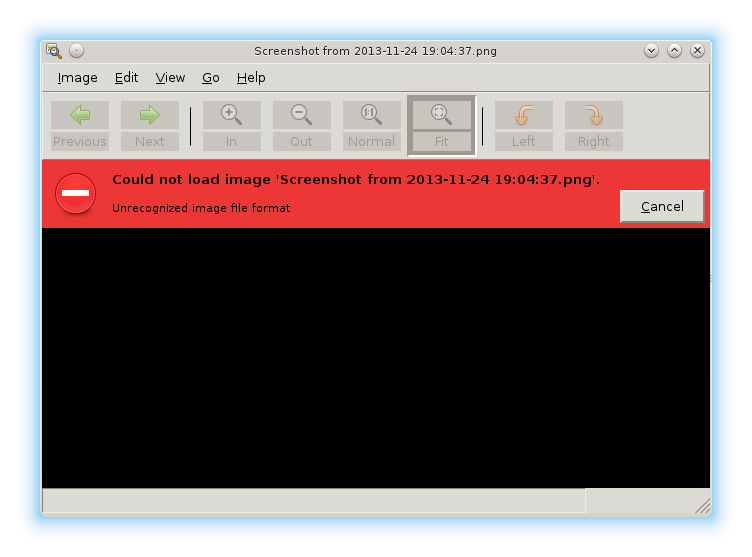
Also eog says "Could not load image" "Unrecognized image file format" - Well, why? It's just a .png file. (screenshot on KDE4)
Shotwell cause segfault, too :-( (and some other GTK applications)

I cannot point out broken component. Dear lazyweb, could you tell me how to fix this situation, please?


14 December 2013

NOKUBI Takatsugu: The 1st Debian mokumoku meeting

I attended the 1st Debian mokumoku meeting. mokumoku ( ) means silently and concentrativeness in Japan. There were about 6 people in a room. I tried to prepare release of Namazu and KAKASI. debmoku

7 December 2013

Hideki Yamane: I was in Mini DebConf in Taiwan 2013

I've done GPG key sign for Mini DebConf in Taiwan 2013 participates, and written an article for Japanese magazine, Software Design 2014/Jan. This means, my short trip has been ended, at last.


In this event, I've talked about "local community" for Debian, a bit (PDF/ODF are in Debian Wiki).
Local Community for Debian (2013 Taiwan miniDebConf) from Hideki Yamane

Probably you know, most of Debian contributors are in Euro/America(North and South), not in Asia. But there are lots of talented people. It means: there is huge possibility for Debian :)


I hope we Asian Debian people unite and publish its community work more, and do "DebConf in Asia" - in the future.

3 December 2013

Brett Parker: dd over ssh oddness

So, using the command:
root@new# ssh root@old dd if=/dev/vg/somedisk dd of=/dev/vg/somedisk
appears to fail, getting a SIGTERM at some point for no discernable reason... however, using
root@old# dd if=/dev/vg/somedisk ssh root@new dd of=/dev/vg/somedisk
works fine. The pull version fails at a fairly random point after a fairly undefined period of time. The push version works everytime. This is most confusing and odd... Dear lazyweb, please give me some new ideas as to what's going on, it's driving me nuts! Update: solved... A different daemon wasn't limiting it's killing habits in the case that a certain process wasn't running, and was killing the ssh process on the new server almost at random, found the bug in the code and now testing with that. Thanks for all the suggestions though, much appreciated.

Antoine Beaupr : Announcing a prettier noping

I have implemented really pretty histograms in the venerable ping software, something I never thought could be improved, until I discovered prettyping.sh, something that was just begging for improvements. Which are now done. But first some history... First, in 1983 (!), there was ping and network operators rejoiced, as they could see if a host was down or not, and have all sorts of geeky statistics:
PING koumbit.net (209.44.112.66): 48 data bytes
56 bytes from 209.44.112.66: icmp_seq=0 ttl=52 time=25.076 ms
56 bytes from 209.44.112.66: icmp_seq=1 ttl=52 time=24.006 ms
56 bytes from 209.44.112.66: icmp_seq=2 ttl=52 time=24.106 ms
^C--- koumbit.net ping statistics ---
3 packets transmitted, 3 packets received, 0% packet loss
round-trip min/avg/max/stddev = 24.006/24.396/25.076/0.483 ms
Then, in 2006, there was noping, and things were, well, not much better, but we had colors, and there was some rejoicing. noping before Then, in october 2013, there was prettyping.sh, and things got really flashy and "oh wow, you can do that?" There was much rejoicing. prettyping animation Then, tonight, I learned ncurses and there was much headaches. But then, I reimplemented prettyping in noping, and I am so happy that I wrote this blog post: noping now Unless you haven't figured out how cool this is, let me break it down for you:
  1. it supports IPv4 and IPv6
  2. it allows you to track multiple hosts at the same time, and compare them
  3. this allows you to easily track down failure points in a network, something for which you usually need smokeping (needs a webserver) or mtr (doesn't have colors)
  4. it allows you to track a lot (the last minute at least) of history by default
  5. it is visually easy to track, even from a distance
You may know of that hack that can make "ping" ring a bell when it receives a packet? This is better: you can see the packets latency (or when they are just dropped!) from a distance, using an intuitive color code. The code is up for review here:
git clone -b prettyping git://src.anarc.at/liboping
Thanks to the well architectured noping, the patches were not that complicated to implemented. I have contacted upstream to get those changes merged, and hopefully this will be in your favorite Debian distribution soon. Rejoice!

26 November 2013

Daniel Pocock: The free software country?

Loch Ness Monster, Scotland There is big news in Europe right now, especially the UK, about the Scottish nation's manifesto for independence. I thought this was really amazing, a country that is going to move to free software and protect its citizens from horrors like DRM. I couldn't wait to find out more, for example, will they use Linux or *BSD? After all, how many nations today can really consider themselves independent when they are trapped in the use of complex and opaque systems that require ongoing royalty payments to a foreign corporation, much like ancient villages paying their tithes to Rome? Today it is actually worse: these independent nations are not just sacrificing their cash - the new Rome is also using those same secret, proprietary systems to raid their subjects' privacy. So I went to the manifesto's web site to get the details. I couldn't even find the words "software" or "technology" listed in the policy index on the front page - and software doesn't even appear in the search results. A section on Culture, Communications and Digital only really looks at the issues for the media (BBC after independence). They don't even make any comment about the British Telecom (BT) pension crisis and whether Scotland will abandon BT's services, leaving only those customers south of the border to continue subsidising the deficit through higher phone bills. There is some hope, with the dot scot (.scot) top level domain coming in 2015 regardless of the referendum outcome. Does this mean an independent Scotland is going to be run without technology at all then? That could be an interesting way to avoid the type of infiltration of communications technology that has been taking place in Brussels. Or do the people calling the shots simply fail to realise the impact of software and communications technology on a modern day concept of independence? Party date set For those who just care about gatecrashing the post-independence party, start booking your leave for March 2016.

Ricardo Mones: Shared memory crazyness

The output of some commands explains it all.

These are the default values in a Wheezy system:

$ ipcs -l
------ Shared Memory Limits --------
max number of segments = 4096
max seg size (kbytes) = 32768
max total shared memory (kbytes) = 8388608
min seg size (bytes) = 1


That's not enough for all the data I want to load in a single segment, so let's start with 1Gb of shared memory:

# sysctl kernel.shmmax=1073741824 kernel.shmall=1073741824
kernel.shmmax = 1073741824
kernel.shmall = 1073741824

So now, both should be equal, isn't it?

$ ipcs -l
------ Shared Memory Limits --------
max number of segments = 4096
max seg size (kbytes) = 1048576
max total shared memory (kbytes) = 4294967296
min seg size (bytes) = 1

Uh!?

A free $BEVERAGE when we met for the one which tells me what's happening here ;-)

21 November 2013

Michael Banck: 21 Nov 2013

PostgreSQL talk at Linux-Stammtisch

Next Wednesday (November 27th), the Munich Linux-Stammtisch is happening again. This time the topic will be Open-Source databases. Mathias Brandstetter will present MySQL and I will give a talk about PostgreSQL.

So if you are from or around Munich and using/interested in PostgreSQL in particular or databases in general, come around! The Stammtisch is in the Maximiliansst berl at Hofbr ukeller, starting from 19:00. As a Brotzeit is sponsored for attendees, you need to sign up either at the Xing page or here.

16 November 2013

Lars Wirzenius: Debian: developing it wrong

This is an essay form of a talk I have given today at the Cambridge Mini-debconf. The talk was videoed, so will presumably show up in the Debconf video archive eventually. Abstract Debian has a long and illustrious history. However, some of the things we do perhaps no longer make as much sense as they used to do. It's a new millennium, and we might find better ways of doing things. Things that used to be difficult might now be easy, if we dare look at things from a fresh perspective. I have been doing that at work, for the Baserock project, and this talk is a compilation of observations based on what I've learnt, concentrating on things that affect the development workflow of package maintainers. Introduction and background I have been a Debian developer since August, 1996 (modulo a couple of retirements), and have used it a little bit longer. I have done a variety of things for Debian, from maintaining PGP 2 packages to writing piuparts to blathering excessively on the mailing lists. My day job is to develop the Baserock system at Codethink. Baserock is a set of tools and workflows for developing embedded and appliance Linux systems. If you squint, it looks a bit like a source-based Linux distribution. I have worked on Baserock since September, 2011. Some of Baserock's design has been influenced by my experience with Debian. With Baserock I have the chance to fix all the things that are wrong in Debian, and this talk is me giving back to Debian by pointing out some the things I feel should be fixed. I don't have solutions for these problems: this is a bug report, not a patch. It's also perhaps a bit of a rant. I am specifically concentrating here on technical and tooling issues that affect the development process of Debian. I excluding social issues. I am also not trying to get Debian to switch to Baserock. Baserock is targeting embedded and appliance systems, and makes simplifying assumptions based on those targets, which Debian does not get to do. I am pointing out problems, and I am outlining solutions as implemented in Baserock, when I think the concept carries over well to Debian. Build tools should be intelligent, packaging should be dumb In Debian, the fundamental tool for compiling the upstream code and assembling a binary package is dpkg-buildpackage. It uses debian/rules, which is a Makefile with targets with specific names and semantics. By executing the right targets in the right order, dpkg-buildpackage tells the source package to build the binary package. On the one hand, this is a nice design, because it abstracts away the large variety of upstream build systems into one API for dpkg-buildpackage to use. On the other hand, it puts all the intelligence for how packages are built into the packages. Making packaging intelligent, rather than the build tool, means packagers need to do more work, and there's more work to do when, say, the Debian policy changes, or when there are other changes that affect a large number of packages. If packaging is intelligent, then every package needs changes. If the build tool is intelligent, then you change the build tool and re-build everything. In Baserock we put as much intelligence as we can into the Morph tool, which drives the build process. It turns out that today, unlike in 1995, most upstream projects use one of a handful well-known build systems: autotools, cpan, cmake, Python distutils, etc. With just a little extra logic in Morph we avoid having any delta against upstream in Baserock. This doesn't work for quite all upstream projects, of course, but we've spent the 2% (two, not twenty) of effort that solves 80% of the problem. In recent years, the dh approach to packaging has made a lot of packages be able to have only a minimal, 3-line debian/rules file. This is excellent. Wouldn't it be nice if even that wasn't needed? It'd save thousands of files in source packages across the archive, at least. It would be easy to: if the file is missing, have dpkg-buildpackage assume the 3-line version by default. Getting rid of a single file is, of course, not a particularly big win. The big win is the change in mindset: rather than dealing with all new issues in development by adding yet more fields to debian/control and more optional, competing tooling outside the core toolset, if you improve the tools everyone uses, then everyone's packages gets better. The goal should, in my opinion, be that for the large number of packages where upstream uses a well-known, well-behaved build system, and uses it in a reasonably sensible way, the Debian source package should not require anything added to make the package build. There will still be a need to add some stuff, such as the debian/copyright file, to make a good Debian package, but just getting the package to build should require nothing extra. (Side note: wouldn't it be nice if there was a well-known, widely used way to mark up copyright information so that debian/copyright could be constructed and updated automatically?) Configuration file handling on upgrades: add ucf to dpkg already In the 1990s, dpkg had excellent handling of configuration files and merging local changes with changes from the new package version, but it was excellent only because it tried to do that at all, and mostly nothing else did. It hasn't changed much, since, and it's not excellent on any absolute scale. We have the ucf tool, which can do a better job, but requires to be added to each package wanting to use it. Why don't we make dpkg smarter, instead? If ucf is not not good enough to be merged wholesale into dpkg, let's write something better. Making every package maintainer use ucf manually is just wasteful. This is not the kind of thing that should be done for each package separately: the package manager should be smart so that packaging can be stupid. The goal should be that dpkg is smart enough in its configuration file handling that having the package do it is a very rare special case. Clean building shouldn't be hard The basic tool for building a package is dpkg-buildpackage. It is ever so slightly cumbersome to use, so there are some wrappers, most importantly debuild. However, if you're making a build intended to be uploaded to the Debian archive, you should be doing a clean build. This means having to learn, configure, and use yet more tools. A clean build is important: security updates, development, debugging, quality control, porting, and user support become more difficult if we don't know how a package was built, and can't reproduce the build. It gets harder to keep build dependencies correct, making it harder for everyone to build things. Luckily, Debian has solved the clean build problem. Unluckily, it has solved it multiple times, creating the problem of having to choose the clean building approach you want to use. The default way of building is not clean, so then you have to remember to use the non-standard way. You also get to spend time maintaining the clean build environments yourself, since that doesn't seem to be fully automated. None of this is hard, as such, but it's extra friction in the development workflow. The primary approaches for clean building in Debian seem to be pbuilder, cowbuilder, and sbuild. I happen to use pbuilder myself, because it's what's been around the longest, but I make no claim of having made an informed choice. That is part of the problem here: why should I have to spend the effort to become informed to make a choice well? Why is the default way of building not clean? Don't say performance: Morph sets up a clean staging area in seconds, and does not offer you a choice of not doing so. It's a chroot, with everything but the build tree hardlinked from cached, unpacked build dependencies, and protected using read-only bind mounts. What's more, this approach avoids having to maintain the pbuilder base tarballs or sbuild chroots manually. It's all automatic, and up to date, for every build. Furthermore, the staging area contains only the specified build dependencies, and not anything else, meaning a build fails if a build dependency is missing, rather than succeeding because it happens to be in the default set of packages the build tool installs. Mass building shouldn't be hard Suppose you want to try out a large-scale change in Debian. It might be trying out a new version of GCC, or using llvm's clang as the default C compiler, or updating glibc, or doing a large library transition such as a new version of GTK+, or trying a new dpkg version, or even something more exploratory such as changing the default optimisation flags for all packages to see what breaks. All of these will require you to at least rebuild all affected packages. Ideally you'd test the built packages as well, but let's concentrate on the building for now. Here's what you do. You make the changes you want to try out, and build those packages. You create a dedicated APT repository, and upload your packages there. You configure your build environment to favour that APT repository. You make a list of all reverse build dependencies of the packages you changed. You write a script to build all of those, preferably so that if you change A, and rebuild B, then you also rebuild C which build depends on B. Each rebuilt package you also upload to your APT repository. You keep track of the build log, and success or failure, of each build. The people in Debian who do this kind of stuff regularly presumably have tools for doing it. It shouldn't be a rare, special thing, though. If my package has reverse build dependencies, I should at least consider testing building when I'm making changes. Otherwise, it might take years until the reverse build dependencies are rebuilt, and the problem is only found then, making it harder to fix. To be fair, building a lot of packages takes a lot of resources. It's not feasible to rebuild everything in Debian every time there's any change to, say, eglibc. However, it's feasible to do it, for large subsets of the archive, without huge hardware investments. One VCS to rule them all In 1995 there was really only one relevant version control system: CVS. It was not a great tool. In 2000, another contender existed: Subversion. It fixed some problems in CVS, but still wasn't a great tool. In 2005, there was a great upheaval and distributed version control systems started to become mainstream. There were a large handful of them. In 2010, it was becoming pretty clear that git had won. It's ugly, but it's powerful. I'm not going to debate the relative merits of different version control systems. Until recently, I was a Bazaar boy, and all of my personal projects were kept in Bazaar. (I have recently switched everything to git.) There are, however, strong benefits from everyone using the same system. Developers don't need to learn a dozen version control systems. Tools that operate on many repositories are easier to write and maintain. Workflows become simpler if one system can be assumed. Debian has a strong historical tendency to choose every option. This is sometimes a good thing, and sometimes a bad thing. For keeping source packages in version control I believe it is to be a bad thing. The status quo is that a Debian source package may not be in version control at all, or it might be in any version control system. This is acceptable when everyone only ever needs to maintain their own packages. However, in a distribution the size of Debian, that is not the case. NMUs, security support, archive wide transitions, and other situations arise when I might need to change yours, or you might need to change mine. We try to work around this by having a complicated source package format, using quilt to maintain patches to upstream semi-manually in a debian/patches directory. This is an awkward workflow. It's a workflow that trips up those that are not used to it. (I know quilt is a patch management system, not a version control system. I think git does it much better anyway.) It would be oh so much easier if everyone kept their source packages in the same, real version control system. I don't even care what it is, as long as it is powerful enough to handle the use cases we have. Imagine a world where every Debian source package is kept, for argument's sake, git, and everyone also uses the same layout and roughly the same workflow to maintain it. What would this mean? It would mean that if you want to inspect the history of your package, you know how to do that. If you want to merge in some bugfix from upstream code, you know how to do that, without having to figure out which of the several source package formats are in use. It would make feasible the development of more powerful, more higher level tooling. For example, it would allow Debian to have what we call system branches in Baserock. In Debian we have stable, testing, unstable, and experimental. We may get something like Ubuntu's PPAs, or perhaps an improved version of those. These are very poor versions of system branches, just like quilt is a poor way to manage patches and deltas against upstream. For example, you can upload an experimental version of gccto experimental, but then nobody else can upload another experimental version. You can set up your own PPA for this, but you'll still be affected by all the uploads to unstable while you're working. A Baserock system branch is a branch of the entire system, or the entire distribution in the case of Debian. It is isolated from other system branches. In branch in an individual repository is a well-known concept. A system branch is conceptually like branching every repository in the distribution at once. The actual implementation is more efficient, of course. This would be possible to implement without standardising on one version control system, but it would be much harder to implement, and would have to live with the lowest common denominator for features. CVS and Subversion, for example, don't really to merges, where Bazaar, Mercurial, and git do. Possible does not mean feasible. Any work you do in a system branch is isolated. Your work doesn't affect others, and theirs doesn't affect yours, until a merge happens. This is a simple, but very powerful tool. Cheap system branches, and powerful merging, makes it possible to do experiments safely, with little fuss. Combine that with being able to build everything cleanly and quickly, and get into a situation where there's no need to have make technical decisions based on arguments on mailing lists, and instead they can be done by choosing by looking at working code. I don't know how this could be implemented in Debian, but think about it. If Debian could have this, it might many archive-scale changes easier. debian/rules clean: really? One of the silliest things we require of packages is that they have a debian/rules clean rule that cleans up after a build perfectly so that we can do repeated builds in the same source tree. Let's just use git clean -fdx instead. This is a problem that is superbly well suited for automation. There is no point whatsover making packagers do any manual work for this. Large scale semi-mechanical changes require too much effort About a decade ago, we decided to follow a new version of the Filesystem Hierarchy Standard and transition from /usr/doc to /usr/share/doc. This was an almost entirely mechanical change: in many cases, a mere rebuild would fix it, and in almost every other case it was just a minor tweak to the packaging. A one-line change. It took us seven years to do this. Seven years. Think about it. In a recent discussion about building R binary data files from source at package build time it was suggested that we take 2-3 release cycles to get this done. That's four to six years. Think about it. These are not isolated cases. Every time we need to make a change that affects more than a small handful of packages, it becomes a major undertaking. Most of the time all the people involved in this are agreeable to the change, and welcome it. The change takes long because it requires co-ordinating a large number of people. Sometimes people are just busy. Sometimes they've left the project, but haven't properly orphaned their packages. Waiting for a timeout for answers about packages drags the process longer. Mechanical changes, or semi-mechanical ones, which are very easy and very quick to do should not take years. They should take an evening, no more. There's no end of changes we might want to do like this. In 2005 and 2006 I filed a few hundred bugs from failed piuparts runs. They're still being fixed, even when the fix is simple, such as adding a postrm script to remove, when the package is purged, a configuration file created by postinst, or starting the service with invoke-rc.d rather than running an init.d script directly. Mostly one-line changes. There's more mechanical changes that might happen. For example, changing the value of the VCS-Browser field when the Debian version control server changes domain names. It's not just about simple, mechanical changes, either. Transitions of important library packages, for example, which require changes to reverse dependencies due to a changed API are another source of pain. What should be a few evenings of build fixes can drag out to months of co-ordination. This is caused partly by technical issues, and partly due to social issues. The main social issue is that we have quite a strong ownership of packages, and NMUs are to be done carefully, and only in some cases. This is both good and bad, and I won't discuss that aspect now. The technical issues are that our tools are primarily intended for maintaining individual packages, rather than all of them together, making it harder to make even simple changes in large number of packages. In addition to easy mass building and system branches, as outlined above, large-scale changes would require testing tools so that you don't build the new package versions, but also test things automatically. Essentially, CI at the distribution level. Conclusion I've listed above a small variety of problems I see in the Debian development processes and tools. They're not the important part of this talk. The important part is that it we, the Debian developers, should look at our tools, and workflows, critically, and improve them when we can. Even small improvements are very useful, when they affect each of our twenty thousand source packages. The important change I argue for here is one in mindset, rather than any specific problem in any tool. We need a mindset of constant, incremental improvement for our tools.

Russ Allbery: Review: Blue Remembered Earth

Review: Blue Remembered Earth, by Alastair Reynolds
Series: Poseidon's Children #1
Publisher: Ace
Copyright: January 2012
Printing: June 2012
ISBN: 0-441-02071-2
Format: Hardcover
Pages: 505
Geoffrey Akinya is one heir to the vast Akinya business empire, which straddles the solar system and has created vast riches from exploration and mining. He wants nothing to do with it. His passion is elephants: long and methodical study of wild herds in Africa, including a slow and careful investigation into their thought processes. His obnoxious and superior cousins have a passion for business and finance and can have the running of the company for all he cares. But Geoffrey's grandmother Eunice, the family matriarch and driving force behind much of their business expansion, has died. Her ashes are brought back to Africa from the Winter Palace in orbit around the Moon where she lived out her final days and scattered in a family ceremony. And, shortly thereafter, Geoffrey's cousins convince him to investigate a safe-deposit box left on the Moon by Eunice to ensure that it doesn't contain anything damaging to the family. What it contains is the first step in a puzzle. Despite himself, Geoffrey and his sister Sunday an artist and family black sheep who lives in a region of the Moon that is one of the sole holdouts against the ubiquitous monitoring common in the rest of the inhabited solar system are slowly pulled into unraveling that puzzle. This leads them into an uneasy alliance with one of the major political forces in the solar system and some startling revelations about their grandmother's actual plans. Blue Remembered Earth is another entry in the currently-popular sub-genre of solar system SF. Interstellar travel is still a dream, but a combination of improved technology, suspended animation, and heavy use of robots and robotic factories has let humans slowly expand into more of the solar system. On Earth, powers have risen and fallen, and the leap into the solar system coincided with a surging and powerful Africa. Extensive undersea colonization has established a new international consortium of sea-floor countries, and Earth politics have realigned into a diplomatic and business struggle between surface and oceanic nations. Unusually for this sort of fiction, most characters of significance in this story are African. The United States and Europe have quietly disappeared in the way that all non-US countries tend to in most other SF. Reynolds doesn't do very much with this setup (and the characters don't seem distinctly African to me). It's just there as the unremarked normal. I liked that. I kind of wish more of African culture had come through in the story, but there are enough SF novels with an assumed and unremarked white (and usually US) future that an assumed and unremarked black African culture is a nice change of pace. I picked up this book in part because it was described as a better 2312. That's a fairly accurate summary (although only helpful to those who have read Kim Stanley Robinson's novel). The scope and setting are similar, although Reynolds's future cuts back on the scope of off-world human colonization, relies more heavily on robotics, and keeps the power base on Earth. Both books are structured as a mystery, although in Blue Remembered Earth that mystery is deliberately planted for the characters. Reynolds is nowhere near as good at set pieces as Robinson, sadly. There's nothing here at the level of some of the scenes on Mercury in 2312. But he is much better at plotting and characterization, and Blue Remembered Earth tells a coherent story with increasing tension and a satisfying ending. Reynolds here uses an interesting strategy for spinning a mystery out of pieces of knowledge and discovery: set the discovery process prior to the novel, use protagonists who were unaware of it, and turn the details into a mystery that they have to investigate. This is an interesting way to address the problem that most discovery processes are slow and not particularly dramatic. It is artificial Eunice creates the plot for the novel but that worked for me. By the end of the book, I think I understand her reasons for doing so, and both Geoffrey and Sunday have good reasons to not be aware of any of the details before they start following the clues that Eunice leaves behind. The mystery of course sends Geoffrey and Sunday on a bit of a tour of the solar system as well as a tour of the past of their family business and the politics of the present. Here, Reynolds draws on an old SF idea: a conflict between groups that want to mechanize space exploration and groups that want to adapt humans for space. Long-time SF readers will be familiar with this approach, and I don't think Reynolds does anything startlingly new with it, but I thought it was a well-executed side plot. And, for once, an SF author realizes that Earth's oceans are as compelling of a place for that conflict to play out as outer space. There are, of course, significant mysteries to be uncovered, but it takes much of the book before those revelations start (even if one of them is almost spoiled in the dust jacket summary). The story up until that point is driven by character, particularly Geoffrey's stubborn annoyance at the rest of his family and his complete lack of interest in being the protagonist of a novel. I should probably warn here that many of the Amazon reviews disliked this book because of the characters, particularly Geoffrey. Apparently he comes across to some as whiny, resentful, and annoying. I, however, didn't have this reaction at all, possibly in part because I wholeheartedly share his opinion of both big business and his cousins. I thoroughly enjoyed reading an SF novel whose main characters are not driven either typical capitalist motives or a desire for personal exploration, but instead are pulled into the plot through a sense of loyalty and an inability to get out of the way of the problem. I also liked the way Reynolds manages to broaden and deepen the reader's appreciation for the characters as the story unfolds, and even salvages some characters I thought were unsalvageable. The last third of the book features some excellent plot twists and some very nicely-handled revelations. This is apparently the first book of a trilogy, and I had a suspicion at the end of the book that sequels were coming, but I think it stands on its own quite well. Most of the questions raised by the plot are resolved by the end of the book, and those that remain are of a size that other books have left unanswered intentionally. Despite not reaching the same moments of awe-inspiring beauty, and despite more workman-like descriptions, the stronger plot and more interesting characters do make Blue Remembered Earth a better 2312 for me. Given that 2312 won a Nebula, that's saying something (although I don't agree with that award). It's a bit deliberate in its pacing, and the plot built around a constructed puzzle can feel a bit artificial, but I think it's a solid and satisfying near-space SF novel. Followed by On the Steel Breeze. Rating: 7 out of 10

14 November 2013

Jan Wagner: Upgrade RAM of your QNAP TS-459 Pro+ to 2GB

After running a QNAP TS-459 Pro+ for the last 3 or 4 years at home, my monitoring was alerting me about memory warnings cause I upgraded my SqueezeBox Server to the latest nightly version. So I looked into how to upgrade the shipped Adata SU3S1333B1G9-B.
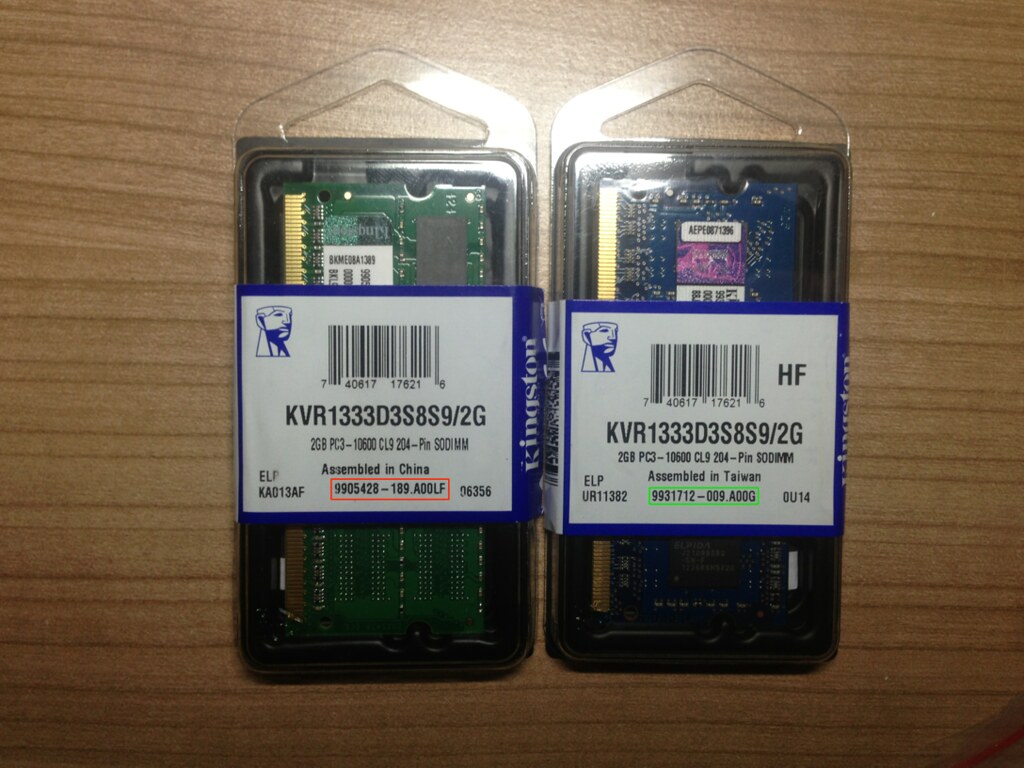
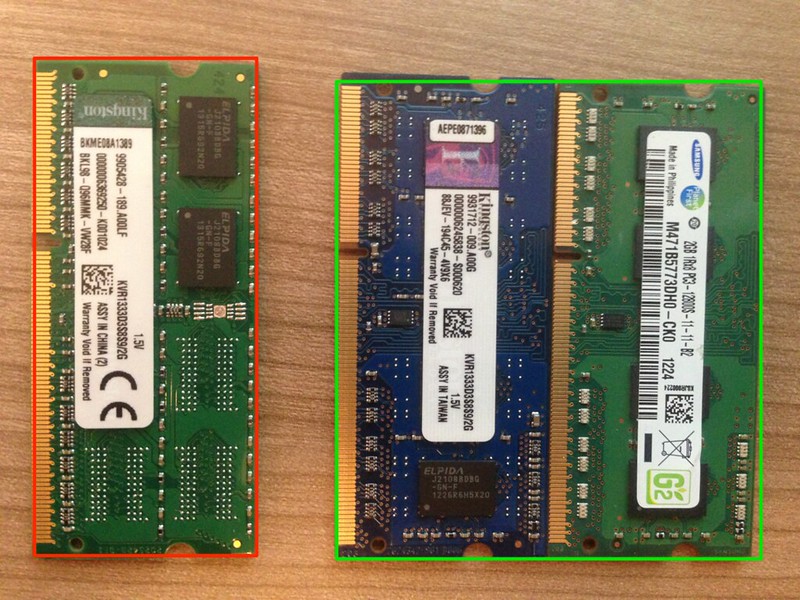
It seems that the KVR1333D3S8S9/2G should work, so I ordered one. After plugin it in, it revealed that the module wasn't working while it worked for others. After digging around, it seems essentially that the modul has a 8-chip design. Indeed, my modul just has only 8 memory chips, but the design is a 16 chip. So I thought it would be a nice try to order the one from amazon that worked for others. And like expected it's not the same module but has the same Kingston Part Number.

As you can see, the 16 chip design module has printed '9905428-189.A00lf' on and the 8 chip design '9931712-009.A00G'. It's something like in the Wireless LAN USB dongle business where they sell totally different hardware with the same Part Number but different Revisions.
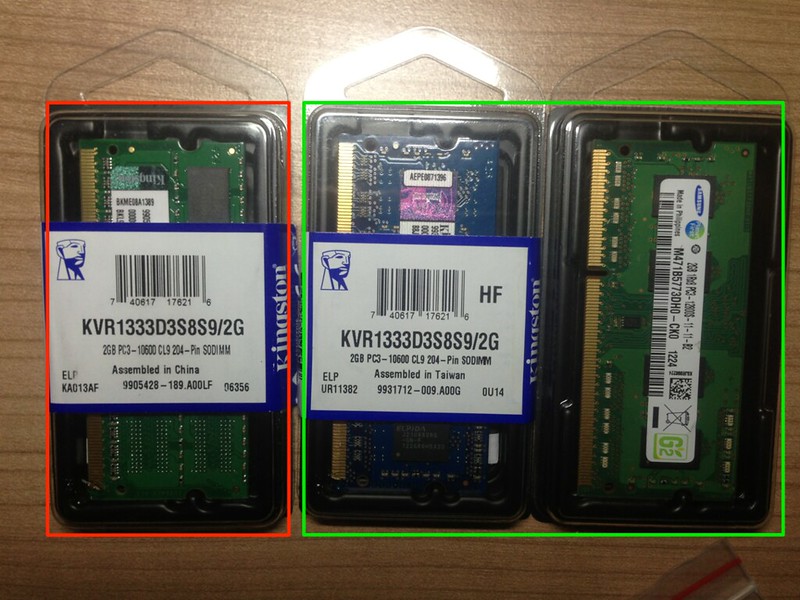
I also ordered a Samsung M471B5773DH0-CH9 cause that's also a 8 chip design.

To make it short, both 8 chips design modules worked like a charm, the M471B5773DH0-CH9 and the KVR1333D3S8S9/2G (9931712-009.A00G). - Please avoid the Adolf one from Kingston! ;)
Russ Allbery: C TAP Harness 2.3

This release pushes out some improvements to my TAP library and test harness that I found time to do a while back. I have some other plans, but not much time, so I'm not sure when I'll get to them. Now included in the C TAP library is a test_cleanup_register function that registers a cleanup function called during exit from the test. This function will be passed a boolean argument indicating whether the test succeeded or failed. It was already possible to do this with simple atexit, but now callers can decide whether to delete possibly-interesting trace files based on whether the test was successful. As part of this change, I also refactored and improved everything that happens during test exit, and in the process fixed a bug where lazy plans and test summaries were still displayed even when a test aborted with bail. This release also adds the gcc warn_unused_result attribute to the various TAP library functions (mostly the malloc variations that call bail on failure) where the return value really shouldn't be ignored. You can get the latest release from the C TAP Harness distribution page.

Benjamin Drung: Wanted: Most secure unencrypted email solution

Dear lazy web, Thanks to the global surveillance disclosures, I am searching for a secure email solution. Using end-to-end encryption seems to be the only secure solution to keep the email content private, but it does not protect your email header. End-to-end encryption has the big drawback that the communication partner has to use it, which is rarely the case. I want to communicate as secure as possible even with people that do not use end-to-end encryption. What is the most secure unencrypted email solution? Should I rent a (virtual) server in my country (Germany) and run my own email server on it? Do you know any reliable, inexpensive server host for such use case?

13 November 2013

Julien Danjou: OpenStack Design Summit Icehouse, from a Ceilometer point of view

Last week was the OpenStack Design Summit Icehouse in Hong-Kong where we, OpenStack developers, discussed and designed the new OpenStack release (Icehouse) that is coming up. The week has been wonderful. It was my second OpenStack design summit, and I loved it. Bumping into various people I've never met so far and worked with online was a real pleasure. As it was to meet again with fellow OpenStack developers! The event organisation was great, as were the parties. :-) On the last day, I had the chance to present a talk with Eoghan Glynn and Nick Barcet how we built the auto-scaling feature in Heat, implementing the "alarming" feature needed in Ceilometer.
The slides and video of the talk is online on my talks page. Design sessions This time, Ceilometer design sessions were spread on 3 days. Everything we talked about has its Etherpad instance. The discussions were interesting, and the amount of feedback gathered is big and is going to be very useful. There's a lot of people and companies using Ceilometer now, and the project is getting more and more traction in general. There's a lot of different way to use it and to bend it to one's needs. Considering the amount of features and options that is provided, building functionality with a genericized approach it making Ceilometer useful for a lot of different and interesting use-cases. Icehouse roadmap The list of blueprints targeting Icehouse is available, but not yet complete. I expect people to start filling this list in the next days.If you want to propose blueprints, you're free to do so and inform us about it so we can validate it. The same applies if you wish to implement one of them! Thereafter, I try to guess what the roadmap will look like in the upcoming weeks for Ceilometer based on the discussion we had last week during the summit. Events management A lot of work is going to be put into event management. Ceilometer plans to store notifications sent using oslo.messaging by OpenStack projects. Some work already got merge for Havana, but the API part and future improvements and ideas will continue to flow into the Icehouse release. Agents and group management A lot has been discussed around the polling agents and around the alarm evaluator agent. The current state of the ceilometer-central-agent disallows any kind of high-availability and load-balancing, as the polling task are kept and scheduled on only one node. The high-availability part is already covered by a custom mechanism built into ceilometer-alarm-evaluator, but it came clear to us that a more generic approach is needed. A lot of other projects needs this kind of functionality, and a pattern have been pointed out. A blueprint about group membership has been discussed in an Oslo session, and will end into a new Python library written to solve this in Ceilometer and in other projects. TaskFlow will also probably be leveraged to solve the task distribution issue. Documentation Since a few weeks, Ceilometer auto-generates its API reference documentation using sphinxcontrib-docbookrestapi that parses our API code that uses WSME. We also want to start writing a user guide, and we'll do that inside our own repository. That way, I hope that we will be the first project in OpenStack to require documentation to be incorporated into every patch that's being sent to Ceilometer. This is the best way to assure that nothing can be changed nor added without being accompanied with a documentation update. Tempest testing Testing of Ceilometer already has been a subject during the previous design summit about testing. We already put a large effort on Tempest testing in this last cycle, but we encountered a lot of small issues that we had to tackle to achieve something. Some Ceilometer basic tests are already on their way into Tempest, so this is something that is going to be achieved very soon. Ultimately, I would also want Ceilometer moving towards providing its own set of Tempest tests as part of the code base. That way, it'd be as easy for core reviewers to refuse a patch if it doesn't provide functional tests as it is to refuse it if it doesn't provide unit tests. As we'll do for the documentation. API improvements Once again, a few API improvements will probably be implemented, like aggregation or the ability to specify multiple queries with OR and AND operators. Roll-up, archiving of data There seems to be interest in archiving and rolling-up the data stored by Ceilometer, so work in this area is to be expected. Supporting multiple data storage driver in parallel seems to be something that needs to be done for this and other aspects of Ceilometer feature set. Alarming The alarming feature set is already big, and the work that has been accomplished pretty amazing. A few improvements will be made, as retrieving better metrics and building better statistics (exclusion of low quality data points).

11 November 2013

Daniel Pocock: Outreach Program for Women applications

The deadline for Outreach Program for Women applications is very imminent and a range of applications have now appeared on the OPW wiki It is great to see Debian has attracted a diverse range of women who all appear to have coding experience. Code samples have been submitted in Java, C++ and Python among other things and they come from a range of locations around the globe, including Brazil, the UK, Iran and India. Experience counts Looking through the records of some of these applications, it is interesting to see a range of experience and connections in industry and the wider open source family:
  • translator for O'Reilly
  • IBM internship
  • Linux module programming
  • Working alongside one of the Mercurial contributors in a previous role
Funding needed Recent emails from the OPW organisors and DPL have highlighted the need to raise more funding to ensure that Debian can offer OPW internships to the selected applicants. Solving the biggest problem of GSoC 2014 Many of these applicants are students and will be eligible for GSoC 2014. According to the Google FAQ, even students who graduate in 2014 are eligible as long as they are enrolled in a course on the cut-off date 21 April 2014 One of the biggest challenges facing GSoC mentors is the selection of students who are capable of completing good work and have a long term interest in open source. One of the best ways to overcome that challenge is to start forming relationships with potential GSoC students well in advance and get to know them as they make small contributions over an extended period of time. The interest that these candidates have expressed in Debian and OPW suggests that some of them may well be suitable for Debian to help them get onto this track for the next GSoC. Not only will this make the GSoC 2014 selection process easier but it may help us to select more GSoC candidates with a long term outlook. Women in science, engineering and the wider business world More news items have appeared recently about women in science and engineering and other leadership roles:

In the early 1950s, Morgan was the only female analyst among 900 rocket scientists at North American Aviation. She was also one of the few without a college degree.

"What I saw a thousand times during the downturn was, 'We'd like to give her that opportunity, but we need to go with the sure thing - we can't afford diversity right now,'" - Sallie Krawcheck, former chief executive at Merrill Lynch

Next.

Previous.