Search Results: "ed"

26 February 2011

Ritesh Raj Sarraf: Patents and the Pharmacy Industry

Mosf of us would be well versed with the Patent system in general. We have patents in every sector - Technology, Agriculture, Pharmacy etc. Most readers in our profession must already be well versed of the Pros/Cons of the Patent system in Software/Technology. Patents in software are more like ammunition. The more you have, the stronger you are. We don't seem much cat fight in Software/Technology because not one organization own all the patents for a product. An IBM ThinkPad might be using a cool track pad feature which might be a patent of Dell. Since the finished product comprises of many patents from different owners in the same industry, it is better to play good with each other. You scratch my back, I scratch yours. But what about the Pharmaceutical Industry? There, one single patent could comprise the product. I was reading this document from Bruce Lehman which touches upon Patents and Pharmaceutical Industries, but couldn't find an answer to my question. read more

Raphaël Hertzog: February 2011 wrap up

February has been again a busy month for me. Here s a quick summary of what I did: Multi-Arch work I have spent many days implementing and refining dpkg s Multi-Arch support with Guillem Jover (dpkg co-maintainer) and Steve Langasek (beta-tester of my code ;-) ). Early testers can try what s in my latest pu/multiarch/snapshot/* branch in my personal git repository. A Debian DVD shop I m always exploring new options to fund my Debian work (besides direct donations) and this month with the Debian Squeeze release I saw an opportunity in selling Debian DVD. Nobody provides DVD with included firmwares and quite a few people would like to avoid the SpaceFun theme. So I built unofficial Debian DVDs that integrate firmware and that install a system with the old theme (MoreBlue Orbit). Click here to learn more about my unofficial DVDs. On my blog In my People behind Debian series, I interviewed Mike Hommey (Iceweasel maintainer) and Maximiliam Attems (member of the kernel team). I started a Debian Cleanup Tip series and already published 4 installments: For contributors, I wrote two articles: the first gives a set of (suggested) best practices for sponsoring Debian packages and adapted my article as a patch for the Developers Reference. In the second article, I shared some personal advice for people who are considering participating on Debian mailing list: 7 mistakes to avoid when participating to Debian mailing lists.
Click here to subscribe to my free newsletter and get my monthly analysis on what s going on in Debian and Ubuntu. Or just follow along via the RSS feed, Identi.ca, Twitter or Facebook.

No comment Liked this article? Click here. My blog is Flattr-enabled.

Steve Kemp: IPv6 email

I've been slowly moving towards full IPv6 usage on my main machines for the past few months. My main servers all have IPv6 setup and appropriate DNS records in place. This weekend I configured my mailserver, which is based upon QPSMTPD & exim4, to be available on IPv6 too. Previously it would send mail via IPv6 where appropriate, but only receive mail via IPv4. QPSMTPD I've written about a lot in the past, and indeed I did commercial things with it for a year or two, but in short it is more of an SMTP framework than an actual mailserver. These days I use a small collection of plugins which test incoming mail in various ways, and either: My plugins are pretty simple, but I've made a few changes for the brave new IPv6 world: I reject (+ archive) about 8,000 SPAM messages a day. So far I've seen precisely zero SPAM mails be received via IPv6; though I'm sure that won't last for long! My reject archive looks like this:
steve@steve:~$ tree -d -L 2 /spam/
/spam/
 -- 23
     -- debian-administration.org
     -- mail-scanning.com
     -- steve.org.uk
 -- 24
     -- debian-administration.org
     -- steve.org.uk
 -- 25
     -- debian-administration.org
     -- mail-scanning.com
     -- steve.org.uk
...
 -- 55
     -- debian-administration.org
     -- mail-scanning.com
     -- steve.org.uk
     -- stolen-souls.com
 -- 56
     -- debian-administration.org
     -- steve.org.uk
     -- stolen-souls.com
 -- today -> /spam/56
 -- yesterday -> /spam/55
(Here "N" is the day of the year - Think of this as "date +%j". I rotate such that I keep 32 days of past SPAM mail, for reference/amusement/mistake-catching.) ObQuote: "I am already grown up, I just get older. " - Leon

Sylvain Le Gall: OCaml Debian News

... or don't shoot yourself in the foot. This is not a big secret, Debian Squeeze has been released. Right after this event, the OCaml Debian Task force was back in action -- with Stephane in the leading role. He has planned the transition to OCaml 3.12.0. We will proceed in two steps: a small transition of a reduced set of packages that can be transitioned before 3.12 and then the big transition. The reason for the small transition, is to avoid having to dep-wait (waiting for dependencies) of package upload by human. In -- a not so far -- past, the OCaml Debian Task force members were uploading packages by hand and waited for a full rebuild to go to the next step. This was long and cumbersome. We use now binNMU: it is binary only uploads -- with no source changes -- processed automatically by the release team and its infrastructure. This is far more effective and helps us to reduce the delay of the transition... The small transition is happening now!!! Don't update/upgrade your critical Debian installations with OCaml packages, you'll get a lot of removal if you do so. N.B. these removal are part of the famous Enforcing type-safe linking using package dependencies paper. As a side note, I am happy to announce that a full round of new OCaml packages has landed in Debian unstable: People aware of my current work, should notice that all the dependencies of OASIS are now in Debian unstable: ocaml-data-notation, ocamlify, ocaml-expect. This is a hint about the next OCaml Debian package, I will upload. You can also have a look at OASIS enabled packages (all the OASIS dependencies, ocaml-sqlexpr and ocaml-extunix). These packages have been generated using oasis2debian a tool to convert _oasis into debian/ packaging files. After these transition we will continue proceeding with standard upgrade work (e.g. camomile to 0.8.1). Sylvain Le Gall is an OCaml consultant working for OCamlCore SARL

Joey Hess: infrastructure update

I'm surprised to be on the porch hearing rushing water. I tend to think of up here as high and mostly dry, but not this time of year. Yesterday was such a soaking rain, very annoying at the time as I did chores and drove out from town. Now there are two little creeks here. That's a sound I've missed.. Pity that all the water is going to waste. I discovered the reason the large cistern is not filling up is simply because the pipe into it is not connected to the feeder pipe in the spring. It seems like a complete shambles really, with layer upon layer of pipes, all broken. I will have to wait until the water is down to dig and find out what's going on, and fix it. In the last of the evening light today I got the house's two battery banks finally combined into one bank. I had planned this out long ago, and bought one long cable I'd need, so was surprised to find I needed two long cables. Had to slide batteries around like a big sokoban puzzle, and swap several cables to make it work. While I was away I'd charged up the bank that had gone unused most of the winter. So they were near equalized and the combination seems to have gone ok. I got through the lean part of the year with only half the batteries; there never seemed to be a good time to combine them. It remains to be seen if the solar panels can keep my increased capacity filled. I hope this was only an early taste of spring. Would be nice to have some more icy weather so I can put off dealing with refrigeration a little while longer. I have my eye on a 12v/propane fridge.

25 February 2011

Lucas Nussbaum: Debian is changing

I ve been playing with snapshot.d.o, which is a fantastic resource to look at how Debian has been changing over the years.
Below are some preliminary results about various aspects of source packages: format, packaging helpers, and patch systems.
For clarification: Random comments: If you have other ideas of things to investigate using snapshot.d.o, don t hesitate to ask in comments.

Evgeni Golov: Desktop in a shell: mutt

Continuing my series about a desktop in a shell, today I will present you my mutt setup. I use mutt because it has no bugs and is a really good MUA for people loving consoles ;)First of all you have to know, that all my mail is forwarded to my server and sorted into Maildirs via maildrop, so I do not care about sorting on my desktop , which just fetches the mail via IMAP from the server ;)I m running mutt-patched from Debian Squeeze, so not all options may be available for you if you do not have the same patchset as I do.First, tell mutt to fetch mail from imap.die-welt.net via IMAP:
set imap_user=username
set imap_pass=password
set folder="imaps://imap.die-welt.net/INBOX"
set spoolfile="imaps://imap.die-welt.net/INBOX"
Now, enable IMAP-IDLE, list subscribed folders, reconnect to the server if needed and mark mail as read when you open it:
set imap_idle
set imap_check_subscribed
unset imap_passive
unset imap_peek
Let mutt save sent mail to the Sent directory on the IMAP server, and postponed mail to Drafts:
set record=+Sent
set postponed=+Drafts
Read mail should stay where it is:
set mbox="!"
We use IMAP-IDLE, thus check for new mail manually only every 90 seconds:
set mail_check=90
Instead timeout after 15 seconds if no user input is given:
set timeout=15
Set default mail from address to my default mail address:
set from=evgeni@golov.de
And send mail via mstmp (see below for mstmp configuration):
set sendmail="/usr/bin/msmtp"
Tell mutt which addresses I recieve mail to (danger, ugly regex!):
alternates (evgeni@(debian.org golov.(de eu)) sargentd@(die-welt sargentd).net evgeni.golov@uni-duesseldorf.de)
As mutt knows where I receive mail, let it set From accordingly:
set reverse_name
Let mutt cache some stuff and find its certificates:
set header_cache="~/.mutt/cache/headers"
set message_cachedir="~/.mutt/cache/bodies"
set certificate_file=~/.mutt/certificates
set ssl_ca_certificates_file=/etc/ssl/certs/ca-certificates.crt
Show only interesting headers in an useful order:
ignore headers *
unignore headers from to subject date cc
hdr_order from to cc subject date
Fix stupid MUAs behaviour (e.g. filenames like =?iso-8859-1?Q?file=5F=E4=5F991116=2Ezip?=):
set rfc2047_parameters
Beep on new mail, will generate a ! in the window name in screen:
set beep_new
mutt-patched has the great sidebar patch, assign ctrl-n, ctrl-p to select next, prev folder, ctrl-o to open selected folder:
bind index \Cp sidebar-prev
bind index \Cn sidebar-next
bind index \Co sidebar-open
And toggle sidebar visibility with ctrl-b:
macro index \Cb '<enter-command>toggle sidebar_visible<enter><refresh>'
macro pager \Cb '<enter-command>toggle sidebar_visible<enter><redraw-screen>'
Since 1.5.20-2, mutt patched contains my sidebar-dotted and sidebar-sorted patches.
Let mutt shorten the displayed path (e.g. debian-devel instead of INBOX.ml.debian-devel) and sort the folders (the are returned in random order when using imap_check_subscribed):
set sidebar_shortpath
set sidebar_sort
Now let s set some colors (that match the rest of my desktop ):
color sidebar_new yellow default
color normal white default
color hdrdefault brightcyan default
color signature green default
color attachment brightyellow default
color quoted green default
color quoted1 white default
color tilde blue default
And add some useful macros for marking new and old messages as read:
macro index .n "<tag-pattern>~N<enter><tag-prefix><clear-flag>N<clear-flag>*" "Catchup all new messages"
macro index .o "<tag-pattern>~O<enter><tag-prefix><clear-flag>O<clear-flag>*" "Catchup all old messages"
When forwarding mail, I like it to be forwarded as an attachment (YMMV):
set mime_forward=yes
I m using goobook in mutt to fetch my addressbook from Google. As there is no Debian package for goobook (yet), you have to install it yourself (via easy_install):
apt-get install python-argparse python-gdata python-simplejson python-keyring python-nose
easy_install goobook
Configuration is easy via ~/.goobookrc:
[DEFAULT]
# If not given here, email and password is taken from .netrc using
# machine google.com
email: me@gmail.com
password: password
And then add the following to your .muttrc:
set query_command="goobook query '%s'"
bind editor  complete-query
macro index,pager a "<pipe-message>goobook add<return>" "add the sender address to Google contacts"
That s all for mutt, but We are running mutt in a screen, so let s add the following to .screenrc to fix transparency and cut&paste (see http://wiki.mutt.org/?MuttFaq/Appearance):
 defbce on
 term screen-bce
And as mutt uses mstmp (yes, I know, mutt can handle SMTP itself ), this is my .msmtprc:
defaults
domain dorei.kerker.die-welt.net
tls on
account die-welt.net
host smtp.die-welt.net
from sargentd@die-welt.net
auth on
user username
password password
tls_starttls on
tls_certcheck off
# Set a default account
account default : die-welt.net
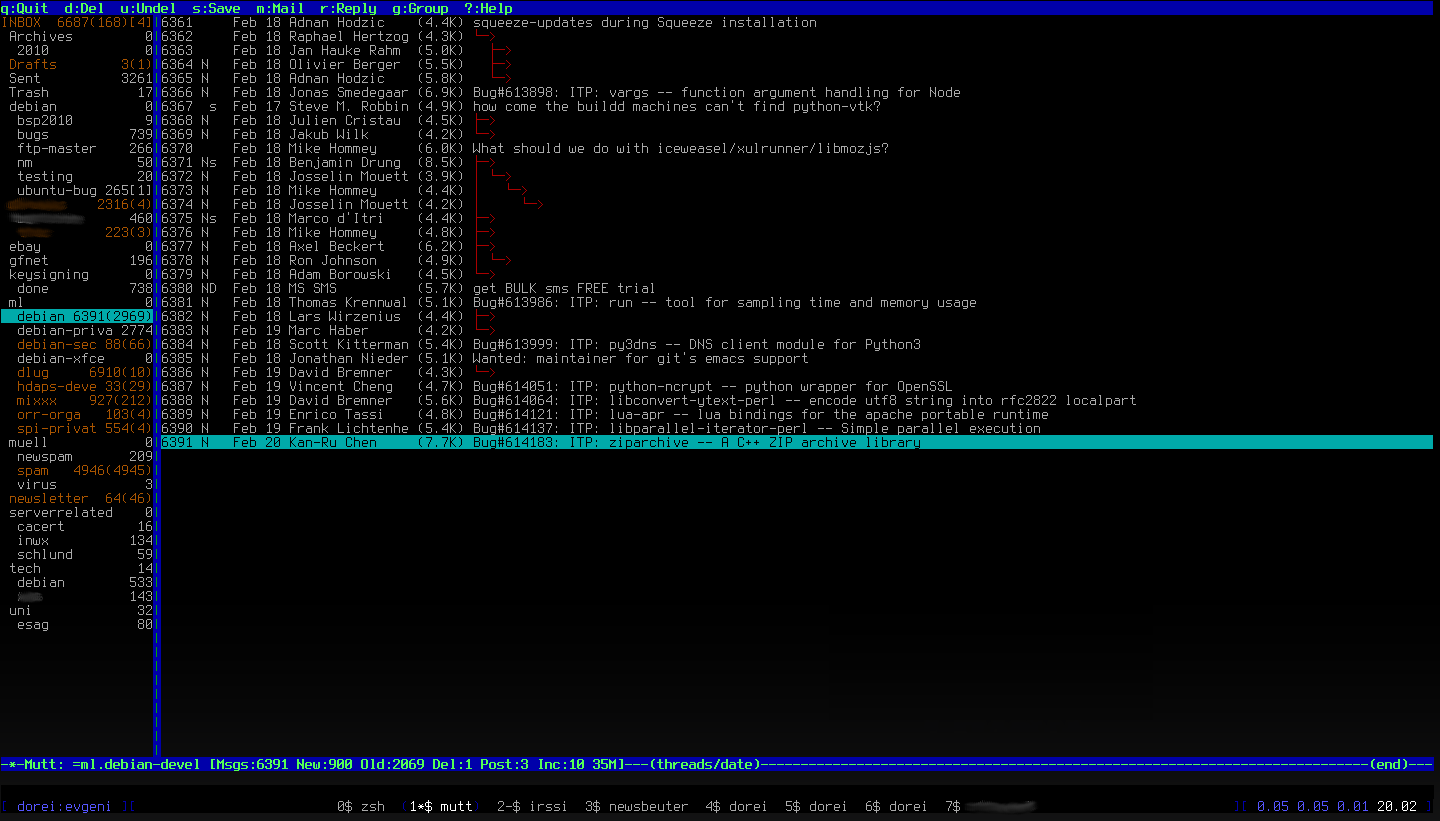
C est tout! That is my personal mutt configuration, you can download it as one file here: my .muttrc. And as everyone loves screenshots, here is one:the default view of my muttOh, the next chapter will be about irssi, but not before next Sunday (March 6th) as I ll be offline for a week, skiing in Austria :)

Patrick Schoenfeld: Let me introduce DPKG::Log and dpkg-report

We have customers, which require a report about what we've done during maintenance windows. Usually this includes a report about upgrades, newly installed packages etc. and obviously everything we've done apart from that.
Till now we've prepared them manually. For a greater bunch of systems this is a big PITA, because to be somehow useful you have to collect the data for all systems and after that, prepare a report where you have:

Its also error-prone because humans make mistakes.

Perl to the rescue!
At least the part about generating a report about installed/upgraded/removed packages could be automated, because dpkg writes a well-formed logfile in /var/log/dpkg.log. But I noticed that there appearently is no library specialised at parsing that file. Its not a big deal, because the format of that file is really simple, but a proper library would be nice anyway.
And so I wrote such a library.
It basically takes a logfile, reads it line by line and stores each line parameterized into a generic object.

Its features include:

Based on that, I wrote another library DPKG::Log::Analyse, which takes a log, parses it with DPKG::Log and then extracts the more relevant information such as installed packages, upgraded packages, removed packages etc.

This, in turn, features:
- Info about newly installed packages
- Info about removed packages
- Info about upgraded packages
- Info about packages which got installed and removed again
- Info about packages which stayed halfinstalled or halfconfigured at the end of the logfile (or defined reporting period)


These libraries are already uploaded to CPAN and packaged for Debian.
They passed the NEW queue very quickly and are therefore available for Sid:

http://packages.debian.org/sid/libdpkg-log-perl

As an example use (and for my own use case, as stated above), I wrote dpkg-report, which uses the module and a Template::Toolkit based template to generate a report about what happened in the given logfile.
It currently misses some documentation, but it works somehow like this:

Report for a single host over the full log:
dpkg-report

Report for a single host for the last two days:
dpkg-report --last-two-days

Report for multiple hosts (and logfiles):
The script expects that each log file has the name <systemname>.dpkg.log so that it can guess the hostname from the system and can grab all such log files from a directory if a directory is specified as log-file arguments:</systemname>

dpkg-report --log-file /path/to/logs

This will generate a report about all systems without any merging.

Report for multiple hosts with merging:
dpkg-report --log-file /path/to/logs --merge

This will do the following:
A (fictive) report could look some what like this:

dpkg-Report for all:
------------------------
Newly Installed:
abc
Removed:
foo
Upgraded:
bar (0.99-12 - 1.00-1)

dpkg-Report for test*:
------------------------
Newly Installed:
blub

dpkg-Report for test1:
------------------------
Upgraded:
baz (1.0.0-1 -> 1.0.0-2)

dpkg-Report for test2:
------------------------
Upgraded:
zab (0.9.7 -> 0.9.8)

Currently this report generator is only included in the source package or in the git(hub) repository of the library. I wonder if it makes sense to let the source package build another binary package for it.
But its only a 238 lines perl script with a dependency on the perl library so I'm unsure if it warrants a new binary package. What do others think?

24 February 2011

Pau Garcia i Quiles: Applied for Debian Maintainer, FLOSS workflow works

I have been packaging for Debian for a few years now. My first serious package was Wt back in 2007, but I had been backporting for Ubuntu for at least 2 years already, which means I have been doing .deb packaging for about 5 years (!). Last week I decided it was about time stop nagging my sponsors (Vincent Bernat, Thomas Girard and Sune Vuorela) every time I wanted to update the packages I maintain (witty, ace and libmsn), and I finally started the Debian New Maintainer process. The main reason I had not applied for Debian Maintainer yet was it requires some bureaucracy and, well, I d rather spend my time coding or packaging than doing paperwork :-) I sent my Declaration of Intent and soon after, Thomas and Vincent replied and supported my application with very very nice and kind words. Thank you, guys! I m flattered! :roll: Had I known I would be buttered up so much, I would have certainly applied a long time ago! :-D But you know what is the best part of this? It shows how open source projects take advantage of all the tools and communications channels we have (IRC, mailing lists, sprints, conferences, etc), and make distributed development work very well: here we have a 900-developers project in which two French guys are praising an Spanish guy they have never, ever met face-to-face (only e-mail, occasional IRC, and the most important of all: code review). Meritocracy at its full extent. Have you ever seen that in a traditional 100,000 workers company with hundreds of developers working in a single project?

Dirk Eddelbuettel: Rcpp 0.9.2

The 0.9.2 release of Rcpp is now on CRAN and Debian. This version contains a build fix for the older 10.5.* version of OS X and its g++ 4.2.1 compiler; we now skip one test that upset it. CRAN builds for OS X should resume. We also added simple configuration support for the Intel Compiler; feedback would be welcome on the list. Lastly, documentation in the vignettes was expanded a little. The NEWS entry is below; more detail is in the ChangeLog file in the package and on the Rcpp Changelog page.
0.9.2   2011-02-23
    o   The unitTest runit.Module.client.package.R is now skipped on older OS
        X releases as it triggers a bug with g++ 4.2.1 or older; OS X 10.6 is
        fine but as it no longer support ppc we try to accomodate 10.5 too
        Thanks to Simon Urbanek for pinning this down and Baptiste Auguie
        and Ken Williams for additonal testing 
    o   RcppCommon.h now recognises the Intel Compiler thanks to a short
        patch by Alexey Stukalov; this turns off Cxx0x and TR1 features too
    o   Three more setup questions were added to the Rcpp-FAQ vignette
    o   One question about RcppArmadillo was added to the Rcpp-FAQ vignette
Thanks to CRANberries, there is also a diff to the previous release 0.9.1. As always, even fuller details are on the Rcpp Changelog page and the Rcpp page which also leads to the downloads, the browseable doxygen docs and zip files of doxygen output for the standard formats. A local directory has source and documentation too. Questions, comments etc should go to the rcpp-devel mailing list off the R-Forge page

Sean Finney: git merge -s theirs

...For the cases where, yes, you actually do want it. For the impatient assuming you're in a clean checkout on the tip of your current branch:
git merge -s ours ref-to-be-merged
git diff ref-to-be-merged   git apply -R --index
git commit -F .git/COMMIT_EDITMSG --amend
you can then double check that everything is as you expect with git diff ref-to-be-merged, which should be empty. The longer story It's noted from time to time that git does not have a -s theirs option to complement the -s ours strategy when merging (or, it did, but it was removed long ago, see below). For those not savvy the idea with git merge -s ours is to pretend as though a merge from some other branch has occurred, though the result remains the current branch's contents, unchanged. This is a neat trick that can be used to show that all changes in some branch have been superceded by the current branch, which can help ease merges further down the line as parallel devlopment continues. However, there is no corresponding -s theirs option, which would conversely say that "everything developed up to here is superceded by this other branch". This feature was discussed and discarded by one of the git authors, who instead advised a developer to throw away the previous work and start on a fresh branch:
One big problem "-s theirs" has, compared to the above "reset to origin, discarding or setting aside the failed history" is that your 'master' history that your further development is based on will keep your failed crap in it forever if you did "-s theirs". Hopefully you will become a better programmer over time, and you may eventually have something worth sharing with the world near the tip of your master branch. When that happens, however, you cannot offer your master branch to be pulled by the upstream, as the wider world will not be interested in your earlier mistakes at all.
In what would probably qualify as "most cases", he's right, but sometimes you do want to do this, and not because you have "crap" in your history, but perhaps because you want to change the baseline for development in a public repository where rebasing should be avoided. In debian, for example, it's pretty common for maintainers who use git-buildpackage to build debian packages from git to have two branches: an "upstream" branch and a "debianized" branch. The upstream branch will follow the changes from the upstream project (either by importing tarballs, or by pulling directly from the project's git repo if they also use git), while the debianized branch contains all the packaging related changes as well as any debian-specific changes to the code. In this context, if the upstream project uses git and rebases their history (out of your control), or if they shift development to a different branch, you might want to have a way to merge with their latest changes without rebasing/abandoning your current debian branch. Hence, a "theirs" merge. The author is totally right that the upstream project may be less interested in pulling from such a repository (since they would drag in the entire previous history), and if that's a problem you might need to splinter off the old branch and start a fresh branch instead. But at least for the projects with which I work, I find that it's more likely that pulling is pretty much one way upstream to debian, and that the patches flow back to the upstream project by way of bug trackers, git format-patch sendmail, or quilt patches sitting in the patch-tracker. And if it becomes a problem later you're no worse off, you can still split off a new branch or take some other action. So anyway, I asked Teh Internetz and found a few hits in the right direction, such as this guy at stack overflow, or this guy here. But from an aesthetic point of view I thought their solutions still left some room for improvement--they were both more complicated, involved setting up temporary branches, and I don't know, just weren't pretty on the eyes. So, ending where I started, this is the relatively clean and easy to follow 3 lines I conjured up, which I will give to teh internetz for posterity.
git merge -s ours ref-to-be-merged
git diff ref-to-be-merged   git apply -R --index
git commit -F .git/COMMIT_EDITMSG --amend
Alternatively, if you want to keep the local upstream branches fast-forwardable, a potential compromise is to work with the understanding that for sid/unstable, the upstream branch can from time to time be reset/rebased (based on events that are ultimately out of your control on the upstream project's side). This isn't a big deal and working with that assumption means that it's easy to keep the local upstream branch in a state where it only takes fast-forward updates. However, on the debian branch your less interested in the clean upstream development, and instead want to keep a sane history of the debianization work, so on this branch you still do something like a merge -s theirs (though in this case, you probably want to amend the previous version's ./debian dir back in post-merge). So applying the same approach as above with the slight modification, in practice (assuming you're on the clean tip of the debian unstable branch, that'd be):
git branch -m upstream-unstable upstream-unstable-save
git branch upstream-unstable upstream-remote/master
git merge -s ours upstream-unstable
git diff ref-to-be-merged   git apply -R --index --exclude="debian/*"
git commit -F .git/COMMIT_EDITMSG --amend
PS In spirit, this is a similar approach to what's done by the XSF team, though I would argue that with what I'm describing both the approach and the resulting history are a bit cleaner and easier to follow. Also, thanks to ron, mrvn, jcristau, and nthykier on #debian-devel for some quick reviewing of this.

MJ Ray: Event for creative co-operatives

Last week, I was at this event in Bristol where we heard some interesting stories from other creative co-ops. I think the oldest had been running for about the same length as time as our co-op, but with a bit of a smoother history. The organisers have posted their report on the event. What did surprise me is that it seemed that the other tech co-ops weren t as strong about free and open source software. I felt that the links between co-op values of self-help, self-responsibility, democracy, equality, equity, solidarity, honesty, openness, social responsibility and caring for others and the freedoms to use, study, adapt and share were obvious, but maybe I should try to write them out very clearly?

Rapha&#235;l Hertzog: 7 mistakes to avoid when participating to Debian mailing lists

You re eager to start contributing to Debian, your first action is to subscribe to some high-profile mailing lists (like debian-devel and debian-project) to get a feel of the community. You read the mails for a few days and then you find out that you could participate to the discussions, it s a simple first step after all. True enough. That said, it s not as easy as it looks like. There are many mistakes that you should avoid:
  1. Don t fall in the trap where your mailing list participation is your sole contribution to Debian. If you want people to give credit to your messages, you should already be doing something else for Debian.
  2. Don t participate more than once a day to a given thread. There are many people subscribed, you should leave room for other people to express their point of view. You can always follow up one day after and reply to several messages at once if you believe you still have something new to add to the discussion.
  3. Don t reply to off-topic threads. Someone asked a simple question and someone else pointed out that his message was off-topic. Don t reply, or if you really need to, do it on the correct list or with a private response.
  4. Don t ask questions unless it s useful to bring the discussion forward. Development lists are not here to fill the gaps in your knowledge. We already have debian-mentors for this. Furthermore there s no better way to learn than to find yourself the answers to your questions. :-)
  5. Don t believe your opinion is so important. We re all very opinionated and discussions that consist only of contradicting opinions tend to go nowhere. Thus don t give your opinion unless you can back it up with new facts or another experience.
  6. Don t participate to all threads. There are surely some topics where you are more knowledgeable than others, participate where you add the most value and leave the others threads to the other experts (and learn by reading them).
  7. Don t hide your identity. In Debian we like to know each other. Use your real name and not some anonymous nickname. You need to be able to stand up behind your words, otherwise you re not credible.
I have myself been guilty of several of those when I started I invite you to follow my recommendations to ensure our mailing lists remain pleasant to read and an effective discussion place.
You should follow me on Identi.ca, Twitter and Facebook. Or subscribe to this blog by RSS or by email.

4 comments Liked this article? Click here. My blog is Flattr-enabled.

Steve Kemp: I like languages

One of the reasons I like Scotland is the fun that Scottish people have with language. I'm going to use two examples to illustrate my point: The last one is particularly fun when you use questions such as "How no?" - meaning roughly "Why not?". Languages, and idioms, vary wildly in different parts of the world, even when you restrict yourself to English-speaking languages. I'll not even get started on Accents. The UK is tiny compared to many other countries, yet we have a wide array of accents - Australia, by contrast is huge, but I can think of only two accents across the country. (Rationally I expect that there are many accents in different parts of Australia, and I'm merely ignorant.) In conclusion languages are fun, and some places this is more evident than in others. I will most likely contintue to say "The shop is open from 9 while 4" rather than the more typical "From 9 til 4" - I'm allowed to do that, having grown up in Yorkshire!
(PS. PHP still sucks - Even if you post it upon a PHP-powered blog. ;)
ObQuote: "People take you for granted, you know. We gotta make people miss you." - Hancock

23 February 2011

Dirk Eddelbuettel: RQuantLib 0.3.6

A bug-fix release RQuantLib 0.3.6 is now on CRAN and in Debian. RQuantLib combines (some of) the quantitative analytics of QuantLib with the R statistical computing environment and language. There are only two changes to two files where an explicit conversion as per Rcpp::as<double> was called for. A Debian archive rebuild had triggered one of those fails to build from source bug reports as the compiler version seems to be more finicky now than when version 0.3.5 was uploaded in November. No other changes were made. Thanks to CRANberries, there is also a diff to the previous release 0.3.5. Full changelog details, examples and more details about this package are at my RQuantLib page.

Gunnar Wolf: Finally presented that long-overdue exam!

Finally presented that long-overdue exam!
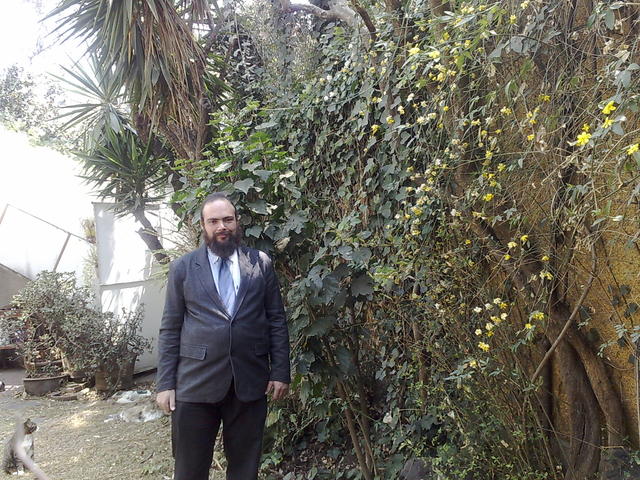
What Yes, I have not used this kind of outfit for over 20 years. And I hope it will be 20 more years before I do it again. But today, I was seen like this in public. Why? Well, I won't explain the whole background yet again I did it a bit over a month ago in this same space. Much much in short, I never attended university, so after many years of working without any formal validation for my knowledge I followed the CENEVAL Acuerdo 286 procedure to get a "Software Engineering" title and the corresponding c dula profesional. Today I did the last portion of this procedure: Presenting an oral exam, defending the work I developed. Not precisely a thesis, but you can see it as an equivalent. One of the requisites was to go on formal attire Of course, I have some beautiful shirts I am very fond of, but I didn't want to risk it to such a detail, so I asked my friend and almost-neighbour Miguel Barajas to lend me the needed bits of clothing, and presented the exam. Was it easy? No, not by a long shot. Did I pass? Yes! Now, back to work!

Julien Danjou: Handling my music collection with git-annex

git-annex is a recent tool allowing to manage files with git without having theirs contents checked into git. I've been looking at it with some interest in the past few weeks in order to use it to handle my music collection on the various computers I use. My laptop just got a new SSD drive which is quite small and cannot handle the whole collection. By using git-annex, I'm now able to only check out part of my music collection and keeping it synchronized with all my others computers. Using git-annex is pretty trivial once you understand the concepts. I've set up a a git repository in my Music directory, like that:
% git init
Initialized empty Git repository in /home/jd/Music
Then I initialized git annex:
% git annex init "Music on keller"
So now I'm able to import all my date into git annex. git-annex offers several backends to store data. WORM is the default, but is not a good choice for file that could be modified, and music files can be, at least when editing the metadata. Therefore, I chose the slow but more reliable SHA1 backend.
% git annex add --backend=SHA1 .
That can be long, so you should be patient. Then you should commit the fact you annexed files:
% git commit -a -m "Imported my music collection"
[master 82d060f] Imported my music collection
Now, it's done. You can go on another computer and clone the repo:
% git clone ssh://keller/~/Music
% cd Music
% git annex get "Incubus - Light Grenades"
And then let the magic happens. It will retrieve the whole directory for you. Do not forgot to commit the fact that you got those album on that machine! The concept used by git-annex is quite simple. All files are replaced by symlinks pointing to .git-annex/SHA1:filechecksum.log. This file contains lines, whose format is:
retrieval-timestamp is-file-present uuid-of-the-repository
Indicating if the file is present in a repository. This logs file are commited into the repository, whereas the real content is stored in the .git/annex directory and therefore not commited. I recommend to take a look to the walkthrough page to get more idea and what you can and cannot do with git-annex. Flattr this

Thomas Koch: I've been young - I needed the money

Yesterday I had my last day at $company and today is my first day in freedom. I'll write about my future plans in another blog post. Here I just want to express the joy I had yesterday afternoon when I did:
CODE:
aptitude purge php5

I've started using PHP in 2006 and used it almost exclusively until the end of 2009. I believe I've learned most of what one can learn about PHP in this time. In 2010 I started to work in Java and only started to understand how limited PHP is.
I know that java is far from perfect. So I don't stop there and already started to learn Scala and looking forward to learn other languages too. But Java is for sure a better answer then PHP, regardless what the question was.
There are many reasons, why you should not, never, for no project ever use PHP. I'll only tell you my personal top reasons:
I once advocated PHP as a serious plattform and even gave three talks about PHP. I feel ashamed of this now and apologize. Please forgive me. It's not worth arguing about this post. Its just to make me feel less guilty about my foolishness in the past.

Pietro Abate: More on Xen 4.0 setup on squeeze

After the upgrade of last week, I didn't have any major problems : xen 4 seems pretty stable and does its job well. One problem I encountered the other day was about the dom0 balloning. By default, xen sets dom0_min_mem to 196Mb and balloning set to true. This is all and good untill you try to use too much memory for your VMs, squeezing dom0 to its minimum amount of memory and causing all sort of problems. On the xen wiki, they reccomend as best practice to reserve a minimum of 512Mb to dom0 for its operations. This is done but setting dom0_mem=512M on the grub command line and the adjusting enable-dom0-ballooning to no and dom0-min-mem accordingly to the amount of memory you choose. On debian, you can set the grub command line once for all just by adding in /etc/default/group the conf variable
GRUB_CMDLINE_XEN="dom0_mem=512M"
Another small problem is related to the reboot sequence. Since I'm using lvm on aoe, the default shutdown sequence (network down first, lvm later) is not going to work for me. As I've few lvm volumes on aoe and others on the physical disk, the proper solution to this problem is to write a custom shutdown script for the aoe lvm volumes and make it run before deconfiguring the network interfaces. In the mean time, to avoid the kernel hanging there forever, I've added these lines to in /etc/syscntl.d/panic.conf
# Reboot 5 seconds after panic
kernel.panic = 5

# Panic if a hung task was found
kernel.hung_task_panic = 1

# Setup timeout for hung task to 300 seconds
kernel.hung_task_timeout_secs = 120
This will instruct the kernel to panic and then reboot if there a task will not respond for more then 120 seconds.

Joachim Breitner: Goodbye server4you

My server, which is among other things hosting this weblog, is a dedicated server originally hosted by the German webhoster webperoni. It was a bargain at that time, and still a good price, and I was satisfied with webperoni s performance and reliability. Unfortunately, they were taken over by another web hosting company, best known for their server4you brand. They moved my server to a different data center and continued to run it there. Unfortunately, server4you was less reliable and less flexible than my original hoster: For example, when one sector on the hard drive turned bad, they were not able to put in a new drive in my system, let me mirror the content, and then remove the old drive. In another, even worse, instance, my second IP address, which I bought from webperoni, was given to another customer. When I finally noticed and complained, they refunded me the charges that I paid for the IP. But understandably, I wanted to get away from that hoster. The contract is automatically prolonged for one year if not canceled in time, and I missed the deadline last year. This year, I finally got around to rent a slightly better and slightly more expensive server from Hetzner, which whom I already made good experience. I would have preferred to switch when I am back from India, but server4you would not even let me prolong the contract by just two months only a whole year or nothing. So they got nothing, and I started to work on the move yesterday. At first I set off installing the new system from scratch, setting up all the various services and copying over data and configuration. But quickly, I gave up and moved the system by completely by copying programs, configuration and data from the old server. The new system has its root partition on a LVM share on software RAID, and now uses grub2 to boot. I had a hard time to get it booting, and a hard time to debug the issues without access to the physical console. I finally understood the problem by running kvm -hda /dev/sda -hdb /dev/sdb -curses from the recovery system and observing that the initial ramdisk is having problems finding the root partition. The problem was that I thought addressing partitions via file system labels is the way to go now and manually added root=LABEL=root to the Linux command line in /etc/default/grub. But then the initial ramdisk would not activate the logical volume. If I had just left it to the grub package, which inserted root=/dev/mapper/vg-root, everything would work fine. The new IP address (88.198.48.143) has not propagated throughout the Internet yet. Running the following command for a variety of ports on the old machine (80.86.81.20) makes sure nobody notices:
port=443
iptables -t nat -A POSTROUTING -p tcp --dst 88.198.48.143 --dport $port -j SNAT --to-source 80.86.81.20
iptables -t nat -A PREROUTING -p tcp --dst 80.86.81.20 --dport $port -j DNAT --to-destination 88.198.48.143:$port
The only question remaining is: What to do with the old server for the remaining six weeks? I am considering to erase the system, set up a plain Debian system and run a tor/freenet/whatelse node at full speed.

Next.

Previous.