Search Results: "ed"

3 March 2011

Michal Čihař: Bloating dependencies

It looks like many peoples decided it is right time to bloat my system with stuff I don't use. The first think I did not like when squeeze went out was libpcsclite1 pulling pcsd and hal into my system. This is being solved on two fronts - porting pcsd to udev (in #612971) and disabling libpcslite1 support in wpasupplicant. Both of them being good ideas. What actually drove me to writing this post is today's update, where aptitude suddenly wanted to install whole latex and thus using about 760MiB of extra disk space. I know disk space is supposed to be cheap these days, but it's not that cheap with SSD in notebook. The culprit turned out to be doxygen, which up to now happily lived without single bit of latex, but now needs it (though temporarily according to changelog). I know it is tempting to enable every possible feature in your package, but in same cases it is really not something what most of people would appreciate.

Filed under: Debian English 4 comments Flattr this!

2 March 2011

Craig Small: JFFNMS 0.9.0 release candidate 1 out

The next version of jffnms is nearing completion and is now at Release Candidate 1. Version 0.9.0 has a major amount of work in cleaning up and securing the code. The majority of the work has been in the complete re-write of the engines that do the polling, autodiscovery and consolidation. The parent/child communication has changed as has the way the processes are forked. On the front-end, the requirement to register globals has finally been removed, with the code explicitly specifying and sanitising the variables it requires. This will make it easier to debug problems and make the application webservers more secure. Finally there is better support for High Capacity interface counters and some support for IPv6, meaning you can see how slow ipv6.google.com is from your place. JFFNMS 0.9.0rc1 is available from SourceForge at https://sourceforge.net/projects/jffnms/files/jffnms%20RC/

Jonathan Wiltshire: Privacy specialists should hire security specialists

I was interested to hear about a company here in the UK called ALLOW Ltd., offering marketing database management under a we ll get you off lists, then pay you to go back on at your pleasure basis. That sounds a fair deal to me, so I decided to sign up for it.
Our technology is built using some of the best and most secure tools in the industry. We have partnered with infrastructure providers who handle some of the most sensitive data in the UK (such as medical and financial records). Both the digital and physical security measures we have implemented are amongst the strongest available anywhere. This includes full encryption of all data at all times, full implementation of secure socket layers, security certificates and physical restriction of access to the data, our servers and our offices. Our systems have been fully penetration tested (that means we ve asked people to try and break in).
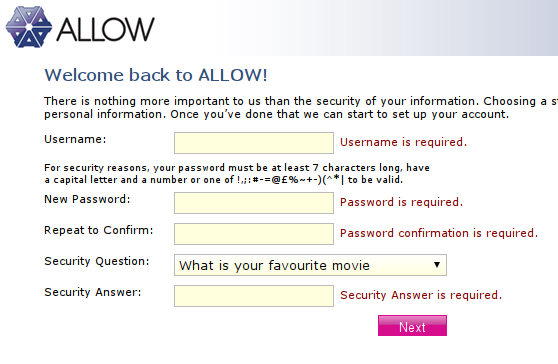
(There are other suitable assertions in various places they even have a set of principles about safeguarding data.) Unfortunately, this promise is rather undermined in several ways after noticing the first couple, I did a little digging to see what else was exploitable. Here s the final part of the joining process, where you choose a username and password combination: The text I ve cropped too eagerly says Choosing a secure password is an essential part of protecting your personal information , or thereabouts. I duly chose a complex password that fitted the requirements, and to my surprise it was rejected. I tried another, and it was rejected; then a third and a fourth. By trial and error I worked out what was going on: 1. The password must contain only the listed special characters, not just include one of them. That s a bit of a problem, because even assuming a basic ASCII set, 15 characters are unavailable to users; 80 are left, so that s about a 15% fall in the available combinations*. Not a good start. More concerning is the presence of a security question field. It s used for resetting the password in the event losing it, but this technique for recovery has long been ridiculed the shared secret is often common knowledge amongst friends, and sometimes (as in this case) the available questions are fairly easy for an attacker to find the answer to in public records or solicit from the victim without arousing much suspicion: 2. The security questions available include First pet s name and worse, First school name . It s pretty pointless enforcing stringent password requirements, and then bypassing them with something so susceptible to a dictionary attack. I was pleased to find that failing to log in to an account more than a few times results in a temporary lockout, which should deter casual brute force attacks. But I wanted to know how that security question would be used, so I forgot my password and followed the links to reset it. Here s the form: Actually the first form, not shown here, initially just asks for a username, giving an error message if it isn t registered, and here s another problem: 3. The password reset process confirms the existence, or non-existence, of a given username half the credentials required to log in to any visitor. I d be prepared to take a bet that most users will choose What was the name of your first school? as a security question. The first pet you have is often at such a young age you can t remember it clearly; the name of the street you grew up on might change a couple of times if you moved house. But first school I attended? I ll never forget that, so it makes most sense to use as a backup password . It s also the best one for an attacker to try and find out from public sources. But that aside, as you can see the password is not generated at random and communicated to the real account holder out-of-band, in the manner of many other sites. Instead: 4. A new password is immediately set to a value already known by the attacker. Once inside, an attacker can also change the security question or answer, or both, so you can t even regain your account by telephoning the company unless you can convince them you re genuine, in which case the security question was a total waste of time anyway. I awarded some marks for notifying the user by email that the password has been changed, but immediately docked them again because bingo! You re now a victim of identity theft! Let s assume you ve been locked out, the security question has been changed and you want your account back. ALLOW don t let you telephone them; you either have to dig around and find an address to send an email, which we all know can be intercepted, or (and you re encouraged to) contact them through a form on the site. You ll probably include some personal details, because you want to convince them of your real identity; indeed, two of the options on the form are I ve got a question and Something doesn t work . I sent my findings through this very form, under the latter heading, and to my surprise: 5. Despite promises of full encryption of all data at all times, full implementation of secure socket layers , the contact form is transmitted to ALLOW in the clear, with no protection whatsoever. So now anyone listening in your connection knows all about you too: your ISP, any of the peers along the route, the deep packet inspection advertisers if your ISP is less than reputable, and the neighbour who connects to your wireless and slips you a fiver every month for the privilege. Nice work, privacy specialists. (For the record: * please feel free to correct my maths. It was never my strongest subject.

Comments
Privacy specialists should hire security specialists is a post from: jwiltshire.org.uk Flattr

Julien Blache: Digi AccelePort driver 1.3-21 available for Squeeze

Long time no see! I ve just packaged Digi s latest dgap beta release, dgap 1.3-21, for Squeeze. The packages are available at the usual address, using this APT source: deb http://debian.technologeek.org squeeze non-free I have made some changes to the packaging as far as udev and firmware loading is concerned, but this is nothing major. Firmware files moved out of /usr, along with udev-related utilities. Should you notice any issue with the packages or the APT repository, please let me know. The previous packages, version 1.3-15, are still available for Lenny, APT source unchanged: deb http://debian.technologeek.org lenny non-free

Joachim Breitner: Tor exit node shut down by server4you

As mentioned earlier this week, I changed the server for my hoster from server4you to Hetzner. Because the contract for my old server is still running until the 14th of April, I thought I can make some good use of it by running an Tor exit node on it. Tor, The onion router is a world-wide network of server to anonymize network connections, and used for example by freedom-loving people in repressive countries, or by Facebook users in repressively proxied university networks Naturally, such a system is also used by people with lesser motives, and after nearly one week of running the server, some complaints were reaching server4you a honeynet supposedly detected botnet activity from my IP address, another company hired by Paramount Pictures claimed that someone downloaded Iron Man 2 over BitTorrent via my server. These were forwarded to my by server4you, demanding an explanation. I explained that I am running a Tor node, that such things are unavailable, and that neither I nor server4you is going to be held responsible. Nevertheless, they insist that I should stop whatever I am doing (I am not sure if they really understood what tor is), and when I said that I won t, they decided to unilaterally and immediately end my contract by tomorrow. Thus a powerful exit node that might have made life better for Tor users is doing to disappear again. They will not reimburse the advance fee that I had paid in advance and made a non-specific threat about further claims they might have. So server4you was, at least in my case, not only an unreliable and inflexible provider, they also prefer to cut off their customer s server just because of two complaints by third parties. I conclude that this is not a hoster that you should trust important services to. And I am not a unique case: There are reports of similar server shut-downs by server4you (in German).

Ian Wienand: Pyblosxom Recaptcha Plugin

I think maybe the world has moved on from Pyblosxom and, as my logs can attest, spammers seem to have moved on past Recaptcha (even if it is manual). However, maybe there are some other holdouts like myself who will find this plugin useful. In reality, this will do nothing for stopping spam for that I am currently having good luck with Akismet. However, I like that in displaying the captcha it costs the spammers presumably something to crack it so they can even attempt to submit the comment.

Michal Čihař: OpenID in phpMyAdmin

Well not really. The simple reason is that it does not make sense without further integration with other services. However if you want to deploy such solution, you can now base on example script, I've just pushed to our git repository. It is definitely meant only as example, major reason being storing MySQL user names and passwords in clear text in the PHP script.

Filed under: English Phpmyadmin 0 comments Flattr this!

Maximilian Attems: Cross distribution collaboration on longterm 2.6.32 linux-2.6

I'll collect here links to the various linux-2.6 distribution trees based on the longterm release 2.6.32. I won't go into details of bigger external patches (grsec, openvz, rt, xen, ..), which in consequence also aligned themselves on 2.6.32. Important bug fixes usually are connected to some bug report, which may be publicly viewable. So from the patch and changelog entry one can usually assume if a certain patch satisfies the stable criteria and forward it for 2.6.32 longterm inclusion (+ other branches where it might apply). If the patch applies and compiles fine with the Debian tree one can assume that the patch will be fine for upstream 2.6.32 as Debian with small exceptions mostly follows the longterm release: 2.6.32 branch of Debian linux-2.6 (Comment: This is currently only a svn mirror but this bug is worked on for next release). The canonical 2.6.32 linux-2.6 longterm repository is of course on kernel.org maintained by gregkh. Opensuse publishes it's kernel-source on gitorious including all branches and the especially interesting SLE11-SP1 2.6.32 branch. Fedora was following till late Autumn 2.6.32 and the F12 branch has the relevant patches. Ubuntu released 10.04 with 2.6.32 as in a collaborative decision they also based their drm on 2.6.33 (same story as in Debian, thus particularly relevant for us). Oracle had a 2.6.32 that was maintained until Sept 2010 or such. It is already bad that kernel source in Red Hat doesn't really follow upstream 2.6.32 longterm release itself. For 2.6.18 of course no such option existed, but for 2.6.32 this policy already shows a certain snobbery. Red Hat 6.0 Beta at least shipped kernel-2.6.32-37.el6.src.rpm with broken out patches - since then no patch series or git tree to be seen from RH. This strange move got since picked by lwn - RH "obfuscated" kernel source.

Lucas Nussbaum: Banshee and Ubuntu

[ If you haven't heard of this debate yet, you probably want to read Vincent Untz's and Mark Shuttleworth's blog posts. ] Last year, I gave a talk at FOSDEM about Debian and Ubuntu (slides of a slightly updated version). One of my points was that Debian has better values, being a volunteer-driven project where decisions are taken in the open. In contrast, Ubuntu is a project managed and controlled by Canonical, and recent history has shown that Canonical had no problem imposing some decisions to the developers community: first with the inclusion of UbuntuOne, then the switch from Google to Yahoo! to Google as the default search engine, both to increase revenue streams. So one should not be surprised by the Banshee story. I find Mark s justification quite difficult to buy, and similar to Apple s model where 30% of the revenues from the App Store go to Apple, and 70% to the seller of the application. For those wondering how much work was done by Canonical directly on the Banshee package: the banshee package in Ubuntu natty is based on the package currently in Debian experimental. The package is mainly maintained in Debian by an Ubuntu developer not paid by Canonical AFAIK, Chow Loong Jin. There are some differences between the Debian package and the Ubuntu package, which are fairly limited (full diff here) and mainly about enabling UbuntuOne and disabling the other music stores. That patch itself apparently was provided by Jo Shields, who doesn t seem to be a canonical employee. (Feel free to correct me) I think that one of the conclusions to draw from this story is that we now have several proofs that Ubuntu isn t a volunteer-driven project, and that volunteer contributors should really decide whether they are OK with working for free for Canonical, or if their free time would be better spent on other projects where they actually have a chance to influence decisions. From the Debian POV, I m still convinced that we should take the feedback that we receive from Ubuntu in consideration to improve our Debian packages (by looking at patches made by Ubuntu, or at bugs reported in Launchpad). But my motivation for contributing to Ubuntu directly has just diminished a bit more (not that it was very high before).

Kai Wasserb ch: Downloading entire YouTube playlists

Downloading videos from YouTube isn't a problem thanks to tools like clive. But fetching all videos of a playlist was always a little bit tricky. There is clivescan, but it requires user intervention and needs Tk. Other tools have focused on feed parsing, so in case you have a playlist feed you can then download all (listed) videos. But none of the tools offered me a simple way to download all videos in a playlist from the command line. That's when I started writing ytplaylistfetcher, a simple shell script aiming to parse a YouTube playlist, extract all unique video ids and pass the list on to clive for downloading. By now ytplaylistfetcher is pretty much complete and there aren't many changes ahead (unless YouTube changes its page layout again, e.g. back to multi-page playlists). At the moment ytplaylistfetcher can handle the three common playlist link formats. If you've encountered another format or found a playlist link that doesn't work, let me know. ytplaylistfetcher has just one limitation in my opionin (but one I can live well with): it is limited to YouTube playlists. But that isn't a severe drawback in my opinion, as I rarely receive playlist links to other video hosting platforms (at least none where a simple wget call doesn't solve the problem. This little script show-cases one reason, why I like Linux so much: there is always an easy way to extend existing functionality.

Steve Kemp: I updated my redis-based filesystem

In July last year I made a brief post about a simple filesystem I'd put together which used Redis for the storage. At that time I thought it was a cute hack, and didn't spend too much time with it. But recently I found a use for it so I cleaned it up, synced up the C client for Redis which I used and generally started to care again. If it is useful you can now find it online: The basic idea is the same as it was before, except I did eventually move to an INODE-like system. Each file/directory entry receives a unique identifier (integer) - and then I store the meta-data in a key based off that name. This means for a file I might have keys, and values,like this:
KeyValue
INODE:1:NAMEThe name of the file (e.g. "passwd").
INODE:1:SIZEThe size of the file (e.g. "1661" )
INODE:1:GIDThe group ID of the file's owner (e.g. "0")
INODE:1:UIDThe user ID of the file's owner (e.g. "0")
INODE:1:MODEThe mode of the file (e.g. 0755)
To store these things I use a Redis "SET" which allows me to easily iterate over all the entries in each directory. ObQuote: "They fuck up, they get beat. We fuck up, they give us pensions. " - The Wire

Sandro Tosi: MySQL master/slave chain

Have you ever needed to create a MySQL databases replication chain like A->B->C where B is slave of A and master of C? Me neither, until yesterday.

Since it took us about an afternoon to make it works (along with our DBAs, so we're not alone ;)) let's share some knowledge.

A very brief recap of how MySQL replication works:

  1. slave I/O thread connects to the master, gets the new information from the binlog files and stores them in the relay log;
  2. slave SQL thread reads the relay log and applies the changes to the slave database, without changing the slave binlog files.
That said, B replicates correctly from A, but C is unable to replicate from B because B doesn't change its binlog files with updates coming from A, because there's no changes done directly on B.

In order to make the chain works, you need to add the parameter log-slave-updates on B configuration: that will reply the changes from relay log to binlog, and so C will see the changes it needs to correctly replicate.

PS: mysqldump --master-data (executed on the slave server against the master) would help you set up the correct information for replication.

Adrian von Bidder: Open Letter to Gianugo Rabellino

Dear Mr. Rabellino, Actions speak louder than words. So stop giving interviews and do your homework. Release documentation without license and patent threats surrounding them (how about all protocols related to Sharepoint and Exchange?) Support stuff like Ogg Theora in HTML 5 for IE and the OpenDocument format in MS Office. Admit that you just bought the OOXML standard and that you can't even implement it yourself. Hand over your patent portfolio to the Open Invention Network. Use your cash reserves to buy Nvidia and then release a proper driver for their GPUs (obviously, I'm talking about a driver for the X window system under appropriate licenses, not a Windows driver.) If you ever are challenged that Microsoft should do something like this, don't come up with lame excuses like I would like to do this but the company won't let me. Either you can move your company or admit defeat and resign instead of pretending to care about relationship to the Free Software communitites. Your company has a long, long history and needs to make good on it. Talking won't change any of this. Being forced to take some (very small) steps towards openness by court decisions won't change any of this. Probably, even being a model citizen for 5 years won't change much because people have long memories, but hey, you worked hard to get this reputation.

1 March 2011

Michal Čihař: phpMyAdmin has new theme

Following results of theme survey, I've changed default theme of phpMyAdmin to pmahomme: pmahomme theme I'm sure this new attractive look will improve user experience of upcoming 3.4 release. You can expect beta release with new theme soon and then we will hopefully smoothly continue through one (or more) release candidates to final release. While making this theme default one, we've also offered team membership to Mike Homm and I'm quite confident this will be valuable addition to the team. Mike, welcome on board!

Filed under: English Phpmyadmin 0 comments Flattr this!

Daniel Kahn Gillmor: Turning my back on the IEEE

I used to maintain a membership with IEEE. I no longer do. The latest nonsense to come from them is a change for the worse in their copyright assignment policy, which i thought was already problematic. Other engineering societies (IETF, USENIX, etc) continue to do socially relevant, useful work without attempting to control copyright of work contributed to them. This just makes IEEE look like a power- and money-hungry organization, rather than a force for positive advancement of technology. For shame, IEEE. I will not consider reinstating my membership unless the organization changes their copyright assignment and publication policy to better reflect the spirit of scientific inquiry and technological advancement they should stand for.Tags: freedom, ieee, policy

Kai Wasserb ch: KVIrc in Debian: a small addendum

Ra l (another maintainer of KVIrc) asked me to add a request to our users to my previous entry about KVIrc in Debian. So here it is: please report any bugs you find! Please note, that most of the bugs you find are most likely upstream bugs. If you're sure of this, you can help us by tagging your bug accordingly. This is done by adding Tags: upstream to the pseudo-headers of your e-mail. If you really want to help us, you can also check, if upstream already knows about this bug and add a Forwarded: pseudo header to your e-mail (if you want to report a new bug upstream, you can do so at https://svn.kvirc.de/kvirc/newticket).

Joachim Breitner: Nomen est Omen

Google provides a handy image search, and given that the Internet is for porn, it is a good thing that they provide a filter that tries to remove pornographic images. This allows us to define the pornyness of a name (or of any word): It is the percentage of images found by Google that are removed when enabling the SafeSearch filter. For those who want to find out the pornyness of their name without having to count pictures that are NSFW, I have created the pornyness calculator. The range of values goes from 0% (for Ursel) to 97% (for Aletta, exact percentage depends on your location, it seems). This is implemented by some simple JavaScript in a static file, and using Google s API. PS: It was pointed out to me that Maschinenbau (civil engeneering) has a score of 0%, but Mathematik (mathematics) has a score of 2%. Feel free to add more interesting results to the comments.

Bastian Venthur: Summer School: Advanced Scientific Programming in Python

Once again, there will be another round of the Summer School Advanced Scientific Programming in Python . This year in St. Andrews, UK. Quoting from the official announcement:
Scientists spend more and more time writing, maintaining, and debugging software. While techniques for doing this efficiently have evolved, only few scientists actually use them. As a result, instead of doing their research, they spend far too much time writing deficient code and reinventing the wheel. In this course we will present a selection of advanced programming techniques, incorporating theoretical lectures and practical exercises tailored to the needs of a programming scientist. New skills will be tested in a real programming project: we will team up to develop an entertaining scientific computer game. We use the Python programming language for the entire course. Python works as a simple programming language for beginners, but more importantly, it also works great in scientific simulations and data analysis. We show how clean language design, ease of extensibility, and the great wealth of open source libraries for scientific computing and data visualization are driving Python to become a standard tool for the programming scientist. This school is targeted at PhD students and Post-docs from all areas of science. Competence in Python or in another language such as Java, C/C++, MATLAB, or Mathematica is absolutely required. Basic knowledge of Python is assumed. Participants without any prior experience with Python should work through the proposed introductory
materials before the course.
You can apply on-line at http://python.g-node.org Applications must be submitted before May 29, 2011. Notifications of acceptance will be sent by June 19, 2011. No fee is charged but participants should take care of travel, living, and accommodation expenses. Candidates will be selected on the basis of their profile. Places are limited: acceptance rate in past editions was around 30%. Prerequisites: You are supposed to know the basics of Python to participate in the lectures. Please consult the website for a list of introductory material. If your re a scientist and interested in Python, I cannot recommend this summer school highly enough. The Summer School is always fun, the faculty members are very nice and always willing to help and answer questions. The balance between lectures and exercises is in my opinion very good, and you ll learn a lot about Python during the week. The highlight of every Python School is always the Pac Man tournament, where groups of students will implement their own Pac Man agent (in Python) and compete against the other agents in a tournament till the bitter end! The students of the previous editions were usually very happy during and after the School. Speaking of happiness, since no fee is charged for the Summer School, you ll have more money left over to invest into the excellent Scottish pubs!

Kai Wasserb ch: Weather Forecasts In A KDE Environment

As Squeeze was just released, some might be on the lookout for a replacement for LiquidWeather++, a SuperKaramba script. Others might just search for the first time for a way to have a weather forecast displayed on their desktop. With my yaWP maintainer hat on, I'd like to recommend yaWP for the job. Why yaWP? Short answer: because it's the best (SCNR). Longer answer: because yaWP is easy to use, yet highly customizable. yaWP can track the forecasts of several cities for you, you can put yaWP on your desktop or in your control bar. You can limit the amount of days displayed (in the control bar mode). It's localized for many languages (if your language isn't among the already existing ones, please consider translating yaWP). yaWP can work with multiple services, is themeable and can display a satellite image for your area. Now, some of you might still (don't ask me why) prefer a different Plasmoid for displaying the weather forecasts. But even those can benefit from yaWP and use one of its three data engines (AccuWeather, Google Weather Service and Weather Underground (Wunderground)), thanks to KDE's Weather Ions. Ok, and how does it look? Please remember, that yaWP can be themed, so the picture below just shows one option of many. A screenshot of yaWP displaying data
Included from screenshots.debian.org (License: GPL2 or later + OpenSSL exception)

Julien Danjou: My latest contributions to the Emacs' world

I spend too much time writing Emacs Lisp code these days. Unfortunately, the more I do the more I find new useful tools to improve my work-flow and save time for doing more Lisp. D'oh. I did not work on any big thing these last weeks, so I'm thinking it's a good time to talk about the various code and patches I sent to multiple Emacs packages. el-get el-get, a fabulous tool that installs and handles all the external Emacs packages I use. A friendly war started on the development list about autoloads handling. The discussion was overall pointless, since we had a very hard time to communicate our ideas, and we did not understand each others several times. In the end, el-get now supports autoload correctly and do not load automatically all your packages, improving the startup time, and using the Emacs way to do things. Which is always better, obviously. git-commit-mode

I've started to use git-commit-mode some times ago. I usually use git-commit with the -v option to see what I'm committing. I though it would be useful to color the diff with diff-mode, so I wrote a patch just to do that, which was merged today by Florian. magit

Some weeks ago, I decided to give a try to magit, and loved it. I am not always using it, but for basic operations it is very useful. But I really soon found some things I did not like and therefore send patches to enhance it. First, I've added a patch to honor status.showUntrackedFiles which I use in my home directory. In the mean time, I've also added a patch to allow adding an arbitrary file. Yesterday, I sent another pull request, not closed for now, which adds the possibility to visit files in another window from a diff file, and the support for add-change-log-entry directly from the displayed diff. Useful for these old projects still using ChangeLog files but accessible through git (hi Emacs & Gnus!). Gnus

Nothing remarkable, but I write a couple of fixes and enhancements to the Sieve manage mode, to the Gravatar code and cleaned-up some very very old code. Also added the possibility to set list-identifier as a group parameter. Org-mode

I spent most of my time working on my jd/agenda-format branch, which is soon to be merged. I've also just got developer access to the Org-mode patch work and repository, so I'll be able to break things even more! ;-) ERC

I fixed the bug that annoyed me for a long time. Now erc-track does not reset the last channel status on window visibility changes not made by the user. Flattr this

Next.

Previous.