Shirish Agarwal: John Grisham s books, Evolution removed from textbooks

 The more I say, the more depressed I will become so will leave it for now. In many ways the destruction seems similar to the destruction that happened in Brazil under Jair Bolsonaro. So as can be seen from what I have shared this book was mostly about environment and punitive damages and also how punitive damages have been ceiling in America (South). This was done via lobbying by the coal groups and apparently destroyed people s lives, communities, even whole villages. It also shared how most people called black lung and how those claims had been denied by Coal Companies all the time. And there are hardly any unions. While the book itself is a fiction piece, there is a large amount of truth in it. And that is one of the reasons people write a fiction book. You could write about reality using fictional names and nobody can sue you while you set the reality as it is. In many ways, it is a tell-all.
An attacker is able to substitute any component of the device (hardware or software) at any time for any period of time.
kdf_do=required option.
cdi = blake2s(UDS, blake2s(device_app), USS)
cdi = weakprng(UDS , weakprng(device_app), USS)
weakprng is a compromised algorithm that is predictable for the attacker, but still appears random. Everything will work correctly, but the attacker will be able to learn the secrets used by the user, and the user will typically not be able to tell the difference since the CDI is secret and the Ed25519 public key is not self-verifiable.
 This post serves as a report from my attendance to Kubecon and CloudNativeCon 2023 Europe that took place in
Amsterdam in April 2023. It was my second time physically attending this conference, the first one was in
Austin, Texas (USA) in 2017. I also attended once in a virtual fashion.
The content here is mostly generated for the sake of my own recollection and learnings, and is written from
the notes I took during the event.
The very first session was the opening keynote, which reunited the whole crowd to bootstrap the event and
share the excitement about the days ahead. Some astonishing numbers were announced: there were more than
10.000 people attending, and apparently it could confidently be said that it was the largest open source
technology conference taking place in Europe in recent times.
It was also communicated that the next couple iteration of the event will be run in China in September 2023
and Paris in March 2024.
More numbers, the CNCF was hosting about 159 projects, involving 1300 maintainers and about 200.000
contributors. The cloud-native community is ever-increasing, and there seems to be a strong trend in the
industry for cloud-native technology adoption and all-things related to PaaS and IaaS.
The event program had different tracks, and in each one there was an interesting mix of low-level and higher
level talks for a variety of audience. On many occasions I found that reading the talk title alone was not
enough to know in advance if a talk was a 101 kind of thing or for experienced engineers. But unlike in
previous editions, I didn t have the feeling that the purpose of the conference was to try selling me
anything. Obviously, speakers would make sure to mention, or highlight in a subtle way, the involvement of a
given company in a given solution or piece of the ecosystem. But it was non-invasive and fair enough for me.
On a different note, I found the breakout rooms to be often small. I think there were only a couple of rooms
that could accommodate more than 500 people, which is a fairly small allowance for 10k attendees. I realized
with frustration that the more interesting talks were immediately fully booked, with people waiting in line
some 45 minutes before the session time. Because of this, I missed a few important sessions that I ll
hopefully watch online later.
Finally, on a more technical side, I ve learned many things, that instead of grouping by session I ll group
by topic, given how some subjects were mentioned in several talks.
On gitops and CI/CD pipelines
Most of the mentions went to FluxCD and ArgoCD. At
that point there were no doubts that gitops was a mature approach and both flux and argoCD could do an
excellent job. ArgoCD seemed a bit more over-engineered to be a more general purpose CD pipeline, and flux
felt a bit more tailored for simpler gitops setups. I discovered that both have nice web user interfaces that
I wasn t previously familiar with.
However, in two different talks I got the impression that the initial setup of them was simple, but migrating
your current workflow to gitops could result in a bumpy ride. This is, the challenge is not deploying
flux/argo itself, but moving everything into a state that both humans and flux/argo can understand. I also
saw some curious mentions to the config drifts that can happen in some cases, even if the goal of gitops is
precisely for that to never happen. Such mentions were usually accompanied by some hints on how to operate
the situation by hand.
Worth mentioning, I missed any practical information about one of the key pieces to this whole gitops story:
building container images. Most of the showcased scenarios were using pre-built container images, so in that
sense they were simple. Building and pushing to an image registry is one of the two key points we would need
to solve in Toolforge Kubernetes if adopting gitops.
In general, even if gitops were already in our radar for
Toolforge Kubernetes,
I think it climbed a few steps in my priority list after the conference.
Another learning was this site: https://opengitops.dev/.
 On etcd, performance and resource management
I attended a talk focused on etcd performance tuning that was very encouraging. They were basically talking
about the exact
same problems we
have had in Toolforge Kubernetes, like api-server and etcd failure modes, and how sensitive etcd is to disk
latency, IO pressure and network throughput. Even though
Toolforge Kubernetes scale is small compared to other Kubernetes deployments out there, I found it very
interesting to see other s approaches to the same set of challenges.
I learned how most Kubernetes components and apps can overload the api-server. Because even the api-server
talks to itself. Simple things like
kubectl may have a completely different impact on the API depending on
usage, for example when listing the whole list of objects (very expensive) vs a single object.
The conclusion was to try avoiding hitting the api-server with LIST calls, and use ResourceVersion which
avoids full-dumps from etcd (which, by the way, is the default when using bare kubectl get calls). I
already knew some of this, and for example the jobs-framework-emailer was already making use of this
ResourceVersion functionality.
There have been a lot of improvements in the performance side of Kubernetes in recent times, or more
specifically, in how resources are managed and used by the system. I saw a review of resource management from
the perspective of the container runtime and kubelet, and plans to support fancy things like topology-aware
scheduling decisions and dynamic resource claims (changing the pod resource claims without
re-defining/re-starting the pods).
On cluster management, bootstrapping and multi-tenancy
I attended a couple of talks that mentioned kubeadm, and one in particular was from the maintainers
themselves. This was of interest to me because as of today we use it for
Toolforge. They shared all
the latest developments and improvements, and the plans and roadmap for the future, with a special mention to
something they called kubeadm operator , apparently capable of auto-upgrading the cluster, auto-renewing
certificates and such.
I also saw a comparison between the different cluster bootstrappers, which to me confirmed that kubeadm was
the best, from the point of view of being a well established and well-known workflow, plus having a very
active contributor base. The kubeadm developers invited the audience to submit feature requests,
so I did.
The different talks confirmed that the basic unit for multi-tenancy in kubernetes is the namespace. Any
serious multi-tenant usage should leverage this. There were some ongoing conversations, in official sessions
and in the hallway, about the right tool to implement K8s-whitin-K8s, and vcluster
was mentioned enough times for me to be convinced it was the right candidate. This was despite of my impression
that multiclusters / multicloud are regarded as hard topics in the general community. I definitely would like to play
with it sometime down the road.
On networking
I attended a couple of basic sessions that served really well to understand how Kubernetes instrumented the
network to achieve its goal. The conference program had sessions to cover topics ranging from network
debugging recommendations, CNI implementations, to IPv6 support. Also, one of the keynote sessions had a
reference to how kube-proxy is not able to perform NAT for SIP connections, which is interesting because I
believe Netfilter Conntrack could do it if properly configured. One of the conclusions on the CNI front was
that Calico has a massive community adoption (in Netfilter mode), which is reassuring, especially considering
it is the one we use for Toolforge Kubernetes.
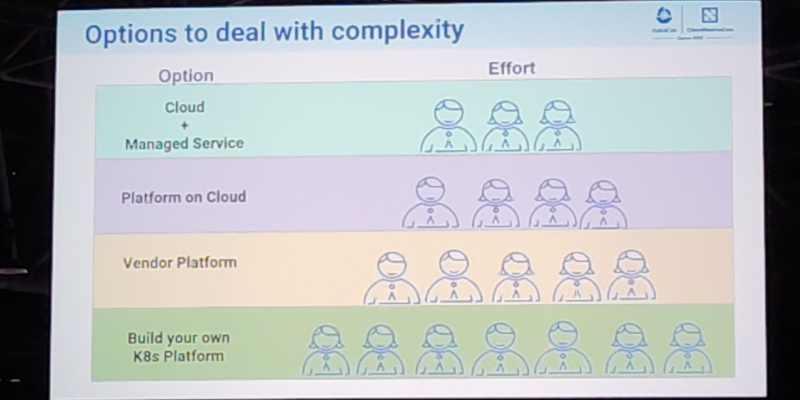 On jobs
I attended a couple of talks that were related to HPC/grid-like usages of Kubernetes. I was truly impressed
by some folks out there who were using Kubernetes Jobs on massive scales, such as to train machine learning
models and other fancy AI projects.
It is acknowledged in the community that the early implementation of things like Jobs and CronJobs had some
limitations that are now gone, or at least greatly improved. Some new functionalities have been added as
well. Indexed Jobs, for example, enables each Job to have a number (index) and process a chunk of a larger
batch of data based on that index. It would allow for full grid-like features like sequential (or again,
indexed) processing, coordination between Job and more graceful Job restarts. My first reaction was: Is that
something we would like to enable in Toolforge Jobs Framework?
On policy and security
A surprisingly good amount of sessions covered interesting topics related to policy and security. It was nice
to learn two realities:


javac and javadoc acceleration.
rustc is deterministic in itself and simple rustc invocations were already accelerated, but parallel builds driven by Cargo needed a few enhancements in Firebuild.
# rustc's environment variables
...
CARGO_MAKEFLAGS="-j --jobserver-fds=4,5 --jobserver-auth=4,5"
.../configure script, thus the case is far from being theoretical.
To stay on the safe side firebuild ignores jobserver fd usage only in programs which are known to use the jobserver properly. The list of the programs is now configurable in /etc/firebuild.conf and since rustc is on the list by default parallel Rust builds are accelerated out of the box!
rustc s -L dependency=<dir> parameter. This directory is populated in a not fully deterministic order in parallel builds. Firebuild on the other hand hashes directory listings of open()-ed directories treating them as inputs assuming that the directory content will influence the intercepted programs outputs. As rustc programs started in parallel scanned the dependency directory in different states depending on what other Rust compilations finished already Firebuild had to store the full directory content as an input for each rustc cache entry resulting low hit rate when rustc was started again with otherwise identical inputs.
The solution here is ignoring rustc scanning the dependency directory, because the dependencies actually used are still treated as input and are checked when shortcutting rustc. With that implemented in firebuild, too, librsvg s build that uses Rust and Cargo can be accelerated by more than 90%, even on a system having 12 cores/24 threads!:
 Firebuild accelerating librsvg s Rust + Cargo build from 38s to 2.8s on a Ryzen 5900X (12C/24T) system
gfortran that was already supported and included many smaller changes improving the acceleration of other compilers and tools. If your favorite toolchain is not mentioned, there is still a good chance that it is already supported. Give Firebuild a try and tell us about your experience!
Update 1: Comparison to sccache came up in the reddit topic about Firebuild s Rust acceleration , thus by popular demand this is how sccache performs on the same project:
 Firebuild 0.8.0 vs. sccache 0.4.2 accelerating librsvg s Rust + Cargo build
git clean command cleared all the build artifacts from the project directory before each build and ./autogen.sh was run to measure only clean rebuilds (without autotools). See test configuration in the Firebuild performance test repository for more details and easy reproduction.
Firebuild had lower overhead than sccache (2.83% vs. 6.10% on 1 CPU and 7.71% vs. 22.05% on 12 CPUs) and made the accelerated build finish much faster (2.26% vs. 19.41% of vanilla build s time on 1 CPU and 7.5% vs. 27.4% of vanilla build s time on 12 CPUs).
 The voting period for the Debian Project Leader election has ended, with all of the votes tallied we announce the winner is: Jonathan Carter, who has been elected for the forth time.
Congratulations! The new term for the project leader started on 2023-04-21.
279 of 997 Developers voted using the Condorcet method.
More information about the results of the voting are available on the Debian Project Leader Elections 2023 page.
Many thanks all of our Developers for voting.
 In a previous blog post I described the use of virtual
postings to track accidental personal/family expenses. I've always been
uncomfortable with that, and in hledger 1yr I outlined a potential scheme
for finally addressing the virtual posting problem.
separate journals
My outline built on top of continuing to maintain both personal and family
financial data in the same place, but I've decided that this can't work,
because the different "directions" (or signs) of accidental transactions
originating from either the family or personal side can't be addressed with any
kind of alternate view on the same data.
To illustrate with an example.
A negative balance in
family:liabilities:jon means "family owes jon". A
coffee bought by mistake on the family credit card will have a negative
posting on the credit card, and thus a positive one on the liabilities
account. ("jon owes family"). That's fine.
But what about when I buy family stuff on a personal card? The other side of
of the transaction is also going to have a positive sign, so it can't be
posted to family:liabilities:jon: it would have to go to somewhere else,
like jon:liabilities:family. Now I have two accounts which track versions
of the same thing, and they cannot be combined with a simple transaction
since they're looking at the same value from opposite directions (and signs).
Back when I first described the problem I was using
a single journal file for all my transactions. After moving to lots of separate
journal files (in hledger 1yr), it's become clearer to me that I don't
need to maintain the Family and Personal data together, at all: they can be
entirely separate journals.
getting data between journals
When I moved to a new set of ledger files for 2023, I needed to carry forward
the balances from 2022 in the form of "opening balance" transactions. This was
achieved by a report on the 2022 data, exported as CSV, and imported into the
2023 data (all following the scheme outlined by fully-fledged hledger.))
Separate Personal and Family journals need some information from each other, and I
can achieve that in the same way as for opening balances: with an export of
the relevant transactions as CSV, then imported on the other side. HLedger's
CSV import system is flexible enough that we can effectively invert the sign
of liabilities, addressing the problem above.
Worked example
We start with an accidental coffee purchased on the family card (and so this
belongs to the Family ledger)
2022-08-20 coffee
    liabilities:creditcard             -3
    liabilities:jon:expenses:coffee     3
expenses:coffee) as a sub-account of the liabilities
category that the Family ledger is interested in1 (the first bit,
liabilities:jon). When viewed on the Family side, the expense category is not
interesting, and we can hide it with HLedger's alias feature2:
alias /^liabilities:jon(.*)$/ = liabilities:jon
2022-08-20 coffee
    liabilities:creditcard             -3
    liabilities:jon                     3
hledger reg -f family/2023-back.journal liabilities:jon: -O csv \
        jon/import/family/liabilities.csv
liabilities:jon: is important here!)
In the resulting CSV file, the running example transaction looks like
"55","2022-08-20","","coffee","liabilities:jon:expenses:coffee"," 3.00"," 3.00"
hledger import. The rules file
for the import is very simple: the fields date, description, account1
and amount are taken as-is; account2 is hard-coded to liabilities:family.
The resulting transaction looks like
2022-08-20 coffee
    liabilities:jon:expenses:coffee     3
    liabilities:family                 -3
liabilities:jon: prefix. The import rules can't do
this3 , so we use another journal file as a go-between with another alias
rule:
alias /^liabilities.jon:/ =
2022-08-20 coffee
    expenses:coffee                     3
    liabilities:family                 -3
hledger reg report. That's what the trailing
colon is for: It ensures I only export transactions which are to a sub-account
of liabilities:jon, and not to the root account liabilities:jon itself:
which is where I put the repayment transactions. I could instead use a more
explicit sub-account like liabilities:jon:repayments or similar, since the
trailing colon is quite subtle, but this works for me.
Wrap up
I've been really on the fence as to whether the complexity of this scheme is
worth it to avoid the virtual postings. The previous scheme was much simpler.
I have definitely made some mistakes with it, which didn't get caught by the
double-entry rules that virtual postings ignore, but they're for small sums
of money anyway.
On the other hand, a lot of the "machinery" of this already existed for getting
opening balances between calendar years, and the gory details are written down
and hidden inside the Makefile. I also expect that I will continue to see
advantages in having Family and Personal entirely separate, as they can each
develop and adapt to their own needs without having to consider the other side
of things every time.
It's a running experiment, and time will tell if it's a good idea.
family/2023.journal
file, which imports the data from another family/2023-back.journal,
and the CSV export is performed on the backing journal with the data
and not the alias. curl https://geekbay.nuug.no/~pere/openai-whisper/D78F5C4796F353D211B119E28200D9B589641240.asc \ -o /etc/apt/trusted.gpg.d/pere-whisper.asc mkdir -p /etc/apt/sources.list.d cat > /etc/apt/sources.list.d/pere-whisper.list <<EOF deb https://geekbay.nuug.no/~pere/openai-whisper/ bookworm main deb-src https://geekbay.nuug.no/~pere/openai-whisper/ bookworm main EOF apt update apt install openai-whisperThe package work for me, but have not yet been tested on any other computer than my own. With it, I have been able to (badly) transcribe a 2 minute 40 second Norwegian audio clip to test using the small model. This took 11 minutes and around 2.2 GiB of RAM. Transcribing the same file with the medium model gave a accurate text in 77 minutes using around 5.2 GiB of RAM. My test machine had too little memory to test the large model, which I believe require 11 GiB of RAM. In short, this now work for me using Debian packages, and I hope it will for you and everyone else once the packages enter Debian. Now I can start on the audio recording part of this project. As usual, if you use Bitcoin and want to show your support of my activities, please send Bitcoin donations to my address 15oWEoG9dUPovwmUL9KWAnYRtNJEkP1u1b.
 The fifth release of the still new-ish qlcal package
arrivied at CRAN just now.
qlcal
delivers the calendaring parts of QuantLib. It is provided (for the R
package) as a set of included files, so the package is self-contained
and does not depend on an external QuantLib library (which can be
demanding to build). qlcal covers
over sixty country / market calendars and can compute holiday lists, its
complement (i.e. business day lists) and much more.
This release brings updates to five calendars from the QuantLib 1.30
release from this week.
We also added a quick little demo usingChanges in version 0.0.5 (2023-04-19)
- Calendars routines for Australia, Denmark, New Zealand, Turkey and the US have been updated from QuantLib 1.30.
- Support for 'Australia/ASX' has been added.
- Added demo showing all US holidays in current year
xts to
column-bind calendars produced from each of the different US
sub-calendars. This is a slightly updated version of the sketch we
tooted a few days ago. The output now is
> print(Reduce(cbind, Map(makeHol, cals)))
           LiborImpact NYSE GovernmentBond NERC FederalReserve
2023-01-02        TRUE TRUE           TRUE TRUE           TRUE
2023-01-16        TRUE TRUE           TRUE   NA           TRUE
2023-02-20        TRUE TRUE           TRUE   NA           TRUE
2023-04-07          NA TRUE             NA   NA             NA
2023-05-29        TRUE TRUE           TRUE TRUE           TRUE
2023-06-19        TRUE TRUE           TRUE   NA           TRUE
2023-07-04        TRUE TRUE           TRUE TRUE           TRUE
2023-09-04        TRUE TRUE           TRUE TRUE           TRUE
2023-10-09        TRUE   NA           TRUE   NA           TRUE
2023-11-10        TRUE   NA             NA   NA             NA
2023-11-23        TRUE TRUE           TRUE TRUE           TRUE
2023-12-25        TRUE TRUE           TRUE TRUE           TRUE
> h -> hols
bug in the demo so see the git repo sorry!).
The release was finalized uploaded yesterday morning. But because we
have to set CXX_STD=CXX14 as satisfy requirements of some
of the Boost headers, we get ourselves a NOTE and with that a manual
inspection and a delay of 1 1/2 days. Not really all that meaningful
in the grand scheme of things but still suboptimal relative to the fully
automated passage this release should have gotten. Oh well.
Courtesy of my CRANberries, there
is a diffstat report for this
release. See the project page
and package documentation for more details, and more examples.
If you like this or other open-source work I do, you can now sponsor me at
GitHub.
This post by Dirk Eddelbuettel originated on his Thinking inside the box blog. Please report excessive re-aggregation in third-party for-profit settings.
numpy.percentile say this about
the method keyword argument:
Changed in version 1.22.0: This argument was previously called "interpolation" ...They renamed a keyword argument. So if you had working code that did
np.percentile( ...., interpolation=xxx, ....)
np.percentile( ...., method=xxx, ....)
percentile_compat()
function that figures out which flavor of argument we should use, and
uses it. Here it is:
def percentile_compat(*args, **kwargs):
    r'''Wrapper for np.percentile() to handle their API change
In numpy 1.24 the "interpolation" kwarg was renamed to "method". I need to pass
the right thing to work with both old and new numpy. This function tries the
newer method, and if that fails, uses the old one. The test is only done the
first time.
It is assumed that this is called with the old 'interpolation' key.
    '''
    if not 'interpolation' in kwargs or \
       percentile_compat.which == 'interpolation':
        return np.percentile(*args, **kwargs)
    kwargs_no_interpolation = dict(kwargs)
    del kwargs_no_interpolation['interpolation']
    if percentile_compat.which == 'method':
        return np.percentile(*args, **kwargs_no_interpolation,
                             method = kwargs['interpolation'])
    # Need to detect
    try:
        result = np.percentile(*args, **kwargs_no_interpolation,
                               method = kwargs['interpolation'])
        percentile_compat.which = 'method'
        return result
    except:
        percentile_compat.which = 'interpolation'
        return np.percentile(*args, **kwargs)
percentile_compat.which = None
rust-<name-of-crate> is probably in violation.
There are a number of more detailed problems with the wording.
Values
The policy has all the hallmarks of excessive influence from traditional trademark lawyers and not enough influence from the Free Software community.
I would like to remind the Free Software activists on the inside of this process that the lawyers are there to serve you and the community.
The values embodied in trademark law often conflict with the values of the Free Software community. The Rust Project should adopt a trademark policy which follows the community s values - even if that might weaken our ability to sue evildoers.
Next steps
The Foundation should take a step back and pause the process.
Then, the Foundation should restart the process from a much earlier stage, with much wider publicity. Each stage should be widely advertised to the whole community, with opportunities for feedback.
This should include publishing the results of the August 2022 survey. The Foundation should publish a sketch of the legal advice they have received, publicly say what the plausible options are and what their consequences might be (for the community, for downstreams, and for the Foundation s enforcement ability).
(Some of this will no doubt repeat the work that has been done in the informal trademark working group. That work wasn t widely enough advertised.)
Echoes of a dispute from 2006
Mozilla made a very similar mistake with Firefox in 2006.
The official policy stated that no-one was allowed to distribute Firefox with any patches, unless those patches had been pre-approved by Mozilla.
Debian is committed to Software Freedom. This must includes the freedom to modify the software as one sees fit, even if the original authors don t agree.
Now, overly-restrictive trademark policies are hardly new. Debian often takes the practical view that usually the upstream with such a policy doesn t really mean it.
But Mozilla decided they did mean it. They contacted Debian asking for Debian to get their patches approved.
Since that wasn t acceptable to Debian, they stopped using the word Firefox . For a decade, Debian s Firefox browser was called Iceweasel .
We don t want something similar happening to Rust . $ sudo hwinfo --monitor grep Model Model: "PHILIPS PHL 221S8L"
FWIW hwinfo is the latest version
~$ sudo hwinfo --version21.82 Previously, I explained why ventilation monitoring is important, and the opportunity I see to help accelerate deployment of high quality ventilation monitoring for small businesses and organisations.
In this post, I m going to discuss my plans to tackle that opportunity:
 Here's an article from a French anarchist describing how his (encrypted) laptop was seized after he was arrested, and material from the encrypted partition has since been entered as evidence against him. His encryption password was supposedly greater than 20 characters and included a mixture of cases, numbers, and punctuation, so in the absence of any sort of opsec failures this implies that even relatively complex passwords can now be brute forced, and we should be transitioning to even more secure passphrases.
 I wrote the Ruby bindings for the Enquo Project, my attempt to bring queryable encryption to all databases, using the Rutie library.
Recently, I ve rewritten the bindings to use Magnus instead, and I thought I d put down my thoughts about the whole situation.
 Wrong sort of shim, but canned language bindings would be handy
u32 type, which can only store integers between zero and about four billion (232 - 1, to be precise).
There s also lots of little things that need to be just right, also, like translating the different memory management approaches of the languages, and dealing with a myriad of fiddly little issues like passing arguments and return values in and out of method calls, helpers for defining classes and methods (and pointing to the correct Rust functions), and so on.
 This is what I imagine it looks like inside these libraries
self reference to the current object):
fn enquo_field_decrypt_text(ciphertext_obj: RString, context_obj: RString) -> RString
    let ciphertext = ciphertext_obj.to_str_unchecked();
    let context = context_obj.to_vec_u8_unchecked();
    let field = rbself.get_data(&*FIELD_WRAPPER);
    // etc etc etc
fn decrypt_text(&self, ciphertext: String, context: String) -> Result<String, magnus::Error>
Result return value, while Rutie s approach to raising an exception involves poking the Ruby VM directly, which always struck me as a bit ugly.
There are several other minor things in Magnus (like its cleaner approach to wrapping structs so they can be stored in Ruby objects) that I m appreciating, too.
Never discount the power of ergonomics for making a happy developer.
$ git diff --stat -- lib ext/enquo/src
 ruby/ext/enquo/src/field.rs         342 ++++++++++++++++++++++++++++++++++++++
 ruby/ext/enquo/src/lib.rs           338 ++++---------------------------------
 ruby/ext/enquo/src/root.rs           39 +++++
 ruby/ext/enquo/src/root_key.rs       67 ++++++++
 ruby/lib/enquo.rb                     6 +-
 ruby/lib/enquo/field.rb             173 -------------------
 ruby/lib/enquo/root.rb               28 ----
 ruby/lib/enquo/root_key.rb            1 -
 ruby/lib/enquo/root_key/static.rb    27 ---
 9 files changed, 479 insertions(+), 542 deletions(-)
raise ArgumentError if something.isnt_right code in those .rb files.
So, in conclusion, if you, too, are building Ruby extensions in Rust, while Rutie is a solid choice (and you probably should stick with it if you re already using it), I highly recommend giving Magnus a look for your next extension.
CPUs can't do anything without being told what to do, which leaves the obvious problem of how do you tell a CPU to do something in the first place. On many CPUs this is handled in the form of a reset vector - an address the CPU is hardcoded to start reading instructions from when power is applied. The address the reset vector points to will typically be some form of ROM or flash that can be read by the CPU even if no other hardware has been configured yet. This allows the system vendor to ship code that will be executed immediately after poweron, configuring the rest of the hardware and eventually getting the system into a state where it can run user-supplied code.tcpmss_mangle_packet, first there is this comment:
/* Never increase MSS, even when setting it, as
 * doing so results in problems for hosts that rely
 * on MSS being set correctly.
*/set rt mtu rather than set 1452), in the
if
branch
for XT_TCPMSS_CLAMP_PMTU. This means, it s safer to use
auto-clamping, rather than manually set the value.
And finally, there is handling of some corner cases as well (syn
packet with data, syn packet without the MSS option - unlikely for
modern stacks - in which case it defaults to minimal values).
All in all, it seems to me that it should always be correct to simply
do what the wiki recommends, setting this for all packets traversing
the host:
nft add rule ip filter forward tcp flags syn tcp option maxseg size set rt mtunft add rule ip filter forward iifname ppp0 tcp flags syn tcp option maxseg size set rt mtu
nft add rule ip filter forward oifname ppp0 tcp flags syn tcp option maxseg size set rt mtuiifgroup/oifgroup for better rules .
apt-get update to only ever use files whose hash checksum have been recorded in the globally immutable tamper-resistance ledger rekor provided by the Sigstore project? Well I thought you d never ask, but now you can, thanks to my new projects apt-verify and apt-sigstore. I have not done proper stable releases yet, so this is work in progress. To try it out, adapt to the modern era of running random stuff from the Internet as root, and run the following commands. Use a container or virtual machine if you have trust issues.
apt-get install -y apt gpg bsdutils wget
wget -nv -O/usr/local/bin/rekor-cli 'https://github.com/sigstore/rekor/releases/download/v1.1.0/rekor-cli-linux-amd64'
echo afde22f01d9b6f091a7829a6f5d759d185dc0a8f3fd21de22c6ae9463352cf7d  /usr/local/bin/rekor-cli   sha256sum -c
chmod +x /usr/local/bin/rekor-cli
wget -nv -O/usr/local/bin/apt-verify-gpgv https://gitlab.com/debdistutils/apt-verify/-/raw/main/apt-verify-gpgv
chmod +x /usr/local/bin/apt-verify-gpgv
mkdir -p /etc/apt/verify.d
ln -s /usr/bin/gpgv /etc/apt/verify.d
echo 'APT::Key::gpgvcommand "apt-verify-gpgv";' > /etc/apt/apt.conf.d/75verify
wget -nv -O/etc/apt/verify.d/apt-rekor https://gitlab.com/debdistutils/apt-sigstore/-/raw/main/apt-rekor
chmod +x /etc/apt/verify.d/apt-rekor
apt-get update
less /var/log/syslog
If the stars are aligned (and the puppet projects of debdistget and debdistcanary have ran their GitLab CI/CD pipeline recently enough) you will see a successful output from
apt-get update and your syslog will contain debug logs showing the entries from the rekor log for the release index files that you downloaded. See sample outputs in the README.
If you get tired of it, disabling is easy:
chmod -x /etc/apt/verify.d/apt-rekorOur project currently supports Trisquel GNU/Linux 10 (nabia) & 11 (aramo), PureOS 10 (byzantium), Gnuinos chimaera, Ubuntu 20.04 (focal) & 22.04 (jammy), Debian 10 (buster) & 11 (bullseye), and Devuan GNU+Linux 4.0 (chimaera). Others can be supported to, please open an issue about it, although my focus is on FSDG-compliant distributions and their upstreams. This is a continuation of my previous work on apt-canary. I have realized that it was better to separate out the generic part of apt-canary into my new project apt-verify that offers a plugin-based method, and then rewrote apt-canary to be one such plugin. Then apt-sigstore s apt-rekor was my second plugin for
apt-verify.
Due to the design of things, and some current limitations, Ubuntu is the least stable since they push out new signed InRelease files frequently (mostly due to their use of Phased-Update-Percentage) and debdistget and debdistcanary CI/CD runs have a hard time keeping up. If you have insight on how to improve this, please comment me in the issue tracking the race condition.
There are limitations of what additional safety a rekor-based solution actually provides, but I expect that to improve as I get a cosign-based approach up and running. Currently apt-rekor mostly make targeted attacks less deniable. With a cosign-based approach, we could design things such that your machine only downloads updates when they have been publicly archived in an immutable fashion, or submitted for validation by a third-party such as my reproducible build setup for Trisquel GNU/Linux aramo.
What do you think? Happy Hacking!
Next.
