Search Results: "rra"

10 August 2010

Dirk Eddelbuettel: RQuantLib 0.3.4

A fresh release of RQuantLib is now on CRAN and in Debian. RQuantLib combines (some of) the quantitative analytics of QuantLib with the R statistical computing environment and language. This follows the 0.3.3 release from last week and has again a number of internal changes. All uses of objects from external namespaces are now explicit as I removed the remaining using namespace QuantLib;. This makes things a little more verbose, but should be much clearer to read, especially for those not yet up to speed on whether a given object comes from any one of the Boost, QuantLib or Rcpp namespaces. We also generalized an older three-dimensional plotting function used for option surfaces -- which had already been used in the demo() code -- and improved the code underlying this: arrays of option prices and analytics given two input vectors are now computed at the C++ level for a nice little gain in efficiency. This also illustrates the possible improvements from working with the new Rcpp API that is now used throughout the package, Full changelog details, examples and more details about this package are at my RQuantLib page.

9 August 2010

Gerfried Fuchs: On BTS usage

You might remember that I started to work on closing RC bugs for stable. This effort hasn't died off so I joined the RC Bug Squashing Contest that was going on during the Debian conference (which I was unable to attend). The rules did permit it, even though I was aware that it can't (and shouldn't) be compared to the unstable/testing squashers and thus it was split of into its own Special category. There still seems to be a lot of confusion on how our BTS works, especially with respect to version tracking. I was even accused of falsely claiming bug closing because the bug has been closed by someone else already. This wasn't the case, otherwise the bugs would had been archived a long time ago already[1] given that I had expected that person to know how bug archival works and also given the sheer amount of bugs that I simply had closed for stable, I guess it is needed to shine a light upon why some bugs won't get archived as expected. If you followed my IRC talk on BTS usage last month you might already have an idea of what's going on. There might be several different reasons why bugs aren't marked for archival yet. I'll try to explain them as I understand it (given that I neither have taken a look at the debbugs code nor am involved with its development) through my working on bugs over the last 10 years. I hope this will get others also interested to fix stuff for stable. Actually when I see something that potential falls into the last group I ping the maintainers of those packages to let them know about having them fixed. Some of you might already have received such a ping and I am thankful for those that received them well and actually already fixed some of those, too. Thanks for making stable a better place! Coming back to the RCBC, it was an interesting small competition (if only in my brain) between myself and the testing/unstable RC squashers going on. It would had been nice to get at least as many bugs in stable addressed as in testing/unstable because the amount is still a lot higher, but I can still be happy about the things done. And it is good to know that not everything seems to think that it's wasted effort to work on getting the RC count lower for stable, too (like I also was told about my effort). So thanks from that point of view!
[1] There are currently 2688 bugs still unarchived that were closed last year already! This UDD query helps you:
select count(*) from bugs where status = 'done' and last_modified <= '2009-12-31';

/debian permanent link Comments: 0 Flattr this

Stefano Zacchiroli: missing DebConf10

It is not that I've missed DebConf10, I've totally been there (as some embarrassing video and photo evidence can prove ...).
Rather, I've just got back home and I already miss DebConf10, melancholy is in the air. It will probably stay around for a while and then leave room to a vivid memory of 2 weeks of Debian life, as strong as I've never experienced before. So, before I become too sentimental, let me just thank everyone who has made the conference possible: the orga team, the video team, all the volunteers, the sponsors, the speakers, the attendees, and everyone else I couldn't possibly remember. Specific kudos of mine goes to the Debian NYC cabal: DDs and non-DDs, new to our project and not-so-new. You guys made me remember what does living Debian mean, you guys made all this possible (emotions included!), you guys rock. Say whaaaaaat?

6 August 2010

Martin-&#201;ric Racine: Hell just froze over a.k.a. Squeeze is frozen

Just noticed about an hour ago on debian-announce: Squeeze entered into freeze tonight. Hurray! What this means in practice is that, unless a new version of something fixes a serious bug, it will not be allowed to trickle down from Sid into Squeeze on time for the actual release. Still, I cannot help but feel sad that it happened just a few days short of upstream releasing the Geode 2.11.9 driver for X.org, because AMD recently committed a lot of resources towards fixing all outstanding issues on this driver and yet one major Linux distribution is about to release without those fixes, unless the Release Manager agrees to let us squeeze 2.11.9 into, well, Squeeze. Doable? Possibly, if enough people calmly ask the Release Manager for it.

4 August 2010

Neil Williams: FreedomBox

Eben Moglen's talk at DebConf10 has inspired a flood of responses and activity at DebConf10. The original talk overran the allotted time within the venue and then outside the venue for something like an hour, HackLab discussions migrated to the single theme and brought in more and more people over lunch. When the Skype talk was left without a speaker in the afternoon, it morphed into a FreedomBox BOF with maybe 100 delegates planning and contributing to the ideas and another BOF is planned for Friday. A rough outline is appearing on the wiki page for those who want to follow it and the video of the original talk is available, linked from that Wiki page.

What gets people excited about this project is that we already have all the components to do the work, people have been doing most of this stuff at home, on their own, for some time and it needs to be brought together as a series of packages and meta packages and other middleware glue to get it working. (multistrap is part of that glue - it's already being used commercially in a similar role. Debian Pure Blends is another part of the glue. This can be a Debian solution, it doesn't have to be a separate project.)

The software and glue doesn't have to be dependent on a single hardware platform, this is about getting the software right and deploying it on whatever hardware can run it - albeit that the architecture itself is likely to be ARM-something.

It is time for social networking to be freed from the man-in-the-middle - time to withdraw user data from central servers owned by some third-party and share directly with your friends (whichever network they use). Aggregate all data from all your friends, keep all your data in your own plug and access it from wherever you are using whatever devices you have to hand. What's more, your friends - especially the non-techy friends - can just buy a cheap beige box that hides away in the corner of their home and have all the same access too - everyone gets to choose exactly which pieces of data get shared and to whom and can then use their friends plugs to store encrypted backups of their other data. Or maybe the final solution will be slightly different - it's up to people in Debian to make it happen. The tools are in our own hands, if we want this, we just need to do it.

What is needed now is some direction, there are choices to be made about how the glue is designed and how this is turned into a "self-discoverable" distributed network service. Yes, IPv6 will make this easier but only once ordinary users can deploy the device transparently and without configuration, so an interim solution will be needed.

Who's up for the challenge?

Russell Coker: Why Clusters Usually Don t Work

It s widely regarded that to solve reliability problems you can just install a cluster. It s quite obvious that if instead of having one system of a particular type you have multiple systems of that type and a cluster configured such that broken systems aren t used then reliability will increase. Also in the case of routine maintenance a cluster configuration can allow one system to be maintained in a serious way (EG being rebooted for a kernel or BIOS upgrade) without interrupting service (apart from a very brief interruption that may be needed for resource failover). But there are some significant obstacles in the path of getting a good cluster going. Buying Suitable Hardware If you only have a single server that is doing something important and you have some budget for doing things properly then you really must do everything possible to keep it going. You need RAID storage with hot-swap disks, hot-swap redundant PSUs, and redundant ethernet cables bonded together. But if you have redundant servers then the requirement for making one server reliable is slightly reduced. Hardware is getting cheaper all the time, a Dell R300 1RU server configured with redundant hot-plug PSUs, two 250G hot-plug SATA disks in a RAID-1 array, 2G of RAM, and a dual-core Xeon Pro E3113 3.0GHz CPU apparently costs just under $2,800AU (when using Google Chrome I couldn t add some necessary jumper cables to the list so I couldn t determine the exact price). So a cluster of two of them would cost about $5,600 just for the servers. But a Dell R200 1RU server with no redundant PSUs, a single 250G SATA disk, 2G of RAM, and a Core 2 Duo E7400 2.8GHz CPU costs only $1,048.99AU. So if a low end server is required then you could buy two R200 servers that have no redundancy built in which cost less than a single server that has hardware RAID and redundant PSUs. Those two servers have different sets of CPU options and probably other differences in the technical specs, but for many applications they will probably both provide more than adequate performance. Using a server that doesn t even have RAID is a bad idea, a minimal RAID configuration is a software RAID-1 array which only requires an extra disk per server. That takes the price of a Dell R200 to $1,203. So it seems that two low-end 1RU servers from Dell that have minimal redundancy features will be cheaper than a single 1RU server that has the full set of features. If you want to serve static content then that s all you need, and a cluster can save you money on hardware! Of course we can debate whether any cluster node should be missing redundant hot-plug PSUs and disks. But that s not an issue I want to address in this post. Also serving static content is the simplest form of cluster, if you have a cluster for running a database server then you will need a dual-attached RAID array which will make things start to get expensive (or software for replicating the data over the network which is difficult to configure and may be expensive), so while a trivial cluster may not cost any extra money a real-world cluster deployment is likely to add significant expense. My observation is that most people who implement clusters tend to have problems getting budget for decent hardware. When you have redundancy via the cluster you can tolerate slightly less expected uptime from the individual servers. While we can debate about whether a cluster member should have redundant PSUs and other expensive features it does seem that using a cheap desktop system as a cluster node is a bad idea. Unfortunately some managers think that a cluster solves the reliability problem and therefore you can just use recycled desktop systems as cluster nodes, this doesn t give a good result. Even if it is agreed that server class hardware is used for all servers so features such as ECC RAM are used you will still have problems if someone decides to use different hardware specs for each of the cluster nodes. Testing a Cluster Testing a non-clustered server or some servers that use a load-balancing device at the front-end isn t that difficult in concept. Sure you have lots of use cases and exception conditions to test, but they are all mostly straight-through tests. With a cluster you need to test node failover at unexpected times. When a node is regarded as having an inconsistent state (which can mean that one service it runs could not be cleanly shutdown when it was due to be migrated) it will need to be rebooted which is sometimes known as a STONITH. A STONITH event usually involves something like IPMI to cut the power or a command such as reboot -nf , this loses cached data and can cause serious problems for any application which doesn t call fsync() as often as it should. It seems likely that the vast majority of sysadmins run programs which don t call fsync() often enough, but the probability of losing data is low and the probability of losing data in a way that you will notice (IE it doesn t get automatically regenerated) is even lower. The low probability of data loss due to race conditions combined with the fact that a server with a UPS and redundant PSUs doesn t unexpectedly halt that often means that problems don t get found easily. But when clusters have problems and start calling STONITH the probability starts increasing. Getting cluster software to work in a correct manner isn t easy. I filed Debian bug #430958 about dpkg (the Debian package manager) not calling fsync() and thus having the potential to leave systems in an inconsistent or unusable state if a STONITH happened at the wrong time. I was inspired to find this problem after finding the same problem with RPM on a SUSE system. The result of applying a patch to call fsync() on every file was bug report #578635 about the performance of doing so, the eventual solution was to call sync() after each package is installed. Next time I do any cluster work on Debian I will have to test whether the sync() code seems to work as desired. Getting software to work in a cluster requires that not only bugs in system software such as dpkg be fixed, but also bugs in 3rd party applications and in-house code. Please someone write a comment claiming that their favorite OS has no such bugs and the commercial and in-house software they use is also bug-free I could do with a cheap laugh. For the most expensive cluster I have ever installed (worth about 4,000,000 UK pounds back when the pound was worth something) I was not allowed to power-cycle the servers. Apparently the servers were too valuable to be rebooted in that way, so if they did happen to have any defective hardware or buggy software that would do something undesirable after a power problem it would become apparent in production rather than being a basic warranty or patching issue before the system went live. I have heard many people argue that if you install a reasonably common OS on a server from a reputable company and run reasonably common server software then the combination would have been tested before and therefore almost no testing is required. I think that some testing is always required (and I always seem to find some bugs when I do such tests), but I seem to be in a minority on this issue as less testing saves money unless of course something breaks. It seems that the need for testing systems before going live is much greater for clusters, but most managers don t allocate budget and other resources for this. Finally there is the issue of testing issues related to custom code and the user experience. What is the correct thing to do with an interactive application when one of the cluster nodes goes down and how would you implement it at the back-end? Running a Cluster Systems don t just sit there without changing, you have new versions of the OS and applications and requirements for configuration changes. This means that the people who run the cluster will ideally have some specialised cluster skills. If you hire sysadmins without regard to cluster skills then you will probably end up not hiring anyone who has any prior experience with the cluster configuration that you use. Learning to run a cluster is not like learning to run yet another typical Unix daemon, it requires some differences in the way things are done. All changes have to be strictly made to all nodes in the cluster, having a cluster fail-over to a node that wasn t upgraded and can t understand the new data is not fun at all! My observation is that the typical experience of having a team of sysadmins who have no prior cluster experience being hired to run a cluster usually involves learning experiences for everyone. It s probably best to assume that every member of the team will break the cluster and cause down-time on at least one occasion! This can be alleviated by only having one or two people ever work on the cluster and having everyone else delegate cluster work to them. Of course if something goes wrong when the cluster experts aren t available then the result is even more downtime than might otherwise be expected. Hiring sysadmins who have prior experience running a cluster with the software that you use is going to be very difficult. It seems that any organisation that is planning a cluster deployment should plan a training program for sysadmins. Have a set of test machines suitable for running a cluster and have every new hire install the cluster software and get it all working correctly. It s expensive to buy extra systems for such testing, but it s much more expensive to have people who lack necessary skills try and run your most important servers! The trend in recent years has been towards sysadmins not being system programmers. This may be a good thing in other areas but it seems that in the case of clustering it is very useful to have a degree of low level knowledge of the system that you can only gain by having some experience doing system coding in C. It s also a good idea to have a test network which has machines in an almost identical configuration to the production servers. Being able to deploy patches to test machines before applying them in production is a really good thing. Conclusion Running a cluster is something that you should either do properly or not at all. If you do it badly then the result can easily be less uptime than a single well-run system. I am not suggesting that people avoid running clusters. You can take this post as a list of suggestions for what to avoid doing if you want a successful cluster deployment.

Jaldhar Vyas: Sita Sings the Blues

In the evening today (Tuesday), the Debconf organizers arranged for a screening of the Creative Commons licensed film "Sita Sings the Blues" by Nina Paley. I went to see it as I had missed it when it was first released among tales of trials and tribulation at the hands of copyright meanies. So first let me say yay Free Culture!, boo Intellectual Property! etc. etc. Now we have that out of the way... "Sita Sings the Blues" has two main narrative threads: The breakup of Ninas relationship with her boyfriend and the Ramayana particularly a story from the uttarakanda about how after Shri Rama returned from Lanka, Sita had to undergo the agnipravesha to prove her chastity and even after she passed that test was eventually banished to the forest. I had an adverse reaction to this film. In fact I stayed to the end to be polite but I left afterwards as soon as I could. I had almost a physical feeling of nausea and I was surprised by this. Since then I have been pondering why this is so. It's not that its blasphemous. Shri Rama is not just a "perfect man", he is God (an avatar of Vishnu Bhagavan as is briefly touched upon in the film) for millions of people so, well, yes it is blasphemous but its more Rowan Atkinson style rather than Norwegian Black Metal style blasphemy. One never gets the impression that the author hates Hinduism or Indian culture the opposite in fact. And in fact it is not uncommon in our culture to speak of Sita and Rama in this way. They are not remote authority figures but as familiar to us as our own friends and family and the Ramayana is not just about events that happened long ago it is relevant to our lives right now. Even the "good woman done wrong by big dumb male jerk" narrative is not unknown. (See the Uttararamacharita of Bhavabhuti for instance.) though I would suggest reducing the Ramayana this way is akin to treating the Hitchhikers Guide to the Galaxy as a book about towels. Even the milder criticism that it is not accurate is offbase because although the Sanskrit poem by Maharshi Valmiki is the canonical rendition of the Ramayana, there are other well-known versions. Not just in Sanskrit, the Hindi retelling by Sant Tulsidas called Ramacharitamanasa is more popular than Valmiki. Also speaking as someone who has preached Ramakatha "professionally" I can tell you that even the priests do not stick to the letter of the text. It is encouraged and expected that they will riff on the basic stories adding or removing details according to the needs and taste of the audience. And the device of the three narrators made me smile as this is exactly the kind of discussions that go on after hearing the Ramakatha. (I must say Paley picked a notably illiterate trio though.) One place where this fell flat was when they discussed the alleged discrepancy between Sita living simply in the forest and dropping a trail of jewellery on the way to Lanka. Although I can imagine someone at some point saying, "Do not question these stories" not at this point. Even the most retarded westernized Indian would know that removing ones ornaments is a sign of widowhood. A married woman would only do that in extremis certainly not just merely because she was a hermit. In a few cases some extra details might have helped the story. It was not explained that Ravana does not just have rakshasas in his command but he is one himself. (And he certainly wasn't a good guy until one day he got up and kidnapped Sita.) Shri Ramas brother Lakshamana accompanied the couple into the forest to Lanka and back but he only pops up (for no apparent reason) at the end. But look at me, I'm turning into one of those people who rant about Star Trek continuity errors or complain that the Romans in a gladiator movie have the wrong helmets for that time period etc. One has to cut a storyteller some slack and I entered the screening determined to be charitable. It's also not because I don't really see much connection between the two stories. Getting dumped by someone who simply loses interest in you hardly seems equivalent to being trapped by a moral code that doesn't allow for individuals feelings. Paley could have easily made "Princess Leia Sings the Blues" and it wouldn't have changed the significance much. But in India people make far more tenuous connections between the epics and events in their own life so one can hardly complain about that. Aesthetics are not the problem either. The first version of the Ramayana I ever read was the Amar Chitra Katha comicbook version which partly influenced the visual style of this film. (In fact you briefly see it in one scene when different editions of the Ramayana flash by.) Hindu popular culture is very gaudy. (See Ramanand Sagars '80s Ramayana Hindi TV serial, which was very reverential, insanely popular and tacky beyond belief.) The animation in this film is very good and quite artistic. "So Jaldhar", you might be asking if you've read this far, "what exactly is your problem with this film?" I have read the Valmiki Ramayana in Sanskrit with the commentaries from beginning to end. I've read other Ramayanas in Sanskrit, Gujarati, and English. I have read the comicbook, I've read anti-Ramayana polemics. When you learn Sanskrit in the traditional way the first lesson, in the declension of masculine gendered nouns ending in vowels is rAma.h rAmau rAmA.h ... I am well aware there are different emphases, different interpretations in various versions. Why can't I accept this as just another take on a story that has shown its fluidity over and over again? It's just...wrong on a subrational level. How can I put this? Imagine you are flipping through the TV channels and you see your grandparents amongst Lady Gaga's backup dancers. Or you came home one night to find everything that was on the floor meticulously glued to the ceiling. Over the course of my life (to hear my mother tell it my first exposure to the Ramayana was before I could speak.) I have developed a mental bond with this story a certain idea of how it should be. I think so has Nina Paley. And this is the problem. "Sita Sings the Blues" is Nina Paleys Ramayana not mine.

Ingo Juergensmann: OS X, Linux and netatalk

After coming back from holiday where I made lots of photos and videos, I needed the possibility to import all those from SD cards to my fileserver running Debian unstable. To import the photos I used Digikam on Linux, that was no problem. But for the videos I needed iMovie and/or FinalCut Express on my Mac. I've looked into Kino and Cinelerra, but those Linux apps are awful. The problem was that iMovie is able to directly import from our Panasonic HD camcorder to the network storage. I was always forced to first import the fotoage to the drive in my MacBook Pro and copy it then to the Linux box onto a Samba share. The solution for that problem is to use netatalk/AFP. The Linux box appears as a Mac Xserve then. However, I quickly found some HowTos for configuring netatalk. One HowTo is from Mike Hughes and the other one can be found on disgruntled-dutch.com. If you follow these two HowTos you're quite close to have a working AFP service to interact with your Mac via Bonjour/Avahi. There are mainly two problems when you follow them. First, Mike Hughes has some illegal chars in his sample /etc/avahi/services/afpd.servicefile:
<!DOCTYPE service-group SYSTEM avahi-service.dtd >
<service-group>
<name replace-wildcards= yes >%h</name>
The quotation marks are the problem. Instead of you'll need normal " quotation marks. Or you can use the file on disgruntled-dutch.com. Next problem is the configuration of the shares. On both sites the examples are using cdb as CNID backend:
~/ "Home Directory" cnidscheme:cdb options:usedots,upriv
But this will give the following error:
Aug 3 23:30:29 muaddib afpd[8151]: Can't open volume "/home/ij" CNID backend "cdb"
Aug 3 23:31:26 muaddib afpd[8151]: Cannot find module named [cdb] in registered module list!
The solution can be found on forum.ubuntuusers.de (German): you'll need to change the cdb to dbd. So, the Home Directory share will look like this then:
~/ "Home Directory" cnidscheme:dbd options:usedots,upriv
Quite simple and easy. Now restart your avahi-daemon and netatalk services and have fun! When you want to use a share on your Linux server for TimeMachine backups, you'll need to add a "tm" to the options of your share.

3 August 2010

Wouter Verhelst: Something's very wrong...

I maintain NBD I have an irrational emotional dislike for python. (I know, I know). I needed to build nbd in a clean environment. So I set up the environment, install openssh-client (to get the sources across) and then do apt-get build-dep nbd. That pulls in python. Something is wrong with this world.

2 August 2010

Lucas Nussbaum: Ubuntu bugs with patches on the PTS and the QA Packages Overview

Like the Debian BTS, Launchpad is full of open bugs with patches[1]. They have an ongoing effort called Operation Cleansweep whose goal is to get the number of bugs with patches to zero, by reviewing patches and forwarding them upstream or to Debian. Since it really makes sense to expose bugs with patches to the Debian maintainers, I ve modified the Ubuntu box on the Packages Tracking System and the Ubuntu column on the QA Packages Overview (hidden by default for now) to include that information. You can see the result on the dpkg PTS page and the debian-pkg@ packages overview page. Many thanks to Brian Murray for making this possible on the Launchpad side.
[1] Debian has 55115 open bugs affecting unstable, of which 4011 have a patch. Ubuntu has 76916 open bugs, of which 2207 have a patch. [Insert here disclaimer that this is not at all a judgement of value on the abilities of any distribution at triaging bugs, or at generating patches]
Relevant UDD queries:
select count(*) from bugs
where affects_unstable and status = 'pending'
and id in (select id from bugs_tags where tag ='patch');
select count(*) from bugs
where affects_unstable and status = 'pending';
select count(distinct bugs.bug)
from ubuntu_bugs_tasks tasks,ubuntu_bugs bugs
where tasks.bug = bugs.bug
and distro in ('', 'Ubuntu')
and status not in ('Invalid', 'Fix Released', 'Won''t Fix')
and bugs.patches is true;
select count(distinct bugs.bug)
from ubuntu_bugs_tasks tasks,ubuntu_bugs bugs
where tasks.bug = bugs.bug
and distro in ('', 'Ubuntu')
and status not in ('Invalid', 'Fix Released', 'Won''t Fix');

30 July 2010

Lucas Nussbaum: Debcamp+Debconf again!

As I did since 2007, I will be attending Debconf again this year. I have been quite busy recently, and am lagging behind in some of my Debian work, so I plan to use Debconf to get stuff done, not just socialize and attend talks. Here is my TODO list, basically by order of willingness to do the work . It s probably too much for 9 days, so don t hesitate to talk to me if you want to help with some items.

28 July 2010

Russell Coker: Yubikeys Have Arrived

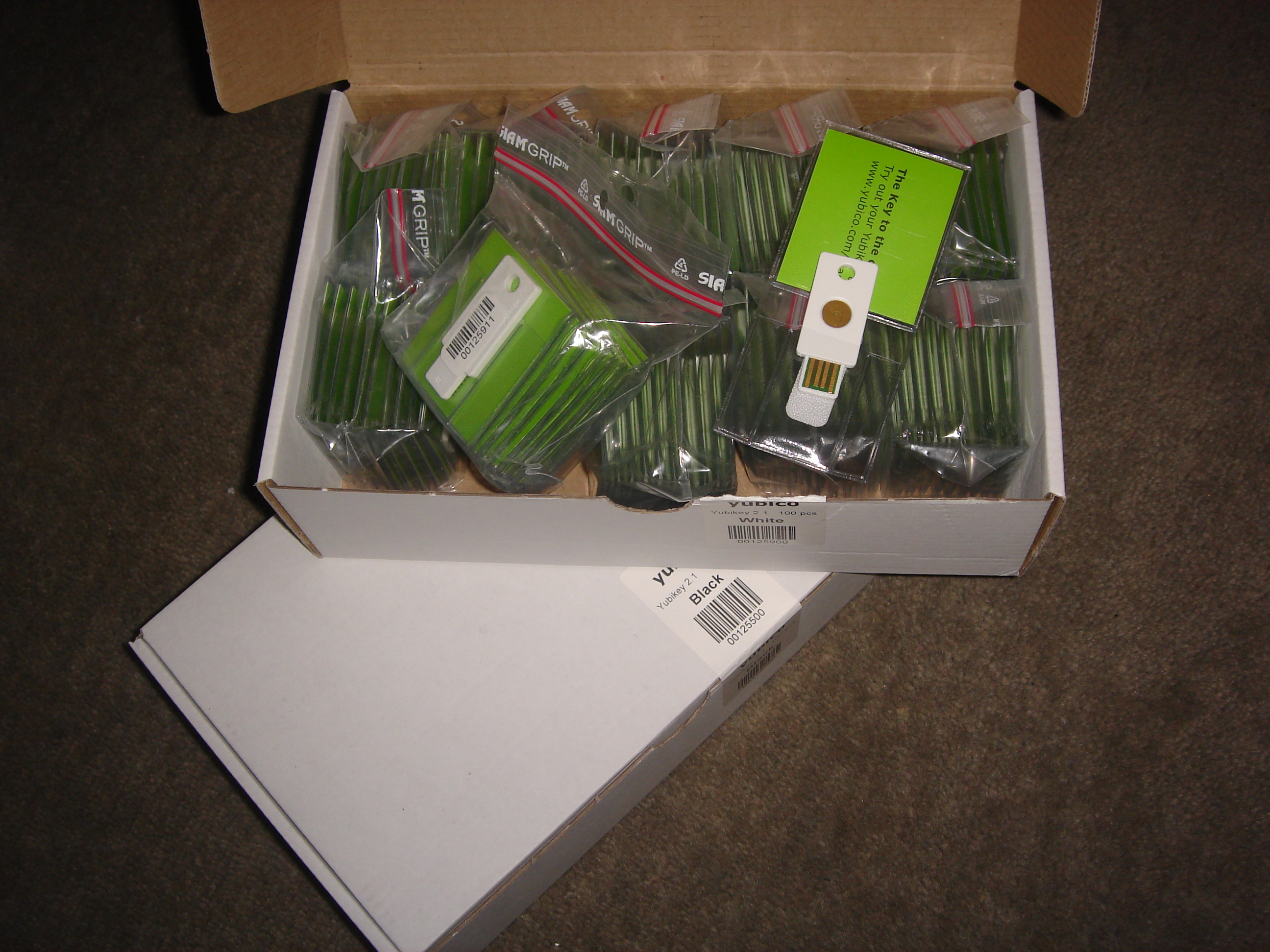
Picture of lots of Yubikeys In my previous post about the Yubikey I suggested that computer users groups should arrange bulk purchases to get the best prices [1]. I ran such a buying club for Linux users in Australia as well as members of SAGE-AU [2]. The keys have arrived and I now have to start posting them out. Above is a picture of two boxes that each contain 100 keys. Presumably if you buy a smaller number of keys then you get more fancy packing. Thanks to Yubico for giving us a greater discount than the usual discount rate for boxes of 100 keys!

27 July 2010

Daniel Baumann: The World's most powerful Wireless Network Card

About two weeks ago I got a Wifly-City G2000, the world's most powerful 802.11bg wireless network card. It features 2000mW which is 10 times more than the legally allowed limit of 200mW in Switzerland (or 2 times more than the allowed 1000mW in the USA, 5 times more than the allowed 400mW in Brazil, or 20 times more than the allowed 100mW in the EU). Contents The adapter is sold as a set named Wifly-City AVATAR-4PA with some accessories.
click on the images for full resolution The box prominelty lists Linux compatibility and contains the following part: The adapter has a Realtek 8187L chipset. This is particulary nice since there is no firmware needed for this chipset (therefore no questinable binary-only firmware blob). Also, it works out of the box with any Linux as of kernel version 2.6.30 and newer. I tested it on lenny with kernel backports, vanilla squeeze and vanilla sid. In all of these setups, it works out of the box without any configuration whatsoever - just plug it in and it works. I know that this is how it is supposed to be but still, I am always surprised again when things just work. For those who care, this is the output of dmesg when plugging in the card...
[...]
usb 1-1: new high speed USB device using ehci_hcd and address 6
usb 1-1: New USB device found, idVendor=0bda, idProduct=8187
usb 1-1: New USB device strings: Mfr=1, Product=2, SerialNumber=3
usb 1-1: Product: RTL8187_Wireless_LAN_Adapter
usb 1-1: Manufacturer: Manufacturer_Realtek_RTL8187_
usb 1-1: SerialNumber: xxxxxxxxxxxx
usb 1-1: configuration #1 chosen from 1 choice
phy1: Selected rate control algorithm 'minstrel'
phy1: hwaddr xx:xx:xx:xx:xx:xx, RTL8187vB (default) V1 + rtl8225z2, rfkill mask 2
rtl8187: Customer ID is 0xFF
Registered led device: rtl8187-phy1::tx
Registered led device: rtl8187-phy1::rx
rtl8187: wireless switch is on
usbcore: registered new interface driver rtl8187
ADDRCONF(NETDEV_UP): wlan1: link is not ready
wlan1: direct probe to AP xx:xx:xx:xx:xx:xx (try 1)
wlan1: direct probe responded
wlan1: authenticate with AP xx:xx:xx:xx:xx:xx (try 1)
wlan1: authenticated
wlan1: associate with AP xx:xx:xx:xx:xx:xx (try 1)
wlan1: RX AssocResp from xx:xx:xx:xx:xx:xx (capab=0x411 status=0 aid=5)
wlan1: associated
ADDRCONF(NETDEV_CHANGE): wlan1: link becomes ready
wlan1: no IPv6 routers present
[...]
...and this is the output of lsusb:
Bus 001 Device 006: ID 0bda:8187 Realtek Semiconductor Corp. RTL8187 Wireless Adapter
Special Offer I have played with the card for some time now and am really pleased with it. It works nicely with all the standard tools (aircrack-ng, kismet, etc.). The only bummer is that the card is quite expensive. Fortunately, we could arrange a good deal for Free Software people where the store selling it does not make any money on it: instead of 89 USD you can get it for 68 USD (including everything). If you are interested in getting one and you are comming to DebConf 10 in New York between 2010-07-25 and 2010-08-08, you can write an email to Ralph Amissah or speak to Ralph personally during the event. 1 I have no idea why they are shipping with a Y cable because the adapter does not need one. However, it does not disturb and in case I ever need an Y cable, I now have one :)

25 July 2010

Russell Coker: Links July 2010

David Byrne gave an interesting TED talk about how changes to architecture drove changes to musical styles [1]. I think he does stretch the point a little. To a certain extent people develop the most complex instruments and the largest music halls that can be supported by the level of technology in their society people with a hunter-gatherer civilisation play drums because they can build them and can carry them. The NY Times has an interesting article about paternity leave in Sweden [2]. The Swedish government pays for a total of 13 months leave that can be split between parents for every child. Of those 13 months 2 months can only be taken by the father and that is likely to increase to a minimum of 4 months of paternity leave after the next election. Dan Meyer gave an interesting TEDX talk about how the current math curriculum in the US (as well as Australia and lots of other countries that do the same thing) is totally wrong [3]. His main point is that maths problems should be based on real-world use cases where not all needed data is immediately available and there is also useless data that must be discarded. He believes that the most important thing is developing mathematical problem solving skills basically the things that I did for fun when I was in primary school are skills that need to be taught to high-school students The Atlantic magazine has an amusing article by Daniel Byman and Christine Fair about the incompetent Islamic terrorists [4]. In Afghanistan half the suicide bombers kill only themselves and the US government has a lot of evidence of Taliban soldiers practicing bestiality and collecting porn. Islamic extremist groups are staffed by people who are bad soldiers and bad Muslims. Jon Masters wrote an interesting post titled What Would Jesus Buy about ethical purchasing decisions [5]. Jon references The Church of Stop Shopping which isn t a real religious organisation but a street theatre activist group. ZeroHedga has an insightful article comparing corporations and the US government to street gangs [6]. The conclusion is that when gangs take over a neighbourhood everyone has to join a gang for their own protection. Hillel Cooperman gave an interesting TED talk about being obsessed with Lego [7]. He compares Lego fans to Furries and makes a good case for this comparison. Marian Bantjes gave an interesting TED talk about her graphic art / graphic design work [8]. I ve never seen anything quite like this. Business Insider has an interesting article about oil cleanup, it seems that most people who worked on the Exxon Valdez disaster are now dead [9], s opposed to most people who worked in almost every other occupation at that time who are either still working or enjoying their retirement. The current gulf disaster is bigger, will require more workers for the cleanup, and can be expected to have a higher death toll. Some people claim that measures to reduce oil efficiency will impact the economy, how will millions of people who are chronically ill for the rest of their lives impact the economy? The NY Times has an interesting article on circle lenses [10], contact lenses designed to make the eyes look larger. It s illegal to sell contact lenses in the US without a prescription, but the latest trend is for women to buy them online in a variety of colors. The FDA should probably approve them, it would be better to have the quality controls you expect from a medical supply company instead of having people rely on Malaysian mail-order companies for the safety of their eyes. Don Marti has written an interesting article about the economic decline in the US, he suggests making pension funds invest in local jobs [11]. Companies are supposed to act on behalf of their stock-holders, but US companies often have the majority of their stock owned by the pension funds of workers but they act on behalf of a small number of rich people who own a minority of the stock. Don s article was inspired by Andy Grove s article in Bloomberg about the stagnation in technological development that has been caused by off-shoring the manufacturing [12]. Neil Brown has completed a test release of a new Linux software RAID feature for arrays with multiple redundancy that have bad sectors [13]. When a disk gets a bad sector the current behavior is to kick it out of the array, if you have two such errors on a 3 disk RAID-1 or a RAID-6 array then you lose all redundancy and are at risk of catastrophic failure even though in most cases both disks will still mostly work. With this patch some regions of the disk may be excluded but it can provide redundancy for other stripes. Thanks Neil for your great work here, and all your previous work over the last 10+ years! The RSPCA has a new campaign titled Close the Puppy Factories [14]. Dogs are kept in very poor conditions and forced to churn out puppies for their entire lives to supply pet stores. The RSPCA recommends that people buy puppies from registered dog breeders (not registered dog breeding companies ) and ask to see the dog s parents. They also recommend not buying from classified adverts or pet stores. Animal shelters have to euthenise huge numbers of unwanted animals, you can buy a pet dog or cat from an animal shelter for a small fee that covers the expenses related to housing and spaying it and save that animal from being euthenised! Maureen Dowd criticises the Catholic Church properly in an article for the New York Times [15]. The Catholic Church officially regards ordaining a woman and raping a child to be equally bad offenses. Frank Rich wrote an interesting column for the New York Times about Mel Gibson [16]. He describes the destruction of Mel Gibson s reputation as a symptom of changes in the culture in the US and also links it to the fall of Ted Haggard (who supported Gibson s most notorious movie The Passion of the Christ).

22 July 2010

Erich Schubert: Dropbox revisited

Like one or two years ago, I got myself a free Dropbox account. I use it occasionally to exchange files with some friends. It does an excellent job at that. Basically, it works like any network folder. Except it is not within a local network, but over the internet.Dropbox serves me as an occasional replacement for both email and USB pen drive. Instead of sending a modified file by email or bringing around a dozen of photos on a USB stick, I just put them into the shared folder. This also very useful for files such as flyers, templates. They may easily grow to big to be sensibly sent by email.For all my use, a regular free Dropbox account is more than enough. As in, I have less than 1 GB in use, and I could easily free some of that space. You start at 2 GB, and can currently get up to 10 GB free (+250 MB for each referrer; if you use the link above you'll already start at 2.25 GB). But for my use, this is already a lot.Note that there are a couple of alternatives around. For Linux (only) there is Ubuntu One, and there is Zumo Drive and Box.net just to name a few. I havn't tried them, given that Dropbox works for me well enough.

19 July 2010

Wouter Verhelst: Stream-of-image video data and cinelerra

Just so I won't forget, but also to make sure others with similar problems to me don't need to search for several hours before finding it's so simple that it's silly: If you have a bunch of image files (PNG, JPG, whatnot) that you want to treat as a single clip in cinelerra rather than hundreds (if not thousands) of individual files, the trick is to use a "list file": you create a file with some metadata and a list of all the files that make up the video clip, and import that, rather than the individual files. If said individual files are PNG files with alpha information, doing so also makes it ridiculously easy to create an animation that only covers part of the screen. The file format is pretty basic; but over at this page on the cinelerra.org website they list two scripts (one python with GUI, one bash and command-line only) that can generate such a file, given a bunch of image files. That makes it even easier. I'd also like to note, for the record, that cinelerra outperforms kdenlive in everything but 'transcoding flexibility'. Kdenlive also has support for image lists (and you can create them in the gui rather than having to muck about with external programs or editors), but it has the rather nasty misfeature of doing the equivalent of "Oh, look, what's that? We don't need that, let's throw it away" whenever it encounters alpha information in PNG files. For full reproducability, it's also possible to generate PNG files with alpha information from povray if you use the +UA command-line parameter, and say something like
sky_sphere  
	pigment  
		color rgbt <0, 0, 0, 1>
	 
 
somewhere in your scene file. Yes, I know, povray is non-free, but it works, and as opposed to blender I do know how to use it. Hey, I'm not RMS.

Tim Retout: Gnash and BBC glow

One thing I noticed having started to use gnash is that the BBC's iPlayer website (UK-only, I believe) gives a message like "You do not have Flash player installed" - not merely complaining about the version, but actually not recognising gnash as a Flash player at all. Cue some digging. The BBC's pages use glow, an in-house JavaScript library (available under the Apache 2.0 License) to detect whether Flash is installed. The documentation was really easy to follow - I had a test page going quicker than you can say "Hello, World!" The bottom line is, glow uses this regex:
var regexFLASH_VERSION = /^Shockwave Flash\s*(\d+)\.(\d+)\s*\w(\d+)$/;
and gnash uses a description like this:
Shockwave Flash 10.1 r999.
Gnash trunk, the GNU SWF Player. Copyright (C) 2006, 2007, 2008, 2009,
2010 Free Software Foundation, Inc.
Gnash comes with NO WARRANTY, to the extent permitted by law. You may
redistribute copies of Gnash under the terms of the GNU General Public
License. For more information about Gnash, see
http://www.gnu.org/software/gnash.
Compatible Shockwave Flash 10.1 r999.
Note the dollar sign at the end of the regex. Indeed, rebuilding gnash without all the notices at the end of the description lets you see the iPlayer UI. (It doesn't actually play anything, don't get your hopes up.) Interestingly, different parts of iPlayer require different minimum versions of Flash. Clips of radio programmes tend to be more liberal with what they will accept - right down to version 7. Most TV streams and clips require at least version "9.0 r115", and I've heard they use SWF verification. I'm not sure how legal it is to implement that, although apparently code exists.

Jamie McClelland: Growing disks: upgrading from 1 TB to 2 TB disks

We've got a fairly layered set of software that runs beneath our file systems: RAID1 followed by cryptsetup, followed by lvm. It works remarkably well. However, when it's time to do something like enlarge a partition or disk, it gets complicated. We have a server (hubert) that was running two 1 TB disks in a RAID1. We typically create two partitions: one small boot partition and one large partition the uses the rest of the available disk (with 2 TB disks we've added a third partition for grub). Last month I replaced one of the disks with a 2 TB disk, partitioned the new disk with similar a partition scheme (except that the "rest of the disk" partition was twice the size as the original one), and then added the new partitions to the RAID (mdadm /dev/md0 --add /dev/sda1; mdadm /dev/md1 --add /dev/sda2). Yesterday, I replaced the 2nd 2 TB disks, and again added the new partitions. The result was a fairly painless transition from 1 to 2 TB disks with minimal downtime. The problem - though - is that we're not using all the disk space available, since md1, the RAID array that uses the "rest of the disk" partition, is only about 1 TB when it should be just under 2 TB. That problem was easy enough to solve by growing the RAID device with:
mdadm -G /dev/md1 -z max
It took a while, but eventually, running:
cat /proc/mdstat
And
cat /proc/partitions
Reported the right sizes for md1. After RAID, comes cryptsetup (/dev/md1 is the source device for md1_crypt). So, the next command was:
cryptsetup resize md1_crypt
In the output of:
cat /proc/partitions
I saw the change reflected in the dm-0 device. Since md1_crypt is used as the physical volume for a volume group, the next step was to resize the physical volume:
pvresize /dev/dm-0
This change was reflected with:
pvs
Now, the command:
vgs
Displayed a full 931 GB available that wasn't there before. Next up: resizing the logical volume:
lvresize --size 1700GB vg_hubert0/blanco_members
And, last but not least, was the file system:
 resize2fs /dev/mapper/vg_hubert0-blanco_members
See also dkg's article on resizing crypt partitions.

17 July 2010

Petter Reinholdtsen: What are they searching for - PowerDNS and ISC DHCP in LDAP

This is a followup on my previous work on merging all the computer related LDAP objects in Debian Edu. As a step to try to see if it possible to merge the DNS and DHCP LDAP objects, I have had a look at how the packages pdns-backend-ldap and dhcp3-server-ldap in Debian use the LDAP server. The two implementations are quite different in how they use LDAP. To get this information, I started slapd with debugging enabled and dumped the debug output to a file to get the LDAP searches performed on a Debian Edu main-server. Here is a summary. powerdns Clues on how to set up PowerDNS to use a LDAP backend is available on the web. PowerDNS have two modes of operation using LDAP as its backend. One "strict" mode where the forward and reverse DNS lookups are done using the same LDAP objects, and a "tree" mode where the forward and reverse entries are in two different subtrees in LDAP with a structure based on the DNS names, as in tjener.intern and 2.2.0.10.in-addr.arpa. In tree mode, the server is set up to use a LDAP subtree as its base, and uses a "base" scoped search for the DNS name by adding "dc=tjener,dc=intern," to the base with a filter for "(associateddomain=tjener.intern)" for the forward entry and "dc=2,dc=2,dc=0,dc=10,dc=in-addr,dc=arpa," with a filter for "(associateddomain=2.2.0.10.in-addr.arpa)" for the reverse entry. For forward entries, it is looking for attributes named dnsttl, arecord, nsrecord, cnamerecord, soarecord, ptrrecord, hinforecord, mxrecord, txtrecord, rprecord, afsdbrecord, keyrecord, aaaarecord, locrecord, srvrecord, naptrrecord, kxrecord, certrecord, dsrecord, sshfprecord, ipseckeyrecord, rrsigrecord, nsecrecord, dnskeyrecord, dhcidrecord, spfrecord and modifytimestamp. For reverse entries it is looking for the attributes dnsttl, arecord, nsrecord, cnamerecord, soarecord, ptrrecord, hinforecord, mxrecord, txtrecord, rprecord, aaaarecord, locrecord, srvrecord, naptrrecord and modifytimestamp. The equivalent ldapsearch commands could look like this:
ldapsearch -h ldap \
  -b dc=tjener,dc=intern,ou=hosts,dc=skole,dc=skolelinux,dc=no \
  -s base -x '(associateddomain=tjener.intern)' dNSTTL aRecord nSRecord \
  cNAMERecord sOARecord pTRRecord hInfoRecord mXRecord tXTRecord \
  rPRecord aFSDBRecord KeyRecord aAAARecord lOCRecord sRVRecord \
  nAPTRRecord kXRecord certRecord dSRecord sSHFPRecord iPSecKeyRecord \
  rRSIGRecord nSECRecord dNSKeyRecord dHCIDRecord sPFRecord modifyTimestamp
ldapsearch -h ldap \
  -b dc=2,dc=2,dc=0,dc=10,dc=in-addr,dc=arpa,ou=hosts,dc=skole,dc=skolelinux,dc=no \
  -s base -x '(associateddomain=2.2.0.10.in-addr.arpa)'
  dnsttl, arecord, nsrecord, cnamerecord soarecord ptrrecord \
  hinforecord mxrecord txtrecord rprecord aaaarecord locrecord \
  srvrecord naptrrecord modifytimestamp
In Debian Edu/Lenny, the PowerDNS tree mode is used with ou=hosts,dc=skole,dc=skolelinux,dc=no as the base, and these are two example LDAP objects used there. In addition to these objects, the parent objects all th way up to ou=hosts,dc=skole,dc=skolelinux,dc=no also exist.
dn: dc=tjener,dc=intern,ou=hosts,dc=skole,dc=skolelinux,dc=no
objectclass: top
objectclass: dnsdomain
objectclass: domainrelatedobject
dc: tjener
arecord: 10.0.2.2
associateddomain: tjener.intern
dn: dc=2,dc=2,dc=0,dc=10,dc=in-addr,dc=arpa,ou=hosts,dc=skole,dc=skolelinux,dc=no
objectclass: top
objectclass: dnsdomain2
objectclass: domainrelatedobject
dc: 2
ptrrecord: tjener.intern
associateddomain: 2.2.0.10.in-addr.arpa
In strict mode, the server behaves differently. When looking for forward DNS entries, it is doing a "subtree" scoped search with the same base as in the tree mode for a object with filter "(associateddomain=tjener.intern)" and requests the attributes dnsttl, arecord, nsrecord, cnamerecord, soarecord, ptrrecord, hinforecord, mxrecord, txtrecord, rprecord, aaaarecord, locrecord, srvrecord, naptrrecord and modifytimestamp. For reverse entires it also do a subtree scoped search but this time the filter is "(arecord=10.0.2.2)" and the requested attributes are associateddomain, dnsttl and modifytimestamp. In short, in strict mode the objects with ptrrecord go away, and the arecord attribute in the forward object is used instead. The forward and reverse searches can be simulated using ldapsearch like this:
ldapsearch -h ldap -b ou=hosts,dc=skole,dc=skolelinux,dc=no -s sub -x \
  '(associateddomain=tjener.intern)' dNSTTL aRecord nSRecord \
  cNAMERecord sOARecord pTRRecord hInfoRecord mXRecord tXTRecord \
  rPRecord aFSDBRecord KeyRecord aAAARecord lOCRecord sRVRecord \
  nAPTRRecord kXRecord certRecord dSRecord sSHFPRecord iPSecKeyRecord \
  rRSIGRecord nSECRecord dNSKeyRecord dHCIDRecord sPFRecord modifyTimestamp
ldapsearch -h ldap -b ou=hosts,dc=skole,dc=skolelinux,dc=no -s sub -x \
  '(arecord=10.0.2.2)' associateddomain dnsttl modifytimestamp
In addition to the forward and reverse searches , there is also a search for SOA records, which behave similar to the forward and reverse lookups. A thing to note with the PowerDNS behaviour is that it do not specify any objectclass names, and instead look for the attributes it need to generate a DNS reply. This make it able to work with any objectclass that provide the needed attributes. The attributes are normally provided in the cosine (RFC 1274) and dnsdomain2 schemas. The latter is used for reverse entries like ptrrecord and recent DNS additions like aaaarecord and srvrecord. In Debian Edu, we have created DNS objects using the object classes dcobject (for dc), dnsdomain or dnsdomain2 (structural, for the DNS attributes) and domainrelatedobject (for associatedDomain). The use of structural object classes make it impossible to combine these classes with the object classes used by DHCP. There are other schemas that could be used too, for example the dnszone structural object class used by Gosa and bind-sdb for the DNS attributes combined with the domainrelatedobject object class, but in this case some unused attributes would have to be included as well (zonename and relativedomainname). My proposal for Debian Edu would be to switch PowerDNS to strict mode and not use any of the existing objectclasses (dnsdomain, dnsdomain2 and dnszone) when one want to combine the DNS information with DHCP information, and instead create a auxiliary object class defined something like this (using the attributes defined for dnsdomain and dnsdomain2 or dnszone):
objectclass ( some-oid NAME 'dnsDomainAux'
    SUP top
    AUXILIARY
    MAY ( ARecord $ MDRecord $ MXRecord $ NSRecord $ SOARecord $ CNAMERecord $
          DNSTTL $ DNSClass $ PTRRecord $ HINFORecord $ MINFORecord $
          TXTRecord $ SIGRecord $ KEYRecord $ AAAARecord $ LOCRecord $
          NXTRecord $ SRVRecord $ NAPTRRecord $ KXRecord $ CERTRecord $
          A6Record $ DNAMERecord
    ))
This will allow any object to become a DNS entry when combined with the domainrelatedobject object class, and allow any entity to include all the attributes PowerDNS wants. I've sent an email to the PowerDNS developers asking for their view on this schema and if they are interested in providing such schema with PowerDNS, and I hope my message will be accepted into their mailing list soon. ISC dhcp The DHCP server searches for specific objectclass and requests all the object attributes, and then uses the attributes it want. This make it harder to figure out exactly what attributes are used, but thanks to the working example in Debian Edu I can at least get an idea what is needed without having to read the source code. In the DHCP server configuration, the LDAP base to use and the search filter to use to locate the correct dhcpServer entity is stored. These are the relevant entries from /etc/dhcp3/dhcpd.conf:
ldap-base-dn "dc=skole,dc=skolelinux,dc=no";
ldap-dhcp-server-cn "dhcp";
The DHCP server uses this information to nest all the DHCP configuration it need. The cn "dhcp" is located using the given LDAP base and the filter "(&(objectClass=dhcpServer)(cn=dhcp))". The search result is this entry:
dn: cn=dhcp,dc=skole,dc=skolelinux,dc=no
cn: dhcp
objectClass: top
objectClass: dhcpServer
dhcpServiceDN: cn=DHCP Config,dc=skole,dc=skolelinux,dc=no
The content of the dhcpServiceDN attribute is next used to locate the subtree with DHCP configuration. The DHCP configuration subtree base is located using a base scope search with base "cn=DHCP Config,dc=skole,dc=skolelinux,dc=no" and filter "(&(objectClass=dhcpService)( (dhcpPrimaryDN=cn=dhcp,dc=skole,dc=skolelinux,dc=no)(dhcpSecondaryDN=cn=dhcp,dc=skole,dc=skolelinux,dc=no)))". The search result is this entry:
dn: cn=DHCP Config,dc=skole,dc=skolelinux,dc=no
cn: DHCP Config
objectClass: top
objectClass: dhcpService
objectClass: dhcpOptions
dhcpPrimaryDN: cn=dhcp, dc=skole,dc=skolelinux,dc=no
dhcpStatements: ddns-update-style none
dhcpStatements: authoritative
dhcpOption: smtp-server code 69 = array of ip-address
dhcpOption: www-server code 72 = array of ip-address
dhcpOption: wpad-url code 252 = text
Next, the entire subtree is processed, one level at the time. When all the DHCP configuration is loaded, it is ready to receive requests. The subtree in Debian Edu contain objects with object classes top/dhcpService/dhcpOptions, top/dhcpSharedNetwork/dhcpOptions, top/dhcpSubnet, top/dhcpGroup and top/dhcpHost. These provide options and information about netmasks, dynamic range etc. Leaving out the details here because it is not relevant for the focus of my investigation, which is to see if it is possible to merge dns and dhcp related computer objects. When a DHCP request come in, LDAP is searched for the MAC address of the client (00:00:00:00:00:00 in this example), using a subtree scoped search with "cn=DHCP Config,dc=skole,dc=skolelinux,dc=no" as the base and "(&(objectClass=dhcpHost)(dhcpHWAddress=ethernet 00:00:00:00:00:00))" as the filter. This is what a host object look like:
dn: cn=hostname,cn=group1,cn=THINCLIENTS,cn=DHCP Config,dc=skole,dc=skolelinux,dc=no
cn: hostname
objectClass: top
objectClass: dhcpHost
dhcpHWAddress: ethernet 00:00:00:00:00:00
dhcpStatements: fixed-address hostname
There is less flexiblity in the way LDAP searches are done here. The object classes need to have fixed names, and the configuration need to be stored in a fairly specific LDAP structure. On the positive side, the invidiual dhcpHost entires can be anywhere without the DN pointed to by the dhcpServer entries. The latter should make it possible to group all host entries in a subtree next to the configuration entries, and this subtree can also be shared with the DNS server if the schema proposed above is combined with the dhcpHost structural object class. Conclusion The PowerDNS implementation seem to be very flexible when it come to which LDAP schemas to use. While its "tree" mode is rigid when it come to the the LDAP structure, the "strict" mode is very flexible, allowing DNS objects to be stored anywhere under the base cn specified in the configuration. The DHCP implementation on the other hand is very inflexible, both regarding which LDAP schemas to use and which LDAP structure to use. I guess one could implement ones own schema, as long as the objectclasses and attributes have the names used, but this do not really help when the DHCP subtree need to have a fairly fixed structure. Based on the observed behaviour, I suspect a LDAP structure like this might work for Debian Edu:
ou=services
  cn=machine-info (dhcpService) - dhcpServiceDN points here
    cn=dhcp (dhcpServer)
    cn=dhcp-internal (dhcpSharedNetwork/dhcpOptions)
      cn=10.0.2.0 (dhcpSubnet)
        cn=group1 (dhcpGroup/dhcpOptions)
    cn=dhcp-thinclients (dhcpSharedNetwork/dhcpOptions)
      cn=192.168.0.0 (dhcpSubnet)
        cn=group1 (dhcpGroup/dhcpOptions)
    ou=machines - PowerDNS base points here
      cn=hostname (dhcpHost/domainrelatedobject/dnsDomainAux)
This is not tested yet. If the DHCP server require the dhcpHost entries to be in the dhcpGroup subtrees, the entries can be stored there instead of a common machines subtree, and the PowerDNS base would have to be moved one level up to the machine-info subtree. The combined object under the machines subtree would look something like this:
dn: dc=hostname,ou=machines,cn=machine-info,dc=skole,dc=skolelinux,dc=no
dc: hostname
objectClass: top
objectClass: dhcpHost
objectclass: domainrelatedobject
objectclass: dnsDomainAux
associateddomain: hostname.intern
arecord: 10.11.12.13
dhcpHWAddress: ethernet 00:00:00:00:00:00
dhcpStatements: fixed-address hostname.intern
One could even add the LTSP configuration associated with a given machine, as long as the required attributes are available in a auxiliary object class.

15 July 2010

Jordi Mallach: Hiking through the Pyrenean GR 11

Tomorrow, at this time, I'll probably be unsuccessfully trying to find a comfortable position on a seat of the Bilmanbus to Irun. Very early on Saturday, as soon as we get off the bus, Maria and I will quickly head to Hondarribia's beach in Cape Higer to symbolically wet our feet in the waters of the Cantabrian Sea. We won't have much time to enjoy the cold waters of the ocean, though. Soon after that, we'll have to take a deep breath, look East, and start walking if we want to achieve our utmost objective: take a bath in the beautiful beaches of the Cap de Creus, in the Mediterranean sea. In between, 30 days and 840 kilometres of thick woods, deep valleys, high peaks and cold waters, all of which shape incredible landscapes.
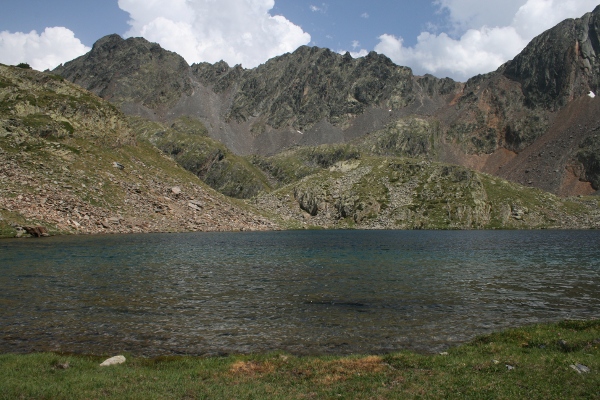

The Portella de Baiau, during our 2008 trip For a whole month, we'll be mostly disconnected from everything else that isn't our knee ache, our blisters, the Sun over our heads or where to get food. It's the first time I leave on a hiking trip as long and tough as this one, and I feel both uncertainty and eagerness. We've been so busy during the last few months that we've been unable to train at all for this, and I'm probably in the worst physical condition in a decade. It's too late to take care of that now, so we'll try to take good care of our legs and spine. In order to get back home in the Mediterranean, we'll have to be fast, some days joining two stages and skipping a few that we know are not that interesting (sections over asphalt, etc.). It's hard to make it in just one month, but we'll try our best. The plan is going to sleep not long after sunset, getting up at dawn, to be able to walk for a decent time before the heat starts being a handicap and just resting at midday, when the Sun is <strongest.> Of course, this means that I'm missing, yet again, this year's edition of DebConf in New York City, which is really sad because I was looking forward hanging around with Mako, Mika, Biella, micah, Clint and the rest of the NYC/ Boston gang, but when the idea of doing a long trip this summer popped up around January, it was clear DebConf seemed unlikely this year. I hope all of you have a lot of fun, and see you in a few weeks!

Next.

Previous.