Search Results: "nic"

5 April 2021

Kees Cook: security things in Linux v5.9

Previously: v5.8 Linux v5.9 was released in October, 2020. Here s my summary of various security things that I found interesting: seccomp user_notif file descriptor injection
Sargun Dhillon added the ability for SECCOMP_RET_USER_NOTIF filters to inject file descriptors into the target process using SECCOMP_IOCTL_NOTIF_ADDFD. This lets container managers fully emulate syscalls like open() and connect(), where an actual file descriptor is expected to be available after a successful syscall. In the process I fixed a couple bugs and refactored the file descriptor receiving code. zero-initialize stack variables with Clang
When Alexander Potapenko landed support for Clang s automatic variable initialization, it did so with a byte pattern designed to really stand out in kernel crashes. Now he s added support for doing zero initialization via CONFIG_INIT_STACK_ALL_ZERO, which besides actually being faster, has a few behavior benefits as well. Unlike pattern initialization, which has a higher chance of triggering existing bugs, zero initialization provides safe defaults for strings, pointers, indexes, and sizes. Like the pattern initialization, this feature stops entire classes of uninitialized stack variable flaws. common syscall entry/exit routines
Thomas Gleixner created architecture-independent code to do syscall entry/exit, since much of the kernel s work during a syscall entry and exit is the same. There was no need to repeat this in each architecture, and having it implemented separately meant bugs (or features) might only get fixed (or implemented) in a handful of architectures. It means that features like seccomp become much easier to build since it wouldn t need per-architecture implementations any more. Presently only x86 has switched over to the common routines. SLAB kfree() hardening
To reach CONFIG_SLAB_FREELIST_HARDENED feature-parity with the SLUB heap allocator, I added naive double-free detection and the ability to detect cross-cache freeing in the SLAB allocator. This should keep a class of type-confusion bugs from biting kernels using SLAB. (Most distro kernels use SLUB, but some smaller devices prefer the slightly more compact SLAB, so this hardening is mostly aimed at those systems.) new CAP_CHECKPOINT_RESTORE capability
Adrian Reber added the new CAP_CHECKPOINT_RESTORE capability, splitting this functionality off of CAP_SYS_ADMIN. The needs for the kernel to correctly checkpoint and restore a process (e.g. used to move processes between containers) continues to grow, and it became clear that the security implications were lower than those of CAP_SYS_ADMIN yet distinct from other capabilities. Using this capability is now the preferred method for doing things like changing /proc/self/exe. debugfs boot-time visibility restriction
Peter Enderborg added the debugfs boot parameter to control the visibility of the kernel s debug filesystem. The contents of debugfs continue to be a common area of sensitive information being exposed to attackers. While this was effectively possible by unsetting CONFIG_DEBUG_FS, that wasn t a great approach for system builders needing a single set of kernel configs (e.g. a distro kernel), so now it can be disabled at boot time. more seccomp architecture support
Michael Karcher implemented the SuperH seccomp hooks, Guo Ren implemented the C-SKY seccomp hooks, and Max Filippov implemented the xtensa seccomp hooks. Each of these included the ever-important updates to the seccomp regression testing suite in the kernel selftests. stack protector support for RISC-V
Guo Ren implemented -fstack-protector (and -fstack-protector-strong) support for RISC-V. This is the initial global-canary support while the patches to GCC to support per-task canaries is getting finished (similar to the per-task canaries done for arm64). This will mean nearly all stack frame write overflows are no longer useful to attackers on this architecture. It s nice to see this finally land for RISC-V, which is quickly approaching architecture feature parity with the other major architectures in the kernel. new tasklet API
Romain Perier and Allen Pais introduced a new tasklet API to make their use safer. Much like the timer_list refactoring work done earlier, the tasklet API is also a potential source of simple function-pointer-and-first-argument controlled exploits via linear heap overwrites. It s a smaller attack surface since it s used much less in the kernel, but it is the same weak design, making it a sensible thing to replace. While the use of the tasklet API is considered deprecated (replaced by threaded IRQs), it s not always a simple mechanical refactoring, so the old API still needs refactoring (since that CAN be done mechanically is most cases). x86 FSGSBASE implementation
Sasha Levin, Andy Lutomirski, Chang S. Bae, Andi Kleen, Tony Luck, Thomas Gleixner, and others landed the long-awaited FSGSBASE series. This provides task switching performance improvements while keeping the kernel safe from modules accidentally (or maliciously) trying to use the features directly (which exposed an unprivileged direct kernel access hole). filter x86 MSR writes
While it s been long understood that writing to CPU Model-Specific Registers (MSRs) from userspace was a bad idea, it has been left enabled for things like MSR_IA32_ENERGY_PERF_BIAS. Boris Petkov has decided enough is enough and has now enabled logging and kernel tainting (TAINT_CPU_OUT_OF_SPEC) by default and a way to disable MSR writes at runtime. (However, since this is controlled by a normal module parameter and the root user can just turn writes back on, I continue to recommend that people build with CONFIG_X86_MSR=n.) The expectation is that userspace MSR writes will be entirely removed in future kernels. uninitialized_var() macro removed
I made treewide changes to remove the uninitialized_var() macro, which had been used to silence compiler warnings. The rationale for this macro was weak to begin with ( the compiler is reporting an uninitialized variable that is clearly initialized ) since it was mainly papering over compiler bugs. However, it creates a much more fragile situation in the kernel since now such uses can actually disable automatic stack variable initialization, as well as mask legitimate unused variable warnings. The proper solution is to just initialize variables the compiler warns about. function pointer cast removals
Oscar Carter has started removing function pointer casts from the kernel, in an effort to allow the kernel to build with -Wcast-function-type. The future use of Control Flow Integrity checking (which does validation of function prototypes matching between the caller and the target) tends not to work well with function casts, so it d be nice to get rid of these before CFI lands. flexible array conversions
As part of Gustavo A. R. Silva s on-going work to replace zero-length and one-element arrays with flexible arrays, he has documented the details of the flexible array conversions, and the various helpers to be used in kernel code. Every commit gets the kernel closer to building with -Warray-bounds, which catches a lot of potential buffer overflows at compile time. That s it for now! Please let me know if you think anything else needs some attention. Next up is Linux v5.10.

2021, Kees Cook. This work is licensed under a Creative Commons Attribution-ShareAlike 4.0 License.
CC BY-SA 4.0

4 April 2021

Russ Allbery: Review: Prince Caspian

Review: Prince Caspian, by C.S. Lewis
Illustrator: Pauline Baynes
Series: Chronicles of Narnia #2
Publisher: Collier Books
Copyright: 1951
Printing: 1979
ISBN: 0-02-044240-8
Format: Mass market
Pages: 216
Prince Caspian is the second book of the Chronicles of Narnia in the original publication order (the fourth in the new publication order) and a direct sequel to The Lion, the Witch and the Wardrobe. As much as I would like to say you could start here if you wanted less of Lewis's exploration of secondary-world Christianity and more children's adventure, I'm not sure it would be a good reading experience. Prince Caspian rests heavily on the events of The Lion, the Witch and the Wardrobe. If you haven't already, you may also want to read my review of that book for some introductory material about my past relationship with the series and why I follow the original publication order. Prince Caspian always feels like the real beginning of a re-read. Re-reading The Lion, the Witch and the Wardrobe is okay but a bit of a chore: it's very random, the business with Edmund drags on, and it's very concerned with hitting the mandatory theological notes. Prince Caspian is more similar to the following books and feels like Narnia proper. That said, I have always found the ending of Prince Caspian oddly forgettable. This re-read helped me see why: one of the worst bits of the series is in the middle of this book, and then the dramatic shape of the ending is very strange. MAJOR SPOILERS BELOW for both this book and The Lion, the Witch and the Wardrobe. Prince Caspian opens with the Pevensie kids heading to school by rail at the end of the summer holidays. They're saying their goodbyes to each other at a train station when they are first pulled and then dumped into the middle of a wood. After a bit of exploration and the discovery of a seashore, they find an overgrown and partly ruined castle. They have, of course, been pulled back into Narnia, and the castle is Cair Paravel, their great capital when they ruled as kings and queens. The twist is that it's over a thousand years later, long enough that Cair Paravel is now on an island and has been abandoned to the forest. They discover parts of how that happened when they rescue a dwarf named Trumpkin from two soldiers who are trying to drown him near the supposedly haunted woods. Most of the books in this series have good hooks, but Prince Caspian has one of the best. I adored everything about the start of this book as a kid: the initial delight at being by the sea when they were on their way to boarding school, the realization that getting food was not going to be easy, the abandoned castle, the dawning understanding of where they are, the treasure room, and the extended story about Prince Caspian, his discovery of the Old Narnia, and his flight from his usurper uncle. It becomes clear from Trumpkin's story that the children were pulled back into Narnia by Susan's horn (the best artifact in these books), but Caspian's forces were expecting the great kings and queens of legend from Narnia's Golden Age. Trumpkin is delightfully nonplussed at four school-age kids who are determined to join up with Prince Caspian and help. That's the first half of Prince Caspian, and it's a solid magical adventure story with lots of potential. The ending, alas, doesn't entirely work. And between that, we get the business with Aslan and Lucy in the woods, or as I thought of it even as a kid, the bit where Aslan is awful to everyone for no reason. For those who have forgotten, or who don't care about spoilers, the kids plus Trumpkin are trying to make their way to Aslan's How (formerly the Stone Table) where Prince Caspian and his forces were gathered, when they hit an unexpected deep gorge. Lucy sees Aslan and thinks he's calling for them to go up the gorge, but none of the other kids or Trumpkin can see him and only Edmund believes her. They go down instead, which almost gets them killed by archers. Then, that night, Lucy wakes up and finds Aslan again, who tells her to wake the others and follow him, but warns she may have to follow him alone if she can't convince the others to go along. She wakes them up (which does not go over well), Aslan continues to be invisible to everyone else despite being right there, Susan is particularly upset at Lucy, and everything is awful. But this time they do follow her (with lots of grumbling and over Susan's objections). This, of course, is the right decision: Aslan leads them to a hidden path that takes them over the river they're trying to cross, and becomes visible to everyone when they reach the other side. This is a mess. It made me angry as a kid, and it still makes me angry now. No one has ever had trouble seeing Aslan before, so the kids are rightfully skeptical. By intentionally deceiving them, Aslan puts the other kids in an awful position: they either have to believe Lucy is telling the truth and Aslan is being weirdly malicious, or Lucy is mistaken even though she's certain. It not only leads directly to conflict among the kids, it makes Lucy (the one who does all the right things all along) utterly miserable. It's just cruel and mean, for no purpose. It seems clear to me that this is C.S. Lewis trying to make a theological point about faith, and in a way that makes it even worse because I think he's making a different point than he intended to make. Why is religious faith necessary; why doesn't God simply make himself apparent to everyone and remove the doubt? This is one of the major problems in Christian apologetics, Lewis chooses to raise it here, and the answer he gives is that God only shows himself to his special favorites and hides from everyone else as a test. It's clearly not even a question of intention to have faith; Edmund has way more faith here than Lucy does (since Lucy doesn't need it) and still doesn't get to see Aslan properly until everyone else does. Pah. The worst part of this is that it's effectively the last we see of Susan. Prince Caspian is otherwise the book in which Susan comes into her own. The sibling relationship between the kids is great here in general, but Susan is particularly good. She is the one who takes bold action to rescue Trumpkin, risking herself by firing an arrow into the helmet of one of the soldiers despite being the most cautious of the kids. (And then gets a little defensive about her shot because she doesn't want anyone to think she would miss that badly at short range, a detail I just love.) I identified so much with her not wanting to beat Trumpkin at an archery contest because she felt bad for him (but then doing it anyway). She is, in short, awesome. I was fine with her being the most grumpy and frustrated with the argument over picking a direction. They're all kids, and sometimes one gets grumpy and frustrated and awful to the people around you. Once everyone sees Aslan again, Susan offers a truly excellent apology to Lucy, so it seemed like Lewis was setting up a redemption arc for her the way that he did for Edmund in The Lion, the Witch and the Wardrobe (although I maintain that nearly all of this mess was Aslan's fault). But then we never see Susan's conversation with Aslan, Peter later says he and Susan are now too old to return to Narnia, and that's it for Susan. Argh. I'll have more to say about this later (and it's not an original opinion), but the way Lewis treats Susan is the worst part of this series, and it adds insult to injury that it happens immediately after she has a chance to shine. The rest of the book suffers from the same problem that The Lion, the Witch and the Wardrobe did, namely that Aslan fixes everything in a somewhat surreal wild party and it's unclear why the kids needed to be there. (This is the book where Bacchus and Silenus show up, there is a staggering quantity of wine for a children's book, and Aslan turns a bunch of obnoxious school kids into pigs.) The kids do have more of a role to play this time: Peter and Edmund help save Caspian, and there's a (somewhat poorly motivated) duel that sends up the ending. But other than the brief battle in the How, the battle is won by Aslan waking the trees, and it's not clear why he didn't do that earlier. The ending is, at best, rushed and not worthy of its excellent setup. I was also disappointed that the "wait, why are you all kids?" moment was hand-waved away by Narnia giving the kids magical gravitas. Lewis never felt in control of either The Lion, the Witch and the Wardrobe or Prince Caspian. In both cases, he had a great hook and some ideas of what he wanted to hit along the way, but the endings are more sense of wonder and random Aslan set pieces than anything that follows naturally from the setup. This is part of why I'm not commenting too much on the sour notes, such as the red dwarves being the good and loyal ones but the black dwarves being suspicious and only out for themselves. If I thought bits like that were deliberate, I'd complain more, but instead it feels like Lewis threw random things he liked about children's books and animal stories into the book and gave it a good stir, and some of his subconscious prejudices fell into the story along the way. That said, resolving your civil war children's book by gathering all the people who hate talking animals (but who have lived in Narnia for generations) and exiling them through a magical gateway to a conveniently uninhabited country is certainly a choice, particularly when you wrote the book only two years after the Partition of India. Good lord. Prince Caspian is a much better book than The Lion, the Witch and the Wardrobe for the first half, and then it mostly falls apart. The first half is so good, though. I want to read the book that this could have become, but I'm not sure anyone else writes quite like Lewis at his best. Followed by The Voyage of the Dawn Treader, which is my absolute favorite of the series. Rating: 7 out of 10

2 April 2021

Raphaël Hertzog: Challenging times for Freexian (4/4)

Note: This is the continuation of part 1, part 2 and part 3. You can get the full document as a single PDF. Feel free to share this document to anyone that might be interested to work towards the goals outlined. Conclusion I m very excited by the perspective that I outlined in this document. It really resonates with my own mission statement as a Debian developer (written a long time ago):
My main role in Debian is to help Debian to evolve so that it s always able to face the new challenges that are showing up.My approach is both corrective and proactive, I work to solve current problems and prepare for tomorrow s. This requires to remain sufficiently involved to identify new trends, see the deficiencies and be a force of proposition.Most of the changes require to interact with many people, and problems are often more relational than technical. I will ensure to follow the habits of interdependence (Think Win-Win, Seek First to Understand, Then to be Understood, Synergize) to find a solution acceptable to all and to inspire others to do the same.The easiest changes to implement are technical (such as improvements to distro-tracker) and require little interaction. This work is used to recharge me by offering me an immediate reward for my efforts.Finally, and this is a substantive effort, I want to create in the project working conditions that allow all contributors to give their best. It starts with developing a common vision
But I can t achieve this alone, I need help from passionate individuals sharing this vision. Let me know if you want to be one of those persons.

Reproducible Builds (diffoscope): diffoscope 172 released

The diffoscope maintainers are pleased to announce the release of diffoscope version 172. This version includes the following changes:
* If zipinfo(1) shows a difference but we cannot uncover a difference within
  the underlying .zip or .apk file, add a comment and show the binary
  comparison. (Closes: reproducible-builds/diffoscope#246)
* Make "error extracting X, falling back to binary comparison E" error
  message nicer.
You find out more by visiting the project homepage.

1 April 2021

Raphaël Hertzog: Challenging times for Freexian (3/4)

Note: This is the continuation of part 1 and part 2. Going forward: growing Freexian Part 2: Extending the team By all accounts, Freexian is still a small company which relies largely on me in many aspects. The growth of its business is however providing enough financial margin to allow looking into ways to recruit external help, be it through direct hiring (for French residents) or via long term contracting (for people based in other countries). If you believe you could be the right person for one of the roles listed below, or if you know someone that we should contact, please reach out to raphael@freexian.com. Project manager I m looking for someone that cares about Debian and that has the following skills:
  • knows how to manage developers and software projects
    • bonus points for any experience in environments mixing volunteers and paid contributors
  • is fluent and experienced enough in Python to be able to do software design and code reviews
    • bonus points for experience with: Django, Test Driven Development
That person would handle (some of) the following tasks:
  • lead the Debian project funding initiative to a success
    • find useful projects to fund, for example by
      • discussing with various Debian teams / contributors (including the DPL)
      • running a survey among Debian developers
      • doing your own analysis
    • help with drafting and specifying the various projects
    • help to find someone to implement and review the projects
    • coordinate with those persons during execution
  • manage other free software projects that Freexian would like to pursue
    • debusine: a software factory tailored for Debian packages
      • participate in design discussions, set milestones and goals
        • start with the short term needs of Freexian
        • but take into account the needs of Debian so that it can replace some aging infrastructure within Debian
      • coordinate with contractors, possibly implement some parts
    • infrastructure to run the various Freexian services and automate most of the administrative work (see Part2: From Debian LTS to Debian for the Enterprise )
  • maybe coordinate the team of paid LTS/ELTS contributors
Debian/Python Developer While the current priority is on the above role, there could also be room for a developer role with the following tasks:
  • Creation and maintenance of Debian packages
  • Technical support
  • Software development in Python (debusine, internal infrastructure)
  • Security support (contributor to Debian LTS)
Sales manager / sales representative Up until now, the growth of Freexian has mostly been organic, through word of mouth and increased awareness of Debian LTS within the Debian community. We never spent a single euro on advertising, except for one promotional video and for Debconf sponsorship (with a flyer and stickers). But if we can manage to make a positive impact on Debian through the funding that Freexian brings, then I m interested to grow the company so that we can pay more people to work on Debian. That growth likely would have to go through some more active sales work. At the same time, it is an opportunity for me to delegate (some of) the administrative work that lies solely on my shoulders (invoicing, day to day customer relationship, etc.). I assume it will be hard to find a member of the Debian community that has an interest in those areas, but who knows This article is to be continued in an upcoming post. Stay tuned!

Russell Coker: Censoring Images

A client asked me to develop a system for censoring images from an automatic camera. The situation is that we have a camera taking regular photos from a fixed location which includes part of someone else s property. So my client made a JPEG with some black rectangles in the sections that need to be covered. The first thing I needed to do was convert the JPEG to a PNG with transparency for the sections that aren t to be covered. To convert it I loaded the JPEG in the GIMP and went to the Layer->Transparency->Add Alpha Channel menu to enabled the Alpha channel. Then I selected the Bucket Fill tool and used Mode Erase and Fill by Composite and then clicked on the background (the part of the JPEG that was white) to make it transparent. Then I exported it to PNG. If anyone knows of an easy way to convert the file then please let me know. It would be nice if there was a command-line program I could run to convert a specified color (default white) to transparent. I say this because I can imagine my client going through a dozen iterations of an overlay file that doesn t quite fit. To censor the image I ran the composite command from imagemagick. The command I used was composite -gravity center overlay.png in.jpg out.jpg . If anyone knows a better way of doing this then please let me know. The platform I m using is a ARM926EJ-S rev 5 (v5l) which takes 8 minutes of CPU time to convert a single JPEG at full DSLR resolution (4 megapixel). It also required enabling swap on a SD card to avoid running out of RAM and running systemctl disable tmp.mount to stop using tmpfs for /tmp as the system only has 256M of RAM.

Junichi Uekawa: April, new year for schools in Japan.

April, new year for schools in Japan. What am I learning these days?

Paul Wise: FLOSS Activities March 2021

Focus This month I didn't have any particular focus. I just worked on issues in my info bubble.

Changes

Issues

Debugging

Review

Administration
  • Debian packages: migrate flower git repo from alioth-archive to salsa
  • Debian: restart bacula-director after PostgreSQL restart
  • Debian wiki: block spammer, clean up spam, approve accounts

Communication

Sponsors The librecaptcha/libpst/flower/marco work was sponsored by my employers. All other work was done on a volunteer basis.

31 March 2021

Chris Lamb: Free software activities in March 2021

Here is my monthly update covering what I have been doing in the free software world during March 2021 (previous month):
  • Reviewed and merged a number of contributions from Dan Palmer for my django-autologin library aimed at applications that use the Django web-development framework that wish to include automatic "login" links in emails (etc.). Changes made include allowing callers to override max-age [...], ensuring we always retrieve the same user account [...] and to improve the usability of the public API [...].
  • Opened a pull request to make the build process for Scrapy (a framework for extracting data from websites) reproducible. [...]
Reproducible Builds One of the original promises of open source software is that distributed peer review and transparency of process results in enhanced end-user security. However, whilst anyone may inspect the source code of free and open source software for malicious flaws, almost all software today is distributed as pre-compiled binaries. This allows nefarious third-parties to compromise systems by injecting malicious code into ostensibly secure software during the various compilation and distribution processes. The motivation behind the Reproducible Builds effort is to ensure no flaws have been introduced during this compilation process by promising identical results are always generated from a given source, thus allowing multiple third-parties to come to a consensus on whether a build was compromised. The project is proud to be a member project of the Software Freedom Conservancy. Conservancy acts as a corporate umbrella allowing projects to operate as non-profit initiatives without managing their own corporate structure. If you like the work of the Conservancy or the Reproducible Builds project, please consider becoming an official supporter. This month, I:
  • Categorised a huge number of packages and issues in the Reproducible Builds "notes" repository.
  • In Debian:
    • Kept isdebianreproducibleyet.com up to date. [...]
    • I submitted 4 patches to fix specific reproducibility issues in cdebootstrap, jalview, php8.0 & python-scrapy.
    • Whilst looking into reproducible builds issues, I noticed that the heudiconv package could not be built reproducibly. This was because the call to help2man fails, so the manual page includes a Python traceback instead of the actual manpage. I filed a bug with a patch as Debian bug #984778.
    • I uploaded flask-peewee (0.6.7-3) to Debian to make the build reproducible (#885326) and did the same for pyvows (3.0.0-3) (#977487) too, refreshing the packaging at the same time.

I also made the following changes to diffoscope, including uploading versions 169, 170 and 171 to Debian:
  • New features:
    • If zipinfo(1) shows a difference but we cannot uncover a difference within the underlying .zip or .apk file, add a comment to the output and actually show the binary comparison. (#246)
    • Ensure all our temporary directories have useful names. [...]
    • Ignore --debug and similar arguments when creating a (hopefully-useful) temporary directory suffix. [...]
  • Optimisations:
    • Avoid frequent long lines in RPM header outputs that cause extremely slow HTML output generation. (#245)
    • Use larger read buffer block sizes when extracting files from archives. [...]
    • Use a much-shorter HTML class name instead of diffponct to optimise HTML output. [...]
  • Output improvements:
    • Make error extracting X, falling back to binary comparison 'Y' error message in diffoscope's output nicer. [...]
    • Don't emit "Unable to stat file" debug messages at all. We have entirely-artificial directory "entries" such as ELF sections which, of course, will never exist as files. [...]
  • Logging improvements:
    • Add the target directory when logging which directory we are extracting containers to. [...]
    • Format report size messages when generating HTML reports. [...]
    • Don't emit a Returning a FooContainer logging message too, as we already emit Instantiating a FooContainer log message. [...]
    • Reduce "Unable to stat file" warnings to debug messages as these are sometimes by design. [...]
  • Misc improvements:
    • Clarify a comment regarding not extracting excluded files. [...]
    • Remove trailing newline from updated test file (re: #243). [...]
    • Fix test_libmix_differences failure on openSUSE Tumbleweed. (#244)
    • Move test_rpm to use the assert_diff utility helper.
Debian Uploads
  • redis:
    • 6.0.12-1 New upstream release.
    • 6.2.1-1 New upstream release.
  • python-django (3.2~rc1-1) New upstream beta release.
  • flask-peewee (0.6.7-3) (via the Debian Python packaging team) Upload to refresh packaging and to make the build reproducible. (#885326)
  • bfs (2.2-1) New upstream release.
  • pyvows (3.0.0-3) (via the Debian Python packaging team) Refresh packaging and make the build reproducible. (#977487)

Debian LTS This month I worked 18 hours on Debian Long Term Support (LTS) and 12 hours on its sister Extended LTS project.
  • Frontdesk duties, responding to user/developer questions, attending monthly meeting, reviewing others' packages, participating in internal mailing list discussions, etc.
  • Investigated and triaged botan1.10 (CVE-2021-24115), busybox (CVE-2021-28831), courier-authlib (CVE-2021-28374), edk2 (CVE-2021-28210 & CVE-2021-28211), netty (CVE-2021-21295), open-build-service (CVE-2020-8031), openjpeg2 (CVE-2020-27844), python2.7 (CVE-2021-23336), rpm (CVE-2021-20248, [CVE-2021-20249](https://security-tracker.debian.org/tracker/CVE-2021-20249), CVE-2021-20266 & CVE-2021-20271), ruby-activerecord-session-store (CVE-2019-25025), ruby-carrierwave (CVE-2021-21288), salt (CVE-2020-28243, etc.), slic3r (CVE-2020-28591), squid3 (CVE-2020-25097 & CVE-2021-28116), velicity-tools (CVE-2020-13959), velocity (CVE-2020-13936) & yara (CVE-2021-3402).
  • Proposed an stable update for python-django in buster. (#983526)
  • Prepared and uploaded a stable update for redis in buster. (#983527)
  • Issued DLA 2595-1 and ELA 380-1 for velocity, a Java-based template engine for writing web applications. Velocity could be exploited to run arbitrary code by applications that allowed untrusted users to upload/modify templates.
  • Issued DLA 2597-1 and ELA 381-1 to address a cross-site scripting (XSS) vulnerability in velocity-tools, a collection of useful tools for the Velocity template engine. The default error page could be exploited to steal session cookies, perform requests in the name of the victim, used for phishing attacks and many other similar attacks.
  • Issued DLA 2600-1 and ELA 384-1 for pygments as it was discovered that there was a series of denial of service vulnerabilities in this syntax highlighting library for Python. A number of regular expressions had cubic (or even exponential) worst-case complexity which could cause a remote denial of service (DoS) when provided with malicious input.
  • Issued DLA 2603-1 to address a number of vulnerabilities in libmediainfo, a library reading metadata such as track names, lengths, etc. from media files.
You can find out more about the Debian LTS via the following video:

Raphaël Hertzog: Challenging times for Freexian (2/4)

Note: This is the continuation of part 1 where I presented Freexian and its purpose. Going forward: growing Freexian Part 1: From Debian LTS to Debian for the Enterprise Freexian s Debian LTS service has so far been entirely successful, with a steady growth over the years. Thanks to this, and even if there are always new challenges, it is fair to say that the Debian LTS team has met its goal in the last few years. While this started from the desire to make LTS a reality, many sponsors are only looking for a way to give back to Debian through their company, and to make sure that Debian fits their needs. But if you look at the bigger picture outside of this small LTS area, you will easily find many issues that need to be addressed if we want Debian to meet the needs of corporate users. Those issues can have widely different types and complexity. They can be as simple as missing the latest upstream version for an important package because the maintainer disappeared and nobody noticed before it was too late (i.e. the release was frozen); or a somewhat basic piece of software not yet packaged at all; or a release critical bug that was left unattended. On the other end of the spectrum, some corporate requirements will prove tougher to solve, for instance for large software suites that are complex to package, or could potentially have an impact elsewhere in Debian. Bringing those facts together, we would like to have Freexian s Debian LTS/ELTS offering evolve into a more general Debian Software Assurance offering, where you commit to a yearly budget for Debian sponsorship in the larger sense. That budget would fund different projects and the allocation between those projects would vary over time depending on the desires and needs of the sponsors/customers:
  • Technical support: the budget would always ensure that you have a few spare hours of technical support available in case you need them
  • Debian LTS: we want this to continue!
  • Debian ELTS: when the customer has not managed to migrate their Debian servers in time, they should be able to reallocate their budget towards ELTS and ensure their servers are secure until the migration has taken place.
  • Debian for the enterprise
    • Make sure that the packages used by sponsors are in good shape in Debian Testing/Unstable so that they are in the best shape for the next stable release.
    • Package new software that are relevant for corporate users. Offer to pool the maintenance work.
    • Fix bugs that customers are hitting.
    • Etc.
  • Debian project funding: that s the variable part of the budget (and would have a minimum of 10% like we do for Debian LTS right now). When the other projects do not consume the whole budget, we invest the remaining money into generic Debian improvements.
This major shift in our offering would also be an ideal opportunity to build a professional, free-software based infrastructure aimed at sustaining this business, making it easier to administer the various aspects of this work, and easily allowing many more sponsors to join (individuals included!). On a more pragmatic/operational note, this shift will bring a lot of challenges to the table, and those can hardly be handled with the current resources of Freexian: if we hope to properly implement this new strategy, we ll need some additional help. This article is to be continued in an upcoming post. Stay tuned!

Timo Jyrinki: MotionPhoto / MicroVideo File Formats on Pixel Phones

Google Pixel phones support what they call Motion Photo which is essentially a photo with a short video clip attached to it. They are quite nice since they bring the moment alive, especially as the capturing of the video starts a small moment before the shutter button is pressed. For most viewing programs they simply show as static JPEG photos, but there is more to the files.
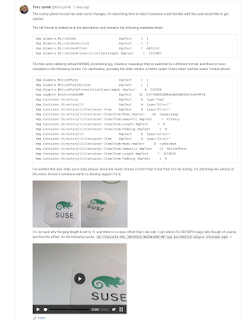
I d really love proper Shotwell support for these file formats, so I posted a longish explanation with many of the details in this blog post to a ticket there too. Examples of the newer format are linked there too.
Info posted to Shotwell ticket

There are actually two different formats, an old one that is already obsolete, and a newer current format. The older ones are those that your Pixel phone recorded as MVIMG_[datetime].jpg", and they have the following meta-data:
Xmp.GCamera.MicroVideo                       XmpText     1  1
Xmp.GCamera.MicroVideoVersion XmpText 1 1
Xmp.GCamera.MicroVideoOffset XmpText 7 4022143
Xmp.GCamera.MicroVideoPresentationTimestampUs XmpText 7 1331607
The offset is actually from the end of the file, so one needs to calculate accordingly. But it is exact otherwise, so one simply extract a file with that meta-data information:
#!/bin/bash
#
# Extracts the microvideo from a MVIMG_*.jpg file

# The offset is from the ending of the file, so calculate accordingly
offset=$(exiv2 -p X "$1" grep MicroVideoOffset sed 's/.*\"\(.*\)"/\1/')
filesize=$(du --apparent-size --block=1 "$1" sed 's/^\([0-9]*\).*/\1/')
extractposition=$(expr $filesize - $offset)
echo offset: $offset
echo filesize: $filesize
echo extractposition=$extractposition
dd if="$1" skip=1 bs=$extractposition of="$(basename -s .jpg $1).mp4"
The newer format is recorded in filenames called PXL_[datetime].MP.jpg , and they have a _lot_ of additional metadata:
Xmp.GCamera.MotionPhoto                      XmpText     1  1
Xmp.GCamera.MotionPhotoVersion XmpText 1 1
Xmp.GCamera.MotionPhotoPresentationTimestampUs XmpText 6 233320
Xmp.xmpNote.HasExtendedXMP XmpText 32 E1F7505D2DD64EA6948D2047449F0FFA
Xmp.Container.Directory XmpText 0 type="Seq"
Xmp.Container.Directory[1] XmpText 0 type="Struct"
Xmp.Container.Directory[1]/Container:Item XmpText 0 type="Struct"
Xmp.Container.Directory[1]/Container:Item/Item:Mime XmpText 10 image/jpeg
Xmp.Container.Directory[1]/Container:Item/Item:Semantic XmpText 7 Primary
Xmp.Container.Directory[1]/Container:Item/Item:Length XmpText 1 0
Xmp.Container.Directory[1]/Container:Item/Item:Padding XmpText 1 0
Xmp.Container.Directory[2] XmpText 0 type="Struct"
Xmp.Container.Directory[2]/Container:Item XmpText 0 type="Struct"
Xmp.Container.Directory[2]/Container:Item/Item:Mime XmpText 9 video/mp4
Xmp.Container.Directory[2]/Container:Item/Item:Semantic XmpText 11 MotionPhoto
Xmp.Container.Directory[2]/Container:Item/Item:Length XmpText 7 1679555
Xmp.Container.Directory[2]/Container:Item/Item:Padding XmpText 1 0
Sounds like fun and lots of information. However I didn t see why the length in first item is 0 and I didn t see how to use the latter Length info. But I can use the mp4 headers to extract it:
#!/bin/bash
#
# Extracts the motion part of a MotionPhoto file PXL_*.MP.mp4

extractposition=$(grep --binary --byte-offset --only-matching --text \
-P "\x00\x00\x00\x18\x66\x74\x79\x70\x6d\x70\x34\x32" $1 sed 's/^\([0-9]*\).*/\1/')

dd if="$1" skip=1 bs=$extractposition of="$(basename -s .jpg $1).mp4"
UPDATE: I wrote most of this blog post earlier. When now actually getting to publishing it a week later, I see the obvious ie the Length is again simply the offset from the end of the file so one could do the same less brute force approach as for MVIMG. I ll leave the above as is however for the of binary grepping.(cross-posted to my other blog)

30 March 2021

Raphaël Hertzog: Challenging times for Freexian (1/4)

TLDR: Freexian s success means that we have resources to invest into Debian projects. Plainly offering money has not worked so far, so I am looking to hire a project manager whose work would be to help spend that money in useful ways. At the same time, Freexian needs to adapt to cope with the growth: with new employees, with new infrastructure and a new offering. I want to give an idea of where we are headed, to try to inspire persons that share our values and our desire to improve Debian. Read on if you are interested. Note: The original text has been split into 4 blog posts that will be published over a few days. Introduction
Freexian is an IT service company specialized in Debian. We provide technical support by email on Debian, we create and maintain Debian packages requested by our customers, we also help organizations run an entire Debian derivative (Kali Linux being the most notable one).
On top of this, it runs the commercial part of the Debian LTS service : Freexian invoices many sponsors that need long term support, and uses the money to pay Debian contributors (about 12 currently) to make sure that Debian releases are supported for 5 years instead of 3. With the Extended LTS service, we push that further to 7 years, however only for a smaller subset of packages and in a repository that is hosted outside of debian.org. Freexian s purpose When I created Freexian, it was out of a desire to be paid to work on Debian, and to be able to contribute during work time to the project that was so important to me. That goal has been met a long time ago. But ultimately what I strive to achieve for Debian is not entirely aligned with the work that Freexian s customers are requesting. That s why, in the long term projects of Freexian, I always kept find a business model that can fund the Debian projects that I would like to do , as well as if that model works for me, build something so that other can benefit from it too . The first occasion to experiment something appeared when Debian discussed Long Term Support and when I stepped up to setup a commercial offer to pay Debian contributors. Step 1: Paying Debian contributors for LTS work When we started the Debian LTS service, I voluntarily opted to use an hourly rate that was rather high so that any Debian developer regardless of their geographical location, could participate and not earn (much) less than what they would have from working on other tasks. This choice did imply paying a very high rate for some countries, but I didn t see that as a problem, quite the contrary: if a Debian developer can earn enough money to cover their cost of living with 15h of Debian LTS, and then spend the rest of their month contributing on Debian, all the better! I m not sure if anyone made this choice, but that was a dream of my younger self From a personal standpoint, the launch of Debian LTS has meant less free time, more administrative work, new duties to coordinate a team of paid contributors, more communication with many Debian-using companies, and many new opportunities too! This ultimately resulted in the launch of Extended LTS and PHP LTS, both of which have been rather successful so far. Step 2: Funding Debian projects With the growth of the Debian LTS service, and given that we have reached the required funding level, we decided to put a small share of the revenues aside and use that to fund useful Debian projects, typically in areas that were affected by our Debian LTS work. This effort was fully formalized in the project-funding git repository. We announced this process in November 2020, and we have kept mentioning it in our monthly LTS reports ever since, but so far only a single project has benefited from this. This is really the dream offer that I wish had existed when I was younger and was still struggling to get enough customers: hence I don t really understand this lack of interest. You can find some discussions over the reasons why this offer has not (yet) found its target audience in this debian-vote thread. I was hoping that spending money would be easy, but I now realize I was wrong! I m positive that I could find dozens of useful projects to fund, but I just don t have the time for this extra effort on top of my regular Freexian duties. I still really want to put this money to good use, which is why I m looking into some solutions. This article is to be continued in another upcoming post, stay tuned!

Molly de Blanc: Helping

How can you help free software? Aside from donating to the excellent free software nonprofits out there, and contributing to a project by building software or other resources, there are things you can do to help the free software cause. The two biggest things I think are providing mentorship and gently normalizing free software.

Providing Mentorship Allison Randal introduced me to the idea that mentorship doesn t have to be an ongoing process. This is to say, you don t have to sign up to be someone s best friend and advisor for life (though you certainly can). Providing short term, project or skill based, or one off mentorship is useful for building community because it makes people feel welcome and cared for and helps build skills that benefit free software. I do a lot of proofreading and editing of people s writing especially people with minimal writing experience and/or non-native English speakers who are writing important documents in English. If the person is interested, I try to talk to them about their writing and why I m making these particular suggestions. I hope this helps them with their writing in the future. Other examples are working on a particular project or skill, this can be helping them develop a particular skill (e.g. git outside of the command line), or giving advice on a project with a level of specificity and detail you re both comfortable with. These can, again, be one off things or things that require minimal effort/occasional conversation. I have some friends who I consider my Debian mentors who just answer functional questions whenever I have trouble doing something. I also love love love talking with people about their free software trajectories, their goals and desires and dreams for their involvement in free software, whether that s finding a place in a community, developing a skill set, or other things about their future (like job hopes, schooling, etc). These conversations have been so helpful for me personally, and I like to think they help others.

Gently Normalizing Free Software I think normalizing free software is very important to its success and adoption. It s not helpful to insist someone who has never done so before to create a Debian boot disk and install it. It is helpful to suggest using Big Blue Button or jitsi. If a friend wants help finding audio editing software, suggest they try audacity. I d go as far as to suggest doing this without explaining that it s free software, and instead focus on why it ll work and that it s available at no cost. If they like it, then it s a great time to talk about rights and freedoms. Of course if they already care about these sorts of things, if you re discussing privacy software, if anti-surveillance is an issue, or any number of other things, software freedom is a great thing to bring up!

Above all, just be nice. Be nice. It s basically the best thing you can do for free software.

29 March 2021

Anton Gladky: 2021/03, FLOSS activity

LTS This is my first (beside test time last year) official month of working for LTS. I was assigned 12 hrs and worked all of them. I could relatively easy set up the development environment for Debian Stretch and managed to release several DLAs.

Released DLAs
  1. DLA-2588-1 zeromq3_4.2.1-4+deb9u4
    • CVE-2021-20234
    • CVE-2021-20235
  2. DLA-2594-1 tomcat8_8.5.54-0+deb9u6
    • CVE-2021-24122
    • CVE-2021-25122
    • CVE-2021-25329.
  3. DLA-2605-1 mariadb-10.1_10.1.48-0+deb9u2
    • CVE-2021-27928

CVE-2020-119977 I investigated CVE-2020-119977, which was marked as guacamole-server issue. There were not so much information about this CVE. I was trying to analyze git log and git diff between affected and fixed versions without any visible success. After that I contacted upstream and they were very responsive! This CVE affects guacamole-client only and the ancient versions in the archive is very difficult to fix. So I decided to mark this CVE as NOT-FOR-US.

Repositories with pipelines For most of packages, which I touched due to LTS work the new repositories were created in LTS packages group on salsa.d.o with enabled CI-pipelines. It really helps to test updates though some tests needs to be disabled for passing pipelines.

LTS-Meeting I attended the Debian LTS team IRC-meeting.

Debian Science Team I have prepared and uploaded following packages, which are maintained under the umbrella of Debian Science Team:
  • gmsh_4.7.1+ds1-5
  • vtk7_7.1.1+dfsg2-10
  • gl2ps_1.4.2+dfsg1-1~bpo10+1
  • vtk9_9.0.1+dfsg1-8~bpo10+2
  • sundials_5.7.0+dfsg-1~exp1

27 March 2021

Neil Williams: Free and Open

A long time, no blog entries. What's prompted a new missive? Two things:
  • my own hankering to get back into free software after too many years faced with daily struggles against proprietary software
  • the upcoming GR in Debian.
All the time I've worked with software and computers, the lack of diversity in the contributors has irked me. I started my career in pharmaceutical sciences where the mix of people, at university, would appear to be genuinely diverse. It was in the workplace that the problems started, especially in the retail portion of community pharmacy with a particular gender imbalance between management and counter staff. Then I started to pick up programming. I gravitated to free software for the simple reason that I could tinker with the source code. To do a career change and learn how to program with a background in a completely alien branch of science, the only realistic route into the field is to have access to the raw material - source code. Without that, I would have been seeking a sponsor, in much the same way as other branches of science need grants or sponsors to purchase the equipment and facilities to get a foot in the door. All it took from me was some time, a willingness to learn and a means to work alongside those already involved. That's it. No complex titration equipment, flasks, centrifuges, pipettes, spectrographs, or petri dishes. It's hard to do pharmaceutical science from home. Software is so much more accessible - but only if the software itself is free. Software freedom removes the main barrier to entry. Software freedom enables the removal of other barriers too. Once the software is free, it becomes obvious that the compiler (indeed the entire toolchain) needs to be free, to turn the software into something other people can use. The same applies to interpreters, editors, kernels and the entire stack. I was in a different branch of science whilst all that was being created and I am very glad that Debian Woody was available as a free cover disc on a software magazine just at the time I was looking to pick up software programming. That should be that. The only next step to be good enough to write free software was the "means to work alongside those already involved". That, it turns out, is much more than just a machine running Debian. It's more than just having an ISP account and working email (not commonplace in 2003). It's working alongside the people - all the people. It was my first real exposure to the toxicity of some parts of many scientific and technical arenas. Where was the diversity? OK, maybe it was just early days and the other barriers (like an account with an ISP) were prohibitive for many parts of the world outside Europe & USA in 2003, so there were few people from other countries but the software world was massively dominated by the white Caucasian male. I'd been insulated by my degree course, and to a large extent by my university which also had courses which already had much more diverse intakes - optics and pharmacy, business and human resources. Relocating from the insular world of a little town in Wales to Birmingham was also key. Maybe things would improve as the technical barriers to internet connectivity were lowered. Sadly, no. The echo chamber of white Caucasian input has become more and more diluted as other countries have built the infrastructure to get the populace online. Debian has helped in this area, principally via DebConf. Yet only the ethnicity seemed to change, not the diversity. Recently, more is being done to at least make Debian more welcoming to those who are brave enough to increase the mix. Progress is much slower than the gains seen in the ethnicity mix, probably because that was a benefit of a technological change, not a societal change. The attitudes so prevalent in the late 20th century are becoming less prevalent amongst, and increasingly abhorrent to, the next generation of potential community members. Diversity must come or the pool of contributors will shrink to nil. Community members who cling to these attitudes are already dinosaurs and increasingly unwelcome. This is a necessary step to retain access to new contributors as existing contributors age. To be able to increase the number of contributors, the community cannot afford to be dragged backwards by anyone, no matter how important or (previously) respected. Debian, or even free software overall, cannot change all the problems with diversity in STEM but we must not perpetuate the problems either. Those people involved in free software need to be open to change, to input from all portions of society and welcoming. Puerile jokes and disrespectful attitudes must be a thing of the past. The technical contributions do not excuse behaviours that act to prevent new people joining the community. Debian is getting older, the community and the people. The presence of spouses at Debian social events does not fix the problem of the lack of diversity at Debian technical events. As contributors age, Debian must welcome new, younger, people to continue the work. All the technical contributions from the people during the 20th century will not sustain Debian in the 21st century. Bit rot affects us all. If the people who provided those contributions are not encouraging a more diverse mix to sustain free software into the future then all their contributions will be for nought and free software will die. So it comes to the FSF and RMS. I did hear Richard speak at an event in Bristol many years ago. I haven't personally witnessed the behavioural patterns that have been described by others but my memories of that event only add to the reality of those accounts. No attempts to be inclusive, jokes that focused on division and perpetuating the white male echo chamber. I'm not perfect, I struggle with some of this at times. Personally, I find the FSFE and Red Hat statements much more in line with my feelings on the matter than the open letter which is the basis of the GR. I deplore the preliminary FSF statement on governance as closed-minded, opaque and archaic. It only adds to my concerns that the FSF is not fit for the 21st century. The open letter has the advantage that it is a common text which has the backing of many in the community, individuals and groups, who are fit for purpose and whom I have respected for a long time. Free software must be open to contributions from all who are technically capable of doing the technical work required. Free software must equally require respect for all contributors and technical excellence is not an excuse for disrespect. Diversity is the life blood of all social groups and without social cohesion, technical contributions alone do not support a community. People can change and apologies are welcome when accompanied by modified behaviour. The issues causing a lack of diversity in Debian are complex and mostly reflective of a wider problem with STEM. Debian can only survive by working to change those parts of the wider problem which come within our influence. Influence is key here, this is a soft issue, replete with unreliable emotions, unhelpful polemic and complexity. Reputations are hard won and easily blemished. The problems are all about how Debian looks to those who are thinking about where to focus in the years to come. It looks like the FSFE should be the ones to take the baton from the FSF - unless the FSF can adopt a truly inclusive and open governance. My problem is not with RMS himself, what he has or has not done, which apologies are deemed sincere and whether behaviour has changed. He is one man and his contributions can be respected even as his behaviour is criticised. My problem is with the FSF for behaving in a closed, opaque and divisive manner and then making a governance statement that makes things worse, whilst purporting to be transparent. Institutions lay the foundations for the future of the community and must be expected to hold individuals to account. Free and open have been contentious concepts for the FSF, with all the arguments about Open Source which is not Free Software. It is clear that the FSF do understand the implications of freedom and openness. It is absurd to then adopt a closed and archaic governance. A valid governance model for the FSF would never have allowed RMS back onto the board, instead the FSF should be the primary institution to hold him, and others like him, to account for their actions. The FSF needs to be front and centre in promoting diversity and openness. The FSF could learn from the FSFE. The calls for the FSF to adopt a more diverse, inclusive, board membership are not new. I can only echo the Red Hat statement:
in order to regain the confidence of the broader free software community, the FSF should make fundamental and lasting changes to its governance.
...
[There is] no reason to believe that the most recent FSF board statement signals any meaningful commitment to positive change.
And the FSFE statement:
The goal of the software freedom movement is to empower all people to control technology and thereby create a better society for everyone. Free Software is meant to serve everyone regardless of their age, ability or disability, gender identity, sex, ethnicity, nationality, religion or sexual orientation. This requires an inclusive and diverse environment that welcomes all contributors equally.
The FSF has not demonstrated the behaviour I expect from a free software institution and I cannot respect an institution which proclaims a mantra of freedom and openness that is not reflected in the governance of that institution. The preliminary statement by the FSF board is abhorrent. The FSF must now take up the offers from those institutions within the community who retain the respect of that community. I'm only one voice, but I would implore the FSF to make substantive, positive and permanent change to the governance, practices and future of the FSF or face irrelevance.

23 March 2021

Bits from Debian: New Debian Developers and Maintainers (January and February 2021)

The following contributors got their Debian Developer accounts in the last two months:
  • Nicholas D. Steeves (sten)
  • Nilesh Patra (nilesh)
  • David Su rez Rodr guez (deiv)
  • Pierre Gruet (pgt)
The following contributors were added as Debian Maintainers in the last two months:
  • Antonio Valentino
  • Boian Nikolaev Bonev
  • Filip Hroch
  • Maarten L. Hekkelman
  • Xialei Qin
  • Xiang Gao
Congratulations!

Antoine Beaupr : Major email crash with syncmaildir

TL:DR; lost half my mail (150,000 messages, ~6GB) last night. Cause uncertain, but possibly a combination of a dead CMOS battery, systemd OnCalendar=daily, a (locking?) bug in syncmaildir, and generally, a system too exotic and complicated.

The crash So I somehow lost half my mail:
anarcat@angela:~(main)$ du -sh Maildir/
7,9G    Maildir/
anarcat@curie:~(main)$ du -sh Maildir
14G     Maildir
anarcat@marcos:~$ du -sh Maildir
8,0G    Maildir
Those are three different machines:
  • angela: my laptop, not always on
  • curie: my workstation, mostly always on
  • marcos: my mail server, always on
Those mails are synchronized using a rather exotic system based on SSH, syncmaildir and rsendmail. The anomaly started on curie:
-- Reboot --
mar 22 16:13:00 curie systemd[3199]: Starting pull emails with syncmaildir...
mar 22 16:13:00 curie smd-pull[4801]: rm: impossible de supprimer '/home/anarcat/.smd/workarea/Maildir': Le dossier n'est pas vide
mar 22 16:13:00 curie systemd[3199]: smd-pull.service: Main process exited, code=exited, status=1/FAILURE
mar 22 16:13:00 curie systemd[3199]: smd-pull.service: Failed with result 'exit-code'.
mar 22 16:13:00 curie systemd[3199]: Failed to start pull emails with syncmaildir.
mar 22 16:14:00 curie systemd[3199]: Starting pull emails with syncmaildir...
mar 22 16:14:00 curie smd-pull[7025]:  4091 ?        00:00:00 smd-push
mar 22 16:14:00 curie smd-pull[7025]: Already running.
mar 22 16:14:00 curie smd-pull[7025]: If this is not the case, remove /home/anarcat/.smd/lock by hand.
mar 22 16:14:00 curie smd-pull[7025]: any: smd-pushpull@localhost: TAGS: error::context(locking) probable-cause(another-instance-is-running) human-intervention(necessary) suggested-actions(run(kill 4091) run(rm /home/anarcat/.smd/lock))
mar 22 16:14:00 curie systemd[3199]: smd-pull.service: Main process exited, code=exited, status=1/FAILURE
mar 22 16:14:00 curie systemd[3199]: smd-pull.service: Failed with result 'exit-code'.
mar 22 16:14:00 curie systemd[3199]: Failed to start pull emails with syncmaildir.
Then it seems like smd-push (from curie) started destroying the universe for some reason:
mar 22 16:20:00 curie systemd[3199]: Starting pull emails with syncmaildir...
mar 22 16:20:00 curie smd-pull[9319]:  4091 ?        00:00:00 smd-push
mar 22 16:20:00 curie smd-pull[9319]: Already running.
mar 22 16:20:00 curie smd-pull[9319]: If this is not the case, remove /home/anarcat/.smd/lock by hand.
mar 22 16:20:00 curie smd-pull[9319]: any: smd-pushpull@localhost: TAGS: error::context(locking) probable-cause(another-instance-is-running) human-intervention(necessary) suggested-actions(ru
mar 22 16:20:00 curie systemd[3199]: smd-pull.service: Main process exited, code=exited, status=1/FAILURE
mar 22 16:20:00 curie systemd[3199]: smd-pull.service: Failed with result 'exit-code'.
mar 22 16:20:00 curie systemd[3199]: Failed to start pull emails with syncmaildir.
mar 22 16:21:34 curie smd-push[4091]: default: smd-client@smd-server-anarcat: TAGS: stats::new-mails(0), del-mails(293920), bytes-received(0), xdelta-received(26995)
mar 22 16:21:35 curie smd-push[9374]: register: smd-client@smd-server-register: TAGS: stats::new-mails(0), del-mails(0), bytes-received(0), xdelta-received(215)
mar 22 16:21:35 curie systemd[3199]: smd-push.service: Succeeded.
Notice the del-mails(293920) there: it is actively trying to destroy basically every email in my mail spool. Then somehow push and pull started both at once:
mar 22 16:21:35 curie systemd[3199]: Started push emails with syncmaildir.
mar 22 16:21:35 curie systemd[3199]: Starting push emails with syncmaildir...
mar 22 16:22:00 curie systemd[3199]: Starting pull emails with syncmaildir...
mar 22 16:22:00 curie smd-pull[10333]:  9455 ?        00:00:00 smd-push
mar 22 16:22:00 curie smd-pull[10333]: Already running.
mar 22 16:22:00 curie smd-pull[10333]: If this is not the case, remove /home/anarcat/.smd/lock by hand.
mar 22 16:22:00 curie smd-pull[10333]: any: smd-pushpull@localhost: TAGS: error::context(locking) probable-cause(another-instance-is-running) human-intervention(necessary) suggested-actions(r
mar 22 16:22:00 curie systemd[3199]: smd-pull.service: Main process exited, code=exited, status=1/FAILURE
mar 22 16:22:00 curie systemd[3199]: smd-pull.service: Failed with result 'exit-code'.
mar 22 16:22:00 curie systemd[3199]: Failed to start pull emails with syncmaildir.
mar 22 16:22:00 curie smd-push[9455]: smd-client: ERROR: Data transmission failed.
mar 22 16:22:00 curie smd-push[9455]: smd-client: ERROR: This problem is transient, please retry.
mar 22 16:22:00 curie smd-push[9455]: smd-client: ERROR: server sent ABORT or connection died
mar 22 16:22:00 curie smd-push[9455]: smd-server: ERROR: Unable to open Maildir/.kobo/cur/1498563708.M122624P22121.marcos,S=32234,W=32792:2,S: Maildir/.kobo/cur/1498563708.M122624P22121.marco
mar 22 16:22:00 curie smd-push[9455]: smd-server: ERROR: The problem should be transient, please retry.
mar 22 16:22:00 curie smd-push[9455]: smd-server: ERROR: Unable to open requested file.
mar 22 16:22:00 curie smd-push[9455]: default: smd-client@smd-server-anarcat: TAGS: stats::new-mails(0), del-mails(293920), bytes-received(0), xdelta-received(26995)
mar 22 16:22:00 curie smd-push[9455]: default: smd-client@smd-server-anarcat: TAGS: error::context(receive) probable-cause(network) human-intervention(avoidable) suggested-actions(retry)
mar 22 16:22:00 curie smd-push[9455]: default: smd-server@localhost: TAGS: error::context(transmit) probable-cause(simultaneous-mailbox-edit) human-intervention(avoidable) suggested-actions(r
mar 22 16:22:00 curie systemd[3199]: smd-push.service: Main process exited, code=exited, status=1/FAILURE
mar 22 16:22:00 curie systemd[3199]: smd-push.service: Failed with result 'exit-code'.
mar 22 16:22:00 curie systemd[3199]: Failed to start push emails with syncmaildir.
There it seems push tried to destroy the universe again: del-mails(293920). Interestingly, the push started again in parallel with the pull, right that minute:
mar 22 16:22:00 curie systemd[3199]: Starting push emails with syncmaildir...
... but didn't complete for a while, here's pull trying to start again:
mar 22 16:24:00 curie systemd[3199]: Starting pull emails with syncmaildir...
mar 22 16:24:00 curie smd-pull[12051]: 10466 ?        00:00:00 smd-push
mar 22 16:24:00 curie smd-pull[12051]: Already running.
mar 22 16:24:00 curie smd-pull[12051]: If this is not the case, remove /home/anarcat/.smd/lock by hand.
mar 22 16:24:00 curie smd-pull[12051]: any: smd-pushpull@localhost: TAGS: error::context(locking) probable-cause(another-instance-is-running) human-intervention(necessary) suggested-actions(run(kill 10466) run(rm /home/anarcat/.smd/lock))
mar 22 16:24:00 curie systemd[3199]: smd-pull.service: Main process exited, code=exited, status=1/FAILURE
mar 22 16:24:00 curie systemd[3199]: smd-pull.service: Failed with result 'exit-code'.
mar 22 16:24:00 curie systemd[3199]: Failed to start pull emails with syncmaildir.
... and the long push finally resolving:
mar 22 16:24:00 curie smd-push[10466]: smd-client: ERROR: Data transmission failed.
mar 22 16:24:00 curie smd-push[10466]: smd-client: ERROR: This problem is transient, please retry.
mar 22 16:24:00 curie smd-push[10466]: smd-client: ERROR: server sent ABORT or connection died
mar 22 16:24:00 curie smd-push[10466]: smd-client: ERROR: Data transmission failed.
mar 22 16:24:00 curie smd-push[10466]: smd-client: ERROR: This problem is transient, please retry.
mar 22 16:24:00 curie smd-push[10466]: smd-client: ERROR: server sent ABORT or connection died
mar 22 16:24:00 curie smd-push[10466]: smd-server: ERROR: Unable to open Maildir/.kobo/cur/1498563708.M122624P22121.marcos,S=32234,W=32792:2,S: Maildir/.kobo/cur/1498563708.M122624P22121.marcos,S=32234,W=32792:2,S: No such file or directory
mar 22 16:24:00 curie smd-push[10466]: smd-server: ERROR: The problem should be transient, please retry.
mar 22 16:24:00 curie smd-push[10466]: smd-server: ERROR: Unable to open requested file.
mar 22 16:24:00 curie smd-push[10466]: default: smd-client@smd-server-anarcat: TAGS: stats::new-mails(0), del-mails(293920), bytes-received(0), xdelta-received(26995)
mar 22 16:24:00 curie smd-push[10466]: default: smd-client@smd-server-anarcat: TAGS: error::context(receive) probable-cause(network) human-intervention(avoidable) suggested-actions(retry)
mar 22 16:24:00 curie smd-push[10466]: default: smd-server@localhost: TAGS: error::context(transmit) probable-cause(simultaneous-mailbox-edit) human-intervention(avoidable) suggested-actions(retry)
mar 22 16:24:00 curie systemd[3199]: smd-push.service: Main process exited, code=exited, status=1/FAILURE
mar 22 16:24:00 curie systemd[3199]: smd-push.service: Failed with result 'exit-code'.
mar 22 16:24:00 curie systemd[3199]: Failed to start push emails with syncmaildir.
mar 22 16:24:00 curie systemd[3199]: Starting push emails with syncmaildir...
This pattern repeats until 16:35, when that locking issue silently recovered somehow:
mar 22 16:35:03 curie systemd[3199]: Starting pull emails with syncmaildir...
mar 22 16:35:41 curie smd-pull[20788]: default: smd-client@localhost: TAGS: stats::new-mails(5), del-mails(1), bytes-received(21885), xdelta-received(6863398)
mar 22 16:35:42 curie smd-pull[21373]: register: smd-client@localhost: TAGS: stats::new-mails(0), del-mails(0), bytes-received(0), xdelta-received(215)
mar 22 16:35:42 curie systemd[3199]: smd-pull.service: Succeeded.
mar 22 16:35:42 curie systemd[3199]: Started pull emails with syncmaildir.
mar 22 16:36:35 curie systemd[3199]: Starting pull emails with syncmaildir...
mar 22 16:36:36 curie smd-pull[21738]: default: smd-client@localhost: TAGS: stats::new-mails(0), del-mails(0), bytes-received(0), xdelta-received(214)
mar 22 16:36:37 curie smd-pull[21816]: register: smd-client@localhost: TAGS: stats::new-mails(0), del-mails(0), bytes-received(0), xdelta-received(215)
mar 22 16:36:37 curie systemd[3199]: smd-pull.service: Succeeded.
mar 22 16:36:37 curie systemd[3199]: Started pull emails with syncmaildir.
... notice that huge xdelta-received there, that's 7GB right there. Mysteriously, the curie mail spool survived this, possibly because smd-pull started failing again:
mar 22 16:38:00 curie systemd[3199]: Starting pull emails with syncmaildir...
mar 22 16:38:00 curie smd-pull[23556]: 21887 ?        00:00:00 smd-push
mar 22 16:38:00 curie smd-pull[23556]: Already running.
mar 22 16:38:00 curie smd-pull[23556]: If this is not the case, remove /home/anarcat/.smd/lock by hand.
mar 22 16:38:00 curie smd-pull[23556]: any: smd-pushpull@localhost: TAGS: error::context(locking) probable-cause(another-instance-is-running) human-intervention(necessary) suggested-actions(run(kill 21887) run(rm /home/anarcat/.smd/lock))
mar 22 16:38:00 curie systemd[3199]: smd-pull.service: Main process exited, code=exited, status=1/FAILURE
mar 22 16:38:00 curie systemd[3199]: smd-pull.service: Failed with result 'exit-code'.
mar 22 16:38:00 curie systemd[3199]: Failed to start pull emails with syncmaildir.
That could have been when i got on angela to check my mail, and it was busy doing the nasty removal stuff... although the times don't match. Here is when angela came back online:
anarcat@angela:~(main)$ last
anarcat  :0           :0               Mon Mar 22 19:57   still logged in
reboot   system boot  5.10.0-0.bpo.3-a Mon Mar 22 19:57   still running
anarcat  :0           :0               Mon Mar 22 17:43 - 18:47  (01:03)
reboot   system boot  5.10.0-0.bpo.3-a Mon Mar 22 17:39   still running
Then finally the sync on curie started failing with:
mar 22 16:46:35 curie systemd[3199]: Starting pull emails with syncmaildir...
mar 22 16:46:42 curie smd-pull[27455]: smd-server: ERROR: Client aborted, removing /home/anarcat/.smd/curie-anarcat__Maildir.db.txt.new and /home/anarcat/.smd/curie-anarcat__Maildir.db.txt.mtime.new
mar 22 16:46:42 curie smd-pull[27455]: smd-client: ERROR: Failed to copy Maildir/.debian/cur/1613401668.M901837P27073.marcos,S=3740,W=3815:2,S to Maildir/.koumbit/cur/1613401640.M415457P27063.marcos,S=3790,W=3865:2,S
mar 22 16:46:42 curie smd-pull[27455]: smd-client: ERROR: The destination already exists but its content differs.
mar 22 16:46:42 curie smd-pull[27455]: smd-client: ERROR: To fix this problem you have two options:
mar 22 16:46:42 curie smd-pull[27455]: smd-client: ERROR: - rename Maildir/.koumbit/cur/1613401640.M415457P27063.marcos,S=3790,W=3865:2,S by hand so that Maildir/.debian/cur/1613401668.M901837P27073.marcos,S=3740,W=3815:2,S
mar 22 16:46:42 curie smd-pull[27455]: smd-client: ERROR:   can be copied without replacing it.
mar 22 16:46:42 curie smd-pull[27455]: smd-client: ERROR:   Executing  cd; mv -n "Maildir/.koumbit/cur/1613401640.M415457P27063.marcos,S=3790,W=3865:2,S" "Maildir/.koumbit/cur/1616446002.1.localhost"  should work.
mar 22 16:46:42 curie smd-pull[27455]: smd-client: ERROR: - run smd-push so that your changes to Maildir/.koumbit/cur/1613401640.M415457P27063.marcos,S=3790,W=3865:2,S
mar 22 16:46:42 curie smd-pull[27455]: smd-client: ERROR:   are propagated to the other mailbox
mar 22 16:46:42 curie smd-pull[27455]: default: smd-client@localhost: TAGS: error::context(copy-message) probable-cause(concurrent-mailbox-edit) human-intervention(necessary) suggested-actions(run(mv -n "/home/anarcat/.smd/workarea/Maildir/.koumbit/cur/1613401640.M415457P27063.marcos,S=3790,W=3865:2,S" "/home/anarcat/.smd/workarea/Maildir/.koumbit/tmp/1613401640.M415457P27063.marcos,S=3790,W=3865:2,S") run(smd-push default))
mar 22 16:46:42 curie systemd[3199]: smd-pull.service: Main process exited, code=exited, status=1/FAILURE
mar 22 16:46:42 curie systemd[3199]: smd-pull.service: Failed with result 'exit-code'.
mar 22 16:46:42 curie systemd[3199]: Failed to start pull emails with syncmaildir.
It went on like this until I found the problem. This is, presumably, a good thing because those emails were not being destroyed. On angela, things looked like this:
-- Reboot --
mar 22 17:39:29 angela systemd[1677]: Started run notmuch new at least once a day.
mar 22 17:39:29 angela systemd[1677]: Started run smd-pull regularly.
mar 22 17:40:46 angela systemd[1677]: Starting pull emails with syncmaildir...
mar 22 17:43:18 angela smd-pull[3916]: smd-server: ERROR: Unable to open Maildir/.tor/new/1616446842.M285912P26118.marcos,S=8860,W=8996: Maildir/.tor/new/1616446842.M285912P26118.marcos,S=886
0,W=8996: No such file or directory
mar 22 17:43:18 angela smd-pull[3916]: smd-server: ERROR: The problem should be transient, please retry.
mar 22 17:43:18 angela smd-pull[3916]: smd-server: ERROR: Unable to open requested file.
mar 22 17:43:18 angela smd-pull[3916]: smd-client: ERROR: Data transmission failed.
mar 22 17:43:18 angela smd-pull[3916]: smd-client: ERROR: This problem is transient, please retry.
mar 22 17:43:18 angela smd-pull[3916]: smd-client: ERROR: server sent ABORT or connection died
mar 22 17:43:18 angela smd-pull[3916]: default: smd-server@smd-server-anarcat: TAGS: error::context(transmit) probable-cause(simultaneous-mailbox-edit) human-intervention(avoidable) suggested
-actions(retry)
mar 22 17:43:18 angela smd-pull[3916]: default: smd-client@localhost: TAGS: error::context(receive) probable-cause(network) human-intervention(avoidable) suggested-actions(retry)
mar 22 17:43:18 angela systemd[1677]: smd-pull.service: Main process exited, code=exited, status=1/FAILURE
mar 22 17:43:18 angela systemd[1677]: smd-pull.service: Failed with result 'exit-code'.
mar 22 17:43:18 angela systemd[1677]: Failed to start pull emails with syncmaildir.
mar 22 17:43:18 angela systemd[1677]: Starting pull emails with syncmaildir...
mar 22 17:43:29 angela smd-pull[4847]: default: smd-client@localhost: TAGS: stats::new-mails(29), del-mails(0), bytes-received(401519), xdelta-received(38914)
mar 22 17:43:29 angela smd-pull[5600]: register: smd-client@localhost: TAGS: stats::new-mails(2), del-mails(0), bytes-received(92150), xdelta-received(471)
mar 22 17:43:29 angela systemd[1677]: smd-pull.service: Succeeded.
mar 22 17:43:29 angela systemd[1677]: Started pull emails with syncmaildir.
mar 22 17:43:29 angela systemd[1677]: Starting push emails with syncmaildir...
mar 22 17:43:32 angela smd-push[5693]: default: smd-client@smd-server-anarcat: TAGS: stats::new-mails(0), del-mails(0), bytes-received(0), xdelta-received(217)
mar 22 17:43:33 angela smd-push[6575]: register: smd-client@smd-server-register: TAGS: stats::new-mails(0), del-mails(0), bytes-received(0), xdelta-received(219)
mar 22 17:43:33 angela systemd[1677]: smd-push.service: Succeeded.
mar 22 17:43:33 angela systemd[1677]: Started push emails with syncmaildir.
Notice how long it took to get the first error, in that first failure: it failed after 3 minutes! Presumably that's when it started deleting all that mail. And this is during pull, not push, so the error didn't come from angela.

Affected data It seems 2GB of mail from my main INBOX was destroyed. Another 2.4GB of spam (kept for training purposes) was also destroyed, along with 700MB of Sent mail. The rest is hard to figure out, because the folders are actually still there, just smaller. So I relied on ncdu to figure out the size changes. (Note that I don't really archive (or delete much of) my mail since I use notmuch, which is why the INBOX is so large...) Concretely, according to the notmuch-new.service which still runs periodically on marcos, here are the changes that happened on the server:
mar 22 16:17:12 marcos notmuch[10729]: Added 7 new messages to the database. Removed 57985 messages. Detected 1372 file renames.
mar 22 16:22:43 marcos notmuch[12826]: No new mail. Removed 143842 messages. Detected 6072 file renames.
mar 22 16:27:02 marcos notmuch[13969]: No new mail. Removed 82071 messages. Detected 1783 file renames.
mar 22 16:29:45 marcos notmuch[15079]: Added 22743 new messages to the database. Detected 1 file rename.
mar 22 16:31:48 marcos notmuch[16196]: Added 22779 new messages to the database. Removed 5 messages.
mar 22 16:33:11 marcos notmuch[17192]: Added 3711 new messages to the database.
mar 22 16:40:41 marcos notmuch[19122]: Added 74558 new messages to the database. Detected 1 file rename.
mar 22 16:43:21 marcos notmuch[20325]: Added 9061 new messages to the database. Detected 4 file renames.
mar 22 17:43:08 marcos notmuch[7420]: Added 1793 new messages to the database. Detected 6 file renames.
That is basically the entire mail spool destroyed at first (283 898 messages), and then bits and pieces of it progressively re-added (134 645 messages), somehow, so 149 253 mails were lost, presumably.

Recovery I disabled the services all over the place:
systemctl --user --now disable smd-pull.service smd-pull.timer smd-push.service smd-push.timer notmuch-new.service notmuch-new.timer
(Well, technically, I did that only on angela, as I thought the problem was there. Luckily, curie kept going but it seems like it was harmless.) I made a backup of the mail spool on curie:
tar cf - Maildir/   pv -s 14G   gzip -c > Maildir.tgz
Then I crossed my fingers and ran smd-push -v -s, as that was suggested by smd error codes themselves. That thankfully started restoring mail. It failed a few times on weird cases of files being duplicates, but I resolved this by following the instructions. Or mostly: I actually deleted the files instead of moving them, which made smd even unhappier (if there ever was such a thing). I had to recreate some of those files, so, lesson learned: do follow the advice smd gives you, even if it seems useless or strange. But then smd-push was humming along, uploading tens of thousands of messages, saturating the upload in the office, refilling the mail spool on the server... yaay!... ? Except... well, of course that didn't quite work: the mail spool in the office eventually started to grow beyond the size of the mail spool on the workstation. That is what smd-push eventually settled on:
default: smd-client@smd-server-anarcat: TAGS: error::context(receive) probable-cause(network) human-intervention(avoidable) suggested-actions(retry)
default: smd-client@smd-server-anarcat: TAGS: stats::new-mails(151697), del-mails(0), bytes-received(7539147811), xdelta-received(10881198)
It recreated 151 697 emails, adding about 2000 emails to the pool, kind of from nowhere at all. On marcos, before:
ncdu 1.13 ~ Use the arrow keys to navigate, press ? for help
--- /home/anarcat/Maildir ------------------------------------
    4,0 GiB [##########] /.notmuch
  717,3 MiB [#         ] /.Archives.2014
  498,2 MiB [#         ] /.feeds.debian-planet
  453,1 MiB [#         ] /.Archives.2012
  414,5 MiB [#         ] /.debian
  408,2 MiB [#         ] /.quoifaire
  389,8 MiB [          ] /.rapports
  356,6 MiB [          ] /.tor
  182,6 MiB [          ] /.koumbit
  179,8 MiB [          ] /tmp
   56,8 MiB [          ] /.nn
   43,0 MiB [          ] /.act-mtl
   32,6 MiB [          ] /.feeds.sysadvent
   31,7 MiB [          ] /.feeds.releases
   31,4 MiB [          ] /.Sent.2005
   26,3 MiB [          ] /.sage
   25,5 MiB [          ] /.freedombox
   24,0 MiB [          ] /.feeds.git-annex
   21,1 MiB [          ] /.Archives.2011
   19,1 MiB [          ] /.Sent.2003
   16,7 MiB [          ] /.bugtraq
   16,2 MiB [          ] /.mlug
 Total disk usage:   8,0 GiB  Apparent size:   7,6 GiB  Items: 184426
After:
ncdu 1.13 ~ Use the arrow keys to navigate, press ? for help
--- /home/anarcat/Maildir ------------------------------------
    4,7 GiB [##########] /.notmuch
    2,7 GiB [#####     ] /.junk
    1,9 GiB [###       ] /cur
  717,3 MiB [#         ] /.Archives.2014
  659,3 MiB [#         ] /.Sent
  513,9 MiB [#         ] /.Archives.2012
  498,2 MiB [#         ] /.feeds.debian-planet
  449,6 MiB [          ] /.Archives.2015
  414,5 MiB [          ] /.debian
  408,2 MiB [          ] /.quoifaire
  389,8 MiB [          ] /.rapports
  380,8 MiB [          ] /.Archives.2013
  356,6 MiB [          ] /.tor
  261,1 MiB [          ] /.Archives.2011
  240,9 MiB [          ] /.koumbit
  183,6 MiB [          ] /.Archives.2010
  179,8 MiB [          ] /tmp
  128,4 MiB [          ] /.lists
  106,1 MiB [          ] /.inso-interne
  103,0 MiB [          ] /.github
   75,0 MiB [          ] /.nanog
   69,8 MiB [          ] /.full-disclosure
 Total disk usage:  16,2 GiB  Apparent size:  15,5 GiB  Items: 341143
That is 156 717 files more. On curie:
ncdu 1.13 ~ Use the arrow keys to navigate, press ? for help
--- /home/anarcat/Maildir ------------------------------------------------------------------
    2,7 GiB [##########] /.junk
    2,3 GiB [########  ] /.notmuch
    1,9 GiB [######    ] /cur
  661,2 MiB [##        ] /.Archives.2014
  655,3 MiB [##        ] /.Sent
  512,0 MiB [#         ] /.Archives.2012
  447,3 MiB [#         ] /.Archives.2015
  438,5 MiB [#         ] /.feeds.debian-planet
  406,5 MiB [#         ] /.quoifaire
  383,6 MiB [#         ] /.debian
  378,6 MiB [#         ] /.Archives.2013
  303,3 MiB [#         ] /.tor
  296,0 MiB [#         ] /.rapports
  237,6 MiB [          ] /.koumbit
  233,2 MiB [          ] /.Archives.2011
  182,1 MiB [          ] /.Archives.2010
  127,0 MiB [          ] /.lists
  104,8 MiB [          ] /.inso-interne
  102,7 MiB [          ] /.register
   89,6 MiB [          ] /.github
   67,1 MiB [          ] /.full-disclosure
   66,5 MiB [          ] /.nanog
 Total disk usage:  13,3 GiB  Apparent size:  12,6 GiB  Items: 342465
Interestingly, there are more files, but less disk usage. It's possible the notmuch database there is more efficient. So maybe there's nothing to worry about. Last night's marcos backup has:
root@marcos:/home/anarcat# find /mnt/home/anarcat/Maildir   pv -l   wc -l
 341k 0:00:16 [20,4k/s] [                             <=>                                                                                                                                     ]
341040
... 341040 files, which seems about right, considering some mail was delivered during the day. An audit can be performed with hashdeep:
borg mount /media/sdb2/borg/::marcos-auto-2021-03-22 /mnt
hashdeep -c sha256 -r /mnt/home/anarcat/Maildir   pv -l -s 341k > Maildir-backup-manifest.txt
And then compared with:
hashdeep -c sha256 -k Maildir-backup-manifest.txt Maildir/
Some extra files should show up in the Maildir, and very few should actually be missing, because I shouldn't have deleted mail from the previous day the next day, or at least very few. The actual summary hashdeep gave me was:
hashdeep: Audit failed
   Input files examined: 0
  Known files expecting: 0
          Files matched: 339080
Files partially matched: 0
            Files moved: 782
        New files found: 107
  Known files not found: 106
So 106 files added, 107 deleted. Seems good enough for me... Postfix was stopped at Mar 22 21:12:59 to try and stop external events from confusing things even further. I reviewed the delivery log to see if mail that came in during the problem window disappeared:
grep 'dovecot:.*stored mail into mailbox' /var/log/mail.log  
  tail -20  
  sed 's/.*msgid=<//;s/>.*//'   
  while read msgid; do 
    notmuch count --exclude=false id:$msgid  
      grep 0 && echo $msgid missing;
  done
And things looked okay. Now of course if we go further back, we find mail I actually deleted (because I do do that sometimes), so it's hard to use this log as an audit trail. We can only hope that the curie spool is sufficiently coherent to be relied on. Worst case, we'll have to restore from last night's backup, but that's getting far away now: I get hundreds of mails a day in that mail spool, and reseting back to last night does not seem like a good idea. A dry run of smd-pull on angela seems to agree that it's missing some files:
default: smd-client@localhost: TAGS: stats::new-mails(154914), del-mails(0), bytes-received(0), xdelta-received(0)
... a number of mails somewhere in between the other two, go figure. A "wet" run of this was started, without deletion (-n), which gave us:
default: smd-client@localhost: TAGS: stats::new-mails(154911), del-mails(0), bytes-received(7658160107), xdelta-received(10837609)
Strange that it sync'd three less emails, but that's still better than nothing, and we have a mail spool on angela again:
anarcat@angela:~(main)$ notmuch new
purging with prefix '.': spam moved (0), ham moved (0), deleted (0), done
Note: Ignoring non-mail file: /home/anarcat/Maildir//.uidvalidity
Processed 1779 total files in 26s (66 files/sec.).
Added 1190 new messages to the database. Removed 3 messages. Detected 593 file renames.
tagging with prefix '.': spam, sent, feeds, koumbit, tor, lists, rapports, folders, done.
Notice how only 1190 messages were re-added, that is because I killed notmuch before it had time to remove all those mails from its database.

Possible causes I am totally at a loss as to why smd started destroying everything like it did. But a few things come to mind:
  1. I rewired my office on that day.
  2. This meant unplugging curie, the workstation.
  3. It has a bad CMOS battery (known problem), so it jumped around the time continuum a few times, sometimes by years.
  4. The smd services are ran from a systemd unit with OnCalendar=*:0/2. I have heard that it's possible that major time jumps "pile up" execution of jobs, and it seems this happened in this case.
  5. It's possible that locking in smd is not as great as it could be, and that it corrupted its internal data structures on curie, which led it to command a destruction of the remote mail spool.
It's also possible that there was a disk failure on the server, marcos. But since it's running on a (software) RAID-1 array, and no errors have been found (according to dmesg), I don't think that's a plausible hypothesis.

Lessons learned
  1. follow what smd says, even if it seems useless or strange.
  2. trust but verify: just backup everything before you do anything, especially the largest data set.
  3. daily backups are not great for email, unless you're ready to lose a day of email (which I'm not).
  4. hashdeep is great. I keep finding new use cases for it. Last time it was to audit my camera SD card to make sure I didn't forget anything, and now this. it's fast and powerful.
  5. borg is great too. the FUSE mount was especially useful, and it was pretty fast to explore the backup, even through that overhead: checksumming 15GB of mail took about 35 minutes, which gives a respectable 8MB/s, probably bottlenecked by the crap external USB drive I use for backups (!).
  6. I really need to finish my backup system so that I have automated offsite backups, although in this case that would actually have been much slower (certainly not 8MB/s!).

Workarounds and solutions I setup fake-hwclock on curie, so that the next power failure will not upset my clock that badly. I am thinking of switching to ZFS or BTRFS for most of my filesystems, so that I can use filesystem snapshots (including remotely!) as a backup strategy. This seems so much more powerful than crawling the filesystem for changes, and allows for truly offsite backups protected from an attacker (hopefully). But it's a long way there. I'm also thinking of rebuilding my mail setup without smd. It's not the first time something like this happens with smd. It's the first time I am more confident it's the root cause of the problem, however, and it makes me really nervous for the future. I have used offlineimap in the past and it seems it was finally ported to Python 3 so that could be an option again. isync/mbsync is another option, which I tried before but do not remember why I didn't switch. A complete redesign with something like getmail and/or nncp could also be an option. But alas, I lack the time to go crazy with those experiments. Somehow, doing like everyone else and just going with Google still doesn't seem to be an option for me. Screw big tech. But I am afraid they will win, eventually. In any case, I'm just happy I got mail again, strangely.

22 March 2021

Rapha&#235;l Hertzog: Freexian s report about Debian Long Term Support, February 2020

A Debian LTS logo
Like each month, have a look at the work funded by Freexian s Debian LTS offering. Debian project funding In February, we put aside 5475 EUR to fund Debian projects. The first project from this initiative was finished and thus Carles Pina was able to issue the first invoice! We are looking forward to receive more projects from various Debian teams and contributors. Learn more about the rationale behind this initiative in this article. Debian LTS contributors In February, 12 contributors have been paid to work on Debian LTS, their reports are available:
  • Abhijith PA did 19.0h (out of 7h assigned and 12h from January).
  • Ben Hutchings did 19h (out of 16h assigned and 15.25h from January), thus carrying over 12.25h to March.
  • Brian May did 10h (out of 10h assigned).
  • Chris Lamb did 18h (out of 18h assigned).
  • Emilio Pozuelo Monfort did not report back about their work so for now we assume they did nothing (out of 28h assigned plus 35.5h from January), thus is carrying over 63.5h for March.
  • Holger Levsen did 6h coordinating/managing the LTS team.
  • Markus Koschany did 23.25h (out of 23.25h assigned).
  • Ola Lundqvist did 7h (out of 12h assigned and 10h from January) and gave back 5h, thus carrying over 10h to March.
  • Roberto C. S nchez did 10.5h (out of 32h assigned), thus carrying over 21.5h to March.
  • Sylvain Beucler did 30h (out of 30h assigned).
  • Thorsten Alteholz did 30h (out of 30h assigned).
  • Utkarsh Gupta did 60h (out of 60h assigned).
Evolution of the situation In February we released 28 DLAs (including one regression update) and we held an internal team meeting using video chat.
Finally, as every month we would like to remark once again that we are constantly looking for new contributors. Please contact Holger if you are interested! The security tracker currently lists 46 packages with a known CVE and the dla-needed.txt file has 34 packages needing an update. Thanks to our sponsors Sponsors that joined recently are in bold.

Wouter Verhelst: Twenty years of Debian

Ten years ago, I reflected on the fact that -- by that time -- I had been in Debian for just over ten years. This year, in early February, I've passed the twenty year milestone. As I'm turning 43 this year, I will have been in Debian for half my life in about three years. Scary thought, that. In the past ten years, not much has changed, and yet at the same time, much has. I became involved in the Debian video team; I stepped down from the m68k port; and my organizing of the Debian devroom at FOSDEM resulted in me eventually joining the FOSDEM orga team, where I eventually ended up also doing video. As part of my video work, I wrote SReview, for which in these COVID-19 times in much of my spare time I have had to write new code and/or fix bugs. I was a candidate for the position of DPL one more time, without being elected. I was also a candidate for the technical committee a few times, also without success. I also added a few packages to the list of packages that I maintain for Debian; most obviously this includes SReview, but there's also things like extrepo and policy-rcd-declarative, both fairly recent packages that I hope will improve Debian as a whole in the longer term. On a more personal level, at one debconf I met a wonderful girl that I now have just celebrated my first wedding anniversary with. Before that could happen, I have had to move to South Africa two years ago. Moving is an involved process at any one time; moving to a different continent altogether is even more so. As it would have been complicated and involved to remain a business owner of a Belgian business while living 9500km away from the country, I sold my shares to my (now ex) business partner; it turned the page of a 15-year chapter of my life, something I could not do without feelings one way or the other. The things I do in Debian has changed over the past twenty years. I've been the maintainer of the second-highest number of packages in the project when I maintained the Linux Gazette packages; I've been an m68k porter; I've been an AM, and briefly even an NM frontdesk member; I've been a DPL candidate three times, and a TC candidate twice. At the turn of my first decade of being a Debian Developer, I noted that people started to recognize my name, and that I started to be one of the Debian Developers who had been with the project longer than most. This has, obviously, not changed. New in the "I'm getting old" department is the fact that during the last Debconf, I noticed for the first time that there was a speaker who had been alive for less long than I had been a Debian Developer. I'm assuming these types of things will continue happening in the next decade, and that the future will bring more of these kinds of changes that will make me feel older as I and the project mature more. I'm looking forward to it. Here's to you, Debian; may you continue to influence my life, in good ways and in bad (but hopefully mostly good), as well as continue to inspire me to improve the world, as you have over the past twenty years!

20 March 2021

Dirk Eddelbuettel: An Ode to Stable Interfaces: R and R Core Deserve So Much Praise

A few days ago, a friend and I were riffing about the wonderful stability of R and (subsets of) R packages. The rigorous ASAN/UBSAN/Valgrind/ checks, while at times frustrating for us package maintainers when we do not have easily replicable setups [1], really help in ensuring code quality. As do of course all other layers of quality control at CRAN, and for R. In passing, I mentioned there was an older blog post demonstrating a little power-law-alike behaviour between the most frequent R Core committer and everybody else. So I was intrigued. Could we just pick up a blog post I had written in August of 2007, or almost fourteen years ago, and run it as is? [2] Yes, we can. Which is truly, truly awesome. Back then I must have taken a minor shortcut and analysed just one calendar year of SVN that was pre-extracted (and a few more still exists here if one scrolls down). Maybe then I might not have had the r-devel SVN repo checkout. But these days (and for probably a decade now) I do, and just a few lines of bash get us a full log:
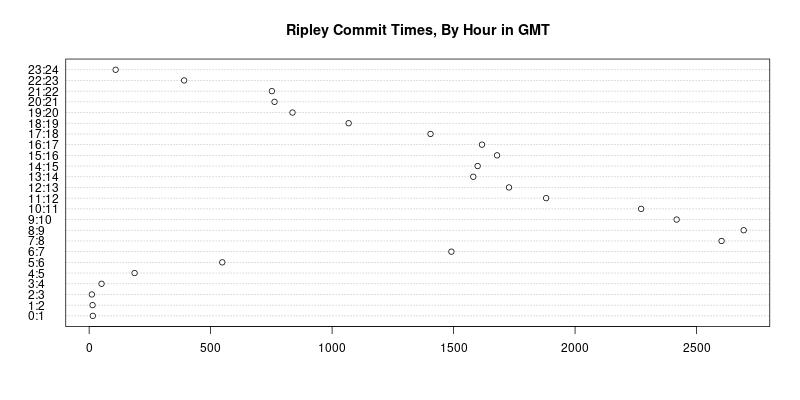
#!/bin/bash

## adjust as needed
svn=$ HOME /svn/r-devel

rev=$(cd $ svn  && svn info --show-item revision)
today=$(date +%Y-%m-%d)

echo -n "Extracting $ rev  revisions at $ today  ... "
(cd $ svn  && svn log --limit $ rev  )   gzip -9 > svn-log-$ today .txt.gz
echo "done"
So that leads to one code adjustments given the different input source. But otherwise the first paragraph runs as is (and now gives us 49.2% for the amazing Prof Ripley):
logfile <- "svn-log-2021-03-20.txt.gz"

## cf http://dirk.eddelbuettel.com/blog/2007/08/11/
x <- readLines(logfile)
rx <- x[grep("^r",x)]
who <- gsub(" ","",sapply(strsplit(rx,"\\ "),"[",2))
twho <- table(who)
twho["ripley"]/sum(twho)
That is what one gets by trusting stable interfaces: code untouched for fourteen years runs unchanged. R itself has had well over sixty releases since then, including two major and eighteen minor releases. Yet the code just runs, including the code for two graphs one can reproduce with the exact same code as we show next.
tod <- unlist(sapply(rx,function(x)strsplit(x,split=" ")[[1]][6]))
tod <- tod[who=="ripley"]

tz <- sub(pattern=".*(-[0-9] 4 ).*",replacement="\\1",x=rx)
tz <- tz[who=="ripley"]
tz <- as.numeric(tz)/100
offset <- 3600*tz

z <- strptime(tod,format="%H:%M:%S")
hist(z,"hours",main="Ripley Commit Times in SVN TZ")

h <- z - offset
h <- format(h,format="%H")
h <- factor(as.numeric(h), levels=0:23)
## added as.vector() here to suppress a warning
dotchart(as.vector(table(h)), main="Ripley Commit Times, By Hour in GMT",
         labels=paste(0:23,1:24,sep=":"))
The code reproduces the chart from 2008, but this time uses the full twenty plus years of SVN history. I added just one as.vector() to suppress one new warning which appears under current R and which was presumably added in the fourteen years since (at the chart is produces without it too). The remainder of the code also runs. I just added one library(zoo) my blog post had omitted. No other changes.
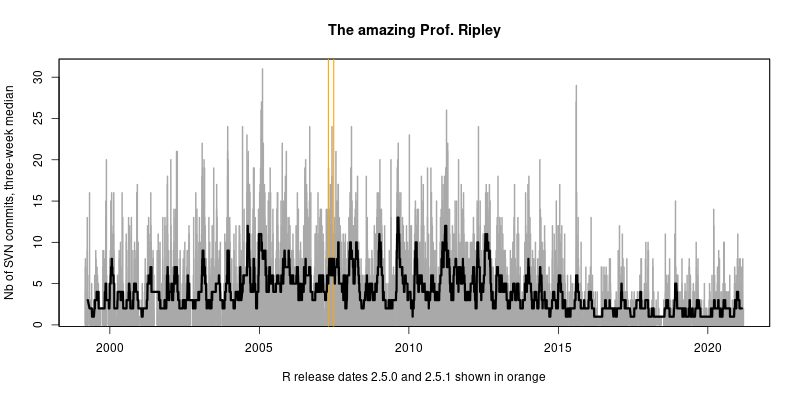
## rather extract both  date and time
dat <- unlist(sapply(rx, function(x)  
  txt <- strsplit(x,split=" ")[[1]]
  paste(txt[5], txt[6])
 ))
## subset on Prof Ripley
dat <- dat[who == "ripley"]
## and convert to POSIXct, correcting by tz as well
datpt <- as.POSIXct(strptime(dat,format="%Y-%m-%d %H:%M:%S")) - offset

## turn into zoo -- we use a constant series of ones as each
## committ is taken as a timestamped event
library(zoo)
datzoo <- zoo(1, order.by=datpt)
## and use zoo to aggregate into commits per date
daily <- aggregate(datzoo, as.Date(index(datzoo)), sum)

## now plot as grey bars
plot(daily, col='darkgrey', type='h', lwd=2,
     ylab="Nb of SVN commits, three-week median",
     xlab="R release dates 2.5.0 and 2.5.1 shown in orange",
     main="The amazing Prof. Ripley")
## mark the two R releases of 2007
abline(v=c(as.Date("2007-04-24"),as.Date("2007-06-28")),col='orange',lwd=1.5)
## and do a quick centered rolling median
lines(rollmedian(daily, 21, align="center"), lwd=3)
It produces this chart spanning two decades of commits. [3] The subtitle highlighting the then-most-recent releases is a little quaint now given that R has had eighten major.minor releases, and over sixty total releases, since then. Stable and rigourously maintained interfaces are a fantastic resource that is dramatically under-appreciated. Efforts such as the ten-year reproduction challenge demonstrate that this really is not a given. Maybe instead of celebrating band aides ( look, I reproduce via code I have frozen in a virtual environment / container / machine / ) we should celebrate languages, ecosystems, packages, that allow us to rely on just the code itself. Because we can. And we should strengthen and reinforce that ability. And discourage rapid changes just for changes sake. Code running for a decade, or even longer, is a huge boon to everybody relying on it. Three cheers to R Core. [1] Docker containers would be really good, and a step above the specs in the README. Winston s nice r-debug sumo container comes closest and helps a lot, and is updated regularly (which my earlier r-devel-san container is not). [2] The post owes some of its code ideas to Ben Bolker and Simon Jackman, but links to now-stale prior affiliations of theirs. [3] And the singularly impressive contributions charted remain unparalled, but were already the focus of the previous post. Yet over three times as a long period, they remain even more stunning. Edit 2021-03-21: Two minor fixes for grammar and typing.

Next.

Previous.