Search Results: "edd"

25 November 2012

Dirk Eddelbuettel: digest 0.6.0

A new version of the digest package (which generates hash function summaries for arbitrary (and possibly nested) R objects using any of the standard md5, sha-1, sha-256, sha-512 or crc32 algorithms) is now on CRAN, and I will push the corresponding version into Debian in a moment. For this release, Hannes Muehleisen added support for sha-512 using an older standalone function by Aaron D. Gifford which I had to whip into slightly more portable shape to work on Windows. (Hint: uint32_t from stdint.h, not u_int32_t) CRANberries provides the usual summary of changes to version 0.5.2. As usual, our package is available via the R-Forge page leading to svn and tarball access, my digest page and the local directory here.

24 November 2012

Eddy Petrișor: Singing your way to Parliament

Here is a "customized" version of a political ad that I made based on the real one of a guy running in the area where I live right now. I made it as a joke, I don't endorse the guy at all. In fact, I think that I would advise anyone having this guy on the ballot, to vote whomever else.


The candidate is a singer part of a band which had it's heyday around the beginning of the previous decade. His slogan is "Facts not words", but I thought "Rhymes, not words" is more appropriate.

There are two other jokes in here, I hope my Romanian readers will appreciate them.

22 November 2012

Ian Wienand: Upgrading Samsung Series 9 Laptop BIOS without Windows

Having recently acquired a Samsung Series 9 laptop, I'd like to update the BIOS. This is proving rather difficult without Windows. The first thing you download from the Samsung website isn't actually BIOS update at all; it's a Windows application which then goes and finds a BIOS update for your machine. Some time with a Windows VM, tcpdump and you'll end up at http://sbuservice.samsungmobile.com/. I'll leave interested parties to play around at that website, but with a little fiddling you can find the BIOS you're looking for. In this case, it is ITEM_20121024_754_WIN_P08AAH.exe which is the latest version, P08AAH. Unfortunately, this still won't run in any useful way -- in a virtual-machine it errors out saying the battery isn't connected. On previous endeavors such as this, running various incarnations of zip on the .exe file has found interesting components, but not in this case. Not to be deterred, some work with strings will yield the following
$ strings ./ITEM_20121024_754_WIN_P08AAH.exe   grep Copyright
inflate 1.2.7 Copyright 1995-2012 Mark Adler
deflate 1.2.7 Copyright 1995-2012 Jean-loup Gailly and Mark Adler
Now this is interesting, because it tells us that the components aren't using some fancy compression scheme we have no hope of figuring out. Checking RFC1952 we see the following header mentioned
Each member has the following structure:
+---+---+---+---+---+---+---+---+---+---+
 ID1 ID2 CM  FLG      MTIME      XFL OS   (more-->)
+---+---+---+---+---+---+---+---+---+---+
We can easily look for that in the file. Expanding the values, what we're looking for is 0x1f 0x8b 0x08 0x0 0x0 0x0 0x0 0x0 0x0 0x0 which represents the compressed stream (the OS byte is 0xb for NTFS which we can just ignore). A quick hack will get that done and give us the offsets we need
$ ./look-for-headers
Found potential header at 455212
Found potential header at 677136
Found potential header at 1293930
Found potential header at 1294980
Found potential header at 2771193
Found potential header at 2779874
Found potential header at 2789142
Found potential header at 2935778
Found potential header at 3078639
Found potential header at 3083039
Found potential header at 3338552
Found potential header at 3339443
Found potential header at 3352440
Found potential header at 3366757
Found potential header at 3391734
Found potential header at 3444255
Found potential header at 3494372
So, we can feed this into a shell script and extract the streams
FILE=ITEM_20121024_754_WIN_P08AAH.exe
for offset in 455212 677136 1293930 1294980 \
    2771193 2779874 2789142 2935778 3078639 \
    3083039 3338552 3339443 3352440 3366757 \
    3391734 3444255 3494372
do
    echo "create $offset.gz"
    dd if=$FILE  bs=1 skip=$offset   zcat > $offset.data
done
We don't have to worry about the end-point, because zcat will handily stop outputting and ignore junk at the end of the stream. That will yield the following output files:
$ md5sum *
c014e900b02ae39d6e574c63154809b2  1293930.data
982747cd5215c7d51fa1fba255557fef  1294980.data
942c6a8332d5dd06d8f4b2a9cb386ff4  2771193.data
d98d2f80b94f70780b46d1f079a38d93  2779874.data
33ce3174b0e205f58c7cedc61adc6f32  2789142.data
1d6851288f40fa95895b2fadee8a8b82  2935778.data
3a0a9b2fa9b40bdf5721068acde351ce  3078639.data
fc166141d06934e9c7238326f18a4e68  3083039.data
8cf7f86f84afa81363d3cef44b257d50  3338552.data
85e09e18fd495599041e13b4197e1746  3339443.data
0c72004eae0131d52817f23faf8a46a7  3352440.data
26347f93721e7ac49134a17104f56090  3366757.data
26973e301da4948a0016765e40700e8c  3391734.data
c8e4675cda3aa367d523a471bb205fba  3444255.data
7bf5ea753d4cc056b9462a02ac51b160  3494372.data
a2c6562f7f43aaa0e636cc1995b7ee3d  455212.data
d5c91b007dac3a5c6317f8a8833f9304  677136.data
65c0dcd1e7e9f8f87a8e9fb706eb8768  ITEM_20121024_754_WIN_P08AAH.exe
$ file *
1293930.data:                     MS-DOS executable
1294980.data:                     data
2771193.data:                     PE32 executable (native) Intel 80386, for MS Windows
2779874.data:                     PE32+ executable (native) x86-64, for MS Windows
2789142.data:                     PE32 executable (console) Intel 80386 (stripped to external PDB), for MS Windows
2935778.data:                     PE32+ executable (console) x86-64 (stripped to external PDB), for MS Windows
3078639.data:                     MS-DOS executable
3083039.data:                     PE32 executable (GUI) Intel 80386, for MS Windows
3338552.data:                     ASCII text, with CRLF line terminators
3339443.data:                     PE32 executable (native) Intel 80386, for MS Windows
3352440.data:                     PE32+ executable (native) x86-64, for MS Windows
3366757.data:                     PE32 executable (DLL) (GUI) Intel 80386, for MS Windows
3391734.data:                     PE32 executable (GUI) Intel 80386, for MS Windows
3444255.data:                     PE32 executable (GUI) Intel 80386, for MS Windows
3494372.data:                     PE32 executable (DLL) (GUI) Intel 80386, for MS Windows
455212.data:                      PE32 executable (DLL) (console) Intel 80386, for MS Windows
677136.data:                      data
ITEM_20121024_754_WIN_P08AAH.exe: PE32 executable (GUI) Intel 80386, for MS Windows
This is where I get a bit stuck. There is clearly a bunch of WinFlash stuff that Wine kind-of recognises, but so far I haven't managed to figure out how I might go about flashing this from a DOS boot disk. So far I know it's a "Phoenix SecureCore Tiano" based BIOS, and there is some indication that there is a UEFI app to flash the BIOS, but unfortunately I didn't set the laptop up with UEFI (note to anyone setting this up; probably a good idea to do that). I believe that if you have Windows, you can halt the install part-way through and see these files extracted in a temp directory. Possibly if we can put some file-names to the blobs it might help. There may also be a much easier way to do this that I'm completely missing. If anything comes up, I'll update this post; hopefully a future Googlenaut who enjoys BIOS hacking will drop a comment... Update 2012-11-27 I'm unfortunately less optimistic about being able to update this. Certainly the files identified above as MS-DOS executable are EFI binaries; however they are both 32-bit binaries. You can easily get an EFI shell up and running by putting a 64-bit EFI shell binary on a FAT formatted USB disk in the efi/boot/bootx64.efi but it will not run either of those binaries, presumably because they're 32-bit. A 32-bit EFI binary doesn't seem to be recognised for boot, so no luck there. A comment also mentioned some issues with Samsung's and UEFI boot in this bug though it's not clear what models are affected. Another comment mentioned binwalk which also does a nice job of finding the embedded zip streams.
$ strings ./1293930.data
...
RSDS
D:\flash\Source\ENV\src\Efi863\edk\phoenix\edk\Sample\Platform\DUET\ldr16\IA32\oemslp20.pdb
oemslp20.dll
InitializeDriver
2n3u3
$ strings ./3078639.data
en-us;zh-Hans
slp20.marker
slp20.size
slp20.offset
slp20.offset2
read marker fail!
Marker file '%s''s size(%d)!=%d
Not a valided OemMarker!
Update image data error.
marker file is updated.
marker file size too big!
Not a valided OemMarker in ROM.
Update image data error.
SLP marker is reserved.
-PROT
Prot flag is found, mProgFlag is true.
Prot flag is not found, mProgFlag is false.
Please specify input file name.
-PROT
slpFile
OEM Activation 2.0 processing
Failed to Locate Flash Support protocol.
...
D:\flash\Source\ENV\src\Efi863\edk\phoenix\edk\Sample\Platform\DUET\ldr16\IA32\SLP20.pdb

21 November 2012

Dirk Eddelbuettel: Rcpp attributes: A simple example 'making pi'

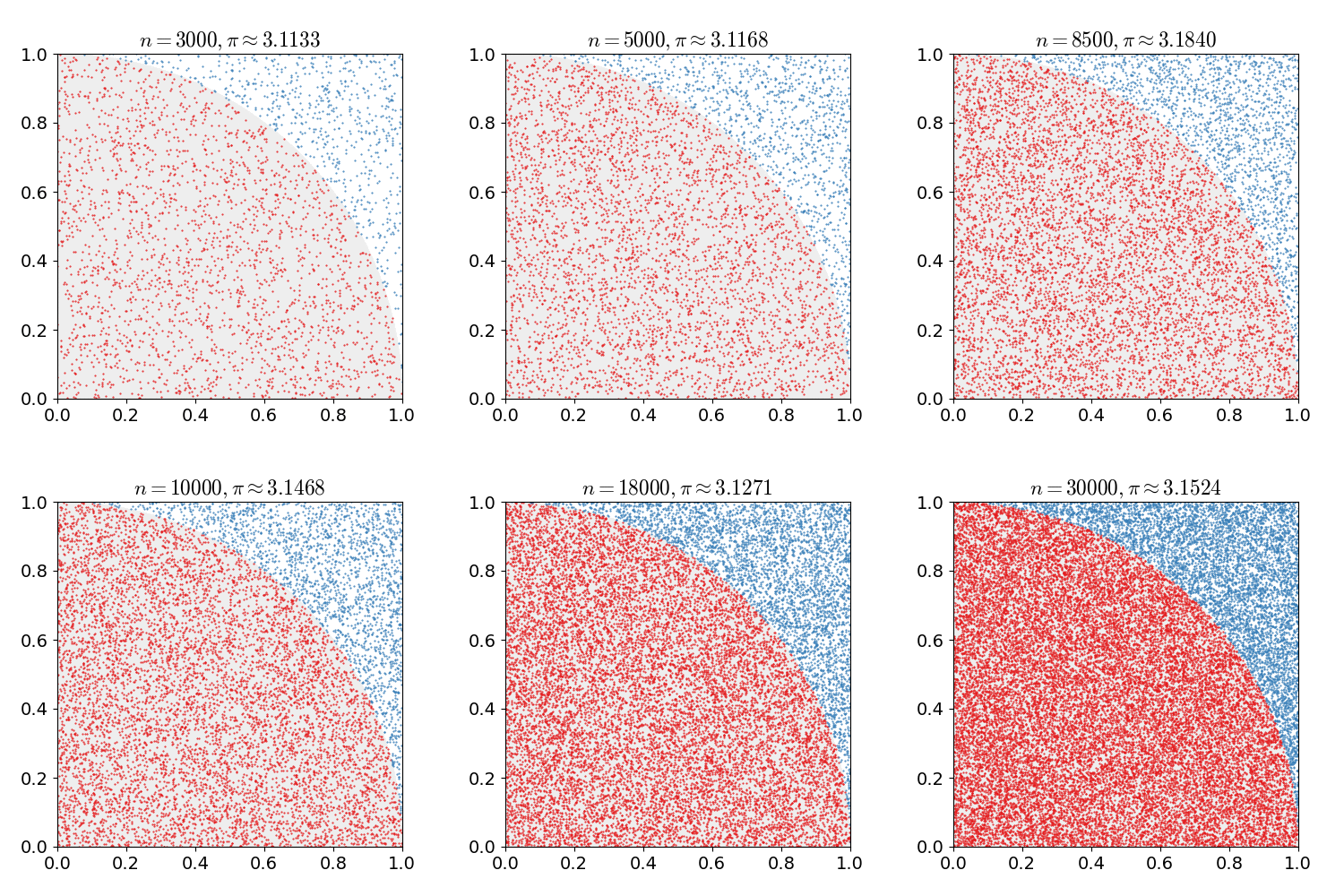
We introduced Rcpp 0.10.0 with a number of very nice new features a few days ago, and the activity on the rcpp-devel mailing list has been pretty responsive which is awesome. But because few things beat a nice example, this post tries to build some more excitement. We will illustrate how Rcpp attributes makes it really easy to add C++ code to R session, and that that code is as easy to grasp as R code. Our motivating example is everybody's favourite introduction to Monte Carlo simulation: estimating . A common method uses the fact the unit circle has a surface area equal to . We draw two uniform random numbers x and y, each between zero and one. We then check for the distance of the corresponding point (x,y) relative to the origin. If less than one (or equal), it is in the circle (or on it); if more than one it is outside. As the first quadrant is a quarter of a square of area one, the area of the whole circle is -- so our first quadrant approximates over four. The following figure, kindly borrowed from Wikipedia with full attribution and credit, illustrates this: Example of simulating pi Now, a vectorized version (drawing N such pairs at once) of this approach is provided by the following R function.
piR <- function(N)  
    x <- runif(N)
    y <- runif(N)
    d <- sqrt(x^2 + y^2)
    return(4 * sum(d < 1.0) / N)
 
And in C++ we can write almost exactly the same function thanks the Rcpp sugar vectorisation available via Rcpp:
#include <Rcpp.h>
using namespace Rcpp;
// [[Rcpp::export]]
double piSugar(const int N)  
    RNGScope scope;		// ensure RNG gets set/reset
    NumericVector x = runif(N);
    NumericVector y = runif(N);
    NumericVector d = sqrt(x*x + y*y);
    return 4.0 * sum(d < 1.0) / N;
 
Sure, there are small differences: C++ is statically typed, R is not. We need one include file for declaration, and we need one instantiation of the RNGScope object to ensure random number draws remain coordinated between the calling R process and the C++ function calling into its (compiled C-code based) random number generators. That way we even get the exact same draws for the same seed. But the basic approach is identical: draw a vector x and vector y, compute the distance to the origin and then obtain the proportion within the unit circle -- which we scale by four. Same idea, same vectorised implementation in C++. But the real key here is the one short line with the [[Rcpp::export]] attribute. This is all it takes (along with sourceCpp() from Rcpp 0.10.0) to get the C++ code into R. The full example (which assumes the C++ file is saved as piSugar.cpp in the same directory) is now:
#!/usr/bin/r
library(Rcpp)
library(rbenchmark)
piR <- function(N)  
    x <- runif(N)
    y <- runif(N)
    d <- sqrt(x^2 + y^2)
    return(4 * sum(d < 1.0) / N)
 
sourceCpp("piSugar.cpp")
N <- 1e6
set.seed(42)
resR <- piR(N)
set.seed(42)
resCpp <- piSugar(N)
## important: check results are identical with RNG seeded
stopifnot(identical(resR, resCpp))
res <- benchmark(piR(N), piSugar(N), order="relative")
print(res[,1:4])
and it does a few things: set up the R function, source the C++ function (and presto: we have a callable C++ function just like that), compute two simulations given the same seed and ensure they are in fact identical -- and proceed to compare the timing in a benchmarking exercise. That last aspect is not even that important -- we end up being almost-but-not-quite twice as fast on my machine for different values of N. The real takeaway here is the ease with which we can get a C++ function into R --- and the new process completely takes care of passing parameters in, results out, and does the compilation, linking and loading. More details about Rcpp attributes are in the new vignette. Now enjoy the .

Update:One somewhat bad typo fixed.

Update:Corrected one background tag.

17 November 2012

Dirk Eddelbuettel: RcppArmadillo 0.3.4.4

A minor bug-fix release 3.4.4 of Armadillo came out upstream a few days ago. RcppArmadillo, our wrapper for R and Armadillo, is now on CRAN with its corresponding version 0.3.4.4. No R level or interface changes were made and the upstream changes are summarized below.
Changes in RcppArmadillo version 0.3.4.4 (2012-11-15)
  • Upgraded to Armadillo release 3.4.4
    • fix for handling complex numbers by sparse matrices
    • fix for minor memory leak by sparse matrices
Courtesy of CRANberries, there is also a diffstat report for 0.3.4.4 relative to 0.3.4.3 As always, more detailed information is on the RcppArmadillo page. Questions, comments etc should go to the rcpp-devel mailing list off the R-Forge page.

15 November 2012

Dirk Eddelbuettel: Rcpp and the new R:: namespace for Rmath.h

We released Rcpp 0.10.0 earlier today. This post will just provide a simple example for one of the smaller new features -- the new namespace for functions from Rmath.h -- and illustrate one of the key features (Rcpp attributes) in passing. R, as a statistical language and environment, has very well written and tested statistical distribution functions providing probability density, cumulative distribution, quantiles and random number draws for dozens of common and not so common distribution functions. This code is used inside R, and available for use from standalone C or C++ programs via the standalone R math library which Debian / Ubuntu have as a package r-mathlib (and which can be built from R sources). User sometimes write code against this interface, and then want to combine the code with other code, possibly even with Rcpp. We allowed for this, but it required a bit of an ugly interface. R provides a C interface; these have no namespaces. Identifiers can clash, and to be safe one can enable a generic prefix Rf_. So functions which could clash such as length or error become Rf_length and Rf_error and are less likely to conflict with symbols from other libraries. Unfortunately, the side-effect is that calling, say, the probability distribution function for the Normal distribution becomes Rf_pnorm5() (with the 5 denoting the five parameters: quantile, mean, std.deviation, lowerTail, logValue). Not pretty, and not obvious. So one of the things we added was another layer of indirection by adding a namespace R with a bunch of inline'd wrapper functions (as well as several handful of unit tests to make sure we avoided typos and argument transposition and what not). The short example below shows this for a simple function taking a vector, and returning its pnorm computed three different ways:
#include <Rcpp.h>
// [[Rcpp::export]]
Rcpp::DataFrame mypnorm(Rcpp::NumericVector x)  
    int n = x.size();
    Rcpp::NumericVector y1(n), y2(n), y3(n);
    for (int i=0; i<n; i++)  
        // the way we used to do this
        y1[i] = ::Rf_pnorm5(x[i], 0.0, 1.0, 1, 0);
        // the way we can do it now
        y2[i] = R::pnorm(x[i], 0.0, 1.0, 1, 0);
     
    // or using Rcpp sugar in one go
    y3 = Rcpp::pnorm(x);
    return Rcpp::DataFrame::create(Rcpp::Named("Rold")  = y1,
                                   Rcpp::Named("Rnew")  = y2,
                                   Rcpp::Named("sugar") = y3);
 
This example also uses the new Rcpp attributes described briefly in the announcement blog post and of course in more detail in the corresponding vignette. Let us just state here that we simply provide a complete C++ function, using standard Rcpp types -- along with one 'attribute' declaration of an export via Rcpp. That's it -- even easier than using inline. Now in R we simply do
R> sourceCpp("mypnorm.cpp")
to obtain a callable R function with the C++ code just shown behind it. No Makefile, no command-line tool invocation -- nothing but a single call to sourceCpp() which takes care of things --- and brings us a compiled C++ function to R just given the source file with its attribute declaration. We can now use the new function to compute the probaility distribution both the old way, the new way with the 'cleaner' R::pnorm(), and of course the Rcpp sugar way in a single call. We build a data frame in C++, and assert that all three variants are the same:
R> x <- seq(0, 1, length=1e3)
R> res <- mypnorm(x)
R> head(res)
      Rold     Rnew    sugar
1 0.500000 0.500000 0.500000
2 0.500399 0.500399 0.500399
3 0.500799 0.500799 0.500799
4 0.501198 0.501198 0.501198
5 0.501597 0.501597 0.501597
6 0.501997 0.501997 0.501997
R> all.equal(res[,1], res[,2], res[,3])
[1] TRUE
R> 
This example hopefully helped to illustrate how Rcpp 0.10.0 brings both something really powerful (Rcpp attributes -- more on this another time, hopefully) and convenient in the new namespace for statistical functions.

14 November 2012

Dirk Eddelbuettel: Rcpp 0.10.0

Rcpp release 0.10.0 is now on CRAN and being uploaded to Debian. This is a new feature release, and we are very exciting about the changes, notably Rcpp attributes which make using C++ from R even easier than inline (see below as well as the new vignette for details and first examples), the extensions to Rcpp modules (see below) and more as for example new Rcpp sugar functions, a new error output device syncing to R, and a new namespace R> for the statistical functions from Rmath.h. The complete NEWS entry for 0.10.0 is below; more details are in the ChangeLog file in the package and on the Rcpp Changelog page.
Changes in Rcpp version 0.10.0 (2012-11-13)
  • Support for C++11 style attributes (embedded in comments) to enable use of C++ within interactive sessions and to automatically generate module declarations for packages:
    • Rcpp::export attribute to export a C++ function to R
    • sourceCpp() function to source exported functions from a file
    • cppFunction() and evalCpp() functions for inline declarations and execution
    • compileAttribtes() function to generate Rcpp modules from exported functions within a package
    • Rcpp::depends attribute for specifying additional build dependencies for sourceCpp()
    • Rcpp::interfaces attribute to specify the external bindings compileAttributes() should generate (defaults to R-only but a C++ include file using R_GetCCallable can also be generated)
    • New vignette "Rcpp-attribute"
  • Rcpp modules feature set has been expanded:
    • Functions and methods can now return objects from classes that are exposed through modules. This uses the make_new_object template internally. This feature requires that some class traits are declared to indicate Rcpp's wrap/as system that these classes are covered by modules. The macro RCPP_EXPOSED_CLASS and RCPP_EXPOSED_CLASS_NODECL can be used to declared these type traits.
    • Classes exposed through modules can also be used as parameters of exposed functions or methods.
    • Exposed classes can declare factories with ".factory". A factory is a c++ function that returns a pointer to the target class. It is assumed that these objects are allocated with new on the factory. On the R side, factories are called just like other constructors, with the "new" function. This feature allows an alternative way to construct objects.
    • "converter" can be used to declare a way to convert an object of a type to another type. This gets translated to the appropriate "as" method on the R side.
    • Inheritance. A class can now declare that it inherits from another class with the .derives<Parent>( "Parent" ) notation. As a result the exposed class gains methods and properties (fields) from its parent class.
  • New sugar functions:
    • which_min implements which.min. Traversing the sugar expression and returning the index of the first time the minimum value is found.
    • which_max idem
    • unique uses unordered_set to find unique values. In particular, the version for CharacterVector is found to be more efficient than R's version
    • sort_unique calculates unique values and then sorts them.
  • Improvements to output facilities:
    • Implemented sync() so that flushing output streams works
    • Added Rcerr output stream (forwarding to REprintf)
  • Provide a namespace 'R' for the standalone Rmath library so that Rcpp users can access those functions too; also added unit tests
  • Development releases sets variable RunAllRcppTests to yes to run all tests (unless it was alredy set to 'no'); CRAN releases do not and still require setting which helps with the desired CRAN default of less testing at the CRAN server farm.
Thanks to CRANberries, you can also look at a diff to the previous release 0.9.15. As always, even fuller details are on the Rcpp Changelog page and the Rcpp page which also leads to the downloads, the browseable doxygen docs and zip files of doxygen output for the standard formats. A local directory has source and documentation too. Questions, comments etc should go to the rcpp-devel mailing list off the R-Forge page

Update: One link corrected.

13 November 2012

Erich Schubert: Migrating from GNOME3 to XFCE

I have been a GNOME fan for years. I actually liked the switch from 1.x to 2.x, and at some point switched to 3.x when it became somewhat usable. At some point, I even started some small Gnome projects, one even was uploaded to the Gnome repositories. But I didn't have much time for my Linux hobby anymore back then.
However, I am now switching to XFCE. And for all I can tell, I am about the last one to make that switch. Everybody I know hates the new Gnome.
My reason is not emotional. It's simple: I have systems that don't work well with OpenGL, and thus don't work well with Gnome shell. Up to now, I can live fine with "Fallback mode" (aka: Gnome classic). It works really good for me, and does exactly what I need. But it has been all over the media: Gnome 3.8 will drop 'fallback' mode.
Now the choice is obvious: instead of switching to shell, I go to XFCE. Which is much closer to the original Gnome experience, and very productivity oriented.
There are tons of rants on GNOME 3 (for one of the most detailed ones, see Gnome rotting in threes, going through various issues). Something must be very wrong about what they are doing to receive this many sh*tstorms all the time. Every project receives some. I've even received a share of the Gnome 2 storms when Galeon (an early Gnome browser) made the move and started dropping some of the hard-to-explain and barely used options that would break with every other Mozilla release. And Mozilla embedding was a major pain these days. Yet, for every feature there would be some user somewhere that loved it, and as Debian maintainer of Galeon, I got to see all the complaints (and at the same time was well aware of the bugs caused by the feature overload).
Yet with Gnome 3, things are IMHO a lot different. In Gnome 2, it was a lot about making things more usable as they are, a bit cleaner and more efficient. With Gnome 3, it seems to be about experimenting with new stuff. Which is why it keeps on breaking APIs all the time. For example themeing GTK 3 is constantly broken; most of the themes available just don't work. Similar Gnome Shell extensions - most of them work with exactly one version of Gnome Shell (doesn't this indicate the author has abandoned Gnome shell?).
But the one thing that was really sticking out was when my I updated the PC of my dad. Apart from some glitches, he could not even shutdown his PC with Gnome-shell. Because you needed to press the Alt button to actually get a shutdown option.
This is indicative of where Gnome is heading: something undefined inbetween of PCs, tablets, media centers and mobile phones. They just decided that users don't need to shutdown anymore, so they could as well drop that option.
But the worst thing about the current state of GNOME is: They happily live with it. They don't care that they are losing users by the dozens. Because to them, these are just "complainers". Of cousre there is some truth in "Complainers gonna complain and haters gonna hate". But what Gnome is receiving is way above average. At some point, they should listen. 200 posts long comment chains from dozens of peopls on LWN are not just your average "complaints". It's an indicator that a key user base is unhappy with the software. In 2010 GNOME 2 had 45% market share in the LinuxQuestions poll, XFCE had 15%. In 2011, GNOME 3 had 19%, and XFCE jumped to 28%. And I wouldn't be surprised if GNOME 3 shell (not counting fallback mode) would clock at less than 10% in 2012 - despite being default.
Don't get me wrong: there is a lot on Gnome that I really like. But as they decided to drop my preferred UI, I am of course looking for alternatives. In particular, as I can get lots of the Gnome 3 benefits with XFCE. There is a lot in the Gnome ecosystem that I value, and that IMHO is driving Linux forward. Network-manager, Poppler, Pulseaudio, Clutter just to name a few. Usually, the stuff that is modular is really good. And in fact I have been a happy user of the "fallback" mode, too. Yet, the overall "desktop" Gnome 3 goals are in my opinion targeting the wrong user group. Gnome might need to target linux developers more again, to keep a healthy development community around. Frequently triggering sh*tstorms by high-profile people such as Linux Torvalds is not going to strengthen the community. There is nothing wrong in the FL/OSS community to encourage people to use XFCE. But these are developers that Gnome might need at some point.
On a backend / technical level (away from the Shell/UI stuff that most of the rants are about), my main concern about the Gnome future is GTK3. GTK2 was a good toolkit for cross-platform development. GTK3 as of now is not, but is largely a Linux/Unix only toolkit - in particular, because there apparently is no up to date Win32 port. With GTK 3.4 it was said that they are now working on Windows - but as of GTK 3.6 they are still nowhere to be found. So if you want to develop cross-platform, as of now, you better stay away from GTK 3. If this doesn't change soon, GTK might sooner or later lose the API battle to more portable libraries.

12 November 2012

Ingo Juergensmann: Resurrecting m68k

In August I picked up Elgar, a m68k machine, from NMMN in Hamburg, where it was ought to run as a buildd (NMMN donated space and network). Unfortunately it was in some kind of bad state: operating system was out of date, expansion cards were getting loose and NMMN wasn't happy about the CRT monitor in its datacenter as well. Elgar is an Amiga 4000 Desktop built into a custom tower case. It took some weeks and months until I found a little time to care about Elgar, but now it's up and running again:
[ 0.000000] Initializing cgroup subsys cpuset
[ 0.000000] Initializing cgroup subsys cpu
[ 0.000000] Linux version 3.2.0-3-amiga (Debian 3.2.23-1) (debian-kernel@lists.debian.org) (gcc version 4.6.3 (Debian 4.6.3-8+m68k.1) ) #1 Wed Jul 25 13:02:31 UTC 2012
[ 0.000000] Enabling workaround for errata I14
[ 0.000000] console [debug0] enabled
[ 0.000000] Amiga hardware found: [A4000] VIDEO BLITTER AUDIO FLOPPY A4000_IDE KEYBOARD MOUSE SERIAL PARALLEL A3000_CLK CHIP_RAM PAULA LISA ALICE_PAL ZORRO3
That's the stock Debian m68k kernel and it already runs on Arrakis and Vivaldi, two other buildds, as well without any problem. The only problem at the moment is the missing SCSI driver for the CyberStorm Mk1 accelerator card. There were some changes in the kernel that need to be dealt with by someone knowing. The other problem was to upgrade from etch-m68k to unstable. I already blogged about this last year. It's not as easy anymore and you'll need to deal with lots of dependency problems and such nowadays. But anyway:
elgar:~# cat /etc/debian_version
wheezy/sid
elgar:~# dpkg -l libc6
Desired=Unknown/Install/Remove/Purge/Hold
Status=Not/Inst/Conf-files/Unpacked/halF-conf/Half-inst/trig-aWait/Trig-pend
/ Err?=(none)/Reinst-required (Status,Err: uppercase=bad)
/ Name Version Architecture Description
+++-====================-===============-===============-==============================================
ii libc6:m68k 2.13-35 m68k Embedded GNU C Library: Shared libraries
It's amazing that the m68k port is in such good condition after more than 4 years. That's because of the real great work of Torsten Glaser who is doing much of the porter work for the tool chain. But m68k has currently 4833 packages in state Needs-Build:
wanna-build statistics - Mon Nov 12 06:51:13 CET 2012
----------------------------------------------------- Distribution unstable:
---------------------
Installed : 1321
Needs-Build : 4833
Building : 0
Uploaded : 0
Failed : 0
Dep-Wait : 0
Reupload-Wait : 0
Install-Wait : 0
Failed-Removed : 0
Dep-Wait-Removed: 0
Not-For-Us : 0
total : 9906 13.34% (1321) up-to-date, 13.34% (1321) including uploaded
48.79% (4833) need building
0.00% ( 0) currently building
0.00% ( 0) failed/dep-wait
0.00% ( 0) old failed/dep-wait
0.00% ( 0) need porting or cause the buildd serious grief
So, there's a lot of work to do, but it's apparent that m68k won't keep up with 10.000 packages in unstable. When I started running an autobuilder back in year 2000 there were 2400 packages for m68k, on Aug. 15th 2005 we had a total of 5949 packages in the archive. For m68k this means that we will have to start adding lots of packages to Not-For-Us. I think m68k will/should end up with approx. 4000 packages at most. In the end m68k is a fairly good shape now. It only needs to get some packages built... Let's see when the buildds are operational again... ;-)
Kategorie:

10 November 2012

Mart&iacute;n Ferrari: Amusing ourselves to death

What Orwell feared were those who would ban books. What Huxley feared was that there would be no reason to ban a book, for there would be no one who wanted to read one. --Foreword to the book. Just finished this book today. It was written in 1985, it talks about Dallas, and the 700 Club, Reagan and many other (by now) old fashioned things. It only talks about computers in passing, as this new thing that everybody is talking about. And it is extremely current. It's been 27 years, and it could have been written yesterday. You'll just need to replace some TV shows with Twitter, Reddit, or G+, but it has made me think a lot about my own relationship with information, and amusement. I couldn't help but think about this book when reading various essays that touch culture, education, or politics these days. It has also made me realise my own incongruence: being proud of not owning a TV, while I spent hours of my waking ours watching cat videos, news snippets in Google Reader, or curating links that have been reshared dozens of times. If you're at all interested in understanding our culture and discourse, do yourself a favor and get a copy. It's not long, nor dense in academic jargon. It's only 9 euro with free shipping in the Book Depository, and they even have a Kindle version in Amazon. Tags: Libros, Planet Debian

5 November 2012

Dirk Eddelbuettel: RInside 0.2.9

A new version 0.2.9 of RInside arrived on CRAN earlier today; Windows binaries have already been built too. RInside provides a set of convenience classes which facilitate embedding of R inside of C++ applications and programs, using the classes and functions provided by the Rcpp R and C++ integration package. This release adds a few new features as detailed in the extract from the NEWS below. A key new feature is the added support for resilience to bad user input based on discussions and an initial (but altered) patch by Theodore Lytras. There are a few ways that this can be deployedon so we also added two more example programs detailing it. The featured Qt example and the Wt example have been updated to use this too. Another feature that may be quite useful for some is the additonal attempt to find a value for R_HOME if none has been set. The value is typically found at compile time of the RInside package which poses a problem for those using the Windows build -- which is shipped as a binary reflecting the value of the build system. One alternative has always been to build the package locally too to get the local value, or to set it explicitly. But because the error behaviour a cryptic message of Cannot open base package is confusing to many, we now try to call the R function which gets this value from the registry. This may need more tweaking and testing, and if you use RInside on the Windows platform I would appreciate feedback. The complete list of changes since the last release are summarized below in the corresponding NEWS file entry:
Changes in RInside version 0.2.9 (2012-11-04)
  • Applied (modified) patch by Theodore Lytras which lets RInside recover from some parsing errors and makes RInside applications more tolerant of errors
  • Added non-throwing variants of parseEval() and parseEvalQ()
  • Modified Qt and Wt examples of density estimation applications to be much more resilient to bad user input
  • On Windows, have RInside use R's get_R_HOME() function to get R_HOME value from registry if not set by user
  • Added note to examples/standard/Makefile.win that R_HOME may need to be set to run the executables so either export your local value, or re-install RInside from source to have it reflected in the library build of libRinside
  • Updated CMake build support for standard, armadillo and eigen
  • Improved CMake builds of examples/standard, examples/eigen and examples/armadillo by detecting architecture
CRANberries also provides a short report with changes from the previous release. More information is on the RInside page. Questions, comments etc should go to the rcpp-devel mailing list off the Rcpp R-Forge page.

Alberto Garc a: Igalia at LinuxCon Europe

I came to Barcelona with a few other Igalians this week for LinuxCon, the Embedded
Linux Conference
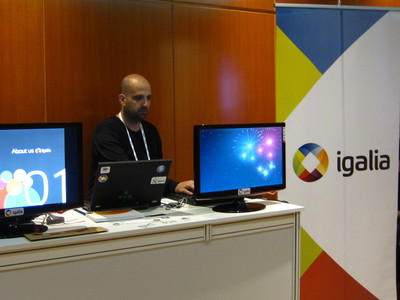
and the KVM Forum. We are sponsoring the event and we have a couple of presentations this year, one about QEMU, device drivers and industrial hardware (which I gave today, slides here) and the other about the Grilo multimedia framework (by Juan Su rez). We ll be around the whole week so you can come and talk to us anytime. You can find us at our booth on the ground floor, where you ll also be able to see a few demos of our latest work and get some merchandising.
Igalia booth

3 November 2012

Richard Hartmann: Release Critical Bug report for Week 42

Lucas Nussbaum pointed out that the weekly stats which Alexander Reichle-Schmehl used to provide are AWOL so I decided to take over. As I am patently lazy, I hacked together a little helper in perl which outputs the page I am just adding to by writing this. It's a tad hackish inasmuch I don't bother to transform the HTML into anything and simply embedd it in the Markdown, but it's working well enough for now. In the medium term, I am hoping to add some nice graphs as per azhag's suggestion, but they didn't get back to me, yet. A warning to anyone not subscribed to Planet Debian and reading this via a different aggregator: You will still see weekly stats from now on which may or may not be interesting to you. In case you object, please leave a comment or poke me directly. The UDD bugs interface currently knows about the following release critical bugs: How do we compare to the squeeze cycle ?
Week Squeeze Wheezy Diff
43 284 (213+71) 468 (332+136) +184 (+119 ; +65)
44 261 (201+60)
45 261 (205+56)
46 271 (200+71)
47 283 (209+74)
48 256 (177+79)
49 256 (180+76)
50 204 (148+56)
51 124 (124+54)
52 115 (78+37)
1 93 (60+33)
2 82 (46+36)
3 25 (15+10)
4 14 (8+6)
5 2 (0+2)
6 release!

30 October 2012

Matthew Garrett: An overview of our Secure Boot implementation

I've written rather a lot about how we're implementing our Secure Boot support, but there's been a range of subtle changes over time. Here's an overview of how it all fits together.Secure Boot and signingSecure Boot is part of the UEFI specification. When enabled, systems will refuse to boot any UEFI executables (such as an OS bootloader) unless they've been signed by a trusted key. The only trusted key effectively guaranteed to be present is Microsoft's, and Microsoft will sign binaries if you have access to the Windows hardware dev center. You gain access to this by purchasing a certificate from Verisign that verifies your identity and then use that to create a developer account at the Sysdev website. Once you've agreed to the legal contracts, you can submit a UEFI executable and Microsoft will then send you back a signed one. The signature is added to the end of the binary, so it's trivial to verify that your executable hasn't otherwise been modified in the process.
Avoiding signing round tripsWe didn't want to have to get binaries re-signed every time we updated our bootloader or kernel, so we came up with a compromise approach. We implemented a shim bootloader (cunningly called "Shim") which is signed by Microsoft and includes a copy of a public key that's under our control. Shim will launch any binary signed with either a key installed in the system firmware or the public key built into it. This allows us to build and sign all other binaries ourselves.
Preventing Secure Boot circumventionSecure Boot is intended to prevent scenarios where untrusted code can be run before an OS kernel. Locking down the boot environment avoids the simple case of using a modified bootloader, and requiring that the kernel also be signed avoids simply booting arbitrary attack code that looks roughly like a kernel but does nothing to prevent the more complex case of using a running kernel to launch another kernel. To do that we've had to restrict the behaviour of the kernel in Secure Boot environments. Direct hardware access from userspace has been blocked, and modules must be signed by a key the kernel trusts.
Providing user control over trustMicrosoft requires that it be possible to modify the key database on all Windows-certified x86 systems, but the UI to do so may be inconsistent and awkward. Suse developed a plan to avoid this, involving adding an additional key database to the system. The user enrols a key from the running OS and enters a password. On the next reboot, shim detects that a key is awaiting enrolment and drops to a prompt. If the user does nothing or just hits enter, the system continues to boot. If the user chooses to enrol a new key, the user is asked to re-enter the password in order to confirm that they're the same user that initiated the original request. If successful, the key is then copied into a boot services variable which cannot be directly modified from the OS. Anything signed with the user's key will then be trusted.
Providing user control over signature verificationSome users (such as kernel developers) may be hampered by Secure Boot - forcing them to sign every new kernel they build is time consuming and unhelpful. Windows-certified x86 hardware will be required to provide an option to disable Secure Boot, but again that UI may be inconsistent. We've added an option where a user can generate a request to disable signature validation, again requiring a password. On next boot the user must explicitly choose the "Toggle signature validation" menu item and will then be requested to enter three randomly chosen characters from their password. After confirmation, signature validation in Shim will then be disabled.
Supporting other distributionsNot all distributions will want (or be able) to sign via Microsoft. They'll be able to take any other signed version of Shim and put it on their boot media. If their second stage bootloader is signed by a key that Shim doesn't trust, Shim will pop up a menu permitting the user to choose to enrol a new key off the install media. The user can select this, navigate a file browser and select the key. After confirmation, the key will be added to Shim's trusted key list. The user can then install the distribution.
Third party modulesThere's two approaches here. The first is for the third party to provide a module key that the user can install into Shim's database. The kernel will import this at boot time and trust any modules signed with it. The second is for the third party to provide a key signed by Microsoft. David Howells has come up with with the idea of utilising this approach of embedding a public key in a pe binary, with the kernel then having support for importing this key, noticing that it's signed by a trusted key and adding it to the kernel keyring.
How about ARM?We're not planning on supporting Secure Boot on ARM, for two reasons. The first is that Microsoft require that it be impossible to disable Secure Boot on ARM, and we don't want to support systems unless it's guaranteed that the user will be able to run what they want. The second is that there's no strong expectation that the signing key used for signing third party UEFI binaries will be present on ARM systems.
What are other distributions doing?As far as I know, Suse and Fedora will be shipping the same code. Ubuntu is shipping an older version of Shim but should pick up the local key management code in the next release. The only significant difference is that Ubuntu doesn't require that kernel modules be signed.

comment count unavailable comments

28 October 2012

Steve Langasek: SecureBoot in Ubuntu 12.10

The 12.10 release is the first version of Ubuntu that supports Secure Boot out of the box. In what is largely an accident of release timing, from what I can tell (and please correct me if I'm wrong), this actually makes Ubuntu 12.10 the first general release of any OS to support Secure Boot. (Windows 8 of course is also now available; and I'm sure Matthew Garrett, who has been a welcome collaborator throughout this process, has everything in good order for the upcoming Fedora 18 release.) That's certainly something of a bittersweet achievement. I'm proud of the work we've done to ensure Ubuntu will continue to work out of the box on the consumer hardware of the future; in spite of the predictable accusations on the blogowebs that we've sold out, I sleep well at night knowing that this was the pragmatic decision to make, maximizing users' freedom to use their hardware. All the same, I worry about what the landscape is going to look like in a few years' time. The Ubuntu first-stage EFI bootloader is signed by Microsoft, but the key that is used for signing is one that's recommended by Microsoft, not one that's required by the Windows 8 certification requirements. Will all hardware include this key in practice? The Windows 8 requirements also say that every machine must allow the user to disable Secure Boot. Will manufacturers get this right, and will users be able to make use of it in the event the manufacture didn't include the Microsoft-recommended key? Only time will tell. But I do think the Linux community is going to have to remain engaged on this for some time to come, and possibly hold OEMs' feet to the fire for shipping hardware that will only work with Windows 8. But that's for the future. For now, we have a technical solution in 12.10 that solves the parts of the problem that we can solve. This first release gives us preliminary support for booting on Secure Boot, but there's more work to be done to provide a full solution that's sustainable over the long term. We'll be discussing some of that this week at UDS in Copenhagen. And as part of our committment to enabling new hardware on the current LTS release, we will be backporting this work for inclusion in 12.04.2. It remains to be decided how Debian will approach the Secure Boot question. At DebConf 12, many people seemed to consider it a foregone conclusion that Debian would never agree to include binaries in main signed by third-party keys. I don't think that should be a given; I think allowing third-party signatures in main for hardware compatibility is consistent with Debian's principles, and refusing to make Debian compatible with this hardware out of the box does nothing to advance user freedom. I hope to see frank discussion post-wheezy about keeping Debian relevant on consumer hardware of the future.

26 October 2012

Dirk Eddelbuettel: Accelerating R code: Computing Implied Volatilities Orders of Magnitude Faster

This blog, together with Romain's, is one of the main homes of stories about how Rcpp can help with getting code to run faster in the context of the R system for statistical programming and analysis. By making it easier to get already existing C or C++ code to R, or equally to extend R with new C++ code, Rcpp can help in getting stuff done. And it is often fairly straightforward to do so. In this context, I have a nice new example. And for once, it is work-related. I generally cannot share too much of what we do there as this is, well, proprietary, but I have this nice new example. The other day, I was constructing (large) time series of implied volatilities. Implied volatilities can be thought of as the complement to an option's price: given a price (and all other observables which can be thought of as fixed), we compute an implied volatility price (typically via the standard Black-Scholes model). Given a changed implied volatility, we infer a new price -- see this Wikipedia page for more details. In essence, it opens the door to all sorts of arbitrage and relative value pricing adventures. Now, we observe prices fairly frequently to create somewhat sizeable time series of option prices. And each price corresponds to one matching implied volatility, and for each such price we have to solve a small and straightforward optimization problem: to compute the implied volatility given the price. This is usually done with an iterative root finder. The problem comes from the fact that we have to do this (i) over and over and over for large data sets, and (ii) that there are a number of callbacks from the (generic) solver to the (standard) option pricer. So our first approach was to just call the corresponding function GBSVolatility from the fOption package from the trusted Rmetrics project by Diethelm Wuertz et al. This worked fine, but even with the usual tricks of splitting over multiple cores/machines, it simply took too long for the resolution and data amount we desired. One of the problems is that this function (which uses the proper uniroot optimizer in R) is not inefficient per se, but simply makes to many function call back to the option pricer as can be seen from a quick glance at the code. The helper function .fGBSVolatility gets called time and time again:
R> GBSVolatility
function (price, TypeFlag = c("c", "p"), S, X, Time, r, b, tol = .Machine$double.eps, 
    maxiter = 10000) 
 
    TypeFlag = TypeFlag[1]
    volatility = uniroot(.fGBSVolatility, interval = c(-10, 10), 
        price = price, TypeFlag = TypeFlag, S = S, X = X, Time = Time, 
        r = r, b = b, tol = tol, maxiter = maxiter)$root
    volatility
 
<environment: namespace:fOptions>
R> 
R> .fGBSVolatility
function (x, price, TypeFlag, S, X, Time, r, b, ...) 
 
    GBS = GBSOption(TypeFlag = TypeFlag, S = S, X = X, Time = Time, 
        r = r, b = b, sigma = x)@price
    price - GBS
 
<environment: namespace:fOptions>
So the next idea was to try the corresponding function from my RQuantLib package which brings (parts of) QuantLib to R. That was seen as been lots faster already. Now, QuantLib is pretty big and so is RQuantLib, and we felt it may not make sense to install it on a number of machines just for this simple problem. So one evening this week I noodled around for an hour or two and combined (i) a basic Black/Scholes calculation and (ii) a standard univariate zero finder (both of which can be found or described in numerous places) to minimize the difference between the observed price and the price given an implied volatility. With about one hundred lines in C++, I had something which felt fast enough. So today I hooked this into R via a two-line wrapper in quickly-created package using Rcpp. I had one more advantage here. For our time series problem, the majority of the parameters (strike, time to maturity, rate, ...) are fixed, so we can structure the problem to be vectorised right from the start. I cannot share the code or more the details of my new implementation. However, both GBSVolatility and EuropeanOprionImpliedVolatility are on CRAN (and as I happen to maintain these for Debian, also just one sudo apt-get install r-cran-foptions r-cran-rquantlib away if you're on Debian or Ubuntu). And writing the other solver is really not that involved. Anyway, here is the result, courtesy of a quick run via the rbenchmark package. We create a vector of length 500; the implied volatility computation will be performed at each point (and yes, our time series are much longer indeed). This is replicated 100 times (as is the default for rbenchmark) for each of the three approaches:
xyz@xxxxxxxx:~$ r xxxxR/packages/xxxxOptions/demo/timing.R
    test replications elapsed  relative user.self sys.self user.child sys.child
3 zzz(X)          100   0.038     1.000     0.040    0.000          0         0
2 RQL(X)          100   3.657    96.237     3.596    0.060          0         0
1 fOp(X)          100 448.060 11791.053   446.644    1.436          0         0
xyz@xxxxxxxx:~$ 
The new local solution is denoted by zzz(X). It is already orders of magnitude faster than the RQL(x) function using RQuantLib (which is, I presume, due to my custom solution internalising the loop). And the new approach is a laughable amount faster than the basic approach (shown as fOp) via fOptions. For one hundred replications of solving implied volatilities for all elements of a vector of size 500, the slow solution takes about 7.5 minutes --- while the fast solution takes 38 milliseconds. Which comes to a relative gain of over 11,000. So sitting down with your C++ compiler to craft a quick one-hundred lines, combining two well-known and tested methods, can reap sizeable benefits. And Rcpp makes it trivial to call this from R.

21 October 2012

Jon Dowland: Dropbox and drive letters

For long-winded reasons I'd rather not explain nor defend, my partner uses Dropbox for a large set of important files (~70G), which are stored on a removable drive. She is also a Windows user. Recently, by introducing a few new drives, I inadvertently changed the drive letter that is assigned to her portable device, which stopped Dropbox from working. Solving this properly is rather finicky so I thought I'd write down what I did. The end goal is to try and ensure that the portable drive always gets the same drive letter and that Dropbox is configured to use that drive letter, but before I can get that far I need to get Dropbox syncing again. It used to be F:, and I opted for U: going forward. Luckily the extra letters I'd introduced were all partitions on a separate hard drive from the OS, so I powered the machine down, unplugged the extra hard drive and booted back up. This freed up the stolen drive letters, but the portable drive did not re-inherit them. Running regedit as an administrative user and renaming keys in HKEY_LOCAL_MACHINE\SYSTEM\MountedDevices moved the USB drive back to the correct letter, but I suspected the extra hard drive would take precedence when it was back, so this was only an interim solution. With the portable drive back on F:, the Dropbox client was happy once again. However I needed to reconfigure the Dropbox client to use a different letter. I wasn't happy with the idea of altering the Dropbox client's configuration database under its feet, so I had to do everything "by the book". Luckily, the client supports the notion of moving your Dropbox folder. Combined with the command-prompt subst command (run as the local user rather than as an admin this time), I was able to clone the F: drive to a virtual U: drive, and then ask Dropbox to move the folder.
subst U: F:\
This was pretty awkward. F:\Dropbox and U:\Dropbox are in fact the same folder, so I needed to ask Dropbox to move it from F: to something other than U:. I opted for U:\tmp. The move took a long time (~2 hours). The proper solution is to try and get a stable drive letter for her device. This can be achieved using a tool called 'USB Drive letter Manager', or USBDLM. USBDLM is free for educational use, and my partner is a teacher, which is lucky. Once that's all sorted, reboot, insert portable device, ensure it's on the right drive letter, and move the Dropbox folder back down to U:. This time the move was near instantaneous.

19 October 2012

Martin F. Krafft: Digital picture frames and random image order

I am moving into an office. And as any proud husband and father, I want to have photos of my wife and daughter on my desk. The year being 2012, I did not hike to the photo shop to get a print framed, but instead thought to myself that I should put a digital photo frame onto my table. This idea exposed me to the ridiculous world of consumer electronics. It led me to conclude that digital picture frame designers need to be whacked with cluebats. Step by step Once accepted, the thought of a digital photo frame developed into a product definition along the following lines: my idea photo frame would connect to my Wifi-network, and obtain the photos on-the-go from a folder exposed via HTTP or CIFS, and then go on to display them in random order, incorporating new photos as it encounters them. With this in mind, I went to the shops, and since I believe in specialised retailers and want to support them, my first stop was Foto Sauter at Sendlinger Tor. Unfortunately, none of the frames they had came with Wifi, so I decided to look further. I vehemently oppose to the business practices of the Metro group, thus skipped Saturn and MediaMarkt, and eventually ended up at Conrad. They had a frame with Wifi! I jumped for joy, until I read the manual: pictures can be obtained from Flickr and Picasa. Period. All other models on the Internet seem to be similarly limited, including the new Sony S-frame. The night before, Penny had researched the field a bit and came to the conclusion that the S-frame would be the best product available. This led me to scratch Wifi off my requirements list and get a model that would read photos off a USB stick. I went back to the photo store and bought a "Sony S-frame", only to discover that it cannot show photos in random order. It has three viewing modes (single photo, collage, single photo with clock), and a random mode, but guess what: the random mode randomly switches the viewing modes, which then display the photos in lexicographical order. How stupid is that??? I returned the product and left the store after discovering that none of their products could do random playback. I went back to Conrad and found an "Intenso MediaCreator" (what media does it create???), which displayed the photos seemingly randomly. But at home I found out that the "random" order is always the same, probably because the bright engineer that programmed this thought it was better to sort filenames by last letter and call it random, than to figure out a way to roll a dice on the device. I wrote to the support team and asked them. The response was that the desired functionality (random selection) is not possible and won't be made available. So I am returning the product. Gah! Would someone please tell me about a digital picture frame (8 inch or so) that can display images in random order, ideally loading them off a CIFS share via Wifi? Or is it really the case that consumer electronics are completely useless these days, by which I mean that "consumers" have dumbed down so far to buy this crap? Update: a lot of people wrote in suggesting to invest in a cheap Android tablet. Some suggested Raspberry Pis in USB host mode (emulating the USB stick and hence the source of the images, provided that the frame doesn't cache). Other suggestions included the Samsung SPF-85V which can display images according to an RSS feed but needs Microsoft for that (or maybe not), and the community-developed, Linux-based Joggler. Regarding the non-random order on the Intenso frame, Paul Hedderly postulated that the order comes from the filesystems (FAT order) and can be changed by writing the files differently.

18 October 2012

Jonas Smedegaard: SOME DESCRIPTIVE TITLE

# Copyright (C) YEAR Free Software Foundation, Inc. # This file is distributed under the same license as the PACKAGE package. # FIRST AUTHOR <email>, YEAR. # #, fuzzy msgid "" msgstr "" "Project-Id-Version: PACKAGE VERSION\n" "POT-Creation-Date: 2012-10-12 12:27+0300\n" "PO-Revision-Date: YEAR-MO-DA HO:MI+ZONE\n" "Last-Translator: FULL NAME <email>\n" "Language-Team: LANGUAGE <ll>\n" "Language: \n" "MIME-Version: 1.0\n" "Content-Type: text/plain; charset=UTF-8\n" "Content-Transfer-Encoding: 8bit\n" #. type: Title # #, no-wrap msgid "Robot-driven phone theater" msgstr "" #. type: Plain text #, no-wrap msgid "\n" msgstr "" #. type: Plain text #, no-wrap msgid "\n" msgstr "" #. type: Plain text msgid "I collaborate with [Hello!earth][] on creating theater performances." msgstr "" #. type: Title ## #, no-wrap msgid "You've got a message!" msgstr "" #. type: Plain text msgid "" "Unlike traditional theater, however, the "stage" is everyday life. The " "familiar streets of your home town, the supermarket, or perhaps your own " "home. And the story is yours uniquely, like ancient storytelling at a " "campfire unfolding inside your head, imagined by you, only seeded by the " "storyteller." msgstr "" #. type: Plain text msgid " and the storyteller is robots, texting your cellphone." msgstr "" #. type: Title ## #, no-wrap msgid "Programming poems to be live-performed by machines" msgstr "" #. type: Plain text msgid "" "Vera and Jacob, the artists behind Hello!earth, compose "poems" that I " "program a system to "read" for the audience, triggered by a "dialogue" " "of words and actions of the audience." msgstr "" #. type: Plain text #, no-wrap msgid "[[!graph src="""\n" msgstr "" #. type: Plain text #, no-wrap msgid "" "rankdir=LR\n" "subgraph robot botphone poetrybot chatbot \n" "authors -> poetrybot -> botphone -> "phone net" -> audience;\n" "admin -> chatbot;\n" msgstr "" #. type: Plain text #, no-wrap msgid "#rank=same authors audience artists admin \n" msgstr "" #. type: Title ## #, no-wrap msgid "Who's behind the wheel?" msgstr "" #. type: Plain text msgid "When I say "robot-driven" I don't mean computers taking over." msgstr "" #. type: Plain text msgid "" "Like a car driven by the engine, these performances are driven by programs " "acting like agents with tiny missions. But like someone is (or should be!) " "steering the car to reach a sensible destination, the robot agents don't " "operate autonomously, but are steered throughout the performance." msgstr "" #. type: Plain text msgid "" "Our phone performances are guided by the plot and storyline(s) embedded " "into the robot system by HelloEarth and me. But the real beauty of it is " "that the one steering - the one really in control - are those traditionally " "called "audience", but here more accurately labelled "participants". " "Individually or collaboratively, depending on plot of each performance, the " "participants unfold the "play" in their minds, inspired by the weakest " "possible but accurately planted seeds of inspiration provided by our " "machinary." msgstr "" #. type: Plain text msgid "Theater performed by robots, controlled by the minds of the audience." msgstr "" #. type: Plain text #, no-wrap msgid "" "[hello!earth]: http://helloearth.cc/\n" " "hello!earth - platform for art projects crossing the edge of diverse performative practice"\n" msgstr ""

Jonas Smedegaard: SOME DESCRIPTIVE TITLE

# Copyright (C) YEAR Free Software Foundation, Inc. # This file is distributed under the same license as the PACKAGE package. # FIRST AUTHOR <email>, YEAR. # #, fuzzy msgid "" msgstr "" "Project-Id-Version: PACKAGE VERSION\n" "POT-Creation-Date: 2012-10-12 11:14+0300\n" "PO-Revision-Date: YEAR-MO-DA HO:MI+ZONE\n" "Last-Translator: FULL NAME <email>\n" "Language-Team: LANGUAGE <ll>\n" "Language: \n" "MIME-Version: 1.0\n" "Content-Type: text/plain; charset=UTF-8\n" "Content-Transfer-Encoding: 8bit\n" #. type: Title # #, no-wrap msgid "Status hos doktoren" msgstr "" #. type: Plain text #, no-wrap msgid "\n" msgstr "" #. type: Plain text #, no-wrap msgid "\n" msgstr "" #. type: Plain text #, no-wrap msgid "" "**Jonas Smedegaard** [dr.jones at pobox.com " "](mailto:friends%40jones.dk?Subject=Status%20hos%20doktoren&In-Reply-To=1.5.4.32.19971011010004.0067de34%40kaospilot.dk) " "\n" msgstr "" #. type: Plain text msgid "_Sat Oct 11 15:22:00 CEST 1997_" msgstr "" #. type: Bullet: ' * ' #: msgid "Previous message: [Spamming? ](000001.html)" msgstr "" #. type: Bullet: ' * ' #: msgid "" "**Messages sorted by:** ? date (date.html#2) ? thread (thread.html#2) " "? subject (subject.html#2) ? author (author.html#2)" msgstr "" #. type: Plain text #, no-wrap msgid " Hej Patrik (og alle Jer andre )!\n" msgstr "" #. type: Plain text #, no-wrap msgid "" " >_Vad sker med dig det var ett stycke tid diden?\n" " _>_Vad skedde der med ditt arbejde pa cafeet og pa skolen?\n" " _\n" " Lang historie!\n" " (den kommer nu )\n" msgstr "" #. type: Plain text #, no-wrap msgid "" " Jeg tror snart jeg har laert (the hard way) hvor dyr jeg egentligt er i " "drift.\n" " Jeg har nu i 3 maneder "ligget med r ven *under* vandskorpen" " " konomisk: minus 15.000,- pa kontoen. Det vender forhabentligvis indenfor " "den naeste maned - ellers pa jeg tage et regulaert lan, hvis jeg fortsat " "skal have firma som fuldtidsbeskaeftigelse.\n" " Det betyder, at jeg for tiden arbejder fra ca. 9 morgen til 0:30 nat syv " "dage om ugen (med enkelte eftermiddage eller aftener fri). Der er faktisk " "opgaver at lave, som ogsa gi'r penge i kassen - men det har der ikke vaeret " "for nogle maneder siden, og nar der var, har jeg taget mig for billigt " "betalt (men du kender mig jo!). Jeg er begyndt mere at involvere min " "storebror, nar jeg udarbejder tilbud, til at hjaelpe mig med en mere reel " "prissaetning.\n" msgstr "" #. type: Plain text #, no-wrap msgid " Her er lidt(?) om, hvad jeg beskaeftiger mig med for tiden:\n" msgstr "" #. type: Plain text #, no-wrap msgid "" " *** Homebase ***\n" " Jeg far forbindelse fra mit kontor og ned til Mejlgade om en lille uge - " "rent teoretisk ihvertfald - derefter skal jeg ha' elektronikken til at " "fungere \n" " Jeg administrerer deres servere og netvaerk, og er "Boss" for Morten " "P. fra Frontl berne, som er blevet hyret til at vedligeholde alle " "arbejdspladserne pa skolen.\n" " Jeg har *intet* at g re med content pa webserveren. Efter i foraret at " "have haft DogSystem (et par nystartede edb-folk) til at udarbejde noget " "smart (som vist aldrig blev rigtigt til noget) har Uffe nu faet samlet nogle " "studerende (vist primaert fra hold 3), som skal hitte pa noget \n" msgstr "" #. type: Plain text #, no-wrap msgid "" " Her er et uddrag af en mail til Rasmus fra hold 3:\n" " >>_Du ma gerne f lge lidt med i arbejdet og sende mig en kommentar " "eller\n" " _>>_gode rad, hvis du f ler for det.\n" " _>_\n" " _>_Jeg har et ambivalent forhold til Jeres arbejde:\n" " _>_ - Jeg f ler for det, Ja. Meget!\n" " _>_ - I sidder og laver mit arbejde \n" " _>_ - Meningen med mit arbejde er ar g re mig selv arbejdsl s - sa det " "er\n" " _>_*godt*, at I laver det \n" " _>_ - I laver det maske bedre, maske darligere end jeg ville ha' gjort " "det -\n" " _>_men helt sikkert anderledes!\n" " _>_ - Min force (og min kaephest!) er grundstrukturer mere end visuel " "(og\n" " _>_anden) indpakning. Det er svaert at kommentere og komme med gode rad, " "nar de\n" " _>_er omkring grundstruktur. Det kraever naesten, at man sidder ved " "roret \n" " _>_ - Hvis ikke jeg kommer med mine kommentarer nu, skal jeg enten holde " "mund\n" " _>_med det (og det er svaert) eller de vil udvikles til bagklogskab og\n" " _>_bedrevidenhed \n" " _>_ - Jeg har egentligt for travlt til at beskaeftige mig med det: Jeg " "har hele\n" " _>_tiden haft "travlt". At jeg har "for travlt" er et udtryk for, at " "jeg er\n" " _>_blevet klar over, at for at leve et liv som selvstaendigt " "erhvervsdrivende\n" " _>_er det ikke nok at arbejde hardt - man skal ogsa ta' penge for " "det Jeg\n" " _>_har derfor ikke for travlt, hvis der er penge i lortet (men det er " "sjaeldent\n" " _>_tilfaeldet i Mejlgade - til gengaeld er der sa meget andet " "dernede!).\n" " _\n" " *** Brugerflade-design ***\n" " Jeg har faet et job ved Frontl berne: VPAE (Virtual Project Assistance " "Environment).\n" " De er med i et faelles-nordisk projekt om at lave en "virtuel " "projektvugge" - altsa et forum pa Internet med en raekke vaerkt jer til " "projektudvikling og administration af gamle projekter.\n" " Konkret arbejder jeg i diss uger pa design af brugergraenseflade " "(dialogbokse osv.) og n dvendige datastrukturer til et system til " "udarbejdelse af en projektbeskrivelse.\n" msgstr "" #. type: Plain text #, no-wrap msgid "" " Jeg arbejder taet sammen med Morten P., og det er utroligt spaendende at " "arbejde med en konkret, mindre opgave med stor paedagogisk og funktionel " "vaerdi.\n" msgstr "" #. type: Plain text #, no-wrap msgid "" " *** Praktikant ***\n" " En af mine venner fra gymnasietiden, Henrik, studerer informatik (det " "hedder vist noget lidt andet ) her i rhus, og meget tyder pa, at han " "snart kommer i praktik her hos mig i en maned.\n" " Han skal arbejde meget selvstaendigt. Jeg har brug for hans viden " "indenfor PR, han kan bruge mig som "pr veklud", og jeg kan stille medier " "(webserver o.l.) til hans radighed.\n" msgstr "" #. type: Plain text #, no-wrap msgid "" " Jeg har en ide om at vaere meget aben overfor brug af praktikanter - " "ikke bare som nem arbejdskraft (det er kraevende at saette i arbejde, og at " "give opgaver fra sig!), men mere fordi det giver mig en traening i " "formidling af min viden, og erfaringer mht. "s saetning" af mine metoder " "og ideer som tekniker - men det kraever maske lidt uddybning :\n" msgstr "" #. type: Plain text #, no-wrap msgid "" " Mit virke er grundliggende at bygge bro mellem teknikere og brugere " "indenfor IT. Det har 2 aspekter - at naerme teknikeren til brugeren, og at " "naermere brugeren til teknikken. Jeg arbejder med undervisning (arketyper, " "paedagogik og kommunikation), brugerfladedesign og almen radgivning for at " "hjaelpe brugeren pa vej. For at hjaelpe teknikeren tager jeg udgangspunkt i " "mig selv og mit arbejde med brugeren, og udvikler herigennem en raekke " "metoder og tankesaet, som jeg vil formidle - gennem praktikanter eller " "evt. decideret undervisning - til andre teknikere, som ikke i det daglige " "arbejder "i begge lejre", og derfor ikke ser de samme problematikker som " "mig.\n" " konomisk skulle "Projekt dr. Jones" gerne baeres igennem " "vha. konkrete projekter - virksomheder og enkeltpersoner, som har behov for " "min viden og mit arbejde, og som er villige til at betale merprisen for " "forskning fremfor traditionelle l sninger (NB! jeg bruger bevidst ikke ord " "som "udvikling" og "innovation" - for mit arbejde f rer til tider " "tilbage til udgangspunktet - det er ikke *altid* n dvendigt at opfinde den " "dybe tallerken igen!)\n" msgstr "" #. type: Plain text #, no-wrap msgid "" " Henrik vil ikke give mig de store erfaringer mht. formidling af min " "viden - jeg har for stor en pukkel af opgaver liggende til at kunne gabe " "over ham ogsa. Denne gang er det primaert hans felt - PR - jeg kan drage " "nytte af.\n" msgstr "" #. type: Plain text #, no-wrap msgid "" " *** Undevisning ***\n" " Jeg har nu i en maned undeervist i edb som valgfag pa IDA " "(Idraetsdagh jskolen). Indtil nu har det vaeret 2 timer om ugen, elever i " "alderen 30-60 ar - men om fa uger bliver der yderligere 4 timer om ugen med " "elever pa 20-30 ar.\n" msgstr "" #. type: Plain text #, no-wrap msgid "" " Afl nningen er symbolsk (nej, god l n regnet som underviser, jeg far " "samme l n som en uddannet laerer - men ikke sammenholdt med, hvor " ""dyrebar" min tid er som selvstaendig ), men sjaeldent har jeg oplevet " "sa tydeligt et ryk i min paedagogiske forstaelse og opmaerksomhed.\n" " Jeg bliver sandsynligvis ikke haengende ved IDA i mere end et 1/2-1 ar - " "det er simpelthen for tids- og ressourcekraevende - men h ster gode " "erfaringer salaenge (og bader mig i deres positive feedback :-)\n" msgstr "" #. type: Plain text #, no-wrap msgid "" " *** Brugerflade-programmering ***\n" " Samtidig (egentligt burde jeg forlaengst vaere faerdig, men opgaven greb " "om sig) arbejder jeg pa mit eget projekt: BOS (BrugerOpdateringsSystem).\n" " Det er et CGI-script (lille program pa en web-server), som muligg r " "redigering af indholdet pa websider uafhaengigt af sidens grafiske " "opsaetning, og - vaesentligst - UDEN AT SKRIVE EEN ENESTE KODE!\n" msgstr "" #. type: Plain text #, no-wrap msgid "" " 1. udgave af BOS betalte jeg en programm r 15.000,- for at udvikle. Jeg " "havde brug for det til en opgave for AC (Akademikernes Centralorganisation), " "som skulle bruge det til bl.a. pressemeddelelser og publicering af et " "manedsblad pa deres 200+ siders websider (som jeg ogsa har lavet!).\n" " Da AC i sensommeren kom med rettelser og udvidelser til deres website " "blev der brug for forbedringer af BOS, og jeg erfarede, at min programm r " "havde lavet meget u-fleksibel kode, som var umulig at bygge videre pa.\n" " 2. udgave af BOS er nu naesten faerdig. Jeg valgte at skrive det om fra " "grunden selv (med hjaelp fra en god ven, som studerer datalogi), og har " "efterhanden skrevet ca. 750 linjers kode i programmeringssproget Perl \n" msgstr "" #. type: Plain text #, no-wrap msgid "" " Jeg havde ikke troet, at jeg nogensinde skulle kunne programmere. Det " "kraever disciplin og god forstaelse for grundliggende datastrukturer, som " "jeg hidtil troede n dvendiggjorde et mangearigt universitetsstudie " "(datalogi).\n" " Jeg vil ikke sla mig ned som programm r, men kan nu bruge det som ekstra " "fjer i min vifte af erfaringsomrader, i min rejse mod "At vaere det ledende " "radgivningsorgan i Danmark indenfor anvendt edb"!\n" msgstr "" #. type: Plain text #, no-wrap msgid "" " *** Internet-Cafe ***\n" " Jeg har jo kontor i 2 lokaler hos NETLAB, en spillecafe (computerspil i " "netvaerk). Det tog ikke mange jeblikke at slutte deres og mit netvaerk " "sammen, sa alle spillecomputerne ogsa kunne komme pa Internet - desvaerre " "fungerede det ikke med store computerspil (lang teknisk forklaring ), kun " "med alm. ting som e-mail og at "surfe" pa nettet.\n" " Jeg far snart (indenfor fa uger) "aegte" adgang til Internet, via fast " "forbindelse d gnet rundt. Sa kan der spilles computerspil via Internet, og " "spillecafeen er reelt blevet en Internet-Cafe \n" " Den kommende Internetforbindelse er dog ikke saerligt kraftig (64kbit - " "2-4 x modemhastighed) til deling mellem 20 kraftige maskiner, og har lagt en " "f ler ind hos Telia: Om ikke de har lyst til at sponsorere stedet. Give os " "en kraftig forbindelse til Internet, og til gengaeld fa reklamevaerdien af " "en stabil og hurtig forbindelse Folk der bliver rigtigt bidt af det vil " "jo f r eller siden k be en maskine selv, og sa far de jo brug for en " "Internet-udbyder \n" " Min rolle bliver at administrere "hullet" (eller "hullerne" til " "Internet, og evt. ogsa at strukturere og administrere mail-adresser til " "bes gende pa cafeen.\n" " konomisk forestiller jeg mig en fast procentdel af indtaegterne i " "cafeen - eller evt. simpelthen en billigere husleje?!?. Det gaelder om at " "finde en prispolitik, som spiller sammen med den grundliggende holdning ved " "bade dr. Jones og NETLAB om et indbydende, seri st (uden at blive kedeligt!) " "milj fremfor "flest muligt forbi kasseapperatet".\n" msgstr "" #. type: Plain text #, no-wrap msgid " -\n" msgstr "" #. type: Plain text #, no-wrap msgid "" " Det blev et laengere brev - og jeg tror faktisk, jeg vil genbruge det " "til ogsa at fortaelle familie og andre venner, hvorfor de har h rst sa lidt " "til mig pa det sidste \n" msgstr "" #. type: Plain text #, no-wrap msgid "" " Hej allesammen!\n" " Haber I nyder tilvaerelsen. Det g r jeg - men traenger ogsa snart til et " "lille pusterum - juleferie i Sydfrankrig, regner jeg med!\n" msgstr "" #. type: Plain text #, no-wrap msgid "" " Ha' det bra!\n" " Jonas\n" " :_-)\n" " _\n" msgstr "" #. type: Plain text msgid "" "[More information about the Friends mailing list](http://mail.jones.dk/cgi- " "bin/mailman/listinfo/friends)" msgstr "" #. type: Plain text msgid "This text is part of my friends scriblings." msgstr ""

Next.

Previous.