Search Results: "ed"

5 July 2024

Reproducible Builds (diffoscope): diffoscope 272 released

The diffoscope maintainers are pleased to announce the release of diffoscope version 272. This version includes the following changes:
[ Chris Lamb]
* Move away from using DSA OpenSSH keys in tests; support has been removed
  in OpenSSH 9.8p1. (Closes: reproducible-builds/diffoscope#382)
* Move to assert_diff helper in test_openssh_pub_key.py
* Update copyright years.
You find out more by visiting the project homepage.

4 July 2024

Arturo Borrero Gonz lez: Wikimedia Toolforge: migrating Kubernetes from PodSecurityPolicy to Kyverno

Le ch teau de Val re et le Haut de Cry en juillet 2022 Christian David, CC BY-SA 4.0, via Wikimedia Commons This post was originally published in the Wikimedia Tech blog, authored by Arturo Borrero Gonzalez. Summary: this article shares the experience and learnings of migrating away from Kubernetes PodSecurityPolicy into Kyverno in the Wikimedia Toolforge platform. Wikimedia Toolforge is a Platform-as-a-Service, built with Kubernetes, and maintained by the Wikimedia Cloud Services team (WMCS). It is completely free and open, and we welcome anyone to use it to build and host tools (bots, webservices, scheduled jobs, etc) in support of Wikimedia projects. We provide a set of platform-specific services, command line interfaces, and shortcuts to help in the task of setting up webservices, jobs, and stuff like building container images, or using databases. Using these interfaces makes the underlying Kubernetes system pretty much invisible to users. We also allow direct access to the Kubernetes API, and some advanced users do directly interact with it. Each account has a Kubernetes namespace where they can freely deploy their workloads. We have a number of controls in place to ensure performance, stability, and fairness of the system, including quotas, RBAC permissions, and up until recently PodSecurityPolicies (PSP). At the time of this writing, we had around 3.500 Toolforge tool accounts in the system. We early adopted PSP in 2019 as a way to make sure Pods had the correct runtime configuration. We needed Pods to stay within the safe boundaries of a set of pre-defined parameters. Back when we adopted PSP there was already the option to use 3rd party agents, like OpenPolicyAgent Gatekeeper, but we decided not to invest in them, and went with a native, built-in mechanism instead. In 2021 it was announced that the PSP mechanism would be deprecated, and removed in Kubernetes 1.25. Even though we had been warned years in advance, we did not prioritize the migration of PSP until we were in Kubernetes 1.24, and blocked, unable to upgrade forward without taking actions. The WMCS team explored different alternatives for this migration, but eventually we decided to go with Kyverno as a replacement for PSP. And so with that decision it began the journey described in this blog post. First, we needed a source code refactor for one of the key components of our Toolforge Kubernetes: maintain-kubeusers. This custom piece of software that we built in-house, contains the logic to fetch accounts from LDAP and do the necessary instrumentation on Kubernetes to accommodate each one: create namespace, RBAC, quota, a kubeconfig file, etc. With the refactor, we introduced a proper reconciliation loop, in a way that the software would have a notion of what needs to be done for each account, what would be missing, what to delete, upgrade, and so on. This would allow us to easily deploy new resources for each account, or iterate on their definitions. The initial version of the refactor had a number of problems, though. For one, the new version of maintain-kubeusers was doing more filesystem interaction than the previous version, resulting in a slow reconciliation loop over all the accounts. We used NFS as the underlying storage system for Toolforge, and it could be very slow because of reasons beyond this blog post. This was corrected in the next few days after the initial refactor rollout. A side note with an implementation detail: we stored a configmap on each account namespace with the state of each resource. Storing more state on this configmap was our solution to avoid additional NFS latency. I initially estimated this refactor would take me a week to complete, but unfortunately it took me around three weeks instead. Previous to the refactor, there were several manual steps and cleanups required to be done when updating the definition of a resource. The process is now automated, more robust, performant, efficient and clean. So in my opinion it was worth it, even if it took more time than expected. Then, we worked on the Kyverno policies themselves. Because we had a very particular PSP setting, in order to ease the transition, we tried to replicate their semantics on a 1:1 basis as much as possible. This involved things like transparent mutation of Pod resources, then validation. Additionally, we had one different PSP definition for each account, so we decided to create one different Kyverno namespaced policy resource for each account namespace remember, we had 3.5k accounts. We created a Kyverno policy template that we would then render and inject for each account. For developing and testing all this, maintain-kubeusers and the Kyverno bits, we had a project called lima-kilo, which was a local Kubernetes setup replicating production Toolforge. This was used by each engineer in their laptop as a common development environment. We had planned the migration from PSP to Kyverno policies in stages, like this:
  1. update our internal template generators to make Pod security settings explicit
  2. introduce Kyverno policies in Audit mode
  3. see how the cluster would behave with them, and if we had any offending resources reported by the new policies, and correct them
  4. modify Kyverno policies and set them in Enforce mode
  5. drop PSP
In stage 1, we updated things like the toolforge-jobs-framework and tools-webservice. In stage 2, when we deployed the 3.5k Kyverno policy resources, our production cluster died almost immediately. Surprise. All the monitoring went red, the Kubernetes apiserver became irresponsibe, and we were unable to perform any administrative actions in the Kubernetes control plane, or even the underlying virtual machines. All Toolforge users were impacted. This was a full scale outage that required the energy of the whole WMCS team to recover from. We temporarily disabled Kyverno until we could learn what had occurred. This incident happened despite having tested before in lima-kilo and in another pre-production cluster we had, called Toolsbeta. But we had not tested that many policy resources. Clearly, this was something scale-related. After the incident, I went on and created 3.5k Kyverno policy resources on lima-kilo, and indeed I was able to reproduce the outage. We took a number of measures, corrected a few errors in our infrastructure, reached out to the Kyverno upstream developers, asking for advice, and at the end we did the following to accommodate the setup to our needs: I have to admit, I was briefly tempted to drop Kyverno, and even stop pursuing using an external policy agent entirely, and write our own custom admission controller out of concerns over performance of this architecture. However, after applying all the measures listed above, the system became very stable, so we decided to move forward. The second attempt at deploying it all went through just fine. No outage this time When we were in stage 4 we detected another bug. We had been following the Kubernetes upstream documentation for setting securityContext to the right values. In particular, we were enforcing the procMount to be set to the default value, which per the docs it was DefaultProcMount . However, that string is the name of the internal variable in the source code, whereas the actual default value is the string Default . This caused pods to be rightfully rejected by Kyverno while we figured the problem. I sent a patch upstream to fix this problem. We finally had everything in place, reached stage 5, and we were able to disable PSP. We unloaded the PSP controller from the kubernetes apiserver, and deleted every individual PSP definition. Everything was very smooth in this last step of the migration. This whole PSP project, including the maintain-kubeusers refactor, the outage, and all the different migration stages took roughly three months to complete. For me there are a number of valuable reasons to learn from this project. For one, the scale is something to consider, and test, when evaluating a new architecture or software component. Not doing so can lead to service outages, or unexpectedly poor performances. This is in the first chapter of the SRE handbook, but we got a reminder the hard way This post was originally published in the Wikimedia Tech blog, authored by Arturo Borrero Gonzalez.

Samuel Henrique: Debian's curl now supports HTTP3

tl;dr Starting with curl 8.0.0-2, you can now use HTTP3.
curl --http3-only https://example.com
Or, if you would like to try it out in a container:
podman run debian:unstable apt install --update -y curl && curl --http3-only https://example.com
(in case you haven't noticed, apt now has the --update option for the upgrade and install commands, although not available on stable yet)

Availability
  • Debian unstable - Since 2024-07-02
  • Debian testing - Since 2024-07-18
  • Debian 12/bookworm backports - Expected by the end of August 2024.
  • Debian 12/bookworm - Due to the mechanisms we have in place to make sure Debian stable is in fact stable, we will never be able to ship this in the regular repository. Users can make use of the backports repositories instead.
  • Debian derivatives - Rolling releases will get it by the time it's on Debian testing (e.g.: Kali Linux). Stable derivatives only in their next major release.

The challenge HTTP3 is fresh new, well... not really, but at least fresh enough that I'm not aware of any other Linux distribution supporting it on curl, the reason is likely two-fold:
  1. OpenSSL is not there yet OpenSSL still doesn't have proper HTTP3 support, and given that OpenSSL is so widely used, almost every curl distributor/packager will build curl with it and thus changing the TLS backend to something else is risky. Unfortunately, proper support for the OpenSSL libcurl is unlikely to come anytime before the end of this year, the OpenSSL performance is not good enough yet as of version 3.3. Daniel Stenberg has written about the state of this multiple times, most recently at HTTP/3 in curl mid 2024, if you're interested, I suggest reading through his other posts as well. Some might have noticed that nginx does support HTTP3 through OpenSSL, although when you look closely, it's not exactly perfect:
    An SSL library that provides QUIC support is recommended to build nginx, such as BoringSSL, LibreSSL, or QuicTLS. Otherwise, the OpenSSL compatibility layer will be used that does not support early data.
    As you can see, they don't recommend using OpenSSL, and when doing so, you don't get complete support.

  2. HTTP3 support for GnuTLS/nghttp3/ngtcp2 is recent The non-experimental support arrived back in October 2023, and so that's when I started seriously planning for this. curl has been working on HTTP3 support for years, and so it did support other TLS backends before that, but out of them, the one most feasible for a distribution to ship would be GnuTLS, which gets HTTP3 support through ngctp2 and nghttp3.

How it was done The Debian curl package has historically shipped at least two variants of libcurl, an OpenSSL and a GnuTLS one. The OpenSSL libcurl can't support HTTP3 for the reasons explained above, but the GnuTLS libcurl can (with ngtcp2 and nghtp3). Debian packages can choose which version of libcurl to link against (without having to modify any upstream source code). Debian's "git" package being a famous example of a package that links against the GnuTLS libcurl. Enabling HTTP3 on curl was done in three steps:
  1. Make sure all required dependencies fulfill the minimum requirements.
  2. Enable HTTP3 for GnuTLS libcurl.
  3. Change the libcurl used by the curl CLI, from OpenSSL to GnuTLS.
curl's HTTP3 support requires a somewhat recent version of nghttp3 and updating that required a transition (due to the SONAME bump), while we've also had months of freeze for transitions due to the time_t transition. After the dependencies were in place, enabling HTTP3 for the GnuTLS libcurl was straightforward. Then, for the last part, we had to switch the TLS backend used by the curl CLI. Doing the swap is also quite easy on the packaging level, but we have to consider the chances of this change breaking our users' environments.

Ensuring there are no breakages The first thing to consider regarding breakages is that this change is not going to be pushed directly to the current Debian stable releases, it will be present in the next stable release (13/trixie) but the current one will stick to the version that's already shipped. Secondly, we have to consider the risk of losing the ability to use certain parameters from the curl CLI which could be limited to the OpenSSL backend. During curl-up 2024, the curl developers pointed out the existence of a page that lists the TLS related options and the backends they work with. Analysing that page, ignoring all of the options that are suffixed with "BLOB" (only pertinent to the library, not the CLI), the only one left which is attention worthy is CURLOPT_ECH.
This experimental feature requires a special build of OpenSSL, as ECH is not yet supported in OpenSSL releases. In contrast ECH is supported by the latest BoringSSL and wolfSSL releases.
As it turns out, Encrypted Client Hello is experimental and it's not supported by the vanilla OpenSSL. This was enough of an investigation for me to go ahead with the change. Noting that even in the worst case scenario (we find a horrible regression), we can rollback without having affected a single stable release. Now that the package is on Debian unstable, the CI tests (autopkgtest) of every package that depends on curl is currently running, the results are compared against the migration-reference (in this case, the curl CLI with OpenSSL, before the change). If everything goes right, curl with HTTP3 support will migrate to Debian testing in around 5 days. If we spot any issues, we'll have to solve them first and it's going to be hard to predict how long it takes, although it's fair to expect less than a month.

Feedback Feel free to join the Matrix room for the Debian curl maintainers:
https://matrix.to/#/#debian-curl-maintainers:matrix.org

Acknowledgements It took us a bit longer than expected to be able to enable HTTP3, nonetheless it's still early enough to be excited about. A lot of people were crucial to make this happen. I should recognize in the first place, obviously, the curl developers and the developers of the supporting libraries: GnuTLS, nghttp3, ngtcp2. Participating in the curl-up 2024 conference helped me get motivated to push this through, besides becoming aware of the right documentation to research for impact. On the Debian side, Sakirnth Nagarasa <sakirnth> was responsible for updating and taking care of the transition for nghttp3 and ngtcp2. Also on the Debian side, I've got loads of help and support from the co-maintainers of the curl package: Sergio Durigan Junior <sergiodj> and Carlos Henrique Lima Melara <charles>.

Changes since publication

2024-07-18
  • Update date of availability for Debian testing and expected date for bookworm backports.
  • We have historically spoken Portuguese in the room but we'll switch to English in case anyone joins.

3 July 2024

Mike Gabriel: Polis - a FLOSS Tool for Civic Participation -- Initial Evaluation and Adaptation (episode 2/5)

Here comes the 2nd article of the 5-episode blog post series written by Guido Berh rster, member of staff at my company Fre(i)e Software GmbH. Enjoy also this read on Guido's work on Polis,
Mike
Table of Contents of the Blog Post Series
  1. Introduction
  2. Initial evaluation and adaptation (this article)
  3. Issues extending Polis and adjusting our goals
  4. Creating (a) new frontend(s) for Polis
  5. Current status and roadmap
Polis - Initial evaluation and adaptation The Polis code base consists of a number of components, the administration and participation interfaces, a common web backend, and a statistics processing server. Both frontends and the backend are written in a mixture of JavaScript and TypeScript, only the statistics processing server is written in Clojure. In case of self hosting the preferred method of deployment is via Docker containers using Docker Compose or any other orchestrator. The participation frontend for conversations can either be used as a standalone web page or be embedded via an iframe. For our planned use case we initially defined the following goals: After a preliminary evaluation of our own and consulting with Policy Lab UK who were also evaluating and testing Polis and had already made a range of improvements related to self-hosting as well as bug fixes and modernization changes we decided to take their work as a base for our adaptations with the intent of submitting generally useful changes back to the Polis project. Subsequently, a number of changes were implemented, including the removal of hardcoded domain names, the elimination of unnecessary cookies and third-party requests, support for an alternative email sending service, and the option of disabling Facebook and X integration. For the branding our approach was to add an option allowing websites which are embedding conversations in an iframe to load an alternative stylesheet for overriding the native Polis branding. For this to be practical we intended to use CSS custom properties for defining branding-related styles such as colors and fonts. That approach turned out to be problematic because although the Polis participation frontend stylesheet is generated via SCSS and some of the colors are parameterized, however, they are not used consistently throughout the SCSS stylesheets, unfortunately. In addition the frontend templates contain a large amount of hardcoded style attributes. While we succeeded in implementing user-defined stylesheets, it took a disproportionate amount of development resources to parameterize all used colors and fonts via CSS custom properties aggravated by the fact that the SCSS and template files are huge and contain many unused rules and code.

Ian Jackson: derive-deftly is nearing 1.x - call for review/testing

derive-deftly, the template-based derive-macro facility for Rust, has been a great success. It s coming up to time to declare a stable 1.x version. If you d like to try it out, and have final comments / observations, now is the time. Introduction to derive-deftly Have you ever wished that you could that could write a new derive macro without having to mess with procedural macros? You can! derive-deftly lets you write a #[derive] macro, using a template syntax which looks a lot like macro_rules!:
use derive_deftly:: define_derive_deftly, Deftly ;
define_derive_deftly!  
    ListVariants:
    impl $ttype  
        fn list_variants() -> Vec<&'static str>  
            vec![ $( stringify!( $vname ) , ) ]


#[derive(Deftly)]
#[derive_deftly(ListVariants)]
enum Enum  
    UnitVariant,
    StructVariant   a: u8, b: u16  ,
    TupleVariant(u8, u16),
 
assert_eq!(
    Enum::list_variants(),
    ["UnitVariant", "StructVariant", "TupleVariant"],
);
Status derive-deftly has a wide range of features, which can be used to easily write sophisticated and reliable derive macros. We ve been using it in Arti, the Tor Project s reimplementation of Tor in Rust, and we ve found it very useful. There is comprehensive reference documentation, and more discursive User Guide for a more gentle introduction. Naturally, everything is fully tested. History derive-deftly started out as a Tor Hackweek project. It used to be called derive-adhoc. But we renamed it because we found that many of the most interesting use cases were really not very ad-hoc at all. Over the past months we ve been ticking off our 1.0 blocker tickets. We ve taken the opportunity to improve syntax, terminology, and semantics. We hope we have now made the last breaking changes. Plans - call for review/testing In the near future, we plan to declare version 1.0. After 1.x, we intend to make breaking changes very rarely. So, right now, we d like last-minute feedback. Are there any wrinkles that need to be sorted out? Please file tickets or MRs on our gitlab. Ideally, anything which might imply breaking changes would be submitted on or before the 13th of August. In the medium to long term, we have many ideas for how to make derive-deftly even more convenient, and even more powerful. But we are going to proceed cautiously, because we don t want to introduce bad syntax or bad features, which will require difficult decisions in the future about forward compatibility.

comment count unavailable comments

Sahil Dhiman: RTI to NPL Regarding Their NTP Infrastructure

I became interested in Network Time Protocol (NTP) last year after learning how fundamental this protocol is to the functioning of the global Internet. NTP helps synchronize clocks on devices over the Internet, which is essential for secure browsing, timestamping, keeping everyone in sync or just checking what time it is. Computers usually have a hardware real-time clock (RTC) but that deviates over time, so an occasional sync over NTP is required to keep the time accurate. Many network and IoT devices don t have hardware RTC so have even more reliance on NTP. Accurate time keeping starts with reference clocks like atomic clocks, GPS etc. Multiple government standard agencies host these reference clocks, which are regarded as Stratum 0. Stratum 1 servers are known as primary servers, and directly connect to Stratum 0 clocks for time. Stratum 1 servers then distribute time to Stratum 2 and further down the hierarchy. Computers typically connects to one or more Stratum 1/2/3 servers to get their time. Someone has to host these public Stratum 1,2,3 NTP servers. That s what NTP pool, a global effort by volunteers does. They provide NTP servers for the public to use. As of today, there are 4700+ servers in the pool which are free to use for anyone. Now let s come to the reason for writing this post. Indian Computer Emergency Response Team (CERT-In) in April 2022 released a set of cybersecurity directions which set the alarm bells ringing. Internet Society (and almost everyone else) wrote about it. And then there was this specific section about NTP:
All service providers, intermediaries, data centres, body corporate and Government organisations shall connect to the Network Time Protocol (NTP) Server of National Informatics Centre (NIC) or National Physical Laboratory (NPL) or with NTP servers traceable to these NTP servers, for synchronisation of all their ICT systems clocks. Entities having ICT infrastructure spanning multiple geographies may also use accurate and standard time source other than NPL and NIC, however it is to be ensured that their time source shall not deviate from NPL and NIC.
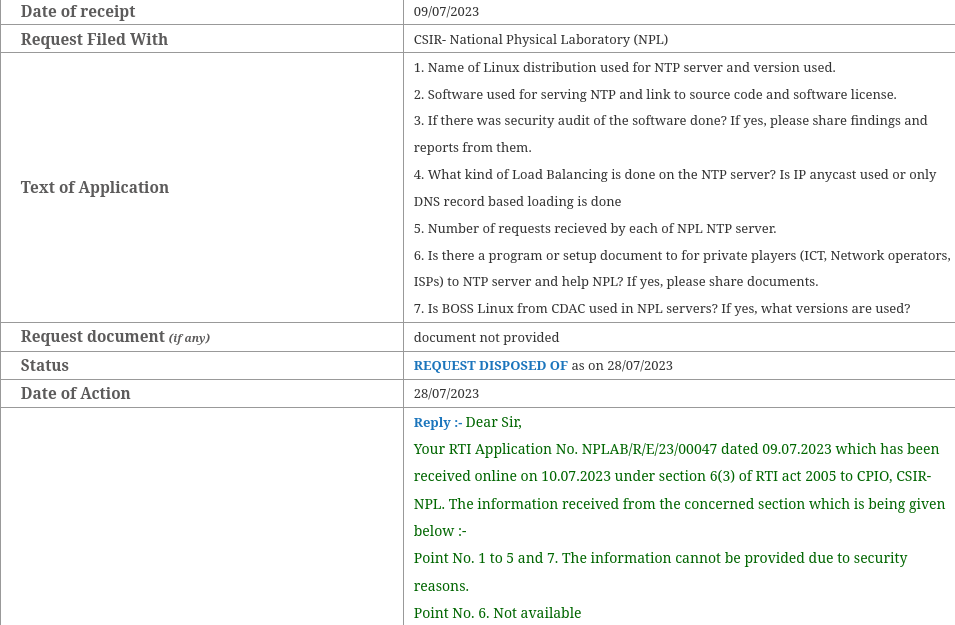
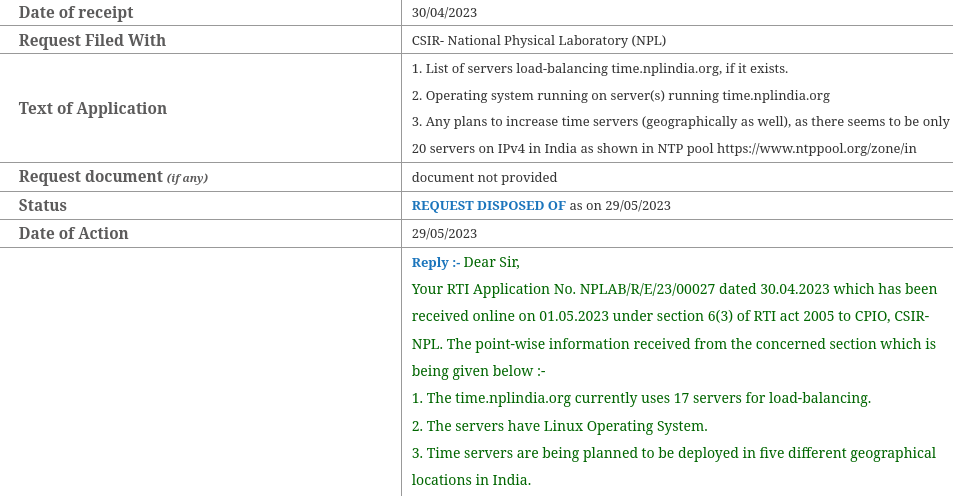
CSIR-National Physical Laboratory (NPL) is the official timekeeper for India and hosts the only public Stratum 1 clock in India, according to NTP pool website. So I was naturally curious to know what kind of infrastructure they re running for NTP. India has a Right to Information (RTI) Act which, like the Freedom of Information Act (FOIA) in the United States, gives citizens rights to request information from governmental entities, to which they have to respond in under 30 days. So last year, I filed two sets of RTI (one after the first reply came) inquiring about NPL s public NTP server setup. The first RTI had some generic questions: RTI 1
First RTI. Click to enlarge
This gave a vague idea about the setup, so I sat down and came with some specific questions in the next RTI. RTI 2
Second RTI. Click to enlarge
Feel free to make your conclusions from it now. Bear in mind these were filled last year so things might have changed. Do let me know if you have more information about it. Update (07/07/2024): Found an article from Medianama about Indian government time servers with information sourced through RTI.

Samuel Henrique: Announcing wcurl: a curl wrapper to download files

tl;dr Whenever you need to download files through the terminal and don't feel like using wget:
wcurl example.com/filename.txt
Manpage:
https://manpages.debian.org/unstable/curl/wcurl.1.en.html

Availability (comes installed with the curl package):
  • Debian unstable - Since 2024-07-02
  • Debian testing - Since 2024-07-18
  • Debian 12/bookworm backports - Expected by the end of August 2024.
  • Debian 12/bookworm - Depends on whether Debian's release team will approve it, it could be available in the next point release.
  • Debian derivatives - Rolling releases will get it by the time it's on Debian testing (e.g.: Kali Linux). Stable derivatives only in their next major release.
If you don't want to wait for the package update to arrive, you can always copy the script and place it in your /usr/bin, the code is here:
https://github.com/Debian/wcurl/blob/main/wcurl
https://salsa.debian.org/debian/wcurl/-/blob/main/wcurl?ref_type=heads

Smoother CLI experience Starting with curl version 8.8.0-2, the Debian's curl package now ships a wcurl executable. wcurl is the solution for those who just need to download files without having to remember curl's parameters for things like automatically naming the files. Some people, myself included, would fall back to using wget whenever there was a need to download a file. Sometimes even installing wget just for that usecase. After all, it's easier to remember "apt install wget" rather than "curl -L -O -C - ...". wcurl consists of a simple shell script that provides sane defaults for the curl invocation, for when the use case is to just download files. By default, wcurl will:
  • Encode whitespaces in URLs;
  • Download multiple URLs in parallel if the installed curl's version is >= 7.66.0;
  • Follow redirects;
  • Automatically choose a filename as output;
  • Avoid overwriting files if the installed curl's version is >= 7.83.0 (--no-clobber);
  • Perform retries;
  • Set the downloaded file timestamp to the value provided by the server, if available;
  • Default to the protocol used as https if the URL doesn't contain any;
  • Disable curl's URL globbing parser so and [] characters in URLs are not treated specially.
Example to download a single file:
wcurl example.com/filename.txt
If you ever need to set a custom flag, you can make use of the --curl-options wcurl option, anything set there will be passed to the curl invocation. Just beware that if you need to set any custom flags, it's likely you will be better served by calling curl directly. The --curl-options option is there to allow for some flexibility in unforeseen circumstances.

The need for wcurl I've always felt a bit ashamed of not remembering curl's parameters for downloading a file and automatically naming it, having resorted to wget most of the times this was needed (even installing wget when it wasn't there, just for this). I've spoken to a few other experienced people I know and confirmed what could be obvious to others: a lot of people struggle with this. Recently, the curl project released the results of 2024's curl survey, which also showed this is as a much needed feature, just look at some of the answers:

Q: Which curl command line option do you think needs improvement and how?
-O, I really want wget like functionality where I don't have to specify the name
Downloading a file (like wget) could be improved - with automatic naming of the file
downloading files - wget is much cleaner
I wish the default behaviour when GETting a binary was to drop it on disk. That's the only reason 'wget foo.tgz" is still ingrained in my muscle memory .
Maybe have a way to download without specifying something in -o (the only reason i used wget still)
--remote-time should be default
--remote-name-all could really use a short flag

Q: If you miss support for something, tell us what!
"Write the data to the file named in the URL (or in redirects if I'm feeling daring), and timestamp the file to the last-modified-date". This is the main reason I'm still using wget.
I can finally feel less bad about falling back to wget due to not remembering the parameters I want.

Idealization vs. reality I don't believe curl will ever change its default behavior in such a way that would accommodate this need, as that would have a side-effect of breaking things which expect the current behavior (the blast radius is literally the solar system). This means a new executable needs to be shipped side-by-side with curl, an opportunity to start fresh and work with a more focused use case (to download files). Ideally, this new executable would be maintained by the curl project, make use of libcurl under-the-hood, and be available everywhere. Nobody wants to worry if their systems have the tool or not, it should always be there. Given I'm just a Debian Developer, with not as much free time as I wish, I've decided to write a simple shell script wrapper calling the curl CLI under-the-hood. wcurl will come installed with the curl package from now on, and I will check with the release team about shipping it on the current Debian stable as well. Shipping wcurl in other distros will be up to them (Debian-derivatives should pick it up automatically, though). We've tried to make it easy for anyone to ship this by using the curl license, keeping the script POSIX-compliant, and shipping a manpage. Maybe if there's enough interest across distributions, someone might sign up for implementing this in upstream curl and increase its reach. I would be happy with the curl project reusing the wcurl name when that happens. It's unlikely that wcurl would be shipped by curl upstream as it is, assuming they would prefer a solution that uses libcurl direclty (more similar to curl the CLI, to maintain). In the worst case, wcurl becomes a Debian-specific tool that only a few people are aware of, in the best case, it becomes the new go-to CLI tool for simply downloading files. I would be happy if at least someone other than me finds it useful.

Naming is hard When I started working on it, I was calling the new executable "curld" (stands for "curl download"), but then when discussing this in one of our weekly calls in the Debian Bras lia community, it was mentioned that this could be confused for a daemon. We then settled for the name "wcurl", suggested by Carlos Henrique Lima Melara <charles>. It doesn't really stand for anything, but it's very easy to remember. You know... "it's that wget alternative for when you want to use curl instead" :)

Feedback I'm hosting the code on Github and Debian's GitLab instance, feel free to open an issue to provide feedback.
https://salsa.debian.org/debian/wcurl
https://github.com/Debian/wcurl We also have a Matrix room for the Debian curl maintainers:
https://matrix.to/#/#debian-curl-maintainers:matrix.org

Acknowledgments The idea for wcurl came a few days before the curl-up conference 2024. I've been thinking a lot about developer productivity in the terminal lately, different tools and better defaults. Before curl-up, I was also thinking about packaging improvements for the curl package. I don't remember what exactly happened, but I likely had to download something and felt a bit ashamed of maintaining curl and not remembering the parameters to download files the way I wanted. I first discussed this idea in the conference, where I asked the participants about it and there were no concerns raised, and some people said I should give it a go. Participating in curl-up was a really great experience and I'm thankful for the interactions I've had there. On the Debian side, I've got reviews of the code and manpage by Sergio Durigan Junior <sergiodj>, Guilherme Puida Moreira <puida> and Carlos Henrique Lima Melara <charles>. Sergio ended up rewriting the tool to be POSIX-compliant (my version was written in bash), so he takes all the credit for the portability.

Changes since publication

2024-07-18
  • Update date of availability for Debian testing and expected date for bookworm backports.
  • Mention charles as the person who suggested "wcurl" as a name.
  • Update wcurl's -o/--opts options, it's now just --curl-options.
  • Remove mention of language spoken in the Matrix room, we are using English now.
  • Update list of features of wcurl.

2 July 2024

Dima Kogan: vnlog.slurp() with non-numerical data

For a while now I'd see an annoying problem when trying to analyze data. I would be trying to import into numpy an innocuous-looking data file like this:
#  image   x y z temperature
image1.png 1 2 5 34
image2.png 3 4 1 35
As usual, I would be using vnlog.slurp() (a thin wrapper around numpy.loadtxt()) to read this in, but that doesn't work: the image filenames aren't parseable as numerical values. Up until now I would work around this by using the suprocess module to fork off a vnl-filter -p !image and then slurp that, but it's a pain and slow and has other issues. I just solved this conclusively using the numpy structured dtypes. I can now do this:
dtype = np.dtype([ ('image',       'U16'),
                   ('x y z',       int, (3,)),
                   ('temperature', float), ])
arr = vnlog.slurp("data.vnl", dtype=dtype)
This will read the image filename, the xyz points and the temperature into different sub-arrays, with different types each. Accessing the result looks like this:
print(arr['image'])
---> array(['image1.png', 'image2.png'], dtype='<U16')
print(arr['x y z'])
---> array([[1, 2, 5],
            [3, 4, 1]])
print(arr['temperature'])
---> array([34., 35.])
Notes: We still do not support records with any null values (-). This could probably be handled with the converters kwarg of numpy.loadtxt(), but that sounds slow. I'll look at that later. This is available today in vnlog 1.38.

Bits from Debian: Bits from the DPL

Dear Debian community, Statement on Daniel Pocock The Debian project has successfully taken action to secure its trademarks and interests worldwide, as detailed in our press statement. I would like to personally thank everyone in the community who was involved in this process. I would have loved for you all to have spent your volunteer time on more fruitful things. Debian Boot team might need help I think I've identified the issue that finally motivated me to contact our teams: for a long time, I have had the impression that Debian is driven by several "one-person teams" (to varying extents of individual influence and susceptibility to burnout). As DPL, I see it as my task to find ways to address this issue and provide support. I received private responses from Debian Boot team members, which motivated me to kindly invite volunteers to some prominent and highly visible fields of work that you might find personally challenging. I recommend subscribing to the Debian Boot mailing list to see where you might be able to provide assistance. /usrmerge Helmut Grohne confirmed that the last remaining packages shipping aliased files inside the package set relevant to debootstrap were uploaded. Thanks a lot for Helmut and all contributors that helped to implement DEP17. Contacting more teams I'd like to repeat that I've registered a BoF for DebConf24 in Busan with the following description: This BoF is an attempt to gather as much as possible teams inside Debian to exchange experiences, discuss workflows inside teams, share their ways to attract newcomers etc. Each participant team should prepare a short description of their work and what team roles ( openings ) they have for new contributors. Even for delegated teams (membership is less fluid), it would be good to present the team, explain what it takes to be a team member, and what steps people usually go to end up being invited to participate. Some other teams can easily absorb contributions from salsa MRs, and at some point people get commit access. Anyway, the point is that we work on the idea that the pathway to become a team member becomes more clear from an outsider point-of-view. I'm lagging a bit behind my team contacting schedule and will not manage to contact every team before DebConf. As a (short) summary, I can draw some positive conclusions about my efforts to reach out to teams. I was able to identify some issues that were new to me and which I am now working on. Examples include limitations in Salsa and Salsa CI. I consider both essential parts of our infrastructure and will support both teams in enhancing their services. Some teams confirmed that they are basically using some common infrastructure (Salsa team space, mailing lists, IRC channels) but that the individual members of the team work on their own problems without sharing any common work. I have also not read about convincing strategies to attract newcomers to the team, as we have established, for instance, in the Debian Med team. DebConf attendance The amount of money needed to fly people to South Korea was higher than usual, so the DebConf bursary team had to make some difficult decisions about who could be reimbursed for travel expenses. I extended the budget for diversity and newcomers, which enabled us to invite some additional contributors. We hope that those who were not able to come this year can make it next year to Brest or to MiniDebConf Cambridge or Toulouse tag2upload On June 12, Sean Whitton requested comments on the debian-vote list regarding a General Resolution (GR) about tag2upload. The discussion began with technical details but unfortunately, as often happens in long threads, it drifted into abrasive language, prompting the community team to address the behavior of an opponent of the GR supporters. After 560 emails covering technical details, including a detailed security review by Russ Allbery, Sean finally proposed the GR on June 27, 2024 (two weeks after requesting comments). Firstly, I would like to thank the drivers of this GR and acknowledge the technical work behind it, including the security review. I am positively convinced that Debian can benefit from modernizing its infrastructure, particularly through stronger integration of Git into packaging workflows. Sam Hartman provided some historical context [1], [2], [3], [4], noting that this discussion originally took place five years ago with no results from several similarly lengthy threads. My favorite summary of the entire thread was given by Gregor Herrmann, which reflects the same gut feeling I have and highlights a structural problem within Debian that hinders technical changes. Addressing this issue is definitely a matter for the Debian Project Leader, and I will try to address it during my term. At the time of writing these bits, a proposal from ftpmaster, which is being continuously discussed, might lead to a solution. I was also asked to extend the GR discussion periods which I will do in separate mail. Talk: Debian GNU/Linux for Scientific Research I was invited to have a talk in the Systems-Facing Track of University of British Columbia (who is sponsoring rack space for several Debian servers). I admit it felt a bit strange to me after working more than 20 years for establishing Debian in scientific environments to be invited to such a talk "because I'm DPL". Kind regards Andreas.

Mike Gabriel: Polis - a FLOSS Tool for Civic Participation -- Introduction (episode 1/5)

This is the first article of a 5-episode blog post series written by Guido Berh rster, member of staff at my company Fre(i)e Software GmbH. Thanks, Guido for being on the Polis project. Enjoy the read on the work Guido has been doing over the past months,
Mike
A team lead by Raoul Kramer/BetaBreak is currently adapting Polis for evaluation and testing by several Dutch provincial governments and central government ministries. Guido Berh rster (author of this article) who is an employee at Fre(i)e Software GmbH has been involved in this project as the main software developer. This series of blog posts describes how and why Polis was initially modified and adapted, what issues the team ran into and how this ultimately lead them to start a new Open Source project called Particiapp for accelerating the development of alternative Polis frontends compatible to but independent from the upstream project. Table of Contents of the Blog Post Series
  1. Introduction (this article)
  2. Initial evaluation and adaptation
  3. Issues extending Polis and adjusting our goals
  4. Creating (a) new frontend(s) for Polis
  5. Current status and roadmap
Polis - The Introduction What is Polis? Polis is a platform for participation which helps to gather, analyze and understand viewpoints of large groups of participants on complex issues. In practical terms participants take part in conversations on a predefined topic by voting on statements or submitting their own statements (referred to as comments in Polis) for others to vote on1. Through statistical analysis including machine learning participants are sorted into groups based on similarities in voting behavior. In addition, group-informed and overall consensus statements are identified and presented to participants in real-time. This allows for participants to react to and refine statements and either individually or through a predefined process to come to an overall consensus. Furthermore, the order in which statements are presented to participants is influenced by a complex weighting system based on a number of factors such as variance, recency, and frequency of skipping. This so called comment routing is intended to facilitate a meaningful contribution of participants without requiring them to vote on each of a potentially huge number of statements 2. Polis open-ended nature sets it apart from online surveys using pre-defined questions and allows its users to gather a more accurate picture of the public opinion. In contrast to a discussion forum or comment section where participants directly reply to each other, it discourages unproductive behavior such as provocations or personal attacks by not presenting statements in chronological order in combination with voting. Finally, its comment routing is intended to provide scalability towards a large number of participants which generate a potentially large number of statements. The project was developed and is maintained by The Computational Democracy Project, a USA-based non-profit organization which provides a hosted version and offers related services. It is also released as Open Source software under the AGPL 3.0 license. Polis has been used in a variety of different contexts as part of broader political processes facilitating broader political participation and opinion-forming, and gathering feedback and creative input. Use of Polis in Taiwan One prominent use case of Polis is its adoption as part of the vTaiwan participatory governance project. Established by the g0v civic tech community in the wake of the 2014 mass protests by the Sunflower movement, the vTaiwan project enables consultations on proposed legislation among a broad range of stakeholders including government ministries, lawmakers, experts, interest groups, civil society as well as the broader public. Although the resulting recommendations are non-binding, they exert pressure on the government to take action and recommendations have been adopted into legislation.345 vTaiwan uses Polis for large-scale online deliberations as part of a structured participation process. These deliberations take place after identifying and involving stakeholders and experts and providing through information about the topic at hand to the public. Citizens are then given the opportunity to vote on statements or provide alternative proposals which allows for the refinement of ideas and ideally leads to a consensus at the end. The results of these online deliberations are then curated, discussed in publicly broadcast face-to-face meetings which ultimately produce concrete policy recommendations. vTaiwan has in numerous cases given impulses resulting in government action and provided significant input e.g. on legislation regulating Uber or technological experiments by Fintech startups.35 See also
  1. https://compdemocracy.org/Polis/
  2. https://compdemocracy.org/comment-routing/
  3. https://info.vtaiwan.tw/
  4. https://www.theguardian.com/world/2020/sep/27/taiwan-civic-hackers-polis-consensus-social-media-platform
  5. https://www.technologyreview.com/2018/08/21/240284/the-simple-but-ingenious-system-taiwan-uses-to-crowdsource-its-laws/

Colin Watson: Free software activity in June 2024

My Debian contributions this month were all sponsored by Freexian. You can support my work directly via Liberapay.

Ben Hutchings: FOSS activity in June 2024

Ben Hutchings: FOSS activity in May 2024

1 July 2024

Ben Hutchings: FOSS activity in April 2024

Paul Wise: FLOSS Activities June 2024

Focus This month I didn't have any particular focus. I just worked on issues in my info bubble.

Changes

Issues

Communication
  • Respond to queries from Debian users and contributors on IRC

Sponsors All work was done on a volunteer basis.

Sahil Dhiman: Personal ASNs From India

Internet and it s working are interesting and complex. We need an IP address to connect to the Internet. A group of IP addresses with common routing policy is known as an Autonomous System (AS). Each AS has a globally unique Autonomous System Number (ASN) and is maintained by a single entity or individual(s). Your ISP would have an ASN. IP addresses/prefixes are advertised (announced) by an AS through Border Gateway Protocol (BGP) to its peers (ASes which it connects to) to steer traffic in its direction or back. Take for example Google DNS service at 8.8.8.8 owned and operated by AS15169 Google LLC. AS15169 through BGP announcements, lets all its peers know that traffic for whole of 8.8.8.0/24 (including 8.8.8.8) prefix should be sent to them. See the following screenshot response of mtr -zt 8.8.8.8 from my system. From my Internet Service Provider (ISP), AS133982 Excitel Broadband, traffic travels to AS15169 to reach 8.8.8.8 (dns.google) and returns via the same path. This Inter-AS traffic makes the Internet tick. mtr from Excitel to Google ASes comes in different sizes and purposes. Like AS749 DoD Network Information Center which holds more than 200 million+ IPv4 addresses for historical reasons or AS23860 Alliance Broadband Services which has 68 thousand+ IPv4 address for purpose of providing consumer Internet. Similarly, some individuals also run their personal ASN including a bunch of Indians. Most of these Indian ASNs are IPv6 (primary or only) networks run for hobby and educational purposes. I was interested in this data, so complied a list of active ones (visible in the global routing table) from BGP.Tools: Let me know if I m missing someone.

Russell Coker: VoLTE in Australia

Introduction In Australia the 3G mobile frequencies are to be reused so they are in the process of shutting down the 3G service. That means that everyone has to use VoLTE (Voice Over LTE) for phone calls (including emergency calls). The shutdown time varies by telco, Kogan Mobile (one of the better services which has good value for money and generally works well) shut down their 3G service in January. Aldi Mobile (another one of the good services which is slightly more expensive but has included free calls to most first-world countries and uses the largest phone network) will shut theirs down at the end of August. For background there s a Fosdem talk about OpenSIPS with VoLTE and VoNR [1], it s more complex than you want to know. Also VoNR (Voice over New Radio) is the standard for 5G voice and it s different from VoLTE and has a fallback to VoLTE. Another good lecture for background information is the Fosdem talk on VoLTE at the handset end [2]. The PinePhonePro In October 2023 I tried using my PinePhonePro as my main phone but that only lasted a few days due to problems with calls and poor battery life [3]. Since then I went back to the Huawei Mate 10 Pro that I bought refurbished in June 2019 for $389. So that has been my main phone for 5 years now, giving a cost of $1.50 per week. I had tried using a Huawei Nova 7i running Android without Google Play as an experiment but that had failed, I do many things that need Android apps [4]. I followed the PinePhone wiki to get my PinePhonePro working with VoLTE [5]. That worked fine for me, the only difference from the instructions is that I had to use device /dev/ttyUSB3 and that the modem kept resetting itself during the process and when that happened I had to kill minicom and start again. After changing the setting and saving it the PinePhonePro seemed to work well with VoLTE on a Kogan Mobile SIM (so definitely not using 3G). One issue I have found is that Plasma Mobile (my preferred FOSS phone GUI) appears to have a library issue that results in polling every 14ms even when the screen is locked [6]. If you have a few processes doing that (which means the most lightly used Plasma system) it really hurts battery use. The maintainer has quite reasonably deferred action on this bug report given the KDE 6 transition. Later on in the Trixie development cycle I hope to get this issue resolved, I don t expect it to suddenly make battery life good. But it might make battery life acceptable. I am now idly considering carrying around my PinePhonePro in a powered off state for situations where I might need to do high security operations (root logins to servers or online banking) but for which carrying a laptop isn t convenient. It will do well for the turn on, do 30 mins of work that needs security, and then turn off scenario. Huawei Mate 10 Pro and Redmi 9A The Huawei Mate 10 Pro has been my main phone for 5 years and it has worked well, so it would be ideal if it could do VoLTE as the PinePhonePro isn t ready yet. All the web pages I ve seen about the Mate 10 Pro say that it will either allow upgrading to a VoLTE configuration if run with the right SIM or only support it with the right SIM. I did a test with a Chinese SIM which gave an option of turning on VoLTE but didn t allow any firmware updates and the VoLTE option went away when I put an Australian SIM in. Some forum comments had led me to believe that it would either permanently enable VoLTE or allow upgrading the firmware to one that enables VoLTE if I used a Chinese SIM but that is not the case. I didn t expect a high probability of success but I had to give it a go as it s a nice phone. I did some tests on a Redmi 9A (a terrible phone that has really bad latency on the UI in spite of having reasonably good hardware). The one I tested on didn t have VoLTE enabled when I got it, to test that I used the code *#*#4636#*#* in the dialler to get the menu of SIM information and it showed that VoLTE was not provisioned. I then had to update to the latest release of Android for that phone and enter *#*#86583#*#* in the dialler to enable VoLTE, the message displayed after entering that magic number must end in DISABLE . I get the impression that the code in question makes the phone not check certain aspects of whether the carrier is good for VoLTE and just do it. So apparently Kogan Mobile somehow gives the Redmi 9A the impression that VoLTE isn t supported but if the phone just goes ahead and connects it will work. I don t plan to use a Redmi 9A myself as it s too slow, but I added it to my collection to offer to anyone else I know who needs a phone with VoLTE and doesn t use the phone seriously or to someone who needs a known good phone for testing things. Samsung Galaxy Note 9 I got some Samsung Galaxy Note 9 phones to run Droidian as an experiment [7]. But Droidian dropped support for the Note 9 and I couldn t figure out how to enable VoLTE via Droidian, which was very annoying after I had spent $109 on a test phone and $215 on a phone for real use (I have no plans to try Droidian again at this time). I tried installing LineageOS on one Note 9 [8] which was much easier than expected (especially after previously installing Droidian). But VoLTE wasn t an option. According to Reddit LineageOS doesn t support VoLTE on Samsung devices and you can use a magisk module or a VoLTE enabler module but those aren t supported by LineageOS either [9]. I downloaded an original image for the Note 9 from SamsMobile.com [10]. That image booted past the orange stage (where if you have problems then your phone is probably permanently useless) but didn t boot into the OS. A friend helped me out with that and it turned out that the Heimdal flash tool on Linux didn t do something it needed to do and that Odin on Windows was required. After using Odin everything was fine and I have a Note 9 with VoLTE running the latest Samsung firmware which is security patch level 1st July 2022!!! So I have a choice between using a Note 9 for data and SMS while running a current version of Lineage OS with all security fixes or running a Samsung image with no security updates for 2 years which supports phone calls. So based on this I have to recommend Pixel as the phone of choice, it has a decent level of support from Google and long term support from LineageOS. According to the LineageOS web site you can run the current version of Lineage on the original Pixel phone from 2016! Of course getting VoLTE to work on it might be another saga, but it would probably be easier to do with LineageOS on a Pixel than on a Samsung phone. Conclusion The operation of the Note 9 for me is decent now apart from the potential security issues. The same goes for selling one of the phones. The PinePhonePro still has potential to become my daily driver at some future time if I and others can optimise power use. Also a complicating factor is that I want to have both Jabber and Matrix be actually instant IM systems not IM with a 5 minute delay, so suspend mode isn t a good option. Pixel phones will be a much higher priority when looking at phones to buy in future. The older Pixel phones go for as little as $100 on eBay and can still run the latest LineageOS. VoLTE seems needlessly complicated.

Niels Thykier: Debian packaging with style black

When I started working on the language server for debputy, one of several reasons was about automatic applying a formatting style. Such that you would not have to remember to manually reformat the file. One of the problems with supporting automatic formatting is that no one agrees on the "one true style". To make this concrete, Johannes Schauer Marin Rodrigues did the numbers of which wrap-and-sort option that are most common in https://bugs.debian.org/895570#46. Unsurprising, we end up with 14-15 different styles with various degrees of popularity. To make matters worse, wrap-and-sort does not provide a way to declare "this package uses options -sat". So that begged the question, how would debputy know which style it should use when it was going to reformat file. After a couple of false-starts, Christian Hofstaedtler mentioned that we could just have a field in debian/control for supporting a "per-package" setting in responds to my concern about adding a new "per-package" config file. At first, I was not happy with it, because how would you specify all of these options in a field (in a decent manner)? But then I realized that one I do not want all these styles and that I could start simpler. The Python code formatter black is quite successful despite not having a lot of personalized style options. In fact, black makes a statement out of not allowing a lot of different styles. Combing that, the result was X-Style: black (to be added to the Source stanza of debian/control), which every possible reference to the black tool for how styling would work. Namely, you outsource the style management to the tool (debputy) and then start using your focus on something else than discussing styles. As with black, this packaging formatting style is going to be opinionated and it will evolve over time. At the starting point, it is similar to wrap-and-sort -sat for the deb822 files (debputy does not reformat other files at the moment). But as mentioned, it will likely evolve and possible diverge from wrap-and-sort over time. The choice of the starting point was based on the numbers posted by Johannes #895570. It was not my personal favorite but it seemed to have a majority and is also close to the one suggested by salsa pipeline maintainers. The delta being -kb which I had originally but removed in 0.1.34 at request of Otto Kek l inen after reviewing the numbers from Johannes one more time. To facilitate this new change, I uploaded debputy/0.1.30 (a while back) to Debian unstable with the following changes:
  • Support for the X-Style: black header.
  • When a style is defined, the debputy lsp server command will now automatically reformat deb822 files on save (if the editor supports it) or on explicit "reformat file" request from the editor (usually indirectly from the user).
  • New subcommand debputy reformat command that will reformat the files, when a style is defined.
  • A new pre-commit hook repo to run debputy lint and debputy reformat. These hooks are available from https://salsa.debian.org/debian/debputy-pre-commit-hooks version v0.1 and can be used with the pre-commit tool (from the package of same name).
The obvious omission is a salsa-pipeline feature for this. Otto has put that on to his personal todo list and I am looking forward to that.
Beyond black Another thing I dislike about our existing style tooling is that if you run wrap-and-sort without any arguments, you have a higher probability of "trashing" the style of the current package than getting the desired result. Part of this is because wrap-and-sort's defaults are out of sync with the usage (which is basically what https://bugs.debian.org/895570 is about). But I see another problem. The wrap-and-sort tool explicitly defined options to tweak the style but provided maintainers no way to record their preference in any machine readable way. The net result is that we have tons of diverging styles and that you (as a user of wrap-and-sort) have to manually tell wrap-and-sort which style you want every time you run the tool. In my opinion that is not playing to the strengths of neither human nor machine. Rather, it is playing to the weaknesses of the human if anything at all. But the salsa-CI pipeline people also ran into this issue and decided to work around this deficiency. To use wrap-and-sort in the salsa-CI pipeline, you have to set a variable to activate the job and another variable with the actual options you want. The salsa-CI pipeline is quite machine readable and wrap-and-sort is widely used. I had debputy reformat also check for the salsa-CI variables as a fallback. This fallback also works for the editor mode (debputy lsp server), so you might not even have to run debputy reformat. :) This was a deliberate trade-off. While I do not want all us to have all these options, I also want Debian packaging to be less painful and have fewer paper cuts. Having debputy go extra lengths to meet wrap-and-sort users where they are came out as the better solution for me. A nice side-effect of this trade-off is that debputy reformat now a good tool for drive-by contributors. You can safely run debputy reformat on any package and either it will apply the styling or it will back out and inform you that no obvious style was detected. In the latter case, you would have to fallback to manually deducing the style and applying it.
Differences to wrap-and-sort The debputy reformat has some limitations or known differences to wrap-and-sort. Notably, debputy reformat (nor debputy lsp server) will not invoke wrap-and-sort. Instead, debputy has its own reformatting engine that provides similar features. One reason for not running wrap-and-sort is that I want debputy reformat to match the style that debputy lsp server will give you. That way, you get consistent style across all debputy commands. Another reason is that it is important to me that reformatting is safe and does not change semantics. This leads to two regrettable known differences to the wrap-and-sort behavior due to safety in addition to one scope limitation in debputy:
  1. debputy will ignore requests to sort the stanzas when the "keep first" option is disabled (-b --no-keep-first). This combination is unsafe reformatting. I feel it was a mistake for wrap-and-sort to ever allow this but at least it is no longer the default (-b is now -bk by default). This will be less of a problem in debhelper-compat 15, since the concept of "main package" will disappear and all multi-binary source packages will be required to use debian/package.install rather than debian/install.
  2. debputy will not reorder the contents of debhelper packaging files such as debian/install. This is also an (theoretical) unsafe thing to do. While the average package will not experience issues with this, there are rare corner cases where the re-ordering can affect the end result. I happen to know this, because I ran into issues when trying to optimize dh_install in a way that assumed the order did not matter. Stuff broke and there is now special-case code in dh_install to back out of that optimization when that happens.
  3. debputy has a limited list of wrap-and-sort options it understands. Some options may cause debputy to back out and disable reformatting entirely with a remark that it cannot apply that style. If you run into a case of this, feel free to file a feature request to support it. I will not promise to support everything, but if it is safe and trivially doable with the engine already, then I probably will.
As stated, where debputy cannot implement the wrap-and-sort styles fully, then it will currently implement a subset that is safe if that can be identified or back out entirely of the formatting when it cannot. In all cases, debputy will not break the formatting if it is correct. It may just fail at correcting one aspect of the wrap-and-sort style if you happen to get it wrong. It is also important to remember that the prerequisite for debputy applying any wrap-and-sort style is that you have set the salsa-CI pipeline variables to trigger wrap-and-sort with the salsa-CI pipeline. So there is still a CI check before the merge that will run the wrap-and-sort in its full glory that provides the final safety net for you.
Just give me a style In conclusion, if you, like me, are more interested in getting a consistent style rather than discussing what that style should be, now you can get that with X-Style: black. You can also have your custom wrap-and-sort style be picked up automatically for drive-by contributors.
$ apt satisfy 'dh-debputy (>= 0.1.30), python3-lsprotocol'
# Add  X-Style: black  to  debian/control  for "just give me a style"
#
# OR, if there is a specific  wrap-and-sort  style for you then set
# SALSA_CI_DISABLE_WRAP_AND_SORT=no plus set relevant options in
# SALSA_CI_WRAP_AND_SORT_ARGS in debian/salsa-ci.yml (or .gitlab-ci.yml)
$ debputy reformat
It is sadly not yet in the salsa-ci pipeline. Otto is looking into that and hopefully we will have it soon. :) And if you find yourself often doing archive-wide contributions and is tired of having to reverse engineer package formatting styles, consider using debputy reformat or debputy lsp server. If you use debputy in this way, please consider providing feedback on what would help you.

Russell Coker: Links June 2024

Modos Labs have released the design of an e-ink display connected by USB-C [1]. They have provided a lot of background information on e-ink displays which isn t available elsewhere. Excellent work! Informative article about a company giving renters insecure locks while facilitating collusion to raise rents [2]. Insightful video by JimmyTheGiant about the destruction of housing estates in the UK [3]. I wonder how much of this was deliberate by the Tories. Insightful video by Modern Vintage Gamer about the way Nintendo is destroying history by preventing people playing old games [4]. Interesting video by Louis Rossmann about the low quality of products and reviews on Amazon [5]. We all know about Enshittification, but it seems that Amazon is getting to the stage of being unusable for some products. Amusing video by Folding Ideas about Decentraland an attampt at a blockchain based second life type thing which failed as you expect blockchain things to fail [6]. The top comment is a transcription of the actions of the speaker s pet cat. ;)

Guido G nther: Free Software Activities June 2024

A short status update of what happened on my side last month. Was able to test our Cellbroadcast bits, feedbackd became more flexible regarding LEDs, Phosh 0.40 is out, and some more. Phosh Phoc gmobile phosh-mobile-settings phosh-wallpapers emacs Debian ModemManager Feedbackd Livi Calls Chatty meta-phosh Libhandy If you want to support my work see donations.

Next.

Previous.