Search Results: "bod"

26 September 2014

Holger Levsen: 20140925-reproducible-builds

Reproducible builds? I never did any - manually :) I've never done a reproducible build attempt of any package, manually, ever. But what I've done now is setting up reproducible builds on jenkins.debian.net which will build hundreds or thousands of packages, hopefully reproducibly, regularily in the future. Thanks to Lunar's and many other peoples work, this was actually rather easy. If you want to do this manually, it should take you just a few minutes to setup a suitable build environment. So three days ago when I wasn't exactly bored I decided that it was a good moment to implement some reproducible build jobs on jenkins.d.n, and so I gave it a try and two hours later the basic implementation was working, and then it was an evening and morning of fine tuning until I was mostly satisfied. Since then there has been some polishing, but the basic setup is done and has been working since. What's the result? One job, reproducible_setup will just create a suitable environment for pbuilding reproducible packages as documented so well on the Debian wiki. And as that job runs 3.5 minutes only (to debootstrap from scratch), it's run daily. And then there are currently 16 other jobs, which test reproducible builds in different areas: d-i, core, some six major desktops and some selected desktop applications, some security + privacy related packages, some build chains we have in Debian, libreoffice and X.org. Most of these jobs run several hours, but luckily not days. And they discover packages which still fail to build reproducibly, which already has caused some bugs to be filed, eg. #762732 "libdebian-installer: please do not write timestamps in Doxygen generated documentation". So this is the output from testing the reproducibilty of all debian-installer packages: 72 packages were successfully built reproducibly, while 6 packages failed to do so. I was quite impressed by these numbers as AFAIK noone tried to build d-i reproducibly before.
72 packages successfully built reproducibly: userdevfs user-setup usb-discover udpkg tzsetup rootskel rootskel-gtk rescue preseed pkgsel partman-xfs partman-target partman-partitioning partman-nbd partman-multipath partman-md partman-lvm partman-jfs partman-iscsi partman-ext3 partman-efi partman-crypto partman-btrfs partman-basicmethods partman-basicfilesystems partman-base partman-auto partman-auto-raid partman-auto-lvm partman-auto-crypto partconf os-prober oldsys-preseed nobootloader network-console netcfg net-retriever mountmedia mklibs media-retriever mdcfg main-menu lvmcfg lowmem localechooser live-installer lilo-installer kickseed kernel-wedge kbd-chooser iso-scan installation-report installation-locale hw-detect grub-installer finish-install efi-reader dh-di debian-installer-utils debian-installer-netboot-images debian-installer-launcher clock-setup choose-mirror cdrom-retriever cdrom-detect cdrom-checker cdebconf-terminal cdebconf-entropy bterm-unifont base-installer apt-setup anna 
6 packages failed to built reproducibly: win32-loader libdebian-installer debootstrap console-setup cdebconf busybox 
What's also impressive: all packages for the newly introduced Cinnamon Desktop build reproducibly from the start! The jenkins setup is configured via just three small files: That's it and that's enough to keep several cores busy for days. :-) But as each job only takes a few hours each is scheduled twice a month and more jobs and packages shall be added in future (with some heuristics to schedule known good packages less often...) I guess it's an appropriate opportunity to say "many thanks to Profitbricks", who have been donating the powerful virtual machine jenkins.debian.net is running on since October 2012. I also want to say "many many thanks to Helmut" (Grohne) who has recently joined me in maintaining this jenkins setup. And then I'd like to thank "the KGB trio" (Gregor, Tincho and Dam!) for providing those KGB bots on IRC, which are very helpful for providing notifications on IRC channels and last but not least thanks to everybody who contributed so that reproducible builds got this far! Keep up the jolly good work! And If you happen to know failing packages not included in job-cfg/reproducible.yaml I'd like to hear about those, so they'll get regularily tested and appear on the radar, until finally bugs are filed, fixed and migrated to stable. So one day all binary packages in Debian stable will be build reproducibly. An important step on this road is probably to have this defined as an release goal for Jessie+1. And then for jessie+1 hopefully the first 10k packages will build reproducibly? Or whooping 23k maybe? ;-) And maybe release jessie+2 with 100%?!? We will see! Even Jessie already has quite some packages (someone needs to count them...) which build reproducibly with just modified dpkg(-dev) and debhelper packages alone... So let's fix all the bugs! That said, an easier start for most of you is probably the list of useful things you (yes, you!) can do! :-) Oh, and last but surely not least in my book: many thanks too to the nice people hosting me so friendly in the last days! Keep on rockin'!

25 September 2014

Russ Allbery: Review: Turn the Ship Around!

Review: Turn the Ship Around!, by L. David Marquet
Publisher: Portfolio
Copyright: 2012
ISBN: 1-101-62369-1
Format: Kindle
Pages: 272
Turn the Ship Around! (yes, complete with the irritating exclamation point in the title) is marketed to the business and management non-fiction market, which is clogged with books claiming to provide simple techniques to be a great manager or fix an organization. If you're like me, this is a huge turn-off. The presentation of the books is usually just shy of the click-bait pablum of self-help books. Many of the books are written by famous managers best known for doing horrible things to their staff (*cough* Jack Welch). It's hard to get away from the feeling that this entire class of books is an ocean of bromides covering a small core of outright evil. This book is not like that, and Marquet is not one of those managers. It can seem that way at times: it is presented in the format that caters to short attention span, with summaries of primary points at the end of every short chapter and occasionally annoying questions sprinkled throughout. I'm capable of generalizing information to my own life without being prompted by study questions, thanks. But that's just form. The core of this book is a surprisingly compelling story of Marquet's attempt to introduce a novel management approach into one of the most conservative and top-down of organizations: a US Navy nuclear submarine. I read this book as an individual employee, and someone who has no desire to ever be a manager. But I recently changed jobs and significantly disrupted my life because of a sequence of really horrible management decisions, so I have strong opinions about, at least, the type of management that's bad for employees. A colleague at my former employer recommended this book to me while talking about the management errors that were going on around us. It did such a good job of reinforcing my personal biases that I feel like I should mention that as a disclaimer. When one agrees with a book this thoroughly, one may not have sufficient distance from it to see the places where its arguments are flawed. At the start of the book, Marquet is assigned to take over as captain of a nuclear submarine that's struggling. It had a below-par performance rating, poor morale, and the worst re-enlistment rate in the fleet, and was not advancing officers and crew to higher ranks at anywhere near the level of other submarines. Marquet brought to this assignment some long-standing discomfort with the normal top-down decision-making processes in the Navy, and decided to try something entirely different: a program of radical empowerment, bottom-up decision-making, and pushing responsibility as far down the chain of command as possible. The result (as you might expect given that you can read a book about it) was one of the best-performing submarines in the fleet, with retention and promotion rates well above average. There's a lot in here about delegated decision-making and individual empowerment, but Turn the Ship Around! isn't only about that. Those are old (if often ignored) rules of thumb about how to manage properly. I think the most valuable part of this book is where Marquet talks frankly about his own thought patterns, his own mistakes, and the places where he had to change his behavior and attitude in order to make his strategy successful. It's one thing to say that individuals should be empowered; it's quite another to stop empowering them (which is still a top-down strategy) and start allowing them to be responsible. To extend trust and relinquish control, even though you're the one who will ultimately be held responsible for the performance of the people reporting to you. One of the problems with books like this is that they focus on how easy the techniques presented in the book are. Marquet does a more honest job in showing how difficult they are. His approach was not complex, but it was emotionally quite difficult, even though he was already biased in favor of it. The control, hierarchy, and authority parts of the book are the most memorable, but Marquet also talks about, and shows through specific examples from his command, some accompanying principles that are equally important. If everyone in an organization can make decisions, everyone has to understand the basis for making those decisions and understand the shared goals, which requires considerable communication and open discussion (particularly compared to a Navy ideal of an expert and taciturn captain). It requires giving people the space to be wrong, and requires empowering people to correct each other without blame. (There's a nice bit in here about the power of deliberate action, and while Marquet's presentation is more directly applicable to the sorts of physical actions taken in a submarine, I was immediately reminded of code review.) Marquet also has some interesting things to say about the power of, for lack of a better term, esprit de corps, how to create it, and the surprising power of acting like you have it until you actually develop it. As mentioned, this book is very closely in alignment with my own biases, so I'm not exactly an impartial reviewer. But I found it fascinating the degree to which the management situation I left was the exact opposite of the techniques presented in this book in nearly every respect. I found it quite inspiring during my transition period, and there are bits of it that I want to read again to keep some of the techniques and approaches fresh in my mind. There is a fair bit of self-help-style packaging and layout here, some of which I found irritating. If, like me, you don't like that style of book, you'll have to wade through a bit of it. I would have much preferred a more traditional narrative story from which I could draw my own conclusions. But it's more of a narrative than most books of this sort, and Marquet is humble enough to show his own thought processes, tensions, and mistakes, which adds a great deal to the presentation. I'm not sure how directly helpful this would be for a manager, since I've never been in that role, but it gave me a lot to think about when analyzing successful and unsuccessful work environments. Rating: 8 out of 10

24 September 2014

Laura Arjona: 10 short steps to contribute translations to free software for Android

This small guide assumes that you know how to create a public repository with git (or other version control system). Maybe some projects use other VCS, Subversion or whatever; the process would be similar although the commands will be different of course. If you don t want to use any VCS, you can just download the corresponding file, translate it, and send it by email or to the BTS of the project, but the commands required are very easy and you ll see soon that using git (or any VCS) is quite comfortable and less scary than what it seems. So, you were going to recommend a nice app that you use or found in F-Droid to your friend, but she does not understand English. Why not translating the app for her? And for everybody? It s a job that can be done in 15 minutes or so (Android apps have very short strings, few menus, and so). Let s go! 1.- Search the app in the F-Droid website You can do it going to the URL: https://f-droid.org/repository/browse/?fdfilter=wordofappname Example: https://f-droid.org/repository/browse/?fdfilter=pomodoro Then, open the details of the app, and learn where s the source code. 2.- Clone the source code If you have an account in that forge, fork/clone the project into your account, and then, clone your fork/clone in local. If you haven t got an account in that forge, clone the project in local. git clone URLofTheProjectOrYourClone 3.- In local, create a new branch, and checkout to it. cd nameofrepo git checkout -b Spanish 4.- Then, copy the /res/values folder into res/values-XX folder (where XX is your language code) cp ./res/values /res/values-es -R 5.- Translate Edit the strings.xml file that is in the res/values-XX folder, and change the English strings to your language (respect the XML format). 6.- Translate other files, or delete them If there are more files in that folder (e.g. arrays.xml ), review them to know if they have translatable strings. If yes, translate them. If not, delete the files. 7.- Commit When you are finished, commit your changes: git add res/values-es/* git commit -a (Message can be Spanish translation or so) 8.- Push your changes to your public repo If you didn t create a public clone of the repo in your forge, create a public repo and push your local stuff into there. git push --all 9.- Request a merge to the original repo (Using the web interface of the forge, if it is the same for the original repo and your clone, or sending an email or creating an issue and providing the URL of your repo). For example, open a new issue in the project s BTS Title: Spanish translation available for merging Body: Hi everybody. Thanks for your work in "nameofapp". I have completed a Spanish translation, it's available for review/merge in the Spanish branch of my repo: https://urlofyourclone Best regards 10.- Congratulations! Translations are new features, and having a new feature in your app for free is a great thing, so probably the app developer(s) will merge your translation soon. Share your joy with your friends, so they begin to use the app you translated, and maybe become translators too! Comments? You can comment on this post in this pump.io thread.
Filed under: Tools, Writings (translations) Tagged: Android, Contributing to libre software, English, Free Software, libre software, translations

Russ Allbery: Review: 2014 Hugos: Short Story Nominees

Review: 2014 Hugos: Short Story Nominees, edited by Loncon 3
Publisher: Loncon 3
Copyright: 2014
Format: Kindle
This is a bit of a weird "book review," since this is not a book. Rather, it's the collection of Hugo-nominated short stories for the 2014 Hugos (given for works published in 2013) at Loncon 3, the 2014 Worldcon. As such, the "editor" is the pool of attendees and supporting members who chose to nominate works, all of which had been previously edited by other editors in their original publication. This is also not something that someone else can acquire; if you were not a supporting or attending member, you didn't get the voting packet. But I believe all of the stories here are available on-line for free in some form, a short search away. "If You Were a Dinosaur, My Love" by Rachel Swirsky: The most common complaint about this story is that it's not really a story, and I have to agree. It's a word image of an alternate world in which the narrator's love is a human-sized dinosaur, starting with some surreal humor and then slowly shifting tone as it reveals the horrible event that's happened to the narrator's actual love, and that's sparked the wish for her love to have claws and teeth. It's reasonably good at what it's trying to do, but I wanted more of a story. The narrator's imagination didn't do much for me. (5) "The Ink Readers of Doi Saket" by Thomas Olde Heuvelt: At least for me, this story suffered from being put in the context of a Hugo nominee. It's an okay enough story about a Thai village downstream from a ritual that involves floating wishes down the river, often with offerings in the improvised small boats. The background of the story is somewhat cynical: the villagers make some of the wishes come true, sort of, while happily collecting the offerings and trying to spread the idea that the wishes with better offerings are more likely to come true. The protagonist follows a familiar twist: he actually can make wishes come true, maybe, but is very innocent about his role in the world. This is not a bad story, although stories written by people with western-sounding names about non-western customs worry me, and there were a few descriptions and approaches here (such as the nickname translations in footnotes and the villager archetypes) that made my teeth itch. But it is not a story that belongs on the Hugo nomination slate, at least in my opinion. It's either cute or mildly irritating, depending on one's mood when one meets it, not horribly original, and very forgettable. (5) "Selkie Stories Are for Losers" by Sofia Samatar: I really liked this story for much of its length. It features a couple of young, blunt, and bitter women, and focuses on the players in the typical selkie story that don't get much attention. The selkie's story is one of captivity or freedom; her lover's story is the inverse, the captor or the lover. But I don't recall a story about the children before, and I think Samatar got the tone right. It has the bitterness of divorce and abandonment mixed with the disillusionment of fantasy turned into pain. My problem with this story is the ending, or rather, the conclusion, since the story doesn't so much end as stop. There's a closing paragraph that gives some hint of the shape to come, but it gave me almost no closure, and it didn't answer any of the emotional questions that the rest of the story raised for me. I wanted something more, some sort of epiphany or clearer determination. (7) "The Water That Falls on You from Nowhere" by John Chu: This was by far my favorite of the nominees, which is convenient since it won. I thought it was the only nominee that felt in the class of stories I would expect to win a Hugo. I think this story needs one important caveat up front. The key conceit of the story is that, in this world, water falls on you out of nowhere if you tell any sort of lie. It does not explore the practical impact on that concept for the broader world. That didn't bother me; for some reason, I wasn't really expecting it to do so. But it did bother several other people I've seen comment on this story. They were quite frustrated that the idea was used primarily to shape a personal and family emotional dilemma, not to explore the impact on the world. So, go into this with the right expectations: if you want world-building or deep exploration of a change in physical laws, you will want a different story. This story, instead, is a beautiful gem about honesty in relationships, about communication about very hard things and very emotional things, about coming out, about trusting people, and about understanding people. I thought it was beautiful. If you read Captain Awkward, or other discussion of how to deal with difficult families and the damage they cause to relationships, seek this one out. It surprised me, and delighted me, and made me cry in places, and I loved the ending. It's more fantasy than science fiction, and it uses the conceit as a trigger for a story about people instead of a story about worlds and technology, but I'm still very happy to see it win. (9) Rating: 7 out of 10

22 September 2014

Gunnar Wolf: One month later: How is the set of Debian keyrings faring?

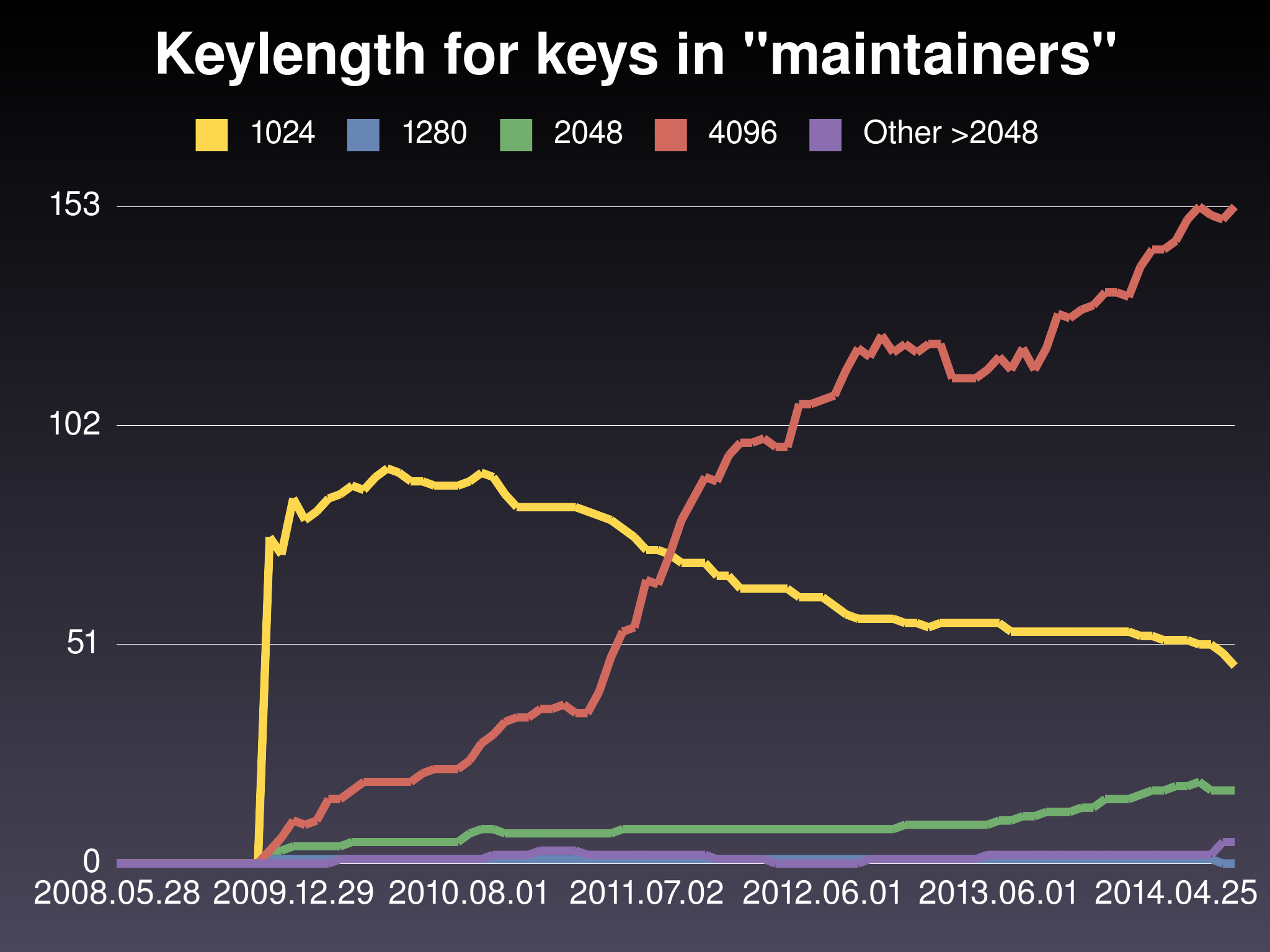
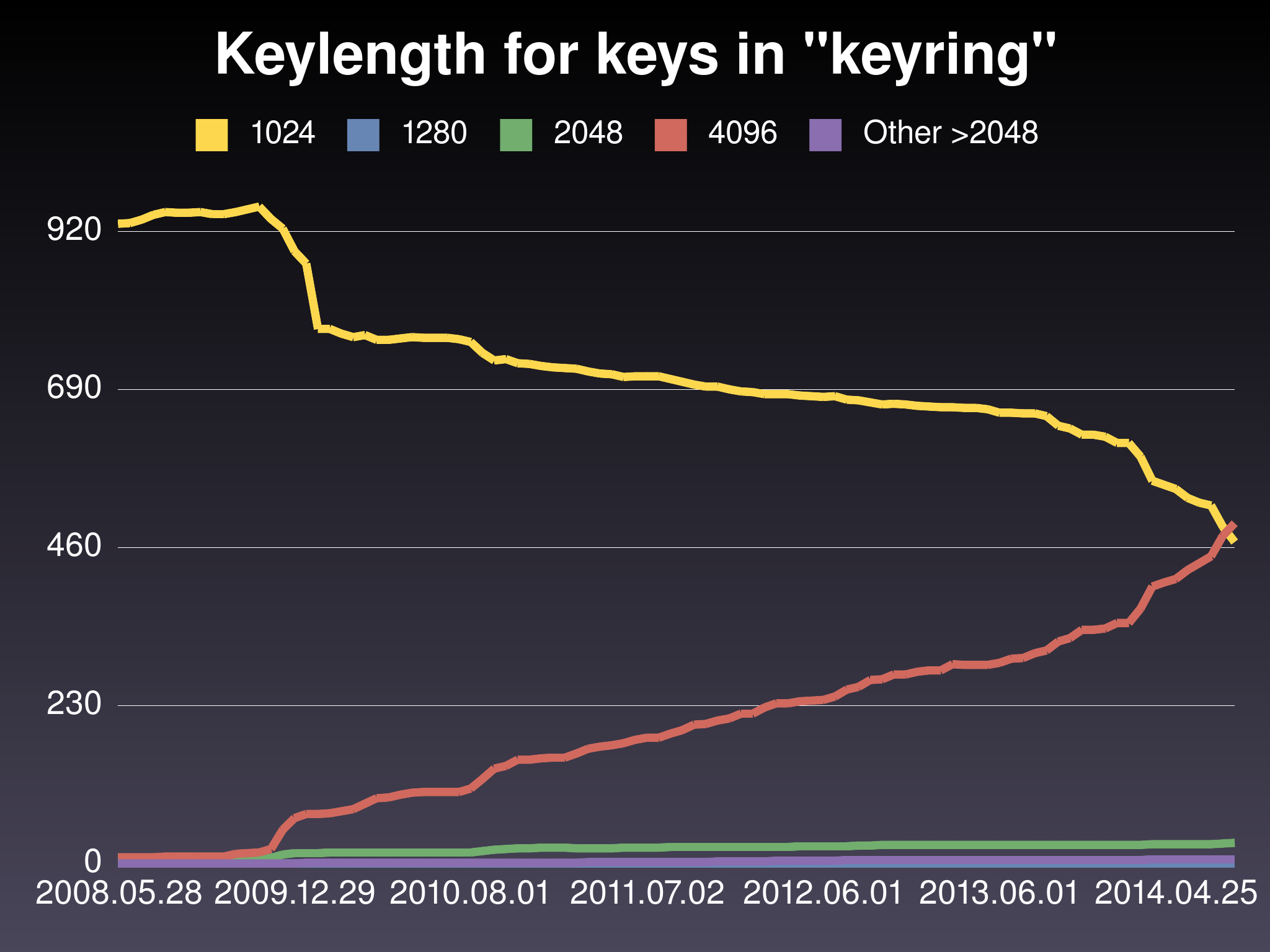
OK, it's almost one month since we (the keyring-maintainers) gave our talk at DebConf14; how are we faring regarding key transitions since then? You can compare the numbers (the graphs, really) to those in our DC14 presentation. Since the presentation, we have had two keyring pushes: First of all, the Non-uploading keyring is all fine: As it was quite recently created, and as it is much smaller than our other keyrings, it has no weak (1024 bit) keys. It briefly had one in 2010-2011, but it's long been replaced. Second, the Maintainers keyring: In late July we had 222 maintainers (170 with >=2048 bit keys, 52 with weak keys). By the end of August we had 221: 172 and 49 respectively, and by September 18 we had 221: 175 and 46. As for the Uploading developers, in late July we had 1002 uploading developers (481 with >=2048 bit keys, 521 with weak keys). By the end of August we had 1002: 512 and 490 respectively, and by September 18 we had 999: 531 and 468. Please note that these numbers do not say directly that six DMs or that 50 uploading DDs moved to stronger keys, as you'd have to factor in new people being added, keys migrating between different keyrings (mostly DM DD), and people retiring from the project; you can get the detailed information looking at the public copy of our Git repository, particularly of its changelog. And where does that put us? Of course, I'm very happy to see that the lines in our largest keyring have already crossed. We now have more people with >=2048 bit keys. And there was a lot of work to do this processing done! But that still means... That in order not to lock a large proportion of Debian Developers and Maintainers out of the project, we have a real lot of work to do. We would like to keep the replacement slope high (because, remember, in January 1st we will remove all small keys from the keyring). And yes, we are willing to do the work. But we need you to push us for it: We need you to get a new key created, to gather enough (two!) DD signatures in it, and to request a key replacement via RT. So, by all means: Do keep us busy!
AttachmentSize
Debian Developers (uploading)266.66 KB
Debian Developers (non-uploading)204.17 KB
Debian Maintainers296.73 KB

Konstantinos Margaritis: EfikaMX updated wheezy and jessie images available

A while ago, I promised to some people in powerdeveloper.org forum that I would provide bootable armhf images for wheezy but most importantly for jessie with an updated kernel. After a delay -I did have the images ready and working, but had to clean them up a bit- I decided to publish them here first. So, here are the images: http://freevec.org/files/efikamx-wheezy-armhf-20140921.img.xz (559MB)
http://freevec.org/files/efikamx-jessie-armhf-20140921.img.xz (635MB)

21 September 2014

Dariusz Dwornikowski: statistics of RFS bugs and sponsoring process

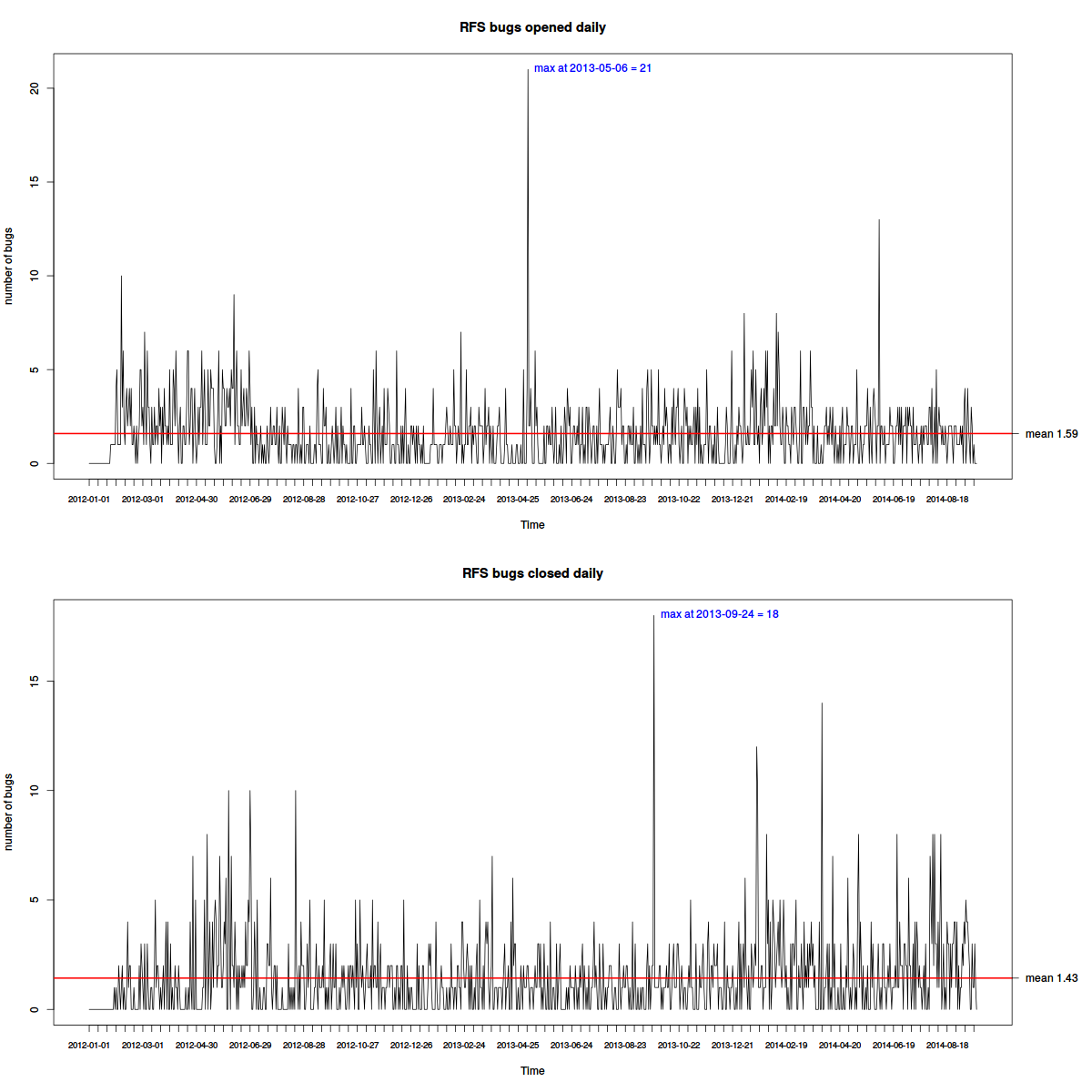
For some days I have been working on statistics of the sponsoring process in Debian. I find this to be one of the most important things that Debian has to attract and enable new contributions. It is important to know how this process works, whether we need more sponsors, how effective is the sponsoring and what are the timings connected to it. How I did this ? I have used Debbugs SOAP interface to get all bugs that are filed against sponsorship-requests pseudo package. SOAP gives a little bit of overhead because it needs to download a complete list of bugs for the sponsorship-requests package, and then process them according to given date ranges. The same information can be easily extracted from the UDD database in the future, it will be faster because SQL is better when working with date ranges than python obviously. The most problematic part was getting the "real done date" of a particular bug, and frankly most of my time I have spent on writing a rather dirty and complicated script. The script gets a log for a particular bug number and returns a "real done date". I have published a proof of concept in a previous post.. What I measured ? RFSs is a queue, and in every queue one is interested in a mean time to get processed. In this case I called the metric global MTTGS (mean time to get sponsored). This is a metric that gives the overall performance insight in RFS queue. Time to get sponsored (TTGS) for a bug is a number of days that passed between filing an RFS bug and closing it (bug was sponsored). Mean time to get sponsored is calculated as a sum of TTGSs of all bugs divided by number of bugs (in a given period of time). Global MTTGS is MTTGS calculated for a period of time 2012-1-1 until today(). Besides MTTGS I have also measured typical bug related metrics: Plots and graphs Below is a plot of global MTTGS vs. time (click for a larger image). mttgs plot As you can see, the trend is roughly exponential and MTTGS tends to settle around 60 days at the end of the year 2013. This does not mean that your package will wait 60 days on average nowadays to get sponsored. I remind that this is a global MTTGS, so even if the MTTGS of last month was very low, the global MTTGS would decrease just slightly. It gives, however, a good glance in performance of the process. Even that more packages are filed for sponsoring (see next graphs) now, than in the beginning of the epoch, the sponsoring rate is high enough to flatten the global MTTGS, and with time maybe decrease it. The image below (click for a larger one) shows how many bugs reside in a queue with status open or closed (calculated for each day). For closed we have an almost linear function, so each day more or less the same amount of bugs are closed and they increase the pool of bugs with status closed. For bugs with status open the interesting part begins around May 2012 after the system is saturated or gets popular. It can be interpreted as a plot of how many bugs reside in the queue, the important part is that it is stable and does not show clear increasing trend. open done plot The last plot shows arrival and departure rate of bugs from RFS queue, i.e. how many bugs are opened and closed each day. The interesting part here are the maxima. Let's look at them. opened closed plot Maximal number of opened bugs (21) was on 2012-05-06. As it appears it was a bunch upload of RFSs for tryton-modules-*..
  706953  RFS: tryton-modules-account-stock-anglo-saxon/2.8.0-1 
  706954  RFS: tryton-modules-purchase-shipment-cost/2.8.0-1 
  706948  RFS: tryton-modules-production/2.8.0-1 
  706969  RFS: tryton-modules-account-fr/2.8.0-1 
  706946  RFS: tryton-modules-project-invoice/2.8.0-1 
  706950  RFS: tryton-modules-stock-supply-production/2.8.0-1 
  706942  RFS: tryton-modules-product-attribute/2.8.0-1 
  706957  RFS: tryton-modules-stock-lot/2.8.0-1 
  706958  RFS: tryton-modules-carrier-weight/2.8.0-1 
  706941  RFS: tryton-modules-stock-supply-forecast/2.8.0-1 
  706955  RFS: tryton-modules-product-measurements/2.8.0-1 
  706952  RFS: tryton-modules-carrier-percentage/2.8.0-1 
  706949  RFS: tryton-modules-account-asset/2.8.0-1 
  706904  RFS: chinese-checkers/0.4-1 
  706944  RFS: tryton-modules-stock-split/2.8.0-1 
  706981  RFS: distcc/3.1-6 
  706945  RFS: tryton-modules-sale-supply/2.8.0-1 
  706959  RFS: tryton-modules-carrier/2.8.0-1 
  706951  RFS: tryton-modules-sale-shipment-cost/2.8.0-1 
  706943  RFS: tryton-modules-account-stock-continental/2.8.0-1 
  706956  RFS: tryton-modules-sale-supply-drop-shipment/2.8.0-1
Maximum number of closed bugs (18) was on 2013-09-24, and as you probably guessed right also tryton modules had impact on that.
  706953  RFS: tryton-modules-account-stock-anglo-saxon/2.8.0-1 
  706954  RFS: tryton-modules-purchase-shipment-cost/2.8.0-1 
  706948  RFS: tryton-modules-production/2.8.0-1 
  706969  RFS: tryton-modules-account-fr/2.8.0-1 
  706946  RFS: tryton-modules-project-invoice/2.8.0-1 
  706950  RFS: tryton-modules-stock-supply-production/2.8.0-1 
  706942  RFS: tryton-modules-product-attribute/2.8.0-1 
  706958  RFS: tryton-modules-carrier-weight/2.8.0-1 
  706941  RFS: tryton-modules-stock-supply-forecast/2.8.0-1 
  706955  RFS: tryton-modules-product-measurements/2.8.0-1 
  706952  RFS: tryton-modules-carrier-percentage/2.8.0-1 
  706949  RFS: tryton-modules-account-asset/2.8.0-1 
  706944  RFS: tryton-modules-stock-split/2.8.0-1 
  706959  RFS: tryton-modules-carrier/2.8.0-1 
  723991  RFS: mapserver/6.4.0-2 
  706951  RFS: tryton-modules-sale-shipment-cost/2.8.0-1 
  706943  RFS: tryton-modules-account-stock-continental/2.8.0-1 
  706956  RFS: tryton-modules-sale-supply-drop-shipment/2.8.0-1
The software Most of the software was written in Python. Graphs were generated in R. After a code cleanup I will publish a complete solution on my github account, free to use by everybody. If you would like to see another statistics, please let me know, I can create them if the data provides sufficient information.

Konstantinos Margaritis: VSX port added to Eigen!

Being the SIMD fanatic that I am, a few years ago I did the PowerPC Altivec and ARM NEON port for the Eigen linear algebra library, one of the best and most popular libraries -and most ported. Recently I thought it would be a good idea to extend both ports to 64-bit, and it would also help me with the SIMD book, using VSX in one case and ARMv8 NEON (or Advanced SIMD as ARM likes to call it) in the latter. ARMv8 hardware is a bit scarce at the moment, so I thought I'd start with VSX. Being in Debian, I have access to a number of porterboxes in several architectures, and luckily one of those was a Power7 (with VSX) running ppc64. So I started the porting -or rather extending the code- to use VSX in the 64-bit doubles case. Unluckily, I could not test anything because Debian kernels do not have VSX enabled in wheezy -which is what the porterbox is running and enabling it is a non-option(#758620). So, running VSX code would turn out to be quite hard.

20 September 2014

Laura Arjona: Happy Software Freedom Day!

Today we celebrate the day of free software (each year, a saturday around mid-September) More info at softwarefreedomday.org There are no public events in Madrid, but I m going to try to hack and write a bit more this weekend, as my personal celebration. In this blog post you can find some of my very very recent activities on free software, and my plans for this weekend of celebration! Debian Children distros aka Derivatives I had the translation/update of the page www.debian.org/misc/children-distros pending since long time. It s a long page, and I was not sure what was better: if picking up the too-outdated last translation, and review it carefully in order to update it, or starting from scratch. I decided to reuse the last translation (thanks Luis Uribe!) and after some days dedicating my commuting time on it, finally, yesterday evening I finished it at home. Now it s in the review queue, and I hope in 10 days or so it will be uploaded. In the meantime, I have learned a bit about the Debian Derivatives subproject and census, I have watched the Derivatives Panel at DebConf13, and had a look at the bug #723069 about keeping the children-distros page up to date. So now that I m liberated about this translation, I m going to put some time in keeping up to date the original English page (I m part of the www and publicity team, so I think it makes sense). My goal is to review at least one Debian derivative each two days, and when I finish the list, start again. I can update the wiki myself, and for the www, I ll send patches against #723069, unless I m told to do it other way. BTW, wouldn t be nice to mark web/wiki pages as RFH the same as packages?, so other people can easily decide to put some time on them, and make http://www.debian.org even more awesome! Or make them appear in the how-can-i-help reminders :) Mmm maybe it s just a matter of filing a bug and tagging it as gift ? I think no, because nobody has the package www.debian.org installed in their system I ll talk with the maintainer about this. New Member process I promised myself to try to work a bit more in Debian during the summer and September, and if everything goes well, try to apply to the new member process in October. I wanted to read all the documentation first, and one challenge is to review/update the translations of www.debian.org/devel/join folder. This way, both myself and the Spanish speaking community benefit from the effort. Yesterday I translated one of those pending pages and I hope during the weekend I can translate/update the rest. When I finish that, I ll keep reading the other documentation. DebConf15 This summer I was invited to join the DebConf15 organization team and pick up tasks in the publicity area. I was very happy to join, I m not sure at all that I can go to DebConf15 in Heidelberg (Germany), in fact I m quite sure I will not go since mid-August is the only opportunity to visit family who lives far away, but anyway, there are things that we can do before DebConf15 and I can contribute. For now, I attended last Monday to the meeting at IRC, and I m finishing a short blogpost about the DebConf14 talk presenting DebConf15, that will be published in the DebConf15 blog. Android, F-Droid I keep on trying to spread the word about F-Droid and the free software available for Android, last week some of my friends updated Kontalk to the 3.0.b1 version (I had updated at the beginning of September) and they liked that now, the images are sent encrypted as well as the text messages :) Some friends also liked the 2048 game, since it can be played offline, without ads, and so. I decided to spend some time this weekend contributing translations to the Android apps that I use. A long pending issue is to try to put workforce in the F-Droid project itself so apps descriptions are internationalized (the program is fully translatable, but the categories of apps and the descriptions themselves, are not). This is a complicated issue, it requires to take some design decisions, and later, of course, the implementation. I cannot do it alone, and I cannot do it in the short time. But today I have filed a bug report (#35) so maybe I find other people able to help. Jabber/XMPP and the RedesLibres chatroom Since several months I ve been using more often my Jabber/XMPP account to join the chatroom redeslibres@salas.mijabber.es I meet there some people that I follow in Pump.io (for example, the people that write in the Comun cate Libremente or Lignux blogs) and we talk about pump.io, free software, free services, and other things. I feel very comfortable there, it s nice to have a Spanish speaking group inside the Free Software community, and I m also learning a bit about XMPP (I ve tried a lot of desktop and Android clients, just for fun!), free networks, and so. So today I wanted to publicly thank you everybody in that chatroom, that welcomed me so well :) Thank you, free software friends And, by extension, I want to thank you all the people that work and have fun in the Free Software communities, in the projects where I contribute or others. They (we) hack to make the world better, and to allow others join to this beautiful challenge that is making machines do what their (final) users wants. Comments? You can comment on this post in this Pump.io thread.
Filed under: My experiences and opinion Tagged: Android, Communities, Contributing to libre software, Debian, English, F-Droid, federation, Free Software, Freedom, internationalization, libre software, localization, translations

19 September 2014

Dariusz Dwornikowski: getting real "done date" of a bug from Debian BTS

As I wrote in my last post currently, SOAP interface, nor Ultimate Debian Database do not provide a date when a given bug was closed (done date). It is quite hard to calculate statistics on a bug tracker when you do not know when a bug was closed (!!). Done date of bug can be found in its log. The log itself can be downloaded by SOAP method get_bug_log but the processing of it is quite complicated. The same comes to web scrapping of a BTS's web interface. Fortunatelly the web interface gives a possibility to download a log in an mbox format. Below is a script that extracts the done date of a bug from its log in mbox format. It uses requests to download the mbox and caches the result in ~/.cache/rfs_bugs, which you need to create. It performs different checks:
  1. Check existence of a header e.g. Received: (at 657783-done) by bugs.debian.org; 29 Jan 2012 13:27:42 +0000
  2. Check for header CC: NUMBER-close done
  3. Check for header TO: NUMBER-close done
  4. Check for Close: NUMBER in body.
The code is below:
import requests
from datetime import datetime
import mailbox
import re
import os
import tempfile
def get_done_date(bug_num):
    CACHE_DIR = os.path.expanduser("~") + "/.cache/rfs_bugs/"
    def get_from_cache():
        if os.path.exists(" ".format(CACHE_DIR, bug_num)):
            with open(" ".format(CACHE_DIR, bug_num)) as f:
                return datetime.strptime(f.readlines()[0].rstrip(), "%Y-%m-%d").date()
        else:
            return None
    done_date = get_from_cache()
    if done_date is not None:
        return done_date
    else:
        r = requests.get("https://bugs.debian.org/cgi-bin/bugreport.cgi?mbox=yes;bug= ;mboxstatus=yes".format(self._num))
        d = try_header(r.text)
        if d is None:
            d = try_cc(r.text)
        if d is None:
            d = try_body(r.text)
        if d is not None:
            with open(" ".format(CACHE_DIR, bug_num), "w") as f:
                f.write(" ".format(d.date()))
        else:
            return None
        return d.date()
    def try_body(text):
        reg = "\(at\s.+\)\s+by\sbugs\.debian\.org;\s(\d 1,2 \s\w\w\w\s\d\d\d\d)"
        handle, name = tempfile.mkstemp()
        with open(name, "w") as f:
            f.write(text.encode('latin-1'))
        mbox = mailbox.mbox(name)
        for i in mbox.items():
            if i[1].is_multipart():
                for m in i[1].get_payload():
                    if "close" in str(m) or "done" in str(m):
                        try:
                            result = re.search(reg, i[1]['Received'])
                            return datetime.strptime(result.group(1), "%d %b %Y")
                        except:
                            return None
            else:
                if "close" in i[1].get_payload() or "done" in i[1].get_payload():
                    try:
                        result = re.search(reg, i[1]['Received'])
                        return datetime.strptime(result.group(1), "%d %b %Y")
                    except:
                        return None
        return None
    def try_header(text):
        reg = "Received:\s\(at\s\d\d\d\d\d\d-(close done)\)\s+by.+"
        try:
            result = re.search(reg, r.text)
            line = result.group(0)
            reg2 = "\d 1,2 \s\w\w\w\s\d\d\d\d"
            result = re.search(reg2, line)
            d = datetime.strptime(result.group(0), "%d %b %Y")
            return d
        except:
            return None
    def try_cc(text):
        reg = "\(at\s.+\)\s+by\sbugs\.debian\.org;\s(\d 1,2 \s\w\w\w\s\d\d\d\d)"
        handle, name = tempfile.mkstemp()
        with open(name, "w") as f:
            f.write(text.encode('latin-1'))
        mbox = mailbox.mbox(name)
        for i in mbox.items():
            if ('CC' in i[1] and "done" in i[1]['CC']) or ('To' in i[1] and "done" in i[1]['To']):
                try:
                    result = re.search(reg, i[1]['Received'])
                    return datetime.strptime(result.group(1), "%d %b %Y")
                except:
                    return None
if __name__ == "__main__":
    print get_done_date(752210)
PS: I hope that the script will be not needed in the near future, as Don Armstrong plans a new BTS database, a Debconf14 video is here.

Daniel Pocock: reSIProcate migration from SVN to Git completed

This week, the reSIProcate project completed the move from SVN to Git. With many people using the SIP stack in both open source and commercial projects, the migration was carefully planned and tested over an extended period of time. Hopefully some of the experience from this migration can help other projects too. Previous SVN committers were tracked down using my script for matching emails to Github accounts. This also allowed us to see their recent commits on other projects and see how they want their name and email address represented when their previous commits in SVN were mapped to Git commits. For about a year, the sync2git script had been run hourly from cron to maintain an official mirror of the project in Github. This allowed people to test it and it also allowed us to start using some Github features like travis-CI.org before officially moving to Git. At the cut-over, the SVN directories were made read-only, sync2git was run one last time and then people were advised they could commit in Git. Documentation has also been created to help people get started quickly sharing patches as Github pull requests if they haven't used this facility before.

16 September 2014

Matthew Garrett: ACPI, kernels and contracts with firmware

ACPI is a complicated specification - the latest version is 980 pages long. But that's because it's trying to define something complicated: an entire interface for abstracting away hardware details and making it easier for an unmodified OS to boot diverse platforms.

Inevitably, though, it can't define the full behaviour of an ACPI system. It doesn't explicitly state what should happen if you violate the spec, for instance. Obviously, in a just and fair world, no systems would violate the spec. But in the grim meathook future that we actually inhabit, systems do. We lack the technology to go back in time and retroactively prevent this, and so we're forced to deal with making these systems work.

This ends up being a pain in the neck in the x86 world, but it could be much worse. Way back in 2008 I wrote something about why the Linux kernel reports itself to firmware as "Windows" but refuses to identify itself as Linux. The short version is that "Linux" doesn't actually identify the behaviour of the kernel in a meaningful way. "Linux" doesn't tell you whether the kernel can deal with buffers being passed when the spec says it should be a package. "Linux" doesn't tell you whether the OS knows how to deal with an HPET. "Linux" doesn't tell you whether the OS can reinitialise graphics hardware.

Back then I was writing from the perspective of the firmware changing its behaviour in response to the OS, but it turns out that it's also relevant from the perspective of the OS changing its behaviour in response to the firmware. Windows 8 handles backlights differently to older versions. Firmware that's intended to support Windows 8 may expect this behaviour. If the OS tells the firmware that it's compatible with Windows 8, the OS has to behave compatibly with Windows 8.

In essence, if the firmware asks for Windows 8 support and the OS says yes, the OS is forming a contract with the firmware that it will behave in a specific way. If Windows 8 allows certain spec violations, the OS must permit those violations. If Windows 8 makes certain ACPI calls in a certain order, the OS must make those calls in the same order. Any firmware bug that is triggered by the OS not behaving identically to Windows 8 must be dealt with by modifying the OS to behave like Windows 8.

This sounds horrifying, but it's actually important. The existence of well-defined[1] OS behaviours means that the industry has something to target. Vendors test their hardware against Windows, and because Windows has consistent behaviour within a version[2] the vendors know that their machines won't suddenly stop working after an update. Linux benefits from this because we know that we can make hardware work as long as we're compatible with the Windows behaviour.

That's fine for x86. But remember when I said it could be worse? What if there were a platform that Microsoft weren't targeting? A platform where Linux was the dominant OS? A platform where vendors all test their hardware against Linux and expect it to have a consistent ACPI implementation?

Our even grimmer meathook future welcomes ARM to the ACPI world.

Software development is hard, and firmware development is software development with worse compilers. Firmware is inevitably going to rely on undefined behaviour. It's going to make assumptions about ordering. It's going to mishandle some cases. And it's the operating system's job to handle that. On x86 we know that systems are tested against Windows, and so we simply implement that behaviour. On ARM, we don't have that convenient reference. We are the reference. And that means that systems will end up accidentally depending on Linux-specific behaviour. Which means that if we ever change that behaviour, those systems will break.

So far we've resisted calls for Linux to provide a contract to the firmware in the way that Windows does, simply because there's been no need to - we can just implement the same contract as Windows. How are we going to manage this on ARM? The worst case scenario is that a system is tested against, say, Linux 3.19 and works fine. We make a change in 3.21 that breaks this system, but nobody notices at the time. Another system is tested against 3.21 and works fine. A few months later somebody finally notices that 3.21 broke their system and the change gets reverted, but oh no! Reverting it breaks the other system. What do we do now? The systems aren't telling us which behaviour they expect, so we're left with the prospect of adding machine-specific quirks. This isn't scalable.

Supporting ACPI on ARM means developing a sense of discipline around ACPI development that we simply haven't had so far. If we want to avoid breaking systems we have two options:

1) Commit to never modifying the ACPI behaviour of Linux.
2) Exposing an interface that indicates which well-defined ACPI behaviour a specific kernel implements, and bumping that whenever an incompatible change is made. Backward compatibility paths will be required if firmware only supports an older interface.

(1) is unlikely to be practical, but (2) isn't a great deal easier. Somebody is going to need to take responsibility for tracking ACPI behaviour and incrementing the exported interface whenever it changes, and we need to know who that's going to be before any of these systems start shipping. The alternative is a sea of ARM devices that only run specific kernel versions, which is exactly the scenario that ACPI was supposed to be fixing.

[1] Defined by implementation, not defined by specification
[2] Windows may change behaviour between versions, but always adds a new _OSI string when it does so. It can then modify its behaviour depending on whether the firmware knows about later versions of Windows.

comment count unavailable comments

Petter Reinholdtsen: Speeding up the Debian installer using eatmydata and dpkg-divert

The Debian installer could be a lot quicker. When we install more than 2000 packages in Skolelinux / Debian Edu using tasksel in the installer, unpacking the binary packages take forever. A part of the slow I/O issue was discussed in bug #613428 about too much file system sync-ing done by dpkg, which is the package responsible for unpacking the binary packages. Other parts (like code executed by postinst scripts) might also sync to disk during installation. All this sync-ing to disk do not really make sense to me. If the machine crash half-way through, I start over, I do not try to salvage the half installed system. So the failure sync-ing is supposed to protect against, hardware or system crash, is not really relevant while the installer is running. A few days ago, I thought of a way to get rid of all the file system sync()-ing in a fairly non-intrusive way, without the need to change the code in several packages. The idea is not new, but I have not heard anyone propose the approach using dpkg-divert before. It depend on the small and clever package eatmydata, which uses LD_PRELOAD to replace the system functions for syncing data to disk with functions doing nothing, thus allowing programs to live dangerous while speeding up disk I/O significantly. Instead of modifying the implementation of dpkg, apt and tasksel (which are the packages responsible for selecting, fetching and installing packages), it occurred to me that we could just divert the programs away, replace them with a simple shell wrapper calling "eatmydata $program $@", to get the same effect. Two days ago I decided to test the idea, and wrapped up a simple implementation for the Debian Edu udeb. The effect was stunning. In my first test it reduced the running time of the pkgsel step (installing tasks) from 64 to less than 44 minutes (20 minutes shaved off the installation) on an old Dell Latitude D505 machine. I am not quite sure what the optimised time would have been, as I messed up the testing a bit, causing the debconf priority to get low enough for two questions to pop up during installation. As soon as I saw the questions I moved the installation along, but do not know how long the question were holding up the installation. I did some more measurements using Debian Edu Jessie, and got these results. The time measured is the time stamp in /var/log/syslog between the "pkgsel: starting tasksel" and the "pkgsel: finishing up" lines, if you want to do the same measurement yourself. In Debian Edu, the tasksel dialog do not show up, and the timing thus do not depend on how quickly the user handle the tasksel dialog.
Machine/setup Original tasksel Optimised tasksel Reduction
Latitude D505 Main+LTSP LXDE 64 min (07:46-08:50) <44 min (11:27-12:11) >20 min 18%
Latitude D505 Roaming LXDE 57 min (08:48-09:45) 34 min (07:43-08:17) 23 min 40%
Latitude D505 Minimal 22 min (10:37-10:59) 11 min (11:16-11:27) 11 min 50%
Thinkpad X200 Minimal 6 min (08:19-08:25) 4 min (08:04-08:08) 2 min 33%
Thinkpad X200 Roaming KDE 19 min (09:21-09:40) 15 min (10:25-10:40) 4 min 21%
The test is done using a netinst ISO on a USB stick, so some of the time is spent downloading packages. The connection to the Internet was 100Mbit/s during testing, so downloading should not be a significant factor in the measurement. Download typically took a few seconds to a few minutes, depending on the amount of packages being installed. The speedup is implemented by using two hooks in Debian Installer, the pre-pkgsel.d hook to set up the diverts, and the finish-install.d hook to remove the divert at the end of the installation. I picked the pre-pkgsel.d hook instead of the post-base-installer.d hook because I test using an ISO without the eatmydata package included, and the post-base-installer.d hook in Debian Edu can only operate on packages included in the ISO. The negative effect of this is that I am unable to activate this optimization for the kernel installation step in d-i. If the code is moved to the post-base-installer.d hook, the speedup would be larger for the entire installation. I've implemented this in the debian-edu-install git repository, and plan to provide the optimization as part of the Debian Edu installation. If you want to test this yourself, you can create two files in the installer (or in an udeb). One shell script need do go into /usr/lib/pre-pkgsel.d/, with content like this:
#!/bin/sh
set -e
. /usr/share/debconf/confmodule
info()  
    logger -t my-pkgsel "info: $*"
 
error()  
    logger -t my-pkgsel "error: $*"
 
override_install()  
    apt-install eatmydata   true
    if [ -x /target/usr/bin/eatmydata ] ; then
        for bin in dpkg apt-get aptitude tasksel ; do
            file=/usr/bin/$bin
            # Test that the file exist and have not been diverted already.
            if [ -f /target$file ] ; then
                info "diverting $file using eatmydata"
                printf "#!/bin/sh\neatmydata $bin.distrib \"\$@\"\n" \
                    > /target$file.edu
                chmod 755 /target$file.edu
                in-target dpkg-divert --package debian-edu-config \
                    --rename --quiet --add $file
                ln -sf ./$bin.edu /target$file
            else
                error "unable to divert $file, as it is missing."
            fi
        done
    else
        error "unable to find /usr/bin/eatmydata after installing the eatmydata pacage"
    fi
 
override_install
To clean up, another shell script should go into /usr/lib/finish-install.d/ with code like this:
#! /bin/sh -e
. /usr/share/debconf/confmodule
error()  
    logger -t my-finish-install "error: $@"
 
remove_install_override()  
    for bin in dpkg apt-get aptitude tasksel ; do
        file=/usr/bin/$bin
        if [ -x /target$file.edu ] ; then
            rm /target$file
            in-target dpkg-divert --package debian-edu-config \
                --rename --quiet --remove $file
            rm /target$file.edu
        else
            error "Missing divert for $file."
        fi
    done
    sync # Flush file buffers before continuing
 
remove_install_override
In Debian Edu, I placed both code fragments in a separate script edu-eatmydata-install and call it from the pre-pkgsel.d and finish-install.d scripts. By now you might ask if this change should get into the normal Debian installer too? I suspect it should, but am not sure the current debian-installer coordinators find it useful enough. It also depend on the side effects of the change. I'm not aware of any, but I guess we will see if the change is safe after some more testing. Perhaps there is some package in Debian depending on sync() and fsync() having effect? Perhaps it should go into its own udeb, to allow those of us wanting to enable it to do so without affecting everyone. Update 2014-09-24: Since a few days ago, enabling this optimization will break installation of all programs using gnutls because of bug #702711. An updated eatmydata package in Debian will solve it.

15 September 2014

Ritesh Raj Sarraf: apt-offline 1.5

I am very pleased to announce the release of apt-offline, version 1.5. In version 1.4, the offline bug report functionality had to be dropped. In version 1.5, it is back again. apt-offline now uses the new Debian native BTS library. Thanks to its developers, this library is much more slim and neat. The only catch is that it depends on the SOAPpy library which currently is not stock in Python. If you run apt-offline of Debian, you may not have to worry as I will add a Recommends on that package. For users using it on Microsoft Windows, please ensure that you have the SOAPpy library installed. It is available on pypi. The old bundled magic library has been replaced with the version of python magic library that Debian ships. This library is derived from the file package and is portable on almost all Unixes. For Debian users, there will be a Recommends on it too. There were also a bunch of old, outstanding, and annoying bugs that have been fixed in this release. For a full list of changes, please refer to the git logs. With this release, apt-offline should be in good shape for the Jessie release. apt-offline is available on Alioth @ https://alioth.debian.org/projects/apt-offline/

AddThis:

Categories:

Keywords:

Julien Danjou: Python bad practice, a concrete case

A lot of people read up on good Python practice, and there's plenty of information about that on the Internet. Many tips are included in the book I wrote this year, The Hacker's Guide to Python. Today I'd like to show a concrete case of code that I don't consider being the state of the art. In my last article where I talked about my new project Gnocchi, I wrote about how I tested, hacked and then ditched whisper out. Here I'm going to explain part of my thought process and a few things that raised my eyebrows when hacking this code. Before I start, please don't get the spirit of this article wrong. It's in no way a personal attack to the authors and contributors (who I don't know). Furthermore, whisper is a piece of code that is in production in thousands of installation, storing metrics for years. While I can argue that I consider the code not to be following best practice, it definitely works well enough and is worthy to a lot of people. Tests The first thing that I noticed when trying to hack on whisper, is the lack of test. There's only one file containing tests, named test_whisper.py, and the coverage it provides is pretty low. One can check that using the coverage tool.
$ coverage run test_whisper.py
...........
----------------------------------------------------------------------
Ran 11 tests in 0.014s

OK
$ coverage report
Name Stmts Miss Cover
----------------------------------
test_whisper 134 4 97%
whisper 584 227 61%
----------------------------------
TOTAL 718 231 67%

While one would think that 61% is "not so bad", taking a quick peak at the actual test code shows that the tests are incomplete. Why I mean by incomplete is that they for example use the library to store values into a database, but they never check if the results can be fetched and if the fetched results are accurate. Here's a good reason one should never blindly trust the test cover percentage as a quality metric. When I tried to modify whisper, as the tests do not check the entire cycle of the values fed into the database, I ended up doing wrong changes but had the tests still pass. No PEP 8, no Python 3 The code doesn't respect PEP 8 . A run of flake8 + hacking shows 732 errors While it does not impact the code itself, it's more painful to hack on it than it is on most Python projects. The hacking tool also shows that the code is not Python 3 ready as there is usage of Python 2 only syntax. A good way to fix that would be to set up tox and adds a few targets for PEP 8 checks and Python 3 tests. Even if the test suite is not complete, starting by having flake8 run without errors and the few unit tests working with Python 3 should put the project in a better light. Not using idiomatic Python A lot of the code could be simplified by using idiomatic Python. Let's take a simple example:
def fetch(path,fromTime,untilTime=None,now=None):
fh = None
try:
fh = open(path,'rb')
return file_fetch(fh, fromTime, untilTime, now)
finally:
if fh:
fh.close()

That piece of code could be easily rewritten as:
def fetch(path,fromTime,untilTime=None,now=None):
with open(path, 'rb') as fh:
return file_fetch(fh, fromTime, untilTime, now)

This way, the function looks actually so simple that one can even wonder why it should exists but why not. Usage of loops could also be made more Pythonic:
for i,archive in enumerate(archiveList):
if i == len(archiveList) - 1:
break

could be actually:
for i, archive in itertools.islice(archiveList, len(archiveList) - 1):

That reduce the code size and makes it easier to read through the code. Wrong abstraction level Also, one thing that I noticed in whisper, is that it abstracts its features at the wrong level. Take the create() function, it's pretty obvious:
def create(path,archiveList,xFilesFactor=None,aggregationMethod=None,sparse=False,useFallocate=False):
# Set default params
if xFilesFactor is None:
xFilesFactor = 0.5
if aggregationMethod is None:
aggregationMethod = 'average'

#Validate archive configurations...
validateArchiveList(archiveList)

#Looks good, now we create the file and write the header
if os.path.exists(path):
raise InvalidConfiguration("File %s already exists!" % path)
fh = None
try:
fh = open(path,'wb')
if LOCK:
fcntl.flock( fh.fileno(), fcntl.LOCK_EX )

aggregationType = struct.pack( longFormat, aggregationMethodToType.get(aggregationMethod, 1) )
oldest = max([secondsPerPoint * points for secondsPerPoint,points in archiveList])
maxRetention = struct.pack( longFormat, oldest )
xFilesFactor = struct.pack( floatFormat, float(xFilesFactor) )
archiveCount = struct.pack(longFormat, len(archiveList))
packedMetadata = aggregationType + maxRetention + xFilesFactor + archiveCount
fh.write(packedMetadata)
headerSize = metadataSize + (archiveInfoSize * len(archiveList))
archiveOffsetPointer = headerSize

for secondsPerPoint,points in archiveList:
archiveInfo = struct.pack(archiveInfoFormat, archiveOffsetPointer, secondsPerPoint, points)
fh.write(archiveInfo)
archiveOffsetPointer += (points * pointSize)

#If configured to use fallocate and capable of fallocate use that, else
#attempt sparse if configure or zero pre-allocate if sparse isn't configured.
if CAN_FALLOCATE and useFallocate:
remaining = archiveOffsetPointer - headerSize
fallocate(fh, headerSize, remaining)
elif sparse:
fh.seek(archiveOffsetPointer - 1)
fh.write('\x00')
else:
remaining = archiveOffsetPointer - headerSize
chunksize = 16384
zeroes = '\x00' * chunksize
while remaining > chunksize:
fh.write(zeroes)
remaining -= chunksize
fh.write(zeroes[:remaining])

if AUTOFLUSH:
fh.flush()
os.fsync(fh.fileno())
finally:
if fh:
fh.close()

The function is doing everything: checking if the file doesn't exist already, opening it, building the structured data, writing this, building more structure, then writing that, etc. That means that the caller has to give a file path, even if it just wants a whipser data structure to store itself elsewhere. StringIO() could be used to fake a file handler, but it will fail if the call to fcntl.flock() is not disabled and it is inefficient anyway. There's a lot of other functions in the code, such as for example setAggregationMethod(), that mixes the handling of the files even doing things like os.fsync() while manipulating structured data. This is definitely not a good design, especially for a library, as it turns out reusing the function in different context is near impossible. Race conditions There are race conditions, for example in create() (see added comment):
if os.path.exists(path):
raise InvalidConfiguration("File %s already exists!" % path)
fh = None
try:
# TOO LATE I ALREADY CREATED THE FILE IN ANOTHER PROCESS YOU ARE GOING TO
# FAIL WITHOUT GIVING ANY USEFUL INFORMATION TO THE CALLER :-(
fh = open(path,'wb')

That code should be:
try:
fh = os.fdopen(os.open(path, os.O_WRONLY os.O_CREAT os.O_EXCL), 'wb')
except OSError as e:
if e.errno = errno.EEXIST:
raise InvalidConfiguration("File %s already exists!" % path)

to avoid any race condition. Unwanted optimization We saw earlier the fetch() function that is barely useful, so let's take a look at the file_fetch() function that it's calling.
def file_fetch(fh, fromTime, untilTime, now = None):
header = __readHeader(fh)
[...]

The first thing the function does is to read the header from the file handler. Let's take a look at that function:
def __readHeader(fh):
info = __headerCache.get(fh.name)
if info:
return info

originalOffset = fh.tell()
fh.seek(0)
packedMetadata = fh.read(metadataSize)

try:
(aggregationType,maxRetention,xff,archiveCount) = struct.unpack(metadataFormat,packedMetadata)
except:
raise CorruptWhisperFile("Unable to read header", fh.name)
[...]

The first thing the function does is to look into a cache. Why is there a cache? It actually caches the header based with an index based on the file path (fh.name). Except that if one for example decide not to use file and cheat using StringIO, then it does not have any name attribute. So this code path will raise an AttributeError. One has to set a fake name manually on the StringIO instance, and it must be unique so nobody messes with the cache
import StringIO

packedMetadata = <some source>
fh = StringIO.StringIO(packedMetadata)
fh.name = "myfakename"
header = __readHeader(fh)

The cache may actually be useful when accessing files, but it's definitely useless when not using files. But it's not necessarily true that the complexity (even if small) that the cache adds is worth it. I doubt most of whisper based tools are long run processes, so the cache that is really used when accessing the files is the one handled by the operating system kernel, and this one is going to be much more efficient anyway, and shared between processed. There's also no expiry of that cache, which could end up of tons of memory used and wasted. Docstrings None of the docstrings are written in a a parsable syntax like Sphinx. This means you cannot generate any documentation in a nice format that a developer using the library could read easily. The documentation is also not up to date:
def fetch(path,fromTime,untilTime=None,now=None):
"""fetch(path,fromTime,untilTime=None)
[...]
"""

def create(path,archiveList,xFilesFactor=None,aggregationMethod=None,sparse=False,useFallocate=False):
"""create(path,archiveList,xFilesFactor=0.5,aggregationMethod='average')
[...]
"""

This is something that could be avoided if a proper format was picked to write the docstring. A tool cool be used to be noticed when there's a diversion between the actual function signature and the documented one, like missing an argument. Duplicated code Last but not least, there's a lot of code that is duplicated around in the scripts provided by whisper in its bin directory. Theses scripts should be very lightweight and be using the console_scripts facility of setuptools, but they actually contains a lot of (untested) code. Furthermore, some of that code is partially duplicated from the whisper.py library which is against DRY. Conclusion There are a few more things that made me stop considering whisper, but these are part of the whisper features, not necessarily code quality. One can also point out that the code is very condensed and hard to read, and that's a more general problem about how it is organized and abstracted. A lot of these defects are actually points that made me start writing The Hacker's Guide to Python a year ago. Running into this kind of code makes me think it was a really good idea to write a book on advice to write better Python code!

The Hacker's Guide to Python
A book I wrote talking about designing Python applications, state of the art, advice to apply when building your application, various Python tips, etc. Interested? Check it out.

13 September 2014

Laura Arjona: Disabling comments in the blog

I m getting more spam than the amount that I can stand in this blog. Comments are moderated, so the public is not suffering that, only me. From time to time I go to my dashboard and clean the spam. I m afraid that I delete some legit comment in these spam-cleaning-fevers, or, more probably, that a legit comment waits in the queue for several days (weeks?), just because I m lazy to deal with spam and let days pass by (until the fever comes). I think I m going to follow the wisdom of Bradley M. Kuhn and link to a pump.io note for comments on my blog posts (disabling them here in WordPress.com). I usually post a notice when I write something in my blog, so the only task is to update the blog post with the pump.io URL of the thread for comments. While WordPress.com allows to write comments quickly, without need of an account (you write just a name and an email, and the comment), in pump you need to have an account and sign in to comment. That looks as a bad thing, a barrier for people to participate. But of course, it stops spam :) After thinking about it a bit, pump.io it s a federated network, you can choose the pump server that they want, you can create a fake account, you don t need to provide personal information and it s another way to promote one of the social networks where I live. Other systems link to facebook, twitter, or other places, and nobody complains! Even when those services don t have any of the advantages of being in a federated free-software powered social network :) If anybody don t want to use pump.io but wants to comment, other ways to reach me or the related blog post are: So now it s decided, and this is the first post of this new experiment. This text is posted in pump.io too, and you can comment there :)
Filed under: My experiences and opinion, Tools Tagged: Blog, English, federation, pump.io, social networks, Wordpress

11 September 2014

Steve Kemp: A small email utility and other updates.

Last night I was looking for an image I knew a model had mailed me a few months ago, as we were talking about rescheduling a shoot at the weekend. I couldn't find it, even with my awesome mail client and filing system. With some free time I figured I could write a little utility to dump all attachments from email folders, and find it that way. It did cross my mind that there is the simple mail-utility for dumping headers, etc, called formail, which is distributed alongside procmail, but it doesn't handle attachments .. I was tempted to write a general purpose script to dump attachments, email header values, etc, etc but given the lack of time I merely solved my own problem. I suspect there is room for a "mail utilities" package, similar to Joey's "moreutils" and my "sysadmin utils". However I note that there is a GNU Mailutils which does things differently than I'd expect - i.e. it contains a POP3 server. Still if you want to dump attachments from emails, have GMIME installed, and want to filter by attachment-name, or MIME-type, you might look at my trivial attachment-dump program. Related to that I spent some time last night updating my photography site, so the animals & pets section has updated images at least. During the course of that I found a bug in my static-site generator, templer which stopped it from automatically populating image height/widths when called in a glob:
Title: Pets &amp; Animals
Images: file_glob( "*.jpg" )
---
This is the page body, it now has access to a variable called 'images'
which is a HTML::Template loop-structure containing name/height/width/etc
for each image in the current directory.
That should now be resolved, and life should once again be good.

10 September 2014

Steve Kemp: kvm-hosting will be ceasing, soon.

Seven years ago I wanted to move on from the small virtual machine I had to a larger one. Looking at the the options available it seemed the best approach was to rent a big host, and divide it up into virtual machines myself. Renting a machine with 8Gb of RAM and 500Gb of disk-space, then dividing that into eights would give a decent spec and assuming that I found enough users to pay for the other slots/shares it would be economically viable too. After a few weeks I took the plunge, advertised here, and found users. I had six users: There were some niggles, one user seemed to suffer from connectivity problems more than the others, but on the whole the experiment worked out well. These days, thanks to BigV, Digital Ocean, and all the new-comers there is less need for this kind of thing so last December I announced that the service would cease - and gave all current users 1 year of free service to give them time to migrate away. The service was due to terminate in December, but triggered by some upcoming downtime where our host would have been moved, in the back of a van, from Manchester to York, I've taken the decision to stop it early. It was a fun experiment, it provided me with low cost hosting (subsidized by the other paying users), and provided some other people with hosting of their own that was setup nicely. The only outstanding question is what to do with the domain-names? I could let them expire, I could try to sell them, or I could donate them to other people running hosting setups. If anybody reading this has a use for kvm-hosting.org, kvm-hosting.net, or kvm-hosting.com, then do feel free to get in touch. No promises, obviously, but it'd be a shame for them to end up hosting adverts in a year or twos time..

Rapha&#235;l Hertzog: Freexian s first report about Debian Long Term Support

When we setup Freexian s offer to bring together funding from multiple companies in order to sponsor the work of multiple developers on Debian LTS, one of the rules that I imposed is that all paid contributors must provide a public monthly report of their paid work. While the LTS project officially started in June, the first month where contributors were actually paid has been July. Freexian sponsored Thorsten Alteholz and Holger Levsen for 10.5 hours each in July and for 16.5 hours each in August. Here are their reports: It s worth noting that Freexian sponsored Holger s work to fix the security tracker to support squeeze-lts. It s my belief that using the money of our sponsors to make it easier for everybody to contribute to Debian LTS is money well spent. As evidenced by the progress bar on Freexian s offer page, we have not yet reached our minimal goal of funding the equivalent of a half-time position. And it shows in the results, the dla-needed.txt still shows around 30 open issues. This is slightly better than the state two months ago but we can improve a lot on the average time to push out a security update To have an idea of the relative importance of the contributions of the paid developers, I counted the number of uploads made by Thorsten and Holger since July: of 40 updates, they took care of 19 of them, so about the half. I also looked at the other contributors: Rapha l Geissert stands out with 9 updates (I believe that he is contracted by lectricit de France for doing this) and most of the other contributors look like regular Debian maintainers taking care of their own packages (Paul Gevers with cacti, Christoph Berg with postgresql, Peter Palfrader with tor, Didier Raboud with cups, Kurt Roeckx with openssl, Balint Reczey with wireshark) except Matt Palmer and Luciano Bello who (likely) are benevolent members of the LTS team. There are multiple things to learn here:
  1. Paid contributors already handle almost 70% of the updates. Counting only on volunteers would not have worked.
  2. Quite a few companies that promised help (and got mentioned in the press release) have not delivered the promised help yet (neither through Freexian nor directly).
Last but not least, this project wouldn t exist without the support of multiple companies and organizations. Many thanks to them: Hopefully this list will expand over time! Any help to reach out to new companies and organizations is more than welcome.

One comment Liked this article? Click here. My blog is Flattr-enabled.

Ian Donnelly: New Release: Elektra 0.8.8

Hi Everybody! Great news! I am very happy to announce that we have reached a new milestone for Elektra and released a new version, 0.8.8! This release comes right on the tail of the 0.8.7 release and it might just be our biggest release yet! We already have a great article covering all the changes from the previous release on our News documentation on GitHub. I just wanted to focus on a few of those changes on this blog, especially the ones that pertain to my Google Summer of Code Project. First of all, Felix has worked to greatly improve the ini plug-in. This is the plug-in I used in my technical demo for mounting Samba s smb.conf file. It now works even better with complex ini files such as smb.conf which means the automatic merging of files like smb.conf is even better now! That really goes to show one of the greatest strengths of the design of Elektra. Just by improving plug-ins, all the functions of Elektra can improve as well. The merge code was not changed in this release, yet because of an updated plug-in, the merge has improved. Secondly, there have been some good improvements to the kdb command-line tool. Many of these improvements were used in my technical demo, but now they are actually a part of release (and a little more refined from then). We added a new command called kdb remount which allows a user (or script) to mount a file to the Elektra Key Database using an existing backend. An example of this command is:
kdb remount [new filename] [new path] [existing mountpoint]

This command mounts the new file to the new path in the Key Database using an existing backend. This works with the conffile merging by allowing us to mount the various versions of the conffile without having to specify which backend to use (it will use the same backend as the currently used conffile). Additionally, the umount command was updated to allow users to umount using the current mountpath (allowing commands such as kdb umount system/smb.conf) as opposed to backends. Moreover, we added an option to the kdb import command to specify a merge strategy using thing -s option. Now you can import a file into the Key Database and merge the content of that file with the current Keys in the Database. Thirdly, we added some new scripts to Elektra to help with the ucf integration. These scripts were used in my technical demo, but now they are part of the release. elektra-mount and elektra-umount are wrappers for the commands kdb mount and kdb umount respectively. They are designed to be used in debian package scripts and are adapted for easier use than the generic commands. For instance, running elektra-mount will check to see if a file is already mounted at that location in the Key Database. Similarly, elektra-umount will not produce an error if the file was already unmounted. This is because maintainer scripts can be run multiple times in a row and producing an error will stop dpkg even when it shouldn t. Additionally, we added a script called elektra-merge which can be used as a method for ucf to merge configuration files. This script acts as a liaison between ucf and elektra allowing automatic merges to be done by ucf using Elektra s merge features in a seamless manner. For information of how these scripts work, check out my tutorial on integrating elektra-merge into a debian package. The last bit of news I would like to share is the great progress of the Debian package. Thanks to Pino Toscano, version 0.8.7-4 of Elektra is now available in the Debian testing repo! This is great news as we are now that much closer to replacing the outdated Elektra 0.7 versions that are currently the latest versions of Elektra in the stable repo. Once the 0.8.X versions of Elektra make it to stable it will be much easier for us to keep the latest versions of Elektra in Debian, and that s key to allowing Elektra to help improve users lives. You can download the release from:
http://www.markus-raab.org/ftp/elektra/releases/elektra-0.8.8.tar.gz size: 1644441
md5sum: fe11c6704b0032bdde2d0c8fa5e1c7e3
sha1: 16e43c63cd6d62b9fce82cb0a33288c390e39d12
sha256: ae75873966f4b5b5300ef5e5de5816542af50f35809f602847136a8cb21104e2 And the API-Documentation can be found here: http://doc.libelektra.org/api/0.8.8/html/ Hope you enjoy the new release! Sincerely,
Ian S. Donnelly

Next.

Previous.