Search Results: "ag"

12 June 2010

Aurelien Jarno: bindv6only=1 and GNU/kFreeBSD

A few months ago the netbase package started to install the /etc/sysctl.d/bindv6only.conf file to switch the default bindv6only value from 0 to 1. A lot of people are not happy with this change, but it is not my goal to give my opinion here. On the other hand, people have propagated the rumour that it has been done as the FreeBSD kernel, used in the kfreebsd-amd64 and kfreebsd-i386 ports of Debian, only supports the mode corresponding to 1. Let s give the truth:

Matt Zimmerman: How to decide what to read (and what not to read)?

Like you, dear Internet readers, I have no shortage of reading material. I have ready access to more engaging, high quality, informative and relevant information than I can possibly digest. Every day, I have to choose what to read, and what to pass by. This seems like an important thing to do well, and I wonder if I do a good enough job of it. This is just one example of a larger breadth/depth problem, but I m finding the general problem difficult to stomach, so I m focusing on reading for the moment. These are my primary sources of reading material on a day-to-day basis: How do you decide what to read, and what not to read? How does your experience differ between your primary information sources? How have you tried to improve?

Joachim Breitner: bluetile in Debian

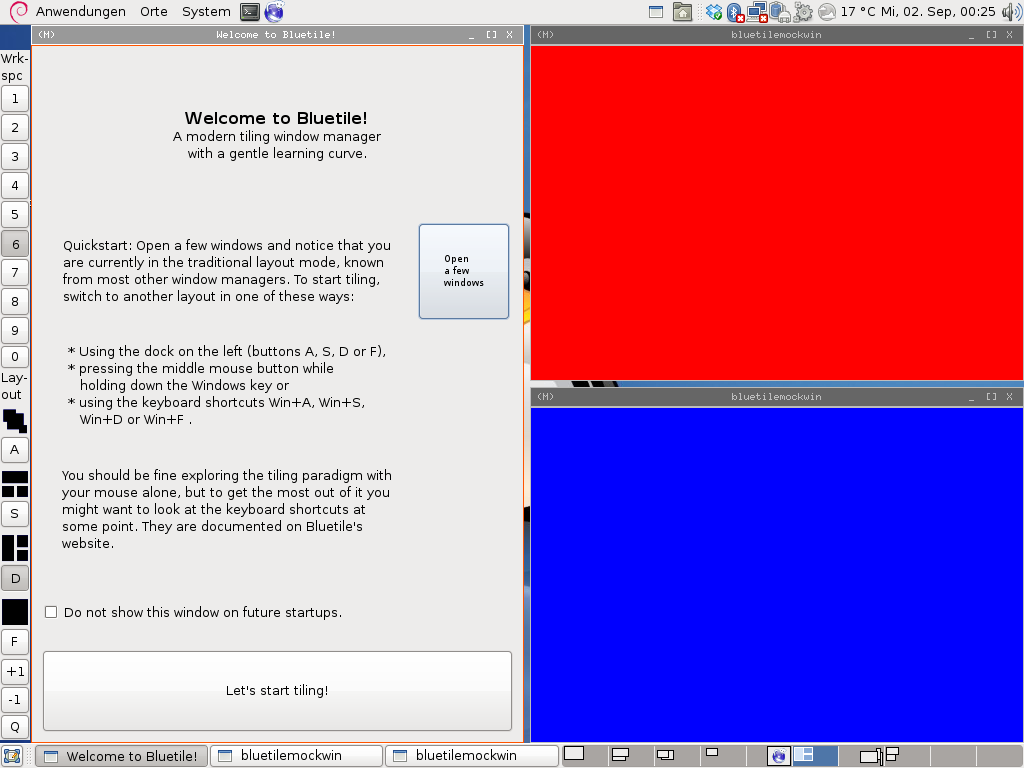
I just packaged and uploaded Jan Vornberger s window manager bluetile to Debian. This very nice piece of software brings the benefits of a tiling window manager to users who prefer to use the mouse and who don t want to learn a new programing language to configure their window manager. Bluetile uses the xmonad libraries and extends them with an easy to use and discoverable user interface.

Bradley Smith: Gitorious + Blog = Fun (+ Ruby)

Something I've wanted to do for a while now, is somehow combine my blog with all of my projects/git repositories, and now I've done it! Welcome to my new site :) So, I got bored a few nights ago, and started trying to find some kind of project management type system to host my git repositories in. After searching for a while I stumbled across Gitorious. I'd heard of Gitorious before, but I'd never really looked at it, nor did I know that it's codebase was infact completely open. So I thought I'd give it a try to see what it was like Now I have to admit, my first impressions of it weren't exactly great. Firstly, it uses Ruby, which I can't say I'm much of a fan of (but that's a different discussion :p), nor am I a fan of installing all of the 'packages' it needed, via gem. Deploying it is an absolute nightmare, it has 4 different daemons, all of which have hideous init scripts that don't really work properly, and low and behold you try and put the git repositories and the site itself under different users, figuring out what needs to run as what and what needs what permissions is very much a game of trial and error. In Gitorious' defence, there /are/ numerous guide lurking around on the internet explaining how to do these things. But once I'd got over these niggles, and had actually deployed it, it worked quite nicely, and really did exactly what I wanted, so I decided to stick with it. It then occurred to me that it probably wouldn't be too hard to stick a blog onto it, after all, it's written using Rails, which is supposed to be easy, right? So with no knowledge of Ruby, let alone Rails, I got stuck in. Fortunately, it turns out Rails is in fact pretty easy to use, (at least once you've got used to it implicitly doing everything behind the scenes..), I'm even starting to think I prefer it to Django... So there we have it, a brand new site, and one that looks considerably better than my old one.. even if it is just Gitorious in disguise _ The only thing I'm disappointed Gitorious doesn't have, is some kind of bug tracker, but then, I'm not sure I'd use one given most of my projects just go through Debian.

Thomas Koch: udev ate my laptop today?

I finally got punished today for using unstable without knowing enough about my system. :-) Since I can't access my emails I'm hoping for help from planet-debian. Please excuse...

So the last words of my machine:

Loading, please wait...
  One or more specified logical volume(s) not found.
Unable to find LVM volume mylvm/root_crypt
  One or more specified logical volume(s) not found.
Unable to find LVM volume mylvm/swap_crypt
File descriptor 3 (/conf/conf.d/cryptroot) leaked on lvm invocation. Parent PID 
352: /bin/sh
udevd-work[77]: kernel-provided name 'dm-0' and NAME= 'mapper/mylvm-swap' 
disagree, please use SYMLINK+= or change the kernel to provide the proper name
<blink>_</blink>

Please, if you can help me, write a comment to this blogpost!
(Thank you, Hanno for borrowing me your laptop!)

update: It wasn't udev (this time). Sorry. The problem was, that I updated libdevmapper without also updating dmsetup. I could boot into an older kernel and solve this. A Bug against the LVM Debian package is already filled.

Russell Coker: Links June 2010

Seth Berkley gave an interesting TED talk about developing vaccines against the HIV and Influenza viruses [1]. The part I found most interesting was the description of how vaccines against viruses are currently developed using eggs and how they plan to use bacteria instead for faster and cheaper production. One of the problems with using eggs is that if the chickens catch the disease and die then you can t make a vaccine. Aigars Mahinovs wrote a really good review of Microsoft Azure and compared it to Amazon EC2 [2]. It didn t surprise me that Azure compared poorly to the competition. Johanna Blakley gave an insightful TED talk about IP lessons from the fashion industry [3]. She explained how an entire lack of IP protection other than trademark law was an essential part of the success of the fashion industry. She also compared the profits in various industries and showed that industries with little or no IP protection involve vastly larger amounts of money than industries with strong IP protection. Lisa D wrote an insightful post about whether Autism Spectrum Disorders (such as Asperger Syndrome) should be considered to be disabilities [4]. I don t entirely agree with her, but she makes some really good points. Sharmeen Obaid-Chinoy gave an interesting TED talk about the way the Taliban train young children to become suicide bombers [5]. Apparently the Taliban prey on large poor families, sometimes paying the parents for taking children away to school . At the Taliban schools the children are beaten, treated poorly, and taught theology by liars who will say whatever it takes to get a result. Then after being brain-washed they are sent out to die. Wired has an interesting article about Charles Komanoff s research into New York traffic problems [6]. He aims to track all the economic externalities of traffic patterns and determine incentives to encourage people to do things that impose less costs on the general economy. His suggestions include making all bus travel free as the externality of the time spent collecting fares is greater than the fare revenue. It s a really interesting article, his research methods should be implemented when analysing traffic in all large cities, and many of his solutions can be implemented right now without further analysis such as free buses and variable ticket pricing according to the time of day. William Li gave an interesting TED talk about starving cancer by preventing new blood vessels from growing to feed it [7]. Drugs to do this have been shown to increase the life expectancy of cancer patients by more than 100% on average. Also autopsies of people who died in car accidents show that half the women in their 40 s had breast cancer and half the men in their 50 s prostate cancer but those cancers didn t grow due to a natural lack of blood supply, so the aim here is to merely promote what naturally happens in terms of regulating cancers and preventing them from growing larger than 0.5mm^3. There are a number of foods that prevent blood vessels growing to cancers which includes dark chocolate! ;) Also drugs which prevent blood vessel growth also prevent obesity, I always thought that eating chocolate all the time prevented me from getting fat due to the central nervous system stimulants that kept me active Graham Hill gave an inspiring TED talk about becoming a weekday vegetarian [8]. Instead of making a commitment to being always vegetarian he s just mostly vegetarian (only eating meat on Sundays). He saves most of the environmental cost and doesn t feel guilty if he ever misses a day. It s an interesting concept. Cory Doctorow wrote an insightful article for the Guardian about the phrase Information Wants To Be Free [9]. He points out that really it s people who want to be free from the tyranny that is being imposed on us in the name of anti-piracy measures. He also points out that it s a useful straw-man for the MAFIAA to use when claiming that we are all pirates. The Atlantic has an interesting article about the way that Google is working to save journalistic news [10]. Adam Sadowsky gave an interesting TED talk about creating a Rube Goldberg machine for the OK Go video This Too Shall Pass [11]. At the end of the talk they include a 640*480 resolution copy of the music video. Brian Cox gave an interesting TED talk advocating increased government spending on scientific research [12]. Among other things he pointed out that the best research indicates that the amount of money the US government invested in the Apollo program was returned 14* to the US economy due to exports of new American products that were based on that research. It s surprising that any justification other than the return on investment for the Apollo program is needed! Moot gave an interesting TED talk about Anonymity [13]. I don t think that he made a good case for anonymity, he cited one person being identified and arrested for animal cruelty due to the efforts of 4chan people and also the campaign against the Cult of Scientology (which has not been very successful so far). Rory Sutherland gave an intriguing TED talk titled Sweat the Small Stuff [14]. He describes how small cheap changes can often provide greater benefits than huge expensive changes and advocates corporations having a Chief Detail Officer to take charge of identifying and implementing such changes. TED Hosted an interesting debate between pro and anti nuclear campaigners [15]. They agreed that global warming is a significant imminent problem but disagree on what methods should be implemented to solve it.

Bernd Zeimetz: styling changes in ikiwiki 3.20100610

Some minutes before the release of 3.20100610 we convinced Joey in #ikiwiki to commit the following changes: We hope that nobody wants to hit us with a bat now :-)

11 June 2010

Bernd Zeimetz: merkaartor 0.16.0 available in unstable

Merkaartor 0.16.0 was uploaded to Debian/unstable several days ago and should be available on all architectures now. Merkaartor As usual please help testing the new version - upstream and me will try to fix all bugs as fast as possible. Below follows the long list of new features, for the full list of changes see the CHANGELOG.

Petter Reinholdtsen: Automatic upgrade testing from Lenny to Squeeze

The last few days I have done some upgrade testing in Debian, to see if the upgrade from Lenny to Squeeze will go smoothly. A few bugs have been discovered and reported in the process (#585410 in nagios3-cgi, #584879 already fixed in enscript and #584861 in kdebase-workspace-data), and to get a more regular testing going on, I am working on a script to automate the test. The idea is to create a Lenny chroot and use tasksel to install a Gnome or KDE desktop installation inside the chroot before upgrading it. To ensure no services are started in the chroot, a policy-rc.d script is inserted. To make sure tasksel believe it is to install a desktop on a laptop, the tasksel tests are replaced in the chroot (only acceptable because this is a throw-away chroot). A naive upgrade from Lenny to Squeeze using aptitude dist-upgrade currently always fail because udev refuses to upgrade with the kernel in Lenny, so to avoid that problem the file /etc/udev/kernel-upgrade is created. The bug report #566000 make me suspect this problem do not trigger in a chroot, but I touch the file anyway to make sure the upgrade go well. Testing on virtual and real hardware have failed me because of udev so far, and creating this file do the trick in such settings anyway. This is a known issue and the current udev behaviour is intended by the udev maintainer because he lack the resources to rewrite udev to keep working with old kernels or something like that. I really wish the udev upstream would keep udev backwards compatible, to avoid such upgrade problem, but given that they fail to do so, I guess documenting the way out of this mess is the best option we got for Debian Squeeze. Anyway, back to the task at hand, testing upgrades. This test script, which I call upgrade-test for now, is doing the trick:
#!/bin/sh
set -ex
if [ "$1" ] ; then
    desktop=$1
else
    desktop=gnome
fi
from=lenny
to=squeeze
exec < /dev/null
unset LANG
mirror=http://ftp.skolelinux.org/debian
tmpdir=chroot-$from-upgrade-$to-$desktop
fuser -mv .
debootstrap $from $tmpdir $mirror
chroot $tmpdir aptitude update
cat > $tmpdir/usr/sbin/policy-rc.d <<EOF
#!/bin/sh
exit 101
EOF
chmod a+rx $tmpdir/usr/sbin/policy-rc.d
exit_cleanup()  
    umount $tmpdir/proc
 
mount -t proc proc $tmpdir/proc
# Make sure proc is unmounted also on failure
trap exit_cleanup EXIT INT
chroot $tmpdir aptitude -y install debconf-utils
# Make sure tasksel autoselection trigger.  It need the test scripts
# to return the correct answers.
echo tasksel tasksel/desktop multiselect $desktop   \
    chroot $tmpdir debconf-set-selections
# Include the desktop and laptop task
for test in desktop laptop ; do
    echo > $tmpdir/usr/lib/tasksel/tests/$test <<EOF
#!/bin/sh
exit 2
EOF
    chmod a+rx $tmpdir/usr/lib/tasksel/tests/$test
done
DEBIAN_FRONTEND=noninteractive
DEBIAN_PRIORITY=critical
export DEBIAN_FRONTEND DEBIAN_PRIORITY
chroot $tmpdir tasksel --new-install
echo deb $mirror $to main > $tmpdir/etc/apt/sources.list
chroot $tmpdir aptitude update
touch $tmpdir/etc/udev/kernel-upgrade
chroot $tmpdir aptitude -y dist-upgrade
fuser -mv
I suspect it would be useful to test upgrades with both apt-get and with aptitude, but I have not had time to look at how they behave differently so far. I hope to get a cron job running to do the test regularly and post the result on the web. The Gnome upgrade currently work, while the KDE upgrade fail because of the bug in kdebase-workspace-data I am not quite sure what kind of extract from the huge upgrade logs (KDE 167 KiB, Gnome 516 KiB) it make sense to include in this blog post, so I will refrain from trying. I can report that for Gnome, aptitude report 760 packages upgraded, 448 newly installed, 129 to remove and 1 not upgraded and 1024MB need to be downloaded while for KDE the same numbers are 702 packages upgraded, 507 newly installed, 193 to remove and 0 not upgraded and 1117MB need to be downloaded I am very happy to notice that the Gnome desktop + laptop upgrade is able to migrate to dependency based boot sequencing and parallel booting without a hitch. Was unsure if there were still bugs with packages failing to clean up their obsolete init.d script during upgrades, and no such problem seem to affect the Gnome desktop+laptop packages.

Norbert Tretkowski: DRBD source dropped from Debian unstable

OK, not really... DRBD 8.3.7 is an official part of the Linux kernel since 2.6.33, and thanks to Dann Frazier we also have a backport of that patch in Debian's 2.6.32 kernel as well.

Until yesterday, the DRBD source package in Debian built a -utils and a -source package, the latter was now dropped. From now on, users no longer need to recompile the DRBD module after a kernel upgrade.

MJ Ray: Koha in Book Industry Communication

Our co-op has joined Book Industry Communication as an associate member, mainly in order to voice experiences of the Koha community and ourselves about RFID tag standardisation and related sustainable development. I want us to give the Free and Open Source Software library world and our charity and academic clients more input in developing this big change to libraries. Even so, it wasn t an easy decision to join. I still believe that RFID standards development would be better done in an open forum, but there doesn t seem to be a perfect choice and I don t think we can create one. BIC already has cross-sector support and seems much more open than the so-called RFID Alliance . Pragmatism was enough, this time, and so far BIC seems friendly and welcoming. I see that a larger service provider co-operative, OCLC (UK), is also a member, so hopefully that means it s safe for co-ops. I think most of the readers of this will be free software developers, koha users and/or members of other co-ops. So, I ask you, what do you think of this move? Leave me a comment on our blog or email me if you prefer to keep it private.

Rapha&#235;l Hertzog: About the Debian Community Poll

While I find the idea interesting, several of the questions can t be correctly answered because the proposed choices are not realistic or too limited. On the question of the usage of money, I believe we should spend money to fund important projects but I don t want to fund people having important positions in Debian and doing important work . What should I reply? (Granted, there s the other item but that doesn t help getting a clear picture of the answers) On the question Do you prefer time based releases instead of the it s ready when it s ready releases? , it is putting two concepts in opposition when the release managers recently proposed a third way that combines both: time based freezes and release when it s ready . This is what I want and I can t adequately express it either in the current poll. Partagez cet article / Share This

Jan Hauke Rahm: MiniDebConf in Berlin, now

Good morning everyone, after quite some time of organization, we got the MiniDebConf running in Berlin. Yesterday at 9.30, Zack had the pleasure of opening the event which seems to be reflected in the press already. After that, we had nice talks, one every hour from 10 to 6 with mine being the last one of the day at 5 p.m. Yes, I did it :) Slides, links, and all that stuff will follow in a later post, or more official announcements. Right now I m preparing myself to get back to the fairground. The second day starts with another bunch of talks at 10 and I m excited to meet different people again and hear more interesting talks. The BSP went well. :) Actually, we didn t really fix many bugs, I guess. A few maintainers stayed after the event as well as a couple of users completely new to packaging. Thus, it was more like a small social event bit it was really fun. And of course the HackLab is still open today, so we have every chance to fix more bugs This just as a small input from where we stand. More is to come some time later, probably after the weekend, we ll see

10 June 2010

Rog rio Brito: A version of xpdf with the poppler backend available

Well, it s been some time since I last wrote here and things are quite hectic, due to some real-life happenings. Announcement For those people that are insterested in a small PDF viewer, based on an actively maintained backend, and that doesn t bring your computer to a halt when you try to zoom your documents when you need to see some details, then you might want to give this version of xpdf a try. I already received some reports for some bugs and fixed them, with one of them being a problem related by a kind user of Gentoo. Motivation Some people have asked me why this even needs to exist in the first place and I agree that it would be better if it didn t: I would love to spend my time actually using my computers rather than fixing my computers for better tasks (read: studying Mathematics, etc). The upstream maintainer of xpdf uses it as one source of income and keeps it running across many system (even legacy ones). I imagine that this one of the reasons why he tries to keep xpdf almost self contained, with many parts that could be delegated to other libraries, and with some abstraction code that makes the code compile even in the presence of very broken compilers. Of course, this means, in part, that as long as you take more duties, maintaing the code becomes more and more complex. He told me that he doesn t offer an open development tree because he wants to give his customers some advantages over the public version and his reasons are perfectly justifiable, of course. He also manifested the interest of possibly basing xpdf on a more modern toolkit and, when I asked him what that would be, he mentioned that, perhaps, it would be Qt. The development of xpdf will, quite probably, take newer directions. Unfortunately, xpdf has not seen a new upstream release since 2007-02-27. It did, though, have some patchlevel updates released. Taking care of the maintainance of the code is a high concern for distributions. Some people, though, would like to keep it simple (me included). Unfortunately, some efforts to maintain it had not had the necessary coordination and duplication of effort has occured. Proposal I am willing to become a patch aggregator for the code in xpdf with a poppler backend. I would love to give it some refactoring too, drop some of the legacy code that is not used (and only serves to make the code hard to read), and adopt some good coding style standard (I particularly like the one from the Linux Kernel with the proper adaptations for C++). I have already contacted the people at Gentoo, and I would love to get people from Fedora, Ubuntu, and Suse involved also. Alas, the last time I tried to mail their mailing lists, I got messages telling me that my messages were rejected or waiting for moderation, because I was not a subscriber. I never heard back, since. I appreciate it if you could help spread the word. Thanks.

Russell Coker: Logging Shell Commands

In response to my previous post about logging in directly as root [1] it was suggested that using sudo is the only way to log the commands that are entered as root. One reason for doing this is if you don t trust the people who are granted root access and you want to log all commands to a remote server that is run by different people. I wonder whether it is really possible to run systems with untrusted sysadmins, if someone can apply patches etc then they can surely install a trojan and then wait a while before activating it to make things more difficult for anyone who is analysing the logs. One of the many issues is that even the restricted version of vim permits the :r and :w commands, so one could start vim from sudo with an innocuous file as the target of the edit operation and then read and write some critical file such as /etc/shadow. I expect that someone has written an editor which has a restricted mode that doesn t allow reading/writing files other than the one specified on the command-line, and if not it surely wouldn t be difficult to patch vim (or your favorite editor) to have such a mode of operation. But there are always other programs that can access files other than the ones specified on their command-line. It seems that using the auditctl interface to log access to certain critical files (EG read access to /etc/shadow and write access to everything under /etc, /bin, /sbin, and /usr) would be a necessary part of an effective auditing strategy and that sudo would only comprise a small part of a useful configuration. There are other viable ways of logging everything that is done as root which offer benefits over sudo. Ways of Logging Shell Commands The Korn shell supports doing all the logging you might desire as part of a shell function [2]. Bash can have a similar shell function to do the logging, but when a command is entered the previous command is logged [3], this means that any single bash command that unsets this will never be logged. It might be possible to solve this if you know more about Bash than I do. I wonder if the Korn shell function has the same issue. This is still probably useful for some situations when you want to track what honorable sysadmins do, but of little benefit for tracking hostile sysadmins (tracking hostile sysadmins is actually possible). You can put code in a file such as /etc/bash.bash_logout to log the commands elsewhere, but even trivial things such as kill -9 $$ can defeat that so it s only useful when the sysadmin is trusted. The Sudoshell project exists to log all data that is entered in a shell [3]. One deficiency of this for the people who don t trust the root user is that it logs the data to files on disk, but it shouldn t be difficult to rewrite sudoscriptd to write directly to another machine over the network. Also one benefit of this for auditing is that it captures all the output of the commands as well (which can be a little inconvenient to decipher when curses programs are run. The web site also describes some of the problems with trying to use sudo directly for everything (such as pipelines). If you compile Bash version 4.1 with the SYSLOG_HISTORY macro enabled (which can be done by editing the file config-top.h) then it will log all commands to syslog. RootShell.be has a short post about this which mentions the security issues, some commands take passwords as parameters and these passwords could be exposed to the network [5]. Of course the best option is to just avoid such commands. Thanks to Chris Samuel for pointing out the Bash logging feature. Conclusion If you use sudo for auditing root access then you lose some shell functionality. Sudo also only logs the commands that are executed you don t get logging of output. It seems that depending on the exact needs either a modified version of Sudoshell or the logging that can be compiled in to Bash would be the way to go depending on the exact requirements. The main benefit of using sudo for logging would be that some distributions of Linux are configured that way by default but it seems unlikely that someone would go to the effort of running a separate logging server that the regular sysadmin team can t touch and then configure their servers in a default manner.

Dirk Eddelbuettel: Rcpp 0.8.2

A bug fix release Rcpp version 0.8.2 is now on CRAN and Debian. It contains some fixes for Sun compiler, but no user-visible changes and complements the Rcpp 0.8.1 release made Tuesday. Our thanks to Brian Ripley for help with the portability tests for that platform. It will be good to get an autobuilder for pre-emptive testing for that platform too as we make quite some use of the win-builder servive in Dortmund. The full NEWS entry for this release follows below:
0.8.2   2010-06-09
    o   Bug-fix release for suncc compiler with thanks to Brian Ripley for
        additional testing.
As always, even fuller details are in Rcpp Changelog page and the Rcpp page which also leads to the downloads, the browseable doxygen docs and zip files of doxygen output for the standard formats. A local directory has source and documentation too. Questions, comments etc should go to the rcpp-devel mailing list off the R-Forge page

Dirk Eddelbuettel: RcppArmadillo 0.2.2

Following the Rcpp 0.8.1 release we made yesterday, we released RcppArmadillo release 0.2.2 this morning. RcppArmadillo uses Rcpp (and some 'glue' code) to provide a transparent interface from R to Conrad Sanderson's impressive Armadillo library for linear algebra. This release works well with the most recent inline release 0.3.5. One can now employ inlined R code as we generalized how/which headers are included and how library / linking information is added thanks a plugin mechanism. This is the first RcppArmadillo version to provide such a plugin, We also updated the included Armadillo headers to its most recent release 0.9.10, added some more operators and provide a utility function RcppArmadillo:::CxxFlags() to provide include directory information on the fly. An example of the direct inline approach for the fastLm function:
library(inline)
library(RcppArmadillo)
src <- '
	Rcpp::NumericVector yr(ys);			// creates Rcpp vector from SEXP
	Rcpp::NumericMatrix Xr(Xs);			// creates Rcpp matrix from SEXP
	int n = Xr.nrow(), k = Xr.ncol();

	arma::mat X(Xr.begin(), n, k, false);   	// reuses memory and avoids extra copy
	arma::colvec y(yr.begin(), yr.size(), false);

	arma::colvec coef = arma::solve(X, y);      	// fit model y ~ X
	arma::colvec res = y - X*coef;			// residuals

	double s2 = std::inner_product(res.begin(), res.end(), res.begin(), double())/(n - k);
							// std.errors of coefficients
	arma::colvec std_err = arma::sqrt(s2 * arma::diagvec( arma::inv(arma::trans(X)*X) ));

	return Rcpp::List::create(Rcpp::Named("coefficients") = coef,
				  Rcpp::Named("stderr")       = std_err,
				  Rcpp::Named("df")           = n - k
				  );
'
fun <- cxxfunction(signature(ys="numeric", Xs="numeric"), src, plugin="RcppArmadillo")
This creates a compiled function fun which, by using Armadillo, regresses a vector ys on a matrix Xs (just how the fastLmPure() function in the package does) --- yet is constructed on the fly using cxxfunction from inline. More information is on the RcppArmadillo page. Questions, comments etc should go to the rcpp-devel mailing list off the R-Forge page.

9 June 2010

Sylvain Le Gall: Waiting for her in ~1month

My wife is pregnant and we are expecting our second baby's arrival in about a month. Last time, she came back from her preparation lessons with a adverstisement "baby shower" gift pack. One of them catch my attention: English translation: be prepared to offer him the best... English translation: because Debian guarantee the quality and offering the quality is a proof of love OK, the swirl is the other way and I made a 5 minutes GIMP modification to cut-and-paste the Debian logo. But the message is here! Remember me: For those interested, the real thing is a soap by NUK(R).



David Welton: A Minor Erlang Rant

In an earlier post, I compared node.js to Erlang: http://journal.dedasys.com/2010/04/29/erlang-vs-node-js - which admittedly has a whiff of apples and oranges about it. Still, though, I think there's something to it. Node.js is creating lots of buzz for itself these days. Some of that will turn into actual production use, and at that point actual companies will have a vested interest in seeing the system improved. Currently, it is not as 'good' as Erlang. Erlang's VM has a built in scheduler, so you simply don't have to worry about manually creating bite-sized chunks of processing that feed into one another, it all "just works". For instance, my current Erlang project involves reading from twitter's stream, and distributing that to IRC and the web. It's pretty simple, works well, and is quite robust. I haven't had the best of days though, and one little annoyance of the many I dealt with today really caught my eye. I need to do an HTTP POST in Erlang, and:
  1. The documentation does not have examples.
  2. Here's an example of how to do a POST:
    http:request( post, "http://scream-it.com/win/tests/posttest.cfm", [], "application/x-www-form-urlencoded", "x=2&y=3&msg=Hello%20World" , [], [] ).
  3. Aside from being ugly and not very leggible, you'll note that he's passing the parameters as a string, and also has to manually include the "x-www-form-urlencoded" header.
  4. To create that string, you'd want to url encode it. Actually, ideally, you'd just pass in a list of key/value pairs and let the library module handle it.
  5. However, there's nothing in the http module that does that.
  6. If you look through various bits of Erlang code on the web, you'll note many, many versions of url encoding and decoding, because the http module makes no mention of how one might go about doing so.
  7. It turns out, that the edoc_lib module does have a uri encode function!
  8. That isn't documented in its own man page.
  9. And certainly isn't linked to in the http page.
So, in 2010, doing an HTTP POST in Erlang is still a pain in the neck. I'd be happy to put my money where my mouth is and submit a patch (at least one for the documentation), but you have to wonder why no one has fixed the problem so far - maybe they're not very accepting of patches?

Thibaut Girka: Second week of GSoC

Hi, already two weeks (and a half)! Now, this time, I haven't made as much progress I would have wanted, but here is what have been done during this week (and a half): What I've been doing As a result, the Debian Installer works on the FreeRunner, you can install Debian on the FR using it, but it won't setup anything for the bootloader. Oh, and another important thing is that the GIT repos are now up and running! You can try the prebuilt image or build it yourself. Note that you'll probably want to use a custom repo with the modified udebs. An alternative is to modify pkg-lists/netboot/network-console/armel/s3c24xx.cfg to include them in the image. What's coming next Well, nothing is sure, but I may:

Next.

Previous.