Search Results: "ag"

7 July 2010

James Morrison: A speech that didn't happen

I have a lot of papers lying around. I now try to keep them organized, but I haven't got through the back log of when I didn't organize them. Sometimes I come across stuff that I'm happy I had in the pile. The following was my attempt at a valedictorian speech for the 2005 Math class at the University of Waterloo. I was not the valedictorian, but I tried, and thus have a speech.

Ladies, Gentlemen, Doctors and children of all ages. Thank you for spending our last day at Waterloo, here with us. I am one of those people who won't be staying here after day, but somehow I was still chosen to be the valedictorian. So, when I was asked to be the valedictorian by some friends of mine, I was thrilled. I also though I could do a good job, heck, I got my degree in CS, therefore, I can do anything. So, I accepted the nomination. I looked at the nomination form and didn't find any hints on what to talk about. At this point I realized that this speech may be a little underspecified. In fact, there was no specification at all.

I gathered what I could from the form, i.e. a speech had to be written by, and performed on the 18th of June 2005. Skip forward a few weeks, I'd accomplished nothing more than vague thoughts on what to talk about, then I got an email. All potential speeches had to be presented on the 6th of April 2005 (the deadline had moved up, and still no specification). However, a performance objective was given in that email -- each speech must be completed in 5 minutes. Given that I don't have a spec, I can only hope no one else has one.

What follows is my implementation of this unknown specification.

Another cycle in our lives is over. We are finished our latest round of education. This time from the University of Waterloo, in some Math program. Many of us have changed significantly while we've been here, but we are still the same people. We know we are older, we can guess that we are wiser, and we are certainly more educated. So, here is a quick tour of my cycle through Waterloo.

When I got here back in September 2000, I was amazed at how many smart people could be put together in one small place. I am actually still amazed by all the smart people here. I simply happen to know a bit more about some of these people and the amazing things they have done. With all these smart people here, I even had to do homework to keep up.

Skip forward to second year. Second year is when the university decided there is no more room for me in residence. In fact, they do that to almost all second year students. So, I found a sleezy place to live off-campus and started discovering what life is like outside the university bubble. For example, there are stores not in the plaza. There are a couple malls, a bus station, and a train station.

By third year Waterloo had become home despite working in two other cities and growing up on the other side of Toronto. I no longer had to fear being kicked out of CS since I had enough courses with good marks racked up that my cumulative average wouldn't drop too low unless I started failing, which would have been a bad thing to do.

In fourth year, I could see the end in sight. Grad school applications needed to be done pronto and some interesting job prospects lured me away from yet more years of school. Co-op didn't help keep me in school, I enjoyed the working world. I know there are others that used co-op to find that the working world wasn't for them. I expect those people to be in some school for a good long time.

Now we are at the end, and the cycle is complete. I've been across the country, lived over in sunny California, and biked through Scotland, but no where has compared to Waterloo, or the great people that make it such a wonderful place to be. I'm sad to go, as I'm sure many of you are, but I hope you are excited about the next step at the same time.

That was my 5 years, in a non-chronologically accurate order. But it's been even better to help and see people do amazing things. Small things, like getting a group of friends together to go get pints of Bubbletea. To large things like running frosh week for thousands of first year students.

Now that we have looked at the past, what about the future? One of the things I didn't wan to say during this speech is that "We are the future". What does that even mean? Are we useless now? I don't know what it means, it could even be partially true, but we are not useless. In fact our time is now! Among this graduating class are those who are doing cutting edge research. There are those we are already running their own companies. There are those who are already half-way through there plan to rule the world. There are even those of us who are simply going to help others do those things. So, we are not "the future", we are "the now".

Being "the now", (don't I sound like Dubya?) is one thing, but we should always be "the now". We can always make now be our time. We should do this because if we aren't the ones living happily and making the world a better place, in our own ways, then who is going to do it?

If nothing else, I really hope everyone lives happily. For me, I found if I can keep my hat then I can be happy. Well, I can be happy promoting "No Pants Day"!

DOWN WITH PANTS!!

At the end, I finally figured out the specification for this speech. It's simple: Remind people of the awesome things they have done here, the amazing people they shouldn't forget. Lastly, to convince people to keep doing the awesome things despite what might happen or what obstacles appear.

Thank you, I enjoyed being your VD today.

6 July 2010

Matt Zimmerman: We ve packaged all of the free software what now?

Today, virtually all of the free software available can be found in packaged form in distributions like Debian and Ubuntu. Users of these distributions have access to a library of thousands of applications, ranging from trivial to highly sophisticated software systems. Developers can find a vast array of programming languages, tools and libraries for constructing new applications. This is possible because we have a mature system for turning free software components into standardized modules (packages). Some software is more difficult to package and maintain, and I m occasionally surprised to find something very useful which isn t packaged yet, but in general, the software I want is packaged and ready before I realize I need it. Even the long tail of niche software is generally packaged very effectively. Thanks to coherent standards, sophisticated management tools, and the principles of software freedom, these packages can be mixed and matched to create complete software stacks for a wide range of devices, from netbooks to supercomputing clusters. These stacks are tightly integrated, and can be tested, released, maintained and upgraded as a unit. The Debian system is unparalleled for this purpose, which is why Ubuntu is based on it. The vision, for a free software operating system which is highly modular and customizable, has been achieved. Rough edges This is a momentous achievement, and the Debian packaging system fulfills its intended purpose very well. However, there are a number of areas where it introduces friction, because the package model doesn t quite fit some new problems. Most of these are becoming more common over time as technology evolves and changes shape. Why are we stuck?
I suppose it is tempting, if the only tool you have is a hammer, to treat everything as if it were a nail.
Abraham Maslow
The packaging ecosystem is very strong. Not only do we have powerful tools for working with packages, we also benefit from packages being a well-understood concept, and having established processes for developing, exchanging and talking about them. Once something is packaged, we know what it is and how to work with it, and it fits into everything else. So, it is tempting to package everything in sight, as we already know how to make sense of packages. However, this may not always be the right tool for the job. Various attempts have been made to extend the packaging concept to make it more general, for example: Other package managers aim to solve a specific problem, such as providing lightweight package management for embedded systems, or lazy dependency installation, or fixing the filesystem hierarchy. There is a long list of package managers of various levels which solve different problems. Most of these systems suffer from an important fundamental tradeoff: they are designed to manage the entire system, from the kernel through applications, and so they must be used wholesale in order to reap their full benefit. In other words, in their world, everything is a package, and anything which is not a package is out of scope. Therefore, each of these systems requires a separate collection of packages, and each time we invent a new one, its adherents set about packaging everything in the new format. It takes a very long time to do this, and most of them lose momentum before a mature ecosystem can form around them. This lock-in effect makes it difficult for new packaging technologies to succeed. Divide and Conquer No single package management framework is flexible enough to accommodate all of the needs we have today. Even more importantly, a generic solution won t account for the needs we will have tomorrow. I propose that in order to move forward, we must make it possible to solve packaging problems separately, rather than attempting to solve them all within a single system. But I like things how they are! We don t have a choice. The world is changing around us, and distributions need to evolve with it. If we don t adapt, we will eventually give way to systems which do solve these problems. Take, for example, modern web browsers like Firefox and Chromium. Arguably the most vital application for users, the browser is coming under increasing pressure to keep up with the breakneck pace of innovation on the web. The next wave of real-time collaboration and multimedia applications relies on the rapid development of new capabilities in web browsers. Browser makers are responding by accelerating deployment in the field: both aggressively push new releases to their users. A report from Google found that Chrome upgrades 97% of their users within 21 days of a new release, and Firefox 85% (both impressive numbers). Mozilla recently changed their maintenance policies, discontinuing maintenance of stable releases and forcing Ubuntu to ship new upstream releases to users. These applications are just the leading edge of the curve, and the pressure will only increase. Equally powerful trends are pressing server applications, embedded systems, and data to adapt as well. The ideas I ve presented here are only one possible way forward, and I m sure there are more and better ideas brewing in distribution communities. I m sure that I m not the only one thinking about these problems. Whatever it looks like in the end, I have no doubt that change is ahead.

Martin-Éric Racine: On pohjant hden alla, T koti mulla mainen, M el m st laulan...

My girlfriend and I were out picking up a cake at the bakery last week, when my phone rang: Without knowing, at that moment, I had just become a citizen of the country in which I have been living for the past 12 years. It was only yesterday, upon receiving the decision in the mail and looking at the date on the certificate that I realized that, when I got the phone call, the decision had already been made and the bureaucracy was only looking for reassurances that I fully intend upon acquitting my civic obligations as soon as humanely possible. To say that reading the decision was a highly emotional moment is an understatement. Trying to explain the intensity of this moment to my girlfriend, I compared it to the day when a teenager reaches adulthood. This instant brought a similar feeling: suddenly, the whole EU opens its doors to me and I'm free to decide how to best use the opportunities it offers. What next? For now, completing this government training to become a bureaucrat. Funnily enough, becoming a citizen resolved the whole issue of background checks, which also suddenly triples the number of possible venues for the on-job part of the training. In my case, it looks like I'll be spending the next few months at the Ministry of Employment and Entrepreneurship, working on EU projects that fund R&D efforts and export sales ventures in each member state. After that, I'm not sure. On one hand, I'd like to apply for the Ministry of Foreign Affairs' KAVAKU recruitment program for future diplomats. On the other hand, that ministry is extremely picky about whom it accepts and it's not particularly known for favoring naturalized individuals. This being said, our current Minister recently published rather ambitious plans to completely reform the Ministry by bringing in seasoned professionals from the private sector who could efficiently promote Finnish know-how and products abroad, rather than hiring more of the same Public Administration graduates, so, who knows? Maybe the time is right for someone like me to join the ranks of the Finnish diplomacy? An other option that I'm considering is to permanently move to Estonia. When my last job there ended, I was left with the feeling that I could have accomplished a lot more, if only I were in a legal position to move there, rather than commute a couple of times a week. Beyond the pioneering work that myself and my diplomat friends at the Estonian embassy did in Turkey, there was a demand for us to perform the same magic in other countries of interest to Estonia. Unfortunately, not being in a position to be on-site and no longer having a job that paid for me to be there often enough meant that I had to pass on that opportunity. Now, seeing how one of my friends recently left the diplomacy and is open to new challenges, I'm wondering if now might be a good time to resume our operation and prepare our next campaign? Wow... So much to think about, now that a whole continent opened its doors to me. Hienoa! Olen suomalainen.

C.J. Adams-Collier: blog optimizations

Thanks to some recommendations from Jeremy, Pierre and Jeff, this blog should be running a lot less slowly. I ve installed memcached, set up wordpress plugins, tuned apache MPM parameters, tweaked iptables and tc rules and beaten on the blog with load testing scripts. It seems that it will now reliably handle around 10 concurrent requests and take less than 5 seconds to bring the page up. This is much better than the previous <2r/s 20s load time. I m no amazon.com (thank goodness), but I think this will meet the blog s needs quite well.

Jose Luis Rivas Contreras: Dropbox for Debian

Tired of the versioning issue between libnautilus from Debian and Ubuntu I decided to create myself the packages for nautilus-dropbox and here they are. I ll maintain them on my repo, so if you want to keep dropbox updated I recommend you to add my repo to your sources.list:
deb http://dl.rivco.net/debian sid main
And if you are on testing/squeeze there s a repo for you too:
deb http://dl.rivco.net/debian squeeze main It s only available for i386 but you can grab the sources adding the deb-src for your distro and build it with dpkg-buildpackage or whatever you want. Soon I ll be building the experimental client as well.

5 July 2010

Thorsten Glaser: LSM/RMLL; mksh R40, R41 plans

The current version of mksh had use of arc4random(3) removed, including set -o arc4random , to speed it up (on some architectures, a lot) this will break some existing scripts (such as /etc/rc *cough* on MirBSD ). Hence I decided to publish the next version of mksh(1) as R40 based upon current development, and defer plans for associative arrays (and multidimensional arrays) for mksh R41. There s also already the change to Build.sh arguments, so this suits me quite fine. (Read: if running MirBSD, don t upgrade mksh at the moment.) There will be a new MirBSD snapshot once this is fixed, maybe a few more changes to the shell for better POSuX compliance, and the recently mentioned patent on LFNs (long filename) in FAT will be taken into account with a patch to msdosfs. I ll travel to LSM/RMLL 2010, the Libre Software Meeting (Rencontres Mondiales du Logiciel Libre) tomorrow until the weekend, to hack some on FusionForge (this is worktime for me), visit XTaran, Uriel, and maybe a couple of other usual people . Thundersday, between 10:00 UTC and 12:00 UTC, eurynome will be shut down by gecko2@ due to power supply maintenance on the host system data centre. We have a new mirror in the Americas, thanks a lot to Mike 'Fuzzy' Partin! Benny will mention it on the webpages once it s working.

Marco T&uacute;lio Gontijo e Silva: Immix on GHC Summer of Code weekly report #8

My project. This post assumes that the reader has read my last post. This week I could get my focus on the project again, since most of my classes are already over. I ve investigated the segfault that was happening in GHC with +RTS -w -DS, and I noticed that the code in rts/sm/Sanity.c assumed that all objects in the allocated area of the block are being used.
    for (; bd != NULL; bd = bd->link)  
	p = bd->start;
	while (p < bd->free)  
	    nat size = checkClosure((StgClosure *)p);
	    /* This is the smallest size of closure that can live in the heap */
	    ASSERT( size >= MIN_PAYLOAD_SIZE + sizeofW(StgHeader) );
	    p += size;
	    /* skip over slop */
	    while (p < bd->free &&
		   (*p < 0x1000   !LOOKS_LIKE_INFO_PTR(*p)))   p++;  
	 
     
Since this is true for copy collection and mark compact, it was only with mark sweep that the error happened. The only way I could manage to make the segfault disappear by now was marking the swept blocks with a new flag, and avoid running this code in them. So I went back to my old problem with the allocation of memory in lines. I noticed that (one of) the problem(s) may be that the object that is allocated in the free line is not scavenged after the evacuation. When the object is allocated in a block, using the current allocation method, it will eventually be scavenged, because all blocks that were being used to allocation are scavenged. I m planning to implement a list of lines that need to be scavenged and code to scavenge the lines in this list, and the current line. It ll be very similar to the code that does this with blocks.

Julian Andres Klode: Review: Lenovo ThinkPad Edge 15

Wednesday, after some weeks with a flickering screen (or more precisely, something is causing GTK+ to redraw and the kernel to print ^@ in the terminal when you touch the screen, see http://jak-linux.org/tmp/20100628_002.mp4) in my 3 years old HP Compaq 6720s (which seems to be a software-hardware combination problem, at least it works in Ubuntu); I decided to buy a new laptop. It took me a few minutes to find the Lenovo ThinkPad Edge 15 NVL7VGE; which I ordered at notebooksbilliger.de at around 14:30 CEST using Express. On Thursday morning at 6:40 CEST, the device arrived. The laptop features an Intel Core i5 430 M processor with integrated graphics, 4 GiB of RAM, 320 GB hard disk storage, matte screen, and of course a TrackPoint. The machine comes pre-installed with Windows 7 Professional which is not very nice (and Lenovo does not take Windows licenses back). I booted Ubuntu 10.04 from an USB disk which worked a few times, but not always, so I upgraded the BIOS to make USB booting reliable (as Lenovo published multiple BIOS updates already, one fixing this USB booting issue). The first step was booting Ubuntu 10.04 from an USB hard disk to check the Linux support. Using Ubuntu, everything worked out of the box, including stuff like HDMI audio support or output switching. An exception may be the DVD drive, which only works if you set the SATA mode to compatibility. Non-DVD media also works in AHCI mode, but only if you start with a disc inserted in the drive. Playing DVDs requires setting a region code using setregion(8) [otherwise they do not work at all] and SATA compatibility mode [otherwise they only work partially]. Another issue is the HDMI output, as the TV is not correctly detected and some parts at the top and the bottom of the image are missing (that is, the GNOME panels) (but that happens with different screens and ATI cards as well). Oh, and closing the lid with a screen attached and the internal screen disabled works only as long as you do not open it again, because that causes the GPU to stop. On the input side, we have one keyboard, one TrackPoint, and a touch pad. All of them work out of the box, but they have a few problems on the hardware side: The cursor keys on the keyboard are incredibly small and the touchpad is very large. The keyboard is different from the one in the HP Compaq: First of all, there is space between the keys (like Apple keyboards); and secondly, you need to apply more pressure in order to use the keys. The device feels more solid than the HP Compaq 6720s, especially touching the screen does not change the colors on the screen. I don t know how long the keyboard will last, but I hope that I will still have symbols on them in 5 months (which was not the case for the HP Compaq 6720s keyboard). Power consumption is another interesting point. When the device is idle and the screen is disabled, the device seems to consume about 10W. With screen enabled, consumption varies between 13W (idle) 35W (building source code); if the values received via ACPI are correct. The device ships with a 48 Wh battery which after some time was displayed as 53 Wh in gnome-power-statistics (only the when loaded state, capacity is displayed as 47.5Wh). According to Lenovo, the laptop lasts 4.5 hours on battery, meaning consumption of 47.5 Wh / 4.5 h = 10.5 Wh which is a bit overly optimistic if you want to work on the device. After checking everything, I took over my Debian sid installation from my old laptop (which I installed in 2008). It runs happely now, although I still need to get accustomed to the new keyboard and the large touch pad. All in all, the price of 765 I paid for the device seems to be OK. Now I only need to remove the Windows 7 sticker and hope that the device lasts long enough until I want to buy a new one (probably 2013, if the aliens don t invade us 2012).
Filed under: General

Junichi Uekawa: Getting key verification working for pbuilder.

Getting key verification working for pbuilder. It's been on the TODO list, and after some prodding, I've finally gotten around to getting something implemented. The last time I thought of implementing it was 1 1/2 years ago. Time flies. Not quite sure if this is enough or if I broke something. I have a feeling that something will break, so please try out verifying the signatures for the packages. I am hopeful that since main users of pbuilder are Debian Developers I will get useful patches.

Russell Coker: Is Lebara the Cheapest Mobile Phone company in Australia?

My parents have just got a mobile phone with a Lebara pre-paid SIM [1]. Lebara advertise free calls to other Lebara phones but have a disclaimer that they charge a 25 cent flagfall and charge 15 cents per minute after the first 10 minutes which is still cheaper than most mobile calls although not as good as some other mobile telcos such as Three that offer completely free calls to other phones with the same provider. Lebara s main selling point seems to be cheap international calls, half a cent per minute to Thailand, 1 cent per minute to Hong Kong, Indonesia and Singapore and 3 cents per minute to Bangladesh and China. Strangely calls to the US are 5 cents per minute and to Japan are 7 cents per minute, I would have expected that calling developed countries would have been cheaper due to better infrastructure and more competition. The trend of more developed countries having less expensive calls seems clear, some very undeveloped countries cost as much as $2 per minute! Note that all these rates are for calls to land-lines (calls to mobiles cost more) and are based on the new prices that apply after the 13th of July (it s slightly cheaper for the next 8 days). It seems really strange that calls to land-lines in Australia cost 15 cents per minute which is more than twice as much as calls to the US and Japan. In theory it would be possible to redirect calls to Australian land-lines via the US or Japan to save money. In practice it s probably possible to do so by setting up a PBX in Thailand, Hong Kong, or Singapore. But what I think is most noteworthy about Lebara is the fact that the call credit lasts for 90 days (this is in the FAQ). The cheapest top-up is $10 so therefore the minimum cost for mobile phone service is $40 per annum. Given the importance of owning a mobile phone to job seekers I think that with the current state of the economy there are a lot of people who could do with such a phone. If anyone knows of Australian mobile phones that provide cheaper calls to other countries or a cheaper minimum annual fee then please let me know via the comments section. For international readers, all prices are in Australian cents which are worth about 85% as much as US cents.

4 July 2010

Bernd Zeimetz: gimp-plugin-registry 3.5-1

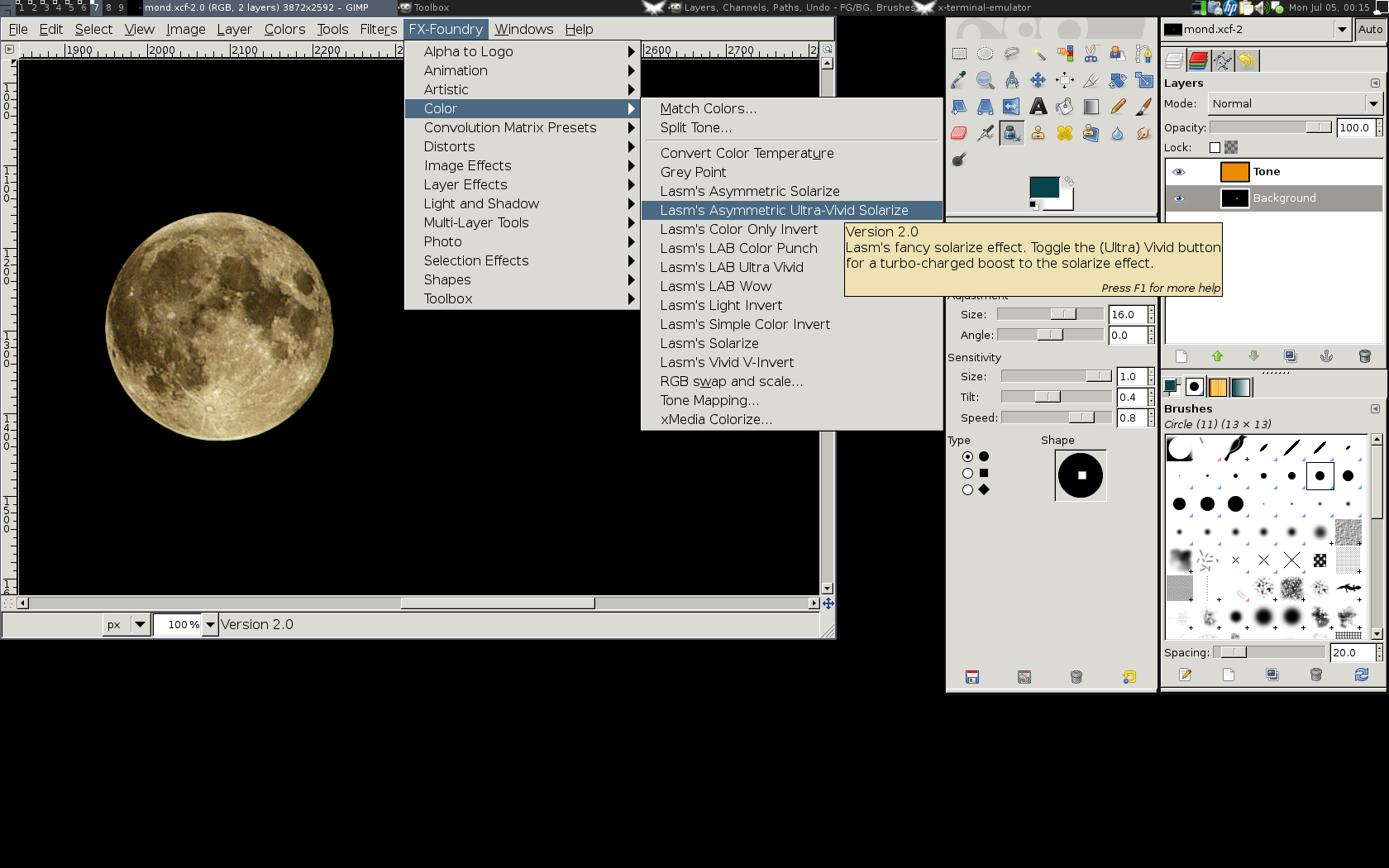
During the last three months and since my last blog-post about gimp-plugin-registry a lot happened: Mainly a large number of new plugins was added, but also various enhancements and bugfixes went into the package, together with updates for various already included plugins. The GIMP screenshot with open FX-Foundry menu For those who don't know gimp-plugin-registry yet, it is a collection of scripts and plugins for The GIMP. The name is based on the webpage GIMP Plugin Registry, where most (new) plugins and scripts are listed. So far the package ships with 170 scripts/plugins. Most of the scripts are written in TinyScheme, but there are also several plugins in C or Python. Probably most noticeable is the inclusion of the GIMP FX Foundry, which is an awesome collection of 124 scripts. Below follows a list of all scripts and plugins as shown in the long description of the Debian package. New plugins are marked with a bold fontface. If there is any interest from other distributions to include the package, I'd be happy to help out to make an integration as easy as possible. The few interesting parts could be ripped out of debian/rules and shipped as a normal Makefile, so they could be used easily. More complicated is the generation of the package description and copyright information, but I guess instead of writing debian/coyright and debian/control, it should be possible to integrate the information into a rpm spec file template or similar files. So in case you're interested to port the package to Fedora, OpenSuSE or some other distribution, don't hesitate to contact me! The sources are available via git, see git.recluse.de for details. For wishes, suggestions and bug reports either use the Debian BTS or Launchpad. While I prefer bugs via the BTS, it might be easier for non-Debian users to file bugs in the Ubuntu Launchpad.
Torsten Landschoff: Postprocessing conference videos

I was planning to attend DebConf New York this year, but for a number of reasons I decided not to go. Fortunately, Ferdinand Thommes organized a MiniDebConf in Berlin at LinuxTag and I managed to attend. Thanks, Ferdinand! There were a number of interesting Talks. I especially liked the talk of our DPL, and those about piuparts and git-buildpackage. In contrast to the other LinuxTag talks, we had a livestream of our talks and recorded (most) of them. The kudos for setting this up goes to Alexander Wirt, who spent quite a few hours to get it up and running. I have to apologize for being late in bringing my Notebook, which was intended to do the theora encoding of the livestream. This was a misunderstanding on my part, I should have known that this is not going to be setup in the night before show time So to compensate the extra hours he had to put in for me, I offered to do the post processing of the videos. Basic approach for post processing The main goal of post processing the videos was (of course) to compress them to a usable size from the original 143 GB. I also wanted to have a title on each video, and show the sponsors at the end of the video. My basic idea to implement that consisted of the following steps:
  1. Create a title animation template.
  2. Generate title animations from template for all talks.
  3. Use a video editor to create a playlist of the parts title talk epilogue.
  4. Run the video editor in batch mode to generate the combined video.
  5. Encode the resulting video as ogg theora.
As always with technology, it turned out that the original plan needed a few modifications. Title animations
<video controls="controls" height="288" src="http://www.landschoff.net/blog/uploads/2010/07/mdc2010_title_anim1.ogv" width="360 "></video>
Originally I wanted to use Blender for the title animation, but I knew it is quite a complicated bit of software. So I looked for something simpler, and stumbled across an article that pointed me towards Synfig Studio for 2D animation. This is also in Debian, so I gave it a try. I was delighted that Synfig Studio has a command line renderer which is just called synfig and that the file format is XML, which would make it simple to batch-create the title animations. My title template can be found in this git repository. Batch creation of title animations I used a combination of make and a simple python script to replace the author name and the title of the talk into the synfig XML file. The data for all talks is another XML file talks.xml. Basically, I used a simple XPath expression to find the relevant text node and change the data using the ElementTree API of lxml python module. The same could be done using XSLT of course (for a constant replacement, see this file) but I found it easier to combine two XML files in python. Note that I create PNG files with synfig and use ffmpeg to generate a DV file from those. Originally, I had synfig create DV files directly but those turned out quite gray for some reason. I am now unable to reproduce this problem. Combining the title animation with the talk For joining the title animation with the talk, I originally went with OpenShot, which somebody of the video team had running at the conference. My idea was to mix a single video manually and just replace the underlying data files for each talk. I expected that this would be easy using the openshot-render command, which renders the output video from the input clips and the OpenShot project file. However, OpenShot stores the video lengths in the project file and will take those literally, so this did not work for talks of different play times I considered working with Kino or Kdenlive but they did not look more appropriate for this use case. I noticed that OpenShot and Kdenlive both use the Media Lovin Toolkit under the hood, and OpenShot actually serializes the MLT configuration to $HOME/.openshot/sequence.xml when rendering. I first tried to read that XML file from python (using the mlt python bindings from the python-mlt2 package) but did not find an API function to do that. So I just hard coded the video sequence in python. I ran into a few gotchas on the way: Things to improve While the results look quite okay for me now, there is a lot of room for improvement. Availability

Gregor Herrmann: RC bugs 2010/25, 2010/26

to start with the good news: christine has joined the RCBW initiative yeah! let's see who joins next ...

as usual, a short overview about my own attempts in the RC bugs department:

Christine Spang: Christine Spang: [h]ledger rocks my world

I hate keeping track of money. Bank accounts, credit cards, investing it's such a hassle. Hell, sometimes I even hate the fact that money exists and needs to be dealt with in the first place. But I admit that it's an easier system than bartering for everything. In college I pretty much ignored most things financial. I rarely had more money than I needed, and put little financial planning into deciding what I could and could not spend money on besides, "I'm going to make X dollars this summer," and, "think twice." But now that I have a steady paycheck, it seems like a good idea to know where all my money goes, so I can make better decisions about how I'm spending (and saving) it. But I've kept procrastinating starting to do so, because GUI programs like Gnucash and HomeBank seem like such a hassle. Their first screen is dauntingly complex, and if you don't know much about accounting it's scary and difficult to be asked to set up a big set of accounts when first starting to use the program, without having any prior experience with what you personally would find useful to keep track of. Entering data through menus and dialogs is tedious and slow. hledger (or ledger, which came first) had been appearing on my radar recently, not least because Iron Blogger uses it). hledger changed my opinion of accounting software. In about 15 minutes, using only the sample transactions from the manual, I was able to enter all my assets and liabilities bank accounts, credit card, student loans, money I've borrowed from people and never paid back though I said I would, etc. And then, I could run 'hledger balance' and it would tell me what sorts of things I had spent money on in the past few days, as far back as I could bother looking up actual transactions for, rather than entering a single transaction with a balance forward. Duuude, awesome! I'm a geek. I like statistics and data about my life, as long as it's not a huge pain to collect the data in the first place. More data means more on which to base decisions, decisions which will then be freer from the bias of what I find memorable enough to remember having done. Here's what I like best about ledger: I don't think I'd be enjoying keeping track of my money nearly so much without a tool like hledger. It gets out of your way to let you focus on the hard things, like choosing categories for the things you spend money on and remembering to record the data in the first place.

Cyril Brulebois: We need *you*! (redux)

We need you! (redux) The X Strike Force needs you! (redux) This time, the focus is on the xserver-xorg-video-intel driver. KMS and UMS are going to be used heavily below, one may want to check the mode-setting wikipedia article and the modesetting page on X.org. Intel follows a 3-month cycle for its video driver releases. Some comments on the last ones: It d be nice to have users install 2.12 from experimental and see how it goes from here. If regressions are found, we should be able to try hard(er) to get them fixed, so that we can move 2.12 to unstable and release with it. If there are too many of them, and if they re not going to be fixed on time, we might stick with 2.9. Pulling the driver from experimental should be quite easy: libdrm* packages are going to be upgraded, but that s mostly it (meaning the server itself will stay the same, and rolling back should be as easy as downgrading the driver and the libdrm* packages). A note on KMS and UMS: a benefit of sticking with 2.9 was being able to switch back to UMS in case KMS wasn t usable for some cards. Unfortunately, popular/well-spread cards like i8xx aren t well supported yet, that s why Chris Wilson (upstream) is considering introducing UMS support again for that kind of blacklisted cards. This way, it should be possible to move to 2.12 (including Chris work) without leaving some users behind. Feedback appreciated as follows: Thanks already!

Torsten Werner: Monday, 19th July: Debian bug squashing party in Berlin

A bug squashing party with take place on monday, 19th july, in the rooms of B ro 2.0 in Berlin Neuk lln. Please check the Wiki page for more information and please register yourself there if you plan to attend. Please don't forget that you have to organize your accomodation by yourself if you do not live in Berlin.

3 July 2010

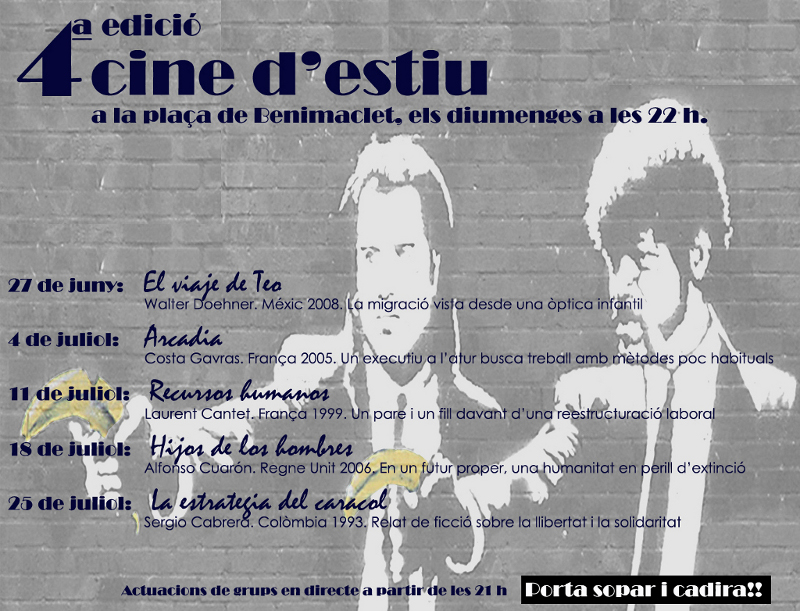
Jordi Mallach: Cinema d'Estiu in Benimaclet 2010

Like other years, Benimaclet's Neighbour Association has organized a new cycle of film projections for the neighbours, by the neighbours, with the intention to get people out of their homes and share a good time with many others. Like in the other two editions, the selected films try to deliver a message to the viewers, and this year the topics are centered about labour and migration social issues. A change in this year's edition is that there will be one more projection, for a total of 5 films, every Sunday of July, at 22:00 in the Pla a de Benimaclet. Last week, we saw El viaje de Teo, a Mexican film describing the migration dramas going on in the Sonora Desert. This Sunday, we'll see Arcadia, which will be followed by Recursos humanos, Hijos de los hombres and La estrategia del caracol. Before each film, some local artists will perform live for us. Make yourself a sandwich, bring a chair to Benimaclet and enjoy some good cinema with your neighbours every Sunday in July!

Petter Reinholdtsen: Lenny->Squeeze upgrades, apt vs aptitude with the Gnome desktop

Here is a short update on my my Debian Lenny->Squeeze upgrade testing. Here is a summary of the difference for Gnome when it is upgraded by apt-get and aptitude. I'm not reporting the status for KDE, because the upgrade crashes when aptitude try because of missing conflicts (#584861 and #585716). At the end of the upgrade test script, dpkg -l is executed to get a complete list of the installed packages. Based on this I see these differences when I did a test run today. As usual, I do not really know what the correct set of packages would be, but thought it best to publish the difference. Installed using apt-get, missing with aptitude
at-spi cpp-4.3 finger gnome-spell gstreamer0.10-gnomevfs libatspi1.0-0 libcupsys2 libeel2-data libgail-common libgdl-1-common libgnomeprint2.2-data libgnomeprintui2.2-common libgnomevfs2-bin libgtksourceview-common libpt-1.10.10-plugins-alsa libpt-1.10.10-plugins-v4l libservlet2.4-java libxalan2-java libxerces2-java openoffice.org-writer2latex openssl-blacklist p7zip python-4suite-xml python-eggtrayicon python-gtkhtml2 python-gtkmozembed svgalibg1 xserver-xephyr zip
Installed using apt-get, removed with aptitude
bluez-utils dhcdbd djvulibre-desktop epiphany-gecko gnome-app-install gnome-mount gnome-vfs-obexftp gnome-volume-manager libao2 libavahi-compat-libdnssd1 libavahi-core5 libbind9-50 libbluetooth2 libcamel1.2-11 libcdio7 libcucul0 libcurl3 libdirectfb-1.0-0 libdvdread3 libedata-cal1.2-6 libedataserver1.2-9 libeel2-2.20 libepc-1.0-1 libepc-ui-1.0-1 libexchange-storage1.2-3 libfaad0 libgd2-noxpm libgda3-3 libgda3-common libggz2 libggzcore9 libggzmod4 libgksu1.2-0 libgksuui1.0-1 libgmyth0 libgnome-desktop-2 libgnome-pilot2 libgnomecups1.0-1 libgnomeprint2.2-0 libgnomeprintui2.2-0 libgpod3 libgraphviz4 libgtkhtml2-0 libgtksourceview1.0-0 libgucharmap6 libhesiod0 libicu38 libisccc50 libisccfg50 libiw29 libkpathsea4 libltdl3 liblwres50 libmagick++10 libmagick10 libmalaga7 libmtp7 libmysqlclient15off libnautilus-burn4 libneon27 libnm-glib0 libnm-util0 libopal-2.2 libosp5 libparted1.8-10 libpisock9 libpisync1 libpoppler-glib3 libpoppler3 libpt-1.10.10 libraw1394-8 libsensors3 libsmbios2 libsoup2.2-8 libssh2-1 libsuitesparse-3.1.0 libswfdec-0.6-90 libtalloc1 libtotem-plparser10 libtrackerclient0 libvoikko1 libxalan2-java-gcj libxerces2-java-gcj libxklavier12 libxtrap6 libxxf86misc1 libzephyr3 mysql-common swfdec-gnome totem-gstreamer wodim
Installed using aptitude, missing with apt-get
gnome gnome-desktop-environment hamster-applet python-gnomeapplet python-gnomekeyring python-wnck rhythmbox-plugins xorg xserver-xorg-input-all xserver-xorg-input-evdev xserver-xorg-input-kbd xserver-xorg-input-mouse xserver-xorg-input-synaptics xserver-xorg-video-all xserver-xorg-video-apm xserver-xorg-video-ark xserver-xorg-video-ati xserver-xorg-video-chips xserver-xorg-video-cirrus xserver-xorg-video-dummy xserver-xorg-video-fbdev xserver-xorg-video-glint xserver-xorg-video-i128 xserver-xorg-video-i740 xserver-xorg-video-mach64 xserver-xorg-video-mga xserver-xorg-video-neomagic xserver-xorg-video-nouveau xserver-xorg-video-nv xserver-xorg-video-r128 xserver-xorg-video-radeon xserver-xorg-video-radeonhd xserver-xorg-video-rendition xserver-xorg-video-s3 xserver-xorg-video-s3virge xserver-xorg-video-savage xserver-xorg-video-siliconmotion xserver-xorg-video-sis xserver-xorg-video-sisusb xserver-xorg-video-tdfx xserver-xorg-video-tga xserver-xorg-video-trident xserver-xorg-video-tseng xserver-xorg-video-vesa xserver-xorg-video-vmware xserver-xorg-video-voodoo
Installed using aptitude, removed with apt-get
deskbar-applet xserver-xorg xserver-xorg-core xserver-xorg-input-wacom xserver-xorg-video-intel xserver-xorg-video-openchrome
I was told on IRC that the xorg-xserver package was changed in git today to try to get apt-get to not remove xorg completely. No idea when it hits Squeeze, but when it does I hope it will reduce the difference somewhat.

Joerg Jaspert: ftp-master.debian.org move to another machine

As I wrote to d-d-a this morning, we are currently moving the ftp-master service from ries to franck. At the same time the release team moved their service over too. This was going on whole day, and we are still not done. There are bits and pieces we still have to check, but it is looking good. The new machine is also much much faster than the old one, for most of the tasks. For one it has 4 times the amount of CPU, double the RAM, but also something like a million times the disks. Well, not a million times, but it has much more storage on many many more disks. From the current state I think we will have the service fully back to normal level tomorrow, Sunday.

Next.

Previous.