Search Results: "tar"

10 October 2022

Ian Jackson: Skipping releases when upgrading Debian systems

Debian does not officially support upgrading from earlier than the previous stable release: you re not supposed to skip releases. Instead, you re supposed to upgrade to each intervening major release in turn. However, skipping intervening releases does, in fact, often work quite well. Apparently, this is surprising to many people, even Debian insiders. I was encouraged to write about it some more. My personal experience I have three conventionally-managed personal server systems (by which I mean systems which aren t reprovisioned by some kind of automation). Of these at least two have been skip upgraded at least once: The one I don t think I ve skip-upgraded (at least, not recently) is my house network manager (and now VM host) which I try to keep to a minimum in terms of functionality and which I keep quite up to date. It was crossgraded from i386 (32-bit) to amd64 (64-bit) fairly recently, which is a thing that Debian isn t sure it supports. The crossgrade was done a hurry and without any planning, prompted by Spectre et al suddenly requiring big changes to Xen. But it went well enough. My home does random stuff server (media server, web cache, printing, DNS, backups etc.), has etckeeper records starting in 2015. I upgraded directly from jessie (Debian 8) to buster (Debian 10). I think it has probably had earlier skip upgrade(s): the oldest file in /etc is from December 1996 and I have been doing occasional skip upgrades as long as I can remember. And of course there s chiark, which is one of the oldest Debian installs in existence. I wrote about the most recent upgrade, where I went directly from jessie i386 ELTS (32-bit Debian 8) to bulleye amd64 (64-bit Debian 11). That was a very extreme case which required significant planning and pre-testing, since the package dependencies were in no way sufficient for the proper ordering. But, I don t normally go to such lengths. Normally, even on chiark, I just edit the sources.list and see what apt proposes to do. I often skip upgrade chiark because I tend to defer risky-looking upgrades partly in the hope of others fixing the bugs while I wait :-), and partly just because change is disruptive and amortising it is very helpful both to me and my users. I have some records of chiark s upgrades from my announcements to users. As well as the recent skip skip up cross grade, direct , I definitely did a skip upgrade of chiark from squeeze (Debian 6) to jessie (Debian 8). It appears that the previous skip upgrade on chiark was rex (Debian 1.2) to hamm (Debian 2.0). I don t think it s usual for me to choose to do a multi-release upgrade the officially supported way, in two (or more) stages, on a server. I have done that on systems with a GUI desktop setup, but even then I usually skip the intermediate reboot(s). When to skip upgrade (and what precautions to take) I m certainly not saying that everyone ought to be doing this routinely. Most users with a Debian install that is older than oldstable probably ought to reinstall it, or do the two-stage upgrade. Skip upgrading almost always runs into some kind of trouble (albeit, usually trouble that isn t particularly hard to fix if you know what you re doing). However, officially supported non-skip upgrades go wrong too. Doing a two-or-more-releases upgrade via the intermediate releases can expose you to significant bugs in the intermediate releases, which were later fixed. Because Debian s users and downstreams are cautious, and Debian itself can be slow, it is common for bugs to appear for one release and then be fixed only in the next. Paradoxically, this seems to be especially true with the kind of big and scary changes where you d naively think the upgrade mechanisms would break if you skipped the release where the change first came in. I would not recommend a skip upgrade to someone who is not a competent Debian administrator, with good familiarity with Debian package management, including use of dpkg directly to fix things up. You should have a mental toolkit of manual bug workaround techniques. I always should make sure that I have rescue media (and in the case of a remote system, full remote access including ability to boot a different image), although I don t often need it. And, when considering a skip upgrade, you should be aware of the major changes that have occurred in Debian. Skip upgrading is more likely to be a good idea with a complex and highly customised system: a fairly vanilla install is not likely to encounter problems during a two-stage update. (And, a vanilla system can be upgraded by reinstalling.) I haven t recently skip upgraded a laptop or workstation. I doubt I would attempt it; modern desktop software seems to take a much harder line about breaking things that are officially unsupported, and generally trying to force everyone into the preferred mold. A request to Debian maintainers I would like to encourage Debian maintainers to defer removing upgrade compatibility machinery until it is actually getting in the way, or has become hazardous, or many years obsolete. Examples of the kinds of things which it would be nice to keep, and which do not usually cause much inconvenience to retain, are dependency declarations (particularly, alternatives), and (many) transitional fragments in maintainer scripts. If you find yourself needing to either delete some compatibility feature, or refactor/reorganise it, I think it is probably best to delete it. If you modify it significantly, the resulting thing (which won t be tested until someone uses it in anger) is quite likely to have bugs which make it go wrong more badly (or, more confusingly) than the breakage that would happen without it. Obviously this is all a judgement call. I m not saying Debian should formally support skip upgrades, to the extent of (further) slowing down important improvements. Nor am I asking for any change to the routine approach to (for example) transitional packages (i.e. the technique for ensuring continuity of installation when a package name changes). We try to make release upgrades work perfectly; but skip upgrades don t have to work perfectly to be valuable. Retaining compatibility code can also make it easier to provide official backports, and it probably helps downstreams with different release schedules. The fact that maintainers do in practice often defer removing compatibility code provides useful flexibility and options to at least some people. So it would be nice if you d at least not go out of your way to break it. Building on older releases I would also like to encourage maintainers to provide source packages in Debian unstable that will still build on older releases, where this isn t too hard and the resulting binaries might be basically functional. Speaking personally, it s not uncommon for me to rebuild packages from unstable and install them on much older releases. This is another thing that is not officially supported, but which often works well. I m not saying to contort your build system, or delay progress. You ll definitely want to depend on a recentish debhelper. But, for example, retaining old build-dependency alternatives is nice. Retaining them doesn t constitute a promise that it works - it just makes life slightly easier for someone who is going off piste. If you know you have users on multiple distros or multiple releases, and wish to fully support them, you can go further, of course. Many of my own packages are directly buildable, or even directly installable, on older releases.

comment count unavailable comments

Joachim Breitner: rec-def: Minesweeper case study

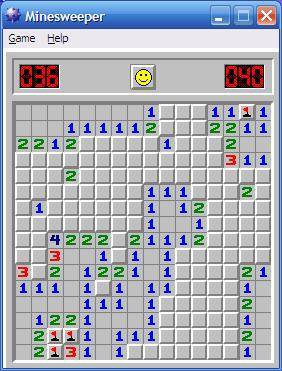
I m on the train back from MuniHac, where I gave a talk about the rec-def library that I have excessively blogged about recently (here, here, here and here). I got quite flattering comments about that talk, so if you want to see if they were sincere, I suggest you watch the recording of Getting recursive definitions off their bottoms (but it s not necessary for the following). After the talk, Franz Thoma approached me and told me a story of how we was once implementing the game Minesweeper in Haskell, and in particular the part of the logic where, after the user has uncovered a field, the game would automatically uncover all fields that are next to a neutral field, i.e. one with zero adjacent bombs. He was using a comonadic data structure, which makes a context-dependent parallel computation such as uncovering one field quite natural, and was hoping that using a suitable fix-point operator, he can elegantly obtain not just the next step, but directly the result of recursively uncovering all these fields. But, much to his disappointment, that did not work out: Due to the recursion inherent in that definition, a knot-tying fixed-point operator will lead to a cyclic definition.
Microsoft Minesweeper Microsoft Minesweeper
He was wondering if the rec-def library could have helped him, and we sat down to find out, and this is the tale of this blog post. I will avoid the comonadic abstractions and program it more naively, though, to not lose too many readers along the way. Maybe read Chris Penner s blog post and Finch s functional pearl Getting a Quick Fix on Comonads if you are curious about that angle.

Minesweeper setup Let s start with defining a suitable data type for the grid of the minesweeper board. I ll use the Array data type, it s Ix-based indexing is quite useful for grids: The library lacks a function to generate an array from a generating function, but it is easy to add: Let s also fix the size of the board, as a pair of lower and upper bounds (this is the format that the Ix type class needs): Now board is simply a grid of boolean values, with True indicating that a bomb is there: It would be nice to be able to see these board in a nicer way. So let us write A function that prints a grid, including a frame, given a function that prints something for each coordinate. Together with a function that prints a bomb (as *), we can print the board: The expression b ! c looks up a the coordinate in the array, and is True when there is a bomb at that coordinate. So here is our board, with two bombs:
ghci> putStrLn $ pBombs board1
######
#    #
#*   #
#*   #
#    #
######
But that s not what we want to show to the user: Every field should have have a number that indicates the number of bombs in the surrounding fields. To that end, we first define a function that takes a coordinate, and returns all adjacent coordinates. This also takes care of the border, using inRange: With that, we can calculate what to display in each cell a bomb, or a number: With a suitable printing function, we can now see the full board: And here it is:
ghci> putStrLn $ pBoard board1
######
#11  #
#*2  #
#*2  #
#11  #
######
Next we have to add masks: We need to keep track of which fields the user already sees. We again use a grid of booleans, and define a function to print a board with the masked fields hidden behind ?:
So this is what the user would see
ghci> putStrLn $ pMasked board1 mask1
######
#11 ?#
#????#
#????#
#????#
######

Uncovering some fields With that setup in place, we now implement the piece of logic we care about: Uncovering all fields that are next to a neutral field. Here is the first attempt: The idea is that we calculate the new mask m1 from the old one m0 by the following logic: A field is visible if it was visible before (m0 ! c), or if any of its neighboring, neutral fields are visible. This works so far: I uncovered the three fields next to the one neutral visible field:
ghci> putStrLn $ pMasked board1 $ solve0 board1 mask1
######
#11  #
#?2  #
#????#
#????#
######
But that s not quite what we want: We want to keep doing that to uncover all fields.

Uncovering all fields So what happens if we change the logic to: A field is visible if it was visible before (m0 ! c), or if any of its neighboring, neutral fields will be visible. In the code, this is just a single character change: Instead of looking at m0 to see if a neighbor is visible, we look at m1: (This is roughly what happened when Franz started to use the kfix comonadic fixed-point operator in his code, I believe.) Does it work? It seems so:
ghci> putStrLn $ pMasked board1 $ solve1 board1 mask1
######
#11  #
#?2  #
#?2  #
#?1  #
######
Amazing, isn t it! Unfortunately, it seems to work by accident. If I start with a different mask: which looks as follows:
ghci> putStrLn $ pMasked board1 mask2
######
#11??#
#????#
#????#
#??? #
######
Then our solve1 function does not work, and just sits there:
ghci> putStrLn $ pMasked board1 $ solve1 board1 mask2
######
#11^CInterrupted.
Why did it work before, but now now? It fails to work because as the code tries to figure out if a field, it needs to know if the next field will be uncovered. But to figure that out, it needs to know if the present field will be uncovered. With the normal boolean connectives ( and or), this does not make progress. It worked with mask1 more or less by accident: None of the fields on in the first column don t have neutral neighbors, so nothing happens there. And for all the fields in the third and forth column, the code will know for sure that they will be uncovered based on their upper neighbors, which come first in the neighbors list, and due to the short-circuting properties of , it doesn t have to look at the later cells, and the vicious cycle is avoided.

rec-def to the rescue This is where rec-def comes in: By using the RBool type in m1 instead of plain Bool, the recursive self-reference is not a problem, and it simply works: Note that I did not change the algorithm, or the self-reference through m1; I just replaced Bool with RBool, with RB. and or with RB.or. And used RB.get at the end to get a normal boolean out. And , here we go:
ghci> putStrLn $ pMasked board1 $ solve2 board1 mask2
######
#11  #
#?2  #
#?2  #
#?1  #
######
That s the end of this repetition of let s look at a tying-the-knot-problem and see how rec-def helps , which always end up a bit anti-climatic because it just works , at least in these cases. Hope you enjoyed it nevertheless.

9 October 2022

Emmanuel Kasper: Markdown CMS or Wiki for smallish website

Following my markdown craze, I am slowly starting to move my Dokuwiki based homesite to Grav, a flat file Markdown CMS. PHP will be always be PHP, but the documentation and usage seem sound (all config is either via an admin panel or editing YAML files) and it has professional support. I intend to use this Debian based Dockerfile and Podman to deploy Grav. Pandoc the talented document converter, hat support for Dokuwiki syntax, Markdown and PHP Markdown extra, so I expected limited hurdles when converting the data.

Sergio Talens-Oliag: Shared networking for Virtual Machines and Containers

This entry explains how I have configured a linux bridge, dnsmasq and iptables to be able to run and communicate different virtualization systems and containers on laptops running Debian GNU/Linux. I ve used different variations of this setup for a long time with VirtualBox and KVM for the Virtual Machines and Linux-VServer, OpenVZ, LXC and lately Docker or Podman for the Containers.

Required packagesI m running Debian Sid with systemd and network-manager to configure the WiFi and Ethernet interfaces, but for the bridge I use bridge-utils with ifupdown (as I said this setup is old, I guess ifupdow2 and ifupdown-ng will work too). To start and stop the DNS and DHCP services and add NAT rules when the bridge is brought up or down I execute a script that uses:
  • ip from iproute2 to get the network information,
  • dnsmasq to provide the DNS and DHCP services (currently only the dnsmasq-base package is needed and it is recommended by network-manager, so it is probably installed),
  • iptables to configure NAT (for now docker kind of forces me to keep using iptables, but at some point I d like to move to nftables).
To make sure you have everything installed you can run the following command:
sudo apt install bridge-utils dnsmasq-base ifupdown iproute2 iptables

Bridge configurationThe bridge configuration for ifupdow is available on the file /etc/network/interfaces.d/vmbr0:
# Virtual servers NAT Bridge
auto vmbr0
iface vmbr0 inet static
    address         10.0.4.1
    network         10.0.4.0
    netmask         255.255.255.0
    broadcast       10.0.4.255
    bridge_ports    none
    bridge_maxwait  0
    up              /usr/local/sbin/vmbridge $ IFACE  start nat
    pre-down        /usr/local/sbin/vmbridge $ IFACE  stop nat
Warning: To use a separate file with ifupdown make sure that /etc/network/interfaces contains the line:
source /etc/network/interfaces.d/*
or add its contents to /etc/network/interfaces directly, if you prefer.
This configuration creates a bridge with the address 10.0.4.1 and assumes that the machines connected to it will use the 10.0.4.0/24 network; you can change the network address if you want, as long as you use a private range and it does not collide with networks used in your Virtual Machines all should be OK. The vmbridge script is used to start the dnsmasq server and setup the NAT rules when the interface is brought up and remove the firewall rules and stop the dnsmasq server when it is brought down.

The vmbridge scriptThe vmbridge script launches an instance of dnsmasq that binds to the bridge interface (vmbr0 in our case) that is used as DNS and DHCP server. The DNS server reads the /etc/hosts file to publish local DNS names and forwards all the other requests to the the dnsmasq server launched by NetworkManager that is listening on the loopback interface. As this server already does catching we disable it for our server, with the added advantage that, if we change networks, new requests go to the new resolvers because the DNS server handled by NetworkManager gets restarted and flushes its cache (this is useful if we connect to a new network that has internal DNS servers that are configured to do split DNS for internal services; if we use this model all requests get the internal address as soon as the DNS server is queried again). The DHCP server is configured to provide IPs to unknown hosts for a sub range of the addresses on the bridge network and use fixed IPs if the /etc/ethers file has a MAC with a matching hostname on the /etc/hosts file. To make things work with old DHCP clients the script also adds checksums to the DHCP packets using iptables (when the interface is not linked to a physical device the kernel does not add checksums, but we can fix it adding a rule on the mangle table). If we want external connectivity we can pass the nat argument and then the script creates a MASQUERADE rule for the bridge network and enables IP forwarding. The script source code is the following:
/usr/local/sbin/vmbridge
#!/bin/sh
set -e
# ---------
# VARIABLES
# ---------
LOCAL_DOMAIN="vmnet"
MIN_IP_LEASE="192"
MAX_IP_LEASE="223"
# ---------
# FUNCTIONS
# ---------
get_net()  
  NET="$(
    ip a ls "$ BRIDGE " 2>/dev/null   sed -ne 's/^.*inet \(.*\) brd.*$/\1/p'
  )"
  [ "$NET" ]   return 1
 
checksum_fix_start()  
  iptables -t mangle -A POSTROUTING -o "$ BRIDGE " -p udp --dport 68 \
    -j CHECKSUM --checksum-fill 2>/dev/null   true
 
checksum_fix_stop()  
  iptables -t mangle -D POSTROUTING -o "$ BRIDGE " -p udp --dport 68 \
    -j CHECKSUM --checksum-fill 2>/dev/null   true
 
nat_start()  
  [ "$NAT" = "yes" ]   return 0
  # Configure NAT
  iptables -t nat -A POSTROUTING -s "$ NET " ! -d "$ NET " -j MASQUERADE
  # Enable forwarding (just in case)
  echo 1 >/proc/sys/net/ipv4/ip_forward
 
nat_stop()  
  [ "$NAT" = "yes" ]   return 0
  iptables -t nat -D POSTROUTING -s "$ NET " ! -d "$ NET " \
    -j MASQUERADE 2>/dev/null   true
 
do_start()  
  # Bridge address
  _addr="$ NET%%/* "
  # DNS leases (between .MIN_IP_LEASE and .MAX_IP_LEASE)
  _dhcp_range="$ _addr%.* .$ MIN_IP_LEASE ,$ _addr%.* .$ MAX_IP_LEASE "
  # Bridge mtu
  _mtu="$(
    ip link show dev "$ BRIDGE "  
      sed -n -e '/mtu/   s/^.*mtu \([0-9]\+\).*$/\1/p  '
  )"
  # Compute extra dnsmasq options
  dnsmasq_extra_opts=""
  # Disable gateway when not using NAT
  if [ "$NAT" != "yes" ]; then
    dnsmasq_extra_opts="$dnsmasq_extra_opts --dhcp-option=3"
  fi
  # Adjust MTU size if needed
  if [ -n "$_mtu" ] && [ "$_mtu" -ne "1500" ]; then
    dnsmasq_extra_opts="$dnsmasq_extra_opts --dhcp-option=26,$_mtu"
  fi
  # shellcheck disable=SC2086
  dnsmasq --bind-interfaces \
    --cache-size="0" \
    --conf-file="/dev/null" \
    --dhcp-authoritative \
    --dhcp-leasefile="/var/lib/misc/dnsmasq.$ BRIDGE .leases" \
    --dhcp-no-override \
    --dhcp-range "$ _dhcp_range " \
    --domain="$ LOCAL_DOMAIN " \
    --except-interface="lo" \
    --expand-hosts \
    --interface="$ BRIDGE " \
    --listen-address "$ _addr " \
    --no-resolv \
    --pid-file="$ PIDF " \
    --read-ethers \
    --server="127.0.0.1" \
    $dnsmasq_extra_opts
  checksum_fix_start
  nat_start
 
do_stop()  
  nat_stop
  checksum_fix_stop
  if [ -f "$ PIDF " ]; then
    kill "$(cat "$ PIDF ")"   true
    rm -f "$ PIDF "
  fi
 
do_status()  
  if [ -f "$ PIDF " ] && kill -HUP "$(cat "$ PIDF ")"; then
    echo "dnsmasq RUNNING"
  else
    echo "dnsmasq NOT running"
  fi
 
do_reload()  
  [ -f "$ PIDF " ] && kill -HUP "$(cat "$ PIDF ")"
 
usage()  
  echo "Uso: $0 BRIDGE (start stop [nat]) status reload"
  exit 1
 
# ----
# MAIN
# ----
[ "$#" -ge "2" ]   usage
BRIDGE="$1"
OPTION="$2"
shift 2
NAT="no"
for arg in "$@"; do
  case "$arg" in
  nat) NAT="yes" ;;
  *) echo "Unknown arg '$arg'" && exit 1 ;;
  esac
done
PIDF="/var/run/vmbridge-$ BRIDGE -dnsmasq.pid"
case "$OPTION" in
start) get_net && do_start ;;
stop) get_net && do_stop ;;
status) do_status ;;
reload) get_net && do_reload ;;
*) echo "Unknown command '$OPTION'" && exit 1 ;;
esac
# vim: ts=2:sw=2:et:ai:sts=2

NetworkManager ConfigurationThe default /etc/NetworkManager/NetworkManager.conf file has the following contents:
[main]
plugins=ifupdown,keyfile
[ifupdown]
managed=false
Which means that it will leave interfaces managed by ifupdown alone and, by default, will send the connection DNS configuration to systemd-resolved if it is installed. As we want to use dnsmasq for DNS resolution, but we don t want NetworkManager to modify our /etc/resolv.conf we are going to add the following file (/etc/NetworkManager/conf.d/dnsmasq.conf) to our system:
/etc/NetworkManager/conf.d/dnsmasq.conf
[main]
dns=dnsmasq
rc-manager=unmanaged
and restart the NetworkManager service:
$ sudo systemctl restart NetworkManager.service
From now on the NetworkManager will start a dnsmasq service that queries the servers provided by the DHCP servers we connect to on 127.0.0.1:53 but will not touch our /etc/resolv.conf file.

Configuring systemd-resolvedIf we start using our own name server but our system has systemd-resolved installed we will no longer need or use the DNS stub; programs using it will use our dnsmasq server directly now, but we keep running systemd-resolved for the host programs that use its native api or access it through /etc/nsswitch.conf (when libnss-resolve is installed). To disable the stub we add a /etc/systemd/resolved.conf.d/disable-stub.conf file to our machine with the following content:
# Disable the DNS Stub Listener, we use our own dnsmasq
[Resolve]
DNSStubListener=no
and restart the systemd-resolved to make sure that the stub is stopped:
$ sudo systemctl restart systemd-resolved.service

Adjusting /etc/resolv.confFirst we remove the existing /etc/resolv.conf file (it does not matter if it is a link or a regular file) and then create a new one that contains at least the following line (we can add a search line if is useful for us):
nameserver 10.0.4.1
From now on we will be using the dnsmasq server launched when we bring up the vmbr0 for multiple systems:
  • as our main DNS server from the host (if we use the standard /etc/nsswitch.conf and libnss-resolve is installed it is queried first, but the systemd-resolved uses it as forwarder by default if needed),
  • as the DNS server of the Virtual Machines or containers that use DHCP for network configuration and attach their virtual interfaces to our bridge,
  • as the DNS server of docker containers that get the DNS information from /etc/resolv.conf (if we have entries that use loopback addresses the containers that don t use the host network tend to fail, as those addresses inside the running containers are not linked to the loopback device of the host).

TestingAfter all the configuration files and scripts are in place we just need to bring up the bridge interface and check that everything works:
$ # Bring interface up
$ sudo ifup vmbr0
$ # Check that it is available
$ ip a ls dev vmbr0
4: vmbr0: <NO-CARRIER,BROADCAST,MULTICAST,UP> mtu 1500 qdisc noqueue state DOWN
          group default qlen 1000
    link/ether 0a:b8:ef:b8:07:6c brd ff:ff:ff:ff:ff:ff
    inet 10.0.4.1/24 brd 10.0.4.255 scope global vmbr0
       valid_lft forever preferred_lft forever
$ # View the listening ports used by our dnsmasq servers
$ sudo ss -tulpan   grep dnsmasq
udp UNCONN 0 0  127.0.0.1:53     0.0.0.0:* users:(("dnsmasq",pid=1733930,fd=4))
udp UNCONN 0 0  10.0.4.1:53      0.0.0.0:* users:(("dnsmasq",pid=1705267,fd=6))
udp UNCONN 0 0  0.0.0.0%vmbr0:67 0.0.0.0:* users:(("dnsmasq",pid=1705267,fd=4))
tcp LISTEN 0 32 10.0.4.1:53      0.0.0.0:* users:(("dnsmasq",pid=1705267,fd=7))
tcp LISTEN 0 32 127.0.0.1:53     0.0.0.0:* users:(("dnsmasq",pid=1733930,fd=5))
$ # Verify that the DNS server works on the vmbr0 address
$ host www.debian.org 10.0.4.1
Name: 10.0.4.1
Address: 10.0.4.1#53
Aliases:
www.debian.org has address 130.89.148.77
www.debian.org has IPv6 address 2001:67c:2564:a119::77

Managing running systemsIf we want to update DNS entries and/or MAC addresses we can edit the /etc/hosts and /etc/ethers files and reload the dnsmasq configuration using the vmbridge script:
$ sudo /usr/local/sbin/vmbridge vmbr0 reload
That call sends a signal to the running dnsmasq server and it reloads the files; after that we can refresh the DHCP addresses from the client machines or start using the new DNS names immediately.

7 October 2022

Reproducible Builds: Reproducible Builds in September 2022

Welcome to the September 2022 report from the Reproducible Builds project! In our reports we try to outline the most important things that we have been up to over the past month. As a quick recap, whilst anyone may inspect the source code of free software for malicious flaws, almost all software is distributed to end users as pre-compiled binaries. If you are interested in contributing to the project, please visit our Contribute page on our website.
David A. Wheeler reported to us that the US National Security Agency (NSA), Cybersecurity and Infrastructure Security Agency (CISA) and the Office of the Director of National Intelligence (ODNI) have released a document called Securing the Software Supply Chain: Recommended Practices Guide for Developers (PDF). As David remarked in his post to our mailing list, it expressly recommends having reproducible builds as part of advanced recommended mitigations . The publication of this document has been accompanied by a press release.
Holger Levsen was made aware of a small Microsoft project called oss-reproducible. Part of, OSSGadget, a larger collection of tools for analyzing open source packages , the purpose of oss-reproducible is to:
analyze open source packages for reproducibility. We start with an existing package (for example, the NPM left-pad package, version 1.3.0), and we try to answer the question, Do the package contents authentically reflect the purported source code?
More details can be found in the README.md file within the code repository.
David A. Wheeler also pointed out that there are some potential upcoming changes to the OpenSSF Best Practices badge for open source software in relation to reproducibility. Whilst the badge programme has three certification levels ( passing , silver and gold ), the gold level includes the criterion that The project MUST have a reproducible build . David reported that some projects have argued that this reproducibility criterion should be slightly relaxed as outlined in an issue on the best-practices-badge GitHub project. Essentially, though, the claim is that the reproducibility requirement doesn t make sense for projects that do not release built software, and that timestamp differences by themselves don t necessarily indicate malicious changes. Numerous pragmatic problems around excluding timestamps were raised in the discussion of the issue.
Sonatype, a pioneer of software supply chain management , issued a press release month to report that they had found:
[ ] a massive year-over-year increase in cyberattacks aimed at open source project ecosystems. According to early data from Sonatype s 8th annual State of the Software Supply Chain Report, which will be released in full this October, Sonatype has recorded an average 700% jump in repository attacks over the last three years.
More information is available in the press release.
A number of changes were made to the Reproducible Builds website and documentation this month, including Chris Lamb adding a redirect from /projects/ to /who/ in order to keep old or archived links working [ ], Jelle van der Waa added a Rust programming language example for SOURCE_DATE_EPOCH [ ][ ] and Mattia Rizzolo included Protocol Labs amongst our project-level sponsors [ ].

Debian There was a large amount of reproducibility work taking place within Debian this month:
  • The nfft source package was removed from the archive, and now all packages in Debian bookworm now have a corresponding .buildinfo file. This can be confirmed and tracked on the associated page on the tests.reproducible-builds.org site.
  • Vagrant Cascadian announced on our mailing list an informal online sprint to help clear the huge backlog of reproducible builds patches submitted by performing NMU (Non-Maintainer Uploads). The first such sprint took place on September 22nd with the following results:
    • Holger Levsen:
      • Mailed #1010957 in man-db asking for an update and whether to remove the patch tag for now. This was subsequently removed and the maintainer started to address the issue.
      • Uploaded gmp to DELAYED/15, fixing #1009931.
      • Emailed #1017372 in plymouth and asked for the maintainer s opinion on the patch. This resulted in the maintainer improving Vagrant s original patch (and uploading it) as well as filing an issue upstream.
      • Uploaded time to DELAYED/15, fixing #983202.
    • Vagrant Cascadian:
      • Verify and updated patch for mylvmbackup (#782318)
      • Verified/updated patches for libranlip. (#788000, #846975 & #1007137)
      • Uploaded libranlip to DELAYED/10.
      • Verified patch for cclive. (#824501)
      • Uploaded cclive to DELAYED/10.
      • Vagrant was unable to reproduce the underlying issue within #791423 (linuxtv-dvb-apps) and so the bug was marked as done .
      • Researched #794398 (in clhep).
    The plan is to repeat these sprints every two weeks, with the next taking place on Thursday October 6th at 16:00 UTC on the #debian-reproducible IRC channel.
  • Roland Clobus posted his 13th update of the status of reproducible Debian ISO images on our mailing list. During the last month, Roland ensured that the live images are now automatically fed to openQA for automated testing after they have been shown to be reproducible. Additionally Roland asked on the debian-devel mailing list about a way to determine the canonical timestamp of the Debian archive. [ ]
  • Following up on last month s work on reproducible bootstrapping, Holger Levsen filed two bugs against the debootstrap and cdebootstrap utilities. (#1019697 & #1019698)
Lastly, 44 reviews of Debian packages were added, 91 were updated and 17 were removed this month adding to our knowledge about identified issues. A number of issue types have been updated too, including the descriptions of cmake_rpath_contains_build_path [ ], nondeterministic_version_generated_by_python_param [ ] and timestamps_in_documentation_generated_by_org_mode [ ]. Furthermore, two new issue types were created: build_path_used_to_determine_version_or_package_name [ ] and captures_build_path_via_cmake_variables [ ].

Other distributions In openSUSE, Bernhard M. Wiedemann published his usual openSUSE monthly report.

diffoscope diffoscope is our in-depth and content-aware diff utility. Not only can it locate and diagnose reproducibility issues, it can provide human-readable diffs from many kinds of binary formats. This month, Chris Lamb prepared and uploaded versions 222 and 223 to Debian, as well as made the following changes:
  • The cbfstools utility is now provided in Debian via the coreboot-utils package so we can enable that functionality within Debian. [ ]
  • Looked into Mach-O support.
  • Fixed the try.diffoscope.org service by addressing a compatibility issue between glibc/seccomp that was preventing the Docker-contained diffoscope instance from spawning any external processes whatsoever [ ]. I also updated the requirements.txt file, as some of the specified packages were no longer available [ ][ ].
In addition Jelle van der Waa added support for file version 5.43 [ ] and Mattia Rizzolo updated the packaging:
  • Also include coreboot-utils in the Build-Depends and Test-Depends fields so that it is available for tests. [ ]
  • Use pep517 and pip to load the requirements. [ ]
  • Remove packages in Breaks/Replaces that have been obsoleted since the release of Debian bullseye. [ ]

Reprotest reprotest is our end-user tool to build the same source code twice in widely and deliberate different environments, and checking whether the binaries produced by the builds have any differences. This month, reprotest version 0.7.22 was uploaded to Debian unstable by Holger Levsen, which included the following changes by Philip Hands:
  • Actually ensure that the setarch(8) utility can actually execute before including an architecture to test. [ ]
  • Include all files matching *.*deb in the default artifact_pattern in order to archive all results of the build. [ ]
  • Emit an error when building the Debian package if the Debian packaging version does not patch the Python version of reprotest. [ ]
  • Remove an unneeded invocation of the head(1) utility. [ ]

Upstream patches The Reproducible Builds project detects, dissects and attempts to fix as many currently-unreproducible packages as possible. We endeavour to send all of our patches upstream where appropriate. This month, we wrote a large number of such patches, including:

Testing framework The Reproducible Builds project runs a significant testing framework at tests.reproducible-builds.org in order to check packages and other artifacts for reproducibility. This month, however, the following changes were made:
  • Holger Levsen:
    • Add a job to build reprotest from Git [ ] and use the correct Git branch when building it [ ].
  • Mattia Rizzolo:
    • Enable syncing of results from building live Debian ISO images. [ ]
    • Use scp -p in order to preserve modification times when syncing live ISO images. [ ]
    • Apply the shellcheck shell script analysis tool. [ ]
    • In a build node wrapper script, remove some debugging code which was messing up calling scp(1) correctly [ ] and consquently add support to use both scp -p and regular scp [ ].
  • Roland Clobus:
    • Track and handle the case where the Debian archive gets updated between two live image builds. [ ]
    • Remove a call to sudo(1) as it is not (or no longer) required to delete old live-build results. [ ]

Contact As ever, if you are interested in contributing to the Reproducible Builds project, please visit our Contribute page on our website. However, you can get in touch with us via:

4 October 2022

Jonathan Dowland: rewrite rule representation

I've begun writing up my phd and, not for the first time, I'm pondering issues of how best to represent things. Specifically, rewrite rules. Here's one way of representing an example rewrite rule:
streamFilter g . streamFilter f = streamFilter (g . f)
This is a fairly succinct representation. It's sort-of Haskell, but not quite. It's an equation. The left-hand side is a pattern: it's intended to describe not one expression but a family of expressions that match. The lower case individual letters g and f are free variables: labelled placeholders within the pattern that can be referred to on the right hand side. I haven't stipulated what defines a free variable and what is a more concrete part of the pattern. It's kind-of Haskell, and I've used the well-known operator . to represent the two stream operators (streamFilters) being connected together. (In practice, when we get to the system where rules are actually applied, the connecting operator is not going to be . at all, so this is also an approximation). One thing I don't like about . here, despite its commonness, is having to read right-to-left. I adopted the habit of using the lesser-known >>> in a lot of my work (which is defined as (>>>) = flip (.)), which reads left-to-right. And then I have the reverse problem: people aren't familiar with >>>, and, just like ., it's a stand-in anyway. Towards the beginning of my PhD, I spent some time inventing rewrite rules to operate on pairs of operators taken from a defined, known set. I began representing the rules much as in the example above. Later on, I wanted to encode them as real Haskell, in order to check them more thoroughly. The above rule, I first encoded like this
filterFilterPre     = streamFilter g . streamFilter f
filterFilterPost    = streamFilter (g . f)
prop_filterFilter s = filterFilterPre s == filterFilterPost s
This is real code: the operators were already implemented in StrIoT, and the final expression defined a property for QuickCheck. However, it's still not quite a rewrite rule. The left-hand side, which should be a pattern, is really a concrete expression. The names f and g are masquerading as free variables but are really concretely defined in a preamble I wrote to support running QuickCheck against these things: usually simple stuff like g = odd, etc. Eventually, I had to figure out how to really implement rewrite rules in StrIoT. There were a few approaches I could take. One would be to express the rules in some abstract form like the first example (but with properly defined semantics) and write a parser for them: I really wanted to avoid doing that. As a happy accident, the solution I landed on was enabled by the semantics of algebraic-graphs, a Graph library we adopted to support representing a stream-processing topology. I wrote more about that in data-types for representing stream-processing programs. I was able to implement rewrite rules as ordinary Haskell functions. The left-hand side of the rewrite rule maps to the left-hand side (pattern) part of a function definition. The function body implements the right-hand side. The system that applies the rules attempts to apply each rewrite rule to every sub-graph of a stream-processing program. The rewrite functions therefore need to signal whether or not they're applicable at runtime. For that reason, the return type is wrapped in Maybe, and we provide a catch-all pattern for every rule which simply returns Nothing. The right-hand side implementation can be pretty thorny. On the left-hand side, the stream operator connector we've finally ended up with is Connect from algebraic-graphs. Here's filter fuse, taken from the full ruleset:
filterFuse :: RewriteRule
filterFuse (Connect (Vertex a@(StreamVertex i (Filter sel1) (p:_) ty _ s1))
                    (Vertex b@(StreamVertex _ (Filter sel2) (q:_) _ _ s2))) =
    let c = a   operator    = Filter (sel1 * sel2)
              , parameters  = [\[  (\p q x -> p x && q x) $(p) $(q)  ]]
              , serviceTime = sumTimes s1 sel1 s2
               
    in Just (removeEdge c c . mergeVertices ( elem  [a,b]) c)
filterFuse _ = Nothing
That's perhaps the simplest rule in the set. (See e.g. hoistOp for one of the worst!) The question that remains to me, is, which representation, or representations, to use in the thesis? I'm currently planning to skip the abstract example I started with and start with the concrete Haskell encoding using QuickCheck. I'm not sure if it seems weird to have two completely separate implementations of the rules, but the simpler QuickCheck-checked rules are much closer to the "core essence" of the rules than the final implementation in StrIoT. And the derivation of the rules comes earlier in the timeline than the design work that led to the final StrIoT implementation. The middle-option is still compromised, however, by having concrete expressions pretending to be patterns. So I'm not sure.

Abhijith PA: Laptop refreshment

(Sorry if you have read this already, due to a tag mistake, my draft copy got published) laptop I recently bought a refurbished thinkpad x260. If you have read my post of my <a href= <!DOCTYPE html> Laptop refreshment