Search Results: "sf"

17 September 2015

Julien Danjou: My interview in le Journal du Hacker

A few days ago, the French equivalent of Hacker News, called "Le Journal du Hacker", interviewed me about my work on OpenStack, my job at Red Hat and my self-published book The Hacker's Guide to Python. I've spent some time translating it into English so you can read it if you don't understand French! I hope you'll enjoy it.
Hi Julien, and thanks for participating in this interview for the Journal du Hacker. For our readers who don't know you, can you introduce you briefly?
You're welcome! My name is Julien, I'm 31 years old, and I live in Paris. I now have been developing free software for around fifteen years. I had the pleasure to work (among other things) on Debian, Emacs and awesome these last years, and more recently on OpenStack. Since a few months now, I work at Red Hat, as a Principal Software Engineer on OpenStack. I am in charge of doing upstream development for that cloud-computing platform, mainly around the Ceilometer, Aodh and Gnocchi projects.
Being myself a system architect, I follow your work in OpenStack since a while. It's uncommon to have the point of view of someone as implied as you are. Can you give us a summary of the state of the project, and then detail your activities in this project?
The OpenStack project has grown and changed a lot since I started 4 years ago. It started as a few projects providing the basics, like Nova (compute), Swift (object storage), Cinder (volume), Keystone (identity) or even Neutron (network) who are basis for a cloud-computing platform, and finally became composed of a lot more projects. For a while, the inclusion of projects was the subject of a strict review from the technical committee. But since a few months, the rules have been relaxed, and we see a lot more projects connected to cloud-computing joining us. As far as I'm concerned, I've started with a few others people the Ceilometer project in 2012, devoted to handling metrics of OpenStack platforms. Our goal is to be able to collect all the metrics and record them to analyze them later. We also have a module providing the ability to trigger actions on threshold crossing (alarm). The project grew in a monolithic way, and in a linear way for the number of contributors, during the first two years. I was the PTL (Project Technical Leader) for a year. This leader position asks for a lot of time for bureaucratic things and people management, so I decided to leave my spot in order to be able to spend more time solving the technical challenges that Ceilometer offered. I've started the Gnocchi project in 2014. The first stable version (1.0.0) was released a few months ago. It's a timeseries database offering a REST API and a strong ability to scale. It was a necessary development to solve the problems tied to the large amount of metrics created by a cloud-computing platform, where tens of thousands of virtual machines have to be metered as often as possible. This project works as a standalone deployment or with the rest of OpenStack. More recently, I've started Aodh, the result of moving out the code and features of Ceilometer related to threshold action triggering (alarming). That's the logical suite to what we started with Gnocchi. It means Ceilometer is to be split into independent modules that can work together with or without OpenStack. It seems to me that the features provided by Ceilometer, Aodh and Gnocchi can also be interesting for operators running more classical infrastructures. That's why I've pushed the projects into that direction, and also to have a more service-oriented architecture (SOA)
I'd like to stop for a moment on Ceilometer. I think that this solution was very expected, especially by the cloud-computing providers using OpenStack for billing resources sold to their customers. I remember reading a blog post where you were talking about the high-speed construction of this brick, and features that were not supposed to be there. Nowadays, with Gnocchi and Aodh, what is the quality of the brick Ceilometer and the programs it relies on?
Indeed, one of the first use-case for Ceilometer was tied to the ability to get metrics to feed a billing tool. That's now a reached goal since we have billing tools for OpenStack using Ceilometer, such as CloudKitty. However, other use-cases appeared rapidly, such as the ability to trigger alarms. This feature was necessary, for example, to implement the auto-scaling feature that Heat needed. At the time, for technical and political reasons, it was not possible to implement this feature in a new project, and the functionality ended up in Ceilometer, since it was using the metrics collected and stored by Ceilometer itself. Though, like I said, this feature is now in its own project, Aodh. The alarm feature is used since a few cycles in production, and the Aodh project brings new features on the table. It allows to trigger threshold actions and is one of the few solutions able to work at high scale with several thousands of alarms. It's impossible to make Nagios run with millions of instances to fetch metrics and triggers alarms. Ceilometer and Aodh can do that easily on a few tens of nodes automatically. On the other side, Ceilometer has been for a long time painted as slow and complicated to use, because its metrics storage system was by default using MongoDB. Clearly, the data structure model picked was not optimal for what the users were doing with the data. That's why I started Gnocchi last year, which is perfectly designed for this use case. It allows linear access time to metrics (O(1) complexity) and fast access time to the resources data via an index. Today, with 3 projects having their own perimeter of features defined and which can work together Ceilometer, Aodh and Gnocchi finally erased the biggest problems and defects of the initial project.
To end with OpenStack, one last question. You're a Python developer for a long time and a fervent user of software testing and test-driven development. Several of your blogs posts point how important their usage are. Can you tell us more about the usage of tests in OpenStack, and the test prerequisites to contribute to OpenStack?
I don't know any project that is as tested on every layer as OpenStack is. At the start of the project, there was a vague test coverage, made of a few unit tests. For each release, a bunch of new features were provided, and you had to keep your fingers crossed to have them working. That's already almost unacceptable. But the big issue was that there was also a lot of regressions, et things that were working were not anymore. It was often corner cases that developers forgot about that stopped working. Then the project decided to change its policy and started to refuse all patches new features or bug fix that would not implement a minimal set of unit tests, proving the patch would work. Quickly, regressions were history, and the number of bugs largely reduced months after months. Then came the functional tests, with the Tempest project, which runs a test battery on a complete OpenStack deployment. OpenStack now possesses a complete test infrastructure, with operators hired full-time to maintain them. The developers have to write the test, and the operators maintain an architecture based on Gerrit, Zuul, and Jenkins, which runs the test battery of each project for each patch sent. Indeed, for each version of a patch sent, a full OpenStack is deployed into a virtual machine, and a battery of thousands of unit and functional tests is run to check that no regressions are possible. To contribute to OpenStack, you need to know how to write a unit test the policy on functional tests is laxer. The tools used are standard Python tools, unittest for the framework and tox to run a virtual environment (venv) and run them. It's also possible to use DevStack to deploy an OpenStack platform on a virtual machine and run functional tests. However, since the project infrastructure also do that when a patch is submitted, it's not mandatory to do that yourself locally.
The tools and tests you write for OpenStack are written in Python, a language which is very popular today. You seem to like it more than you have to, since you wrote a book about it, The Hacker's Guide to Python, that I really enjoyed. Can you explain what brought you to Python, the main strong points you attribute to this language (quickly) and how you went from developer to author?
I stumbled upon Python by chance, around 2005. I don't remember how I hear about it, but I bought a first book to discover it and started toying with that language. At that time, I didn't find any project to contribute to or to start. My first project with Python was rebuildd for Debian in 2007, a bit later. I like Python for its simplicity, its object orientation rather clean, its easiness to be deployed and its rich open source ecosystem. Once you get the basics, it's very easy to evolve and to use it for anything, because the ecosystem makes it easy to find libraries to solve any kind of problem. I became an author by chance, writing blog posts from time to time about Python. I finally realized that after a few years studying Python internals (CPython), I learned a lot of things. While writing a post about the differences between method types in Python which is still one of the most read post on my blog I realized that a lot of things that seemed obvious to me where not for other developers. I wrote that initial post after thousands of hours spent doing code reviews on OpenStack. I, therefore, decided to note all the developers pain points and to write a book about that. A compilation of what years of experience taught me and taught to the other developers I decided to interview in the book.
I've been very interested by the publication of your book, for the subject itself, but also the process you chose. You self-published the book, which seems very relevant nowadays. Is that a choice from the start? Did you look for an editor? Can you tell use more about that?
I've been lucky to find out about others self-published authors, such as Nathan Barry who even wrote a book on that subject, called Authority. That's what convinced me it was possible and gave me hints for that project. I've started to write in August 2013, and I ran the firs interviews with other developers at that time. I started to write the table of contents and then filled the pages with what I knew and what I wanted to share. I manage to finish the book around January 2014. The proof-reading took more time than I expected, so the book was only released in March 2014. I wrote a complete report on that on my blog, where I explain the full process in detail, from writing to launching. I did not look for editors though I've been proposed some. The idea of self-publishing really convince me, so I decided to go on my own, and I have no regret. It's true that you have to wear two hats at the same time and handle a lot more things, but with a minimal audience and some help from the Internet, anything's possible! I've been reached by two editors since then, a Chinese and Korean one. I gave them rights to translate and publish the books in their countries, so you can buy the Chinese and Korean version of the first edition of the book out there. Seeing how successful it was, I decided to launch a second edition in Mai 2015, and it's likely that a third edition will be released in 2016.
Nowadays, you work for Red Hat, a company that represents the success of using Free Software as a commercial business model. This company fascinates a lot in our community. What can you say about your employer from your point of view?
It only has been a year since I joined Red Hat (when they bought eNovance), so my experience is quite recent. Though, Red Hat is really a special company on every level. It's hard to see from the outside how open it is, and how it works. It's really close to and it really looks like an open source project. For more details, you should read The Open Organization, a book wrote by Jim Whitehurst (CEO of Red Hat), which he just published. It describes perfectly how Red Hat works. To summarize, meritocracy and the lack of organization in silos is what makes Red Hat a strong organization and puts them as one of the most innovative company. In the end, I'm lucky enough to be autonomous for the project I work on with my team around OpenStack, and I can spend 100% working upstream and enhance the Python ecosystem.

14 September 2015

Francois Marier: Setting up a network scanner using SANE

Sharing a scanner over the network using SANE is fairly straightforward. Here's how I shared a scanner on a server (running Debian jessie) with a client (running Ubuntu trusty).

Install SANE The packages you need on both the client and the server are: You should check whether or your scanner is supported by the latest stable release or by the latest development version. In my case, I needed to get a Canon LiDE 220 working so I had to grab the libsane 1.0.25+git20150528-1 package from Debian experimental.

Test the scanner locally Once you have SANE installed, you can test it out locally to confirm that it detects your scanner:
scanimage -L
This should give you output similar to this:
device  genesys:libusb:001:006' is a Canon LiDE 220 flatbed scanner
If that doesn't work, make sure that the scanner is actually detected by the USB stack:
$ lsusb   grep Canon
Bus 001 Device 006: ID 04a9:190f Canon, Inc.
and that its USB ID shows up in the SANE backend it needs:
$ grep 190f /etc/sane.d/genesys.conf 
usb 0x04a9 0x190f
To do a test scan, simply run:
scanimage > test.ppm
and then take a look at the (greyscale) image it produced (test.ppm).

Configure the server With the scanner working locally, it's time to expose it to network clients by adding the client IP addresses to /etc/sane.d/saned.conf:
## Access list
192.168.1.3
and then opening the appropriate port on your firewall (typically /etc/network/iptables in Debian):
-A INPUT -s 192.168.1.3 -p tcp --dport 6566 -j ACCEPT
Then you need to ensure that the SANE server is running by setting the following in /etc/default/saned:
RUN=yes
if you're using the sysv init system, or by running this command:
systemctl enable saned.socket
if using systemd. I actually had to reboot to make saned visible to systemd, so if you still run into these errors:
$ service saned start
Failed to start saned.service: Unit saned.service is masked.
you're probably just one reboot away from getting it to work.

Configure the client On the client, all you need to do is add the following to /etc/sane.d/net.conf:
connect_timeout = 60
myserver
where myserver is the hostname or IP address of the server running saned.

Test the scanner remotely With everything in place, you should be able to see the scanner from the client computer:
$ scanimage -L
device  net:myserver:genesys:libusb:001:006' is a Canon LiDE 220 flatbed scanner
and successfully perform a test scan using this command:
scanimage > test.ppm

13 September 2015

Russ Allbery: Accumulated haul

I haven't posted one of these in a while, but now that I'm finally caught up with writing reviews (although not posting them yet), I've been feeling about reading again. And of course the backlog always grows. Let's see if I can figure out what I've picked up since the last post. Catherine Asaro The Phoenix Code (sff)
Annie Bellet Justice Calling (sff)
Annie Bellet Murder of Crows (sff)
Annie Bellet Pack of Lies (sff)
Zen Cho Sorcerer to the Crown (sff)
J.J. Gribble Steel Victory (sff)
Judith L. Herman Trauma and Recovery (non-fiction)
Janis Ian & Mike Resnick Stars: The Anthology (sff anthology)
Megg Jensen Hidden (sff)
T. Kingfisher Bryony and Roses (sff)
T. Kingfisher The Seventh Bride (sff)
Nancy Kress Crossfire (sff)
Edmond Lau The Effective Engineer (non-fiction)
Yoon Ha Lee The Fox's Tower and Other Tales (sff collection)
Lozzi Roma Rome and the Vatican (non-fiction)
Elizabeth Lynn The Dancers of Arun (sff)
Elizabeth Lynn The Northern Girl (sff)
Rhonda Mason Empress Game (sff)
Vonda N. McIntyre Starfarers (sff)
Linda Nagata Memory (sff)
Jody Lynn Nye Strong Arm Tactics (sff)
Cat Rambo Near + Far (sff)
Kristine Kathryn Rusch The Diving Bundle (sff collection)
Kristine Kathryn Rusch Recovering Apollo 8 (sff)
L. Shelby Serendipity's Tide (sff)
L. Shelby Treachery's Harbor (sff)
L. Shelby Fealty's Shore (sff)
K.B. Spangler Digital Divide (sff)
Judith Tarr Forgotten Suns (sff)
Greg van Eekhout California Bones (sff) Hm, that's quite a lot. Most of it is various ebooks I picked up from various places, including a Humble Bundle. I've been impulse-buying a lot of stuff based on James Nicoll's reviews. The travel guide was a gift from a friend from a vacation in Italy.

Russ Allbery: Review: My Real Children

Review: My Real Children, by Jo Walton
Publisher: Tor
Copyright: May 2014
ISBN: 0-7653-3265-5
Format: Hardcover
Pages: 317
Patricia, the one form of her name that she's never used, is what the staff in the nursing home call her. "VC" is the frequent annotation on her daily chart: very confused. She's old, and forgetful, and trying very hard not to be her mother, and she remembers two lives. Not only remembers but lives: the nursing home isn't the same from day to day. They keep misplacing the lift, and the staff keep changing. But the memories are the strongest. She has two lives, two sets of children, all of whom she recognizes. When someone from one life visits, the other feels like a dream, but both of them persist. Two lives that divided at the most significant decision of her life. My Real Children is one of those books that fits in the broader speculative fiction genre as alternate history, but also has many of the virtues of mimetic fiction. It's the story of one woman's life, told, except for the opening frame, chronologically from start to finish. At the start, it's simple biography, telling Patty's story from childhood, through World War II, until the moment of her fateful decision in 1949. From there the narrative splits, and she lives two lives. And the world splits as well: in one, Kennedy was assassinated by a bomb; in another, the Cuban Missile Crisis escalated into something much worse. Much is still unchanged, including the general lives of people Patty knew well in one life and not in another, but the worlds keep diverging from each other and from ours. The exact nature of the divergence is not, however, a significant part of the book. This is not the type of alternate history that is obsessed with the point of change, or even the implications for the world. Rather, this novel is about one woman, one decision, and two very different paths through life. Different friends, different challenges, different careers... different hopes and dreams, and different children. But always the same person, the same sense of practicality, the same ethics. It's beautifully told, striking just the right balance of showing important moments in detail and passing quickly, but smoothly, over some years. And, as with Among Others, Walton strikes the perfect emotional balance, leaving some reactions understated, letting the reader bring their own reactions to the book, and filling it with small bits of telling, factual detail rather than internal monologues. This is also one of the most heart-wrenching books I've ever read. My Real Children is a whole life, and not an easy one, complete with the heartaches and betrayals, the good and bad decisions, care for elderly relatives, dementia, tragedy, and even abuse. And moments of shining joy or profound satisfaction, but made all the more poignant because they're fleeting. The reader knows, in a sense, how the story ends, which casts a shadow over the rest of the book. But, even without that shadow, life can be hard, or cruel, alongside the wonder and joy. And it ends, and the ending is not neat and clean and uplifting, although one can choose how one meets it. This is the story of a life, all of it, and how choices can divide that life, and how they can cast a long shadow over how one later defines oneself. This book hurts. A lot. Enough that I want to warn you in advance I was in tears through the last third of the book. But it hurts because it's so very real and deep, not via a blow-by-blow description of daily actions, but by striding unafraid into the deep complications of choice and consequence. It's also a profoundly feminist book, in a quiet and descriptive way. It shared the Tiptree award for 2015 and fully deserved it. Both of the protagonist's lives are struggles against expectations, around gender, sexuality, and the role of women in society. Those struggles take very different forms, but they share some deep similarities. Walton shows the impact from the bottom up: the effects on specific lives, specific people, specific situations. It's brilliantly done. One can't help but think of The Female Man given the telling of parallel lives, but this is a case study, whereas Russ's novel was a battle cry. It gets under your skin instead of in your face. (Use of subtlety on this topic is easier now, forty years of occasional progress past when Russ wrote her classic.) This is a much harder book to read than Among Others. It's less forgiving, less reassuring, less willing to provide a happy ending. Lives rarely have clean, happy endings; one has to construct them, by choosing the material to build the ending on. But it's a brilliant, profound book, in that way that stories about people in all their complexity can be. Be cautious about your mood when you read this, particularly if you've had the experience of caring for a dying relative, but it's a book I will remember for a very long time. Rating: 9 out of 10

11 September 2015

Daniel Pocock: Payment for shadow work

A significant court ruling yesterday means that companies in the EU have to pay employees for time spent traveling to and from work. If something seems too good to be true, it usually is. Once you get past the headline, you find that it only applies to workers who are going to appointments outside their workplace. Some companies have been careless about scheduling such appointments, sometimes leaving an employee more than 2 hours from his home at the end of the day and this new ruling may just force them to either try a little harder to schedule appointments with consideration for the employee or pay for the extra time if excessive travel sometimes occurs. The ruling may be good news for IT workers, road congestion and the environment. With companies now becoming more efficient in managing travel time, they may well need to improve the software they use for scheduling the employee's time. With certain types of employee potentially having a shorter journey after the last appointment, this means less road congestion and less pollution. Professionals who have to fly may also be taking note: if you work in Paris but have to fly to London one day for meetings, then your working time starts when you leave your home at 05:30 and finishes at 22:00 when you get home. Shadow work comes in many forms It is good to see society taking note of the hidden cost of shadow work. What about all those other nasty and inefficient practices that take time but you don't get paid for them? Have you ever wondered why some companies send bills and statements to you by email or post, but others expect you to waste 5 minutes of your time logging in to their web site to download the bill or statement? Should people be paid for this time too and would that force these companies to stop being so lazy? Some companies have been trying to avoid doing the right thing by arguing that email is not secure, but this just doesn't add up: the original PGP MIME specs for email encryption were published through the IETF process in 1996. Barclaycard recently began offering to send credit card statements using encrypted PDF, proving that many of the excuses given by other companies are just that: excuses. For developers For people who are interested in improving the way their organization sends communications to customers, a popular choice is the Apache Camel integration framework. I've deployed Camel for customer trade notification and other purposes at several large and well known firms in financial services. It has a rich set of features for transforming messages, including a PGP data format for encryption and it is able to send messages out using a vast number of connectivity options, including many of the basic ones like SMTP, SMPP (for SMS), XMPP/Jabber and message queues.

10 September 2015

Antoine Beaupr : Switched to bootstrap theme

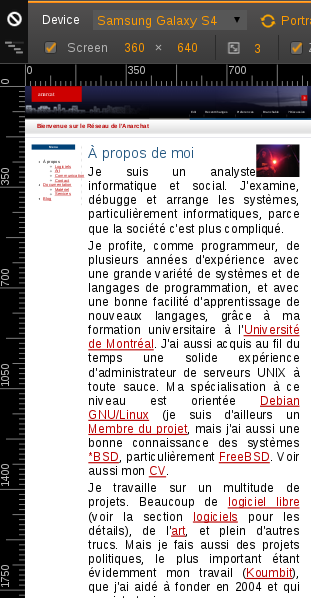
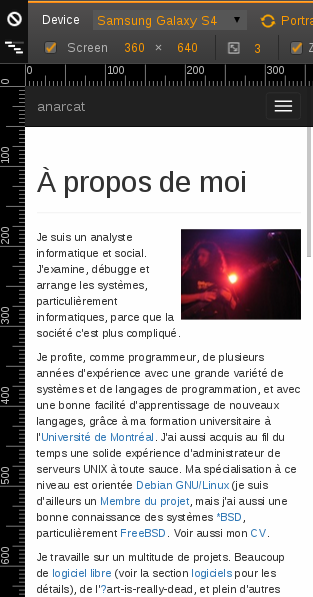
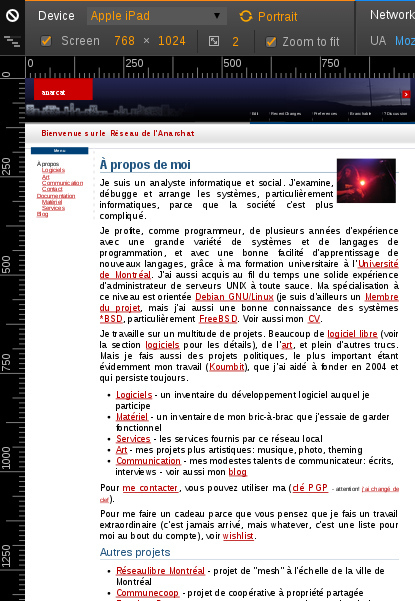
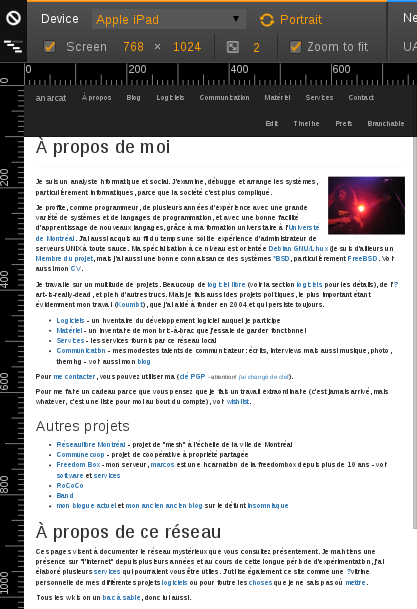
I finally gave up and drank the cool-aid of the Bootstrap theme. The main reason was that I noticed the site was basically unusable on any mobile device, including tablet computers like the iPad, which are unfortunately very, very common. Phones wouldn't render the site in a legible way either, unfortunately. The change is rather drastic, so I figured it was important to mention it here. I am not so satisfied pretty exctied with the result: the theme is very basic, if not absent. I actually like that purified form now, and it works across devices now much better. But I do feel I just made my blog look like everyone else that uses Bootstrap. We seem to enter an era where non-graphic designers (like me) are back to building web pages that all look the same, not very different, in a way, from the old days of plain HTML, like the default ikiwiki theme. I did some work to change the look at least minimally, but the top black navbar is really a killer giveaway this is a bootstrap theme. Bootstrap does a lot for the typography, at least when checking the presslabs checklist or the practical typography checklist, but I still had to change the main body width, which helped a lot I think. Anyways, the old Night City theme is still available for download and I could still flip it back on here if I need to.

What changed The new theme keeps the distractions away, but ironically, it's slower than the previous theme even though there are no images and basically no colors at all. On my tests, it now loads in about 3.42 seconds on the "Regular 2G (250Kbps)" simulation of Chromium with 72KB in 12 requests. Whereas my tests with the previous theme were taking 3.25 seconds with 43.5KB in 17 requests. This is due to the Bootstrap CSS, which takes a whopping 19KB itself, but especially because I now load JQuery, which takes a whopping 32.8KB! And that is probably gzip-compressed, as the original is more around 90KB. But at least the thing is readable on phones and tablets now. Compare:

Samsung S3, before Screenshot of a fake rendering on the Samsung Galaxy S3 in night city

Samsung S3, after Screenshot of a fake rendering on the Samsung Galaxy S3 in bootstrap I like this: much simpler, purer version on smaller devices. And we see what counts: the freaking text. Of course, on tablets, it doesn't fare as well: the top menu gets wrapped around...

Apple iPad, before Screenshot of a fake rendering on the iPad in night city

Apple iPad, after Screenshot of a fake rendering on the iPad in bootstrap Apparently, the fix would be for me to "customize the @grid-float-breakpoint variable" in LESS (which I thought was a pager, but seems to be a CSS preprocessor, graaah). Still, I think it's better that way, more readable, and less crufty.

How it was done After doing a thorough evaluation of all the Bootstrap ikiwiki themes I could find (there are more than 4 at least!), I figured I prefered the Jak Linux one. It seemed to be better implemented than the others, cleaner, and I liked the mean black border on top. Black is cool. Oh, and I liked the subtle footer as well. Subtle is cool. Unfortunately, that theme originally required a custom plugin to have a menu on top, which i thought was silly. So I patched it to make it work with the sidebar plugin, which turned out to be trivially simple: just dump the sidebar content, and make the sidebar page have explicit HTML tags in it that match Bootstrap's required classes. I also added the regular action links in the top navbar, but that does overload it quite a bit. I also did some code cleanups and various other small changes, all of which are available in my personnal git repo.

What doesn't work So of course, there are always problems. The first problem is the extra bandwidth usage. Not sure that can be fixed, other than switching to the upcoming Bootstrap 4, which is smaller than Bootstrap 3, bizarrely. The more annoying problems are weird alignment issues. If the screen gets two narrow without kicking some collapse rules in place (the iPad bug above), the navbar rows overflow and look ugly. Even more bizarre, in some cases the right navbar can just completely disappear, in fact, that's the only fix I could find: to assign the hidden-xs and hidden-sm classes to the navbar-right <UL> element. But then it just goes away, which is pretty darn stupid. Still - I assigned the classes to a few actions that seemed low priority, both in the theme and in the sidebar page. Similarly, the search form at the bottom of the page doesn't seem to want to fit in the footer properly. No idea why and I can't bother to figure that one out. I ended up merging this with the backlinks, tags and trails navigation items. Oh, and amazingly enough: comments are simply not rendered at all right now. Oops. I seemed to have picked the single bootstrap Ikiwiki theme that does *not* have comments rendering... Aaaargh. For now I just copy-pasted stuff from the [ramseydsilva][] theme and it looks pretty ugly, but at least it works. I ended up theming comments the same way i did for Night City, which looks pretty good, but is not in sync with the LESS stuff in Bootstrap. I also add to add back trails, backlinks and favicon... looks like the Jak theme wasn't made for a blog after all... but that's now fixed! :) Another improvement would be to change the font from the canonical Helvetica to something prettier, like suggested in Practical Typography, in the font recommendations section, or the presslabs checklist. So far I have settled on Mozilla's Fira font (which means, yes, one set of objects is actually loading from the CDN, sorry). Feedback welcome.

7 September 2015

Steve Kemp: The Jessie 8.2 point-release broke for me

I have about 18 personal hosts, all running the Jessie release of Debian GNU/Linux. To keep up with security updates I use unattended-upgrades. The intention is that every day, via cron, the system will look for updates and apply them. Although I mostly expect it to handle security updates I also have it configured such that point-releases will be applied by magic too. Unfortunately this weekend, with the 8.2 release, things broke in a significant way - The cron deamon was left in a broken state, such that all cronjobs failed to execute. I was amazed that nobody had reported a bug, as several people on twitter had the same experience as me, but today I read through a lot of bug-reports and discovered that #783683 is to blame: The solution:

# dpkg --configure -a
# apt-get upgrade
I guess the good news is I spotted it promptly, with the benefit of hindsight the bug report does warn of this as being a concern, but I guess there wasn't a great solution. Anyway I hope others see this, or otherwise spot the problem themselves. In unrelated news the seaweedfs file-store I previously introduced is looking more and more attractive to me. I reported a documentation-related bug which was promptly handled, even though it turned out I was wrong, and I contributed CIDR support to whitelisting hosts which was merged in well. I've got a two-node "cluster" setup at the moment, and will be expanding that shortly. I've been doing a lot of little toy-projects in Go recently. This weekend I was mostly playing with the nats.io message-bus, and tying it together with sinatra.

6 September 2015

Lunar: Reproducible builds: week 19 in Stretch cycle

What happened in the reproducible builds effort this week: Toolchain fixes Dmitry Shachnev uploaded sphinx/1.3.1-6 with improved patches from Val Lorentz. Chris Lamb submitted a patch for ibus-table which makes the output of ibus-table-createdb deterministic. Niko Tyni wrote a patch to make libmodule-build-perl linking order deterministic. Santiago Vila has been leading discussions on the best way to fix timestamps coming from Gettext POT files. Packages fixed The following 35 packages became reproducible due to changes in their build dependencies: apache-log4j2, dctrl-tools, dms, gitit, gnubik, isrcsubmit, mailutils, normaliz, oaklisp, octave-fpl, octave-specfun, octave-vrml, opencolorio, openvdb, pescetti, php-guzzlehttp, proofgeneral, pyblosxom, pyopencl, pyqi, python-expyriment, python-flask-httpauth, python-mzml, python-simpy, python-tidylib, reactive-streams, scmxx, shared-mime-info, sikuli, siproxd, srtp, tachyon, tcltk-defaults, urjtag, velvet. The following packages became reproducible after getting fixed: The package is not in yet in unstable, but linux/4.2-1~exp1 is now reproducible! Kudos to Ben Hutchings, and most fixes are already merged upstream. Some uploads fixed some reproducibility issues but not all of them: Patches submitted which have not made their way to the archive yet: reproducible.debian.net Some bugs that prevented packages to build successfully in the remote builders have been fixed. (h01ger) Two more amd64 build jobs have been removed from the Jenkins host in favor of six more on the new remote nodes. (h01ger) The munin graphs currently looks fine, so more amd64 jobs will probably be added in the next week. diffoscope development Version 32 of diffoscope has been released on September 3rd with the following new features: It also fixes many bugs. Head over to the changelog for the full list. Version 33 was released the day after to fix a bug introduced in the packaging. Documentation update Chris Lamb blessed the SOURCE_DATE_EPOCH specification with the version number 1.0 . Lunar documented how the .file assembler directive can help with random filenames in debug symbols. Package reviews 235 reviews have been removed, 84 added and 277 updated this week. 29 new FTBFS bugs were filled by Chris Lamb, Chris West (Faux), Daniel Stender, and Niko Tyni. New issues identified this week: random_order_in_ibus_table_createdb_output, random_order_in_antlr_output, nondetermistic_link_order_in_module_build, and timestamps_in_tex_documents. Misc. Thanks to Dhole and Thomas Vincent, the talk held at DebConf15 now has subtitles! Void Linux started to merge changes to make packages produced by xbps reproducible.

5 September 2015

Russell Coker: A Long Term Review of Android Devices

Xperia X10 My first Android device was The Sony Ericsson Xperia X10i [1]. One of the reasons I chose it was for the large 4 screen, nowadays the desirable phones (the ones that are marketed as premium products) are all bigger than that (the Galaxy S6 is 5.1 ) and even the slightly less expensive phones are bigger. At the moment Aldi is advertising an Android phone with a 4.5 screen for $129. But at the time there was nothing better in the price range that I was willing to pay. I devoted a lot of my first review to the default apps for SMS and Email. Shortly after that I realised that the default email app is never going to be adequate (I now use K9 mail) and the SMS app is barely adequate (but I mostly use instant messaging). I ve got used to the fact that most apps that ship with an Android device are worthless, the camera app and the app to make calls are the only built in apps I regularly use nowadays. In the bug list from my first review the major issue was lack of Wifi tethering which was fixed by an update to Android 2.3. Unfortunately Android 2.3 ran significantly more slowly which decreased the utility of the phone. The construction of the phone is very good. Over the last 2 years the 2 Xperia X10 phones I own have been on loan to various relatives, many of whom aren t really into technology and can t be expected to take good care of things. But they have not failed in any way. Apart from buying new batteries there has been no hardware failure in either phone. While 2 is a small sample size I haven t see any other Android device last nearly as long without problems. Unfortunately I have no reason to believe that Sony has continued to design devices as well. The Xperia X10 phones crash more often than most Android phones with spontaneous reboots being a daily occurrence. While that is worse than any other Android device I ve used it s not much worse. My second review of the Xperia X10 had a section about ways of reducing battery use [2]. Wow, I d forgotten how much that sucked! When I was last using the Xperia X10 the Life360 app that my wife and I use to track each other was taking 15% of the battery, on more recent phones the same app takes about 2%. The design of modern phones seems to be significantly more energy efficient for background tasks and the larger brighter displays use more energy instead. My father is using one of the Xperia phones now, when I give him a better phone to replace it I will have both as emergency Wifi access points. They aren t useful for much else nowadays. Samsung Galaxy S In my first review of the Galaxy S I criticised it for being thin, oddly shaped, and slippery [3]. After using it for a while I found the shape convenient as I could easily determine the bottom of the phone in my pocket and hold it the right way up before looking at it. This is a good feature for a phone that s small enough to rotate in my pocket the Samsung Galaxy Note series of phones is large enough to not rotate in a pocket. In retrospect I think that being slippery isn t a big deal as almost everyone buys a phone case anyway. But it would still be better for use on a desk if the bulge was at the top. I wrote about my Galaxy S failing [4]. Two of my relatives had problems with those phones too. Including a warranty replacement I ve seen 4 of those phones in use and only one worked reliably. The one that worked reliably is now being used by my mother, it s considerably faster than the Xperia X10 because it has more RAM and will probably remain in regular use until it breaks. CyanogenMod I tried using CyanogenMod [5]. The phone became defective 9 months later so even though CyanogenMod is great I don t think I got good value for the amount of time spent installing it. I haven t tried replacing the OS of an Android phone since then. I really wish that they would start manufacturing phones that can have the OS replaced as easily as a PC. Samsung Galaxy S3 and Wireless Charging The Galaxy S3 was the first phone I owned which competes with phones that are currently on sale [6]. A relative bought one at the same time as me and her phone is running well with no problems. But my S3 had some damage to it s USB port which means that the vast majority of USB cables don t charge it (only Samsung cables can be expected to work). After I bought the S3 I bought a Qi wireless phone charging device [7]. One of the reasons for buying that is so if a phone gets a broken USB port then I can still use it. It s ironic that the one phone that had a damaged USB port also failed to work correctly with the Qi card installed. The Qi charger is gathering dust. One significant benefit of the S3 (and most Samsung phones) is that it has a SD socket. I installed a 32G SD card in the S3 and now one of my relatives is happily using it as a media player. Nexus 4 I bought a Nexus 4 [8] for my wife as she needed a better phone but didn t feel like paying for a Galaxy S3. The Nexus 4 is a nice phone in many ways but the lack of storage is a serious problem. At the moment I m only keeping it to use with Google Cardboard, I will lend it to my parents soon. In retrospect I made a mistake buying the Nexus 4. If I had spent a little more money on another Galaxy S3 then I would have had a phone with a longer usage life as well as being able to swap accessories with my wife. The Nexus 4 seems reasonably solid, the back of the case (which is glass) broke on mine after a significant impact but the phone continues to work well. That s a tribute to the construction of the phone and also the Ringke Fusion case [9]. Generally the Nexus 4 is a good phone so I don t regret buying it. I just think that the Galaxy S3 was a better choice. Galaxy Note 2 I got a Samsung Galaxy Note 2 in mid 2013 [10]. In retrospect it was a mistake to buy the Galaxy S3, the Note series is better suited to my use. If I had known how good it is to have a larger phone I d have bought the original Galaxy Note when it was first released. Generally everything is good about the Note 2. While it only has 16G of storage (which isn t much by today s standards) it has an SD socket to allow expansion. It s currently being used by a relative as a small tablet. With a 32G SD card it can fit a lot of movies. Bluetooth Speakers I received Bluetooth speakers in late 2013 [11]. I was very impressed by them but ended up not using them for a while. After they gathered dust for about a year I started using them again recently. While nothing has changed regarding my review of the Hive speakers (which I still like a lot) it seems that my need for such things isn t as great as I thought. One thing that made me start using the Bluetooth speakers again is that my phone case blocks the sound from my latest phone and makes it worse than phone sound usually is. I bought Bluetooth speakers for some relatives as presents, the relatives seemed to appreciate them but I wonder how much they actually use them. Nexus 5 The Nexus 5 [12] is a nice phone. When I first reviewed it there were serious problems with overheating when playing Ingress. I haven t noticed such problems recently so I think that an update to Android might have made it more energy efficient. In that review I was very impressed by the FullHD screen and it made me want a Note 3, at the time I planned to get a Note 3 in the second half of 2014 (which I did). Galaxy Note 3 Almost a year ago I bought the Samsung Galaxy Note 3 [13]. I m quite happy with it at the moment but I don t have enough data for a long term review of it. The only thing to note so far is that in my first review I was unhappy with the USB 3 socket as that made it more difficult to connect a USB cable in the dark. I ve got used to the socket and I can now reliably plug it in at night with ease. I wrote about Rivers jeans being the only brand that can fit a Samsung Galaxy Note series phone in the pocket [14]. The pockets of my jeans have just started wearing out and I think that it s partly due to the fact that I bought a Armourdillo Hybrid case [15] for my Note 3. I ve had the jeans for over 3 years with no noticable wear apart from the pockets starting to wear out after 10 months of using the Armourdillo case. I don t think that the Armourdillo case is bad, but the fact that it has deep grooves and hard plastic causes it to rub more on material when I take the phone out of my pocket. As I check my phone very frequently this causes some serious wear. This isn t necessarily a problem given that a phone costs 20* more than a pair of jeans, if the case was actually needed to save the phone then it would be worth having some jeans wear out. But I don t think I need more protection than a gel case offers. Another problem is that the Armourdillo case is very difficult to remove. This isn t a problem if you don t need access to your phone, IE if you use a phone like the Nexus 5 that doesn t permit changing batteries or SD cards. But if you need to change batteries, SD cards, etc then it s really annoying. My wife seems quite happy with her Armoudillo case but I don t think it was a good choice for me. I m considering abandoning it and getting one of the cheap gel cases. The sound on the Note 3 is awful. I don t know how much of that is due to a limitation in the speaker and how much is due to the case. It s quite OK for phone calls but not much good for music. Tablets I m currently on my third tablet. One was too cheap and nasty so I returned it. Another was still cheap and I hardly ever used it. The third is a Galaxy Note 10 which works really well. I guess the lesson is to buy something worthwhile so you can use it. A tablet that s slower and has less storage than a phone probably isn t going to get used much. Phone Longevity I owned the Xperia X10 for 22 months before getting the Galaxy S3. As that included 9 months of using a Galaxy S I only had 13 months of use out of that phone before lending it to other people. The Galaxy S3 turned out to be a mistake as I replaced it in only 7 months. I had the Note 2 for 15 months before getting the Note 3. I have now had the Note 3 for 11 months and have no plans for a replacement any time soon this is the longest I ve owned an Android phone and been totally satisfied with it. Also I only need to use it for another 4 months to set a record for using an Android phone. The Xperia was free as part of a telco contract. The other phones were somewhere between $500 and $600 each when counting the accessories (case, battery, etc) that I bought with them. So in 4 years and 7 months I ve spent somewhere between $1500 and $1800 on phones plus the cost of the Xperia that was built in to the contract. The Xperia probably cost about the same so I ll assume that I spent $2000 on phones and accessories. This seems like a lot. However that averages out to about $1.20 per day (and hopefully a lot less if my Note 3 lasts another couple of years). I could justify $1.20 per day for either the amount of paid work I do on Android phones or the amount of recreational activities that I perform (the Galaxy S3 was largely purchased for Ingress). Conclusion I think that phone companies will be struggling to maintain sales of high end phones in the future. When I chose the Xperia X10 I knew I was making a compromise, the screen resolution was an obvious limitation on the use of the device (even though it was one of the best devices available). The storage in the Xperia was also a limitation. Now FullHD is the minimum resolution for any sort of high-end device and 32G of storage is small. I think that most people would struggle to observe any improvement over a Nexus 5 or Note 3 at this time. I think that this explains the massive advertising campaign for the Galaxy S6 that is going on at the moment. Samsung can t sell the S6 based on it being better than previous phones because there s not much that they can do to make it obviously better. So they try and sell it for the image.

4 September 2015

Julien Danjou: Data validation in Python with voluptuous

Continuing my post series on the tools I use these days in Python, this time I would like to talk about a library I really like, named voluptuous. It's no secret that most of the time, when a program receives data from the outside, it's a big deal to handle it. Indeed, most of the time your program has no guarantee that the stream is valid and that it contains what is expected. The robustness principle says you should be liberal in what you accept, though that is not always a good idea neither. Whatever policy you chose, you need to process those data and implement a policy that will work lax or not. That means that the program need to look into the data received, check that it finds everything it needs, complete what might be missing (e.g. set some default), transform some data, and maybe reject those data in the end.
Data validation The first step is to validate the data, which means checking all the fields are there and all the types are right or understandable (parseable). Voluptuous provides a single interface for all that called a Schema.
>>> from voluptuous import Schema
>>> s = Schema(
... 'q': str,
... 'per_page': int,
... 'page': int,
... )
>>> s( "q": "hello" )
'q': 'hello'
>>> s( "q": "hello", "page": "world" )
voluptuous.MultipleInvalid: expected int for dictionary value @ data['page']
>>> s( "q": "hello", "unknown": "key" )
voluptuous.MultipleInvalid: extra keys not allowed @ data['unknown']

The argument to voluptuous.Schema should be the data structure that you expect. Voluptuous accepts any kind of data structure, so it could also be a simple string or an array of dict of array of integer. You get it. Here it's a dict with a few keys that if present should be validated as certain types. By default, Voluptuous does not raise an error if some keys are missing. However, it is invalid to have extra keys in a dict by default. If you want to allow extra keys, it is possible to specify it.
>>> from voluptuous import Schema
>>> s = Schema( "foo": str , extra=True)
>>> s( "bar": 2 )
"bar": 2

It is also possible to make some keys mandatory.
>>> from voluptuous import Schema, Required
>>> s = Schema( Required("foo"): str )
>>> s( )
voluptuous.MultipleInvalid: required key not provided @ data['foo']

You can create custom data type very easily. Voluptuous data types are actually just functions that are called with one argument, the value, and that should either return the value or raise an Invalid or ValueError exception.
>>> from voluptuous import Schema, Invalid
>>> def StringWithLength5(value):
... if isinstance(value, str) and len(value) == 5:
... return value
... raise Invalid("Not a string with 5 chars")
...
>>> s = Schema(StringWithLength5)
>>> s("hello")
'hello'
>>> s("hello world")
voluptuous.MultipleInvalid: Not a string with 5 chars

Most of the time though, there is no need to create your own data types. Voluptuous provides logical operators that can, combined with a few others provided primitives such as voluptuous.Length or voluptuous.Range, create a large range of validation scheme.
>>> from voluptuous import Schema, Length, All
>>> s = Schema(All(str, Length(min=3, max=5)))
>>> s("hello")
"hello"
>>> s("hello world")
voluptuous.MultipleInvalid: length of value must be at most 5

The voluptuous documentation has a good set of examples that you can check to have a good overview of what you can do. Data transformation
What's important to remember, is that each data type that you use is a function that is called and returns a value, if the value is considered valid. That value returned is what is actually used and returned after the schema validation:
>>> import uuid
>>> from voluptuous import Schema
>>> def UUID(value):
... return uuid.UUID(value)
...
>>> s = Schema( "foo": UUID )
>>> data_converted = s( "foo": "uuid?" )
voluptuous.MultipleInvalid: not a valid value for dictionary value @ data['foo']
>>> data_converted = s( "foo": "8B7BA51C-DFF5-45DD-B28C-6911A2317D1D" )
>>> data_converted
'foo': UUID('8b7ba51c-dff5-45dd-b28c-6911a2317d1d')

By defining a custom UUID function that converts a value to a UUID, the schema converts the string passed in the data to a Python UUID object validating the format at the same time. Note a little trick here: it's not possible to use directly uuid.UUID in the schema, otherwise Voluptuous would check that the data is actually an instance of uuid.UUID:
>>> from voluptuous import Schema
>>> s = Schema( "foo": uuid.UUID )
>>> s( "foo": "8B7BA51C-DFF5-45DD-B28C-6911A2317D1D" )
voluptuous.MultipleInvalid: expected UUID for dictionary value @ data['foo']
>>> s( "foo": uuid.uuid4() )
'foo': UUID('60b6d6c4-e719-47a7-8e2e-b4a4a30631ed')

And that's not what is wanted here. That mechanism is really neat to transform, for example, strings to timestamps.
>>> import datetime
>>> from voluptuous import Schema
>>> def Timestamp(value):
... return datetime.datetime.strptime(value, "%Y-%m-%dT%H:%M:%S")
...
>>> s = Schema( "foo": Timestamp )
>>> s( "foo": '2015-03-03T12:12:12' )
'foo': datetime.datetime(2015, 3, 3, 12, 12, 12)
>>> s( "foo": '2015-03-03T12:12' )
voluptuous.MultipleInvalid: not a valid value for dictionary value @ data['foo']

Recursive schemas So far, Voluptuous has one limitation so far: the ability to have recursive schemas. The simplest way to circumvent it is by using another function as an indirection.
>>> from voluptuous import Schema, Any
>>> def _MySchema(value):
... return MySchema(value)
...
>>> from voluptuous import Any
>>> MySchema = Schema( "foo": Any("bar", _MySchema) )
>>> MySchema( "foo": "foo": "bar" )
'foo': 'foo': 'bar'
>>> MySchema( "foo": "foo": "baz" )
voluptuous.MultipleInvalid: not a valid value for dictionary value @ data['foo']['foo']

Usage in REST API
I started to use Voluptuous to validate data in a the REST API provided by Gnocchi. So far it has been a really good tool, and we've been able to create a complete REST API that is very easy to validate on the server side. I would definitely recommend it for that. It blends with any Web framework easily. One of the upside compared to solution like JSON Schema, is the ability to create or re-use your own custom data types while converting values at validation time. It is also very Pythonic, and extensible it's pretty great to use for all of that. It's also not tied to any serialization format. On the other hand, JSON Schema is language agnostic and is serializable itself as JSON. That makes it easy to be exported and provided to a consumer so it can understand the API and validate the data potentially on its side.

Norbert Preining: How to rename a local OfflineIMAP managed folder

Since quite some time I am using OfflineIMAP to keep my mailbox status from various servers locally available on my machine. I did more or less follow the excellent guide A unix style mail setup, but didn t use folder name translation right from the beginning. So I got stuck with four folders named INBOX: acc1/INBOX, acc2/INBOX, etc. This wouldn t be a big problem, but when using Mutt with the folder sidebar patch (as available in the mutt-patched package in Debian), there is the problem that only the INBOX part is shown. offlineimap So I decided to rename all the local folders to the scheme described in the above guide. At the end I want to have a folder layout as follows:
  Maildir/acc1/acc1
  Maildir/acc1/acc1.folder1
  Maildir/acc1/acc1.folder2
where the acc1 related to the INBOX on the remote account acc1, and the others are folders on the remote end. Unfortunately, renaming is not supported in offlineimap, it would simply download everything again at best! So I checked what needs to be done, and it turned out it is not as complicated as I thought. The necessary steps are: To make this more specific, let us assume I want to reorganize the account acc1 in this way, and there are two folders synced. That is, before we start the Maildir folder contains:
Maildir/acc1/INBOX
Maildir/acc1/folder1
Maildir/acc1/folder2
and we want to achieve that the layout is
Maildir/acc1/acc1
Maildir/acc1/acc1.folder1
Maildir/acc1/acc1.folder2
Due to the fact that both the LocalStatus files and the FolderValidity files are naned in the same way as the folders, the following trivial script does all the necessary renaming for this simple case:
for d in ~/Maildir/acc1 ~/.offlineimap/Account-acc1/LocalStatus ~/.offlineimap/Repository-acc1local/FolderValidity ; do
  mv $d/INBOX $d/acc1
  mv $d/folder1 $d/acc1.folder1
  mv $d/folder2 $d/acc1.folder2
done
Finally, the correct renaming has to be done by adding nametrans rules to the helper script. The functions oimaptransfolder_acc1 and localtransfolder_acc1 as defined in the above tutorial can be used as is, and need only be added to the respective Repository sections in the configuration file. After having done the necessary renaming, what remains is to give it a good test. Best way to do it is with
offlineimap --dry-run -o -a acc1
which runs the syncronization in dry-run mode, so nothing is actually copied, and only once and only for acc1. If during this test run nothing strange appears, like many many emails are deleted on either end, then you are fine. Enjoy.

3 September 2015

Vincent Fourmond: Releases 1.19.1 of Tioga and 0.13.1 of ctioga2

I've just released the versions 1.19.1 of Tioga and 0.13.1 of ctioga2. They both fix installation problems with recent versions of Ruby. Update as usual, though that isn't strictly necessary if you've managed to install them properly.
~ gem update tioga ctioga2

1 September 2015

Lunar: Reproducible builds: week 18 in Stretch cycle

What happened in the reproducible builds effort this week: Toolchain fixes Aur lien Jarno uploaded glibc/2.21-0experimental1 which will fix the issue were locales-all did not behave exactly like locales despite having it in the Provides field. Lunar rebased the pu/reproducible_builds branch for dpkg on top of the released 1.18.2. This made visible an issue with udebs and automatically generated debug packages. The summary from the meeting at DebConf15 between ftpmasters, dpkg mainatainers and reproducible builds folks has been posted to the revelant mailing lists. Packages fixed The following 70 packages became reproducible due to changes in their build dependencies: activemq-activeio, async-http-client, classworlds, clirr, compress-lzf, dbus-c++, felix-bundlerepository, felix-framework, felix-gogo-command, felix-gogo-runtime, felix-gogo-shell, felix-main, felix-shell-tui, felix-shell, findbugs-bcel, gco, gdebi, gecode, geronimo-ejb-3.2-spec, git-repair, gmetric4j, gs-collections, hawtbuf, hawtdispatch, jack-tools, jackson-dataformat-cbor, jackson-dataformat-yaml, jackson-module-jaxb-annotations, jmxetric, json-simple, kryo-serializers, lhapdf, libccrtp, libclaw, libcommoncpp2, libftdi1, libjboss-marshalling-java, libmimic, libphysfs, libxstream-java, limereg, maven-debian-helper, maven-filtering, maven-invoker, mochiweb, mongo-java-driver, mqtt-client, netty-3.9, openhft-chronicle-queue, openhft-compiler, openhft-lang, pavucontrol, plexus-ant-factory, plexus-archiver, plexus-bsh-factory, plexus-cdc, plexus-classworlds2, plexus-component-metadata, plexus-container-default, plexus-io, pytone, scolasync, sisu-ioc, snappy-java, spatial4j-0.4, tika, treeline, wss4j, xtalk, zshdb. The following packages became reproducible after getting fixed: Some uploads fixed some reproducibility issues but not all of them: Patches submitted which have not made their way to the archive yet: Chris Lamb also noticed that binaries shipped with libsilo-bin did not work. Documentation update Chris Lamb and Ximin Luo assembled a proper specification for SOURCE_DATE_EPOCH in the hope to convince more upstreams to adopt it. Thanks to Holger it is published under a non-Debian domain name. Lunar documented easiest way to solve issues with file ordering and timestamps in tarballs that came with tar/1.28-1. Some examples on how to use SOURCE_DATE_EPOCH have been improved to support systems without GNU date. reproducible.debian.net armhf is finally being tested, which also means the remote building of Debian packages finally works! This paves the way to perform the tests on even more architectures and doing variations on CPU and date. Some packages even produce the same binary Arch:all packages on different architectures (1, 2). (h01ger) Tests for FreeBSD are finally running. (h01ger) As it seems the gcc5 transition has cooled off, we schedule sid more often than testing again on amd64. (h01ger) disorderfs has been built and installed on all build nodes (amd64 and armhf). One issue related to permissions for root and unpriviliged users needs to be solved before disorderfs can be used on reproducible.debian.net. (h01ger) strip-nondeterminism Version 0.011-1 has been released on August 29th. The new version updates dh_strip_nondeterminism to match recent changes in debhelper. (Andrew Ayer) disorderfs disorderfs, the new FUSE filesystem to ease testing of filesystem-related variations, is now almost ready to be used. Version 0.2.0 adds support for extended attributes. Since then Andrew Ayer also added support to reverse directory entries instead of shuffling them, and arbitrary padding to the number of blocks used by files. Package reviews 142 reviews have been removed, 48 added and 259 updated this week. Santiago Vila renamed the not_using_dh_builddeb issue into varying_mtimes_in_data_tar_gz_or_control_tar_gz to align better with other tag names. New issue identified this week: random_order_in_python_doit_completion. 37 FTBFS issues have been reported by Chris West (Faux) and Chris Lamb. Misc. h01ger gave a talk at FrOSCon on August 23rd. Recordings are already online. These reports are being reviewed and enhanced every week by many people hanging out on #debian-reproducible. Huge thanks!

Rapha&#235;l Hertzog: My Free Software Activities in August 2015

My monthly report covers a large part of what I have been doing in the free software world. I write it for my donators (thanks to them!) but also for the wider Debian community because it can give ideas to newcomers and it s one of the best ways to find volunteers to work with me on projects that matter to me. Debian LTS This month I have been paid to work 6.5 hours on Debian LTS. In that time I did the following: Apart from that, I also gave a talk about Debian LTS at DebConf 15 in Heidelberg and also coordinated a work session to discuss our plans for Wheezy. Have a look at the video recordings: DebConf 15 I attended DebConf 15 with great pleasure after having missed DebConf 14 last year. While I did not do lots of work there, I participated in many discussions and I certainly came back with a renewed motivation to work on Debian. That s always good. :-) For the concrete work I did during DebConf, I can only claim two schroot uploads to fix the lack of support of the new overlay filesystem that replaces aufs in the official Debian kernel, and some Distro Tracker work (fixing an issue that some people had when they were logged in via Debian s SSO). While the numerous discussions I had during DebConf can t be qualified as work , they certainly contribute to build up work plans for the future: As a Kali developer, I attended multiple sessions related to derivatives (notably the Debian Derivatives Panel). I was also interested by the Debian in the corporate IT BoF led by Michael Meskes (Credativ s CEO). He pointed out a number of problems that corporate users might have when they first consider using Debian and we will try to do something about this. Expect further news and discussions on the topic. Martin Kraff, Luca Filipozzi, and me had a discussion with the Debian Project Leader (Neil) about how to revive/transform the Debian s Partner program. Nothing is fleshed out yet, but at least the process initiated by the former DPL (Lucas) is again moving forward. Other Debian work Sponsorship. I sponsored an NMU of pep8 by Daniel Stender as it was a requirement for prospector which I also sponsored since all the required dependencies are now available in Debian. \o/ Packaging. I NMUed libxml2 2.9.2+really2.9.1+dfsg1-0.1 fixing 3 security issues and a RC bug that was breaking publican. Since there s no upstream fix for more than 8 months, I went back to the former version 2.9.1. It s in line with the new requirement of release managers a package in unstable should migrate to testing reasonably quickly, it s not acceptable to keep it unfixed for months. With this annoying bug fixed, I could again upload a new upstream release of publican so I prepared and uploaded 4.3.2-1. It was my first source only upload. This release was more work than I expected and I filed no less than 3 bug to upstream (new bash-completion install path, request to provide sources of a minified javascript file, drop a .po file for an invalid language code). GPG issues with smartcard. Back from DebConf, when I wanted to sign some key, I stumbled again upon the problem which makes it impossible for me to use my two smartcards one after the other without first deleting the stubs for the private key. It s not a new issue but I decided that it was time to report it upstream, so I did it: #2079 on bugs.gnupg.org. Some research helped me to find a way to work-around the problem. Later in the month, after a dist-upgrade and a reboot, I was no longer able to use my smartcard as a SSH authentication key again it was already reported but there was no clear analysis, so I tried to do my own one and added the results of my investigation in #795368. It looks like the culprit is pinentry-gnome3 not working when started by the gpg-agent which is started before the DBUS session. Simple fix is to restart the gpg-agent in the session but I have no idea yet of what the proper fix should be (letting systemd manage the graphical user session and start gpg-agent would be my first answer, but that doesn t solve the issue for users of other init systems so it s not satisfying). Distro Tracker. I merged two patches from Orestis Ioannou fixing some bugs tagged newcomer. There are more such bugs (I even filed two: #797096 and #797223), go grab them and do a first contribution to Distro Tracker like Orestis just did! I also merged a change from Christophe Siraut who presented Distro Tracker at DebConf. I implemented in Distro Tracker the new authentication based on SSL client certificates that was recently announced by Enrico Zini. It s working nice, and this authentication scheme is far easier to support. Good job, Enrico! tracker.debian.org broke during DebConf, it stopped being updated with new data. I tracked this down to a problem in the archive (see #796892). Apparently Ansgar Burchardt changed the set of compression tools used on some jessie repositorie, replacing bz2 by xz. He dropped the old Packages.bz2 but missed some Sources.bz2 which were thus stale and APT reported Hashsum mismatch on the uncompressed content. Misc. I pushed some small improvement to my Salt formulas: schroot-formula and sbuild-formula. They will now auto-detect which overlay filesystem is available with the current kernel (previously aufs was hardcoded). Thanks See you next month for a new summary of my activities.

No comment Liked this article? Click here. My blog is Flattr-enabled.

Russ Allbery: Review: Kanban

Review: Kanban, by David J. Anderson
Publisher: Blue Hole
Copyright: 2010
ISBN: 0-9845214-0-2
Format: Trade paperback
Pages: 240
Another belated review, this time of a borrowed book. Which I can now finally return! A delay in the review of this book might be a feature if I had actually used it for, as the subtitle puts it, successful evolutionary change in my technology business. Sadly, I haven't, so it's just late. So, my background: I've done a lot of variations of traditional project management for IT projects (both development and more operational ones), both as a participant and as a project manager. (Although I've never done the latter as a full-time job, and have no desire to do so.) A while back at Stanford, my team adopted Agile, specifically Scrum, so I did a fair bit of research about Scrum including a couple of training courses. Since then, at Dropbox, I've used a few different variations on a vaguely Agile-inspired planning process, although it's not particularly consistent with any one system. I've been hearing about Kanban for a while and have friends who swear by it, but I only had a vague idea of how it worked. That seemed like a good excuse to read a book. And Anderson's book is a good one if, like me, you're looking for a basic introduction. It opens with a basic description and definition, talks about motivation and the expected benefits, and then provides a detailed description of Kanban as a system. The tone is on the theory side, written using the terminology of (I presume) management theory and operations management, areas about which I know almost nothing, but the terminology wasn't so heavy as to make the book hard to read. Anderson goes into lots of detail, and I thought he did a good job of distinguishing between basic principles, optional techniques, and variations that may be appropriate for particular environments. If you're also not familiar, the basic concept of Kanban is to organize work using an in-progress queue. It eschews time-bounded planning entirely in favor of staging work at the start of a sequence of queues and letting the people working on each queue pull from the previous queue when they're ready to take on a new task. As you might guess from that layout, Kanban was originally invented for assembly-line manufacturing (at Toyota). That was one of the problems that I had with it, or at least the presentation in this book: most of my software development doesn't involve finishing one part of something and handing it off to someone else, which made it hard to identify with the pipeline model. Anderson has clearly spent a lot of time working with large-scale programming shops, including outsourced development firms, with dedicated QA and operations roles. This is not at all how Silicon Valley agile development works, so parts of this book felt like missives from a foreign country. That said, the key point of Kanban is not the assembly line but the work limit. One of the defining characteristics of Kanban, at least as Anderson presents it, is that one does not try to estimate work and tile it based on estimates, not even to the extent that Scrum and other Agile methodologies do within the sprint. Instead, each person takes as long as they take on the things they're working on, and pulls a new task when they have free capacity. The system instead puts a limit on how many things they can have in progress at a time. The problem of pipeline stalls is dealt with both via continuous improvement and "swarming" of a problem to unblock the line (since other teams may not be able to work until the block is fixed), and with being careful about the sizing of work items (I'm used to calling them stories) that go in the front end. Predictability, which Scrum uses story sizing and team velocity analysis to try to achieve, is basically statistical. One uses a small number of buckets of sizes of stories, and the whole pipeline will finish some number of work items per unit time, with a variance. The promise made to clients and other teams is that some percentage of the work items will be finished within some time frame from when they enter the system. Most importantly, these are all descriptive properties, determined statistically after the fact, rather than planned properties worked out through story sizing and extensive team discussion. If you, like me, are pretty thoroughly sick of two-hour sprint planning meetings and endless sizing exercises, this is rather appealing. My problem with most work planning systems is that I think they overplan and put too much weight our ability to estimate how long work will take. Kanban is very appealing when viewed through that lens: it gives up on things we're bad at in favor of simple measurement and building a system with enough slack that it can handle work of various different sizes. As mentioned at the top, I haven't had a chance to try it (and I'm not sure it's a good fit with the inter-group planning methods in use at my current workplace), but I came away from this book wanting to do so. If, like me, your experience is mostly with small combined teams or individual programming work, Anderson's examples may seem rather large, rather formal, and bureaucratic. But this is a solid introduction and well worth reading if your only experience with Agile is sprint planning, story writing and sizing, and fast iterations. Rating: 7 out of 10

31 August 2015

Russ Allbery: Review: Through Struggle, The Stars

Review: Through Struggle, The Stars, by John J. Lumpkin
Series: Human Reach #1
Publisher: John J. Lumpkin
Copyright: July 2011
ISBN: 1-4611-9544-6
Format: Kindle
Pages: 429
Never let it be said that I don't read military SF. However, it can be said that I read books and then get hellishly busy and don't review them for months. So we'll see if I can remember this well enough to review it properly. In Lumpkin's future world, mankind has spread to the stars using gate technology, colonizing multiple worlds. However, unlike most science fiction futures of this type, it's not all about the United States, or even the United States and Russia. The great human powers are China and Japan, with the United States relegated to a distant third. The US mostly maintains its independence from either, and joins the other lesser nations and UN coalitions to try to pick up a few colonies of its own. That's the context in which Neil and Rand join the armed services: the former as a pilot in training, and the latter as an army grunt. This is military SF, so of course a war breaks out. But it's a war between Japan and China: improved starship technology and the most sophisticated manufacturing in the world against a much larger economy with more resources and a larger starting military. For reasons that are not immediately clear, and become a plot point later on, the United States president immediately takes an aggressive tone towards China and pushes the country towards joining the war on the side of Japan. Most of this book is told from Neil's perspective, following his military career during the outbreak of war. His plans to become a pilot get derailed as he gets entangled with US intelligence agents (and a bad supervisor). The US forces are not in a good place against China, struggling when they get into ship-to-ship combat, and Neil's ship goes on a covert mission to attempt to complicate the war with political factors. Meanwhile, Rand tries to help fight off a Chinese invasion of one of the rare US colony worlds. Through Struggle, The Stars does not move quickly. It's over 400 pages, and it's a bit surprising how little happens. What it does instead is focus on how the military world and the war feels to Neil: the psychological experience of wanting to serve your country but questioning its decisions, the struggle of working with people who aren't always competent but who you can't just make go away, the complexities of choosing a career path when all the choices are fraught with politics that you didn't expect to be involved in, and the sheer amount of luck and random events involved in the progression of one's career. I found this surprisingly engrossing despite the slow pace, mostly because of how true to life it feels. War is not a never-ending set of battles. Life in a military ship has moments when everything is happening far too quickly, but other moments when not much happens for a long time. Lumpkin does a great job of reflecting that. Unfortunately, I thought there were two significant flaws, one of which means I probably won't seek out further books in this series. First, one middle portion of the book switches away from Neil to follow Rand instead. The first part of that involves the details of fighting orbiting ships with ground-based lasers, which was moderately interesting. (All the technological details of space combat are interesting and thoughtfully handled, although I'm not the sort of reader who will notice more subtle flaws. But David Weber this isn't, thankfully.) But then it turns into a fairly generic armed resistance story, which I found rather boring. It also ties into the second and more serious flaw: the villain. The overall story is constructed such that it doesn't need a personal villain. It's about the intersection of the military and politics, and a war that may be ill-conceived but that is being fought anyway. That's plenty of conflict for the story, at least in my opinion. But Lumpkin chose to introduce a specific, named Chinese character in the villain role, and the characterization is... well. After he's humiliated early in the story by the protagonists, Li Xiao develops an obsession with killing them, for his honor, and then pursues them throughout the book in ways that are sometimes destructive to the Chinese war efforts. It's badly unrealistic compared to the tone of realism taken by the rest of the story. Even if someone did become this deranged, it's bizarre that a professional military (and China's forces are otherwise portrayed as fairly professional) would allow this. Li reads like pure caricature, and despite being moderately competent apart from his inexplicable (but constantly repeated) obsession, is cast in a mustache-twirling role of personal villainy. This is weirdly out of place in the novel, and started irritating me enough that it took me out of the story. Through Struggle, The Stars is the first book of a series, and does not resolve much by the end of the novel. That plus its length makes the story somewhat unsatisfying. I liked Neil's development, and liked him as a character, and those who like the details of combat mixed with front-lines speculation about politics may enjoy this. But a badly-simplified mustache-twirling victim and some extended, uninteresting bits mar the book enough that I probably won't seek out the sequels. Followed by The Desert of Stars. Rating: 6 out of 10

30 August 2015

DebConf team: DebConf15: Farewell, and thanks for all the Fisch (Posted by DebConf Team)

A week ago, we concluded our biggest DebConf ever! It was a huge success. Handwritten feedback note We are overwhelmed by the positive feedback, for which we re very grateful. We want to thank you all for participating in the talks; speakers and audience alike, in person or live over the global Internet it wouldn t be the fantastic DebConf experience without you! Many of our events were recorded and streamed live, and are now available for viewing, as are the slides and photos. To share a sense of the scale of what all of us accomplished together, we ve compiled a few statistics: Our very own designer Valessio Brito made a lovely video of impressions and images of the conference.
We re collecting impressions from attendees as well as links to press articles, including Linux Weekly News coverage of specific sessions of DebConf. If you find something not yet included, please help us by adding links to the wiki.
DebConf15 group photo (by Aigars Mahinovs)
We tried a few new ideas this year, including a larger number of invited and featured speakers than ever before. On the Open Weekend, some of our sponsors presented their career opportunities at our job fair, which was very well attended. And a diverse selection of entertainment options provided the necessary breaks and ample opportunity for socialising. On the last Friday, the Oscar-winning documentary Citizenfour was screened, with some introductory remarks by Jacob Appelbaum and a remote address by its director, Laura Poitras, and followed by a long Q&A session by Jacob. DebConf15 was also the first DebConf with organised childcare (including a Teckids workshop for kids of age 8-16), which our DPL Neil McGovern standardised for the future: it s a thing now, he said. The participants used the week before the conference for intensive work, sprints and workshops, and throughout the main conference, significant progress was made on Debian and Free Software. Possibly the most visible was the endeavour to provide reproducible builds, but the planning of the next stable release stretch received no less attention. Groups like the Perl team, the diversity outreach programme and even DebConf organisation spent much time together discussing next steps and goals, and hundreds of commits were made to the archive, as well as bugs closed. DebConf15 was an amazing conference, it brought together hundreds of people, some oldtimers as well as plenty of new contributors, and we all had a great time, learning and collaborating with each other, says Margarita Manterola of the organiser team, and continues: The whole team worked really hard, and we are all very satisfied with the outcome. Another organiser, Martin Krafft adds: We mainly provided the infrastructure and space. A lot of what happened during the two weeks was thanks to our attendees. And that s what makes DebConf be DebConf. Photo of hostel staff wearing DebConf15 staff t-shirts (by Martin Krafft) Our organisation was greatly supported by the staff of the conference venue, the Jugendherberge Heidelberg International, who didn t take very long to identify with our diverse group, and who left no wishes untried. The venue itself was wonderfully spacious and never seemed too full as people spread naturally across the various conference rooms, the many open areas, the beergarden, the outside hacklabs and the lawn. The network installed specifically for our conference in collaboration with the nearby university, the neighbouring zoo, and the youth hostel provided us with a 1 Gbps upstream link, which we managed to almost saturate. The connection will stay in place, leaving the youth hostel as one with possibly the fastest Internet connection in the state. And the kitchen catered high-quality food to all attendees and their special requirements. Regional beer and wine, as well as local specialities, were provided at the bistro. DebConf exists to bring people together, which includes paying for travel, food and accomodation for people who could not otherwise attend. We would never have been able to achieve what we did without the support of our generous sponsors, especially our Platinum Sponsor Hewlett-Packard. Thank you very much. See you next year in Cape Town, South Africa!
The DebConf16 logo with white background

29 August 2015

Tassia Camoes Araujo: Report from the MicroDebconf Bras lia 2015

This was an event organized due to a coincidental meeting of a few DD s in the city of Brasilia on May 31st 2015. What a good thing when we can mix vacations, friends and Debian ;-)

Group photo

We called it Micro due to its short duration and planning phase, to be fair with other Mini DebConfs that take a lot more of organization. We also ended up having a translation sprint inside the event that attracted contributors from other cities. Our main goal was to boost the local community and bring new contributors to Debian. And we definitely made it! The meeting happened at University of Brasilia (UnB Gama). It started with a short presentation where each DD and Debian contributor presented their involvement with Debian and plans for the hacking session. This was an invitation for new contributors to choose the activities they were willing to engage, taking advantage of being guided by more experienced people. Then we moved to smaller rooms where participants were split in different groups to work on each track: packaging, translation and community/contribution. We all came together later for the keysigning party. Some of the highlights of the day: For more details of what happened, you can read our full report. The MicroDebconf wouldn t be possible without the support of prof. Paulo Meirelles from UnB Gama and all the LAPPIS team for the local organization and students mobilization. We also need to thank to Debian donnors, who covered the travel costs of one of our contributors. Last but not least, thanks to our participants and the large Brazilian community who is giving a good example of team work. A similar meeting happened in July during the Free Software International Forum (FISL) and another one is already planned to happen in October as part of the LatinoWare. I hope I can join those folks again in the near future!

Francois Marier: Letting someone ssh into your laptop using Pagekite

In order to investigate a bug I was running into, I recently had to give my colleague ssh access to my laptop behind a firewall. The easiest way I found to do this was to create an account for him on my laptop and setup a pagekite frontend on my Linode server and a pagekite backend on my laptop.

Frontend setup Setting up my Linode server in order to make the ssh service accessible and proxy the traffic to my laptop was fairly straightforward. First, I had to install the pagekite package (already in Debian and Ubuntu) and open up a port on my firewall by adding the following to both /etc/network/iptables.up.rules and /etc/network/ip6tables.up.rules:
-A INPUT -p tcp --dport 10022 -j ACCEPT
Then I created a new CNAME for my server in DNS:
pagekite.fmarier.org.   3600    IN  CNAME   fmarier.org.
With that in place, I started the pagekite frontend using this command:
pagekite --clean --isfrontend --rawports=virtual --ports=10022 --domain=raw:pagekite.fmarier.org:Password1

Backend setup After installing the pagekite and openssh-server packages on my laptop and creating a new user account:
adduser roc
I used this command to connect my laptop to the pagekite frontend:
pagekite --clean --frontend=pagekite.fmarier.org:10022 --service_on=raw/22:pagekite.fmarier.org:localhost:22:Password1

Client setup Finally, my colleague needed to add the folowing entry to ~/.ssh/config:
Host pagekite.fmarier.org
  CheckHostIP no
  ProxyCommand /bin/nc -X connect -x %h:10022 %h %p
and install the netcat-openbsd package since other versions of netcat don't work. On Fedora, we used netcat-openbsd-1.89 successfully, but this newer package may also work. He was then able to ssh into my laptop via ssh roc@pagekite.fmarier.org.

Making settings permanent I was quite happy settings things up temporarily on the command-line, but it's also possible to persist these settings and to make both the pagekite frontend and backend start up automatically at boot. See the documentation for how to do this on Debian and Fedora.

27 August 2015

Joey Hess: then and now

It's 2004 and I'm in Oldenburg DE, working on the Debian Installer. Colin and I pair program on partman, its new partitioner, to get it into shape. We've somewhat reluctantly decided to use it. Partman is in some ways a beautful piece of work, a mass of semi-object-oriented, super extensible shell code that sprang fully formed from the brow of Anton. And in many ways, it's mad, full of sector alignment twiddling math implemented in tens of thousands of lines of shell script scattered amoung hundreds of tiny files that are impossible to keep straight. In the tiny Oldenburg Developers Meeting, full of obscure hardware and crazy intensity of ideas like porting Debian to VAXen, we hack late into the night, night after night, and crash on the floor. sepia toned hackers round a table It's 2015 and I'm at a Chinese bakery, then at the Berkeley pier, then in a SF food truck lot, catching half an hour here and there in my vacation to add some features to Propellor. Mostly writing down data types for things like filesystem formats, partition layouts, and then some small amount of haskell code to use them in generic ways. Putting these peices together and reusing stuff already in Propellor (like chroot creation). Before long I have this, which is only 2 undefined functions away from (probably) working:
let chroot d = Chroot.debootstrapped (System (Debian Unstable) "amd64") mempty d
        & Apt.installed ["openssh-server"]
        & ...
    partitions = fitChrootSize MSDOS
        [ (Just "/boot", mkPartiton EXT2)
        , (Just "/", mkPartition EXT4)
        , (Nothing, const (mkPartition LinuxSwap (MegaBytes 256)))
        ]
 in Diskimage.built chroot partitions (grubBooted PC)
This is at least a replication of vmdebootstrap, generating a bootable disk image from that config and 400 lines of code, with enormous customizability of the disk image contents, using all the abilities of Propellor. But is also, effectively, a replication of everything partman is used for (aside from UI and RAID/LVM). sailboat on the SF bay What a difference a decade and better choices of architecture make! In many ways, this is the loosely coupled, extensible, highly configurable system partman aspired to be. Plus elegance. And I'm writing it on a lark, because I have some spare half hours in my vacation. Past Debian Installer team lead Tollef stops by for lunch, I show him the code, and we have the conversation old d-i developers always have about partman. I can't say that partman was a failure, because it's been used by millions to install Debian and Ubuntu and etc for a decade. Anything that deletes that many Windows partitions is a success. But it's been an unhappy success. Nobody has ever had a good time writing partman recipes; the code has grown duplication and unmaintainability. I can't say that these extensions to Propellor will be a success; there's no plan here to replace Debian Installer (although with a few hundred more lines of code, propellor is d-i 2.0); indeed I'm just adding generic useful stuff and building further stuff out of it without any particular end goal. Perhaps that's the real difference.

Next.

Previous.