Search Results: "rul"

2 December 2010

Matt Zimmerman: Breathing information

I ve written previously about my reading habits, online and offline, and the patterns I extrapolate to content consumption in general. I ve been talking with other people about this as well, and am beginning to develop a model to apply to my daily life. There are plenty of unsatisfactory metaphors circulating in this area: we eat the information diet , drink from the fire hose , endure the information explosion , and so on. None of them describe the richness of my experience: the profound variations in style, texture, speed, depth and movement are lost in this kind of dry imagery. Instead, I think of it like respiration. We inhale information, and we also exhale it transformed. We do this, consciously or unconsciously, every moment of our lives. Sometimes we do it quickly, other times slowly, and it can be relaxing or stimulating. We only retain a small amount of what we take in, but it becomes a part of us. We can immerse ourselves deeply, meditatively, in a series of breaths, or fail to notice as we breathe shallowly or pause altogether. One breath may be virtually silent, the next filled with a song or a question or a piercing whistle. We maintain a balance in our breathing, and I aspire to do the same with information: reading and writing, listening and speaking, seeing and being seen. I don t mean this simplistically, that I should do both in equal proportion (imagine trying to write as many words as you read!), but doing both consistently. It is often only when I share an idea that I come to understand it deeply, no matter how much I have read about it. By writing it down, or telling someone about it, I naturally fill in the gaps in my understanding and create mental structures which help me recall and apply what I ve learned. My input and output should be balanced appropriately for my circumstances. Rapid-fire email is like hyperventilation: I can do it for a while, reading and replying in quick succession, and even feel energized by it, but if I go on for too long, I get dizzy. Running might call for a certain breathing ratio, and Yoga quite a different one. Both can be healthy practices, but they are different, and each requires focus and consistency. Another key lesson from breathing is to let go. A friend recently told me about his daily online news routine, which included closing any unread tabs at the end of the session. I will sometimes hang onto an article or a video for days or weeks before I find the opportunity to take it in. I eventually get around to most of them, but meanwhile they are taking up space and causing a continuous low level of anxiety or guilt. This information isn t going anywhere, and if it s truly significant for me, it will most likely turn up again. If it doesn t, that s OK too. Similarly, it s not wise to breathe stale, indoor air for too long. I will try to step outside regularly, and engage with people and media from outside my usual sphere. When the weather is tolerable, I ll open up the house and let plenty of fresh air circulate. This will help me avoid getting stuck in the echo chamber of my own ideas, or in groupthink. Perhaps most significantly, I will try to remember that information exchange, like breathing, is not an end in itself. It is a means to action. This will remind me to get out of my head regularly, and do something significant with what I ve learned. Ready? Breathe.

Robert Collins: justworks-hardware-vendors

Ok, so micro rant time: this is the effect of not taking things upstream: hardware doesn t work Out Of The Box. Very briefly, I purchased a Vodafone prepaid mobile broadband package today, which comes with a modem and SIM. The modem is a K3571-Z, and Ubuntu *thinks* it knows how they work (it doesn t). So it fails to connect in NetworkManager with a rather opaque NO CARRIER message. Thanks to excellent assistance from Matt Trudel, we tracked this down to a theory that perhaps modemmanager is using the wrong serial port and voila, it is. From there, the config file (/lib/udev/rules.d/77-mm-zte-port-types.rules) was an obvious next step and indeed there is no entry in there for the 19d2:1010 the K3571-Z. Google found one immediately though, on a Vodafone research site. The awful shame is this: that was committed to the bcm project in March this year. If Vodafone had shipped off a patch to modemmanager, we could have had that in 10.10, and possibly even in 10.04. There are plenty of users having trouble on Whirlpool etc with this model who would have had a better experience helping Vodafone s users be happier. All it would have taken is an email :( I m sure Vodafone want a great experience for their users, but I think they re failing to separate out platform improvements share and share alike, and branding / custom facilities. The net impact is harmful, not helpful. Anyhow, Natty will support this modem.

1 December 2010

Gunnar Wolf: Back to... Normality?

For the past month, I got disconnected from basically all of my usual activities. Not only from Debian work (well, yes, I followed up on a couple of important bugs and releases, but I was in a very low power consumption mode of sorts), DebConf organization/following (some people have contacted me regarding the DebConf 12 venue decision, for which we should start working and have a presentation soon) Even the always-so-important Real Life got pushed aside. I barely participated in this year's EDUSOL (On-line Encounter of Education and Free Software). Even work suffered I asked my boss to hold any incoming requests for me (save, of course, for urgent stuff). I am now shyly coming up from the hole I dug myself in for this time. Why did I do such a thing? I do not have a formal education beyond high school. Due to several personal issues, I was accepted to the best university in my country, and to the first generation of the study program I would definitively love to have followed, but didn't attend. Of course, I had a fair bit of computing background, enough to be competitive and start working. After amazingly few years, I didn't only get a decent job, but I got a job precisely at the very university I wanted to study at (and where my father has worked for the past 40 years). And, even with some changes along the years, here I am with 10 years of laboral history in this university, with an academic position (although the smallest academic position, but still). It is one of my life's achievements, one of the things that makes me proudest of. Still, I don't want to stay at this level for the rest of my life. And an institution such as this one has rules Yes, flexible enough to allow me in, but rules whose importance I cannot deny. I aspire to become a professor/researcher at some point, and that is just not possible without filling in the prerequisites. Besides, I want to try my hand at teaching at a universitary level. So, what choices did I have besides devoting at least four years to full-time study? Well, there is a government entity that evaluates and regulates formal education given by smaller universities CENEVAL. For probably around ten years now, they have offered the ACREL (Acuerdo 286 Licenciatura) program to validate professional knowledge acquired through work experience And I'm writing this detail as several people have asked me for details on it. So, once you are accepted in the program (basic requisites: Having a high school certificate, over 30 year old, and with over 10 years of provable work experience), they can grant a Licenciatura degree (i.e. the equivalent to a four-year study program). So, in order to get it granted, I have to: Anyway... Enough of a blog posting. I hope this is useful for somebody. And I hope it explains why I have disappeared so much lately. If everything goes as planned, I expect to be receiving my "licenciatura" title around March, and afterwards... Well, we shall see! Now... Back to work. And back to life. And back to my huge backlog of other pending things :)

30 November 2010

Sergio Talens-Oliag: The FreakyWall (Part 3: Packages)

In this post I'll describe the changes made to the kernel and some of the Squeeze packages for the Freaky Wall. The plan is to submit whishlist bugs to the BTS on the hope of having all what is needed for this project available on Debian after the Squeeze release, as my feeling is that a freeze is not the right time to push this changes... ;) I'm giving access here to all the changes made to the source packages, but if anyone wants the binary packages (amd64 only) send me an email and I'll give you the URL of an apt repository that contains all the modified packages (it's the one at work, that contains other modified packages) or, if there is interest, I can put them on people.debian.org. Kernel To be able to build the firewall we need a kFreeBSD kernel with some options not compiled on the version distributed with Debian. To compile the kernel I've followed the procedure described on the following debian-bsd mailing list post: http://lists.debian.org/debian-bsd/2010/09/msg00023.html Basically I've done the following:
    apt-get build-dep kfreebsd-8
    apt-get source kfreebsd-8
    cd kfreebsd-8-8.1
    cat >> debian/arch/amd64/amd64.config << EOF
    # Add pflog, pfsync, ALTQ and CARP support
    # ----------------------------------------
    # http://www.freebsd.org/doc/en_US.ISO8859-1/books/handbook/firewalls-pf.html
    device      pf
    device      pflog
    device      pfsync
    options         ALTQ
    options         ALTQ_CBQ        # Class Bases Queuing (CBQ)
    options         ALTQ_RED        # Random Early Detection (RED)
    options         ALTQ_RIO        # RED In/Out
    options         ALTQ_HFSC       # Hierarchical Packet Scheduler (HFSC)
    options         ALTQ_PRIQ       # Priority Queuing (PRIQ)
    options         ALTQ_NOPCC      # Required for SMP build
    # http://www.freebsd.org/doc/en_US.ISO8859-1/books/handbook/carp.html
    device      carp
    EOF
    vi debian/changelog 
    dpkg-buildpackage -B -uc
Once the package was built I installed the new kernel package and rebooted the machine. Utilities To be able to use some utilities related to pf I have built patched versions of three packages: On the next post I'll describe how I've configured the system, the network interfaces and the different utilities patched and compiled on this post.

25 November 2010

Cyril Brulebois: Debian XSF News

Since people seem to like it, I ll be trying to publish some news about ongoing work on the XSF side, on a (possibly) regular basis. Let s have a look at what happened since last time I blogged about X in Debian, mostly by checking what appeared in my =debian-x mailbox. Debian XSF News #1 What are the XSF plans?

24 November 2010

Matthew Garrett: Viewsonic and the GPL

Somebody linked me to this reddit story about the fact that Viewsonic appear to be engaging in the currently fashionable trend of shipping Android devices without providing any source. This one's more interesting though, in that Viewsonic appear to be entirely happy to publicly state that they have no intention of following their license obligations. I've pulled the kernel image for the device and confirmed that it contains code that's not present in the generic Android Tegra tree, so I don't think they have a leg to stand on here.

So of the companies I'm currently complaining about (Fusion Garage, Barnes and Noble, Viewsonic): One is in Singapore and two are based in the US. Chinese companies may be the current easy target when it comes to complaining about GPL violations, but the truth is that companies in countries with stronger IP enforcement are also either blissfully ignorant or feel that the risk of failing to follow their license obligations is low. This isn't a sustainable position. We've got three real choices here - do nothing, start lawsuits or start educating companies. The third is probably the most productive in the long run, though I wouldn't absolutely rule out the second if we don't get anywhere. I'm currently exploring the education possibilities. We'll see what happens next.

21 November 2010

Gunnar Wolf: This side up Finally

Can I count myself in a majority of people that feel that, while the USB standard is a great advance regarding the way we used to connect our stuff to the computer some years ago (when we used a different cable for every friggin' device we had, and we had to care about having only one parallel and two seral ports in regular configurations, and don't even get me started on port settings speed, parity, etc.), every time we hold a USB cable in our hand we feel one of the designer teams decided to play a prank on humanity by making the connector's orientation basically unguessable? By the frustration this square thingy inflinges on us (being any other decent cable used on a computer either have a visually recognizable shape or just round and thus omnidirectional) I think that the rate by which I get the connector with the correct side up (or front, or right, or whatever) is way lower than 50%. Anyway, I found that the standard does provide for a (IMO quite dubious but still better than guesswork at the port) way to distinguish which way up - Quoting from Wikipedia's entry on USB connectors:
( )The side of the connector on a USB cable or other product with the "USB Icon" (trident logo) should be "visible" to the user during the mating process.( ) Officially, the USB 2.0 specification states that the required USB Icon is to be "embossed" ("engraved" on the accompanying diagram) on the "topside" of the USB plug, which "provides easy user recognition and facilitates alignment during the mating process."
There are several caveats which make this less than ideal, some of which you already thought of, some others are in the referred article and I won't reproduce them. I am just amazed that... USB has been around for almost 15 years (and has been the most popular connection type for ~10 years). And I have never seen anybody apparently knowing this rule. This was a public service announcement in the hopes you will be happier people armed with its knowledge.

20 November 2010

Jon Dowland: music players: from old to new

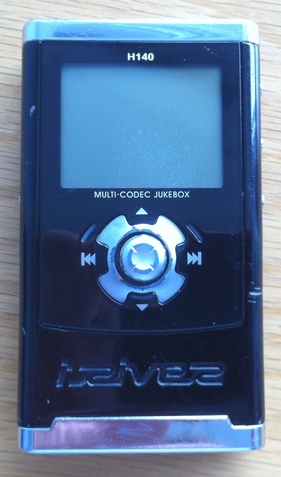
the iRiver music player
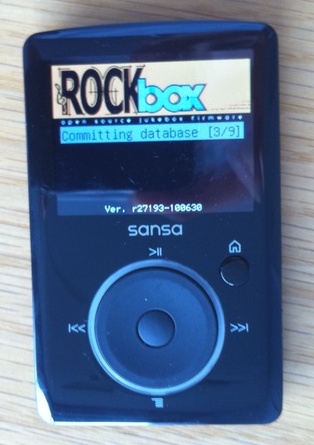
About six years ago, I spent a chunk of my very first salary on a portable music player, the iRiver H140, a relatively bulky and large hard-disk based player, with a capacity of 40G. Uniquely for music players before or since, the iRiver features both digital and analogue line ins and outs. It also has (more common) recording facilities and an FM tuner, the latter of which I used a great deal (and rules out just about all the iPods). This remarkable player has lasted nearly six years of moderate daily use. For the majority of that time, I've ran the rockbox open source firmware on the player, which has provided me with really wide codec support and excellent recording facilities. In the last month I finally had to replace the iRiver. I bought a Sansa Fuze player, featuring 8G of flash storage and a microsd expansion slot. The Fuze is also capable of running rockbox. This year, 32G microsd cards have arrived. Adding one of those brings the capacity of the new player right back up to 40G. For those who are curious: yes, a Sandisk 32G microsd does work in the Fuze, at least with rockbox, for playback. At the moment, rockbox cannot write to storage on the Fuze, so you need to either use the original firmware or an external reader/writer to manipulate the contents of the microsd. However, I am not sure how well the original firmware can handle the 32G. Whenever I boot it, I see a "refreshing your media" message which lasts longer than my patience. I will write an update once I've established further the degree of support.
the fuze player
I kept a canonical copy of my music library on a desktop computer and used rsync to keep the iRiver up-to-date. I can use almost exactly the same procedure for the new player (with some small changes to cope with the split-storage) I now have a 40G player running rockbox exactly as I had before, albeit at a fraction of the size and weight (and cost: approximately half as expensive), and with a nicer display including colours, album art, etc. They both can even play doom (although the controls are even more awkward than iPhone Doom).

18 November 2010

John Goerzen: The TSA: Stupid, Owned, or Complicit?

I have long been in Bruce Schneier s camp, thinking that the TSA is a joke: nothing but security theater. A few recent examples come to mind: I don t get it. They have been completely reactionary since they began. They have a complete failure of institutional imagination. Something happens, and then a new rule comes out to prevent the thing that everybody is now expecting. And what happens about the thing that people aren t expecting yet? Nothing. So we now have to take off our shoes because one guy tried to use them for something nefarious. OK, fine, but the next guy is probably going to try something other than shoes. Which is why, I m sure, many people are pointing out that the TSA is over-reliant on technology and device detection and completely underemphasizing evildoer detection as, we are repeatedly reminded, the Israelis excel at. The TSA s attempt to remedy that was foolish at best, and, according to a recent report, not grounded in science. Which is why I am heartened that, almost a decade after 9/11, Americans are starting to let go of their fear and be ready to reclaim some sense of intelligence at the security line. The fact that politicians think there is something to be gained by being tough on TSA s invasive screening procedures, rather than risk looking soft on terrorism, is evidence of this. So, what I haven t yet worked out is this: What gives, TSA? Are they: (Note: this criticism is directed mostly at the upper levels of TSA management; I do not believe the people most of us see have the ability to change the system, even if they wanted to.) One final word: I also get annoyed at all the people that grouse at the TSA checking 80-year-olds as thoroughly as everyone else. An 80-year-old could be wearing a hidden device just as much as anyone else could, and if we don t check them, then someday they probably will. The key is to be smart about who we check carefully. Use data, behavioral analysis, simple questioning, etc it works, and is a lot better than exempting people under 13 and over 80 from screening on arbitrary grounds. Also, it might help anyone with a blurry groin. And it might just save a bunch of us from getting cancer.

14 November 2010

Marco d'Itri: Other people's ethics and tastes

In the last years I noticed a growing trend of people pushing for "new" rules about what is appropriate or not for single developers or for the project as a whole. In too many cases even just considering these ideas to be an obvious fact... I prefer to not give specific examples because these would divert the attention from the main topic and would be affected by my own biases. At this point I believe it is useful to remember that all ethical issues which are not explicitly covered by the Social Contract are just the developers' own opinions. It may even be a good idea, but other developers are not and should not be compelled to agree with it no matter how good or important you believe it is. You are entitled to having your own ethics and even ranting about it on Planet Debian, but I am entitled to not caring at all without this making me a worse Debian Developer. Let's try to be grown ups and not be excessively annoyed by other people's choices. This is why I want to convey this simple message to the people who keep preaching about what is proper for me or for Debian: please fuck you. If I want to receive lectures about what is right or wrong then I surely know where I can find a priest. For some reason, now I see fit to mention that I have an Amazon wishlist...

10 November 2010

Cyril Brulebois: XServer 1.9

State of X in experimental What happened since last month? The video drivers we were previously lacking were built against X Server 1.9, with a tiny exception: xserver-xorg-video-nouveau. This one is particularly annoying because the ABI is not stable, and it requires a particular version of the kernel to be usable. The same seems to happen with the nouveau part of the libdrm library. As a consequence, I ve demoted it from Depends to Recommends for the xserver-xorg-video-all metapackage. The same happened to the xserver-xorg-input-wacom driver (for the xserver-xorg-input-all metapackage this time), since it isn t maintained by debian-x@, and since it didn t look too bad to have it only recommended (after all, we re only targeting experimental right now). In addition, all drivers were updated to the last upstream releases. Bottom-line, the following is now possible on (at least) both amd64 and i386 architectures:
apt-get install -t experimental xserver-xorg
As a side note: Intel users probably want to upgrade their libdrm-intel1 package to 2.4.22-2 (in experimental as well), they could run into X.Org Bug #31443 otherwise. Dependency handling for X packages in Debian Previously, dependencies were quite fun: So what did we do to ensure the server and drivers were all using the same ABI? When the server was updated to a new ABI, one had to add the previous virtual packages to Conflicts (and keep a list of all of them, yay!). Needless to say, asking a package manager to upgrade at a same time many packages (several dozens for all drivers) declaring conflicts, especially during a mass dist-upgrade from a stable release to the next stable was no fun. So what s the current situation now? So one might think everything is now fine, except there are some conflicts still declared, to ensure one can transition from packages using the former (bad) logic to the new state of affairs. And those conflicts were still causing headaches to package managers. Fortunately, David Kalnischkies came up with a proposal to replace Conflicts with Breaks, which turned out to ease things. Yatta! All of that is implemented in experimental. squeeze is the transition period where the metapackage stills the depends on xserver-xorg- input,video -$ABI virtual packages, but where drivers now depend on the appropriate server ABI. (Thanks to Alexander Kurtz for his feedback.)

8 November 2010

Cyril Brulebois: Debugging using netconsole

Now that we have KMS, it happens things go bad enough that when X goes down, one can no longer access any console to see what happened. Mainly, one can distinguish between two cases. I m going to discuss the second case. There s a nice tool in the kernel which makes it possible to send kernel logs over the network. It s called netconsole. As far as limitations are concerned, one shall note that it s UDP only, and over Ethernet (in other words: no wireless). The good news is that it can usually make the last crucial lines available. Let s call the crashy machine a patient and the logging machine a doctor. One should keep in mind that if something goes wrong while configuring the netconsole module, it can be unloaded at anytime through:
sudo modprobe -r netconsole
Easy case: on a local network Local network Here s an example: Patient s IP is 192.168.0.1, doctor's IP is 192.168.0.2. Doctor setup What one needs on the receiving side: only netcat. A tiny warning, there are several implementations. Here s the appropriate syntax:
# netcat-traditional:
nc -l -u -p 6666   tee ~/netconsole.log
# netcat-openbsd:
nc -l -u 6666   tee ~/netconsole.log
The nc command is handled through the alternatives system, one can use update-alternative --config nc to pick the appropriate one if several netcat-* packages are installed. To list the current one, an easy way is readlink -f $(which nc). Using tee means that incoming messages are going to be printed, both to the standard output and to the specified file. Running as non-privileged user is sufficient. Patient setup Now, to have the patient send stuff to the doctor, a simple modprobe is needed:
sudo modprobe netconsole netconsole=@/,6666@192.168.0.2/
What happens here? One requests the netconsole module to be loaded, and one specifies the parameters. Details can be read in the Linux kernel documentation (Documentation/networking/netconsole.txt), but concentrating on the points of interest here: That s all! On the doctor side, one should see something along those lines:
[2920549.188090] console [netcon0] enabled
[2920549.188102] netconsole: network logging started
Slightly harder case: over internet Over internet Because one might not have a second machine handy, it s also possible to go through a router and send stuff across the internet. Here s an example: Patient s IP is 192.168.0.1, connecting to internet through a router, which IP is 192.168.0.254. The doctor, available over the internet, is 192.0.32.10. Doctor setup Exactly the same as in the previous case. The main issue one can run into is firewalls at this point. That s why one may want to switch from the default 6666 port to another one which wouldn t be filtered. One can think of 53 (DNS), but that means running nc as root since it s a privileged port (below 1024). Patient setup Routing is also possible, but that requires an extra parameter: the MAC address of the router. To obtain it, one can use the arp command:
/usr/sbin/arp 192.168.0.254
Supposing it returned the 01:02:03:04:05:06 address, loading the module becomes:
sudo modprobe netconsole netconsole=@/,6666@192.0.32.10/01:02:03:04:05:06
Now, if you re running into firewall-related issues, you can change the source for the UDP packets. The default is 6665, but assuming you want to send from an unfiltered 1234 port, that becomes:
sudo modprobe netconsole netconsole=1234@/,6666@192.0.32.10/01:02:03:04:05:06

Gerfried Fuchs: Unheilig

On 24th of October we've been to the concert of Unheilig. It was actually very touching, even though the sound quality of the venue was disappointing. Here are the common three songs that I usually share about bands that I like to introduce you to: I am aware that these songs are all pretty emotional and rather quiet. Unheilig has also a much harder side to them. It's just that my current mood is pretty emotional, that's also the reason for this selection.

/music permanent link Comments: 0

Rapha&#235;l Hertzog: 5 reasons why a Debian package is more than a simple file archive

Folder with gearsYou re probably manipulating Debian packages everyday, but do you know what those files are? This article will show you their bowels Surely they are more than file archives otherwise we would just use TAR archives (you know those files ending with .tar.gz). Let s have a look! 1. It s two TAR file archives in an AR file archive! A .deb file is actually an archive using the AR format, you can manipulate it with the ar command. This archive contains 3 files, you can check it yourself, download any .deb file and run ar t on it:
$ ar t gwibber_2.31.91-1_all.deb
debian-binary
control.tar.gz
data.tar.gz
debian-binary is a text file indicating the version of the format of the .deb file, the current version is 2.0 .
$ ar p gwibber_2.31.91-1_all.deb debian-binary
2.0
data.tar.gz contains the real files of the package, the content of that archive gets installed in your root directory when you run dpkg --unpack . But the most interesting part which truly makes .deb files more than a file archive is the last file. control.tar.gz contains meta-information used by the package manager. What are they?
$ ar p gwibber_2.31.91-1_all.deb control.tar.gz   tar tzf -
./
./postinst
./prerm
./preinst
./postrm
./conffiles
./md5sums
./control
2. It contains meta-information defining the package and its relationships The control file within the control.tar.gz archive is the most fundamental file. It contains basic information about the package like its name, its version, its description, the architecture it runs on, who is maintaining it and so on. It also contains dependency fields so that the package manager can ensure that everything needed by the package is installed before-hand. If you want to learn more about those fields, you can check Binary control files in the Debian Policy. Those information end up in /var/lib/dpkg/status once the package is installed. 3. It contains maintainer scripts so that everything can just work out of the box At various steps of the installation/upgrade/removal process, dpkg is executing the maintainer scripts provided by the package: Note that this description is largely simplified. In fact the scripts are executed on many other occasions with different parameters. There s an entire chapter of the Debian Policy dedicated to this topic. But you might find this wiki page easier to grasp: http://wiki.debian.org/MaintainerScripts. While this looks scary, it s a very important feature. It s required to cope with non-backwards compatible upgrades, to provide automatic configuration, to create system users on the fly, etc. 4. Configuration files are special files Unpacking a file archive overwrites the previous version of the files. This is the desired behavior when you upgrade a package, except for configuration files. You prefer not to loose your customizations, don t you? That s why packages can list configuration files in the conffiles file provided by control.tar.gz. That way dpkg will deal with them in a special way. 5. You can always add new meta-information And in fact many tools already exploit the possibility to provide supplementary files in control.tar.gz: Once installed, those files are kept by dpkg in /var/lib/dpkg/info/package.* along with maintainer scripts.
If you want to read more articles like this one, click here to subscribe to my free newsletter. You can also follow me on Identi.ca, Twitter and Facebook.

19 comments Liked this article? Click here. My blog is Flattr-enabled.

7 November 2010

Benjamin Mako Hill: Monopedal Sumo

At LCA in Wellington -- immediately after a trip to Japan where I saw sumo for the first time -- a number of us created a game we called "monopedal sumo." Basically, the rules are those of sumo wrestling. Push your opponent either down or out of a ring before they do so to you. Unlike normal sumo, in our game you do so standing only one one leg. If your second leg touches the ground. That also counts as a loss. It's surprisingly entertaining. Try it!

Thorsten Glaser: Sorry for accidentally spamming ~60 people/lists

When doing porter uploads, one must not forget to pass -m"My Name <my@email.addr>" to dpkg-buildpackage, e.g. with --debbuildopts for cowbuilder. Thanks Aur lien and sorry to everyone who got the upload mails. (How are the rules for sponsored uploads? I get conflicting info on these, and indeed, the one I sponsored never showed up on my QA DDPO page )

6 November 2010

Russell Coker: Unparliamentary Language and Free Software

I ve just read the Wikipedia page about Unparliamentary Language [1]. I recommend that everyone read it, if only for the amusement value, among other things it links to incidents where elected representatives acted in a way that would be expected of primary school children. The general concept of having rules about Unparliamentary Language is that MPs are permitted to say anything in Parliament without the risk of being sued or prosecuted, but certain things are inappropriate the most common example is directly accusing another MP of lying. One of the main aims of rules against Unparliamentary Language is to prevent attacks on the honor of another member. Having just witnessed a mailing list discussion go widely off track when a free software project was denigrated, it seems to me that we could do with some similar guidelines for mailing list discussions. The aim would be not to just prevent excessive attacks on the honor of other members but to also protect the honor of the free software projects. So for example one might recommend not using a particular program because of design decisions which seem dubious or a bad security history, but saying it s crap would be considered to be inappropriate. Not that rejecting a program based on design decisions or a history of security flaws would be uncontroversial, but at least that gives objective issues to discuss so if there is a debate it will educate some of the lurkers. Note that I m not claiming to be better than other people in this regard, I ve described software as crap on more than a few occasions. But I will try to avoid such things in future. Finally does anyone have a good suggestion for a Free Software equivalent to the term Unparliamentary Language ? It seems that to a large extent the support of certain ideas depends on having a catchy name and I can t think of one.

5 November 2010

Craig Small: Book: Surface Detail

Oh yes, another Iain M. Banks story is out and I had to read it right away. I wasn't disappointed either.

It's another one of his Sci Fi books in the world, or worlds of The Culture. I wasn't disappointed and it was interesting to see him flesh out more of his universe in this book. Like a lot of his books, there are several sub-threads within the main story with no real obvious connection between them all.

Transferring your "mind state" from the grey mushy stuff you have in your head into a computer isn't new in this series. Even the concept of the dead "living" in a computer is not that unique. What has been introduced is the "hells". A computer simulation of hell where people who go against some societies rules end up if they're bad enough.

Now some civilizations think this is great, it keeps their population on the straight and narrow. As they know there really is a hell for them if they break whatever rules they have on the planet. Other civilizations think they are abhorrent and want to shut them down.

Hence the "virtual wars" where the two sides fight in simulators, winner gets to keep the hells running or shut them down, depending who you are. But now one side is thinking of taking it outside the simulation, to attacking in "the real".

And this change to "the real" and the political mess that makes is the main story. There are plenty of twists as you'd expect. A lot of decisions made where you're not sure if the "right" thing was done but more importantly it was a very enjoyable read.

One thing, if you are the sort of person who reads the last page first, do not do it on this book! The surprise on the last line was worth it.

4 November 2010

Gintautas Miliauskas: Living a monastic life for 10 days

About a month ago, at the end of August, I finished a 10-day Vipassana meditation course. This was probably one of the more extreme activities I have ever participated in, and it's well worth a blog post. I found out about the course in a ridiculously trivial way, by following a link in a Reddit comment (I wonder if I could track down that comment...). The website referenced by the comment contained (almost) no new-agey mumbo-jumbo and looked legit in general. I also appreciated the fact that this was a relatively serious and intensive course, which should be enough to form a reasonably founded opinion on meditation in general. When learning sporadically, in small bits, it is hard to say whether the material itself is no good, or you just do not understand it yet and need to study more; I was quite skeptical towards the practice, but wanted to give it fair trial. I was quite impressed that there was a course available in Lithuania, a few hours by train from where I live. Finally, the course was free (by tradition Vipassana is taught without monetary compensation). I went ahead and signed up for a standard introductory 10-day course. Vipassana (also called insight meditation) is a meditation technique allegedly coming back from Gautama Buddha himself (well, all the traditions like to claim that origin...). It has been experiencing a renaissance, partly due to an organization set up by a meditation teacher S. N. Goenka which has founded meditation centers all over the world. The essence of Vipassana is a method of teaching your mind to act instead of merely reacting to outside stimuli such as pain, anger of other people or hardships. The technique provided is to monitor your sensations, watch them with equanimity and suspend any reaction, and slowly it sinks in that all things are temporary and you can choose what to react to and how. That's the basic idea; I don't want to go deep into exposition of Vipassana as there is plenty of information about that (also at the same time the information is almost useless because you have to experience it to really understand it). Instead, I will sure some of the more personal remarks and experiences. The course took place in an cottage near Kretinga, housing around 50 people. The living conditions were absolutely great, and this would have been a true holiday if not for the regime and the rules. The day would start very early, at 4 AM (ending at around 9:30 PM), and we'd do about 12 hours of meditation in total inbetween, with occasional breaks, but the most gruesome part is that no communication at all was allowed with anyone except the manager of the camp (and the teacher during a specified time). That gets to you after a few days, but still, there are people around you, so it's bearable; on the other side, the senses (touch, smell) become very acute. The food was taken care of by volunteers (students who have finished the course), and I could say it was quite good actually. The goal, of course, was to keep the environment from interfering with meditation, and I think it was done very well. The presentation of the actual technique also did not disappoint. Each day a new step would be introduced, with the whole day to practice before moving on. Looking back, the pacing worked well. Every day in the evening there were lectures on theory. They were somewhat informative, but also sometimes annoyingly primitive and verbose. The little mistakes, holes in logic and slight doses of mumbo-jumbo almost drove me nuts by the middle of the course, until I learned not to react to them. Despite the shortcomings of presentation, the simplicity and lucidity of the practice and lightness of theoretical baggage really appealed to me. The whole organisation in general gave the impression of complete transparency, with no strings attached, no financial interests in play and no agitation for further involvement. While there are many meditation techniques, I am happy that I've gone with Vipassana in particular for one reason: Vipassana meditation uses no artificial tools to help you concentrate, such as mantras, visualisations, counting, etc. Such methods make concentration much easier, but they also create a dependence on the methods themselves. I appreciate the purity of Vipassana in this regard. Not everything in the practice is roses though. First, a particular worldview supported by Vipassana is presented as "scientific" and supposedly "the right way to live", and if even if you don't agree, "the truth" of Vipassana will become obvious to you with time. This is a distinctive mark of ideologies. The thing that makes everything break is the reincarnation, which is generally assumed as true, even if it's not shoved down the student's throat. Every rationalization of a world view has a "white lie" (usually related to the concept of eternity somehow) at the core, and in this context reincarnation is it. Given what we know now about the relationship between the mind and the body, reincarnation is absolutely ridiculous and completely untenable, and that breaks all "moral" reasoning for practicing meditation as opposed to doing something else. I'm not the first to bring up this problem, there's plenty of material about it online. The second slippery idea is that the concept of "negative happiness" is central in Vipassana, that is: happiness is defined as lack of suffering. This point is not that unreasonable actually, from personal experience I could indeed call the state of non-suffering happiness, but there is definitely something missing when compared to the state of mind when I'm truly, positively happy. Whether you consider that something important or not, it's definitely there. Third, Vipassana suggests that it is only you who is at fault when your inner state is disturbed; the world affects you as much as you let it, and in order to find happiness you should learn to control the "interface" rather than the outside world, which will usually not behave as you want. This may be correct, but sometimes it could just be easier to fix the world rather than change yourself, and I have the suspicion that it this is much more frequently the case in the modern world compared to the pre-modern environment. (This is one of the points which break when reincarnation is rejected, as with reincarnation you have the whole eternity to fix yourself.) While the complaints are serious, they do not mean complete rejection of Vipassana but rather integration among the various other techniques available. The actual meditation technique is still great for gaining and maintaining mental composure, reducing anxiety and improving well-being. Now, if I could only get used to meditating regularly... If you have the chance, I highly recommend you try out an introductory 10-day course. There is little to lose and a lot to gain. And if you do go ahead, I have two hints. First, do not even think about leaving the course before it's over. Any hardships are temporary and will be overcome quickly. Second, use the time with the teacher, those interactions were very helpful to me. Also, given the "noble silence", talking to someone once in a while will not hurt.

1 November 2010

Ben Hutchings: RCBW(eekend) 2010-11-01

Next.

Previous.