Search Results: "ema"

29 March 2020

Enrico Zini: Politics links

How tech's richest plan to save themselves after the apocalypse
politics privilege archive.org
Silicon Valley s elite are hatching plans to escape disaster and when it comes, they ll leave the rest of us behind
Heteronomy refers to action that is influenced by a force outside the individual, in other words the state or condition of being ruled, governed, or under the sway of another, as in a military occupation.
Poster P590CW $9.00 Early Warning Signs Of Fascism Laurence W. Britt wrote about the common signs of fascism in April, 2003, after researching seven fascist regimes: Hitler's Nazi Germany; Mussolini's Italy; Franco's Spain; Salazar's Portugal; Papadopoulos' Greece; Pinochet's Chile; Suharto's Indonesia. Get involved! Text: Early Warning Signs of Fascism Powerful and Continuing Nationalism Disdain For Human Rights Identification of Enemies As a unifying cause Supremacy of the military Rampant Sexism Controlled Mass Media Obsession With National Security
Political and social scientist Stefania Milan writes about social movements, mobilization and organized collective action. On the one hand, interactions and networks achieve more visibility and become a proxy for a collective we . On the other hand: Law enforcement can exercise preemptive monitorin
How new technologies and techniques pioneered by dictators will shape the 2020 election
A regional election offers lessons on combatting the rise of the far right, both across the Continent and in the United States.
The Italian diaspora is the large-scale emigration of Italians from Italy. There are two major Italian diasporas in Italian history. The first diaspora began more or less around 1880, a decade or so after the Unification of Italy (with most leaving after 1880), and ended in the 1920s to early-1940s with the rise of Fascism in Italy. The second diaspora started after the end of World War II and roughly concluded in the 1970s. These together constituted the largest voluntary emigration period in documented history. Between 1880-1980, about 15,000,000 Italians left the country permanently. By 1980, it was estimated that about 25,000,000 Italians were residing outside Italy. A third wave is being reported in present times, due to the socio-economic problems caused by the financial crisis of the early twenty-first century, especially amongst the youth. According to the Public Register of Italian Residents Abroad (AIRE), figures of Italians abroad rose from 3,106,251 in 2006 to 4,636,647 in 2015, growing by 49.3% in just ten years.

Molly de Blanc: Computing Under Quarantine

Under the current climate of lock-ins, self-isolation, shelter-in-place policies, and quarantine, it is becoming evident to more people the integral role computers play in our lives. Students are learning entirely online, those who can are working from home, and our personal relationships are being carried largely by technology like video chats, online games, and group messages. When these things have become our only means of socializing with those outside our homes, we begin to realize how important they are and the inequity inherent to many technologies. Someone was telling me how a neighbor doesn t have a printer, so they are printing off school assignments for their neighbor. People I know are sharing internet connections with people in their buildings, when possible, to help save on costs with people losing jobs. I worry now even more about people who have limited access to home devices or poor internet connections. As we are forced into our homes and are increasingly limited in the resources we have available, we find ourselves potentially unable to easily fill material needs and desires. In my neighborhood, it s hard to find flour. A friend cannot find yeast. A coworker couldn t find eggs. Someone else is without dish soap. Supply chains are not designed to meet with the demand currently being exerted on the system. This problem is mimicked in technology. If your computer breaks, it is much harder to fix it, and you lose a lot more than just a machine you lose your source of connection with the world. If you run out of toner cartridges for your printer and only one particular brand works the risk of losing your printer, and your access to school work, becomes a bigger deal. As an increasing number of things in our homes are wired, networked, and only able to function with a prescribed set of proprietary parts, gaps in supply chains become an even bigger issue. When you cannot use whatever is available, and instead need to wait for the particular thing, you find yourself either hoarding or going without. What happens when you can t get the toothbrush heads for your smart toothbrush due to prioritization and scarcity with online ordering when it s not so easy to just go to the pharmacy and get a regular toothbrush? In response to COVID-19 Adobe is offering no-cost access to some of their services. If people allow themselves to rely on these free services, they end up in a bad situation when a cost is re-attached. Lock-in is always a risk, but when people are desperate, unemployed, and lacking the resources they need to survive, the implications of being trapped in these proprietary systems are much more painful. What worries me even more than this is the reliance on insecure communication apps. Zoom, which is becoming the default service in many fields right now, offers anti-features like attendee attention tracking and user reporting. We are now being required to use technologies designed to maximize opportunities for surveillance to learn, work, and socialize. This is worrisome to me for two main reasons: the violation of privacy and the normalization of a surveillance state. It is a violation of privacy, to have our actions tracked. It also gets us used to being watched, which is dangerous as we look towards the future.

28 March 2020

Dirk Eddelbuettel: RProtoBuf 0.4.17: Robustified

A new release 0.4.17 of RProtoBuf is now on CRAN. RProtoBuf provides R with bindings for the Google Protocol Buffers ( ProtoBuf ) data encoding and serialization library used and released by Google, and deployed very widely in numerous projects as a language and operating-system agnostic protocol. This release contains small polishes related to the release 0.4.16 which added JSON support for messages, and switched to ByteSizeLong. This release now makes sure JSON functionality is only tested where available (on version 3 of the Protocol Buffers library), and that ByteSizeLong is only called where available (version 3.6.0 or later). Of course, older versions build as before and remain fully supported.

Changes in RProtoBuf version 0.4.17 (2020-03-xx)
  • Condition use of ByteSizeLong() on building with ProtoBuf 3.6.0 or later (Dirk in #71 fixing #70).
  • The JSON unit tests are skipped if ProtoBuf 2.* is used (Dirk, also #71).
  • The configure script now extracts the version from the DESCRIPTION file ( (Dirk, also #71).

CRANberries provides the usual diff to the previous release. The RProtoBuf page has copies of the (older) package vignette, the quick overview vignette, and the pre-print of our JSS paper. Questions, comments etc should go to the GitHub issue tracker off the GitHub repo. If you like this or other open-source work I do, you can now sponsor me at GitHub. For the first year, GitHub will match your contributions.

This post by Dirk Eddelbuettel originated on his Thinking inside the box blog. Please report excessive re-aggregation in third-party for-profit settings.

25 March 2020

Raphaël Hertzog: Freexian s report about Debian Long Term Support, February 2020

A Debian LTS logo Like each month, here comes a report about the work of paid contributors to Debian LTS. Individual reports In February, 226 work hours have been dispatched among 14 paid contributors. Their reports are available: Evolution of the situation February began as rather calm month and the fact that more contributors have given back unused hours is an indicator of this calmness and also an indicator that contributing to LTS has become more of a routine now, which is good. In the second half of February Holger Levsen (from LTS) and Salvatore Bonaccorso (from the Debian Security Team) met at SnowCamp in Italy and discussed tensions and possible improvements from and for Debian LTS. The security tracker currently lists 25 packages with a known CVE and the dla-needed.txt file has 21 packages needing an update. Thanks to our sponsors New sponsors are in bold.

No comment Liked this article? Click here. My blog is Flattr-enabled.

24 March 2020

Anisa Kuci: Outreachy post 5 - Final report

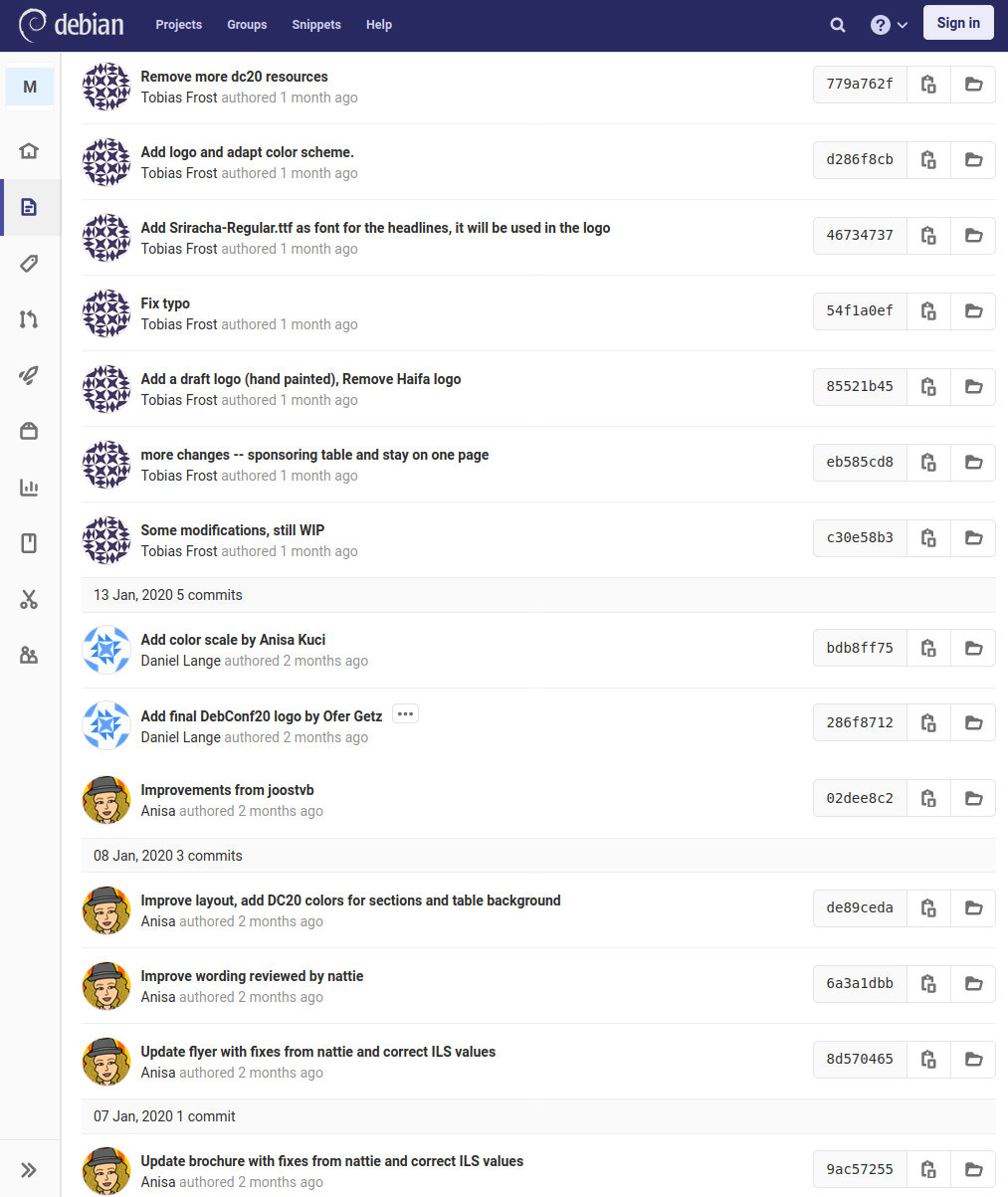
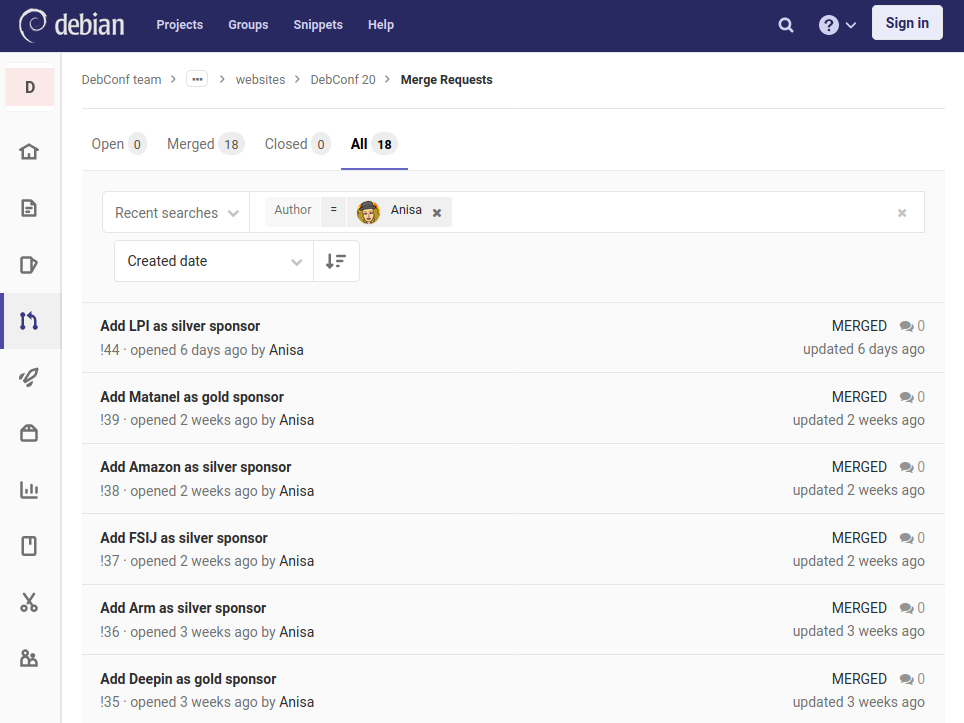
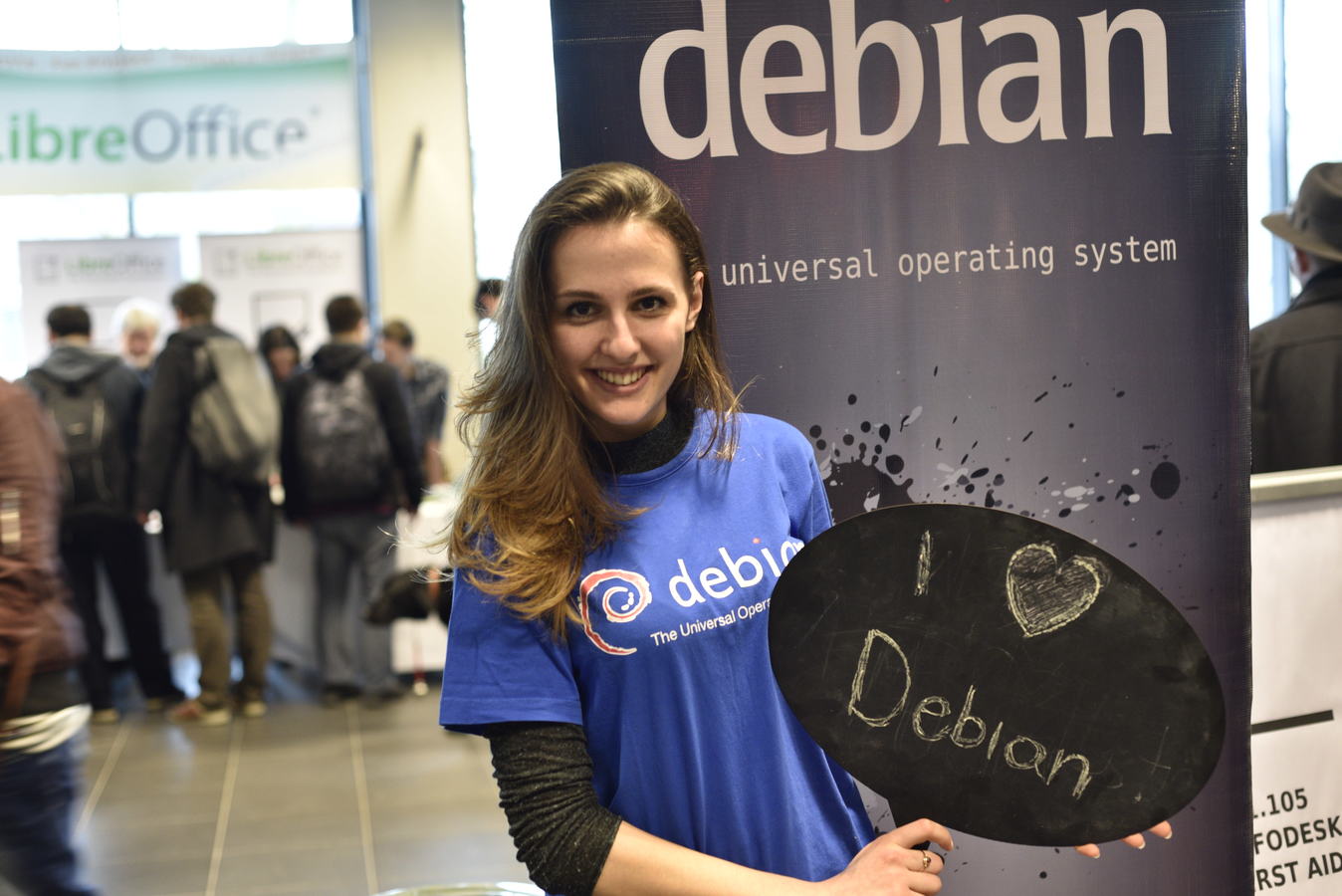
This is my last Outreachy blogpost, as my internship unfortunately has come to an end. It was a blast! Through the Outreachy internship I gained a lot of valuable knowledge and even though I dont know what the future will bring, I am more confident about myself, my skills in fundraising and my technical abilities now. During the contribution phase I did quite a lot of research so I could come up with relevant information to add on the Debian wiki as part of the contribution phase tasks. This was helpful for me to build a more deep understanding of the Debian project, the DebConf conferences and the general style of working within Debian. During this phase I completed most of the tasks given and got onto the mailing lists and IRC channels which are public. This was quite an intense experience by itself as it was like digging into a new job but in a competitive situation as other applicants, of course, were also putting in their best to get one of the 50 Outreachy internships (two in Debian) that were available. When I got selected I also got access to the sponsors@debconf.org email address and the private git repos as they would be needed for me to work on fundraising. I was also provided with an @debconf.org email address that is the one I use for sponsors communication. I learned what makes communication look professional and how to think of the recipient when formulating emails, sending replies or creating marketing messages. As the internship continued I started to learn how the DebConf organizing structure works, with a particular attention on the fundraising team. I have also quickly been given the responsibility to reach out to 100 potential sponsors and combine learning and working experience very nicely. I was given responsibility of working on the fundraising material (flyer and brochure) for DebConf20, so using LaTeX I updated the files in order to remove the translation system, I added the Israeli currency and the visual design chosen from a public logo proposal contest that is held for each DebConf. My creative side could also be put to good use as the team trusted me with selecting the images for the brochure and making sure that the usage rights granted and attribution are all compliant to Free Software/Creative Commons licences. I have continuously maintained those materials and was very happy that long term team members even asked me to approve changes they proposed on the fundraising material. The MiniDebConf team for Regensburg have taken the files I created and made them into their fundraising material (brochure, flyer) which is great to see. MiniDebConf Regensburg commits I have profited so much from other people s work, so I am very happy if community members can build on mine. Afterall sharing is caring! Through the Outreachy travel stipend I was able to attend FOSDEM 2020 and besides meeting many friends from the community and having a fundraising meeting with a sponsor, I was able to also support distributing the DebConf20 fundraising material both in electronic form and as printed versions. During the Outreachy internship I did two communication waves to potential sponsors and maintained the daily communication with them. I followed the documentation that was already available in the Debian wiki guiding me through the process of invoicing sponsors through the organizations that Debian collaborates with. As I have been in frequent contact with the sponsors, I have continuously updated the DebConf20 website with sponsor logos and links through git files, improving web pages on the wafer system and doing 18 merge requests in total. DebConf20 website merge requests I completed six email templates for the DebConf sponsor communication campaigns. While two of them have already been very useful, I hope my other proposals will be the ones used for the next waves of sponsors contacting. I committed them to the sponsors git repo so they can be easily accessible and well documented for other DebConf teams or can be recycled for smaller Debian events. Unfortunately, due to the insecurity about travel around the Corona virus pandemic, the third wave of communication, originally scheduled for the end of my internship in March, has been held. I have committed to the team to do this once the travel restrictions have been lifted and we know that DebConf20 can proceed as planned for August 2020. So yeah, I am definitely going to stay around and continue to help with DebConf fundraising! DebConf has been held for two decades and it also has a generic website, so I also updated the static sponsors page on the main website as it is the first landing page for everyone especially for people who are not necessarily insiders in Debian or DebConf. I have completed a Python tutorial, got the general understanding of the programming language and made some smaller contributions to improve existing tools in the fundraising team based on the learning. The internship was also focused on documentation, so during the whole internship I have kept notes in order to be able to improve existing documentation and I have also written new material, especially on the tasks that I have been working on more closely: Every DebConf has a new team every year, in a new country, so I hope this documentation I have worked on will be useful as a jump-starter for them to organize and finance their events. I would like to take a moment to thank again my mentors Daniel and Karina for all their support, it has been great working with them. Having them as an example, I have learned a lot. Also warm thanks to the DebConf global and local teams which have been very welcoming and always supportive during my internship. So, as you might already know, if you have read my other Outreachy blog posts, this has been a great experience for me! Outreachy provides an awesome opportunity that would not be available if it was not for the generous sponsors and volunteers making such a program for people from underrepresented groups in the FLOSS community. I really encourage people from these groups to find the confidence within themselves and apply for Outreachy! I love Debian
Russ Allbery: Review: Lost in Math

Review: Lost in Math, by Sabine Hossenfelder
Publisher: Basic
Copyright: June 2018
ISBN: 0-465-09426-0
Format: Kindle
Pages: 248
Listening to experts argue can be one of the better ways to learn about a new field. It does require some basic orientation and grounding or can be confusing or, worse, wildly misleading, so some advance research or Internet searches are warranted. But it provides some interesting advantages over reading multiple popular introductions to a field. First, experts arguing with each other are more precise about their points of agreement and disagreement because they're trying to persuade someone who is well-informed. The points of agreement are often more informative than the points of disagreement, since they can provide a feel for what is uncontroversial among experts in the field. Second, internal arguments tend to be less starry-eyed. One of the purposes of popularizations of a field is to get the reader excited about it, and that can be fun to read. But to generate that excitement, the author has a tendency to smooth over disagreements and play up exciting but unproven ideas. Expert disagreements pull the cover off of the uncertainty and highlight the boundaries of what we know and how we know it. Lost in Math (subtitled How Beauty Leads Physics Astray) is not quite an argument between experts. That's hard to find in book form; most of the arguments in the scientific world happen in academic papers, and I rarely have the energy or attention span to read those. But it comes close. Hossenfelder is questioning the foundations of modern particle physics for the general public, but also for her fellow scientists. High-energy particle physics is facing a tricky challenge. We have a solid theory (the standard model) which explains nearly everything that we have currently observed. The remaining gaps are primarily at very large scales (dark matter and dark energy) or near phenomena that are extremely difficult to study (black holes). For everything else, the standard model predicts our subatomic world to an exceptionally high degree of accuracy. But physicists don't like the theory. The details of why are much of the topic of this book, but the short version is that the theory does not seem either elegant or beautiful. It relies on a large number of measured constants that seem to have no underlying explanation, which is contrary to a core aesthetic principle that physicists use to judge new theories. Accompanying this problem is another: New experiments in particle physics that may be able to confirm or disprove alternate theories that go beyond the standard model are exceptionally expensive. All of the easy experiments have been done. Building equipment that can probe beyond the standard model is incredibly expensive, and thus only a few of those experiments have been done. This leads to two issues: Particle physics has an overgrowth of theories (such as string theory) that are largely untethered from experiments and are not being tested and validated or disproved, and spending on new experiments is guided primarily by a sense of scientific aesthetics that may simply be incorrect. Enter Lost in Math. Hossenfelder's book picks up a thread of skepticism about string theory (and, in Hossenfelder's case, supersymmetry as well) that I previously read in Lee Smolin's The Trouble with Physics. But while Smolin's critique was primarily within the standard aesthetic and epistemological framework of particle physics, Hossenfelder is questioning that framework directly. Why should nature be beautiful? Why should constants be small? What if the universe does have a large number of free constants? And is the dislike of an extremely reliable theory on aesthetic grounds a good basis for guiding which experiments we fund?
Do you recall the temple of science, in which the foundations of physics are the bottommost level, and we try to break through to deeper understanding? As I've come to the end of my travels, I worry that the cracks we're seeing in the floor aren't really cracks at all but merely intricate patterns. We're digging in the wrong places.
Lost in Math will teach you a bit less about physics than Smolin's book, although there is some of that here. Smolin's book was about two-thirds physics and one-third sociology of science. Lost in Math is about two-thirds sociology and one-third physics. But that sociology is engrossing. It's obvious in retrospect, but I hadn't thought before about the practical effects of running out of unexplained data on a theoretical field, or about the transition from more data than we can explain to having to spend billions of dollars to acquire new data. And Hossenfelder takes direct aim at the human tendency to find aesthetically appealing patterns and unified explanations, and scores some palpable hits.
I went into physics because I don't understand human behavior. I went into physics because math tells it how it is. I liked the cleanliness, the unambiguous machinery, the command math has over nature. Two decades later, what prevents me from understanding physics is that I still don't understand human behavior. "We cannot give exact mathematical rules that define if a theory is attractive or not," says Gian Francesco Giudice. "However, it is surprising how the beauty and elegance of a theory are universally recognized by people from different cultures. When I tell you, 'Look, I have a new paper and my theory is beautiful,' I don't have to tell you the details of my theory; you will get why I'm excited. Right?" I don't get it. That's why I am talking to him. Why should the laws of nature care what I find beautiful? Such a connection between me and the universe seems very mystical, very romantic, very not me. But then Gian doesn't think that nature cares what I find beautiful, but what he finds beautiful.
The structure of this book is half tour of how physics judges which theories are worthy of investigation and half personal quest to decide whether physics has lost contact with reality. Hossenfelder approaches this second thread with multiple interviews of famous scientists in the field. She probes at their bases for preferring one theory over another, at how objective those preferences can or should be, and what it means for physics if they're wrong (as increasingly appears to be the case for supersymmetry). In so doing, she humanizes theory development in a way that I found fascinating. The drawback to reading about ongoing arguments is the lack of a conclusion. Lost in Math, unsurprisingly, does not provide an epiphany about the future direction of high-energy particle physics. Its conclusion, to the extent that it has one, is a plea to find a way to put particle physics back on firmer experimental footing and to avoid cognitive biases in theory development. Given the cost of experiments and the nature of humans, this is challenging. But I enjoyed reading this questioning, contrarian take, and I think it's valuable for understanding the limits, biases, and distortions at the edge of new theory development. Rating: 7 out of 10

23 March 2020

Bits from Debian: New Debian Developers and Maintainers (January and February 2020)

The following contributors got their Debian Developer accounts in the last two months: The following contributors were added as Debian Maintainers in the last two months: Congratulations!

Gunnar Wolf: Made in what?

Say What? Just bought a 5-pack of 64GB USB keys. Am about to test them to ensure their actual capacity. And the label is Actually true! For basically anything we are likely to encounter, specially in electronics. But still, it demands a photo before opening. How come I ve never come across anything like this before? :-] update Of course, just opening the package yielded this much more traditional (and much more permanent) piece of information:

Dima Kogan: org-babel for documentation

So I just gave a talk at SCaLE 18x about numpysane and gnuplotlib, two libraries I wrote to make using numpy bearable. With these two, it's actually quite nice! Prior to the talk I overhauled the documentation for both these projects. The gnuplotlib docs now have a tutorial/gallery page, which is interesting-enough to write about. Check it out! Mostly it is a sequence of Clearly you want the plots in the documentation to correspond to the code, so you want something to actually run each code snippet to produce each plot. Automatically. I don't want to maintain these manually, and periodically discover that the code doesn't make the plot I claim it does or worse: that the code barfs. This is vaguely what Jupyter notebooks do, but they're ridiculous, so I'm doing something better: That's it. The git repo is hosted by github, which has a rudimentary renderer for .org documents. I'm committing the .svg files, so that's enough to get rendered documentation that looks nice. Note that the usual workflow is to use org to export to html, but here I'm outsourcing that job to github; I just make the .svg files, and that's enough. Look at the link again: gnuplotlib tutorial/gallery. This is just a .org file committed to the git repo. github is doing its normal org->html thing to display this file. This has drawbacks too: github is ignoring the :noexport: tag on the init section at the end of the file, so it's actually showing all the emacs lisp goop that makes this work (described below!). It's at the end, so I guess this is good-enough. Those of us that use org-mode would be completely unsurprised to hear that the talk is also written as .org document. And the slides that show gnuplotlib plots use the same org-babel system to render the plots. It's all oh-so-nice. As with anything as flexible as org-babel, it's easy to get into a situation where you're bending it to serve a not-quite-intended purpose. But since this all lives in emacs, you can make it do whatever you want with a bit of emacs lisp. I ended up advising a few things (mailing list post here). And I stumbled on an (arguable) bug in emacs that needed working around (mailing list post here). I'll summarize both here.

Handling large Local Variables blocks
The advises I ended up with ended up longer than emacs expected, which made emacs not evaluate them when loading the buffer. As I discovered (see the mailing list post) the loading code looks for the string Local Variables in the last 3000 bytes of the buffer only, and I exceeded that. Stefan Monnier suggested a workaround in this post. Instead of the normal Local Variables block at the end:
Local Variables:
eval: (progn ... ...
             ... ...
             LONG chunk of emacs-lisp
      )
End:
I do this:
(progn ;;local-config
   lisp lisp lisp
   as long as I want
)
Local Variables:
eval: (progn (re-search-backward "^(progn ;;local-config") (eval (read (current-buffer))))
End:
So emacs sees a small chunk of code that searches backwards through the buffer (as far back as needed) for the real lisp to evaluate. As an aside, this blog is also an .org document, and the lisp snippets above are org-babel blocks that I'm not evaluating. The exporter knows to respect the emacs-lisp syntax highlighting, however.

Advises
OK, so what was all the stuff I needed to tell org-babel to do specially here? First off, org needed to be able to communicate to the Python session the name of the file to write the plot to. I do this by making the whole plist for this org-babel snippet available to python:
;; THIS advice makes all the org-babel parameters available to python in the
;; _org_babel_params dict. I care about _org_babel_params['_file'] specifically,
;; but everything is available
(defun dima-org-babel-python-var-to-python (var)
  "Convert an elisp value to a python variable.
  Like the original, but supports (a . b) cells and symbols
"
  (if (listp var)
      (if (listp (cdr var))
          (concat "[" (mapconcat #'org-babel-python-var-to-python var ", ") "]")
        (format "\"\"\"%s\"\"\"" var))
    (if (symbolp var)
        (format "\"\"\"%s\"\"\"" var)
      (if (eq var 'hline)
          org-babel-python-hline-to
        (format
         (if (and (stringp var) (string-match "[\n\r]" var)) "\"\"%S\"\"" "%S")
         (if (stringp var) (substring-no-properties var) var))))))
(defun dima-alist-to-python-dict (alist)
  "Generates a string defining a python dict from the given alist"
  (let ((keyvalue-list
         (mapcar (lambda (x)
                   (format "%s = %s, "
                           (replace-regexp-in-string
                            "[^a-zA-Z0-9_]" "_"
                            (symbol-name (car x)))
                           (dima-org-babel-python-var-to-python (cdr x))))
                 alist)))
    (concat
     "dict( "
     (apply 'concat keyvalue-list)
     ")")))
(defun dima-org-babel-python-pass-all-params (f params)
  (cons
   (concat
    "_org_babel_params = "
    (dima-alist-to-python-dict params))
   (funcall f params)))
(unless
    (advice-member-p
     #'dima-org-babel-python-pass-all-params
     #'org-babel-variable-assignments:python)
  (advice-add
   #'org-babel-variable-assignments:python
   :around #'dima-org-babel-python-pass-all-params))
So if there's a :file plist key, the python code can grab that, and write the plot to that filename. But I don't really want to specify an output file for every single org-babel snippet. All I really care about is that each plot gets a unique filename. So I omit the :file key entirely, and use this advice to generate one for me:
;; This sets a default :file tag, set to a unique filename. I want each demo to
;; produce an image, but I don't care what it is called. I omit the :file tag
;; completely, and this advice takes care of it
(defun dima-org-babel-python-unique-plot-filename
    (f &optional arg info params)
  (funcall f arg info
           (cons (cons ':file
                       (format "guide-%d.svg"
                               (condition-case nil
                                   (setq dima-unique-plot-number (1+ dima-unique-plot-number))
                                 (error (setq dima-unique-plot-number 0)))))
                 params)))
(unless
    (advice-member-p
     #'dima-org-babel-python-unique-plot-filename
     #'org-babel-execute-src-block)
  (advice-add
   #'org-babel-execute-src-block
   :around #'dima-org-babel-python-unique-plot-filename))
This uses the dima-unique-plot-number integer to keep track of each plot. I increment this with each plot. Getting closer. It isn't strictly required, but it'd be nice if each plot had the same output filename each time I generated it. So I want to reset the plot number to 0 each time:
;; If I'm regenerating ALL the plots, I start counting the plots from 0
(defun dima-reset-unique-plot-number
    (&rest args)
    (setq dima-unique-plot-number 0))
(unless
    (advice-member-p
     #'dima-reset-unique-plot-number
     #'org-babel-execute-buffer)
  (advice-add
   #'org-babel-execute-buffer
   :after #'dima-reset-unique-plot-number))
Finally, I want to lie to the user a little bit. The code I'm actually executing writes each plot to an .svg. But the code I'd like the user to see should use the default output: an interactive, graphical window. I do that by tweaking the python session to tell the gnuplotlib object to write to .svg files from org by default, instead of using the graphical terminal:
;; I'm using github to display guide.org, so I'm not using the "normal" org
;; exporter. I want the demo text to not contain the hardcopy= tags, but clearly
;; I need the hardcopy tag when generating the plots. I add some python to
;; override gnuplotlib.plot() to add the hardcopy tag somewhere where the reader
;; won't see it. But where to put this python override code? If I put it into an
;; org-babel block, it will be rendered, and the :export tags will be ignored,
;; since github doesn't respect those (probably). So I put the extra stuff into
;; an advice. Whew.
(defun dima-org-babel-python-set-demo-output (f body params)
  (with-temp-buffer
    (insert body)
    (beginning-of-buffer)
    (when (search-forward "import gnuplotlib as gp" nil t)
      (end-of-line)
      (insert
       "\n"
       "if not hasattr(gp.gnuplotlib, 'orig_init'):\n"
       "    gp.gnuplotlib.orig_init = gp.gnuplotlib.__init__\n"
       "gp.gnuplotlib.__init__ = lambda self, *args, **kwargs: gp.gnuplotlib.orig_init(self, *args, hardcopy=_org_babel_params['_file'] if 'file' in _org_babel_params['_result_params'] else None, **kwargs)\n"))
    (setq body (buffer-substring-no-properties (point-min) (point-max))))
  (funcall f body params))
(unless
    (advice-member-p
     #'dima-org-babel-python-set-demo-output
     #'org-babel-execute:python)
  (advice-add
   #'org-babel-execute:python
   :around #'dima-org-babel-python-set-demo-output))
)
And that's it. The advises in the talk are slightly different, in uninteresting ways. Some of this should be upstreamed to org-babel somehow. Now entirely clear which part, but I'll cross that bridge when I get to it.

22 March 2020

Enrico Zini: Notable people

Lotte Reiniger. The Unsung Heroine of Early Animation
history people wikipedia
Lotte Reiniger pioneered early animation, yet her name remains largely unknown. We pay homage to her life and work, and reflect on why she never received the recognition she deserves.
Stephen Wolfram shares what he learned in researching Ada Lovelace's life, writings about the Analytical Engine, and computation of Bernoulli numbers.
Elizabeth Cochran Seaman[1] (May 5, 1864[2] January 27, 1922), better known by her pen name Nellie Bly, was an American journalist who was widely known for her record-breaking trip around the world in 72 days, in emulation of Jules Verne's fictional character Phileas Fogg, and an expos in which she worked undercover to report on a mental institution from within.[3] She was a pioneer in her field, and launched a new kind of investigative journalism.[4] Bly was also a writer, inventor, and industrialist.
Delia Ann Derbyshire (5 May 1937 3 July 2001)[1] was an English musician and composer of electronic music.[2] She carried out pioneering work with the BBC Radiophonic Workshop during the 1960s, including her electronic arrangement of the theme music to the British science-fiction television series Doctor Who.[3][4] She has been referred to as "the unsung heroine of British electronic music,"[3] having influenced musicians including Aphex Twin, the Chemical Brothers and Paul Hartnoll of Orbital.[5]
Charity Adams Earley (5 December 1918 13 January 2002) was the first African-American woman to be an officer in the Women's Army Auxiliary Corps (later WACS) and was the commanding officer of the first battalion of African-American women to serve overseas during World War II. Adams was the highest ranking African-American woman in the army by the completion of the war.

Emmanuel Kasper: Big Iron UNIX emulated on ARM

I have somewhere in the basement a DEC Vax workstation, but in the end it was a bigger fun to run an emulated Vax 11/780 (size of two refrigerators) in Beagle Bone Black (size of a big matchbox). For this I used the Dockerfiles available in this git repo using the simh emulator, and tweaked a bit for ARM.
I recorded the boot sequence with the very nice asciinema, also available in the Debian archive, so here is 4.3 BSD, in all its 1986 glory.

19 March 2020

John Goerzen: COVID-19 is serious for all ages. Treat it like WWII

Today I d like to post a few updates about COVID-19 which I have gathered from credible sources, as well as some advice also gathered from credible sources. Summary
  1. Coronavirus causes health impacts requiring hospitalization in a significant percentage of all adult age groups.
  2. Coronavirus also can cause no symptoms at all in many, especially children.
  3. Be serious about social distancing.
COVID-19 is serious for young adults too According to this report based on a CDC analysis, between 14% and 20% of people aged 20 to 44 require hospitalization due to COVID-19. That s enough to be taken seriously. See also this CNN story. Act as if you are a carrier because you may be infected and not even know it, even children Information on this is somewhat preliminary, but it is certainly known that a certain set of cases is asymptomatic. This article discusses manifestations in children, while this summary of a summary (note: not original research) suggests that 17.9% of people may not even know they are infected. How serious is this? Serious. This excellent article by Daniel W. Johnson, MD, is a very good read. Among the points it makes: Advice I m going to just copy Dr. Johnson s advice here:
  1. You and your kids should stay home. This includes not going to church, not going to the gym, not going anywhere.
  2. Do not travel for enjoyment until this is done. Do not travel for work unless your work truly requires it.
  3. Avoid groups of people. Not just crowds, groups. Just be around your immediate family. I think kids should just play with siblings at this point no play dates, etc.
  4. When you must leave your home (to get groceries, to go to work), maintain a distance of six feet from people. REALLY stay away from people with a cough or who look sick.
  5. When you do get groceries, etc., buy twice as much as you normally do so that you can go to the store half as often. Use hand sanitizer immediately after your transaction, and immediately after you unload the groceries.
I m not saying people should not go to work. Just don t leave the house for anything unnecessary, and if you can work from home, do it. Everyone on this email, besides Mom and Dad, are at low risk for severe disease if/when they contract COVID-19. While this is great, that is not the main point. When young, well people fail to do social distancing and hygiene, they pick up the virus and transmit it to older people who are at higher risk for critical illness or death. So everyone needs to stay home. Even young people. Tell every person over 60, and every person with significant medical conditions, to avoid being around people. Please do not have your kids visit their grandparents if you can avoid it. FaceTime them. Our nation is the strongest one in the world. We have been through other extreme challenges and succeeded many times before. We WILL return to normal life. Please take these measures now to flatten the curve, so that we can avoid catastrophe.
I d also add that many supermarkets offer delivery or pickup options that allow you to get your groceries without entering the store. Some are also offering to let older people shop an hour before the store opens to the general public. These could help you minimize your exposure. Other helpful links Here is a Reddit megathread with state-specific unemployment resources. Scammers are already trying to prey on people. Here are some important tips to avoid being a victim. Although there are varying opinions, some are recommending avoiding ibuprofen when treating COVID-19. Bill Gates had some useful advice. Here s a summary emphasizing the need for good testing.

18 March 2020

Dirk Eddelbuettel: RcppCCTZ 0.2.7

A new release 0.2.7 of RcppCCTZ is now at CRAN. RcppCCTZ uses Rcpp to bring CCTZ to R. CCTZ is a C++ library for translating between absolute and civil times using the rules of a time zone. In fact, it is two libraries. One for dealing with civil time: human-readable dates and times, and one for converting between between absolute and civil times via time zones. And while CCTZ is made by Google(rs), it is not an official Google product. The RcppCCTZ page has a few usage examples and details. This package was the first CRAN package to use CCTZ; by now at least three others do using copies in their packages which remains less than ideal. This version adds internal extensions, contributed by Leonardo, which support upcoming changes to the nanotime package we are working on.

Changes in version 0.2.7 (2020-03-18)
  • Added functions _RcppCCTZ_convertToCivilSecond that converts a time point to the number of seconds since epoch, and _RcppCCTZ_convertToTimePoint that converts a number of seconds since epoch into a time point; these functions are only callable from C level (Leonardo in #34 and #35).
  • Added function _RcppCCTZ_getOffset that returns the offset at a speficied time-point for a specified timezone; this function is only callable from C level (Leonardo in #32).

We also have a diff to the previous version thanks to CRANberries. More details are at the RcppCCTZ page; code, issue tickets etc at the GitHub repository. If you like this or other open-source work I do, you can now sponsor me at GitHub. For the first year, GitHub will match your contributions.

This post by Dirk Eddelbuettel originated on his Thinking inside the box blog. Please report excessive re-aggregation in third-party for-profit settings.

Antoine Beaupr : How can I trust this git repository?

Join me in the rabbit hole of git repository verification, and how we could improve it.

Problem statement As part of my work on automating install procedures at Tor, I ended up doing things like:
git clone REPO
./REPO/bootstrap.sh
... something eerily similar to the infamous curl pipe bash method which I often decry. As a short-term workaround, I relied on the SHA-1 checksum of the repository to make sure I have the right code, by running this both on a "trusted" (ie. "local") repository and the remote, then visually comparing the output:
$ git show-ref master
9f9a9d70dd1f1e84dec69a12ebc536c1f05aed1c refs/heads/master
One problem with this approach is that SHA-1 is now considered as flawed as MD5 so it can't be used as an authentication mechanism anymore. It's also fundamentally difficult to compare hashes for humans. The other flaw with comparing local and remote checksums is that we assume we trust the local repository. But how can I trust that repository? I can either:
  1. audit all the code present and all the changes done to it after
  2. or trust someone else to do so
The first option here is not practical in most cases. In this specific use case, I have audited the source code -- I'm the author, even -- what I need is to transfer that code over to another server. (Note that I am replacing those procedures with Fabric, which makes this use case moot for now as the trust path narrows to "trust the SSH server" which I already had anyways. But it's still important for my fellow Tor developers who worry about trusting the git server, especially now that we're moving to GitLab.) But anyways, in most cases, I do need to trust some other fellow developer I collaborate with. To do this, I would need to trust the entire chain between me and them:
  1. the git client
  2. the operating system
  3. the hardware
  4. the network (HTTPS and the CA cartel, specifically)
  5. then the hosting provider (and that hardware/software stack)
  6. and then backwards all the way back to that other person's computer
I want to shorten that chain as much as possible, make it "peer to peer", so to speak. Concretely, it would eliminate the hosting provider and the network, as attackers.

OpenPGP verification My first reaction is (perhaps perversely) to "use OpenPGP" for this. I figured that if I sign every commit, then I can just check the latest commit and see if the signature is good. The first problem here is that this is surprisingly hard. Let's pick some arbitrary commit I did recently:
commit b3c538898b0ed4e31da27fc9ca22cb55e1de0000
Author: Antoine Beaupr  <anarcat@debian.org>
Date:   Mon Mar 16 14:37:28 2020 -0400
    fix test autoloading
    pytest only looks for file names matching  test  by default. We inline
    tests inside the source code directly, so hijack that.
diff --git a/fabric_tpa/pytest.ini b/fabric_tpa/pytest.ini
new file mode 100644
index 0000000..71004ea
--- /dev/null
+++ b/fabric_tpa/pytest.ini
@@ -0,0 +1,3 @@
+[pytest]
+# we inline tests directly in the source code
+python_files = *.py
That's the output of git log -p in my local repository. I signed that commit, yet git log is not telling me anything special. To check the signature, I need something special: --show-signature, which looks like this:
commit b3c538898b0ed4e31da27fc9ca22cb55e1de0000
gpg: Signature faite le lun 16 mar 2020 14:37:53 EDT
gpg:                avec la clef RSA 7B164204D096723B019635AB3EA1DDDDB261D97B
gpg: Bonne signature de  Antoine Beaupr  <anarcat@orangeseeds.org>  [ultime]
gpg:                 alias  Antoine Beaupr  <anarcat@torproject.org>  [ultime]
gpg:                 alias  Antoine Beaupr  <anarcat@anarc.at>  [ultime]
gpg:                 alias  Antoine Beaupr  <anarcat@koumbit.org>  [ultime]
gpg:                 alias  Antoine Beaupr  <anarcat@debian.org>  [ultime]
Author: Antoine Beaupr  <anarcat@debian.org>
Date:   Mon Mar 16 14:37:28 2020 -0400
    fix test autoloading
    pytest only looks for file names matching  test  by default. We inline
    tests inside the source code directly, so hijack that.
Can you tell if this is a valid signature? If you speak a little french, maybe you can! But even if you would, you are unlikely to see that output on your own computer. What you would see instead is:
commit b3c538898b0ed4e31da27fc9ca22cb55e1de0000
gpg: Signature made Mon Mar 16 14:37:53 2020 EDT
gpg:                using RSA key 7B164204D096723B019635AB3EA1DDDDB261D97B
gpg: Can't check signature: No public key
Author: Antoine Beaupr  <anarcat@debian.org>
Date:   Mon Mar 16 14:37:28 2020 -0400
    fix test autoloading
    pytest only looks for file names matching  test  by default. We inline
    tests inside the source code directly, so hijack that.
Important part: Can't check signature: No public key. No public key. Because of course you would see that. Why would you have my key lying around, unless you're me. Or, to put it another way, why would that server I'm installing from scratch have a copy of my OpenPGP certificate? Because I'm a Debian developer, my key is actually part of the 800 keys in the debian-keyring package, signed by the APT repositories. So I have a trust path. But that won't work for someone who is not a Debian developer. It will also stop working when my key expires in that repository, as it already has on Debian buster (current stable). So I can't assume I have a trust path there either. One could work with a trusted keyring like we do in the Tor and Debian project, and only work inside that project, that said. But I still feel uncomfortable with those commands. Both git log and git show will happily succeed (return code 0 in the shell) even though the signature verification failed on the commits. Same with git pull and git merge, which will happily push your branch ahead even if the remote has unsigned or badly signed commits. To actually verify commits (or tags), you need the git verify-commit (or git verify-tag) command, which seems to do the right thing:
$ LANG=C.UTF-8 git verify-commit b3c538898b0ed4e31da27fc9ca22cb55e1de0000
gpg: Signature made Mon Mar 16 14:37:53 2020 EDT
gpg:                using RSA key 7B164204D096723B019635AB3EA1DDDDB261D97B
gpg: Can't check signature: No public key
[1]$
At least it fails with some error code (1, above). But it's not flexible: I can't use it to verify that a "trusted" developer (say one that is in a trusted keyring) signed a given commit. Also, it is not clear what a failure means. Is a signature by an expired certificate okay? What if the key is signed by some random key in my personal keyring? Why should that be trusted?

Worrying about git and GnuPG In general, I'm worried about git's implementation of OpenPGP signatures. There has been numerous cases of interoperability problems with GnuPG specifically that led to security, like EFAIL or SigSpoof. It would be surprising if such a vulnerability did not exist in git. Even if git did everything "just right" (which I have myself found impossible to do when writing code that talks with GnuPG), what does it actually verify? The commit's SHA-1 checksum? The tree's checksum? The entire archive as a zip file? I would bet it signs the commit's SHA-1 sum, but I just don't know, on the top of my head, and neither do git-commit or git-verify-commit say exactly what is happening. I had an interesting conversation with a fellow Debian developer (dkg) about this and we had to admit those limitations:
<anarcat> i'd like to integrate pgp signing into tor's coding practices more, but so far, my approach has been "sign commits" and the verify step was "TBD" <dkg> that's the main reason i've been reluctant to sign git commits. i haven't heard anyone offer a better subsequent step. if torproject could outline something useful, then i'd be less averse to the practice. i'm also pretty sad that git remains stuck on sha1, esp. given the recent demonstrations. all the fancy strong signatures you can make in git won't matter if the underlying git repo gets changed out from under the signature due to sha1's weakness
In other words, even if git implements the arcane GnuPG dialect just so, and would allow us to setup the trust chain just right, and would give us meaningful and workable error messages, it still would fail because it's still stuck in SHA-1. There is work underway to fix that, but in February 2020, Jonathan Corbet described that work as being in a "relatively unstable state", which is hardly something I would like to trust to verify code. Also, when you clone a fresh new repository, you might get an entirely different repository, with a different root and set of commits. The concept of "validity" of a commit, in itself, is hard to establish in this case, because an hostile server could put you backwards in time, on a different branch, or even on an entirely different repository. Git will warn you about a different repository root with warning: no common commits but that's easy to miss. And complete branch switches, rebases and resets from upstream are hardly more noticeable: only a tiny plus sign (+) instead of a star (*) will tell you that a reset happened, along with a warning (forced update) on the same line. Miss those and your git history can be compromised.

Possible ways forward I don't consider the current implementation of OpenPGP signatures in git to be sufficient. Maybe, eventually, it will mature away from SHA-1 and the interface will be more reasonable, but I don't see that happening in the short term. So what do we do?

git evtag The git-evtag extension is a replacement for git tag -s. It's not designed to sign commits (it only verifies tags) but at least it uses a stronger algorithm (SHA-512) to checksum the tree, and will include everything in that tree, including blobs. If that sounds expensive to you, don't worry too much: it takes about 5 seconds to tag the Linux kernel, according to the author. Unfortunately, that checksum is then signed with GnuPG, in a manner similar to git itself, in that it exposes GnuPG output (which can be confusing) and is likely similarly vulnerable to mis-implementation of the GnuPG dialect as git itself. It also does not allow you to specify a keyring to verify against, so you need to trust GnuPG to make sense of the garbage that lives in your personal keyring (and, trust me, it doesn't). And besides, git-evtag is fundamentally the same as signed git tags: checksum everything and sign with GnuPG. The difference is it uses SHA-512 instead of SHA-1, but that's something git will eventually fix itself anyways.

kernel patch attestations The kernel also faces this problem. Linus Torvalds signs the releases with GnuPG, but patches fly all over mailing list without any form of verification apart from clear-text email. So Konstantin Ryabitsev has proposed a new protocol to sign git patches which uses SHA256 to checksum the patch metadata, commit message and the patch itself, and then sign that with GnuPG. It's unclear to me what this solves, if anything, at all. As dkg argues, it would seem better to add OpenPGP support to git-send-email and teach git tools to recognize that (e.g. git-am) at least if you're going to keep using OpenPGP anyways. And furthermore, it doesn't resolve the problems associated with verifying a full archive either, as it only attests "patches".

jcat Unhappy with the current state of affairs, the author of fwupd (Richard Hughes) wrote his own protocol as well, called jcat, which provides signed "catalog files" similar to the ones provided in Microsoft windows. It consists of a "gzip-compressed JSON catalog files, which can be used to store GPG, PKCS-7 and SHA-256 checksums for each file". So yes, it is yet again another wrapper to GnuPG, probably with all the flaws detailed above, on top of being a niche implementation, disconnected from git.

The Update Framework One more thing dkg correctly identified is:
<dkg> anarcat: even if you could do exactly what you describe, there are still some interesting wrinkles that i think would be problems for you. the big one: "git repo's latest commits" is a loophole big enough to drive a truck through. if your adversary controls that repo, then they get to decide which commits to include in the repo. (since every git repo is a view into the same git repo, just some have more commits than others)
In other words, unless you have a repository that has frequent commits (either because of activity or by a bot generating fake commits), you have to rely on the central server to decide what "the latest version" is. This is the kind of problems that binary package distribution systems like APT and TUF solve correctly. Unfortunately, those don't apply to source code distribution, at least not in git form: TUF only deals with "repositories" and binary packages, and APT only deals with binary packages and source tarballs. That said, there's actually no reason why git could not support the TUF specification. Maybe TUF could be the solution to ensure end-to-end cryptographic integrity of the source code itself. OpenPGP-signed tarballs are nice, and signed git tags can be useful, but from my experience, a lot of OpenPGP (or, more accurately, GnuPG) derived tools are brittle and do not offer clear guarantees, and definitely not to the level that TUF tries to address. This would require changes on the git servers and clients, but I think it would be worth it.

Other Projects

OpenBSD There are other tools trying to do parts of what GnuPG is doing, for example minisign and OpenBSD's signify. But they do not integrate with git at all right now. Although I did find a hack] to use signify with git, it's kind of gross...

Golang Unsurprisingly, this is a problem everyone is trying to solve. Golang is planning on hosting a notary which would leverage a "certificate-transparency-style tamper-proof log" which would be ran by Google (see the spec for details). But that doesn't resolve the "evil server" attack, if we treat Google as an adversary (and we should).

Python Python had OpenPGP going for a while on PyPI, but it's unclear if it ever did anything at all. Now the plan seems to be to use TUF but my hunch is that the complexity of the specification is keeping that from moving ahead.

Docker Docker and the container ecosystem has, in theory, moved to TUF in the form of Notary, "a project that allows anyone to have trust over arbitrary collections of data". In practice however, in my somewhat limited experience, setting up TUF and image verification in Docker is far from trivial.

Android and iOS Even in what is possibly one of the strongest models (at least in terms of user friendliness), mobile phones are surprisingly unclear about those kind of questions. I had to ask if Android had end-to-end authentication and I am still not clear on the answer. I have no idea of what iOS does.

Conclusion One of the core problems with everything here is the common usability aspect of cryptography, and specifically the usability of verification procedures. We have become pretty good at encryption. The harder part (and a requirement for proper encryption) is verification. It seems that problem still remains unsolved, in terms of usability. Even Signal, widely considered to be a success in terms of adoption and usability, doesn't properly solve that problem, as users regularly ignore "The security number has changed" warnings... So, even though they deserve a lot of credit in other areas, it seems unlikely that hardcore C hackers (e.g. git and kernel developers) will be able to resolve that problem without at least a little bit of help. And TUF seems like the state of the art specification around here, it would seem wise to start adopting it in the git community as well. Update: git 2.26 introduced a new gpg.minTrustLevel to "tell various signature verification codepaths the required minimum trust level", presumably to control how Git will treat keys in your keyrings, assuming the "trust database" is valid and up to date. For an interesting narrative of how "normal" (without PGP) git verification can fail, see also A Git Horror Story: Repository Integrity With Signed Commits.

17 March 2020

Mike Gabriel: Time for home office! Time for X2Go?

Most of us IT people should be in home office by now. If not, make sure you'll arrange that with your employers, cooperation partners, contractors, etc. Please help flatten the curve. X2Go as your Home Office solution If your computer at work runs a GNU/Linux desktop and you can SSH into it, then it might be time for you to try out X2Go [1]. Remote desktop access under GNU/Linux. Free Support for simple Client-Server Setups If your daily work is related to health care, municipal work, medical research, etc. (all those fields that are currently working under very high demands), please join the #x2go IRC channel on Freenode [2] and I'll do my very best to help you with setting up X2Go. Professional Support for Large Scale Setups If you run a business and need X2Go support site-wide, brokerage support, etc. please consider asking for professional support [3]. References

Dirk Eddelbuettel: Rcpp 1.0.4: Lots of goodies

rcpp logo The fourth maintenance release 1.0.4 of Rcpp, following up on the 10th anniversary and the 1.0.0. release sixteen months ago, arrived on CRAN this morning. This follows a few days of gestation at CRAN. To help during the wait we provided this release via drat last Friday. And it followed a pre-release via drat a week earlier. But now that the release is official, Windows and macOS binaries will be built by CRAN over the next few days. The corresponding Debian package will be uploaded as a source package shortly after which binaries can be built. As with the previous releases Rcpp 1.0.1, Rcpp 1.0.2 and Rcpp 1.0.3, we have the predictable and expected four month gap between releases which seems appropriate given both the changes still being made (see below) and the relative stability of Rcpp. It still takes work to release this as we run multiple extensive sets of reverse dependency checks so maybe one day we will switch to six month cycle. For now, four months still seem like a good pace. Rcpp has become the most popular way of enhancing R with C or C++ code. As of today, 1873 packages on CRAN depend on Rcpp for making analytical code go faster and further, along with 191 in BioConductor. And per the (partial) logs of CRAN downloads, we are running steasy at one millions downloads per month. This release features quite a number of different pull requests by seven different contributors as detailed below. One (personal) highlight is the switch to tinytest.

Changes in Rcpp version 1.0.4 (2020-03-13)
  • Changes in Rcpp API:
    • Safer Rcpp_list*, Rcpp_lang* and Function.operator() (Romain in #1014, #1015).
    • A number of #nocov markers were added (Dirk in #1036, #1042 and #1044).
    • Finalizer calls clear external pointer first (Kirill M ller and Dirk in #1038).
    • Scalar operations with a rhs matrix no longer change the matrix value (Qiang in #1040 fixing (again) #365).
    • Rcpp::exception and Rcpp::stop are now more thread-safe (Joshua Pritikin in #1043).
  • Changes in Rcpp Attributes:
    • The cppFunction helper now deals correctly with mulitple depends arguments (TJ McKinley in #1016 fixing #1017).
    • Invisible return objects are now supported via new option (Kun Ren in #1025 fixing #1024).
    • Unavailable packages referred to in LinkingTo are now reported (Dirk in #1027 fixing #1026).
    • The sourceCpp function can now create a debug DLL on Windows (Dirk in #1037 fixing #1035).
  • Changes in Rcpp Documentation:
    • The .github/ directory now has more explicit guidance on contributing, issues, and pull requests (Dirk).
    • The Rcpp Attributes vignette describe the new invisible return object option (Kun Ren in #1025).
    • Vignettes are now included as pre-made pdf files (Dirk in #1029)
    • The Rcpp FAQ has a new entry on the recommended importFrom directive (Dirk in #1031 fixing #1030).
    • The bib file for the vignette was once again updated to current package versions (Dirk).
  • Changes in Rcpp Deployment:
    • Added unit test to check if C++ version remains remains aligned with the package number (Dirk in #1022 fixing #1021).
    • The unit test system was switched to tinytest (Dirk in #1028, #1032, #1033).

Please note that the change to execptions and Rcpp::stop() in pr #1043 has been seen to have a minor side effect on macOS issue #1046 which has already been fixed by Kevin in pr #1047 for which I may prepare a 1.0.4.1 release for the Rcpp drat repo in a day or two. Thanks to CRANberries, you can also look at a diff to the previous release. Questions, comments etc should go to the rcpp-devel mailing list off the R-Forge page. Bugs reports are welcome at the GitHub issue tracker as well (where one can also search among open or closed issues); questions are also welcome under rcpp tag at StackOverflow which also allows searching among the (currently) 2356 previous questions. If you like this or other open-source work I do, you can now sponsor me at GitHub. For the first year, GitHub will match your contributions.

This post by Dirk Eddelbuettel originated on his Thinking inside the box blog. Please report excessive re-aggregation in third-party for-profit settings.

16 March 2020

Ulrike Uhlig: Deconstructing the term control freak

Control freaks. You may have called people like this. Or you may have been called one yourself. Maybe you got angry. Or, on the contrary, you felt like being a control freak is a feature, because who would notice all these little details that are not exactly perfect if not you? This post is an attempt to deconstruct the term. Etymological considerations Control - from latin contra- rotulus - refers to the copy of an account register as a means of verification of the original register. So control is about keeping track, not making mistakes, i.e. it's about doing a perfect calculation. The meaning of control in our society is linked to authority, or to policing like in crowd control. What English calls an inspector, is a Kontrolleur in German or contr leur in French. The word is also linked to manufacturing, as in quality control. We also talk about being in control, which is linked to the desire of being autonomous, to be able to act on one's own account. Being in control can also designate a need to preserve one's own integrity: if I have integrity (in the sense of feeling whole), I can self-determine, which is the most fundamental requirement for having one's own identity. Freak - refers to someone who does not fit the norm. Calling someone a freak is per se problematic, because it blames a person for being atypical, abnormal. Freak is a word that, while pointing a finger at difference, at the same time denies people the right to be different and diverse. People can reappropriate such words to make it clear that not fitting the norm is a wanted expression of their diversity we can see that if we follow the history of the word queer for an example. Types of control freaking To me, being a control freak is mostly a feature, if it's about controlling my own life and my own effectiveness. Control freaking becomes troublesome when it's about controlling other people's effectiveness. And it becomes highly problematic when it's about controlling other people's lives. Controlling one's own life Having control over one's own life is a basic human need. In particular people who are part of minorities, people who face discrimination and oppression every day have an increased need for self-determination, and the need to see their existence and their identity acknowledged and accepted by the rest of the world. Too often do we experience that other people (generally the ones with privilege, or not facing the same oppression) try to own the narrative over our lives (1)(2). Calling this control freakish is missing the point, and is probably a sign of looking at it from a perspective of privilege. Controlling one's own effectiveness People produce things. People write code, make ceramics, or write texts, for example. People have a need to control their own effectiveness: they set up routines, product tests, documentation. This type of control is a feature, and can help to release better software, better texts, or perfectly burnt clay pots ultimately controlling one's own effectiveness helps to learn from one's mistakes and to improve routines over time. The grey zone The grey zone describes the zone in between wanting to control one's own effectiveness and wanting to control other people's effectiveness. Here we could situate the type of control freak who does not delegate tasks to others for fear of seeing them done differently then they had expected them to be done. This can be harmful particularly to the person who does not delegate: they can get overworked or burnt out. This type of control freakism might be linked to perfectionism. Controlling other people's effectiveness When we work with other people, our own effectiveness might get in the way of other people's effectiveness, or vice versa. Indeed, it happens - not only in work contexts - that people find themselves in setups in which mutual responsibilities and autonomies conflict with one another because one person is dependent on the other for making decisions or moving things forward as they see fit. (There is generally a relation of dependency between two conflicting parties that is worth looking at (3).) Add to this the fact that, when delegating a task, some people have a hard time also delegating the responsibility and autonomy needed to resolve the task. They lack trust that another person can also do the work, or want that person to do the work exactly in the same way they would do it. (In some cases this can be related to Founder's Syndrome and can result in organizations staying stuck with one or a small group of founders holding knowledge and power, and preventing the organization from growing. Page 11 in the booklet "Working with conflict in our groups" describes how such an informal hierarchy can come into being in grassroot groups.) The (perfectly valid) need behind this type of control freaking could be to make sure that a group of people builds a successful product, releases a fact-checked documentary, or creates a publication without mistakes. But controlling other people's effectiveness as a strategy to satisfy this need can create a non-cooperative climate in which people do not meet each other on eye level, but are dependent on each other, experience a lack autonomy, a break of boundaries, or sometimes feel authority to be overexerted. Acknowledging the need to build a good product, it is possible to create the appropriate strategies to guarantee that the involved people can meet each other on eye level: for example by clearly defining and documenting role-responsibility-accountability along with appropriate decision making processes, or by distributing leadership ( you should totally click on that link!), by looking at inclusive leadership models, by learning from past mistakes, by instating feedback cycles, by making boundaries between the direction of an organization and the day-to-day work clear. An organization I work with has the rule that people can make decisions for themselves if the decision only affects their work, while decisions that affect a team should be made with the team, and decisions that affect the organization as a whole need to be made at the organizational level. They call that a no-brainer, but in organizations with traditional hierarchies, or in grown grassroot environments that have never clearly defined and assigned responsibilities and accountabilities (aka "functional roles") this is not so obvious at all. Controlling someone else's life This type of control freak does not only desire to control their own life but for a reason or another wants to know and control what other people do, think (especially about the control freak), decide, or how they live. In some cases, this type of control freak might even want to force upon others things they should do as a way to be accepted by the control freak. It's what we call narcissism, harassment, abuse. It is unacceptable. Conclusion In summary, the distinctions I came up with in this post describe the boundaries along which control freakism takes hold of someone else's effectiveness or life and ultimately prevents them from self-determining. In German we have the word bergriffig which describes that someone is infringing someone else's boundaries they are over - grabbing, seizing, grasping, taking hold of. Which type of control freak are you, if any?

(1) Like when a West-Berliner in a round of 15 East Germans arrogantly talks about the time when the wall came down and tells the story that he could not go shopping between Thursdays and Sundays because the East Germans bought too many products in the supermarkets while this event marked an unimaginable rift in the biographies of 17 million East Germans, 15 of whom are sitting right in front of him. Thirty years after 1989, many of us are finally starting to question this publicly ( links in German language).

(2) Women experience it similary regularly, see Men Explain Things to me, a book by Rebecca Solnit.

(3) By the way, rather than having "recruited the wrong person" conflict may intrinsically arise as part of certain work relationships, simply due to the inter-dependencies of roles or workers, like in a delivery chain.

15 March 2020

Antoine Beaupr : Remote presence tools for social distancing

As a technologist, I've been wondering how I can help people with the rapidly spreading coronavirus pandemic. With the world entering the "exponential stage" (e.g. Canada, the USA and basically all of Europe), everyone should take precautions and limit practice Social Distancing (and not dumbfuckery). But this doesn't mean we should dig ourselves in a hole in our basement: we can still talk to each other on the internet, and there are great, and free, tools available to do this. As part of my work as a sysadmin, I've had to answer questions about this a few times and I figured it was useful to share this more publicly.

Just say hi using whatever First off, feel free to use the normal tools you normally use: Signal, Facetime, Skype, Zoom, and Discord can be fine to connect with your folks, and since it doesn't take much to make someone's day please do use those tools to call your close ones and say "hi". People, especially your older folks, will feel alone and maybe scared in those crazy times. Every little bit you can do will help, even if it's just a normal phone call, an impromptu balcony fanfare, a remote workout class, or just a sing-along from your balcony, anything goes. But if those tools don't work well for some reason, or you want to try something new, or someone doesn't have an iPad, or it's too dang cold to go on your balcony, you should know there are other alternatives that you can use.

Jitsi We've been suggesting our folks use a tool called "Jitsi". Jitsi is a free software platform to host audio/video conferences. It has a web app which means anyone with a web browser can join a session. It can also do "screen sharing" if you need to work together on a project. There are many "instances", but here's a subset I know about: You can connect to those with your web browser directly. If your web browser doesn't work, try switching to another (e.g. if Firefox doesn't work, try Chrome and vice-versa). There are also apps for desktop and mobile apps (F-Droid, Google Play, Apple Store) that will work better than just using your browser. Jitsi should scale for small meetings up to a dozen people.

Mumble ... but beyond that, you might have trouble doing a full video-conference with a lot of people anyways. If you need to have a large conference with a lot of people, or if you have bandwidth and reliability problems with Jitsi, you can also try Mumble. Mumble is an audio-only conferencing service, similar to Discord or Teamspeak, but made with free software. It requires users to install an app but there are clients for every platform out there (F-Droid, Google Play, Apple Store). Mumble is harder to setup, but is much more efficient in terms of bandwidth and latency. In other words, it will just scale and sound better. Mumble ships with a list of known servers, but you can also connect to those trusted ones:
  • mumble.mayfirst.org - Mayfirst (see also their instructions on how to use it, hosted in New York city
  • mumble.riseup.net - Riseup, an autonomous collective, hosted in Seattle (ask me if you need their password) not a public service
  • talk.systemli.org - systemli, a left-wing network and technics-collective, hosted in Berlin

Live streaming If for some reason those tools still don't scale, you might have a bigger problem on your hands. If your audience is over 100 people, you will not be able to all join in the same conference together. And besides, maybe you just want to broadcast some news and do not need audio or video feedback from the audience. In this case, you need "live streaming". Here, proprietary services are Twitch, Livestream.com and Youtube. But the community also provides alternatives to those. This is more complicated to setup, but just to get you started, I'll link to: For either of those tools, you need an app on your desktop. The Mayfirst instructions use OBS Studio for this, but it might be possible to hotwire VLC to stream video from your computer as well.

Text chat When all else fails, text should go through. Slack, Twitter and Facebook are the best known alternatives here, obviously. I would warn against spending too much time on those, as they can foment harmful rumors and can spread bullshit like a virus on any given day. The situation does not make that any better. But it can be a good way to keep in touch with your loved ones. But if you want to have a large meetings with a crazy number of people, text can actually accomplish wonders. Internet Relay Chat also known as "IRC" (and which oldies might have experienced for a bit as mIRC) is, incredibly, still alive at the venerable age of 30 years old. It is mainly used by free software projects, but can be used by anyone. Here are some networks you can try: Those are all web interface to the IRC networks, but there are also a plenitude of IRC apps you can install on your desktop if you want the full experience.

Whiteboards and screensharing I decided to add this section later on because it's a frequently mentioned "oh but you forgot..." comment I get from this post.
  • Big Blue Button - seems to check all the boxes: free software, VoIP integration, whiteboarding and screen sharing, works from a web browser
  • CodiMD: collaborative text editor with UML and diagrams support
  • Excalidraw: (collaborative) whiteboard tool that lets you easily sketch diagrams that have a hand-drawn feel
I'll also mention that collaborative editors, in general, like Etherpad are just great for taking minutes because you don't have that single person with the load of writing down what people are saying and is too busy to talk. Google Docs and Nextcloud have similar functionality, of course. Update, public Big Blue Button instances: BBB requires one user to register to start the conference, but once that's done, anyone with the secret URL can join.

Common recommendations Regardless of the tools you pick, audio and video streaming is a technical challenge. A lot of things happen under the hood when you pick up your phone and dial a number, and sometimes using a desktop, it can be difficult to get everything "just right". Some advice:
  1. get a good microphone and headset: good audio really makes a difference in how pleasing the experience will be, both for you and your peers. good hardware will reduce echo, feedback and other audio problems. (see also my audio docs)
  2. check your audio/video setup before joining the meeting, ideally with another participant on the same platform you will use
  3. find a quiet place to meet: even a good microphone will pick up noises from the environment, if you reduce this up front, everything will sound better. if you do live streaming and want high quality recording, considering setting up a smaller room to do recording. (tip: i heard of at least one journalist hiding in a closer full of clothes to make recordings, as it dampens the sound!)
  4. mute your microphone when you are not speaking (spacebar in Jitsi, follow the "audio wizard" in Mumble)
If you have questions or need help, feel free to ask! Comment on this blog or just drop me an email (see contact), I'd be happy to answer your questions.

Other ideas Inevitably, when I write a post like this, someone writes something like "I can't believe you did not mention APL!" Here's a list of tools I have not mentioned here, deliberately or because I forgot:
  • Nextcloud Talk - needs access to a special server, but can be used for small meetings (less than 5, or so i heard)
  • Jabber/XMPP - yes, I know, XMPP can do everything and it's magic. but I've given up a while back, and I don't think setting up audio conferences with multiple enough is easy enough to make the cut here
  • Signal - signal is great. i use it every day. it's the primary way I do long distance, international voice calls for free, and the only way I do video-conferencing with family and friends at all. but it's one to one only, and the group (text) chat kind of sucks
Also, all the tools I recommend above are made of free software, which means they can be self-hosted. If things go bad and all those services stop existing, it should be possible for you to run your own instance. Let me know if I forgot anything, but in a friendly way. And stay safe out there. Update: a similar article from the good folks at systemli also recommends Mastodon, Ticker, Wikis and Etherpad. Update 2: same, at SFC, which also mentions Firefox Send and Etherpad (and now I wish I did).

11 March 2020

Rapha&#235;l Hertzog: Keeping Debian 8 Jessie alive for longer than 5 years

Just like we did for Debian 7 Wheezy, some of the paid Debian LTS contributors will continue to maintain Debian 8 Jessie after its 5 years of support as part of Freexian s Extended LTS service. This service works differently than regular LTS: Some packages will not be supported: If you expect to have Debian 8 servers/devices running after June 30th 2020, and would like to have security updates for them, please get in touch with us. We re building a list of potential sponsors right now and we expect to provide cost estimations at the end of the month.

No comment Liked this article? Click here. My blog is Flattr-enabled.

Markus Koschany: My Free Software Activities in February 2020

Welcome to gambaru.de. Here is my monthly report (+ the first week in March) that covers what I have been doing for Debian. If you re interested in Java, Games and LTS topics, this might be interesting for you. Debian Games Debian Java Misc Debian LTS This was my 48. month as a paid contributor and I have been paid to work 10 hours on Debian LTS, a project started by Rapha l Hertzog. In that time I did the following: ELTS Extended Long Term Support (ELTS) is a project led by Freexian to further extend the lifetime of Debian releases. It is not an official Debian project but all Debian users benefit from it without cost. The current ELTS release is Debian 7 Wheezy . This was my 21. month and I have been paid to work 8 hours on ELTS. Thanks for reading and see you next time.

Next.

Previous.
