Search Results: "edd"

30 December 2012

Keith Packard: MicroPeakSerial

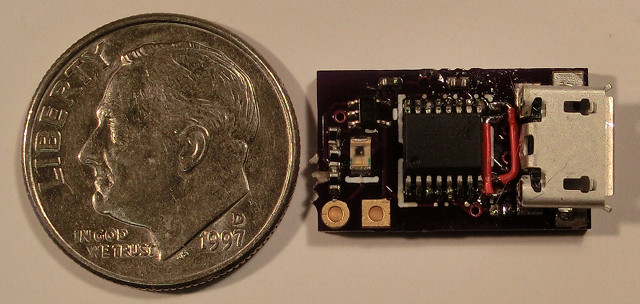
MicroPeak Serial Interface Flight Logging for MicroPeak MicroPeak was original designed as a simple peak-recording altimeter. It displays the maximum height of the last flight by blinking out numbers on the LED. Peak recording is fun and easy, but you need a log across apogee to check for unexpected bumps in baro data caused by ejection events. NAR also requires a flight log for altitude records. So, we wondered what could be done with the existing MicroPeak hardware to turn it into a flight logging altimeter. Logging the data The 8-bit ATtiny85 used in MicroPeak has 8kB of flash to store the executable code, but it also has 512B (yes, B as in bytes ) of eeprom storage for configuration data. Unlike the code flash, the little eeprom can be rewritten 100,000 times, so it should last for a lifetime of rocketry. The original MicroPeak firmware already used that to store the average ground pressure and minimum pressure (in Pascals) seen during flight; those are used to compute the maximum height that is shown on the LED. If we store just the two low-order bytes of the pressure data, we d have room left for 251 data points. That means capturing data at least every 32kPa, which is about 3km at sea level. 251 points isn t a whole lot of storage, but we really only need to capture the ascent and arc across apogee, which generally occurs within the first few seconds of flight. MicroPeak samples air pressure once every 96ms, if we record half of those samples, we ll have data every 192ms. 251 samples every 192ms captures 48 seconds of flight. A flight longer than that will just see the first 48 seconds. Of course, if apogee occurs after that limit, MicroPeak will still correctly record that value, it just won t have a continuous log. Downloading the data Having MicroPeak record data to the internal eeprom is pretty easy, but it s not a lot of use if you can t get the data into your computer. However, there aren t a whole lot of interfaces avaialble on MicroPeak. We ve only got: First implementation I changed the MicroPeak firmware to capture data to eeprom and made a test flight using my calibrated barometric chamber (a large syringe). I was able to read out the flight data using the AVR programming pins and got the flight logging code working that way. The plots I created looked great, but using an AVR programmer to read the data looked daunting for most people as it requires: With the hardware running at least $120 retail, and requiring a pile of software installed from various places around the net, this approach didn t seem like a great way to let people easily capture flight data from their tiny altimeter. The Blinking LED The only other interface available is the MicroPeak LED. It s a nice LED, bright and orange and low power. But, it s still just a single LED. However, it seemed like it might be possible to have it blink out the data and create a device to watch the LED and connect that to a USB port. The simplest idea I had was to just blink out the data in asynchronous serial form; a start bit, 8 data bits and a stop bit. On the host side, I could use a regular FTDI FT230 USB to serial converter chip. Those even have a 3.3V regulator and can supply a bit of current to other components on the board, eliminating the need for an external power supply. To see the LED blink, I needed a photo-transistor that actually responds to the LED s wavelength. Most photo-transistors are designed to work with infrared light, which nicely makes the whole setup invisible. There are a few photo-transistors available which do respond in the visible range, and ROHM RPM-075PT actually has its peak sensitivity right in the same range as the LED. In between the photo-transistor and the FT230, I needed a detector circuit which would send a 1 when the light was present and a 0 when it wasn t. To me, that called for a simple comparator made from an op-amp. Set the voltage on the negative input to somewhere between light and dark and then drive the positive input from the photo-transistor; the output would swing from rail to rail. Bit-banging async The ATtiny85 has only a single serial port , which is used on MicroPeak to talk to the barometric sensor in SPI mode. So, sending data out the LED requires that it be bit-banged directly modulated with the CPU. I wanted the data transmission to go reasonably fast, so I picked a rate of 9600 baud as a target. That means sending one bit every 104 S. As the MicroPeak CPU is clocked at only 250kHz, that leaves only about 26 cycles per bit. I need all of the bits to go at exactly the same speed, so I pack the start bit, 8 data bits and stop bit into a single 16 bit value and then start sending. Of course, every pass around the loop would need to take exactly the same number of cycles, so I carefully avoided any conditional code. With that, 14 of the 26 cycles were required to just get the LED set to the right value. I padded the loop with 12 nops to make up the remaining time. At 26 cycles per bit, it s actually sending data at a bit over 9600 baud, but the FT230 doesn t seem to mind. A bit of output structure I was a bit worried about the serial converter seeing other light as random data, so I prefixed the data transmission with MP ; that made it easy to ignore anything before those two characters as probably noise. Next, I decided to checksum the whole transmission. A simple 16-bit CRC would catch most small errors; it s easy enough to re-try the operation if it fails after all. Finally, instead of sending the data in binary, I displayed each byte as two hex digits, and sent some newlines along to keep the line lengths short. This makes it easy to ship flight logs in email or whatever. Here s a sample of the final data format:
MP
dc880100fec000006800f56d8f63b059
73516447273fa93728301927d91b7712
730bbf0491fe88f7c5ee8ee896e3fadc
9dd9d3d502d1afcea2cbafc6b4c34ec1
bfbfcabf10c03dc05dc070c084c08fc0
9cc0abc0b9c0c1c0ccc0dcc020c152c4
71c9a6cf45d623db7de05ee758edd9f2
b4f9fd00aa074311631a9221c4291330
c035873b2943084bbb52695c0c67eb6b
d26ee5707472fb74a4781f7dee802b84
09860a87e786ad868a866e8659865186
4e8643863e863986368638862e862d86
2f862d86298628862a86268629862686
28862886258625862486
d925
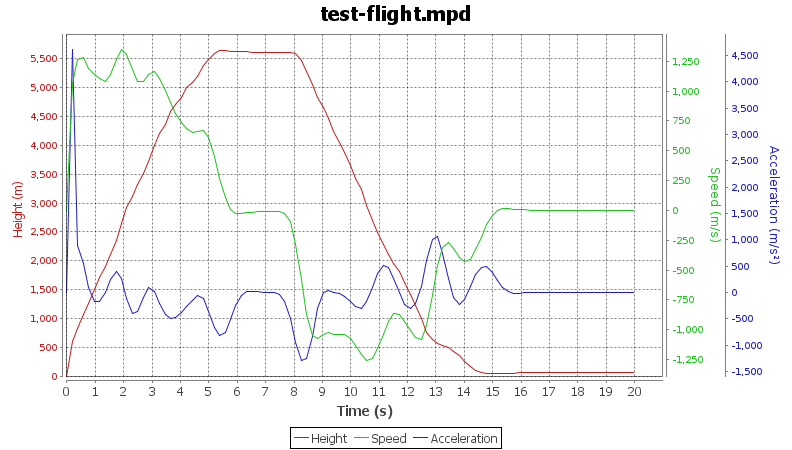
Making the photo-transistor go fast enough The photo-transistor acts as one half of a voltage divider on the positive op-amp terminal, with a resistor making the other half. However, the photo-transistor acts a bit like a capacitor, so when I initially chose a fairly large value for the resistor, it actually took too long to switch between on and off the transistor would spend a bunch of time charging and discharging. I had to reduce the resistor to 1k for the circuit to work. Remaining hardware design I prototyped the circuit on a breadboard using a through-hole op-amp that my daughter designed into her ultrasonic guided robot and a prefabricated FTDI Friend board. I wanted to use the target photo-transistor, so I soldered a couple of short pieces of wire onto the SMT pads and stuck that into the breadboard. Once I had that working, I copied the schematic to gschem, designed a board and had three made at OSHPark for the phenomenal sum of $1.35. Aside from goofing up on the FT230 USB data pins (swapping D+ and D-), the board worked perfectly. The final hardware design includes an LED connected to the output of the comparator that makes it easier to know when things are lined up correctly, otherwise it will be essentially the same. Host software Our AltosUI code has taught us a lot about delivering code that runs on Linux, Mac OS X and Windows, so I m busy developing something based on the same underlying Java bits to support MicroPeak. Here s a sample of the graph results so far: Production plans I ve ordered a couple dozen raw boards from OSH Park, and once those are here, I ll build them and make them available for sale in a couple of weeks. The current plan is to charge $35 for the MicroPeak serial interface board, or sell it bundled with MicroPeak for $75.

29 December 2012

Dirk Eddelbuettel: RcppExamples 0.1.5 and RcppClassicExamples 0.1.0

The recent releases of Rcpp 0.10.2 and RcppClassic 0.9.3 had one more repercussion. On that dreaded OS, the linker no longer wanted to instantiate a symbol present in both packages; seems to me that the linker in the other two OSs is a little smarter. Anyway -- I didn't fight this but at long last moved all remnands of the long-deprecated older Rcpp API (which is still maintained by package RcppClassic) out of package RcppExamples and into a new package RcppClassicExamples. And the updated version 0.1.5 of the RcppExamples package appeared on CRAN and has now been joined by the initial version 0.1.0 of the new package RcppClassicExamples. No code changed were made; manual pages and descriptions where brushed up and that is about it. Thanks to CRANberries, you can also look at a diff to the previous release 0.1.4 of RcppExamples. Questions, comments etc should go to the rcpp-devel mailing list off the R-Forge page.

25 December 2012

Uwe Hermann: sigrok at the 29th Chaos Communication Congress (29c3)

29c3 logo Yup, it's been a while since my last blog post, but I'm not dead yet. Most of my spare time goes into sigrok development these days (open-source signal analysis suite for logic analyzers, oscilloscopes, multimeters, and lots more), but I'll try to revive my blog too. I have various microcontroller/embedded topics and devices I want to talk about in a small blog post series in the nearer future. But more on that later. Feel free to subscribe to the sigrok-devel mailing list, join us on IRC in #sigrok (Freenode) where most of the discussions take place, or follow our new sigrok blog (RSS) if you're interested in the ongoing sigrok developments. Anyway, for now just a quick announce: Same as last year, we will be at the Chaos Communication Congress (29c3), this time in Hamburg, Germany. The conference takes place from December 27th to 30th, 2012. We'll have a sigrok "assembly", likely in area 3b of the conference building, where we'll be hanging around, working on new sigrok features, new hardware drivers, new protocol decoders and various other things. We'll have lots of gear with us for demo and development purposes, including logic analyzers, oscilloscopes, MSOs, multimeters, and lots more. Bring your own device if you own models we don't yet support or know about. We'll be happy to have a look! Chat with us, give us your suggestions which features you'd like to see, which devices you want to be supported, which protocol decoders you'd like to have, or even help us write some drivers/decoders! Hope to see you there!

22 December 2012

Dirk Eddelbuettel: RcppClassic 0.9.3

Yesterday's release of Rcpp 0.10.2 required a small change to RcppClassic, the package supporting the deprecated older classic Rcpp API defined in the earlier 2005 to 2006 releases. So version 0.9.3 of RcppClassic is now on CRAN. There is no new user-facing code. Courtesy of CRANberries, there is the set of changes relative to the previous release 0.9.2. Questions, comments etc should go to the rcpp-devel mailing list off the R-Forge page.

Dirk Eddelbuettel: Kurt Elling Quintet at the Green Mill

Kurt Elling is back in Chicago for two gigs at the Green Mill (where I last saw him in a wonderful big-band setting), along with his long-time collaborator Laurence Hobgood on piano, Clark Sommers on bass, Chicago's own John McLean on guitar, and the new kid Bryan Carter on drums. And they were, of course, awesome. Great mix of standards as well as new stuff from the Grammy-nominated new recording. If you can see Kurt Elling live, go. Now. They return for another gig tonight and I will have to see if I can swing that.

Dirk Eddelbuettel: Patricia Barber at Unity Temple

Forgot to blog about this (though I posted on Google+ about it), but we went to a neat little concert in the neighborhood on October 6. Chicago's own Patricia Barber came to the wonderful Unity Temple by Frank Lloyd Wright (more on the temple at Wikipedia and the foundation). This closed the 2012 series of the Unity Temple concerts and the setting was a little, well, weird. Look like mostly concert subscribers, with the commensurate age brackets, and not too many jazz folks. Not sure how many Patricia Barber, along with Larry Kohut on bass, won over, but I enjoyed it. I had secured front row (!!) seats in what is already an wonderfully intimate setting for such a duet concert. See the Google+ link for a YouTube recording by her.

21 December 2012

Dirk Eddelbuettel: Rcpp 0.10.2

Relase 0.10.2 of Rcpp provides the second update to the 0.10.* series, and has arrived on CRAN and in Debian. It brings another great set of enhancements and extensions, building on the recent 0.10.0 and 0.10.1 releases. The new Rcpp attributes were rewritten to not require Rcpp modules (as we encountered on issue with exceptions on Windows when built this way), code was reorganized to significantly accelerate compilation and a couple of new things such as more Rcpp sugar goodies, a new timer class, and a new string class were added. See below for full details. We also tested this fairly rigorously by checking about two thirds of the over 90 CRAN packages depending on Rcpp (and the remainder required even more package installs which we did not do as this was already taking about 12 total cpu hours to test). We are quite confident that no changes are required (besides one in our own RcppClassic package which we will update. The complete NEWS entry for 0.10.2 is below; more details are in the ChangeLog file in the package and on the Rcpp Changelog page.
Changes in Rcpp version 0.10.2 (2012-12-21)
  • Changes in Rcpp API:
    • Source and header files were reorganized and consolidated so that compile time are now significantly lower
    • Added additional check in Rstreambuf deletetion
    • Added support for clang++ when using libc++, and for anc icpc in std=c++11 mode, thanks to a patch by Yan Zhou
    • New class Rcpp::String to facilitate working with a single element of a character vector
    • New utility class sugar::IndexHash inspired from Simon Urbanek's fastmatch package
    • Implementation of the equality operator between two Rcomplex
    • RNGScope now has an internal counter that enables it to be safely used multiple times in the same stack frame.
    • New class Rcpp::Timer for benchmarking
  • Changes in Rcpp sugar:
    • More efficient version of match based on IndexHash
    • More efficient version of unique base on IndexHash
    • More efficient version of in base on IndexHash
    • More efficient version of duplicated base on IndexHash
    • More efficient version of self_match base on IndexHash
    • New function collapse that implements paste(., collapse= "" )
  • Changes in Rcpp attributes:
    • Use code generation rather than modules to implement sourceCpp and compileAttributes (eliminates problem with exceptions not being able to cross shared library boundaries on Windows)
    • Exported functions now automatically establish an RNGScope
    • Functions exported by sourceCpp now directly reference the external function pointer rather than rely on dynlib lookup
    • On Windows, Rtools is automatically added to the PATH during sourceCpp compilations
    • Diagnostics are printed to the console if sourceCpp fails and C++ development tools are not installed
    • A warning is printed if when compileAttributes detects Rcpp::depends attributes in source files that are not matched by Depends/LinkingTo entries in the package DESCRIPTION
Thanks to CRANberries, you can also look at a diff to the previous release 0.10.1. As always, even fuller details are on the Rcpp Changelog page and the Rcpp page which also leads to the downloads, the browseable doxygen docs and zip files of doxygen output for the standard formats. A local directory has source and documentation too. Questions, comments etc should go to the rcpp-devel mailing list off the R-Forge page

18 December 2012

Dirk Eddelbuettel: R / Finance 2013 Call for Papers

The text below just went out to r-sig-finance along with updates to the R/Finance website and its Call for Papers page.
Call for Papers: R/Finance 2013: Applied Finance with R
May 17 and 18, 2013
University of Illinois, Chicago, IL, USA
The fifth annual R/Finance conference for applied finance using R will be held on May 17 and 18, 2013 in Chicago, IL, USA at the University of Illinois at Chicago. The conference is expected to cover topics including portfolio management, time series analysis, advanced risk tools, high-performance computing, market microstructure, and econometrics. All will be discussed within the context of using R as a primary tool for financial risk management, portfolio construction, and trading. Over the past four years, R/Finance has included attendees from around the world. It featured presentations from prominent academics and practitioners, and we anticipate another exciting line-up for 2013. We invite you to submit complete papers in pdf format for consideration. We will also consider one-page abstracts (in txt or pdf format) although more complete papers are preferred. We welcome submissions for full talks and abbreviated "lightning talks". Both academic and practitioner proposals related to R are encouraged. Presenters are strongly encouraged to provide working R code to accompany the presentation/paper. Data sets should also be made public for the purposes of reproducibility (though we realize this may be limited due to contracts with data vendors). Preference may be given to presenters who have released R packages. The conference will award two (or more) $1000 prizes for best papers. A submission must be a full paper to be eligible for a best paper award. Extended abstracts, even if a full paper is provided by conference time, are not eligible for a best paper award. Financial assistance for travel and accommodation may be available to presenters at the discretion of the conference committee. Requests for assistance should be made at the time of submission. Please send submissions to: committee at RinFinance.com. The submission deadline is February 15, 2013. Submitters will be notified of acceptance via email by February 28, 2013. Notification of whether a presentation will be a long presentation or a lightning talk will also be made at that time. Additional details will be announced at this website as they become available. Information on previous year's presenters and their presentations are also at the conference website. For the program committee:
Gib Bassett, Peter Carl, Dirk Eddelbuettel, Brian Peterson,
Dale Rosenthal, Jeffrey Ryan, Joshua Ulrich
So see you in Chicago in May!

Dirk Eddelbuettel: RcppArmadillo 0.3.6.1

A first minor bug-fix update by Conrad to the 3.6 series of Armadillo arrived today as version 3.6.1, and we prepared a corresponding version 0.3.6.1 of RcppArmadillo, our wrapper for R and Armadillo. This is now on CRAN, and the changes are summarized below.
Changes in RcppArmadillo version 0.3.6.1 (2012-12-17)
  • Upgraded to Armadillo release Version 3.6.1
    • faster trace()
    • fix for handling sparse matrices by dot()
    • fixes for interactions between sparse and dense matrices
  • Now throws compiler error if Rcpp.h is included before RcppArmadillo.h (as the former is included automatically by the latter anyway, but template logic prefers this ordering).
Courtesy of CRANberries, there is also a diffstat report for the most recent release As always, more detailed information is on the RcppArmadillo page. Questions, comments etc should go to the rcpp-devel mailing list off the R-Forge page.

16 December 2012

John Goerzen: The world is still a good place

At times like these, it is easy to think of the world as a cold, evil place. Perhaps in some ways, it is. I saw this quote from Fred Rogers floating around today:
When I was a boy and I would see scary things in the news, my mother would say to me, Look for the helpers. You will always find people who are helping. To this day, especially in times of disaster, I remember my mother s words, and I am always comforted by realizing that there are still so many helpers so many caring people in this world.
Sometimes I think that Fred Rogers wisdom is so often under-appreciated. What he says is true, very true. I know what it s like to fear for my child s life. And sometimes the shoe has been on the other foot, when I have been one of the helpers. Many of you know these last few months have been the most difficult in my life. And despite having gone through the deaths of three relatives, nothing has quite compared to this. I can not even begin to express my gratitude for all the care, compassion, and love that has come my way and towards the boys. People I barely knew before are now close friends. Random strangers have offered kindness and support. I have never before needed to be cared for like that, and in some ways perhaps it was hard to let myself be cared for. But I did, and all that caring and generosity has made an incredible difference in my life. Most of us don t see our pain on CNN or BBC, but that doesn t mean it s less real. And it doesn t mean there s nobody that cares. Open up to others, let them care for you. Things can and do get better. The people in Newtown did nothing to deserve this. No matter what evidence is found, they will never get an adequate answer to why? Children have been frightened, families torn apart, lives ended, for no reason at all. But they will survive the terrible pain. In time, they will find happiness again. And they will feel love and compassion from people around the world something to sustain them in their grief. I am certain of this. I recently read this quote, part of a story about a dying cancer patient: Don t forget that it doesn t take much to make someone s day. Yes, the world is still a good place.

13 December 2012

Patrick Matth i: otrs 3.1.12 in Debian experimental

Heyho, I have just uploaded otrs2 version 3.1.12+dfsg1-1 to Debian experimental yesterday! It includes many bugfixes, for a full list have a look at [0]. I also would welcome help for two important tasks:
#690306: Upgrade to Wheezy fails, if InnoDB is used in (some) tables
#695664: Embedded JavaScript code copies. As usual problematic with a package which is as big as otrs.. I also will backport otrs 3.1.x to Wheezy backports, if it is released. After this step, work on the 3.2.x packaging will begin. [0]: otrs changelog

8 December 2012

Dirk Eddelbuettel: Rcpp attributes: Even easier integration of GSL code into R

Following the Rcpp 0.10.0 release, I had written about simulating pi easily by using the wonderful new Rcpp Attributes feature. Now with Rcpp 0.10.1 released a good week ago, it is time to look at how Rcpp Attributes can help with external libraries. As this posts aims to show, it is a breeze! One key aspect is the use of the plugins for the inline package. They provide something akin to a callback mechanism so that compilation and linking steps can be informed about header and library locations and names. We are going to illustrate this with an example from GNU Scientific Library (GSL). The example I picked uses B-Spline estimation from the GSL. This is a little redundant as R has its own spline routines and package, but serves well as a simple illustration---and, by reproducing an existing example, followed an established path. So we will look at Section 39.7 of the GSL manual which has a complete example as a standalone C program, generating both the data and the fit via cubic B-splines. We can decompose this two parts: data generation, and fitting. We will provide one function each, and then use both from R. These two function will follow the aforementioned example from Section 39.7 somewhat closely. We start with the first function to generate the data.
// [[Rcpp::depends(RcppGSL)]]
#include <RcppGSL.h>
#include <gsl/gsl_bspline.h>
#include <gsl/gsl_multifit.h>
#include <gsl/gsl_rng.h>
#include <gsl/gsl_randist.h>
#include <gsl/gsl_statistics.h>
const int N = 200;                              // number of data points to fit 
const int NCOEFFS = 12;                         // number of fit coefficients */
const int NBREAK = (NCOEFFS - 2);               // nbreak = ncoeffs + 2 - k = ncoeffs - 2 since k = 4 */
// [[Rcpp::export]]
Rcpp::List genData()  
    const size_t n = N;
    size_t i;
    double dy;
    gsl_rng *r;
    RcppGSL::vector<double> w(n), x(n), y(n);
    gsl_rng_env_setup();
    r = gsl_rng_alloc(gsl_rng_default);
    //printf("#m=0,S=0\n");
    /* this is the data to be fitted */
    for (i = 0; i < n; ++i)  
        double sigma;
        double xi = (15.0 / (N - 1)) * i;
        double yi = cos(xi) * exp(-0.1 * xi);
        sigma = 0.1 * yi;
        dy = gsl_ran_gaussian(r, sigma);
        yi += dy;
        gsl_vector_set(x, i, xi);
        gsl_vector_set(y, i, yi);
        gsl_vector_set(w, i, 1.0 / (sigma * sigma));
                
        //printf("%f %f\n", xi, yi);
     
    Rcpp::DataFrame res = Rcpp::DataFrame::create(Rcpp::Named("x") = x,
                                                  Rcpp::Named("y") = y,
                                                  Rcpp::Named("w") = w);
    x.free();
    y.free();
    w.free();
    gsl_rng_free(r);
    return(res);
 
We include a few header files, define (in what is common for C programs) a few constants and then define a single function genData() which returns and Rcpp::List as a list object to R. A primary importance here are the two attributes: one to declare a dependence on the RcppGSL package, and one to declare the export of the data generator function. That is all it takes! The plugin of the RcppGSL will provide information about the headers and library, and Rcpp Attributes will do the rest. The core of the function is fairly self-explanatory, and closely follows the original example. Space gets allocated, the RNG is setup and a simple functional form generates some data plus noise (see below). In the original, the data is written to the standard output; here we return it to R as three columns in a data.frame object familiar to R users. We then free the GSL vectors; this manual step is needed as they are implemented as C vectors which do not have a destructor. Next, we can turn the fitting function.
// [[Rcpp::export]]
Rcpp::List fitData(Rcpp::DataFrame ds)  
    const size_t ncoeffs = NCOEFFS;
    const size_t nbreak = NBREAK;
    const size_t n = N;
    size_t i, j;
    Rcpp::DataFrame D(ds);              // construct the data.frame object
    RcppGSL::vector<double> y = D["y"]; // access columns by name, 
    RcppGSL::vector<double> x = D["x"]; // assigning to GSL vectors
    RcppGSL::vector<double> w = D["w"];
    gsl_bspline_workspace *bw;
    gsl_vector *B;
    gsl_vector *c; 
    gsl_matrix *X, *cov;
    gsl_multifit_linear_workspace *mw;
    double chisq, Rsq, dof, tss;
    bw = gsl_bspline_alloc(4, nbreak);      // allocate a cubic bspline workspace (k = 4)
    B = gsl_vector_alloc(ncoeffs);
    X = gsl_matrix_alloc(n, ncoeffs);
    c = gsl_vector_alloc(ncoeffs);
    cov = gsl_matrix_alloc(ncoeffs, ncoeffs);
    mw = gsl_multifit_linear_alloc(n, ncoeffs);
    gsl_bspline_knots_uniform(0.0, 15.0, bw);   // use uniform breakpoints on [0, 15] 
    for (i = 0; i < n; ++i)                     // construct the fit matrix X 
        double xi = gsl_vector_get(x, i);
        gsl_bspline_eval(xi, B, bw);            // compute B_j(xi) for all j 
        for (j = 0; j < ncoeffs; ++j)           // fill in row i of X 
            double Bj = gsl_vector_get(B, j);
            gsl_matrix_set(X, i, j, Bj);
         
     
    gsl_multifit_wlinear(X, w, y, c, cov, &chisq, mw);  // do the fit 
    
    dof = n - ncoeffs;
    tss = gsl_stats_wtss(w->data, 1, y->data, 1, y->size);
    Rsq = 1.0 - chisq / tss;
    
    Rcpp::NumericVector FX(151), FY(151);       // output the smoothed curve 
    double xi, yi, yerr;
    for (xi = 0.0, i=0; xi < 15.0; xi += 0.1, i++)  
        gsl_bspline_eval(xi, B, bw);
        gsl_multifit_linear_est(B, c, cov, &yi, &yerr);
        FX[i] = xi;
        FY[i] = yi;
     
    Rcpp::List res =
      Rcpp::List::create(Rcpp::Named("X")=FX,
                         Rcpp::Named("Y")=FY,
                         Rcpp::Named("chisqdof")=Rcpp::wrap(chisq/dof),
                         Rcpp::Named("rsq")=Rcpp::wrap(Rsq));
    gsl_bspline_free(bw);
    gsl_vector_free(B);
    gsl_matrix_free(X);
    gsl_vector_free(c);
    gsl_matrix_free(cov);
    gsl_multifit_linear_free(mw);
    
    y.free();
    x.free();
    w.free();
    return(res);   
 
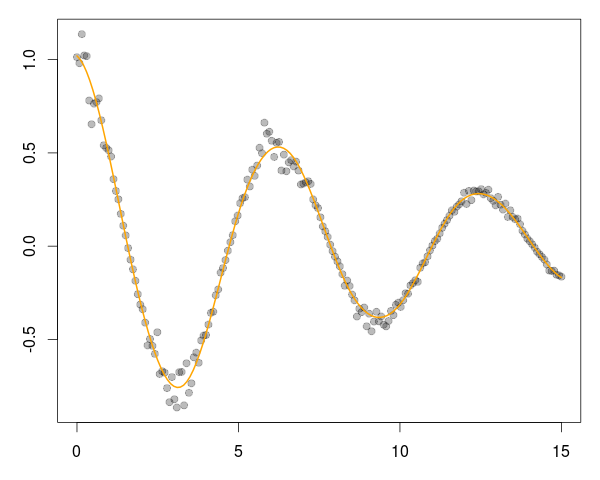
The second function closely follows the second part of the GSL example and, given the input data, fits the output data. Data structures are setup, the spline basis is created, data is fit and then the fit is evaluated at a number of points. These two vectors are returned along with two goodness of fit measures. We only need to load the Rcpp package and source a file containing the two snippets shown above, and we are ready to deploy this:
library(Rcpp)
sourceCpp("bSpline.cpp")                # compile two functions
dat <- genData()                        # generate the data
fit <- fitData(dat)                     # fit the model, returns matrix and gof measures
And with that, we generate a chart such as Spline fitting example from GSL manual redone with Rcpp Attributes via a simple four lines, or as much as it took to create the C++ functions, generate the data and fit it!
op <- par(mar=c(3,3,1,1))
plot(dat[,"x"], dat[,"y"], pch=19, col="#00000044")
lines(fit[[1]], fit[[2]], col="orange", lwd=2)
par(op)
The RcppArmadillo and RcppEigen package support plugin use in the same way. Add an attribute to export a function, and an attribute for the depends -- and you're done. Extending R with (potentially much faster) C++ code has never been easier, and opens a whole new set of doors.

Eddy Petri&#537;or: Consent is needed, but not the point

Russ makes a good point about a nuance of practical jokes that makes them special, the characteristic of involving a third party which is the target of the joke, and how that relates to consent. He is right, consent is an important fact, I acknowledge that. Russ also says at the end of his post that being an asshole doesn't make you responsible for somebody else's decisions, I ackowledge that, too. I even somewhat agree to the position that the employer might fire you on assholery reasons, but in this particular case, I think that's a hypocrite position. If assholery was an issue, it should have been before, too, and I don't think the employer thought of it before this sad even, as long as it meant more money for them. I think this only shows how cynical they are, the cost analysis for them showed them they now might lose more money by not firing, than by keeping them. It's just cynical.

In spite of that, my initial post, just as I wrote, was not about the DJs, the people involved, the assholery, the taste or lack thereof of the joke. That's why I was intentionally leaving out names or specific context. It was about the bigger picture, irrational reactions and how in the face of a tragedy we surrender our thinking capabilities and react in an irrational manner to the least significant things.

I have had quite recent unfortunate events happening to people close to me, and, invariably, I observe this loss of rational faculties in the face of sad events. Even when this kind of disproportionate response is shown for what it is and how it is harmful in itself, people still refuse to give up on being irrational or they do after a long struggle with the facts.

I'll finish my article with a similar question: can we, as a species, go beyond our condition and make a conscious effort to keep calm and think things through before making decisions in the face of tragedy, or are we incapable to do that?

And no, I am not advocating to drop feelings and affection, I find it sad that I have to say that again, but I am almost sure that in spite of it, I will be wrongly understood by somebody.

Dirk Eddelbuettel: RcppArmadillo 0.3.6.0

Conrad launched the 3.6 series of Armadillo earlier today with a first 3.6.0 release. So RcppArmadillo, our wrapper for R and Armadillo, is now on CRAN with its corresponding version 0.3.6.0. No R level or interface changes were needed, and the upstream changes are summarized below.
Changes in RcppArmadillo version 0.3.6.0 (2012-12-07)
  • Upgraded to Armadillo release Version 3.6.0 (Piazza del Duomo)
    • faster handling of compound expressions with submatrices and subcubes
    • added support for loading matrices as text files with NaN and Inf elements
    • added stable_sort_index(), which preserves the relative order of elements with equivalent values
    • added handling of sparse matrices by mean(), var(), norm(), abs(), square(), sqrt()
    • added saving and loading of sparse matrices in arma_binary format
Courtesy of CRANberries, there is also a diffstat report for the most recent release As always, more detailed information is on the RcppArmadillo page. Questions, comments etc should go to the rcpp-devel mailing list off the R-Forge page.

Eddy Petri&#537;or: Faulty logic - confusing correlation with causation

I want to start this post by saying two things:
  1. It is sad when a good person decides to commit suicide
  2. It is even sadder anyone writing on a subject like this MUST add this kind of disclaimers in the hope the message of the writing isn't distorted because we are unable to listen to each other without suspecting/blaming the other of pure evilness/lack of compassion.
Imagine you are working in an office with other colleagues and one of them makes a print screen of your desktop screen and then displays it full-screen on your computer. You struggle a little and get frustrated when nothing works, the colleagues laugh at your expense. Pretty childish, but no harm, right? You laugh it off.

Imagine a similar scenario, but your shoelaces are tied to the desk without your notice, and the colleagues tied your laces so you can't stand, so the risk of injury is null. You stumble a little when you want to leave the desk. Again, childish, funny, but no harm, right? Again, you laugh it off.

Imagine even a scenario where you are the target of a prank that doesn't injure you physically, but it happens in front of an audience of 100 people. You might feel ashamed, embarrassed, depending on the prank. But that would go away with time, with your laughs or by leaving that audience, right?

So now imagine you are just a person that unknowingly contributed to the success of a harmless prank in which somebody was duped into thinking they were talking to a very public figure about some unimportant and inconsequential stuff related to their job. You'd brush it off, wouldn't you? Most likely, you'd probably laugh at the prank and you wouldn't think the pranksters should be prosecuted or fired. Even if the famous public figure would be upset, taking into account the fact that the things discussed were inconsequential, you wouldn't worry about it. I wouldn't worry even if that famous person was my direct boss and I was the one talking about my boss.

At least, that's how I am thinking, but for some reason, many people don't think this way. And yes, I am talking about the recent sad news about the apparent suicide of a nurse who was involved in the care of the person called Kate Middleton.

I don't want to talk about names, or man-made titles, man-made concepts, or how some people forget that even the most influential people in the world are still a member of this same species that all of us are. I don't even want to talk about this particular sad situation, I just want to talk about the totally irrational reaction many people had to it.


Everybody knows that jokes are a matter of taste. What I might consider funny, some people would take offence at, but, generally speaking, there's an area of jokes that even kids would consider funny. Also, if we are honest to ourselves, a joke is not funnier or less funnier if from the total of people in the room instead of 2 people not liking it, 5 people don't. Not even if some of them are so offended by the joke they leave the room. The joke is equally funny or in poor taste with 2 or with 100 people in the room.

And there's the issue of confusing correlation with causation. If I tell somebody some good news about my aunt and the next day that somebody happens to had bought a car, it doesn't mean my good news made that person decide they want to buy a car. It could be, but it's not necessary, it could be a coincidence.

The same happens in the sad case of the nurse. She decided to take her life, as far as it seems. But that's the extent to which we know anything about the situation. We don't know if the suicide had anything to do with the prank or not. Just the fact that it happened the next day doesn't mean AT ALL the prank call is the cause of the suicide. It doesn't even mean that is "the straw that broke the camel's back", it might be totally unrelated. Or it might not. Taking into account the inconsequential and harmless nature of the call, it seems even less likely. Yet, I might be mistaken.

What I am sure of now is that jumping to the conclusion that the prank call had anything to do with the death, is wrong, as it is jumping to the opposing conclusion. I am also sure that in the absence of other information, the latter, the lack of connection, is more likely, because we know that such drastic sad decisions are not generally caused by trivial stuff.

Time proximity doesn't prove causation. Geographical proximity doesn't either. There needs to be a lot more into it than simple temporal sequence.


Which gets me to the second part of irrational reactions: terminating the show and twitter accounts of the two pranksters. What the hell? Talk about hypersensitivity and paranoid reactions! Are we this blind and willing to blame the least insignificant thing for the gravest consequences that we forget how we all make decisions and how to use our brains, as soon as some tragedy happens?

<iframe allowfullscreen="allowfullscreen" frameborder="0" height="315" src="http://www.youtube.com/embed/tbhsdlJ_MiQ" width="560"></iframe>
Australian Prime-minister Julia Gillard making fun of doomsday believers


Imagine some person who thinks the 21st of December 2012 will bring the end of the earth. Imagine that person taking as a serious declaration the obvious joke from the Australian prime-minister Julia Gillard, and would end their lives to avoid the mayhem, panic and violence they think would follow the 21st of December. I wonder, would as many people blame Julia Gillard for the suicide? I doubt it. And the irony is that for such an hypothetical case, there would be a stronger case for causation than what we now know about the previous case.


I still wonder, when will we learn to think a little more rationally than the people walking the Earth 100.000 years ago?

6 December 2012

Dirk Eddelbuettel: RInside 0.2.10

The new maintenance release 0.2.10 of RInside is now on CRAN, including Windows binaries. RInside provides a set of convenience classes which facilitate embedding of R inside of C++ applications and programs, using the classes and functions provided by the Rcpp R and C++ integration package. This release helps with an update to stack checking, required by a recent change in R itself. The NEWS extract below has more details.
Changes in RInside version 0.2.10 (2012-12-05)
  • Adjusted to change in R which requires turning checking of the stack limit off in order to allow for access from multiple threads as in the Wt examples. As there are have been no side-effects, this is enabled by default on all platforms (with the exception of Windows).
  • Added new threads example directory with a simple example based on a Boost mutex example.
  • Disabled two examples (passing an external function down) which do not currently work; external pointer use should still work.
CRANberries also provides a short report with changes from the previous release. More information is on the RInside page. Questions, comments etc should go to the rcpp-devel mailing list off the Rcpp R-Forge page.

4 December 2012

Andrea Veri: My favorite WordPress Plugins

It took me a while to build a complete WordPress blog with all the things I needed, from modifying the default Twenty Eleven theme to broadcasting my posts directly on Twitter. WordPress has a nice selection of plugins and given the fact I spent a few days evaluating all the possibilities, I decided to share my own setup to speed up the process in case you are willing to build a WordPress powered blog. The plugins: And a few modifications I made on my Child theme for the Twenty Eleven theme to suit my needs: Remove the navigation buttons on the header. On the Child theme s style.css:

#access, #branding .only-search #s, .entry-header .comments-link  
display: none;
 
Remove the gray line on the top of the header s banner. On the Child theme s style.css:
#branding  
border-top: none;
 
.and a little tip about WordPress itself: have you ever wondered how you could install/update/remove a WordPress theme or plugin without FTP access? Here s how! On the config.php file:
/*** Updates WordPress without FTP credentials. ***/
define('FS_METHOD','direct');
If you know any other handy WordPress Tip or Plugin, please share!

2 December 2012

Dirk Eddelbuettel: RQuantLib 0.3.9

A minor feature release RQuantLib 0.3.9 is now on CRAN and in Debian. RQuantLib combines (some of) the quantitative analytics of QuantLib with the R statistical computing environment and language. Bryan Lewis had suggested to enable another pricing engine for American Options in order to get (at least some) Greeks. This is now supported by picking engine="CrankNicolson" as shown in the default example for the AmericanOption function:
R> library(RQuantLib)
R> example(AmericanOption)
AmrcnOR> # simple call with unnamed parameters
AmrcnOR> AmericanOption("call", 100, 100, 0.02, 0.03, 0.5, 0.4)
Concise summary of valuation for AmericanOption 
  value   delta   gamma    vega   theta     rho  divRho 
11.3648      NA      NA      NA      NA      NA      NA 
AmrcnOR> # simple call with some explicit parameters
AmrcnOR> AmericanOption("put", strike=100, volatility=0.4, 100, 0.02, 0.03, 0.5)
Concise summary of valuation for AmericanOption 
  value   delta   gamma    vega   theta     rho  divRho 
10.9174      NA      NA      NA      NA      NA      NA 
AmrcnOR> # simple call with unnamed parameters, using Crank-Nicolons
AmrcnOR> AmericanOption("put", strike=100, volatility=0.4, 100, 0.02, 0.03, 0.5, engine="CrankNicolson")
Concise summary of valuation for AmericanOption 
  value   delta   gamma    vega   theta     rho  divRho 
10.9173 -0.4358  0.0140      NA      NA      NA      NA 
R> 
Thanks to CRANberries, there is also a diff to the previous release 0.3.8. Full changelog details, examples and more details about this package are at my RQuantLib page.

28 November 2012

Dirk Eddelbuettel: Rcpp 0.10.1

A the new Rcpp release 0.10.1 arrived this morning on CRAN (as already has Windows binaries) and in Debian. This is a follow-up to the recent 0.10.0 release which extends the exciting new Rcpp-attributes and Rcpp-sugar work further, and as in a number of other areas as detailed below in the NEWS sections. This release brings an change to some of the binary interfaces. If you have packages using Rcpp, you will most likely have to reinstall them from source. Some change were made to const correctness as well as other aspects, and it seems that we have temporarily broken the excellent RcppEigen and RcppOctave packages. We are looking into this, and are sorry about the bug. The complete NEWS entry for 0.10.1 is below; more details are in the ChangeLog file in the package and on the Rcpp Changelog page.
Changes in Rcpp version 0.10.1 (2012-11-26)
  • Changes in Rcpp sugar:
    • New functions: setdiff, union_, intersect setequal, in, min, max, range, match, table, duplicated
    • New function: clamp which combines pmin and pmax, e.g. clamp( a, x, b) is the same as pmax( b, pmin(x, a) )
    • New function: self_match which implements something similar to match( x, unique( x ) )
  • Changes in Rcpp API:
    • The Vector template class (hence NumericVector ...) get the is_na and the get_na static methods.
    • New helper class no_init that can be used to create a vector without initializing its data, e.g. : IntegerVector out = no_init(n) ;
    • New exception constructor requiring only a message; stop function to throw an exception
    • DataFrame gains a nrows method
  • Changes in Rcpp attributes:
    • Ability to embed R code chunks (via specially formatted block comments) in C++ source files.
    • Allow specification of argument defaults for exported functions.
    • New scheme for more flexible mixing of generated and user composed C++ headers.
    • Print warning if no export attributes are found in source file.
    • Updated vignette with additional documentation on exposing C++ interfaces from packages and signaling errors.
  • Changes in Rcpp modules:
    • Enclose .External invocations in BEGIN_RCPP/END_RCPP
  • Changes in R code :
    • New function areMacrosDefined
    • Additions to Rcpp.package.skeleton:
      • attributes parameter to generate a version of rcpp_hello_world that uses Rcpp::export.
      • cpp_files parameter to provide a list of C++ files to include the in the src directory of the package.
  • Miscellaneous changes:
    • New example 'pi simulation' using R and C++ via Rcpp attributes
Thanks to CRANberries, you can also look at a diff to the previous release 0.10.0. As always, even fuller details are on the Rcpp Changelog page and the Rcpp page which also leads to the downloads, the browseable doxygen docs and zip files of doxygen output for the standard formats. A local directory has source and documentation too. Questions, comments etc should go to the rcpp-devel mailing list off the R-Forge page

25 November 2012

Lars Wirzenius: Made some t-shirt designs

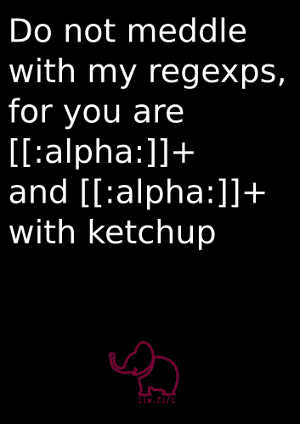
I enjoy funny and geeky t-shirts. For some time, I've been collecting ideas of my own, and now I've implemented them as Trunk tees (US), a Cafepress shop. I'll add more over time. do-not-meddle-regexps.jpg
Next.

Previous.