Search Results: "bab"

31 October 2015

Andrew Cater

Ken Starks (Helios) of Reglue could use your help

I'm not normally one to respond to online appeals for money: there are often far too many of them. Ken Starks is a well known Linux personality who set up a charity to provide needy local people with Linux and recycled machines. He's also a good guy who works hard for this as something he believes in: this is no scam. The Helios Project (from before his own charity merged with another known as Reglue) is also still an SPI project as far as I know

Ken is currently holding a fund raising drive to replace his vehicle used for the Reglue project on Indiegogo. This is probably most of interest to US readers who may be able to treat this as charitable donation - the things he's offering in return for donations are most readily shipped within the US and Canada.

Any and all help would be greatly appreciated.


Jonathan McDowell: Thoughts on the LG G Watch R Android smartwatch

Back in March I was given an LG G Watch R, the first Android Wear smartwatch to have a full round display (the Moto 360 was earlier, but has a bit cut off the bottom of the actual display). I d promised I d get round to making some comments about it once I d had it for a while and have failed to do so until now. Note that this is very much comments on the watch from a user point of view; I haven t got to the point of trying to do any development or other hacking of it. Firstly, it s important to note I already was wearing a watch and have been doing so for all of my adult life. Just a basic, unobtrusive analogue watch (I ve had a couple since I was 18, before that it was pretty much every type of calculator watch available at some point), but I can t remember a period where I didn t. The G Watch R is bulkier than what I was previously wearing, but I haven t found it obtrusive. And I love the way it looks; if you don t look closely it doesn t look like a smart watch (and really it s only the screen that gives it away). Secondly, I already would have taken my watch off at night and when I was showering. So while the fact that the battery on the G Watch R will really only last a day and a half is by far and away its most annoying problem, it s not as bad as it could be for me. The supplied charging dock is magnetic, so it lives on my beside table and I just drop the watch in it when I go to bed. With those details out of the way, what have I thought of it? It s certainly a neat gadget. Being able to see my notifications without having to take my phone out of my pocket is more convenient than I expected - especially when it s something like an unimportant email that I can then easily dismiss by swiping the watch face. My agenda being just a flick away, very convenient, particularly when I m still at the stage of trying to remember where my next lecture is. Having walking directions from Google Maps show up on the watch (and be accompanied by a gentle vibration when I need to change direction) is pretty handy too. The ability to take pictures via the phone camera, not so much. Perhaps if it showed me roughly what I was about to photograph, but without that it s no easier than using the phone interface. It s mostly an interface for consuming information - I ve tried the text to SMS interface a few times, but it s just not reliable enough that I d choose to use it. I ve also been pleased to see it get several updates from LG in the time I ve had it. First the upgrade from Wear 4.4 to Wear 5.1 (probably via 5.0 but I forget), but also the enabling of wifi support. The hardware could always support this, but initially Android Wear didn t and then there was some uncertainty about the FCC certification for the G Watch R. I can t say I use it much (mostly the phone is within range) but it s nice to see the improvements in support when they re available. What about the downsides? Battery life, as mentioned above, is definitely the major one. Mostly a day is fine, but the problem comes if I m ever away. There s no way to charge without the charging dock, so that becomes another things I have to pack. And it s really annoying to have your watch go dead on you midday when you forget to do so. I also had a period where I d frequently (at least once a week) find an Android Wear isn t responding. Wait/Restart? error on the watch screen. Not cool, but thankfully seems to have stopped happening. Finally there s the additional resource requirements it puts on the phone. I have a fairly basic Moto G 4G that already struggles with Ingress and Chrome at the same time, so adding yet another thing running all the time doesn t help. I m sure I could make use of a few more apps if I was more comfortable with loading the phone. The notable point for me with the watch was DebConf. I d decided not to bring it, not wanting the hassle of dealing with the daily charging. I switched back to my old analogue watch (a Timex, if you care). And proceeded to spend 3 days looking at it every time my phone vibrated before realising that I couldn t do that. That marked the point where I accepted that I was definitely seeing benefits from having a smart watch. So when I was away for a week at the start of September, I brought the charger with me (at some point I ll get round to a second base for travel). I was glad I d done so. I m not sure I m yet at the point I d replace it in the event it died, but on the whole I m more of a convert that I was expecting to be.

30 October 2015

Dirk Eddelbuettel: littler 0.3.0 -- on CRAN !!

max-heap image A new major release of littler is now available. And for the first time in the nine years since 2006 when Jeff started the effort (which I joined not long after) we are now a CRAN package. This required a rewrite of the build system, foregoing the calls to aclocal, autoheader, automake and leaving just a simpler autoconf layer creating a configure script and a simple src/Makevars.in. Not only does R provide such a robust and well-understood build system (which I got to understand reasonably well given all my R packages, but being on CRAN and leveraging its mechanism for installation and upgrades is clearly worth the change. There may be a moment or two of transition. While we can create a binary in an R package, we cannot (generally) copy to /usr/bin or /usr/local/bin as part of the build process (for lack of write-rights to those directories). So if you do not have r in the $PATH and load the package, it makes a suggestion (which needs a linebreak which I added here):
R> library(littler)
The littler package provides 'r' as a binary.
You could link to the 'r' binary installed in
'/usr/local/lib/R/site-library/littler/bin/r' from
'/usr/local/bin' in order to use 'r' for scripting.
R> 
Similarly, you could copy (or softlink) r to ~/bin if that is in your $PATH. The Debian (and Ubuntu) packages will continue to provide /usr/bin/r as before. Note thah these packages will now be called r-cran-littler to match all other CRAN packages. The NEWS file entry is below.
Changes in littler version 0.3.0 (2015-10-29)
  • Changes in build system
    • First CRAN Release as R package following nine years of source releases
    • Script configure, src/Makevars.in and remainder of build system rewritten to take advantage of the R package build infrastructure
    • Reproducible builds are better supported as the (changing) compilation timestamps etc are only inserted for 'verbose builds' directly off the git repo, but not for Debian (or CRAN) builds off the release tarballs
  • Changes in littler functionality
    • Also source $R_HOME/etc/Rprofile.site and ~/.Rprofile if present
  • Changes in littler documentation
    • Added new vignette with examples
Full details for the littler release are provided as usual at the ChangeLog page. The code is available via the GitHub repo, from tarballs off my littler page and the local directory here -- and now of course all from its CRAN page and via install.packages("littler"). A fresh package has gone to the incoming queue at Debian where it will a few days as the binary packages was renamed from littler to r-cran-littler matching all other CRAN packages. Michael Rutter will probably have new Ubuntu binaries at CRAN once the source package gets into Debian proper. Comments and suggestions are welcome at the GitHub repo.

This post by Dirk Eddelbuettel originated on his Thinking inside the box blog. Please report excessive re-aggregation in third-party for-profit settings.

29 October 2015

Joey Hess: concurrent output library

concurrent-output is a Haskell library I've developed this week, to make it easier to write console programs that do a lot of different things concurrently, and want to serialize concurrent outputs sanely. It's increasingly easy to write concurrent programs, but all their status reporting has to feed back through the good old console, which is still obstinately serial. Haskell illustrates problem this well with this "Linus's first kernel" equivilant interleaving the output of 2 threads:
> import System.IO
> import Control.Concurrent.Async
> putStrLn (repeat 'A')  concurrently  putStrLn (repeat 'B')
BABABABABABABABABABABABABABABABABABABABABABABABABABABABABABABABABABABABABABABA
...
That's fun, but also horrible if you wanted to display some messages to the user:
> putStrLn "washed the car"  concurrently  putStrLn "walked the dog"
walwkaesdh etdh et hdeo gc
ar
To add to the problem, we often want to run separate programs concurrently, which have output of their own to display. And, just to keep things interesting, sometimes a unix program will behave differently when stdout is not connected to a terminal (eg, ls cat). To tame simple concurrent programs like these so they generate readable output involves a lot of plumbing. Something like, run the actions concurrently, taking care to capture the output of any commands, and then feed the output that the user should see though some sort of serializing channel to the display. Dealing with that when you just wanted a simple concurrent program risks ending up with a not-so-simple program. So, I wanted an library with basically 2 functions:
outputConcurrent :: String -> IO ()
    
createProcessConcurrent :: CreateProcess -> IO whatever
The idea is, you make your program use outputConcurrent to display all its output, and each String you pass to that will be displayed serially, without getting mixed up with any other concurrent output. And, you make your program use createProcessConcurrent everywhere it starts a process that might output to stdout or stderr, and it'll likewise make sure its output is displayed serially. Oh, and createProcessConcurrent should avoid redirecting stdout and stderr away from the console, when no other concurrent output is happening. So, if programs are mostly run sequentially, they behave as they normally would at the console; any behavior changes should only occur when there is concurrency. (It might also be nice for it to allocate ttys and run programs there to avoid any behavior changes at all, although I have not tried to do that.) And that should be pretty much the whole API, although it's ok if it needs some function called by main to set it up:
import Control.Concurrent.Async
import System.Console.Concurrent
import System.Process
main = withConcurrentOutput $
    outputConcurrent "washed the car\n"
         concurrently 
    createProcessConcurrent (proc "ls" [])
         concurrently 
    outputConcurrent "walked the dog\n"
$ ./demo
washed the car
walked the dog
Maildir/  bin/  doc/  html/  lib/  mail/  mnt/  src/  tmp/
I think that's a pretty good API to deal with this concurrent output problem. Anyone know of any other attempts at this I could learn from? I implemented this over the past 3 days and 320 lines of code. It got rather hairy: It seems to work pretty great though. I got Propellor using it, and Propellor can now run actions concurrently!

27 October 2015

Wouter Verhelst: Adventures with modern electronics

I got me a new television last wednesday. The previous one was still functional, but with its 20 inch display it was (by today's standards) a very small one. In itself that wasn't an issue, but combined with my rather large movie collection and the 5.1 surround set that I bought a few years ago, my living room was starting to look slightly ridiculous. The new TV is a Panasonic 40" UHD ("4K") 3D-capable so-called smart thing. Unfortunately, all did not go well. When I initially hooked it up, I found it confusingly difficult to figure out how to make it display something useful from the HDMI input rather than from the (not yet connected) broadcast cable. This eventually turned out to be due to the fact that the HDMI input was not selectable by a button marked "AUX" or similar, but by a button marked with some pictogram on a location near the teletext controls, which was pretty much the last place I'd look for such a thing. After crossing that bridge, I popped in the correct film for that particular day and started watching it. The first thing I noticed, however, was that something was odd with the audio. It turned out that the TV as well as the 5.1 amplifier support the CEC protocol, which allows the TV to control some functionality of the A/V receiver. Unfortunately, the defaults were set in the TV to route audio to the TV's speakers, rather than to the 5.1 amp. This was obviously wrong, and it took me well over an hour to figure out why that was happening, and how I could fix it. My first solution at that time was to disable CEC on the amplifier, so that I could override where the audio would go there. Unfortunately, that caused the audio and video to go out of sync; not very pleasant. In addition, the audio would drop out every twenty seconds or so, which if you're trying to watch a movie is horribly annoying, and eventually I popped the DVD into a machine with analog 5.1 audio and component HD video outputs; not the best quality, but at least I could stop getting annoyed about it. Over the next few days, I managed to get the setup working better and better: There's just on thing remaining: when I go into the channel list and try to move some channels around, the TV has the audacity to tell me that it's "not allowed". I mean, I paid for it, so I get to say what's allowed, not you, thankyouverymuch. Anyway, I'm sure I'll figure that out eventually. The TV also has some 3D capability, but unfortunately it's one of those that require active 3D glasses, so the set that I bought at the movie theatre a while ago won't work. So after spending several tens of euros on extra cabling, I'll have to spend even more on a set of 3D glasses. They'll probably be brand-specific, too. Ah well. It's a bit odd, in my opinion, that it takes me almost a week to get all that stuff to properly work. Ten years ago, the old TV had some connections, a remote, and that was it; you hook it up and you're done. Not anymore.

26 October 2015

Russ Allbery: Review: Hawk

Review: Hawk, by Steven Brust
Series: Vlad Taltos #14
Publisher: Tor
Copyright: October 2014
ISBN: 0-7653-2444-X
Format: Hardcover
Pages: 320
This is the fourteenth book in the Vlad Taltos series (not counting the various associated books and other series), builds directly on the long-term plot arc of the series (finally!), and is deeply entangled with Vlad's friends and former life as a Jhereg boss. As you might imagine from that introduction, this is absolutely not the place to start with this series. For the past few books, Brust has been following a pattern of advancing the series plot in one book and then taking the next book to fill in past history or tell some side story. That means, following Tiassa, we were due some series advancement, and that's exactly what we get. We also, finally, get some more details about Lady Teldra. Nothing all that revelatory, but certainly intriguing, and more than just additional questions (at last). When Brust finally takes this gun off the wall and fires it, the resulting bits of world-building might be even better than Issola. At its heart, though, Hawk is a caper novel. If you're like me, you're thinking "it's about time." I think this is the sort of story Brust excels at, particularly with Vlad as his protagonist. Even better, unlike some of the other multi-part novels, this is a book-length caper focused on a very important goal, and with the potential to get rid of some annoyances in Vlad's life that have lingered for rather too long. We see many of Vlad's Dragaeran friends, but (apart from Daymar) mostly in glimpses. This is Vlad's book, with heavy helpings of Loiosh. The caper is also a nicely twisty one, involving everything from different types of magic to the inner workings of the Jhereg organization. As is typical for Vlad's schemes, there are several false fronts and fake goals, numerous unexpected twists, and a rather fun guest appearance. Oh, and lots and lots of snark, of course. I think my favorite part of the book was the interaction between Vlad and Kragar, which added a lot of emotional depth both to this story and to some of the previous stories of Vlad's life as a Jhereg. And I'm hoping that where Brust leaves things at the end of this book implies a Vlad who is more free to act, to see his friends, and to get entangled in Imperial politics, since I think that leads to the best stories. Of course, if Brust holds to pattern, the next book will be backfill or side stories and we'll have to wait longer for a continuation of the main story. As much as I like those side stories, I'm hoping Brust will break pattern. I'm increasingly eager to see where this story will go. The all-too-brief interaction with Sethra in this book promises so much for the future. If you like the Vlad Taltos books overall, you'll probably like this one. It's a return to the old scheming Vlad, but tempered by more experience and different stakes. There's a bit of lore, a bit of world-building, and a lot of Vlad being tricky. This series is still going strong fourteen books in. Rating: 8 out of 10

25 October 2015

Johannes Schauer: unshare without superuser privileges

TLDR: With the help of Helmut Grohne I finally figured out most of the bits necessary to unshare everything without becoming root (though one might say that this is still cheated because the suid root tools newuidmap and newgidmap are used). I wrote a Perl script which documents how this is done in practice. This script is nearly equivalent to using the existing commands lxc-usernsexec [opts] -- unshare [opts] -- COMMAND except that these two together cannot be used to mount a new proc. Apart from this problem, this Perl script might also be useful by itself because it is architecture independent and easily inspectable for the curious mind without resorting to sources.debian.net (it is heavily documented at nearly 2 lines of comments per line of code on average). It can be retrieved here at https://gitlab.mister-muffin.de/josch/user-unshare/blob/master/user-unshare Long story: Nearly two years after my last last rant about everything needing superuser privileges in Linux, I'm still interested in techniques that let me do more things without becoming root. Helmut Grohne had told me for a while about unshare(), or user namespaces as the right way to have things like chroot without root. There are also reports of LXC containers working without root privileges but they are hard to come by. A couple of days ago I had some time again, so Helmut helped me to get through the major blockers that were so far stopping me from using unshare in a meaningful way without executing everything with sudo. My main motivation at that point was to let dpkg-buildpackage when executed by sbuild be run with an unshared network namespace and thus without network access (except for the loopback interface) because like pbuilder I wanted sbuild to enforce the rule not to access any remote resources during the build. After several evenings of investigating and doctoring at the Perl script I mentioned initially, I came to the conclusion that the only place that can unshare the network namespace without disrupting anything is schroot itself. This is because unsharing inside the chroot will fail because dpkg-buildpackage is run with non-root privileges and thus the user namespace has to be unshared. But this then will destroy all ownership information. But even if that wasn't the case, the chroot itself is unlikely to have (and also should not) tools like ip or newuidmap and newgidmap installed. Unsharing the schroot call itself also will not work. Again we first need to unshare the user namespace and then schroot will complain about wrong ownership of its configuration file /etc/schroot/schroot.conf. Luckily, when contacting Roger Leigh about this wishlist feature in bug#802849 I was told that this was already implemented in its git master \o/. So this particular problem seems to be taken care of and once the next schroot release happens, sbuild will make use of it and have unshare --net capabilities just like pbuilder already had since last year. With the sbuild case taken care of, the rest of this post will introduce the Perl script I wrote. The name user-unshare is really arbitrary. I just needed some identifier for the git repository and a filename. The most important discovery I made was, that Debian disables unprivileged user namespaces by default with the patch add-sysctl-to-disallow-unprivileged-CLONE_NEWUSER-by-default.patch to the Linux kernel. To enable it, one has to first either do
echo 1   sudo tee /proc/sys/kernel/unprivileged_userns_clone > /dev/null
or
sudo sysctl -w kernel.unprivileged_userns_clone=1
The tool tries to be like unshare(1) but with the power of lxc-usernsexec(1) to map more than one id into the new user namespace by using the programs newgidmap and newuidmap. Or in other words: This tool tries to be like lxc-usernsexec(1) but with the power of unshare(1) to unshare more than just the user and mount namespaces. It is nearly equal to calling:
lxc-usernsexec [opts] -- unshare [opts] -- COMMAND
Its main reason of existence are: I hoped that systemd-nspawn could do what I wanted but it seems that its requirement for being run as root will not change any time soon Another tool in Debian that offers to do chroot without superuser privileges is linux-user-chroot but that one cheats by being suid root. Had I found lxc-usernsexec earlier I would've probably not written this. But after I found it I happily used it to get an even better understanding of the matter and further improve the comments in my code. I started writing my own tool in Perl because that's the language sbuild was written in and as mentioned initially, I intended to use this script with sbuild. Now that the sbuild problem is taken care of, this is not so important anymore but I like if I can read the code of simple programs I run directly from /usr/bin without having to retrieve the source code first or use sources.debian.net. The only thing I wasn't able to figure out is how to properly mount proc into my new mount namespace. I found a workaround that works by first mounting a new proc to /proc and then bind-mounting /proc to whatever new location for proc is requested. I didn't figure out how to do this without mounting to /proc first partly also because this doesn't work at all when using lxc-usernsexec and unshare together. In this respect, this perl script is a bit more powerful than those two tools together. I suppose that the reason is that unshare wasn't written with having being called without superuser privileges in mind. If you have an idea what could be wrong, the code has a big FIXME about this issue. Finally, here a demonstration of what my script can do. Because of the /proc bug, lxc-usernsexec and unshare together are not able to do this but it might also be that I'm just not using these tools in the right way. The following will give you an interactive shell in an environment created from one of my sbuild chroot tarballs:
$ mkdir -p /tmp/buildroot/proc
$ ./user-unshare --mount-proc=/tmp/buildroot/proc --ipc --pid --net \
    --uts --mount --fork -- sh -c 'ip link set lo up && ip addr && \
    hostname hoothoot-chroot && \
    tar -C /tmp/buildroot -xf /srv/chroot/unstable-amd64.tar.gz; \
    /usr/sbin/chroot /tmp/buildroot /sbin/runuser -s /bin/bash - josch && \
    umount /tmp/buildroot/proc && rm -rf /tmp/buildroot'
(unstable-amd64-sbuild)josch@hoothoot-chroot:/$ whoami
josch
(unstable-amd64-sbuild)josch@hoothoot-chroot:/$ hostname
hoothoot-chroot
(unstable-amd64-sbuild)josch@hoothoot-chroot:/$ ls -lha /proc   head
total 0
dr-xr-xr-x 218 nobody nogroup    0 Oct 25 19:06 .
drwxr-xr-x  22 root   root     440 Oct  1 08:42 ..
dr-xr-xr-x   9 root   root       0 Oct 25 19:06 1
dr-xr-xr-x   9 josch  josch      0 Oct 25 19:06 15
dr-xr-xr-x   9 josch  josch      0 Oct 25 19:06 16
dr-xr-xr-x   9 root   root       0 Oct 25 19:06 7
dr-xr-xr-x   9 josch  josch      0 Oct 25 19:06 8
dr-xr-xr-x   4 nobody nogroup    0 Oct 25 19:06 acpi
dr-xr-xr-x   6 nobody nogroup    0 Oct 25 19:06 asound
Of course instead of running this long command we can also instead write a small shell script and execute that instead. The following does the same things as the long command above but adds some comments for further explanation:
#!/bin/sh

set -exu

# I'm using /tmp because I have it mounted as a tmpfs
rootdir="/tmp/buildroot"

# bring the loopback interface up
ip link set lo up

# show that the loopback interface is really up
ip addr

# make use of the UTS namespace being unshared
hostname hoothoot-chroot

# extract the chroot tarball. This must be done inside the user namespace for
# the file permissions to be correct.
#
# tar will fail to call mknod and to change the permissions of /proc but we are
# ignoring that
tar -C "$rootdir" -xf /srv/chroot/unstable-amd64.tar.gz true

# run chroot and inside, immediately drop permissions to the user "josch" and
# start an interactive shell
/usr/sbin/chroot "$rootdir" /sbin/runuser -s /bin/bash - josch

# unmount /proc and remove the temporary directory
umount "$rootdir/proc"
rm -rf "$rootdir"
and then:
$ mkdir -p /tmp/buildroot/proc
$ ./user-unshare --mount-proc=/tmp/buildroot/proc --ipc --pid --net --uts --mount --fork -- ./chroot.sh
As mentioned in the beginning, the tool is nearly equivalent to calling lxc-usernsexec [opts] -- unshare [opts] -- COMMAND but because of the problem with mounting proc (mentioned earlier), lxc-usernsexec and unshare cannot be used with above example. If one tries anyways one will only get:
$ lxc-usernsexec -m b:0:1000:1 -m b:1:558752:1 -- unshare --mount-proc=/tmp/buildroot/proc --ipc --pid --net --uts --mount --fork -- ./chroot.sh
unshare: mount /tmp/buildroot/proc failed: Invalid argument
I'd be interested in finding out why that is and how to fix it.

Russ Allbery: Review: The Thrilling Adventures of Lovelace and Babbage

Review: The Thrilling Adventures of Lovelace and Babbage, by Sydney Padua
Publisher: Pantheon
Copyright: 2015
ISBN: 0-307-90827-5
Format: Hardcover
Pages: 317
I seem to be writing a lot of reviews lately where any reader can easily do their own research and see if this is something they'd like. This is another of those, but perhaps a bit more obscure. As Padua explains in the preface, the first Lovelace and Babbage strip was intended to be a one-off joke. A friend suggested that she draw a comic telling the (short and rather tragic) life of Ada Lovelace, widely considered the first computer programmer even though the computer for which she wrote programs was never built: Charles Babbage's Analytic Engine. Padua found the story of Babbage and Lovelace's collaboration fascinating but too grim, and so wrote an alternate ending involving a pocket universe in which Babbage and Lovelace lived on to fight crime! Or at least fought against street organs and poetry. Padua meant this as a joke. The Internet took it as a teaser. Quite to her surprise, she found herself writing occasional additional episodes and getting lost in fascinating research about Lovelace and Babbage. The result is all at 2dgoggles.com. This book is a curated collection of those comics, including much of their (extensive) footnotes and research notes, in a very attractive and well-constructed book form. The best review, therefore, would be to go read some of the comics yourself, easily accessible via the Comics tab on the web site, and see if this is the sort of thing you'd enjoy. There is some material in the book that isn't on the web site, but most of it is there (including one full story that didn't make it into the book). There are a few reasons to buy a collection like this of material that previously appeared on the Internet. One, of course, is out of gratitude to support the author, which is the main reason I bought it. If you want to do that, though, you probably already know you do. Another reason is for additional unpublished material, but that's not really the case here. But a third is that, despite all the technology of the web, books can sometimes provide a more elegant and beautiful presentation. And that's very much the case for The Thrilling Adventures of Lovelace and Babbage. The hardcover is a beautiful work of art. It has what you would expect from a hardcover graphic novel, of course: sturdy paper, lovely story headings in the form of Victorian-style posters, and very nice artwork beneath the dust jacket. (I've been so happy to see that in the last few hardcovers I've reviewed.) But, best of all, it presents the primary research notes on each page underneath comic panels. Those who have been reading Lovelace and Babbage as it appears on the web know Padua's copious research notes. But they're normally presented at the end of each complete part, and I found myself often not reading them in detail. This might not be the case for everyone, but at least for me this presentation works so much better. Historical notes are at the bottom of (nearly) every page, in context. This might sound like it would distract from and break up the flow of the story, but at least for me it does the opposite. The comics feel so much richer when intermixed with the actual history (which in some cases is surprisingly similar to what seemed to be wild, invented scenarios). The historical notes also have end notes, and quite substantial ones. I found that organization less successful (readers of my reviews will know I have a long-standing antipathy towards end notes for anything other than cross-references), but I have to admit I have no idea how Padua would have fit those on the same page as footnotes. They're also written well enough, and with sufficient detail, that I could usually read a chapter and then read all the end notes and mostly remember what they referred to. Padua also takes advantage of the format to play a few neat games with frame breaks: characters commenting on the notes, stabbing things into them, or otherwise affecting them. I have to admit to some mild frustration where this makes the notes unreadable, since they're nearly as fascinating as the comics, but the overall effect is still worth it. (And, of course, the full notes are available on the web if one wishes to look them up.) Rounding out the book version are a few of the best original source documents that Padua found, thankfully excerpted and well-edited to not outlive their welcome for those of us who don't like poring over Victorian letters. And, finally, some beautiful illustrations of the mechanisms of the Analytic Engine with supporting descriptions of how they were supposed to work. I'm not particularly mechanically inclined, nor that fascinated by steampunk, and I still found these diagrams impressive and fun to look at. Someone more interested in such things will be in for a treat. I've been thoroughly enjoying the (sadly infrequent) installments of Lovelace and Babbage for years now, and am utterly delighted by their hardcover appearance. If you already knew about Padua's work and have any interest in nice hardcovers of such things, I don't think you'll regret the purchase. If you haven't heard of her, or this series, before, some quick reading at the web site should quickly reveal whether this is something you'd enjoy. Rating: 9 out of 10

24 October 2015

Russ Allbery: Review: Oathbreakers

Review: Oathbreakers, by Mercedes Lackey
Series: Vows and Honor #2
Publisher: DAW
Copyright: January 1989
ISBN: 0-88677-454-3
Format: Mass market
Pages: 318
The Tarma and Kethry stories tend to be stand-alone and are readable out of order, and this isn't an exception. But if you want their background, consider reading Oathblood or (less recommended) The Oathbound before reading this book. (Reading Oathblood first may require a bit of finesse, since some of the stories in that book come after this novel. Unfortunately, there is no good ordering or collection of these stories that maintains internal chronological order.) This is more like it. This is the Tarma and Kethry story that I remembered when calling them my favorite characters in the Valdemar universe. Following the short stories merged into The Oathbound fixup novel, Tarma and Kethry are still trying to gather the resources required to start a school and to rebuild Tarma's clan. That's led to them signing with a highly-respected mercenary company: Idra's Sunhawks. Idra renounced her claims to the Rethwellen line of royal succession to lead the Sunhawks, creating a mercenary band that's legendary for their quality and battlefield capabilities. The story opens with a campaign in Jkatha, on one side of a civil war, which is mostly an opportunity to get to know the Sunhawks and to see Tarma and Kethry show their competence. The real story starts later, when Idra is called back to Rethwellen for family business and something goes very wrong. I think Lackey is best at two types of stories: misunderstood young people who grow into themselves and their place in the world, and competent people displaying their competence. The Tarma and Kethry stories, and particularly Oathbreakers, are of the latter type. This is clearly wish fulfillment: Lackey's stories often lack nuance, there's rarely any doubt as to who the good and bad guys are, and, although very bad things can happen, you're probably going to get some sort of happy ending. But if you're in the mood for that sort of story, it's so satisfying. The Tarma and Kethry we see here are a mature, experienced fighter and mage team (plus Warrl, who provides vitally important magical and combat assistance, as well as some pointed advice). They know what they're doing, they care deeply for each other, and both their relationship patterns and their capabilities are well-understood. Both do a bit of growing over the course of this novel, but that's not really the point. The point is seeing them take on unfamiliar challenges and tricky investigations while being very good at what they do. In other words, this isn't bildungsroman or high fantasy; it's sword and sorcery, and an excellent example of the genre. Reading these books as part of the overall Valdemar series provides some enjoyable moments with the first explicit contact between Valdemar and its Heralds and Tarma and Kethry's world. The maps here firmly establish their home regions as well to the south of Valdemar and multiple kingdoms away, but Rethwellen (as previously established in earlier Herald-focused trilogies) is on Valdemar's southern border. Seeing Lackey's very separate magic and divinity systems cross and meet, with a bit of initial mutual suspicion, is a rather fun moment (if, at least, you're in the mood for a story in which the world has a vested interest in making sure all the good people like each other). Although I'm wondering why Kethry didn't get extremely uncomfortable when she crossed the border into Valdemar due to the trick that Vanyel pulled in his trilogy. (I seem to recall this is explained away at some point.) Be warned that this novel does contain other elements typical of early Lackey. There is, for example, the inevitable rape, although thankfully off-camera and not quite as central to the plot. (Although in a way that makes it worse since it felt gratuitous. I'm unconvinced that the rape was at all necessary to the story that Lackey was telling.) Revenge and eye-for-an-eye justice are hotly defended by the protagonists. This isn't a series to look to for subtle and complex solutions to political problems; instead, everything gets better if you just kill all the evil people. There isn't anything quite as egregious as the actions of the supposed good guys in The Oathbound, but you still have to read past a certain bloodthirstiness in the stated good side of a very black-and-white morality. That means this isn't a novel for all people or all moods. But within those genre conventions, which aren't that unusual for sword and sorcery, Oathbreakers is a lot of fun. It's one of the few Valdemar novels I've read during this re-read that lived up to my memory of it. Recommended if you like this sort of thing. Rating: 8 out of 10

23 October 2015

Joey Hess: propelling disk images

Following up on Then and Now ... In quiet moments at ICFP last August, I finished teaching Propellor to generate disk images. With an emphasis on doing a whole lot with very little new code and extreme amount of code reuse. For example, let's make a disk image with nethack on it. First, we need to define a chroot. Disk image creation reuses propellor's chroot support, described back in propelling containers. Any propellor properties can be assigned to the chroot, so it's easy to describe the system we want.
 nethackChroot :: FilePath -> Chroot
    nethackChroot d = Chroot.debootstrapped (System (Debian Stable) "amd64") mempty d
        & Apt.installed ["linux-image-amd64"]
        & Apt.installed ["nethack-console"]
        & accountFor gamer
        & gamer  hasInsecurePassword  "hello"
        & gamer  hasLoginShell  "/usr/games/nethack"
      where gamer = User "gamer"
Now to make an image from that chroot, we just have to tell propellor where to put the image file, some partitioning information, and to make it boot using grub.
 nethackImage :: RevertableProperty
    nethackImage = imageBuilt "/srv/images/nethack.img" nethackChroot
        MSDOS (grubBooted PC)
        [ partition EXT2  mountedAt  "/boot"
             setFlag  BootFlag
        , partition EXT4  mountedAt  "/"
             addFreeSpace  MegaBytes 100
        , swapPartition (MegaBytes 256)
        ]
The disk image partitions default to being sized to fit exactly the files from the chroot that go into each partition, so, the disk image is as small as possible by default. There's a little DSL to configure the partitions. To give control over the partition size, it has some functions, like addFreeSpace and setSize. Other functions like setFlag and extended can further adjust the partitions. I think that worked out rather well; the partition specification is compact and avoids unecessary hardcoded sizes, while providing plenty of control. By the end of ICFP, I had Propellor building complete disk images, but no boot loader installed on them.
Fast forward to today. After stuggling with some strange grub behavior, I found a working method to install grub onto a disk image. The whole disk image feature weighs in at: 203 lines to interface with parted
88 lines to format and mount partitions
90 lines for the partition table specification DSL and partition sizing
196 lines to generate disk images
75 lines to install grub on a disk image
652 lines of code total Which is about half the size of vmdebootstrap 1/4th the size of partman-base (probably 1/100th the size of total partman), and 1/13th the size of live-build. All of which do similar things, in ways that seem to me to be much less flexible than Propellor.
One thing I'm considering doing is extending this so Propellor can use qemu-user-static to create disk images for eg, arm. Add some u-boot setup, and this could create bootable images for arm boards. A library of configs for various arm boards could then be included in Propellor. This would be a lot easier than running the Debian Installer on an arm board. Oh! I only just now realized that if you have a propellor host configured, like this example for my dialup gateway, leech --
 leech = host "leech.kitenet.net"
        & os (System (Debian (Stable "jessie")) "armel")
        & Apt.installed ["linux-image-kirkwood", "ppp", "screen", "iftop"]
        & privContent "/etc/ppp/peers/provider"
        & privContent "/etc/ppp/pap-secrets"
        & Ppp.onBoot
        & hasPassword (User "root")
        & Ssh.installed
-- The host's properties can be extracted from it, using eg hostProperties leech and reused to create a disk image with the same properties as the host! So, when my dialup gateway gets struck by lightning again, I could use this to build a disk image for its replacement:
 import qualified Propellor.Property.Hardware.SheevaPlug as SheevaPlug
    laptop = host "darkstar.kitenet.net"
        & SheevaPlug.diskImage "/srv/images/leech.img" (MegaBytes 2000)
            (& propertyList "has all of leech's properties"
                (hostProperties leech))
This also means you can start with a manually built system, write down the properties it has, and iteratively run Propellor against it until you think you have a full specification of it, and then use that to generate a new, clean disk image. Nice way to transition from sysadmin days of yore to a clean declaratively specified system.

22 October 2015

Russ Allbery: Review: What If?

Review: What If?, by Randall Munroe
Publisher: Houghton Mifflin Harcourt
Copyright: 2014
ISBN: 0-544-27299-4
Format: Hardcover
Pages: 295
This is another one of those reviews that's somewhat pointless to write, at least beyond telling people who for some strange reason aren't xkcd readers that this is a thing that exists in the world. What If? is a collection of essays from that feature on the xkcd web site and new essays in the same vein. (Over half are new to this collection.) If you've read them, you know what to expect; if you haven't, and have any liking at all for odd scientific facts or stick figures, you're in for a treat. So, short review: The subtitle is Serious Scientific Answers to Absurd Hypothetical Questions, and it's exactly what it says on the tin, except that "serious" includes a healthy dose of trademark xkcd humor. Go read what-if.xkcd.com for numerous samples of Munroe's essay style. If you like what you see, this is a whole book of that: a nice, high-quality hardcover (at least the edition I bought), featuring the same mix of text and cartoon commentary, and with new (and in some cases somewhat longer) material. You probably now have all the information necessary to make a purchasing decision. If you need more motivation, particularly to buy a physical copy, the inside of the dust jacket of the hardcover is a detailed, labeled map of the world after a drain in the Marianas Trench has emptied most of the oceans onto Mars. And the book inside the dust jacket is embossed with what happens after the dinosaur on the cover is lowered into, or at least towards, the Great Pit of Carkoon. This made me particularly happy, since too often hardcovers inside the dust jacket look just like every other hardcover except for the spine lettering. Very few of them have embossed Star Wars references. Personally, I think that's a great reason to buy the hardcover even if, like me, you've been following What If? on the web religiously since it started. But of course the real draw is the new material. There's enough of it that I won't try any sort of comprehensive list, but rest assured that it's of equal or better quality than the web-published essays we know and love. My favorite of the new pieces is the answer to the question "what would happen if you made a periodic table out of cube-shaped bricks, where each brick was made of the corresponding element?" As with so many What If? questions, it starts with killing everyone in the vicinity, and then things get weird. Another nice touch in this collection is what I'd call "rejected questions": questions that people submitted but that didn't inspire an essay. Most of these (I wish all) get a single cartoon of reaction to the question itself, which include some of the funniest (and most touching) panels in the book. Ebook formatting has gotten much better, so there's some hope that at least some platforms could do justice to this book with its embedded cartoons. Putting the footnotes properly at the bottom of each page (thank you!) might be a challenge, though. Writing mixed with art is one of the things I think benefits greatly from a physical copy, and the hardcover is a satisfying and beautiful artifact. (I see there's also an audio book, but I'm sure how well that could work; so much of the joy of What If? is the illustrations, and I'm dubious that one could adequately describe them.) Prior web readers will be relieved to know that the mouse-over text is preserved as italic captions under the cartoons, although sadly most cartoons are missing captions. (As I recall, that's also the case for the early web What If? essays, but later essays have mouse-over text for nearly every cartoon.) Anyway, this is a thing that exists. If you follow xkcd, you probably knew that already, given that the book was published last year and I only now got around to reading it. (My current backlog is... impressive.) If you were not previously aware of What If? or of xkcd itself, now you are, and I envy you the joy of discovery. A short bit of reading will tell you for certain whether this is something you want to purchase. If your relationship to physics is at all similar to mine, I suspect the answer will be yes. A small personal note: I just now realized how much the style of What If? resembles the mixed text and illustrations of One Two Three... Infinity. Given how foundational that book was to my love of obscure physics facts, my love of What If? is even less surprising. Rating: 10 out of 10

21 October 2015

Antoine Beaupr : Proprietary VDSL2 Linux routers adventures

I recently bought a wireless / phone adapter / VDSL modem from my Internet Service Provider (ISP) during my last outage. It generally works fine as a VDSL modem, but unfortunately, I can't seem to get used to configuring the device through their clickety web user interface... Furthermore, I am worried that I can't backup the config in a meaningful way, that is: if the device fails, I will probably not find the same model again and because they run a custom Linux distributions, the chances of the backup being possible to restore on another machine are basically zero. No way i will waste my time configuring this black box. So I started looking at running a distribution like OpenWRT on it.
(Unfortunately, I don't even dare hoping to run a decent operating system like Debian on those devices, if only because of the exotic chipsets that require all sorts of nasty hacks to run...)
The machine is a SmartRG SR630n (specs). I am linking to third party site, because the SmartRG site doesn't seem to know about their own product (!). I paid extra for this device to get one that would do both Wifi and VoIP, so i could replace two machines: my current Soekris net5501 router and a Cisco ATA 186 phone adapter that seems to mysteriously defy the challenges of time. (I don't remember when I got that thing, but it's at least from 2006.) Unfortunately, it seems that SmartRG are running a custom, proprietary Linux distribution. According to my ISP, init is a complete rewrite that reads an XML config file (and indeed it's the format of the backup files) and does the configuration through a shared memory scheme (!?). According to DSL reports, the device seems to be running a Broadcom 63168 SOC (system on a chip) that is unsupported in Linux. There are some efforts to write drivers for those from scratch, but they have been basically stalled for years now. Here are more details on the sucker: Now the next step would logically be to "simply" build a new image with OpenWRT and install it in place. Then I would need to figure out a way to load the binary blobs into the OpenWRT kernel and run all the ADSL utilities as well. It's basically impossible: the odds of the binary modules being compatible with another arbitrary release of the Linux kernel are near zero. Furthermore, the userland tool are most likely custom as well. And worse of all: it seems that Bell Canada deployed a custom "Lucent Stinger" DSLAM which requires a custom binary firmware in the modem. This could be why the SmartRG is so bizarre in the first place. As long as the other end is non-standard, we are all screwed. And those Stinger DSLAM will stick around for a long time, thanks to bell.
See this other good explanation of Stinger.
Which means this machine is now yet another closed box sitting on the internet without firmware upgrades, totally handicapped. I will probably end up selling it back for another machine that has OpenWRT support for their VDSL modems. But there are very few such machines, and with a lot of those, VDSL support is often marked as "spotty" or "in progress". Some machines are supported but are basically impossible to find. There's the Draytek modems are also interesting because, apparently, some models run OpenWRT out of the box too, which is a huge benefit. This is because they use the more open Lantiq SOC. Which are probably not going to support Stinger lines. Still, there are some very interesting projects out there... The Omnia is one I am definitely interested in right now. I really like their approach... But then they don't have a VDSL chipset in there (I asked for one, actually). And the connectors are only mini-PCIe, which makes it impossible to connect a VDSL PCI card into it. I could find a single VDSL2 PCI card online, and it could be supported, but only the annex B is available, not the annex A, and it seems the network is using "annex A" according to the ADSL stats i had in 2015-05-28-anarcat-back-again. With such a card, I could use my existing Soekris net5501 router, slam a DSL card into it, and just use the SmartRG as a dumb wifi router/phone adapter. Then it will remain to see how supported are those VDSL cards in FreeBSD (they provide Linux source code, so that's cool). And of course, all this assumes the card works with the "Stinger" mode, which is probably not the case anyways. Besides, I have VDSL2 here, not the lowly ADSL2+. By the way, Soekris keeps on pushing new interesting products out: their net6501, with 2 extra Gig-E cards could be a really interesting high-end switch, all working with free software tools. A friend has a SmartRG 505n modem, which looks quite similar, except without the ATA connectors. And those modems are the ones that Teksavvy recommends ("You may use a Cellpipe 7130 or Sagemcom F@ST 2864 in lieu of our SmartRG SR505N for our DSL 15/10, DSL 25 or DSL 50 services."). Furthermore, Teksavvy provides a firmware update for the 505n - again, no idea if it works with the 630n. Of course, the 505n doesn't run OpenWRT either. So, long story short, again I got screwed by my ISP: I thought i would get a pretty hackable device, "running Linux" that my ISP said over the phone. I got weeks of downtime, no refund, and while i got a better line (more reliable, higher bandwidth), my costs doubled. And I have yet another computing device to worry about: instead of simplifying and reducing waste, I actually just added crap on top of my already cluttered desk. Next time, maybe I'll tell you about how my ISP overbilled me, broke IPv6 and drops large packets to the floor. I haven't had a response from them in months now... hopefully they will either answer and fix all of this (doubtful) or I'll switch to some other provider, probably Teksavvy. Many thanks to the numerous people in the DSL reports Teksavvy forum that have amazing expertise. They are even building a map of Bell COs... Thanks also to Taggart for helping me figure out how the firmware images work and encouraging me to figure out how my machine works overall.
Note: all the information shared here is presented in the spirit of the fair use conditions of copyright law.

20 October 2015

Russ Allbery: Review: The Oathbound

Review: The Oathbound, by Mercedes Lackey
Series: Vows and Honor #1
Publisher: DAW
Copyright: July 1988
ISBN: 0-88677-414-4
Format: Mass market
Pages: 302
This book warrants a bit of explanation. Before Arrows of the Queen, before Valdemar (at least in terms of publication dates), came Tarma and Kethry short stories. I don't know if they were always intended to be set in the same world as Valdemar; if not, they were quickly included. But they came from another part of the world and a slightly different sub-genre. While the first two Valdemar trilogies were largely coming-of-age fantasy, Tarma and Kethry are itinerant sword-and-sorcery adventures featuring two women with a soul bond: the conventionally attractive, aristocratic mage Kethry, and the celibate, goddess-sworn swordswoman Tarma. Their first story was published, appropriately, in Marion Zimmer Bradley's Swords and Sorceress III. This is the first book about Tarma and Kethry. It's a fix-up novel: shorter stories, bridged and re-edited, and glued together with some additional material. And it does not contain the first Tarma and Kethry story. As mentioned in my earlier Valdemar reviews, this is a re-read, but it's been something like twenty years since I previously read the whole Valdemar corpus (as it was at the time; I'll probably re-read everything I have on hand, but it's grown considerably, and I may not chase down the rest of it). One of the things I'd forgotten is how oddly, from a novel reader's perspective, the Tarma and Kethry stories were collected. Knowing what I know now about publishing, I assume Swords and Sorceress III was still in print at the time The Oathbound was published, or the rights weren't available for some other reason, so their first story had to be omitted. Whatever the reason, The Oathbound starts with a jarring gap that's no less irritating in this re-read than it was originally. Also as is becoming typical for this series, I remembered a lot more world-building and character development than is actually present in at least this first book. In this case, I strongly suspect most of that characterization is in Oathbreakers, which I remember as being more of a coherent single story and less of a fix-up of puzzle and adventure stories with scant time for character growth. I'll be able to test my memory shortly. What we do get is Kethry's reconciliation of her past, a brief look at the Shin'a'in and the depth of Tarma and Kethry's mutual oath (unfortunately told more than shown), the introduction of Warrl (again, a relationship that will grow a great deal more depth later), and then some typical sword and sorcery episodes: a locked room mystery, a caravan guard adventure about which I'll have more to say later, and two rather unpleasant encounters with a demon. The material is bridged enough that it has a vague novel-like shape, but the bones of the underlying short stories are pretty obvious. One can tell this isn't really a novel even without the tell of a narrative recap in later chapters of events that you'd just read earlier in the same book. What we also get is rather a lot of rape, and one episode of seriously unpleasant "justice." A drawback of early Lackey is that her villains are pure evil. My not entirely trustworthy memory tells me that this moderates over time, but early stories tend to feature villains completely devoid of redeeming qualities. In this book alone one gets to choose between the rapist pedophile, the rapist lord, the rapist bandit, and the rapist demon who had been doing extensive research in Jack Chalker novels. You'll notice a theme. Most of the rape happens off camera, but I was still thoroughly sick of it by the end of the book. This was already a cliched motivation tactic when these stories were written. Worse, as with the end of Arrow's Flight, the protagonists don't seem to be above a bit of "turnabout is fair play." When you're dealing with rape as a primary plot motivation, that goes about as badly as you might expect. The final episode here involves a confrontation that Tarma and Kethry brought entirely on themselves through some rather despicable actions, and from which they should have taken a lesson about why civilized societies have criminal justice systems. Unfortunately, despite an ethical priest who is mostly played for mild amusement, no one in the book seems to have drawn that rather obvious conclusion. This, too, I recall as getting better as the series goes along and Lackey matures as a writer, but that only helps marginally with the early books. Some time after the publication of The Oathbound and Oathbreakers, something (presumably the rights situation) changed. Oathblood was published in 1998 and includes not only the first Tarma and Kethry story but also several of the short stories that make up this book, in (I assume) something closer to their original form. That makes The Oathbound somewhat pointless and entirely skippable. I re-read it first because that's how I first approached the series many years ago, and (to be honest) because I'd forgotten how much was reprinted in Oathblood. I'd advise a new reader to skip it entirely, start with the short stories in Oathblood, and then read Oathbreakers before reading the final novella. You'd miss the demon stories, but that's probably for the best. I'm complaining a lot about this book, but that's partly from familiarity. If you can stomach the rape and one stunningly unethical protagonist decision, the stories that make it up are solid and enjoyable, and the dynamic between Tarma and Kethry is always a lot of fun (and gets even better when Warrl is added to the mix). I think my favorite was the locked room mystery. It's significantly spoiled by knowing the ending, and it has little deeper significance, but it's a classic sort unembellished, unapologetic sword-and-sorcery tale that's hard to come by in books. But since it too is reprinted (in a better form) in Oathblood, there's no point in reading it here. Followed by Oathbreakers. Rating: 6 out of 10

17 October 2015

Iustin Pop: Server upgrades and monitoring

Undecided whether the title should be "exercises in Yak shaving" or "paying back technical debt" or "too much complexity for personal systems". Anyway I started hosting my personal website and some other small stuff on a dedicated box (rented from a provider) in early 2008. Even for a relatively cheap box, it worked without issues for a good number of years. A surprising number of years, actually; the only issue was a power supply failure that was solved by the provider automatically and then nothing for many years. Even the harddrive (mechanical) had no issues at all for 7 years (Power_On_Hours: 64380; I probably got it after it had a few months of uptime). I believe it was the longest running harddrive I've ever used (for the record: Seagate Barracuda 7200.10, ST3250310AS). The reason I delayed upgrade for a long time was twofold: first, at the same provider I couldn't get a similar SLA for the same amount of money. I could get better hardware, but with worse SLA and options. This is easily solvable, of course, by just finding a different provider. The other issue was that I never bothered to setup proper configuration management for the host; after all, it was only supposed to run Apache with ikiwiki and some other trivial small other things. The truth was that over time it started pilling up more and more "small things" so actually changing the host is expensive. As the age of the server neared 7 years, I thought to combine upgrade from Wheezy to Jessie with a HW upgrade. Managed to find a different provider that had my desired SLA and HW configuration, got the server and the only thing left was to do the migration. Previous OS upgrades were simple as they were on the same host; i.e. rely on Debian's reliable upgrade and nothing else to, eventually adjust slightly some configs. With a cross-host upgrade (I couldn't just copy the old OS since it was also a 32-to-64 bit change) it's much worse: since there's no previous installation, I had to manually check and port the old configuration for each individual service. This got very tedious, and I realised I have to make it somehow better. "Proper" configuration management aside, I thought that I need proper monitoring first. I already had (for a long while actually) graphing via Munin, but no actual monitoring. Since the host only had few services, this was again supposed to be easy - same mistake again. The problem is that once you have any monitoring system setup, it's very easy to actually add "just one more" host or service to it. First it was only the external box, then it was my firewall, then it was the rest of my home network. Then it was the cloud services that I use for example, checking whether my domain registrar's nameservers still are authoritative for my domain or whether the expiration date it still far in the future. And so on In the end, what was in previous iterations (e.g. Squeeze to Wheezy upgrade) a half-weekend job only, spread out over many weekends (interleaved with other activities, not fully working on it). I had to keep the old machine running for a month more in order to make sure everything was up and running, and I ended up with 80 services monitored across multiple systems; the migrated machine itself has almost half of these. Some of these are light items (e.g. a checking that a single vhost responds) other are aggregates. I still need to add some more checks though, especially more complex (end-to-end) ones. The lesson I learned in all this is that, with or without configuration management in place, having monitoring makes it much easier do to host or service moves, as you know much better when everything is done whether it's "done-done" or just "almost done". The question that remains though: with 80 services for a home network plus external systems (personal use); I'm not sure if I'm doing things right (monitor the stuff I need) or wrong (do I really need these many things)?

16 October 2015

Norbert Preining: Debian/TeX Live multiarch update

A big update of all related packages (tex-common 6.04, texlive-bin 2015.20150524.37493-7, texlive-base/lang/extra package 2015.20151016-1) due to the move to support multi-arch. Of course, the regular updates of the TeX Live are included, too. With this change it should be possible to run a multi-arch system with only one TeX Live installed. Debian - TeX Live 2015 Thanks to the excellent support and testing of the Multi-arch guys, in particular Thorsten Glaser, Helmut Grohne, Johannes Schauer, and Wookey, I learned a lot about multi-arch, and I hope that the current setup is safe. All the packages but the various lib* packages are tagged as Multi-Arch: foreign, while the lib packages are tagged Multi-Arch: same. Anyway, if you find a bug concerning multi-arch, that is that some of the programs exhibit architecture information, please let us know via a bug report. Updated packages acro, alegreya, amiri, assoccnt, attachfile, babel-french, babel-hungarian, barr, beebe, biblatex-philosophy, bidi, bnumexpr, caption, chemfig, chemformula, chemmacros, cjk-gs-integrate, csplain, dantelogo, dataref, dtxgen, dvipdfmx-def, dvips, eledmac, elements, fcolumn, fithesis, fontspec, genealogytree, gradstudentresume, gtl, jfontmaps, knuth-local, koma-script, kotex-oblivoir, kotex-plain, kotex-utf, kpathsea, l3build, l3experimental, l3kernel, l3packages, latex, latexconfig, ledmac, ltxfileinfo, lualatex-math, luamplib, luatex, luatexbase, luatexja, luatexko, make4ht, mcf2graph, mflogo, modiagram, multiexpand, newtx, odsfile, old-arrows, paracol, pdfpages, pdftex, plain, pst-stru, pxchfon, randomwalk, reledmac, resumecls, rubik, selnolig, showhyphens, siunitx, suftesi, tetex, teubner, tex4ebook, tex4ht, texlive-scripts, tikzsymbols, tipfr, tools, tudscr, uassign, unicode-math, unravel, visualfaq, xepersian, xetex-def, xint. New packages archaeologie, ctablestack, dynamicnumber, exercises, fibeamer, h2020proposal, imfellenglish, lstbayes, tempora, xellipsis. Enjoy.

Russ Allbery: Review: Ancillary Mercy

Review: Ancillary Mercy, by Ann Leckie
Series: Imperial Radch #3
Publisher: Orbit
Copyright: October 2015
ISBN: 0-316-24668-9
Format: Trade paperback
Pages: 330
This is the third book of the series that starts with Ancillary Justice. Please don't read it out of order. The three books form a rare thing in SF: a trilogy with a clear start and a clear ending. They're ideally read fairly close together so that you can remember the people involved. By the end of Ancillary Sword, Leckie had apparently resolved most of the plot in the Athoek system, although the Ghost Gate and broader imperial turmoil still lurked. I was expecting this novel to be another change of scene, and probably a broadening of the scope into the more sweeping events set off by earlier books. That's not what Ancillary Mercy is at all. Leckie caught me by surprise early, and the book kept not going in the direction I was expecting. And the result is brilliant. It's obviously difficult to talk about this in detail, since there's no way I'm going to spoil this or any of the previous books. This is some of the best SF I've ever read, and I want anyone who's not read the series yet to have the full experience. What I will say is that there was a lot of character growth left, including in some places that I thought would remain setting-mandated blind spots. Leckie tackles some very tricky themes, ones that are hard to do well because of how thoroughly the ground has already been explored, and still manages to find an original take and an even more original tone. And remains true to Breq's characterization throughout, including one critical scene that's masterful in its heart-breaking understatedness. Breq's flat affect is both very difficult and incredibly rewarding as a first-person protagonist. If I had to call out one thing that makes this series so special to me, it's the way that Leckie puts the reader in the middle of a restrained and very careful culture, centers the book on a character with a very unusual relationship to emotion, nearly completely avoids outward displays of feeling, treats emotions primarily as data to be weighed with other information, and yet provides just the right amount of subtle clues and external reflection to show just how central emotion is to everything that happens. This is an incredibly difficult balancing act, much harder than an openly emotional book (let alone the tough-guy cliches that military SF is normally full of), and it makes the occasional pay-offs so rewarding. I think some people might find Ancillary Mercy too understated, but I thought it was note-perfect throughout. And the ending was spectacular. For those who are less enamored of Breq and more interested in the plot, don't worry: we do get some resolution to most of the loose threads. There's clearly potential in this universe for more stories (and apparently more books coming!), but this trilogy comes to a definite end. If I had to quibble, I'd say that a few bits of the plot are too convenient: the resolution would have been impossible without one very critical mistake at the start of the second book, and there's at least one perfectly-timed accident. But Leckie's most critical plot resolution tool was properly hung on the wall in the last book and used perfectly. It's hard to manage a satisfying resolution to a twisty political conflict between very sharp antagonists; for me, at least, Leckie pulls it off. Looking back on the whole series, I find it striking how much more satisfying and believable Leckie's military culture is for her setting than those I normally read. I think we're too often given far-future military stories that are full of impulsive drama, high emotion, and physical feats. But in a world of starships and space stations, advanced computers, careful and systematized roles, and precise engineering, that's not realistic. While there is some physical violence required, problems in that world are more likely to look like operational computer problems than gladiatorial problems. That means the required tools are careful and fast analytical skills, quick iterative decision-making, and precise execution, not physical toughness and grit. In that world, adrenaline is at best useless and often your enemy. Leckie's world of tea sets and emotional control is partly driven by other world-building factors, but, particularly in this book, I was struck by how well-adapted it is to a military where calm decisions and efficient follow-through are far more important than adrenaline-driven courage. The emotion is absolutely there, but the catharsis doesn't come through bloody battles or feats of physicality. Again, so tricky to pull off, since it plays against the expectations we bring as readers to a war story, but I found it so much more satisfying when written well. I also love that this series is not about saving the world, at least in any direct sense. It is about justice, and ethics, and about standing up for what's right, but it's just as much about identity, about how to choose and define one's ethics, and how to make the most of the small number of decisions one gets to make. Everyone in this world is operating under sharp constraints: culture, ability, available alliances, physical limitations, and particularly the role into which they were cast. Huge things happen in this series, but not from the dramatic, order-overturning action of Chosen Ones. Rather, change is created by individuals who find small points of leverage and definition, and who make quiet, critical decisions to become better people than they were. I adore this series, and particularly this conclusion, beyond all rational measure. I'm sure that won't be universal, just as other readers weren't as enamored as I was of the direction Leckie went in Ancillary Sword. But this was a series conclusion that I was not expecting at all, that kept surprising me right up to the climax, and was exactly the conclusion that I wanted. If you liked the previous books, and particularly if you liked Ancillary Sword but thought Breq was a bit too much in control of the plot and a bit too able to make things go her way, I think you'll love Ancillary Mercy. This is simply the best SF series I've read in a long time. Rating: 10 out of 10

15 October 2015

Laura Arjona: Long summer story, Welcome team, and I am a Debian Developer now

Note: 2015/10/16: I need to add some links but I won t delay this more, posting now, will edit later. Summer ended long time ago, but believe me, I m still catching up with all the things that I began in June/July, all the things I left in August when I went holidays, and more things that appeared in August and September. This is a long overdue post, I hope you bear with me for waiting so long, and writing (now) so long too! June In June, I was 100% sure that I would not attend DebConf15 (well, I was 98% sure until then), and when the new Outreach Sponsorship grants were announced, I decided to write some mails to several Debian contributors, so they consider applying for the grant and attend DebConf (and maybe trigger some i18n/l10n meeting ). They kindly declined, and I understood their reasons, but also wondered what would have happened if the proposal would have come from somebody more official instead of a random contributor that they don t know. I also hoped that lots of other Debianites also write to newbies or not-yet-DD-contributors or non-packaging contributors to invite them to DebConf, and I hoped that they had better luck than me in convincing them :) July In July I usually work hard preparing the computer labs for next academic year at my workplace in the University, but I also have more free time in the long afternoons and evenings, since I don t sleep much, and there is not much to do outside with the summer hot. So I used that month to go on contributing to DebConf publicity and think a bit more about Debian and the other free software communities. I didn t put much time in advancing my selfhosting (no SSL yet in *.larjona.net! booooo!) but I decided to deep my toe in Sandstorm.io, and try to selfhost an instance ( http://lacaja.larjona.net ) and try Etherpad inside Sandstorm (since I failed in deploying Etherpad by myself in my jessie+nginx+postgres box). Sandstorm worked, and Etherpad was packaged in Sandstorm so it worked too; and I have my free-software-base pads now for writing and share. So I joined #sandstorm IRC channel since then, and there I learnt that Asheesh Laroia (who works in Sandstorm.io and is also a Debian Developer and was going to give a talk about Sandstorm.io in DebConf15) was offering mentorship for people wanting to learn Sandstorm packaging, and his proposal was to begin packaging Framadate. I also failed in selfhosting Dudle (prepared for Apache + FastCGI, couldn t make it work in my Nginx), so Asheesh s proposal looked suitable for me. We talked and decided to invest the rest of July and first days of August in learning to package Framadate. I learned a lot, but couldn t finish the task. I encountered many issues (setting my dev environment, and later trying to package), and we solved some of them but my time ran out. I posted my work in the list, and I hope that my feedback on the documentation and the issues I encountered helped Asheesh and the Sandstorm community. Framadate is packaged in Sandstorm.io now, Drew Fisher packaged it, not sure if my stuff was useful or not (it s been useful for me, for learning, at least). I ll talk more about Sandstorm.io in a future blog post updating on my selfhosting adventures. What I liked most was the kind of proposal of mentoring that Asheesh made. It was very detailed in every aspect: the task, the things you need to accomplish it, details about his availability for mentorship I try to be welcoming in the teams in which I participate, but the fact is that I fail in actually mentor, maybe because of not making specific proposals to people (until now, I was like Hi, newcomer! Go read this, this and this, and try for yourself any task you feel you like it, and come back if you have issues , la Debian ). This, plus the thoughts about my mails in June for diversity outreach in DebConf, made me feel the need of having a team where people willing to welcome newcomers share tricks and procedures, write together more specific proposals, and follow up the newcomers experiences in a regular way. I talked with Enrico Zini and we wrote down some notes for a Welcome Team in Debian; he said he would spread the word during DebCamp/DebConf and we would see what people thinks about it. August August came, and the day before going on holidays I was really tired: too much luggage to prepare, too many hours in front of the computer, and the usual stress of traveling; and I took the bad decision of signing some GPG keys of several Debianites that I met in July. I say bad decision because the lack of sleep showed its black magic and I accidentally deleted my secring.gpg file. I knew I had a backup but I didn t have too much time to invest and I didn t want to mess it with the backup too, and my laptop was going to stay at home, powered off, during the whole month, so I just went on holidays and left the GPG issue for later. The day after, meanwhile I was waiting in the airport for my boarding time, I received a mail accepting me as Debian Developer. Wow!! Really, I was not expecting that the process was already finished, I had interchanged several mails with my Application Manager (who happens to be the current DPL!) and I thought that his summer could be quite packed of Debian/DebConf work and my process could wait a bit. So it was a very happy news and very motivating after one month (July) full of free software work. On the other side, I was a bit scared: what type of Debian Developer are you, larjona, not capable to sign some GPG keys without breaking your setup?! but I answered myself well, I m the type of Debian Developer that has backups :) and then, with that mixed feelings of excitement and impostor syndrome, I took my plane and went on holidays, not expecting to touch any computer until the end of the month. August is probably the month in the year when I have more free time (holidays), but less time to dedicate to free software. I devote most of the month to visit family and stay with them, with no internet connection available or no free time to look at the mailbox or social networks or IRC But DebCamp and DebConf15 were happening during my holidays. And this DebConf15 was the first one in which I participated in the organization, and the first one in which I felt more than being a consumer of Debian videos . I could not follow the streamings, my only internet-capable device was my Android 2.x phone, but when I had wifi I fetched the mail, and during the nights, while everybody else was sleeping and I was laying on the terrace, below the sky full of stars, I could read batches of hundred of mails from debconf-discuss mailing list. And I could get some feeling from DebConf life, because I learned about the ad-hoc BoFs and discussions, the morning bike rides and swimming proposals, and the dancing classes, the i18m/l10n meeting, and many other things. I could answer some mail from time to time, and I also knew that a fellow Debianite from Madrid was going to bring me some stickers, maybe a t-shirt, and shake hands in my name to some persons. September and October September was about finishing reading all the mails and try to answer the pending ones, and preparing my computer to use my new Debian identity (and stop using larjona-guest). I still have some things to do, pending technical work, and some mails that I should have answered and I ve forgotten, for sure (if you sent me a mail that needs answer or would be fine that I answer (even if it was months ago!), please resend or ping me). I recovered my secring.gpg but and just now I added larjona@debian.org to the ID in my GPG key, but didn t signed the pending keys again (sorry dkg and holger! will catch up there soon). My subkeys expired and I m trying to find out how to proceed (they are in my FSFE SmartCard) :/ About the Debian teams, I ve resumed my work in publicity team (this year I ll try to be more involved, in Debian Project News in particular), partially in the website team, and recently I ve finished catching up with the Spanish translation of the website. I ve also joined the DebConf team again (for DebConf16, no matter I probably won t attend) and documented the Publicity task for DebConf, and I try to engage the mailing list and the IRC meetings. I finally could have time to watch some DebConf15 videos and Andreas Tille s talk ( Creating a more inviting environment for newcomers New experiences from MoM, SoB, Teammetrics ) helped me to step ahead in welcoming people with more useful stuff than Hi, newcomer! Go read this (general URLs), try for yourself whatever you like . I have made specific proposals for two people. In mid September I accepted an interview about Debian for a podcast with quite a lot audience (in Spanish), in which I explained the idea of the Welcome Team and offered myself as first-contact. Since then, two more people have contacted me and I have offered specific tasks I think are suitable for them. I also try to be more available in the IRC and offer some time spans for new contributors to DebConf to explain the git setup, the wiki, and all this stuff that looks more complicated than what it is. And I think that s all. My Debianite friend kindly brought me some stickers and a DebConf t-shirt, plus the organization t-shirt that the team gave me as present for my contributions in DebConf15. Neil McGovern kindly sent me a certificate of my new Debian Developer status (thanks!!), and it s posted in my wall at work. Here you are a photo! larjona_dd.JPG (Note: my wall is full of stickers and pieces of papers with things I need, things I like and things I use to explain my work (sometimes sarcastically/ironically ). Maybe some day I ll make a blog post about that!) I feel very proud and happy. Still, a lot of things to learn and work to do, but my intentions are: to keep on progressing (sometimes fast, sometimes slowly), never give up, and enjoy the multiple flowers I find in my way :) Thanks everybody! October and future Some other ideas/plans for the future (the ones I didn t say yet): Comments? If you want to comment you can use this pump.io thread.
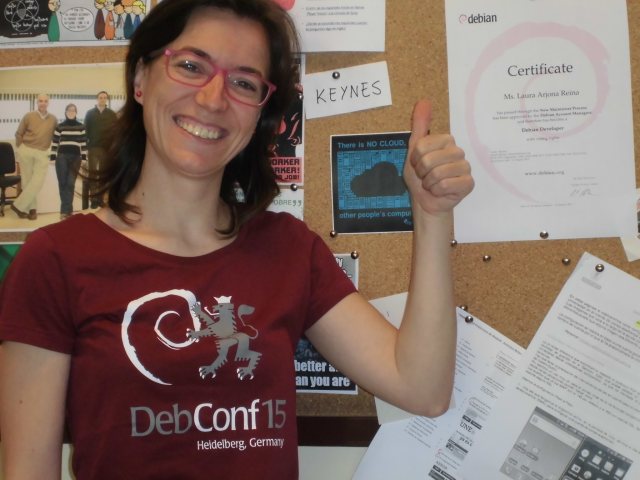
Filed under: My experiences and opinion, News Tagged: Communities, Contributing to libre software, Debian, Developer motivations, encryption, English, Free Software, gpg, libre software

14 October 2015

Norbert Preining: On Lars Wirzenius, Mart n Ferrari, and Debian

Now that the tsunami that followed my recent blog post has passed, I can read through all the nice comments and blogs of other people. I didn t expect that just writing up some links to posts on LKML, plus adding my personal opinion on what has happened and about my interpretation concerning Debian could gather so much attention. Anyway, let us look at the blog posts written in the aftermath. debian-newspeak-coc In particular do I want to answer to two blogs: Lars Wirzenius blog and Mart n Ferrari s blog, both of which are excellent examples of insults. I also want to mention that although the previous two are bad examples, there are fortunately also those who are able to resist primitive insults, in particular Gunnar Wolf (direct link to the blog does not work), and Miriam Ruiz blog, which contradict my blog and propose a different view, without pulling the knife. Lars Wirzenius Let us start with Lars (ah sorry, I have to call him Wirzenius here, strange custom has suddenly popped up in Debian!):
I think Preining mis-characterises what happens on the Linux kernel mailing list, and in Debian, in free software development in general, and what Sarah Sharp has said and done. I continue to think he is wrong about everything on this topic.
I am very surprised that Lars^WWirzenius is in possession of a crystal ball that allows him to see and evaluate my attitude towards all these items, considering that I have presented links to posts on the LKML, and yes, my interpretation of the matter. Mind that the whole text amounts to about 130 lines on my screen, while my personal opinion was stated in two paragraphs of total 9 lines plus some interspersed comments. And in these maybe 20 lines I didn t make general statements about open source, kernel development etc etc. Lars, I know you have closed your blog for comments so I couldn t ask you but please, can you send me one of your crystal balls if you have more of them? At least he has managed to keep a bit of proper writing and disagreed with my statement on Debian (whether there is fun or not in Debian). He is of course free to do that, but please, don t rob me the right to state that I think Debian has changed. All this dispute centers around people not being capable to distinguish two things: One, being against the Code of Conduct due to the inclusion of administrative actions without clear definitions, and Two, being pro offensive behavior and and insults. Now, dear Lars^WWirzenius, please listen: I never advocated abusive behavior or insults, nor do I defend it. (Did you hear that!) I simply opposed the Code of Conduct as ruling instrument. And what kind of emails I got due to my opposition was far outside the Code of Conduct you are so strongly defending. So please, stay at the facts, and stop insulting me. Thanks. Mart n Ferrari Concerning Mart n I don t have much to say but please, stop spreading lies. You stated:
Once again, he s complaining about how the fun from Debian has been lost because making sexist jokes, or treating other people like shit is not allowed any more.
Could you please come up with a reference to this? Or are you just interpreting? I am very disappointed about this level of discussion between Debian Developers. You not even cared to answer my comment on your blog. Should I say something clear here you should be happy that this has not been written on a Debian mailing list, otherwise I hope the Code of Conduct hammer would hit you.
So yes, it seems that at least these two blogs underline exactly what my opinion is: Communication culture in Debian has changed to be more company-like. Probably due to the ever increasing amount of developers that are paid for their work on Debian (Ubuntu), the pressure to follow US company codes has taken a firm grip, so firm that even stating my diverging opinion is already enough to get branded. Good Future!

13 October 2015

Norbert Preining: (Kim Doo Soo) ( , Free Spirit)

On the recently reviewed album International Sad Hits Vol 1 I wrote that Kim Doo Soo was the great surprise of the CD for me. So I went ahead and bought (not that easy, import from US!) one of his most recommended album, the Free Spirit. Kim_Doo_Soo-Free_Spirit Sad songs, full of melancholy, speaking of desperation, isolation, destroyed love. The music and singing is simple, mainly based on guitar and voice only, at times harmonica, strings and others are added. In contrast to the Crying Philosopher Tomokawa Kazuki, the songs are all very melodic and easy to listen, but still carrying a strong impact. After listening to these songs, the melodies wander around my brain resonating again and again, like (mis)guiding lights in a dark forest. kim-doo-soo-japanese-textAll the songs are in Korean, but fortunately the accompanying booklet carries a Japanese translation for the Korean incapables like me. In the future I will provide some translations into English, since I believe that this artist should be more known outside this small area. While a friend of mine said I don t like (bimbokusai) music, I have to say I enjoy reading through the sad stories while listening to this special music.
This is the 2002 fourth album by Korea s true cult folk/singer-songwriter hero, Kim Doo Soo. Kim Doo Soo is perhaps the deepest and most introspective of Korea s acid folk singers. Legends surround his songs political oppression, alcoholism, suicide, a 10-year period of mountain seclusion. [ ] On Free Spirit he mines productive veins of profound melancholy, animistic nature, and unfathomable, hermetic affection. These songs are couched in a veil of gorgeous, still melodicism, Kim s quavering vocals and guitar shaded with subtle accordion, cello, organ and harmonica. A reflective and unearthly masterpiece.
Forced Exposure
To this I cannot add anything more eloquent! The songs on this CD are as follows, the English translation is taken from Kim Doo Soo s official web page.
  1. (Wild flower)
  2. (Boat for the shore)
  3. (Butterfly)
  4. (Sweetbrier)
  5. (Bohemian)
  6. (Dawn rain)
  7. 19 Blues (Blues of 19th street)
  8. (Mountain)
  9. (As time goes by)
  10. Romantic Horizon
  11. ( ) (Reminiscence)
  12. (Evening river)
  13. ( ) (Bohemian poetry)
  14. , (Dandelion, dandelion)
My favorites under these songs are Boat for the shore ( You aren t coming any more onto a wild sea I am leaving ), Bohemian ( I m going to the shores of emptiness, my free spirit flows down the river probably his most famous song, assumed to be responsible for his retreat to the mountains), Dawn rain (A lovely song, and the only one without Japanese translation! Very strange.), Mountain ( Mountains Mountains my dream, mountains ). But I can recommend each and every song on this CD. To close this short review, if you are interested in something else but the usual happy-pappy KPop or JPop or USPop, and are searching for inspiring and songs with Tiefgang (deep meaning, as we say it in German), give this special artist a try! Some links concerning Kim Doo Soo that might be useful:

12 October 2015

Steve Kemp: So about that idea of using ssh-keygen on untrusted input?

My previous blog post related to using ssh-keygen to generate fingerprints from SSH public keys. At the back of my mind was the fear that running the command against untrusted, user-supplied, keys might be a bad plan. So I figured I'd do some fuzzing to reassure myself. The most excellent LWN recently published a piece on Fuzzing with american fuzzy lop, so with that to guide me I generated a pair of SSH public keys, and set to work. Two days later I found an SSH public key that would make ssh-keygen segfault, and equally the SSH client (same parser), so that was a shock. The good news is that my Perl module to fingerprint keys is used like so:
my $helper = SSHKey::Fingerprint->new( key => "ssh ...." );
if ( $helper->valid() )  
   my $fingerprint = $helper->fingerprint();
   ...
 
The validity-test catches my bogus key, so in my personal use-cases this OK. That said it's a surprise to see this:
skx@shelob ~ $ ssh -i key.trigger.pub steve@ssh.steve.org.uk 
Segmentation fault
Similarly running "ssh-keygen -l -f ~/key.trigger.pub" results in an identical segfault. In practice this is a low risk issue, hence mentioning it, and filing the bug-report publicly, even if code execution is possible. Because in practice how many times do people fingerprint keys from unknown sources? Except for things like githubs key management page? Some people probably do it, but I assume they do it infrequently and only after some minimal checking. Anyway we'll say this is my my first security issue of 2015, we'll call it #roadhouse, and we'll get right on trademarking the term, designing the logo, and selling out for all the filthy filthy lucre ;)

Next.

Previous.