Search Results: "angel"

11 April 2007

MJ Ray: Online Banking: What works with GNU/Linux? (12)

Added: Banco R o, ING Bank l ski, mBank, Sparkasse I notice that Jonathan's earth.li presence: Planned bank outages notes Cahoot's good approach and asks about others. I've sometimes seen announcements on the web pages of NPBS and Co-operative Bank, but no email unless it appears in their routine email newsletters. How about others? (I've posted this comment here because the presence is a login-to-comment site.)

Maximilian Attems: Happy switch from bzr to git

The cardinal reason for the switch is collaboration: git scales. During my bzr usage time of the last year i observed the following shortcomings of bzr:
  • Speed - This improved a bit lately but not enough for my q&d usage.
  • Documentation - Beside the obvious "svn-style" commands the usage of the other commands isn't obvious and the man pages lack examples. git is not perfect in that regard, but you quickly find typical usage pattern on wiki tutorials or on many google hits.
  • Pager - On big diff output bzr doesn't pipe that to pager^Wless. I consider that as a big usability bug.
  • Branches - I recently learned that a bzr repository corresponds to a git repo with just one branch. This seems strangely complicated. I really love to have different branches ready to checkout in my pwd . This short-coming blocks cooperation as i'm not confident enough to fetch random changes from bug reporters in my own branch.
  • Minor Nitpicks:
    * Push command - Defaults on the non-obvious old sftp protocol. Worked with rsync on some very ancient version.
    * Repo format - Changes on every major upgrade.
    * Patchlevel - Probably for svn compat reason the chosen default patchlevel is -p0 not -p1.
  • Latest initramfs-tools repo is available at:
    git clone git://git.debian.org/git/kernel/initramfs-tools.git Thanks to tailor it is now possible to move from different version control systems. For git as target repository it is recommended to use latest upstream either directly via darcs or at least install the unstable version. The etch version throws strange python backtraces.

    6 April 2007

    MJ Ray: Online Banking: What works with GNU/Linux? (11)

    Added: List of Sweden Banks; BBVA Bancomer, Bendigo Bank, HSBC Canada, Rabobank, San Paolo IMI, Santander, Skandinaviska Enskilda Banken Updated: Nordea Thanks again for the updates, especially the new country list.

    3 April 2007

    MJ Ray: Web searchers: Your Questions Answered

    Totally unoriginal, but I thought it was amusing. I also get some strange search phrases: "My gas meter is making a clicking noise" - then stop using the computer and call your gas company! (In England, the contact number should be on a label on the meter, or in most phone books under "Gas".) "My computer is making loud ticking noise" - that's better. Open the case and listen to the fans and hard disks. One is probably broken. "How many cars are there on the roads today" - too damn many? "How to send an email so that everyone doesn t see the addresses" - put yourself in the To line and everyone else in the Bcc (blind carbon copy). See my email guide for other handy tips. "How do i say in an email that there is an attachment" - How about "There is an attachment"? "Samsung yp-u2 linux" - it works as long as you don't want to upgrade the firmware. More... "How to satellite aiming motor europa" - point it at the sky, not at europa. I'll add more instructions to my satellite page as I rebuild my system. "MJ bad" - at least there are 4 times as many "good" searches. "How do I get the software for the samsung ml-4500" and "Samsung ml-4500 xp drivers" - I have a Ghostscript driver patch. Does Ghostscript work as a printer driver on XP? "Cycle tracks near sandringham" - there's part of NCN1 alongside the A149, but most of the other cycle routes near Sandringham are along quiet roads (which is fine). "What does wag stand for regarding football?" - Wives And Girlfriends. BTW it's a stupid TLA IMO. "Wretton planning", "Wretton parish council", "business properties for sale in Wretton" and "properties for sale in field lane Wretton" - I've not been to Wretton in some time, let alone mentioned its planning or set up an estate agent there! "How to grow grapevine in a conservatory?" - damned if I know. I would think the temperature change each time you open a door would hurt it too much. "Hanging washing out over night" - it's a bad idea if it's going to freeze. "Why some people take so long to reply to emails" - we're busy trying to thaw the washing out. "Satellite frequency for ulster tv for sky plus box" - 10906MHz Vertical polarisation 22Msym/s, but can you record "other channels" on Sky Plus or should you buy a real DVR? "Where can i find a picture of st james swimming pool in kings lynn?" - try Norlink's Picture Norfolk section. "What happened to opensource.org?" - It was transferred from SPI to OSI. Strangely, the next search phrase listed was "simple example of unethical behaviour"... "What to do about death?" - be very still and start to rot? "bf uk cbhf" - I give up. Did 8 of you headbutt the keyboard? "I hate belkin" - Me too. "Interesting questions to ask someone" - no, not on this site. "Bar" - best idea yet. Cheers!

    MJ Ray: Online Banking: What works with GNU/Linux? (10)

    Added: Handelsbanken, Vermont State Employees Credit Union, ING Direct US, Monte dei Paschi di Siena, Banca Sella Updated: HSBC, 1822direkt Thanks again everyone. Anyone want to keep a list for their own country? Please?

    Erich Schubert: Launchpad and usefulness

    Launchpad, Ubuntus proprietary (!) bug tracker has received a facelift. I'm deliberately calling it a facelift, because I still don't understand it. It sure is a lot prettier than Debians bug tracking, and it likely has some really nifty features, too, but I'm totally lacking the basics: Have a look at this bug for example. It's about the Intel ipw3945 driver being unstable on systems with SMP and load when using WPA2 encrypted networks. Launchpad says "fix committed" for linux-source-2.6.17, but I still havn't found out in which revision of that package. Or how I could actually find out how they fixed the bug. Or how I could access that information. Nor have I found any way to access changelogs for the packages.

    2 April 2007

    MJ Ray: Online Banking: What works with GNU/Linux? (9)

    Added: Cr dit Coop ratif, link to French compilation, Skandiabanken, postbank, 1822direkt, Deutsche Kreditbank AG, ing-diba Question from Carsten Aulbert: some banks "offer HBCI with cards, but so far I haven't tried it. Do you happen to know a good link, which cardreaders are supported under Linux?"

    1 April 2007

    MJ Ray: Online Banking: What works with GNU/Linux? (8)

    Added: Clydesdale, Record Bank, TD Canada Trust, Wachovia Thanks for the updates. Anyone able to confirm whether HSBC (UK) business banking works?

    28 March 2007

    Neil Williams: Cross-building a rootfs

    With updated cross-building toolchains and a much improved emdebian-tools package, work has finally started on actually building cross-built packages for Emdebian. Wookey has identified the first set - a usable rootfs. http://wiki.debian.org/EmdebianRootfs

    Nineteen packages have been cross-built so far, from base-files and popt to util-linux and ncurses so I thought I'd make a note of how it has gone at this early stage. Packages, patches and build logs can be viewed at: http://www.emdebian.org/packages/search.php

    Results:
    ======

    1. CDBS cross-builds like a dream. No failures, no missing files, no misplaced files, no files Emdebian doesn't want (like changelogs and manpages). em_make replaces one makefile with a customised one and everything else falls into place. Fantastic.

    2. debhelper packages generally cross-build quite well - as long as debian/rules sticks to actually using debhelper rather than creating bespoke rules that just do what dh_foo would have done anyway! (I then have to go behind them and remove the custom rules to get rid of manpages etc. when if the task had been left to dh_foo, em_make would have removed dh_foo automatically. Grrr.)

    3. Packages built without CDBS or debhelper are an absolute PITA. I know it is a good exercise to build without "high-level" tools, but PLEASE, only put non-debhelper packages in the main archive if you really cannot have debhelper involved. It'd make my life SO much easier right now. :-)

    4. Splitting out the translation files into individual, dedicated, packages one per language is having two related effects: there are a plethora of packages in the repository with only 19 source packages built; the size of the main binary packages has dropped substantially. Some translation packages are 30-60kb in size but in Debian, 12 maybe 30 of these are packaged inside the main binary or a similar combined _common package. Users get no choice, it's no translations or all translations. I cribbed the idea from OpenEmbedded and it's nice to see it paying off, even if it means that 'apt-cache search' listings will be at least an order of magnitude longer in Emdebian. (Sounds like a wrapper is needed.) Need to start testing 'langupdate' soon to make sure it can cope with keeping users up to date with translations of installed programs.

    So far, haven't needed too many cache files to be used with ./configure --cache-file but I'm bound to meet those soon.

    Overall, things are going well (famous last words).

    MJ Ray: Online Banking: What works with GNU/Linux? (7)

    Thanks again to all the updaters. Please, start lists for banks in other countries and tell me about them. If a list already exists for your country, consider sending updates there first. Added: Banca Popolare Etica, Caisses Populaires Desjardins, Caja Madrid, Caja de Segovia, Fortis Bank Belgium, KBC, netbank.de, Osuuspankki, PC Financial Master Card, Soci t G n rale, Sparebank 1-Gruppen, Storebrand Bank Updated: NatWest Andrew Donnellan suggested:
    "Perhaps it would be useful to start a list of banks that *don't* work with Free Software as well so we can a) petition them, and b) boycott them until they make it work."
    I'd prefer to keep this to a positive list for various reasons (including lawyer-fear, search engine rankings, rewarding the good and saying nothing if I've nothing nice to say). If a listed bank goes bad, it will show up as Removed. If you want to rant about how a bank screwed you, please use your own site. If I see it and like it, it will appear in one of my linkposts.

    John Goerzen: Today's ethereal xkcd

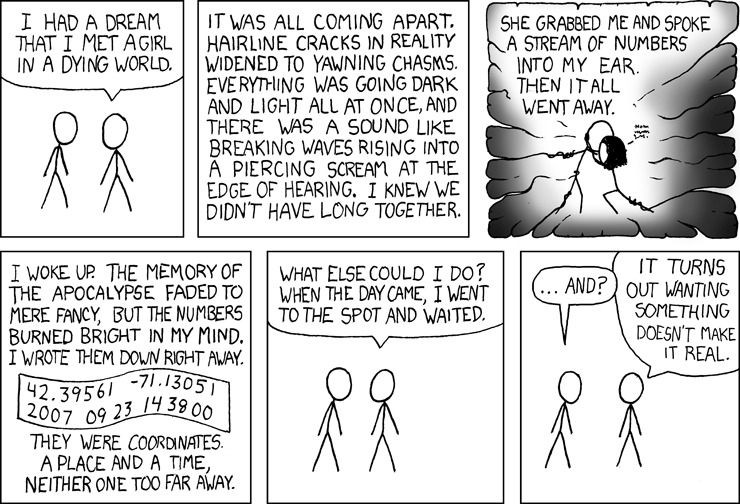
    Today's xkcd comic is:


    You can use Google Maps to look up that location.

    Looks like it's a little northwest of MIT, and north of Harvard.

    Hmm.

    I wonder what is going on there in 6 months?

    Perhaps if we all want to find out, we can make it real.

    27 March 2007

    Kai Hendry: Changelog

    Millpool path

    Axel Beckert: The Software Museum inside the Software Museum

    Most Linuxers know that Debian and most of its users prefer stable software over up-to-date software. So do I, but sometimes this goes a little bit too far, e.g. when I find software which has been compiled years before the first line of Linux kernel code has been written:
    C:\>ls +version
    GNU ls, Version 1.4.0.2 (compiled Sep 19 1990 12:43:10 for MS-DOS)
    C:\>ls -alF gnu\
    total 521
    drwxrwxrwx   1 anonymou anonymou     4096 Mar 26 23:16 ./
    drwxrwxrwx   1 anonymou anonymou     4096 Mar 26 23:17 ../
    -rwxrwxrwx   1 anonymou anonymou    17868 Sep 19  1990 cat.exe*
    -rwxrwxrwx   1 anonymou anonymou    20028 Sep 19  1990 cmp.exe*
    -rwxrwxrwx   1 anonymou anonymou    26780 Sep 19  1990 cp.exe*
    -rwxrwxrwx   1 anonymou anonymou    17948 Sep 19  1990 cut.exe*
    -rwxrwxrwx   1 anonymou anonymou    27138 Sep 24  1990 grep.exe*
    -rwxrwxrwx   1 anonymou anonymou    16572 Sep 19  1990 head.exe*
    -rwxrwxrwx   1 anonymou anonymou    27756 Sep 19  1990 ls.exe*
    -rwxrwxrwx   1 anonymou anonymou    23100 Sep 19  1990 mv.exe*
    -rwxrwxrwx   1 anonymou anonymou    19820 Sep 23  1990 rm.exe*
    -rwxrwxrwx   1 anonymou anonymou    37644 Sep 19  1990 tac.exe*
    -rwxrwxrwx   1 anonymou anonymou    20188 Sep 19  1990 tail.exe*
    C:\>
    
    And yes, this looks like DOS. This is FreeDOS (1:0.0.b9r5a-3) inside of dosemu, packaged for Debian 4.0 Etch and installed from the original Debian archives. BTW, the date looks quite authentic: According to the ChangeLog, Version 1.4 of the GNU Fileutils have been released on the 9th of September 1990. The oldest version of the GNU Fileutils (nowadays coreutils) available on the GNU FTP server is version 3.13 from July 1996, though. I really wonder how many buffer overflows this version has. And I wonder if there’s really a scenario in which this combination (Debian → dosemu → FreeDOS → GNU fileutils) could be exploited.

    26 March 2007

    Neil McGovern: Don't get free hardware, win it


    A while back, I entered a competition to win one of a few prizes. The results came in, and it looks like I was a runner up, netting me a Mac Mini.

    First, a rant about Mac OS X. It appears that there is no way to:

    They also asked me to " become one of our evangelists and tell your developer friends and colleagues about Zimki".
    Well, I'm not so sure about evangelism, but I'll certainly blog about their platform, as it's fairly interesting.
    So, what exactly is Zimki?
    Well, it's basically a server side Javascript parser, based on SeaMonkey. The thought of using Javascript as a server side language is, initially, enough to make you run a thousand miles. After you get over your initial shock of this and examine it a little more closely, it does make at least a moderate amount of sense. It's entirely OO, so you should be able to pull in common functionality, perfect for the quick deployment of Webapps that Zimki is designed for.
    Of course, this does rely on having the core libraries available. The only ones which seem to exist at the moment are: So, I can make a wiki which uses a template, and outputs it as an RSS feed. The rest I have to code myself - or do I?
    This brings me nicely on to the next issue: documentation. There is a thorough lack of it. Thus, more classes may exist, but who knows. This is my MAJOR bugbear about Zimki. Give developers docs, and a nice coding environment, and they're happy. Zimki doesn't have either. Oh wait? I haven't mentioned the coding environment?
    All editing seems to be done via a text box with some AJAX magic on the save button. But the save button doesn't work in Linux. Oh, and you can't indent your code. And you can't use a local editor.

    This may sound all doom-and-gloom for Zimki, but it isn't. The editor could do with some attention, but it's not a show stopper. Zimki does manage to throw together HA concepts, backups and database (ish. The database object idea which Zimki uses is something I really don't like, but that's personal preference). The cost model they use is rather... odd. A charge is made for each call to the Zimki framework. I'm not a beancounter though, so I can't tell you how cheap/expensive this system is. If you know JavaScript well, and want to develop a complete webapp in it, this is certainly a good tool.

    Now hopefully they'll get some documentation together and so people can actually USE the thing. If you're bored, why not play with my app that I wrote.

    John Goerzen: Some more git, mercurial, and darcs

    Ted Ts'o had an interesting post about git recently. He has a lot of good thoughts on the subject. He comments that he wound up using git because it's so Unixy (with its small commands to do things), that he sees the git community developing innovations faster than Mercurial, and that they are working to improve the documentation and user interface problems.

    The being so Unixy is a double-edged sword. On the one hand, it can make it easy to write shell scripts to extend Git. That itself can be a double-edged sword (think filename quoting and the like). But one doesn't have to use the shell. The other downside is that being Unixy makes it hard to run on platforms that aren't, such as Windows. So if one is working on Unix-only software (X, the kernel, e2fsprogs, etc.), there's no need to care about it. But if you're a person like me, who has Windows users using my software, or a large organization like Mozilla, it's maybe a showstopper. Of course, workarounds exist (cygwin, git-cvsserver), but none of them are particularly nice.

    I think that both Git and Mercurial are working to address their shortcomings. I've chosen hg for now because it does what I need now. And because there are very nice tools to convert hg to git, and vice-versa. So if Ted's right, and a year from now git is easier to use, better documented, more featureful, and runs well on Windows, it won't be that hard to switch over and preserve history. Ted's the sort of person that usually is right, so maybe I should starting looking at hg2git right now

    So following up on my bzr post, here are the things that Mercurial is great at right now:

    1. Performance. Approximately even with git, occasionally faster. Nobody else can compete with these two right now.
    2. Simplicity. It's almost as easy to get started as with darcs, and with recent patches, will be even closer in the future.
    3. Lots of ways to interact. You can send hg bundles, which preserve all metadata (parents, hash, authors, etc), or you can send git-format email patches, or you can push and pull between repos. The email tools will shortly be able to automatically detect what patches to send. Your choice. git doesn't seem to support lossless emailing of bundles like this, and bzr doesn't make emailing of anything easy by default.
    4. Merging. hg seems to be able to automatically resolve more merge conflicts than anything else, and when it can't automatically resolve them, has a nicely configurable system to let you use your choice of tool to manually resolve them.
    5. Community. The Mercurial community is open and inviting, and open to new/different ideas. It seems similar to Darcs in that respect, and somewhat dissimilar to git.
    6. Rebase does not trash history like it does (barring undocumented manual intervention) in git.


    I've written before about Darcs, so I won't duplicate that here.

    25 March 2007

    Evan Prodromou: 4 Germinal CCXV

    Today is, of course, 4 Germinal, but it's also known in some circles as March 25. It's the Greek national holiday, ikosi-pente martiou, celebrating the beginning of the Greek War of Independence. The Greek revolution is one of my favorites -- rich in fiery spirit, insuperable odds, derring-do, and undying idealism. It also lent English the word eleutheria, what John Fowles in The Magus called "the most Greek of all words": in translation, roughly, freedom. It's also the traditional feast of the Annunciation, being exactly nine months before Christmas. Since the angel Gabriel gave the Virgin Mary the "good news" (of the virgin birth), in Greek evangelismos, it's also my name day, and the name day of all other Evangelo's out there. tags:

    24 March 2007

    Theodore Ts'o: Git and hg

    John Goerzen recently posted about Git, Mercurial and Bzr that I found interesting, especially since I used to be in the hg camp, but have been gradually using git more and more, even to the point making minor improvements to the git documentation and writing the git mergetool, since being able to automatically fire up a graphical merge tool was one of the features which I missed from hg. So while I haven't yet converted the primary SCM repository for e2fsprogs to use git (yet), I've reached an opposite concolusion from John, and yet, I can't really argue with his observations.

    The main reason why I've come out in favor of git is that I see its potential as being greater than hg, and so while it definitely has some ease-of-use and documentation shortcomings, in the long run I think it has "more legs" than hg, and with the release of git 1.5.0, it became clear that the git community was willing to work on these particular shortcomings, which is why I started working on it and making plans to migrate e2fsprogs to use git. The main reasons why I think git is more powerful is that not just that it supports lightweight branches inside a single repository (although I really do like that a lot since it makes it a lot easier to run multiple experiments in parallel and switch back and forth between them), but also because git is much more Unix-like; there are lots of tools that enable scripting for either new git extensions or for ad-hoc shell pipelines that you can't really easily do in hg without breaking into Python.

    But git definitely does have shortcomings, and John is on the mark with most of them. Git's documentation is very poor. Part of the problem stems for tutorials that were written to work with older versions of git (don't try using anything older than git 1.5 if you are a git newbie; git 1.4.x is far more user-hostile) or were written for use with systems built on top of git 1.4.x, such as Cogito. (I don't recommend Cogito, since git 1.5 is significantly more usable, and I've always found Cogito to be more confusing that just using stack git.) The tutorials that are distributed with git 1.5 are much better, but they clear do need more work.

    It is true that the many of the man pages in git are lacking, and John's criticism of the fact that many man pages do not list all of the options that they take, but rather refer to other man pages is on point and accurate. It has gotten better (take a look at the git-diff man page from the git 1.4.x days, and laugh or cry, depending on your point of view) but there is still much work to be done. In practice, the better way to use the git man pages is to skip past the options section, and take a look at the Examples section. This shows a number of ways that a particular command might be used, just as a Unix master might say, "Grasshoper, see how you can use awk to do all of these amazing things."

    I do take issue with John's assertion that git's philosophy has been to make life easy for the central maintainer, and not to pay much attention to the needs of individual contributors. That may have been Linus's development priorities but with Junio having taking over maintenance, there have been a lot of improvements in git 1.5.0 to make life easier for people who are tracking remote repositories and making changes, in particular the git remote command.

    The most interesting observation which John made was the non-intuitive semantics of git-format-patches, and I did find it interesting that one commenter posted a solution which made perfect sense given other git commands, and yet didn't work. Obviously the person who posted the comment didn't bother to try it first, probably because in most other places git is actually pretty consistent; but git-format-patch is one of the places where most painfully is not. I view this as a bug that should be fixed, and fortunately I think it can be fixed without breaking the git-format-patches is currently being used. (The problem is that it doesn't use the standard notation so it is more convenient in the common case of how it is normally used, where the end point is not specified and is always the the tip of the current branch. I believe we can avoid the UI surprise by making git-format-patch use the standard revision range parsing if parameter contains the ".." or "..." operators. I'll have to try to prepare a patch which does this and see whether it gets accepted.)

    So basically git does have short-comings, yes, but people will come out in different places about which tools is best for them, and that's OK. Actually, I think the ultimate solution for this problem is to build a bidrectoinal hg/git gateway. There are tools that will export from hg to git, and vice versa, and they are actually pretty sophisticated. I don't think it should be that painful to create a tool that does incremental exports in both directions, maintaining state so that the right thing happens when a commit gets made on the git side, and gets exported into hg, or vice versa. Ultimately I think that's the best solution, since that way people can use whatever tool they want, and still contribute and development as first class citizens. This is the main reason why I've held off on converting e2fsprogs to git (although I have made some private test repositories which I'll use to take advantage of git's superior annotation and query/log utilities); I don't want to make a git repository of e2fsprogs public until I'm sure that a bidrectional gateway tool won't require me to make any changes that affect the commit-id's, since that would invalidate any work that people have done that was based on a clone of the coverted git repository.

    I have a rough design for how to do the bidirectional gateway, but the issue is finding time to implement it. Anyone with free time looking for a project? If so, contact me. I probably should have written this up as a potential Google Summer of Code project, but it's too late for this year. Oh, well.

    23 March 2007

    John Goerzen: bzr, again

    I've talked a lot lately about different VCSs.

    I got some interesting comments in reply to my most recent post. One person took issue with my complaint that nobody really understood how to specify a revision to git format-patch, and proceeded to issue an incorrect suggestion. And a couple of people complained about my comments about bzr, which generally came down to the released version of bzr didn't have anything compelling and also didn't support tags.

    So I went into #bzr, asked them what bzr has that git, Mercurial, and darcs don't. And gave bzr the benefit of the doubt that 0.15 will be out soon and will be stable. What I got back were these general items:

    1. Renaming of directories (not in hg, git)
    2. 2-way sync with Subversion (not in hg, darcs)
    3. Checkouts (not in any others by default)
    4. No server-side push requirement


    Let's look at these in more detail.

    1. Renaming of directories

    All of them can rename files and (excepting git) completely accurately track back the file's history. But consider this: if person A commits a change to branch A that adds a file, and person B then renames the directory that the file is in on his branch, will a merge cause person A's file to appear in the new directory name? In darcs and bzr, yes. In Mercurial and git, no.

    So yes, this is a nice thing. But I have never actually had this situation crop up in practice, and even if it did, could be trivially remedied. I would say that for me, I don't really care.

    [Update: Current stable releases of Mercurial can do this too. I'm not quite sure how, but it does work. So git is the only one that can't do that.]

    2. 2-way sync with Subversion

    This is a really nice feature and is present in both git and bzr. I haven't tested it either place, but if it works as advertised -- and properly supports tracking multiple related svn branches and merges -- would be slick. That was enough to make me consider using git, but in retrospect, I so rarely interact with people using svn that it is not that big a deal to me.

    Still, for those that have to work with svn users, this feature in bzr and git could be a big one.

    Better yet would be to get all those svn holdouts over to DVCS.

    3. Checkouts

    A bzr checkout is basically a way to make local commits be pushed to the remote repo immediately, as with svn. This is of no utility to me, though I can see some may have a use for it. But it can be done with hg hooks and probably approximated with scripting in others.

    4. No server-side process necessary for pushing repos

    bzr has built-in support to push to a server that has sftp only, and doesn't require a copy of itself on the server. While I believe that none of the other three have that, it is possible to rsync (and probably ftp) darcs and Mercurial repos to a server in a safe fashion by moving repo files in a defined order. Probably also possible with git. All four can pull repos using nothing but regular HTTP.

    What bzr still doesn't have

    Integrated patch emailing. The big thing is that it has no built-in emailing of patches support. darcs is extremely strong in this area, followed by hg, and git is probably third. "darcs send" is all it takes to have darcs look at the remote repo, figure out what you have that they don't, and e-mail a bundle of changesets to them. I posted an extension and later a patchset that does all this for Mercurial except for automatically figuring out what default email address to do (that'll come in a few days, I think). One feature Mercurial has had for awhile that Darcs hasn't is sending multiple textual diffs as a thread, with one message per changeset. bzr doesn't have any support for emailing patches yet, which is disappointing. Because of the strong support for this in darcs and Mercurial, people running those systems feel less of a need to publish their repos.

    [Update: There is a plugin for bzr that seems to address some of this. I haven't tested it, and it's not in bzr core (so doesn't quite meet my very friendly for a newbie requirement), but this does exist, though apparently not as advanced as Mercurial]

    Performance. Supposedly 0.15 is supposed to be better on this, but even if bzr achieves the claimed doubling of performance, most benchmarks I have seen would rate it as still being significantly behind git and Mercurial, though it may overtake darcs in some tests.

    Extensive documentation. I would say that bzr's docs are better in some ways than git's (its tutorials especially), but lack depth. If you want to know some detail about how the repository works on-disk, it's not really documented. Darcs still has David's excellent manual, and Mercurial has the hg book which is still great as well.

    Merging not as advanced. darcs is pretty obviously way on top here, but of the others, Mercurial does a pretty good job with its automatic handling of renames and automatic resolving of different branches that commit the same change (even if that same change is a rename, or an add of the same content). bzr can't resolve as much automatically.

    Summary

    Well, I'll say that bzr still doesn't look compelling enough for my use cases to use, and the lack of an easy-for-a-newbie-to-use automated email submission feature is a pretty big disappointment. Though I did appreciate the time those on #bzr spent with me, and if I needed to sync with svn users frequently, I'd probably choose bzr over git.

    For now, I'm happy with sticking with darcs for my code and hg for my Debian work.

    But all four communities are aggressively working on their weaknesses, and this landscape may look very different in a year.

    22 March 2007

    MJ Ray: Online Banking: What works with GNU/Linux? (6)

    And so this breaks the record and becomes the longest-running item on my blog. Thanks for all the updates. Are there really no up-to-date lists for banks in other countries? Added: S st pankki Updated: National Australia Bank, ING Bank, ING Direct

    John Goerzen: More on Git, Mercurial, and Bzr

    I've been writing a lot about this lately, I know, but it's an interesting landscape.

    I had previously discarded git, but in light of git-cvsserver (which provides a plausible way for Windows people to participate), I gave it a try.

    The first thing I noticed is that git documentation, in general, is really poor. Some tutorials that claim to cover git actually cover cogito. Still others use commands that are much more complex than those in the current git -- and these just the ones linked to from the git homepage.

    git's manpages aren't much better. There are quite a few git commands (such as log) that take arguments that other git commands accept. Sometimes this fact is documented with a pointer to these other commands, but often not; a person is left guessing what the full range of accepted arguments are.

    My complaint that git is overly complex still exists. They've made progress, but still have a serious issue here. Part is because of the docuemtnation, and part is because of the interface. I wanted to export to diffs all patches on the current branch in a repo. I asked on #git, and someone suggested using the revision specifier ..HEAD. Nope, didn't work. A few other git experts chimed in, and none could come up with the correct recipe. I finally used -500, which worked but is hackish.

    git's lack of even offering support for a human to indicate renames also bothers me, though trustworthy people have assured me that it doesn't generally cause a problem in practice.

    git does have nicer intra-repo branching than Mercurial does, for the moment. But the Mercurial folks are working on that anyway, and branching to new directories still works fine for me.

    But in general, git's philosophy is to make things easy for the upstream maintainer, and doesn't spend much effort making things easy for contributors (except to make it mildly easier to contribute to a large project like Linux). Most of my software doesn't have a large developer community, and I want to make it as easy as possible for new developers to join in and participate. git still utterly fails on that.

    I tried bzr again. It seems that every time I try it, after just a few minutes, I am repulsed. This time, I stopped when I realized that bzr doesn't support tags and has no support for emailing changesets whatsoever. As someone that has really liked darcs send (and even used tags way back with CVS!), this is alarming. The tutorial on the bzr website referenced a command "bzr help topics", which does not work.

    So I'll stick with my mercurial and darcs combination for now.

    I announced the first version of a hg send extension yesterday as well. I think Mercurial is very close to having a working equivalent to darcs send.

    Next.

    Previous.