Search Results: "ah"

5 April 2013

Andrew Pollock: [life/repatexpat] Day #5 of repatriation -- the crash

The jet lag, the lack of sleep, and the general pace of the week has caught up with me. I'm feeling decidedly run down today. Leah volunteered to drive me around a bit today, and it was great to catch up with her. I decided to check out a white 2004 Forester that I'd found on carsales.com.au the night before. I took it for a test drive, and it seemed fine. I transferred my NRMA membership back to the RACQ and upped it to something decent, and arranged for them to do an inspection on Monday. Depending on when the inspection report gets to me, I'll head back there with a bank cheque and I'll have a car. I had another half-hearted look at furniture after lunch (I really wasn't feeling it) and then headed over to Woolloongabba to take a look at the condition of Sarah's apartment. The low light of the day was leaving my packet of car-related paperwork (including my temporary driver's licence) on the roof of her car as we left Woolloongabba. It should only be mildly inconvenient, but I was annoyed with myself for being so dumb. Tomorrow should be pretty quiet. I just have my bed getting delivered at 8:30am, then I'll stay in my apartment from then on. I think I'll just take it easy.

4 April 2013

Andrew Pollock: [life/repatexpat] Day #4 of repatriation -- delivery central

Today was spent at my apartment with Zoe. Harvey Norman were scheduled to deliver the fridge, washing machine and TV. Someone from Telstra was scheduled to come out and monkey with the MDF to get the naked ADSL happening, and my desk was scheduled to be delivered. My parents drove us over in the morning, with some of our suitcases. Zoe was very happy with her new room and bed. I was going to get a 1 hour advance warning of Harvey Norman coming, so we all went for a little walk around the neighbourhood to explore. It turns out there's a convenience store right next door, which is, well extremely convenient. I won't need to even hop in the car to get last minute bread or milk or anything like that. Very happy about that. There's also a really gorgeous little boutique deli/gourmet grocery that is easily within walking distance. The neighbourhood is indeed very nice. Mid-morning, Brent dropped around with his daughter to say hi. Zoe had a good time playing with her as well, and we went out for lunch at the Hawthorne Garage. At the end of lunch, Harvey Norman called to say they'd be an hour away, which was well timed. Zoe declined to nap again, so we just hung out waiting for the delivery. In the middle of them delivering, the desk delivery happened as well, and then as Brent was leaving, the Telstra guy turned up, so it all happened at once. I set up the TV and DVD player and Zoe happily christened it all by watching some Play School DVDs, and then my Dad came back and picked us up. So the apartment is now almost habitable. I just need my bed. That's scheduled for Saturday. I'm planning on sleeping there on Saturday night. In the furniture department, I'm still lacking a sofa, a dining table and something to put the TV on. Leah has volunteered to help me shop tomorrow, but I'm starting to think I should focus on resolving the lack of a car, then I can do any further shopping myself. Nick had set me up with a car wholesaler who was going to search for a used Subaru Forester for me, but so far he hasn't turned anything up, so I'm thinking I need to widen my net a little and use some other avenues as well. I'd really wanted for the car finding to be outsourced as much as possible so I could focus on other things, but it's not looking like that's going to be the case, and I really need mobility. I got a notification from Internode after I'd left today that the Internet should now be working, so I need to configure the ADSL router when I next get a chance and confirm that's the case, then I'm all sorted for being technologically able to work from home.

3 April 2013

Daniel Pocock: The multiple repository conundrum in Linux packaging

I'm involved with a number of free software projects as both a developer and as the maintainer of packages for various distributions such as Debian (which also feeds packages to Ubuntu) and OpenCSW. I regularly come across the following situations:
  • Developers of great software who would like to see it packaged, distributed and promoted conveniently through platforms like Debian
  • Users of Linux distributions who are keen to use free software if it is presented in a convenient and accessible manner they are familiar with.
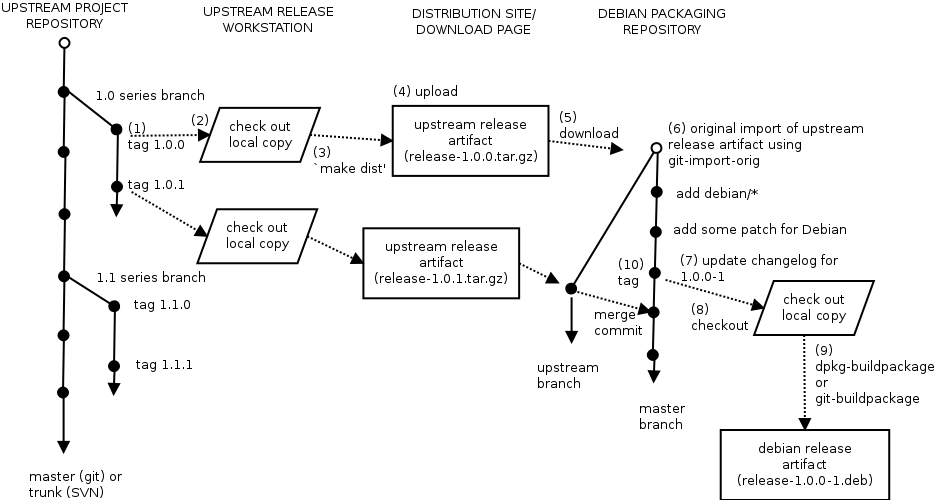
Sadly, despite everybody having the best intentions, there is sometimes a chasm separating these two groups of people. Upstream developers are often busy developing new features and don't have time to work on the intricacies of packaging. I hope that by sharing a few of my own experiences I can help more developers get their software packaged more easily. Fortunately, a number of great tools like git-buildpackage have emerged for streamlining the packaging process, but this has also created more confusion for developers who have their own git repositories and don't quite understand how the Debian git repository and patching process relates to their own repository. The autotools world Here, I focus on autotools based software, because this type of software has it's own peculiar issues when packaging. In particular, these issues appear when using a version control system to track upstream releases. Some of the concepts can be applied to the study of regular Makefile or cmake projects as well. Here is a diagram giving an overview: Let's work through each of the steps in the diagram: The upstream release
  1. The developer/release manager updates the version number in
    configure.ac
    (sometimes called configure.in) and tags the code. (Usually this tag is on a dedicated release branch.)
  2. The developer checks out a copy of the code from the tag into a fresh working directory
  3. The developer runs the autoreconf/automake tools, usually from a bootstrap script. These tools create a number of new files that don't exist in the project repository. Finally, the developer runs
    make dist
    , which puts all the files,
    including the generated files, into a distribution tarball. It is worth emphasizing this point: the tarball is not just an archive of the files from the repository/tag, it also contains a number of
    files generated by autotools.
  4. The developer uploads the tarball to a web site such as the Sourceforge download page. Usually a release announcement is made now containing checksums for the tarball.
At this point, the upstream developer's work is done and packaging teams from various projects such as Debian will take over. Sometimes, the upstream developer is also building the packages and continues
onto the next steps himself: Packaging
  1. The package is downloaded by the package maintainer
  2. If it is the first download, the maintainer creates a new git repository. If it has been packaged before, he clones the repository. The important point here is that this is not the upstream repository, it is an independent repository for Debian packaging. The maintainer uses the git-import-orig tool to import the upstream tarball into the packaging repository. The git-import-orig tool captures an exact snapshot of the upstream release tarball contents in a branch called upstream. One point where the Debian repository differs fundamentally from the upstream repository is that all files from the tarball will be tracked in the Debian git repository, even those automatically generated files that were created by autotools and don't exist in the upstream repository.
  3. The maintainer creates or updates the various artifacts for packaging. These files are kept on the master branch, and the tarball contents from the upstream branch are merged into master to create packages.
  4. When the maintainer feels the code is ready, he will check out a clean copy of the repository to build the package from.
  5. The maintainer executes a tool such as git-buildpackage or regular dpkg-buildpackage, which creates the *.deb files.
  6. The files are checked with a tool like lintian and some manual testing/installation. If all is OK, a tag is made in the packaging repository, with a suffix appended to the upstream version number to indicate which iteration of the package it applies to.
AttachmentSize
release-packaging-workflow.dia3.97 KB

1 April 2013

Francois Marier: Poor man's RAID1 between an SSD and a hard drive

After moving from a hard drive to an SSD on my work laptop, I decided to keep the hard drive spinning and use it as a backup for the SSD. With the following setup, I can pull the SSD out of my laptop and it should still boot up normally with all of my data on the hard drive.

Manually setting up an encrypted root partition Before setting up the synchronization between the two drives, I had to replicate the partition setup. I used fdisk, cfdisk and gparted to create the following partitions:
   Device Boot      Start         End      Blocks   Id  System
/dev/sdb1   *        2048      499711      248832   83  Linux
/dev/sdb2          501760   500117503   249807872    5  Extended
/dev/sdb5          503808   500117503   249806848   83  Linux
and then loosely followed these instructions to create an encrypted root partition on /dev/sdb5:
$ cryptsetup luksFormat /dev/sdb5
$ cryptsetup luksOpen /dev/sdb5 sdb5_crypt
$ pvcreate /dev/mapper/sdb5_crypt
$ vgcreate akranes2 /dev/mapper/sdb5_crypt
$ vgchange -a y akranes2
$ lvcreate -L247329718272B -nroot akranes2
$ lvcreate -L8468299776B -nswap_1 akranes2
$ mkfs.ext4 /dev/akranes2/root
Finally, I added the new encrypted partition to the list of drives to bring up at boot time by looking up its UUID:
$ cryptsetup luksUUID sdb5_crypt
and creating a new entry for it in /etc/crypttab.

Copying the boot partition Setting up the boot partition was much easier because it's not encrypted. All that was needed was to format it and then copy the files over:
$ mkfs.ext2 /dev/sdb1
$ mount /dev/sdb1 /mnt/boot
$ cp -a /boot/* /mnt/boot/
The only other thing to remember is to install grub on the boot loader of that drive. On modern Debian systems, that's usually just a matter of running dpkg-reconfigure grub-pc and adding the second drive (/dev/sdb in my case) to the list of drives to install grub on.

Sync scripts To keep the contents of the SSD and the hard drive in sync, I set up a regular rsync of the root and boot partitions using the following mount points (as defined in /etc/fstab):
/dev/mapper/akranes-root /           ext4    noatime,discard,errors=remount-ro 0       1
/dev/mapper/akranes2-root /mnt/root  ext4    noatime,errors=remount-ro         0       2
UUID=0b9109d0-... /boot              ext2    defaults                          0       2
UUID=6e6f05fb-... /mnt/boot          ext2    defaults                          0       2
I use this script (/usr/local/sbin/ssd_boot_backup) for syncing the boot partition:
#!/bin/sh
if [ ! -e /mnt/boot/hdd.mounted ] ; then
    echo "The rotating hard drive is not mounted in /mnt/boot."
    exit 1
fi
if [ ! -e /boot/ssd.mounted ] ; then
    echo "The ssd is not the boot partition"
    exit 1
fi
nice ionice -c3 rsync -aHx --delete --exclude=/ssd.mounted --exclude=/lost+found/* /boot/* /mnt/boot/
and a similar one (/usr/local/sbin/ssd_root_backup) for the root partition:
#!/bin/sh
if [ ! -e /mnt/root/hdd.mounted ] ; then
    echo "The rotating hard drive is not mounted in /mnt/root."
    exit 1
fi
if [ ! -e /ssd.mounted ] ; then
    echo "The ssd is not the root partition"
    exit 1
fi
nice ionice -c3 rsync -aHx --delete --exclude=/dev/* --exclude=/proc/* --exclude=/sys/* --exclude=/tmp/* --exclude=/boot/* --exclude=/mnt/* --exclude=/lost+found/* --exclude=/media/* --exclude=/var/tmp/* --exclude=/ssd.mounted --exclude=/var/lib/lightdm/.gvfs --exclude=/home/francois/.gvfs /* /mnt/root/
To ensure that each drive is properly mounted before the scripts run, I created empty ssd.mounted files in the root directory of each of the partitions on the SSD, and empty hdd.mounted files in the root directory of the hard drive partitions.

Cron jobs The sync scripts are run every couple of hours through this crontab:
10 */4 * * *                root    /usr/local/sbin/ssd_boot_backup
20 0,4,8,12,16,20 * * *     root    /usr/local/sbin/ssd_root_backup
20 2,6,10,14,18,22 * * *    root    /usr/bin/on_ac_power && /usr/local/sbin/ssd_root_backup
which includes a reduced frequency while running on battery to avoid spinning the hard drive up too much.

27 March 2013

Benjamin Mako Hill: The Institute for Cultural Diplomacy and Wikipedia

A month ago, Mark Donfried from the Institute for Cultural Diplomacy (ICD) an organization dedicated to promoting open dialogue sent me this letter threatening me with legal action because of contributions I ve made to Wikipedia. Yesterday, he sent me this followup threat. According to the letters, Donfried has threatened me with legal action because I participated in a discussion on Wikipedia that resulted in his organization s article being deleted. It is not anything I wrote in any Wikipedia article that made Donfried so upset although Donfried is also unhappy about at least one off-hand comment I made during the deletion discussion on a now-deleted Wikipedia process page. Donfried is unhappy that my actions, in small part, have resulted in his organization not having an article in Wikipedia. He is able to threaten me personally because unlike many people I edit Wikipedia using my real, full, name. Donfried s letter is the latest step in a saga that has been ongoing since last June. It has been a frustrating learning experience for me that has made me worried about Wikipedia, its processes, and its future. In Wikipedia, debates can be won by stamina. If you care more and argue longer, you will tend to get your way. The result, very often, is that individuals and organizations with a very strong interest in having Wikipedia say a particular thing tend to win out over other editors who just want the encyclopedia to be solid, neutral, and reliable. These less-committed editors simply have less at stake and their attention is more distributed. The ICD is a non-profit organization based in Berlin. According to its own website, a large part of the organization s activities are based around arranging conferences. Its goals peace, cultural interchange, human rights are admirable and close to my heart. Its advisors and affiliates are impressive. I had never heard of the ICD before their founder, Mark Donfried, emailed me in April 2012 asking me to give a keynote address at their conference on The 2012 International Symposium on Cultural Diplomacy & Human Rights. I replied, interested, but puzzled because my own research seems very far afield of both cultural diplomacy (which I had never heard of) and human rights. I replied saying:
What would you like me to talk about I ask because I don t consider myself an expert in (or even particularly knowledgeable about) cultural diplomacy. Did someone else refer you to me?
Donfried replied with a long message seemingly copy and pasted thanking me for considering attending and asking me for details of my talk. I replied again repeating text from my previous email and asking why he was interested in me. Donfried suggested a phone call to talk about details. But by this point, I had looked around the web for information about the ICD and had decided to decline the invitation. Among things I found was a blog post by my friend James Grimmelmann that suggests that, at least in his case, the ICD had a history of sending unsolicited email and an apparently inability to take folks off their email lists even after repeated requests. I also read the Wikipedia article about the ICD. Although the Wikipedia article was long and detailed, it sent off some internal Wikipedian-alarm-bells for me. The page read, to me, like an advertisement or something written by the organization being described; it simply did not read to me like an encyclopedia article written by a neutral third-party. I looked through the history of the article and found that the article had been created by a user called Icd_berlin who had made no other substantive edits to the encyclopedia. Upon further examination, I found that almost all other significant content contributions were from a series of anonymous editors with IP addresses associated with Berlin. I also found that a couple edits had removed criticism when it had been added to the article. The criticism was removed by an anonymous editor from Berlin. Criticisms on the article included links to a website called Inside the ICD which was a website that mostly consisted of comments by anonymous people claiming to be former interns of the ICD complaining about the working conditions at the organization. There were also many very positive descriptions of work at the ICD. A wide array of pseudonymous users on the site accused the negative commenters of being liars and detractors and the positive commenters of being ICD insiders. I also found that there had been evidence on Wikipedia also removed without discussion by an anonymous IP from Berlin of an effort launched by the youth wing of ver.di one of the largest trade unions in Germany to campaign for good internships at the ICD. Although details of the original campaign have been removed from ver.di s website, the campaigned ended after coming to an agreement with the ICD that made explicit a set of expectations and created an Intern Council. Although the article about ICD on Wikipedia had many citations, many were to the ICD s own website. Most of the rest were to articles that only tangentially mentioned the ICD. Many were about people with ICD connections but did not mention the ICD at all. As Wikipedia editor, I was worried that Wikipedia s policies on conflict of interest, advertising, neutrality, and notability were not being served by the article in its state. But as someone with no real experience or knowledge of the ICD, I wasn t sure what to do. I posted a request for help on Wikipedia asking for others to get involved and offer their opinions. It turns out, there were several editors who had tried to improve the article in the past and had been met by pro-ICD editors reverting their changes. Eventually, those editors lost patience or simply moved on to other topics. By raising the issue again, I kicked off a round of discussion about the article. At the termination of that discussion, the article was proposed for deletion under Wikipedia s Articles for Deletion policy. A new Wikipedia editor began working enthusiastically to keep the article by adding links and by arguing that the article should stay. The new user edited the Wikipedia article about me to accuse me of slander and defamation although they removed that claim after I tried to explain that I was only trying to help. I spent quite a bit of time trying to rewrite and improve the article during the deletion discussion and I went link by link through the many dozens of citations. During the deletion discussion, Mark Donfried contacted me over email and explained that his representatives had told him that I was working against the ICD in Wikipedia. He suggested that we meet. We had a tentative plan to meet in Berlin on an afternoon last July but, in the end, I was too busy trying to submit my thesis proposal and neither of us followed up to confirm a particular time within the time window we had set. I have still never met him. My feeling, toward the end of the deletion discussion on Wikipedia, was mostly exasperation. Somewhat reluctantly, I voted to delete the article saying:
Delete This AFD is a complete mess for all the reasons that the article itself is. Basically: there are a small number of people who seem to have a very strong interest in the Institute for Cultural Diplomacy having an article in Wikipedia and, from what I can tell, very little else. Hessin fahem, like all the major contributors to the page, joined Wikipedia in order to participate in this issue. This article has serious problems. I have posted a detailed list of my problems on the article talk page: primary sources, conflict of interest for nearly all substantive contributions and reading like an advert are the biggest issues. My efforts to list these problems were reverted without discussion by an anonymous editor from Berlin. I have seen no evidence that the Institute for Cultural Diplomacy satisfies WP:ORG but I agree that it is possible that it does. I strongly agree with Arxiloxos that articles should always be fixed, and not deleted, if they are fixable. But I also know that Wikipedia does not deserve this article, that I don t know to fix it, and that despite my efforts to address these issues (and I ll keep trying), the old patterns of editing have continued and the article is only getting worse. This ICD seems almost entirely based around a model that involves organizing conferences and then calling and emailing to recruit speakers and attendees. A large number of people will visit this Wikipedia article to find out more about the organization before deciding to pay for a conference or to join to do an internship. What Wikipedia shows to them reads like an advert, links almost exclusively to of pages on the organizations websites and seems very likely to have been written by the organization itself. We are doing an enormous disservice to our readers by keeping this page in its current form. If somebody wants to make a serious effort to improve the article, I will help and will happily reconsider my !vote. But after quite a bit of time trying to raise interest and to get this fixed, I m skeptical this can be addressed and my decision reflects this fact. mako 05:18, 12 June 2012 (UTC)
I concluded that although the organization might be notable according to Wikipedia s policies and although the Wikipedia article about it might be fixable, the pattern of editing gave me no faith that it could be fixed until something changed. When the article was deleted, things became quiet. Several months later a new article was created again, by an anonymous user with no other edit history. Although people tend to look closely at previously deleted new pages, this page was created under a different name: The Institute of Cultural Diplomacy and was not noticed. Deleted Wikipedia articles are only supposed to be recreated after they go through a process called deletion review. Because the article was recreated out of this process, I nominated it for what is called speedy deletion under a policy specifically dealing with recreated articles. It was deleted again. Once again, things were quiet. In January, it seems, the Inside the ICD website was threatened with a lawsuit by the ICD and the maintainers of the site took it down with the following message:
Apparently, the ICD is considering filing a lawsuit against this blog and it will now be taken down. We completely forgot about this blog. Let s hope no one is being sued. Farewell.
On February 25, the Wikipedia article on ICD was recreated once again out of process and by a user with almost no previous edit history. The next day, I received an email from Mark Donfried. In the message, Donfried said:
Please note that the ICD is completely in favor of fostering open dialogue and discussions, even critical ones, however some of your activities are raising serious questions about the motives behind your actions and some even seem to be motives of sabotage, since they resulted in ICD not having any Wikipedia page at all. We are deeply concerned regarding these actions of yours, which are causing us considerable damages. As the person who initiated these actions with Wikipedia and member of the board of Wikipedia [1], we would therefore request your answer regarding our questions below within the next 10 days (by March 6th). If we do not receive your response we will unfortunately have to consider taking further legal actions with these regards against you and other anonymous editors.
I responded to Donfried to say that I did not think it was prudent to speak with him while he was threatening me. Meanwhile, other Wikipedia editors nominated the ICD article for deletion once again and unanimously decided to delete it. And although I did not participate in the discussion, Donfried emailed again with more threats of legal action hours after the ICD article was deleted:
[A]s the case of the ICD and its presentation on the Wikipedia has seriously worsened in recent days, we see no alternative but to forward this case (including all relevant visible and anonymous contributors) to our legal representatives in both USA and Europe/Germany as well as to the authorities and other corresponded organizations in order to find a remedy to this case.
Donfried has made it very clear that his organization really wants a Wikipedia article and that they believe they are being damaged without one. But the fact that he wants one doesn t mean that Wikipedia s policies mean he should have one. Anonymous editors in Berlin and in unknown locations have made it clear that they really want a Wikipedia article about the ICD that does not include criticism. Not only do Wikipedia s policies and principles not guarantee them this, Wikipedia might be hurt as a project when this happens. The ICD claims to want to foster open dialogue and criticism. I think they sound like a pretty nice group working toward issues I care about personally. I wish them success. But there seems to be a disconnect between their goals and the actions of both their leader and proponents. Because I used my real name and was skeptical about the organization on discussion pages on Wikipedia, I was tracked down and threatened. Donfried insinuated that I was motivated to sabotage his organization and threatened legal action if I do not answer his questions. The timing of his first letter the day after the ICD page was recreated means that I was unwilling to act on my commitment to Wikipedia and its policies. I have no problem with the ICD and I deeply regret being dragged into this whole mess simply because I wanted to improve Wikipedia. That said, Donfried s threat has scared me off from attempts to improve the ICD articles. I suspect I will not edit ICD pages in Wikipedia in the future. The saddest part for me is that I recognize that what is in effect bullying is working. There are currently Wikipedia articles about the ICD in many languages. For several years, ICD has had an article on English Wikipedia. For almost all of that period, that article has consisted entirely of universally positive text, without criticism, and has been written almost entirely by anonymous editors who have only contributed to articles related to the ICD. In terms of the ICD and its article on Wikipedia, I still have hope. I encourage Donfried and his representatives to create accounts on Wikipedia with their full names just like I have. I encourage them to engage in open dialogue in public on the wiki. I encourage them go through deletion review, make any conflicts of interest they have unambiguously clear, and to work with demonstrably non-conflicted editors on Wikipedia to establish notability under Wikipedia s policies. The result still can be an awesome, neutral, article about their organization. I have offered both advice on how to do this and help in that process in the past. I have faith this can happen and I will be thrilled when it does. But the general case still worries me deeply. If I can be scared off by threats like these, anybody can. After all, I have friends at the Wikimedia Foundation, a position at Harvard Law School, and am close friends with many of the world s greatest lawyer-experts on both wikis and cyberlaw. And even I am intimidated into not improving the encyclopedia. I am concerned by what I believe is the more common case where those with skin in the game will fight harder and longer than a random Wikipedian. The fact that it s usually not me on the end of the threat gives me lots of reasons to worry about Wikipedia at a time when its importance and readership continues to grow as its editor-base remains stagnant.

[1] It s a minor mistake but worth pointing out that I am not on the board of Wikipedia ; I am on its advisory board which carries no power or responsbility within the organization. Sometimes, the foundation asks for my advice and I happily give it.

25 March 2013

Dmitrijs Ledkovs: avahi + apt-cacher-ng + sbuild ?!

Laptop enters the WiFi network and decides that it wants to build some packages using sbuild.
At the same time, on this network there is apt-cacher-ng operating with most of packages cached.
On the other hand, there is a project squid-deb-proxy which provides yet another apt proxy, but with the added bonus of avahi discovery.

Can we throw all of this stuff together and make it work? Well let's try =)

On ubuntu:

$ sudo apt-get install apt-cacher-ng squid-deb-proxy-client

On debian:

Squid-deb-proxy-client is not packaged just fetch and install it. It's really just one python script & one conffile. Or I have published the python script and the config as part of this posts gist.

Next all of the avahi magic, really is just publishing a service file & letting the python-script from the squid-deb-proxy-client package find it, and adding apt-conf.d snippet which calls the above mentioned script and generate correct proxy line.

But we are running apt-cacher-ng! So on the server where apt-cacher-ng is running drop this:

/etc/avahi/services/apt-cacher-ng.service
<?xml version="1.0" standalone='no'?>
<!DOCTYPE service-group SYSTEM "avahi-service.dtd">
<service-group>
<name replace-wildcards="yes">apt-cacher-ng proxy on %h</name>
<service protocol="ipv4">
<type>_apt_proxy._tcp</type>
<port>3142</port>
</service>
</service-group>

Now on any host that you want automatic apt-proxy discovery, simply install squid-deb-proxy-client & your apt-cacher-ng will be auto-discovered.

What about sbuild? Well, you don't really want to install avahi-daemon and start it inside the chroot, so we can cheat with creating an executable hook:

/etc/schroot/setup.d/51aptproxy
#!/bin/sh
set -e

. "$SETUP_DATA_DIR/common-data"
. "$SETUP_DATA_DIR/common-functions"
. "$SETUP_DATA_DIR/common-config"

APT_AVAHI_DISCOVER=/usr/share/squid-deb-proxy-client/apt-avahi-discover

if [ $STAGE = "setup-start" ] [ $STAGE = "setup-recover" ]; then
if type apt-avahi-discover 1>/dev/null; then
APT_AVAHI_DISCOVER=apt-avahi-discover
fi
APT_PROXY= $APT_AVAHI_DISCOVER
if [ -n "$APT_PROXY" ]; then
info "Setting apt-proxy to avahi proxy at $ APT_PROXY "
printf 'Acquire::http Proxy "%s"; ;\n' $ APT_PROXY > "$ CHROOT_PATH /etc/apt/apt.conf.d/30schrootautoproxy"
fi
fi

Tadah. Now I'm using my apt-cacher-ng whenever I'm on my home WiFi =)

Please advertise your apt-cache proxies!

Now to integrate this properly:
  • apt-cacher-ng should auto-create avahi service file in it's init script
  • apt-get or some other package should ship apt-avahi-discover script (there is also a C implementation available)
  • apt-get or some other package should ship the apt.conf.d snippet
  • sbuild / pbuilder / cowbuilder / mk-sbuild / [p cow]builder-dist should have hooks to retrieve hosts' apt proxy settings and use them in the chroots
For full sources see lp:squid-deb-proxy and my gist with all other config snippets.

24 March 2013

Gregor Herrmann: RC bugs 2013/12

there are not many RC bugs left (yeah!), this also means that my work in this area was rather minimal last week:

Petter Reinholdtsen: Typesetting a short story using docbook for PDF, HTML and EPUB

A few days ago, during a discussion in EFN about interesting books to read about copyright and the data retention directive, a suggestion to read the 1968 short story Kod mus by Tore ge Bringsv rd came up. The text was only available in old paper books, and thus not easily available for current and future generations. Some of the people participating in the discussion contacted the author, and reported back 2013-03-19 that the author was OK with releasing the short story using a Creative Commons license. The text was quickly scanned and OCR-ed, and we were ready to start on the editing and typesetting. As I already had some experience formatting text in my project to provide a Norwegian version of the Free Culture book by Lawrence Lessig, I chipped in and set up a DocBook processing framework to generate PDF, HTML and EPUB version of the short story. The tools to transform DocBook to different formats are already in my Linux distribution of choice, Debian, so all I had to do was to use the dblatex, dbtoepub and xmlto tools to do the conversion. After a few days, we decided to replace dblatex with xsltproc/fop (aka docbook-xsl), to get the copyright information to show up in the PDF and to get a nicer <variablelist> typesetting, but that is just a minor technical detail. There were a few challenges, of course. We want to typeset the short story to look like the original, and that require fairly good control over the layout. The original short story have three parts/scenes separated by a single horizontally centred star (*), and the paragraphs do not contain only flowing text, but dialogs and text that started on a new line in the middle of the paragraph. I initially solved the first challenge by using a paragraph with a single star in it, ie <para>*</para>, but it made sure a placeholder indicated where the scene shifted. This did not look too good without the centring. The next approach was to create a new preprocessor directive <?newscene?>, mapping to "<hr/>" for HTML and "<fo:block text-align="center"><fo:leader leader-pattern="rule" rule-thickness="0.5pt"/></fo:block>" for FO/PDF output (did not try to implement this in dblatex, as we had switched at this time). The HTML XSL file looked like this:
<?xml version='1.0'?> 
<xsl:stylesheet xmlns:xsl="http://www.w3.org/1999/XSL/Transform" version='1.0'>
  <xsl:template match="processing-instruction('newscene')">
    <hr/>
  </xsl:template>
</xsl:stylesheet> 
And the FO/PDF XSL file looked like this:
<?xml version='1.0'?> 
<xsl:stylesheet xmlns:xsl="http://www.w3.org/1999/XSL/Transform" version='1.0'>
  <xsl:template match="processing-instruction('newscene')">
    <fo:block text-align="center">
      <fo:leader leader-pattern="rule" rule-thickness="0.5pt"/>
    </fo:block>
  </xsl:template>
</xsl:stylesheet> 
Finally, I came across the <bridgehead> tag, which seem to be a good fit for the task at hand, and I replaced <?newscene?> with <bridgehead>*</bridgehead>. It isn't centred, but we can fix it with some XSL rule if the current visual layout isn't enough. I did not find a good DocBook compliant way to solve the linebreak/paragraph challenge, so I ended up creating a new processor directive <?linebreak?>, mapping to <br/> in HTML, and <fo:block/> in FO/PDF. I suspect there are better ways to do this, and welcome ideas and patches on github. The HTML XSL file now look like this:
<?xml version='1.0'?> 
<xsl:stylesheet xmlns:xsl="http://www.w3.org/1999/XSL/Transform" version='1.0'>
  <xsl:template match="processing-instruction('linebreak)">
    <br/>
  </xsl:template>
</xsl:stylesheet> 
And the FO/PDF XSL file looked like this:
<?xml version='1.0'?> 
<xsl:stylesheet xmlns:xsl="http://www.w3.org/1999/XSL/Transform" version='1.0'
  xmlns:fo="http://www.w3.org/1999/XSL/Format">
  <xsl:template match="processing-instruction('linebreak)">
    <fo:block/>
  </xsl:template>
</xsl:stylesheet> 
One unsolved challenge is our wish to expose different ISBN numbers per publication format, while keeping all of them in some conditional structure in the DocBook source. No idea how to do this, so we ended up listing all the ISBN numbers next to their format in the colophon page. If you want to check out the finished result, check out the source repository at github (future/new/official repository). We expect it to be ready and announced in a few days.

21 March 2013

Paul Tagliamonte: Hy: The joke just got pretty serious

(btw, the source is on github) During the sprints at PyCon in a spare moment after some awesome OpenGov hacking, I ended up doing the unthinkable: rpython support in Hy. Yes. That s right. Lisp > Python > C > x86 instructions. The thanks here goes to Romain Guillebert - who is a really funny rpythonista and took the time to sit down and help me with this frankly insane idea. It works, though. I filed a bug on shipping rpython bits from PyPy s Debian package (hi, tumbleweed!), which should make building this a skitch easier. Finally, and unrelatedly, I also just got a .hy > .pyc compiler working (huzzah!) which means no one will ever know we wrote anything in Lisp, ever. As always, play with the REPL, star the code or have a laugh with it. Let me know what you hack up! I ll post the lightning talk I gave after it s posted :)

20 March 2013

Evgeni Golov: QiFi the pure JS WiFi QR Code Generator

Some time ago, the QR Code Generator WiFi Access made quite some noise on the mighty Internet. Sure, it is cool to be able to share your WiFi-access with someone by just showing him a QR code he can scan on his phone and the phone will auto-connect to the WiFi. But I get a strange feeling telling someone I do not know my WiFi credentials. No, I do not mean my guests, I know them. I mean that shiny web-service that will generate a QR code for me. The geek in you will now say: So? Open up a terminal, install qrencode, pipe it the string WIFI:S:<SSID>;T:<WPA WEP >;P:<password>;; and you got our QR code . Yeah, that works. But was it one or two semicolons at the end? And was it really just WPA even if my WiFi uses WPA2? Oh and how do I encode that umlaut again? I do not want to remember this. Thus, without too much rumble, may I present you: QiFi the pure JS WiFi QR Code Generator. QiFi is a QR code generator for WiFi access in pure JavaScript. It will generate the QR code on your machine, in your browser, not leaking your precious credentials to anyone (but your guests). Don t trust me? Read the code. Fork the code. Host the code yourself. I hope you will find QiFi at least slightly useful ;-)

17 March 2013

Petter Reinholdtsen: Skolelinux 6 got a video review from Pcwizz

Via twitter I just discovered that Pcwizz have done a video review on Youtube of Skolelinux / Debian Edu version 6. He installed the standalone profile and the video show a walk-through of of the menu content, demonstration of a few programs and his view of our distribution. There is also some really nice quotes (transcribed by me, might have heard wrong). While looking thought the Graphics menu:
"Basically everything you ever need in a school environment."
And as a general evaluation of the entire distribution:
"So, yeah, a bit bloated. It kept all the Debian stuff in there, just to keep it nice and GNU. So, I do not want to go on about it, but lets give it 7 out of 10. I am not going to use it. That is because I am not deploying a school network. There may be some mythical feature to help you deploy Skolelinux on a school network."
To bad he did not test the server profile, and discovered the PXE installation option. It make it possible to install only the main server from CD, and the rest of the machines via the net, and might be considered the mythical feature he talk about. :) While looking through the menus, there is also this funny comment about the part of the K menu generated from the Debian menu subsystem:
"[The K menu] have a special Debian section for software that no-one is going to look at, because it contain lots of junky stuff that you actually don't need in the education distribution, but have just been included because it isn't stripped out for some reason."
I guess it is yet another argument for merging the Debian menu and Gnome/KDE desktop menu entries into one consistent menu system instead of two incomplete and partly inconsistent menu systems. The entire video is available below for those accepting iframe embedding: <iframe allowfullscreen="allowfullscreen" frameborder="0" height="315" src="http://www.youtube.com/embed/wPzTZ61Pcuc" width="560"></iframe>

14 March 2013

Mike Hommey: Google Reader death, or how the cloud model can fail you

If you re a Google Reader user, you probably read in one of your subscriptions that Google is pulling the plug on Google Reader. It is yet another demonstration of why putting data in the cloud isn t so much of a nice idea: the service you rely on may well disappear some day, with all the data it contains. Sure Google, in its extreme goodness, allows you to take out the Google Reader data. Or does it?
These are what you ll get from Google Takeout for Reader: Interestingly, while looking into shared-by-followers.json, I found urls that would correspond to friend streams. For instance, Tim Bray s is http://www.google.com/reader/public/atom/user/05198174665841271019/state/com.google/broadcast. But it s useless: all it displays is permission denied . As for subscriptions, one of the strengths of Google Reader is that it allowed to search though past items, which means a big part of the interesting data is the archived items. But that s not part of the take out . Sure, you have the feed urls, but most RSS feeds contain a limited amount of items, not the entire history of items for the given feed. So, history is more or less lost. Except if I star, like or share all items in all my subscriptions and take out again. So much goodness. It could have been worse, though.

13 March 2013

Rapha&#235;l Hertzog: Kali Linux 1.0, a new Debian derivative

Today, during Blackhat Europe, Offensive Security announced the availability of Kali Linux 1.0, which aims to be the most advanced, robust, and stable penetration testing distribution to date. It is the successor of Backtrack Linux. kali Kali s choice of Debian Kali s release is a significant event in the security auditing and penetration testing field, and I m proud to see that Debian was retained as the best distribution to create this new product. Here s what Mati Aharoni of Offensive Security told me:
Debian provides a reliable base to build a new distribution and yet can easily be customized to add bleeding edge features, thanks to the unstable and experimental distributions.
Kali s development policies Even though Kali was prepared in secret, from now on Kali s development happens in the open in public git repositories. There are repositories for all the packages that have been created (or forked) as well as for the ISO images creation script. Debian packages are maintained with git-buildpackage, pristine-tar and the associated helper tools, making it easy to integrate the latest changes of Debian. Kali packaged several hundreds tools that relate to their field and they intend to contribute those which are DFSG-free back to Debian. Kali s technical infrastructure In the last year, I have been working within the Kali team to setup large parts of their infrastructure as a proper Debian derivative. Kali s main ISO images are built with live-build. All the bugfixes that I contributed to Debian Live were the direct result of my work for Kali. The git repositories are managed with gitolite. The package repositories are built with reprepro. The build daemons use rebuildd and sbuild. The (push) mirrors are synchronized with the same tools than Debian (based on rsync), but there s also a central server which redirects to a mirror close to you (and which is used by default everywhere). This one runs mirrorbrain (and not Rapha l Geissert s redirector). The ARM build daemons (armel/armhf) run on machines powered by Calxeda s Highbank (4 cores, 4 GB RAM) that work pretty well. Even better, Offensive Security is willing to dedicate one node of this cluster for Debian s own usage. The future This first release is not an end. It s only the start of a journey. Not all applications have been packaged yet and there s lot of work left to integrate everything in Debian. I m really looking forward to continue my collaboration with the Kali team as this has been one of the most interesting project I ever had as a Debian consultant. And also one of the few where I could really contribute something back to Debian.

9 comments Liked this article? Click here. My blog is Flattr-enabled.

12 March 2013

Richard Hartmann: Gitify your life

These Open Source Days were kind of a mixed experience. The social part Things started off quite nicely; the speaker dinner was very pleasant and the people at my table interesting to talk with. The way back to the hotel and breakfast on Saturday were even more interesting; talking with Amelia Andersdotter, a member of the European Parliament for the Swedish Pirate Party, about anti-trust measures, privacy protection, lobbyists, and creating the right incentives for companies to actually protect user data was fun and engaging. My own claim to fame is that I told her that while Microsoft is willing to sign UEFI payloads for x86, they refuse to do so for ARM which she didn't know. From my understanding, their interpretation is that any anti-trust rulings apply to PCs only, and not general computing devices like tablets. It will be interesting to see how that plays out in the long run, especially once ARM processors start appearing in laptops and desktops as main CPUs where Microsoft clearly still has a near monopoly. It was fascinating to discuss all those issues with someone who's actively involved with legislation, mainly because her style of talking was markedly different from what I am used to. One point which she stressed repeatedly is that the most important skill within the context of political work in the EU is to be able to track down, read, and then reference all the content that's being produced in Brussels and Strasbourg. Maybe that tidbit is useful to people who want to try themselves at political activism. She nicely, and maybe unknowingly, emphasized that point by always referring to specific papers, directives, and studies after making any point. Statement of opinion, reference to supporting document. Statement of opinion, reference to supporting document. Statement of opinion, reference to supporting document. Rinse, repeat. It's no secret that I'm continuously disappointed by the political process in general and politicians in particular. Yet, I have to say that this encounter had a lasting and positive impression on me. Amelia has an incredible amount of energy and genuinely cares about the issues which too many other politicians ignore completely. It's good to know someone like this is on our side. If you're Swedish, please inform yourself about her and consider voting in her favour. Other than that, I met several other people, new and old. This year's OSD felt a lot more relaxed and there were more informal and spontaneous conversations going on in hallways and at tables. Even though I failed to have any intense discussion of Mercurial vs git this year, all those conversation were still really interesting. The "workshop" I already knew that the room assignment for my workshop on Saturday afternoon would be a last-minute thing. What I didn't expect was that the final confirmation by Copenhagen Business School would be given on Friday evening. Mixed with a very cumbersome process to update the slides of the CBS-owned and -operated information beamer in the lobby, this resulted in the official schedule showing my room as "Workshop" instead of "SP 214". The official schedule repeatedly stated that people had to pre-register for the workshop which was a left-over from last year where they actually had to plan the amount of hardware kits needed; the registration itself was was very well hidden behind a rather generic link you saw exactly once after purchasing your ticket. Add to this that my room was literally in the farthest corner of the building and on the top floor and things start to turn sour real quick. All other rooms were either close to the main entrance or on the ground floor. Helpers at the front desk had a lot of people asking where my room was and gave out directions, yet... ...the grand total of six people who arrived were all telling me how they couldn't find the room and almost gave up on finding it. As more people asked for directions than turned up at the workshop, this means that even with directions, the room was really hard to find. Myself, it took me two attempts to find the room after which I was led there by one of the helpers who wasn't completely sure we were going in the right direction, himself. Still, I managed to get everyone who had a laptop and access to a UNIX-based system set up with working mr and vcsh repositories they can work from as well as a demo git-annex repository to play with. Sadly, not everyone had a laptop, or access to UNIX, or the tools installed, or even an idea where to install them from, even though I had noted these "requirements" in the description. Next time I do this workshop, I will need to make sure to include information on what distributions have the relevant packages and how to find and install the software on Max OS X in the workshop description. Feedback from the very few people who actually managed to find me was very good and one of the attendants asked if I would be willing to hold the workshop again at another conference in Denmark. I am still awaiting details on this, but I would obviously enjoy having the chance to reach more people. At least I fared better than the guys who did the workshop on "Binary exploitation 101" in yet another room. Two guys held a workshop with a total attendance of... one... I know the organizers of OSD were really unhappy with how this turned out and I believe them when they say that something like this will never happen again. It's the second year that this team is running the conference, running conferences is an incredible amount of work, and things were smoother this year than last year. Iterate and improve, etc. The talk Saturday evening, Alex offered me the chance to hold a reparation talk on Sunday morning to compensate for the botched workshop. Said talk was scheduled for the first slot and not really announced (but the schedule on both www and the beamer was changed over night). Additionally, this was merely an updated and extended version of the talk which I already held at OSD 2012 so at least part of the visitors knew most of what I had to say, already. To be honest I didn't expect too much, but more than twenty people turned up which is a very decent turnout, all things considered. Same as with the workshop, feedback was extremely positive and I was told afterwards by Bryan that several people mentioned my talk as one of the highlights, or even the highlight, of OSD when he was talking to them. To make things even better this talk has, finally, been videotaped; I will update this blog with a link as soon as the video is online.

10 March 2013

Gregor Herrmann: RC bugs 2013/10

the number of RC bugs concerning wheezy is going down, & here are my small contributions:

Lars Wirzenius: Makefiletab plugin for Gedit 3

Micka l Delahaye has a plugin for Gedit 2 to force off spaces-instead-of-tabs for Makefiles. I wrote a similar plugin for Gedit 3, since all the APIs have changed. The source is at git://git.gitano.org.uk/personal/liw/makefiletab3 (no .deb as of this time). I probably did something really stupid in the plugin code, since I have no idea how plugins should really be written: I wasn't very illuminated by the documentation.

8 March 2013

Vasudev Kamath: Multi-Arch lintian check for font packages

I've provided a new patch #701061 for lintian to warn about font packages that are not marked as Multi-Arch foreign or allowed. Its already included in the lintian by Neils Thykier and will be part of version 2.5.12. The following tag has been implemented
font-package-not-multi-arch-foreign
A Bit of History for this implementation is as follows: We got a bug report on one of the fonts in pkg-fonts team that its not been installed in i386 architecture on a amd64 multi-arch system #694864. We were first confused but Daniel Kahn Gillmor pointed that we indeed need to mark all font packages as Multi-Arch foreign. He proposed that we should write a lintian check for this which I volunteered to do and then forgot!. Recently I was checking my QA page and landed into Ubuntu's page of my package where I saw they were patching imported font package and marking them as Multi-Arch: foreign and I suddenly remembered my promise! and this patch was the result of same enlightenment :-). Since there is huge number of font packages maintained by pkg-fonts devel we targeted this for Jessie release.
Here by I request all font package maintainers to consider marking their packages as Multi-Arch foreign. I also request people to join us on pkg-fonts-devel and help us doing this for all font packages maintained by the team, we really lack people in the team.

Paul Tagliamonte: Ubuntu: The Community

Alas. The blogosphere has been slammed with discontent. Count me as one of them. It s been a long time since the last position (I ve held) of significance in Ubuntu, a LoCo Council Member, which I left with a heavy heart. I felt, at the time, that Ubuntu, The Community was no longer in control of Ubuntu The Distro . Technical opinions of Ubuntu community members started to get disregarded (starting with the gawd-awful Yahoo search switch), and it continued to get worse as Canonical stopped becoming a contributor to Ubuntu and started becoming it s sole guiding force. In comes the mess called Ubuntu One which, for the record, is a wrong name, it s not Ubuntu in any sense, it s not Community driven, it just uses Ubuntu as one of it s platforms. Trading on Ubuntu s good name started this mess. Slowly, like the ship of theseus, Canonical started to swap out bit by bit until nothing was left without Canonical assignment. I always assumed it was so that selling the code for another company to use the code for non-free purpose was the reason. Oh well. Look at us now: Starting off on an ill-thought out path because others are unwilling to say they just didn t understand the whole problem. This is a long way of saying: Ex-Ubuntu ers: You re welcome in Debian. I ve set up #ubuntu-expats on oftc. Please join us. You re welcome there. Working in Debian has been an absolute dream; it feels like contributing to Ubuntu in the early days. Come. Have a say. Re-join a Community that isn t just Like us on Facebook . I still consider myself an Ubuntu Community Member, but I don t think there s any community left.

5 March 2013

Lisandro Dami&aacute;n Nicanor P&eacute;rez Meyer: My Debian freeze experience (so far)

This is the first freeze in which I'm involved with upload rights. And it turned out to be a quite interesting ride so far, so I thought it would be nice to write about it.

As some of you may know, I'm a part of the Qt/KDE team. Before the freeze I was mostly involved in leaf packages, with some patch here or there, nothing fancy. And then the freeze came...

Bugs in Qt

...and bugs appeared in Qt. But they didn't get solved, even if the patches were there. Due to personal reasons, the manpower in Qt/KDE land decreased below normal levels (which were already low).

I took the time to review them, apply them in a local branch, build and test the fixes. I did a Qt upload before, but it was a team-consented one. This time there was not much reaction in our IRC channel as it used to be, so I was doubting if going ahead or not. I asked Ana, my great friend and former sponsor, for an opinion on the subject, and she gave me a really important advice: the patches were looking good and there is one really big true: if something get's broken, it can be fixed with a later upload.

You might be asking yourself why I was that afraid of doing the upload. Well, when one maintains such a medular package for many users one has to be careful And I also got used that those "big ones" like Qt where normally handled by hand skilled people. Do not take me wrong here, it's not that those people where keeping them for themselves, it's knowing that one does not has the same skills nor experience as them.

But again, no one was able to upload and I had the chance and will to do another upload if needed, so off it went. That was Qt 4:4.8.2-2.

Then new experiences followed: asking a buildd maintainer for a giveback, asking the Release Team for an unblock (more on this later), etc. While sponsoring me, Ana gave me another excellent advice which I always keep in my mind:

You can't know **everything** about Debian.

And that also includes a not so technical skill: communicating with other teams. But finally we got this new version of Qt in testing. Cool :-)

Of course, new bugs appeared, and my lack of skills (and sometimes, time) where replaced by team work: Pino looking at patches and Sune contacting upstream. The eleven uploads that followed are a nice example of team work, even if I was the one who signed and did the uploads. Whoever uses Qt must know that these wonderful people (including those who are not so active nowadays like Modestas or Fathi) have done lots to bring the better to their users.Thank you guys!

Be careful, they might bite you back!

Coming back to the non-technical skills, sometimes you have to communicate with other teams in Debian. And each team is (naturally) a separate world: possibly different people, different goals, etc. Of course, we share the goal to make Debian the best experience we can, but we do not necessarily agree on the paths to achieve so.

During the freeze, there is a team that gets lots of pressure, and not by chance: the Release Team. They handle a very important task, which is to ride the freeze to get to a release. OK, that's what everyone knows. Now, one thing is knowing that and another is really understanding what does that means.

Of course I was in the first group. From the outside, communicating with the RT was a kind of "special art", and not an easy one. I have even been advised to not ask for more than one or two unblocks per weekend, as they might "bite me back". So I put on my flamesuit on and... launched reportbug release.debian.org.

Now I'm really happy to say that my experience was far from what I described above. And yes, I had the chance to even disagree on some stuff. But remember: non-technical skills, a.k.a. social skills. Once I started to know what was going on inside the RT (joining #debian-release was a big help for that) I learnt some nice tips to approach them. Please allow me to list some of them:

  • Remember: you are the maintainer of the package, they are like gatekeepers that are there to help us coordinate to do a release. But they don't maintain the code, you do that. So try to be verbose when needed, explain the changes and don't forget a nice diff. They need to understand what is going on: they can't read your mind.
  • They are human beings too: not everyday might be their best day (the same goes for you too!). And they are under the pressure of a release. Be patient, that finally pays off.
  • Does your changes seem not so clear? try to improve them.
  • The package has a lot of changes but you really feel they are needed? Try to explain that as good as you can.
  • Try to put yourself in their position: do we really want this? If in doubt, there is a nice way to know what they think: a pre-approval bug.
I want to make a stop in this last point. A pre-approval bug it's an unblock bug in which you edit the subject to add "pre-approval" in it. Easy, isn't it? It gives you the opportunity to know what the RT thinks before doing the upload. In other words: it gives you the chance to communicate and do things in the best possible way for all the parts involved.

I've have also seen pre-approval bugs that were really not needed. But to learn where the threshold of what can be directly uploaded and what deserves a pre-approval bug is you need to know the guidelines the RT gives you. Do you still have doubts? fire a pre-approval bug and try to be clear.

Of course, this are all fruits of my experience with the RT during this time. If the RT thinks different from what I'm writing here, please stand up: we are hear to listen to you and learn :-)

As a side note, I think I should file a wishlist bug to include the pre-approval bug option in reportbug. Yes, I'm lazy :-)

Summing up

Overall this was a very nice and positive experience. We are not done yet. Are we really done at some point? Let's hope not, because this is where the fun comes from :-)

1 March 2013

Daniel Pocock: Monitoring JBoss, Tomcat and other application servers with JMXetric

JMXetric 1.0 was finally released in February, let's have a quick look at how conveniently it can be integrated with an application server. A more thorough analysis of gmetric4j and JMXetric can be found in the sections I contributed to the new O'Reilly book Monitoring with Ganglia General comments about JVM instrumentation and the JVM boot classpath Monitoring agents (there are a number of them out there) are loaded at an early stage by the JVM and it needs to have access to any of their dependencies through the boot classpath. JMXetric explicitly declares it's dependencies in MANIFEST.MF:
Boot-Class-Path: oncrpc-1.0.7.jar gmetric4j-1.0.2.jar
As no absolute path is specified, the JVM will look for those JARs in the same directory where the jmxetric.jar is located. Furthermore, the JVM will expect the exact filenames to match. If other filenames are used (e.g. for a newer version of gmetric), then the JVM command line needs to specify the filenames and locations, for example:
-Xbootclasspath/a:/opt/ganglia/jmxetric/gmetric4j-1.0.3.jar
Starting JBoss 7 with JMXetric To start with, unpack a vanilla JBoss distribution:
$ mkdir ~/opt
$ cd ~/opt
$ tar xzf ~/Downloads/jboss-as-7.1.0.Final.tar.gz
Now get the JMXetric code and put it, together with dependencies, in the same directory:
$ mkdir -p ~/opt/ganglia/jmxetric
$ cd ~/opt/ganglia/jmxetric
$ wget http://search.maven.org/remotecontent?filepath=info/ganglia/jmxetric/jmxetric/1.0.2/jmxetric-1.0.2.jar
$ wget http://search.maven.org/remotecontent?filepath=info/ganglia/gmetric4j/gmetric4j/1.0.2/gmetric4j-1.0.2.jar
$ wget http://search.maven.org/remotecontent?filepath=org/acplt/oncrpc/1.0.7/oncrpc-1.0.7.jar
Set up a config file for JMXetric:
$ mkdir -p ~/opt/ganglia/jmxetric/etc
$ cd ~/opt/ganglia/jmxetric/etc
$ wget https://raw.github.com/ganglia/jmxetric/master/etc/jmxetric.xml
$ cp jmxetric.xml jmxetric-jboss.xml
$ vi jmxetric-jboss.xml
and insert the following code:
                <!-- report web server request count -->
		<mbean name="jboss.as:subsystem=web,connector=http" pname="http">
			<attribute name="requestCount" type="int32"/>
		</mbean>
Finally, tell JBoss about the agent:
$ cd ~/opt/jboss-as-7.1.0.Final
$ vi bin/standalone.conf
and apply the following changes to standalone.conf:
--- bin/standalone.conf
+++ ../jboss-as-7.1.0.Final.for-jmxetric/bin/standalone.conf
@@ -4,6 +4,7 @@
 ##                                                                          ##
 ##############################################################################
 
+JBOSS_MODULES_SYSTEM_PKGS="org.jboss.logmanager"
 #
 # This file is optional; it may be removed if not needed.
 #
@@ -48,6 +49,8 @@
 #
 if [ "x$JAVA_OPTS" = "x" ]; then
    JAVA_OPTS="-Xms64m -Xmx512m -XX:MaxPermSize=256m -Djava.net.preferIPv4Stack=true -Dorg.jboss.resolver.warning=true -Dsun.rmi.dgc.client.gcInterval=3600000 -Dsun.rmi.dgc.server.gcInterval=3600000"
+   JAVA_OPTS="$JAVA_OPTS -Djava.util.logging.manager=org.jboss.logmanager.LogManager -Xbootclasspath/p:$JBOSS_HOME/modules/org/jboss/logmanager/main/jboss-logmanager-1.2.2.GA.jar -Xbootclasspath/p:$JBOSS_HOME/modules/org/jboss/logmanager/log4j/main/jboss-logmanager-log4j-1.0.0.GA.jar -Xbootclasspath/p:$JBOSS_HOME/modules/org/apache/log4j/main/log4j-1.2.16.jar"
+   JAVA_OPTS="$JAVA_OPTS -javaagent:$HOME/opt/ganglia/jmxetric/jmxetric-1.0.2.jar=host=jboss-host.example.org,port=8649,wireformat31x=true,config=$HOME/opt/ganglia/jmxetric/etc/jmxetric-jboss.xml"
    JAVA_OPTS="$JAVA_OPTS -Djboss.modules.system.pkgs=$JBOSS_MODULES_SYSTEM_PKGS -Djava.awt.headless=true"
    JAVA_OPTS="$JAVA_OPTS -Djboss.server.default.config=standalone.xml"
 else
Note that we are adding some of the core JBoss logging code to the boot classpath - that is because JMXetric depends on the logger, and like many monitoring agents, it is impacted by JBoss bug AS-3681. Adding these extra classpath settings is the workaround. Now go ahead and start JBoss, you should see a log message informing you that JMXetric is operational:
$ cd ~/opt/jboss-as-7.1.0.Final
$ chmod a+x bin/*.sh
$ bin/standalone.sh
=========================================================================
  JBoss Bootstrap Environment
  JBOSS_HOME: ...
.
.
.
=========================================================================
JMXetricAgent instrumented JVM, see https://github.com/ganglia/jmxetric
12:59:34,395 INFO  [info.ganglia.gmetric4j.GMonitor] Setting up 1 samplers
12:59:34,536 INFO  [org.jboss.modules] JBoss Modules version 1.1.1.GA
12:59:34,617 INFO  [org.jboss.msc] JBoss MSC version 1.0.2.GA
12:59:34,653 INFO  [org.jboss.as] JBAS015899: JBoss AS 7.1.0.Final "Thunder" starting
.
.
.
I hope this example is useful for you. Please feel free to share recipes you develop for collecting useful JVM metrics, and also any custom charts/reports through collaboration with the Ganglia community mailing list, the Ganglia wiki or your own blog.

Next.

Previous.