Search Results: "agi"

1 October 2016

Ritesh Raj Sarraf: GNOME Shell Extensions and Chromium

Most GNOME users may be using one or more extensions for the GNOME Shell. These extensions allow extending functionality for the shell, or modify default behavior, to suit the taste of many users, who may want more than the default. Having flexibility to customize the desktop to ones personal need is a great feature, and the extensions help achieve them. The GNOME Shell Extensions distribution mechanism is primarily through the web. I think they aspire to achieve something similar to Chrome's Web Store. Up till recently, the ability to install those Shell Extensions was a) Through your distribution channel, where your distribution may have packaged some of the extensions. b) Through the Firefox web browser. GNOME Shell Extensions installation from the web, to most of what I'm aware of, until recently, only worked with Firefox browser. With the chrome-gnome-shell package, which is now available in Debian, Debian GNOME users should be able to use the Chromium browser for managing their GNOME Shell Extensions.
  1. Install package chrome-gnome-shell
  2. Open Chromium Browser and go to Web Store
  3. Install Chrome Shell Integration extension for Chromium
    1. .
  4. Point your browser to: https://extensions.gnome.org/local
In future releases, the plan is to automate the installation of the browser extension (step 3), when the package is installed. This feature is Chromium specific and will be achieved using a system-wide chromium browser policy, which can be set/overridden by an administrator.

Categories:

Keywords:

Like:

Russ Allbery: Review: Sailing to Sarantium

Review: Sailing to Sarantium, by Guy Gavriel Kay
Series: Sarantine Mosaic #1
Publisher: HarperPrism
Copyright: 1998
Printing: January 2000
ISBN: 0-06-105990-0
Format: Mass market
Pages: 533
Crispin is a well-respected mosaicist, a Rhodian, heir to a long tradition of artistic accomplishment. Rhodias is largely in ruins, and the kings that fight over its land are far removed from the emperors of Rhodias at its height, but there's still demand for skilled craftsmanship. Crispin has a partner, assistants, and the opportunity to do at least adequate work. It's not a bad life, or at least wasn't before plague took his wife and daughters while he watched, helpless. Now, he's closed off, angry, and consumed by fatalism and futility. His partner, Martinian, could never say why, when the imperious and obnoxious courier came from the far-off and half-legendary of Sarantium to summon him to assist with the rebuilding of the Sanctuary of Jad, he pretended not to be himself and pointed the courier at Crispin instead. Nor was Crispin entirely sure why he played along, although the courier was so arrogant and officious that he invited such treatment. He had no intention of going in Martinian's place and name until his friends intervened, united in their conviction that he needed something to focus on and a reason to live. But nothing about Sarantium is simple. Even before Crispin leaves, the local queen, precariously balancing between warring factions, reveals her own reason to send Crispin to the capital of the far-off empire: using him as a desperate messenger to propose an alliance through marriage. And when he finally arrives, after unexpected perils on the road, he tumbles immediately into the deep complexities of the Sarantine court and its remarkable rulers. Most of Guy Gavriel Kay's work is historical fiction with the serial numbers partly filed off and some magic added. The degree to which the serial numbers are removed varies by work; here, the history is obvious. Sarantium is Byzantium, fallen Rhodias is Rome, and the emperor Valerius and his former dancer empress Alixana are clearly Justinian and Theodora. Knowing that will provide a lot of context, but can also be distracting, since the temptation to scramble for Wikipedia and line things up with real history is strong. I read this book the first time without knowing the history and this second time knowing it. I think I enjoyed it a bit more on its own terms, instead of as a reflection and reinterpretation. Either way, though, it's one of Kay's best novels, which is saying quite a bit. Sailing to Sarantium has two very different parts: Crispin's journey to Sarantium, and then what happens when he arrives. The first is a fairly linear travel narrative mixed with old religion, magic, and an experience in the woods that's a little disconnected from the rest of the story. The second is the fast-entangling politics and factionalism of the city itself, which wastes no time pulling Crispin into meetings with the most influential people at court. In my memory, I liked the Sarantium narrative the best, and found the travel story less significant. Re-reading, I'm not sure I agree with my earlier self. Kay does write some of the best conversations in fiction; if you want to see careful verbal maneuvering or gut reactions with wide-ranging consequences, I can't think of any author who shows both the words and the nuances as well as Kay. He makes the court maneuvering feel truly epic. Watching Crispin's blunt competence cut through the Sarantine court, and seeing him stay focused on his life work despite all those distractions, is a truly rewarding experience. But that second part of the book also has some structural problems, and a few characterization problems. The structural problem is that Kay wants to tell the same story from multiple angles, viewpoints, and timelines to show the reader every implication of the hornet's nest that Crispin kicks over, since quite a lot happens in the course of one day and night. This mostly works, but it is so laden with flashbacks, foreshadowing, and rewinds that I started losing track of the time relationship between the scenes. Kay is a very skilled author, so he avoids confusing the reader entirely, but I think he still tried too complex of a temporal structure here. The characterization problem is that I previously wasn't paying as close of attention to Kay's portrayal of women and of male sexual reactions to women. It didn't bother me before; this time, it started getting on my nerves. Yes, this is historical fiction (although limitations on roles for women in history is rather overstated in fiction), and to give Kay credit it does feature a very strong female character in Alixana. But the male protector and female seducer dynamic is very strong, and all the women in this book seem to get shoehorned into it. And perhaps I'm missing some weakness that other men have, but I have never had the sort of overwhelming, thought-destroying reaction to the presence of a seductive woman as Kay's men seem to routinely have in this book. To give Crispin credit, he maneuvers his way through those conversations without doing anything stupid. (Kay's characters very rarely do stupid things, which is refreshing.) But the effort required started undermining my suspension of disbelief. Even making allowances for a culture that might consider a woman with her hair down the equivalent of an entirely nude woman, I simply don't believe that a man who had been married with two daughters, had a long career, and had the life experience Crispin had would have that much difficulty with an aggressively seductive woman that he already doesn't trust. As a result, as much as I love Kay's political conversational fencing, I enjoyed the travel portion of the book more on this re-read. Crispin is a type of character Kay writes extremely well: an honest, honorable man trying to navigate unfamiliar waters without a lot of context, but with a firm sense of internal morality, a lot of natural intelligence, and a true passion for something. At one point in this book, another character decides to walk away from his current job and follow Crispin wherever he goes. Kay makes you believe that and want to do it yourself. It's a very rewarding experience as a reader to watch a character you can trust find careful, courageous, and tricky solutions to complicated problems. But I think the best part of this book is Kay's ability to put Crispin's art, the creation of mosaics, on the page in a way that lets the reader viscerally appreciate it. Crispin is passionate about mosaics, about how to make them and how to think about them, and the passion is contagious and forms the heart and soul of this novel. Kay manages to make mosaics overshadow some of the most dramatic politics in history, which says quite a lot. There is almost nothing I love more than reading about talented, passionate people doing things they are extremely good at. I know nothing about mosaic that I haven't read in this book and its sequel, so I have no basis from which to judge the accuracy of Kay's portrayal, but he made me feel like I could appreciate some of the nuance, skill, and design constraints of the art form. It's a wonderful reading experience. Sailing to Sarantium is best thought of half of a long book that was divided for publication reasons, so don't expect much of an ending here. It can only be read in combination with Lord of Emperors, which you'll want to have on hand when you finish this book so that you can continue the story. Followed by Lord of Emperors. Rating: 9 out of 10

30 September 2016

Chris Lamb: Free software activities in September 2016

Here is my monthly update covering what I have been doing in the free software world (previous month):
Reproducible builds

Whilst anyone can inspect the source code of free software for malicious flaws, most Linux distributions provide binary (or "compiled") packages to end users. The motivation behind the Reproducible Builds effort is to allow verification that no flaws have been introduced either maliciously and accidentally during this compilation process by promising identical binary packages are always generated from a given source. My work in the Reproducible Builds project was also covered in our weekly reports #71, #72, #71 & #74. I made the following improvements to our tools:

diffoscope

diffoscope is our "diff on steroids" that will not only recursively unpack archives but will transform binary formats into human-readable forms in order to compare them.

  • Added a global Progress object to track the status of the comparison process allowing for graphical and machine-readable status indicators. I also blogged about this feature in more detail.
  • Moved the global Config object to a more Pythonic "singleton" pattern and ensured that constraints are checked on every change.

disorderfs

disorderfs is our FUSE filesystem that deliberately introduces nondeterminism into the results of system calls such as readdir(3).

  • Display the "disordered" behaviour we intend to show on startup. (#837689)
  • Support relative paths in command-line parameters (previously only absolute paths were permitted).

strip-nondeterminism

strip-nondeterminism is our tool to remove specific information from a completed build.

  • Fix an issue where temporary files were being left on the filesystem and add a test to avoid similar issues in future. (#836670)
  • Print an error if the file to normalise does not exist. (#800159)
  • Testsuite improvements:
    • Set the timezone in tests to avoid a FTBFS and add a File::StripNondeterminism::init method to the API to to set tzset everywhere. (#837382)
    • "Smoke test" the strip-nondeterminism(1) and dh_strip_nondeterminism(1) scripts to prevent syntax regressions.
    • Add a testcase for .jar file ordering and normalisation.
    • Check the stripping process before comparing file attributes to make it less confusing on failure.
    • Move to a lookup table for descriptions of stat(1) indices and use that for nicer failure messages.
    • Don't uselessly test whether the inode number has changed.
  • Run perlcritic across the codebase and adopt some of its prescriptions including explicitly using oct(..) for integers with leading zeroes, avoiding mixing high and low-precedence booleans, ensuring subroutines end with a return statement, etc.

I also submitted 4 patches to fix specific reproducibility issues in golang-google-grpc, nostalgy, python-xlib & torque.


Debian https://lamby-www.s3.amazonaws.com/yadt/blog.Image/image/original/28.jpeg

Patches contributed

Debian LTS

This month I have been paid to work 12.75 hours on Debian Long Term Support (LTS). In that time I did the following:
  • "Frontdesk" duties, triaging CVEs, etc.
  • Issued DLA 608-1 for mailman fixing a CSRF vulnerability.
  • Issued DLA 611-1 for jsch correcting a path traversal vulnerability.
  • Issued DLA 620-1 for libphp-adodb patching a SQL injection vulnerability.
  • Issued DLA 631-1 for unadf correcting a buffer underflow issue.
  • Issued DLA 634-1 for dropbear fixing a buffer overflow when parsing ASN.1 keys.
  • Issued DLA 635-1 for dwarfutils working around an out-of-bounds read issue.
  • Issued DLA 638-1 for the SELinux policycoreutils, patching a sandbox escape issue.
  • Enhanced Brian May's find-work --unassigned switch to take an optional "except this user" argument.
  • Marked matrixssl and inspircd as being unsupported in the current LTS version.

Uploads
  • python-django 1:1.10.1-1 New upstream release and ensure that django-admin startproject foo creates files with the correct shebang under Python 3.
  • gunicorn:
    • 19.6.0-5 Don't call chown(2) if it would be a no-op to avoid failure under snap.
    • 19.6.0-6 Remove now-obsolete conffiles and logrotate scripts; they should have been removed in 19.6.0-3.
  • redis:
    • 3.2.3-2 Call ulimit -n 65536 by default from SysVinit scripts to normalise the behaviour with systemd. I also bumped the Debian package epoch as the "2:" prefix made it look like we are shipping version 2.x. I additionaly backported this upload to Debian Jessie.
    • 3.2.4-1 New upstream release, add missing -ldl for dladdr(3) & add missing dependency on lsb-base.
  • python-redis (2.10.5-2) Bump python-hiredis to Suggests to sync with Ubuntu and move to a machine-readable debian/copyright. I also backported this upload to Debian Jessie.
  • adminer (4.2.5-3) Move mysql-server dependencies to default-mysql-server. I also backported this upload to Debian Jessie.
  • gpsmanshp (1.2.3-5) on behalf of the QA team:
    • Move to "minimal" debhelper style, making the build reproducible. (#777446 & #792991)
    • Reorder linker command options to build with --as-needed (#729726) and add hardening flags.
    • Move to machine-readable copyright file, add missing #DEBHELPER# tokens to postinst and prerm scripts, tidy descriptions & other debian/control fields and other smaller changes.

I sponsored the upload of 5 packages from other developers:

I also NMU'd:


FTP Team

As a Debian FTP assistant I ACCEPTed 147 packages: alljoyn-services-1604, android-platform-external-doclava, android-platform-system-tools-aidl, aufs, bcolz, binwalk, bmusb, bruteforce-salted-openssl, cappuccino, captagent, chrome-gnome-shell, ciphersaber, cmark, colorfultabs, cppformat, dnsrecon, dogtag-pki, dxtool, e2guardian, flask-compress, fonts-mononoki, fwknop-gui, gajim-httpupload, glbinding, glewmx, gnome-2048, golang-github-googleapis-proto-client-go, google-android-installers, gsl, haskell-hmatrix-gsl, haskell-relational-query, haskell-relational-schemas, haskell-secret-sharing, hindsight, i8c, ip4r, java-string-similarity, khal, khronos-opencl-headers, liblivemedia, libshell-config-generate-perl, libshell-guess-perl, libstaroffice, libxml2, libzonemaster-perl, linux, linux-grsec-base, linux-signed, lua-sandbox, lua-torch-trepl, mbrola-br2, mbrola-br4, mbrola-de1, mbrola-de2, mbrola-de3, mbrola-ir1, mbrola-lt1, mbrola-lt2, mbrola-mx1, mimeo, mimerender, mongo-tools, mozilla-gnome-keyring, munin, node-grunt-cli, node-js-yaml, nova, open-build-service, openzwave, orafce, osmalchemy, pgespresso, pgextwlist, pgfincore, pgmemcache, pgpool2, pgsql-asn1oid, postbooks-schema, postgis, postgresql-debversion, postgresql-multicorn, postgresql-mysql-fdw, postgresql-unit, powerline-taskwarrior, prefix, pycares, pydl, pynliner, pytango, pytest-cookies, python-adal, python-applicationinsights, python-async-timeout, python-azure, python-azure-storage, python-blosc, python-can, python-canmatrix, python-chartkick, python-confluent-kafka, python-jellyfish, python-k8sclient, python-msrestazure, python-nss, python-pytest-benchmark, python-tenacity, python-tmdbsimple, python-typing, python-unidiff, python-xstatic-angular-schema-form, python-xstatic-tv4, quilt, r-bioc-phyloseq, r-cran-filehash, r-cran-png, r-cran-testit, r-cran-tikzdevice, rainbow-mode, repmgr, restart-emacs, restbed, ruby-azure-sdk, ruby-babel-source, ruby-babel-transpiler, ruby-diaspora-prosody-config, ruby-haikunator, ruby-license-finder, ruby-ms-rest, ruby-ms-rest-azure, ruby-rails-assets-autosize, ruby-rails-assets-blueimp-gallery, ruby-rails-assets-bootstrap, ruby-rails-assets-bootstrap-markdown, ruby-rails-assets-emojione, ruby-sprockets-es6, ruby-timeliness, rustc, skytools3, slony1-2, snmp-mibs-downloader, syslog-ng, test-kitchen, uctodata, usbguard, vagrant-azure, vagrant-mutate & vim.

28 September 2016

Sean Whitton: 'Do you really need to do that?'

A new postdoc student arrived at our department this semester, and after learning that he uses GNU/Linux for all his computing, I invited him along to TFUG. During some of our meetings people asked how could I do X on my GNU/Linux desktop? and, jokingly, the postdoc would respond the answer to your question is do you really need to do that? Sometimes the more experienced GNU/Linux users at the table would respond to questions by suggesting that the user should simply give up on doing X, and the postdoc would slap his thigh and laugh and say see? I told you that s the answer! The phenomenon here is that people who have at some point made a commitment to at least try to use GNU/Linux for all their computing quickly find that they have come to value using GNU/Linux more than they value engaging in certain activities that only work well/at all under a proprietary operating system. I think that this is because they get used to being treated with respect by their computer. And indeed, one of the reasons I ve almost entirely given up on computer gaming is that computer games are non-free software. Are you sure you need to do that? starts sounding like a genuine question rather than simply a polite way of saying that what someone wants to do can t be achieved. I suggest that this is a blessing in disguise. The majority of the things that you can only do under a proprietary operating system are things that it would be good for you if you were to switch them out for other activities. I m not suggesting that switching to a GNU/Linux is a good way to give up on the entertainment industry. It s a good way of moderating your engagement with the entertainment industry. Rather than logging onto Netflix, you might instead pop in a DVD of a movie. You can still engage with contemporary popular culture, but the technical barriers give you an opportunity to moderate your consumption: once you ve finished watching the movie, the software won t try to get you to watch something else by making a calculation as to what you re most likely to assent to watching next based on what you ve watched before. For this behaviour of the Netflix software is just another example of non-free software working against its user s interests: watching a movie is good for you, but binge-watching a TV series probably isn t. In cases like this, living in the world of Free Software makes it easier to engage with media healthily.

26 September 2016

Reproducible builds folks: Reproducible Builds: week 74 in Stretch cycle

Here is what happened in the Reproducible Builds effort between Sunday September 18 and Saturday September 24 2016: Outreachy We intend to participate in Outreachy Round 13 and look forward for new enthusiastic applications to contribute to reproducible builds. We're offering four different areas to work on: Reproducible Builds World summit #2 We are planning e a similar event to our Athens 2015 summit and expect to reveal more information soon. If you haven't been contacted yet but would like to attend, please contact holger. Toolchain development and fixes Mattia uploaded dpkg/1.18.10.0~reproducible1 to our experimental repository. and covered the details for the upload in a mailing list post. The most important change is the incorporation of improvements made by Guillem Jover (dpkg maintainer) to the .buildinfo generator. This is also in the hope that it will speed up the merge in the upstream. One of the other relevant changes from before is that .buildinfo files generated from binary-only builds will no longer include the hash of the .dsc file in Checksums-Sha256 as documented in the specification. Even if it was considered important to include a checksum of the source package in .buildinfo, storing it that way breaks other assumptions (eg. that Checksums-Sha256 contains only files part of that are part of a single upload, wheras the .dsc might not be part of that upload), thus we look forward for another solution to store the source checksum in .buildinfo. Bugs filed Reviews of unreproducible packages 250 package reviews have been added, 4 have been updated and 4 have been removed in this week, adding to our knowledge about identified issues. 4 issue types have been added: 3 issue types have been updated: Weekly QA work FTBFS bugs have been reported by: Documentation updates h01ger created a new Jenkins job so that every commit pushed to the master branch for the website will update reproducible-builds.org. diffoscope development strip-nondeterminism development reprotest development tests.reproducible-builds.org Misc. This week's edition was written by Chris Lamb, Holger Levsen and Mattia Rizzolo and reviewed by a bunch of Reproducible Builds folks on IRC.

25 September 2016

Russ Allbery: podlators 4.08

A new release of the distribution that provides Pod::Man and Pod::Text for Perl documentation formatting. The impetus for this release is fixing a rendering bug in Pod::Man that spewed stray bits of half-escaped *roff into the man page for the text "TRUE (1)". This turned out to be due to two interlocking bugs in the dark magic regexes that try to fix up formatting to make man pages look a bit better: incorrect double-markup in both small caps and as a man page reference, and incorrect interpretation of the string "\s0(1)". Both are fixed in this release. podlators 4.00 changed Pod::Man to make piping POD through pod2man on standard input without providing the --name option an error, since there was no good choice for the man page title. This turned out to be too disruptive: the old behavior of tolerating this had been around for too long, and I got several bug reports. Since I think backward compatibility is extremely important for these tools, I've backed down from this change, and now Pod::Man and pod2man just silently use the man page name "STDIN" (which still fixes the original problem of being reproducible). It is, of course, still a good idea to provide the name option when dealing with standard input, since "STDIN" isn't a very good man page title. This release also adds new --lquote and --rquote options to pod2man to set the quote marks independently, and removes a test that relied on a POD construct that is going to become an error in Pod::Simple. You can get the latest release from the podlators distribution page.

24 September 2016

Iain R. Learmonth: Azure from Debian

Around a week ago, I started to play with programmatically controlling Azure. I needed to create and destroy a bunch of VMs over and over again, and this seemed like something I would want to automate once instead of doing manually and repeatedly. I started to look into the azure-sdk-for-python and mentioned that I wanted to look into this in #debian-python. ardumont from Software Heritage noticed me, and was planning to package azure-storage-python. We joined forces and started a packaging team for Azure-related software. I spoke with the upstream developer of the azure-sdk-for-python and he pointed me towards azure-cli. It looked to me that this fit my use case better than the SDK alone, as it had the high level commands I was looking for. Between me and ardumont, in the space of just under a week, we have now packaged: python-msrest (#838121), python-msrestazure (#838122), python-azure (#838101), python-azure-storage (#838135), python-adal (#838716), python-applicationinsights (#838717) and finally azure-cli (#838708). Some of these packages are still in the NEW queue at the time I m writing this, but I don t foresee any issues with these packages entering unstable. azure-cli, as we have packaged, is the new Python-based CLI for Azure. The Microsoft developers gave it the tagline of our next generation multi-platform command line experience for Azure . In the short time I ve been using it I ve been very impressed with it. In order to set it up initially, you have to configure a couple of of defaults using az configure. After that, you need to az login which again is an entirely painless process as long as you have a web browser handy in order to perform the login. After those two steps, you re only two commands away from deploying a Debian virtual machine:
az resource group create -n testgroup -l "West US"
az vm create -n testvm -g testgroup --image credativ:Debian:8:latest --authentication-type ssh
This will create a resource group, and then create a VM within that resource group with a user automatically created with your current username and with your SSH public key (~/.ssh/id_rsa.pub) automatically installed. Once it returns you the IP address, you can SSH in straight away. Looking forward to some next steps for Debian on Azure, I d like to get images built for Azure using vmdebootstrap and I ll be exploring this in the lead up to, and at, the upcoming vmdebootstrap sprint in Cambridge, UK later in the year (still being organised).

20 September 2016

Vincent Sanders: If I see an ending, I can work backward.

Now while I am sure Arthur Miller was referring to writing a play when he said those words they have an oddly appropriate resonance for my topic.

In the early nineties Lou Montulli applied the idea of magic cookies to HTTP to make the web stateful, I imagine he had no idea of the issues he was going to introduce for the future. Like most of the web technology it was a solution to an immediate problem which it has never been possible to subsequently improve.

Chocolate chip cookie are much tastier than HTTP cookiesThe HTTP cookie is simply a way for a website to identify a connecting browser session so that state can be kept between retrieving pages. Due to shortcomings in the design of cookies and implementation details in browsers this has lead to a selection of unwanted side effects. The specific issue that I am talking about here is the supercookie where the super prefix in this context has similar connotations as to when applied to the word villain.

Whenever the browser requests a resource (web page, image, etc.) the server may return a cookie along with the resource that your browser remembers. The cookie has a domain name associated with it and when your browser requests additional resources if the cookie domain matches the requested resources domain name the cookie is sent along with the request.

As an example the first time you visit a page on www.example.foo.invalid you might receive a cookie with the domain example.foo.invalid so next time you visit a page on www.example.foo.invalid your browser will send the cookie along. Indeed it will also send it along for any page on another.example.foo.invalid

A supercookies is simply one where instead of being limited to one sub-domain (example.foo.invalid) the cookie is set for a top level domain (foo.invalid) so visiting any such domain (I used the invalid name in my examples but one could substitute com or co.uk) your web browser gives out the cookie. Hackers would love to be able to set up such cookies and potentially control and hijack many sites at a time.

This problem was noted early on and browsers were not allowed to set cookie domains with fewer than two parts so example.invalid or example.com were allowed but invalid or com on their own were not. This works fine for top level domains like .com, .org and .mil but not for countries where the domain registrar had rules about second levels like the uk domain (uk domains must have a second level like .co.uk).
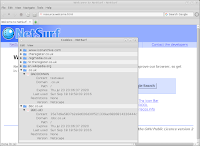
 NetSurf cookie manager showing a supercookieThere is no way to generate the correct set of top level domains with an algorithm so a database is required and is called the Public Suffix List (PSL). This database is a simple text formatted list with wildcard and inversion syntax and is at time of writing around 180Kb of text including comments which compresses down to 60Kb or so with deflate.

A few years ago with ICANN allowing the great expansion of top level domains the existing NetSurf supercookie handling was found to be wanting and I decided to implement a solution using the PSL. At this point in time the database was only 100Kb source or 40Kb compressed.

I started by looking at limited existing libraries. In fact only the regdom library was adequate but used 150Kb of heap to load the pre-processed list. This would have had the drawback of increasing NetSurf heap usage significantly (we still have users on 8Mb systems). Because of this and the need to run PHP script to generate the pre-processed input it was decided the library was not suitable.

Lacking other choices I came up with my own implementation which used a perl script to construct a tree of domains from the PSL in a static array with the label strings in a separate table. At the time my implementation added 70Kb of read only data which I thought reasonable and allowed for direct lookup of answers from the database.

This solution still required a pre-processing step to generate the C source code but perl is much more readily available, is a language already used by our tooling and we could always simply ship the generated file. As long as the generated file was updated at release time as we already do for our fallback SSL certificate root set this would be acceptable.

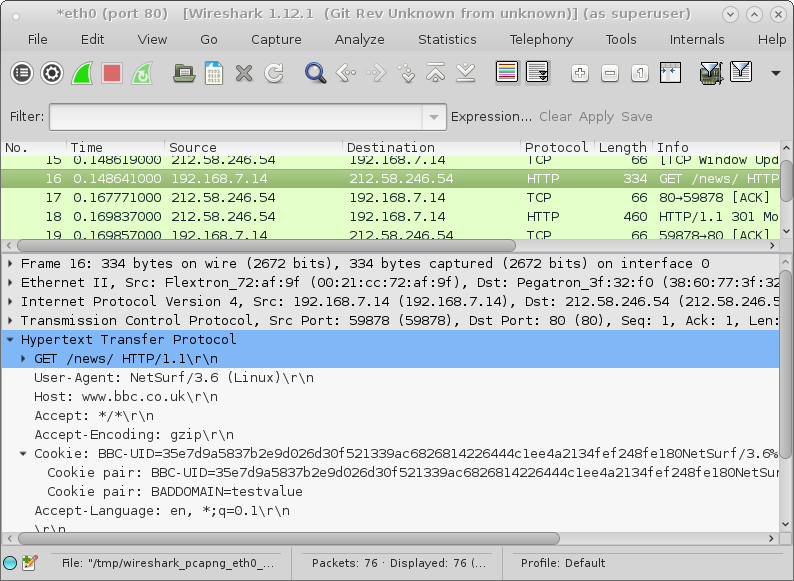
wireshark session shown NetSurf sending a co.uk supercookie to bbc.co.uk
I put the solution into NetSurf, was pleased no-one seemed to notice and moved on to other issues. Recently while fixing a completely unrelated issue in the display of session cookies in the management interface and I realised I had some test supercookies present in the display. After the initial "thats odd" I realised with horror there might be a deeper issue.

It quickly became evident the PSL generation was broken and had been for a long time, even worse somewhere along the line the "redundant" empty generated source file had been removed and the ancient fallback code path was all that had been used.

This issue had escalated somewhat from a trivial display problem. I took a moment to asses the situation a bit more broadly and came to the conclusion there were a number of interconnected causes, centered around the lack of automated testing, which could be solved by extracting the PSL handling into a "support" library.

NetSurf has several of these support libraries which could be used separately to the main browser project but are principally oriented towards it. These libraries are shipped and built in releases alongside the main browser codebase and mainly serve to make API more obvious and modular. In this case my main aim was to have the functionality segregated into a separate module which could be tested, updated and monitored directly by our CI system meaning the embarrassing failure I had found can never occur again.

Before creating my own library I did consider a library called libpsl had been created since I wrote my original implementation. Initially I was very interested in using this library given it managed a data representation within a mere 32Kb.

Unfortunately the library integrates a great deal of IDN and punycode handling which was not required in this use case. NetSurf already has to handle IDN and punycode translations and uses punycode encoded domain names internally only translating to unicode representations for display so duplicating this functionality using other libraries requires a great deal of resource above the raw data representation.

I put the library together based on the existing code generator Perl program and integrated the test set that comes along with the PSL. I was a little alarmed to discover that the PSL had almost doubled in size since the implementation was originally written and now the trivial test program of the library was weighing in at a hefty 120Kb.

This stemmed from two main causes:
  1. there were now many more domain label strings to be stored
  2. there now being many, many more nodes in the tree.
To address the first cause the length of the domain label strings was moved into the unused padding space within each tree node removing a byte from each domain label saving 6Kb. Next it occurred to me that while building the domain label string table that if the label to be added already existed as a substring within the table it could be elided.

The domain labels were sorted from longest to shortest and added in order searching for substring matches as the table was built this saved another 6Kb. I am sure there are ways to reduce this further I have missed (if you see them let me know!) but a 25% saving (47Kb to 35Kb) was a good start.

The second cause was a little harder to address. The structure representing nodes in the tree I started with was at first look reasonable.

struct pnode  
uint16_t label_index; /* index into string table of label */
uint16_t label_length; /* length of label */
uint16_t child_node_index; /* index of first child node */
uint16_t child_node_count; /* number of child nodes */
;

I examined the generated table and observed that the majority of nodes were leaf nodes (had no children) which makes sense given the type of data being represented. By allowing two types of node one for labels and a second for the child node information this would halve the node size in most cases and requiring only a modest change to the tree traversal code.

The only issue with this would be that a way to indicate a node has child information. It was realised that the domain labels can have a maximum length of 63 characters meaning their length can be represented in six bits so a uint16_t was excessive. The space was split into two uint8_t parts one for the length and one for a flag to indicate child data node followed.

union pnode  
struct
uint16_t index; /* index into string table of label */
uint8_t length; /* length of label */
uint8_t has_children; /* the next table entry is a child node */
label;
struct
uint16_t node_index; /* index of first child node */
uint16_t node_count; /* number of child nodes */
child;
;

static const union pnode pnodes[8580] =
/* root entry */
.label = 0, 0, 1 , .child = 2, 1553 ,
/* entries 2 to 1794 */
.label = 37, 2, 1 , .child = 1795, 6 ,

...

/* entries 8577 to 8578 */
.label = 31820, 6, 1 , .child = 8579, 1 ,
/* entry 8579 */
.label = 0, 1, 0 ,

;

This change reduced the node array size from 63Kb to 33Kb almost a 50% saving. I considered using bitfields to try and reduce the label length and has_children flag into a single byte but such packing will not reduce the length of a node below 32bits because it is unioned with the child structure.

A possibility of using the spare uint8_t derived by bitfield packing to store an additional label node in three other nodes was considered but added a great deal of complexity to node lookup and table construction for saving around 4Kb so was not incorporated.

With the changes incorporated the test program was a much more acceptable 75Kb reasonably close to the size of the compressed source but with the benefits of direct lookup. Integrating the libraries single API call into NetSurf was straightforward and resulted in correct operation when tested.

This episode just reminded me of the dangers of code that can fail silently. It exposed our users to a security problem that we thought had been addressed almost six years ago and squandered the limited resources of the project. Hopefully a lesson we will not have to learn again any time soon. If there is a positive to take away it is that the new implementation is more space efficient, automatically built and importantly tested

Reproducible builds folks: Reproducible Builds: week 73 in Stretch cycle

What happened in the Reproducible Builds effort between Sunday September 11 and Saturday September 17 2016: Toolchain developments Ximin Luo started a new series of tools called (for now) debrepatch, to make it easier to automate checks that our old patches to Debian packages still apply to newer versions of those packages, and still make these reproducible. Ximin Luo updated one of our few remaining patches for dpkg in #787980 to make it cleaner and more minimal. The following tools were fixed to produce reproducible output: Packages reviewed and fixed, and bugs filed The following updated packages have become reproducible - in our current test setup - after being fixed: The following updated packages appear to be reproducible now, for reasons we were not able to figure out. (Relevant changelogs did not mention reproducible builds.) The following 3 packages were not changed, but have become reproducible due to changes in their build-dependencies: jaxrs-api python-lua zope-mysqlda. Some uploads have addressed some reproducibility issues, but not all of them: Patches submitted that have not made their way to the archive yet: Reviews of unreproducible packages 462 package reviews have been added, 524 have been updated and 166 have been removed in this week, adding to our knowledge about identified issues. 25 issue types have been updated: Weekly QA work FTBFS bugs have been reported by: diffoscope development A new version of diffoscope 60 was uploaded to unstable by Mattia Rizzolo. It included contributions from: It also included from changes previous weeks; see either the changes or commits linked above, or previous blog posts 72 71 70. strip-nondeterminism development New versions of strip-nondeterminism 0.027-1 and 0.028-1 were uploaded to unstable by Chris Lamb. It included contributions from: disorderfs development A new version of disorderfs 0.5.1 was uploaded to unstable by Chris Lamb. It included contributions from: It also included from changes previous weeks; see either the changes or commits linked above, or previous blog posts 70. Misc. This week's edition was written by Ximin Luo and reviewed by a bunch of Reproducible Builds folks on IRC.

18 September 2016

Eriberto Mota: Statistics to Choose a Debian Package to Help

In the last week I played a bit with UDD (Ultimate Debian Database). After some experiments I did a script to generate a daily report about source packages in Debian. This report is useful to choose a package that needs help. The daily report has six sections: The first section has several important data about all source packages in Debian, ordered by last upload to Sid. It is very useful to see packages without revisions for a long time. Other interesting data about each package are Standards-Version, packaging format, number of NMUs, among others. Believe it or not, there are packages uploaded to Sid for the last time 2003! (seven packages) With the report, you can choose a ideal package to do QA uploads, NMUs or to adopt. Well, if you like to review packages, this report is for you: https://people.debian.org/~eriberto/eriberto_stats.html. Enjoy!

17 September 2016

Jonas Meurer: apache rewritemap querystring

Apache2: Rewrite REQUEST_URI based on a bulk list of GET parameters in QUERY_STRING Recently I searched for a solution to rewrite a REQUEST_URI based on GET parameters in QUERY_STRING. To make it even more complicated, I had a list of ~2000 parameters that have to be rewritten like the following:
if % QUERY_STRING  starts with one of <parameters>:
    rewrite % REQUEST_URI  from /new/ to /old/
Honestly, it took me several hours to find a solution that was satisfying and scales well. Hopefully, this post will save time for others with the need for a similar solution. Research and first attempt: RewriteCond % QUERY_STRING ... After reading through some documentation, particularly Manipulating the Query String, the following ideas came to my mind at first:
RewriteCond % REQUEST_URI  ^/new/
RewriteCond % QUERY_STRING  ^(param1)(.*)$ [OR]
RewriteCond % QUERY_STRING  ^(param2)(.*)$ [OR]
...
RewriteCond % QUERY_STRING  ^(paramN)(.*)$
RewriteRule /new/ /old/?%1%2 [R,L]
or instead of an own RewriteCond for each parameter:
RewriteCond % QUERY_STRING  ^(param1 param2 ... paramN)(.*)$

There has to be something smarter ... But with ~2000 parameters to look up, neither of the solutions seemed particularly smart. Both scale really bad and probably it's rather heavy stuff for Apache to check ~2000 conditions for every ^/new/ request. Instead I was searching for a solution to lookup a string from a compiled list of strings. RewriteMap seemed like it might be what I was searching for. I read the Apache2 RewriteMap documentation here and here and finally found a solution that worked as expected, with one limitation. But read on ... The solution: RewriteMap and RewriteCond $ mapfile:% QUERY_STRING ... Finally, the solution was to use a RewriteMap with all parameters that shall be rewritten and check given parameters in the requests against this map within a RewriteCond. If the parameter matches, the simple RewriteRule applies. For the inpatient, here's the rewrite magic from my VirtualHost configuration:
RewriteEngine On
RewriteMap RewriteParams "dbm:/tmp/rewrite-params.map"
RewriteCond % REQUEST_URI  ^/new/
RewriteCond $ RewriteParams:% QUERY_STRING NOT_FOUND  !=NOT_FOUND
RewriteRule ^/new/ /old/ [R,L]

A more detailed description of the solution First, I created a RewriteMap at /tmp/rewrite-params.txt with all parameters to be rewritten. A RewriteMap requires two field per line, one with the origin and the other one with the replacement part. Since I use the RewriteMap merely for checking the condition, not for real string replacement, the second field doesn't matter to me. I ended up putting my parameters in both fields, but you could choose every random value for the second field: /tmp/rewrite-params.txt:
param1 param1
param2 param2
...
paramN paramN
Then I created a DBM hash map file from that plain text map file, as DBM maps are indexed, while TXT maps are not. In other words: with big maps, DBM is a huge performance boost:
httxt2dbm -i /tmp/rewrite-params.txt -o /tmp/rewrite-params.map

Now, let's go through the VirtualHost configuration rewrite magic from above line by line. First line should be clear: it enables the Apache Rewrite Engine:
RewriteEngine On
Second line defines the RewriteMap that I created above. It contains the list of parameters to be rewritten:
RewriteMap RewriteParams "dbm:/tmp/rewrite-params.map"
The third line limits the rewrites to REQUEST_URIs that start with /new/. This is particularly required to prevent rewrite loops. Without that condition, queries that have been rewritten to /old/ would go through the rewrite again, resulting in an endless rewrite loop:
RewriteCond % REQUEST_URI  ^/new/
The fourth line is the core condition: it checks whether QUERY_STRING (the GET parameters) is listed in the RewriteMap. A fallback value 'NOT_FOUND' is defined if the lookup didn't match. The condition is only true, if the lookup was successful and the QUERY_STRING was found within the map:
RewriteCond $ RewriteParams:% QUERY_STRING NOT_FOUND  !=NOT_FOUND
The last line is a simple RewriteRule from /new/ to /old/. It is executed only if all previous conditions are met. The flags are R for redirect (issuing a HTTP redirect to browser) and L for last (causing mod_rewrite to stop processing immediately after that rule):
RewriteRule ^/new/ /old/ [R,L]

Known issues A big limitation of this solution (compared to the ones above) is, that it looks up the whole QUERY_STRING in RewriteMap. Therefore, it works only if param is the only GET parameter. In case of additional GET parameters, the second rewrite condition fails and nothing is rewritten even if the first GET parameter is listed in RewriteMap. If anyone comes up with a solution to this limitation, I would be glad to learn about it :)

Jonas Meurer: data recovery

Data recovery with ddrescue, testdisk and sleuthkit From time to time I need to recover data from disks. Reasons can be broken flash/hard disks as well as accidently deleted files. Fortunately, this doesn't happen to often, which on the downside means that I usually don't remember the details about best practice. Now that a good friend asked me to recover very important data from a broken flash disk, I take the opportunity to write down what I did and hopefully don't need to read the same docs again next time :) Disclaimer: I didn't take the time to read through full documentation. This is rather a brief summary of the best practice to my knowledge, not a sophisticated and detailed explanation of data recovery techniques. Create image with ddrescue First and most secure rule for recovery tasks: don't work on the original, use a copied image instead. This way you can do, whatever you want without risking further data loss. The perfect tool for this is GNU ddrescue. Contrary to dd, it doesn't reiterate over a broken sector with I/O errors again and again while copying. Instead, it remembers the broken sector for later and goes on to the next sector first. That way, all sectors that can be read without errors are copied first. This is particularly important as every extra attempt to read a broken sector can further damage the source device, causing even more data loss. In Debian, ddrescue is available in the gddrescue package:
apt-get install gddrescue
Copying the raw disk content to an image with ddrescue is as easy as:
ddrescue /dev/disk disk-backup.img disk.log
Giving a logfile as third argument has the great advantage that you can interupt ddrescue at any time and continue the copy process later, possibly with different options. In case of very large disks where only the first part was in use, it might be useful to start with copying the beginning only:
ddrescue -i0 -s20MiB /dev/disk disk-backup.img disk.log
In case of errors after the first run, you should start ddrescue again with direct read access (-d) and tell it to try again bad sectors three times (-r3):
ddrescue -d -r3 /dev/disk disk-backup.img disk.log
If some sectors are still missing afterwards, it might help to run ddrescue with infinite retries for some time (e.g. one night):
ddrescue -d -r-1  /dev/disk disk-backup.img disk.log

Inspect the image Now that you have an image of the raw disk, you can take a first look at what it contains. If ddrescue was able to recover all sectors, chances are high that no further magic is required and all data is there. If the raw disk (used to) contain a partition table, take a first look with mmls from sleuthkit:
mmls disk-backup.img
In case of a intact partition table, you can try to create device maps with kpartx after setting up a loop device for the image file:
losetup /dev/loop0 disk-backup.img
kpartx -a /dev/loop0
If kpartx finds partitions, they will be made available at /dev/mapper/loop0p1, /dev/mapper/loop0p2 and so on. Search for filesystems on the partitions with fsstat from sleuthkit on the partition device map:
fsstat /dev/mapper/loop0p1
Or directly on the image file with the offset discovered by mmls earlier. This also might work in case of
fsstat -o 8064 disk-backup.img
The offset obviously is not needed if the image contains a partition dump (without partition table):
fsstat disk-backup.img
In case that a filesystem if found, simply try to mount it:
mount -t <fstype> -o ro /dev/mapper/loop0p1 /mnt
or
losetup -o 8064 /dev/loop1 disk-backup.img
mount -t <fstype> -o ro /dev/loop1 /mnt

Recover partition table If the partition table is broken, try to recover it with testdisk. But first, create a second copy of the image, as you will alter it now:
ddrescue disk-backup.img disk-backup2.img
testdisk disk-backup2.img
In testdisk, select a media (e.g. Disk disk-backup2.img) and proceed, then select the partition table type (usually Intel or EFI GPT) and analyze -> quick search. If partitions are found, select one or more and write the partition structure to disk.

Recover files Finally, let's try to recover the actual files from the image. testdisk If the partition table recovery was sucessfull, try to undelete files from within testdisk. Go back to the main menu and select advanced -> undelete. photorec Another option is to use the photorec tool that comes with testdisk. It searches the image for known file structures directly, ignoring possible filesystems:
photorec sdb2.img
You have to select either a particular partition or the whole disk, a file system (ext2/ext3 vs. other) and a destination for recovered files. Last time, photorec was my last resort as the fat32 filesystem was so damaged that testdisk detected only an empty filesystem. sleuthkit sleuthkit also ships with tools to undelete files. I tried fls and icat. fls searches for and lists files and directories in the image, searching for parts of the former filesystem. icat copies the files by their inode numer. Last time I tried, fls and icat didn't recover any new files compared to photorec. Still, for the sake of completeness, I document what I did. First, I invoked fls in order to search for files:
fls -f fat32 -o 8064 -pr disk-backup.img
Then, I tried to backup one particular file from the list:
icat -f fat32 -o 8064 <INODE>
Finally, I used the recoup.pl script from Dave Henk in order to batch-recover all discovered files:
wget http://davehenk.googlepages.com/recoup.pl
chmod +x recoup.pl
vim recoup.pl
[...]
my $fullpath="~/recovery/sleuthkit/";
my $FLS="/usr/bin/fls";
my @FLS_OPT=("-f","fat32","-o","8064","-pr","-m $fullpath","-s 0");
my $FLS_IMG="~/recovery/disk-image.img";
my $ICAT_LOG="~/recovery/icat.log";
my $ICAT="/usr/bin/icat";
my @ICAT_OPT=("-f","fat32","-o","8064");
[...]
Further down, the double quotes around $fullfile needed to be replaced by single quotes (at least in my case, as $fullfile contained a subdir called '$OrphanFiles'):
system("$ICAT @ICAT_OPT $ICAT_IMG $inode > \'$fullfile\' 2>> $ICAT_LOG") if ($inode != 0);
That's it for now. Feel free to comment with suggestions on how to further improve the process of recovering data from broken disks.

Norbert Preining: Android 7.0 Nougat Root PokemonGo

Since my switch to Android my Nexus 6p is rooted and I have happily fixed the Android (<7) font errors with Japanese fonts in English environment (see this post). The recently released Android 7 Nougat finally fixes this problem, so it was high time to update. In addition, a recent update to Pokemon Go excluded rooted devices, so I was searching for a solution that allows me to: update to Nougat, keep root, and run PokemonGo (as well as some bank security apps etc). android-nougat-root-poke After some playing around here are the steps I took: Installation of necessary components Warning: The following is for Nexus6p device, you need different image files and TWRP recovery for other devices. Flash Nougat firmware images Get it from the Google Android Nexus images web site, unpack the zip and the included zip one gets a lot of img files.

unzip angler-nrd90u-factory-7c9b6a2b.zip
cd angler-nrd90u/
unzip image-angler-nrd90u.zip
As I don t want my user partition to get flashed, I did not use the included flash script, but did it manually:
fastboot flash bootloader bootloader-angler-angler-03.58.img
fastboot reboot-bootloader
sleep 5
fastboot flash radio radio-angler-angler-03.72.img
fastboot reboot-bootloader
sleep 5
fastboot erase system
fastboot flash system system.img
fastboot erase boot
fastboot flash boot boot.img
fastboot erase cache
fastboot flash cache cache.img
fastboot erase vendor
fastboot flash vendor vendor.img
fastboot erase recovery
fastboot flash recovery recovery.img
fastboot reboot
After that boot into the normal system and let it do all the necessary upgrades. Once this is done, let us prepare for systemless root and possible hiding of it. Get the necessary file Get Magisk, SuperSU-magisk, as well as the Magisk-Manager.apk from this forum thread (direct links as of 2016/9: Magisk-v6.zip, SuperSU-v2.76-magisk.zip, Magisk-Manager.apk). Transfer these two files to your device I am using an external USB stick that can be plugged into the device, or copy it via your computer or via a cloud service. Also we need to get a custom recovery image, I am using TWRP. I used the version 3.0.2-0 of TWRP I had already available, but that version didn t manage to decrypt the file system and hangs. One needs to get at least version 3.0.2-2 from the TWRP web site. Install latest TWRP recorvery Reboot into boot-loader, then use fastboot to flash twrp:
fastboot erase recovery
fastboot flash recovery twrp-3.0.2-2-angler.img
fastboot reboot-bootloader
After that select Recovery with the up-down buttons and start twrp. You will be asked you pin if you have one set. Install Magisk-v6.zip Select Install in TWRP, select the Magisk-v6.zip file, and see you device being prepared for systemless root. Install SuperSU, Magisk version Again, boot into TWRP and use the install tool to install SuperSU-v2.76-magisk.zip. After reboot you should have a SuperSU binary running. Install the Magisk Manager From your device browse to the .apk and install it. How to run safety net programs Those programs that check for safety functions (Pokemon Go, Android Pay, several bank apps) need root disabled. Open the Magisk Manager and switch the root switch to the left (off). After this starting the program should bring you past the special check.

12 September 2016

Shirish Agarwal: mtpfs, feh and not being able to share the debconf experience.

I have been sick for about 2 weeks now hence haven t written. I had joint pains and still am weak. There has been lot of reports of malaria, chikungunya and dengue fever around the city. The only thing I came to know is how lucky I am to be able to move around on 2 legs and how powerless and debilitating it feels when you can t move. In the interim I saw Me Before You and after going through my most miniscule experience, I could relate with Will Taylor s character. If I was in his place, I would probably make the same choices. But my issues are and were slightly different. Last month I was supposed to share my debconf experience in the local PLUG meet. For that purpose, I took some pictures from my phone on a pen-drive to share. But when reached the venue, found out that I had forgotten to take the pen-drive. What I had also done is used the mogrify command from the imagemagick stable to lossy compress the images on the pen-drive so it is easier on image viewers. But that was not to be and at the last moment had to use my phone plugged into the USB drive of the lappy and show some pictures. This was not good. I had known that it was mounted somewhere but hadn t looked at where. After coming back home, it took me hardly 10 minutes to find out where it was mounted. It is not mounted under /media/shirish but under /run/user/1000/gvfs . If I do list under it shows mtp:host=%5Busb%3A005%2C007%5D . I didn t need any packages under debian to make it work. Interestingly, the only image viewer which seems to be able to work with all the images is feh which is a command-line image viewer in Debian. [$] aptitude show feh
Package: feh
Version: 2.16.2-1
State: installed
Automatically installed: no
Priority: optional
Section: graphics
Maintainer: Debian PhotoTools Maintainers
Architecture: amd64
Uncompressed Size: 391 k
Depends: libc6 (>= 2.15), libcurl3 (>= 7.16.2), libexif12 (>= 0.6.21-1~), libimlib2 (>= 1.4.5), libpng16-16 (>= 1.6.2-1), libx11-6, libxinerama1
Recommends: libjpeg-progs
Description: imlib2 based image viewer
feh is a fast, lightweight image viewer which uses imlib2. It is commandline-driven and supports multiple images through slideshows, thumbnail
browsing or multiple windows, and montages or index prints (using TrueType fonts to display file info). Advanced features include fast dynamic
zooming, progressive loading, loading via HTTP (with reload support for watching webcams), recursive file opening (slideshow of a directory
hierarchy), and mouse wheel/keyboard control.
Homepage: http://feh.finalrewind.org/
I did try various things to get it to mount under /media/shirish/ but as of date have no luck. Am running Android 6.0 Marshmallow and have enabled USB debugging with help from my friend Akshat . I even changed the /etc/fuse.conf options but even that didn t work. #cat /etc/fuse.conf
[sudo] password for shirish:
# /etc/fuse.conf - Configuration file for Filesystem in Userspace (FUSE)
# Set the maximum number of FUSE mounts allowed to non-root users.
# The default is 1000.
mount_max = 1
# Allow non-root users to specify the allow_other or allow_root mount options.
user_allow_other
One way which I haven t explored is adding/making an entry into /etc/fstab. If anybody knows of a solution which doesn t involve changing content of /etc/fstab. At the same time you are able to get the card and phone directories mounted under /media// , in my case /media/shirish would be interested to know. I would like the /etc/fstab to remain as it is. I am using Samsung J5 (unrooted) Btw I tried all the mtpfs packages in Debian testing but without any meaningful change Look forward to tips.
Filed under: Miscellenous Tagged: #Android, #Debconf16, #debian, #mptfs, feh, FUSE, PLUG

8 September 2016

Wouter Verhelst: Installing files for other applications with autotools

Let's say you have a configure.ac file which contains this:
PKG_CHECK_VAR([p11_moduledir], "p11-kit-1", "p11_module_path")
AC_SUBST([p11_moduledir])
and that it goes with a Makefile.am which contains this:
dist_p11_module_DATA = foo.module
Then things should work fine, right? When you run make install, your modules install to the right location, and p11-kit will pick up everything the way it should. Well, no. Not exactly. That is, it will work for the common case, but not for some other cases. You see, if you do that, then make distcheck will fail pretty spectacularly. At least if you run that as non-root (which you really really should do). The problem is that by specifying the p11_moduledir variable in that way, you hardcode it; it doesn't honour any $prefix or $DESTDIR variables that way. The result of that is that when a user installs your package by specifying --prefix=/opt/testmeout, it will still overwrite files in the system directory. Obviously, that's not desireable. The $DESTDIR bit is especially troublesome, as it makes packaging your software for the common distributions complicated (most packaging software heavily relies on DESTDIR support to "install" your software in a staging area before turning it into an installable package). So what's the right way then? I've been wondering about that myself, and asked for the right way to do something like that on the automake mailinglist a while back. The answer I got there wasn't entirely satisfying, and at the time I decided to take the easy way out (EXTRA_DIST the file, but don't actually install it). Recently, however, I ran against a similar problem for something else, and decided to try to do it the proper way this time around. p11-kit, like systemd, ships pkg-config files which contain variables for the default locations to install files into. These variables' values are meant to be easy to use from scripts, so that no munging of them is required if you want to directly install to the system-wide default location. The downside of this is that, if you want to install to the system-wide default location by default from an autotools package (but still allow the user to --prefix your installation into some other place, accepting that then things won't work out of the box), you do need to do the aforementioned munging. Luckily, that munging isn't too hard, provided whatever package you're installing for did the right thing:
PKG_CHECK_VAR([p11_moduledir], "p11-kit-1", "p11_module_path")
PKG_CHECK_VAR([p11kit_libdir], "p11-kit-1", "libdir")
if test -z $ac_cv_env_p11_moduledir_set; then
    p11_moduledir=$(echo $p11_moduledir sed -e "s,$p11kit_libdir,\$ libdir ,g")
fi
AC_SUBST([p11_moduledir])
Whoa, what just happened? First, we ask p11-kit-1 where it expects modules to be. After that, we ask p11-kit-1 what was used as "libdir" at installation time. Usually that should be something like /usr/lib or /usr/lib/gnu arch triplet or some such, but it could really be anything. Next, we test to see whether the user set the p11_moduledir variable on the command line. If so, we don't want to munge it. The next line looks for the value of whatever libdir was set to when p11-kit-1 was installed in the value of p11_module_path, and replaces it with the literal string $ libdir . Finally, we exit our if and AC_SUBST our value into the rest of the build system. The resulting package will have the following semantics: I suppose it would've been easier if the PKG_CHECK_VAR macro could (optionally) do that munging by itself, but then, can't have everything.

7 September 2016

Julian Andres Klode: New software: sicherboot

Fork me on GitHub Today, I wrote sicherboot, a tool to integrate systemd-boot into a Linux distribution in an entirely new way: With secure boot support. To be precise: The use case here is to only run trusted code which then unmounts an otherwise fully encrypted disk, as in my setup: screenshot-from-2016-09-06-04-09-52 If you want, sicherboot automatically creates db, KEK, and PK keys, and puts the public keys on your EFI System Partition (ESP) together with the KeyTool tool, so you can enroll the keys in UEFI. You can of course also use other keys, you just need to drop a db.crt and a db.key file into /etc/sicherboot/keys. It would be nice if sicherboot could enroll the keys directly in Linux, but there seems to be a bug in efitools preventing that at the moment. For some background: The Platform Key (PK) signs the Key Exchange Key (KEK) which signs the database key (db). The db key is the one signing binaries. sicherboot also handles installing new kernels to your ESP. For this, it combines the kernel with its initramfs into one executable UEFI image, and then signs that. Combined with a fully encrypted disk setup, this assures that only you can run UEFI binaries on the system, and attackers cannot boot any other operating system or modify parts of your operating system (except for, well, any block of your encrypted data, as XTS does not authenticate the data; but then you do have to know which blocks are which which is somewhat hard). sicherboot integrates with various parts of Debian: It can work together by dracut via an evil hack (diverting dracut s kernel/postinst.d config file, so we can run sicherboot after running dracut), it should support initramfs-tools (untested), and it also integrates with systemd upgrades via triggers on the /usr/lib/systemd/boot/efi directory. Currently sicherboot only supports Debian-style setups with /boot/vmlinuz-<version> and /boot/initrd.img-<version> files, it cannot automatically create combined boot images from or install boot loader entries for other naming schemes yet. Fixing that should be trivial though, with a configuration setting and some eval magic (or string substitution). Future planned features include: (1) support for multiple ESP partitions, so you can have a fallback partition on a different drive (think RAID type situation, keep one ESP on each drive, so you can remove a failing one); and (2) a tool to create a self-contained rescue disk image from a directory (which will act as initramfs) and a kernel (falling back to a vmlinuz file ) It might also be interesting to add support for other bootloaders and setups, so you could automatically sign a grub cryptodisk image for example. Not sure how much sense that makes. I published the source at https://github.com/julian-klode/sicherboot (MIT licensed) and uploaded the package to Debian, it should enter the NEW queue soon (or be in NEW by the time you read this). Give it a try, and let me know what you think.
Filed under: Debian, sicherboot

Reproducible builds folks: Reproducible Builds: week 71 in Stretch cycle

What happened in the Reproducible Builds effort between Sunday August 28 and Saturday September 3 2016: Media coverage Antonio Terceiro blogged about testing build reprodubility with debrepro . GSoC and Outreachy updates The next round is being planned now: see their page with a timeline and participating organizations listing. Maybe you want to participate this time? Then please reach out to us as soon as possible! Packages reviewed and fixed, and bugs filed The following packages have addressed reproducibility issues in other packages: The following updated packages have become reproducible in our current test setup after being fixed: The following updated packages appear to be reproducible now, for reasons we were not able to figure out yet. (Relevant changelogs did not mention reproducible builds.) The following 4 packages were not changed, but have become reproducible due to changes in their build-dependencies: Some uploads have addressed some reproducibility issues, but not all of them: Patches submitted that have not made their way to the archive yet: Reviews of unreproducible packages 706 package reviews have been added, 22 have been updated and 16 have been removed in this week, adding to our knowledge about identified issues. 5 issue types have been added: 1 issue type has been updated: Weekly QA work FTBFS bugs have been reported by: diffoscope development diffoscope development on the next version (60) continued in git, taking in contributions from: strip-nondeterminism development Mattia Rizzolo uploaded strip-nondeterminism 0.023-2~bpo8+1 to jessie-backports. A new version of strip-nondeterminism 0.024-1 was uploaded to unstable by Chris Lamb. It included contributions from: Holger added jobs on jenkins.debian.net to run testsuites on every commit. There is one job for the master branch and one for the other branches. disorderfs development Holger added jobs on jenkins.debian.net to run testsuites on every commit. There is one job for the master branch and one for the other branches. tests.reproducible-builds.org Debian: We now vary the GECOS records of the two build users. Thanks to Paul Wise for providing the patch. Misc. This week's edition was written by Ximin Luo, Holger Levsen & Chris Lamb and reviewed by a bunch of Reproducible Builds folks on IRC.

6 September 2016

Markus Koschany: My Free Software Activities in August 2016

Welcome to gambaru.de. Here is my monthly report that covers what I have been doing for Debian. If you re interested in Android, Java, Games and LTS topics, this might be interesting for you. Debian Android Debian Games Debian Java Debian LTS This was my seventh month as a paid contributor and I have been paid to work 14,75 hours on Debian LTS, a project started by Rapha l Hertzog. In that time I did the following: Non-maintainer uploads QA

Guido G nther: Debian Fun in August 2016

Debian LTS August marked the sixteenth month I contributed to Debian LTS under the Freexian umbrella. I spent 9 hours (of allocated 8) mostly on Rails related CVEs which resulted in DLA-603-1 and DLA-604-1 fixing 6 CVEs and marking others as not affecting the packages. The hardest part was proper testing since the split packages in Wheezy don't allow to run the upstream test suite as is. There's still CVE-2016-0753 which I need to check if it affects activerecord or activesupport. Additionally I had one relatively quiet week of LTS frontdesk work triaging 10 CVEs. Other Debian stuff

Guido G nther: Debian Fun in Augst 2016

Debian LTS August marked the sixteenth month I contributed to Debian LTS under the Freexian umbrella. I spent 9 hours (of allocated 8) mostly on Rails related CVEs which resulted in DLA-603-1 and DLA-604-1 fixing 6 CVEs and marking others as not affecting the packages. The hardest part was proper testing since the split packages in Wheezy don't allow to run the upstream test suite as is. There's still CVE-2016-0753 which I need to check if it affects activerecord or activesupport. Additionally I had one relatively quiet week of LTS frontdesk work triaging 10 CVEs. Other Debian stuff

Next.

Previous.