Search Results: "ag"

23 July 2010

Alexander Reichle-Schmehl: Release Critical Bug report for Week 29

The unofficial rc bug tracker currently knows about the following bugs:
In Total:446
Affecting Squeeze:348
Squeeze only:62
Remaining to be fixed in Squeeze:286
Of these 286 bugs, the following tags are set:
Pending in Squeeze:18
Patched in Squeeze:48
Duplicates in Squeeze:36
Contrib or non-free in Squeeze:12
Claimed in Squeeze:2
Delayed in Squeeze:7
Can fixed in a security Update:23
Otherwise fixed in Squeeze:36
Ignoring all the above (multiple tags possible), 152 bugs need to be fixed by Debian Contributers to get Debian 6.0 Squeeze released. However, with the view of the Release Managers, 250 need to be dealt with for the release to happen. Please see my older post for an explanation of the different numbers.

Christian Perrier: Bug #590000

Joe Hansen reported the Debian bug #590000 on Thursday July 22nd, against the uif package. Guess what? That was a localization bug..:-)... Joe is doing a lot of work for Danish localization in Debian since a few months and I'm happy to see him rewarded byt this little "success". Bug #580000 was reported as of May 2nd. It is now confirmed that the rate for 10,000 bugs is more 2.5 months than 2 months as it was in the past. So, now my next post about this topic will be about Bug #600000 for which a bet was placed two years ago. I already lost the bet as I predicted it to happen on June 30th. Either Ren Mayorga or Josu Abarca are likely to win this bet, more likely Ren , I would say. One should note that all people who did bet where optimistic about the moment where bug #600000 would be reported.

22 July 2010

Steve Kemp: My Linksys router now runs Linux and almost provides PXE.

I've been interesting in running Linux upon my router for a long time, but I never had a really compelling reason to do so. The potential for brickage was always too high to make me want to experiment for the sake of it. However last night I installed Gargoyle upon my Linksys WRT53GL. Although I have no single compelling reason to do so there were a few things on my mind which made me risk it:
Syslog
I thought it would be nice to log things to my desktop machine.
QoS
I often run rsync to mirror my photographs, videos, and files, to off-site locations. These are then replicated via chironfs. Being able to use QoS to prioritise SSH traffic, which is the transport I use for rsync, means I don't suffer from laggy connections.
Graphing & Statistics
Having statistics and traffic information is interesting.
Since I've only just installed it I've not had too much opportunity to experiment with it - and my initial forays were not so productive. For example "opkg install tcpdump" failed as the root filesystem wasn't big enough. However which was to update the router to function as PXE server. I installed the tftpd server:
opkg install tftpd-hpa
Then I added this to /etc/dnsmasq.conf:
dhcp-boot=pxelinux.0,router.my.flat,192.168.1.1
Only after I'd done this did I realise two things: Tomorrow, (after visiting the dentist. Uggh) I will experiment with this further. Right now it looks like I have two options: Either way I have to store the files upon another host, due to the constrained space on the router's filsystem. So the question becomes "Which service should I run externally: TFPTD or NFS?". Running TFTPD, upon my desktop, seems smaller, less of a security risk, and neater. Running TFTPD also avoids issues if I reboot both the router and my desktop at the same time as a stalling NFS mount could prevent a timely router-boot. ObQuote: Looking for a secret door. Places like this always have a secret door.

- St Trinian's 2: The Legend of Fritton's Gold

Raphaël Hertzog: Quick news: dpkg, collab-maint, alioth and the future

Dpkg got rid of Perl Let s start with the interesting part and the great news: dpkg 1.15.8 (to be uploaded soon) will no longer need perl! After my changes to rewrite update-alternatives in C, Guillem recently pushed the rewrite of dpkg-divert/mksplit in C. Please test it out (binary package for i386 or .dsc). This is rather exciting news for those who would like to use dpkg in embedded contexts. And it s great to see this completed in time for Squeeze. In Squeeze+1, we might go one step further and merge cdebconf, the C replacement for debconf. I got rid of some recurring administrative tasks I have been administrating the Alioth server since its inception (see the announce I sent in 2003) but I m no longer enjoying the day-to-day administrative work that it represents. That s why I just retired from the team. We recently recruited Tollef Fog Heen so the number of admins is still the same (that said, Alioth could benefit from some more help, if you re a DD and interested, drop a mail to admin@alioth.debian.org or come to #alioth). Same goes for the collab-maint project. I have dealt with hundreds of requests to add new contributors to the project since it s the central repository where all Debian developers have write access and where they put the VCS for their packages that do not belong to a more specialized team. The new administrator that will approve the requests is Xavier Oswald and he s doing the work under the umbrella of the New Maintainer s Front Desk. The future I will continue to spend the same amount of time on Debian, the time freed will quickly be reallocated to other Debian and free software related projects. In fact, I even anticipated a bit by launching Flattr FOSS last week but that s a relatively simple project. :-) The other projects that will never all fit in the freed time: I want to spend more time working on dpkg. I do plan to blog more often too, but I m sure you ll notice that yourself soon. I would like to see my Debian book translated into English (another post coming on the topic sometimes soon). In my dreams, I could even start yet another software project, I have some ideas that I really would like to see implemented but I don t see how that could fit in this year s planning unless I can convince someone else to implement them! Maybe I should blog about them. Flattr this Share/Bookmark 5 comments Support my work

Erich Schubert: Dropbox revisited

Like one or two years ago, I got myself a free Dropbox account. I use it occasionally to exchange files with some friends. It does an excellent job at that. Basically, it works like any network folder. Except it is not within a local network, but over the internet.Dropbox serves me as an occasional replacement for both email and USB pen drive. Instead of sending a modified file by email or bringing around a dozen of photos on a USB stick, I just put them into the shared folder. This also very useful for files such as flyers, templates. They may easily grow to big to be sensibly sent by email.For all my use, a regular free Dropbox account is more than enough. As in, I have less than 1 GB in use, and I could easily free some of that space. You start at 2 GB, and can currently get up to 10 GB free (+250 MB for each referrer; if you use the link above you'll already start at 2.25 GB). But for my use, this is already a lot.Note that there are a couple of alternatives around. For Linux (only) there is Ubuntu One, and there is Zumo Drive and Box.net just to name a few. I havn't tried them, given that Dropbox works for me well enough.

Kartik Mistry: Love to see gwibber 2 in Debian?

* Testing needed from more people. Feel free to break your working gwibber with, http://people.debian.org/~kartik/packages/gwibber/ and let me know at usual address. Known issues: + Read README.Debian after installing package (Thanks to Dionisio E Alonso (Baco)) + Facebook updates seems broken and also pidgin integration. + Tray icon is missing (It use indicator now!) + Lots of hidden issues!!
Dionisio E Alonso (Baco)

Stefano Zacchiroli: debian podcast planning

This Week In Debian I've been contacted by Jonathan Nadeau of Frostbite Systems, a company selling computer hardware with pre-installed GNU/Linux distros, including Debian (of course!). (Usual disclaimer applies: I haven't tried their products, I've just skimmed through their website ...) Both for promotion and as a service to the communities, Jonathan has started various podcasts, such as This Week in Fedora. Jonathan has contacted me to check whether Debian is interested in having a This Week in Debian podcast, which will be discussing weekly Debian-related topics, interviewing at each episode someone from the community. So, folks, are you interested in seeing that happen?
Personally I like the idea, as I'm myself an eager podcast listener and I've always missed something Debian-specific. To make it a reality however we need to plan and record some episode in advance, to ensure the podcast will have enough "buffer" to start. That's why I've created the ThisWeekInDebian wiki page, where interested people should drop a line, proposing a topic and volunteering to speak about it. Any Debian-related topic is a good candidate: a team, an initiative, a general discussion about a relevant project aspect, etc. You don't even need any particular upfront preparation, as it'll be interview-like. So, what are you waiting for? Drop a line to the wiki page. Jonathan will attend DebConf10 so, in case you are attending, that can be a nice occasion to record some episode in person (otherwise recordings usually happen over the net).

Wouter Verhelst: New toy

Just bought me an external flashlight; a Nikon Speedlight SB-900, which is Nikon's top model. It wasn't as expensive as that sounds, though, since this was their demo model that they got me a good discount on, on top of the already rather low prices that this shop offers; this made it cheaper than the list price of the SB-600, Nikon's second-best model. I'm afraid it will take a while before I'll be able to fully understand its features, though. I did get a course at photography when I was about 13 years old, which did help me in picking up again how to work with an SLR camera when I bought it. But that course never included anything about using flashlights; and while I do understand how bouncing light off of walls and other things may sometimes help in getting the picture just right, I haven't actually ever done that. So I guess I'll be practicing a bit, now...

Alexander Reichle-Schmehl: Recent RC-Bug activity

Remember the one rc bug a days activities from Steinar and Zack? Well, maybe I won't make to one rc bug per day, but at least I could blog about some of my recent activities. Maybe it motivates some others? #553248 libnel-dev: missing-dependency-on-libc needed...
Trivial bug solved by adapting the depends-lines; uploaded.
#589344 missing symbols in library
Missing build depends; sponsored NMU by Davi Leal to delayed.
#582309 Links against libclamav
"solved" by disabling clamav support; uploaded to delayed 15.
#589819 Unmet Recommends on extremetuxracer-racer
Fixed typo in recommends (introduced by yours truly); uploaded.
#565805 FTBFS on kfreebsd-*: need to define type GLUTesselatorFunction
Applied patch by Felix Geyer; (doesn't help the release, package is experimental).
#568990 planetpenguin-racer-extras: Outdated; needs restructured and updated to be usefull
Upload fixed package prepared by Bertrand Marc.
#548084 aegir-provision: /etc/aegir/drushrc.php PHP error,
#548085 aegir-provision: /etc/aegir and /etc/aegir/drushrc.php file permissions
and unreported piuparts problem Uploaded to delayed.
#569177 kernel-patch-nfs-ngroups: doesn't apply anymore
Added an updated version of the patch; uploaded.
#580120 mediatomb allows anyone to browse and export the whole filesystem
Disabled user interface in configuration file; uploaded to delayed.
#588554 jamin: Ships files in /usr/lib64/
Patched configure-script to install to the correct place; with maintainers permission uploaded without delay.
#576901 init.d script fails under Squeeze with insserv due to lack of run level definitions
Updated LSB header of init script same was as upstream did in recent version; uploaded to delayed (got thanks from the maintainer for that).
#574624 dibbler-client: after removing package with dselect impossible to purge it.
Verified fix by Edward Welbourne and uploaded to delayed.
#586057 havp 0.91-1.1~volatile1 still haven't show up in lenny-volatile yet.
Seems to have been an infrastructure hick up, which got solved in the meantime. Closed without upload.
#518227 hplip: text missing at the bottom of a page on HP DJ 5550
Discussed with release team, severity got lowered.
As you can see, finding fixable rc bugs is certainly possible. So please step in :) BTW: If you don't have upload rights yourself, but prepared an NMU / patch, feel free to ping me and I'll take a look and try to sponsor your NMU. Just ask!

John Goerzen: Once, We Were Makers

I saw an article on Wired today: The Lost Tribes of RadioShack. It is well worth the read even if you re not into electronics. A key quote:
[H]is shop is a lone outpost; in a single generation, the American who built, repaired, and tinkered with technology has evolved into an entirely new species: the American who prefers to slip that technology out of his pocket and show off its killer apps. Once, we were makers. Now most of us are users.
I remember as a kid eagerly awaiting each year s new RadioShack catalog. I d read them pretty much cover to cover for fun. And who wouldn t? The catalogs had fun things like radios, telephone gadgets, calculators, tape recorders, electronic lab kits , books, components, LEDs I loved the catalogs and loved the store. My parents bought me a electronic kit (if memory serves 20 years later, it s the deluxe 160-project electronic kit from page 156 of the 1988 catalog, though it may have been purchased a different year). I had endless fun with that thing. It had resistors, diode, capacitors, oscillator, speaker, LED, relay, etc plenty to make a bunch of kid-friendly projects. Just looking at the catalog makes me excited even today. On the next page from the kit I had is a $5 crystal radio kit which needs no power source Solderless. With earphone, instructions, theory. On page 28 there was a revolving red light, and some microcassette recorders on p. 36 (I had one of those for awhile). I had enthusiasm for building and figuring out things for a long time. My dad let me take apart an old lawn mower for fun once I m sure he knew ahead of time it would never be back together. One of his friends from work built homemade contraptions out of things like an old vacuum cleaner (attach a cardboard tube to the exhaust and you get a great tennis ball shooter). And there was always all sorts of fun junk to discover up in the barn. I eventually shifted to a different sort of making things : programming. It has kept me busy for quite a number of years. But the Wired article has a point. RadioShack is struggling. Many people have no interest in making or fixing things anymore. The best-selling smartphone in the world comes sealed in a metal case where not even the battery can be replaced, the software is dictated by a company in California, and good luck trying to program for it without signing your life away first. A far cry from the first computer I used, a TRS-80 Color Computer II, bought, yes, at RadioShack. Turn it on, and in a few seconds you get a BASIC prompt. Can t really use it without programming. Being able to read its manual was an early motivation for me to work at learning to read. It is sad that so many devices can t be worked on anymore, and that so many people don t care. It is difficult for me to give Jacob (and later, Oliver) the sort of experience I had as a child. Companies would love to sell us $50 DVD sets, $300 educational game systems, $40 educational games, and any number of $30 plastic toys (some of which we have and the boys enjoy). I d rather give him a $10 bag of resistors, capacitors, wire, battery holders, LEDs, and a book, and see what he can come up with (when he s a bit older, of course). And, in fact, he and I built his first computer together. We installed the ultimate in operating systems for tinkering: Linux. This all brings me back to RadioShack. I ve been working on ham radio lately, with an eye to that being a project for Jacob (age 3.5), Oliver (just turned 1), and me to enjoy in the future. I needed some cable, and had been told by many people to visit the RadioShack in Derby, KS. It s like the one mentioned in the Wired article: huge, selling everything from washing machines to bulk cable, except this one specializes in amateur radio. I asked Jacob if he would like to come with me to a radio store. Dad, I would LOVE that! He brought his little semi-broken walkie-talkies with him to use during the hour drive there. At one point, he was concerned that a radio store is like a library and he might have to leave them on a shelf. I assured him he could keep them. We got to the RadioShack and he loved it. He couldn t even really contain his excitement. He ran back and forth along the bright green stripe running down the middle of the carpet. He excitedly watched them measure out 60ft of RG-8 coax for me. He pushed buttons on the demo clothes dryer, looked at all the antennas, and just had a great time. And he s been interested in my radio, too. When I was talking to somebody on it the other day, he said, I think he is at the radio store. He is having fun there. Right now, everybody I talk to on the radio is at the radio store to him. Jacob loves the fact that the backlight on my FT-857D can change colors, and often comes into the office just so I can put it into setup mode and let him spin the big wheel to change the colors. He enjoys opening boxes of components, and came out to help (and run around) while I suspended a dipole from some trees last Friday. I had told Jacob when we got to the store that This radio store is called RadioShack. He obviously took that to heart, because now if he hears me talking about a radio store , he will say, Dad, actually it is radio SHACK. So I say thank you to the Derby RadioShack for keeping the magic of making things with your dad alive for another generation.

21 July 2010

Maximilian Attems: Solid bases in Theoretical Physics

Landau, L. D.; Lifshitz, E. M. (1976). Course of Theoretical Physics is still the most interesting and solid base that is to be considered as a reference and inspiration in Theoretical Physics. The reference for "Classical Electrodynamics" is the book by J.D. Jackson. "Advanced Quantum Mechanics" by J.J. Sakurai is a popular student choice. Compendium of Relations contains various formulas and relations of the Standard Model. The Lecture Notes on General Relativity by S. Carroll are a solid introduction for an initiate relativist. "Quantum Field Theory in a Nutshell" by A. Zee is amazing. Quantum electrodynamics can be explored in the books by "The Quantum Theory of Fields" by S. Weinberg or "Quantum field theory" by L.H. Ryder or Quantum Chromodynamics in M.E. Peskin & D.V. Schroeder "An Introduction to Quantum Field Theory". The lecture notes on Quantum Chromodynamics (QCD) might be interesting for people diving into the particle physics standard model. "Finite-temperature field theory: Principles and Application" discusses systems in equilibrium but at finite temperatures and chemical potentials and thus connects to cosmology of the early universe. The field of Statistical Field Theory has the classic "Quantum Many-Particle Systems" by J.W. Negele and H. Orland or the more recent "Quantum Field Theory of Many-Body Systems" by X-G. Wen or "Ultracold Quantum Fields" by H.T.C Stoof, D.B.M. Dickerscheid, K. Gubbels. String Theory is so diverse that you'll find lots of different approaches, recommendations are Graduate Course in String Theory by A. Uranga, Applied Conformal Field Theory by P. Ginsparg, Lectures on String Theory by D. Tong or more introductory the book "A First Course in String Theory " by B. Zwiebach or the dense "Superstring Theory" by M. Green, J. Schwarz and E. Witten, "String Theory" by J. Polchinski. "Quantum Field Theory of Point Particles and Strings" by B. Hatfield assumes no previous stringy background and is known for excellent explanation of the path integral formalism. M. Nakahara wrote the wonderfull bridge to maths: "Geometry, Topology and Physics". So please when looking for "references" in theoretical physics venture on solid grounds and don't get distracted by sketchy notes. Update: Peter West pointed out that the The Feynman Lectures on Physics are missing as a timeless reference.
20 July 2010

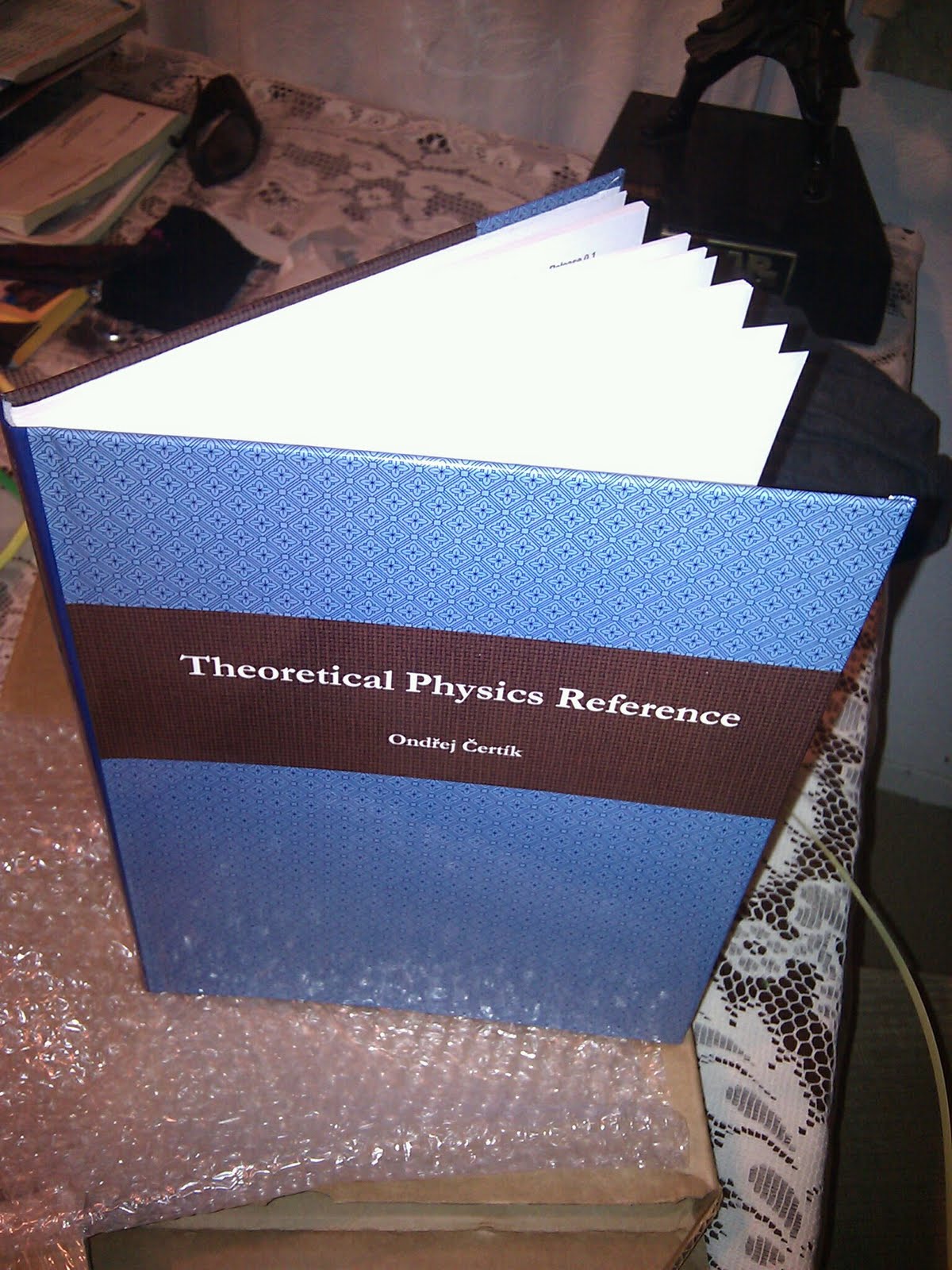
Ondřej Čertík: Theoretical Physics Reference Book

Today I fulfilled my old dream --- I just created my first book! Here is how it looks like:

More images
here.

Here is the source code of the book: http://github.com/certik/theoretical-physics, the repository contains a branch 'master' with the code and 'gh-pages' with the generated html pages, that are hosted at github, at the url theoretical-physics.net.

Then I published the book at Lulu: http://www.lulu.com/product/hardcover/theoretical-physics-reference/11612144, I wanted a hardcover book, so I setup a project at Lulu, used some Lulu templates for the cover and that was it. Lulu's price for the book is $19.20 (166 black & white pages, hardcover), then I can set my own price and the rest of the money probably goes to me. I set the price to $20, because Lulu has free shipping for orders $20 or more. You can also download the pdf (for free) at the above link (or just use my git repository). So far this didn't cost me anything.

I have then ordered the book myself (just like anybody else would, at the above address) and it arrived today. It's a regular hardcover book. Beautiful, you can browse the pictures above. It smells deliciously (that you have to believe me). And all that it cost me was $19.20.

As for the contents itself, you can browse it online at theoretical-physics.net, essentially it's most of my physics notes, that I collected over the years. I'd like to treat books like software --- release early release often. This is my first release and I would call it beta. The main purpose of it was to see if everything goes through, how long it takes (the date inside the book is July 4, 2010, I created and ordered it on July 5, got the physical book on July 19) and what the quality is (excellent). I also wanted to see how the pages correspond to the pdf (you can see for yourself on the photos, click on the picasa link above).

Now I need to improve the first pages a bit, as well as the last pages, improve the index, write some foreword and so on. I also need to think how to better organize the contents itself and generally improve it. I also need to figure out some versioning scheme, so far this is version 0.1. I think I'll do edition 1, edition 2, edition 3, and so on. And whenever I feel that I have added enough new content, I'll just publish it as a new edition. So if you want to buy it, I suggest to wait for my 1.0 version, that will have the mentioned improvements.

It'd be also cool to have all the editions online somehow and create nice webpages for it (currently theoretical-physics.net points directly to the book html itself).

So far the book is just text. I still need to figure out how to handle pictures and also whether or not to use program examples (in Python, using sympy, scipy, etc.). So far I am inclining not to put there any program codes, as then I don't need to maintain them.

Overall I am very pleased with the quality, up to some minor issues that I mentioned above, everything else end up just fine. I think we have come a long way from the discovery of the printing press. Anybody can now create a book for free, and if you want to hold the hardcopy in your hands, it costs around $20. You don't need to order certain amounts of books, nor partner with some publisher etc. I think that's just awesome.

Russell Coker: Digital Video Cameras

I ve just done some quick research on Digital Video Cameras for some relatives. It seems to me that the main feature that is necessary is Full HD (1920*1080) resolution as everyone seems to be getting 1920*1080 resolution monitors (getting smaller doesn t save enough money to be worth-while). Resolutions higher than 1920*1080 will probably available in affordable monitors in the next few years, so the ability of programs like mplayer to zoom videos will probably be required even for Full HD video soon. Saving maybe $300 on a video camera while getting a lower resolution doesn t seem like a good idea. The next feature is optical zoom, most cameras are advertised with features such as advanced zoom to try and trick customers, cameras which advertise 60* or better zoom often turn out to only have 20* zoom. I think that about 20* optical zoom should be considered the minimum, not that there is anything special about 20* zoom, it s just that there is a good range of cameras with better zoom capacity. Image stabilisation is a required feature, no-one can keep their hand perfectly steady and the typically a DVC only gets hand-held use most people who own them don t even own a tripod! Digital image stabilisation is apparently not nearly as good as optical image stabilisation, and image stabilisation that involves moving the CCD is apparently somewhere in between. Finally it s good to have the ability to take quality photos as few people will want to carry a Digital Camera and a Digital Video Camera. I did a search for DVCs on the web site of Ted s Camera store (a chain of camera stores in Australia that generally provide good service at a competitive price but not the cheapest price). The best of the Ted s options seems to be the Panasonic SD60 HD Video [1] which does 25* optical zoom, 1920*1080i video, 5 megapixel still photography, and optical image stabilisation it costs $750 from Ted s. The next best option seems to be the Sony Handycam HDR-CX110 HD [2] which does 25* optical zoom, 1920*1080i video, 3.1 megapixel 2048*1536 still photography, and digital image stabilisation. The Panasonic seems to be a better option due to having optical image stabilisation and a higher resolution for still photographs. It is also $750 from Ted s. Now there s the issue of how well the cameras work on Linux. A quick Google search indicated that the Sony cameras present themselves as USB card readers and can be mounted on a Linux system, I couldn t discover anything about the Panasonic. If I was going to buy one I would take my Netbook to the store and do a quick test. I don t have enough information to recommend either of those cameras, they may have some awful defects that are only apparent when you use them. But in terms of features they seem pretty good. The Panasonic SD60 HD Video should be a good benchmark when comparing cameras in the store. If nothing else the camera store staff seem to not be very helpful if asked generic questions such as which camera is best , but if asked questions such as how is this other camera better than the one I m looking at they can usually give good answers. If anyone has any other advice for purchasing a DVC then please let me know. Either generic advice or specific examples of Linux-friendly DVCs that have been purchased recently.

19 July 2010

Wouter Verhelst: Stream-of-image video data and cinelerra

Just so I won't forget, but also to make sure others with similar problems to me don't need to search for several hours before finding it's so simple that it's silly: If you have a bunch of image files (PNG, JPG, whatnot) that you want to treat as a single clip in cinelerra rather than hundreds (if not thousands) of individual files, the trick is to use a "list file": you create a file with some metadata and a list of all the files that make up the video clip, and import that, rather than the individual files. If said individual files are PNG files with alpha information, doing so also makes it ridiculously easy to create an animation that only covers part of the screen. The file format is pretty basic; but over at this page on the cinelerra.org website they list two scripts (one python with GUI, one bash and command-line only) that can generate such a file, given a bunch of image files. That makes it even easier. I'd also like to note, for the record, that cinelerra outperforms kdenlive in everything but 'transcoding flexibility'. Kdenlive also has support for image lists (and you can create them in the gui rather than having to muck about with external programs or editors), but it has the rather nasty misfeature of doing the equivalent of "Oh, look, what's that? We don't need that, let's throw it away" whenever it encounters alpha information in PNG files. For full reproducability, it's also possible to generate PNG files with alpha information from povray if you use the +UA command-line parameter, and say something like
sky_sphere  
	pigment  
		color rgbt <0, 0, 0, 1>
	 
 
somewhere in your scene file. Yes, I know, povray is non-free, but it works, and as opposed to blender I do know how to use it. Hey, I'm not RMS.

Tim Retout: Gnash and BBC glow

One thing I noticed having started to use gnash is that the BBC's iPlayer website (UK-only, I believe) gives a message like "You do not have Flash player installed" - not merely complaining about the version, but actually not recognising gnash as a Flash player at all. Cue some digging. The BBC's pages use glow, an in-house JavaScript library (available under the Apache 2.0 License) to detect whether Flash is installed. The documentation was really easy to follow - I had a test page going quicker than you can say "Hello, World!" The bottom line is, glow uses this regex:
var regexFLASH_VERSION = /^Shockwave Flash\s*(\d+)\.(\d+)\s*\w(\d+)$/;
and gnash uses a description like this:
Shockwave Flash 10.1 r999.
Gnash trunk, the GNU SWF Player. Copyright (C) 2006, 2007, 2008, 2009,
2010 Free Software Foundation, Inc.
Gnash comes with NO WARRANTY, to the extent permitted by law. You may
redistribute copies of Gnash under the terms of the GNU General Public
License. For more information about Gnash, see
http://www.gnu.org/software/gnash.
Compatible Shockwave Flash 10.1 r999.
Note the dollar sign at the end of the regex. Indeed, rebuilding gnash without all the notices at the end of the description lets you see the iPlayer UI. (It doesn't actually play anything, don't get your hopes up.) Interestingly, different parts of iPlayer require different minimum versions of Flash. Clips of radio programmes tend to be more liberal with what they will accept - right down to version 7. Most TV streams and clips require at least version "9.0 r115", and I've heard they use SWF verification. I'm not sure how legal it is to implement that, although apparently code exists.

DebConf team: Last Call for keys for keysigningat DebConf10 (Posted by Michael Schultheiss)

As part of the 11th Debian Conference in New York City, USA, there will be OpenPGP (pgp/gpg) keysignings. If you intend to participate in the DebConf10 keysignings, please send your ascii armored public key as explained no later than Tuesday 20th of July, 2010 at 23:59 UTC. If your mail to anibal@debian.org cannot get through, send it to anibal at v7w dot com but first try the debian.org email address, please. More (and up-to-date) information is available so keep watching that page. An bal Monsalve Salazar and the DebConf team

Giuseppe Iuculano: Why would you prefer chromium-browser in sid over google-chrome

I ve seen a lot of Debian user asking: What is the difference between chromium-browser in sid and google-chrome (stable)? , Does chromium-browser support html5, h264, vp8? Why would I prefer chromium-browser in sid over google-chrome (stable)? BTW, the next step is to get chromium-browser into testing and upload a dev version (6.x) in experimental. Related posts:
  1. Chromium ready for unstable

Andreas Barth: How to autorotate images?

I'm still receiving messages by fax. Sometimes pages get inserted wrong (head-down). To make my life easier, I'd like to execute code which automatically rotates the page if it was inserted with bottom first - any idea if there is free software suiteable to recognize if it's wrong (I won't mind if hand-written pages appear wrong - if it works in 90% of the cases, I'm entirely happy).

Wouter Verhelst: Monty at it again...

Apparently Michael Widenius isn't quite about to give up on his quest against Oracle. The latest news is that he's appealing the EC decision. Wonder what the use of that is, since the merger seems pretty final already. I also don't think it's a very good cause, at any rate. After all, the worst that can happen is that MySQL will fork. Or that Oracle will pour some resources in it, and actually make it a database, rather than the POS toy it currently is. Or that it dies out, and that the world switches over to PostgreSQL or Firebird for Free Software database requirements. Wouldn't be a big loss, would it? Give up already, Monty!

Jamie McClelland: Growing disks: upgrading from 1 TB to 2 TB disks

We've got a fairly layered set of software that runs beneath our file systems: RAID1 followed by cryptsetup, followed by lvm. It works remarkably well. However, when it's time to do something like enlarge a partition or disk, it gets complicated. We have a server (hubert) that was running two 1 TB disks in a RAID1. We typically create two partitions: one small boot partition and one large partition the uses the rest of the available disk (with 2 TB disks we've added a third partition for grub). Last month I replaced one of the disks with a 2 TB disk, partitioned the new disk with similar a partition scheme (except that the "rest of the disk" partition was twice the size as the original one), and then added the new partitions to the RAID (mdadm /dev/md0 --add /dev/sda1; mdadm /dev/md1 --add /dev/sda2). Yesterday, I replaced the 2nd 2 TB disks, and again added the new partitions. The result was a fairly painless transition from 1 to 2 TB disks with minimal downtime. The problem - though - is that we're not using all the disk space available, since md1, the RAID array that uses the "rest of the disk" partition, is only about 1 TB when it should be just under 2 TB. That problem was easy enough to solve by growing the RAID device with:
mdadm -G /dev/md1 -z max
It took a while, but eventually, running:
cat /proc/mdstat
And
cat /proc/partitions
Reported the right sizes for md1. After RAID, comes cryptsetup (/dev/md1 is the source device for md1_crypt). So, the next command was:
cryptsetup resize md1_crypt
In the output of:
cat /proc/partitions
I saw the change reflected in the dm-0 device. Since md1_crypt is used as the physical volume for a volume group, the next step was to resize the physical volume:
pvresize /dev/dm-0
This change was reflected with:
pvs
Now, the command:
vgs
Displayed a full 931 GB available that wasn't there before. Next up: resizing the logical volume:
lvresize --size 1700GB vg_hubert0/blanco_members
And, last but not least, was the file system:
 resize2fs /dev/mapper/vg_hubert0-blanco_members
See also dkg's article on resizing crypt partitions.

Next.

Previous.