Search Results: "ag"

3 August 2010

Tiago Bortoletto Vaz: Live Debconf10

Thanks to Val ssio you can enjoy all this modern web stuff for DC10 :) http://debianart.org/live/

Michael Schultheiss: Mao

Despite this being my 4th DebConf, I hadn't ever played Mao until yesterday evening. I had a great time, although I don't think I understand the game any more than I did as an outside observer over these past years :) I'm looking forward to playing again - feel free to invite me to a game if you see me around DebConf10!

Russell Coker: Pre-Meeting Lightning Talks

This evening I arrived at the LUV [1] meeting half an hour before it started. I was one of about a dozen people sitting in the room waiting, some of us had laptops and were reading email but others just sat quietly the venue is sometimes open as much as an hour before the event starts and in bad weather some people arrive early because it s more comfortable than anywhere else that they might hang out. So I went to the front and suggested that instead of just doing nothing we get some short talks about random Linux things to fill the time. This seems to be a good opportunity for people to practice their public speaking skills, share things that interest them with a small and friendly audience, and keep everyone else entertained. With some prompting a few members of the audience got up and spoke about Linux things that they were doing or had recently read about. They were all interesting and I learned a few things. I considered giving a talk myself (my plan B was to just speak for 15 minutes about random Linux stuff I m doing) but decided that it would be best if I just encouraged other people to give talks. I have suggested to the committee that we plan to do this in future and maybe have a mention of it on the web site to encourage people who are interested in such things (either speaking or listening) to attend early enough. I think that this concept has been demonstrated to work and should also work well in most other user group meetings of a suitable size. At LUV we typically have about 60 people attend the main meeting and maybe a dozen arrive really early so people who would be nervous about speaking to an audience of 60 may feel more comfortable. For a significantly larger group (where you have maybe 300 people attend the main meeting and 60 arrive early) the dynamic would be quite different, instead of having more nervous people give talks you might find that a membership of 300 gives a significant number of people who have enough confidence to give an impromptu short lecture to an audience of 60. As an aside the Connected Community Hackerspace [2] is having a meeting tonight to decide what to do about an office in a central Melbourne area. One of the many things that a Hackerspace can be used for is a meeting venue for lightning talks etc.

Mark Brown: ASoC updates in 2.6.35

Linux 2.6.35 has been a fairly interesting release from an ASoC point of view, with several notable framework enhancements:

Rog rio Brito: First post from DebConf 10

Even though I am late with this post, it is nice to say that I am writing here from this year s DebConf10, in NYC. Today (well, yesterday) was the day of the Cheese and Wine party and I think that it was cool, at least for the moments that I were there. This post, though, isn t technical in any sense. I only talks shortly about my impressions of the community, as this is my first DebConf ever (despite the fact that I have been using Debian since the late nineties). I was very pleased to have met Bdale Garbee. I saw him the other day arriving with Keith Packard, but I just didn t want to disturb them at that point. We only talked for, say, 2 minutes, and his was one of the nicest receptions that I had here. And there were some other people that were equally easy to approach, nice to talk with and, to my surprise, knew my name after some brief moments (yes, this does make a difference, especially when you are in a strange country, when you don t know anybody with whom you have worked for some years). Being involved in the organization stuff, one would think that Jimmy Kaplowitz would be so busy, but he was so kind. I had longer conversations with T ssia Cam es, Tiago Vaz (as always) and some other people that I had not yet had the pleasure of meeting in person. In particular, Daniel Baumann (who apparently is now crazy about our FISL and wants to drink all Guaran that he can get :-) ), Chris Lamb and Ot vio Salvador and his mom. Those people are so cool and it is nice to discuss some legal issues among different continents in the lounge of their building at late night. :-) Too bad that I am allocated to the other building. :-) I am forgetting many other people (hey, it is 2 am here in NYC), but I would feel guilty if I had not mentioned at least three people more: Martin Michlmayr, Phil Hands, and Reinhard Tartler (who is uploading lame to the debian repository, as the patents regarding it are expiring or expired already). Thanks! P.S.: I just created an account on flickr that I hope to populate with some photos that I took here. And even with a nice squirrel. :-)

Tim Retout: Fireflies

I was up early this morning for the 17km run with bubulle over the George Washington Bridge and back. We had an interesting diversion near the start, as we tried to go cross-country through a woodland path that slowly disappeared. I was quite happy to have finished at the same time as the "real" runners... and grabbed a bagel with cream cheese for breakfast. During the day I attended a few talks from the Java track. I had afternoon tea with Safir, and then chatted to a few people before the Cheese & Wine party this evening. My kettle and teapot were commandeered to provide Taiwanese tea. The US supplies electricity at about half the voltage of the UK. So my US kettle has a power rating of a mere 1500W (compared to 3kW for my UK one) and takes twice as long to boil water. Also, if I took it home, it would probably blow a fuse, I guess. This is probably why everyone uses stove-top kettles here. While walking back from the hacklab to Carman, there were some fireflies glowing yellow on the corner near where the Columbia flag flies. They didn't seem to be there on the way back from the party - maybe they only shine at dusk.

Dirk Eddelbuettel: RcppExamples 0.1.1

On Friday, I quickly provided a new release of RcppExamples, our example package for using Rcpp, to CRAN. Very little content has been updated --- and a new TODO file even notes that we need to add more documentation for the new Rcpp API. And update existing documentation as lots has changed since the initial release in March. But at least this package now joins RcppArmadillo is using the highly-recommened LinkingTo: Rcpp directive in the DESCRIPTION file to let R find the Rcpp headers, making the build process a little more robust. A few more details on the page are on the RcppExamples page.

Dirk Eddelbuettel: inline 0.3.6

A couple of days ago, Romain released inline release 0.3.6 to CRAN. This is a maintenance release with no user-visible changes. However, as it captures compiler errors more directly, it should help us debug Rcpp on recalcitrant platforms such as Solaris with suncc where we have no shell access and no build robot (though that may be changing with the rumoured bin-builder). More details on the release at Romain's blog.

Lucas Nussbaum: On extending Debian membership to non-programming contributors

Stefano raised again the issue of providing some kind of Debian membership to people that contribute to Debian in unusual ways (not involving deep purely technical skills), like doing translation, documentation, marketing, design, etc. Each time this discussion comes back, people seem to think that we need another membership status for them. But what for? It s true that the name Debian Developer is suboptimal for non-programmers. But it s also suboptimal for most DDs, since most of us don t strictly develop software: we just maintain packages, mainly developing meta-data around the upstream source code. Debian Developer is how we call our full-fledged project members. Do we want to classify those non-programming contributors as second-class citizens? If not, we need to make them Debian Developers , not some strange other name. Of course, there s the issue of security and trust. Debian Developers have upload rights on all packages, and access to the project s machines. And it s a bit strange to trust non-programmers with that level of power. On the other hand, we have many Debian Developers that are mostly inactive, became DDs half a decade ago, and have the same access rights. Worst, it s possible that they remember how to use dput, having used it before! And 95% of DDs (me included) should probably not be uploading the libc, even if they can. Why should they be more trusted than active non-programming contributors that probably would be quite scared by the idea of breaking something? Overall, I think that this issue is actually a non-issue. We should:

2 August 2010

Matt Zimmerman: DebConf 10: Day 2

Today was the first day of DebConf proper, where all of the sessions were aimed at project participants. Bits from the DPL (Stefano Zacchiroli) Stefano delivered an excellent address to the Debian project. As Project Leader, he offered a perspective on how far Debian has come, raised some of the key questions facing Debian today, and challenged the project to move forward and improve in several important ways. He asked the audience: Is Debian better than other distributions? Is Debian still relevant? Why/how? Having asked this question on identi.ca and Twitter recently, he presented a summary. There was a fairly standard list of technical concerns, but also: He pointed out some areas which we would like to see improve, including: All in all, I thought this was an accurate, timely and inspirational message for the project, and the talk is worth watching for any current or prospective contributor to Debian. Debian Policy BoF (Russ Albery) Russ facilitated a discussion about the Debian policy document itself and the process for managing it. He has recently put in a lot of time working on the backlog (down from 160+ to 120), but this is not sustainable for him, and help is needed. There was a wide-ranging discussion of possible improvements including: There was also some discussion in passing of the long-standing confusion (presumably among people new to the project) with regard to how policy is established. In Debian, best practices are first implemented in packages, then documented in policy (not the reverse). Sometimes, improvements are suggested at the policy level, when they need to start elsewhere. I m not very familiar with how the policy manual is maintained at present, but listening to the discussion, it sounded like it might help to extend the process to include the implementation stage. This would allow standards improvements to be tracked all the way through from concept, to implementation, to documentation. The Java Packaging Nightmare (Torsten Werner) Torsten described the current state of Java packaging in Debian and the general problems involved, including licensing issues, build system challenges (e.g. maven) and dependency management. His slides were information-dense, so I didn t take a lot of notes. His presentation inspired a lively discussion about why upstream developers of Java applications and libraries often do not engage with Debian. Suggested reasons included: Collaboration between Ubuntu and Debian (Jorge Castro) Jorge talked about the connections between Debian and Ubuntu, how people in the projects perceive each other, and how to foster good relationships between developers. He talked about past efforts to quantify collaboration between the projects, but the focus is now on building personal relationships. There were many good questions and comments afterward, and I m looking forward to the Debian derivatives BoF session tomorrow to get into more detail. Tonight is the traditional wine and cheese party. When this tradition started, I was one of just a handful of people in a room with some cheese and paper plates, but it s now a large social gathering with contributions of cheese and wine from around the world. I m looking forward to it.

Christine Spang: lolbikeride to debconf

DebConf being in New York City this year, clearly the right way to get there was to bike, together with Molly and Daf. Being touring newbs, there were a few mishaps.

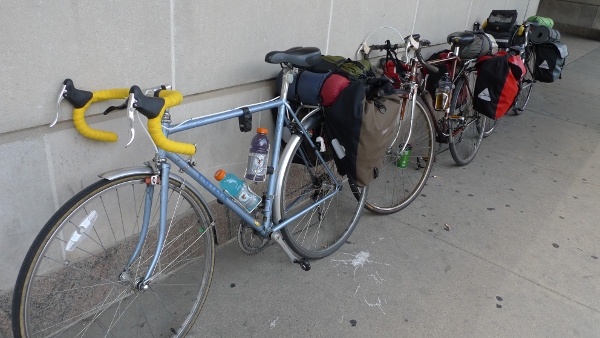
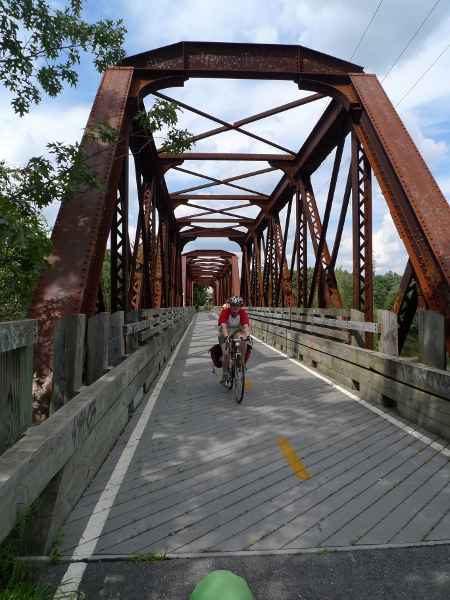
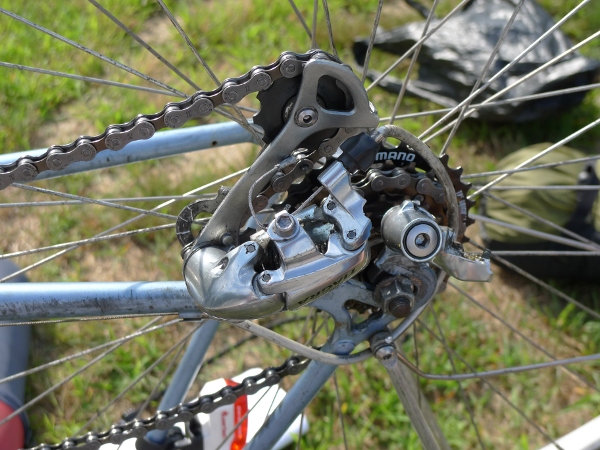
Day 1 We aimed to catch the 10:00 commuter rail train from Boston to Providence, Rhode Island, but we ran late (predictable) and had problems with the bicycle rack for my racing bike, which attaches without frame mounts (also predictable, since Mako and Mika test-rode it earlier in the week), so we didn't make it in to the station until around 10:20. We used the extra time to eat and fix up the bikes, though, so it's not clear how much of a setback that was. Here are our bikes ready to go at the Providence commuter rail station. bikes at Providence We then had some problems with Molly's brakes, and it took a long time to navigate out of the city, but eventually we found ourself on the "Washington Secondary Trail" a wonderful bike path along an old rail line. Every couple miles there'd be an old covered rail bridge over the river, and it was a well-paved straight shot for about ten miles, with no cars and no need to navigate. Molly on a train bridge Just as we were getting into things after the bike trail ended, something completely unexpected happened. This is Daf's derailleur after it sheared off in the middle as we attempted to start after a red light outside Tractor Supply Co. broken derailleur Luckily, John and his son Chris lent us a hand and hauled Daf and his bike to the nearest bicycle shop in the back of their pickup truck. They'd just come from there, where John had bought Chris a new helmet. Greenway Cycles, the only bike shop in a twenty mile radius, was three miles away. We got there an hour before it closed and Rick replaced the derailleur and straightened the hanger in a jiffy. Due to all these things, we didn't get as far as we'd planned in the first day and ended up camping in Seaport Campground in Mystic, Connecticut, rolling in at around 22:00. We did about 65 miles, including six due to the detour to the cycle shop. Carrying camping gear is heavy! Several delicious peanut butter and jelly bagels and some wheatberry and couscous salad later, we were passed out.

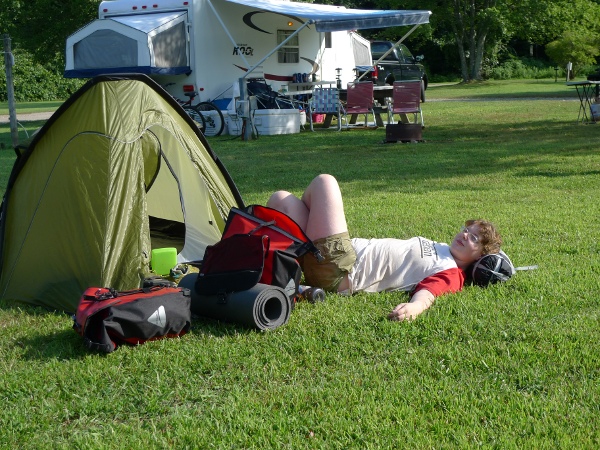
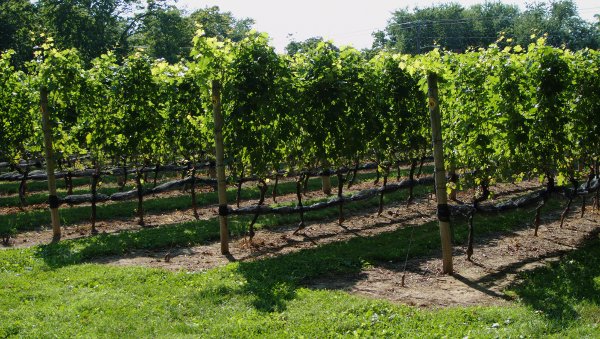
Day 2 Molly at the campground The second day included less bike trouble, but was no less eventful, and we were tired from the previous day's riding. The highlights included taking a tiny sidewalk path that I'm baffled how Google knows about up onto a sidewalk alongside the I-95 bridge across the Thames to New London, Connecticut. the Thames bridge The 13:00 ferry from New London to Orient Point, New York, where we got some remarkably good veggie burgers (whole edamame visible!) for lunch. Cross Sound Ferry And a vineyard on the north fork of Long Island, where we stopped for a quick tasting and ended up picking up a bottle of barrel-fermented chardonnay. The vineyard was small 23 acres, with 11 acres of grapes and the proprietors were friendly and extremely interested in our trip. They gave us a dollar off on the bottle due to our method of transport. The Old Field Vineyard It turns out there are only two trains a day on the Long Island rail, and we just barely caught the 18:52 return from Riverhead. We had mere seconds in the station and ended up without enough cash to pay for tickets onboard, but the conductor just took what we had and gave us tickets to Penn Station anyway. Outside Penn, a girl with a mohawk and a messenger bag overheard us talking about biking up Broadway and told us to bike up 8th Avenue instead. "Always bike up 8th and down Broadway because they have bike lanes in those directions." Thus, we didn't die dodging taxis in the dark. So basically, due to various people being extremely nice to us for no good reason, we made it to Columbia University around 22:30, on the correct day. Warm fuzzies for humanity all around. :)

Gunnar Wolf: We have released!

If you have seen me anywhere near my computer at DebConf, you probably have seen the face of a hurried, worried developer. Still, if you monitor my Debian-related activity, you will notice it is still quite low, even given my (much needed and very much enjoyed) vacations pre-DebConf. Yes, orga-team work is very time consuming, even if my role is far from central this year. And yes, DebCamp+DebConf are known for sucking time into social interaction, which is great but not so (formally) productive. And yes, I even took 1.5 days off to visit my family and a friend who live in the area... Still, I managed to release! \ / Release what? I have been working with Pooka for the last ~2 years on the Seminary on Collaborative Knowledge Construction. We assembled a group of ~10 speakers/authors, each of whom prepared a chapter for a book meant for publication. Pooka and me coordinated the work, which took a long time because it was also an interaction experiment (and because we both did it only in our free time). After the coordination work started fading, I took up the task of coming up with a way to translate it all into LaTeX (and fix a host of conversion bugs, and play with the available packages, and... Hey, I'm after all just a LaTeX newbie, and had to learn to tame the beast!), I stumbled upon that precious fact that makes so many projects release. I stumbled upon a deadline. We want to publish the book under the seal of IIEc-UNAM. Besides my workplace, it is a very well regarded university, and having its seal in our work is definitively a big plus. And the Publications Committee of my Institute is meeting this week - So I had to send our final manuscript by today. Having a deadline overlapping with DebConf sucks. But somehow, I managed to do the needed work to my complete satisfaction. The work is now in the Committee's hands, and I expect to have more news soon(ish). Oh, and where can you get our work? Well, if you register in our site, you will be able to read the whole contents. And once the book is approved and published, the whole work will be published online under a free (CC-BY-SA) license. BTW, that probably means I will have more time to fix my Debian bugs and pending stuff! \ /

Lucas Nussbaum: Ubuntu bugs with patches on the PTS and the QA Packages Overview

Like the Debian BTS, Launchpad is full of open bugs with patches[1]. They have an ongoing effort called Operation Cleansweep whose goal is to get the number of bugs with patches to zero, by reviewing patches and forwarding them upstream or to Debian. Since it really makes sense to expose bugs with patches to the Debian maintainers, I ve modified the Ubuntu box on the Packages Tracking System and the Ubuntu column on the QA Packages Overview (hidden by default for now) to include that information. You can see the result on the dpkg PTS page and the debian-pkg@ packages overview page. Many thanks to Brian Murray for making this possible on the Launchpad side.
[1] Debian has 55115 open bugs affecting unstable, of which 4011 have a patch. Ubuntu has 76916 open bugs, of which 2207 have a patch. [Insert here disclaimer that this is not at all a judgement of value on the abilities of any distribution at triaging bugs, or at generating patches]
Relevant UDD queries:
select count(*) from bugs
where affects_unstable and status = 'pending'
and id in (select id from bugs_tags where tag ='patch');
select count(*) from bugs
where affects_unstable and status = 'pending';
select count(distinct bugs.bug)
from ubuntu_bugs_tasks tasks,ubuntu_bugs bugs
where tasks.bug = bugs.bug
and distro in ('', 'Ubuntu')
and status not in ('Invalid', 'Fix Released', 'Won''t Fix')
and bugs.patches is true;
select count(distinct bugs.bug)
from ubuntu_bugs_tasks tasks,ubuntu_bugs bugs
where tasks.bug = bugs.bug
and distro in ('', 'Ubuntu')
and status not in ('Invalid', 'Fix Released', 'Won''t Fix');

Joachim Breitner: Protecting static content selectively by OpenID

When I created my on-line photo album, we had the year 2001 and there was nothing wrong with publishing ones photos in the Internet. It has been almost ten years now, and things have changed. Privacy is an issue, especially when it also affects your friends and family. The problem
So I needed to find some protection. These were my requirements:
  1. I only want to protect parts of the site, as there are some pictures that I intentionally share with the public. This selection should be possible down to the individual image.
  2. The solution should work without any dynamic server component besides the web server itself. This rules out any self-written CGI scripts as well.
  3. One password, given to all my friends etc., is not sufficient as it might leak to unintended audience.
  4. I do not want my visitors to have to register and remember yet another username and password just for my site. I also do not want to manage this user database.
  5. I do not want to have do large changes to the file structure of my photo album.
This rules out most common options, e.g. protection by a .htpasswd file. Requirements 3 and 4 point to a solution based on OpenID. With OpenID, my visitors can authenticate against a service they already use (Google, Yahoo, etc.), relieving me from the burden of maintaining a user database and them from having to remember a password. There is a mod_auth_openid module for the Apache webserver, and it is even distributed with Debian in the libapache2-mod-auth-openid package. So requirement 2 is fulfilled. The tricky part is: How do we achieve OpenID protection for some images, and not for others. The solution I first played around with selectively enabling or disabling mod_auth_openid based on <FileMatch> directives in the Apache configuration, but it was not elegant and would not scale well. I have more than 20.000 pictures to manage, and have already selected over 5000 pictures to be shown without protection. My solution is based on a partial copy of the whole directory tree that contains all public files. To save disk space, these are just symbolic links to the real file in the protected location. Some mod_rewrite magic then takes care of giving the user the impression that all files are in the same location. I set up a small example of my solution, which has this directory structure:
.:
drwxr-xr-x 2 root root 4096  2. Aug 12:03 images
lrwxrwxrwx 1 root root   18  1. Aug 12:05 index.html -> private/index.html
lrwxrwxrwx 1 root root   18  1. Aug 12:05 login.html -> private/login.html
drwxr-xr-x 3 root root 4096  2. Aug 12:03 private
./images:
lrwxrwxrwx 1 root root 33  2. Aug 12:00 pleaselogin.png -> ../private/images/pleaselogin.png
lrwxrwxrwx 1 root root 28  2. Aug 12:03 public.png -> ../private/images/public.png
./private:
drwxr-xr-x 2 root root 4096  2. Aug 12:00 images
-rw-r--r-- 1 root root  267  2. Aug 12:03 index.html
-rw-r--r-- 1 root root   94  2. Aug 12:01 loggedin.html
-rw-r--r-- 1 root root 2091  2. Aug 12:03 login.html
-rw-r--r-- 1 root root   10 18. Nov 2009  protected.html
./private/images:
-rw-r--r-- 1 root root 4074  2. Aug 11:58 pleaselogin.png
-rw-r--r-- 1 root root 2670  2. Aug 11:58 private.png
-rw-r--r-- 1 root root 2043  2. Aug 11:58 public.png
As you can see, real files only reside in private/, outside of that, only symbolic links exist. The apache configuration protects the private directory and blends it into the main directory:
   <directory /var/www/nomeata.de/openid-test>
        RewriteEngine On
        # Abuse the login page as an error image
        RewriteCond % QUERY_STRING  \.(png jpg)
        RewriteRule ^login.html$ /openid-test/images/pleaselogin.png
        # Ship private files, if they exist, unless public files exist
        RewriteCond  $1 !^private
        RewriteCond  /var/www/nomeata.de/openid-test/$1 !-f
        RewriteCond  /var/www/nomeata.de/openid-test/private/$1 -f
        RewriteRule  ^(.+)$ /openid-test/private/$1
   </directory>
   <directory /var/www/nomeata.de/openid-test/private>
        AuthOpenIDEnabled        On
        AuthOpenIDDBLocation     /var/lib/apache2/mod_auth_openid/mod_auth_openid.db
        AuthOpenIDLoginPage      /openid-test/login.html
        AuthOpenIDTrustRoot      http://nomeata.de
        AuthOpenIDCookiePath     /
        AuthOpenIDCookieLifespan 2592000
    </directory>
A special trick handles the login page for protected images: If the login page is requested and the referrer indicates that the user tried to access a .png or .jpg file, apache will instead ship an image containing an error message. For my photo album I have a small Perl script that, given a directory with a private/ directory therein and a list of rules in form of glob patterns, will symlink matching files and remove symlinks that are not allowed any more.
What s next? As you can see, this does not actually protect the content. It only requires the user to authenticate, then everything is visible. To select which OpenIDs are allowed to access which code, some bugs will have to be fixed in mod_auth_openid first. There was little activity there recently, I hope that the project is not dead.

Jaldhar Vyas: PreventaCamp Days 3 and 4

I missed yesterdays report but there was not a lot to say anyway. I've made further progress on the DHCP problem in the sense that I can make it go away if I use NAT in VMWare instead of Bridged networking. Tried compiling gcc 4.4.4 and ran out of disk space. I've been feeling guilty about not volunteering so that evening I assisted the organizers by eating some of their excess baked ziti. It's my civic duty. Today (Sunday) was Debian day. I spent some time in the hacklab trying to compile gcc again. This time I ran out of inodes. I did manage to get to two of the presentations. One was about the GSoC projects various students are doing. Perhaps next year Debian Minix will be a subject for GSoC? The other one was by Andy Oram about FLOSS Manuals. They are doing important work in Free Software documentation and have developed some interesting tech towards that end. One is CSS3 print profile support. This will be a relief for anyone who has had to deal with the bletcherous XSL. Another is booki a platform for collaborative writing and editing. I shall be following the progress of this project as I hope to make a big contribution to Debian documentation soon. Andy works for O'Reilly and after the talk we had some informative discussion about the publishing world. This "hallway track" is the great thing about gatherings like Debconf.

John Goerzen: The Best Place of Ever

Jacob and Oliver have enjoyed our recent train trip, and our stay, from Kansas to New York City for Debconf. All told, that s a 40-hour trip, including the layover in Chicago. When we got on the train, in the middle of the night as usual, Jacob couldn t stop chattering about how great , fun , and exciting it is. He told us about all the lots of great things on the train, the fact that we were on a night train , and generally couldn t stop chattering. For an hour. At 3:30AM. This was a typical sight from Jacob: IMG_4284 It wasn t as relaxing as usual for Terah and me. Oliver is at the grabbing everything in sight stage. Which worked fine when Jacob was at the age, but with Jacob also along it was a bit more difficult to manage. I suspect that our next trip, when Oliver is a few months older, will go easier. A highlight for both boys, as usual, is the dining car. Oliver loves anything related to eating solid food it s still novel to him and Jacob loves anything relating to trains. What could go wrong? (Parents will probably identify the capability for two hyper-excited young boys to have plenty of things go wrong at a table in a restaurant here fortunately we didn t have anything go terribly wrong.) Oliver turned out to find the things outside the window to require intense concentration intense enough to stick out his tongue while he worked it all out. IMG_4296 And Jacob, of course, wanted to get the wrapper off his straw by himself. Which he can do, but takes a minute. IMG_4305 They also enjoyed the lounge car. IMG_4292 We were in a sleeper room on both trains. That was nice, and when we needed to go explore , we could. Jacob s favorite part of the trip was when I folded down the upper bunk during the day for him to play. I pointed out that it was like a train treehouse. His face sure lit up. He loved that he had his own window up there to look out of. He climbed up the ladder, and after awhile of playing, said, Dad, would you like to play with me up here? Of course I would it always makes me happy when he asks if I want to play with him. As I was playing with him, I asked him if he was having fun in his train treehouse. He gave me a sweet smile, and said, Dad, this is the best place of ever! IMG_4321 In Chicago, Jacob and I went outside and walked around. He enjoyed walking across the bridges over the canal by Union Station. I checked some work email when we got back, tried but failed to reach some local hams with my handheld, and then we got on the train for New York. The boys loved it too, and Jacob was very ready to be in New York when we got there. We got out at Penn Station which was, I think, pretty much what my mind had imagined of an underground station robbed of its former glory (especially having been in that part of Chicago Union Station). We found the connection to the 2 train uptown, bought some MetroCards for the subway, and got on. Jacob was very interested in the subway. He sat very, very still I thought he was scared but on asking him some questions, realized that he was just very interested and engrossed in it all. I had been trying out my HF antenna for my amateur radio setup a few days ago, and by some coincidence, kept making contact with people that grew up in New York. A guy from Fargo, ND a native of Brooklyn told me to make sure to get pretzels from a hot sauce vendor, Pastrami on rye or corned beef on rye from a Jewish deli (because they have the best meat), pizza from guys wearing red and white shirts, and don t be afraid of rats on the subway tracks, and that our boys will love to feed leftover bits of pretzels to pigeons and squirrels. He got so excited about NYC that he went on and on, saying, Man, you re making me hungry now. During times I m not at sessions at Debconf, we ve found some time to do some things as a family. We went to Grand Central Terminal, just to see it it is indeed still Grand. I knew there was a Jewish deli there, so I thought hey try out his advice. It was closed, and when I realized it was Saturday, I realized why. Oops. We hopped on another train to Brooklyn and checked out the New York Transit Museum, which is great and has a lot of exhibits about the history of the city s subway and bus systems. It s housed in a former subway station, and they have a lot of old subway cars down there dating back to 1905 most of which are open to go inside of. It s been nice to meet people at Debconf that I have only known via email or IRC. The organizers of this conference have done a fabulous job. I have every expectation that this will turn out to be the best conference I ve been to in at least 12 years this is my first Debconf. It doesn t skimp on the technical details, people are friendly, and there is a sense of common purpose. But just as important, while there is a set schedule, there is an easy way to add other ad-hoc sessions to the conference schedule. People can get together a group interested in a topic, and schedule an event about it for the next day very easily. I m quite impressed by that, and am looking forward to the virtualization discussion that grew out of a question to the mailing list. It was also neat to meet people that sort of knew our family from my blog posts. I had no idea that there were all that many people that actually read these things ;-) The Debconf kick-off was great. As I was walking across the campus of Columbia towards it, it was a nice temperature, with some light rain, and I heard bagpipes in the distance. Beautiful. And when I left after the evening sessions, I still heard bagpipes. So I went to check it out, and ran into Gabriella Coleman, one of the Debconf organizers and the person that gave the talk I just left on the way, with the same idea. The Columbia campus is beautiful and historic, and it is an excellent venue for the conference. New York is a great city and I m sure we ll be back. It is great to walk out of the hotel in the morning, buy a fresh peach or two from the street vendor 20 feet away, and then go buy a roll or two ($0.75 each) from the bakery down the street. I have been so missing rolls like that since we got back from Germany in March. These weren t quite like the German bakeries, but the closest I ve had to it. It is interesting to note how differently people from different places look at things. Terah has told several people how we live 6 miles from a town with 500 people in it, and people that stop to think about it realize how different it is from New York. It was a surprise to me to hear that some New Yorkers think of Columbia as country . It is beautifully landscaped, and feels different than the rest of the city. The numbers I ve seen suggest that a typical fall weekday has more people on the Columbia campus than in the entire county where we live. And that county is twice the size of New York City. That s not to say that there s anything wrong with New Yorkers thinking of it as country, any more than there is of me thinking of a town with 15,000 people as a pretty big town. It s a different perspective, and I enjoy different perspectives which is another thing I like about Debconf. There are so many people from all over the world there that different perspectives are inevitable.

Bastian Venthur: Debconf: Day 2


Second day in the big city and after the obligatory pancakes, scrambled eggs and bacon breakfast, I spend almost the entire day in the hacklab fixing the documentation for the debbugs SOAP interface. Thanks to Don I think I finally have the get_status part at an accurate state. Accordingly I was very busy making changes in python-debianbts which uses the SOAP interface to query the BTS. Some Bugreport attributes disappeared, others got their data type fixed, Unittests where added and docstrings updated. Finally I uploaded the new version to unstable. Between that mess I met a lot of nice people, and heard a talk whose slides consisted almost entirely of lolcat images which was of course awesome! I definitively have to try that in one of my next scientific talks. Hopefully tomorrow I ll find some time to actually prepare my talk.

Chris Lamb: Debian Live Studio

http://chris-lamb.co.uk/wp-content/2010/live_studio.png
Over the last couple of days I have been creating Debian Live Studio, a web-based service for creating Debian Live systems. After choosing between various options, you wait a few minutes and the server generates an ISO or USB stick image for download. I have a list of features I plan to implement but have put the service live so I can respond to feedback throughout DebConf. Please grab me. Regarding the current server infrastructure, I'm hosting this on a $15 virtual machine which will fill up in a few hours. If anyone can donate more serious hosting for this service please get in touch. You can check it out at: http://studio.debian.net.

Matt Zimmerman: DebConf 10: Day 1

This week, I am attending DebConf 10 at Columbia University in New York. The first day of DebConf is known as Debian Day. While most of DebConf is for the benefit of people involved in Debian itself, Debian Day is aimed at a wider audience, and invites the public to learn about, and interact with, the Debian project. These are the talks I attended. Debian Day Opening Plenary (Gabriella Coleman, Hans-Christoph Steiner) Hans-Christoph discussed Debian and free software from a big picture perspective: why software freedom matters, challenging the producer/consumer dichotomy, how the Debian ecosystem hangs together, and so on. Steps to adopting F/OSS in government (Andy Oram) Andy discussed FLOSS adoption in governments, drawing on examples from Peru, the city of Munich, the state of Massachusetts. He covered the reasons why this is valuable, the relationship between government transparency and software freedom, and practical advice for successful adoption and deployment. Pedagogical Freedom (panel, Jonah Bossewitch et al) The panelists discussed the use of technology in education, especially free software, some of the parallels between free software and education, and what these communities could learn from each other. This is a promising topic, though the perspectives seemed to be mostly from the education realm. There is much to be learned on both sides. Google Summer of Code 2010 at Debian (Obey Arthur Liu) This talk covered the student projects for this year s Summer of Code. Most of the students were in attendance, and presented their own work. They ranged from more specialized projects like the Hurd installer, to core infrastructure improvements like multi-arch in APT. Beyond Sharing: Open Source Design (Mushon Zer-Aviv) Mushon gave an excellent talk on open design. This is a subject I ve thought quite a bit about, and Asheesh validated many of my conclusions from a different angle. I ve added a new post to my todo list to go into more detail on this subject. Some points from his talk which resonated with me: How Government can Foster Freedom in Technology (Hon. Gale Brewer) Councillor Brewer paid a visit to DebConf to tell us about the work she is doing on the city council to promote better government through technology. Brewer seems to be a strong advocate of open data, saying essentially that all government data should be public. She summarized a bill to mandate that New York City government data be public, shared in raw form using open standards, and kept up to date. It sounded like a very strong move which would encourage third party innovation around the data. She also discussed the need for greater access to computers and Internet connectivity, particularly in educational settings, and a desire to to have all public hearings and meetings shared online. Why is GNU/Linux Like a Player Piano? (Jon Anderson Hall, Esq.) Jon is a very engaging speaker. He drew parallels between the development of player pianos, reproducing pianos, reed organs, pipe organs and free software. He even tied in Hedi Lamarr s work which led to spread spectrum wireless technology. To be quite honest, I did not find that these analogies taught me much about either free software or player pianos, but nonetheless, I couldn t help but take an interest in what he was saying and how he presented it. DebConf Opening Plenary (Gabriella Coleman) Biella and company explained all the ins and outs of the event: where to go, what to do (and not do), and most importantly, whom to thank for all of it. Now in its 11th year, DebConf is an impressively well-run conference. I m looking forward to the rest of the week!

1 August 2010

Rapha&#235;l Hertzog: First Flattr FOSS Suggestions

Flattr FLOSS LogoThe Flattr FOSS project is quite young so very few free software are currently listed in the dedicated directories. It s still advocacy time: if there are free software that you d like to flattr, please tell them and point them to Flattr FOSS. It s too early for any conclusion, but the feedback from users is good and it looks like that people using flattr to support free software are more generous than the average flattr user. You re great people! :-) Anyway, it s time for me to give a few suggestions of projects to flattr.
  1. My first recommendation is Project Hamster, it s a time-tracking application for GNOME but it has come a long way thanks to the work of Toms Bau is. I use everyday and it rocks.
  2. My second recommendation is verallt, it s a Firefox extension that allows usage of Flattr even in places where it was not designed to be used: forums, mailing list archives, etc. The persons using Flattr just put [Flattr=20693] in their signature and the Firefox extension automatically replaces this text with a real Flattr button ready to be clicked. Thanks to Paul Da Silva for the nice idea and the first implementation!
  3. My third recommendation is Mustard, it s a StatusNet client for the Android platform. More concretely you can install it on your Android phone to send updates to identi.ca while traveling. I have no Android phone but Mustard seems to be popular among owners of such phones!
  4. My fourth recommendation is moreutils from Joey Hess. It s set of unix (command line) tools that nobody else thought of writing when unix was young (according to Joey himself). They are all very useful, I use more or less regularly isutf8 (verify if a file is UTF-8 compliant), combine (logical operations on lines of two files), pee (send standard input to two programs, very useful in git hooks when you want to run two programs that both consume the same data), sponge (ever tried grep -v foo file >file and lost your data? now you can use grep -v foo file sponge file ). And Joey is a long time Debian developer who has truly shaped Debian, he s behind several major Debian projects (debconf, debian-installer, debhelper, ). Big kudos to him!
  5. My last recommendation is to flattr Andreas Gohr for his work as dokuwiki lead developer. There s no flattr button on dokuwiki s website but you ll find some in Andreas blog, just pick a dokuwiki related article like this one: Dokuwiki Birthday Bughunting Weekend. Dokuwiki is a simple wiki that works without any database (the pages are stored in flat files) and it s even commonly used to setup simple websites thanks to the numerous themes available.
Okay, that s it for this month. I ll try to keep a broad panel of software (desktop, command line, mobile, web, etc.). Since I have promoted a GNOME desktop application, I would like to be able to promote a KDE or XFCE application next month but I did not discover any KDE/XFCE project using Flattr do you know any? Please share in the comments if you find some. Also I wonder if you have decided of a flattr strategy Personally I m likely to flattr my favorites projects/persons each month and to flattr a few other occasionally as I discover them. What s your own strategy? Flattr this Share/Bookmark 4 comments Support my work

Next.

Previous.