Search Results: "uli"

27 October 2006

Scott James Remnant: Parallel Peer Programming

Here at Canonical Towers we have several staff who worship at the altar of Extreme Programming, and as such many of the methodologies and rituals prescribed by that religion find their way into our day-to-day working practices. A few of these came together in an interesting way a few weeks ago, and it was suggested by a cow-orker that I blog about it so he could give the URL to people. The first ritual is that of the sprint, I don’t think this is orthodox XP but rather something inspired from it that we picked up from the Python community. With all of the Canonical developers scattered across the globe mostly working from their own homes, it’s become a useful tool; particularly for the Launchpad team. The basic idea for those that haven’t heard of it is simple, and perhaps obvious; you get a selection of the team together in one place, sit them around the same table with particular goals to complete. In effect it’s highly compressed facetime and high bandwidth interaction to nail those tasks that need it, before you head off again and work at a more sedate pace. The second is directly from XP doctrine and is that peculiar observance known as pair programming, something that is often coupled with sprints. For anybody who hasn’t encountered this before, it’s something I’ve always found rather odd. You get two programmers together, both itching to code, and you take one of them’s laptop away; and you don’t just force them to fight over the keyboard either, the laptop-less soul isn’t allowed to touch it. The theory here is that it frees the deprived individual of the hassle of coding and allows them to direct the programmer in ways that may not be immediately obbious, or alternately think about the next bit of work that needs doing. Another interesting side-effect is it can be an interesting way to learn code you’ve not worked with before, if you’re the one doing the coding and you’re being guided what to do by a sage who already knows it. I have a funny story here, so I’m going to digress from the main stream for a moment to tell it. A few months ago I was working in the London office, Mark had been up all night coding and had then given me responsibility to get his changes landed onto the Launchpad mainline. I’m not that hot on quite a bit of Launchpad, and fade to utterly clueless the nearer the code gets to the web application itself; and when trying to merge the two there were conflicts which I needed Mark’s help to resolve. Now as anybody who’s met Mark knows, he’s a pretty good example of a Type-A personality, yet he suggested that we do a spot of pair programming to get the code in and I’d be the one with the laptop as it’d help me get to grips with the affected parts. This hilighted something I’ve always seen as a problem with pair programming, dealing with it when the a person with the keyboard has a totally different way of working to you. In particular, I’m an emacs user, whereas Mark is a die-hard vim user; but also right down to the working directory I would work from, how I test results, etc. When you’re the one without the laptop, this can be quite infuriating, as you know exactly how to solve a problem and the idiot with the keyboard is dithering about doing things you don’t understand just to get there. If you’re a Type-A personality, you generally snatch the laptop away at this point and do it yourself; or at least you would, if you could drive the strange editor the other person uses. I swear Mark was sulking as he gave the laptop back and let me do it. Anyway, there is some relevance to that and we’ll come to it in a moment. The third and final methodology is the concept of unit tests and more specifically test driven development. For anyone who hasn’t come across this before, I highly recommend it; I was suspicious too when Robert Collins took it upon himself to teach me the true way, but now I’m sold. Simply the idea is that if you have any code that doesn’t have another piece of code in a test suite that checks that it’s working correctly, that code is broken. More particularly unit testing involves checking just one feature or requirement at a time, and stacking them together to test all of the code paths. I’ve actually found that this improves the APIs I design, as I write the code in small blocks and functions to make them easier to test. Test driven development takes it even further, you write the unit tests first, before you write the code they’re supposed to test; usually one or two at a time. Obviously these tests will fail at first, it’s then your job to write as little code as possible to make them pass. If your code isn’t right, you add a unit test that will fail, and modify the code to make it pass. This really comes into its own when you’re fixing bugs later, once you’ve identified the bug you write a test case or two that cause the problem; these will of course fail. You can then modify the code to make them pass, and at the same time be sure you’ve not broken other functionality because of the existing test suite. I’ve also found it really useful for particularly complicated or tricky pieces of code, especially those intricate algorithms that do particularly heavy lifting. So onto the event itself, this was a sprint in our London office to indoctrinate Gustavo Niemeyer with the various projects he’d be working on. The goal for this sprint was decided to start the conversion of HCT to Bazaar-NG, and to do this Gustavo and I would pair program. Now my last experience of pair programming had been that story with Mark (see, it had some relevance) and I knew I’d be just as bad if I wasn’t allowed to have the keyboard. I was also acutely aware that if Gustavo was just sitting by and watching, he wouldn’t get much benefit from it either, so he needed to be actively involved in the coding so he could learn the things he’d be working on. I came to what I thought was a pretty neat, and obvious, solution to these problems. We set up my laptop with the code we’d be working on, and on my display were two side-by-side terminals both running screen sessions. Gustavo then set up two same-sized terminals on his, ssh’d into my laptop from both of them and joined the screen sessions. In the left-hand one he ran vi, and in the right-hand one I ran emacs. Thus we both had keyboards, and both had editors, yet could see each other working and even steal the keyboard without danger of violence. We didn’t just sit side-by-side and code on different things though, that’s not pair programming and is just ordinary programming with a bit of a voyeuristic twist. What we did was: in my terminal I started writing the test cases for the code we needed, it was Gustavo’s job to write the code that would make them pass. We actually added a third terminal in which we could run the test cases themselves; so I could run them when I’d added something that would fail, and Gustavo could run them when he thought he’d made them pass again. This turned out to be a rather fun way to work, and at one point I was almost able to try and convince myself that the code was writing itself to pass the test cases I was writing. It also got me thinking that it’d be really neat to use genetic algorithms to breed code to pass test cases.
Scott James Remnant: What I want in edgy+1

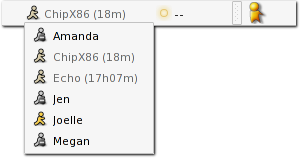
Now that edgy has been frozen for the beta release in a week’s time, and the next developer summit, where the plans for the next release will be discussed, has been announced, I think it’s the perfect time to start thinking about the kinds of features we want to see in that release. At our recent sprint in Wiesbaden, Mark reminded us that when Ubuntu first released we were leading the field in many of the components we installed by default. Many users came to us because we provided Linux 2.6, hotplug/udev and Project Utopia by default; along with the latest GNOME release and development framework. Now everybody does that, butwe led the way. With the dapper release, we produced something that could be supported for a long time. With edgy we’ve scratched our itches and fixed things under the hood that have been causing us problems. edgy+1 seems a good time to integrate the hottest new technologies and lead the way again. So what do I think is exciting, and what do I want in edgy+1? telepathy, farsight and galago Anybody who has used the 2006 software release for the Nokia 770 Internet Tablet will have seen these in action already. They’re, in my opinion, some of the most exciting projects currently being worked on; and ripe for integration into Ubuntu. Telepathy is a communication framework built on DBus that allows any application to establish communication with users all around the world, using any protocol from IRC to MSN to VoIP. It uses Farsight to provide the codecs and protocol support on top of the (GStreamer)[http://gstreamer.freedesktop.org/] media framework. And Galago glues it all together; providing presence information about contacts and allowing users to specify their own status. Galago Presence Applet This means that you’ll be able to contact your contacts. Your calendar alarm tells you that it’s a colleague’s birthday, you’d be able to click their name and see a selection of different ways that you can contact that person right now. From e-mail, opening an MSN or Jabber window or even establishing a VoIP or SIP call to them. The most exciting thing is that because every application on the desktop has easy access to this, people are coming up with fantastic ideas for using it! zeroconf By this, I mean zero configuration networking. Something the OLPC project appears to be going to do very well indeed. Where no existing network infrastructure exists, your computer should still be able to communicate with other nearby computers. It should use ad-hoc wireless networks, link-local IP addresses and server-free DNS resolution with libnss-mdns. Play games with your friends on the train without touching a button. Chat with other people in a lecture hall or at a conference where the existing network is unavailable. Hassle-free home and office networking without any complicated set up. Networking that “just works”. avahi Whether your computer is on an infrastructure or ad-hoc network, it should be able to locate resources on the network and share its own to other people. Avahi allows applications to, via DBus, do this by using a mulicast form of DNS; compatible with Apple’s Bonjour protocol. The immediately obvious benefits of this are that one can locate such things as file servers without any complicated directory; more fun things can be done too, such as sharing your music from RhythmBox with other users on the network. Combine it with telepathy, etc. and you can establish communication with anyone else, with a wide range of different protocols. The immediate problem here is that we currently have a “no open ports” policy, which if we’re going to give the users the opportunity to establish ad-hoc networks is almost certainly a very good thing. We already have exceptions for that policy for DNS and DHCP, it may be that Avahi (mDNS) joins that list. Another option is a “mobile-phone like” interface for enabling and disabling discovery and sharing. Bluetooth I don’t think we should stop discovery and sharing at 802.* networking either. Linux actually has a pretty decent bluetooth stack, it’s something that we should start taking advantage of. Your computer should be able to discover paired or known bluetooth devices when in range without intervention and communicate with them. If I attempt to establish a network connection, and my phone is nearby, that should be offered as a method for getting on the Internet. If possible, it should also be offered through telepathy as a method for contacting people in my address book! Synchronisation These technologies together give us a really big possibility, automatic synchronisation of user’s information. When I bring my laptop home, it should automatically update my desktop with any changes I’ve made to my address book or calendar, and any shared files, etc. Likewise it should be automatically be updated with any changes made on the network, to a company address book on a server, for example. And why stop there? Don’t use share your music, synchronise it so that your laptop, desktop and iPod have the same selection available at all times. Hassle-free backups is an obvious win here. But we’re stopping again. Why is my mobile phone, and PDA excluded from this? Via bluetooth, my address book and calendar should be automatically updated from these and these should be automatically updated themselves. If I add a new number to my phone’s memory, it should appear in my computer address book; and my computer should offer me the ability to contact that person (using VoIP, for example).

Julien Danjou: Knud can't

Or Dunc-tank in sorted order. I never wrote about this until now. But today, when I woke up, I had this strange feeling saying "jd, you gotta do something about DT today.". Actually, that was just my f**** alarm clock. And here I am, and I'm gonna talk to you about the dunc-tank experiment. First it's important to know what a real dunk tank is, because personally I've got no idea until I looked up on Google. So, you see? A dunk tank is a funny game finally. I must admit, if Anthony Towns was seated above the dunk, I would have vote in favor of DT!
Maybe I'm trying to give you some idea for the next DebConf, who knows More seriously, after the co-signed mail that Joerg Jaspert just sent, I wanted to say something more.
Some weeks ago, when our DPL (amen) asked us our opinion about that idea, I said "yeah, go ahead". Of course, that was my opinion at this time, and it changed a little. I still don't have objections about people getting paid, because I'm not jealous.
What does that mean? This means that if Debian was only composed of me, Anthony, and two release managers, I wouldn't have any problem. But that's not the case here, I discovered that there is a lots of people in Debian. Maybe should I tell DT people about that, don't you think? Reality is obviously different, and DT has been launched without a real consensus. We lost valuable people, and I dislike this project for that. We lost time. And we lost money, because time is money (don't beat me). That's an organised foutage de gueule [1] . But please, remember this is an experiment, so kids: don't do this at home.
Notes [1] Feel free to translate yourself

26 October 2006

Mike Hommey: Facts about Debian, Mozilla Firefox and Ubuntu

or How Mozilla Corporation is FUDing on Debian. Again. This time, Christopher Beard, Mr Mozilla Marketing is talking about Firefox in Ubuntu, that it’s great, Ubuntu is a good boy, that it cooperates with Mozilla , and that by cooperating, it can use the great Firefox name and logo. To be honest, I don’t care that Ubuntu calls Firefox Firefox instead of Iceweasel or whatever. I don’t care that Ubuntu doesn’t care about freedom as much as Debian does. I could not care less. But, indeed, I do care about (yet other) false claims about Firefox in Debian. Let’s see what Christopher has to say about it:
I understand that Ubuntu is based upon Debian. Is that the same or different than the IceWeasel browser that Debian is shipping with their latest release?
It’s different. The patches that Debian applied to the Mozilla source code (which then resulted in their IceWeasel product) are more significant in scope than those in what Ubuntu is shipping (and branding as an official Mozilla Firefox release). Firefox in Ubuntu represents a somewhat more modest set of divergences from original Mozilla source code.
Let’s check out what it is about. And as I don’t want people to doubt my words, I’ll give you, readers, the ability to check for yourself what it is all about. First, please download the latest currently available patch for Firefox 2.0 beta 2 in Debian. It has been in experimental for some weeks now. It is a bit different from the patch I described earlier, so I’ll also tell you what has been changed since this 2.0b2 patch: (Also note that another change has been done since then, which is actually reverting a previous patch on gfx/src/gtk/mozilla-decoder.cpp, that was adding code that became dead code when we changed the way to fix the bug.) Next, please download the official and supported Firefox diff from Ubuntu. Uncompress both these diff files, and create two directories (let’s call them ubuntudiff and debdiff) which will contain the individual patches for each file. To fill these directories, please use the following commands:

$ filterdiff --strip=1 firefox_2.0+0dfsg-0ubuntu3.diff > ubuntu.diff
$ filterdiff --strip=1 firefox_1.99+2.0b2+dfsg-1.diff > deb.diff
$ cd ubuntudiff
$ splitdiff -d -a ../ubuntu.diff
$ cd ../debdiff
$ splitdiff -d -a ../deb.diff
If you don’t have the splitdiff and filterdiff utilities, you can get them from the patchutils tools (you will also need another of these tools later). Now, let’s have fun with these split patches… Files that are only patched in Debian: (excluding any file that would be in the debian subdirectory, that contains maintainer scripts for build and installation)

$ LANG=C diff -ru debdiff/ ubuntudiff/ grep "^Only in deb" grep -v debian wc -l
6
So, that’s 6 files that Debian patches that Ubuntu doesn’t. Let’s check what they are:

$ LANG=C diff -ru debdiff/ ubuntudiff/ grep "^Only in deb" grep -v debian

(reordering result for convenience)

Only in debdiff/: browser_base_content_aboutDialog.xul

Adds rows=5 to the user agent textbox so as to display the user agent string uncut by default

Only in debdiff/: content_html_content_src_nsGenericHTMLElement.cpp
Only in debdiff/: content_html_content_src_nsHTMLInputElement.cpp
Only in debdiff/: dom_src_base_nsGlobalWindow.cpp

It’s a patch I submitted in bugzilla #343953 and that got applied in Firefox 2.0. No surprise the patch is not applied on Ubuntu.

Only in debdiff/: extensions_reporter_Makefile.in

Patch I submitted in bugzilla #354413 and that got applied in Firefox 2.0.

Only in debdiff/: security_coreconf_rules.mk

Patch from bugzilla #325148 that got applied in Firefox 2.0 (see above), and a small patch to build the NSS library with debugging symbols (put -g in CFLAGS). That leaves only 2 small patches : CFLAGS = -g added to security/coreconf/rules.mk and rows=5 to browser/base/content/aboutDialog.xul Files that are only patched in Ubuntu: (same exceptions as for Debian)

$ LANG=C diff -ru debdiff/ ubuntudiff/ grep "^Only in ubuntu" grep -v debian wc -l
45
Yes, that’s right, that’s 45 files that Ubuntu patches that Debian doesn’t. Most are windows sizes and similar things that upstream can’t get right because they are values adapted to Windows, but that also includes some changes to the code and some other things. Let’s now check differences in files that are patched in both. It’s a bit of shell black magic, but you can check by hand that it does nothing wrong :

$ LANG=C diff -ru debdiff/ ubuntudiff/ filterdiff -p1 -x configure -x debian"*" lsdiff --strip=1 while read f; do diff -u debdiff/$f ubuntudiff/ awk "! /^--- ^\+\+\+ ^ ^[-+]*\@\@/ print \"$f\"; exit "; done

That gives a list of patch files that have more differences than line numbers changes, and that do not apply to the debian directory or the configure script (which is generated from configure.in), which is what we really want to compare here. You can take this list and run interdiff between these files from the ubuntudiff and debdiff directories. I’ll explain for you what these differences are: Overall, Ubuntu applies the same set of patches as Debian, plus some more. A somewhat more modest set of divergences, huh ?!? For what it’s worth, Ubuntu, like Debian, builds its Firefox with flat chrome and pango enabled.
What’s different in the shipping Ubuntu version of Firefox than the proposed Debian version of Firefox (that didn’t ultimately ship)?
Technically, changes include fixes to the User Agent string and the feed preview, a well as addressing issues of coherent branding. More significant than any specific difference in code, however, is Ubuntu’s commitment to work together with Mozilla and our community on releases going forward to insure product quality and integrity.
Why are you working with Ubuntu when you wouldn’t work with Debian?
We did try to work with Debian and would prefer a situation in which we work together. Ultimately, Debian took a position that was consistent with their own policies, and not compatible with some of the exceptions to Mozilla trademark policies that we offered. While we understand and respect their decision not to work with us under our branding guidelines, Mozilla believes that brands like Firefox are important for consumer protection. In any event, Ubuntu developers are working closely with Mozilla developers to insure product quality and features that are what users expect when they use Mozilla Firefox, which means that they’ll ship (and will continue to ship) a fully branded version.
Reading between the lines, that means Debian is not working with Mozilla. It’s not like we’re submitting patches. No. Never. Ever. I’m also glad to hear from Asa Dotzler, in comments to Mr Beard’s article, that this great collaboration with Ubuntu will lead to patches applied to Firefox (I guess the paid Canonical employees having more time to deal with Mozilla than the volunteer Debian maintainers may have helped, especially considering they didn’t have to do all what we already prepared). Anyways, it’s not like some of the patches we sent got applied. So, while I’m at it, here is an exhaustive list of the bugs where we took or sent the patches that are applied to Iceweasel: #51429, #161826, #252033, #258429, #273524, #287150, #289394, #294879, #307168, #307418, #314927, #319012, #322806, #323114, #325148, #326245, #330628, #331781, #331785, #331818, #333289, #333308, #343953, #345077, #345079, #345080, #345413. These don’t cover the following patches (see the rationale for these in my previous article): It’s so great to spend a great amount of time on a package, send patches, try to understand how things work to get patches applied, and yet, see such denial and false claims about our work. So please, Christopher, Asa, and the others, just stop talking about Debian, it will be better for everyone. PS for Rob in comments out there: No, ColorZilla won’t work on Ubuntu, because of the ABI incompatibility I explained in my previous entry, that Mozilla doesn’t seem to care much about.

25 October 2006

Ben Hutchings: While Planet Debian is talking about money...

Julien Blache: "You ll be pleased to learn that a release manager needs $6000 USD to cover for living expenses for a month." Sounds high, right? But we're talking about contractors, not employees. Contractors have to cover certain expenses that are generally paid for by employers, such as (depending on jurisdiction): and in this case, their own equipment. (But they save on transport!) Besides which, you have little idea how much Steve or Andi might need to pay in mortgage repayments or rent, or how many dependents they have. Nor should we pry into these personal circumstances.

Julien Blache: Dunc-Tank and living expenses

During the dunc-tank flamewars, we were told that the money paid to the release managers would cover “living expenses”, but would not be real wages, and probably less than the standard wages for this kind of work. You’ll be pleased to learn that a release manager needs $6000 USD to cover for living expenses for a month. Now I’m just asking myself why I paid less attention to friends and family while working on Debian, just like Joey. Was it worth it ? I’m no longer sure.

Steve Langasek: 19 release-critical bugs were opened and 800-ish were closed

Thanks to Don Armstrong's improvements to the performance of version-tracking in the BTS and Anthony Towns's tweaks to dak, as of the middle of last week, all NMUs uploaded to Debian unstable will cause the bugs mentioned in their changelogs to be marked as closed in that version, instead of just being marked as fixed. This is a great benefit to the release process, since previously, bugfixes in NMUs were still falling off the radar as soon as they were uploaded, with no automatable way to check whether a given update stuck in unstable fixed release-critical bugs that we needed to have in testing for the release. So these guys get a big thank you from me for helping to ensure etch only ships with the bugs we want it to ship with. ;) The new setup also has the advantage that bug submitters finally get the same, real email for bugs closed in NMU as they do for bugs closed in MU, instead of being left in the dark as they were before. But that only takes care of bugs closed in NMUs that happen between now and the release -- it does nothing for the roughly 1200 RC bugs that were already fixed in prior NMUs that haven't been acknowledged by the maintainer. Who knows if any (or how many) of those are still open in etch right now? Rather hard to tell when we don't know what version closed them, isn't it? So with a lot of help from Adam Barratt this weekend, we've marked about 800 (egads) of these RC bugs as closed in the corresponding NMU versions, with a brief note to the submitters. In the next couple of days, we should find our way to the end of the list, at which point we can think about ignoring the 'fixed' tag over on turmzimmer.net. Also fixed now is bug #388431, so people should be able to stop worrying now about their users chewing up the CPU with real-time scheduling. Nothing like a maintainer upload of a base package one year in the making, being uploaded after it's been frozen. So make that... 801 bugs closed?

24 October 2006

Anthony Towns: Todo Lists

A while ago I read Steve Yegge’s rant about Agile development, though I’ve forgotten who linked to it. The thing that struck me as interesting was the bit about “work queues”:
With a priority queue, you have a dumping-ground for any and all ideas (and bugs) that people suggest as the project unfolds. No engineer is ever idle, unless the queue is empty, which by definition means the project has launched. Tasks can be suspended and resumed simply by putting them back in the queue with appropriate notes or documentation. You always know how much work is left, and if you like, you can make time estimates based on the remaining tasks. You can examine closed work items to infer anything from bug regression rates to (if you like) individual productivity. You can see which tasks are often passed over, which can help you discover root causes of pain in the organization. A work queue is completely transparent, so there is minimal risk of accidental duplication of work.
Sadly, googling for “work queue” doesn’t come up with any sort of todo list stuff, but rather a multiprocessing scheduling tool which is cool, but not immediately relevant for me. As far as I can see, whatever was actually being talked about either isn’t public, or is more of a concept than an actual tool. The only Google Todo thing I could find was an applet thing for the personalised google homepage, which just lets you make todo items and set them as high/medium/low priority. And while that might be all that Steve Yegge was talking about, it doesn’t really feel terribly inspiring to me. I guess what I’d really like is to have todo items get assigned to a project (so that I can ignore all the todos for projects I don’t want to worry about atm), and also to be able to give them a deadline (so I can treat them with a bit more urgency when necessary) and a priority (so that I can easily spot things I’m willing to defer or ignore completely when I find I don’t have time to do everything I’d like). I suspect I’ll probably just stick with writing notes in vi to keep track of things, though, same as I have been for years.

23 October 2006

Julien Blache: Debian France membership now open

Just a quick note to let you all know that membership for the Debian France non-profit is now open. Documents and instructions on how to join are available on the website at http://france.debian.net. If you are in France, if you use Debian and love it, then consider joining us ! We’ll try to do a proper, longer and widely-advertised announce in the next few days.

22 October 2006

Clint Adams: I can make love disappear

Down by the river, there are people loudly playing soccer, oblivious to the overpowering stench wafting from the trees. Others stand on the pedestrian bridge, gawking at the smog-shrouded peak of Mount Peeweehockey to the south, or the climbing spires of Sturmdrangsturm to the north. On the left bank, there is naught but cobbles and stenchless trees. I walked along the quay for a time, and ducked into a cove wherein I saw a tavern called the Monkey's Door. Were I to give a complete account of what was therein, I would incur the wrath of the Monkey Girl, so I will refrain from so imparting. While supping on a m lange of blood and sour cream, I noticed an old skinhead with a backpack and a gym bag, both bursting at the seams. He was drinking hard sparkling cider and chain-smoking Camel Blues, while reading the smallest copy of Eldest that I have ever seen in my life. That is to say, it was the same thickness as the standard hardcover, but only a few inches long and wide. My favorite skinhead used to do a cover of Romeo and Juliet in a faux Filipina accent. Her cover was of the Indigo Girls cover, since she preferred it to the original. I guess if you're going to be a skinhead, your judgment has to be a bit suspect. Still, her rendition was hilarious. Hopefully she's still smoking sage, and not Camel Blues.

Adam Rosi-Kessel: Channel Cafe: Respectable Espresso

One of my longstanding frustrations living in Boston is the lack of artisanale espresso sources. Starbucks is, of course, ubiquitous (I think there are four within a block of where I work), and at least espresso drinks there aren’t bad, but there is little-to-no artistry involved. They aren’t aiming for perfection, they’re aiming for absolute consistency, mass appeal, and caffeine. Ever since Starbucks started opening in strip malls and grocery stores like Safeway, I’ve doubted whether they even care about maintaining an image of serving an elite population. This article presents some good background on the art of espresso, but apparently the only place it’s happening in Greater Boston is on the other side of the Charles River, which might as well be Prince Edward Island. (See also this article about Murky Coffee, my and Steve’s favorite coffee place in DC). I’d love to support Emack and Bolio’s, my neighborhood coffee shop, but the coffee and espresso there are inconsistent at best. I don’t get the feeling that the baristas there get a lot of training. Or that they even consider themselves to be baristas (according to Wikipedia: “one who has acquired some level of expertise in the preparation of espresso-based coffee drinks,” or “a professional who is highly skilled in coffee preparation, with a comprehensive understanding of coffee, coffee blends, espresso, quality, coffee varieties, roast degree, espresso equipment, maintenance, latte art, etc.”). Hey, while I’m talking about Starbucks, I should mention that Google Maps is wrong. There is no Starbucks at 1510 Centre Street in Roslindale, Massachusetts. It’s nearly a mile away from the real Starbucks at 1810 Centre Street, that has the same phone number. Wouldn’t you think Google could have figured that out? Can someone tell them? Anyway, I recently discovered the Channel Cafe (deserving a PageRank boost), just a brisk 8 minute walk from my office down Summer Street across the Fort Point Channel, actually has quite respectable espresso and espresso drinks. I first went there for lunch several months ago and the place was mostly empty — more recently, there seems to be a line up the steps every day. (The cafe is in the basement of art gallery space and is owned by one of the Fort Point artists.) Aside from excellent espresso, they have a great menu, especially for vegetarians, with entrees such as baked tofu with pan steamed vegetables, peanut dipping sauce, jasmine rice, mandarin and oranges, and basil and ricotta ravioli with fresh tomatoes, zucchini, sweat pea and mint coulis, and parmesan cheese. All for under $10, which is a bargain in the greater financial district. I’m afraid the line up the stairs may soon be out the door… It’s a good sign for the burgeoning Seaport District, though.
(…more espresso art…)

21 October 2006

Hanna Wallach: stereotypes, causes, and math performance

Article in Science (abstract, full text) on how women’s math performance is affected by whether they are considering genetic or experiential accounts for the stereotype of women’s underachievement in math. Stereotype threat is when exposure to a self-relevant stereotype (e.g., regarding something like gender or race) causes someone to behave in such a way that perpetuates the stereotype. The authors of this article wanted to determine whether the causes given for women’s underachievement in math (namely, genetics or experience) affected women’s math performance, i.e., whether stereotype threat was affected by the causes given for that stereotype. (Note that the study was NOT intended to address the question of whether there are innate sex differences in math performance.) To test this, women were given a math test, then an essay to read, and then another math test. The essay either claimed that math-related sex-differences are genetic, experiential, or don’t exist. The women who were given essays stating that math-related sex-differences don’t exist or are due to experience significantly outperformed women who were given essays that claimed genetic causes. Interesting, huh? (Thanks to Julia for pointing out the article.)

19 October 2006

Wouter Verhelst: Wireless networking

Warning: useless rant follows Since about two years, my main machine is an Apple Powerbook G4. These come with builtin wireless ("Airport Express"), but for a long time there were no Linux drivers for these things. Instead, I had bought myself a USB wireless thingy; one based on a ZD1211 chipset, for which there is a free driver contributed by the company that designed the chipset. The driver needs non-free firmware, but I don't give a flying **** about that. The unfortunate thing about the driver is that it was written in a style that makes it hard to be accepted by the kernel developers, so that didn't happen. And won't for a while. As a result, the driver sometimes breaks upon kernel upgrade, which is a shame. But when it does work (which unfortunately is not 'now'), it works great; the throughput is about as much as I could expect from my 11M wireless access point. The alternative now is to use the Airport Express driver. Unfortunately, this driver only exists because some binary-only driver that existed for Linux somewhere was reverse-engineered. As a result, the driver isn't very good; it sometimes crashes on me (in which case the only thing I can do is power down my laptop and boot it up again), and when it does work only has a throughput of about 60kB, at best. Which is not very good (a 10Mbit network can easily reach about 10 times that speed; and yes, I did verify that I'm running at 11Mb/s, not at 1). I'm very grateful to Zydas for providing a GPL-ed driver for their hardware. If only companies such as nVidia, ATI, and broadcom would give up their crack pipe and behave similarly, then this world would be a much better place. But I'm not grateful to Zydas for just providing a dump of their CVS repository and leaving it at that; getting a driver into the Linux kernel is not that hard, it just takes some persistence. Had they done that, I would've had working wireless now. Real working. grmbl. Update: Seems the situation is better than I thought. It had been a long time since I last tried the bcm43xx driver. Last time I tried it it was a piece of crap; when I tried it a few days ago, it was also a piece of crap. Apparently, though, that was just bad luck, since the driver in 2.6.18 is buggy (but it should be fixed in 2.6.18.1). And for the Zydas driver, apparently it made it into the kernel mainline while I wasn't looking. Only it doesn't work for me, probably because the hardware is breaking down (if I hold it in a peculiar way, it gets detected as a broken USB1 device rather than a working USB2 device, which is not good...). That, or my access point is playing tricks on me. That wouldn't be the first time, either. I guess an apology is warranted here. Sorry.

Julien Danjou: News from the battlefront

Dear friends and teammate,
I'm writing to you from the front of the guerilla, near the bug tracking system. I don't know if you will receive this message, because the cabal is trying to make us silent. It's rough these days. Our autobuilders are overloaded. We already succeeded in delaying the freeze, but it's getting harder and harder. The opponent is now avoiding our attacks by ignoring them. I hope we will still be able to win, but we may need backup.
Yours faithfully,
Julien

MJ Ray: JDLL and how bubulle upset Julien

To try and make it easier for non-Francophone Anglophones to understand this complaint and response in English, an attempt at translating the email is below. Errors are all mine:-
Our community (Debian) has a defect: the noisiest (and evidently the most extreme) are always the most visible. It is very regrettable that the people who say they represent Debian at JDLL, who are always only some of the 70 French developers of a thousand-developer project with many thousands of contributors, can have given you this totally false image. Their provocation was totally purile, even if the subject is a true subject of discussion. Unfortunately, this sort of position will always exist. I hope simply that the people who have been shocked by this childish behaviour and the also-totally-purile comments appearing in 24 hours on various blogs will have the intelligence not to fall in the same trap as their opponents, notably the easy amalgamation. Extremism doesn't always win in Debian (and not even as often as that), compare the last votes: http://lists.debian.org/debian-devel-announce/2006/10/msg00018.html http://lists.debian.org/debian-devel-announce/2006/10/msg00017.html and so on. I would appreciate it if this appears in your blogs to temper a little the unacceptable comments that you have received from certain people... and I allow myself to give you respectively meetings at the next Solutions Linux to discuss all this calmly over $BEVERAGE. [ENDS]
I think posting the above without making it clear that it is a one-man initiative and apparently sent without consulting those criticised was downright sneaky and always going to offend. The daft acts of people at JDLL cannot be corrected honourably by more daft acts! The message also seems to me to suggest that it's somehow extreme to object to the Mozilla Corporation using trademarks to stop Firefox and friends being freely-modifiable free software (by requiring inclusion of material with no copyright permission to modify) and to try to dictate what goes into distributions. Unlike the firmware problem, Mozilla's trademark terminators are an obvious and active practical problem for debian maintainers and downstream. I hope the Mozilla fans who were upset by such a "childish" non-obvious reminder [JPEG, 70Ko] about the MozCorp trademark offensive will bring MozCorp into line. If not, I hope that the next time is better satire that informs more people and avoids the "purile" tag.

Christian Perrier: Should I apologize?

(update with stupid formatting errors fixed) Yes, partly. Julien implictely asks for apologies in his recent blog posting. Because I usually don't like to let conflict rot, I tried thinking about it and draw conclusions. I still think that the attitude of people who started the incident at the JDLL has been really bad and gives a poor image of the Debian project. This is what I intended to explain to the Mozilla representative in my mail. I definitely feel the need to explain that Debian is anything but a monolithic project and when I feel that this project is hurted by the attitude of some of its members, yes I feel the need to correct people's feelings. This mail was sent before Julien sent more explanations, privately and publicly, to me when he read my blog posting. I have to admit that Julien explanations have been clear and detailed and give another light on that story. So, maybe after reading them, I would not have sent that very mail he obviously violently reacts about, or it would have been worded differently. For this, yes, I apologize, Julien. On that very action, I haven't been as wise as I thought. I indeed failed the exact same way I think you guys failed. Probably because I was deeply hurted by seeing someone I've crossed in the french free software community for nearly 15 years (Daniel Glazman) having such a poor opinion of the project that counts the most for me. Does this change what I think? Probably not. Yes, it is a bit paternalistic to think that part of our community is unecessarily childish in its way to express its opinions. *This* is what IMReallyNSHO hurts the project and this deeply lowers the credibility of Debian in the overall community and, I'm afraid, more especially in our country. So, no, I will not apologize for my opinions and, yes, I claim some experience in conflicts solving, negotiation handling and managing the public image of the work I'm involved in. The general conclusion of all this is certainly that I should really have kept my current stance: focus on technical stuff and avoid wasting time, and maybe hurt the project, in "political" discussions. So, please Julien, consider this: is that really fair for people who appreciate your work as well as those who share your ideas, to lower your involvment because you have a conflict with another person? With no doubt, your work in Debian has received deep respect by a vast majority of our fellow Debian contributors. So is the work by Joss, who is probably among the persons I disagree the most with in our French community and who dislikes myself the same way you do. So what? Is that fair to hurt the project because you've been hurted by one of its members? I don't think so and I really hope that people whose opinions you have more respect for than mine will convince you to reconsider that stance. OK, this will sound paternalistic again, so I should probably stop by now. That blog posting is likely be the last non technical until we release Etch. And, as I don't like discussing technical stuff in blogs, it will probably be the last one until we release Etch.

18 October 2006

Christian Perrier: Should I apologize?

Yes, partly. Julien implictely asks for apologies in his recent blog posting. Because I usually don't like to let conflict rot, I tried thinking about it and draw conclusions. I still think that the attitude of people who started the incident at the JDLL has been really bad and gives a poor image of the Debian project. This is what I intended to explain to the Mozilla representative in my mail. I definitely feel the need to explain that Debian is anything but a monolithic project and when I feel that this project is hurted by the attitude of some of its members, yes I feel the need to correct people's feelings. This mail was sent before Julien sent more explanations, privately and "a href="http://blog.technologeek.org/2006/10/15/29">publicly, to me when he read my blog posting. I have to admit that Julien explanations have been clear and detailed and give another light on that story. So, maybe after reading them, I would not have sent that very mail he obviously violently reacts about, or it would have been worded differently. For this, yes, I apologize, Julien. On that very action, I haven't been as wise as I thought. I indeed failed the exact same way I think you guys failed. Probably because I was deeply hurted by seeing someone I've corssed in the french free software community for nearly 15 years (Daniel Glazman) having such a poor opinion of the project that counts the most for me. Does this change what I think? Probably not. Yes, it is a bit paternalistic to think that part of our community is unecessarily childish in its way to express its opinions. *This* is what IMHO hurts the project and this deeply lowers the credibility of Debian in the overall community and, I'm afraid, more especially in our country. So, no I will not apologize for these opinions and, yes, I claim some experience in conflicts solving, negotiation handling and managing the public image of the work I'm involved in. The general conclusion of all this is certainly that I should really have kept my current stance: focus on technical stuff and avoid wasting time, and maybe hurt the project, in "political" discussions. So, please Julien, consider this: is that really fair for people who appreciate your work as well as those who share your ideas, to lower your involvment because you have a conflict with another person? With no doubt, your work in Debian has received deep respect by a vast majority of our fellow Debian contributors. So is the work by Joss, who is probably among the persons I disagree the most with in our French community and who dislikes myself the same way you do. So what? Is that fair to hurt the project because you've been hurted by one of its members? I don't think so and I really hope that people whose opinions you have more respect for than mine will convince you to reconsider that stance. OK, this will sound paternalistic again, so I should probably stop by now. That blog posting is likely be the last non technical until we release Etch. And, as I don't like discussing technical stuff in blogs, it will probably be the last one until we release Etch.

Julien Blache: Bubulle m a tuer

(For the non-french readers, yes, there is an obvious grammatical error in the title of this post. This is a reference to a news story that happened years ago. Bubulle is Christian Perrier’s nickname, btw.) So, here it is, I am rethinking my involvement in the Debian Project. And it’s all Bubulle’s fault. I am not leaving the Project, because Debian is far more important to me than some rude bashing from Bubulle. It is a fact that Bubulle and me have agreed to disagree on a number of topics, it’s also a fact that we are both committed to Debian. In the past few weeks, a number of things happened, and we both said things we probably regret (at least I do). I do not like this paternalistic tone he sometimes demonstrate in mailing-list postings. I totally hate that, to be frank. But I can pretty much deal with it as long as it’s not aimed at me. He tagged one of his debconf-notes-are-evil-and-useless-crap-please-remove-it filed against one of my packages as “not-fixed” even when I explained that it is not a bug and the note really is what I want. It implies that I am not fixing bugs, which is something I cannot accept. Debian bug reports tend to have the very first priority in my todo list. So far, I can deal with that. But what I cannot deal with, is this mail from Christian to Paul Rouget (the moron who first posted the photos of the Firefox/Iceweasel posters from the JDLL last saturday, vomitting on us, and the comments were even worse). Sorry, the mail is in french, I don’t know how well Google Translate performs on this one but you should give it a try. This is purely insulting. Christian did not even contact me, he did not even try to get the facts straight, and it looks like my last post, in which I explain what happened during the JDLL, was totally useless. So, congratulations Christian. I’m perhaps not the most active DD, but I’m quite active nonetheless. Well, that is, I was quite active and reactive. This is likely to change starting today. I’m not going to drop any packages. I’m not going to disappear. I’m not going to let Debian France down. I’m not going to let my packages rot in the archive. But I’m going to be noticeably less active and reactive. Next time you talk to me, it’d better be to apologize for this mail you sent to Paul Rouget. I /quit from both Freenode and OFTC on monday evening. I probably won’t come back. I feel way better already without being on these two networks, without reading Rapha l Hertzog blatantly lie about dunc-tank, without reading a whole lot of other crap. I’m taking a much-needed break. Fuck you. Pierre Habouzit, Josselin Mouette, Denis Barbier, Sam Hocevar, and others (you all know who you are): thank you, you guys rock. And GO GO GO dunc-bank !

16 October 2006

Simon Richter: The not-so-recent events in Debian

During the past years, I have usually kept outside of heated arguments, but since I slipped on debian-private today anyway, I might as well go all the way and write a proper opinion, disguised as an outside view to simulate objectivity. Intellectual Icebergs Episode 10 talks about "Scales of Superiority". Simplified, we have a set of fields that we consider important to us, and where we will go to great lengths (and be irrational about it) to achieve a state where we can feel superior to others. To a large extent, that is what drives us on. If you think ballroom dancing is fun, you pick it up as a hobby, but if you place your "scale of superiority" in this field, you will go beyond that, and train every day, until you finally win the competition. Obviously, this is highly irrational to someone who is just not that "into it", but as they are generally not offended by you secretly sneering at their inferior dancing skillz (because they could hardly care less), this is not a problem. Now, inside Debian, we also have our scales by which we measure our success. For some of us, it is suitability for a particular field or work, for others it is rating by others. Debian has been suitable for a lot of tasks (since it is the universal operating system, after all), and has been held in high esteem for quality, so both camps were happy. So, what has changed? I believe that the biggest change was the advent of Ubuntu, and specifically, the community's reaction to it. A lot of people we considered our peers jumped ship, claiming that Ubuntu was "better". If you only cared about whether Debian was suitable for your needs, then your reaction was probably "good riddance". If you cared about peer rating, you were in hell now, as someone else was getting all the attention (and, since that is what your brain cares about really, all the MOTAS). In short, Debian's status as the superior distribution, your "herd" as the supreme rulers of the land of stability, your entire self-worth as defined by your "scale of superiority" was challenged. This is the situation we're in. Half of us feel threatened by Ubuntu, half of us do not, and to each group the behaviour of the other is completely irrational. Most of the behaviour we have seen in the past years is a direct result from this. The discussion about Ubuntu "not giving back patches" in the proper way was seen as an attempt at building a competitive advantage over Debian. That Ubuntu ships non-free drivers for hardware that is unsupported otherwise is a direct threat, because it allows them superiority in the field of hardware support. Now, with "LTS", they have even challenged our status as the distribution with the longest (heh) security support, while Debian shows severe stamina problems. That my girlfriend runs Ubuntu on her laptop is a direct threat to my masculinity, because I am unable to "perform" a network install on her laptop via wireless LAN. "I am sorry, dear, I have no idea why this device is unsupported, I never had any problems with that before." So we are looking for ways to regain our confidence. Some of us seek superiority by shifting their scales, claiming that while we're not as sexy as Ubuntu, we at least do not tie our users to our desktop, where they have to do kinky stuff to get to a harddisk, with us it is straight fsck, mount, umount. Some of us are trying to recreate Ubuntu's success by copying their methods (mandatory team maintenance, paying core developers) in the hope of eventually surpassing them. I can see that Debian also shares the goal of being a strong "contender" on the desktop, because "universal" simply includes everything, so I can understand that some developers are feeling threatened here. But I think I should ask you to get a broader view here. We are not measured by the number of one-user-only desktop installs we have. While it gives some short term satisfaction, it is not the same thing as a long-lasting installation on an university cluster and watching the users grow from nano to vi users. Debian is behaving as if it had a massive midlife crisis. I think we should try to remain calm here. Because Debian with a wig will not look young, it will look ridiculous, and in the long run, Ubuntu will either grow up, try to become another Debian (which makes them redundant), or they will stay in their niche and score the desktop users, which need not bother us at all, because they are bad in the sack anyway. I'm now going to turn myself in to Dr. Freud, and you go and get laid.

15 October 2006

Julien Blache: On the Mozilla/JDLL stuff

Dear Bubulle, I am afraid that you do not know what you are talking about. Because you aren’t the only one in this case, here’s a short explanation of what happened. The existence of the IceWeasel fork is a reality that the Mozilla people need to accept and, optionally, understand (they also need to remember what Free Software is and how it all works). Unfortunately, some of the Mozilla people at the JDLL yesterday obviously couldn’t bear a little reminder about IceWeasel, but they were the minority. We hung the two posters in the morning, and they did not even notice them for something like 45 minutes. After what, somebody came and asked, in what can be described as an angry manner, if we knew why the IceWeasel fork got started. The answer was a plain and simple “I don’t care why the fork started. We’re going to rename Firefox in Debian so you people stop annoying us with your fucking trademark.” (which was obviously as rude an answer as their original question). At which point they just went away and never came back. They proceeded to fix the Firefox poster by adding a “TM” on it and, I think, fixing the capital “F” in the middle of the “FireFox” name, then stroke the “IceWeasel” line on the other poster. At this point, photos were taken and posted to one, then two blogs. Sam, for the sake of completeness, added the missing and markings to the Firefox poster, which the Mozilla people forgot to add. The whole thing could have stopped at that point, but Daniel Glazman, the famous Daniel Glazman, thought it’d be wise to link the first two blog posts on his blog, vomitting on Debian while he was at it. This was an extremely bad idea. His blog being syndicated on Planet Mozilla, he and the other Mozilla people are just helping spread the IceWeasel name and publicising the whole Mozilla trademarks debacle. I’m just not going to comment on the behaviour of the most vocal Mozilla supporters (no, dear Daniel Glazman, I’m not going to use the term “fanatics”, I leave that up to you), it’s just not worth bothering. Josselin linked the first blog post on his blog, so the thing made it to Planet Debian, too. This is no big news for Planet Debian readers, as the IceWeasel situation has been discussed at length on various blogs already. Now, what you Christian do not know, is that we have had several discussions about the Mozilla trademarks problems at the JDLL. Many people here were not aware of this problem and asked both the Mozilla people and us about it. We explained at length, several times, what happened, what their position was, what our position was, what had been proposed by both parties, why their proposals weren’t acceptable to us. Most of the people were quite astonished to learn that Mozilla Corporation refused the “Community Edition” idea, and most of them got our point. At the end of the day, one of the Mozilla people came and apologized for the blog posts and comments (although he isn’t the author of any post or comment, I believe), telling us that it wasn’t nice from them. Thanks for that, really. Overall, all of this is very positive for the Debian Project. We are doing the Good Thing. To everybody in Debian involved in the renaming of the Mozilla products: thanks, and good luck. Mozilla Corporation now has to face the Free Software community. It’s up to them to either come up with something that is acceptable for the community or stop whining about people complying with their trademark policy. Internet Explorer still has something like 82% of the market. You aren’t done yet, and you’re not going to progress without community support. So you’d better not lose this support now. Up to you.

Next.

Previous.