Search Results: "spa"

30 January 2021

Reproducible Builds (diffoscope): diffoscope 166 released

The diffoscope maintainers are pleased to announce the release of diffoscope version 166. This version includes the following changes:
[ Chris Lamb ]
* New features and bugfixes:
  - Explicitly remove our top-level temporary directory.
    (Closes: #981123, reproducible-builds/diffoscope#234)
  - Increase fuzzy matching threshold to 130 ensure that we show more
    differences. (Closes: reproducible-builds/diffoscope#232)
  - Save our sys.argv in our top-level temporary directory in case it
    helps debug current/errant temporary directories.
  - Prefer to use "magic.Magic" over the "magic.open" compatibility
    interface. (Closes: reproducible-builds/diffoscope#236)
  - Reduce fuzzy threshold to 110 to prevent some test failures.
    (Closes: reproducible-builds/diffoscope#233)
* Output improvements:
  - Show fuzzyness amount in percentage terms, not out of the
    rather-arbitrary "400".
  - Improve the logging of fuzzy matching.
  - Print the free space in our temporary directory when we create it, not
    from within diffoscope.main.
* Codebase improvements:
  - Tidy the diffoscopecomparators.utils.fuzzy module.
  - Update my copyright years.
  - Clarify the grammar of a comment.
  - Clarify in a comment that __del__ is not always called, so temporary
    directories are not neccessary removed the *moment* they go out of scope.
[ Conrad Ratschan ]
* Fix U-Boot Flattened Image Tree ("FIT") image detection for larger image
  files. (MR: reproducible-builds/diffoscope!75)
You find out more by visiting the project homepage.

28 January 2021

Christian Kastner: qemu-sbuild-utils merged into sbuild

qemu-sbuild-utils have been merged into sbuild and are now shipped as package sbuild-qemu. The executables have been renamed from qemu-sbuild-* to sbuild-qemu-*, to be consisent with the other utilities provided by sbuild. I may or may not have botched the transitional dummy package, but as the original package never migrated to testing (this was deliberate) and popcon was low, I'm confident that people will manage. sbuild-qemu depends on the recently uploaded vdbm2, which added support for arm64, armhf, and ppc64el images. This is really exciting, as this means that sbuild-qemu and autopkgtest will soon be able to build for and test on most of the officially supported architectures, all from one host machine. MRs to enable these new features in autopkgtest have already been filed by Ryutaro Matsumoto. Support for the armel architecture is being discussed; support for the MIPS architectures is a more complicated issue, as they don't use GRUB. I'd like to thank Johannes Schauer for reaching out, initiating discussion, and collaborating on this merge!

Daniel Lange: Compiling and installing the Gentoo Linux kernel on emerge without genkernel

Gentoo emerges of sys-kernel/gentoo-sources will nicely install the current kernel into /usr/src/linux-* but it will not compile them. The Gentoo wiki kernel documentation has a script snippet to automate the kernel build with genkernel. I do not like to use genkernel as it brings in lots of firmware files to build initrds that are not needed on virtual hardware. It also makes building the kernel slower. So, the plain approach: Make emerge sys-kernel/gentoo-sources symlink the latest kernel to /usr/src/linux so we can find it easily:
echo "sys-kernel/gentoo-sources symlink" >> /etc/portage/package.use/gentoo-sources
Create /etc/portage/env/sys-kernel/gentoo-sources with the following:
post_pkg_postinst()
CURRENT_KV=$(uname -r)
unset ARCH
if [[ -f "$ EROOT:-/ usr/src/linux-$ CURRENT_KV /.config" ]] ; then
cp -n "$ EROOT:-/ usr/src/linux-$ CURRENT_KV /.config" "$ EROOT:-/ usr/src/linux/.config"
cd "$ EROOT:-/ usr/src/linux/" && \
make olddefconfig && \
make -j5 && make modules_install && make install && \
grub-mkconfig -o /boot/grub/grub.cfg
fi
This will compile the next kernel on the basis of the config of the currently running kernel, install the modules and the kernel bzImage and update grub so it knows about the new kernel for the next reboot. If you forget to unset ARCH the Linux build system will complain like:
Makefile:583: arch/amd64/Makefile: No such file or directory
make: *** No rule to make target 'arch/amd64/Makefile'.  Stop.
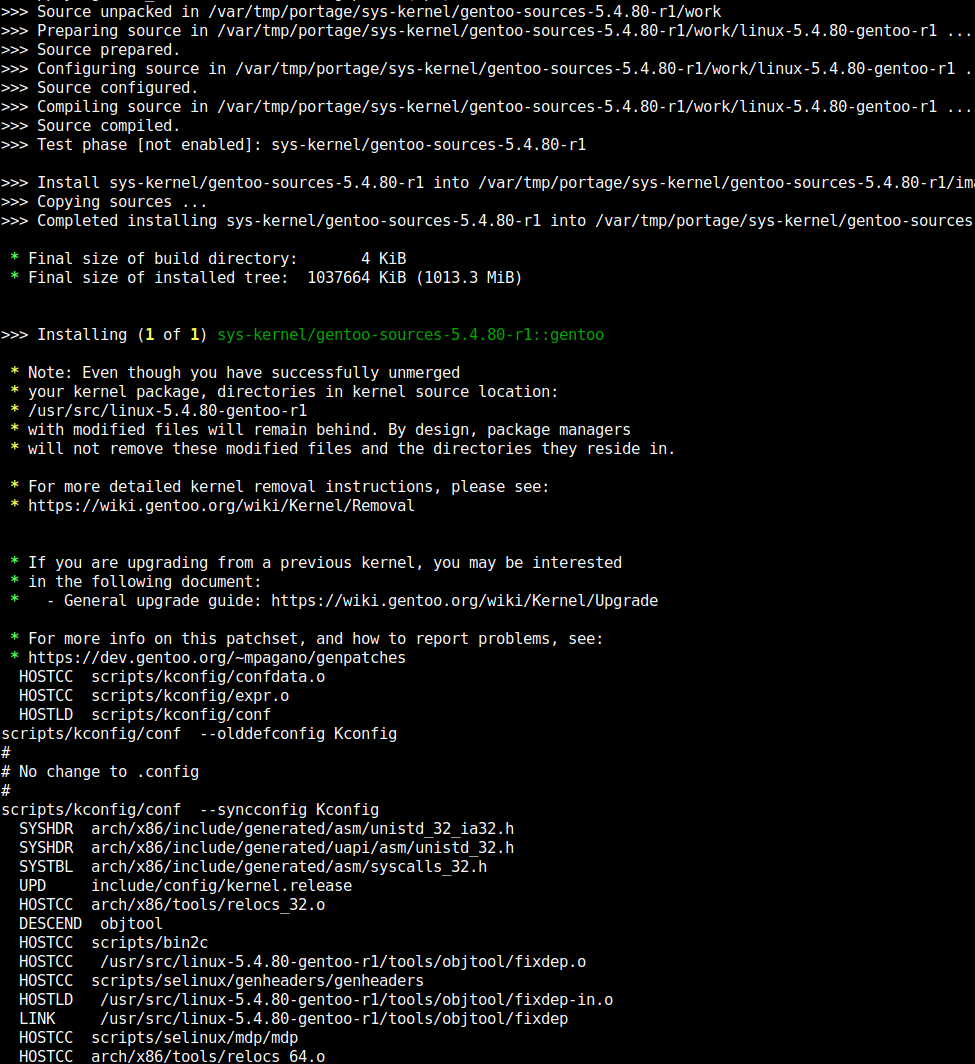
You can test the new magic by re-emerging the latest kernel, e.g. currently emerge =sys-kernel/gentoo-sources-5.4.80-r1:

Daniel Lange: Compiling and installing the Gentoo Linux kernel on emerge without genkernel (part 1)

Gentoo emerges of sys-kernel/gentoo-sources will nicely install the current kernel into /usr/src/linux-* but it will not compile them. The Gentoo wiki kernel documentation has a script snippet to automate the kernel build with genkernel. I do not like to use genkernel as it brings in lots of firmware files to build initrds that are not needed on virtual hardware. It also makes building the kernel slower. So, the plain approach: Make emerge sys-kernel/gentoo-sources symlink the latest kernel to /usr/src/linux so we can find it easily:
echo "sys-kernel/gentoo-sources symlink" >> /etc/portage/package.use/gentoo-sources
Create /etc/portage/env/sys-kernel/gentoo-sources with the following:
post_pkg_postinst()
CURRENT_KV=$(uname -r)
unset ARCH
if [[ -f "$ EROOT:-/ usr/src/linux-$ CURRENT_KV /.config" ]] ; then
cp -n "$ EROOT:-/ usr/src/linux-$ CURRENT_KV /.config" "$ EROOT:-/ usr/src/linux/.config"
cd "$ EROOT:-/ usr/src/linux/" && \
make olddefconfig && \
make -j5 && make modules_install && make install && \
grub-mkconfig -o /boot/grub/grub.cfg
fi
This will compile the next kernel on the basis of the config of the currently running kernel, install the modules and the kernel bzImage and update grub so it knows about the new kernel for the next reboot. If you forget to unset ARCH the Linux build system will complain like:
Makefile:583: arch/amd64/Makefile: No such file or directory
make: *** No rule to make target 'arch/amd64/Makefile'.  Stop.
You can test the new magic by re-emerging the latest kernel, e.g. currently emerge =sys-kernel/gentoo-sources-5.4.80-r1:

27 January 2021

Russ Allbery: Review: A Deadly Education

Review: A Deadly Education, by Naomi Novik
Series: The Scholomance #1
Publisher: Del Rey
Copyright: 2020
ISBN: 0-593-12849-4
Format: Kindle
Pages: 319
Some children are born with magic, which grows as they mature. Magic attracts maleficaria: extremely deadly magical beasts that want to feast on that magic. Having innate magical ability is therefore a recipe for endless attacks from monsters and a death at a young age. This was true even for the enclaves, which are the rich, gated communities of the magical world. Hence, the Scholomance. This is a boarding school for magic users placed in the Void and protected against maleficaria as completely as possible while still letting the students graduate and leave after their senior year. Students are sent there via a teleportation spell with a weight allowance, taught magic by automated systems and magical artifacts, and left on their own to make alliances and survive. Or not survive; protected as well as possible still means that there are maleficaria everywhere, sneaking past the wards of the graduation hall and looking for snacks. The school sends cleansing fire through the halls at certain times; the rest of the time, the students either learn enough magic to defeat maleficaria themselves, form alliances with those who can, or die to feed the magic of the school. Enter Galadriel, or El as she prefers. She's not an enclave kid; she's the grumpy, misfit daughter of a hippie mother whose open-hearted devotion to healing and giving away her abilities make her the opposite of the jealously guarded power structures of the enclaves. El has no resources other than what she can muster on her own. She also has her mother's ethics, which means that although she has an innate talent for malia, drawing magic from the death of other living things, she forces herself to build her mana through rigorously ethical means. Like push-ups. Or, worse, crochet. At the start of the book, El is in her third year of four, and significantly more of her classmates are alive than normally would be. That's because of her classmate, Orion Lake, who has made a full-time hobby of saving everyone from maleficaria. His unique magical ability frees him from the constraints of mana or malia that everyone else is subject to, and he uses that to be a hero, surrounded by adoring fans. And El is thoroughly sick of it. This book is so good in so many different ways that I don't know where to start. Obviously, A Deadly Education is a twist on the boarding school novel, both the traditional and the magical kind. This is not a genre in which I'm that well-read, but even with my lack of familiarity, I noticed so many things Novik does to improve the genre tropes, starting with not making the heroic character with the special powers the protagonist. And getting rid of all the adults, which leaves way more space for rich social dynamics between the kids (complex and interesting ones that are entangled with the social dynamics outside of the school, not some simplistic Lord of the Flies take). Going alone anywhere in the school is dangerous, as is sitting at the bad tables in the cafeteria, so social cliques become a matter of literal life and death. And the students aren't just trying to survive; the ones who aren't part of enclaves are jockeying for invitations or trying to build the power to help their family and allies form their own. El is the first-person narrator of the story and she's wonderful. She's grumpy, cynical, and sarcastic, which is often good for first-person narrators, but she also has a core of ethics from her mother, and from her own decisions, that gives her so much depth. She is the type of person who knows exactly how much an ethical choice will cost her and how objectively stupid it is, and then will make it anyway out of sheer stubbornness and refuse to take credit for it. I will happily read books about characters like El until the end of time. Her mother never appears in this book, and yet she's such a strong presence because El's relationship with her matters, to both El and to the book. El could not be more unlike her mother in both personality and in magical focus, and she's exasperated by the sheer impracticality of some of her mother's ideals. And yet there's a core of love and understanding beneath that, a level at which El completely understands her mother's goals, and El relies on it even when she doesn't realize she's doing so. I don't think I've ever read a portrayal of a mother-daughter relationship this good where one of the parties isn't even present. And I haven't even gotten to the world-building, and the level to which Novik chases down and explores all the implications of this ridiculous murder machine of a school. I will offer this caveat: If you poke at the justification for creating this school in the way it was built, it's going to teeter a lot. That society thought this school was the best solution to its child mortality problem is just something you have to roll with. But once you accept that, the implications are handled so very well. The school is an inhuman character in its own right, with exasperating rules that the students learn and warn each other about. It tries to distract you with rare spellbooks or artifact materials because it's trying to kill you. The language tapes whisper horrific stories of your death. The back wall of your room is a window to the Void, from which you can demand spellbooks. You'll even get them in languages that you understand, for a generous definition of understand that may have involved glancing at one page of text, so be careful not to do that! The school replaces all of the adult teachers in the typical boarding school novel and is so much more interesting than any of them because it adds the science fiction thrill of setting as character. The world-building does mean a lot of infodumping, so be prepared for that. El likes to explain things, tell stories, and over-analyze her life, and reading this book is a bit like reading the journal of a teenage girl. For me, El's voice is so strong, authentic, stubborn, and sarcastically funny that I scarcely noticed the digressions into background material. And the relationships! Some of the turns will be predictable, since of course El's stubborn ethics will be (eventually) rewarded by the story, but the dynamic that develops between El and Orion is something special. It takes a lot to make me have sympathy with the chosen one boy hero, but Novik pulls it off without ever losing sight of the dynamics of class and privilege that are also in play. And the friendships El develops almost accidentally by being stubbornly herself are just wonderful, and the way she navigates them made me respect her even more. The one negative thing I will say about this book is that I don't think Novik quite nailed the climax. Some of this is probably because this is the first book of a series and Novik wanted to hold some social developments in reserve, but I thought El got a bit sidelined and ended up along for the ride in an action-movie sequence. Still, it's a minor quibble, and it's clear from the very end of the book that El is going to get more attention and end up in a different social position in the next book. This was a wholly engrossing and enjoyable story with a satisfying climax and only the barb of a cliffhanger in the very last line. It's the best SFF novel published in 2020 that I've read so far (yes, even better than Network Effect). Highly recommended, and I hope it gets award recognition this year. Followed by The Last Graduate (not yet published at the time of this review). Rating: 9 out of 10

26 January 2021

Russ Allbery: Review: The City We Became

Review: The City We Became, by N.K. Jemisin
Series: The Great Cities Trilogy #1
Publisher: Orbit
Copyright: March 2020
ISBN: 0-316-50985-X
Format: Kindle
Pages: 449
At an unpredictable point after a city has accumulated enough history, character, and sense of itself, it is born as a living creature. It selects an avatar who both embodies the city and helps it be born. But in that moment of birth, a city is at its most vulnerable, and that is when the Enemy attacks. The birth of cities and the Enemy attacks have happened for millennia, so the cities that have survived the process have developed a system. The most recently born goes to assist the avatar with the birthing process and help fight off Enemy attacks. But the process has become riskier and the last two cities have failed to be born, snuffed out in natural disasters despite that support. Now, it's New York City's turn. It selects its avatar and survives the initial assault with the help of S o Paulo. But something still goes wrong, and it is severely injured in the process. Complicating matters, now there are five more avatars, one for each borough, who will have to unite to fight off the Enemy. And, for the first time, the Enemy has taken human form and is attacking with reason and manipulation and intelligence, not just force. The City We Became has a great premise: take the unique sense of place that defines a city and turn it into a literalized character in a fantasy novel. The avatars are people who retain their own lives and understanding (with one exception that I'll get to in a moment), but gain an awareness of the city they represent. They can fight and repair their city through sympathetic magic and metaphor made real. The prelude that introduces this concept (adapted from Jemisin's earlier short story "The City Born Great") got too gonzo for me, but once Jemisin settles into the main story and introduces avatars with a bit more distance from the city they represent, the premise clicked. The execution, on the other hand, I thought was strained. The biggest problem is that the premise requires an ensemble cast of five borough avatars, the primary avatar, S o Paulo, and the Enemy. That's already a lot, but for the story to work each avatar has to be firmly grounded in their own unique experience of New York, which adds family members, colleagues, and roommates. That's too much to stuff into one novel, which means characters get short shrift. For example, Padmini, the avatar of Queens, gets a great introductory scene and a beautiful bit of characterization that made her one of my favorite characters, but then all but disappears for the remainder of the book. She's in the scenes, but not in a way that matters. Brooklyn and Aislyn get moments of deep characterization, but there's so much else going on that they felt rushed. And what ever happened to Manny's roommate? The bulk of the characterization in this book goes to Broncha, the Bronx avatar, a Lenape woman and a tough-as-nails administrator of a community art museum and maker space. The dynamics between her and her co-workers, her mentorship of Veneza, and her early encounters with the Woman in White are my favorite parts of the book. I thought she and Brooklyn were a useful contrast: two very different ways of finding a base of power in the city without letting go of one's ideals. But before we get to Broncha, we first meet Manny, the Manhattan avatar. Thematically, I thought what Jemisin did here was extremely clever. Manny's past is essentially erased at the start of the book, so he's making sense of this world in the same way the reader is. It makes him a useful reader insert character and parallels the typical tourist experience of arriving in Manhattan and trying to use it to make sense of New York. He's disconnected from the rest of the city because he's the dangerous newcomer with power but not a lot of understanding, which works with my model of the political dynamics of Manhattan. Unfortunately, he's not an interesting person. I appreciated what was happening at the metaphorical layer, but Manny veers between action hero and exposition prompt, and his amnesia meant I never got enough sense of him as a character to care that much about what happened to him. I thought his confrontation with the Woman in White near the start of the book, which establishes the major villain of the book, felt clunky and forced compared to her later encounters with the other characters. The Woman in White, though, is a great villain. It's clear from earlier on that the Enemy is Lovecraftian, but the Woman in White mixes mad scientist glee, manic enthusiasm, and a child-like amusement at the weirdness of humanity into the more typical tropes of tentacles, corruption, and horrific creatures. One of my qualms about reading this book is that I'm not a horror fan and don't enjoy the mental images of unspeakable monsters, but the Woman in White puts such a fascinating spin on them that I enjoyed the scenes in which she appeared. I think the book was at its best when she was trying to psychologically manipulate the characters or attack them with corrupted but pre-existing power structures. I was less interested when it turned into an action-movie fight against animated monsters. The other place Jemisin caught me by surprise is too much of a spoiler to describe in detail (and skip the next paragraph in its entirety if you want to avoid all spoilers): Jemisin didn't take the moral conflict of the book in the direction I was expecting. This book is more interested in supporting the people who are already acting ethically than in redeeming people who make bad choices. That produces a deus ex machina ending that's a bit abrupt, but I appreciated the ethical stance. Overall, I thought the premise was great but the execution was unsteady and a bit overstuffed. There are some great characters and some great scenes, but to me they felt disjointed and occasionally rushed. You also need to enjoy characters taking deep pride in the feel of a specific place and advocating for it with the vigor of a sports rivalry, along with loving descriptions of metaphors turned into magical waves of force. But, if you can roll with that, there are moments of real awe. Jemisin captured for me the joy that comes from a deeply grounded sense of connection to a place. Recommended, albeit with caveats, if you're in the mood for reading about people who love the city they live in. This is the first book of a planned trilogy and doesn't resolve the main conflict, but it reaches a satisfying conclusion. The title of the next book has not yet been announced at the time of this review. Rating: 7 out of 10

25 January 2021

Enrico Zini: nspawn-runner: support for image selection

.gitlab-ci.yml supports 'image' to allow selecting in which environment the script gets run. The documentation says "Used to specify a Docker image to use for the job", but it's clearly a bug in the documentation, because we can do it with nspawn-runner, too. It turns out that most of the environment variables available to CI runs are also available to custom runner scripts. In this case, the value passed as image can be found as $CUSTOM_ENV_CI_JOB_IMAGE in the custom runner scripts environment. After some experimentation I made this commit that makes every chroot under /var/lib/nspawn-runner available as an image:
# Set up 3 new images for CI jobs:
nspawn-runner chroot-create buster
nspawn-runner chroot-create bullseye
nspawn-runner chroot-create sid
That's it, CI scripts can now use image: buster, image: bullseye or image: sid, as they please. You can manually set up other chroots under /var/lib/nspawn-runner and they'll be automatically available. You can also now choose a default image in config.toml in case the CI script doesn't specify one:
prepare_args = ["--verbose", "prepare", "--default-image=buster"]

Iustin Pop: Raspbian/Raspberry PI OS with initrd

Background While Raspbian, ahem, Raspberry PI OS is mostly Debian, the biggest difference is the kernel, both in terms of code and packaging. The packaging is weird since it needs to deal with the fact that there s no bootloader per se, the firmware parses /boot/config.txt and depending on the setting of 64bit and/or kernel line, it loads a specific file. Normally, one of kernel7.img, kernel7l.img or kernel8.img. While this configuration file supports an initrd, it doesn t have a clean way to associate an initrd with a kernel, but rather you have to (like for the actual kernel) settle on a hard-coded initrd name. Due to this, the normal way of using an initrd doesn t work, and one has to do two things:
  • enable building initrd s at all
  • settle on the naming for the initrd
  • ensure the initrd is updated correctly
There are quite a few of forum threads about this, but there s no official support for this. The best link I found was this Stack Exchange post, which goes most of the way, but fails at the third point above.

My trivial solution Instead of naming tricks the above post suggests, I settled on having a fixed name. It risks boot failure when the kernel architecture will change, which could be worked around with hard-coded kernel too, but I haven t done that yet. First, enable initrd creation/update in /etc/default/raspberrypi-kernel, like the post says. Uncomment INITRD=yes, but not the RPI_INITRD. This will enable creating/updating the initrd when the kernel package is installed and/or other packages trigger it via hooks. Second, naming: choose an initrd name. I have simply this in my config.txt:
initramfs initrd.img followkernel
So the value is fully hard-coded, and the actual work is done in the next part. Last, add an initramfs-hook in (e.g.) /etc/initramfs/post-update.d/rpi-initrd. Note that, by default (unless other packages have created it), the /etc/initramfs directory doesn t exist. It s not the confusingly-named /etc/initramfs-tools/ directory, which is related to building the initrd, but rather to doing things with the (already built) initrd. This directory is briefly explain in the Debian kernel-handbook guide. This is my contents:
#!/bin/bash

ABI="$1"
INITRD="$2"
BOOTDIR="$(dirname "$INITRD")"

# Note: the match below _must_ be synced with the boot kernel
if [[ "$ABI" == *-v8+ ]]; then
        echo "Building v8l+ image, updating top initrd"
        cp -p "$INITRD" "$BOOTDIR/initrd.img"
fi
This script seems to me much simpler, so in principle less chance of bugs, than all the renaming and editing config.txt I saw in that stack exchange post. As far as I know, all one needs to care about is to sync the ABI passed to this hook with the kernel one is running, and since there is only one kernel version installed at a time on Raspbian (as there s no versioning in the kernel names), this should work correctly. With this hook, the update also works correctly when packages trigger initrd updates, not only when new kernels are installed. Note that the cp there is needed since the book partition is FAT, so no symbolic links/hard links allowed. Happy initrd ing!

23 January 2021

Dirk Eddelbuettel: prrd 0.0.4: More tweaks

prrd facilitates the parallel running [of] reverse dependency [checks] when preparing R packages. It is used extensively for Rcpp, RcppArmadillo, RcppEigen, BH, and possibly others. prrd screenshot image The key idea of prrd is simple, and described in some more detail on its webpage and its GitHub repo. Reverse dependency checks are an important part of package development that is easily done in a (serial) loop. But these checks are also generally embarassingly parallel as there is no or little interdependency between them (besides maybe shared build depedencies). See the (dated) screenshot (running six parallel workers, arranged in split byobu session). This release brings several smaller tweaks and improvements to the summary report that had accumulated in my use since the last realease last April. We also updated the CI runners as one does these days. The release is summarised in the NEWS entry:

Changes in prrd version 0.0.4 (2021-01-23)
  • Report summary mode is now compact, more robust and reports extended CRAN summaries. (Dirk via several changes)
  • Continuous Integration now uses run.sh from r-ci

My CRANberries provides the usual summary of changes to the previous version. See the aforementioned webpage and its repo for details. For more questions or comments use the issue tracker off the GitHub repo. If you like this or other open-source work I do, you can now sponsor me at GitHub.

This post by Dirk Eddelbuettel originated on his Thinking inside the box blog. Please report excessive re-aggregation in third-party for-profit settings.

22 January 2021

Robert McQueen: Launching Endless OS Foundation

Passion Led Us Here

How our for-profit company became a nonprofit, to better tackle the digital divide. Originally posted on the Endless OS Foundation blog.

An 8-year journey to a nonprofit On the 1st of April 2020, our for-profit Endless Mobile officially became a nonprofit as the Endless OS Foundation. Our launch as a nonprofit just as the global pandemic took hold was, predictably, hardly noticed, but for us the timing was incredible: as the world collectively asked What can we do to help others in need? , we framed our mission statement and launched our .org with the same very important question in mind. Endless always had a social impact mission at its heart, and the challenges related to students, families, and communities falling further into the digital divide during COVID-19 brought new urgency and purpose to our team s decision to officially step in the social welfare space.
On April 1st 2020, our for-profit Endless Mobile officially became a nonprofit as the Endless OS Foundation, focused on the #DigitalDivide.
Our updated status was a long time coming: we began our transformation to a nonprofit organization in late 2019 with the realization that the true charter and passions of our team would be greatly accelerated without the constraints of for-profit goals, investors and sales strategies standing in the way of our mission of digital access and equity for all. But for 8 years we made a go of it commercially, headquartered in Silicon Valley and framing ourselves as a tech startup with access to the venture capital and partnerships on our doorstep. We believed that a successful commercial channel would be the most efficient way to scale the impact of bringing computer devices and access to communities in need. We still believe this we ve just learned through our experience that we don t have the funding to enter the computer and OS marketplace head-on. With the social impact goal first, and the hope of any revenue a secondary goal, we have had many successes in those 8 years bridging the digital divide throughout the world, from Brazil, to Kenya, and the USA. We ve learned a huge amount which will go on to inform our strategy as a nonprofit.
Endless always had a social impact mission at its heart. COVID-19 brought new urgency and purpose to our team s decision to officially step in the social welfare space.
Our unique perspective One thing we learned as a for-profit is that the OS and technology we ve built has some unique properties which are hugely impactful as a working solution to digital equity barriers. And our experience deploying in the field around the world for 8 years has left us uniquely informed via many iterations and incremental improvements.
Endless OS designer in discussion with prospective user
With this knowledge in-hand, we ve been refining our strategy throughout 2020 and now starting to focus on what it really means to become an effective nonprofit and make that impact. In many ways it is liberating to abandon the goals and constraints of being a for-profit entity, and in other ways it s been a challenging journey for me and the team to adjust our way of thinking and let these for-profit notions and models go. Previously we exclusively built and sold a product that defined our success; and any impact we achieved was a secondary consequence of that success and seen through that lens. Now our success is defined purely in terms of social impact, and through our actions, those positive impacts can be made with or without our product . That means that we may develop and introduce technology to solve a problem, but it is equally as valid to find another organization s existing offering and design a way to increase that positive impact and scale.
We develop technology to solve access equity issues, but it s equally as valid to find another organization s offering and partner in a way that increases their positive impact.
The analogy to Free and Open Source Software is very strong while Endless has always used and contributed to a wide variety of FOSS projects, we ve also had a tension where we ve been trying to hold some pieces back and capture value such as our own application or content ecosystem, our own hardware platform necessarily making us competitors to other organisations even though they were hoping to achieve the same things as us. As a nonprofit we can let these ideas go and just pick the best partners and technologies to help the people we re trying to reach.
School kids writing on paper
Digital equity 4 barriers we need to overcome In future, our decisions around which projects to build or engage with will revolve around 4 barriers to digital equity, and how our Endless OS, Endless projects, or our partners offerings can help to solve them. We define these 4 equity barriers as: barriers to devices, barriers to connectivity, barriers to literacy in terms of your ability to use the technology, and barriers to engagement in terms of whether using the system is rewarding and worthwhile.
We define the 4 digital equity barriers we exist to impact as:
1. barriers to devices
2. barriers to connectivity
3. barriers to literacy
4. barriers to engagement
It doesn t matter who makes the solutions that break these barriers; what matters is how we assist in enabling people to use technology to gain access to the education and opportunities these barriers block. Our goal therefore is to simply ensure that solutions exist building them ourselves and with partners such as the FOSS community and other nonprofits proving them with real-world deployments, and sharing our results as widely as possible to allow for better adoption globally. If we define our goal purely in terms of whether people are using Endless OS, we are effectively restricting the reach and scale of our solutions to the audience we can reach directly with Endless OS downloads, installs and propagation. Conversely, partnerships that scale impact are a win-win-win for us, our partners, and the communities we all serve. Engineering impact Our Endless engineering roots and capabilities feed our unique ability to build and deploy all of our solutions, and the practical experience of deploying them gives us evidence and credibility as we advocate for their use. Either activity would be weaker without the other.
Our engineering roots and capabilities feed our unique ability to build and deploy digital divide solutions.
Our partners in various engineering communities will have already seen our change in approach. Particularly, with GNOME we are working hard to invest in upstream and reconcile the long-standing differences between our experience and GNOME. If successful, many more people can benefit from our work than just users of Endless OS. We re working with Learning Equality on Kolibri to build a better app experience for Linux desktop users and bring content publishers into our ecosystem for the first time, and we ve also taken our very own Hack, the immersive and fun destination for kids learning to code, released it for non-Endless systems on Flathub, and made it fully open-source.
Planning tasks with sticky notes on a whiteboard
What s next for our OS? What then is in store for the future of Endless OS, the place where we have invested so much time and planning through years of iterations? For the immediate future, we need the capacity to deploy everything we ve built all at once, to our partners. We built an OS that we feel is very unique and valuable, containing a number of world-firsts: first production OS shipped with OSTree, first Flatpak-only desktop, built-in support for updating OS and apps from USBs, while still providing a great deal of reliability and convenience for deployments in offline and educational-safe environments with great apps and content loaded on every system. However, we need to find a way to deliver this Linux-based experience in a more efficient way, and we d love to talk if you have ideas about how we can do this, perhaps as partners. Can the idea of Endless OS evolve to become a spec that is provided by different platforms in the future, maybe remixes of Debian, Fedora, openSUSE or Ubuntu? Build, Validate, Advocate Beyond the OS, the Endless OS Foundation has identified multiple programs to help underserved communities, and in each case we are adopting our build, validate, advocate strategy. This approach underpins all of our projects: can we build the technology (or assist in the making), will a community in-need validate it by adoption, and can we inspire others by telling the story and advocating for its wider use?
We are adopting a build, validate, advocate strategy.
1. build the technology (or assist in the making)
2. validate by community adoption
3. advocate for its wider use
As examples, we have just launched the Endless Key (link) as an offline solution for students during the COVID-19 at-home distance learning challenges. This project is also establishing a first-ever partnership of well-known online educational brands to reach an underserved offline audience with valuable learning resources. We are developing a pay-as-you-go platform and new partnerships that will allow families to own laptops via micro-payments that are built directly into the operating system, even if they cannot qualify for standard retail financing. And during the pandemic, we ve partnered with Teach For America to focus on very practical digital equity needs in the USA s urban and rural communities. One part of the world-wide digital divide solution We are one solution provider for the complex matrix of issues known collectively as the #DigitalDivide, and these issues will not disappear after the pandemic. Digital equity was an issue long before COVID-19, and we are not so naive to think it can be solved by any single institution, or by the time the pandemic recedes. It will take time and a coalition of partnerships to win. We are in for the long-haul and we are always looking for partners, especially now as we are finding our feet in the nonprofit world. We d love to hear from you, so please feel free to reach out to me I m ramcq on IRC, RocketChat, Twitter, LinkedIn or rob@endlessos.org.

Enrico Zini: Polishing nspawn-runner

This post is part of a series about trying to setup a gitlab runner based on systemd-nspawn. I published the polished result as nspawn-runner on GitHub. gitlab-runner supports adding extra arguments to the custom scripts, and I can take advantage of that to pack all the various scripts that I prototyped so far into an all-in-one nspawn-runner command:
usage: nspawn-runner [-h] [-v] [--debug]
                      chroot-create,chroot-login,prepare,run,cleanup,gitlab-config,toml 
                     ...
Manage systemd-nspawn machines for CI runs.
positional arguments:
   chroot-create,chroot-login,prepare,run,cleanup,gitlab-config,toml 
                        sub-command help
    chroot-create       create a chroot that serves as a base for ephemeral
                        machines
    chroot-login        enter the chroot to perform maintenance
    prepare             start an ephemeral system for a CI run
    run                 run a command inside a CI machine
    cleanup             cleanup a CI machine after it's run
    gitlab-config       configuration step for gitlab-runner
    toml                output the toml configuration for the custom runner
optional arguments:
  -h, --help            show this help message and exit
  -v, --verbose         verbose output
  --debug               verbose output
chroot maintenance chroot-create and chroot-login are similar to what pbuilder, cowbuilder, schroot, debspawn and similar tools do. They only take a chroot name, and default the rest of paths to where nspawn-runner expects things to be under /var/lib/nspawn-runner. gitlab-runner setup nspawn-runner toml <chroot-name> outputs a snippet to add to /etc/gitlab-runner/config.toml to configure the CI. For example:
$ ./nspawn-runner toml buster
[[runners]]
  name="buster"
  url="TODO"
  token="TODO"
  executor = "custom"
  builds_dir = "/var/lib/nspawn-runner/.build"
  cache_dir = "/var/lib/nspawn-runner/.cache"
  [runners.custom_build_dir]
  [runners.cache]
    [runners.cache.s3]
    [runners.cache.gcs]
    [runners.cache.azure]
  [runners.custom]
    config_exec = "/home/enrico/ /nspawn-runner/nspawn-runner"
    config_args = ["gitlab-config"]
    config_exec_timeout = 200
    prepare_exec = "/home/enrico/ /nspawn-runner/nspawn-runner"
    prepare_args = ["prepare", "buster"]
    prepare_exec_timeout = 200
    run_exec = "/home/enrico/dev/nspawn-runner/nspawn-runner"
    run_args = ["run"]
    cleanup_exec = "/home/enrico/ /nspawn-runner/nspawn-runner"
    cleanup_args = ["cleanup"]
    cleanup_exec_timeout = 200
    graceful_kill_timeout = 200
    force_kill_timeout = 200
One needs to remember to set url and token, and the runner is configured. The end, for now This is it, it works! Time will tell what issues or ideas will come up: for now, it's a pretty decent first version. The various prepare, run, cleanup steps are generic enough that they can be used outside of gitlab-runner: feel free to build on them, and drop me a note if you find this useful! Updated: Issues noticed so far, that could go into a new version:

Enrico Zini: Assembling the custom runner

This post is part of a series about trying to setup a gitlab runner based on systemd-nspawn. I published the polished result as nspawn-runner on GitHub. The plan Back to custom runners, here's my plan: The scripts Here are the scripts based on Federico's work: base.sh with definitions sourced by all scripts:
MACHINE="run-$CUSTOM_ENV_CI_JOB_ID"
ROOTFS="/var/lib/gitlab-runner-custom-chroots/buster"
OVERLAY="/var/lib/gitlab-runner-custom-chroots/$MACHINE"
config.sh doing nothing:
#!/bin/sh
exit 0
prepare.sh starting the machine:
#!/bin/bash
source $(dirname "$0")/base.sh
set -eo pipefail
# trap errors as a CI system failure
trap "exit $SYSTEM_FAILURE_EXIT_CODE" ERR
logger "gitlab CI: preparing $MACHINE"
mkdir -p $OVERLAY
systemd-run \
  -p 'KillMode=mixed' \
  -p 'Type=notify' \
  -p 'RestartForceExitStatus=133' \
  -p 'SuccessExitStatus=133' \
  -p 'Slice=machine.slice' \
  -p 'Delegate=yes' \
  -p 'TasksMax=16384' \
  -p 'WatchdogSec=3min' \
  systemd-nspawn --quiet -D $ROOTFS \
    --overlay="$ROOTFS:$OVERLAY:/"
    --machine="$MACHINE" --boot --notify-ready=yes
run.sh running the provided scripts in the machine:
#!/bin/bash
logger "gitlab CI: running $@"
source $(dirname "$0")/base.sh
set -eo pipefail
trap "exit $SYSTEM_FAILURE_EXIT_CODE" ERR
systemd-run --quiet --pipe --wait --machine="$MACHINE" /bin/bash < "$1"
cleanup.sh stopping the machine and removing the writable overlay directory:
#!/bin/bash
logger "gitlab CI: cleanup $@"
source $(dirname "$0")/base.sh
machinectl stop "$MACHINE"
rm -rf $OVERLAY
Trying out the plan I tried a manual invocation of gitlab-runner, and it worked perfectly:
# mkdir /var/lib/gitlab-runner-custom-chroots/build/
# mkdir /var/lib/gitlab-runner-custom-chroots/cache/
# gitlab-runner exec custom \
    --builds-dir /var/lib/gitlab-runner-custom-chroots/build/ \
    --cache-dir /var/lib/gitlab-runner-custom-chroots/cache/ \
    --custom-config-exec /var/lib/gitlab-runner-custom-chroots/config.sh \
    --custom-prepare-exec /var/lib/gitlab-runner-custom-chroots/prepare.sh \
    --custom-run-exec /var/lib/gitlab-runner-custom-chroots/run.sh \
    --custom-cleanup-exec /var/lib/gitlab-runner-custom-chroots/cleanup.sh \
    tests
Runtime platform                                    arch=amd64 os=linux pid=18662 revision=775dd39d version=13.8.0
Running with gitlab-runner 13.8.0 (775dd39d)
Preparing the "custom" executor
Using Custom executor...
Running as unit: run-r1be98e274224456184cbdefc0690bc71.service
executor not supported                              job=1 project=0 referee=metrics
Preparing environment
Getting source from Git repository
Executing "step_script" stage of the job script
WARNING: Starting with version 14.0 the 'build_script' stage will be replaced with 'step_script': https://gitlab.com/gitlab-org/gitlab-runner/-/issues/26426
Job succeeded
Deploy The remaining step is to deploy all this in /etc/gitlab-runner/config.toml:
concurrent = 1
check_interval = 0
[session_server]
  session_timeout = 1800
[[runners]]
  name = "nspawn runner"
  url = "http://gitlab.siweb.local/"
  token = " "
  executor = "custom"
  builds_dir = "/var/lib/gitlab-runner-custom-chroots/build/"
  cache_dir = "/var/lib/gitlab-runner-custom-chroots/cache/"
  [runners.custom_build_dir]
  [runners.cache]
    [runners.cache.s3]
    [runners.cache.gcs]
    [runners.cache.azure]
  [runners.custom]
    config_exec = "/var/lib/gitlab-runner-custom-chroots/config.sh"
    config_exec_timeout = 200
    prepare_exec = "/var/lib/gitlab-runner-custom-chroots/prepare.sh"
    prepare_exec_timeout = 200
    run_exec = "/var/lib/gitlab-runner-custom-chroots/run.sh"
    cleanup_exec = "/var/lib/gitlab-runner-custom-chroots/cleanup.sh"
    cleanup_exec_timeout = 200
    graceful_kill_timeout = 200
    force_kill_timeout = 200
Next steps My next step will be polishing all this in a way that makes deploying and maintaining a runner configuration easy.

Enrico Zini: Exploring nspawn for CIs

This post is part of a series about trying to setup a gitlab runner based on systemd-nspawn. I published the polished result as nspawn-runner on GitHub. Here I try to figure out possible ways of invoking nspawn for the prepare, run, and cleanup steps of gitlab custom runners. The results might be useful invocations beyond Gitlab's scope of application. I begin with a chroot which will be the base for our build environments:
debootstrap --variant=minbase --include=git,build-essential buster workdir
Fully ephemeral nspawn This would be fantastic: set up a reusable chroot, mount readonly, run the CI in a working directory mounted on tmpfs. It sets up quickly, it cleans up after itself, and it would make prepare and cleanup noops:
mkdir workdir/var/lib/gitlab-runner
systemd-nspawn --read-only --directory workdir --tmpfs /var/lib/gitlab-runner "$@"
However, run gets run multiple times, so I need the side effects of run to persist inside the chroot between runs. Also, if the CI uses a large amount of disk space, tmpfs may get into trouble. nspawn with overlay Federico used --overlay to keep the base chroot readonly while allowing persistent writes on a temporary directory on the filesystem. Note that using --overlay requires systemd and systemd-container from buster-backports because of systemd bug #3847. Example:
mkdir -p tmp-overlay
systemd-nspawn --quiet -D workdir \
  --overlay=" pwd /workdir: pwd /tmp-overlay:/"
I can run this twice, and changes in the file system will persist between systemd-nspawn executions. Great! However, any process will be killed at the end of each execution. machinectl I can give a name to systemd-nspawn invocations using --machine, and it allows me to run multiple commands during the machine lifespan using machinectl and systemd-run. In theory machinectl can also fully manage chroots and disk images in /var/lib/machines, but I haven't found a way with machinectl to start multiple machines sharing the same underlying chroot. It's ok, though: I managed to do that with systemd-nspawn invocations. I can use the --machine=name argument to systemd-nspawn to make it visible to machinectl. I can use the --boot argument to systemd-nspawn to start enough infrastructure inside the container to allow machinectl to interact with it. This gives me any number of persistent and named running systems, that share the same underlying chroot, and can cleanup after themselves. I can run commands in any of those systems as I like, and their side effects persist until a system is stopped. The chroot needs systemd and dbus for machinectl to be able to interact with it:
debootstrap --variant=minbase --include=git,systemd,systemd,build-essential buster workdir
Let's boot the machine:
mkdir -p overlay
systemd-nspawn --quiet -D workdir \
    --overlay=" pwd /workdir: pwd /overlay:/"
    --machine=test --boot
Let's try machinectl:
# machinectl list
MACHINE CLASS     SERVICE        OS     VERSION ADDRESSES
test    container systemd-nspawn debian 10      -
1 machines listed.
# machinectl shell --quiet test /bin/ls -la /
total 60
[ ]
To run commands, rather than machinectl shell, I need to use systemd-run --wait --pipe --machine=name, otherwise machined won't forward the exit code. The result however is pretty good, with working stdin/stdout/stderr redirection and forwarded exit code. Good, I'm getting somewhere. The terminal where I ran systemd-nspawn is currently showing a nice getty for the booted system, which is cute, and not what I want for the setup process of a CI. Spawning machines without needing a terminal machinectl uses /lib/systemd/system/systemd-nspawn@.service to start machines. I suppose there's limited magic in there: start systemd-nspawn as a service, use --machine to give it a name, and machinectl manages it as if it started it itself. What if, instead of installing a unit file for each CI run, I try to do the same thing with systemd-run?
systemd-run \
  -p 'KillMode=mixed' \
  -p 'Type=notify' \
  -p 'RestartForceExitStatus=133' \
  -p 'SuccessExitStatus=133' \
  -p 'Slice=machine.slice' \
  -p 'Delegate=yes' \
  -p 'TasksMax=16384' \
  -p 'WatchdogSec=3min' \
  systemd-nspawn --quiet -D  pwd /workdir \
    --overlay=" pwd /workdir: pwd /overlay:/"
    --machine=test --boot
It works! I can interact with it using machinectl, and fine tune DevicePolicy as needed to lock CI machines down. This setup has a race condition where if I try to run a command inside the machine in the short time window before the machine has finished booting, it fails:
# systemd-run [ ] systemd-nspawn [ ] ; machinectl --quiet shell test /bin/ls -la /
Failed to get shell PTY: Protocol error
# machinectl shell test /bin/ls -la /
Connected to machine test. Press ^] three times within 1s to exit session.
total 60
[ ]
systemd-nspawn has the option --notify-ready=yes that solves exactly this problem:
# systemd-run [ ] systemd-nspawn [ ] --notify-ready=yes ; machinectl --quiet shell test /bin/ls -la /
Running as unit: run-r5a405754f3b740158b3d9dd5e14ff611.service
total 60
[ ]
On nspawn's side, I should now have all I need. Next steps My next step will be wrapping it all together in a gitlab runner.

Enrico Zini: Gitlab runners with nspawn

This is a first post in a series about trying to setup a gitlab runner based on systemd-nspawn. I published the polished result as nspawn-runner on GitHub. The goal I need to setup gitlab runners, and I try to not involve docker in my professional infrastructure if I can avoid it. Let's try systemd-nspawn. It's widely available and reasonably reliable. I'm not the first to have this idea: Federico Ceratto made a setup based on custom runners and Josef Kufner one based on ssh runners. I'd like to skip the complication of ssh, and to expand Federico's version to persist not just filesystem changes but also any other side effect of CI commands. For example, one CI command may bring up a server and the next CI command may want to test interfacing with it. Understanding gitlab-runner First step: figuring out gitlab-runner. Test runs of gitlab-runner I found that I can run gitlab-runner manually without needing to go through a push to Gitlab. It needs a local git repository with a .gitlab-ci.yml file:
mkdir test
cd test
git init
cat > .gitlab-ci.yml << EOF
tests:
 script:
  - env   sort
  - pwd
  - ls -la
EOF
git add .gitlab-ci.yml
git commit -am "Created a test repo for gitlab-runner"
Then I can go in the repo and test gitlab-runner:
gitlab-runner exec shell tests
It doesn't seem to use /etc/gitlab-runner/config.toml and it needs all the arguments passed to its command line: I used the shell runner for a simple initial test. Later I'll try to brew a gitlab-runner exec custom invocation that uses nspawn. Basics of custom runners A custom runner runs a few scripts to manage the run: run gets at least one argument which is a path to the script to run. The other scripts get no arguments by default. The runner configuration controls the paths of the scripts to run, and optionally extra arguments to pass to them Next steps My next step will be to figure out possible ways of invoking nspawn for the prepare, run, and cleanup scripts.

21 January 2021

Russell Coker: Links January 2021

Krebs on Security has an informative article about web notifications and how they are being used for spamming and promoting malware [1]. He also includes links for how to permanently disable them. If nothing else clicking no on each new site that wants to send notifications is annoying. Michael Stapelberg wrote an insightful posts about inefficiencies in the Debian development processes [2]. While I agree with most of his assessment of Debian issues I am not going to decrease my involvement in Debian. Of the issues he mentions the 2 that seem to have the best effort to reward ratio are improvements to mailing list archives (to ideally make it practical to post to lists without subscribing and read responses in the archives) and the issues of forgetting all the complexities of the development process which can be alleviated by better Wiki pages. In my Debian work I ve contributed more to the Wiki in recent times but not nearly as much as I should. Jacobin has an insightful article Ending Poverty in the United States Would Actually Be Pretty Easy [3]. Mark Brown wrote an interesting blog post about the Rust programming language [4]. He links to a couple of longer blog posts about it. Rust has some great features and I ve been meaning to learn it. Scientific America has an informative article about research on the spread of fake news and memes [5]. Something to consider when using social media. Bruce Schneier wrote an insightful blog post on whether there should be limits on persuasive technology [6]. Jonathan Dowland wrote an interesting blog post about git rebasing and lab books [7]. I think it s an interesting thought experiment to compare the process of developing code worthy of being committed to a master branch of a VCS to the process of developing a Ph.D thesis. CBS has a disturbing article about the effect of Covid19 on people s lungs [8]. Apparently it usually does more lung damage than long-term smoking and even 70%+ of people who don t have symptoms of the disease get significant lung damage. People who live in heavily affected countries like the US now have to worry that they might have had the disease and got lung damage without knowing it. Russ Allbery wrote an interesting review of the book Because Internet about modern linguistics [9]. The topic is interesting and I might read that book at some future time (I have many good books I want to read). Jonathan Carter wrote an interesting blog post about CentOS Streams and why using a totally free OS like Debian is going to be a better option for most users [10]. Linus has slammed Intel for using ECC support as a way of segmenting the market between server and desktop to maximise profits [11]. It would be nice if a company made a line of Ryzen systems with ECC RAM support, but most manufacturers seem to be in on the market segmentation scam. Russ Allbery wrote an interesting review of the book Can t Even about millenials as the burnout generation and the blame that the corporate culture deserves for this [12].

20 January 2021

Molly de Blanc: Inauguration Pie

How can I put four years into a pie? I m thinking of Inauguration Day 2017 through to today, Inauguration Day 2021. In truth things started back in 2015, when Donald Trump announced his run for the United States presidency, and I don t know how long things will continue past the moment when President-Elect Joe Biden becomes President Joe Biden. For the United States, it s been a hell of a time. For the world, it d been even worse. Every generation thinks that they lived through more than anyone else, that they had it worse. I had a Boomer tell me that the existential stress of COVID is nothing compared to the Vietnam War. I m sure when we are living through a global water crisis, I ll tell the kids that we had it bad too. Everyday I listen to the radio and read Twitter, aware that the current state of endless wars wars against terrorism and drugs, organized crime and famine, climate change and racism is global, and not limited to just what s happening to and around me. That makes it feel worse and bigger and I wonder if earlier generations can really grasp how big that is. The last four years brought me in closer working relationships with people in India and Nigeria. I would call these people my friends in that if they were in town I would want to see them and show them around. Most of them I would offer a space in my small apartment, in case they needed somewhere to sleep and wanted to save the money. We chat, though we only have the internet as opposed to elevator rides in tall office buildings and slow walks down to the shops during lunch breaks. From these relationships I have learned very little about life in India or Nigeria, and I only visited India separately from any of my colleagues there. (I went for a wedding. My visa to Nigeria was denied on account of a medical issue.) But, I follow these people on social media and see what they share, the same political and social utterances that could be the same here or virtually any other place, as long as we replace the right keywords. Exchange the name of one leader, conservative party, or government unit for another. When I first saw the #EndSARS hashtag show up, I thought the images were from Black Lives Matter protests. Stop police brutality. And that was only in the last few months. I ve had three jobs since Trump first announced his candidacy in three very different places. In the first I felt like I wasn t able to talk about the sexism and discrimination I was dealing with in the office, and how much more so my views on an organizational partnership with a government whose policies I strongly disagreed with. In the second I was able to talk about these things, but there was nothing to do about them. I ve been in love and had my heart broken three times in three very different ways that all came down to someone valuing someone else more than they valued me. Can I bake heartbreak into a pie? Is it even fair to distract from the political world with my own loss? What about COVID-19? There s bitterness and anger and tears and pain emotional and physical. There is desperation and desolation and loneliness. Covid has colored everything during the past year. It is a burden our new political leaders will take on. Biden and Harris, all of the new people in Congress, and everyone else who has taken on an elected position now must content with Covid with new levels of responsibility. Not only do their decisions affect the people they come into contact with, they now affect everyone their policies touch and perhaps even more than that. The government hired people to build walls. Our government approved it and people willingly took on the job of building those walls. Families were separated. Children were placed in inhumane conditions; children were tortured. Remember when the guards at border detention facilities were raping children? Remember when children had guards? Women were forcefully operated upon and had their bodies permanently changed without their permission, against their desires. People were executed by the state. There were so many things I ve lost track of them all. I remember bits and pieces as I write this, coming back to me like singing a song I haven t thought about in years. With each line, I remember another one. Being worried about coming home from Cuba, when the visitation rules were changed in the middle of my trip. Climate change, again and again. Pollution and microplastics and watching the country being broken into pieces and sold off in the name of economy and progress. People losing their access to healthcare, through clinics closing down and loss of insurance. What do you bake into a pie that tastes like sedition? What are the flavors of loss and racism and hate? How to you balance the sourness with subtle hints of hope, which feels to tender and fragile? Do we pair equal parts of the palatable with the unpalatable, in the name of our neatly divided senate? I have hope, of course I have hope, and I have always had hope, but now it feels thinner than ever, like a ganache or a caramel after your hand slips and you pour too much cream in. A custard or compote or curd that that refuses to thicken no matter how long you cook it. I see that things could be better, but better does not mean good and better does not mean enough. So I will put my hope into this pie. I put my pain and anger into the dough. I will put my tears and helplessness and bitterness into the filling. I will cover it sweetness and the delicate hope I ve spun out of sugar. Soon I will bake it and share it with the three other people I see because the most important thing about surviving these past years, these past months and weeks and days, is that we did it together. We will commiserate on what we ve overcome, and we will share our hope and the sweetness of the moment, as the spun sugar dissolves on our tongues. There is so much we have left to do, so much we must do. We will be angry in the future, we may be angry later today, but until then, we have pie.

Rapha&#235;l Hertzog: Freexian s report about Debian Long Term Support, December 2020

A Debian LTS logo Like each month, have a look at the work funded by Freexian s Debian LTS offering. Debian project funding In December, we put aside 2100 EUR to fund Debian projects. The first project proposal (a tracker.debian.org improvement for the security team) was received and quickly approved by the paid contributors, then we opened a request for bids and the bid winner was announced today (it was easy, we had only one candidate). Hopefully this first project will be completed until our next report. We re looking forward to receive more projects from various Debian teams! Learn more about the rationale behind this initiative in this article. Debian LTS contributors In December, 12 contributors have been paid to work on Debian LTS, their reports are available: Evolution of the situation December was a quiet month as we didn t have a team meeting nor any other unusual activity and we released 43 DLAs. The security tracker currently lists 30 packages with a known CVE and the dla-needed.txt file has 25 packages needing an update. This month we are pleased to welcome Deveryware as new sponsor! Thanks to our sponsors Sponsors that joined recently are in bold.

18 January 2021

Evgeni Golov: building a simple KVM switch for 30

Prompted by tweets from Lesley and Dave, I thought about KVM switches again and came up with a rather cheap solution to my individual situation (YMMY, as usual). As I've written last year, my desk has one monitor, keyboard and mouse and two computers. Since writing that post I got a new (bigger) monitor, but also an USB switch again (a DIGITUS USB 3.0 Sharing Switch) - this time one that doesn't freak out my dock \o/ However, having to switch the used computer in two places (USB and monitor) is rather inconvenient, but also getting an KVM switch that can do 4K@60Hz was out of question. Luckily, hackers gonna hack, everything, and not only receipt printers ( ). There is a tool called ddcutil that can talk to your monitor and change various settings. And udev can execute commands when (USB) devices connect You see where this is going? After installing the package (available both in Debian and Fedora), we can inspect our system with ddcutil detect. You might have to load the i2c_dev module (thanks Philip!) before this works -- it seems to be loaded automatically on my Fedora, but you never know .
$ sudo ddcutil detect
Invalid display
   I2C bus:             /dev/i2c-4
   EDID synopsis:
      Mfg id:           BOE
      Model:
      Serial number:
      Manufacture year: 2017
      EDID version:     1.4
   DDC communication failed
   This is an eDP laptop display. Laptop displays do not support DDC/CI.
Invalid display
   I2C bus:             /dev/i2c-5
   EDID synopsis:
      Mfg id:           AOC
      Model:            U2790B
      Serial number:
      Manufacture year: 2020
      EDID version:     1.4
   DDC communication failed
Display 1
   I2C bus:             /dev/i2c-7
   EDID synopsis:
      Mfg id:           AOC
      Model:            U2790B
      Serial number:
      Manufacture year: 2020
      EDID version:     1.4
   VCP version:         2.2
The first detected display is the built-in one in my laptop, and those don't support DDC anyways. The second one is a ghost (see ddcutil#160) which we can ignore. But the third one is the one we can (and will control). As this is the only valid display ddcutil found, we don't need to specify which display to talk to in the following commands. Otherwise we'd have to add something like --display 1 to them. A ddcutil capabilities will show us what the monitor is capable of (or what it thinks, I've heard some give rather buggy output here) -- we're mostly interested in the "Input Source" feature (Virtual Control Panel (VCP) code 0x60):
$ sudo ddcutil capabilities
 
   Feature: 60 (Input Source)
      Values:
         0f: DisplayPort-1
         11: HDMI-1
         12: HDMI-2
 
Seems mine supports it, and I should be able to switch the inputs by jumping between 0x0f, 0x11 and 0x12. You can see other values defined by the spec in ddcutil vcpinfo 60 --verbose, some monitors are using wrong values for their inputs . Let's see if ddcutil getvcp agrees that I'm using DisplayPort now:
$ sudo ddcutil getvcp 0x60
VCP code 0x60 (Input Source                  ): DisplayPort-1 (sl=0x0f)
And try switching to HDMI-1 using ddcutil setvcp:
$ sudo ddcutil setvcp 0x60 0x11
Cool, cool. So now we just need a way to trigger input source switching based on some event There are three devices connected to my USB switch: my keyboard, my mouse and my Yubikey. I do use the mouse and the Yubikey while the laptop is not docked too, so these are not good indicators that the switch has been turned to the laptop. But the keyboard is! Let's see what vendor and product IDs it has, so we can write an udev rule for it:
$ lsusb
 
Bus 005 Device 006: ID 17ef:6047 Lenovo ThinkPad Compact Keyboard with TrackPoint
 
Okay, so let's call ddcutil setvcp 0x60 0x0f when the USB device 0x17ef:0x6047 is added to the system:
ACTION=="add", SUBSYSTEM=="usb", ATTR idVendor =="17ef", ATTR idProduct =="6047", RUN+="/usr/bin/ddcutil setvcp 0x60 0x0f"
$ sudo vim /etc/udev/rules.d/99-ddcutil.rules
$ sudo udevadm control --reload
And done! Whenever I connect my keyboard now, it will force my screen to use DisplayPort-1. On my workstation, I deployed the same rule, but with ddcutil setvcp 0x60 0x11 to switch to HDMI-1 and my cheap not-really-KVM-but-in-the-end-KVM-USB-switch is done, for the price of one USB switch (~30 ). Note: if you want to use ddcutil with a Lenovo Thunderbolt 3 Dock (or any other dock using Displayport Multi-Stream Transport (MST)), you'll need kernel 5.10 or newer, which fixes a bug that prevents ddcutil from talking to the monitor using I C.

17 January 2021

Wouter Verhelst: On Statements, Facts, Hypotheses, Science, Religion, and Opinions

The other day, we went to a designer's fashion shop whose owner was rather adamant that he was never ever going to wear a face mask, and that he didn't believe the COVID-19 thing was real. When I argued for the opposing position, he pretty much dismissed what I said out of hand, claiming that "the hospitals are empty dude" and "it's all a lie". When I told him that this really isn't true, he went like "well, that's just your opinion". Well, no -- certain things are facts, not opinions. Even if you don't believe that this disease kills people, the idea that this is a matter of opinion is missing the ball by so much that I was pretty much stunned by the level of ignorance. His whole demeanor pissed me off rather quickly. While I disagree with the position that it should be your decision whether or not to wear a mask, it's certainly possible to have that opinion. However, whether or not people need to go to hospitals is not an opinion -- it's something else entirely. After calming down, the encounter got me thinking, and made me focus on something I'd been thinking about before but hadn't fully forumlated: the fact that some people in this world seem to misunderstand the nature of what it is to do science, and end up, under the claim of being "sceptical", with various nonsense things -- see scientology, flat earth societies, conspiracy theories, and whathaveyou. So, here's something that might (but probably won't) help some people figuring out stuff. Even if it doesn't, it's been bothering me and I want to write it down so it won't bother me again. If you know all this stuff, it might be boring and you might want to skip this post. Otherwise, take a deep breath and read on... Statements are things people say. They can be true or false; "the sun is blue" is an example of a statement that is trivially false. "The sun produces light" is another one that is trivially true. "The sun produces light through a process that includes hydrogen fusion" is another statement, one that is a bit more difficult to prove true or false. Another example is "Wouter Verhelst does not have a favourite color". That happens to be a true statement, but it's fairly difficult for anyone that isn't me (or any one of the other Wouters Verhelst out there) to validate as true. While statements can be true or false, combining statements without more context is not always possible. As an example, the statement "Wouter Verhelst is a Debian Developer" is a true statement, as is the statement "Wouter Verhelst is a professional Volleybal player"; but the statement "Wouter Verhelst is a professional Volleybal player and a Debian Developer" is not, because while I am a Debian Developer, I am not a professional Volleybal player -- I just happen to share a name with someone who is. A statement is never a fact, but it can describe a fact. When a statement is a true statement, either because we trivially know what it states to be true or because we have performed an experiment that proved beyond any possible doubt that the statement is true, then what the statement describes is a fact. For example, "Red is a color" is a statement that describes a fact (because, yes, red is definitely a color, that is a fact). Such statements are called statements of fact. There are other possible statements. "Grass is purple" is a statement, but it is not a statement of fact; because as everyone knows, grass is (usually) green. A statement can also describe an opinion. "The Porsche 911 is a nice car" is a statement of opinion. It is one I happen to agree with, but it is certainly valid for someone else to make a statement that conflicts with this position, and there is nothing wrong with that. As the saying goes, "opinions are like assholes: everyone has one". Statements describing opinions are known as statements of opinion. The differentiating factor between facts and opinions is that facts are universally true, whereas opinions only hold for the people who state the opinion and anyone who agrees with them. Sometimes it's difficult or even impossible to determine whether a statement is true or not. The statement "The numbers that win the South African Powerball lottery on the 31st of July 2020 are 2, 3, 5, 19, 35, and powerball 14" is not a statement of fact, because at the time of writing, the 31st of July 2020 is in the future, which at this point gives it a 1 in 24,435,180 chance to be true). However, that does not make it a statement of opinion; it is not my opinion that the above numbers will win the South African powerball; instead, it is my guess that those numbers will be correct. Another word for "guess" is hypothesis: a hypothesis is a statement that may be universally true or universally false, but for which the truth -- or its lack thereof -- cannot currently be proven beyond doubt. On Saturday, August 1st, 2020 the above statement about the South African Powerball may become a statement of fact; most likely however, it will instead become a false statement. An unproven hypothesis may be expressed as a matter of belief. The statement "There is a God who rules the heavens and the Earth" cannot currently (or ever) be proven beyond doubt to be either true or false, which by definition makes it a hypothesis; however, for matters of religion this is entirely unimportant, as for believers the belief that the statement is correct is all that matters, whereas for nonbelievers the truth of that statement is not at all relevant. A belief is not an opinion; an opinion is not a belief. Scientists do not deal with unproven hypotheses, except insofar that they attempt to prove, through direct observation of nature (either out in the field or in a controlled laboratory setting) that the hypothesis is, in fact, a statement of fact. This makes unprovable hypotheses unscientific -- but that does not mean that they are false, or even that they are uninteresting statements. Unscientific statements are merely statements that science cannot either prove or disprove, and that therefore lie outside of the realm of what science deals with. Given that background, I have always found the so-called "conflict" between science and religion to be a non-sequitur. Religion deals in one type of statements; science deals in another. The do not overlap, since a statement can either be proven or it cannot, and religious statements by their very nature focus on unprovable belief rather than universal truth. Sure, the range of things that science has figured out the facts about has grown over time, which implies that religious statements have sometimes been proven false; but is it heresy to say that "animals exist that can run 120 kph" if that is the truth, even if such animals don't exist in, say, Rome? Something very similar can be said about conspiracy theories. Yes, it is possible to hypothesize that NASA did not send men to the moon, and that all the proof contrary to that statement was somehow fabricated. However, by its very nature such a hypothesis cannot be proven or disproven (because the statement states that all proof was fabricated), which therefore implies that it is an unscientific statement. It is good to be sceptical about what is being said to you. People can have various ideas about how the world works, but only one of those ideas -- one of the possible hypotheses -- can be true. As long as a hypothesis remains unproven, scientists love to be sceptical themselves. In fact, if you can somehow prove beyond doubt that a scientific hypothesis is false, scientists will love you -- it means they now know something more about the world and that they'll have to come up with something else, which is a lot of fun. When a scientific experiment or observation proves that a certain hypothesis is true, then this probably turns the hypothesis into a statement of fact. That is, it is of course possible that there's a flaw in the proof, or that the experiment failed (but that the failure was somehow missed), or that no observance of a particular event happened when a scientist tried to observe something, but that this was only because the scientist missed it. If you can show that any of those possibilities hold for a scientific proof, then you'll have turned a statement of fact back into a hypothesis, or even (depending on the exact nature of the flaw) into a false statement. There's more. It's human nature to want to be rich and famous, sometimes no matter what the cost. As such, there have been scientists who have falsified experimental results, or who have claimed to have observed something when this was not the case. For that reason, a scientific paper that gets written after an experiment turned a hypothesis into fact describes not only the results of the experiment and the observed behavior, but also the methodology: the way in which the experiment was run, with enough details so that anyone can retry the experiment. Sometimes that may mean spending a large amount of money just to be able to run the experiment (most people don't have an LHC in their backyard, say), and in some cases some of the required materials won't be available (the latter is expecially true for, e.g., certain chemical experiments that involve highly explosive things); but the information is always there, and if you spend enough time and money reading through the available papers, you will be able to independently prove the hypothesis yourself. Scientists tend to do just that; when the results of a new experiment are published, they will try to rerun the experiment, partially because they want to see things with their own eyes; but partially also because if they can find fault in the experiment or the observed behavior, they'll have reason to write a paper of their own, which will make them a bit more rich and famous. I guess you could say that there's three types of people who deal with statements: scientists, who deal with provable hypotheses and statements of fact (but who have no use for unprovable hypotheses and statements of opinion); religious people and conspiracy theorists, who deal with unprovable hypotheses (where the religious people deal with these to serve a large cause, while conspiracy theorists only care about the unprovable hypotheses); and politicians, who should care about proven statements of fact and produce statements of opinion, but who usually attempt the reverse of those two these days :-/ Anyway... [[!img Error: Image::Magick is not installed]]

16 January 2021

Abhijith PA: Transition from Thunderbird to Mutt

I was going OK with Thunderbird and enigmail(though it have many problems). Normally I go through changelogs before updating packages and rarely do a complete upgrage of my machine. Couple of days ago I did a complete upgrade of system which updated my Thunderbird to latest version and throwing of enigmail plugin for using their native openPGP support. There is a blog from Mozilla which I should ve read earlier. Thunderbird s builtin openPGP functionality is still in experimental, atleast not ready for my workflow. I could ve downgrade to version 68. But I chose to move to my secondary MUA, mutt. I was using mutt for emails and newsletters that I check twice in a year a so. So I started configuring mutt to handle my big mailboxes. It took three evenings to configure mutt to my workflow. Though the basic setup can be done in less than an hour it is the small nitpicks consumed much of my time. Currently I have isync to pull and keep mails offline. Mutt to read, msmtp to send, abook as the email address book and urlview to see the links in mail. I am still learning notmuch and virtual mailbox ways to filter. Mutt There are ton of articles out there to configure mutt and all related things to it. But I find certain configs very hard to get. So I will write down those. So far, everything going okay.

Cons
  • some times mbsync throws EOF and secret key not found error.
  • searching is still a pain in mutt
  • nano s spell checker also check things which I am replying to.

More to come Well for now I moved mail from part of the Thunderbird. But Thunderbird was more than a MUA to me. It was my RSS reader, calendar and to-do list manager. I will write more about those once I make a complete transition.

Next.

Previous.