Search Results: "nate"

1 September 2017

Dirk Eddelbuettel: RcppAnnoy 0.0.9

An new version 0.0.9 of RcppAnnoy, our Rcpp-based R integration of the nifty Annoy library by Erik, is now on CRAN. Annoy is a small and lightweight C++ template header library for very fast approximate nearest neighbours. This release corrects an issue for Windows users discovered by GitHub user 'khoran' who later also suggested the fix of binary mode. It upgrades to Annoy release 1.9.1 and brings its new Manhattan distance to RcppAnnoy. A number of unit tests were added as well, and we updated some packaging internals such as symbol registration. And I presume I had a good streak emailing with Uwe's robots as the package made it onto CRAN rather smoothly within ten minutes of submission:
RcppAnnou to CRAN
Changes in this version are summarized here:

Changes in version 0.0.9 (2017-08-31)
  • Synchronized with Annoy upstream version 1.9.1
  • Minor updates in calls and tests as required by annoy 1.9.1
  • New Manhattan distance modules along with unit test code
  • Additional unit tests from upstream test code carried over
  • Binary mode is used for save (as suggested by @khoran in #21)
  • A new file init.c was added with calls to R_registerRoutines() and R_useDynamicSymbols()
  • Symbol registration is enabled in useDynLib

Courtesy of CRANberries, there is also a diffstat report for this release.

This post by Dirk Eddelbuettel originated on his Thinking inside the box blog. Please report excessive re-aggregation in third-party for-profit settings.

30 August 2017

Daniel Silverstone: STM32 USB and Rust - Packet Memory Area

In this, our next exciting installment of STM32 and Rust for USB device drivers, we're going to look at what the STM32 calls the 'packet memory area'. If you've been reading along with the course, including reading up on the datasheet content then you'll be aware that as well as the STM32's normal SRAM, there's a 512 byte SRAM dedicated to the USB peripheral. This SRAM is called the 'packet memory area' and is shared between the main bus and the USB peripheral core. Its purpose is, simply, to store packets in transit. Both those IN to the host (so stored queued for transmission) or OUT from the host (so stored, queued for the application to extract and consume). It's time to actually put hand to keyboard on some Rust code, and the PMA is the perfect starting point, since it involves two basic structures. Packets are the obvious first structure, and they are contiguous sets of bytes which for the purpose of our work we shall assume are one to sixty-four bytes long. The second is what the STM32 datasheet refers to as the BTABLE or Buffer Descriptor Table. Let's consider the BTABLE first.

The Buffer Descriptor Table The BTABLE is arranged in quads of 16bit words. For "normal" endpoints this is a pair of descriptors, each consisting of two words, one for transmission, and one for reception. The STM32 also has a concept of double buffered endpoints, but we're not going to consider those in our proof-of-concept work. The STM32 allows for up to eight endpoints (EP0 through EP7) in internal register naming, though they support endpoints numbered from zero to fifteen in the sense of the endpoint address numbering. As such there're eight descriptors each four 16bit words long (eight bytes) making for a buffer descriptor table which is 64 bytes in size at most.
Buffer Descriptor Table
Byte offset in PMA Field name Description
(EPn * 8) + 0 USB_ADDRn_TX The address (inside the PMA) of the TX buffer for EPn
(EPn * 8) + 2 USB_COUNTn_TX The number of bytes present in the TX buffer for EPn
(EPn * 8) + 4 USB_ADDRn_RX The address (inside the PMA) of the RX buffer for EPn
(EPn * 8) + 6 USB_COUNTn_RX The number of bytes of space available for the RX buffer for EPn (and once received, the number of bytes received)
The TX entries are trivial to comprehend. To transmit a packet, part of the process involves writing the packet into the PMA, putting the address into the appropriate USB_ADDRn_TX entry, and the length into the corresponding USB_COUNTn_TX entry, before marking the endpoint as ready to transmit. To receive a packet though is slightly more complex. The application must allocate some space in the PMA, setting the address into the USB_ADDRn_RX entry of the BTABLE before filling out the top half of the USB_COUNTn_RX entry. For ease of bit sizing, the STM32 only supports space allocations of two to sixty-two bytes in steps of two bytes at a time, or thirty-two to five-hundred-twelve bytes in steps of thirty-two bytes at a time. Once the packet is received, the USB peripheral will fill out the lower bits of the USB_COUNTn_RX entry with the actual number of bytes filled out in the buffer.

Packets themselves Since packets are, typically, a maximum of 64 bytes long (for USB 2.0) and are simply sequences of bytes with no useful structure to them (as far as the USB peripheral itself is concerned) the PMA simply requires that they be present and contiguous in PMA memory space. Addresses of packets are relative to the base of the PMA and are byte-addressed, however they cannot start on an odd byte, so essentially they are 16bit addressed. Since the BTABLE can be anywhere within the PMA, as can the packets, the application will have to do some memory management (either statically, or dynamically) to manage the packets in the PMA.

Accessing the PMA The PMA is accessed in 16bit word sections. It's not possible to access single bytes of the PMA, nor is it conveniently structured as far as the CPU is concerned. Instead the PMA's 16bit words are spread on 32bit word boundaries as far as the CPU knows. This is done for convenience and simplicity of hardware, but it means that we need to ensure our library code knows how to deal with this. First up, to convert an address in the PMA into something which the CPU can use we need to know where in the CPU's address space the PMA is. Fortunately this is fixed at 0x4000_6000. Secondly we need to know what address in the PMA we wish to access, so we can determine which 16bit word that is, and thus what the address is as far as the CPU is concerned. If we assume we only ever want to access 16bit entries, we can just multiply the PMA offset by two before adding it to the PMA base address. So, to access the 16bit word at byte-offset 8 in the PMA, we'd look for the 16bit word at 0x4000_6000 + (0x08 * 2) => 0x4000_6010.

Bundling the PMA into something we can use I said we'd do some Rust, and so we shall
    // Thanks to the work by Jorge Aparicio, we have a convenient wrapper
    // for peripherals which means we can declare a PMA peripheral:
    pub const PMA: Peripheral<PMA> = unsafe   Peripheral::new(0x4000_6000)  ;
    // The PMA struct type which the peripheral will return a ref to
    pub struct PMA  
        pma_area: PMA_Area,
     
    // And the way we turn that ref into something we can put a useful impl on
    impl Deref for PMA  
        type Target = PMA_Area;
        fn deref(&self) -> &PMA_Area  
            &self.pma_area
         
     
    // This is the actual representation of the peripheral, we use the C repr
    // in order to ensure it ends up packed nicely together
    #[repr(C)]
    pub struct PMA_Area  
        // The PMA consists of 256 u16 words separated by u16 gaps, so lets
        // represent that as 512 u16 words which we'll only use every other of.
        words: [VolatileCell<u16>; 512],
     
That block of code gives us three important things. Firstly a peripheral object which we will be able to (later) manage nicely as part of the set of peripherals which RTFM will look after for us. Secondly we get a convenient packed array of u16s which will be considered volatile (the compiler won't optimise around the ordering of writes etc). Finally we get a struct on which we can hang an implementation to give our PMA more complex functionality. A useful first pair of functions would be to simply let us get and put u16s in and out of that word array, since we're only using every other word
    impl PMA_Area  
        pub fn get_u16(&self, offset: usize) -> u16  
            assert!((offset & 0x01) == 0);
            self.words[offset].get()
         
        pub fn set_u16(&self, offset: usize, val: u16)  
            assert!((offset & 0x01) == 0);
            self.words[offset].set(val);
         
     
These two functions take an offset in the PMA and return the u16 word at that offset. They only work on u16 boundaries and as such they assert that the bottom bit of the offset is unset. In a release build, that will go away, but during debugging this might be essential. Since we're only using 16bit boundaries, this means that the first word in the PMA will be at offset zero, and the second at offset two, then four, then six, etc. Since we allocated our words array to expect to use every other entry, this automatically converts into the addresses we desire. If we pop (and please don't worry about the unsafe stuff for now):
    unsafe   (&*usb::pma::PMA.get()).set_u16(4, 64);  
into our main function somewhere, and then build and objdump our test binary we can see the following set of instructions added:
 80001e4:   f246 0008   movw    r0, #24584  ; 0x6008
 80001e8:   2140        movs    r1, #64 ; 0x40
 80001ea:   f2c4 0000   movt    r0, #16384  ; 0x4000
 80001ee:   8001        strh    r1, [r0, #0]
This boils down to a u16 write of 0x0040 (64) to the address 0x4006008 which is the third 32 bit word in the CPU's view of the PMA memory space (where offset 4 is the third 16bit word) which is exactly what we'd expect to see. We can, from here, build up some functions for manipulating a BTABLE, though the most useful ones for us to take a look at are the RX counter functions:
    pub fn get_rxcount(&self, ep: usize) -> u16  
        self.get_u16(BTABLE + (ep * 8) + 6) & 0x3ff
     
    pub fn set_rxcount(&self, ep: usize, val: u16)  
        assert!(val <= 1024);
        let rval: u16 =  
            if val > 62  
                assert!((val & 0x1f) == 0);
                (((val >> 5) - 1) << 10)   0x8000
              else  
                assert!((val & 1) == 0);
                (val >> 1) << 10
             
         ;
        self.set_u16(BTABLE + (ep * 8) + 6, rval)
     
The getter is fairly clean and clear, we need the BTABLE base in the PMA, add the address of the USB_COUNTn_RX entry to that, retrieve the u16 and then mask off the bottom ten bits since that's the size of the relevant field. The setter is a little more complex, since it has to deal with the two possible cases, this isn't pretty and we might be able to write some better peripheral structs in the future, but for now, if the length we're setting is 62 or less, and is divisible by two, then we put a zero in the top bit, and the number of 2-byte lumps in at bits 14:10, and if it's 64 or more, we mask off the bottom to check it's divisible by 32, and then put the count (minus one) of those blocks in, instead, and set the top bit to mark it as such. Fortunately, when we set constants, Rust's compiler manages to optimise all this very quickly. For a BTABLE at the bottom of the PMA, and an initialisation statement of:
    unsafe   (&*usb::pma::PMA.get()).set_rxcount(1, 64);  
then we end up with the simple instruction sequence:
80001e4:    f246 001c   movw    r0, #24604  ; 0x601c
80001e8:    f44f 4104   mov.w   r1, #33792  ; 0x8400
80001ec:    f2c4 0000   movt    r0, #16384  ; 0x4000
80001f0:    8001        strh    r1, [r0, #0]
We can decompose that into a C like *((u16*)0x4000601c) = 0x8400 and from there we can see that it's writing to the u16 at 0x1c bytes into the CPU's view of the PMA, which is 14 bytes into the PMA itself. Since we know we set the BTABLE at the start of the PMA, it's 14 bytes into the BTABLE which is firmly in the EP1 entries. Specifically it's USB_COUNT1_RX which is what we were hoping for. To confirm this, check out page 651 of the datasheet. The value set was 0x8400 which we can decompose into 0x8000 and 0x0400. The first is the top bit and tells us that BL_SIZE is one, and thus the blocks are 32 bytes long. Next the 0x4000 if we shift it right ten places, we get the value 2 for the field NUM_BLOCK and multiplying 2 by 32 we get the 64 bytes we asked it to set as the size of the RX buffer. It has done exactly what we hoped it would, but the compiler managed to optimise it into a single 16 bit store of a constant value to a constant location. Nice and efficient. Finally, let's look at what happens if we want to write a packet into the PMA. For now, let's assume packets come as slices of u16s because that'll make our life a little simpler:
    pub fn write_buffer(&self, base: usize, buf: &[u16])  
        for (ofs, v) in buf.iter().enumerate()  
            self.set_u16(base + (ofs * 2), *v);
         
     
Yes, even though we're deep in no_std territory, we can still get an iterator over the slice, and enumerate it, getting a nice iterator of (index, value) though in this case, the value is a ref to the content of the slice, so we end up with *v to deref it. I am sure I could get that automatically happening but for now it's there. Amazingly, despite using iterators, enumerators, high level for loops, function calls, etc, if we pop:
    unsafe   (&*usb::pma::PMA.get()).write_buffer(0, &[0x1000, 0x2000, 0x3000]);  
into our main function and compile it, we end up with the instruction sequence:
80001e4:    f246 0000   movw    r0, #24576  ; 0x6000
80001e8:    f44f 5180   mov.w   r1, #4096   ; 0x1000
80001ec:    f2c4 0000   movt    r0, #16384  ; 0x4000
80001f0:    8001        strh    r1, [r0, #0]
80001f2:    f44f 5100   mov.w   r1, #8192   ; 0x2000
80001f6:    8081        strh    r1, [r0, #4]
80001f8:    f44f 5140   mov.w   r1, #12288  ; 0x3000
80001fc:    8101        strh    r1, [r0, #8]
which, as you can see, ends up being three sequential halfword stores directly to the right locations in the CPU's view of the PMA. You have to love seriously aggressive compile-time optimisation :-) Hopefully, by next time, we'll have layered some more pleasant routines on our PMA code, and begun a foray into the setup necessary before we can begin handling interrupts and start turning up on a USB port.

Wouter Verhelst: Re-encoding DebConf17 videos

Feedback we received after DebConf17 was that the quality of the released videos was rather low. Since I'd been responsible for encoding the videos, I investigated that, and found that I had used the video bitrate defaults of ffmpeg, which are rather low. So, I read some more documentation, and came up with better settings for the encoding to be done properly. While at it, I found that the reason that VP9 encoding takes forever, as I'd found before, has everything to do with the same low-bitrate defaults, and is not an inherent problem to VP9 encoding. In light of that, I ran a test encode of a video with VP8 as well as VP9 encoding, and found that it shaves off some of the file size for about the same quality, with little to no increase in encoder time. Unfortunately, the initial VP9 encoder settings that I used produced files that would play in some media players and in some browsers, but not in all of them. A quick email to the WebM-discuss mailinglist got me a reply, explaining that since our cameras used YUV422 encoding, which VP9 supports but some media players do not, and that since VP8 doesn't support that format, the result was VP9 files with YUV422 encoding, and VP8 ones with YUV420. The fix was to add a single extra command-line parameter to force the pixel format to YUV420 and tell ffmpeg to also downsample the video to that. After adding another few parameters so as to ensure that some metadata would be added to the files as well, I've now told the system to re-encode the whole corpus of DebConf17 videos in both VP8 as well as VP9. It would appear that the VP9 files are, on average, about 1/4th to 1/3rd smaller than the equivalent VP8 files, with no apparent loss in quality. Since some people might like them for whatever reason, I've not dropped the old lower-quality VP8 files, but instead moved them to an "lq" directory. They are usually about half the size of the VP9 files, but the quality is pretty terrible. TLDR: if you downloaded videos from the debconf video archive, you may want to check whether it has been re-encoded yet (which would be the case if the state on that page is "done"), and if so, download them anew.

Dirk Eddelbuettel: RcppArmadillo 0.7.960.1.2

armadillo image A second fix-up release is needed following on the recent bi-monthly RcppArmadillo release as well as the initial follow-up as it turns out that OS X / macOS is so darn special that it needs an entire separate treatment for OpenMP. Namely to turn it off entirely... Armadillo is a powerful and expressive C++ template library for linear algebra aiming towards a good balance between speed and ease of use with a syntax deliberately close to a Matlab. RcppArmadillo integrates this library with the R environment and language--and is widely used by (currently) 384 other packages on CRAN---an increase of 54 since the CRAN release in June!
Changes in RcppArmadillo version 0.7.960.1.2 (2017-08-29)
  • On macOS, OpenMP support is now turned off (#170).
  • The package is now compiling under the C++11 standard (#170).
  • The vignette dependency is correctly set (James and Dirk in #168 and #169)

Courtesy of CRANberries, there is a diffstat report. More detailed information is on the RcppArmadillo page. Questions, comments etc should go to the rcpp-devel mailing list off the R-Forge page.

This post by Dirk Eddelbuettel originated on his Thinking inside the box blog. Please report excessive re-aggregation in third-party for-profit settings.

29 August 2017

Carl Chenet: Send scheduled messages to both Twitter and Mastodon with the Remindr bot

Do you need to send messages to both Twitter and Mastodon? Use the Remindr bot! Remindr is written in Python, released under the GPLv3 license. 1. How to install Remindr Install Remindr from PyPI:
# pip3 install remindr
2. How to configure Remindr First, start by writing a messages.txt file with the following content:
o en Send scheduled messages to both Twitter and Mastodon with the Remindr bot https://carlchenet.com/send-scheduled-messages-to-both-twitter-and-mastodon-with-the-remindr-bot #remindr #twitter #mastodon
x en Follow Carl Chenet for great news about Free Software! https://carlchenet.com #freesoftware
The first field only indicates if the line is the next one to be considered by Remindr, the o indicates the next line to be sent, x means it won t. The second field is the 2-letters code language your content is using, in my example en or fr. Next content on the line will compose the body of your messages to Mastodon and Twitter. You need to configure the Mastodon and the Twitter credentials in order to allow Remindr to send the messages. First you need to generate the credentials. For Twitter, you need to manually create an app on apps.twitter.com. For Mastodon, just launch the following command:
$ register_remindr_app
Some information will be asked by the command. At the end, two files are created, remindr_usercred.txt and remindr_clientcred.txt. You re going to need them for the Remindr configuration above. For the Remindr configuration, here is a complete configuration using the
[mastodon]
instance_url=https://mastodon.social
user_credentials=remindr_usercred.txt
client_credentials=remindr_clientcred.txt
[twitter]
consumer_key=a6lv2gZxkvk6UbQ30N4vFmlwP
consumer_secret=j4VxM2slv0Ud4rbgZeGbBzPG1zoauBGLiUMOX0MGF6nsjcyn4a
access_token=1234567897-Npq5fYybhacYxnTqb42Kbb3A0bKgmB3wm2hGczB
access_token_secret=HU1sjUif010DkcQ3SmUAdObAST14dZvZpuuWxGAV0xFnC
[image]
path_to_image=/home/chaica/blog-carl-chenet.png
[entrylist]
path_to_list=/etc/remindr/messages.txt
Your configuration is complete! Now we have to check if everything is fine.

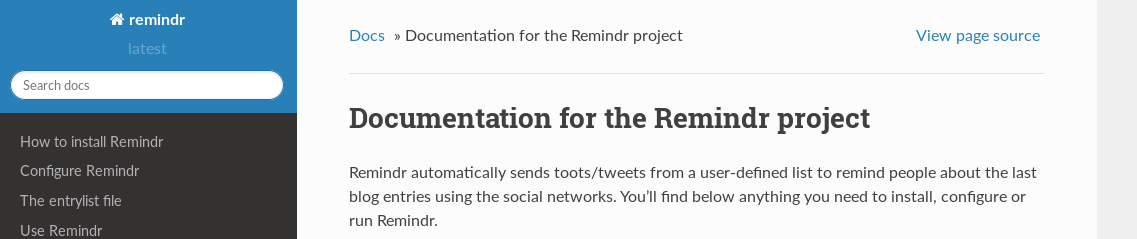
Read the full documentation on Readthedocs.

3. How to use Remindr Now let s try your configuration by launching Remindr the first time by-hand:
$ remindr -c /etc/remindr/remindr.ini
The messages should appear on both Twitter and Mastodon. 4. How to schedule the Remindr execution The easiest way is to use you user crontab. Just add the following line in your crontab file, editing it with crontab -e
00 10 * * * remindr -c /etc/remindr/remindr.ini
From now on, your message will be sent every day at 10:00AM. Going further with Remindr and finally You can help me developing tools for Mastodon and other social networks by donating anything through Liberaypay (also possible with cryptocurrencies). Any contribution will be appreciated. That s a big factor motivation
Donate You also may follow my account @carlchenet on Mastodon

Dirk Eddelbuettel: RcppSMC 0.2.0

A new version 0.2.0 of the RcppSMC package arrived on CRAN earlier today (as a very quick pretest-publish within minutes of submission). RcppSMC provides Rcpp-based bindings to R for the Sequential Monte Carlo Template Classes (SMCTC) by Adam Johansen described in his JSS article. This release 0.2.0 is chiefly the work of Leah South, a Ph.D. student at Queensland University of Technology, who was during the last few months a Google Summer of Code student mentored by Adam and myself. It was pleasure to work with Leah on this, and see her progress. Our congratulations to Leah for a job well done!

Changes in RcppSMC version 0.2.0 (2017-08-28)
  • Also use .registration=TRUE in useDynLib in NAMESPACE
  • Multiple Sequential Monte Carlo extensions (Leah South as part of Google Summer of Code 2017)
    • Switching to population level objects (#2 and #3).
    • Using Rcpp attributes (#2).
    • Using automatic RNGscope (#4 and #5).
    • Adding multiple normalising constant estimators (#7).
    • Static Bayesian model example: linear regression (#10 addressing #9).
    • Adding a PMMH example (#13 addressing #11).
    • Framework for additional algorithm parameters and adaptation (#19 addressing #16; also #24 addressing #23).
    • Common adaptation methods for static Bayesian models (#20 addressing #17).
    • Supporting MCMC repeated runs (#21).
    • Adding adaptation to linear regression example (#22 addressing #18).

Courtesy of CRANberries, there is a diffstat report for this release. More information is on the RcppSMC page. Issues and bugreports should go to the GitHub issue tracker.

This post by Dirk Eddelbuettel originated on his Thinking inside the box blog. Please report excessive re-aggregation in third-party for-profit settings.

25 August 2017

Michal &#268;iha&#345;: New projects on Hosted Weblate

Hosted Weblate provides also free hosting for free software projects. The hosting requests queue has grown too long, so it's time to process it and include new project. This time, the newly hosted projects include: If you want to support this effort, please donate to Weblate, especially recurring donations are welcome to make this service alive. You can do them on Liberapay or Bountysource.

Filed under: Debian English SUSE Weblate

Dirk Eddelbuettel: BH 1.65.0-1

The BH package on CRAN was updated today to version 1.65.0. BH provides a sizeable portion of the Boost C++ libraries as a set of template headers for use by R, possibly with Rcpp as well as other packages. This release upgrades the version of Boost to the rather new upstream version Boost 1.65.0 released earlier this week, and adds two new libraries: align and sort. I had started the upgrade process a few days ago under release 1.64.0. Rigorous checking of reverse dependencies showed that mvnfast needed a small change (which was trivial: just seeding the RNG prior to running tests), which Matteo did in no time with a fresh CRAN upload. rstan is needing a bit more work but should be ready real soon now and we are awaiting a new version. And once I switched to the just release Boost 1.65.0 it became apparent that Cyclops no longer needs its embedded copy of Boost iterator---and Marc already made that change with yet another fresh CRAN upload. It is a true pleasure to work in such a responsive and collaborative community.

Changes in version 1.65.0-1 (2017-08-24)
  • Upgraded to Boost 1.64 and then 1.65 installed directly from upstream source with several minor tweaks (as before)
  • Fourth tweak corrects a misplaced curly brace (see the Boost ublas GitHub repo and its issue #40)
  • Added Boost align (as requested in #32)
  • Added Boost sort (as requested in #35)
  • Added Boost multiprecision by fixing a script typo (as requested in #42)
  • Updated Travis CI support via newer run.sh

Via CRANberries, there is a diffstat report relative to the previous release. Comments and suggestions are welcome via the mailing list or the issue tracker at the GitHub repo.

This post by Dirk Eddelbuettel originated on his Thinking inside the box blog. Please report excessive re-aggregation in third-party for-profit settings.

23 August 2017

Dirk Eddelbuettel: Rcpp now used by 10 percent of CRAN packages

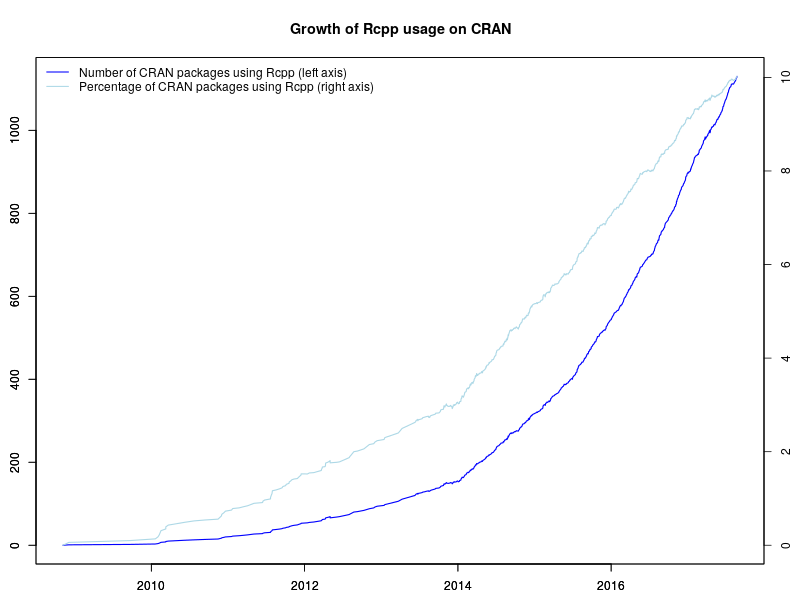
10 percent of CRAN packages Over the last few days, Rcpp passed another noteworthy hurdle. It is now used by over 10 percent of packages on CRAN (as measured by Depends, Imports and LinkingTo, but excluding Suggests). As of this morning 1130 packages use Rcpp out of a total of 11275 packages. The graph on the left shows the growth of both outright usage numbers (in darker blue, left axis) and relative usage (in lighter blue, right axis). Older posts on this blog took note when Rcpp passed round hundreds of packages, most recently in April for 1000 packages. The growth rates for both Rcpp, and of course CRAN, are still staggering. A big thank you to everybody who makes this happen, from R Core and CRAN to all package developers, contributors, and of course all users driving this. We have built ourselves a rather impressive ecosystem. So with that a heartfelt Thank You! to all users and contributors of R, CRAN, and of course Rcpp, for help, suggestions, bug reports, documentation, encouragement, and, of course, code.

This post by Dirk Eddelbuettel originated on his Thinking inside the box blog. Please report excessive re-aggregation in third-party for-profit settings.

22 August 2017

Sven Hoexter: whois databases and registration spam

Lately I experienced some new kind of spam, at least new to myself. Seems that spammer abuse registration input fields that do not implement strong enough validation, and echo back several values from the registration process in some kind of welcome mail. Basically filling the spam message in name and surname fields. So far I found a bunch of those originating from the following AS: AS49453, AS50896, AS200557 and AS61440. The first three belong to something identifying itself as "QUALITYNETWORK". The last one, AS61440, seems to be involved only partially with some networks being delegated to "Atomohost". To block them it's helpful to query the public radb service whois.radb.net for all networks belonging to the specific AS like this:
whois -h whois.radb.net -- '-i origin AS50896'
Another bunch of batch capable whois services are provided by Team Cymru. They've some examples at the end of https://www.team-cymru.org/IP-ASN-mapping.html. In this specific case the spam was for "www.robotas.ru" which is currently terminated at CloudFlare and redirects via JS document.location to "http://link31.net/b494d/ooo/", which in turn redirects via JS window.location to "http://revizor-online.ga/" which is again hosted at CloudFlare. The page at the end plays some strange youtube video - currently at around 1900 plays, so not that widely spread. In the end an interesting indicator about spam campaign success.

Daniel Silverstone: Building a USB descriptor table set

In order to proceed further on our USB/STM32 oddessy, we need to start to build a USB descriptor set for our first prototype piece of code. For this piece, we're going to put together a USB device which is vendor-specific class-wise and has a single configuration with a interface with a single endpoint which we're not going to actually implement anything of. What we're after is just to get the information presented to the computer so that lsusb can see it. To get these built, let's refer to information we discovered and recorded in a previous post about how descriptors go together.

Device descriptor Remembering that values which are > 1 byte in length are always stored little-endian, we can construct our device descriptor as:
Our device descriptor
Field Name Value Bytes
bLength 18 0x12
bDescriptorType DEVICE 0x01
bcdUSB USB 2.0 0x00 0x02
bDeviceClass 0 0x00
bDeviceSubClass 0 0x00
bDeviceProtocol 0 0x00
bMaxPacketSize 64 0x40
idVendor TEST 0xff 0xff
idProduct TEST 0xff 0xff
bcdDevice 0.0.1 0x01 0x00
iManufacturer 1 0x01
iProduct 2 0x02
iSerialNumber 3 0x03
bNumConfigurations 1 0x01
We're using the vendor ID and product id 0xffff because at this point we don't have any useful values for this (it costs $5,000 to register a vendor ID). This gives us a final byte array of:
0x12 0x01 0x00 0x02 0x00 0x00 0x00 0x40 (Early descriptor) 0xff 0xff 0xff 0xff 0x01 0x00 0x01 0x02 0x03 0x01 (and the rest)
We're reserving string ids 1, 2, and 3, for the manufacturer string, product name string, and serial number string respectively. I'm deliberately including them all so that we can see it all come out later in lsusb. If you feed the above hex sequence into a USB descriptor decoder then you can check my working.

Endpoint Descriptor We want a single configuration, which covers our one interface, with one endpoint in it. Let's start with the endpoint...
Our bulk IN endpoint
Field Name Value Bytes
bLength 7 0x07
bDescriptorType ENDPOINT 0x05
bEndpointAddress EP2IN 0x82
bmAttributes BULK 0x02
wMaxPacketSize 64 0x40 0x00
bInterval IGNORED 0x00
We're giving a single bulk IN endpoint, since that's the simplest thing to describe at this time. This endpoint will never be ready and so nothing will ever be read into the host. All that gives us:
0x07 0x05 0x82 0x02 0x40 0x00 0x00

Interface Descriptor The interface descriptor prefaces the endpoint set, and thanks to our simple single endpoint, and no plans for alternate interfaces, we can construct the interface simply as:
Our single simple interface
Field Name Value Bytes
bLength 9 0x09
bDescriptorType INTERFACE 0x04
bInterfaceNumber 1 0x01
bAlternateSetting 1 0x01
bNumEndpoints 1 0x01
bInterfaceClass 0 0x00
bInterfaceSubClass 0 0x00
bInterfaceProtocol 0 0x00
iInterface 5 0x05
All that gives us:
0x09 0x04 0x01 0x01 0x01 0x00 0x00 0x00 0x05

Configuration descriptor Finally we can put it all together and get the configuration descriptor...
Our sole configuration, encapsulating the interface and endpoint above
Field Name Value Bytes
bLength 9 0x09
bDescriptorType CONFIG 0x02
wTotalLength 9+9+7 0x19 0x00
bNumInterfaces 1 0x01
bConfigurationValue 1 0x01
iConfiguration 4 0x04
bmAttributes Bus powered, no wake 0x80
bMaxPower 500mA 0xfa
The wTotalLength field is interesting. It contains the configuration length, the interface length, and the endpoint length, hence 9 plus 9 plus 7 is 25. This gives:
0x09 0x02 0x19 0x00 0x01 0x01 0x04 0x80 0xfa

String descriptors We allowed ourselves a total of five strings, they were iManufacturer, iProduct, iSerial (from the device descriptor), iConfiguration (from the configuration descriptor), and iInterface (from the interface descriptor) respectively. Our string descriptors will therefore be:
String descriptor zero, en_GB only
Field Name Value Bytes
bLength 4 0x04
bDescriptorType STRING 0x03
wLangID[0] en_GB 0x09 0x08
0x04 0x03 0x09 0x08
...and...
String descriptor one, iManufacturer
Field Name Value Bytes
bLength 38 0x26
bDescriptorType STRING 0x03
bString "Rusty Manufacturer" ...
0x26 0x03 0x52 0x00 0x75 0x00 0x73 0x00 0x74 0x00 0x79 0x00 0x20 0x00 0x4d 0x00 0x61 0x00 0x6e 0x00 0x75 0x00 0x66 0x00 0x61 0x00 0x63 0x00 0x74 0x00 0x75 0x00 0x72 0x00 0x65 0x00 0x72 0x00
(You get the idea, there's no point me breaking down the rest of the string descriptors here, suffice it to say that the other strings are appropriate for the values they represent - namely product, serial, configuration, and interface.)

Putting it all together Given all the above, we have a device descriptor which is standalone, then a configuration descriptor which encompasses the interface and endpoint descriptors too. Finally we have a string descriptor table with six entries, the first is the language sets available, and the rest are our strings. In total we have:
    // Device descriptor
    const DEV_DESC: [u8; 18] =  
        0x12, 0x01, 0x00, 0x02, 0x00, 0x00, 0x00, 0x40,
        0xff, 0xff, 0xff, 0xff, 0x01, 0x00, 0x01, 0x02,
        0x03, 0x01
     ;
    // Configuration descriptor
    const CONF_DESC: [u8; 25] =  
        0x09, 0x02, 0x19, 0x00, 0x01, 0x01, 0x04, 0x80, 0xfa,
        0x09, 0x04, 0x01, 0x01, 0x01, 0x00, 0x00, 0x00, 0x05,
        0x07, 0x05, 0x82, 0x02, 0x40, 0x00, 0x00
     ;
    // String Descriptor zero
    const STR_DESC_0: [u8; 4] =  0x04, 0x03, 0x09, 0x08 ;
    // String Descriptor 1, "Rusty Manufacturer"
    const STR_DESC_1: [u8; 38] =  
        0x26, 0x03, 0x52, 0x00, 0x75, 0x00, 0x73, 0x00,
        0x74, 0x00, 0x79, 0x00, 0x20, 0x00, 0x4d, 0x00,
        0x61, 0x00, 0x6e, 0x00, 0x75, 0x00, 0x66, 0x00,
        0x61, 0x00, 0x63, 0x00, 0x74, 0x00, 0x75, 0x00,
        0x72, 0x00, 0x65, 0x00, 0x72, 0x00
     ;
    // String Descriptor 2, "Rusty Product"
    const STR_DESC_2: [u8; 28] =  
        0x1c, 0x03, 0x52, 0x00, 0x75, 0x00, 0x73, 0x00,
        0x74, 0x00, 0x79, 0x00, 0x20, 0x00, 0x50, 0x00,
        0x72, 0x00, 0x6f, 0x00, 0x64, 0x00, 0x75, 0x00,
        0x63, 0x00, 0x74, 0x00
     ;
    // String Descriptor 3, "123ABC"
    const STR_DESC_3: [u8; 14] =  
        0x0e, 0x03, 0x31, 0x00, 0x32, 0x00, 0x33, 0x00,
        0x41, 0x00, 0x42, 0x00, 0x43, 0x00
     ;
    // String Descriptor 4, "Rusty Configuration"
    const STR_DESC_4: [u8; 40] =  
        0x28, 0x03, 0x52, 0x00, 0x75, 0x00, 0x73, 0x00,
        0x74, 0x00, 0x79, 0x00, 0x20, 0x00, 0x43, 0x00,
        0x6f, 0x00, 0x6e, 0x00, 0x66, 0x00, 0x69, 0x00,
        0x67, 0x00, 0x75, 0x00, 0x72, 0x00, 0x61, 0x00,
        0x74, 0x00, 0x69, 0x00, 0x6f, 0x00, 0x6e, 0x00
     ;
    // String Descriptor 5, "Rusty Interface"
    const STR_DESC_5: [u8; 32] =  
        0x20, 0x03, 0x52, 0x00, 0x75, 0x00, 0x73, 0x00,
        0x74, 0x00, 0x79, 0x00, 0x20, 0x00, 0x49, 0x00,
        0x6e, 0x00, 0x74, 0x00, 0x65, 0x00, 0x72, 0x00,
        0x66, 0x00, 0x61, 0x00, 0x63, 0x00, 0x65, 0x00
     ;
With the above, we're a step closer to our first prototype which will hopefully be enumerable. Next time we'll look at beginning our prototype low level USB device stack mock-up.

21 August 2017

Carl Chenet: Remind people about your great content using social networks with Remindr

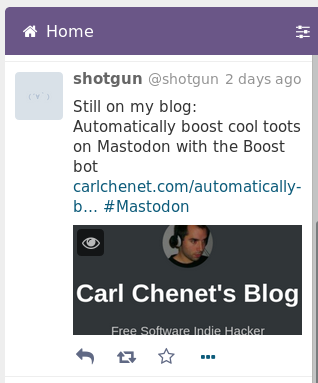
Each time I remind people about one of my best blog posts, I do have positive reviews and a peak of traffic on my blog. But as an IT guy, I hate (so much) manually (gosh!) posting reminders of my articles on both my Twitter account and my Mastodon account. So I wrote Remindr. Each time you launch it, it posts a content through both Mastodon and Twitter. You can attach an image for each message and using different languages is managed for your different content is managed. Under the hood, it s a self hosted (my instance just runs on my workstation) Python 3 application released under the GPLv3 license. Going further with Remindr How does exactly Remindr work? Remindr iterates through a list of messages in a file you write and extract one line for each execution of Remindr, adding a user-defined prefix and send them to both the Mastodon and Twitter social networks. Here is the format of the file:
o en Automatically Send Toots To The Mastodon Social Network https://carlchenet.com/automatically-send-toots-to-the-mastodon-social-network/ #Mastodon
x fr Sur Mastodon, cr er son compte de secours  ou tout perdre https://carlchenet.com/sur-mastodon-creer-son-compte-de-secours-ou-tout-perdre/ #Mastodon
x en Automatically boost cool toots on Mastodon with the Boost bot https://carlchenet.com/automatically-boost-cool-toots-on-mastodon-with-the-boost-bot/ #Mastodon
x en Cryptocurrencies On the New Social Network Mastodon #Mastodon #bitcoin #ethereum #monero
The first field only indicates if the line is the next one to be considered by Remindr, the o indicates the next line to be sent. The second field is the 2-letters code language your content is using, in my example en or fr. Next content on the line will compose the body of your messages to Mastodon and Twitter. So each time you launch Remindr, one of the lines of your file will be sent to Mastodon and Twitter. How easy to use is that? and finally You can help me developing tools for Mastodon and other social networks by donating anything through Liberaypay (also possible with cryptocurrencies). Any contribution will be appreciated. That s a big factor motivation
Donate You also may follow my account @carlchenet on Mastodon  Carl Chenet On Mastodon

20 August 2017

Steinar H. Gunderson: Random codec notes

Post-Solskogen, there hasn't been all that many commits in the main Nageru repository, but that doesn't mean the project is standing still. In particular, I've been working with NVIDIA to shake out a crash bug in their drivers (which in itself uncovered some interesting debugging techniques, although in the end, the bug turned out just to be uncovered by the boring standard technique of analyzing crash dumps and writing a minimal program to reproduce). But I've also been looking at intraframe codecs; my sort-of plan was to go to VideoLAN Dev Days to present my findings, but unfortunately, there seems to be a schedule conflict, so instead, you can have some scattered random notes: Work in progress :-) Maybe something more coherent will come out eventually. Edit: Forgot about TF switching!
Dirk Eddelbuettel: RcppArmadillo 0.7.960.1.1

armadillo image On the heels of the very recent bi-monthly RcppArmadillo release comes a quick bug-fix release 0.7.960.1.1 which just got onto CRAN (and I will ship a build to Debian in a moment). There were three distinct issues I addressed in three quick pull requests: Armadillo is a powerful and expressive C++ template library for linear algebra aiming towards a good balance between speed and ease of use with a syntax deliberately close to a Matlab. RcppArmadillo integrates this library with the R environment and language--and is widely used by (currently) 382 other packages on CRAN---an increase of 52 since the CRAN release in June! Changes in this release relative to the previous CRAN release are as follows:

Changes in RcppArmadillo version 0.7.960.1.1 (2017-08-20)
  • Added improved check for inherited S4 matrix classes (#162 fixing #161)
  • Changed fastLm C++ function to fastLm_impl to not clash with R method (#164 fixing #163)
  • Added OpenMP check for configure (#166 fixing #165)

Courtesy of CRANberries, there is a diffstat report. More detailed information is on the RcppArmadillo page. Questions, comments etc should go to the rcpp-devel mailing list off the R-Forge page.

This post by Dirk Eddelbuettel originated on his Thinking inside the box blog. Please report excessive re-aggregation in third-party for-profit settings.

Dirk Eddelbuettel: #10: Compacting your Shared Libraries, After The Build

Welcome to the tenth post in the rarely ranting R recommendations series, or R4 for short. A few days ago we showed how to tell the linker to strip shared libraries. As discussed in the post, there are two options. One can either set up ~/.R/Makevars by passing the strip-debug option to the linker. Alternatively, one can adjust src/Makevars in the package itself with a bit a Makefile magic. Of course, there is a third way: just run strip --strip-debug over all the shared libraries after the build. As the path is standardized, and the shell does proper globbing, we can just do
$ strip --strip-debug /usr/local/lib/R/site-library/*/libs/*.so
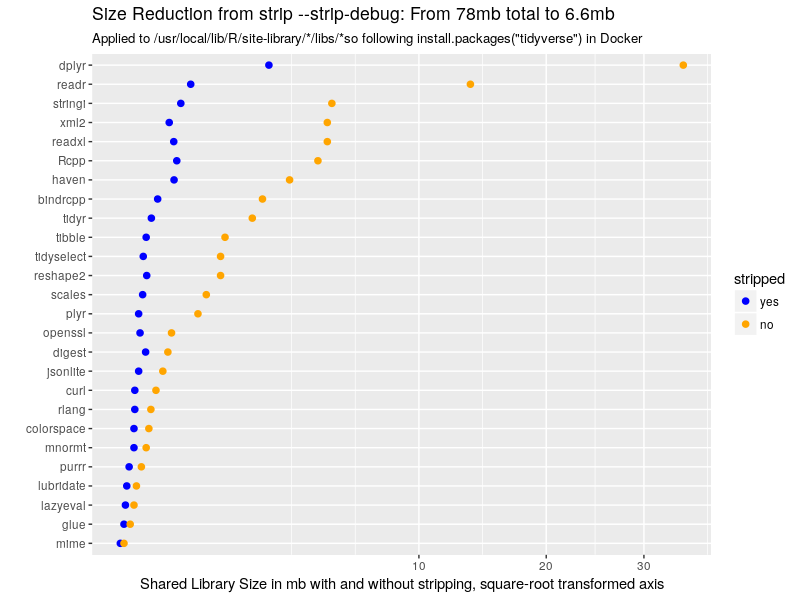
using a double-wildcard to get all packages (in that R package directory) and all their shared libraries. Users on macOS probably want .dylib on the end, users on Windows want another computer as usual (just kidding: use .dll). Either may have to adjust the path which is left as an exercise to the reader. The impact can be Yuge as illustrated in the following dotplot:
This illustration is in response to a mailing list post. Last week, someone claimed on r-help that tidyverse would not install on Ubuntu 17.04. And this is of course patently false as many of us build and test on Ubuntu and related Linux systems, Travis runs on it, CRAN tests them etc pp. That poor user had somehow messed up their default gcc version. Anyway: I fired up a Docker container, installed r-base-core plus three required -dev packages (for xml2, openssl, and curl) and ran a single install.packages("tidyverse"). In a nutshell, following the launch of Docker for an Ubuntu 17.04 container, it was just
$ apt-get update
$ apt-get install r-base libcurl4-openssl-dev libssl-dev libxml2-dev
$ apt-get install mg          # a tiny editor
$ mg /etc/R/Rprofile.site     # to add a default CRAN repo
$ R -e 'install.packages("tidyverse")'
which not only worked (as expected) but also installed a whopping fifty-one packages (!!) of which twenty-six contain a shared library. A useful little trick is to run du with proper options to total, summarize, and use human units which reveals that these libraries occupy seventy-eight megabytes:
root@de443801b3fc:/# du -csh /usr/local/lib/R/site-library/*/libs/*so
4.3M    /usr/local/lib/R/site-library/Rcpp/libs/Rcpp.so
2.3M    /usr/local/lib/R/site-library/bindrcpp/libs/bindrcpp.so
144K    /usr/local/lib/R/site-library/colorspace/libs/colorspace.so
204K    /usr/local/lib/R/site-library/curl/libs/curl.so
328K    /usr/local/lib/R/site-library/digest/libs/digest.so
33M     /usr/local/lib/R/site-library/dplyr/libs/dplyr.so
36K     /usr/local/lib/R/site-library/glue/libs/glue.so
3.2M    /usr/local/lib/R/site-library/haven/libs/haven.so
272K    /usr/local/lib/R/site-library/jsonlite/libs/jsonlite.so
52K     /usr/local/lib/R/site-library/lazyeval/libs/lazyeval.so
64K     /usr/local/lib/R/site-library/lubridate/libs/lubridate.so
16K     /usr/local/lib/R/site-library/mime/libs/mime.so
124K    /usr/local/lib/R/site-library/mnormt/libs/mnormt.so
372K    /usr/local/lib/R/site-library/openssl/libs/openssl.so
772K    /usr/local/lib/R/site-library/plyr/libs/plyr.so
92K     /usr/local/lib/R/site-library/purrr/libs/purrr.so
13M     /usr/local/lib/R/site-library/readr/libs/readr.so
4.7M    /usr/local/lib/R/site-library/readxl/libs/readxl.so
1.2M    /usr/local/lib/R/site-library/reshape2/libs/reshape2.so
160K    /usr/local/lib/R/site-library/rlang/libs/rlang.so
928K    /usr/local/lib/R/site-library/scales/libs/scales.so
4.9M    /usr/local/lib/R/site-library/stringi/libs/stringi.so
1.3M    /usr/local/lib/R/site-library/tibble/libs/tibble.so
2.0M    /usr/local/lib/R/site-library/tidyr/libs/tidyr.so
1.2M    /usr/local/lib/R/site-library/tidyselect/libs/tidyselect.so
4.7M    /usr/local/lib/R/site-library/xml2/libs/xml2.so
78M     total
root@de443801b3fc:/# 
Looks like dplyr wins this one at thirty-three megabytes just for its shared library. But with a single stroke of strip we can reduce all this down a lot:
root@de443801b3fc:/# strip --strip-debug /usr/local/lib/R/site-library/*/libs/*so
root@de443801b3fc:/# du -csh /usr/local/lib/R/site-library/*/libs/*so
440K    /usr/local/lib/R/site-library/Rcpp/libs/Rcpp.so
220K    /usr/local/lib/R/site-library/bindrcpp/libs/bindrcpp.so
52K     /usr/local/lib/R/site-library/colorspace/libs/colorspace.so
56K     /usr/local/lib/R/site-library/curl/libs/curl.so
120K    /usr/local/lib/R/site-library/digest/libs/digest.so
2.5M    /usr/local/lib/R/site-library/dplyr/libs/dplyr.so
16K     /usr/local/lib/R/site-library/glue/libs/glue.so
404K    /usr/local/lib/R/site-library/haven/libs/haven.so
76K     /usr/local/lib/R/site-library/jsonlite/libs/jsonlite.so
20K     /usr/local/lib/R/site-library/lazyeval/libs/lazyeval.so
24K     /usr/local/lib/R/site-library/lubridate/libs/lubridate.so
8.0K    /usr/local/lib/R/site-library/mime/libs/mime.so
52K     /usr/local/lib/R/site-library/mnormt/libs/mnormt.so
84K     /usr/local/lib/R/site-library/openssl/libs/openssl.so
76K     /usr/local/lib/R/site-library/plyr/libs/plyr.so
32K     /usr/local/lib/R/site-library/purrr/libs/purrr.so
648K    /usr/local/lib/R/site-library/readr/libs/readr.so
400K    /usr/local/lib/R/site-library/readxl/libs/readxl.so
128K    /usr/local/lib/R/site-library/reshape2/libs/reshape2.so
56K     /usr/local/lib/R/site-library/rlang/libs/rlang.so
100K    /usr/local/lib/R/site-library/scales/libs/scales.so
496K    /usr/local/lib/R/site-library/stringi/libs/stringi.so
124K    /usr/local/lib/R/site-library/tibble/libs/tibble.so
164K    /usr/local/lib/R/site-library/tidyr/libs/tidyr.so
104K    /usr/local/lib/R/site-library/tidyselect/libs/tidyselect.so
344K    /usr/local/lib/R/site-library/xml2/libs/xml2.so
6.6M    total
root@de443801b3fc:/#
Down to six point six megabytes. Not bad for one command. The chart visualizes the respective reductions. Clearly, C++ packages (and their template use) lead to more debugging symbols than plain old C code. But once stripped, the size differences are not that large. And just to be plain, what we showed previously in post #9 does the same, only already at installation stage. The effects are not cumulative.

This post by Dirk Eddelbuettel originated on his Thinking inside the box blog. Please report excessive re-aggregation in third-party for-profit settings.

18 August 2017

Mike Gabriel: @DebConf17: Ad-hoc BoF: Bits from the Debian+Ubuntu MATE Packaging Team

On Tuesday, late afternoon, at DebConf17, I offered an ad-hoc BoF about the current status of the MATE Desktop packaging efforts in Debian and Ubuntu. I need to get this written down, before DebConf17 feels too far away... Unfortunately, I scheduled that BoF with Joey Hess's talk about his post-Debian life, which attracted many people. So, only a small group of people came together to share and discuss about the current status of MATE in Debian and Ubuntu. Ongoing efforts around MATE in Debian and Ubuntu A quick summary of ongoing efforts was provided and also a collection of URLs for reporting bugs, looking up packaging status, etc. was listed: Cross-Distro Packaging Workflow The workflow of Debian and Ubuntu packaging in the MATE Packaging Team was described in detail (basically, all packages go through Debian, only exception being freeze states of this or that distro) and the benefit of the close cooperation between the two projects underlined. We reduce the packaging effort tremendously by working very closely together. In the past, we (Martin Wimpress and myself) also invited the people from Linux Mint to join our cross-distro packaging efforts, but so far to no avail. Also the packaging for the Parrot Security OS has recently been integrated in our packaging Git repository. Requested / Upcoming Improvements From people attending the BoF, I got these main inputs, which I hope to accomplish with the help of all, for Debian buster: Another project that I will also work on for Debian buster is proper Ayatana Indicator support for Debian's MATE Desktop. Credits Thanks to all the people attending the BoF for your sharings and input. Feel invited to contribute to our team's effort in improving the user experience of the MATE Destkop Environment in Debian (and Ubuntu, and ...). Also a big thanks to the people already on the team for bringing MATE in Debian to where it is now. Good work, folks!

Dirk Eddelbuettel: RcppArmadillo 0.7.960.1.0

armadillo image The bi-monthly RcppArmadillo release is out with a new version 0.7.960.1.0 which is now on CRAN, and will get to Debian in due course. And it is a big one. Lots of nice upstream changes from Armadillo, and lots of work on our end as the Google Summer of Code project by Binxiang Ni, plus a few smaller enhancements -- see below for details. Armadillo is a powerful and expressive C++ template library for linear algebra aiming towards a good balance between speed and ease of use with a syntax deliberately close to a Matlab. RcppArmadillo integrates this library with the R environment and language--and is widely used by (currently) 379 other packages on CRAN---an increase of 49 since the last CRAN release in June! Changes in this release relative to the previous CRAN release are as follows:

Changes in RcppArmadillo version 0.7.960.1.0 (2017-08-11)
  • Upgraded to Armadillo release 7.960.1 (Northern Banana Republic Deluxe)
    • faster randn() when using OpenMP (NB: usually omitted when used fromR)
    • faster gmm_diag class, for Gaussian mixture models with diagonal covariance matrices
    • added .sum_log_p() to the gmm_diag class
    • added gmm_full class, for Gaussian mixture models with full covariance matrices
    • expanded .each_slice() to optionally use OpenMP for multi-threaded execution
  • Upgraded to Armadillo release 7.950.0 (Northern Banana Republic)
    • expanded accu() and sum() to use OpenMP for processing expressions with computationally expensive element-wise functions
    • expanded trimatu() and trimatl() to allow specification of the diagonal which delineates the boundary of the triangular part
  • Enhanced support for sparse matrices (Binxiang Ni as part of Google Summer of Code 2017)
    • Add support for dtCMatrix and dsCMatrix (#135)
    • Add conversion and unit tests for dgT, dtT and dsTMatrix (#136)
    • Add conversion and unit tests for dgR, dtR and dsRMatrix (#139)
    • Add conversion and unit tests for pMatrix and ddiMatrix (#140)
    • Rewrite conversion for dgT, dtT and dsTMatrix, and add file-based tests (#142)
    • Add conversion and unit tests for indMatrix (#144)
    • Rewrite conversion for ddiMatrix (#145)
    • Add a warning message for matrices that cannot be converted (#147)
    • Add new vignette for sparse matrix support (#152; Dirk in #153)
    • Add support for sparse matrix conversion from Python SciPy (#158 addressing #141)
  • Optional return of row or column vectors in collapsed form if appropriate #define is set (Serguei Sokol in #151 and #154)
  • Correct speye() for non-symmetric cases (Qiang Kou in #150 closing #149).
  • Ensure tests using Scientific Python and reticulate are properly conditioned on the packages being present.
  • Added .aspell/ directory with small local directory now supported by R-devel.

Courtesy of CRANberries, there is a diffstat report. More detailed information is on the RcppArmadillo page. Questions, comments etc should go to the rcpp-devel mailing list off the R-Forge page.

This post by Dirk Eddelbuettel originated on his Thinking inside the box blog. Please report excessive re-aggregation in third-party for-profit settings.

17 August 2017

Sean Whitton: DebCamp/DebConf17: reports on sprints and BoFs

In addition to my personal reflections on DebCamp/DebConf17, here is a brief summary of the activities that I had a hand in co-ordinating. I won t discuss here many other small items of work and valuable conversations that I had during the two weeks; hopefully the fruits of these will show themselves in my uploads to the archive over the next year. Debian Policy sprint & BoF Debian Emacs Team meeting/sprint Unfortunately we didn t make any significant progress towards converting all addons to use dh_elpa, as the work is not that much fun. Might be worth a more focused sprint next year. Report on team website Git for Debian packaging BoF & follow-up conversations The BoF was far more about dgit than I had wanted; however, I think that this was mostly because people had questions about dgit, rather than any unintended lecturing by me. I believe that several people came away from DebConf thinking that starting to use dgit would improve Debian for themselves and for users of their packages.

Sean Whitton: I went all the way to Montr al for DebConf17, and all I got was a new MUA

This year s group photo (by Aigars Mahinovs). I really like the tagline
On Sunday night I got back from Montr al, where I attended both DebCamp17 and DebConf17. It was a wonderful two weeks. All I really did was work on Debian for roughly eight hours per day, interspersed with getting to know both people I ve been working with since I first began contributing to Debian in late 2015, and people I didn t yet know. But this was all I really needed to be doing. There was no need to engage in distracting myself. I enjoyed the first week more. There were sufficiently few people present that you could know at least all of their faces, and interesting-sounding talks didn t interrupt making progress on one s own work or unblocking other people s work. In the second week it was great to meet people who were only present for the second week, but it felt more like regular Debian, in that I was often waiting on other people or they were waiting on me. While I spent one morning actually writing fresh code, and I did a fair amount of pure packaging work, the majority of my time was poured into (i) Debian Policy; (ii) discussions within the Emacs team; and (iii) discussions about dgit. This was as I expected. During DebConf, it s not that useful to seclude oneself and sufficiently reacquaint oneself with a codebase that one can start producing patches, because that can be done anywhere in the world, without everyone else around. It s far more useful to bring different people together to get projects unblocked. I did some of that for my own work, and also tried to help other people s, including those who weren t able to attend the conference. In my ordinary life, taking a step back from the methods by which I protect my PGP keys and other personal data, I can appear to myself as a paranoid extremist, or some kind of data hoarder. It was comforting to find at DebConf plenty of people who go way further than me: multiple user accounts on their laptop, with separate X servers, for tasks of different security levels; PGP keys on smartcards; refusal to sign my PGP key based on government-issued ID alone; use of Qubes OS. One thing that did surprise me was to find myself in a minority for using the GNOME desktop; I had previously assumed that most people deep in Debian development didn t bother with tiling window managers. Turns out they are enthusiastic to talk about the trade-offs between window managers while riding the subway train back to our accommodation at midnight who knew such people existed? I was pleased to find them. One evening, I received a tag-teamed live tutorial in using i3 s core keybindings, and the next morning GNOME seemed deeply inelegant. The insinuation began, but I was immediately embroiled in inner struggle over the fact that i3 is a very popular tiling window manager, so it wouldn t be very cool if I were to start using it. This difficulty was compounded when I learned that the Haskell team lead still uses xmonad. The struggle continues. I hope that I ve been influenced by the highly non-judgemental and tolerant attitudes of the attendees of the conference. While most people at the conference were pretty ordinary aside from wanting to talk about the details of Debian packaging and processes! there were several people who rather visibly rejected social norms about how to present themselves. Around these people there was nothing of the usual tension. Further, in contrast with my environment as a graduate student, everyone was extremely relaxed about how everyone was spending their time. People drinking beer in the evenings were sitting at tables where other people were continuing to silently work on Debian. It is nice to have my experience in Montr al as a reference to check my own judgemental tendencies. I came away with a lot more than a new MUA: a certainty that I want to try to get to next year s conference; friends; a real life community behind what was hitherto mostly a hobby; a long list of tasks and the belief that I can accomplish them; a list of PGP fingerprints to sign; a new perspective on the arguments that occur on Debian mailing lists; an awareness of the risk of unconsciously manipulating other community members into getting work done. With regard to the MUA, I should say that I did not waste a lot of DebConf time messing with its configuration. I had actually worked out a notmuch configuration some months ago, but couldn t use it because I couldn t figure out how to incorporate my old mail archives into its index. Fortunately notmuch s maintainer is also on the Emacs team he was able to confirm that the crazy solution I d come up with was not likely to break notmuch s operating assumptions, and so I was able to spend about half an hour copying and pasting the configuration and scripts I d previously developed into my homedir, and then start using notmuch for the remainder of the conference. The main reason for wanting to use notmuch was to handle Debian mailing list volume more effectively than I m able to with mutt, so I was very happy to have the opportunity to pester David with newbie questions. Many, many thanks to all the volunteers whose efforts made DebCamp17 and DebConf17 possible.

15 August 2017

Dirk Eddelbuettel: #9: Compacting your Shared Libraries

Welcome to the nineth post in the recognisably rancid R randomness series, or R4 for short. Following on the heels of last week's post, we aim to look into the shared libraries created by R. We love the R build process. It is robust, cross-platform, reliable and rather predicatable. It. Just. Works. One minor issue, though, which has come up once or twice in the past is the (in)ability to fully control all compilation options. R will always recall CFLAGS, CXXFLAGS, ... etc as used when it was compiled. Which often entails the -g flag for debugging which can seriously inflate the size of the generated object code. And once stored in $ RHOME /etc/Makeconf we cannot on the fly override these values. But there is always a way. Sometimes even two. The first is local and can be used via the (personal) ~/.R/Makevars file (about which I will have to say more in another post). But something I have been using quite a bite lately uses the flags for the shared library linker. Given that we can have different code flavours and compilation choices---between C, Fortran and the different C++ standards---one can end up with a few lines. I currently use this which uses -Wl, to pass an the -S (or --strip-debug) option to the linker (and also reiterates the desire for a shared library, presumably superfluous):
SHLIB_CXXLDFLAGS = -Wl,-S -shared
SHLIB_CXX11LDFLAGS = -Wl,-S -shared
SHLIB_CXX14LDFLAGS = -Wl,-S -shared
SHLIB_FCLDFLAGS = -Wl,-S -shared
SHLIB_LDFLAGS = -Wl,-S -shared
Let's consider an example: my most recently uploaded package RProtoBuf. Built under a standard 64-bit Linux setup (Ubuntu 17.04, g++ 6.3) and not using the above, we end up with library containing 12 megabytes (!!) of object code:
edd@brad:~/git/rprotobuf(feature/fewer_warnings)$ ls -lh src/RProtoBuf.so
-rwxr-xr-x 1 edd edd 12M Aug 14 20:22 src/RProtoBuf.so
edd@brad:~/git/rprotobuf(feature/fewer_warnings)$ 
However, if we use the flags shown above in .R/Makevars, we end up with much less:
edd@brad:~/git/rprotobuf(feature/fewer_warnings)$ ls -lh src/RProtoBuf.so 
-rwxr-xr-x 1 edd edd 626K Aug 14 20:29 src/RProtoBuf.so
edd@brad:~/git/rprotobuf(feature/fewer_warnings)$ 
So we reduced the size from 12mb to 0.6mb, an 18-fold decrease. And the file tool still shows the file as 'not stripped' as it still contains the symbols. Only debugging information was removed. What reduction in size can one expect, generally speaking? I have seen substantial reductions for C++ code, particularly when using tenmplated code. More old-fashioned C code will be less affected. It seems a little difficult to tell---but this method is my new build default as I continually find rather substantial reductions in size (as I tend to work mostly with C++-based packages). The second option only occured to me this evening, and complements the first which is after all only applicable locally via the ~/.R/Makevars file. What if we wanted it affect each installation of a package? The following addition to its src/Makevars should do:
strippedLib: $(SHLIB)
        if test -e "/usr/bin/strip"; then /usr/bin/strip --strip-debug $(SHLIB); fi
.phony: strippedLib
We declare a new Makefile target strippedLib. But making it dependent on $(SHLIB), we ensure the standard target of this Makefile is built. And by making the target .phony we ensure it will always be executed. And it simply tests for the strip tool, and invokes it on the library after it has been built. Needless to say we get the same reduction is size. And this scheme may even pass muster with CRAN, but I have not yet tried. Lastly, and acknowledgement. Everything in this post has benefited from discussion with my former colleague Dan Dillon who went as far as setting up tooling in his r-stripper repository. What we have here may be simpler, but it would not have happened with what Dan had put together earlier.

This post by Dirk Eddelbuettel originated on his Thinking inside the box blog. Please report excessive re-aggregation in third-party for-profit settings.

Next.

Previous.